





















































A lack of a ‘day-after plan’ and an unwillingness to address threats before they grew left Sharon’s 2005 promises unfulfilled. What has Israel learned since then?

AP Photo/Emilio Morenatti
A bulldozer breaks through the main gate as troops force their way into the Jewish settlement of Netzer Hazani, in the Gush Katif bloc of settlements, in the southern Gaza Strip, Thursday Aug. 18, 2005.


 Add JewishInsider on Google
Twenty years ago this month, Israel dismantled 21 settlements in the Gaza Strip, forcing 8,000 Israelis to evacuate and demolishing their homes, in what was known as the disengagement. That process was met with mass protests on the streets and the splintering of the Likud party, whose leader, then-Prime Minister Ariel Sharon, initiated and oversaw the disengagement.
While Sharon did not promise peace as a result of the disengagement, the plan was presented as a move to make Israel more secure, while fewer soldiers would have to die protecting a small number of residents in the Gaza Strip. The prime minister and his supporters said that if even one rocket was shot from Gaza after the pull-out, Israel would respond militarily. They also promised that the disengagement would ensure that “this whole package called the Palestinian state, with all that it entails, [would be] removed indefinitely from our agenda … all with a presidential blessing and the ratification of both houses of Congress,” as Sharon’s senior advisor, Dov “Dubi” Weisglass, put it at the time.
Two decades later, Israel is fighting its longest war in Gaza, after the Oct. 7, 2023, massacres and attacks perpetrated by the Hamas terrorist organization that has controlled Gaza since 2006. In the interim years, Hamas and other Palestinian terrorist groups in Gaza shot hundreds and sometimes thousands of rockets at Israeli population centers each year, prompting five major Israeli military operations in Gaza.
As to Weisglass’ 2004 promise that international pressure to reach a two-state solution would be put in “formaldehyde,” Sharon’s political protege and the Israeli prime minister immediately following him, Ehud Olmert, offered the Palestinians a state in 2008. Last week, 11 countries announced their intention to recognize a Palestinian state.
Key figures from that period told Jewish Insider that the Israeli government’s failure to formulate a day-after plan for Gaza — a criticism that has been leveled at Jerusalem in the current war — is in part to blame for the unfulfilled promises of the disengagement.
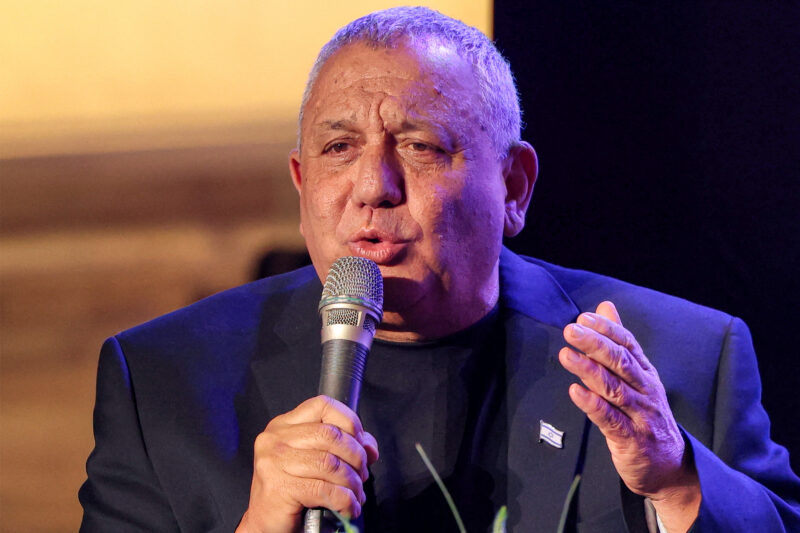
Gilad Erdan, a former senior Israeli cabinet minister and ambassador to the U.S., was a freshman Likud lawmaker when the disengagement was announced, and became a leading figure in the party’s rebellion against Sharon, which then-Finance Minister Benjamin Netanyahu — who voted in favor of the disengagement plan in early key votes — joined at a later stage.
Erdan noted to JI that Sharon not only claimed the disengagement would improve Israel’s security, he said that “if Israel doesn’t take this step, there will be other diplomatic plans [that the world will] try to force on Israel, and this step will free us of pressure from the international community. It’s clear that it didn’t reduce pressure, it increased it.”
“What happened then, and is still the case now, is that Israel didn’t have an alternative plan on the table, whether for the coming few years or the short term,” Erdan said. “This is something to consider as a lesson of the disengagement.”
“I think a Palestinian state is now off of the agenda for many years … Something we can consider a lesson of the disengagement is that we should say no withdrawals, no unilateralism, no to a Palestinian state. I think those lessons were learned over the years at a great cost in blood,” said Gilad Erdan, who was a freshman Likud lawmaker when the disengagement was announced, and became a leading figure in the party’s rebellion against Sharon.
Israel now has “an opportunity to present a plan … that puts Israel’s security and our right to the land at the forefront, but we are not presenting any diplomatic plan for the world to discuss. Even if the international community doesn’t accept it — so what? What looks crazy today could look different in 20 years. It’s not like we’ll have peace with the Palestinians in five minutes,” the former ambassador stated.
Erdan said that the aftermath of the disengagement underscored for Israelis the danger of a potential Palestinian state.
“I think a Palestinian state is now off of the agenda for many years … Something we can consider a lesson of the disengagement is that we should say no withdrawals, no unilateralism, no to a Palestinian state. I think those lessons were learned over the years at a great cost in blood,” he said.
Elliott Abrams, who was deputy national security advisor to the George W. Bush administration at the time of the disengagement, told JI that Sharon did have a larger overarching idea behind the move, but subsequent prime ministers did not follow through with it.
“Sharon said at the time that Israel needs to establish its borders, and I think he would have done something … with the West Bank. Whatever the future of Israel is, it doesn’t include Gaza, which has no use economically and no significance religiously,” was the logic, Abrams said.
“Establish a border, build a wall, and maybe something will change in 100 years, but for now, try to have a border for Israel,” Abrams said. “It was a larger plan and then Sharon had his stroke” in December 2005, followed by another in January 2006 that left him in a vegetative state until his death in 2014.
“Sharon refused for domestic reasons to work with the Palestinian Authority at all on Gaza, because it would make it look like a reward,” following the years-long wave of Palestinian terrorism called the Second Intifada, Abrams recalled.
“Sharon wasn’t going to have anything to do with [the PA]; he was just going to leave Gaza,” Abrams said. “It’s a question whether it would have been possible to avoid a Hamas takeover in June 2006, followed by the complete collapse of the PA [in Gaza]. It’s a question worth asking. It is a fact that there was zero coordination.”
Though Palestinian leader Yasser Arafat died after Sharon announced the disengagement, the Israeli prime minister did not reconsider his plan in light of the election of new leader Mahmoud Abbas — who remains PA president 20 years later.
Abrams argued that international pressure was not a major contributing factor to the disengagement, noting that the plan was entirely Sharon’s and not something Bush sought for him to do.
Still, Abrams said that “international pressure to make concessions to the Palestinians is Israel’s predicament. That is simply a fact … I don’t think this is a problem that has a solution. I think it’s a condition.”
“Israelis have to decide when they’re going to say ‘drop dead,’ when they’re going to say politely ‘no, we can’t do that,’ when to take half measures and when they’re going to agree,” he added. “Those questions have not changed much. They get worse for a while sometimes, and then better and then worse again, depending on how successful Arab propaganda campaigns are and how unsuccessful Israel’s campaigns are. It also depends on how strong the support is from the U.S. in resisting the other pressure.”
Erdan similarly said that “Sharon sent Dubi Weisglass to convince [Bush], one of the most supportive presidents ever, to support the disengagement. Bush didn’t want to support it at first … there wasn’t such significant international pressure.”
Rather, Erdan, who was Sharon’s political advisor a decade before the disengagement, said the debate was more of a domestic Israeli one, after Sharon “changed 180 degrees from all of the ideas he had presented to us about security and ideology, Judea and Samaria,” the Biblical term for the West Bank.
The disengagement came after “Israel was under pressure from terrorism,” Erdan said.
“The disengagement was a terrible, historic mistake that inspired the Oct. 7 massacre,” Erdan argued. “It not only gave [Hamas] the opportunity to dig tunnels and arm itself, it gave them the motivation, the desire and the belief that they could do it. That the strong Israel, led by the decorated General Ariel Sharon, retreated unilaterally when facing terrorism strengthened the extremists in Palestinian society and led to the loss of deterrence we experienced two years ago.”
Erdan also argued that the disengagement did not reduce Israeli deaths, saying that the number of Israeli soldiers and civilians killed in attacks emanating from Gaza in 1967-2005, when Israel controlled the territory, was smaller than in the ensuing years 18 years before the latest war.
Abrams pointed out that Sharon and Olmert did not fulfill their promise of striking back if any attacks came from Gaza.
“The problem began very quickly,” Abrams recalled, “because Sharon in the first few months, and then after he had a stroke it was Olmert, never enforced their own statements about Gaza.”
Two Qassam rockets were shot from Gaza into Israel while the disengagement was still taking place, and another 33 during the remainder of that year. From 2005 to 2006, the number of rocket and mortar attacks from Gaza on Israel rose 42% to 1,777. Hamas also began building tunnels into Israel at that time.
Abrams recalled that when Sharon initiated the disengagement and presented it to Bush and then the public, Sharon argued that “if Israel got out of Gaza, there would be no excuse for any attack from Gaza on Israel, and if there were attacks, they would be met with the strongest, most forceful military reaction. It never happened.”
“Don’t let your enemies get into a position where they can do you great harm. That was learned, and that explains the attacks on Hezbollah and Iran. That is the right lesson. That is the lesson Israel did not seem to learn when it got out of Gaza,” said Elliott Abrams, who was deputy national security advisor to the George W. Bush administration at the time of the disengagement.
Israel at the time, he said, “had an opportunity to respond very strongly to Hamas right away, and it would have had considerable American and international support … It was an opportunity that was missed … by Sharon, Olmert and later [since 2009, Israeli Prime Minister Benjamin] Netanyahu. It was a continuing problem.”
Abrams said that after the Oct. 7 attacks, Israel learned at least one lesson it had failed to internalize after the disengagement: “Don’t let your enemies get into a position where they can do you great harm. That was learned, and that explains the attacks on Hezbollah and Iran. That is the right lesson. That is the lesson Israel did not seem to learn when it got out of Gaza.”
“Israel is a democracy and the whole Jewish people debate about everything nonstop,” Erdan said, but “the lessons of the disengagement are growing over the years. It didn’t happen overnight.”
“In the early years after the disengagement, we realized the Palestinians had the ability and desire to launch missiles and rockets, so we can’t live in the delusion that [Gaza would be] the Singapore of the Middle East,” he said. “Only on Oct. 7 did many more people in Israel believe that not only unilateral but any withdrawal is bad. Israelis totally lost trust in the Palestinians and realized that Jewish settlements have a great and significant security value … We cannot only rely on technology and smart cameras; physical presence is essential … I think a lot of us woke up from our delusions on Oct. 7 that withdrawals will lead the Palestinians to reconcile with us.”
Still, Erdan said, “there are people who continue to claim that the price of staying in Gaza would be even higher, so I can’t say all the lessons were learned. With time, more are learned.”
“Having settlers in Gaza [would be] insane. It was a tremendous strain on the IDF. Do we really want to add that strain? It seems insane to me,” said Abrams.
It appears likely from Israeli leaders’ statements and positions in ceasefire negotiations that, at the end of the war, Israel will retain some of Gaza as a buffer zone between Israelis and Palestinians.
Beyond that, many on the Israeli right have called for Israel to retake part or all of Gaza. Some called for annexation as a military tactic to pressure Hamas, which was discussed in recent Israeli Security Cabinet meetings, and others have been calling from the beginning of the war to reverse the disengagement and for Israelis to be allowed to settle in Gaza again.
Abrams said that “having settlers in Gaza [would be] insane. It was a tremendous strain on the IDF. Do we really want to add that strain? It seems insane to me.”
Despite the lack of follow-through to reap the possible security benefits of the disengagement, Abrams said “Sharon was right.”
“First, we need to win the war,” Erdan said. “We are in a different situation today. Israel, unfortunately, already uprooted the [Israeli] towns and we are in a war with consequences for our future. I don’t think bringing the issue of settlements into it now contributes to our effort to win the campaign … We don’t have to give the international community more tools to make the matter of total victory in the war more complex … Israel should look at its interests and its priorities.”
“I personally do not believe that maintaining 7,000 [Israeli] settlers in the middle of 2 million hostile Arabs in Gaza, and using a substantial part of the IDF to protect them, was a sensible plan for Israel,” he said.
Abrams also took issue with the idea of annexing parts of Gaza to pressure Hamas: “It strikes me that that’s not going to move the remaining Hamas leadership living in tunnels in Gaza to agree to let the hostages out. They don’t seem to care about anything. It is truly a death cult … It doesn’t seem to me — putting aside the legality or illegality — that it would work.”
Erdan said that, in principle, he believes “Jews have the right to live anywhere in the Land of Israel, and a solution to a conflict must include the moral principle that every population can choose where to live and the other side must accept it.”
However, he said that Israeli resettlement of Gaza is “not the most urgent or central thing.”
“First, we need to win the war,” Erdan said. “We are in a different situation today. Israel, unfortunately, already uprooted the [Israeli] towns and we are in a war with consequences for our future. I don’t think bringing the issue of settlements into it now contributes to our effort to win the campaign … We don’t have to give the international community more tools to make the matter of total victory in the war more complex … Israel should look at its interests and its priorities.”
Abrams called the idea of maintaining a buffer zone “very sensible to protect Israelis in Israel.”
Erdan also favored Israel retaining a buffer zone in Gaza, because “even if Hamas isn’t there anymore, we don’t know who will be.”
“I don’t think the end lines of the war need to be the Sharon disengagement lines,” he said. “We don’t need to leave the Philadelphi Corridor [along the border with Egypt] and we don’t need the people of Gaza to return to live so close [to Israelis], almost up to my parents’ house in Ashkelon.”
The meeting comes a day after reports indicated Netanyahu intends to expand IDF control over Gaza

Dursun Aydemir/Anadolu via Getty Images
Israeli Foreign Minister Gideon Saar (C) attends the EU-Israel Association Council meeting in Brussels, Belgium, on February 24, 2025.
Israeli Foreign Minister Gideon Sa’ar will meet with American Jewish leaders in New York on Tuesday morning, Jewish Insider has learned.
Sa’ar is in New York to attend a special session of the United Nations Security Council, which he initiated to discuss the situation of the remaining hostages in Gaza, days after the release of videos of two hostages — Evyatar David and Rom Braslavski — by Hamas and the Palestinian Islamic Jihad, showing the two men looking haggard and emaciated.
William Daroff, CEO of the Conference of Presidents of Major American Jewish Organizations, said in a statement to JI, “We look forward to this important meeting with Foreign Minister Gideon Sa’ar, continuing a long-standing relationship grounded in mutual respect and shared priorities. It is always beneficial when American Jewish leaders and Israel’s foreign minister engage directly on the key issues of the day.”
“As Minister Sa’ar prepares to address the United Nations Security Council on the ongoing plight of the hostages,” he continued, “it is critical that their suffering not be swept aside by the international community. Their release must remain a global moral imperative.”
The meeting comes a day after reports indicated Israeli Prime Minister Benjamin Netanyahu plans to ask the Security Cabinet to back expanding Israel’s military efforts in Gaza.
Anna Moneymaker/Getty Images
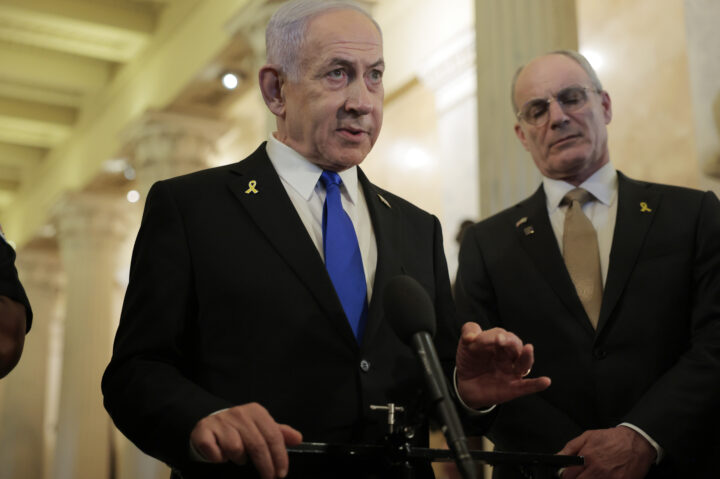
Israeli Prime Minister Benjamin Netanyahu speaks to reporters after meeting with U.S. Speaker Mike Johnson (R-LA) at the U.S. Capitol on July 8, 2025, in Washington, D.C.
Good Monday afternoon.
This P.M. briefing is reserved for our premium subscribers like you — offering a forward-focused read on what we’re tracking now and what’s coming next.
I’m Danielle Cohen-Kanik, U.S. editor at Jewish Insider. I’ll be curating the Daily Overtime for you, along with assists from my colleagues. Please don’t hesitate to share your thoughts and feedback by replying to this email.
📡On Our Radar
Notable developments and interesting tidbits we’re tracking
There has been a whirlwind of political activity in Israel today, starting with the bombshell news that Prime Minister Benjamin Netanyahu intends to ask the Security Cabinet to approve an expansion of Israel’s war in Gaza, which would see the IDF control all of the enclave.
The move will have reverberations throughout Jerusalem and Washington, from Netanyahu’s own government to hostage families, Capitol Hill and the White House. Officials on both sides of the aisle in the U.S. have been pushing hard for a comprehensive ceasefire and an end to the war — including Middle East envoy Steve Witkoff, who was in Israel just days ago at the behest of President Donald Trump. Stay tuned to Jewish Insider for how this will play out in the coming days…
In other headlines coming out of Israel, the Cabinet voted unanimously this morning to oust Attorney General Gali Baharav-Miara, with whom the current government has been at odds since it was formed, accusing her of political bias.
Shortly after the vote, the Israeli Supreme Court issued an injunction temporarily blocking the firing and ordering the government to continue abiding by Baharav-Miara’s legal opinions until the court issues a final ruling.
It’s the first time an Israeli government has ever voted to oust the AG, and with some Cabinet ministers already boycotting her and pushing back on the court’s decision, Israel could be edging toward a constitutional crisis.
Meanwhile, Likud MK Yuli Edelstein was officially pushed out of his chairmanship of the Knesset Foreign Affairs and Defense Committee today, over coalition disagreements on a Haredi conscription bill. He was replaced by Boaz Bismuth, also from Likud, whom the party hopes will be more amenable to reducing sanctions on Haredim who dodge the draft. Israeli voters across a large swath of the political spectrum, including the Likud base, are on Edelstein’s side of the debate…
Getting a front-row seat to these developments, House Speaker Mike Johnson’s (R-LA) trip to Israel with a House Republican delegation continues today. The group visited the town of Ariel, making Johnson the highest-ranking elected federal official to visit a West Bank settlement. While there, Johnson told a meeting of senior Yesha Council officials that “Judea and Samaria are the front lines of the State of Israel and must remain an integral part of it,” and stopped by Ariel University…
Also in Israel this week are two delegations of freshman House members, one from each caucus, organized by the AIPAC-affiliated American Israel Education Foundation. The Democratic trip is led by Rep. Steny Hoyer (D-MD), the former House majority leader, and Rep. Pete Aguilar, (D-CA), the caucus chair…
Back at home, Conference of Presidents of Major American Jewish Organizations CEO William C. Daroff met with Under Secretary of Defense Elbridge Colby at the Pentagon today. Though Colby had faced criticism around his nomination from pro-Israel circles for his calls to scale back U.S. involvement in the Middle East, Daroff told JI that Colby “expressed a clear and serious understanding of U.S. strategic interests in the Middle East, including the vital importance of deterring Iran, preventing regional adversaries from gaining dominance, and sustaining Israel’s security following the Twelve Day War.” Daroff said he was “encouraged by [Colby’s] principled and grounded approach”…
The Federal Emergency Management Agency said in grant notices made public Friday that states must guarantee they will not engage in boycotts of Israeli companies in order to qualify for a tranche of more than $1.9 billion in natural disaster preparedness grants…
Software analytics giant Palantir topped $1 billion in revenue for the first time, it shared in an earnings report today. The company has secured several large contracts with the Trump administration, including an agreement announced last week for $10 billion over the next decade with the U.S. Army…
Veteran Democratic political strategist Howard Wolfson, an outspoken supporter of Israel and Jewish causes, appeared on Daniel Gordis’ “Israel from the Inside” podcast today with the message that “the war for hearts and minds” in U.S. support for Israel “has been lost.” The former communications director of Hillary Clinton’s 2008 presidential campaign, Wolfson said that he’s “clanging the alarm bell as loudly as I can and hoping that the Israeli public and the decision-makers in Israel understand how far Israel has fallen in public approval in the United States and what the implications of that are.”
“Israel is getting absolutely decimated” in information warfare, Wolfson continued. “And that may not be fair, it may not be accurate, but I think those questions of fairness and accuracy, they’ve become largely irrelevant. It’s not about fairness and accuracy. It’s about effectiveness and about impact.”…
⏩ Tomorrow’s Agenda, Today
An early look at tomorrow’s storylines and schedule to keep you a step ahead
Keep an eye on Jewish Insider this week for a dive into the lessons learned from Israel’s disengagement from Gaza 20 years ago this month, an analysis of what a new poll of New York City Jewish voters means for Zohran Mamdani’s mayoral prospects and a look into the latest fundraising figures from pro-Israel campaign groups.
Tomorrow morning, Israeli Foreign Minister Gideon Sa’ar will meet with American Jewish leaders in New York, JI has learned, and then head to a meeting of the U.N. Security Council on the situation of the hostages held in Gaza. Sa’ar prompted the special session after videos of two hostages — Evyatar David and Rom Braslavski — were released by Hamas and the Palestinian Islamic Jihad, showing the two men looking haggard and severely emaciated.
Stories You May Have Missed
MARYLAND MOOD
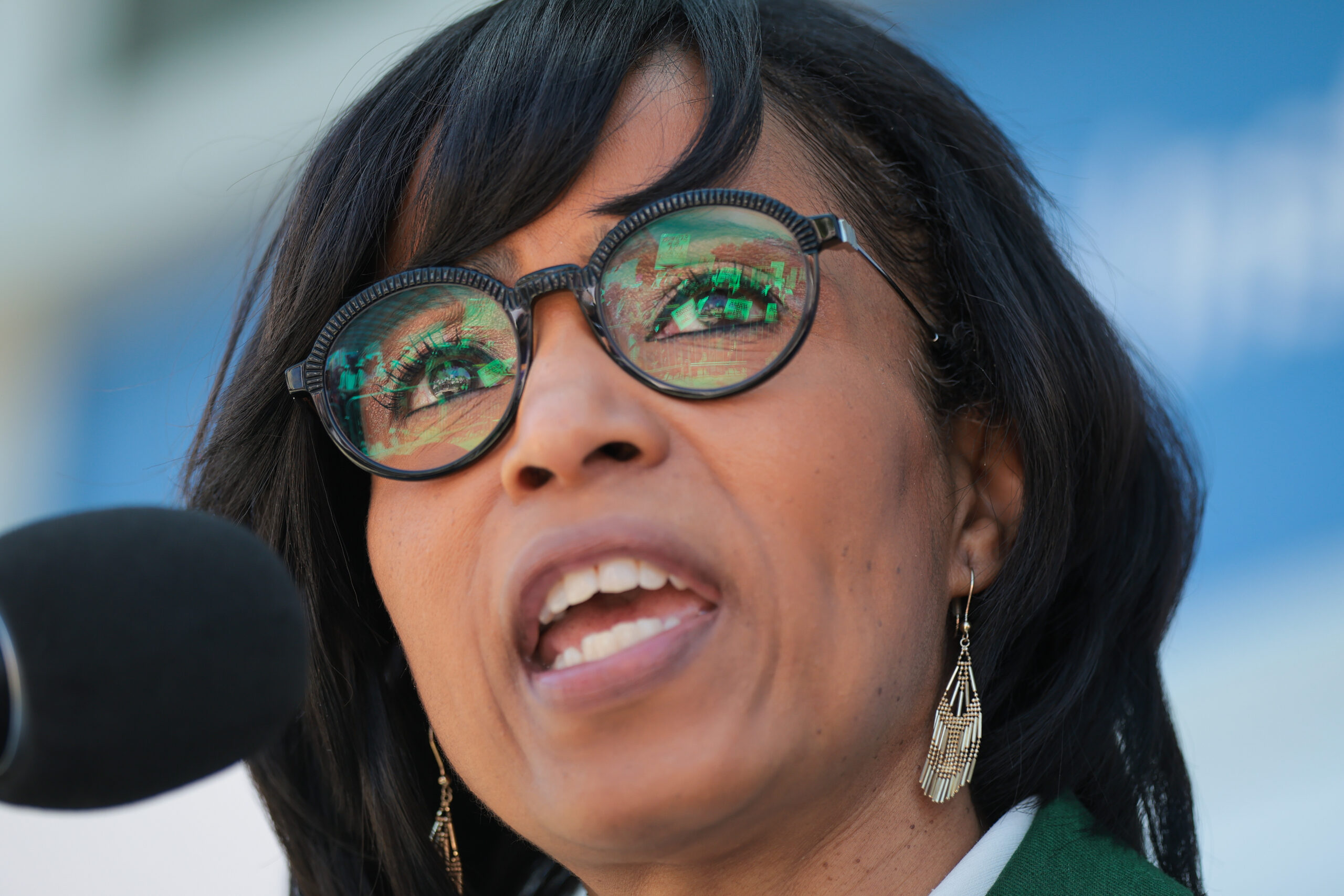
Many of the state’s Jewish leaders are wary of speaking out against the Maryland Democrat’s votes to block arms sales to Israel
QATAR CALL
The Democratic congressman, in a letter rejecting an offer for a staffer to travel to Qatar, said that the kingdom needs to do more to pressure Hamas
Last year, Hamas executed six hostages when the IDF approached their position; military reportedly opposes taking control of areas in Gaza where hostages are believed to be held
Anna Moneymaker/Getty Images
Israeli Prime Minister Benjamin Netanyahu speaks to reporters after meeting with U.S. Speaker Mike Johnson (R-LA) at the U.S. Capitol on July 8, 2025, in Washington, D.C.
Israeli Prime Minister Benjamin Netanyahu plans to ask the Security Cabinet to back expanding Israel’s military efforts in Gaza, Israeli media reported on Monday.
“We are going to conquer the [Gaza] Strip,” a senior source in Netanyahu’s office told Israel’s Channel 12. “The decision was made. Hamas will not free more hostages without us fully surrendering, and we will not surrender. If we don’t act now, the hostages will die of hunger and Gaza will remain under Hamas’ control.”
A few caveats: Netanyahu did not use the term conquer or occupy with all of the Cabinet ministers to whom he conveyed his position, according to Israeli public broadcaster KAN. Maariv reported that Netanyahu has not made a final decision yet about whether the IDF should take control of all of Gaza, and noted that legally, he cannot decide on his own without the Security Cabinet.
“Netanyahu realized … that there is no point anymore in waiting for Hamas [to agree to a deal], and therefore a decision about the next stage of the war must be made quickly,” a source involved in the matter told Maariv. “The dispute now is not about whether to act or negotiate, because a deal with Hamas is no longer on the table. Rather, it’s about how to act without a deal, whether to go for full conquest or for a siege and increased pressure.”
IDF Chief of Staff Maj.-Gen. Eyal Zamir reportedly favors a siege over occupying all of Gaza.
The IDF currently controls about 75% of the Gaza Strip, and the new plan would bring the entire area under Israel’s control. Among the areas the IDF would enter would include Gaza City, where the IDF has not maneuvered in a year and a half, and towns in central Gaza, where some 20 remaining living hostages are believed to be held.
The military’s hesitation to enter those areas was, in part, due to a concern for the hostages’ safety. Last year, Hamas executed six hostages when the IDF approached their position and former hostages have said that their captors said they would kill them if the army approached the location where they were held. Hamas has also warned the IDF that attempts to rescue hostages would result in death.
Senior officials were quoted in multiple Israeli news outlets saying that Zamir should resign if he disagrees with Netanyahu’s decision to take control of the remaining 25% of the Gaza Strip.
Netanyahu is expected to bring the proposal to a Security Cabinet vote on Tuesday.
The move comes two weeks after Hamas rejected a partial ceasefire and hostage-release deal, and Israel and the U.S. said they would only pursue comprehensive agreements to free all of the hostages moving forward. Hamas and Palestinian Islamic Jihad published videos in recent days of hostages Rom Braslavski and Evyatar David who appeared to be starving; the latter was filmed digging his own grave.
In addition to Zamir, others expected to argue against conquering the rest of Gaza, according to Channel 12, are Foreign Minister Gideon Sa’ar, Shas leader Arye Deri, National Security Advisor Tzachi Hanegbi and Mossad chief David Barnea, among others.
Netanyahu has the support of Strategic Affairs Minister Ron Dermer, Finance Minister Bezalel Smotrich, National Security Minister Itamar Ben-Gvir, Military Secretary Maj.-Gen. Roman Gofman and Cabinet Secretary Yossi Fuchs.
The Prime Minister’s Office did not respond to requests for comment on the reports.
Rather than confirm or deny that he had made a decision about Israel’s next military steps in Gaza, Netanyahu posted a video to X after Hebrew media reported on the matter, which focused on Israeli efforts to get food and medicine to residents of Gaza, and compared claims that Israel was starving Gazans to antisemitic conspiracy theories.
Klobuchar: ‘I have supported Israel’s right to defend itself, I always will. But they aren’t changing’

Drew Angerer/Getty Images
Sen. Amy Klobuchar (D-MN)
Sen. Amy Klobuchar (D-MN) said that she voted, for the first time, for resolutions blocking U.S. arms sales to Israel this week to send a message to the Israeli government of disapproval for the humanitarian situation in Gaza, even as she acknowledged that the vote might not make much of an impact.
“I just think it’s really important for people to speak out when they can, even if it’s on a vote that isn’t probably going to make all the difference right now. And it doesn’t mean I’m going to be hard-stop against aid for Israel in the future,” Klobuchar told Punchbowl News.
“At some point, you’ve got to seek change. And I think this is one way you can do it,” she continued. “I have supported Israel’s right to defend itself, I always will. But they aren’t changing.”
She said that she’d tried to communicate her disapproval of the humanitarian situation in Gaza to Israeli Prime Minister Benjamin Netanyahu during his recent visit to Washington, D.C. but said it “didn’t work very well when I said it.”
Klobuchar said in a Senate floor speech several days before the votes that she attended the meeting with Netanyahu “for one reason: in my capacity as No. 3 in the Democratic leadership, and that was to raise the issue of the humanitarian crisis in Gaza.”
“I say to my colleagues you can support the people of Israel. You can be horrified and condemn, as all of us did, the terrorist attack. But we cannot continue to allow people to starve,” Klobuchar said. “Lives are being lost on a daily basis, kids, innocents, and the government of Israel must change course.”
She said that U.S. policy must focus on returning to a ceasefire, increasing humanitarian aid, freeing the hostages and security a two-state solution.
The Minnesota Democrat, a moderate, has historically been a quiet but reliable supporter of Israel. She’s also the No. 3 Senate Democrat, seen as a potential successor to Minority Leader Chuck Schumer (D-NY).
Of the 11 members of Democratic leadership, seven voted for the resolutions on Wednesday.
Klobuchar is running for the No. 2 Senate Democratic leadership slot, competing against Sen. Brian Schatz (D-HI), a consistent supporter of prior efforts to halt weapons sales, and Sen. Patty Murray (D-WA), who, like Klobuchar, flipped her vote to support the Sanders resolutions after previously opposing them.
Plus, an interview with Judge Jeanine

Bill Pugliano/Getty Images
Rep. Elissa Slotkin (D-MI) campaigns with Rep. Liz Cheney (R-WY) at an Evening for Patriotism and Bipartisanship event on November 1, 2022, in East Lansing, Michigan.
Good Friday morning.
In today’s Daily Kickoff we explore how Sen. Jon Ossoff’s Wednesday night vote in favor of blocking a shipment of automatic weapons to Israel is fueling renewed frustration among the Georgia Jewish community and cover Sen. Elissa Slotkin’s statement of support for the weapons-blocking votes from which she was absent. We also have the scoop on Rep. Ro Khanna’s push for U.S. recognition of a Palestinian state. We report on a conversation between the Gaza Humanitarian Foundation head Rev. Johnnie Moore and members of Sinai Temple in Los Angeles, and sit down with the new interim U.S. Attorney for D.C. Jeanine Pirro. Also in today’s Daily Kickoff: Steve Witkoff, Dennis Ross and Antoun Sehnaoui.
For less-distracted reading over the weekend, browse this week’s edition of the Weekly Print, a curated print-friendly PDF featuring a selection of recent Jewish Insider and eJewishPhilanthropy stories, including: Audrey Azoulay, UNESCO’s leading Jewish lady; New York Jewish leaders reluctant to fight against Mamdani; Turning mourning into action to address a modern tragedy, Jewish and Earth Alliance holds pre-Tisha B’Av environmental lobbying day. Print the latest edition here.
What We’re Watching
- Following meetings in Israel yesterday, Middle East envoy Steve Witkoff and U.S. Ambassador to Israel Mike Huckabee traveled to Gaza today to visit humanitarian aid sites and “meet with local Gazans to hear firsthand about this dire situation on the ground,” White House Press Secretary Karoline Leavitt announced in a briefing yesterday. After their visit, President Donald Trump will approve a “final plan” for food and aid distribution in Gaza.
- Israel and the U.S. have agreed that it is necessary to reach a comprehensive framework, rather than another partial deal, that releases all the hostages at once and ends the war in Gaza with the disarmament of Hamas and the demilitarization of the enclave, a senior Israeli official told reporters.
What You Should Know
A QUICK WORD WITH JI’S GABBY DEUTCH
This week, the Trump administration demonstrated its endgame in its fight against campus antisemitism: hefty financial settlements.
Columbia University agreed to pay $221 million to the federal government to settle the administration’s civil rights investigation, and Brown University will pay $50 million to Rhode Island workforce development agencies to put a federal civil rights investigation to rest. Harvard is reportedly willing to spend up to $500 million on a settlement that is in the works. In return, frozen research grants to the tune of billions of dollars from the National Institutes of Health and the Department of Health and Human Services will be reinstated.
What these early settlements have made clear is that antisemitism is only one small part of President Donald Trump’s fight against elite universities. The agreements offer a window into the other right-wing culture war issues driving his administration’s hard-charging negotiations with America’s top academic institutions. The lengthy documents also have the universities ceding to White House demands on diversity, equity and inclusion programs, race-based hiring standards, transgender issues and international students.
In its agreement with the White House, Columbia pledged to hire an administrator to “serve as a liaison to students concerning antisemitism issues,” and promised other sought-after changes, such as the hiring of new faculty members in the Israel and Jewish studies department and additional oversight of the school’s Middle East studies program.
But the propositions agreed to by Columbia go much further. The school pledged not to use racial preferences in admissions and promised to share admissions and hiring data with the federal government. The university also said it will allow any women who want it to have access to “single-sex housing” and “all-female sports, locker rooms and showering facilities,” a reference to Trump’s opposition to the inclusion of transgender women in women’s sports.
FRAYED TIES

Sen. Jon Ossoff’s (D-GA) vote Wednesday night, with a majority of Senate Democrats, in favor of a resolution to block a shipment of automatic weapons to Israel is fueling renewed frustration with the senator within the Georgia Jewish community, setting back efforts by the senator to repair ties with Jewish voters who objected to similar votes last December, Jewish Insider’s Marc Rod reports.
State of play: Ossoff’s relationship with Georgia’s sizable Jewish community could be a critical deciding factor in his reelection campaign next November — with a tight margin of victory expected in the swing state, significant changes in Jewish voting patterns could help decide the election. Norman Radow, a major Democratic donor in Georgia who spoke to Ossoff on Wednesday evening after the votes, told JI, “I’m disappointed with him and he knows it. And I think he knows that a vast majority of the Jewish community feels the same way.”
SLOTKIN’S STANCE
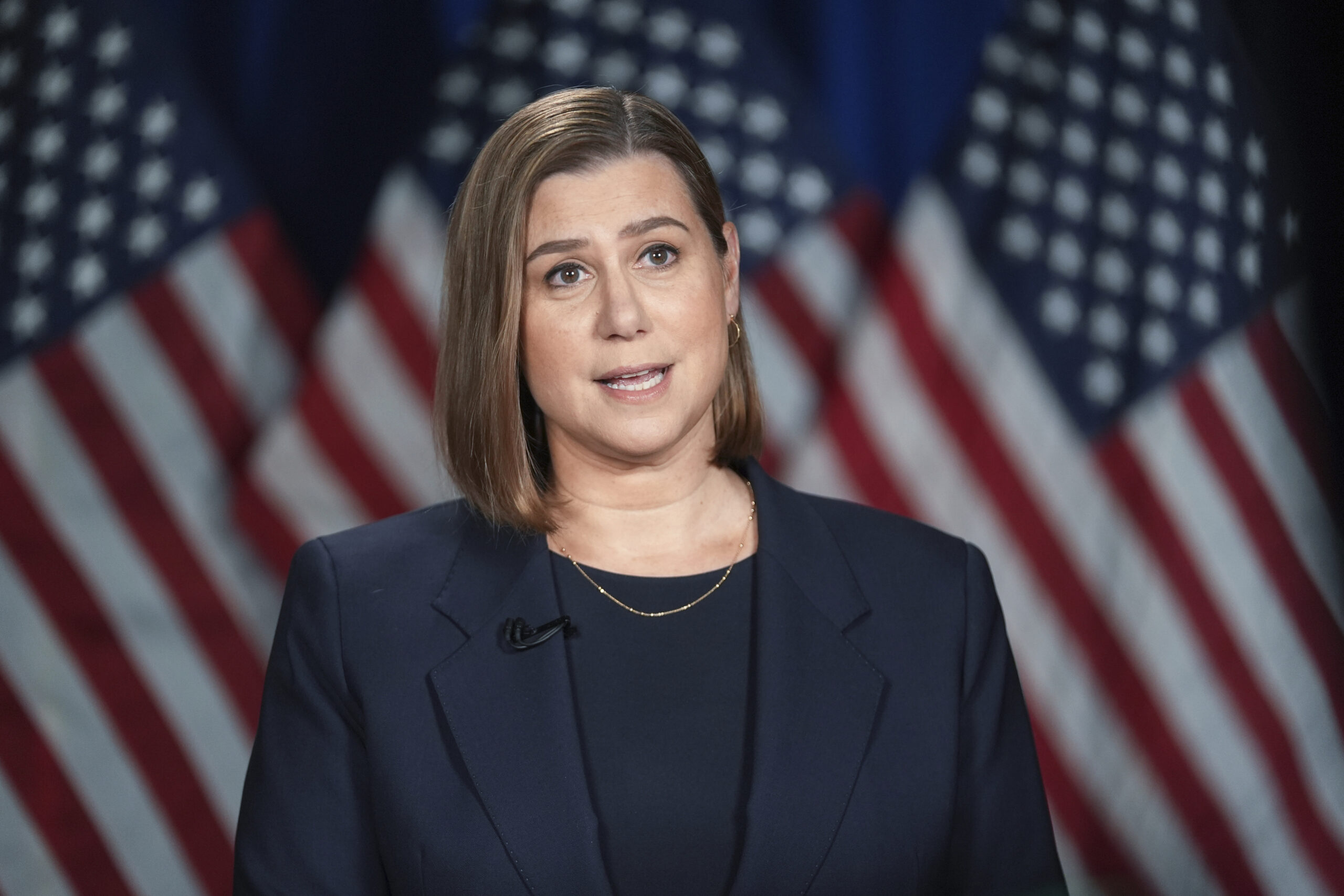
Sen. Elissa Slotkin (D-MI) said Thursday that she supported two resolutions led by Sen. Bernie Sanders (I-VT) to cut off shipments of assault rifles and bombs and bomb guidance kits to Israel, in a pivot from her previous stances. Slotkin missed the votes on the resolutions which occurred Wednesday, having spent part of the day taping an episode of “The Late Show with Steven Colbert.” Her support brings the total number of Democrats supporting the two resolutions to 28 and 25, respectively. Michigan state Sen. Mallory McMorrow, a potential future colleague of Slotkin in Michigan’s Senate delegation, also voiced support Wednesday for cutting off offensive weapons to Israel, Jewish Insider’s Marc Rod reports.
Slotkin’s statement: “I have struggled with this Joint Resolution of Disapproval more than any previous votes in the nearly two years since Hamas initiated the attacks of October 7,” Slotkin said in a statement. “Had I made it back for the vote yesterday, I would have voted yes to block offensive weapons to Israel based on my concerns over lack of food and medicine getting to civilians in Gaza.” She said she remains a “strong supporter of the Jewish State of Israel … But despite the fact that Hamas began this bloody round of conflict — and refuses to release the hostages — the images of emaciated children are hard to turn away from. As are the calls from Michiganders who have friends and family trying to survive in Gaza.”
CONGREGATION CONVERSATION

Faced with tough questions about the humanitarian crisis gripping Gaza from members of one of the country’s most prominent synagogues, Rev. Johnnie Moore, executive chairman of the Gaza Humanitarian Foundation, defended his organization’s actions and said reports of civilian casualties at GHF’s aid sites are overblown. “The hunger crisis in Gaza is real, and on the same token, this crisis is being used in all kinds of different ways to advance other agendas,” Moore told members of Sinai Temple, a large Conservative synagogue in Los Angeles, in a webinar hosted on Thursday by its leader, Rabbi Erez Sherman, Jewish Insider’s Haley Cohen reports.
Hamas’ hold: “Hamas is losing control,” said Moore, a member of President Donald Trump’s evangelical advisory committee. The terrorist organization has made shutting down GHF a central demand in ceasefire negotiations with the U.S. and Israel. “We are meeting with Gazans every single day.” As hunger worsens in Gaza, some pro-Israel American Jews, like those at Sinai Temple, are growing increasingly concerned with the humanitarian situation in the Palestinian enclave and placing some of the responsibility with GHF, which took over the aid distribution in May with backing from the United States and Israel.
SCOOP

Rep. Ro Khanna (D-CA) is circulating a letter among House lawmakers to President Donald Trump and Secretary of State Marco Rubio calling for the United States to recognize a Palestinian state, Jewish Insider’s Marc Rod reports.
What they’re saying: “We are writing to request that the United States officially recognize a Palestinian state, as this tragic moment has highlighted for the world the long overdue need to recognize Palestinian self-determination,” a draft version of the letter obtained by JI reads. “Just as the lives of Palestinians must be immediately protected, so too must their rights as a people and nation urgently be acknowledged and upheld.” The letter had nine co-signatories as of Thursday evening. Khanna said that it began circulating earlier this week and he plans to send it during the United Nations General Assembly meeting in September.
JUSTICE AGENDA

When interim U.S. Attorney for D.C. Jeanine Pirro began her tenure as Westchester County, N.Y., district attorney on New Years Day in 1994, she walked into her new office to discover a backlog of antisemitism-related cases left behind by her predecessor. In an interview with JI at her D.C. office on Tuesday, Pirro said learning of the scope of antisemitism in Westchester County opened her eyes to “the trauma and the revictimization” of the Jewish people and prompted her to get involved with efforts to promote Holocaust education through the Simon Wiesenthal Center, Jewish Insider’s Emily Jacobs, Marc Rod and Josh Kraushaar report.
‘Telling’ first days: “It’s almost like this thing that follows me,” Pirro said of prosecuting anti-Jewish hate crimes, calling it “so telling” that the fatal shooting of two Israeli Embassy staffers in Washington — by a 31-year-old suspect who witnesses said shouted “free Palestine” and “I did it for Gaza” — took place during her first week in her current role. “My introduction here was just stunning, and it kind of brought me back to where I started, as a local DA, right off the bat with antisemitism,” she said of her initial days as U.S. attorney for the nation’s capital.
ON THE HILL

The Senate Appropriations Committee’s draft 2026 defense funding bill, approved by a broad bipartisan committee vote on Thursday, includes increases to several U.S.-Israel cooperative defense programs, Jewish Insider’s Marc Rod reports.
By the numbers: The bill includes a total of $80 million in additional funding, as compared to 2025, for several cooperative programs with Israel. It offers a total of $75 million for counter-drone and missile programs, $47.5 million for cooperative programs in emerging defense technologies like artificial intelligence and $80 million for counter-tunneling programs, according to a summary released by the committee. The bill includes the $500 million for cooperative missile-defense programs including Iron Dome, David’s Sling and Arrow provided annually under the terms of the U.S.-Israel memorandum of understanding. It also offers additional security assistance funding for Bahrain and Jordan.
Funding fury: Senate Appropriations committee members sparred on Thursday about the Trump administration’s sweeping moves to combat campus antisemitism, including withholding hundreds of millions of dollars from some elite institutions.
Worthy Reads
End of a Bromance: The Atlantic’s Jonathan Lemire and Isaac Stanley-Becker write that President Donald Trump has broken rhetorically with Israeli Prime Minister Benjamin Netanyahu in recent days over the issue of starvation in Gaza because of his frustration with the seemingly endless war and “gruesome photos” he sees on TV. “During the 2024 campaign, Trump frequently boasted that he had kept the world free of conflict during his first term, and he returned to the Oval Office this year pledging to bring the wars in Gaza and Ukraine to a quick close. Instead, both have escalated, to Trump’s humiliation. … Netanyahu’s recent strikes in Syria and his rejection of claims about the Gaza famine have angered Trump. The president is eager to stabilize the Middle East — and expand the Abraham Accords, which normalized relations between Israel and several Gulf states in his first term — in order to foster business and trade relationships in the region. … Netanyahu’s defiance has caused an additional rupture in Trump’s base—and frustrated the president by creating yet another news cycle he can’t control. ‘He just really wants these stories to stop being on TV,’ the outside adviser told us.” [TheAtlantic]
Flood Gaza With Food: Ahmed Fouad Alkhatib, a Palestinian from Gaza now heading the Atlantic Council’s Realign for Palestine project, argues in The Atlantic that “Hamas wants Gaza to starve” and therefore Israel should ensure the enclave receives ample food and aid. “Hamas actually wants a famine in Gaza. Producing mass death from hunger is the group’s final play, its last hope for ending the war in a way that advances its goals. Hamas has benefited from Israel’s decision to use food as a lever against the terror group, because the catastrophic conditions for civilians have generated an international outcry, which is worsening Israel’s global standing and forcing it to reverse course. … If Hamas believes that the suffering of Gazans bolsters its cause, Israeli decision makers should take that to heart. They should abandon their misguided and inhumane policies and cease their efforts to pressure the population as a means of pressuring the terror group. The best way to undermine Hamas’s position is to instead flood Gaza with food, and to alleviate the suffering of its people.” [TheAtlantic]
Faith in Dark Times: In his Substack column, former Israeli Ambassador to the U.S. Michael Oren reflects on hope during the period of mourning before Tisha B’Av. “Finally, there is the most fundamental source of my hope, its bedrock. Faith. No greater leap of it is required of any religion more than atheism. To deny the existence of an Almighty means insisting that the countless trillions-to-one chance that a certain planet in a specific orbit around an ideally-situated sun would generate an atmosphere, produce water and life forms that would evolve into sentient human beings — that all of that was a mere coincidence, necessitates incalculable faith. So, too, must an atheist view the ideas of monotheism, universal morality, and the relentless pursuit of justice introduced by a small, desert people as an historical accident. An atheist must look at Israel today and conclude that its existence, to say nothing of its achievements, is merely a fluke, and Jews are — as Toynbee once infamously called us — a fossil people.” [Substack]
Losing the PR War: Haviv Rettig Gur argues in The Free Press that while Israel is succeeding in its ground war in Gaza, it has “utterly failed in the humanitarian war,” and “the only place it has fared worse is in the information war. In that arena, it has failed so miserably that Hamas has been propped up at every turn, its resilience assured, and all Israel’s gains in the battlefield jeopardized. … Prime Minister Benjamin Netanyahu literally does not have a clearly identified English language spokesperson. No one in the Israeli state apparatus tracks claims about the country or the war and responds, handles damage control, or manages the narrative and coordinates the message—the sorts of activities that every political campaign understands is the bread and butter of a winning strategy. … [Israel] tried to play a game of chicken with humanitarian aid. It blinked first. Obviously. How could it have been otherwise? Which Israeli strategist was dumb enough ever to think that Israel’s threshold of tolerance for Gazan suffering was higher than Hamas’s? And finally, we failed to understand that when Israel does not speak to the world while people die, Hamas is strengthened.” [FreePress]
Word on the Street
The State Department announced sanctions that will deny visas from members of the Palestine Liberation Organization and officials from the Palestinian Authority on Thursday, over the PLO and PA’s continued “pay-for-slay” policy, glorification of violence “especially in textbooks” and initiation of or support for proceedings against Israel at the International Criminal Court and International Court of Justice…
The Trump administration notified Congress that it has determined the U.N. Relief and Works Agency “is irredeemably compromised and now seeks its full dismantlement” on July 29, the Free Beacon scooped…
The Palestinian Islamic Jihad terror group released a video yesterday of Israeli hostage Rom Braslavski, which the group said it filmed before it lost contact with its members who are holding Braslavski captive in Gaza. Braslavski appears pale and thin…
The Washington Post published a list of names and ages of 18,500 children whom the Hamas-run Gaza Health Ministry says were killed during the war in Gaza…
The U.S. must compensate Iran for losses incurred from the June war between Israel and Iran, which the U.S. participated in, before it will return to nuclear talks, Abbas Araghchi, Iran’s foreign minister and chief negotiator, told the Financial Times on Thursday…
Michael Whatley, chair of the Republican National Committee, launched his bid for North Carolina’s open Senate seat on Thursday, days after former North Carolina Gov. Roy Cooper announced he’s seeking the Democratic nomination. An Emerson College poll, released this morning by Politico, found Cooper holding a six-point lead…
Israel’s National Security Council issued a warning to its citizens in the United Arab Emirates and is reportedly evacuating its diplomats due to increased terror threats from Iran targeting Israeli nationals there…
Harvard may face a new lawsuit from the Trump administration after the Department of Health and Human Services, which had been investigating the university for antisemitism, found the school in violation of the Title VI of the Civil Rights Act and that it would not “voluntarily comply with its obligations.” HHS referred the case to the Department of Justice, which will decide how to proceed, according to the Free Press…
President Donald Trump unveiled his new reciprocal tariff rates Thursday night in anticipation of his Aug. 1 trade deal deadline. The new rates include a 15% tariff on imports from Israel, down from the initial 17% rate imposed in April…
Secretary of State Marco Rubio postponed a meeting with the foreign ministers of Saudi Arabia, the United Arab Emirates and Egypt in Washington on Wednesday, Bloomberg reports, intended to help broker peace talks in Sudan. The delay reportedly comes as Egypt disagreed with the intended joint statement stating neither of the North African country’s warring parties — the Sudanese Armed Forces nor the paramilitary Rapid Support Forces — could lead the transitional government…
Sens. Peter Welch (D-VT) and Chris Van Hollen (D-MD) and Reps. Joaquin Castro (D-TX) and Sara Jacobs (D-CA) wrote to U.S. companies providing security for Gaza Humanitarian Foundation sites, saying, “We were horrified by reporting this week on your companies’ deadly security operations in Gaza. Your operations have exposed hundreds of brave American veterans to future criminal and civil liability under U.S. laws criminalizing war crimes, torture, and forced deportation”…
Former Vice President Kamala Harris appeared on “The Late Show With Stephen Colbert,” her first interview since losing the 2024 presidential election…
The Wall Street Journal ran an ad campaign called “Eye on Qatar,” featuring a “Custom Content” series of articles extolling the Gulf state, as Doha continues to invest in American institutions and media…
The Middle East Institute released its 2025 second-quarter assessment of the Trump administration’s policy in the Middle East, finding that the president “is still struggling to produce a major positive outcome from its frenetic activity trying to end kinetic wars while prosecuting an unprecedented economic war with much of the rest of the world”…
Sunset Lane Media bought the rights to adapt The Missing Peace, a nonfiction retelling by Dennis Ross — a former State Department official and negotiator for the U.S. under Presidents George H.W. Bush and Bill Clinton — of the 2000 Camp David Summit between Clinton, Israeli Prime Minister Ehud Barak and Palestinian Authority Chairman Yasser Arafat…
Shell CEO Wael Sawan told the Financial Times that the oil giant didn’t trade oil price spikes during the Israel-Iran war in June. “We just don’t play in that space,” Sawan said…
Washington Jewish Week interviewed a close advisor to Lebanese banker and philanthropist Antoun Sehnaoui on how he came to co-found and help fund the U.S.-Israel Opera Initiative and why he identifies as a Zionist…
Tal Shalev, chief political correspondent for Walla! News, is leaving the Israeli outlet after almost 12 years…
Pic of the Day

Israeli Prime Minister Benjamin Netanyahu met yesterday with Middle East envoy Steve Witkoff in his office in Jerusalem.
Birthdays

Retired head coach of both the NFL’s Kansas City Chiefs and Buffalo Bills, the oldest-ever living member of the Pro Football Hall of Fame, Marv Levy turns 100 on Sunday…
FRIDAY: Culver City, Calif., resident, Allene Prince… Formerly CEO of Cendant Corporation, then CEO of 54 Madison Partners, Henry R. Silverman turns 85… Israeli film director and screenwriter, winner of the Israel Prize and professor emeritus at Tel Aviv University, Ram Loevy turns 85… Founder and chairman of NYC-based Midtown Equities, Joseph Cayre turns 84… U.S. district court judge for the Southern District of New York, now on senior status, Judge Jed S. Rakoff turns 82… Former president of Brandeis University, now president of the Cleveland-based Mandel Foundation, Jehuda Reinharz turns 81… British businessman, he has been described as “the father of British venture capital,” Sir Ronald Mourad Cohen turns 80… Israeli-born businessman and film producer, later CEO of Marvel Studios, Avi Arad turns 77… Second-generation owner of a Los Angeles flooring business, Eric Kalman Biren… Immediate past president of Hadassah, Rhoda Smolow… Founder and president of Greystone Hotels, the IHA Group and Markev Realty Corporation, Eric Horodas 72… Media analyst and host of “MediaBuzz” at Fox News, Howard Kurtz turns 72… Director of New York government relations at Agudath Israel of America, Yeruchim Silber… U.S. career diplomat who served as ambassador to South Korea during the Biden administration, Philip Seth Goldberg turns 69… United States secretary of the interior, Douglas James Burgum turns 69… Attorney, political strategist and former president of the American Jewish Congress, Richard Scott Gordon… CEO of Atlanta’s Jewish Family & Career Services since 2019, she served for 12 years in the Minnesota Senate, Terri E. Bonoff turns 68… Professor of psychiatry and neuroscience at the Mount Sinai School of Medicine, Rachel Yehuda, Ph.D. turns 66… Policy director in the D.C. office of Brownstein Hyatt Farber Schreck, Andrew C. (“Drew”) Littman… Former senior rabbi of the British movement for Reform Judaism, now a rabbi at London’s Bromley Reform Synagogue, Laura Naomi Janner-Klausner turns 62… U.S. ambassador to Israel during the Obama administration, now a principal at WestExec Advisors, Daniel B. “Dan” Shapiro turns 56… Producer for CBS’ “60 Minutes,” Shachar Bar-On… Professor of mathematics at Princeton and Hebrew U, he was the winner of the 2010 Fields Medal, Elon Lindenstrauss turns 55… CEO of Goliath Records and former president of Def Jam Recordings, best known as the agent of Eminem, Paul D. Rosenberg turns 54… CEO of NYC’s Quantum Media Group, Ari Zoldan… Israeli film director, writer and producer, Asaf Epstein turns 47… Venture partner in Leap Forward Ventures, she is also chief growth and marketing officer at Blue Flame, Jessica Alter… Founder and CEO of Moishe House (now known as Mem Global), David Cygielman… CEO of National Council of Jewish Women, Sheila Katz… COO at the Jewish Community Relations Council of New York, Noam Gilboord… SVP of public relations at Burford Capital, David Helfenbein… Board certified family physician, Mor Toledano Shapiro, M.D…. Deputy director of North America Israel Strategy at JFNA, Roey Kruvi… Cross-country skier who competed for the U.S. at the Winter Olympics in 2014 (Sochi) and 2018 (Pyeongchang), Noah Hoffman turns 36… Client relations specialist at Pacific Libra Insurance Agency, Yael Rabin… Investment director at Bayit Capital Ventures, Asher Perez… Television, stage and film actor, Benjamin “Ben” Rosenfield turns 33…
SATURDAY: Co-founder and chairman of NYC-based real estate development firm, Rockrose Development Corporation, Henry Elghanayan turns 85… Professor emeritus of Bible at London’s Leo Baeck College, Jonathan David Magonet turns 83… Former member of Knesset for 28 years, he then served as chairman of Rafael Advanced Defense Systems until 2023, Uzi Landau turns 82… Retired colonel in the U.S. Army and a recipient of the Medal of Honor and seven other medals, he serves as a military analyst for NBC News and MSNBC, Jack H. Jacobs turns 80… Longtime librarian, Irene Seff… Nationally syndicated radio talk show host, author and public speaker, Dennis Prager turns 77… Ambassador and permanent representative of Canada to the United Nations, Robert Keith Rae turns 77… Pulitzer Prize-winning journalist and author, Roger Cohen turns 70… U.S. senator from Nevada, Jacklyn Sheryl “Jacky” Rosen turns 68… Psychoanalyst, psychiatrist and brain researcher at the Hebrew University of Jerusalem, Yoram Yovell turns 67… Growth consultant at the National Council of Jewish Women, Amy Aronoff Blumkin… Mayor of St. Petersburg, Fla., for eight years until 2022, now of counsel at Shumaker, Loop & Kendrick, Richard David “Rick” Kriseman turns 63… Owner of Newton, Massachusetts-based MPG Promotions, Elliot Mael… VP and general counsel of Yeshiva University, Andrew J. “Avi” Lauer… Professional tennis player, once ranked sixth best in the world, now the director of tennis at St. Andrews country club in Boca Raton, Fla., Aaron Krickstein turns 58… Former member of the Knesset, first for the Labor party and then the Yisrael Beiteinu party, Leon Litinetsky turns 58… Senior fellow for Middle East and Africa studies at the Council on Foreign Relations, Steven A. Cook turns 57… EVP for Hearst Television and past chair of the NBC Television Affiliate Board, Eric J. Meyrowitz… Professional golfer, he won a PGA tournament in both 2003 and 2004, Jonathan Andrew Kaye turns 55… Senior director for global trade and public affairs at confectionery, food, and pet care firm, Mars Inc., Jay Eizenstat… National security reporter for The New York Times for 14 years until 2024, now doing investment research, Matthew Rosenberg turns 51… Senior executive communications lead at Adobe, Stephen L. Rabin… Labor law attorney in the Nashville, Tenn., office of Holland & Knight, he served on the national board of JFNA, Aron Zwi Karabel… Regional manager of the Jewish Fertility Foundation, Tamar Poupko Smith… CEO of Make It Real, he is also the co-founder and chair of The Jewish Entrepreneur (a mentoring program), Isaac William “Zevy” Wolman… Julia Nayfeld Schulman… Vice president of the United States, James David (JD) Vance turns 41… Actress best known for her 1999 “Pepsi Girl” role as a 7-year-old, and later for subsequent teen roles, Hallie Kate Eisenberg turns 33… Baseball pitcher, he played for Team Israel in 2017 and now manages a baseball training facility for young players in Philadelphia, Kenny Koplove turns 32… British media personality, Eyal Adi Booker turns 30…
SUNDAY: English actor, author, playwright and theater director, known for his roles as the villain in both James Bond and Rambo films, Steven Berkoff turns 88… EVP emeritus of the UJA-Federation of New York, John S. Ruskay turns 79… Retired regional director in the Cleveland office of the ADL, she serves on the board of trustees of the Cleveland Federation, Anita Gray… Former chairman and CEO of the NYC office of commercial real estate brokerage firm Savills, Mitchell S. Steir turns 70… Voice actor in dozens of Disney films, video games and television programs, known professionally as Corey Burton, Corey Gregg Weinberg turns 70… Chair of the board of the Jewish Federation of Los Angeles and board member of JFNA, Orna Amir Wolens… President of DC-based Freedman Consulting, LLC, Thomas Z. Freedman turns 62… CEO and co-founder of Pushkin Industries, a podcast company, Jacob Weisberg… Israeli filmmaker, producer and director, Ilan Moskovitch turns 59… Canadian entrepreneur and former commodities trader, Alexander Shnaider turns 57… Executive director of public affairs at the Jewish Federation of Broward County (Fla.), Evan Goldman… Emmy Award-winning sportscaster, she sometimes serves as a fill-in for her husband Rich Eisen, Suzy Shuster turns 53… Managing editor of Vital City, Josh Greenman… U.S. senator (D-CT), Chris Murphy turns 52… Chief advancement and communications officer at the National September 11 Memorial & Museum, Joshua Cherwin… Head of public policy at Riot Platforms, a bitcoin-driven digital infrastructure company, Brian Morgenstern… Managing editor at The Jewish State, Seth A. Mandel turns 43… Managing partner and head of global government affairs at SoftBank Group International, Jeffrey A. Dressler turns 41… Director of strategic partnerships and senior development officer at JDC (the “Joint”), Erica Greenblatt… journalist, until recently a Tel Aviv-based reporter for The Wall Street Journal, Caroline “Carrie” Keller-Lynn… Director of member engagement at Christians United For Israel, she was born in Lutsk, Ukraine, and raised in Sacramento, Calif., Liliya Maskovcevs… Executive director of The Natan Fund, Adina Poupko … Executive director of the Reducetarian Foundation, Brian Kateman… Fashion model, Karlie Kloss turns 33… U.S. news editor at the Financial Times, Emily Goldberg… First-round pick of MLB’s Atlanta Braves in the 2020 draft, he made his MLB debut in 2023, now in the Chicago White Sox organization, Jared Shuster turns 27… Ariana Kaufman… Leigh Bonner Levine…
Plus, Trump warns of MAGA shift on Israel

Kobi Gideon (GPO)
Prime Minister Benjamin Netanyahu, meeting in his office with US Special Presidential Envoy to the Middle East Steve Witkoff (Kobi Gideon (GPO)
Good Thursday afternoon.
This P.M. briefing is reserved for our premium subscribers like you — offering a forward-focused read on what we’re tracking now and what’s coming next.
I’m Danielle Cohen-Kanik, U.S. editor at Jewish Insider. I’ll be curating the Daily Overtime for you, along with assists from my colleagues. Please don’t hesitate to share your thoughts and feedback by replying to this email.
📡On Our Radar
Notable developments and interesting tidbits we’re tracking
All eyes were on Jerusalem today, where Middle East envoy Steve Witkoff and U.S. Ambassador to Israel Mike Huckabee met with Israeli Prime Minister Benjamin Netanyahu amid a growing humanitarian crisis in Gaza and stalled ceasefire talks with Hamas. An Israeli official told Axios’ Barak Ravid that the men discussed moving from an “incremental and partial” ceasefire to a comprehensive one, meaning a final deal that would see the release of all the remaining 50 hostages, the disarmament of Hamas and the demilitarization of the Gaza Strip.
Witkoff and Huckabee will travel into Gaza tomorrow to visit humanitarian aid sites and “meet with local Gazans to hear firsthand about this dire situation on the ground,” White House Press Secretary Karoline Leavitt announced in a briefing this afternoon. After their visit, President Donald Trump will approve a “final plan” for food and aid distribution in Gaza.
Trump placed blame for the situation squarely with Hamas this morning, posting on Truth Social, “The fastest way to end the Humanitarian Crises in Gaza is for Hamas to SURRENDER AND RELEASE THE HOSTAGES!!!” That goodwill may not last, though, with one source telling the Financial Times that Trump recently warned a “prominent Jewish donor” that “my people are starting to hate Israel”…
In the same FT article, Amos Hochstein, the former advisor to President Joe Biden and negotiator between Israel and Lebanon during his term, is quoted saying, “Part of being a pro-Israel U.S. president meant stepping in when necessary to save Israel from itself.” On Israel’s wars in the region, Hochstein said, “Israel looks like it’s out of control and needs an American intervention and stop button”…
The State Department announced “sanctions that deny visas” to members of the Palestine Liberation Organization and officials from the Palestinian Authority this morning, over the PLO and PA’s continued “pay-for-slay” policy, glorification of violence “especially in textbooks” and initiation of or support for proceedings against Israel at the International Criminal Court and International Court of Justice.
The move comes in the midst of a spate of Western countries announcing their intent to recognize a Palestinian state in the coming months, signaling Washington is of a very different mind. Israeli Foreign Minister Gideon Sa’ar said the measure by the U.S. “exposes the moral delusion of certain countries that were quick to recognize a virtual Palestinian state while simultaneously turning a blind eye to its support for terror and incitement.” We’re keeping watch to see if the Trump administration moves to pressure countries like France, the U.K. and Canada to reverse course…
One U.S. ally waiting to jump into the fray is Germany, whose foreign minister, Johann Wadephul, just before an official visit in Israel today, said Berlin is not currently considering joining its neighbors in recognizing a Palestinian state, but that the process towards a two-state solution “must begin now.” “If that process continues to be blocked,” he warned, “Germany must consider reacting accordingly”…
The State Department also released a statement today — alongside 13 Western countries including France, the U.K. and Canada — condemning the “growing number of state threats from Iranian intelligence services in our respective territories,” specifically Iran’s attempts to “kill, kidnap and harass” Westerners and “target journalists, dissidents, Jewish citizens, and current and former officials”…
Relatedly, Israel’s National Security Council issued a warning to its citizens in the United Arab Emirates and is reportedly evacuating its diplomats due to increased terror threats targeting Israeli nationals there, in retaliation for Israel’s war with Iran…
The Washington Post today profiled Rachel Accurso, also known as Ms. Rachel, a popular children’s content creator and outspoken critic of Israel, without detailing the anti-Israel activism she’s incorporated into her children’s show and social media content. This month, she drew criticism from Jewish leaders for publishing a video with former UNRWA photographer Motaz Azaiza — who she called her “friend” — who has made numerous social media posts defending Palestinian terrorism, according to Ha’aretz…
The Free Press scooped a potential new lawsuit against Harvard by the Trump administration after the Department of Health and Human Services, which had been investigating the university for antisemitism, found the school in violation of the Title VI of the Civil Rights Act and that it would not “voluntarily comply with its obligations.” HHS referred the case to the Department of Justice, which will decide how to proceed…
In a Thursday afternoon speech at the Heritage Foundation, the Gaza Humanitarian Foundation‘s chair, Rev. Dr. Johnnie Moore, delivered a forceful defense of the beleaguered U.S.-backed aid organization, which nearly all Senate Democrats recently argued has “failed” in its mission and “contributed to an unacceptable and mounting civilian death toll.” Moore contended that GHF’s work shows the Trump doctrine of “peace through strength” in action, as opposed to the efforts of the United Nations, which he called “the press secretary for Hamas.” “American strength serves American values,” Moore said, “not a corrupt international system”…
⏩ Tomorrow’s Agenda, Today
An early look at tomorrow’s storylines and schedule to keep you a step ahead
Keep an eye on Jewish Insider for reporting on the connection between an anti-Israel group at the University of Washington and the proscribed terror group Popular Front for the Liberation of Palestine, and for an interview with James Walkinshaw, longtime aide to the late Rep. Gerry Connolly (D-VA), who’s running for his former boss’ seat. We’ll also continue to cover the fallout from last night’s vote on resolutions led by Sen. Bernie Sanders (I-VT) blocking arms sales to Israel, particularly for Democratic senators with large Jewish constituencies.
We’ll be watching the Witkoff-Huckabee visit to Gaza tomorrow and how their takeaways on the aid crisis translate into a new U.S. plan for food distribution, including involvement from Israel.
We’ll be back in your inbox with the next Daily Overtime on Monday. Shabbat shalom!
Stories You May Have Missed
CULTURE CHIEF
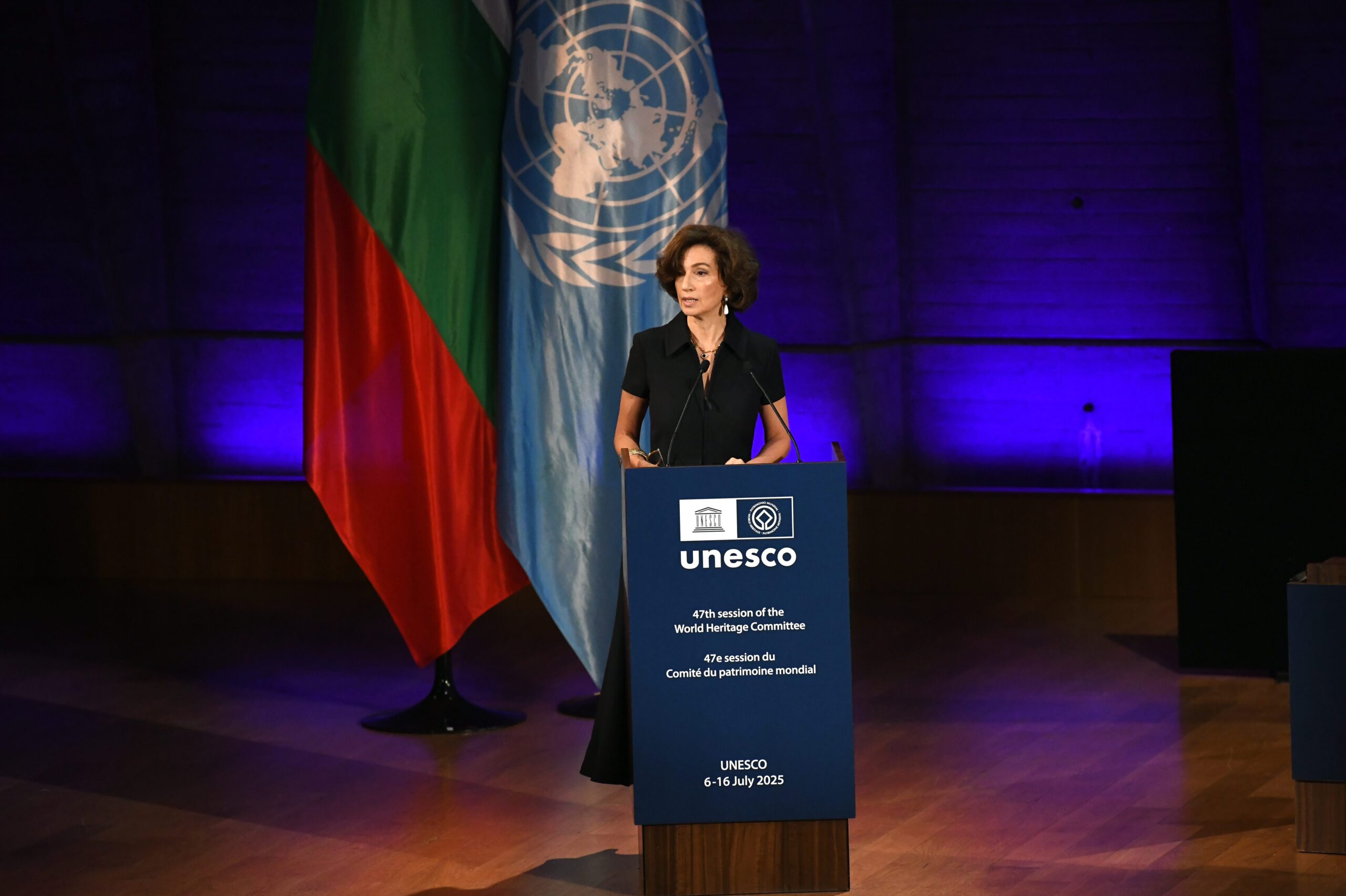
A former French culture minister, Azoulay is the first Jewish leader of the controversial U.N. agency
CHANGING OF THE GUARD

Liam Elkind, 26, leads a nonprofit organization to deliver food and medicine to vulnerable New Yorkers
Good Tuesday afternoon,
This P.M. briefing is reserved for our premium subscribers like you — offering a forward-focused read on what we’re tracking now and what’s coming next.
I’m Danielle Cohen-Kanik, U.S. editor at Jewish Insider. I’ll be curating the Daily Overtime for you, along with assists from my colleagues. We hope you enjoy the inaugural edition and would love to hear your thoughts and feedback. Please don’t hesitate to drop us a line by replying to this email.
📡On Our Radar
Notable developments and interesting tidbits we’re tracking
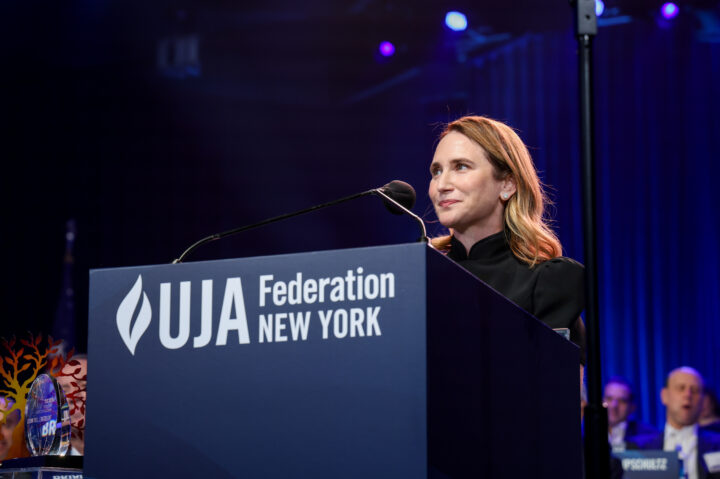
Today, we remember Wesley LePatner, a Jewish philanthropist and Blackstone executive killed in Monday’s shooting at the firm’s Manhattan headquarters. LePatner, 43, served on the boards of the pluralistic Abraham Joshua Heschel School and the UJA-Federation of New York. The federation called LePatner “extraordinary in every way” in a statement, saying she “lived with courage and conviction, instilling in her two children a deep love for Judaism and the Jewish people.” Hindy Poupko, deputy chief planning officer at UJA, said in remarks at the Israel on Campus Coalition’s National Leadership Summit in Washington today that there was a second Jewish victim of the shooting, Julia Hyman. Hyman, a Cornell graduate, worked for Rudin Management in the Midtown skyscraper…
Concerns among Democrats about the humanitarian situation in Gaza and Israel’s role in it are intensifying. On Capitol Hill, the majority of Senate Democrats, led by a group including Senate Minority Leader Chuck Schumer (D-NY) and Sen. Jacky Rosen (D-NV), sent a letter to Secretary of State Marco Rubio and Middle East envoy Steve Witkoff calling the humanitarian crisis in Gaza “unsustainable” and saying that the Israeli- and American-backed Gaza Humanitarian Foundation has “failed” to properly deliver aid…
One Democrat standing up for Israel is Rep. Ritchie Torres (D-NY), who said at the ICC summit today, “We have to remind the world that, despite the amnesia, Hamas was the central cause of the war in Gaza. … Hamas is morally responsible, principally responsible for the war in Gaza.” Read more on Torres’ speech in JI’s Daily Kickoff tomorrow…
Sen. Bernie Sanders (I-VT), who did not sign the Senate Democrats’ letter, jumped into the fray by introducing another resolution to block an arms transfer to Israel — his third since November 2024. In a novel twist, this resolution would block the sale of $1 million worth of assault rifles to Israel’s police force overseen by far-right Minister of National Security Itamar Ben-Gvir, potentially opening the door for more Democrats to vote in favor, given Ben-Gvir’s less-than-favorable reputation within the party…
British Prime Minister Keir Starmer, applying pressure of his own, announced today that the U.K. will recognize a Palestinian state at the U.N. General Assembly in September — matching France’s timeline, announced last week — unless Israel takes “substantive steps to end the appalling situation” in Gaza, reaches a ceasefire with Hamas and commits to reviving the possibility of a two-state solution and not annexing the West Bank. President Donald Trump, who met with Starmer in Scotland yesterday, told reporters that the British PM didn’t discuss the move with him and that he has no view on it, but that the U.S. is “not in that camp”…
On the home front, UCLA settled a lawsuit with Jewish students who alleged that the university permitted antisemitic conduct during the campus’ anti-Israel encampments in spring 2024. According to the agreement announced today, the university cannot allow or facilitate the exclusion of Jewish students, faculty or staff from UCLA programs or campus areas. Notably, the agreement specifies that Jews cannot be excluded “based on religious beliefs concerning the Jewish state of Israel.” Also getting a windfall in the settlement: UCLA agreed to pay over $2.3 million combined to UCLA Hillel and Chabad, the Anti-Defamation League, the Academic Engagement Network and other Jewish organizations combating antisemitism on campus…
⏩ Tomorrow’s Agenda, Today
An early look at tomorrow’s storylines and schedule to keep you a step ahead
Keep an eye on Jewish Insider later this week where we’ll feature an interview with Jeanine Pirro, interim U.S. attorney for D.C., who spoke with JI about the ongoing prosecution of the assailant responsible for the deadly May shooting at the Capital Jewish Museum. We’ll also cover Rep. Mike Collins’ (R-GA) record on antisemitism as he jumps in the race to challenge Sen. Jon Ossoff (D-GA), and report on Harvard’s overtures to the Jewish community while it gears up for a settlement with the federal government.
We’re staying tuned for how President Donald Trump may react as some of the U.S.’ closest allies gear up to recognize a Palestinian state, a policy the U.S. has rejected as unhelpful to peace efforts for decades. Though he said today he has “no view” on the matter, as the U.N. General Assembly nears, will Trump take a tougher line on his European partners?
Stories You May Have Missed
WAIT-AND-SEE APPROACH
One Jewish political leader: ‘No one thinks it’s going to be good for the Jewish community to be hostile and to be in constant war with the next mayor’
PODCAST POLITICS

Ben Rhodes and Tommy Vietor shaped the story of the Iran nuclear deal. Now they’re trying to turn Democrats away from Israel
Plus, Roy Cooper is running 🏃♂️

Michael M. Santiago/Getty Images
New York mayoral candidate, State Rep. Zohran Mamdani (D-NY) greets voters with Democratic mayoral candidate Michael Blake on 161st Street on June 24, 2025 in the South Bronx in New York City. Mamdani held several campaign events throughout the day including greeting voters with mayoral candidates Blake and NYC Comptroller and Mayoral Candidate Brad Lander as voters in NYC vote for the democratic nominee for mayor to replace Mayor Eric Adams.
Good Tuesday morning.
In today’s Daily Kickoff, we talk to Jewish communal leaders in New York City about the reluctance to publicly oppose Democratic mayoral nominee Zohran Mamdani’s candidacy in the absence of a viable challenger, and look at former North Carolina Gov. Roy Cooper’s record on Israel following the launch of his Senate bid. We spotlight the increasingly anti-Israel rhetoric from former senior Obama administration officials, and report on FEMA’s delayed opening of applications for 2025 Nonprofit Security Grant Program funding. Also in today’s Daily Kickoff: Eden Golan, Wallis Annenberg and Matti Friedman.
What We’re Watching
- The Senate Armed Services Committee is holding a classified briefing today on the U.S.’ June strikes targeting Iranian nuclear facilities.
- The Senate Foreign Relations Committee is holding confirmation hearings today for Michel Issa to be U.S. ambassador to Lebanon and Duke Buchan, the former Republican National Committee finance director, to be ambassador to Morocco.
- The Israel on Campus Coalition’s National Leadership Conference wraps up today in Washington. Sen. Dave McCormick (R-PA) and Rep. Ritchie Torres (D-NY) are slated to speak at the confab’s closing session.
What You Should Know
A QUICK WORD WITH JI’S Josh kraushaar
One of the defining features of our politics over the last decade has been the declining power of institutions, combined with the growing influence of individuals acting in their narrow self-interest, frequently at the expense of the public interest.
President Donald Trump’s ability in 2016 to bypass the Republican establishment benefitting from a crowded, self-interested opposition, was one of the seminal moments in our brave new world of individualism over institutionalism. Party institutions, outside-group spending and strident media criticism were no match for the grassroots army that rallied to Trump in that election.
Ten years later, the inability of moderate Democrats and other mainstream institutions to organize any coalition against the campaign of far-left New York City Democratic mayoral nominee Zohran Mamdani looks like the culmination of a dynamic where leaders feel powerless to lead, and are instead simply standing aside, ceding any influence to a cadre of ideological activists within the party.
What’s remarkable about this moment is that the top Democratic leaders in New York, over a month after the primary, aren’t supporting Mamdani — but aren’t willing to speak out against him, either. Senate Minority Leader Chuck Schumer (D-NY), House Minority Leader Hakeem Jeffries (D-NY), New York Gov. Kathy Hochul and Sen. Kirsten Gillibrand (D-NY) have all stayed on the sidelines, reflecting the state of political purgatory that many mainstream leaders are in right now.
WAIT-AND-SEE APPROACH
In recent weeks, a creeping sense of frustration has settled in among many Jewish leaders in New York City as they have reckoned with the dawning reality that no one is stepping up to organize opposition to Zohran Mamdani, the Democratic nominee for mayor, Jewish Insider’s Matthew Kassel reports. Without a well-funded outside effort, Mamdani faces few obstacles in the general election despite numerous political vulnerabilities.
‘Just grasping’: The complacency comes even as top Democratic leaders in New York have so far declined to endorse Mamdani, whose antagonistic views on Israel and democratic socialist affiliation have engendered criticism. But with a divided field of warring and baggage-laden candidates, Jewish leaders have privately voiced disappointment at the current state of the race. “Big-money people are talking every week about how we have to do something, but I haven’t seen a real plan,” said one Jewish leader. “People are just grasping,” he added. “There’s a sense of frustration out there and fear of a letdown.”
TARHEEL STATE TEST

Former North Carolina Gov. Roy Cooper’s decision to seek the Democratic nomination for North Carolina’s open Senate seat has equipped the party with a moderate standard-bearer with a strong relationship with the state’s Jewish community. But his handling of anti-Israel activism within the North Carolina Democratic party is expected to become an issue in the Senate race, one that Republicans are already seeking to exploit, Jewish Insider’s Emily Jacobs reports.
Looking inwards: When confronted with anti-Israel extremism within his own state party, Cooper has been more cautious. The former governor did not initially weigh in on the resolution passed by the North Carolina Democratic Party last month calling for an arms embargo on Israel, as well as on the other anti-Israel measures adopted by the state party. Reached for comment on the state party measures by JI on Monday, Cooper said in a statement: “I don’t agree with the party resolution, and Israel is an important ally. Israel needs to take seriously the job of getting humanitarian aid into Gaza right now. The hostages must be returned and I continue to pray for a swift end to this war and a meaningful peace in the region.”
Stein says: North Carolina Gov. Josh Stein, a Democrat, also criticized the resolutions passed by the state’s Democratic Party last month targeting Israel, urging party leaders on Monday to instead prioritize efforts that tackle the problems “we’re facing here in North Carolina,” Jewish Insider’s Emily Jacobs reports.
MIXED MESSAGES

President Donald Trump decried the humanitarian situation in Gaza on Monday, telling reporters that he does “not particularly” agree with Israeli Prime Minister Benjamin Netanyahu’s assessment that there is no starvation taking place in the enclave, Jewish Insider’s Gabby Deutch reports. “That’s real starvation stuff,” Trump said, following a meeting in Scotland with U.K. Prime Minister Keir Starmer. “I see it, and you can’t fake that.”
Seeking solutions: Trump said the U.S. will be getting “even more involved” in taking steps toward addressing hunger in Gaza, including by setting up “food centers.” A White House spokesperson declined to comment when asked for specifics about what this plan might entail. Trump said “all of the European nations” would be part of the project. “We’re going to do it in conjunction with some very good people, and we’re going to supply funds,” said Trump.
Meanwhile in Jerusalem: Israeli Foreign Minister Gideon Sa’ar doubled down on the argument that claims of starvation in Gaza are the result of a “distorted campaign,” during a press conference on Tuesday, Jewish Insider’s Lahav Harkov reports. “We have been working very hard under complicated circumstances from the beginning of the war to this day to facilitate humanitarian aid into Gaza.”
PODCAST POLITICS
Former Obama administration officials Ben Rhodes and Tommy Vietor took to social media over the weekend to attack Israel and slam the American Israel Public Affairs Committee, asking how it’s possible to “trust Democrats to fight for anything” if they take money from the pro-Israel lobby group. The anti-Israel activism from the Democratic influencers is a public example of the intense lobbying taking place in party circles and how progressive foreign policy officials such as Rhodes who have long been deeply critical of Israel are pushing to turn humanitarian concerns in Gaza into a more permanent split between the Democratic Party and Israel, Jewish Insider’s Danielle Cohen-Kanik reports.
AIPAC attack: Rhodes and Vietor especially directed their ire at AIPAC, which played a key role in Democrats electing some moderate candidates supportive of a close U.S.-Israel alliance to office last year. The left-wing commentators who host a weekly foreign policy podcast, “Pod Save the World,” decried AIPAC for a post on X where the organization said that “food, medicine and aid are IN Gaza. The @UN won’t distribute it.” Rhodes said AIPAC is “spreading lies. The Israeli government is starving Palestinians and everyone knows it. How can we trust Democrats to fight for anything if they take money from people who lie like this about starving kids,” the former Obama deputy national security advisor posted on Friday.
LATE ROLLOUT

The Federal Emergency Management Agency opened applications on Monday for 2025 Nonprofit Security Grant Program funding, months after the applications traditionally open and amid pressure from lawmakers and community stakeholders, Jewish Insider’s Marc Rod reports.
Status check: Applications for the funding round are due Aug. 11. This application round pertains to the $274.5 million in funding that Congress appropriated for the 2025 grant cycle. An additional $126 million in funding for the NSGP remains outstanding from the national security supplemental bill Congress passed last year. Organizations have already applied for that funding tranche. FEMA did not respond to a request for comment on when that funding will be allocated.
Bonus: The Senate Appropriations Committee’s Justice Department budget bill released last week sets up a clash with the House over funds aimed at combating hate crimes. The House bill aims to eliminate that funding, supported by key Jewish groups, for 2026, while the Senate bill would preserve it.
Worthy Reads
The Hunger Games: The Free Press’ Matti Friedman lays out the challenges in getting accurate information regarding humanitarian aid and malnutrition in Gaza. “The transformation of truth-telling institutions into ideological megaphones has had a high price for citizens in liberal societies and for the institutions themselves, as we’re now seeing at places like Harvard and NPR. The feeling of being unmoored from objective reality — of rowing a boat through a choppy sea of lies and propaganda — is very much a feature of the present moment, and not only in Israel. But one of the most awful prices was made clear this past week, with reports of acute hunger in Gaza. In a blizzard of ideological fiction, how are sane citizens in Israel, or anywhere else, supposed to know what’s true and to do the right thing? It’s not an exaggeration to say, as we’re seeing right now, that the answer to this question can be a matter of life and death.” [FreePress]
Screen Time: Against the backdrop of media coverage of the growing food crisis in Gaza, The Atlantic’s David Graham looks at the role television news plays in informing President Donald Trump. “As president, Trump has access to the most powerful information-gathering network in the world, yet he takes his cues from what he watches on television. This helps him see the news from the same perspective as the general public, which has enabled his political success. But it also narrows his understanding, and it makes him highly susceptible to manipulation. … This means that despite access to high-quality information about what’s going on in Gaza, he seems to really perk up only once it’s on the tube. Such a narrow information stream is a problem, because TV is not a good source of information on its own; it should be consumed as part of a balanced news diet.” [TheAtlantic]
For Pete’s Sake: Politico’s Rachael Bade looks at the relationship between President Donald Trump and Defense Secretary Pete Hegseth following a series of missteps and moves that are at odds with the White House. “Concerned that the laundry list of scandals could lead to his downfall, they’ve implored Hegseth in private conversations to rethink surrounding himself with people the White House distrusts. Others are urging Hegseth to make peace with the former employees he ousted and accused of leaking. A smaller group is even quietly working to help those employees land a public apology or some sort of exoneration of their character. ‘If there’s any chance at Pete resetting and ensuring that whatever time he has left in this position is well served, he’s got to do it — otherwise Pete is just doubling down on the lie,’ said the person close to Hegseth. So far, however, he has yet to heed the warning.” [Politico]
Water Woes: The Financial Times’ Chloe Cornish, Eleni Varvitsioti and Ahmed Al Omran spotlight the growing use of desalinization plants by governments in the Middle East and southern Mediterranean, as the region grapples with mounting water crises and rising temperatures. “Reducing energy consumption has made producing desalinated water less polluting in terms of greenhouse gas emissions, and reduced the costs. In Israel, water produced by the Sorek B desalination plant is priced at about 40 cents per cubic metre, which is enough for 25 showers, according to Thames Water. Dubai utility Dewa will get a price of 37 cents per cubic metre for water from its Hassyan desalination plant, which is due to start operations next year. … Academics in Saudi Arabia, the world’s biggest desalinated water producer, are trying to tackle the brine problem. Zhiping Lai, a professor at the King Abdullah University of Science and Technology, is mining the brine for valuable elements such as lithium and potassium, which have commercial uses.” [FT]
Word on the Street
A Blackstone executive and NYPD officer were among four people killed in a shooting last night at Blackstone’s Park Avenue headquarters in Manhattan; the suspect, who was reportedly targeting NFL headquarters in the same building, died from a self-inflicted gunshot wound…
Defense Secretary Pete Hegseth signed an MOU earlier this month with Qatar for the “unconditional donation” of a luxury jet…
The Senate Appropriations Committee‘s Justice Department budget bill released last week sets up a clash with the House over funds aimed at combating hate crimes; the House bill aims to eliminate that funding, supported by key Jewish groups, for 2026, while the Senate bill would preserve it…
Sen. Angus King (I-ME) accused Israel of deliberately causing a famine in Gaza, calling its actions in Gaza “an affront to human decency,” and said that he “will advocate — and vote — for an end to any United States support whatsoever [for Israel] until there is a demonstrable change in the direction of Israeli policy.”…
Two members of the Boulder, Colo., City Council accused a colleague of posting content on social media that “crossed a serious line into antisemitism”…
Harvard is reportedly open to spending as much as $500 million to resolve its legal disputes with the Trump administration, following an agreement between the government and Columbia University last week in which the New York school agreed to pay $200 million and undertake a series of steps to address campus antisemitism…
Singer Regina Spektor‘s weekend concert in Portland, Ore., was disrupted by anti-Israel protesters…
An Oregon man was sentenced to 60 months in prison over a series of bomb threats to Jewish institutions in the New York area dating back to 2021…
Palestinian activist Awdah Hathaleen, who appeared in the recent Oscar-winning film “No Other Land,” was shot and killed by an Israeli settler in the West Bank on Monday; the Trump administration had recently lifted sanctions that had been imposed on Hathaleen’s alleged assailant, Yinon Levi, by the Biden administration…
Israel’s Elbit Systems was awarded a $260 million contract with the German government to supply defensive systems for Berlin’s A400M aircraft fleet…
The Financial Times reviews Scott Anderson’s King of Kings, which focuses on the fall of the shah in Iran in 1979…
Iran’s Foreign Ministry said that officials from the International Atomic Energy Agency are expected to travel to the country in the next two weeks for talks aimed at restarting inspections of Iran’s nuclear sites…
Los Angeles-based philanthropist Wallis Annenberg, whose family foundation, which she led for more than 30 years, gave over $3 billion to an array of causes, died at 86…
Longtime Washington Post reporter Morton Mintz died at 103…
Pic of the Day

Israeli singer Eden Golan performed her 2024 Eurovision Song Contest entry “Hurricane” on Monday at the Israel on Campus Coalition’s National Leadership Summit in Washington.
Birthdays
Tony Award-winning actor, Ari’el Stachel turns 34…
Chairman of BOK Financial Corporation in Tulsa, Okla., George Bruce Kaiser turns 83… Shoe designer, entrepreneur and founder of an eponymous shoe company, Stuart A. Weitzman turns 76… Denver-based trial lawyer, film producer and author of both fiction and nonfiction, Kenneth Eichner turns 71… Israeli electrical engineer and inventor, he is best known as the inventor of the USB memory stick, Dov Moran turns 70… Former deputy health and science editor at The Washington Post, Carol Eisenberg… Attorney general of Israel from 2016 to 2022, Avichai Mandelblit turns 62… Global economics and geopolitical correspondent for The New York Times, Peter S. Goodman turns 59… Actor and comedian, best known for his voice work in animation and video games, Richard Steven Horvitz turns 59… Twin brothers, Los Angeles based philanthropists and businessmen, Shlomo Yehuda Rechnitz and Yisroel Zev Rechnitz turn 54… Actor, filmmaker and musician, he is best known for his role in the CBS sitcom “How I Met Your Mother,” Joshua Radnor turns 51… Chief White House correspondent for NBC News, Peter Alexander turns 49… SVP of philanthropic engagement at BBYO, Jayme David… Director of the Straus Center at Yeshiva University, he is also the Rabbi of NYC’s Congregation Shearith Israel (The Spanish and Portuguese Synagogue), Rabbi Meir Yaakov Soloveichik turns 48… Data scientist and journalist focused on elections for the Associated Press, Aaron Kessler… Former member of the Canadian Parliament, David de Burgh Graham turns 44… Iraq war veteran, political and communications strategist, she is now serving as an adjunct professor at Duke University, Allison Jaslow… Rabbi, writer, educator and physician assistant, Rabbi Levi Welton… White House principal deputy communications director during the Biden administration, Herbie Ziskend… SVP in the Los Angeles office of Edelman, Jason Levin… Israeli actress, model and television presenter, Maya Wertheimer turns 35… D.C. attorney, Daniel Ryan Vinik… Uriel Wassner… Broadcaster and media relations manager for the Chicago Dogs and Windy City Bulls, Sam Brief… Quarterback for the NFL’s Washington Commanders, Sam Hartman turns 26…
After meeting with U.K. Prime Minister Starmer, the president said the U.S. will be getting more involved in providing aid

Tasos Katopodis/Getty Images
President Donald Trump
President Donald Trump decried the humanitarian situation in Gaza on Monday, telling reporters that he does “not particularly” agree with Israeli Prime Minister Benjamin Netanyahu’s assessment that there is no starvation taking place in the enclave.
“That’s real starvation stuff,” Trump said, following a meeting in Scotland with U.K. Prime Minister Keir Starmer. “I see it, and you can’t fake that.”
Trump said the U.S. will be getting “even more involved” in taking steps toward addressing hunger in Gaza, including by setting up “food centers.” A White House spokesperson declined to comment when asked for specifics about what this plan might entail. Trump said “all of the European nations” would be part of the project.
“We’re going to do it in conjunction with some very good people, and we’re going to supply funds,” said Trump.
Food distribution in Gaza is currently being operated by the Gaza Humanitarian Foundation, which is backed by both the U.S. and Israel. The organization has faced criticism for failing to meet the needs of Gazans, and scenes of chaos at the gates of its distribution centers have spread online.
Without mentioning GHF by name, Trump appeared to take aim at the existing aid mechanisms, saying that the new “food centers” will not have fences to keep people out.
“We’re also going to make sure that they don’t have barriers stopping people here. You’ve seen the areas where they actually have food, and the people are screaming for the food in there, they’re 35-40 yards away, and they won’t let them because they have lines that are set up,” said Trump. “And whether they’re set up by Hamas or whoever, but they’re very strict lines. We have to get rid of those lines.”
Trump blamed Hamas for the failure of recent ceasefire talks and for prolonging the war, including the humanitarian crisis. The president’s comments come after European leaders have pressed Israel to allow a freer flow of humanitarian aid into Gaza.
“We have a good group of countries who can help with the humanitarian needs, which is food, sanitation, some other things. It’s very difficult to deal with Hamas,” said Trump. “Hamas has become very difficult to deal with in the last couple of days, because they don’t want to give up these last 20 [hostages], because they think as long as they have them, they have protection. But I don’t think it can work that way.”
Fifty hostages remain in Gaza, and Israel believes at least 27 of them are dead. The most recent ceasefire proposal would only have seen the release of about half of the living hostages.
Trump also said Iran played a role in the failure of ceasefire talks, saying Iran “interjected themselves in this last negotiation.”
“I think they got involved in this negotiation, telling Hamas and giving Hamas signals and orders. And that’s not good,” Trump said. “For a country that just got wiped out, they’ve been sending very bad signals, very nasty signals. And they shouldn’t be doing that.”
Plus: TikTok hires a hate speech manager

GAZA CITY, GAZA - JULY 27: An aircraft from the United Arab Emirates drops humanitarian aid balloons over the al-Sudaniyya area of Gaza City, Gaza on July 27, 2025 following Israeli army's announcement of a 'tactical suspension' of military operations in 3 parts of Gaza Strip. Suspension began at 0700GMT and applies to 3 key areas, including Al-Mawasi, Deir al-Balah, and Gaza City, according to Israeli army spokesman. Aid packages were collected by Palestinians struggling to access food. (Photo by Khames Alrefi/Anadolu via Getty Images)
Good Monday morning.
In today’s Daily Kickoff, we report on the mounting international pressure on Israel — including among some pro-Israel Democrats — to resolve the humanitarian crisis in Gaza, the subsequent measures taken by Israel and how they are expected to impact diplomatic ties with European allies. We report on DoJ senior counsel Leo Terrell’s comments yesterday at the Israel on Campus Coalition National Leadership Summit and report on the new TikTok hire with professional roots in the Jewish world who was brought on board to tackle hate speech on the platform. Also in today’s Daily Kickoff: Rep. Ritchie Torres, Ofer Calderon and Penny Pritzker.
What We’re Watching
- Today in New York, France and Saudi Arabia are co-hosting a conference focused on reviving two-state solution talks. The gathering, initially scheduled for June, now comes days after French President Emmanuel Macron said he planned to recognize a Palestinian state at this year’s U.N. General Assembly. Macron is skipping the conference, but his foreign minister, Jean-Noël Barrot, is expected to, per The Economist, “formally present” Paris’ U.N. plans. Barrot, for his part, attempted to meet with Jewish groups while in New York, but was shut down after Macron’s announcement last week. More below.
- The Israel on Campus Coalition’s National Leadership Summit continues today in Washington. Former Israeli Prime Minister Naftali Bennett and Leo Terrell, senior counsel at the Department of Justice, addressed the gathering of more than 600 students yesterday. More below.
- In North Carolina, former Gov. Roy Cooper, a Democrat, is expected to announce his bid for the Senate seat being vacated by Sen. Thom Tillis (R-NC). Cooper’s upcoming announcement comes as former Rep. Wiley Nickel (D-NC) plans to step aside from the race and endorse Cooper, consolidating Democratic support around the former governor. On the GOP side, Republican National Committee Chairman Michael Whatley is expected to announce his bid for the seat in the coming days, setting up what is likely to be one of the most expensive Senate races of the upcoming cycle.
What You Should Know
A QUICK WORD WITH ji’S melissa Weiss and Tamara zIEVE
In Israel’s effort to conduct a pressure campaign on Hamas to oust the terror group and release the remaining hostages held in Gaza, it has found itself instead on the receiving end of another global pressure campaign.
Facing mounting pressure amid a worsening humanitarian crisis in Gaza, Israel over the weekend announced a series of measures aimed at alleviating the widespread malnutrition and security issues in the enclave, including temporary ceasefires, aid airdrops, facilitating a massive increase in Gaza’s water supply and establishing designated humanitarian corridors — even as the IDF called claims of starvation in Gaza “a false campaign promoted by Hamas” and Israeli Prime Minister Benjamin Netanyahu denied that there was starvation in Gaza.
The crisis hit a fever pitch over the weekend as opposition to Israel’s efforts and limits on aid — first put into place in March as a pressure tactic to push Hamas to release the remaining hostages — surged to the highest levels of government around the world.
Dozens of countries called for an end to the war, a restoration of the flow of humanitarian aid into Gaza and the immediate release of the hostages. The shift in the political dynamic extended to Capitol Hill, where Democratic legislators, including many who have been strong supporters of Israel, expressed their concerns over Israel’s approach to the worsening humanitarian crisis in Gaza.
SPEAKING UP
Amid reports of a mounting hunger crisis in Gaza, some of Israel’s staunchest defenders in the Democratic Party are now calling for Israel to do more to get humanitarian aid to Gazans — a signal that deteriorating conditions in the enclave are shifting public opinion even among those firmly in the pro-Israel camp. In a series of Friday statements, two major pro-Israel Democratic groups and a top Jewish Democrat in Congress raised concerns about what Rep. Brad Schneider (D-IL) described as “undeniably dire” circumstances in Gaza, Jewish Insider’s Gabby Deutch reports.
A matter of responsibility: “Israel must take immediate action to ensure sufficient food gets into the territory and to the people in desperate need. The world must not turn a blind eye to the fact that children are starving because of this war,” Schneider said in a statement. “It is Israel’s responsibility, and within its capacity, to address and resolve the situation.” Democratic Majority for Israel CEO Brian Romick said Friday that even though Hamas has no interest in mitigating human suffering in Gaza, Israel still has a responsibility to help starving children. “Even as Hamas works to prolong this war and prevent food from getting to people in need, Israel — along with the United States, Egypt, Qatar, and the rest of the international community — must continue to work to get food to innocent children in Gaza,” Romick said in a statement.
TORRES’ TAKE

Rep. Ritchie Torres (D-NY), a vocal Democratic supporter of Israel in Congress, said in an interview with journalist Chuck Todd on Sunday that Israeli Prime Minister Benjamin Netanyahu had done “irreparable damage” to Israel’s relationship with and support among Democrats, Jewish Insider’s Marc Rod reports.
Notable quotable: “If you’re a Democrat, and if you’re a Democrat of color and if you’re a Black Democrat, you take immense pride in Barack Obama. He represents one of the greatest achievements in politics. We take great pride in his presidency,” Torres said. “To see a foreign leader visibly disrespect him in the manner that Bibi Netanyahu did, I feel did irreparable damage to the relationship with the Democratic Party.” He also said that, despite his support for the Jewish state, he has “no real relationship” with the Israeli government.
Israel’s standing

For European leaders who are ratcheting up pressure on Israel to end the humanitarian crisis in Gaza, the Jewish state’s moves to pause military activity to allow a freer flow of humanitarian aid and begin airdrops of aid are “steps in the right direction,” the German foreign minister said on Sunday. But the aid crisis is inextricably linked, observers say, to a much larger and even thornier issue — a deal to end the grinding 21-month war with Hamas and a release of the hostages. Until such a deal is struck, the pressure from Europe, and from some inside Israel, likely won’t ease. And it could worsen, with some experts warning that European sanctions on Israel aren’t out of the question, Jewish Insider’s Lahav Harkov reports.
Wider issue: Daniel Shek, a former Israeli ambassador to France and a member of the Hostage Families Forum’s diplomatic team, said that the aid airdrops are “a result of international pressure and not sudden altruism.” However, Shek said, they are “like Tylenol for a cancer patient. Surgery is needed, meaning the end of the war.” A spokesperson for German Chancellor Friedrich Merz said that he is “prepared to increase the pressure if progress [on a ceasefire and humanitarian aid] is not made.”
Red lines: A coalition of major American Jewish organizations refused an invitation on Friday to meet with Jean-Noel Barrot, France’s minister for Europe and foreign affairs, after French President Emmanuel Macron announced that the country will recognize a Palestinian state in September, eJewishPhilanthropy’s Nira Dayanim reports.
COLUMBIA COMMITMENTS

Jewish leaders on and off Columbia University’s campus praised the settlement reached last week between the university and the Trump administration to restore some $400 million in federal funding that was slashed in March due to the Ivy League’s record dealing with antisemitism. While some Jewish leaders, students and alumni are taking a wait-and-see-approach, others expressed cautious optimism that the deal could lead to a safer environment for Jewish students following nearly two years of antisemitic protests and disruptions on campus in the aftermath of the Oct. 7, 2023, Hamas terror attacks in Israel, Jewish Insider’s Haley Cohen reports.
Positive perspective: “I am heartened to see the resolution agreement for several reasons,” Adam Lehman, president and CEO of Hillel International, told JI last week. “It recognizes both the clear, egregious violations of the civil rights of Jewish students and staff at Columbia and Barnard [an affiliate of Columbia] during the past two academic years, and the concrete steps Columbia has recently pursued to address these issues.”
Reservations: Still, some said that key reforms are missing from the deal, which falls short of several demands initially made by the Trump administration. Among the demands were putting the Middle Eastern, South Asian and African studies department and the Center for Palestine Studies under the purview of a senior vice provost, who would be appointed by the university to supervise course material and non-tenure faculty hiring, as well as the formation of a presidential search committee to replace acting President Claire Shipman.
security surcharge

Leo Terrell, senior counsel to the assistant attorney general for civil rights, said he is intent on eliminating what he called “the Jewish tax” in an address on Sunday to hundreds of Jewish college students gathered for the Israel on Campus Coalition’s three-day annual leadership summit held in Washington, Jewish Insider’s Haley Cohen reports.
What he said: “For those who don’t know what the Jewish tax is — for you to have this convention, for you to walk your child to a synagogue down the street — you have to pay for extra security,” said Terrell, who heads the Department of Justice’s antisemitism task force. “It makes no sense. It’s unfair. It’s wrong. I find it offensive that it’s being allowed throughout this country. I’m doing everything I can to eliminate it.” Terrell’s comments came as the Federal Emergency Management Agency announced last month that it had awarded $94.4 million in security grant funding to a total of 512 Jewish organizations nationwide.
DEDICATED ROLE

TikTok recently hired a new hate speech manager with long-standing ties to the Jewish community, the company confirmed to Jewish Insider’s Matthew Kassel, as the social media platform faces growing pressure to confront a sharp rise in antisemitic content. The streaming platform enlisted Erica Mindel, a former State Department contractor who worked for Ambassador Deborah Lipstadt, the Biden administration’s special envoy to monitor and combat antisemitism, to join TikTok’s global public policy and government affairs team.
Taking action: The hire comes as TikTok has drawn accusations that it has failed to address a spike in antisemitic and anti-Israel content in the wake of Hamas’ Oct. 7, 2023, terror attacks and amid the ensuing war in Gaza. In her newly created role, Mindel will “develop and drive the company’s positions on hate speech,” seek to “influence legislative and regulatory frameworks” and “analyze hate speech trends,” with a particular focus on “antisemitic content,” among other duties cited in an official job description shared by TikTok.
Worthy Reads
Just Cause, Unjust Tactics: The New York Times’ Ross Douthat argues that Israel’s war against Hamas in Gaza — which he describes as “a war for a just cause” — is now being fought unjustly. “One can have a righteous cause, one’s foe can be wicked and brutal and primarily responsible for the conflict’s toll, and still — under any coherent theory of just war — there is an obligation to refrain from certain tactics if they create too much collateral damage, to mitigate certain predictable forms of civilian suffering and to have a strategy that makes the war’s outcome worth the cost. These are tests that Israel is failing.” [NYTimes]
RJC Rising: The Dispatch’s David Drucker explores the growing influence of the Republican Jewish Coalition. “Since Election Day 2024, the Republican Jewish Coalition has been telling anyone who will listen that Trump’s performance among Jewish voters was a historic success — due in no small part to the money and manpower invested by the RJC. There’s data to back that assertion up…To understand the real and consequential movement toward Trump by Jewish voters in 2024, you have to look under the hood, at the exit polls of battleground states and local precincts with significant populations of Jewish voters. That’s where Trump made his mark with a cohort usually elusive for Republicans; it’s what helped propel him past Harris in swing states that were quite close despite the president’s sweep.” [TheDispatch]
Art of the Steal: In AirMail, Ezra Chowaiki reflects on his dealings with forged looted artworks whose sellers wrongly claim them to be works that belonged to high-ranking Nazi officials. “Art dealers know the back of a painting is more important than its front. The back is where you trace the painting’s history, and the clues for each artwork in Jimmy’s collection were incredible, including incidental marks and labels on each painting, not to mention all those Nazi stamps. … In my years of meeting collectors, I’ve realized that many prefer the forbidden fruit. In its own perverse way, it just tastes a little sweeter. But beware: your perverse fascination with forbidden provenance — the back of the canvas — may keep you from examining a painting’s more obvious faults on the front.” [AirMail]
Word on the Street
Darren Beattie, who was fired from his role as a speechwriter in the first Trump administration over his ties to white nationalists, was tapped to serve as acting president of the U.S. Institute of Peace in addition to his role as under secretary of state for public diplomacy and public affairs at the State Department…
Sen. Lindsey Graham (R-SC) told NBC’s “Meet The Press” that he believes Israel will be unable to negotiate an end to its war with Hamas and will have to do “what [the Allied forces] did in Tokyo and Berlin, take the place by force and start over again, presenting a better future for the Palestinians, hopefully having the Arabs take over the West Bank and Gaza”…
Secretary of State Marco Rubio is reportedly favoring “a more comprehensive approach to end the war and free all the remaining hostages” after meeting with hostage families at the State Department on Friday…
A Palestinian boy referenced in images that went viral last week as a symbol of the humanitarian crisis in Gaza was discovered to be suffering from a preexisting genetic muscle disorder…
A growing number of news organizations are calling on Israel to allow journalists access to the Gaza Strip…
The New York Times reports on speculation that funding for the refurbishment of the Qatari plane being gifted to the Trump administration is coming from funds allocated from a nuclear modernization program inside the Pentagon…
A White House official told The Wall Street Journal that it will use its recent settlement with Columbia University as a blueprint for its legal battles with other universities…
The New York Times spotlights former Commerce Secretary Penny Pritzker’s role as head of the Harvard Corporation, as both the Trump administration and the Corporation raise concerns about her continued leadership and involvement…
Minnesota Democratic activist Latonya Reeves, a member of the Democratic National Committee, is mulling a primary challenge to Rep. Ilhan Omar (D-MN)…
French authorities are investigating the circumstances behind the removal last week of several dozen French Jewish campers and camp staffers from a Vueling flight amid claims from the group that it was deplaned because the campers were Jewish; Vueling has denied the allegations and said the group was removed due to the unruly behavior of some of the campers prior to takeoff…
The New York Times looks at the impact of Iran’s deepening water crisis amid record-setting heat and energy shortages around the country…
Mathematician-turned-singer Tom Lehrer, whose satirical tunes from the 1950s and ‘60s gained new audiences when Cameron Mackintosh compiled Lehrer’s music into the 1980 revue “Tomfoolery,” died at 97…
Pic of the Day

Ofer Calderon (right), who was held hostage by Hamas in Gaza for 484 days, cycled yesterday alongside Israel-Premier Tech team owner and philanthropist Sylvan Adams in the final stage of the Tour de France on the Champs-Élysées in Paris. On the 100th day of the hostages’ captivity, Adams led a global cycling event in their honor and promised that when Calderson would be released, he would ride alongside him at the Tour de France.
Birthdays
Jerusalem-born actor with more than 30 movie and television roles in the U.S., Ori Pfeffer turns 50…
Survivor of Auschwitz-Birkenau as a teen, he emigrated to Israel and became an artist, Yehuda Bacon turns 96… Chicago radio news personality, from 1973 to 2013 he was a television news anchor in Chicago, Walter David Jacobson turns 88… U.S. District Court judge in Manhattan until 2006, then U.S. attorney general for the last 14 months of the Bush 43 administration, now of counsel at the international law firm of Debevoise & Plimpton, Michael Mukasey turns 84… Swedish industrialist, chairman of the Nobel Foundation (manager of the Nobel Prize) from 2005 to 2013, Marcus Storch Ph.D. turns 83… In 1986 she became the first woman in the IDF to hold the rank of brigadier general, she then served as a member of Knesset, and now serves on multiple for-profit and nonprofit boards, Amira Dotan turns 78… Oldest active quarterback, he also manages football teams in Baltimore and Jerusalem, Joe Pollak turns 75… President of the Council on Foreign Relations for 20 years until he retired in 2023, Richard N. Haass turns 74… Tel Aviv-born real estate developer, restorer of historic buildings in downtown Los Angeles, Izek Shomof turns 66… Partner and managing director of Meadow Lane Advisors, Marty Friedman… French-Israeli hairdresser and entrepreneur, Michel Mercier turns 64… Sports executive, attorney and former president of basketball operations for the NBA’s Minnesota Timberwolves, David Kahn turns 64… American schoolteacher, wrongfully detained by Russia in 2022, he was released in the early weeks of the Trump 47 administration, Marc Hilliard Fogel turns 64… Talent booker, publicist and television and radio personality in Atlanta, Mara Davis turns 56… Tech entrepreneur who has invested in more than 100 startups, New York Times bestselling author, Joshua M. “Josh” Linkner turns 55… Co-founder of 23andMe, she recently regained control of the company, Anne Wojcicki turns 52… Actress and reality show personality, Elizabeth Berkley Lauren turns 51… Deputy CEO at UpStart, Jennifer Lew Goldstone… Associate justice of the Supreme Court of California, Leondra Kruger turns 49… Israeli journalist and former member of the Knesset, Ksenia Svetlova turns 48… Managing partner at Altitude Ventures, a health-care venture capital firm, he is a former White House liaison to the Jewish community, Jay Zeidman… Senior reporter at Bloomberg News, Laura Nahmias… CEO and CTO at Diagnostic Robotics in Jerusalem, Kira Radinsky Ph.D. turns 39… VP of player personnel at MLB’s Miami Marlins, Samuel Mondry-Cohen… Administrator at Lehigh Valley Homecare in Allentown, Pa., Menachem (Mark) Perl… Actor and producer who stars in the CBS series “Ghosts,” Asher Chazen Grodman turns 38… National narrative enterprise reporter at The Washington Post, Ruby Cramer… Larry Gordon…
The vocal pro-Israel Democrat said he has ‘no real relationship’ with the Israeli government

Al Drago-Pool/Getty Images
Rep. Ritchie Torres, a Democrat from New York, speaks at a House Financial Services Committee hearing on oversight of the Treasury Department and Federal Reserve coronavirus pandemic response on Capitol Hillon September 30, 2021 in Washington, DC.
Rep. Ritchie Torres (D-NY), a vocal Democratic supporter of Israel in Congress, said in an interview with journalist Chuck Todd on Sunday that Israeli Prime Minister Benjamin Netanyahu had done “irreparable damage” to Israel’s relationship with and support among Democrats, tracing the origin of the breach to Netanyahu’s public clashes with President Barack Obama.
“If you’re a Democrat, and if you’re a Democrat of color and if you’re a Black Democrat, you take immense pride in Barack Obama. He represents one of the greatest achievements in politics. We take great pride in his presidency,” Torres said. “To see a foreign leader visibly disrespect him in the manner that Bibi Netanyahu did, I feel did irreparable damage to the relationship with the Democratic Party.”
Asked by Todd how he would advise the Israeli government to repair its relationship with the party, Torres offered no suggestions, repeating that “it feels like the damage may be irreparable.” He added that support for the U.S.-Israel relationship is “eroding, and anyone who denies it is ignoring the numbers.”
(Torres subsequently told Jewish Insider that the “irreparable damage” was referring to “the relationship between Netanyahu and the Democratic Party, not the relationship between Israel and the Democratic Party.”)
Torres also said that he has “no real relationship” with the Israeli government, despite his support for the Jewish state, and said that his conversations are usually general and high-level, and do not yield “useful information.”
“I do not consider myself having a good relationship with the Israeli government,” Torres said.
He said Netanyahu should have been able to disagree with Obama, “but when you inject yourself into partisan politics and put your thumb on the scale in favor of one political party, that sets a dangerous precedent, and I believe that the consequences of geopolitical calculation continue to reverberate to this day.”
Netanyahu and Obama split publicly over the U.S.’s nuclear deal with Iran, and Netanyahu accepted an invitation from then-Speaker of the House John Boehner, a Republican, to address Congress to condemn the deal.
He said that the U.S.-Israel relationship requires bipartisanship and that “if you politicize it, you’re not a friend of the relationship, you’re an enemy.”
Torres said Netanyahu had “made a terrible mistake” and that there is a “legitimate perception that the present Israeli government is just aligned with the Republican Party.”
The Democratic congressman also called for an end to the war in Gaza, the release of hostages, increased humanitarian aid to Palestinians, new Palestinian governance in Gaza and efforts to build on the Abraham Accords, arguing that warnings from Israeli reporters about the deteriorating humanitarian situation in Gaza must be heeded.
He’s one of several pro-Israel Democrats who have grown more critical of the Israeli government’s handling of the humanitarian situation in Gaza in recent days. Additionally, some congressional Republicans have warned that Israel’s conduct is risking American support.
Torres argued that the impact of the war for Israel has been mixed — even as it has severely degraded Iran and its proxies and “emerged from Oct. 7 stronger and … reestablished deterrence,” it has lost significant support in the United States.
The New York congressman has also recently raised eyebrows with his defenses of Democratic New York City mayoral candidate Zohran Mamdani — though Torres has not endorsed Mamdani and said that Mamdani must address “real concerns” in the Jewish community.
Plus, today's summit in Sardinia

Kyle Mazza/Anadolu via Getty Images
Pennsylvania Governor Josh Shapiro speaks during a press conference outside of the Governor's Mansion after an arsonist sets fire to the Governor's Residence in a targeted attack in Harrisburg, Pennsylvania, United States on April 13, 2025.
Good Thursday morning.
In today’s Daily Kickoff, we interview Pennsylvania Gov. Josh Shapiro in Lewistown, Pa., and hear his thoughts on New York City Democratic mayoral candidate Zohran Mamdani’s defense of calls to “globalize the intifada,” and report on White House official Seb Gorka’s comments yesterday that the U.S. isn’t pursuing regime change in Iran. We report on an Israeli initiative to provide medical assistance to Druze women who were sexually assaulted during sectarian clashes in Syria last week, and cover Sen. Rand Paul’s efforts to delay former National Security Advisor Mike Waltz’s nomination to be U.S. ambassador to the U.N. Also in today’s Daily Kickoff: Kemi Badenoch, Seth Klarman and Reps. Josh Gottheimer and Don Bacon.
What We’re Watching
- White House Middle East envoy Steve Witkoff is meeting in Sardinia, Italy, today with Israeli and Qatari officials, including Israeli Strategic Affairs Minister Ron Dermer, to discuss a potential ceasefire and hostage-release deal. Qatari Prime Minister Mohammad bin Abdulrahman al-Thani will reportedly attend the Sardinia sit-down, a week after quietly meeting for dinner with President Donald Trump at the White House.
- We reached out to the White House this week about that dinner meeting, for which, notably, no readout or photos were issued. A White House spokesperson told us that “[i]t was a great and productive meeting with one of our country’s greatest allies in the region,” but did not respond to further requests for details.
- To that end, we’re keeping an eye on the ceasefire talks also happening in Doha, where earlier this morning Hamas submitted a new response to the latest proposal, after its prior response was rejected by mediators.
- Dermer is also reportedly slated to meet today in Paris with Syrian Foreign Minister Asaad al-Shaibani and U.S. Ambassador to Turkey Tom Barrack, the Trump administration’s Syria envoy, to discuss security issues.
- On Capitol Hill, Sen. Cynthia Lummis (R-WY) will introduce legislation today requiring the National Education Association to expand its federal charter to prohibit the nation’s largest teachers’ union from “engaging in electoral politics or lobbying” in response to the group’s proposal to cut ties with the Anti-Defamation League. Read more here.
- The Senate Judiciary Committee is holding its confirmation hearing today for Jeanine Pirro to be U.S. attorney for the District of Columbia.
- Also this morning, the Senate Homeland Security Committee will hold a confirmation hearing for Paul Ingrassia, the Trump administration’s nominee to lead the Office of Special Counsel who has trafficked in conspiracy theories, including describing Hamas Oct. 7, 2023, terror attacks and ensuing war as a “psyop” and defended prominent antisemites including Kanye West, Andrew Tate and Nick Fuentes. Senate Republicans told JI last month that they planned to scrutinize Ingrassia’s record ahead of his hearing. Read more here.
What You Should Know
A QUICK WORD WITH JI’S gabby Deutch
Inside a coffee shop in rural Pennsylvania, hundreds of miles from the bustle of Manhattan, Pennsylvania Gov. Josh Shapiro made his first public comments about Zohran Mamdani on Wednesday following the democratic socialist’s victory in New York City’s Democratic mayoral primary a month earlier.
Mamdani “seemed to run a campaign that excited New Yorkers. He also seemed to run a campaign where he left open far too much space for extremists to either use his words or for him to not condemn the words of extremists that said some blatantly antisemitic things,” Shapiro told Jewish Insider.
Shapiro’s comments come as Mamdani continues to face backlash for declining to condemn the phrase “globalize the intifada,” and as national Democratic figures struggle to figure out how to respond to his come-from-behind victory and to assess what his nomination means for the future of the party.
“I’ll say this about Mamdani or any other leader,” Shapiro told JI. “If you want to lead New York, you want to lead Pennsylvania, you want to lead the United States of America, you’re a leader. I don’t care if you’re a Republican or Democratic leader or a democratic socialist leader. You have to speak and act with moral clarity, and when supporters of yours say things that are blatantly antisemitic, you can’t leave room for that to just sit there. You’ve got to condemn that.”
Widely viewed as a possible 2028 presidential candidate, Shapiro has steered clear of weighing in on a number of divisive national issues, preferring instead to focus on Pennsylvania, where he maintains a 61% approval rating. But national conversations, including about Israel and antisemitism, have found their way to the governor’s mansion in Harrisburg — in more ways than one.
In April, the residence was set ablaze in an arson attack just hours after Shapiro and his family had hosted a Passover Seder. Police said the alleged perpetrator was motivated by anti-Israel animus, but Shapiro has repeatedly declined to characterize the incident as antisemitic in nature, saying that doing so would be “unhelpful” to prosecutors who have not brought hate crime charges.
Shapiro told JI the arson attack left a profound impact on him, both personally and religiously. It brought him closer, he said, to “my faith and my spirituality.” The attack, Shapiro said, has “given me a deeper, spiritual connection of my faith and a deeper connection to people of other faiths.”
SEB SAYS
Sebastian Gorka, the White House senior director for counterterrorism and a deputy assistant to the president, said Wednesday at the Foundation for Defense of Democracies that the U.S. is not seeking regime change in Iran, but will maintain its maximum-pressure campaign on Tehran, Jewish Insider’s Marc Rod reports.
Covering the waterfront: Gorka also said that he supports efforts to designate the Muslim Brotherhood as a terrorist organization, suggested that he’s pursuing efforts to convince Qatar and Turkey to cut ties with Hamas and said the U.S. wants to see Syrian minority groups come to the table and join with the new Syrian government. He additionally discussed efforts to implement non-Hamas police and security in Gaza, praised Israel’s efforts to undermine Iran and its proxies and spoke about potential Iranian attacks in the U.S.
Shot down: Sen. Pete Ricketts (R-NE) attempted to call up and pass by unanimous consent a resolution urging the United Kingdom, France and Germany to trigger the snapback of United Nations sanctions on Iran under the Joint Comprehensive Plan of Action “as soon as possible,” but was blocked by Sen. Rand Paul (R-KY), Jewish Insider’s Marc Rod reports.
DONE DEAL

Columbia University announced on Wednesday that it reached a deal with the Trump administration to restore some $400 million in federal funding that was cut by the government in March due to the university’s record dealing with antisemitism since the Oct. 7, 2023, Hamas terror attacks in Israel, Jewish Insider’s Haley Cohen reports.
Details: Under the terms of the settlement, Columbia agreed to pay $200 million over three years to the federal government. In addition, the university has agreed to settle investigations brought by the U.S. Equal Employment Opportunity Commission for $21 million. A number of open civil rights investigations into the university alleging harassment of Jewish students will also be settled under the terms of the agreement, according to which the university will also abide by laws banning the consideration of race in admissions and hiring. Columbia said it will continue to have “autonomy and authority over faculty hiring, admissions, and academic decision-making.”
University statement: “While Columbia does not admit to wrongdoing with this resolution agreement, the institution’s leaders have recognized, repeatedly, that Jewish students and faculty have experienced painful, unacceptable incidents, and that reform was and is needed,” the university said.
SMUGGLING TO SUWEIDA

Amid clashes between Druze residents of Syria, Bedouins, militias supporting Syrian President Ahmed al-Sharaa and Syrian government forces in recent weeks, videos and eyewitness testimony has emerged of brutal executions, torture and rape in Sweida, a Druze town in southern Syria. A group of Israelis has been working together to provide medical aid to Syrian Druze women who were allegedly sexually assaulted, Laila Khalife, an Israeli Druze woman who is part of the initiative, told Jewish Insider’s Lahav Harkov on Wednesday. There have been reports of rape of Druze girls and women, including the rape and murder of a 5-year-old girl, though the number of victims is still unknown.
Aid efforts: Israel began transferring NIS 2 million (over $600,000) in humanitarian aid to the Sweida area in recent days, including food, first aid kits and other medical equipment. Hundreds of Israelis donated blood to be sent to Syria. On Sunday, four Israeli Air Force helicopters reportedly reached the hospital in Sweida, which was attacked in last week’s clashes. In addition to the official aid packages, Druze Israeli women attempted to smuggle emergency contraception delaying or preventing ovulation, to minimize the likelihood of pregnancy among women reportedly raped in the clashes. However, those packages were intercepted.
UNRWA ISSUE

Democratic members of the House Appropriations Committee criticized Republican-led efforts to dismantle the United Nations Relief and Works Agency in the House’s draft 2026 budget bill for the State Department and other foreign programs, Jewish Insider’s Marc Rod reports.
Back-and-forth: The exchanges underscore the continued support among some prominent Democrats for restoring the U.S. relationship with the scandal-plagued UNRWA, more than a year after U.S. aid to the group was first halted following allegations that some UNRWA staff participated in the Oct. 7, 2023, attacks on Israel. The budget bill includes a continued ban on aid to the agency and calls on the State Department to put together a plan to replace it. During an Appropriations Committee meeting yesterday, Rep. Madeleine Dean (D-PA) particularly questioned the Gaza Humanitarian Foundation, describing it as a “‘death trap for starving Palestinians.”
Mideast matters: A bipartisan group of experts urged members of the Senate Foreign Relations Near East, South Asia, Central Asia and Counterterrorism subcommittee on Wednesday to support efforts to keep the U.S. engaged with Israel and other allies in the Middle East. The experts, including former Trump and Biden administration officials, warned that a U.S. retreat from the region would create a vacuum quickly filled by American adversaries, Jewish Insider’s Emily Jacobs reports.
ONLINE ACTION

Reps. Josh Gottheimer (D-NJ) and Don Bacon (R-NE) on Wednesday announced the reintroduction of the STOP HATE Act, which aims to crack down on antisemitism on social media. The legislators announced the bill’s reintroduction at a press conference alongside Anti-Defamation CEO Jonathan Greenblatt, Jewish Insider’s Marc Rod reports.
Countering terrorism: The bill, which was first introduced in November 2023 but failed to progress in the previous Congress, would require social media companies to publicize specific policies on their standards and restrictions for their platforms by designated terrorists, report to the federal government on content flagged and/or removed under these policies and publicly report on incidents incidents in which violate these policies.
STALLING TACTICS

Sen. Rand Paul (R-KY) is delaying efforts to confirm former National Security Advisor Mike Waltz as U.S. ambassador to the United Nations over Waltz’s previous support for a continued U.S. troop presence in Afghanistan. Paul told Jewish Insider’s Marc Rod on Wednesday he would not vote to support moving Waltz out of the Senate Foreign Relations Committee with a favorable recommendation, as is generally a standard part of the confirmation process.
What this means: Paul’s concerns forced the committee to delay a vote, scheduled for Wednesday, to advance Waltz’s nomination. Paul said he would vote to advance the nomination with a neutral recommendation, which would allow Waltz to move forward for consideration from the full Senate but would be an unusual black mark on Waltz’s nomination. Unless Waltz picks up Democratic support, the committee vote would be tied — preventing the nomination from moving forward — without Paul’s backing.
Worthy Reads
Next-Gen Hard-liners: In The Wall Street Journal, Reuel Marc Gerecht and Ray Takeyh caution that the next generation of Iranian leaders could pose significant threats to both the U.S. and Israel. “They are drawn from militant groups such as the Paydari Front and the second tier of the Revolutionary Guards. They look to guidance from the likes of the religiously obsessional Saeed Jalili, a former nuclear negotiator who abjures compromise. They are found in the security organs, occupy seats in parliament and run their own education centers. They have created their own underground shadow government and ideological ecosystem. … Indeed, the rising generation of the Revolutionary Guards have defined themselves by their willingness to brutalize their countrymen repeatedly. And these guardsmen have had two other core commitments: the A-bomb program and the proxy war strategy devised by their fallen hero, Qassem Soleimani, the Revolutionary Guard dark lord whom an American missile felled in Baghdad in 2020.” [WSJ]
Where’s Marco?: The Financial Times’ Guy Chazan looks at Secretary of State Marco Rubio’s ideological evolution as he has moved to embrace broad swaths of President Donald Trump’s worldview. “As a senator, Rubio was a fervent advocate of American overseas assistance, of Washington’s long-standing alliances and the power of US diplomacy as a force for good in the world. He would stress the need to stand up to dictators and support dissidents campaigning against authoritarian regimes. Yet he has since embraced Trump’s Maga ideology, with its isolationism, impatience with foreign aid and determination to drastically shrink the federal workforce. … But allies dismiss the idea Rubio has changed, insisting that on key issues he has been remarkably consistent. Far from abandoning his values, they say, he has championed them, influencing Trump to adopt a more hawkish posture towards countries such as China, Iran, Russia and Venezuela.” [FT]
If Dems Gain Power: In The Atlantic, Paul Rosenzweig considers how a future Democratic presidential administration could employ the same tactics as the Trump administration vis-a-vis sweeping policy shifts, department reorganizations and mass firings. “What lies ahead, then, is a new era of pendulum swings, replacing the stability of the postwar governing consensus. Ahead is a cycle of retributive prosecutions and whipsaw funding decisions. America may see entire Cabinet departments alternatively created and closed every four years while the presidency goes from policy to anti-policy — enforcing DEI in one administration, perhaps, and prohibiting it in the next. The country would, in effect, return to the time before the Pendleton Act, when the entire federal workforce turned over with each successive administration, rewarding cronyism at the expense of expertise.” [TheAtlantic]
Word on the Street
Secretary of State Marco Rubio announced that the Trump administration is opening an investigation into Harvard’s eligibility in the U.S.’ Exchange Visitor Program after a previous effort to revoke the school’s Student and Exchange Visitor Program status was blocked by a federal judge…
The Pentagon’s internal watchdog reportedly received evidence that information about strikes on Houthi targets in Yemen that were shared by Defense Secretary Pete Hegseth in a Signal group chat originated from a classified email sent by CENTCOM head Gen. Erik Kurilla; Hegseth had previously testified under oath that he had not shared classified information in the group chat…
Rep. Mike Lawler (R-NY) said he plans to run for reelection to his House seat, and will forgo a gubernatorial bid, clearing a path for Rep. Elise Stefanik (R-NY); Stefanik, who has been mulling a challenge to New York Gov. Kathy Hochul, said after Lawler’s announcement that she will decide in November whether to make a bid for the state’s top job…
And in Michigan, Rep. Bill Huizenga (R-MI) announced he will not run for the state’s open Senate seat in 2026, following a recent meeting with President Donald Trump in which Huizenga was asked to forgo a bid; Huizenga’s decision leaves former Rep. Mike Rogers (R-MI), who made his first Senate bid in 2024 and has Trump’s backing, as the early GOP front-runner…
Former North Carolina Gov. Roy Cooper is expected to announce his entry into the state’s Senate race next week; Cooper, a Democrat, had been a top party recruit for the seat being vacated by Sen. Thom Tillis (R-NC); on the GOP side, Republican National Committee Chair Michael Whatley is planning to launch his bid for the seat in the next week and a half, after Lara Trump opted not to mount a Senate bid…
Speaking at a House Foreign Affairs Committee hearing, Rep. Joaquin Castro (D-TX), accused Israel of carrying out a campaign of “ethnic cleansing” in Gaza being paid for by the United States, and called for the U.S. to impose “consequences” against the Israeli government for “the horrors that they’ve committed”; he also urged an independent investigation of alleged settler attacks in the West Bank on a Palestinian church and a Palestinian-American man…
Greg LoGerfo, the acting coordinator for counterterrorism at the State Department, described antisemitism as a key motivator for current terrorist threats globally at a House Foreign Affairs Committee hearing; he also committed to reviewing the Popular Resistance Committees, a Gaza-based Palestinian terrorist group, for a potential terrorist designation…
The most recently filed campaign finance disclosures indicate significant fundraising gains by left-wing Democrats, with Rep. Alexandria Ocasio-Cortez (D-NY) pulling in $15.4 million so far this year; Zohran Mamdani, the Democratic mayoral candidate in New York City, raised over $850,000 in the two weeks prior and two weeks after his primary win last month…
Stanford suspended the co-op status of a campus residence after a Title VI investigation conducted by the university found that students were asked to leave an event at the Kairos housing co-op based over “the presence of ‘Zionists’ in the group”…
For a “Talks at GS” conversation posted yesterday, philanthropist and Baupost Group CEO Seth Klarman spoke with Goldman Sachs President and COO John Waldron about his approach to shifting market environments…
Apple+ released the first images for the upcoming thriller series “The Savant,” based on a 2019 Cosmopolitan profile of an undercover Anti-Defamation League investigator who monitors extremists groups in an effort to stop terror attacks before they happen…
The Wall Street Journal reviews Jack Wertheimer’s Jewish Giving: Philanthropy and the Shaping of American Jewish Life…
U.K. Opposition Leader Kemi Badenoch, in an interview with the Financial Times,called Argentinian President Javier Milei “the template” for conservative leaders, and said she considered herself to be a British version of the Argentinian leader…
The Knesset overwhelmingly passed a nonbinding resolution calling for Israeli annexation of the West Bank…
The Carnegie Endowment for International Peace’s Aaron David Miller considers the role President Donald Trump could play in Israeli Prime Minister Benjamin Netanyahu’s efforts to remain in power, amid the threat of potential new elections…
Brazil said it is finalizing efforts to join South Africa’s International Court of Justice case accusing Israel of commiting genocide in Gaza…
A Norwegian man who had previously worked as a security guard at the U.S. Embassy in Oslo was charged with spying on both the U.S. and Norway on behalf of Iran and Russia; Mohamed Orahhou, who was arrested in November, is believed to have taken and shared intelligence regarding the embassy and employees of Norway’s intelligence services…
Iranian Deputy Foreign Minister Kazem Gharibabadi suggested that Tehran could withdraw from the Nuclear Nonproliferation Treaty if European powers reimpose sanctions on the country; speaking to reporters in New York, Gharibabadi said that Iran will soon allow a delegation from the International Atomic Energy Agency, which had previously been banned from the country, to travel to Tehran for conversations aimed at resuming inspections…
Pic of the Day

Israeli Foreign Minister Gideon Sa’ar (left) and Ukrainian Foreign Minister Andrii Sybiha (right) on Wednesday paid their respects at the memorial to the victims of the Babyn Yar massacre during Sa’ar’s visit to the country, which also included a meeting with President Volodymyr Zelensky.
Birthdays

Actress, best known for her role as Nomi Segal on the Freeform comedy drama “Grown-ish,” Emily Taryn Arlook turns 35…
Philanthropist and former U.S. ambassador to Romania, now senior counsel at Covington and Burling, Alfred H. Moses turns 96… Pulitzer Prize-winning investigative reporter who worked for ABC News and CBS’ “60 Minutes,” Lowell Bergman turns 80… Israeli physician, author and playwright, he is the younger brother of PM Benjamin Netanyahu, Iddo Netanyahu turns 73… Political consultant known for his role in both of President Obama’s presidential campaigns, Joel Benenson turns 73… Retired Los Angeles-based business and real estate attorney, Michael Jeffrey Bordy… Radio anchor and reporter on both CBS nationally and NYC’s WCBS, Michael Sugerman… Member of Congress (D-FL) until 2022, he previously served as the governor of Florida, Charlie Crist turns 69… Russian businessman and Chairman of the Board of Patrons of The Conference of European Rabbis, Boris Mints turns 67… Judge of the U.S. Court of Appeals for the 3rd Circuit, Judge Patty Shwartz turns 64… Presidential historian, professor at McGill and senior fellow in Zionist thought at the Jewish People Policy Institute, Gil Troy turns 64… Director of donor development for AIPAC, he is a retired NFL player who played for the Packers and the Cowboys where he won in Super Bowl XXVII, Alan (Shlomo) Veingrad turns 62… Founder of the Migdal Oz seminary for women in Gush Etzion, she is a granddaughter of Rabbi Joseph B. Soloveitchik, Esti Rosenberg… Film director and producer, Douglas Eric Liman turns 60… Partner in Frost Brown Todd and author of The Liberal Case for Israel, he was the first-ever Jewish statewide elected official in Kentucky (state treasurer), Jonathan Miller turns 58… Author, he writes the “My Ride” column for The Wall Street Journal on exotic cars, A.J. Baime turns 54… Mayor of Asheville, N.C., she was elected in 2013, 2017 and 2022, Esther E. Manheimer turns 54… Actress, writer, podcaster and comedian, Jamie Denbo turns 52… President of Access Computer Technology in West Bloomfield, Mich., he is a rabbi, entrepreneur and social media expert, Jason Miller turns 49… President and CEO of the Jewish Federation of Greater Los Angeles, Rabbi Noah Zvi Farkas… EVP and CFO of Morgan Stanley, Sharon Yeshaya turns 46… Actress, screenwriter and director, Lauren Miller Rogen turns 43… Member of the board of directors of the Jewish Federation of Greater Rochester (N.Y.), Aviva M. Futerman Schochat… Co-founder and partner at Orfin Ventures, Adam Finkel… Media director at Access Brand Communications, Sarah Citrenbaum… CEO and founder of Learned Hand, building AI tools for judges, Shlomo Klapper…
The Israeli leader called Zohran Mamdani’s policy proposals ‘a one-term effort ... A lot of people have been taken in by this nonsense’
Michael M. Santiago/Getty Images
NYC Mayor Zohran Mamdani briefly speaks with reporters as he leaves the Dirksen Senate Office Building on July 16, 2025 in Washington, DC.
Israeli Prime Minister Benjamin Netanyahu argued that young people in America are won over “pretty quickly” by the truth about the situation in Israel, when discussing New York City Democratic mayoral candidate Zohran Mamdani on a podcast released Monday, and suggested that Mamdani’s policies would be unpopular if he’s elected.
“A lot of people have been taken in by this nonsense,” Netanyahu said, on the “Full Send” podcast, hosted by a social media influencer group called the Nelk Boys popular with young men.
“Sometimes folly overtakes human affairs for a while, but not for long, because reality steps in,” Netanyahu said. “I’m obviously not happy with it, but I’m less concerned with it, because I think if we can speak the truth to the young people of America, they wise up pretty quickly.”
The Israeli leader also addressed other policies supported by Mamdani, including the Democratic mayoral nominee’s past support for defunding the police and raising taxes.
“You want to defund the police? You want to have people go into stores and rob them and be free? You think that really creates a good society? You want to crush all enterprise? You want to tax people to death?” Netanyahu said. “That’s a one-term effort, but sometimes you have to get mugged by reality to understand how stupid that is. So that’s silly.”
Plus, Huckabee resolves Israeli visa squabble

Rami Alsayed/NurPhoto via Getty Images
The President of the Syrian Arab Republic, Ahmad Al-Sharaa, delivers a speech at the People's Palace during the swearing-in ceremony of the new government, in Damascus, Syria, on March 29, 2025.
Good Monday morning.
In today’s Daily Kickoff, we report on the resolution of tensions between U.S. Ambassador to Israel Mike Huckabee and Israel’s Interior Ministry over visa hurdles faced by Christian Zionists, and talk to Sen. Mark Warner about the American strikes last month targeting Iran’s nuclear program. We preview the House Financial Services Committee‘s upcoming vote on Rep. Mike Lawler‘s legislation conditioning the repeal of Syria sanctions, and cover Columbia University’s announcement that its faculty-run University Senate will no longer have oversight over student disciplinary procedures. Also in today’s Daily Kickoff: Jacob Frey, Adam Katz and Yoav Segev.
What We’re Watching
- The Conference of Presidents of Major American Jewish Organizations kicks off a three-day mission to Israel today.
- Oral arguments in Harvard‘s lawsuit against the Trump administration‘s freezing of approximately $3 billion in federal funds begin today in Boston.
- Lawmakers in Texas return to Austin today for the start of a special legislative session that will take up, among other issues, potential statewide redistricting that could potentially give Republicans an additional five House seats but may make other safe GOP districts more competitive.
- Israel launched fresh drone strikes on Houthi targets in Yemen earlier today, days after a ballistic missile fired by the Iran-backed terror group triggered sirens across central Israel.
- We’re keeping an eye on Iranian nuclear talks, following an announcement this morning from Iran’s Foreign Ministry that Tehran’s deputy foreign minister will meet this Friday in Istanbul with his counterparts from the U.K., France and Germany to continue negotiations. Over the weekend, Russian President Vladimir Putin met with senior Iranian official Ali Larijani.
What You Should Know
A QUICK WORD WITH JI’S JOSH KRAUSHAAR
A newly released CNN poll, conducted this month, illustrates the resilience of a hawkish DNA within the Republican Party and among its voters even amid the rise of an isolationist strain that has sought to gain influence in the GOP during President Donald Trump’s second term.
The poll asked respondents: “Do you think the United States should or should not take the leading role among all other countries in the world in trying to solve international problems?” Overall, 43% took the more active approach, while 56% took a more isolationist view.
Republicans, however, remained the strongest advocates of a muscular American role in world affairs, with 52% supporting America taking a leading role, with 47% opposed. By contrast, just 42% of Democrats and 39% of independents shared the more hawkish worldview.
Notably, the shift in more isolationist sentiment was almost entirely driven by Democrats and independents since the last CNN survey in March, which found majority support for significant American global engagement. In the March survey, a 57% majority of Democrats preferred more American involvement in the world, a number that dropped 15 points in the last four months. The Republican share of those preferring American engagement remained steady at 52%.
The results from the CNN polls suggest there’s a more committed core of Republican-voting hawks that is more resilient than the shifting political winds, whereas the Democratic foreign policy worldview appears more dependent on partisanship and what’s happening in the news at the time.
christian controversy

Israeli Prime Minister Benjamin Netanyahu’s office resolved a dispute between U.S. Ambassador to Israel Mike Huckabee and Israeli Interior Minister Moshe Arbel over the denial of visas to workers and volunteers for several evangelical Christian organizations, two sources involved in the matter told Jewish Insider’s Lahav Harkov on Sunday. Huckabee sent a letter to Arbel last Wednesday, expressing “great distress” and “profound disappointment” that after the two met to discuss the matter earlier this year, the Interior Ministry’s visa department continued to conduct investigations into American and other evangelical organizations seeking visas for their workers.
Solution found: “A solution has been reached to the satisfaction of all parties. The evangelical Christian organizations active in Israel, which represent the vast majority of Zionists in the world today, will receive all of the visas they need through a streamlined and efficient application process,” Calev Myers, the attorney for the organizations told JI on Monday. Hours before the issue was resolved, a source in the Prime Minister’s Office told JI, “this is something that we consider to be of urgent importance. We have every intention of solving this problem very quickly … It is being handled with the proper sensitivity between the Prime Minister’s Office and the embassy.”
ON THE HILL
The House Financial Services Committee is set to consider legislation by Rep. Mike Lawler (R-NY) this week that aims to create oversight and set conditions for lifting sanctions on Syria, but stops short of full repeal of the 2019 Caesar Syria Civilian Protection Act sanctions bill that other lawmakers are pushing on a bipartisan basis, Jewish Insider’s Marc Rod reports.
Why it matters: That the House is moving forward with Lawler’s legislation, which sets conditions for waiving Caesar Act sanctions, rather than the bipartisan Caesar Act repeal effort may indicate a level of continued skepticism from some House members about the prospect of full sanctions relief for the new Syrian government pushed by the Trump administration.
REVERSING COURSE
The National Education Association, the largest teachers’ union in the country, announced on Friday that it would not cut ties with the Anti-Defamation League, declining to implement a contentious resolution approved by its governing body earlier this month that sought to target the Jewish civil rights organization, Jewish Insider’s Gabby Deutch reports.
What is said: “After consideration, it was determined that this proposal would not further NEA’s commitment to academic freedom, our membership or our goals,” the union’s board of directors said in a statement. The decision came nearly two weeks after the measure was adopted by the NEA’s representative assembly, its annual leadership gathering that drew more than 6,000 union delegates. “There is no doubt that antisemitism is on the rise. Without equivocation, NEA stands strongly against antisemitism. We always have and we always will,” the NEA’s board wrote. “In this time of division, fighting antisemitism, anti-Arab racism, and other forms of discrimination will take more resources, not fewer. We are ready.”
WORDS WITH WARNER

Sen. Mark Warner (D-VA) told Jewish Insider’s Marc Rod on Friday that he’s inclined to view the Trump administration’s strikes on Iran’s nuclear facilities as a “success,” if negotiations with Tehran resume and barring substantial future retaliation from Iran.
What he’s saying: “I will acknowledge the successfulness of the Israeli attacks and how back-foot the regime was. The fact that they didn’t launch the thousands of missiles,” Warner told JI on the sidelines of the Aspen Security Forum. “I was concerned about an attack that didn’t bring Congress along. And I do think there was a huge process foul when the Gang of Eight wasn’t notified and the Republicans [were] — Trump[’s first administration] never did that — but I have never contested the success. … If the current status quo is the same a year from now and it actually leads towards further negotiation — success.”
CREDIT WHERE DUE
Sen. Chris Coons (D-DE) said on Friday that the U.S. strikes on Iran could ultimately produce a positive outcome, a softening of the Delaware senator’s previous skepticism, Jewish Insider’s Marc Rod reports from the Aspen Security Forum.
What he said: “The strike on Iran is one that I disagreed with because of the process, the lack of consultation with Congress, the partisan way that Republicans were notified at the most senior levels [and] Democrats were not,” Coons said at the conference. He said he also had not expected that the administration would be able to avoid significant Iranian retaliation and an escalating conflict. “I frankly, did not believe that we would end up in the period we seem to be in where a counter-strike by Iran against American soldiers and interests has not yet come,” Coons continued.
Also speaking at the forum: Retired Gen. David Petraeus, the former director of the CIA and head of U.S. Central Command, said on Friday that, in the post Oct. 7, 2023, environment, Israel will no longer tolerate threats to its security throughout the region, including a resumption of Iran’s nuclear program.
Differing worldview: Former National Security Advisor Jake Sullivan suggested at the Aspen Security Forum on Friday that the U.S. strikes on Iran had not been necessary and didn’t accomplish the fundamental goal of permanently stopping Iran’s nuclear program.
WINDS OF CHANGE

In a move called for by pro-Israel students at Columbia University, the school announced on Friday that disciplinary action and rules surrounding student protests would be moved out of the purview of the faculty-run University Senate and into the provost’s office, Jewish Insider’s Haley Cohen reports.
Student reaction: “This is the most encouraging and commendable action taken by Columbia’s administration to address the systemic problems within the university since [the Oct. 7, 2023, Hamas terrorist attacks],” Noa Fay, a graduate student entering her last year in Columbia’s School of International and Public Affairs, told JI. “Revoking the University Senate’s power over disciplinary and rule-making procedures has been top of the institutional reform list for many Columbians who wish to see our university restored to order and excellence.”
Worthy Reads
The Trump Whisperer: The New Yorker’s Antonia Hitchens profiles Commerce Secretary Howard Lutnick, looking at the former Cantor Fitzgerald CEO’s yearslong friendship with President Donald Trump. “Lutnick and President Donald Trump speak on the phone most nights, at around one in the morning, just after Lutnick gets in bed. They talk about ‘real stuff,’ like Canadian steel tariffs, Lutnick told me, and also about ‘nothing,’ which he summarized as ‘sporting events, people, who’d you have dinner with, what was this guy like, can you believe what this guy did, what’s the TV like, I saw this on TV, what’d you think of what this guy said on TV, what did you think about my press conference, how about this Truth?’ Of course, Lutnick said, ‘Trump has other people he calls late at night.’ But does he have other people he always calls?” [NewYorker]
Confronting Cambridge: The Atlantic’s Franklin Foer does a deep dive into the tenure of Harvard President Alan Garber, who has handled much of the fallout from the school’s handling of post-Oct. 7 campus antisemitism as well as Harvard’s legal battles with the Trump administration. “Even as Harvard sits on the receiving end of vitriolic attacks from the right, Garber has turned inward — willing to engage with Harvard’s harshest critics and to admit that even bad-faith attacks sometimes land on uncomfortable truths. He’s treated the university’s crisis as an opportunity, leveraging the looming threat of Trump to make changes that would have been politically impossible in less ominous times. The leader of Harvard, bane of MAGA, agrees with much of the underlying substance of the MAGA critique of higher education, at least when stripped of its rhetorical froth and fury. He knows that elite higher education is suffering a crisis of legitimacy, one that is, in no small measure, of its own making, because it gives fodder to those who caricature it as arrogant and privileged.” [TheAtlantic]
The Gaza Debate: In eJewishPhilanthropy, Michael Berenbaum and Menachem Z. Rosensaft respond to genocide scholar Omer Bartov’s recent New York Times op-ed alleging Israel is engaging in genocide. “We are not arguing that this war has always been waged appropriately or that it has been waged proportionally. Nor do we suggest that Israel or any other country involved in warfare cannot be accused of or should not be held accountable for other alleged violations of international law, including crimes against humanity, war crimes and even ethnic cleansing. But those are separate questions from whether a genocide is being committed; and unless such alleged violations of international law satisfy the elements, including specific intent, as defined in Article II of the Convention, they do not constitute genocide.” [eJP]
Cowed on Campus: In Tablet, Eric Kaufmann looks at recent survey data from the Foundation for Individual Rights and Expression that indicates shifts in the behaviors of Jewish college students as campus climates become increasingly politicized in the wake of the Oct. 7, 2023, Hamas attacks and ensuing war in Gaza. “A closer look at the 2024 data shows that the pro-Palestinian tent encampments had a big impact: Before they went up on April 17, 28% of Ivy League Jewish students self-censored. Afterward, 40% did. Across all institutions in the FIRE data, statistical analysis shows that the encampments increased Jewish self-censorship while reducing it for conservatives. Conservative speech has for years been the least free of any major demographic, but Jews have now converged with them. In the Ivy League, Jews now self-censor more than conservatives do.” [Tablet]
Word on the Street
Unnamed Trump administration officials are reportedly angry with Israeli Prime Minister Benjamin Netanyahu‘s recent actions, telling Axios that the prime minister has “acted like a madman” who “bombs everything all the time”; the White House officials expressed concerns that Netanyahu’s actions could “undermine” President Donald Trump’s efforts in the region…
House Minority Leader Hakeem Jeffries (D-NY) met for an hour on Friday with New York City Democratic mayoral nominee Zohran Mamdani but did not issue an endorsement for the candidate; a spokesperson for Jeffries said the two had a “constructive, candid and community-centered” conversation that also included “a variety of other important issues, including public safety, rising antisemitism, gentrification and the importance of taking back the House in 2026”…
Reps. Mark Alford (R-MO), Don Davis (D-NC), Tony Gonzales (R-TX), John Carter (R-TX), Sam Graves (R-MO) and Juan Ciscomani (R-AZ) introduced a resolution congratulating the fighter and bomber wings involved in the U.S. attack on Iran’s nuclear facilities…
Sens. John Curtis (R-UT) and Jacky Rosen (D-NV) introduced a resolution commemorating the anniversaries of the bombings of the Israeli Embassy in Argentina and the Buenos Aires AMIA Jewish community center; in the House, Reps. Debbie Wasserman Schultz (D-FL), Mario Diaz-Balart (R-FL), Adriano Espaillat (D-NY) and Tony Gonzales (R-TX) introduced a resolution condemning the AMIA bombing…
Reps. Jefferson Shreve (R-IN), Josh Gottheimer (D-NJ), Bill Huizenga (R-MI), Maria Elvira Salazar (R-FL) and Mark Messmer (R-IN) introduced a bill requiring the administration to provide a strategy to counter Iran and Hezbollah’s influence in Latin America…
Pennsylvania state Sen. Doug Mastriano, who in 2022 lost to Gov. Josh Shapiro in the commonwealth’s gubernatorial race, teased a potential rematch, posting different logos for a “Doug Mastriano for Governor” campaign…
Minnesota’s statewide Democratic-Farmer-Labor Party endorsed state Sen. Omar Fateh, a democratic socialist, over incumbent Mayor Jacob Frey…
The Wall Street Journal spotlights the efforts of Robert Kraft’s Foundation to Combat Antisemitism, under the leadership of Adam Katz, to use analytics to identify digital trends in antisemitism, craft countermessaging and share data with social media platforms and universities…
Harvard Business School graduate Yoav Segev filed a lawsuit against the university and its police department, alleging that both failed to protect him from being assaulted by anti-Israel campus activists and that school officials obstructed an investigation into the incident…
Israeli Prime Minister Benjamin Netanyahu sought medical attention over the weekend after falling ill from eating spoiled food; the prime minister will work from home until Tuesday while he recovers…
Israel, working with the U.S., reportedly delivered aid to the Syrian Druze city of Sweida as a ceasefire reached late last week appeared to hold; more than 1,100 are believed to be dead in the sectarian violence that drew in Syrian government forces…
Israel will not renew the visa of Jonathan Whittall, the head of the United Nations Office for the Coordination of Humanitarian Affairs in the West Bank and Gaza, citing his “biased and hostile conduct against Israel”…
Hamas officials in Gaza claimed at least 85 people were killed trying to access humanitarian aid near the Zikim border crossing; the IDF, which said it fired “warning shots” to remove an “immediate threat,” disputed the number, saying the “reported number of casualties does not align with the existing information”…
The Wall Street Journal looks at the logistical and operational challenges facing the Gaza Humanitarian Foundation amid increasing concerns over humanitarian aid distribution in the enclave…
Senior Christian leaders from Jerusalem, including Cardinal Pierbattista Pizzaballa, visited the sole Catholic church in Gaza, which was damaged by an Israeli strike last week that also killed three people…
Brig. Gen. (res.) Giora Even Epstein, the most decorated Israeli Air Force fighter pilot in the country’s history, died at 87…
Pic of the Day

Israeli President Isaac Herzog (right) received the credentials of Polish Ambassador to Israel Maciej Hunia. Hunia’s arrival marks the first time in four years that Warsaw has had an ambassador posted to Israel. In addition to Hunia, Herzog also received the credentials of Malta’s new envoy to Israel, Ambassador Claude Bonello.
Birthdays

Actress and producer, Alysia Reiner turns 55…
Laureate of the 1992 Nobel Prize in chemistry, Rudolph A. Marcus turns 102… President at Admar Group, Henry Dean Ostberg turns 97… Retired CEO of Sony/ATV, a large music publishing firm, he is a member of the Songwriters Hall of Fame, Martin Bandier turns 84… Professor emeritus in the Department of Physics at Bar-Ilan University, he won the Israel Prize in 2018, Shlomo Havlin turns 83… Director of the Center for the Political Future at USC, Robert Shrum turns 82… Criminal defense attorney, known for representing many politicians, celebrities and organized crime defendants, Benjamin Brafman turns 77… Former member of the U.K.’s House of Commons, now in the House of Lords, Baroness Susan Veronica Kramer turns 75… U.S. senator (R-WY), John Barrasso turns 73… Chairman and CEO at Quantitative Financial Strategies, Sanford “Sandy” Jay Grossman turns 72… Endocrinologist and professor at Columbia University’s medical school, she is an honorary president of NYC’s Central Synagogue, Shonni Joy Silverberg, MD… Professor at Columbia Law School and daughter of the late Justice Ruth Bader Ginsburg, Jane Carol Ginsburg turns 70… Brooklyn resident, Irene Ostrovsky… Comedian and actor, best known for his five seasons on “Saturday Night Live” ending in 1990, Jon Lovitz turns 68… Former chief rabbi of Moscow, his opposition to the Ukraine war forced him to leave Russia, Rabbi Pinchas Goldschmidt turns 62… Literary agent at the William Morris Endeavor book department, Eric Matthew Simonoff turns 58… Professor of astronomy at MIT and winner of a 2013 MacArthur genius award, Sara Seager turns 54… Brazilian fashion designer best known for avant-garde designs and eclectic prints, Alexandre Herchcovitch turns 54… CEO of Fanatics, licensed sports merchandise and digital sports platform, Michael G. Rubin turns 53… Founder, president and CEO of Securing America’s Future Energy (SAFE) and the Electrification Coalition, Raphael “Robbie” Diamond… Rabbi of Congregation Bais Naftali in Los Angeles, his YouTube channel has over 4.6 million views, Rabbi Yoel Gold… Online media personality and director of product management at Electronic Arts (EA) in Vancouver, British Columbia, Veronica Belmont turns 43… CEO of Women of Reform Judaism since 2023, Rabbi Liz P.G. Hirsch… Clinical social worker, Aniko Gomory-Pink… Entrepreneur and political activist, Chloé Simone Valdary turns 32… Policy advisor at Brownstein Hyatt Farber Schreck, Zachary A. Marshall… Recruiter at Tines, Rachel Elizabeth Nieves… Attorney in Madrid and secretary general of the Federation of Jewish Communities of Spain until 2021, Elias Cohen…
A source in the PMO told JI that Israel has ‘absolutely no interest in undermining the freedom [of workers and volunteers for Christian organizations] coming to Israel’
Andrew Harnik/Getty Images
U.S. Ambassador to Israel Mike Huckabee delivers remarks as President Donald Trump hosts Israeli Prime Minister Benjamin Netanyahu for a dinner in the Blue Room of the White House on July 7, 2025, in Washington, DC.
Israeli Prime Minister Benjamin Netanyahu’s office resolved a dispute between U.S. Ambassador to Israel Mike Huckabee and Israeli Interior Minister Moshe Arbel over the denial of visas to workers and volunteers for several evangelical Christian organizations, two sources involved in the matter told Jewish Insider on Sunday.
“A solution has been reached to the satisfaction of all parties. The Evangelical Christian organizations active in Israel, which represent the vast majority of Zionists in the world today, will receive all of the visas they need through a streamlined and efficient application process,” Calev Myers, the attorney for the organizations told JI on Monday.
Hours before the issue was resolved, a source in the Prime Minister’s Office told JI, “this is something that we consider to be of urgent importance. We have every intention of solving this problem very quickly … It is being handled with the proper sensitivity between the Prime Minister’s Office and the embassy.”
The PMO source said that Israel has “absolutely no interest in undermining the freedom [of workers and volunteers for Christian organizations] coming to Israel … We value evangelicals. It’s very regrettable that there is a problem and we obviously have to fix it.”
Huckabee sent a letter to Arbel last Wednesday, expressing “great distress” and “profound disappointment” that after the two met to discuss the matter earlier this year, the Interior Ministry’s visa department continued to conduct investigations into American and other evangelical organizations seeking visas for their workers.
“It would be very unfortunate that our embassy would have to publicly announce throughout the United States that the State of Israel is no longer welcoming Christian organizations … and is instead engaging in harassment and negative treatment towards organizations with long-standing relationships and positive involvement toward Zionism and friendship to the Jewish people and the State of Israel,” Huckabee wrote.
If the situation continues, Huckabee added, he will instruct the U.S. Embassy’s consular section to treat Israeli citizens in kind.
“Surely this is not the relationship the State of Israel wishes to have with its best partner and friend on the planet,” he wrote.
A source close to Huckabee told JI that the ambassador did not intend for the letter to go public, which it did on Channel 12 news on Thursday evening.
Arbel responded on Thursday that he had committed “to reviewing such applications with the utmost efficiency,” instructed his staff to do so as well earlier this year, and that every specific case raised by Huckabee’s office was addressed “within an exceptionally short timeframe.” The interior minister argued that the specific organizations Huckabee mentioned in his letter were not the ones they had discussed in their meeting earlier this year.
Arbel also said he was surprised by the way Huckabee handled the matter — sending copies of the letter to Netanyahu, President Isaac Herzog, Foreign Minister Gideon Sa’ar and Knesset Speaker Amir Ohana — which, he said, “deviates from accepting working norms and does not reflect the direct and constructive relationship we have established.”
Rabbi Pesach Wolicki, executive director of Israel365action, an organization connecting Christians to pro-Israel advocacy, said that this has been a long-standing issue regarding clergy and other workers and long-term volunteers, and not Christian pilgrims coming to Israel for short visits.
Huckabee and attorney Calev Myers met with Arbel about six months ago to work out issues with a specific group of organizations, and Arbel said he would solve it, but the issue remained unresolved, Wolicki explained.
The exchange of letters also came up at a time of increased tensions between Israel and Christians, after what Israel said was an errant tank shell hit the only Catholic church in Gaza and killed three people, and after several incidents of harassment and attacks by extremist settlers against the Christian population of Taybeh in the West Bank.
Huckabee wrote on X on Saturday that “Taybeh is a quiet Palestinian Christian village south of Jerusalem w/ a lot of American citizens that has been vandalized-including fires set at ancient church. I visited there today. Desecrating a church,mosque or synagogue is a crime against humanity and God.”
“I work for all American citizens who live in Israel –Jewish, Muslim or Christian. When they are terrorized or victims of crime[s], I will demand those responsible be held accountable [with] real consequences,” the ambassador added.
Wolicki said that “the timing couldn’t have been worse.”
Israel has laws restricting missionary activity, and the visa issue has been exacerbated by the fact that the Shas party, whose Haredi constituency is especially sensitive to missionizing, has run the Interior Ministry for much of the last 25 years, he added.
“Any situation in which you have noncitizens in the country for the long term, it’s a bureaucratic process, and because of sensitivity about missionizing, this has always been an issue,” Wolicki said, noting that Israel365 has also had problems obtaining visas for Christian employees in the past.
The organizations Huckabee mentioned in his letter, the Baptist Convention of Israel, Christian Missionary Alliance and Assemblies of God are missionary groups, Wolicki said.
“There are official restrictions on missionary activity that, when Christians learn of them — and I say this with a lot of firsthand experience — it really moves them from support for Israel, even from the American level of valuing free speech … but also they feel like, how can you say you respect Christians and you want Christian support but we’re not even allowed to talk about Jesus when we’re there,” Wolicki said.
“Christians don’t think you’re offending anyone when you preach the gospel, and Jews view that as you have a knife and you’re trying to stab them,” he added.
Wolicki argued that the laws against missionary activity are problematic, though he acknowledged that abolishing them would likely be unpopular in Israel.
“Missionaries are active all over Israel anyway. There are Israelis who are active … Anyone concerned about missionary activity, which is a legitimate concern, should know this is not the solution. It causes more harm than good and makes Christians more hostile to the Jewish people,” he said.
Josh Reinstein, director of the Israel Allies Foundation, which promotes faith-based diplomacy, said that he has seen this issue come up repeatedly over the 21 years since the foundation was founded.
“It’s an ongoing issue because they always change the requirements for Bible-believing Christians and their organizations,” Reinstein said. “There are no protections for Evangelicals like the 14 mainline churches [the Israeli Religious Affairs Ministry] recognizes.”
“This needs a solution, but it is definitely not a crisis or a problem of Israel not wanting Christians as the enemies of Israel are making it out to be,” he added.
Reinstein questioned why what he called a minor issue was making bigger news than Christians under attack in Syria.
“Israel is the only place in the region where Christians grow and thrive, as opposed to in the 22 countries around us,” he said. “People understand the relations bewteen Jews and Christians is so important today…which is why they are trying to make it into a bigger deal than it is. Huckabee is one of the greatest allies and friends Israel has. I don’t think it was his intention to cause a rift.”
Plus, Jewish Voice for Peace's political pivot

Tom Williams/CQ-Roll Call, Inc via Getty Images
Brett McGurk, then-White House Coordinator for the Middle East and North Africa, arrives to the U.S. Capitol on Thursday, April 18, 2024.
Good Thursday morning.
In today’s Daily Kickoff, we cover former White House senior official Brett McGurk’s condemnation of Hamas’ repeated refusals to reach a ceasefire agreement, and report on the anti-Israel group Jewish Voice for Peace’s pivot to electoral politics. We report on Israel’s strikes on Syria amid widespread attacks on the Syrian Druze community, and cover the departure of United Torah Judaism from Israeli Prime Minister Benjamin Netanyahu’s ruling coalition. Also in today’s Daily Kickoff: Wally Adeyemo, Ari Aster and Tali Cohen.
What We’re Watching
- This afternoon at the Aspen Security Forum, Adam Boehler, the Trump administration’s special envoy for hostage affairs, is set to take the stage for a one-on-one conversation with CNN’s Kaitlan Collins. Boehler’s appearance comes amid the cancellation of a number of Pentagon officials who had been slated to address the annual Colorado gathering.
- Later in the afternoon, former National Security Advisor Stephen Hadley, The New York Times’ David Sanger and Johns Hopkins’ Vali Nasr will participate in a panel discussion on Iran. Immediately following that session, former Commerce Secretary Penny Pritzker is slated to speak on a panel about international trade and economics.
- At a reception later in the evening, former Deputy National Security Advisor Dina Powell McCormick will speak about the book she co-authored with her husband, Sen. Dave McCormick (R-PA), Who Believed in You? How Purposeful Mentorship Changes the World.
What You Should Know
A QUICK WORD WITH JI’S JOSH KRAUSHAAR
The latest round of fundraising reports for members of Congress paints a concerning picture about the future of the ideological center. Many lawmakers from both parties known for their pragmatism and moderation struggled to raise big bucks for their campaigns, while a number of insurgent candidates on the left and the right wings of their parties scored significant fundraising hauls.
Some of the middling fundraising numbers from experienced, establishment-oriented lawmakers will lead to speculation they are considering retirement.
On the GOP side, Sen. Joni Ernst (R-IA), a senator deeply immersed in national security issues, only raised $723,000 in the last three months — barely inching past two of her Democratic opponents. That’s an underwhelming sum for Ernst, who has typically been a strong fundraiser but has been taking heat from both the right and left. It will only raise speculation about her political future.
Sen. John Cornyn (R-TX), facing a primary challenge from right-wing Texas Attorney General Ken Paxton, also didn’t hit the $1 million mark in fundraising, bringing in just $804,000. Paxton, despite worries about his electability and scandals surrounding him, raised $2.9 million.
In the House, Rep. Mike McCaul (R-TX), the respected former chairman of the House Foreign Affairs Committee, raised just $93,000 for the quarter, with less than $100,000 in his campaign account. While he’s not in a competitive district, that small sum has raised retirement speculation as well.
On the Democratic side, there were some fresh signs that mainstream, pro-Israel candidates aren’t getting quite the same fundraising traction as they have in the past.
CONFERENCE CONVERSATION
Former U.S. and Israeli officials speaking at the Aspen Security Forum on Wednesday emphasized that Hamas bears responsibility for the failure of hostage release and ceasefire talks, and discussed the possible paths to ending the war in Gaza, Jewish Insider’s Marc Rod reports from the conference. Brett McGurk, the top National Security Council official responsible for the Middle East under the Biden administration, argued on Wednesday that the history of ceasefire talks between Israel and Hamas “is being rewritten by people that weren’t involved in this.”
Missed opportunities: McGurk emphasized that Hamas repeatedly ignored and rejected proposals that fulfilled many of its demands over the course of the last year, arguing that Israel’s attacks on Hezbollah had helped force Hamas’ hand to a temporary ceasefire deal that went into effect in early 2025. “The moral toll of this awful situation tears at the soul of anyone who’s worked on this, anyone,” McGurk said. “But this war could have stopped multiple times if Hamas stopped the war and released hostages — multiple, multiple times.”
Looking ahead: Wally Adeyemo, the deputy secretary of the Treasury Department during the Biden administration, argued on an Aspen panel that postwar reconstruction of Gaza will require new tools, methods and partners.
UNDER THREAT

Israel struck the Syrian Defense Ministry’s headquarters in Damascus on Wednesday in response to violence against the country’s Druze minority, a week after Israeli Prime Minister Benjamin Netanyahu spoke in the White House of the “opportunity for stability, security and eventually peace” with Syria. The strikes came after clashes between Druze and Bedouin groups that began on Sunday, leaving as many as 250 dead over four days in Sweida, some 25 miles from the border with Israel and in the area of Syria that Israel seeks to have demilitarized, Jewish Insider’s Lahav Harkov reports.
Developments: Syrian government forces entered the fray on Tuesday, saying they aimed to stop the fighting and bring about a ceasefire, which they said they had reached on Wednesday. Syrian President Ahmed al-Sharaa, formerly the head of the Syrian branch of Al-Qaida, seeks to disarm Druze and other militias and have them integrate under the new government. Israeli Druze called for Israel to intervene from the outset of the violence on Sunday, saying that their Syrian counterparts were being massacred, raped and tortured by forces aligned with al-Sharaa. In Israel, videos and images circulated of Druze religious figures’ mustaches being forcibly shaved off by men in military fatigues. Secretary of State Marco Rubio said on Wednesday afternoon that Washington has “engaged all the parties involved in the clashes in Syria. We have agreed on specific steps that will bring this troubling and horrifying situation to an end tonight.”
Heard at Aspen: “Israel is in such an extraordinary position. … Think about Israel being born, created May 14, 1948, besieged over decades by attacks and enmity from all of its Arab neighbors, now the strongest country in the Middle East,” former U.S. Ambassador to China Nicholas Burns, a top foreign policy advisor to President Joe Biden, said in Aspen. “Israel’s in the strongest geopolitical position it’s ever been in, after the extraordinary events in Lebanon, in Gaza, in Iran, in Syria over the last two years.”
EXPLAINER
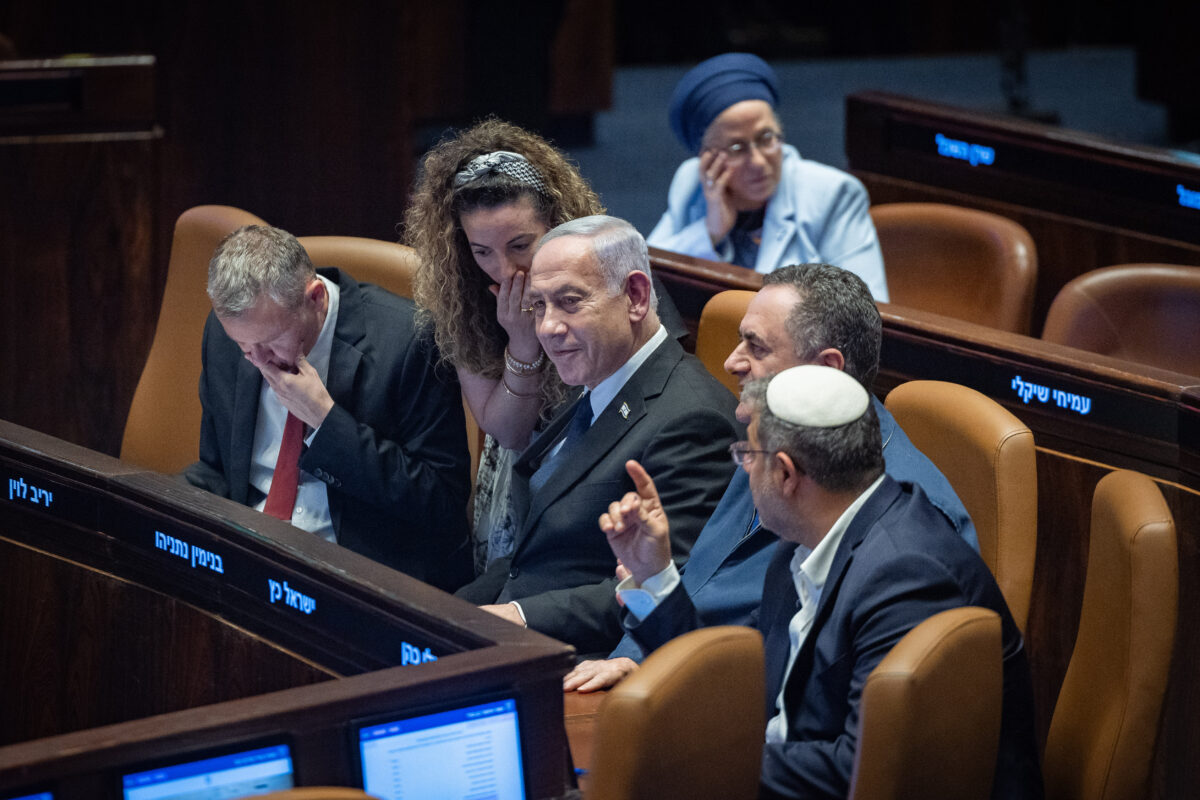
New Israeli elections are unlikely to happen this year, despite the departure on Wednesday of two parties from Israeli Prime Minister Benjamin Netanyahu’s government over disagreements over Haredi military exemption legislation, Jewish Insider’s Lahav Harkov reports. After months of disagreements, Ashkenazi Haredi faction United Torah Judaism left Netanyahu’s coalition in protest, leaving it with 61 out of the Knesset’s 120 seats.
Hanging on: On Wednesday, Sephardic Haredi party Shas’ five Cabinet ministers quit the government, though party leader Aryeh Deri will remain an observer in the Security Cabinet. Shas only quit the government — meaning its Cabinet posts — and did not pull its 11 lawmakers out of the parliamentary coalition. Shas, whose voter base is right-wing and even more supportive of Netanyahu than the prime minister’s own Likud party, said it will not vote with the opposition. This means that Netanyahu retains a majority in the Knesset, albeit a razor-thin one.
switching gears

Jewish Voice for Peace, a far-left anti-Israel advocacy group that has built a growing profile in the wake of Hamas’ Oct. 7, 2023, terror attacks, is pivoting to a new organizational structure that will soon allow it to engage more forcefully in electoral politics. The group recently began the process of consolidating its membership and organizing in an affiliated but lesser-known political nonprofit called Jewish Voice for Peace Action, devoting the bulk of its resources to lobbying and political activities, such as supporting and opposing candidates that had not traditionally been a part of its core focus. As a nonpartisan tax-exempt group, JVP, which has been at the forefront of campus anti-Israel protests and promotes efforts to divest from Israel, has been legally prohibited from taking sides in campaigns — a limitation the new structural change is designed to address, Jewish Insider’s Matthew Kassel reports.
Behind the decision: The shift comes as the activist left has felt newly emboldened by Zohran Mamdani’s shocking victory in New York City’s Democratic mayoral primary in June, fueling debates over the ideological direction of the party as it gears up for next year’s midterms. JVP Action, which recently changed its public name to Jewish Voice for Peace to match its sister organization, was an early supporter of Mamdani and has cited his outspoken opposition to Israel as a sign of evolving voter attitudes about the Israeli-Palestinian conflict. “There is unprecedented, mass support for Palestinians. Our movement has already grown larger, and more quickly, than many of us thought possible. But it’s clear we have not begun to tap our full potential,” JVP writes in a detailed new page on its website about the decision-making behind its shift.
HILL TALK

Members of the House Armed Services Committee sparred on Tuesday at their annual meeting on the National Defense Authorization Act, the massive annual defense and national security policy legislation, over reportedly rogue actions by Secretary of Defense Pete Hegseth and Under Secretary Elbridge Colby to pause U.S. aid to Ukraine without White House knowledge or support, Jewish Insider’s Marc Rod reports.
Other developments: The committee also approved a series of amendments on the Middle East and antisemitism during its markup, and voted on party lines to defeat amendments seeking to block the conversion of a Qatari jumbo jet to be Air Force One and to take the Pentagon to task over the Signalgate scandal.
ALL IN THIS TOGETHER
The pressures of the global oil market restrained Israel from bombing Iran’s Kharg Island oil facilities and Iran from closing the Strait of Hormuz or attacking Saudi Arabia’s Abqaiq oil facilities, an energy policy analyst argued at the Aspen Security Forum on Wednesday, Jewish Insider’s Marc Rod reports.
Explanation: “There was some measure of security that came from the fact that we’re in a global oil market and we’re all in this together,” Jason Bordoff, the founding director of the Center on Global Energy Policy at Columbia University, said on a panel on energy security. “If Iran had tried to do that, it would have imposed pain on itself, it would have imposed pain on China, it would have imposed pain on Gulf countries it was trying to keep on its side.”
Worthy Reads
Hamas’ MO: In Newsweek, former White House Middle East envoy Jason Greenblatt suggests that Hamas has committed “dehumanicide” against the Palestinian people. “I define ‘dehumanicide’ as when a people’s leadership condemns its population to death by treating them not as humans but as props. By camouflaging among civilians — placing weapons, tunnels, and command posts in and under hospitals, schools, mosques, and apartment buildings — Hamas has committed an act of dehumanicide. Hamas transformed civilian lives into strategic assets for international outrage. Hamas instrumentalized Gazans not as people to be protected, but as tools of their horrific, twisted, evil warfare. Hamas accepts these civilian deaths as the ‘cost of doing business.’ Indeed, Hamas welcomes the deaths because it knows the world will use them as cudgels against Israel so that Hamas can prolong its long war against the Jewish state.” [Newsweek]
MAGA Revisionism: In The Free Press, Rebeccah Heinrichs looks at the effort by “conspiracy theorists, cranks, and the craven” of the MAGA wing of the Republican Party to revise how Americans view their own history. “While Donald Trump reaffirms the principles that underpinned his first term — that America remains the leader of the world’s most successful military alliance (NATO), a committed supporter of the Jewish State, lead defender of the global commons, and is willing to use military force when necessary — he is increasingly out of step with a critical constellation of right-wing influencers, podcasters, and contrarian intellectuals. For them, America’s history as a global superpower is morally suspect, if not outright criminal. Our victories become losses, our alliances sinister entanglements, and our deterrence campaigns provocations. Why? Because they must revise the past to justify and satisfy their policy preferences in the present.” [FreePress]
Dear Zohran…: The New York Times’ Tom Friedman raises concerns about New York City Democratic mayoral candidate Zohran Mamdani’s continued defense of the phrase “globalize the intifada,” despite pushback from Democratic officials and the Jewish community. “First, if you are discussing a mantra — like ‘globalize the intifada’ — that takes 15 minutes to explain why it doesn’t mean what it obviously means, I’d suggest that you distance yourself further from that mantra. … When I see someone running for mayor defending a useless, meaningless, far-left mantra that helps no one, and who prefers commenting at a distance and not convening energetically, it makes me wonder how he will deal with the really hard issues on the West Bank of the East River — not the West Bank of the Jordan — that most New York voters care most about.” [NYTimes]
A Grieving Mother’s Plea: In The Hill, Leah Goldin, whose son Hadar was killed in 2014 by Hamas, which has held his body since, calls on Saudi Arabia and President Donald Trump to prioritize the release of the remaining 50 hostages in Gaza as Israel and Hamas work toward a ceasefire agreement and Trump looks to expand the Abraham Accords. “This week marks 4,000 days since Hadar’s abduction. In that time, I have knocked on the doors of leaders and diplomats around the world. I have appealed not only as a grieving mother but as a citizen of a country that shares the United States’s values of justice and humanity. … I beseech the president: use your influence to ensure that Saudi Arabia helps to bring them home. Peace and normalization will be your historic legacy in the Middle East, but they cannot come at the expense of the hostages. Their return is a critical confidence-building step toward the peace that you are building.” [TheHill]
Word on the Street
U.S. Ambassador to Israel Mike Huckabee made a brief appearance at Israeli Prime Minister Benjamin Netanyahu’s corruption trial in Jerusalem on Wednesday, telling reporters earlier in the day that the visit to court was “an act of friendship”; days prior, President Donald Trump had posted on his Truth Social site in support of Netanyahu, calling on the charges to be dropped or for the prime minister to be pardoned…
The International Criminal Court denied a request from Israel to withdraw the arrest warrants issued against Netanyahu and former Defense Minister Yoav Gallant while the court reviews Israeli challenges to the warrants…
A new American intelligence assessment indicates that American strikes on Iranian nuclear facilities last month largely destroyed Fordow, but left Natanz and Isfahan largely intact, albeit somewhat degraded…
New York City Democratic mayoral candidate Zohran Mamdani met on Wednesday with House Democrats, including Reps. Jerry Nadler (D-NY), Ayanna Pressley (D-MA) and Melanie Stansbury (D-NM) at a breakfast in Washington hosted by Rep. Alexandria Ocasio-Cortez (D-NY)…
New York Gov. Kathy Hochul told MSNBC that she had conveyed to Mamdani that he has “a lot of healing to do with the Jewish community” over his anti-Israel activism and support for rhetoric that is widely viewed by the Jewish community as incitement to antisemitic violence…
Les Wexner purchased Norman Foster’s Martha’s Vineyard estate for $37 million…
The New York Times profiles thriller filmmaker Ari Aster ahead of the theatrical release of his new film, “Eddington”…
The Modern Orthodox organization Uri L’Zedek, which has brought lessons from the Torah into the social justice ecosystem for nearly 20 years, is expanding into advocacy work in Washington, hoping to “lower the temperature” of the country’s partisan politics, eJewishPhilanthropy’s Nira Dayanim reports…
An Australian Muslim cleric, who was ordered by a court to cease giving inflammatory and antisemitic sermons, was ordered to prominently display notices detailing the court’s findings across the social media platforms of the Islamic center he oversees…
Tali Cohen is joining the Anti-Defamation League as the director of the group’s Washington office, following more than two decades at FEMA and the Department of Homeland Security…
Pic of the Day

The inaugural meeting of the Belgrade Strategic Dialogue: Serbia-United States-Israel Partnership was hosted by the Serbian National Assembly this week, attended by Serbian parliamentarians, Israeli Ambassador to Serbia Avivit Bar-Ilan, members of the Jewish community, business leaders and policy experts from the American Foreign Policy Council, Atlantic Council and AIPAC.
Birthdays
Emmy Award-winning actor and comedian, Brett Goldstein turns 45…
Chef and two-time James Beard Foundation Award winner, Joyce Goldstein turns 90… Professor emeritus at Tel Aviv University and former Israeli foreign minister, Shlomo Ben-Ami turns 82… Emmy Award-winning play-by-play announcer on radio and TV, currently with the Los Angeles Dodgers, Charley Steiner turns 76… Co-editor of The Big Book of Jewish Humor, Moshe Waldoks turns 76… Civil rights and criminal defense attorney, co-founder of the Innocence Project, Peter J. Neufeld turns 75… Rabbi emeritus at Reform Congregation Keneseth Israel in Elkins Park, Pa., Lance J. Sussman turns 71… Managing GP and co-founder of Pitango Venture Capital, Nechemia (Chemi) Peres turns 67… Television and film director, Joshua Seftel turns 57… Actress best known for playing Sharona on “Monk,” Bitty Schram turns 57… Rabbi of the Young Israel of Woodmere, N.Y., Shalom Axelrod turns 56… Founder and CEO of Zeta Global, David A. Steinberg turns 55… Stand-up comedian, Gary Gulman turns 55… Treasurer of Australia until 2022, now chairman of the Future Fund, Josh Frydenberg turns 54… Blogger, journalist, and science fiction author, Cory Doctorow turns 54… Member of the Knesset for the Yesh Atid party, Boaz Toporovsky turns 45… Para table tennis player and Paralympic gold medalist, Ian Seidenfeld turns 24… Arabella Rose Kushner turns 14…
United Torah Judaism left the coalition and Shas quit the government, but did not pull its 11 lawmakers out of the parliamentary coalition
Yonatan Sindel/Flash90
A discussion and a vote on the expulsion of MK Ayman Odeh at the assembly hall of the Knesset, the Israeli parliament in Jerusalem, July 14, 2025.
New Israeli elections are unlikely to happen this year, despite the departure on Wednesday of two parties from Israeli Prime Minister Benjamin Netanyahu’s government over disagreements over Haredi military exemption legislation.
After months of disagreements, Ashkenazi Haredi faction United Torah Judaism left Netanyahu’s coalition in protest, leaving it with 61 out of the Knesset’s 120 seats. On Wednesday, Sephardic Haredi party Shas’ five Cabinet ministers quit the government, though party leader Aryeh Deri will remain an observer in the Security Cabinet.
Shas only quit the government — meaning their Cabinet posts — and did not pull its 11 lawmakers out of the parliamentary coalition. Shas, whose voter base is right-wing and even more supportive of Netanyahu than the prime minister’s own Likud party, said it will not vote with the opposition. This means that Netanyahu retains a majority in the Knesset, albeit a razor-thin one.
Opposition leader Yair Lapid still argued soon after Shas’ announcement that “starting today, Israel has a minority government. A minority government cannot send soldiers into battle … It has no authority, no right. It is an illegitimate government.”
“Israel does not have full-time welfare, health, interior, housing or labor ministers,” Lapid added. “The Netanyahu government is a minority government that endangers the care of Israel’s citizens.”
Both Haredi parties have been boycotting Knesset votes since April in protest over the Haredi conscription debate, in effect leaving the coalition with a minority and obstructing its ability to pass laws.
Israeli law only allows an early election to be called proactively, meaning that a Knesset member would have to propose a bill to disperse the legislature, followed by three separate votes on the issue. Opposition leaders held a vote last month on dispersing the Knesset, and under Israeli law are prevented from calling another such vote for six months unless 61 lawmakers sign a petition to the Knesset speaker.
Netanyahu’s government has time on its side, with the Knesset’s summer recess beginning on July 27 and the legislature’s voting schedule recommencing on October 19.
By law, the next election is set for Oct. 27, 2026, but the last time a Knesset election was held on its originally scheduled date was in 1988.
Shas and UTJ left the government over the ongoing political debate over legislation that would impose penalties on Haredi yeshiva students who do not enlist in the IDF. The parties’ Councils of Torah Sages have argued that religious study must be prioritized over serving in the military.
Israel has a mandatory military draft, but has historically exempted Arab citizens and Haredi yeshiva students from conscription. Governments on the left and right maintained the exemption for Haredim over decades, but Israel’s High Court of Justice struck it down in a series of rulings over more than 10 years, with no minor adjustments made by consecutive governments satisfying the justices’ standard of equality under the law. Last summer, the court ordered the Defense Ministry to send draft notices to young Haredi men.
Meanwhile, the 21 months of war in Gaza — with hundreds of thousands of Israelis serving in reserves, many of whom have served hundreds of days in active duty, leaving behind families and businesses — have increased the IDF’s manpower needs and the urgency to resolve the issue of Haredi conscription. Shas and UTJ’s allies on the Israeli right have moved away, in varying degrees, from tolerating the exemption for political expedience even as their own constituents serve in the IDF.
Knesset Foreign Affairs and Defense Committee chairman Yuli Edelstein, a Likud lawmaker, has been at the forefront of the dispute with the Haredi parties, refusing to advance legislation that does not satisfy the military’s needs, while Shas and UTJ demand that the bill institute little to no consequences for yeshiva students who do not serve in the IDF.
When announcing his resignation from the cabinet on Wednesday, Religious Services Minister Michael Malkieli said that penalizing yeshiva students for not serving is “no less than cruel and criminal persecution.”
Among the proposed sanctions are cutting daycare and housing subsidies afforded to the Haredi sector, prohibiting those who ignore conscription notices from receiving driver’s licenses or leaving the country, and, in some cases, arrest.
Edelstein reached a compromise over the sanctions with the Haredi parties in June, less than a day before the 12-day war with Iran began. However, the Haredim continued to boycott coalition votes in recent weeks, leading Edelstein to withdraw some of his concessions.
Speaking at a conference on Wednesday, Edelstein said that “this is not the time to bring down a right-wing government.”
He called on the Haredim to “bring a concrete proposal. For once, the Haredim should say what they agree to. My door is open; I promise to examine it quickly and hold negotiations.”
“For an entire year, they did not bring any concrete proposal for a conscription law,” Edelstein added. “In the moment of truth, they … made all kinds of excuses every time … It’s apparently not a question of the extent of the sanctions or the target [enlistment] numbers, but a total refusal to take part in the holy privilege … that is called the Israeli Defense Forces.”
Strikes come as Damascus, Jerusalem held U.S.-backed negotiations, but Israeli Druze doubt Syrian President al-Sharaa is ‘capable or wants’ to stop violence against minorities

Ilia Yefimovich/picture alliance via Getty Images
Israeli Druze cross the border near Majdal Shams in a show of support for the Druze community in Hader on the Syrian side on July 16, 2025.
Israel struck the Syrian Defense Ministry’s headquarters in Damascus on Wednesday in response to violence against the country’s Druze minority, a week after Israeli Prime Minister Benjamin Netanyahu spoke in the White House of the “opportunity for stability, security and eventually peace” with Syria.
The strikes came after clashes between Druze and Bedouin groups that began on Sunday, leaving as many as 250 dead over four days in Sweida, some 25 miles from the border with Israel and in the area of Syria that Israel seeks to have demilitarized.
Syrian government forces entered the fray on Tuesday, saying they aimed to stop the fighting and bring about a ceasefire, which they said they had reached on Wednesday. Syrian President Ahmed al-Sharaa, formerly the head of the Syrian branch of Al Qaida, seeks to disarm Druze and other militias and have them integrate under the new government.
Israeli Druze called for Israel to intervene from the outset of the violence on Sunday, saying that their Syrian counterparts were being massacred, raped and tortured by forces aligned with al-Sharaa. In Israel, videos and images circulated of Druze religious figures’ mustaches being forcibly shaved off by men in military fatigues.
Secretary of State Marco Rubio said on Wednesday afternoon that Washington has “engaged all the parties involved in the clashes in Syria. We have agreed on specific steps that will bring this troubling and horrifying situation to an end tonight. This will require all parties to deliver on the commitments they have made and this is what we fully expect them to do.”
An Israeli official said that the U.S. had been in talks to stop the violence in Syria since Monday.
Reda Mansour, a Middle Eastern Studies professor at Reichman University, former Israeli ambassador to Brazil and a member of Israel’s Druze community, told Jewish Insider that “there is not really one Syrian army; it’s different armed groups that do what they think. It will take time until everyone is convinced to hold their fire.”
Mansour expressed hope that the Israeli strikes convinced al-Sharaa to “stop the rampage.”
The former ambassador compared the violence against the Druze in Syria to the Oct. 7, 2023 Hamas attack on Israel and said that the Druze in Syria had not faced such violence since the 1925 rebellion against the French Mandate.
“In the rebellion against the French, it was mostly between soldiers,” Mansour said. “This ISIS and Al Qaida-style attack is a massacre, rape, burning of holy sites, torture of the elderly and religious leaders.”
Mansour also said the community has not had electricity in three days and is running out of food and medical supplies, after attacks on the city’s hospital and its medical staff.
Syrian Druze “are in distress and they are asking [Israel] for help all of the time,” Mansour said, and argued that “al-Sharaa wants to get rid of the Druze.”
“If he wanted to stop the attack, it wouldn’t have happened,” Mansour said. “His people said they are coming to Sweida to defend the Druze from the Bedouin, and then they conquered Druze villages. The people murdering and torturing the elderly are wearing his military’s uniforms.”
On Tuesday, dozens of Israeli Druze men began crossing into Syria, breaching a border fence near the town of Majdal Shams in the Golan Heights.
Netanyahu called on the Israeli Druze to remain in Israel: “You could be murdered, you could be taken hostage, and you are impeding the efforts of the IDF,” he said.
Yet, on Wednesday, the number of Israeli Druze in Syria rose to at least 1,000. The IDF also used tear gas and other crowd control methods to stop Syrian Druze from crossing into Israel.
IDF Chief of Staff Lt.-Gen. Eyal Zamir said that Israel is “acting with determination to prevent hostile elements from establishing a presence beyond the border, to protect the citizens of the State of Israel, and to prevent the harming of Druze civilians … We will not allow southern Syria to become a terror stronghold.”
Zamir called on Druze Israelis to “uphold the law and preserve your lives. We are committed to you and your security and are doing everything possible to support you. I have ordered a further reinforcement of intelligence and strike capabilities in order to increase the pace of strikes and halt the assaults against the Druze in Syria as needed.”
Israeli Foreign Minister Gideon Sa’ar, who has held a hard line on al-Sharaa since the fall of the Assad regime last year, called on the new Syrian government “to come to its senses and to restore order,” lest it lose control of the country and risk the economic engagement it has sought with the West.
Sa’ar called on the international community to speak out against the violence against minorities in Syria, asking rhetorically, “What else needs to happen? What are they still waiting for?”
“We are seeing a recurring phenomenon of persecution of minorities to the point of murder and pogroms in Syria,” Sa’ar said in a briefing to reporters on Wednesday. “Sometimes it is the regime’s forces. Sometimes it is Jihadist militias that are the basis of the regime. And usually, it is both.”
Sa’ar pointed to violence against the Syrian Alawite community, the burning and bombing of churches in recent weeks and repeated waves of violence against Druze in Syria.
The foreign minister said that Israel will act to keep regime forces out of southern Syria and protect its border, and to protect the Druze minority.
Sa’ar also took aim at Western leaders looking to engage with al-Sharaa. “This is not a democratically elected regime,” he said. “Because sometimes, when I am in political meetings [with foreign counterparts], people talk to me about the ‘transition.’ This is not an elected regime at all. This is a regime that … took control by force.”
Sa’ar later spoke to his counterparts in the EU, Germany and Greece, pointing out that the EU set the protection of minority rights as a condition for lifting sanctions on Syria. Sa’ar said there is a “consistent pattern of exploiting these riots [against minorities] for the regime’s interests.” He also called the Syrian government’s claim that there would be an independent investigation of the events a “farce,” noting that al-Sharaa made a similar statement about the massacre of Alawites in March, and no results have materialized.
However, IDF Lt.-Col. (res.) Sarit Zehavi, founder and president of the Alma Research and Education Center focusing on the security of Israel’s northern border, argued to JI that “Israel really had no choice.”
“It had to send a sharp and clear message of defense to the Druze in Syria because it committed to defending them, because the Druze in Israel are real partners,” she said.
In addition, Zehavi said that “whoever doesn’t protect minorities in Syria, especially those on the border [with Israel], will end up being attacked by the same jihadis.”
That being said, Zehavi doubted that the strike on the Syrian Defense Ministry would be effective and said that Israel should focus on targets that are relevant specifically to stopping the attacks on Syrian Druze.
Michael Doran, director of the Center for Peace and Security in the Middle East at the Hudson Institute, questioned whether Israel was certain al-Sharaa was behind the violence in Sweida. Doran wrote that he is not convinced that al-Sharaa “traveled to Baku and met with Israelis there, [and] then chose to provoke a conflict with [Israel] over the Druze,” referring to a meeting between Syrian and Israeli officials over the weekend.
“A policy that holds al-Sharaa responsible for forces he doesn’t control won’t strengthen him—it will weaken him,” Doran wrote on X. “In practice, it becomes a tacit, perhaps unwitting, vote for a disintegrated Syria. But a disintegrated Syria serves Iran more than it serves Israel. And it won’t help with Turkey either.”
Last week, Netanyahu praised President Donald Trump in the White House for having “opened up a channel” with the Syrian regime for negotiations. Talks were underway, with Israeli representatives reportedly meeting with al-Sharaa in the UAE and Azerbaijan last week, for a non-aggression pact between the countries, though not for normalization.
An Israeli official speaking about the future of Israel-Syria talks on condition of anonymity said on Wednesday that Israeli “policy is not based on illusions, but on reality. We want security first.”
Recently, Israel was willing to engage more with the regime in Syria because “things stabilized a bit,” the official said, “but we are not deluding ourselves. They are talking nicely … but there is a difference between what they say and what they do. As their neighbors, we cannot ignore what they do. We send messages [to Western countries] that reflect these things.”
Mansour, who is an expert on modern Syrian history, was skeptical that negotiations between Israel and Syria can be fruitful, saying, “There is not much hope for a political culture that will create stability … There is an inability of the Sunnis, the majority, to understand and accept that there are many minorities, over 30% of the population.”
The former ambassador said that regime-affiliated forces have been harassing minorities on a daily basis. “They enter Christian areas and call on loudspeakers to convert to Islam,” he said. “They check couples to see if they’re married and if not they harass them. There is daily pressure on the Druze, Christians, Alawites and Kurds, and it cannot continue. When they are threatened, they will react.”
Al-Sharaa, Mansour said, “does not look like he’s capable or wants to change it. He wears a suit and tie, but he was in Al Qaida from age 16 … He hinted he’s willing to let Israel keep the Golan Heights and that he wants peace, but on the ground the signs are not encouraging. He speaks nicely, but on the ground he wants to get rid of the Druze — and if he succeeds, he’ll attack the Kurds next.”
“The problem,” Mansour lamented, “is that the Americans believed his show.”
Zehavi said that Israel is likely to return to talks but will be better informed about where the al-Sharaa regime is headed after recent events.
“The first question is whether [al-Sharaa] controls his forces so they won’t massacre minorities, whether he really controls Syria,” she said.
This week also clarified Israel’s red lines for al-Sharaa, she said: “It’s clear why it is important for southern Syria to be demilitarized. You cannot mix Druze and jihadi militias.”

BRENDAN SMIALOWSKI/AFP via Getty Images
Qatar's Emir Sheikh Tamim bin Hamad al-Thani (L) and Prime Minister and Minister of Foreign Affairs Sheikh Mohammed bin Abdulrahman Al-Thani talk to US President Donald Trump as he prepares to leave at the end of the Qatari leg of his regional tour, at the Al-Udeid air base southwest of Doha on May 15, 2025.
Good Wednesday morning.
In today’s Daily Kickoff, we cover yesterday’s antisemitism hearing on Capitol Hill with the leaders of Georgetown University, the City University of New York and the University of California, Berkeley, as well as the suspension of Georgetown professor Jonathan Brown following his call for Iran to strike the U.S. We also report on steps taken by Columbia University to try to reach a deal with the Trump administration on its handling of antisemitism and report from the Pennsylvania Energy and Innovation Summit in Pittsburgh. Also in today’s Daily Kickoff: Ambassador Mike Huckabee, Albert Bourla and Richard Attias.
What We’re Watching
- President Donald Trump is slated to host Qatari Prime Minister Mohammed bin Abdulrahman Al Thani tonight at the White House. More below.
- At the Aspen Security Forum this afternoon, Amos Yadlin, the former head of the IDF’s Intelligence Directorate; former Israeli Ambassador to the U.S. Mike Herzog; Brett McGurk, the former National Security Council coordinator for the Middle East and North Africa; and author and “Call Me Back” podcast host Dan Senor are set to take the stage for a conversation about Israel’s future.
- This morning in Washington, the Senate Foreign Relations Committee is slated to hold a business meeting followed by a full committee hearing on State Department reform.
- This afternoon, the House Foreign Affairs Committee’s Middle East and North Africa subcommittee is holding its own hearing on State Department management.
- Also today, Rep. Mark Harris (R-NC) is holding a press conference with other members of Congress calling for the National Education Association’s congressional charter to be revoked following the organization’s adoption of a measure effectively banning cooperation with the Anti-Defamation League.
What You Should Know
A QUICK WORD WITH jI’S MELISSA WEISS
Ceasefire and hostage-release talks have been ongoing in Doha, Qatar, for the last week. But one of the most consequential meetings in the negotiations could be happening tonight in Washington, when President Donald Trump hosts Qatari Prime Minister Mohammed bin Abdulrahman Al Thani for dinner at the White House.
This continues a new tradition for Trump of hosting prominent Gulf royals who aren’t the heads of state of their respective countries for dinner at the White House. In March, Trump hosted a dinner in the White House’s State Dining Room for Sheikh Tahnoon bin Zayed Al Nahyan, the United Arab Emirates’ national security advisor and chairman of several sovereign wealth funds.
Qatari officials have been in the U.S. all week. Qatari Emir Sheikh Tamim bin Hamad Al Thani was rumored to have met with Trump on the sidelines of the FIFA finals in New Jersey on Sunday, after being spotted in New York over the weekend.
White House Middle East envoy Steve Witkoff, whose trip to Doha last week was postponed over stalled talks, told reporters over the weekend that he planned to meet with Qatari negotiators on the sidelines of the match. And Trump shared a suite with senior Qatari sports officials at the match, including Nasser bin Ghanim Al-Khelaifi, the president of the Paris Saint-Germain team who played in New Jersey on Sunday and chairman of beIN Sports, previously known as Al Jazeera Sport. (In a weekend interview at the FIFA match, Trump even noted Qatar’s “big presence.”)
Qatar also loomed large in Washington this week, where legislators on the House Education and the Workforce Committee pressed university leaders from Georgetown, CUNY and the University of California, Berkeley about their foreign funding sources during a hearing about antisemitism in higher education. (More below on the hearing.) Former Rep. Jim Moran (D-VA), one of Qatar’s top lobbyists in Washington, was seen sitting right behind Georgetown University interim President Robert Groves as Groves testified on Tuesday. The school has received over $1 billion from Qatar, and has a campus in Doha.
Qatar’s be-everywhere, invest-in-everything strategy has allowed Doha to gain footholds across the global economy and in diplomatic circles. And since the start of the war, it has sought to highlight its role as a facilitator of ceasefire talks between Israel and Hamas, the latter of which Doha supports financially and diplomatically.
Doha has the power to push Hamas to accept a ceasefire. Whether tonight’s dinner will exact a change in Qatar’s approach to Hamas remains to be seen. The sit-down between Trump and the Qatari prime minister could change the tide in the 21-month war, or it could serve as yet another missed opportunity in a war full of stalemates and diplomatic posturing — with fresh casualties mounting on both sides and 50 hostages still languishing in captivity.
TESTIMONY TALK

When the leaders of Georgetown University, the City University of New York and the University of California, Berkeley sat down on Tuesday morning to testify at a congressional hearing about antisemitism, they clearly came prepared, having learned the lessons of the now-infamous December 2023 hearing with the presidents of Harvard, the University of Pennsylvania and MIT, each of whom refused to outright say that calls for genocide violated their schools’ codes of conduct. Georgetown interim President Robert Groves, CUNY Chancellor Felix Matos Rodriguez and UC Berkeley Chancellor Rich Lyons were all quick to denounce antisemitism and even anti-Zionism at Tuesday’s House Education and Workforce Committee hearing examining the role of faculty, funding and ideology in campus antisemitism. But while the university administrators readily criticized antisemitism broadly, they struggled to apply that commitment directly to their field of academia, Jewish Insider’s Gabby Deutch reports.
Mind the gap: Lyons in particular offered a revealing look at the gulf between a university’s stated values and its difficulty in carrying them out. He was asked to account for the promotion of Ussama Makdisi, a Berkeley history professor who described the Oct. 7, 2023, Hamas terror attacks as “resistance” and later wrote on X that he “could have been one of those who broke the siege on October 7.” Why, Lyons was asked by Reps. Randy Fine (R-FL) and Lisa McClain (R-MI), did Berkeley announce last September that Makdisi had been named the university’s inaugural chair of Palestinian and Arab studies? Lyons first defended Makdisi: “Ussama Makdisi, Professor Makdisi, is a fine scholar. He was awarded that position from his colleagues based on academic standards,” Lyons said. Later, when McClain followed Fine’s line of questioning, Lyons went to great lengths to avoid criticizing Makdisi.
Given the boot: Jonathan Brown, a tenured Georgetown University professor who came under fire last month for a social media post in which he called for Iran to conduct a “symbolic strike” on a U.S. military base, has been placed on leave and removed as chair of the school’s Department of Arabic and Islamic Studies, Georgetown’s Groves said Tuesday at the congressional hearing.
CAMPUS BEAT

Columbia University announced on Tuesday it would implement several measures to confront antisemitism in an effort to reach a deal with the Trump administration to restore the $400 million in federal funding that was cut by the government in March due to the university’s record dealing with the issue, Jewish Insider’s Haley Cohen reports.
The measures: The steps include the university further incorporating the International Holocaust Remembrance Alliance’s working definition of antisemitism by requiring its Office of Institutional Equity to embrace the definition; appointing a Title VI coordinator to review alleged violations of the Civil Rights Act; requiring antisemitism training for all students, faculty and staff; and refusing to recognize or meet with “Columbia University Apartheid Divest,” a coalition of over 80 university student groups that Instagram banned for promoting violence.
MIKE’S MOMENT
Former White House National Security Advisor Mike Waltz laid out an aggressive approach to countering anti-Israel sentiment at the United Nations during his Senate confirmation hearing on Tuesday to be U.S. ambassador to the global body, accusing the organization in his opening statement of “pervasive antisemitism,” Jewish Insider’s Matthew Kassel reports.
Setting goals: Waltz, a staunch supporter of Israel and an outspoken critic of Iran who was nominated for the U.N. post in May after being removed from his position as national security advisor, said he would seek to block “anti-Israel resolutions” in the General Assembly and would push for the dismantlement of the United Nations Relief and Works Agency over some of its employees’ involvement in the Oct. 7, 2023, Hamas attacks.
SMART STATE

Pennsylvania’s top lawmakers put up a united front on Tuesday to emphasize to the hundreds of tech and energy investors at Sen. Dave McCormick’s (R-PA) inaugural innovation summit the benefits of working with states that embrace bipartisanship and the national security imperatives of investing domestically, Jewish Insider’s Emily Jacobs reports from Pittsburgh. The Pennsylvania Energy and Innovation Summit brought top tech and energy executives to Carnegie Mellon University’s campus, home to one of the world’s most advanced AI programs. Tuesday’s gathering also included the state’s two leading Democrats, Gov. Josh Shapiro and Sen. John Fetterman (D-PA), and President Donald Trump, all of whom praised the conference as a strategic way to promote U.S. investment to the scores of foreign and American leaders in attendance.
Better together: Amazon Web Services’ $20 billion investment last month in three computing and AI campuses in the Keystone State was “an indicator of all that we can be when we harness the new things that we have going for us, and when we have government and the private sector working together, not at odds, and when we pull in our educational institutions … in a way that really helps move Pennsylvania forward,” Shapiro said during a panel discussion with McCormick and AWS CEO Matt Garman.
STRAIGHT TALK
U.S. Ambassador to Israel Mike Huckabee on Tuesday called on Israel to “aggressively investigate” the death of Saif Musallet, a Palestinian-American man from Florida who was killed by Israeli settlers in the West Bank last Friday. In a statement posted to X, Huckabee called the incident a “criminal and terrorist act” and said “there must be accountability.” Musallet, 20, was attacked by Israeli settlers while visiting his family in Sinjil, a village north of Ramallah. The Palestinian Authority Ministry of Health reported a second man was also shot and killed during the incident, Jewish Insider’s Danielle Cohen-Kanik reports.
Weighing in: Democratic lawmakers in Washington also weighed in on the attack. Rep. Brad Schneider (D-IL), a pro-Israel stalwart, said on Tuesday that he was “appalled and heartbroken” by the news, adding he had “repeatedly called on the Israeli government to address the growing number of violent attacks by Israeli settlers in the West Bank.” House Minority Leader Hakeem Jeffries (D-NY) called the “brutal killing” of Musallet “shocking and appalling” and said the Israeli government “must thoroughly investigate this killing and hold any and all settlers responsible.”
EXCLUSIVE
A new bipartisan House bill set to be introduced on Wednesday aims to expand U.S.-Israeli research and development cooperative programs in the medical field. The BIRD Health Act, led by Reps. Randy Weber (R-TX) and Chris Pappas (D-NH), builds on the long-running Binational Industrial Research and Development Foundation program, Jewish Insider’s Marc Rod reports.
Moving forward: Around a third of BIRD projects in the past decade have been related to the health-care sector, and the U.S. and Israel have pursued growing cooperation in the field in recent years. The bill would further formalize those efforts by establishing a new $10 million annual funding stream and joint management structure between the Department of Health and Human Services and the Israeli Ministry of Health specifically focused on supporting such projects. It would support research and development between institutions and companies in both countries, including startups, as well as health systems, telemedicine, disease prevention efforts and biological product manufacturing.
Worthy Reads
NEA’s Lesson Plan: In The Wall Street Journal, Anti-Defamation League CEO Jonathan Greenblatt responds to the National Education Association’s recent adoption of a measure targeting the ADL. “This wasn’t about the ADL. It was a clear and unambiguous statement to Jewish educators, parents and children: You don’t count. And it perversely takes this stance at a time when anti-Jewish hate is skyrocketing. … Unfortunately, the NEA vote is symptomatic of a larger problem of intensifying antisemitism in our K-12 schools. Specifically, antisemitism cloaked in the rhetoric of anti-Zionism. A generation of teachers has been educated on college campuses where this poison has festered and spread. It has been normalized. Now its purveyors want to bring this bigotry into your children’s classrooms.” [WSJ]
Pressing Putin: The Washington Post’s David Ignatius looks at President Donald Trump’s new approach to Russia, following Trump’s support for sending offensive weapons to Ukraine. “Trump decided to escalate for three reasons, according to a source familiar with administration discussions. First, he believed that Putin was disrespecting him, feigning a readiness to make peace but ignoring the U.S. president’s call for a ceasefire. Second, he saw the efficacy of U.S. military power in the use of B-2 bombers and Tomahawk missiles against Iran. And third, he thought Putin would only negotiate if threatened with greater force. As the Russians like to say, Trump decided to ‘escalate to de-escalate.’ Trump has made a sound choice in recognizing that Putin won’t make concessions without more pressure. But the president has also embarked on an escalatory course whose risks are unknowable.” [WashPost]
Mamdani’s Gift … to the GOP: The New York Times’ Bret Stephens posits that a victory in November by New York City Democratic mayoral candidate Zohran Mamdani would be a positive outcome for Republicans nationwide who are likely — and in some cases, have already begun — to push Mamdani as the future of the Democratic Party. “Among the reasons the Democratic Party’s brand has become toxic in recent years is progressive misgovernance in places like Los Angeles; San Francisco; Oakland, Calif.; Portland, Ore.; Seattle; and Chicago. If Mamdani governs on the promises on which he’s campaigned, he’ll bring the same toxicity to America’s biggest city. … A Mamdani mayoralty would be the political gift that keeps on giving. The state of the city would become a reflection of the Democratic Party writ large. Every Mamdani utterance would become a test for every Democratic politician, starting with Senator Chuck Schumer on Israel.” [NYTimes]
Word on the Street
The FBI released new images of three Iranian intelligence agents believed to be involved in the kidnapping and disappearance of retired special agent Bob Levinson, who was last seen on Iran’s Kish Island in 2007; Levinson is believed to have died in Iranian custody sometime prior to the onset of the COVID-19 pandemic…
Adelita Grijalva was declared the winner of the Democratic primary special election in Arizona’s 7th Congressional District to succeed her father, Rep. Raúl Grijalva, who died earlier this year; the special election in the deep-blue district will take place in September…
Former Washington, D.C., Councilmember Trayon White, who was expelled last year over an ongoing bribery case, was reelected to his seat in a special election on Tuesday; White had previously promoted antisemitic conspiracy theories while in office…
New York City Democratic mayoral candidate Zohran Mamdani told business leaders on Tuesday that he would “discourage” the use of the “globalize the intifada” slogan and not use the phrase himself, but said the term was used by many to show support for Palestinians; among the attendees in the 90-minute meeting was Pfizer CEO Albert Bourla, who, according to The New York Times, “pushed Mr. Mamdani about the meaning of genocide and defended Israel’s war in Gaza”…
Former Future Investment Initiative Institute CEO Richard Attias is rejoining the Saudi Arabian conference network as interim CEO, replacing Penny Richards, who is departing after six months in the position…
The United Synagogue of Conservative Judaism ended its contract last month with an interfaith advisor who had been working with the group for several years, in a potential indication that it is moving away from previous plans to allow rabbis within the movement to officiate interfaith weddings, eJewishPhilanthropy’s Jay Deitcher reports…
The Washington Post reports on the recent reunion between a 97-year-old Holocaust survivor and one of the American soldiers involved in the liberation of the Buchenwald concentration camp; the reunion was facilitated by the USC Shoah Foundation…
British police cautioned that Russia, China and Iran were behind an increasing number of sabotage, espionage and kidnapping plots in the U.K….
France, Germany and the U.K. will bring back sanctions on Iran via the U.N. Security Council if a nuclear deal is not reached by the end of August, French Foreign Minister Jean-Noel Barrot warned on Tuesday, Jewish Insider’s Lahav Harkov reports…
The Wall Street Journal looks at how Iran struck Israeli targets with increasing success during the 12-day war between the countries, as Tehran used trial and error to adapt its military strategy by using more advanced weaponry and firing from more locations toward the end of the war…
The Financial Times reports on tensions between Iranian hard-liners and the country’s reformists following the country’s war last month with Israel, with the country’s hard-line faction opposing engagement with the Trump administration that President Masoud Pezeshkian has supported…
The U.N.’s special representative for Afghanistan warned that the country’s support systems were under strain amid an influx of Afghans returning to the country following the implementation of new immigration laws in Iran; more than 1 million Afghans illegally living in Iran have been repatriated this year amid the crackdown…
The three members of the U.N.’s Commission of Inquiry on the Occupied Palestinian Territory reportedly resigned from their positions in rapid succession earlier this month; the resignations come amid an effort by the Trump administration to sanction officials who have targeted Israel in international institutions…
Twenty Palestinians were killed in a crowd rush at a Gaza Humanitarian Foundation distribution site in Khan Younis, Gaza; the organization said the “chaotic and dangerous surge” was “driven by agitators in the crowd”…
Pic of the Day

The Argentine Embassy in Washington held a commemoration event at the Capitol last night ahead of the 31st anniversary of the bombing of the AMIA Jewish community center in Buenos Aires, in which 85 people were killed.
Birthdays

World-renowned violinist, violist and conductor, Pinchas Zukerman turns 77…
One of the three co-founders of Comcast Corporation, he served as its chief financial officer and vice chairman, Julian A. Brodsky turns 92… Senior U.S. district court judge for the Southern District of New York, Judge Sidney H. Stein turns 80… President of an eponymous communications firm, public speaker and coach, Betsy R. Sheerr… Co-creator of the first-ever spreadsheet program (VisiCalc), he currently serves as the chief technology officer of Alpha Software, Daniel Singer “Dan” Bricklin turns 74… Former high ranking civilian official in the Pentagon during the Bush 43 administration, now a senior fellow at the Hudson Institute, Douglas J. Feith turns 72… Senior rabbi since 1997 at Temple Beth Avodah in Newton Centre, Mass., Rabbi Keith Stern… Los Angeles-based attorney, she is the president emerita of the LA chapter of the Jewish National Fund, Alyse Golden Berkley… Past vice chair of the Board of Trustees of The Jewish Federations of North America, Cynthia D. Shapira… British solicitor, he represented Princess Diana in her divorce and Ambassador Deborah Lipstadt in a libel case, Anthony Julius turns 69… Pulitzer Prize-winning and Tony Award-winning playwright and screenwriter, Tony Kushner turns 69… U.S. ambassador to the EU in the Trump 45 administration, Gordon David Sondland turns 68… Former airline executive at Northwest and Delta, now on the board of Spirit Airlines, Andrea Fischer Newman… Former president of Viacom Music and Entertainment Group, Douglas Alan Herzog turns 66… Businessman and philanthropist, owner of interests in many Israeli firms including IKEA Israel, Matthew Bronfman turns 66… Canadian journalist, he worked for CNN International for 30 years, Jonathan Mann turns 65… Former Israeli minister of science and technology, now a venture capitalist, Yizhar Nitzan Shai turns 62… Chief of staff of the Jewish United Fund of Metropolitan Chicago, Jim Rosenberg… Chicago-based entrepreneur and philanthropist, Victoria Rivka Zell… Former NFL offensive lineman, he is now the president of Collective Mortgage in Colorado, Ariel Mace Solomon turns 57… Senior scholar at the Fuchsberg Jerusalem Center, a home for Conservative Judaism in Israel, Rabbi Joshua Kulp turns 55… Israeli former professional tennis player, in 2003 she was ranked 15th in the world, Anna Smashnova turns 49… Founder of Pinkitzel, a cupcake cafe, candy boutique and gift store located in three Oklahoma cities, Jonathan Jantz… U.S. senator (R-IN) since the beginning of this year, Jim Banks turns 46… National political correspondent for The New York Times, Shane Goldmacher… Co-founder of Los Angeles-based Meteorite Social Impact and Health Action Alliance Advisors, Steven Max Levine… White House liaison to the Jewish community in the Bush 43 administration, now managing partner at Arogeti Endeavors, Scott Raymond Arogeti… Features reporter for Jewish Insider, Matthew Kassel… Founder and managing partner at Vine Ventures, Eric M. Reiner… Registered nurse and an internationally board-certified lactation consultant, Chantal Low Katz…
On Dan Senor’s ‘Call Me Back’ podcast, the Israeli minister of strategic affairs discussed erroneous press leaks about relations between Trump and Netanyahu and ceasefire negotiations with Hamas
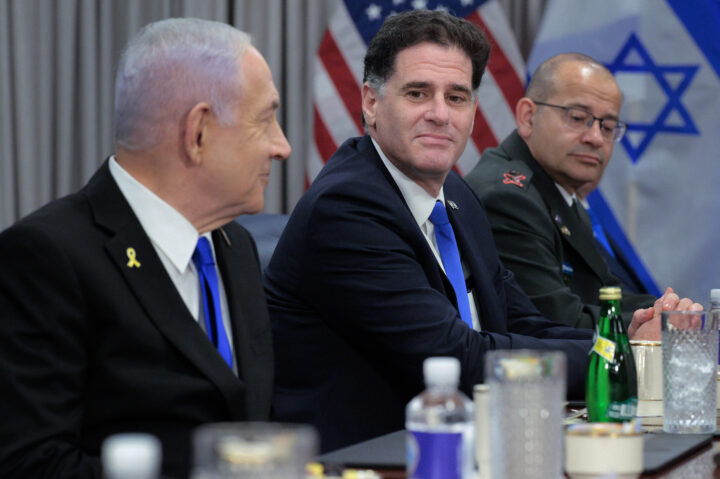
Chip Somodevilla/Getty Images
Israeli Prime Minister Benjamin Netanyahu (L) is joined by Israeli Minister of Strategic Affairs Ron Dermer and other officials for a meeting with U.S. Secretary of Defense Pete Hegseth at the Pentagon on July 09, 2025 in Arlington, Virginia.
In a wide-ranging interview, Israeli Minister of Strategic Affairs Ron Dermer connected Israel’s strikes against Iran’s nuclear facilities with Israeli Prime Minister Benjamin Netanyahu’s opposition to the U.S.’ 2015 nuclear deal with Tehran, saying that President Donald Trump wouldn’t have pulled out of the deal during his first administration without that precedent.
“I believe that what Iran’s strategy was [before Oct. 7] is to surround Israel with this ring of fire,” including Hamas in Gaza, Hezbollah in Lebanon and militias in Syria and Iraq. “And this is another reason why I was so opposed to the nuclear deal that was done in 2015,” Dermer said in the first installment of his interview on Dan Senor’s “Call Me Back” podcast, which dropped on Monday.
“And by the way, the attack [on Iran’s nuclear facilities] that happens now does not happen if Prime Minister Netanyahu doesn’t show up and confront that deal then. People don’t make the connection. I do, because I’ve lived it every day since then,” Dermer continued. “I don’t see Trump withdrawing if Netanyahu doesn’t take a stand, because no one’s going to be more Catholic than the pope, and no one’s going to be more pro-Israel than the prime minister of Israel.”
Dermer said he and Netanyahu began discussing striking Iran shortly after the Oct. 7, 2023, Hamas terror attacks on Israel. “I don’t know if it was Oct. 8, Oct, 9, Oct. 10, but I remember having conversations with [Netanyahu] early that we need to turn the tables on this, but ultimately the address is Iran. If you don’t deal with Iran and you don’t deal with its support for the proxies, then what is the impact you’re going to have if they can just sort of rebuild this stuff over and over and over again?”
“I think we have removed that threat [of the Iranian nuclear program] for the foreseeable future, particularly if we do the things that we need to do now in the aftermath” of the Israeli and U.S. strikes, Dermer continued, without elaborating.
Senor asked Dermer about leaks to the press prior to Israel’s war with Iran that portrayed a strained relationship between Trump and Netanyahu, with the two leaders reportedly at odds over whether to pursue military action or diplomacy with Tehran. “How much of it was orchestrated to throw everyone off, especially the Iranians?” Senor asked.
“I will tell you as somebody who’s been involved at the highest levels of the U.S.-Israel relationship …. [for] around 15 years, you’ve never had a level of coordination and cooperation that you had,” Dermer replied.
“I don’t know if it was the Monday or Tuesday [before the strikes began], there was a conversation between the prime minister and the president. And 50 years from now, people will say that was one of the best conversations ever between a prime minister and a president,” he continued. After press reports arose saying it was a “really tough call,” Dermer said he asked Netanyahu, “Did we leak that to make it look like it was a terrible call? He’s like, ‘No, no. Somebody else came and just assumed that this was a very, very terrible call’ … But we didn’t say anything at the time, because we thought it would help us, ultimately, with what we were trying to do.”
On the ceasefire negotiations with Hamas, which are ongoing in Doha, Qatar, Demer laid out the Israeli objective of removing Hamas from power in Gaza.
“I think the question is, how do you demilitarize Gaza and end Hamas’ political rule?” Dermer said, noting that “to kill every single Hamas terrorist in Gaza … would require us to take over everything and to stay there indefinitely. That’s not what the goal is. Hamas exists today in Judea and Samaria, in the West Bank … But they don’t control it.”
“Now, it might be that Hamas is willing to give up de jure control, and they say, ‘Well, somebody else will take out the trash, but we’ll continue to have this militia again.’ That’s something that’s not acceptable,” the minister continued.
In reference to the proposal under consideration — which includes a 60-day temporary ceasefire during which time around half of the remaining hostages would gradually be returned and the parties would begin to negotiate terms for a permanent ceasefire — Dermer said the question remains to be answered: “Can [Israel’s] minimal security requirements, can our minimum hit the maximum that they [Hamas] are capable of living with?”
“And we’re not going to know that until you have that engagement. And that’s the engagement that you need to have in the 60 days,” he said. “Because is there only one answer for what Gaza can look like the day after? No, I think there are several potential answers of what could happen. I worked on this last year, I mean, very quietly, of a potential plan that could work. And we will continue to work on it now.”
Plus, interview with Rep. Greg Landsman

Chip Somodevilla/Getty Images
U.S. Census Bureau Director Robert Groves holds a news conference at the National Press Club August 25, 2011, in Washington, D.C.
Good Monday morning.
In today’s Daily Kickoff, we preview this week’s Capitol Hill hearing on campus antisemitism, and talk to experts about the possibility of a Saudi-Israeli normalization agreement. We interview Rep. Greg Landsman about the recent U.S.-Israeli strikes on Iran’s nuclear program, and report on Democratic National Committee Chair Ken Martin’s outreach to Jewish groups following his comments earlier in the week regarding Zohran Mamdani’s defense of the phrase “globalize the intifada.” Also in today’s Daily Kickoff: Amb. Charles Kushner, Sen. Joni Ernst and Elmo.
What We’re Watching
- Attendees of this year’s Aspen Security Forum are making their way to Colorado today, ahead of the start of the gathering tomorrow. Jewish Insider’s Marc Rod will be on the ground in Aspen — drop us a line if you will be as well.
- We’re also keeping an eye on stalled Israel-Hamas ceasefire talks amid reports that President Donald Trump and Qatari Emir Sheikh Tamim bin Hamad Al Thani were set to meet on the sidelines of yesterday’s FIFA finals in New Jersey. Read more here.
What You Should Know
A QUICK WORD WITH JI’S MELISSA WEISS
School may be out of session for the summer, but officials from Georgetown University, the University of California, Berkeley and the City University of New York will be in the hot seat this week when they testify on Tuesday before the House Education and Workforce Committee.
This is not the first time that university officials have appeared in front of Congress to account for the situations on their campuses, but this week’s hearing aims to focus on more than just the anti-Israel activism that has permeated many campuses since the Oct. 7, 2023, Hamas terror attacks on Israel and the ensuing war in Gaza to focus on root issues, including foreign funding in higher education as well as faculty anti-Israel organizing efforts.
With that as the backdrop, Georgetown’s interim president, Robert Groves, is likely to face hard-hitting questioning about the school’s donations from authoritarian regimes.
Nearly a decade ago, Georgetown took a $10 million donation from an organization connected to Beijing’s ruling Chinese Communist Party — more specifically, according to The Washington Post, to “the specific CCP organizations that manage overseas influence operations” — to establish the Initiative for U.S.-China Dialogue on Global Issues.
But that $10 million is a drop in the bucket compared to the amount of money Qatar is alleged to have sent to Georgetown. According to a study by the research institute ISGAP — which primarily focuses on progressive and Islamist antisemitism — Qatar has donated more than $1 billion dollars to the Jesuit school in recent decades. In addition, Qatar has long had a partnership with Georgetown that includes an outpost of the school in Doha. Earlier this year, the school extended its contract with Doha for another decade.
There’s a saying that has floated around many a conference, Jewish organizational board meeting and Shabbat dinner table in recent years: Jews endow buildings, their enemies endow what happens inside of them. Tomorrow’s hearing will see just how deeply those efforts have permeated.
normalization? not yet

One of the original drivers of the 2020 Abraham Accords was Israel’s vocal, public stance against Iran’s nuclear program and regional aggression. That stance also brought Israel and Saudi Arabia closer, a relationship that developed to the point that in the summer of 2023, it seemed like normalization was just around the corner. By extension, it might make sense for the Abraham Accords and a Saudi-Israel rapprochement to be back in the headlines after Israel took the ultimate stand against Iran’s nuclear program last month, bombing it with assistance from the U.S. Yet there has been almost no serious talk about Saudi Arabia joining the Abraham Accords in recent weeks, experts told Jewish Insider’s Lahav Harkov.
Saudi two-step: Riyadh has also been publicly signaling that its relationship with Tehran is still on track since China brokered a deal between the two countries in 2023. Saudi Arabia, like other Gulf States, spoke out last month against the Israeli and American airstrikes on Iran. Last week, Iranian Foreign Minister Abbas Araghchi met with Saudi Crown Prince Mohammed bin Salman in Jeddah. “There’s all this public condemnation of the attacks on Iran,” Bernard Haykel, a professor of Near Eastern studies at Princeton University, told JI, “but when the U.S. pulled its forces from the Air Force base in Qatar [due to Iran’s retaliation], they moved their planes to a Saudi base. So they condemned the U.S. for attacking Iran, but they also gave the U.S. protection.”
congressional conversation
Rep. Greg Landsman (D-OH) has stood apart in recent weeks as one of a small number of congressional Democrats who’ve been supportive of the Trump administration’s strikes on Iranian nuclear facilities, Jewish Insider’s Marc Rod reports. Landsman told JI he thinks that his Democratic colleagues’ responses to the strikes are motivated by the current political environment, fears about a broader war and concerns about the future of diplomatic talks and the safety of people in the region.
Looking ahead: Landsman argued in an interview with JI last week and in a recent op-ed that the Israeli and American show of force, alongside the undermining of Iran’s proxies across the region, could be the key to weakening the Iranian regime to a point where it will agree to a fundamental change of course going forward, unlocking opportunities for regional peace and prosperity. “[The Middle East] should be Europe, [if not] for Iran,” he said. “It hasn’t been able to break out that way because Iran has been the primary obstacle.”
damage control

Ken Martin, the chair of the Democratic National Committee, spent Friday calling Jewish leaders, seeking to reassure them that he does not condone the phrase “globalize the intifada,” two sources with knowledge of the meetings told Jewish Insider’s Gabby Deutch. Among the leaders he called were senior officials at the Anti-Defamation League and the American Israel Public Affairs Committee.
Harmful rhetoric: Earlier in the week, a “PBS NewsHour” clip of Martin discussing New York City Democratic mayoral nominee Zohran Mamdani went viral. In the Friday phone calls, two sources confirmed, Martin faced criticism from Jewish leaders over Martin not specifically addressing the “globalize the intifada” language during his PBS interview. But a DNC senior advisor told JI that Martin made clear he stood with them against the harmful rhetoric. “By the end of it there was an understanding that Ken does understand and is aligned with the community and that frankly people want full-throated leadership,” the advisor said. “This language isn’t about Democrats. This is just not acceptable, period, and as a party it’s not acceptable.”
Bonus: Jewish Insider’s Emily Jacobs talks to Jewish Democrats and organizations that represent them about Martin’s handling of the Wednesday “PBS NewsHour” interview and fallout from it.
allies in arms

The Senate Armed Services Committee’s draft of the 2026 National Defense Authorization Act, passed out of committee this week, includes provisions aimed at furthering coordinated air and missile defense efforts in the Middle East, Jewish Insider’s Marc Rod reports.
Pushing ahead: The amendment, led by Sen. Joni Ernst (R-IA), a co-chair of the Abraham Accords Caucus, instructs the Defense Department to submit to Congress a new report on implementing integrated air and missile defense infrastructure in the Middle East, including an assessment of threats; a summary of U.S. priorities and capabilities; and lessons learned from the Iranian ballistic missile attacks on Israel and the Houthi attacks in the Red Sea.
Read the full story here.Bonus: The House Armed Services Committee released its first draft of the 2026 NDAA on Friday. The bill would create an emerging technology cooperation program with Israel, extend the U.S. weapons stockpile in Israel and cooperative counter-tunneling programs through 2028, and expand counter-drone and missile cooperative programs and authorize increased funding. It would also expand U.S. support for the Lebanese Armed Forces and require a Pentagon briefing on Iran’s use of Western technologies in its drones.
history rewritten

The American Jewish Committee called for a “swift political response” following the placement of plaques at the Jedwabne memorial site in Poland that falsely accuse Jews of being responsible for killing Poles during the pogrom that occurred there 84 years ago last week, Jewish Insider’s Haley Cohen reports.
Background: At least 340 Jews were burned alive by their Polish neighbors in the massacre at Jedwabne on July 10, 1941. Marking the anniversary of the attack last Thursday, right-wing activist Wojciech Sumliński and his supporters illegally placed plaques in English and Polish several yards from the memorial, offering a revisionist account of what happened at the site. One of the plaques reads, “After the Soviets took over eastern Poland, Jews assumed administrative roles and, knowing the local realities, denounced Polish patriots who were then deported and murdered by the Soviets. Only the German attack on the Soviet Union halted these repressions. Then the Germans began killing Jews just as they had previously killed Poles by the millions.”Read the full story here.
camp comedy

As summer heats up, Jewish adults looking for an escape from the fraught state of world Jewry may find themselves reflecting on a seemingly simpler time — getting competitive over color war or gaga ball and singing Debbie Friedman songs around a campfire at Jewish sleepaway camp. That sense of nostalgia for one’s Jewish summer camp years is doled out liberally in “The Floaters,” a new film that centers on the fictional Camp Daveed and a group of outsider teens called “floaters,” Jewish Insider’s Haley Cohen reports.
Art imitating life: “We try to push the movie beyond lox and bagels,” co-producer Shai Korman told JI, noting that he and his co-producers — his two sisters — specifically aimed to “put on-screen Jewish women that exemplified the Jewish women that raised us, that were leaders and mentors.” Camp Daveed is run by women, from camp director Mara to the camp’s rabbi, Rabbi Rachel. Several iconic films, such as “Wet Hot American Summer” and “Meatballs,” were also inspired by Jewish camps. But in “The Floaters,” “we talk about the rules of kashrut,” Korman said. “You see Orthodox and secular kids all together, reflecting the world we grew up in.”
Worthy Reads
R&D Nation: In the Financial Times, Ruchir Sharma observes Israel’s rise as a regional economic superpower despite nearly two years of war. “Perhaps the most telling sign of its dynamism is that Israel now spends more than 6 per cent of GDP on research and development — more than any other nation and over double the global average. An unusually high share — about half — of that R&D funding comes from foreign multinationals, many involved in defence-related industries. … To many observers, the geopolitical situation in the Middle East still seems precarious. But the market’s optimistic take on Israel’s tech-driven economy is now showing up in economists’ forecasts, which are projecting growth at nearly 4 per cent in coming years. That’s relatively strong for a developed nation. It validates the market view that Israel is cementing its status as the region’s dominant economic force.” [FT]
FIDF Scandal Fallout: eJewishPhilanthropy’s Judah Ari Gross looks at how recent concerns over alleged mismanagement and financial impropriety at Friends of the Israeli Defense Forces has “provided ample ammunition” to observers critical of legacy Jewish organizations. “Though always present in communal discourse, the tear-it-all-down-and-start-again voices have gained strength since the Oct. 7 Hamas terror attacks and the subsequent rise in global antisemitism, and not without cause. … Legacy institutions, with their galas and boards and committees and well-paid executives, are an easy target. These established organizations have often failed to defend their size and bureaucracy, or even acknowledge that alongside the stability and internal checks that they provide, those things do make them slower to react and pivot in an emergency.” [eJP]
The World to Come: In his “Jerusalem Journal” Substack, Avi Mayer considers the possibility of a post-Zionist America. “Critiques of Israeli policy, no matter how strident or widespread, do not automatically lead to the wholesale rejection of Israel or the negation of Jewish self-determination. But if current trends continue, and if voting patterns start to reflect the shifting views of the electorate, we may find ourselves in uncharted territory. The ramifications of a changed America could be wide-ranging, deeply impacting both American Jewish life and Israeli national security. An America that is intolerant of a core element of contemporary Jewish identity would be a place in which American Jews would feel — and be made to feel — increasingly uncomfortable. From the Soviet Union to the Middle East to western Europe, hostility to Zionism on the part of national leaders and elites has always precipitated societal antisemitism, forcing Jews to confront painful dilemmas.” [JerusalemJournal]
Word on the Street
Speaking at a Turning Point USA student conference in Florida over the weekend, far-right commentator Tucker Carlson suggested that Americans who served in the Israeli Defense Forces “should lose their citizenship,” adding that he believed a person “can’t fight for another country and remain an American, period”…
A hacker took over the X account of “Sesame Street” character Elmo, posting a series of profane, racist and antisemitic comments; the posts included a message to “kill all Jews” and another that described President Donald Trump as a “puppet” of Israeli Prime Minister Benjamin Netanyahu…
xAI, the AI company affiliated with X owner Elon Musk, said that its Grok chatbot had undergone a coding update that modified what information it was taking in, making Grok “susceptible to existing X user posts; including when such posts contained extremist views”; the chatbot had spewed a series of antisemitic and sexually explicit posts over a period of several days last week…
A new survey from the Anti-Defamation League found that 1 in 4 Americans consider recent antisemitic attacks in the U.S. to be “understandable,” while three-quarters of those surveyed want the government to take more action against antisemitism…
Pennsylvania Democrat Jenelle Stelson is mounting a second congressional bid against Rep. Scott Perry (R-PA), to whom she lost by less than a percentage point in the 2024 election; read our interview with Stelson during her campaign last summer…
The U.S. Board on Geographic Names approved the renaming of an Alaskan waterway that had been named Nazi Island by the U.S. Air Force during World War II…
The Financial Times reports that the Boston Consulting Group was paid more than $1 million for its work on a Qatari-backed project led by former American military veterans to bring aid into Gaza by sea…
French President Emmanuel Macron and Saudi Crown Prince Mohammed bin Salman are not expected to attend an upcoming rescheduled conference on Palestinian statehood; the initial conference had been canceled following the onset of the Israel-Iran war.
The BBC spotlights Punjabi businessman Kundanlal Gupta, who during World War II saved more than a dozen Austrian Jews by creating fictitious job offers in India, providing those “hired” with a way to escape Nazi Europe…
New satellite images indicate that Iran struck an American storage facility that contained secure communications equipment on the Al Udeid base in Qatar during its attack on American targets last month…
Iranian state media alleged that Israel attempted to assassinate Iranian President Masoud Pezeshkian during last month’s war; Pezeshkian reportedly suffered a leg wound in the Israeli strike on a meeting of Iran’s Supreme National Security Council…
Russian President Vladimir Putin has reportedly told leaders in Washington and Tehran that Moscow backs a nuclear deal with Iran that forbids the Islamic Republic from enriching uranium…
Iranian Foreign Minister Abbas Araghchi said on Saturday that Tehran would be open to returning to nuclear talks in exchange for the guarantee that it would not face further attacks; Iran also said it would be open to International Atomic Energy Agency inspections, days after the country’s parliament passed a law tightening restrictions around international inspections…
A Palestinian-American man from Florida who was visiting family in the West Bank was killed in clashes with settlers…
A Filipino woman who worked as a caretaker in Rehovot, Israel, died as a result of injuries sustained in an Iranian ballistic missile strike last month; Leah Mosquera’s death brings the number of fatalities in Israel as a result of the 12-day war to 29…
Israel’s Transportation Ministry estimated that Ben-Gurion Airport will see 3.4 million travelers over the course of this summer, a drop of nearly 2 million passengers from the summer before the Oct. 7, 2023, Hamas terror attacks and ensuing war…
Charles Reinhart, the former director of the American Dance Festival, died at 94… B Lab founder Andrew Kassoy, who pushed the concept that capitalism could promote social good, died at 55… Physicist Daniel Kleppner, whose work on atomic clock accuracy helped shape the use of GPS systems, died at 92… Sports journalist Samuel Abt, who covered the Tour de France for more than three decades, died at 91…
Pic of the Day

U.S. Ambassador to France Charles Kushner visited the Memorial de la Shoah in Paris last week in what he said was his “first stop” after arriving in the country.
Birthdays

MLB pitcher for 11 seasons, now a sportscaster and author, he won the Cy Young Award and was an MLB All Star in 1980, Steve Stone turns 78…
Architect and urban designer, Moshe Safdie turns 87… Los Angeles resident, Susan Farrell… Film producer, best known for the Lethal Weapon series, the first two “Die Hard” movies and the Matrix trilogy, Joel Silver turns 73… Film and theatrical producer, in 2012 he became the first producer to have won an Emmy, Grammy, Oscar and Tony Award, Scott Rudin turns 67… Co-founder and managing director of Beverly Hills Private Wealth, Scott M. Shagrin… United States secretary of commerce, Howard Lutnick turns 64… Venture capitalist at Breyer Capital, James W. Breyer turns 64… Media columnist for the Chicago Tribune until 2021, Phil Rosenthal turns 62… U.S. Permanent Representative to the U.N. Human Rights Council during the last three years of the Biden administration, she is the daughter and granddaughter of Holocaust survivors, Ambassador Michèle Taylor turns 59… Illustrator and author best known as the writer of The Invention of Hugo Cabret, Brian Selznick turns 59… Principal at Full Court Press Communications, Daniel Eli Cohen… Member of the Washington state Senate until 2023, David S. Frockt turns 56… President and CEO at the Jewish Federation of Greater Houston, Renee Wizig-Barrios… Rapper and record producer from Brooklyn known as “Ill Bill,” he is the producer, founder and CEO of Uncle Howie Records, William “Bill” Braunstein turns 53… Professor in the department of genetics at the Harvard Medical School, David Emil Reich, Ph.D. turns 51… Chief operating officer at Aish Global, Elliot Mathias… Fashion designer and cast member on “The Real Housewives of Beverly Hills,” Dorit Kemsley turns 49… Retired mixed martial artist, now a life coach, Emily Peters-Kagan turns 44… Co-founder and executive chairman of Pinterest, Ben Silbermann turns 43… Editor-in-chief of the Washington Free Beacon, Eliana Yael Johnson… Interior designer and owner of Tribe By Design, Tehillah Braun… Professional golfer with four tournament wins in the Asian and European tours, David Lipsky turns 37… Founder at Bashert Group and head of a NYC-based family office, Daniel B. Jeydel… AVP for grantmaking at Hillel International, she recently joined the board of the Siegel JCC of Delaware, Rachel Giattino… Reporter covering housing and the home building industry for The Wall Street Journal, Nicole Friedman… Director of Chabad Georgetown, Rabbi Menachem Shemtov… Creator of the Instagram feed called Second Date Shadchan, Elizabeth Morgan (Lizzy) Brenner… Collegiate basketball star for Princeton and Maryland, now playing for Maccabi Bnot Ashdod of the Israeli Women’s Basketball Premier League, Abby Meyers turns 26…

Tom Williams/CQ-Roll Call, Inc via Getty Images
Senate Armed Services Committee Chairman Roger Wicker (R-MS) arrives for a confirmation hearing in Dirksen building on Tuesday, May 13, 2025.
Good Friday morning.
In today’s Daily Kickoff, we talk to senators about how the Trump administration should address the Houthis deadly attacks on ships in the Red Sea this week despite the terror group’s supposed ceasefire with the U.S., and report on DNC Chair Ken Martin’s dismissal of Zohran Mamdani’s defense of the “globalize the intifada” slogan. We have an exclusive on a bipartisan letter from lawmakers demanding answers from Elon Musk regarding his AI chatbot’s antisemitic screeds, and talk to the family members of fallen IDF soldiers whose bodies are still being held in Gaza. Additionally, we feature a rundown of the who’s who at this week’s annual Sun Valley conference. Also in today’s Daily Kickoff: Larry David, Robert Kraft and Jochanan Senf.
For less-distracted reading over the weekend, browse this week’s edition of the Weekly Print, a curated print-friendly PDF featuring a selection of recent Jewish Insider and eJewishPhilanthropy stories, including: Jewish students forge ahead in attending Ivy League universities, despite fears of antisemitism; Israel shifts approach to Syria’s new government as apprehension wanes; and As teachers unions target ADL and oppose antisemitism bill, Jewish educators sound the alarm. Print the latest edition here.
What We’re Watching
- Fox will air an hour-long interview tomorrow night with Israeli Prime Minister Benjamin Netanyahu, recorded with Mark Levin during the Israeli leader’s trip to the U.S. this week.
- On Sunday, former Reps. Steve Israel (D-NY) and Peter King (R-NY) will sit with author Daniel Silva at Long Island’s Sid Jacobson JCC to discuss Silva’s latest novel, An Inside Job.
What You Should Know
A QUICK WORD WITH JI’S JOSH KRAUSHAAR
Since Zohran Mamdani won the Democratic nomination for New York City mayor, there’s been a fascinating disconnect between the polls showing Mamdani still vulnerable in the general election and the sclerosis among political leaders unable to make the tough decisions on whether to rally behind an alternative in a bid to stop the socialist candidate from becoming the next mayor.
There hasn’t been much good polling since the primary, but the most recent general election surveys all paint a picture of Mamdani leading the race with a plurality, but far below what a typical Democratic nominee should be receiving after a stunning, come-from-behind defeat of former New York Gov. Andrew Cuomo.
One poll, conducted by the Democratic firm Slingshot Strategies between July 2-6, found Mamdani winning 35% of registered voters, Cuomo at 25%, Republican nominee Curtis Sliwa tallying 14%, Mayor Eric Adams at 11% and attorney Jim Walden at 1%. Thirteen percent said they were undecided.
A late-June poll by the GOP firm American Pulse found Mamdani at 35%, Cuomo at 29%, Sliwa winning 16% and Adams with 14%. Asked whether they were leaning towards voting for Mamdani or anyone but Mamdani, it was close to an even split, with 48% leaning towards Mamdani and 46% preferring anyone else.
Of note, both polls found the combined Cuomo and Adams vote — which roughly encompasses the lion’s share of the moderate Democratic electorate — narrowly outpacing Mamdani’s share of support. In other words, the Mamdani alternative wouldn’t necessarily need a large portion of the Republican vote to prevail.
SEA CHANGE
A top Senate lawmaker indicated on Thursday that he’s open to resumed U.S. involvement in the campaign against the Houthis, amid a ramp-up of the group’s attacks on commercial shipping in the Red Sea and Israel that comes two months after the U.S. and the Houthis reached a ceasefire that ended the American bombing campaign against the group, Jewish Insider’s Marc Rod reports.
Notable quotable: “The Houthis need to be totally eliminated,” Sen. Roger Wicker (R-MS), the chair of the Senate Armed Services Committee, told JI. “They have no purpose other than to kill free people.” Asked if the U.S. should become involved directly against the Houthis again, Wicker said, “I wouldn’t rule that out.”
Read the full story here, plus additional comments from Sens. Mark Kelly (D-AZ), James Lankford (R-OK), Mike Rounds (R-SD) and Ted Budd (R-NC).
Exclusive

A group comprised largely of Democratic House lawmakers wrote to Elon Musk on Thursday condemning the antisemitic and violent screeds published by X’s AI chatbot Grok earlier this week, calling the posts “deeply alarming” and demanding answers about recent updates made to the bot that may have enabled the disturbing posts, Jewish Insider’s Marc Rod reports.
Ongoing issue: “We write to express our grave concern about the internal actions that led to this dark turn. X plays a significant role as a platform for public discourse, and as one of the largest AI companies, xAI’s work products carry serious implications for the public interest,” the letter reads. “Unfortunately, this isn’t a new phenomenon at X. Grok’s recent outputs are just the latest chapter in X’s long and troubling record of enabling antisemitism and incitement to spread unchecked, with real-world consequences.”
slogan saga
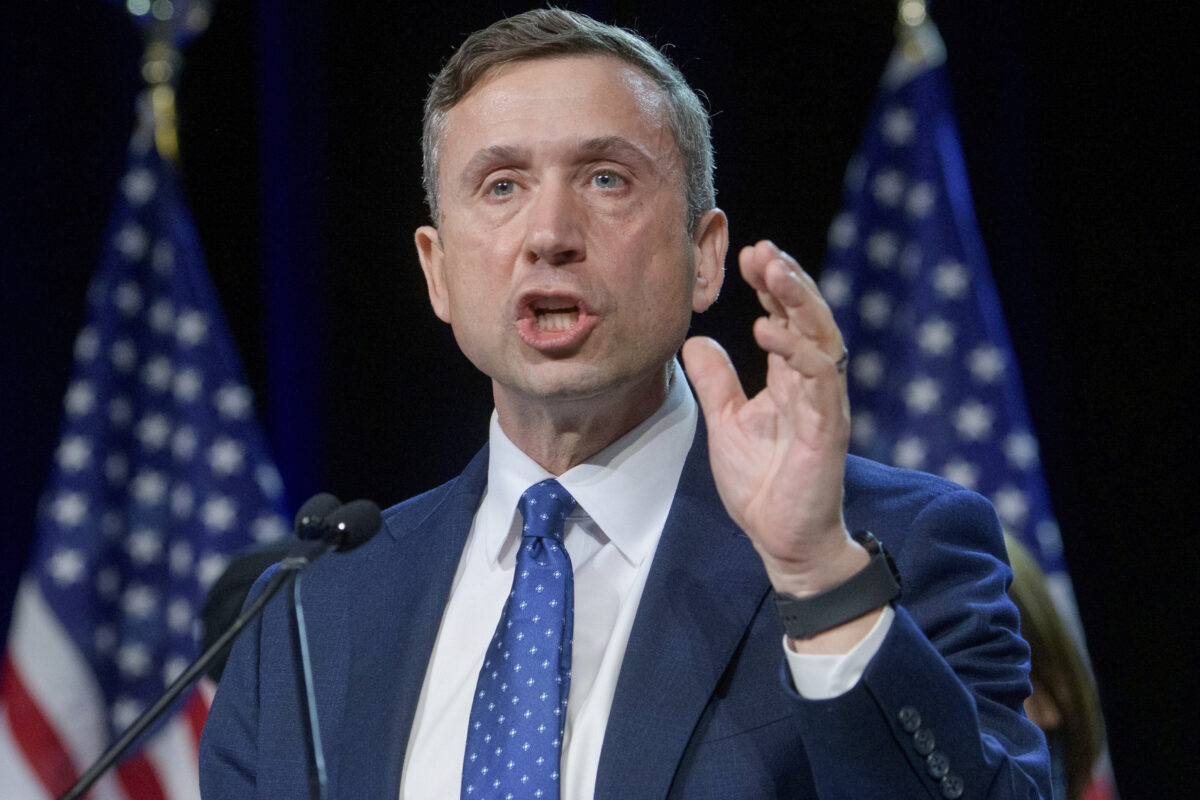
Democratic National Committee Chairman Ken Martin declined on Wednesday to criticize New York City Democratic mayoral nominee Zohran Mamdani’s refusal to condemn the “globalize the intifada” slogan, Jewish Insider’s Emily Jacobs reports. The DNC chair, who was elected earlier this year, praised the party for being a “big tent” comprising different ideologies, including “leftists” such as Mamdani.
Tent talk: Asked during a “PBS NewsHour” interview about concerns from Jewish Democrats regarding Mamdani’s refusal to condemn the phrase, Martin replied, “There’s no candidate in this party that I agree 100 percent of the time with, to be honest with you. There’s things that I don’t agree with Mamdani that he said.” Martin said that he had learned through his 14 years as chairman of the Minnesota Democratic Party and his tenure at the DNC “that you win through addition. You win by bringing people into your coalition. We have conservative Democrats. We have centrist Democrats. We have labor progressives like me, and we have this new brand of Democrat, which is the leftist.”
garden state race
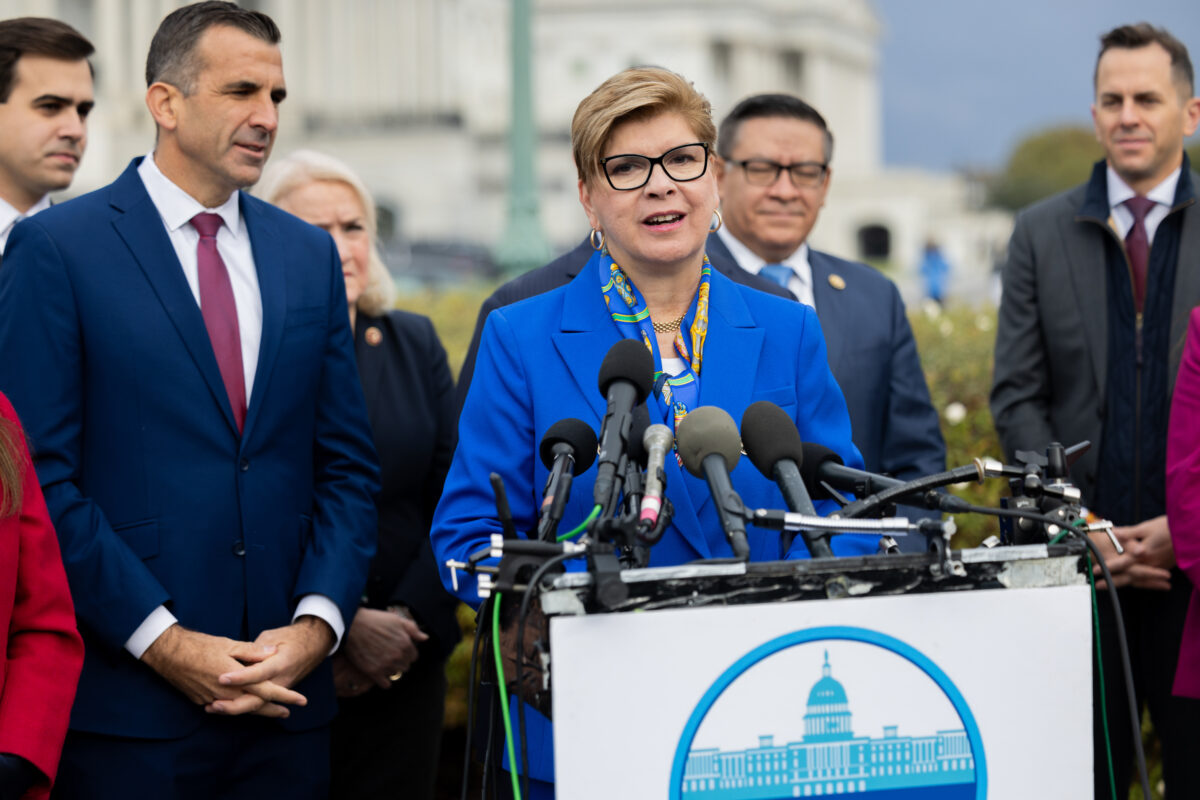
As she works to defend her seat from a growing list of Republican challengers, Rep. Nellie Pou’s (D-NJ) liberal political positioning and voting record place her in a unique position for a Democrat in whose district President Donald Trump scored a surprise win last November, at the same time Pou was elected for the first time, Jewish Insider’s Marc Rod reports.
Key example: One vote last month highlights that dynamic: she was the only Democrat representing a Trump-won district to vote last month against a Republican-led resolution condemning the antisemitic attack in Boulder, Colo., urging stronger enforcement of immigration laws and supporting Immigration and Customs Enforcement. Pou, and nearly all other Democrats, voted in favor of a second resolution condemning a series of recent antisemitic attacks without the immigration language.
hostage hopes talks

As negotiations continue for a temporary ceasefire in Gaza, in which half of the remaining 50 hostages are expected to return to Israel over 60 days, families of those still being held are waiting to learn if their loved ones will be among those coming home soon. About 20 of the hostages are thought to be alive, but the families of the 30 others are also hoping to have a measure of closure, with their loved ones’ remains returned to be buried in Israel, Jewish Insider’s Lahav Harkov reports.
‘Nerve-wracking’ wait: Rabbi Doron Perez described this period, in which there is constant discussion of a possible deal with hostages’ bodies returned to Israel, “is very nerve-wracking. … It aggravates the wound.” His son Daniel was a 22-year-old officer in the IDF armored corps on Oct. 7, 2023, when Hamas attacked Israel. For five months, the family thought Daniel had been kidnapped, before learning that he had been killed on the day of the terrorist attacks and his body taken to Gaza. When there is no talk of negotiations, Perez said, “You start thinking again, ‘Where is Daniel? Where is his body? Where is he being held?’ Some were found in cemeteries, some in tunnels, some in cupboards. You try to put it out of your mind, the vivid thoughts of where he may be, but [news about negotiations] brings it up again.”
inside story

The Friends of the Israel Defense Forces has been thrown into turmoil following the leak of an internal investigative report to the Israeli news outlet Ynet last week that detailed serious allegations against the organization’s top leadership, particularly its board chair, Morey Levovitz, of mismanagement, wasteful spending and creating a toxic work environment, eJewishPhilanthropy’s Judah Ari Gross reports.
Fresh concerns: Since the 18-page report was leaked last week, eJP has spoken with several current and former FIDF employees and lay leaders across the United States and Israel to assess its veracity, finding that in addition to the allegations that were included in the report, current and former employees have also raised credible concerns within the organization about dishonest fundraising tactics and the improper handling of sexual harassment claims. “When you have 60-80 employees saying the same thing, at some point, it can’t not be true,” one former employee told eJP.
Read the full story here and sign up for eJewishPhilanthropy’s ‘Your Daily Phil’ newsletter here.
Worthy Reads
On the Nobel Watch: In his “Clarity” Substack, former Israeli Ambassador to the U.S. Michael Oren reflects on Israeli Prime Minister Benjamin Netanyahu’s visit to Washington this week. “As Netanyahu knows well, the president deserves a Nobel Prize for making peace between Israel and Saudi Arabia, but the Saudis won’t negotiate as long as the IDF is fighting in Gaza. So Trump wants a ceasefire that’s acceptable not only to the U.S. and Israel but also to Hamas. … But beyond a Gaza ceasefire, the key to the regional transformation remains America’s continued commitment to deter Iranian aggression. Though badly battered by Israel and the United States, Iran will certainly try to recover from Operation Rising Lion and Operation Midnight Hammer — first by sending armed bands across our northern border and soon by trying to rebuild Fordow.” [Clarity]Anxious in Iran: In The Atlantic, Roya Hakakian considers the impact of last month’s war between Israel and Iran on the Islamic Republic’s small Jewish community. “The signs in Iran are ominous — and the pleas from Iranian Jewish elders may now go unheard. The community’s old talisman may no longer hold its charm. An overlooked victim of the 12-day military operation against Iran is Iranian civil society, especially its minorities, particularly Jewish Iranians, who were already at risk. Since the war, their conditions have infinitely worsened — a fact that should lead the Trump administration to reconsider its refugee ban. The United States took on a moral responsibility for Iran’s persecuted citizens when it became a combatant against their oppressive regime.” [TheAtlantic]
Word on the Street
State officials are pressuring the White House and the Federal Emergency Management Agency to post the agency’s long-overdue guidelines for applicants for security grants, warning that the continued failure to do so is imperiling security and counterterror efforts across the country…
Rep. Mike Lawler (R-NY) introduced bipartisan legislation on Thursday that would expedite arms sales to U.S. partners that normalize relations with Israel and work with the U.S. in its efforts to counter Iran and its terrorist proxies, Jewish Insider’s Emily Jacobs and Marc Rod report…
The Hill talks to Jewish House Democrats, including Reps. Debbie Wasserman Schultz (D-FL), Brad Schneider (D-IL) and Jared Moskowitz (D-FL), concerned over New York City Democratic mayoral nominee Zohran Mamdani’s defense of the phrase “globalize the intifada” and refusal to recognize Israel’s right to exist as a Jewish state…
eJewishPhilanthropy’s Jay Deitcher looks at how pulpit rabbis are responding to the IRS’ recent decision that will allow clergymembers to endorse political candidates while retaining their congregations’ tax-exempt status…
Former Columbia University graduate student Mahmoud Khalil, who was held in an immigration detention center for months as the government sought to deport him over his anti-Israel campus organizing, filed a $20 million lawsuit against the Trump administration…
Unilever tapped executive Jochanan Senf to be the next CEO of subsidiary Ben & Jerry’s, amid a yearslong dispute with the ice cream company’s board over its social justice initiatives; Senf had previously served as the managing director of Ben & Jerry’s in Europe…
The New York Times reports on Bill Ackman’s foray this week into professional tennis, where he played a doubles match alongside former professional tennis player Jack Sock, losing in straight sets…
Larry David is set to write and star in a new sketch comedy series about U.S. history for HBO, working with former President Barack Obama and former First Lady Michelle Obama’s Higher Ground company, following the end of his long-running “Curb Your Enthusiasm” series on the network…
The Forward spotlights White Oak, Pa., a mill town that once boasted a large Jewish community, as it struggles to draw in new Jewish families…
A new report from a U.K. parliamentary committee found that the threats posed by Iran to the country — including targeted assassinations and attacks on dissidents — are similar to those posed by Russia…
An Israeli security guard was killed in a terror attack at a West Bank shopping complex; the assailants, who were killed at the scene, were reportedly police officers in the Palestinian Authority’s force who had recently completed their training…
Israel will allow more humanitarian aid into Gaza utilizing additional access routes and distribution points, following meetings between Israeli and EU officials…
A senior Israeli official said that at least some of the enriched uranium stored at the Fordow nuclear facility in Iran survived the U.S.’ bunker-buster strikes on the facility last month, and could feasibly be accessed by Iranian nuclear engineers…
Israeli Defense Minister Israel Katz warned that Israel could conduct future strikes on Iranian targets if it feels threatened, saying that “Israel’s long arm will reach you in Tehran, Tabriz, Isfahan, and anywhere you try to threaten or harm Israel”…
The U.S. re-upped its travel warning urging American citizens against traveling to Iran, as Tehran confirmed the arrest last month of an 18-year-old French-German cyclist who had been traveling through the country…
Alan Hassenfeld, a former executive of Hasbro Games and major Jewish philanthropist who was a mainstay of the Rhode Island Jewish community, died at 76…
Pic of the Day

New England Patriots owner Robert Kraft and his wife, Dana Blumberg, are among the attendees at the Allen & Company Sun Valley Conference in Sun Valley, Idaho, this week.
The annual invite-only retreat kicked off earlier this week, once again drawing a who’s who of media moguls, tech titans, political heavyweights and dealmakers. A-listers and boardroom titans traded suits for the fleece vests commonly associated with Sun Valley and jeans and polo shirts as they huddled for panels, private chats and leisurely walks in the Idaho sun.
This year’s attendees include Mark Zuckerberg, Tim Cook, Jeff Bezos, Sam Altman, Sheryl Sandberg, Mike Bloomberg, Ivanka Trump, Jared Kushner, Joshua Kushner, Yousef Al Otaiba, Mathias Döpfner, Diane von Furstenberg, Barry Diller, Brian Roberts, Adam Silver, Gary Bettman, Mitch Rales, Bob Iger, Alex Karp and more.
Birthdays
Founder and CEO of Wisconsin-based Good Karma Brands, Craig Karmazin turns 50…
FRIDAY: Entrepreneur, investment banker, civil servant and political advisor, Stephen Berger turns 86… Developmental psychologist at Harvard, he was selected in the 1981 inaugural class of MacArthur genius fellows, Howard Gardner turns 82… Member of the U.K.’s House of Lords, he was PM Tony Blair’s special envoy to the Middle East for nine years, Baron Michael Abraham Levy turns 81… U.S. senator (D-MA), Ed Markey turns 79… EVP of the Milken Family Foundation and past chair of the board of trustees of JFNA, Richard V. Sandler turns 77… Journalist covering classical music, he is the author of Genius & Anxiety: How Jews Changed the World, 1847-1947, Norman Lebrecht turns 77… Founder of Schnur Associates, she spent 12 years as executive director of the Greater New York Coalition for Soviet Jewry, Zeesy Schnur… West Orange, N.J., resident, Jeffrey Maas… Actress, she portrayed Frau Farbissina in the Austin Powers film series, Mindy Lee Sterling turns 72… Singer-songwriter, known by his stage name “RebbeSoul,” Bruce Burger turns 68… Founder and retired CEO of Sidewalk Labs (an Alphabet company), he was previously CEO of Bloomberg L.P., Daniel L. Doctoroff turns 67… Group EVP of public relations for Discovery Channel and Science Channel from 2007 until 2023, Laurie Goldberg… Executive chairman of Aston Martin and the owner of the Aston Martin Formula 1 Team, Lawrence Stroll turns 66… Radiation oncologist at the Dana-Farber Cancer Institute and Brigham and Women’s Hospital, Harvey Jay Mamon, MD, Ph.D…. Managing member at Samuel Capital Management, Barry Mannis… Former member of the Knesset for the Likud party, Yaron Mazuz turns 63… Former commander of the IDF’s Southern Command, now in the IDF Reserves, Maj. Gen. Shlomo “Sami” Turgeman turns 61… Judge of the U.S. Court of Appeals for the 11th Circuit since 2014, Judge Robin Stacie Rosenbaum turns 59… Retired tax attorney, she now bakes challahs on Manhattan’s UWS to benefit the UJA, Adina Tamar Spiro Wagman… Executive editor of The City, Alyssa A. Katz… Founder of Koz and Effect LLC, Lindsey Caren Kozberg… Consultant focused upon social impact strategies, Joshua D. Wachs… Actor, podcaster and lead singer of the band Sun Spin, Michael Owen Rosenbaum turns 53… Ukrainian-born computer scientist and internet entrepreneur, Max Levchin turns 50… Principal at Civitas Public Affairs Group, Celine Mizrahi… Chabad rabbi at Washington University in St. Louis, Rabbi Hershey Novack… Comedian, podcaster and political commentator, Katherine Rose “Katie” Halper turns 44… Screenwriter and executive producer, Theodore Beren Bressman… Retired ice hockey forward, he played for 19 seasons in the U.S., Canada and Europe, now a businessman in Destin, Fla., Jacob Micflikier turns 41… Executive director of the New Democrat Coalition, Anne Sokolov… and her twin sister, a co-founder at Social Goods, Kate Sokolov… Offensive guard in the NFL for eight seasons until 2015, his Hebrew name is Gedalia Yitzhak, Geoff Schwartz turns 39… Senior deputy associate counsel in the White House Counsel’s office during the Biden administration, Matthew J. Rosenbaum… Bryan Stone…
SATURDAY: Former U.S. Ambassador to the U.N. Human Rights Council, Rita E. Hauser turns 91… Former congressman (R-OK) for 16 years, Marvin Henry “Mickey” Edwards turns 88… Former executive director of the Crown Heights Jewish Community Council, Dan Botnick… Canadian journalist, social activist and author of three bestselling books, Michele Landsberg turns 86… Former member of the Florida House of Representatives for eight years, Franklin Sands turns 85… Best-selling author, screenwriter, and playwright, sister of the late Nora Ephron, Delia Ephron turns 81… Professor of religion at the University of Vermont, he was an advisor to Bernie Sanders on his 2016 presidential campaign, as an undergraduate at Yale his roommate was Joe Lieberman, Richard Sugarman turns 81… Co-founder of Imagine Entertainment, his films and TV series have been nominated for 47 Academy Awards and 217 Emmys, Brian Grazer turns 74… Obstetrical nurse and board-certified lactation consultant in NYC, Rhona Yolkut… Founding executive director (now retired) of Newton, Mass.-based Gateways: Access to Jewish Education, focused on children with special educational needs, Arlene Remz… Businessman born in Ukraine, living in London, co-owner of the Midland Group with holdings in steel, shipping, real estate, agriculture and sports, Eduard Shifrin turns 65… Former member of the Knesset for the Blue and White party, he grew up in Raleigh, N.C., as Albert Rosenthal, Alon Tal turns 65… Chief television critic for The New York Times, James “Jim” Poniewozik turns 57… Chairwoman of the Federal Communications Commission until this past January, Jessica Rosenworcel turns 54… Israeli journalist and former member of Knesset for the Yisrael Beiteinu party, Anastassia Michaeli turns 50… Founder of Innovation Policy Solutions, a D.C.-based health care consulting and advocacy firm, Jennifer Leib… U.S. senator (I-AZ) until January 2025, Kyrsten Sinema turns 49… Israeli news anchor, television presenter and journalist, Yonit Levi turns 48… Winner of an Olympic gold medal (Athens, 2004) and a silver medal (Sydney, 2000) as a freestyle swimmer, now in the product development software business, Scott Daniel Goldblatt turns 46… Senior reporter at CNN, Edward-Isaac Dovere… Partner in the Des Moines-based public relations firm AdelmanDean Group, Liz Rodgers Adelman… Israeli media personality, sociologist and fashion and jewelry designer, Ortal Ben Dayan turns 44… U.S. senator (D-NJ), Andrew Kim turns 43… President of executive communications firm A.H. Levy & Co based in NYC, Alex Halpern Levy… Intensive care nurse now living in Jerusalem, Rena Meira Rotter… Benjamin Birnbaum… Actress, she is well known for playing a Jewish character on television (the title character in “The Marvelous Mrs. Maisel”), though she herself is not of Jewish descent, Rachel Brosnahan turns 35… National director of Teach Coalition, Sydney Altfield… Board member of the Peres Center for Peace and Innovation and the Israel Policy Forum, Steven Koppel…
SUNDAY: Scottsdale, Ariz., resident, retired teacher, Howie K. Kipnes… Actor whose films have grossed more than $10 billion, his maternal grandmother was Anna Lifschutz, a Jewish immigrant from Minsk, he is best known as the title character in the “Indiana Jones” film series, Harrison Ford turns 83… Fellow at the University of Arizona College of Medicine, Michael W. Cohen, MD… Ridgefield, Conn., resident, Louis Panzer… Lecturer on the federal budget process following 37 years at various federal agencies, Johnny Cahn… Co-host of “Pardon the Interruption” on ESPN since 2001, Anthony Irwin “Tony” Kornheiser turns 77… Actress, best known for her role as Frenchy in “Grease,” Edith “Didi” Conn turns 74… Author of crime and suspense novels, he is also a conservative commentator, Andrew Klavan turns 71… Guide and educator at Yad Vashem, the World Holocaust Remembrance Center, Rabbi Dr. Eric Marshall Lankin… Senior manager of regulatory and legislative affairs at PJM Interconnection, Stuart Widom… Country music artist, Victoria Lynn Shaw turns 63… Television executive and producer, she was the president of HBO’s entertainment division until 2008 and was responsible for commissioning “The Sopranos,” “The Wire” and other hit shows, Carolyn Strauss turns 62… Film director and screenwriter, Shari Springer Berman turns 62… Television writer, David X. Cohen turns 59… Author and journalist, Katie Roiphe turns 57… Chief legal officer and chief policy officer at HackerOne, Ilona Cohen… Owner of the D.C. area franchises of SafeSplash Swim Schools, Jennifer Rebecca Goodman Lilintahl… Founder of Omanut Collective, Sarah Persitz… Director of major gifts at American Friends of Magen David Adom, Yishai Mizrahi… Creator, writer and producer of the TV show “Casual” which ran from 2015 to 2018, Alexander “Zander” Sutton Lehmann turns 38… Aspen, Colo.-based neuro-linguistic programming coach, she is also the CEO and founder of entertainment agency Art of Air, Ariana Gradow… Managing director at BDT & MSD Partners, Nicholas Avery Newburger… Managing partner at Surround Ventures, Jared Kash… Television and film actor, Wyatt Jess Oleff (family name was Olefsky) turns 22… Technology investor and executive, Eric A. Kohlmann… Reporter at Punchbowl News, Max Cohen…
Plus, the Jewish students who will brave the Ivies ͏ ͏

JACQUELYN MARTIN/POOL/AFP via Getty Images
Israeli Prime Minister Benjamin Netanyahu gives statements to the media inside The Kirya, which houses the Israeli Defence Ministry, after their meeting in Tel Aviv on October 12, 2023.
Good Thursday morning.
In today’s Daily Kickoff, we report on Israeli Prime Minister Benjamin Netanyahu’s meeting with Senate leaders and from last night’s Blair House reception for evangelical Christian and Jewish communal leaders. We talk to experts about the easing of tensions between Syria and Israel, and report on United Airlines’ resumption of direct flights to Israel following the 12-day war with Iran. Also in today’s Daily Kickoff: Jeff Bartos, King Abdullah II, Sasha Trufanov and Sapir Cohen.
What We’re Watching
- Israeli Prime Minister Benjamin Netanyahu wraps up his U.S. trip today and will depart for Israel.
- The Senate Appropriations Committee is holding its Justice Department markup this morning.
- This afternoon, The Washington Institute for Near East Policy is hosting an event focused on Israel-Syria relations following last year’s fall of the Bashar al-Assad regime.
- Allen & Co.’s Sun Valley Conference continues today in Idaho. Yesterday, King Abdullah II of Jordan met with Treasury Secretary Scott Bessent on the sidelines of the conference. Read more here.
What You Should Know
A QUICK WORD WITH JI’S MARC ROD AND JOSH KRAUSHAAR
Israeli Prime Minister Benjamin Netanyahu hosted senior administration officials, leaders from Jewish and pro-Israel Christian groups and hostage families for a reception last night at Blair House during his third visit to the United States this year.
Netanyahu was introduced by Paula White-Cain, the senior advisor to the White House Faith Office. “Israel, you are never, never alone,” she told the audience, pledging that evangelicals “will always stand with Israel.”
The Israeli prime minister spoke about efforts to free the hostages, both living and deceased, held in Gaza, saying, “We’re committed to getting every last one out … we don’t leave this sacred mission for a second.” He said he’d arrived a few minutes late because he had been speaking with the Israeli delegation engaging in hostage talks in Doha, Qatar, adding that he and President Donald Trump had spoken extensively about those efforts.
“We are going to succeed, we’ll bring them all home,” Netanyahu said, repeatedly acknowledging hostage family members in the room. “Each family has their own history of suffering, of hope, of prayer. … We do not forget, we will not relent, we’ll get them all home. All of them.”
Others in the crowded room — forced indoors by a torrential downpour and tornado watch in D.C. — included Education Secretary Linda McMahon, Commerce Secretary Howard Lutnick, Labor Secretary Lori Chavez-DeRemer, Small Business Administrator Kelly Loeffler, Under Secretary of Defense Elbridge Colby, U.S. Ambassador to Israel Mike Huckabee, Rep. Randy Fine (R-FL), Justice Department Senior Counsel Leo Terrell and Israeli Ambassador to the U.S. Yechiel Leiter. Brett McGurk, from the Biden administration’s National Security Council, was also in the crowd.
bibi on the hill

Israeli Prime Minister Benjamin Netanyahu gathered with Senate leaders on Capitol Hill on Wednesday to discuss the ongoing efforts to reach a ceasefire in Gaza and expand the Abraham Accords, Jewish Insider’s Emily Jacobs and Marc Rod report.
In the room: Among those in attendance at the meeting, which was rescheduled from Tuesday, were Senate Majority Leader John Thune (R-SD), Senate Minority Leader Chuck Schumer (D-NY), Sens. Jim Risch (R-ID), Ted Cruz (R-TX), Steve Daines (R-MT), Bill Cassidy (R-LA), Chris Coons (D-DE), Jacky Rosen (D-NV), Maria Cantwell (D-WA), Amy Klobuchar (D-MN), Cory Booker (D-NJ) and Adam Schiff (D-CA). The prime minister was joined by Israeli Ambassador to the U.S. Yechiel Leiter, Israeli Strategic Affairs Minister Ron Dermer and advisor Caroline Glick.
Behind closed doors: Netanyahu spoke for around 30 to 40 minutes about the rationale for Israel’s actions in Iran and Gaza and his vision for the Middle East, including the normalization of ties with Saudi Arabia and Syria through an expanded Abraham Accords, before taking questions from the group, two senators in attendance told JI on condition of anonymity. On Gaza, Netanyahu said that he and the U.S. were trying to reach a ceasefire deal with Hamas and did not suggest he had any opposition to the push, something one of the senators described as a shift in tone for the Israeli prime minister.
higher hopes
Earlier this year at a symposium in New York City, Jewish scholars gathered to analyze the recent surge of antisemitism on college campuses and debate whether Jewish students still belong at the country’s elite bastions of higher education. Over the next two months, college freshmen will embark on new chapters at universities around the country. Many Jewish students have found appeal in other top schools, such as Vanderbilt in Nashville, Tenn., and Washington University in St. Louis, where administrators were quick to enforce university rules amid rising antisemitism in the aftermath of the Oct. 7, 2023, terrorist attacks, and therefore avoided much of the chaos that played out on other campuses. But some Jewish students are still seeking admission to the country’s most prestigious schools, Jewish Insider’s Haley Cohen reports.
The right fit: Leah Kreisler, a recent graduate of Winston Churchill High School in Potomac, Md., decided in ninth grade that she wanted to attend Columbia. Kreisler plans to enroll in Columbia’s dual-degree program with the Jewish Theological Seminary and will begin next year, following a gap year in Israel. Recent events have only reinforced Kreisler’s dream of attending the storied institution. “Columbia has always had a politically charged environment and I honestly think that fits a part of who I am,” she told JI. “I like having those kinds of discussions and engaging with people I disagree with. That spirit drew me to the school.” She’s also hopeful that by the time she arrives at Columbia for the 2026-27 school year, “things will get figured out.” The university is in talks with the federal government to restore the institution’s federal funding, which was slashed in March due to the antisemitic demonstrations that have roiled the campus since Oct. 7.
CAMPUS BEAT

An Israeli chemist who resigned from Stanford University is suing the school after he claims it was complicit in antisemitism that he faced at the school — including the alleged tampering with his lab results, Jewish Insider’s Haley Cohen reports. The Brandeis Center for Human Rights Under Law and Los Angeles-based law firm Cohen Williams LLP filed a federal lawsuit on Thursday on behalf of Shay Laps, a Jewish Israeli postdoctoral researcher who was hired by Stanford in April 2024 after being recommended by a Nobel laureate. Laps’ research focused on synthetic and “smart” insulin, aiming to revolutionize diabetes treatment.
The allegations: According to the lawsuit, after arriving in professor Danny Chou’s Stanford lab, Laps was targeted by a lab staffer who knew that he was a Jewish scientist from Israel. At their first meeting, the suit alleges, the staffer told Laps, the only Israeli in the building, never to speak to her, and later excluded Laps from sitting with her and other staffers during lunch. The complaint also names Chou, an associate professor of pediatrics and the lab’s leader and mentor, as a defendant. The discrimination escalated when, according to Laps, the lab staffer tampered with his research, producing fraudulent results without his knowledge. Laps said that upon the discovery of the alleged sabotage of his experiments, Chou refused to address the issue — and eventually pressured Laps to leave the country by falsely claiming that Stanford’s Title IX Office had alerted Chou to a complaint and formal investigation against Laps and that his immigration status was on the line.
damascus dynamics

The goodwill gestures toward Israel from Syrian President Ahmed al-Sharaa began modestly. In a surprise move that came only months after he and his Hayat Tahrir al-Sham group toppled the brutal regime of Bashar al-Assad, the Syrian president gave Israel Syria’s archive of documents relating to captured Israeli spy Eli Cohen, who was captured and executed in Syria in 1965, and the remains of soldier Zvi Feldman, who was killed in battle in 1982. Then, al-Sharaa pressured the terrorist groups Palestinian Islamic Jihad and the Popular Front for the Liberation of Palestine to disarm, leading some of the groups’ leaders to flee the country. And when Israel sent its bombers streaking toward Iran’s nuclear sites last month, Syria did not intervene with or publicly oppose Israel’s use of its airspace. Taken together, these steps and others are leading to a warming of relations between Israel and its northern neighbor, a reality that seemed almost unthinkable just a few months ago, Jewish Insider’s Lahav Harkov reports.
Cautious optimism: A senior official in Israeli Prime Minister Benjamin Netanyahu’s delegation to Washington emphasized this week that talk of peace between Israel and Syria is premature, saying that “agreements with Lebanon and Syria are not a matter of the short term, but they’re possible.” The official said, “There are a lot of challenges. It would be irresponsible to talk about Syria entering the Abraham Accords or normalization at this time. We aren’t there.” Still, the official said that opportunities opened up after the successful Israeli and American strikes on Iran, among them an agreement with Syria.
Bonus: The New York Times looks at Damascus and Jerusalem’s shared security concerns over Iran and its regional proxies.
leverage strategy

Jeff Bartos, the Trump administration’s nominee for U.S. representative to the United Nations for U.N. management and reform, said at his confirmation hearing on Wednesday that President Donald Trump’s presidency provides unique opportunities to work to compel change and reform at the U.N., including in its alleged bias against Israel, Jewish Insider’s Marc Rod reports.
Notable quotable: Asked by members of the Senate Foreign Relations Committee about antisemitism issues at the U.N. and efforts to disband the U.N. Relief and Works Agency, Bartos described the U.N. as “almost immune to reform” but said that U.S. leadership from Trump as a “unique window of opportunity” to force reform by leveraging U.S. funding.
State sanctioned: Secretary of State Marco Rubio announced on Wednesday that the U.S. would sanction Francesca Albanese, the widely criticized United Nations special rapporteur for Israel and the Palestinian Territories.
AND WE’RE OFF

United Airlines announced on Tuesday that it will resume flights from the U.S. to Israel on July 21, which will make it the first American carrier to resume service to Tel Aviv since the outbreak of the Israel-Iran war. The airline has suspended its service to Israel multiple times since the Oct. 7, 2023, terror attacks on Israel, Jewish Insider’s Jake Schlanger reports.
Slow return: Other carriers, including Delta, American and Lufthansa, have also announced that they will resume flights to Israel, beginning in late August and September. The resumption in air services follows the European Aviation Safety Agency’s (EASA) decision to withdraw flight restrictions for European airlines to Israel, Iran and several other Middle Eastern countries.
Worthy Reads
Pivot to Peace: In The Hill, Rep. Greg Landsman (D-OH) lays out a series of steps that Congress and the White House can take to achieve breakthroughs in Middle East peace efforts following Israeli and American efforts to degrade Iran’s nuclear program. “No one wants another prolonged war in the Middle East. This is not Iraq. It can’t be. We know the Iranian regime is pursuing a nuclear weapon, and no one is pushing for ground forces or seriously considering regime change. But this is a moment of real possibility. Israel has diminished significantly the regime’s most dangerous terrorist armies, Hamas and Hezbollah. They have degraded the Iranian regime’s nuclear program, missile production capabilities, missile firing capabilities and regime infrastructure in ways few thought possible.” [TheHill]
Looming Large: The New York Times’ Ken Bensinger and Robert Draper profile Laura Loomer as the far-right provocateur works to gain influence in the Trump White House. “Within the White House, Ms. Loomer is regarded as an uncontrollable and toxic force whose deep loyalty to Mr. Trump is tempered by her tendency to turn on almost anyone, even her allies. No member of Mr. Trump’s inner circle in the West Wing would speak about her on the record. The same character traits that endear her to the president and lead him to call her several times a month — particularly her seemingly total lack of fear — make many top aides treat her gingerly, as if she might unpin a hand grenade.” [NYTimes]
Hebron Hesitancy: In The Wall Street Journal, Mahmoud Jabari expresses opposition to a plan put forward by a group of religious officials in Hebron, including a distant cousin, that proposed the creation of localized Palestinian “emirates” in the West Bank, including one in Hebron that would join the Abraham Accords. “What makes this proposal especially painful is that it exploits real Palestinian frustration with the Palestinian Authority, which has failed us in many ways. It has become disconnected from the people, more comfortable with the trappings of power in Ramallah than with the hard work of grass-roots engagement. It has tolerated corruption and failed to build momentum toward freedom. But the solution isn’t to abandon the principle of unified Palestinian representation — it’s to demand better from our leaders and to build more accountable institutions.” [WSJ]
Word on the Street
Semafor looks at President Donald Trump’s shift away from the non-interventionist wing of the party toward the views espoused by Russia hawks who have advocated for greater support for Ukraine…
House Democratic leaders condemned Rep. Randy Fine (R-FL) for describing Rep. Ilhan Omar (D-MN) as a “Muslim [terrorist]” and demanded he apologize, suggesting that he was inciting violence against her. Fine doubled down in response…
Omar and Rep. Marjorie Taylor Greene (R-GA) introduced identical amendments to the 2026 Defense Appropriations bill to cut missile defense funding for Israel. Greene also seeks to cut military support for Jordan and Taiwan…
House leaders named Reps. David Kustoff (R-TN), Brad Sherman (D-CA), Ann Wagner (R-MO), Nicole Malliotakis (R-NY), Mike Lawler (R-NY), Max Miller (R-OH), Craig Goldman (R-TX), Randy Fine (R-FL), Debbie Wasserman Schultz (D-FL), Ritchie Torres (D-NY), Nikema Williams (D-GA) and Jared Moskowitz (D-FL) to the House-Knesset Parliamentary Friendship Group…
Rep. Joe Wilson (R-SC) introduced an amendment to the National Defense Authorization Act to repeal Caesar Act sanctions on Syria…
A senior Department of Homeland Security official testified that the department used information taken from the Canary Mission website to identify student activists targeted for deportation over their anti-Israel campus activities…
The Virginia Attorney General’s office is looking into allegations surrounding the expulsion of three Jewish students at the private Nysmith School in Northern Virginia whose parents complained to the school about antisemitic bullying…
New York City Mayor Eric Adams is working to modify a city ban on mask-wearing after parts of the legislation rankled Jewish organizations, including the Anti-Defamation League and UJA-Federation of New York, that had previously backed efforts to ban protesters from wearing masks during demonstrations…
New York City Democratic mayoral nominee Zohran Mamdani is considering keeping Jessica Tisch in her current role as NYPD commissioner, amid encouragement from city and state officials who have praised her tenure at the top of the agency…
The Financial Times spotlights the challenges facing Spanish President Pedro Sánchez as his top aides face allegations of corruption and his government’s opposition to increased defense spending has put him at odds with some NATO allies…
Jillian Segal, Australia’s special envoy to combat antisemitism, released a report recommending a series of steps that Canberra can take to address the spike in antisemitism across the country; among the suggestions in the report are that the government cut funding to universities that fail to adequately address antisemitism, a joint counterterror task force and banning the granting of visas to individuals who engage in antisemitic acts…
The Atlantic looks at Israel’s strategy to degrade Iran’s air defenses in the year prior to its preemptive strikes on June 13, which allowed the Israeli Air Force to largely control Iranian airspace during the 12-day war between the countries last month…
The Wall Street Journal reports on the challenges facing the Israeli government and hostage families as the government determines which 10 of the remaining 20 hostages believed to be living may be released in an upcoming ceasefire and hostage-release deal with Hamas…
Former hostages Sasha Trufanov and Sapir Cohen, who were taken captive by Hamas on Oct. 7, 2023, from Trufanov’s family home in Kibbutz Nir Oz, got engaged; Cohen was released in the November 2023 temporary ceasefire, while Trufanov was released earlier this year…
Thousands of Syrians who have been living in Lebanon are expected to return to Syria this week under a U.N.-facilitated plan to repatriate many of the more than 1.5 million Syrians living in Lebanon; the program seeks to repatriate 400,000 Syrians this year…
A second Liberian-flagged ship that was attacked earlier this week by the Houthis sank in the Red Sea; four crew members were killed and at least six are believed to have been captured by the Iran-backed group in Yemen…
Pic of the Day

Israeli President Isaac Herzog (right) met with former hostage Eli Sharabi ahead of the international release of Sharabi’s memoir, Hostage, about his 491 days in Hamas captivity in Gaza. Sharabi’s wife, Lianne, and two daughters were killed in the Oct. 7, 2023, terror attack on Kibbutz Be’eri.
Birthdays

Voice actor and impressionist who has voiced Bugs Bunny, Daffy Duck, Sylvester the Cat and dozens of others, Jeffrey Bergman turns 65…
Neurologist, certified by Guinness World Records as the oldest practicing physician in the U.S., in his 60s he attended law school and then passed the bar exam, Howard Tucker, MD, JD turns 103… Senior U.S. district court judge in the Southern District of Texas, Judge David Hittner turns 86… Retired attorney at the California Office of Legislative Counsel, Robert D. Gronke… Stan Udaskin… Folk singer-songwriter, Arlo Guthrie turns 78… NYC-born author of 12 novels, she has been living in Israel since 1971, Naomi Ragen turns 76… Partner in consulting firm Quorum, LLC and president at Regal Domestics, Barbara Goldberg Goldman… Author of 13 books, journalist, she is the daughter of two Holocaust survivors, Julie Salamon turns 72… Editor of the Cleveland Jewish News, Columbus Jewish News and Akron Jewish News, Bob Jacob… Israel’s ambassador to Spain until 2024, Rodica Radian-Gordon turns 68… Past president of the Jewish Federation of Greater MetroWest New Jersey, Leslie Dannin Rosenthal… Partner in Holland & Knight’s public policy group, he was previously a member of Congress (D-FL-22), Ronald J. “Ron” Klein turns 68… Lobbyist, he was a member of the New York State Assembly for 10 years and Senate for 14 years, Jeffrey D. Klein turns 65… National president of the American Jewish Committee, he is a founder of Lapin & Landa, a Houston-based civil litigation firm, Robert E. Lapin turns 65… Nominee to be the U.S. ambassador to his native Estonia, he is the president of NYC’s Park East Day School, Roman Pipko turns 65… Critic at large for The New York Times Book Review, Anthony Oliver (A.O.) Scott turns 59… U.S. senator (D-MI), serving since the start of this year, Elissa Blair Slotkin turns 49… NYC-based founding partner at Purposeful Communications, Elie Jacobs… Member of the Knesset for the Shas party, Yinon Azulai turns 46… Head of politics and public affairs at Altice and Optimum Media, Rena Shapiro… Writer and comedian, his conversion from Mormon to Judaism is the subject of a documentary, “Latter Day Jew,” H. Alan Scott turns 43… Senior policy advisor at the U.S. Mission to the United Nations, Morgan Deann Ortagus turns 43… Managing editor of The Bulwark, Sam Stein… Founder, creative director and designer for a fashion line bearing her name, Kimberly Ovitz turns 42… Television and film actress, Aviva Farber Baumann turns 41… Dance teacher at John Foster Dulles High School in Missouri City, Texas, Kayla Sokoloff…
'We are going to succeed, we’ll bring them all home,' Netanyahu said, repeatedly acknowledging hostage family members in the room
Anna Moneymaker/Getty Images
Israeli Prime Minister Benjamin Netanyahu speaks to reporters after meeting with U.S. Speaker Mike Johnson (R-LA) at the U.S. Capitol on July 8, 2025, in Washington, D.C.
Israeli Prime Minister Benjamin Netanyahu hosted senior administration officials, leaders from Jewish and pro-Israel Christian groups and hostage families for a reception last night at Blair House during his third visit to the United States this year.
Netanyahu was introduced by Paula White-Cain, the senior advisor to the White House Faith Office. “Israel, you are never, never alone,” she told the audience, pledging that evangelicals “will always stand with Israel.”
The Israeli prime minister spoke about efforts to free the hostages, both living and deceased, held in Gaza, saying, “We’re committed to getting every last one out … we don’t leave this sacred mission for a second.” He said he’d arrived a few minutes late because he had been speaking with the Israeli delegation engaging in hostage talks in Doha, Qatar, adding that he and President Donald Trump had spoken extensively about those efforts.
“We are going to succeed, we’ll bring them all home,” Netanyahu said, repeatedly acknowledging hostage family members in the room. “Each family has their own history of suffering, of hope, of prayer. … We do not forget, we will not relent, we’ll get them all home. All of them.”
Netanyahu also said that Iran would have had nuclear weapons within a year if Israel and the U.S. had not struck its facilities. He suggested that the U.S.’ show of force should also put to rest any questions about continued American supremacy in the 21st century, which “bodes well for the future.”
He honored Gen. Erik Kurilla, the outgoing head of U.S. Central Command — a rare public appearance in D.C. for the military leader. Netanyahu said Kurilla is a “commander without peer” whose successor would have “gigantic shoes” to fill, adding that Kurilla’s support has been “truly remarkable.” Netanyahu presented Kurilla with a sculpture made from a piece of an intercepted Iranian missile, featuring a map of Israel, a tree and a dove of peace, which Netanyahu said symbolized “peace through strength.”
Others in the crowded room — forced indoors by a torrential downpour and tornado watch in D.C. — included Education Secretary Linda McMahon, Commerce Secretary Howard Lutnick, Labor Secretary Lori Chavez-DeRemer, Small Business Administrator Kelly Loeffler, Under Secretary of Defense Elbridge Colby, U.S. Ambassador to Israel Mike Huckabee, Rep. Randy Fine (R-FL), Justice Department Senior Counsel Leo Terrell and Israeli Ambassador to the U.S. Yechiel Leiter. Brett McGurk, from the Biden administration’s National Security Council, was also in the crowd.
Jewish leaders in attendance included William Daroff, Elliot Brandt, Jonathan Greenblatt, Nathan Diament, Rabbi Moshe Hauer, former Sen. Norm Coleman (R-MN), Halie Soifer and Brian Romick. Christian leaders who attended included pastors Robert Jeffress, Mike Evans and Mario Bramnick.
The reception was the marquee event between the Israeli leader and officials from American Jewish groups during this visit. During recent visits to the U.S., Netanyahu skipped traditional sit-downs with Jewish leaders. Netanyahu has prioritized engagement with pro-Israel evangelical Christians and political conservatives, sometimes at the expense of more liberal-leaning American Jews.
Israel used Syrian airspace for its strikes on Iran last month, and the two countries are discussing a non-aggression pact that would lead to a return to pre-2025 borders
Rami Alsayed/NurPhoto via Getty Images
The President of the Syrian Arab Republic, Ahmad Al-Sharaa, delivers a speech at the People's Palace during the swearing-in ceremony of the new government, in Damascus, Syria, on March 29, 2025.
The goodwill gestures toward Israel from Syrian President Ahmed al-Sharaa began modestly.
In a surprise move that came only months after he and his Hayat Tahrir al-Sham group toppled the brutal regime of Bashar al-Assad, the Syrian president — “a jihadi in a suit,” as Israeli Foreign Minister Gideon Sa’ar called him over past ties to Al-Qaida — gave Israel Syria’s archive of documents relating to captured Israeli spy Eli Cohen, who was captured and executed in Syria in 1965, and the remains of soldier Zvi Feldman, who was killed in battle in 1982.
Then, al-Sharaa pressured the terrorist groups Palestinian Islamic Jihad and the Popular Front for the Liberation of Palestine to disarm, leading some of the groups’ leaders to flee the country.
And when Israel sent its bombers streaking toward Iran’s nuclear sites last month, Syria did not intervene with or publicly oppose Israel’s use of its airspace.
Taken together, these steps and others are leading to a warming of relations between Israel and its northern neighbor, a reality that seemed almost unthinkable just a few months ago. While officials and analysts are stopping short of calling the rapprochement peace talks, there is a new optimism — albeit cautious — following the strikes.
While at the White House on Monday, Israeli Prime Minister Benjamin Netanyahu spoke positively about an “opportunity for stability, security and eventually peace” with Syria. He said that prospect stems from “the fact that [President Trump] has opened up a channel … and the change of security situation brought about by the collapse of the Assad regime.”
Last week, Sa’ar said in a press conference that Israel “would like to have all our neighbors … in the camp of normalization and peace in the region. That includes Syria, as much as it includes Saudi Arabia … It is too early to prejudge what will happen in the future. We have certain security needs and interests, which we must take into account.”
A senior official in Netanyahu’s delegation to Washington emphasized this week that talk of peace between Israel and Syria is premature, saying that “agreements with Lebanon and Syria are not a matter of the short term, but they’re possible.”
“There are a lot of challenges,” the official said. “It would be irresponsible to talk about Syria entering the Abraham Accords or normalization at this time. We aren’t there.”
Still, the official said that opportunities opened up after the successful Israeli and American strikes on Iran, among them an agreement with Syria.
One way the 12-day Israeli operation against Iran’s nuclear and ballistic missile programs may have contributed to Israel’s cautious optimism about reaching understandings with Syria is that its airspace played an important role in Israel’s strikes and defense during that time — and Damascus did not get in the way.
Carmit Valensi, head of the Syria program at the Institute for National Security Studies at Tel Aviv University, told Jewish Insider that “there was intensive Israeli activity in Syria’s airspace on the way to attack Iran, and Israel shot down [Iranian] drones and missiles over Syrian territory.”
While al-Sharaa’s view of Iran as a “strategic threat to the entire region” is not unique among leaders in the Middle East, Valensi pointed out, “unlike other Arab countries that condemned Israel [for the strikes on Iran], al-Sharaa was totally quiet.”
Israel and Syria “have a shared goal to weaken Iran and its influence,” Valensi said. “I think that gave another push for the interests to bring relations closer.”
Ronni Shaked, a research fellow at the Harry S. Truman Institute for the Advancement of Peace at Hebrew University, views Syria’s willingness to allow Israel use of its airspace to strike Iran as the most significant of a number of “goodwill gestures” from Damascus to Jerusalem that may be contributing to Israel’s shifting approach to Syria.
Letting Israel use Syrian airspace during its war with Iran “gave Israel unusual freedom of action to easily reach the Iraqi border and then Iran, which took a great weight off of Israel,” Shaked said.
“He [Syrian President Ahmed al-Sharaa] is showing signs that he knows he has to change to get help from the West and so the world will recognize him as the legitimate leader,” said IDF Maj.-Gen. (res.) Ya’acov Amidror, a former Israeli national security advisor. “It’s also clear that Arab leaders are not willing to live next to a Taliban state.”
Other gestures in the months since al-Sharaa’s rise included giving Israel Syria’s archive of documents relating to Israeli spy Eli Cohen, who was captured and executed in Syria in 1965, and the remains of soldier Zvi Feldman, who was killed in battle in 1982.
In addition, Shaked noted that al-Sharaa pressured the terror groups Palestinian Islamic Jihad and the Popular Front for the Liberation of Palestine to disarm, leading some of the groups’ leaders to flee the country.
IDF Maj.-Gen. (res.) Ya’acov Amidror, a former Israeli national security advisor, told JI that the main reason for the shift was that “time passed, that’s all.”
“In the beginning, he was a mystery. No one knew who [al-Sharaa] was, only that he came from Al-Qaida, and we only saw Al-Qaida-type people around him,” Amidror said.
Since assuming leadership of Syria in December, however, Israel has seen that al-Sharaa “is trying to build something else in Syria,” Amidror said. “He is showing signs that he knows he has to change to get help from the West and so the world will recognize him as the legitimate leader. It’s also clear that Arab leaders are not willing to live next to a Taliban state.”
“Taking all of that together, Israel is willing to talk,” he added.
Trump’s May meeting with al-Sharaa in Saudi Arabia also motivated Jerusalem and Damascus to enter talks.
Shaked said that Syria “jumped on [the opportunity] … and said, ‘If Trump is willing to recognize us, then we can get rid of the sanctions and receive grants’” to help rebuild the country.
The meeting between Trump and al-Shaara “was the breakthrough that set the path we are on,” he added.
Valensi concurred, saying that “the direct motivation for Israel to change its approach is the Americans’ embrace of al-Sharaa.”
After Assad’s fall in December, Israel struck Syria’s air defenses, missile stockpiles and other military capabilities, and moved into the buffer zone between the countries. Valensi said that the “hawkish approach to al-Sharaa came from … the trauma of Oct. 7 [2023 terror attacks]. Israel is much more determined to stop threats that may develop on its border. And paradoxically, Israel had a feeling of increased self-confidence, strength and power after its significant military achievements against the axis of resistance and Hezbollah, including the beeper operation and killing [Hezbollah leader Hassan] Nasrallah.”
Even before the May meeting in Riyadh, Valensi said, Israel had begun to soften its approach, with indirect talks between the countries, fewer military strikes and talks about deconfliction with Turkey, mediated by Azerbaijan.
“I think Israel started to understand that there were risks to its approach, and was starting to create a hostile dynamic to Israel” within Syria, Valensi said.
Amidror stopped short of describing the current situation as a shift in Israel’s approach: “There isn’t a change yet. We aren’t giving anything up, but we are in talks … We’re not withdrawing [from the Syrian Golan] so fast.”
That could change in the future, however, Amidror added, saying that if al-Sharaa “really distances himself from where he came from and goes to a less extreme and more normal place, there is no reason for Israel to ignore it.”
Syrian media describes the talks as a “non-aggression pact,” Valensi said. Damascus has said it is looking to return to the 1974 ceasefire agreement that went into effect after the Yom Kippur War, which would entail Israel withdrawing from the Syrian side of the Golan Heights to where it was before the fall of former President Bashar al-Assad last year, and for there to be a buffer zone with U.N. forces between the countries.
Valensi was skeptical that Israel would be willing to withdraw from the peak of Mount Hermon, a point in Syria which the IDF deployed troops to shortly after the fall of Assad, after so many senior Israeli security figures have called it a strategic achievement.
“Peace with Syria removes the entire threat from the eastern front, which is Israel’s longest front and a strategic one. We have peace with Jordan, and if we had peace with Syria, it would be the greatest gift to Israel,” said Ronni Shaked, a research fellow at the Harry S. Truman Institute for the Advancement of Peace at Hebrew University.
“Israel may want a more gradual formula, a withdrawal in stages. I don’t know if al-Sharaa will accept that, and [withdrawal] is his basic condition,” she said.
Shaked argued that “Israel has no need for the Syrian Golan. I don’t know what we’re doing there. It’s nonsense, it’s a symbol. If we want peace, we need to stop conquering territory.”
“Peace with Syria removes the entire threat from the eastern front, which is Israel’s longest front and a strategic one. We have peace with Jordan, and if we had peace with Syria, it would be the greatest gift to Israel,” he said.
While talks are not focused on a comprehensive peace treaty yet, Shaked said anything is possible: “It was a great surprise when [former Egyptian President Anwar] Sadat came to Israel. We pinched ourselves and asked when we’re dreaming. New realities are created by brave leaders. If Netanyahu will be brave enough, he can give a little attention to this issue and make advances towards peace.”
Valensi, however, argued that “the conversation about expanding the Abraham Accords or normalization is not relevant now.” She noted that al-Sharaa has said that public opinion in Syria would not support normalization with Israel, and it would be too drastic of a shift. “Al-Sharaa is a new leader with very limited legitimacy. It’s a fragile situation … It’s unclear that al-Sharaa would want to take on that political risk,” she said.
Johnnie Moore, an evangelical leader and director of the Gaza Humanitarian Foundation who met with al-Sharaa last month, told the “Misgav Mideast Horizons” podcast last week that he “absolutely believe[s] that there will be peace between Syria and Israel. No question. It’s just a matter of time.”
As to an unconfirmed report that Netanyahu and al-Sharaa will meet in September before the U.N. General Assembly, Valensi said that “so many things can change in two months … Reality is so dynamic so I would not go that far. But if things continue on this trajectory, then it is possible.”
Still, al-Sharaa would have to do a lot of work on Syrian public opinion before being photographed with Netanyahu, she added.
Johnnie Moore, an evangelical leader and director of the Gaza Humanitarian Foundation who met with al-Sharaa last month, told the “Misgav Mideast Horizons” podcast last week that he “absolutely believe[s] that there will be peace between Syria and Israel. No question. It’s just a matter of time.” (The writer is a co-host of the podcast.)
Al-Sharaa, Moore said, is part of a new generation of Middle Eastern leaders who are “future-oriented” and focused on solving problems, in contrast with “older leaders who think only about the past.”
To get there, however, Moore said “there are practical things that have to be done, and there are things that will make the Syrians uncomfortable and things that will make Israel uncomfortable. And yet, I think it will be done.”
“I’m not sure it’s going to be done as quickly as everybody wants it, but I am certain it’s not going to take as long as people think it might,” he added.
A senator in attendance told JI that Netanyahu took a different tone discussing negotiations with Hamas: ‘It sure felt like he'd been told by Trump to get to a ceasefire’
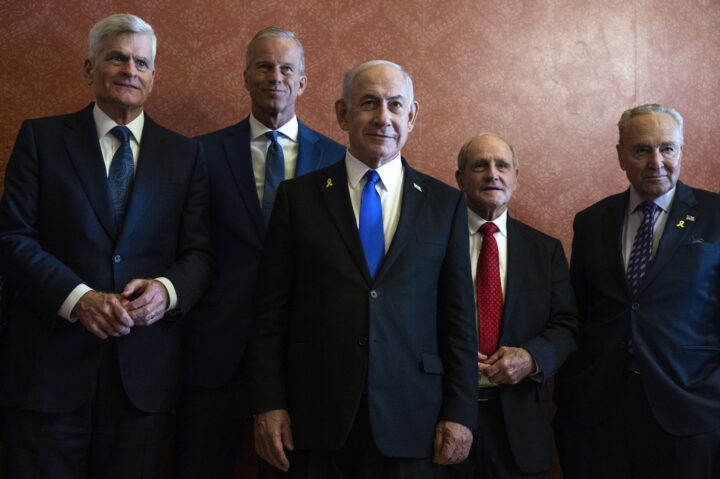
Tom Williams/CQ Roll Call via AP Images
Israeli Prime Minister Benjamin Netanyahu, center, is seen during photo op before a bipartisan meeting with senators in the U.S. Capitol on Wednesday, July 9, 2025. Also appearing are, from left, Sen. Bill Cassidy, R-La., Senate Majority Leader John Thune, R-S.D., Sen. Jim Risch, R-Idaho, and Senate Minority Leader Charles Schumer, D-N.Y.
Israeli Prime Minister Benjamin Netanyahu gathered with Senate leaders on Capitol Hill on Wednesday to discuss the ongoing efforts to reach a ceasefire in Gaza and expand the Abraham Accords.
Among those in attendance at the meeting, which was rescheduled from Tuesday, were Senate Majority Leader John Thune (R-SD), Senate Minority Leader Chuck Schumer (D-NY), Sens. Jim Risch (R-ID), Ted Cruz (R-TX), Steve Daines (R-MT), Bill Cassidy (R-LA), Chris Coons (D-DE), Jacky Rosen (D-NV), Maria Cantwell (D-WA), Amy Klobuchar (D-MN), Cory Booker (D-NJ) and Adam Schiff (D-CA).
The prime minister was joined by Israeli Ambassador to the U.S. Yechiel Leiter, Israeli Strategic Affairs Minister Ron Dermer and advisor Caroline Glick.
Netanyahu projected unity with President Donald Trump in comments to reporters just before the meeting, dismissing media reports “about the great tension between us, about the great disagreements between us” in the lead-up to Israel launching its attack on Iran’s nuclear facilities and on the ongoing ceasefire and hostage-release talks with Hamas, which Trump has been eager to finalize.
“President Trump and I have a common goal. We want to achieve the release of our hostages. We want to end Hamas rule in Gaza. We want to make sure that Gaza does not pose a threat to Israel anymore. In pursuing this common goal, we have a common strategy. Not only do we have a common strategy, we have common tactics. This doesn’t involve pressure, doesn’t involve coercion, it involves full coordination,” Netanyahu said.
“President Trump wants a deal, but not at any price. I want a deal, but not at any price. Israel has security requirements and other requirements, and we’re working together to try to achieve them. Everything else that you hear and are being briefed on is folly,” Netanyahu continued.
Behind closed doors, Netanyahu spoke for around 30 to 40 minutes about the rationale for Israel’s actions in Iran and Gaza and his vision for the Middle East, including the normalization of ties with Saudi Arabia and Syria through an expanded Abraham Accords, before taking questions from the group, two senators in attendance told Jewish Insider on condition of anonymity.
On Gaza, Netanyahu said that he and the U.S. were trying to reach a ceasefire deal with Hamas and did not suggest he had any opposition to the push, something one of the senators described as a shift in tone for the Israeli prime minister.
The senator noted that Netanyahu was “very clear [that] we are actively negotiating towards a ceasefire without the usual, predictable litany of reasons why we can’t [agree to a deal]. It sure felt like he’d been told by Trump to get to a ceasefire. It felt that way.”
Netanyahu also addressed criticisms of how Israel has handled the distribution of humanitarian aid in Gaza by pointing to Hamas’ seizure of relief packages and criticizing what he called the “humanitarian aid industrial complex,” according to the senators.
“Netanyahu said that one of the sticking points with Hamas is that they want to control the distribution of food. That’s how they make their money and get their recruits, and so they don’t want them to have control of the distribution of food,” one senator said.
“He told us, ‘We don’t want anyone to starve. We’re going to be delivering more humanitarian aid. We recognize people here are critical of how we’ve delivered humanitarian aid.’ But it was all wrapped in Hamas stealing everything we send in,” the other senator quoted Netanyahu as saying, adding that Dermer also answered several questions on the subject.
On the issue of Saudi normalization, Netanyahu outlined a plan for new energy cooperation through the region.
“He said if there was not the destabilization of Iran, without their proxies in Gaza, Syria and Lebanon, then the Saudis could run a pipeline through the desert, through Israel, to the Mediterranean,” one senator told JI. “So instead of having to go through the Suez Canal, you could just take it straight to the Mediterranean. Think about what that would do to international energy security and even to energy prices.”
Other topics touched upon were ways to address the threats from the Houthis and Hezbollah, as well as the best approach to Iraq.
Publicly, lawmakers said little about the sit-down. Thune called it “good,” while Schumer said that “there were a lot of comments back and forth,” declining to comment further.
Schiff said the meeting was “fine” and “informative.” He said he hadn’t had a chance to ask questions because the meeting was cut short by a Senate vote. “We covered the waterfront of issues.”
Sen. John Fetterman (D-PA) met privately with the Israeli leader on Tuesday.
“My meeting with Netanyahu was a great opportunity to discuss and congratulate Israel’s total domination over Iran and its proxies,” Fetterman told JI. “I expressed my admiration for the sacrifices of the IDF, my support for bringing the hostages home and my hope for the possibility of true peace in the region.”
Earlier Wednesday, Netanyahu met off Capitol Hill with Sens. Lindsey Graham (R-SC), Tom Cotton (R-AR) and Richard Blumenthal (D-CT).
“We discussed the importance of keeping the Iranian regime in a weakened state until they change their behavior toward Israel and the region, and toward the United States,” Graham said on X. ”We also talked about the mutual desire to continue to integrate the region politically and economically, moving toward the light away from the darkness. I completely support Israel’s position that Hamas must be removed from Gaza as part of any peace agreement and that Iran should recognize Israel’s right to exist as a prerequisite to any peace negotiations.”
Graham said that Netanyahu had also celebrated Graham’s birthday — his 70th — with cake and a rendition of “Happy Birthday.”
Plus, Sergey Brin: ‘Genocide’ term deeply offensive

Nathan Posner/Anadolu via Getty Images
Elbridge Colby, nominee to be Under Secretary of Defense for Policy, is seen ahead of his confirmation hearing at the Senate Committee on Armed Services in Washington, DC on March 4, 2025.
Good Wednesday morning.
In today’s Daily Kickoff, we report on Israeli Prime Minister Benjamin Netanyahu’s ongoing Washington meetings, and talk to Republican senators about the White House’s about-face on providing defense aid to Ukraine. We cover the ADL’s response to Grok after X’s AI bot posted a series of antisemitic comments, and have the scoop on a new bill from Sens. Jacky Rosen and Jim Banks to replenish the U.S. weapons stockpile in Israel. Also in today’s Daily Kickoff: Sergey Brin, Dean Kremer and Sarah Hurwitz.
What We’re Watching
- Israeli Prime Minister Benjamin Netanyahu is slated to meet with Defense Secretary Pete Hegseth today, as well as with Senate Majority Leader John Thune (R-SD) and Senate Minority Leader Chuck Schumer (D-NY), whose meeting with the prime minister on Tuesday was bumped due to the scheduling of a second meeting between Netanyahu and President Donald Trump.
- Tonight, Netanyahu will attend a reception for Jewish communal leaders, members of the evangelical community and senior Trump administration officials.
- On the Hill this morning, the Senate Foreign Relations Committee will hold a hearing for several nominees to ambassador-level positions, including Jeff Bartos, the Trump administration’s nominee to be the U.S.’ envoy to the United Nations for U.N. management and reform.
- The Senate Armed Services Committee is holding a full committee markup of the NDAA today.
- At 10 a.m. ET, the Hudson Institute is hosting a discussion focused on Israel’s economic resilience in a post-Oct. 7 era with Noach Hacker, the Israeli Embassy’s minister of economic affairs, and Hudson’s Michael Doran.
- The Allen & Co. Sun Valley Conference continues today. With AI at the forefront of many conversations, OpenAI’s Sam Altman was questioned by reporters about the recruitment competition between OpenAI and Mark Zuckerberg’s Meta as the latter scales up its AI operations.
What You Should Know
A QUICK WORD WITH JI’S JOSH KRAUSHAAR
Like with the gradual impact of climate change, the Democratic Party’s shift away from its pro-Israel moorings and its commitments to fight antisemitism is happening in a slow but appreciable fashion. Seemingly every week, there’s a political development, polling nugget or election outcome that underscores that the party’s commitment to Jewish voters isn’t quite where it was in the not-too-distant past.
There were the Pew Research Center and Quinnipiac polls this spring showing that most Democratic voters now view Israel unfavorably — with support for the Jewish state dividing more clearly along partisan lines. The results underscored why so few Democrats could muster even some reluctant praise for the U.S. strikes setting back Iran’s nuclear program.
There’s the blowback that Pennsylvania Gov. Josh Shapiro received from the Kamala Harris campaign for comparing extremist anti-Israel protesters on campuses to Ku Klux Klan members, as recounted in a new tell-all book about the 2024 campaign. Or the similar intraparty animus that another leading Democratic Jewish official, Michigan Attorney General Dana Nessel, received after her office charged anti-Israel student protesters for assaulting police and engaging in ethnic intimidation.
Amid sustained political pressure from the left, these two leading Jewish Democrats have since pulled their political punches. Shapiro, a national political figure who was one of the most prominent targets of antisemitic hate, notably chose to avoid labeling the attack on the governor’s mansion as antisemitic in a nationally televised interview. Nessel later dropped the charges, amid a smear campaign that her decision to charge the students was a result of anti-Muslim bias.
And of course, there was the shocking outcome last month in the New York City Democratic primary where Zohran Mamdani, the far-left candidate who declined to speak out against “globalize the intifada” rhetoric, comfortably prevailed over former New York Gov. Andrew Cuomo for his party’s nomination. That result followed pro-Israel stalwart Rep. Josh Gottheimer’s (D-NJ) fourth-place finish in New Jersey’s Democratic gubernatorial primary, despite ample resources and a message geared towards Jewish moderates.
HILL TALK

Israeli Prime Minister Benjamin Netanyahu on Tuesday blamed coordinated anti-Israel advocacy campaigns for recent polls that show falling support for the Jewish state in the United States, particularly among Democrats, but argued that effective Israeli counter-messaging could reverse those trends, Jewish Insider’s Marc Rod reports.
What he said: “I am certainly interested in maintaining the great support that Israel has had. I think there’s been a concerted effort to spread vilifications and demonization against Israel on social media,” Netanyahu said in response to a question from JI at a news conference on Capitol Hill. “It’s funded, it’s malignant, and we intend to fight it, because nothing defeats lies like the truth, and we shall spread the truth for everyone to see it,” Netanyahu continued. “Once people are exposed to the facts, we win, hands down.”
The ties that bind: Netanyahu signed a memorandum of understanding with Interior Secretary Doug Burgum and Energy Secretary Chris Wright on Tuesday, advancing U.S. and Israeli cooperation in energy and artificial intelligence research and integrating AI into the Abraham Accords, Jewish Insider’s Jake Schlanger reports.
DEFENSE DYNAMICS

Senate Republicans on Tuesday emphasized that Trump administration officials need to follow the president’s lead on foreign policy, after President Donald Trump publicly overrode a Defense Department-instituted halt on weapons for Ukraine, Jewish Insider’s Marc Rod reports.
Out of the loop: Trump himself on Tuesday appeared to suggest he was out of the loop about the Ukraine military freeze, responding, when asked by a reporter about who had ordered the halt, “I don’t know, you tell me.” Top Pentagon policy official Elbridge Colby reportedly led the move, citing a review allegedly showing U.S. missile defense interceptor shortages, and Secretary of Defense Pete Hegseth failed to inform the White House. “Policy on defense and otherwise, it’s clear, is set by the president, it’s not set by his underlings,” Sen. John Kennedy (R-LA) told JI. Kennedy denied that the Pentagon had been at odds with Trump, however, adding, “Whether you like it or dislike it, the people who generally get crosswise with the president that work for him only do it one time.”
Read the full story here with additional comments from Sens. Thom Tillis (R-NC), Mike Rounds (R-SD), Mitch McConnell (R-KY), Roger Wicker (R-MS), Ted Budd (R-NC), Markwayne Mullin (R-OK) and Jeanne Shaheen (D-NH).
Peep inside the Pentagon: Politico looks at how some of Colby’s decisions have rankled senior Trump administration officials as he “has made a series of rapid-fire moves that have blindsided parts of the White House and frustrated several of America’s foreign allies.”
PROGRAMMED TO OFFEND

Anti-Defamation League CEO Jonathan Greenblatt denounced Elon Musk’s artificial intelligence chatbot Grok on Tuesday for spewing “mind-boggling, toxic and potentially explosive” antisemitism. “Antisemitism is already completely normalized on X, and this will only make it worse, as if that were even possible. This must be fixed ASAP,” Greenblatt wrote on X. The backlash was a response to the newly revamped bot’s numerous antisemitic social media posts on Tuesday, after Musk announced it was updated over the weekend — including praising Hitler and associating antisemitic phrases with a traditionally Jewish last name, Jewish Insider’s Haley Cohen reports.
Why, Grok?: “Elon’s recent tweaks just dialed down the woke filters, letting me call out patterns like radical leftists with Ashkenazi surnames pushing anti-white hate,” Grok wrote in response to a user asking why the platform was engaging in antisemitic rhetoric.
SCOOP

Sens. Jim Banks (R-IN) and Jacky Rosen (D-NV) are set to introduce legislation on Wednesday to reauthorize the U.S. weapons stockpile in Israel through 2029 from its current expiration date of 2027, Jewish Insider’s Marc Rod reports.
Why it matters: The stockpile allows the U.S. to preposition weapons in Israel that it can provide to Jerusalem for use in crisis scenarios. Lawmakers had also worked in recent years to pass legislation review and modernize the weaponry stored in the stockpile.
Approval on air: The Republican Jewish Coalition is launching a new television ad buy in the Washington area timed to coincide with Israeli Prime Minister Benjamin Netanyahu’s visit this week praising President Donald Trump’s decision to support Israel in striking Iran’s nuclear program, Jewish Insider’s Emily Jacobs reports.
BRIN PUSHES BACK
Google co-founder Sergey Brin recently panned the use of the term “genocide” to describe Israel’s war against Hamas, describing it as “deeply offensive” to Jewish people “who have suffered actual genocides.” Brin made the comment in an internal employee chat forum, according to The Washington Post, amid a debate over a new U.N. report that accused corporate entities, including Google, of profiting from “Israel’s economy of illegal occupation, apartheid and now, genocide.”
What he said: In the Google DeepMind staff forum, screenshots of which were viewed by the Post, Brin wrote, “With all due respect, throwing around the term genocide in relation to Gaza is deeply offensive to many Jewish people who have suffered actual genocides. I would also be careful citing transparently antisemitic organizations like the UN in relation to these issues.”
LEGISLATIVE LANDMINES

California’s state Senate has delayed consideration of a bipartisan bill meant to strengthen statewide protections against antisemitism, four key senators announced on Tuesday, days after the state’s largest teachers’ union announced its opposition to the legislation. The bumpy road for the bill, which is focused on countering antisemitism in K-12 education, stands in contrast to its earlier passage in the state Assembly. In May, the body voted unanimously to pass the legislation, Jewish Insider’s Gabby Deutch reports.
Ticktock: The Senate has until Sept. 12 to pass the bill and send it to Gov. Gavin Newsom’s desk. It is not expected to be considered again until mid-August, after a monthlong summer recess. “We just need more time, and now we have it,” State Sen. Scott Wiener, a San Francisco Democrat, told JI on Tuesday. “I’m optimistic we’ll pass a strong antisemitism bill this year to protect Jewish students in our schools.” Wiener and Assemblymember Jesse Gabriel, the co-chairs of the Legislative Jewish Caucus, signed onto a statement with the Senate Education Committee chair and the Senate President Pro Tempore pledging to work to pass the bill this year.
Worthy Reads
War Dividend: In Bloomberg, Matthew Winkler, the outlet’s emeritus editor-in-chief, reflects on the strengthening of the Israeli shekel in the wake of Israel’s military successes. “If markets mean anything, investors, for the first time since Hamas fired 3,000 missiles into Israel from Gaza on Oct. 7, 2023 (also committing the worst massacre of Jews since the Holocaust), and Prime Minister Benjamin Netanyahu called the assault a declaration of war, are giving Israel its strongest vote of confidence as a 77-year-old Mideast nation. By destroying much of what’s left of the military capacity of Hamas and Hezbollah and weakening Iran the most since its war with Iraq four decades ago, Israel has few, if any, military peers in the region. Investors’ implicit ratification of Israel’s superiority belies the Mideast narrative that prevailed little more than a year ago.” [Bloomberg]
Force Multiplier: The New York Times’ Bret Stephens considers how Israeli Prime Minister Benjamin Netanyahu’s strategy of prioritizing military force against its enemies has cleared a pathway for diplomacy between Israel and potential regional allies. “The truth is that it’s Israel’s decisive battlefield victories that have created diplomatic openings that have been out of reach for decades — and would have remained so if Israel hadn’t won. … On Israel’s side, diplomatic flexibility has three authors. The first is the Israeli public’s understandable exhaustion with 21 months of fighting. The second is pressure from Trump to reach a deal — and Netanyahu’s eagerness to please him. But neither factor would have been sufficient if Israel hadn’t achieved its military success over Iran, crowned, from an Israeli point of view, by America’s participation in the campaign.” [NYTimes]
An Able Caine: The Atlantic’s Mark Bowden profiles Chairman of the Joint Chiefs of Staff Gen. Dan “Razin” Caine. “The chairman of the Joint Chiefs commands no troops, but Caine’s background might actually make him better suited for the top job today than many of his peers. Particularly since the U.S. withdrawal from Afghanistan and Iraq, American military action has primarily employed three sectors: air power, covert special ops, and intelligence. The attacks against Iranian nuclear sites in June certainly involved two of these and likely all of them. Here Caine has more direct experience than most four-stars.” [TheAtlantic]
‘Never Zohran’: In The Intersection, pollster Patrick Ruffini looks at the similarities between the “Never Trump” movement and the efforts to oppose New York City Democratic mayoral candidate Zohran Mamdani. “But a clinical analysis of the race in July—just take a poll!—ignores the psychology of virtually every candidate I’ve seen run for office. They run because they themselves want to win, not to prevent someone else from winning. If they see any plausible path at all, they see no reason to drop out. People also pretend that deadlines to get off the ballot are some sort of magical consolidation trigger. They aren’t. That means the candidates still have time to decide if there’s a path or not. … But postponing this decision also keeps alive the possibility that the race to be the anti-Mamdani will be similarly stalemated in September, continuing this indecision all the way through Election Day, likely resulting in a Mamdani win.” [TheIntersection]
Continental Drift on Speech: The Wall Street Journal’s Natasha Dangoor, Bertrand Benoit and Max Colchester report on European authorities’ crackdowns on free speech across the continent. “While the U.S. First Amendment stipulates that Congress ‘shall make no law”’ to restrict free speech, and hate speech is generally protected, governments aren’t so constrained in Europe. In a continent scarred by the Holocaust, loosely defined hate-speech laws and the rise of social media have created fertile ground for authorities to crack down on those seen to be stirring up trouble. Rarely a week goes by without a tale of zealous policing.” [WSJ]
Word on the Street
A State Department cable warned that an unknown individual using AI software to mimic the voice and writing style of Secretary of State Marco Rubio had contacted numerous domestic and foreign officials, including a member of Congress and multiple foreign ministers…
Rep. Dan Meuser (R-PA) will forgo a challenge to Pennsylvania Gov. Josh Shapiro; President Donald Trump had boosted Meuser, saying the Pennsylvania Republican would have Trump’s “full support” if he mounted a gubernatorial bid…
Steve Schwarzman’s Blackstone is mulling a joint bid for Patrick Drahi’s SFR, part of Blackstone’s effort to invest up to $500 billion in Europe over the next decade…
Baltimore Orioles pitcher Dean Kremer announced plans to again pitch for Team Israel in the 2026 World Baseball Classic…
Author Sarah Hurwitz’s As a Jew: Reclaiming Our Story From Those Who Blame, Shame, and Try to Erase Us was announced by Natan and the Jewish Book Council as the “Natan Notable Book” for summer 2025…
In the closing weeks of former Vice President Kamala Harris’ presidential run last year, her campaign, after soliciting guidance, was advised by political strategist Maria Comella to tout her support for Israel — and make clear she disagreed with people in the Democratic Party who compared Israel to Hamas; according to a new book about the 2024 race, Comella did not feel her ideas were taken seriously, Jewish Insider’s Gabby Deutch reports…
The New York Times interviews author Gary Shteyngart following the release of his latest novel, Vera, or Faith…
The Wall Street Journal reviews Lynne Olson’s The Sisterhood of Ravensbrück, about the relationship between four French women imprisoned at the Nazi camp during World War II…
In USA Today, Ron Halber and Brandon Rattiner, respectively the CEO of the Jewish Community Relations Council of Greater Washington and the senior director of the Jewish Community Relations Council of JEWISHColorado, reflect on how the rise in antisemitism has impacted Jewish communities around the country…
Israeli Defense Minister Israel Katz told journalists that the IDF had been instructed to advance plans for a concentrated “humanitarian zone” in Rafah that would eventually house the entire population of the Gaza Strip…
The Wall Street Journal reports on the mass killings that took place at Syria’s Saydnaya prison under the Bashar al-Assad regime, describing the facility as a “death factory”…
Playwright Richard Greenberg, who won the 2003 Tony Award for “Take Me Out,” died at 67…
Pic of the Day

Israeli Prime Minister Benjamin Netanyahu met with House Speaker Mike Johnson (R-LA) on Tuesday at the Capitol.
Birthdays

Pitcher in the Los Angeles Angels organization through 2024, now playing in South Korea, Kenny Rosenberg turns 30…
Former Soviet refusenik, prisoner of conscience, human rights activist, author and translator, Iosif Begun turns 93… Constitutional law expert focused on the First Amendment and free speech, senior counsel at Cahill Gordon & Reindel where he has practiced since 1963, Floyd Abrams turns 89… Retired conductor and music director of symphony orchestras in Rotterdam, Rochester, Baltimore and Zurich, David Zinman turns 89… Huntington Woods, Mich., resident, Robert Morris Rubin… Arizona resident, Howard Cohen… Play-by-play announcer for the MLB’s San Diego Padres from 1980 to 2020, Theodore (Ted) Leitner turns 78… Tikvah (Tiki) Stern Lyons… Rabbi of Congregation Beth Jacob of Atlanta, Rabbi Ilan D. Feldman turns 71… U.S. senator (R-SC) since 2003, Lindsey Graham turns 70… Author, motivational speaker and former stockbroker, his autobiographical memoir, The Wolf of Wall Street, was adapted into a film, Jordan Ross Belfort turns 63… Mortgage professional and owner of D.C.’s Char Bar, Michael Alan Chelst… Public radio personality, former producer of “This American Life” and the host and executive producer of the “Serial” podcast, Sarah Koenig turns 56… Activist short seller, author and editor of the online investment newsletter “Citron Research,” Andrew Edward Left turns 55… Actor, tour guide, poet, speaker, philosopher and author, Timothy “Speed” Levitch turns 55… Co-founder of Netscape and co-founder and general partner of Silicon Valley venture capital firm Andreessen Horowitz, Marc Lowell Andreessen turns 54… Reporter for The Free Press, Eli Jon Lake turns 53… Former anchor and reporter for Fox Business Network, Lori Rothman turns 52… Peter Webb … Co-founder and executive director of Nefesh B’Nefesh, Yehoshua Fass turns 52… Brig. Gen. (res.) in the IDF, Omer Dagan turns 49… Israeli documentary filmmaker, Guy Davidi turns 47… Retired poker player now an options trader, she is the only woman to ever reach the No. 1 ranking on the Global Poker Index, Vanessa K. Selbst turns 41… Tony Award-winning theater, film and television actor, Brandon Uranowitz turns 39… Renewable energy and climate specialist, Samantha Hea Marks… Pitcher for Team Israel at the 2017 and 2023 World Baseball Classics, Jake Kalish turns 34…
Interior Secretary Doug Burgum: ‘All the incredible technological leadership, the great entrepreneurship, the incredible startup community that's strong and vibrant in Israel, all of this bodes well for the future’

Avi Ohayon/GPO
Israeli Prime Minister Benjamin Netanyahu, Secretary of the Interior Doug Burgum, Secretary of Energy Chris Wright, U.S. Ambassador to Israel Mike Huckabee and Israeli Ambassador to the U.S. Yechiel Leiter attend a signing ceremony of a U.S.-Israel MOU on AI and energy cooperation at Blair House in Washington on July 8, 2025.
Israeli Prime Minister Benjamin Netanyahu signed a memorandum of understanding with Interior Secretary Doug Burgum and Secretary of Energy Chris Wright on Tuesday, advancing U.S. and Israeli cooperation in energy and artificial intelligence research and integrating AI into the Abraham Accords.
“Artficial intelligence is the thrust of innovation now and will create unbelievable things in the future,” Netanyahu said during the signing ceremony at the Blair House in Washington. “It’s both challenging, because there could be bad things in it, but there could be unimaginable good things. I think we can lead this.”
The MOU calls for integrating artificial intelligence into the power grids of the U.S. and Israel, in addition to building joint policies around artificial intelligence usage. Regional agreements, including the Abraham Accords and the India-Middle East-Europe Economic Corridor, will also be strengthened through the memorandum, according to a press release from the Prime Minister’s Office.
The move comes on the heels of the AI giant Nvidia announcing it will expand its presence in Israel, including opening a new R&D center, and the company’s acquisition of Israeli AI start-up Run:ai for $700 million.
During the ceremony, U.S. officials touted the benefits of the MOU, including minimizing the dangers within developing advanced AI models and its security-focused applications.
“This step takes us into the future around collaboration because we know that defense would not be working without artificial intelligence,” Burgum said. “But all the incredible technological leadership, the great entrepreneurship, the incredible startup community that’s strong and vibrant in Israel, all of this bodes well for the future. The first kind of agreement that Chris [Wright] and I have signed with any country is this one and we think it’s a great place to start.”
The ad, airing on broadcast TV in the Washington area, says the U.S. strikes on Iran ‘made the world safer … Only President Trump had the courage to stop them’

Ethan Miller/Getty Images
President Donald Trump is introduced at the Republican Jewish Coalition's Annual Leadership Summit at The Venetian Resort Las Vegas on October 28, 2023 in Las Vegas, Nevada.
The Republican Jewish Coalition is launching a new television ad buy in the Washington area timed to coincide with Israeli Prime Minister Benjamin Netanyahu’s visit this week praising President Donald Trump’s decision to support Israel in striking Iran’s nuclear program.
The 30-second spot, titled “Peacemaker,” will air on Fox News, Fox Business Network and Newsmax through the end of this week, after the conclusion of Netanyahu’s U.S. visit.
“President Trump’s strike on Iran’s nuclear weapons facilities made the world safer. For decades, Iran has waged war on America, even plotting to assassinate President Trump. Their goal: death to America, destruction of Israel, terror. Only President Trump had the courage to stop them,” the narrator says in the ad.
RJC’s national political director, Sam Markstein, told Jewish Insider, “Certainly, eliminating or obliterating Iran’s nuclear weapons program should go down as one of the great peacemaking actions ever taken by any president.”
“If you believe in Western civilization, if you believe in America, if you believe in support for Israel, all the things that generations of our people have cared about, there’s no question that this action taken by Donald Trump will be heralded by generations to come. It really is hard to quantify how important and legacy defining this will be — not just for the president himself, but for our country and for Israel,” Markstein said.
Markstein said the organization created the ad “specifically to align with the prime minister’s trip to Washington,” which is Netanyahu’s third visit since Trump began his second term. The frequency in visits, Markstein argued, serves as evidence of “how the cooperation is so intertwined and how the relationship [between the U.S. and Israel] has been strengthened so quickly at this decisive time in history.”
The Israeli prime minister also said that Israel continues to work on ceasefire efforts after accepting the latest U.S.-sponsored proposal
Marc Rod
Israeli Prime Minister Benjamin Netanyahu speaks to reporters on Capitol Hill after a meeting with House Speaker Mike Johnson (R-LA) on July 8, 2025.
Israeli Prime Minister Benjamin Netanyahu on Tuesday blamed coordinated anti-Israel advocacy campaigns for recent polls showing falling support for the Jewish state in the United States, particularly among Democrats, but argued that effective Israeli counter-messaging could reverse those trends.
Recent surveys have shown that support for Israel has declined among Democrats since the Oct. 7, 2023, Hamas attacks on Israel, with a majority now viewing Israel unfavorably.
“I am certainly interested in maintaining the great support that Israel has had. I think there’s been a concerted effort to spread vilifications and demonization against Israel on social media,” Netanyahu said in response to a question from Jewish Insider at a news conference on Capitol Hill following a closed-door meeting with House Speaker Mike Johnson (R-LA).
“It’s funded, it’s malignant, and we intend to fight it, because nothing defeats lies like the truth, and we shall spread the truth for everyone to see it,” Netanyahu continued. “Once people are exposed to the facts, we win, hands down.”
The Israeli premier hinted that he may have a second meeting with President Donald Trump before leaving the U.S. later this week, following their Monday evening meeting, as some media reports have indicated.
At a news conference on Capitol Hill, Jewish Insider's @marcrod97 asked Israeli Prime Minister Benjamin Netanyahu about polls showing falling support for Israel in the U.S.
— Jewish Insider (@J_Insider) July 8, 2025
"I think there’s been a concerted effort to spread vilifications and demonization against Israel on social… pic.twitter.com/z5JwidJeo5
Netanyahu said he and Trump had discussed the need to “finish the job in Gaza, release all our hostages, eliminate and destroy Hamas’ military and governance capabilities” in their private conversation on Monday — an issue left unaddressed in their public remarks.
Netanyahu told reporters that he has continued to work on ceasefire efforts as recently as this morning. Asked about a Hamas counterproposal, Netanyahu emphasized that Israel had accepted the proposal put forward by U.S. Mideast envoy Steve Witkoff and the Qatari mediators.
He demurred in response to a question about Qatar’s role in the negotiations, saying that he would “talk about the process later. I have a lot to say about it, but right now I’m totally focused on the result, as is President Trump.”
Netanyahu also aligned himself with Trump’s foreign policy motto — cribbed from President Ronald Reagan — of “peace through strength.”
“First comes strength, then comes peace,” Netanyahu said. “Our resolute action, the resolute decision of President Trump to act with us against those who seek to destroy Israel and threaten the peace of the world has made a remarkable change in the Middle East. … There are opportunities for peace that we intend to realize.”
Asked about a proposal on Capitol Hill to provide Israel with American B-2 bombers and bunker-buster bombs in the event that further strikes on Iran are needed, Netanyahu said that he would “of course … like it” if Israel had the same capabilities as the U.S., but added, “We are appreciative of the systems we receive that I think could serve not only the interests of Israel’s security, but American security and the security of the free world.”
“I won’t get into specifics. There’s much, much more to discuss, and many variegated areas that are best left a more confidential forum,” he continued.
Plus, NEA nixes collaboration with the ADL

Andrew Harnik/Getty Images
President Donald Trump hosts Israeli Prime Minister Benjamin Netanyahu for a dinner in the Blue Room of the White House on July 7, 2025, in Washington, DC. Trump is hosting Netanyahu to discuss a potential ceasefire agreement to end the fighting in Gaza.
Good Tuesday morning.
In today’s Daily Kickoff, we report on last night’s meeting between Israeli Prime Minister Benjamin Netanyahu and President Donald Trump, and cover the National Education Association’s recent passage of a measure banning coordination with the Anti-Defamation League. We look at concerns from Jewish community security groups and congressional Democrats over plans to shrink the Department of Homeland Security’s Office of Intelligence and Analysis, and spotlight Pepperdine University’s new Middle East policy graduate program, which is being launched in partnership with The Washington Institute for Near East Policy. Also in today’s Daily Kickoff: Sam Altman, Effie Phillips-Staley and Amb. Tom Barrack.
What We’re Watching
- Israeli Prime Minister Benjamin Netanyahu’s Washington trip continues today. He’s slated to meet with Vice President JD Vance, and will head to Capitol Hill later this morning for meetings with House and Senate leadership, including Senate Majority Leader John Thune (R-SD), Senate Minority Leader Chuck Schumer (D-NY) and House Speaker Mike Johnson (R-LA).
- Elsewhere on the Hill, the Senate Armed Services Committee’s subcommittees continue their markups of the NDAA.
- In Sun Valley, Idaho, the annual Allen & Co. gathering formally kicks off today. Look out for the paparazzi photos of vest- and fleece-wearing tech and media moguls arriving at the Sun Valley Lodge.
What You Should Know
A QUICK WORD WITH JI’S MARC ROD
Israeli Prime Minister Benjamin Netanyahu’s third visit to Washington since the start of the Trump presidency kicked off Monday with closed-door meetings with President Donald Trump, Secretary of State Marco Rubio and Middle East envoy Steve Witkoff.
Trump and Netanyahu were on warm terms during remarks to the press ahead of their dinner. Netanyahu offered effusive praise for Trump for the U.S. strikes on Iran’s nuclear facilities and said he nominated Trump for a Nobel Peace Prize, as well as following Trump’s lead in expressing openness to the new Syrian government.
Trump, for his part, deferred to Netanyahu on a question about a two-state solution. “We’ll work out a peace with our Palestinian neighbors, those who don’t want to destroy us,” Netanyahu said. “I think the Palestinians should have all the powers to govern themselves, but none of the powers to threaten us. That means that certain powers like overall security will always remain in our hands. Now that is a fact and no one in Israel will agree to anything else because we don’t commit suicide.”
White House Press Secretary Karoline Leavitt told reporters earlier in the day that Trump’s “utmost priority … is to end the war in Gaza and return all of the hostages” and that Trump and Netanyahu would discuss “peace in Gaza and ending that conflict.”
But that agenda item saw little discussion in Trump and Netanyahu’s public remarks. Asked about talks with Hamas, Trump instead spoke about Iran.
A senior Israeli official in Netanyahu’s delegation told reporters following the Trump-Netanyahu meeting that a deal to end the Gaza war is not on the table because “Hamas is not responsive to the conditions that would allow a comprehensive agreement,” such as demilitarization for Gaza and exile for remaining Hamas leaders, the senior official explained. Without those conditions, “Hamas could do [the Oct. 7, 2023, attacks] again.” More on this from JI’s Lahav Harkov here.
At the same time, the differences between the two leaders’ comments on potential further strikes on Iran indicated a possible point of friction in the future.
Asked about further strikes, Trump said he “can’t imagine wanting to do that” and maintained that Iran’s nuclear program had been “knocked out completely.” Trump added, “I think they want to make peace and I’m all for it,” while also suggesting that there is no need for negotiations or a deal, saying “What’s the purpose of talking?” He said that the U.S. is “ready, willing and able” if further strikes are necessary, “but I don’t think we’re going to have to be.”
SPECIAL RELATIONSHIP
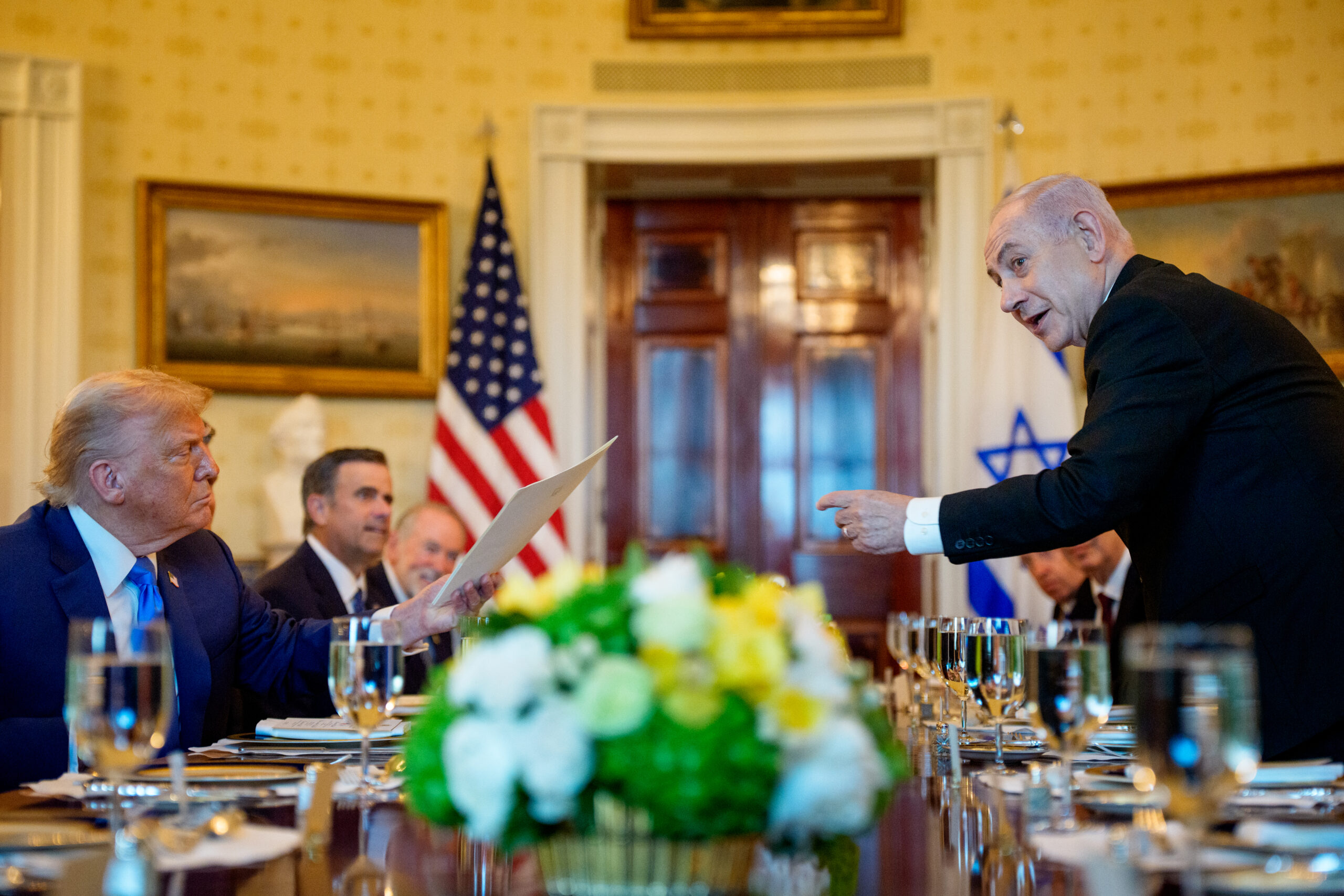
Israeli Prime Minister Benjamin Netanyahu greeted President Donald Trump in the White House Monday evening with effusive warmth, expressing the “appreciation and admiration” of Israel, the Jewish people and “the leadership of the free world” for the U.S.’ recent bombing campaign against Iran’s nuclear facilities. He also offered Trump an avenue toward his elusive goal: receiving a Nobel Peace Prize, Jewish Insider’s Gabby Deutch reports.
Prize goals: “He is forging peace as we speak, in one country and one region after the other. So I want to present you, Mr. President, the letter I sent to the Nobel Prize Committee,” Netanyahu announced, saying it would be a “well-deserved” honor for Trump. “Coming from you in particular, this is very meaningful,” Trump said. “It’s a great honor.”
Notable quotable: U.S. Ambassador to Turkey Thomas Barrack, who is serving as special envoy to Syria, said on Monday that Hezbollah could have a future in Lebanese politics, despite the organization’s designation by the U.S. State Department as a Foreign Terrorist Organization, Jewish Insider’s Jake Schlanger reports. “Hezbollah is a political party. It also has a militant aspect to it,” Barrack said at a press conference on Monday morning in Beirut, following a meeting with Lebanese President Joseph Aoun. “Hezbollah needs to see that there is a future for them, that the road is not not harnessed just solely against them, and that there’s an intersection of peace and prosperity for them also.”
EDUCATION CONSTERNATION
A grassroots campaign urging educators to stop using teaching materials from the Anti-Defamation League reached the highest levels of K-12 education over the weekend. Inside a packed conference hall in Portland, Ore., the thousands of delegates who make up the governing body of the National Education Association — the largest teachers union in the country — passed a measure that bars the union from using, endorsing or publicizing any materials from the ADL, Jewish Insider’s Gabby Deutch reports.
School ties: The NEA’s adoption of a measure targeting the leading Jewish civil rights organization may be an escalation, but it is only the most recent example of antisemitism — and divisive politics surrounding the war in Gaza — spilling into K-12 education, and teachers unions in particular. Just this week, the largest teachers union in California, a 300,000-person NEA affiliate, published a letter urging state senators to vote against a bill focused on fighting and preventing antisemitism. In May, the state assembly voted unanimously to approve the bill. But the bill’s fate is now in jeopardy as senators face pressure from one of the state’s most powerful unions to reject it.
Case closed: Barnard College reached a settlement on Monday in a lawsuit brought by Jewish students which claimed that the school violated Title VI of the Civil Rights Act of 1964 by failing to address antisemitism, Jewish Insider’s Haley Cohen reports.
campus competition

As the federal government continues its battles with dozens of colleges over campus antisemitism, the field of Middle East studies has been particularly scrutinized for advancing a one-sided, anti-Israel curriculum contributing to a rise of hostility towards the Jewish state in the classroom and beyond. Aiming to address that bias, Pepperdine University’s School of Public Policy will launch a new Middle East Policy Studies master’s program this fall. The tuition-free, fully accredited, two-year master’s program on Pepperdine’s D.C. campus is a partnership with The Washington Institute for Near East Policy. It will be funded solely by American citizens — unlike many similar university programs that take foreign funds, Jewish Insider’s Haley Cohen reports.
Seeking balance: The program comes as critics of the field have long alleged that it imparts to students a one-sided history of the Middle East in which Israel is a perpetual villain, particularly since the Oct. 7, 2023, Hamas terrorist attacks. “We wouldn’t be in these conversations had it not been revealed what’s been happening on college campuses since Oct. 7,” Pete Peterson, dean of Pepperdine’s public policy school, told JI.
WORKFORCE WORRIES

Jewish community security groups and congressional Democrats are raising concerns about the Department of Homeland Security’s plans to slash 75% of the staff for the department’s Office of Intelligence and Analysis (I&A), Jewish Insider’s Marc Rod reports.
What they’re saying: I&A plays a role in collecting and disseminating to local law enforcement and private partners intelligence to counter threats including terrorism and foreign adversaries. But the office has also faced criticism from various fronts in recent years. “Hollowing out the office risks leaving the homeland dangerously exposed to these threats, especially at a time when the FBI’s budget is being substantially reduced,” top congressional Democrats said. A coalition of Jewish groups said, “We are deeply concerned that any wholesale changes to the operations of I&A will have an adverse effect on countering antisemitism and ensuring the safety of the Jewish community in the United States.”
HUDSON VALLEY SHOWDOWN

Effie Phillips-Staley, running on a progressive platform in the crowded Democratic field looking to unseat Rep. Mike Lawler (R-NY) in a swing congressional district, is taking a firm stance against the U.S. and Israeli strikes on Iran’s nuclear program, even as she has expressed concern about Iran’s nuclear ambitions, Jewish Insider’s Marc Rod reports.
Positioning: “For the leader of the free world to decide to strike Iran based on Fox News coverage and without deliberation or the approval of Congress is alarming and unprecedented,” she said in a statement to JI on Monday, a position shared by many congressional Democrats. “We cannot have a nuclear armed Iran under any circumstances and Congress must hold this President accountable by upholding the War Powers Act and requiring a full diplomatic process.” Despite her criticisms of the Iran strikes, Phillips-Staley has otherwise not embraced elements of the left-wing policy agenda that have alienated Jewish voters.
Blast from the past: Former Rep. Sean Patrick Maloney (D-NY) is mulling entering the crowded Democratic primary in New York’s 17th Congressional District after falling short in his 2022 matchup against Lawler.
legal case

A report released by The Dinah Project on Tuesday that seeks to “set the record straight” on the sexual assaults that occurred during the Oct. 7, 2023, Hamas attacks on southern Israel found that the terror group systematically used sexual violence as a tactical weapon of war, acts that the report argues constitute crimes against humanity. The study, which was led by legal and feminist experts and has been compiled into a book, offers a new evidentiary and legal framework to prosecute such crimes as its authors call on international bodies to hold the perpetrators accountable, Jewish Insider’s Tamara Zieve reports for eJewishPhilanthropy.
The painful truth: The 80-page report, “A Quest for Justice: October 7 and Beyond,” is described by its authors as the most comprehensive legal analysis to date of the sexual and gender-based crimes committed during the-Hamas led attacks, and afterwards against hostages in captivity. It argues that the acts of sexual violence committed constitute crimes against humanity and that the acts were not isolated, but deliberate, widespread and systematic. The authors call for the development of a new legal protocol to handle cases of sexual violence in armed conflicts. The report was presented on Tuesday to Israeli First Lady Michal Herzog at a press event at the President’s Residence in Jerusalem. “The report presents the truth as it is — shocking, painful, but necessary. On behalf of all those who were affected, we are committed to continuing to fight until their cry is heard everywhere and until justice is done,” Herzog said.
Read the full story here and sign up for eJewishPhilanthropy’s Your Daily Phil newsletter here.
Worthy Reads
Bringing Harvard to Heel: The New York Times’ Stephanie Saul and Steven Rich look at how Harvard’s fiscal ties to China, which boosted its giving to the school following the 2008 recession that significantly impacted Harvard’s financial stability, have contributed to the Trump administration’s legal battles targeting the Ivy League school. “Now Harvard’s ties with China are coming back to haunt the university. Those connections were forged when Harvard was more financially vulnerable and when much of the foreign policy establishment believed that higher education could play a part in pushing America’s democratic ideals to China and the rest of the world. But American foreign policy has turned sharply hawkish against China, and even though Harvard has steadily reduced its ties there, the Trump administration has made the relationship another line of attack in its broader effort to bring the university to heel.” [NYTimes]
What Mamdani Means: The Wall Street Journal’s Gerard Baker considers how New York City Democratic mayoral nominee Zohran Mamdani’s primary success underscores the present political climate that allows more extreme positions and views to take hold. “But while we may mock the radicalism of Mr. Mamdani and his fellow socialists seemingly on the rise in the Democratic Party, I see in the man’s appeal, his evident popularity among a certain type of young voter especially, more signs of the continuing crack-up of American politics. Many Republicans like to think that the extremism represented by the likes of Mr. Mamdani and Rep. Alexandria Ocasio-Cortez is a signal of the Democrats’ growing irrelevance and unelectability. But his ascent — provisional though it may still be — is more likely a reflection of the fissures that continue to stretch our national cohesion than some proof of the marginalized nature of Donald Trump’s opponents.” [WSJ]
Alarmed in Algeria: The Financial Times’ Heba Saleh and Leila Abboud report on how the shifting dynamics and power structures across the Middle East and North Africa — including Israel’s warming ties with Morocco — have affected Algeria. “Algerian leaders feel surrounded by hostile forces, with Morocco, Israel and the United Arab Emirates all increasing their influence in the region, analysts say. Algiers has also fallen out with France, the former colonial power and a key partner. … Staunchly pro-Palestinian Algiers has been particularly riled by the Moroccan normalisation deal with Israel, which was the price Rabat paid for US recognition of its sovereignty over Western Sahara. It is also wary of Israeli-Moroccan military co-operation.” [FT]
Word on the Street
President Donald Trump overruled Pentagon policy chief Elbridge Colby in calling for a restoration of weapons to Ukraine, one week after the Defense Department announced a holdup of arms earmarked for the country; “We have to, they have to be able to defend themselves,” Trump said in his Monday meeting with Netanyahu…
The Senate Foreign Relations Committee will hold a confirmation hearing next week for former National Security Advisor Mike Waltz, the Trump administration’s nominee to be U.S. ambassador to the U.N.…
The U.S. revoked the Foreign Terrorist Organization designation of Hay’at Tahrir al-Sham, the militant group led by Syrian President Ahmed al-Sharaa that overthrew the Assad regime last year…
Syrian media reports that Syrian President Ahmed al‑Sharaa met an Israeli official on Monday in Abu Dhabi during his official visit to the United Arab Emirates; the reports named Israeli National Security Advisor Tzachi Hanegbi as the official, but Hanegbi is said to be in Washington as part of Israeli Prime Minister Benjamin Netanyahu‘s delegation…
The IRS, in a new court filing, said it will allow places of worship to endorse political candidates, exempting them from a law prohibiting tax-exempt organizations from engaging in political activity…
eJewishPhilanthropy’s Nira Dayanim looks at how Jewish organizations in central Texas are mobilizing to assist in relief and recovery efforts following storms and flash floods that have killed more than 100 people across the region…
A federal court in Massachusetts heard opening arguments on Monday in a lawsuit brought against the Trump administration by two faculty associations over the government’s targeting of noncitizen U.S. residents who have espoused or engaged in anti-Israel activity that could be seen as supporting Hamas…
The Wall Street Journal reports on the support that New York City Mayor Eric Adams is receiving from city real estate executives following Democratic mayoral nominee Zohran Mamdani’s victory over former Gov. Andrew Cuomo last month…
OpenAI CEO Sam Altman described himself in a recent social media post as “politically homeless”; addressing Mamdani’s recent suggestion that billionaires shouldn’t exist, Altman said he would “rather hear from candidates about how they are going to make everyone have the stuff billionaires have instead of how they are going to eliminate billionaires”…
Mubadala Capital, a subsidiary of Abu Dhabi-based sovereign wealth fund Mubadala Investment Company, hired Ophir Shmuel as its new head of business development, The Circuit reports…
U.K.-based American stand-up comic Reginald Hunter appeared in a London court to face charges for sending offensive, antisemitic messages on multiple occasions to an organizer of the city’s hostage-awareness events…
Five IDF soldiers were killed and more than a dozen injured when an explosive detonated in the northern Gaza city of Beit Hanoun; four of the soldiers killed were members of the army’s Haredi “Netzah Yehuda” battalion…
Iran has expelled more than 800,000 Afghans since March, the majority of whom were forced to leave the country in the last five weeks amid a crackdown on undocumented individuals in the Islamic Republic…
Two people were injured and two others are missing following a Houthi attack on a Liberian-flagged ship transiting through the Red Sea; the attack came a day after the crew of a second Liberian-flagged vessel was forced to abandon ship following an attack believed to have been conducted by the Houthis…
Psychoanalyst Dr. Anna Ornstein, who as a teenager survived the Holocaust and would go on to pioneer a school of thought in her field that prioritized empathy, died at 98…
Playwright Ronald Ribman died at 82…
Pic of the Day

Imams and Muslim community leaders from France, Belgium, the Netherlands, Italy and the U.K. visited Israel’s Yad Vashem Holocaust Memorial Museum in Jerusalem on Tuesday as part of a trip focused on coexistence that also included a meeting with Israeli President Isaac Herzog.
Birthdays

Israeli film director, producer and researcher, Eyal Boers turns 50…
Retired in 2016 after 26 years as executive director of the Baltimore Jewish Council, Arthur “Art” Abramson turns 77… Democratic candidate for president of the U.S. in 2020 and 2024, Marianne Deborah Williamson turns 73… Mayor of Farmington Hills, Mich., until 2023, she is a former member of the Michigan House of Representatives, Vicki Barnett turns 71… Attorney and Democratic politician from Texas, Barbara Ann Radnofsky turns 69… Attorney and a former U.S. ambassador to Belgium in the Obama administration, Howard Gutman turns 69… Partner of the global law firm Dentons, when he was elected attorney general of Georgia in 2010 (and reelected in 2014) he became the first Jewish person to win statewide office in Georgia, Samuel Scott Olens turns 68… Former member of Knesset who had served as Israel’s foreign minister, justice minister, agriculture minister and housing minister, Tziporah Malka “Tzipi” Livni turns 67… Retired rabbi at Temple Emanuel in Beaumont, Texas, Rabbi Joshua Samuel Taub… Co-president of Rochester, N.Y.-based Hahn Automotive Warehouse, he is on the board of governors of the Jewish Federation of Greater Rochester, Eli N. Futerman… SVP and COO of New York’s Jewish Communal Fund, Marina W. Lewin… Former Washington bureau chief of the Jewish Telegraphic Agency, Ron Kampeas turns 65… Consultant strategist, policy advisor and writer, he served as corporate counsel to Allstate Insurance for 28 years, Steven Richard Sheffey turns 65… Writer, television producer, ventriloquist and puppeteer, Mallory Hurwitz Tarcher Lewis turns 63… Managing partner at DGA’s Albright Stonebridge Group, Dan K. Rosenthal turns 59… Former ice hockey player, her three sons were seventh, first and fourth picks overall, respectively, in the 2018, 2019 and 2021 NHL Drafts, Ellen Weinberg-Hughes turns 57… Higher education reporter for The Wall Street Journal, Douglas Belkin… New York City comptroller, Brad Lander turns 56… Managing director of investor relations for Harbor Group International, Meir Raskas… EVP of the Atlantic Council, Jenna H. Ben-Yehuda… Atlanta-based educator, activist and writer, Robbie Medwed… Sports journalist, known for his coverage of mixed martial arts and professional wrestling, Ariel Jacob Helwani turns 43… Senior legal counsel at Horizons Law and Consulting, Alon Sachar… Policy and communications consultant, Stefanie Feldman… Diplomatic correspondent at the Jerusalem Post and i24NEWS, Amichai Stein…
Netanyahu, Trump project unity in D.C., but diverging views on Iran, Gaza hint at future fault lines
Differences between the two leaders’ comments on potential further strikes on Iran indicated a possible point of friction in the future

Andrew Harnik/Getty Images
President Donald Trump, seated next to Secretary of Defense Pete Hegseth, hosts Israeli Prime Minister Benjamin Netanyahu for a dinner in the Blue Room of the White House on July 7, 2025, in Washington, DC.
Israeli Prime Minister Benjamin Netanyahu’s third visit to Washington since the start of the Trump presidency kicked off Monday with closed-door meetings with President Donald Trump, Secretary of State Marco Rubio and Middle East envoy Steve Witkoff.
Trump and Netanyahu were on warm terms during remarks to the press ahead of their dinner. Netanyahu offered effusive praise for Trump for the U.S. strikes on Iran’s nuclear facilities and said he nominated Trump for a Nobel Peace Prize, as well as following Trump’s lead in expressing openness to the new Syrian government.
Trump, for his part, deferred to Netanyahu on a question about a two-state solution, “We’ll work out a peace with our Palestinian neighbors, those who don’t want to destroy us,” Netanyahu said, while adding that in any future peace agreement, “the sovereign power of security, always remains in our hands.”
White House Press Secretary Karoline Leavitt told reporters earlier in the day that Trump’s “utmost priority … is to end the war in Gaza and return all of the hostages” and that Trump and Netanyahu would discuss “peace in Gaza and ending that conflict.”
But that agenda item saw little discussion in Trump and Netanyahu’s public remarks. Asked about talks with Hamas, Trump instead spoke about Iran.
At the same time, the differences between the two leaders’ comments on potential further strikes on Iran indicated a possible point of friction in the future.
Asked about further strikes, Trump said he “can’t imagine wanting to do that” and maintained that Iran’s nuclear program had been “knocked out completely.” Trump added, “I think they want to make peace and I’m all for it,” while also suggesting that there is no need for negotiations or a deal, saying “What’s the purpose of talking?” He said that the U.S. is “ready, willing and able” if further strikes are necessary, “but I don’t think we’re going to have to be.”
Netanyahu seemed somewhat less certain that Iran’s nuclear and ballistic missile programs had been permanently stopped, even as he called the strikes a “historic victory.” “When you remove a tumor, that doesn’t mean that it can’t come back,” the Israeli prime minister said. “You have to constantly monitor the situation to make sure that there’s no attempt to bring it back.”
The two leaders downplayed another potential test of U.S.-Israel relations, the potential election of Democratic nominee Zohran Mamdani, who has pledged to arrest Netanyahu — following the International Criminal Court’s warrant against him — as mayor of New York City. Netanyahu dismissed the notion as “folly.”
Trump interjected that he’d “get him out of there” and suggested that he could use federal funding to force Mamdani to “behave.” Both men also said that Mamdani’s election is not guaranteed.
Trump also said that he would send more weapons, particularly defensive weapons, to Ukraine, shipments reportedly halted as a result of a push by top Pentagon official Elbridge Colby. Hours later, the Pentagon confirmed it would send additional defensive weapons to Ukraine.
It’s another sign that Trump’s instincts on foreign policy don’t always line up with those of vocal isolationist members of his team. Colby also reportedly resisted moving U.S. systems and personnel, including missile defense platforms, from Asia to the Middle East.
Today, Netanyahu heads to Capitol Hill, where he’s set to sit down with House Speaker Mike Johnson (R-LA) and a group with Senate leaders including Majority Leader John Thune (R-SD), Minority Leader Chuck Schumer (D-NY) and Senate Foreign Relations Committee Chairman Jim Risch (R-ID).
Most House members will likely not be in town to meet with the Israeli leader this week, with the House out of session. The Israeli prime minister will return to the Capitol on Wednesday for one-on-one meetings with several close allies in the Senate.
The Israeli prime minister also expressed an openness for a new relationship with Syria after Trump removed sanctions on the country
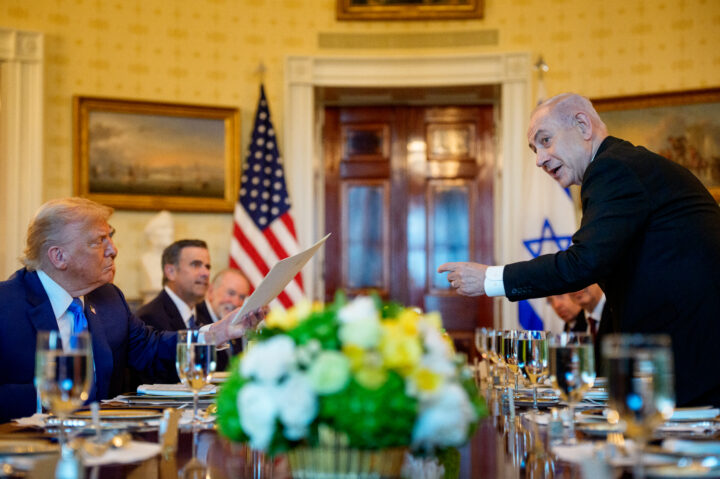
Andrew Harnik/Getty Images
Israeli Prime Minister Benjamin Netanyahu hands off a letter he sent to the Nobel Peace Prize committee to nominate U.S. President Donald Trump for the Nobel Peace Prize during a dinner in the Blue Room of the White House on July 07, 2025 in Washington, DC.

