


(Alexi Rosenfeld/Getty Images)
The Siegels lost their home and community on Oct. 7. Now they’re finding their way forward
The former hostages talk with JI about survivor's guilt and rebuilding their lives far from their Kibbutz Kfar Aza home


 Add JewishInsider on Google
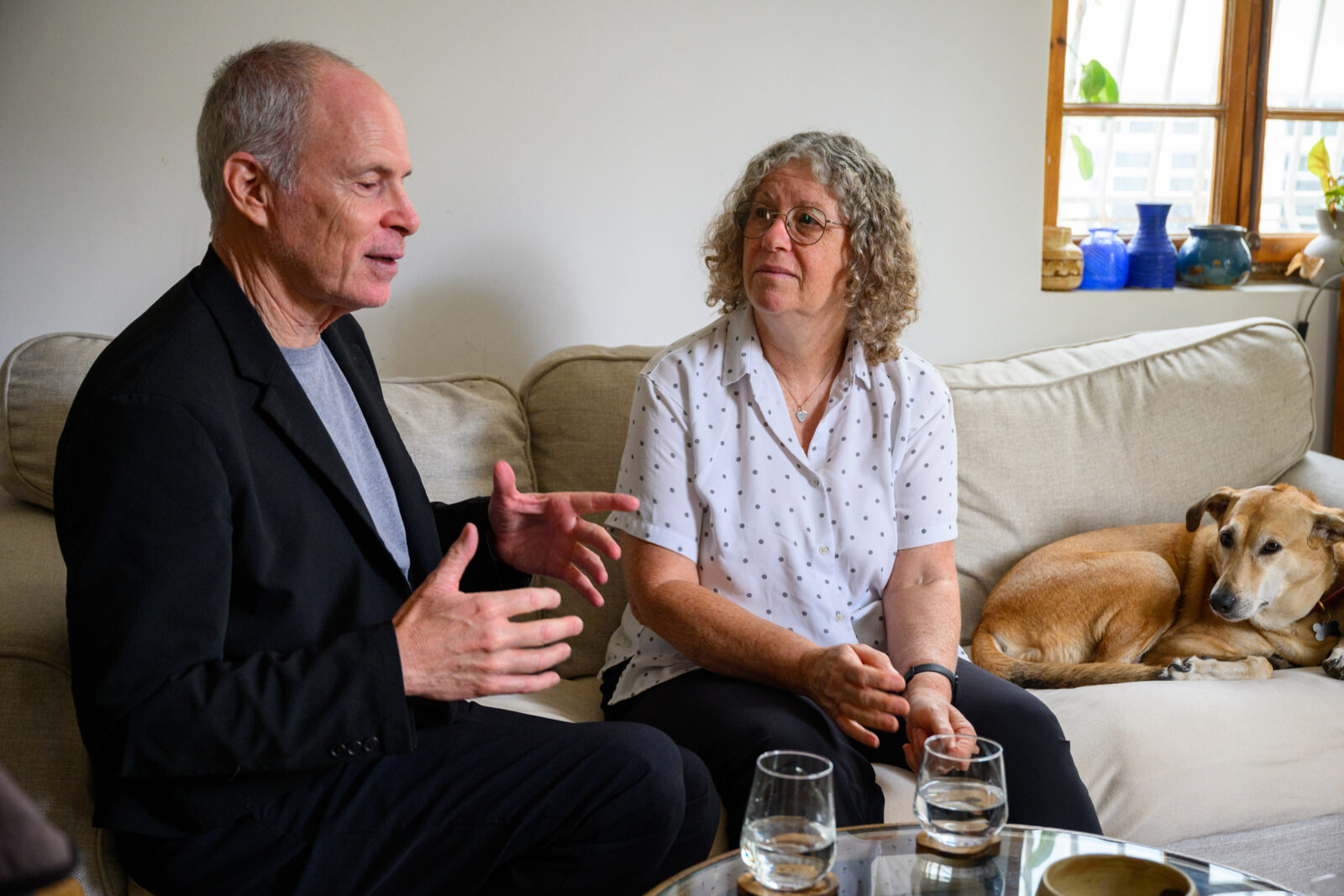
Keith Siegel was held captive by Hamas for 484 days. Of those, 433 were spent apart from his wife, Aviva, who was taken hostage with him but released after 51 days in captivity.
“Every day counts,” he was quick to point out on Tuesday, when he and Aviva met with Jewish Insider in Tel Aviv ahead of the third anniversary of the Oct. 7 Hamas attacks on Israel. “Maybe every hour.” Those 433 days were the longest the couple, who have been together since Keith was 20 and Aviva was 18, had ever been apart.
The Siegels — both immigrants to Israel, him from North Carolina and her from South Africa — built their lives and family in the southern Israeli community of Kfar Aza, kilometers from the border with Gaza. It was from their home there — in their own car — that they were taken by terrorists who stormed their kibbutz on the morning of Oct. 7, 2023. In the wake of her release in November 2023, Aviva became one of the most prominent champions for the release of the hostages; after he was freed, Keith joined his wife’s efforts.
They now live in northern Israel, near two of their four children but far from what had for decades been their home in the small border community, whose population before the attacks had hovered around 300 families — 900 people in total. Only around 50 families have returned to Kfar Aza, with many, like the Siegels, choosing to resettle elsewhere in the country.
Aviva reflected on the pain she continues to feel. “It’s difficult to start your life again in a new place, not feeling at home after what you went through,” she said. “What you want after you go through something is to go home and to recover in your home, but unfortunately, Kfar Aza people can’t do that, because we’re not able to. It hurts. It really, really hurts.”
This year, the Siegels will mark the anniversary with family, far from Kfar Aza. Even as they grieve the loss of their home and community, with all of the hostages returned, they are now able to look toward the future. Their daughter Shir announced over the summer that she was expecting a child, the Siegels’ first grandchild to be born in the aftermath of the attacks.
In part to deal with the trauma of her abduction and ordeal in Gaza, Aviva wrote a book about her experiences, Survived to Tell: A Hostage’s True Story of October 7 and 51 Days in Captivity. It was released in Hebrew earlier this year and in English this month. When she began writing it, her husband of more than 40 years was still a hostage, and she didn’t know if he would return alive. As she put pen to paper, she had her grandchildren in mind.
“I remember thinking, ‘I have to leave all these words for our grandchildren, because if Keith doesn’t come home, and he might never ever come home alive, that they’ll be able to read the love between us and how amazing Keith was,’” Aviva reflected.
This interview has been edited and condensed for clarity.
Jewish Insider: Tomorrow marks the three-year anniversary of the Oct. 7 attacks. It’s also the first anniversary with all of the hostages home. What does this anniversary mean to the two of you?
Aviva Siegel: This anniversary is, for me, completely different, because a year ago the hostages were still in Gaza. This time, it’s painful in a different way, because last [year] I was still doing everything I could to bring them back. This time, having everybody here is making me feel what happened, and what happened on our kibbutz and in our community to the people is really, really breaking me apart. Before, I wasn’t able to carry everything at once. So I had Keith back, and we had the hostages back, and now I’m able to carry things that happen to others. That hurts. It really, really, really hurts. … It’s a very hard time starting to understand more about what happened to other people and what they went through, and being able to hear stories in our community.
It hasn’t been easy for me at all … when Keith wasn’t out, I could imagine to myself, ‘I’m going to go and bury Keith with all these people around me.’ … I knew that things could happen, especially after what happened [in August 2024] to Hersh [Goldberg-Polin] and Carmel [Gat] and Eden [Yerushalmi] and the six hostages [who were killed in captivity]. I, in my thoughts, [felt] more than ever that Keith would come back dead.
So I’m trying to hold on to the good part, that Keith is alive and that he’s here, that I’m alive and I’m here with Keith, and we both are here for our families.
JI: I remember seeing you at Hersh’s funeral, and I was wondering at that time what you were thinking in that moment.
AS: Well, you know, I loved Hersh’s parents so much, and I was so connected to them in my soul. I couldn’t not let myself go, but I was full of emotions. I could hardly handle myself. It was like, in a way, saying, “Just disconnect yourself from what’s happening now, and try not to feel, because that’s Hersh, and [the next one] could be Keith.” I felt lonely, frightened, and it was the whole thing about Hersh and Carmel and Eden and the others, it really broke me up into pieces, completely and utterly.
JI: Keith, as we hit three years, what does this year mean for you?
Keith Siegel: It’s very dynamic, how I feel and what I think about and the directions that my thoughts take me in. I think a lot about gratitude, and I’m so grateful to be alive, and that Aviva is alive, and that our family is whole. So I think a lot about that, and I think a lot about how important my family is to me, which is something that I thought about so much when I was in captivity, and both worrying about them so much, on the one hand, [and] on the other hand, feeling that they gave me a lot of strength, being empowered by my family, and knowing that I must survive in order to return to my family, because that’s the solution to their suffering that they experienced for so long.
So it’s both, and now I would say the gratitude, and I would also say the sorrow, the pain, the void [of] 64 people from our community, Kfar Aza, which was at the time a total of 900 people. We lost 64 of them, and 19 were kidnapped. Two of them didn’t come back; they were killed in Gaza. The people, many of them are friends, neighbors, acquaintances, people that we’ve known for a very long time. It’s hard for me to deal with the fact that I and we were released alive, and so many others were not.
JI: Survivor’s guilt.
KS: Yeah, survivor’s guilt. I was very, very active in advocacy until all the hostages came back. I think I was basically focusing pretty much all of my energy and all of my ability to think about and feel in that. And I, after they all came back, [was] gradually entering a new phase of my life.
JI: Aviva, in reading your book I learned that after being kidnapped, you didn’t know what had happened to your son, Shai [who was also in Kfar Aza]. Keith, did you know over the course of the time that you were in Gaza, did you learn at some point that he had survived?
KS: Yes, I learned it four-and-a-half months into my time in captivity, on the 21st of February at 8 in the morning, when I heard my daughter in an interview on the radio that one of the terrorists was listening to. It’s an Israeli station that broadcasts Arabic, so I was sitting there together with another hostage and a terrorist in a very, very small room, and the radio was on. It was all Arabic, trying to understand … and all of a sudden, I hear the interviewer introducing my daughter Elan in Arabic. It was about a five-minute interview and I heard all of it, and in the middle of the interview, she said ‘Shai is OK.’ The interviewer didn’t even ask her to. Some of the hostages that were released said that they heard either radio or television. So [my family] knew that information might reach me.
JI: So it was intentional. She wanted to make sure you got that message.
KS: Yeah.
JI: Wow.
KS: So very, very wow. Just to hear her voice, and to have certainty that Aviva made it back alive because I didn’t even know that. Just being totally disconnected and knowing virtually nothing about what’s going on, and the bits and pieces of information, not knowing if it’s true.
JI: You talk a lot about the Kfar Aza community. What does that mean to you now that you’re not living there anymore, that so many people who were living there are no longer there? What is the Kfar Aza community to you now?
AS: A lot of pain. I think it just takes me to a lot of pain knowing that there’s still people that don’t know if they’ll be able to go back to live there, and don’t want to go back to live there. It’s difficult to start your life again in a new place, not feeling at home after what you went through. What you want after you go through something is to go home and to recover in your home, but unfortunately, Kfar Aza people can’t do that, because we’re not able to. It hurts. It really, really hurts.
JI: Now you’ve written a book about your time, and you want that to be out in the world to raise awareness. You’re about to welcome another grandchild. What do you want the next few years of your life to look like?
AS: Well, I would love it [if] the people that are in charge of the world and are able to change this world will stand up for human rights and say OK, humans live once, have a party, enjoy your life, love, eat, dance and just enjoy life. But instead of that, we’re getting the feeling that we need to be scared of so many things: that the war will come again, that Hamas will do bad things again, that ISIS will do bad things, that Hezbollah will do bad things, and that feeling of this whole thing hasn’t ended yet. What more is going to happen really, really frightens me.
JI: You write so much in the book about your relationships with the girls [you were held with in Gaza], with Liri Albag, with Agam Berger, with Amit Soussana. What is your relationship like with them now?
AS: Yeah, we write to each other on the WhatsApp group.
JI: What’s the WhatsApp group called?
AS: Well, we used to have that group all together, but it didn’t really work. So I write to them, but all of them are written [with the Hebrew term of endearment that means “my perfect”], “Liri hamushlemet sheli,” “Agam hamushlemet sheli.” We shared a lot of love and a lot of that part of our life. I’ll always carry it with me, and I love the girls so much. I don’t see them as often as I would want to see them.
KS: We’ve seen them at weddings. Four weddings in the last month and a half.
AS: And I’m just going to say that Amit’s mother passed away, and it really, really breaks my heart because I know she loved her mom so much, because she showed her love in captivity to her mom all the time, and it really, really breaks my heart that she has to deal with that in such a short time, even that she’s still deep into her own trauma, and now she won’t have a mom to hug her and to support her. It’s difficult. It’s very, very difficult. I want everybody to have a better life and not to go through anything that could be traumatic, like losing a mom.
JI: Do the two of you talk much between yourselves about the time that you were in Gaza and the time after Aviva left when you were in Gaza alone? Is that a regular conversation, filling in the gaps of what you were each doing?
AS: Yeah, quite often we talk about something that we remember, and I can just say that for months I didn’t want to ask Keith anything. I just wanted him to tell me what happened, and I didn’t want to put any pressure on him to touch the truth because it hurts. And until today, I’m still hearing more and more things that happened to Keith while he was in captivity because I haven’t heard it all.
If there’s something that I’m lucky about, it’s that he can understand when I talk about captivity or feel about what happened to me because he knows what I feel. So it really helps me.
JI: Like a support for each other, because you know what you’ve gone through.
KS: We are our own support group. We’re a couple, and also a support group.
JI: I didn’t realize until I read the book of your love story — I didn’t realize you met when you were very young.
KS: My brother’s wife … introduced us. I was 20. Aviva was 18. When we got married, I was 21. Aviva was almost 20.
AS: When I decided to write the book, I remember that it was difficult for me to start on [Oct. 7], and so my therapist helped me [and told me] that I should just write whatever I wanted to write. I remember thinking, ‘I have to leave all these words for our grandchildren, because if Keith doesn’t come home, and he might never ever come home alive, that they’ll be able to read the love between us and how amazing Keith was.’ And I remember saying to myself all the time, again and again, ‘They’re going to love Keith and the relationship that we had even more, and they’re going to love the girls that we were with even more, because I spoke about the love between us,’ and I really, really meant it when I wrote it because I didn’t know if people [would] come home. I wanted them, when they read it, to really understand what I felt and what happened between Keith and I in captivity, because it was very important for them to take that instead of taking the hard parts.
JI: Keith, did you have any idea after Aviva had been released that she had become this internationally recognized advocate for your release?
KS: I saw my family a few times on television. So I saw Aviva and Elan when [Israeli Prime Minister Benjamin] Netanyahu spoke in Congress. It was just very shadowy, sitting in the audience. I saw them in Hostage Square the day after the proof-of-life video of Omri Miran, a hostage that Hamas did a proof-of-life video for us, so I saw Aviva, Elan and Shir sitting on stage. But no.
JI: Were you surprised when you found out that she had been on every TV station and talked to every major world leader?
KS: Very surprised, amazed. And I still don’t know the extent of everything she did. You know she did so, so much. It’s huge. I’m thinking I will never know everything. Aviva and two of my daughters especially, Shir and Elan, and Shai and Gal, our two other children, and everybody had their own role. It was a team, and many, many, many others, many people that have never met me and didn’t know me, that advocated for my release. [It was] truly extraordinary proof of humanity and caring. [There were] so many caring people that did so much for me and for us and continue to do that. So that’s a shining light amongst a lot of the darkness that we experienced. Not only actual darkness, because [we] literally spent a lot of time in the dark in captivity, but also in a figurative way, so it gives me a lot of strength and a lot of optimism and belief in good.
JI: I learned in the book that even though you are both from English-speaking countries, you speak Hebrew at home and to each other. Is it weird when you’re talking to Americans or other foreigners, and you’re doing it in English with each other?
AS: Not really, because with my mom we used to both speak in English, [and] he used to talk to his brother in English. So we had our groups of English people that we used to talk to.
KS: It’s weird. It was very weird in the beginning. We’ve been doing it for so long that it’s less weird, but we never talk to each other in English.
JI: You’re about to have another grandchild, and it’s the first grandchild who will be born after you both came back. Now this is going to be a child who has no memory of what had happened. What do you wish for them?
AS: Wow. That they’ll never have to be scared that something will happen to them. It’ll just pull everybody up. We all went through such a hard time as a family. … I think it’s going to be healing for everybody. It’s going to be unbelievable. And we all love babies.
JI: We’re in a country that loves babies.
KS: We love dogs, too.
JI: Do you have dogs in your new home?
KS: Our children have dogs. We’ve had dogs.
AS: Elani, our daughter, got a dog a couple of months ago, maybe four months ago, and it’s really, really helping the kids.
KS: He helps me, too. I’ve always loved dogs, but the way I experience dogs since I came back from Gaza is totally different.
JI: What does that mean?
KS: They bring me so much joy.
JI: In a way they didn’t before?
KS: Not to the extent, like much more. Much, much more.
JI: What would you say has been the biggest change for each of you emotionally since you came home?
AS: The trauma is with me all the time, in many many ways, and I feel that as much as I want to run away from it, it’s there, and I can feel that it’s changed me. I’m just so scared that something will happen to anybody that I know, and I’m scared that something would happen to Keith.
KS: Anxiety.
AS: Anxiety.
KS: She’s very anxious.
AS: And I wasn’t like that before. I wasn’t scared to be sick. I wasn’t scared to feel pain. Now everything frightens me so much. And our life has changed in many, many ways. I want to just say that I would love my life to be like it was before, but we also are living closer to two of our daughters [and] that is the best thing that we could have asked for. We lost our community, our house, our friends on the kibbutz, our jobs, but we gained family and lots of time with family, and it’s lovely.
KS: I think I mentioned dynamics of how things are evolving, kind of like getting to know the new — I don’t want to say the new Keith. But getting to know, I mean, the new Keith. I’m doing totally different things than I did before. I’m experiencing emotions and thoughts that I never experienced before. I like emotions as far as the volume, like how powerful they are. Being on this mission of telling my story and looking for opportunities, coming to know that I have a voice that people will listen to, which is something I experienced very limited in the past.
Huge numbers of people that are interested in listening to what I have to say and feeling like I can use my voice to do things, and I want to do good. And how can I do good and kind of trying to navigate that, and on a journey exploring how I can use my voice that I have because I experienced such a terrible thing. And finding it very, very challenging to speak, and tell the story and find the words, and it’s frustrating, but it’s also rewarding, and it’s hard, but it’s also very meaningful, and I feel very passionate about it.
Featured Stories


Please log in if you already have a subscription, or subscribe to access the latest updates.
 Continue with Google
 Continue with Apple