































































For some Jewish Democrats, Michigan’s debate was the ‘final straw’ for El-Sayed
One Jewish community leader said that the debate had ‘reinforced’ Jewish community members’ ‘deep concern’ about El-Sayed and his political ideology
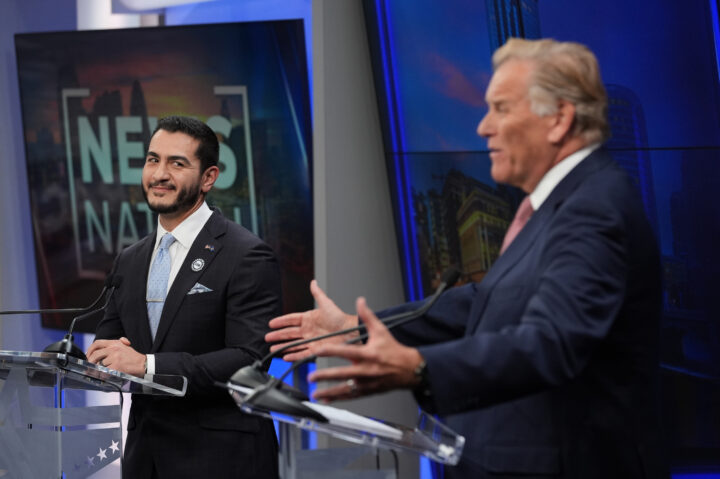
Paul Sancya, Pool/AP
Republican nominee for U.S. Senate Mike Rogers, right, speaks during a televised debate with Democratic nominee for U.S. Senate Abdul El-Sayed on Oct. 8, 2026, in Grand Rapids, Mich.


 Add JewishInsider on Google
Last Thursday’s Michigan Senate debate, where Democratic nominee Abdul El-Sayed framed Israel as a threat to the United States comparable to Iran and said he would not vote to send defensive aid to Israel even if it were under fire, proved to be a breaking point for some Jewish Democrats who were holding out hope that the Democratic nominee would moderate his views in the general election.
Community leaders said that they’re hearing from some previously undecided Jewish Democrats that, after they debate, they now plan to back Republican Mike Rogers.
“I think for a lot of pro-Israel Jewish Democrats, Abdul has made it easy. He’s not really made any accommodations whatsoever, and the debate was just the latest example,” said David Kramer, a prominent Michigan Democratic fundraiser and vice chair of the Michigan Democratic Jewish Caucus.
He told Jewish Insider he’s heard from members of his community that they felt the debate demonstrated that El-Sayed is “not giving an inch and he’s absolutely showing who he is.”
Kramer had previously said he wasn’t willing to vote for El-Sayed without changes to his rhetoric and platform.
“I’ve talked to a couple of people who were wrestling with the same choice as I am, who have said that based on the debate, that was kind of a final straw, and they are going to vote for Rogers,” Kramer told JI.
Another Michigan Jewish Democrat told JI that they are hearing similar feedback in their network.
El-Sayed’s campaign did not respond to a request for comment.
Kramer said, “I think there were well-intentioned voters and community leaders, and even elected officials, who were hoping we’d get him to a better place, and he’ll need us, and he’ll want to embrace us, and it’s quite evident, at this point, that he’s not doing anything.”
Joan Lowenstein, a member of the Michigan Democratic Party Central Committee and president of the Jewish Federation of Ann Arbor, said she’s also heard from people in her community that the debate was a turning point. “I think people who did watch the whole thing really didn’t get anything new about what El-Sayed thinks, or what he was willing to do for Jewish safety — not at all.”
Lowenstein said the debate had “confirmed what I think about El-Sayed,” describing him as evasive and lacking in substantive policy proposals. On Israel, she said that his responses show a “lack of understanding that you would expect a senator to have” about foreign policy issues.
Kramer and Lowenstein are members of the Nonnegotiable Michigan campaign that has sought to pressure El-Sayed to make commitments to supporting Israel’s right to exist as a Jewish state and to Jewish safety in the United States.
Dennis Bernard, the national chair of government relations at the Jewish Federations of North America, who supported both Rep. Haley Stevens (D-MI) and Rogers in their respective primaries, said that El-Sayed’s response on whether Israel or Iran is more dangerous to the United States was “the defining moment for our community. … It’s an astounding comment.”
“At this point, if you still haven’t decided that there is enough out there as a Democrat not to vote for him, nothing’s going to convince you,” he said. “There were still a lot holding out. … After that debate, those who will go for Rogers have made their decision. El-Sayed did not help himself in our community. It was not a good performance. He had to have a better answer.”
Anecdotally, Bernard said that there’s intense discussion in the Jewish community about the race, with his social circle unanimously questioning how any Jewish voter at this point could support El-Sayed. Bernard said that he’d spoken to six lifelong Democrats on Saturday who were all planning to vote for Rogers. Bernard also said he’s never heard so much discussion in the Jewish community about ticket splitting.
Rabbi Aaron Starr, of Congregation Shaarey Zedek in Southfield, Mich., speaking in his personal capacity, said the debate left him “frustrated and sad” with both candidates spending more time “criticizing each other with personal attacks than helping us understand how they will help us work toward a better tomorrow for our children.”
“Dr. El-Sayed’s inability to affirm my basic needs has led me, and many others in my community, to confidently decide we simply cannot vote for him,” Starr continued, referring to the Nonnegotiable campaign’s core principles. Starr is a leading organizer of the Nonnegotiable petition.
He said that El-Sayed’s comments during the debate “reinforced” Jewish community members’ “deep concern about his candidacy, and reminded us that if Dr. El-Sayed’s position takes hold in the Democratic Party, Israel’s enemies will be emboldened, American Jews will be even more vulnerable, and America will be pulled into even more war –– not less, as Dr. El-Sayed claims to want.”
Starr said that he was “horrified, though not surprised” at El-Sayed’s hostility toward Israel and “refusal to condemn the Iranian regime and its proxies.” He added that “Dr. El-Sayed gave voice to centuries-old libels against the Jewish people by suggesting Israelis somehow manipulated an otherwise innocent America into a war. In this way, he denies America’s agency in choosing to defend itself and its allies against nuclear threats and belligerency.”
Zach Nessel, the secretary of the Michigan Democratic Jewish Caucus, who spoke to JI in his personal capacity, said that he thought El-Sayed’s answer to the question about Israel and Iran showed he is “not really taking our national security seriously” and “doesn’t want to upset people who don’t have America’s national security interests top of mind.”
Nessel, the son of Michigan Attorney General Dana Nessel, who is supporting El-Sayed, said he’s still undecided and doesn’t believe in sitting out elections, but feels “unenthusiastic” about both candidates.
He said he also found El-Sayed’s frequent attacks on AIPAC and its donors to be hypocritical when he has refused to address his own donors’ and associates’ support for groups including Hamas and Hezbollah, something that Rogers repeatedly hammered him on during the debate.
El-Sayed denied Sunday that any of his family have ties to the Muslim Brotherhood, and asserted that Rogers had only raised the issue to stoke Islamophobia.
“Now, I don’t think one man is perfectly represented by his donors, but it seems to be certainly very problematic,” Nessel said.
Decky Alexander, the chair of the Michigan Democratic Jewish Caucus, who plans to vote for El-Sayed, said she was broadly disappointed by the debate, calling it “a lot of theater” rather than a substantive exchange of ideas.
She acknowledged that many in the Jewish community did not think the “rhetoric around Israel and Iran in particular was helpful in this moment, particularly for Jews that are on the fence.” She said she was also “uncomfortable” with what she heard at the debate but said that the debate does not tell the “whole story.”
She added she thinks that El-Sayed’s joint event with Sen. Elissa Slotkin (D-MI) the previous weekend was ultimately more impactful for Jewish Democratic voters than the debate. “They want to hear from somebody … that affirms their own perspectives and values,” she said, describing Slotkin as a strong “ambassador” for El-Sayed.
Alexander said she and others in the community feel that the current political moment is existential in two respects: both for the pro-Israel Jewish community and for other elements of American society.
Lowenstein also said that she had received the anti-El-Sayed mailer that AIPAC’s United Democracy Project began circulating to Michigan Jews at the end of last week, describing it as an effective and targeted message, particularly coming in tandem with the debate.
But others take a different view, and said they haven’t heard much movement — in either direction — following the debate.
“From the people that I’ve spoken to, they all said that Rogers didn’t say anything new,” said Rabbi Asher Lopatin, who said previously that he’s voting for Rogers but is no longer discussing his personal views on the race, given his nonpartisan role as director of community relations at the Jewish Federation of Greater Ann Arbor. “On the other hand, the people that have reservations about Abdul El-Sayed, they also feel he avoided questions … he didn’t change his opinion at all. So there wasn’t any real movement on either side and it really hadn’t changed anything.”
He said that people who were struggling with their votes prior to the debate are still struggling, and some are still holding out hope for a change from El-Sayed.
Several Jewish Democrats also said that El-Sayed’s explanation that he didn’t issue a statement honoring the third anniversary of the Oct. 7, 2023, Hamas attacks on Israel to avoid turning the event into “political theater” was unsatisfactory.
“It was a sorry excuse not to stand up for our community three years after the Oct. 7 attack,” Nessel said, adding that El-Sayed’s failure to speak up cast doubt on other comments asserting that he wants to protect and stand up for the Jewish community. “It’s a really simple ask, just to remember the tragedy of Oct.7 and condemn Hamas for killing 1,200 Jews and kidnapping 200 more.”
He said he thinks that El-Sayed stayed silent because “I don’t think anything he would say would have been true to his values and probably would have been inflammatory.”
Starr offered a somewhat different view.
“While at first I felt resentment at his lack of communication on Oct. 7, I actually appreciate Dr. El-Sayed’s explanation about why he chose not to address the Jewish community,” Starr said. “He recognized that because he couldn’t say anything that spoke to the anguish in Jewish hearts, he was better off not saying anything at all. That said, his inability to speak genuinely with sympathy to us on that heartbreaking day does reinforce why so many Jewish Michiganders are unable to vote for him.”
Alexander said that she called El-Sayed’s campaign to ask about the lack of a statement on Oct. 7 and said she hoped for a “recognition of the impact of this day on his Jewish constituents” but also said that it was likely a “no-win situation for him” politically.
“Is it the thing that is going to deter me from not voting for him?” she continued. “No, because I also understand he’s in this really complicated, political space that I am just not in.”
Lowenstein told reporters before the debate that she had been looking for Rogers to make commitments on civil rights and other issues she sees as tied to her Jewish values, and emerged somewhat encouraged by his responses, including his willingness to reform Immigration and Customs Enforcement and to separate from the Trump administration’s stance on tariffs.
Nessel said he was disappointed in the performance of both candidates, saying that neither had done a good job of arguing their points or explaining their policy positions. He said that the debate could have been a “productive conversation and it just simply didn’t happen,” though he credited Rogers as being more willing and able to discuss policy specifics than El-Sayed.
“I might not agree with his ultimate conclusions when it comes to certain policies, but the fact that he expresses working knowledge and being able to at least understand the issues and explain it to the public is helpful,” Nessel said.
Bernard said he felt that El-Sayed appeared off balance and unwilling to address specifics, though he said that he “also would have liked to see Mike a little more senatorial.”
Lopatin said that hearing Rogers make a clearer declaration that he will not be a “rubber stamp for Donald Trump,” particularly when it comes to defending democracy and the Supreme Court, could be helpful to Rogers in reassuring Jewish Democrats still hesitant to pull the lever for him.
More Stories
CROSSING PARTY LINES
Michigan Jewish leaders predict significant swing toward Rogers in Jewish community
SURROGATE ASSURANCE
Mallory McMorrow makes the case for El-Sayed to Jewish voters
common cause
At MDA gala, Van Jones calls antisemitism ‘poison that is being put in’ the Black community

60 MINUTES SPOTLIGHT
El-Sayed says Palestine has a right to exist, but puts conditions on Israel’s right to exist
OPEN FOR BUSINESS
Philly Jewish restaurant owners say they won’t be scared off by antisemitic boycott campaign
DEPARTURES
After Israel’s election, expats leave country disappointed by result
Please log in if you already have a subscription, or subscribe to access the latest updates.
 Continue with Google

 Continue with Apple