












































The secretary of state said Israel had acknowledged publicly that U.S. pressure had contributed to Israel’s decision to begin allowing aid back into the territory

John McDonnell/Getty Images
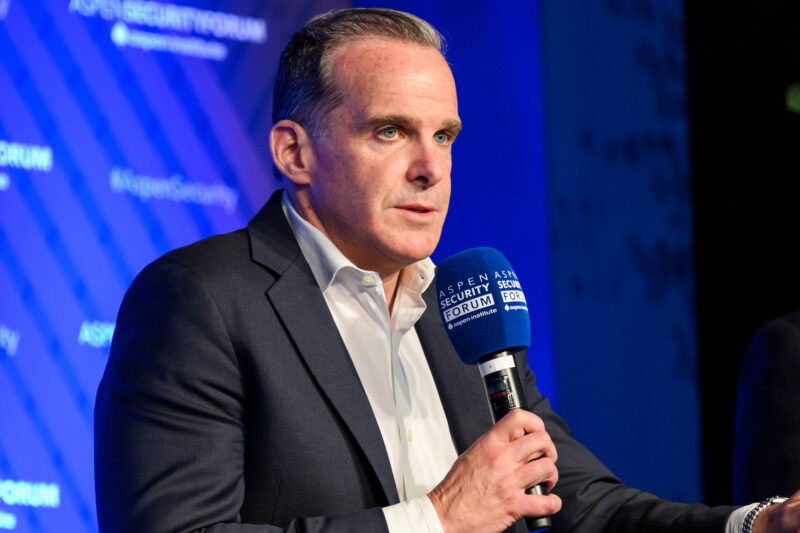
Secretary of State Marco Rubio testifies before the House Committee on Appropriations | Subcommittee on National Security, Department of State, and Related Programs at the Rayburn House Office Building on May 21, 2025 in Washington, DC.


 Add JewishInsider on Google
Secretary of State Marco Rubio, in a shift, said in a House Appropriations Committee hearing on Wednesday that Israel’s 11-week blockade of aid into Gaza was damaging Israel’s national security and international standing and that U.S. pressure had contributed to Israel’s decision to release the hold. He also said that current levels of aid entering Gaza are not sufficient.
The remarks are strikingly similar to comments made since the beginning of the war in Gaza by Democrats, particularly progressives, who have criticized Israel’s policy toward aid to Gaza, and stand in contrast with Rubio’s and other Republicans’ previous comments arguing against allowing aid to flow back into Gaza.
“In the interim period, the one thing we’ve made abundantly clear is that the humanitarian situation — and I think this was acknowledged by the prime minister in his statement — the humanitarian situation, the direction that it was headed was undermining Israel’s standing and national security,” Rubio said.
He added that the Israelis had “acknowledged in their own statement that … the intervention of the United States and others is the reason why they’ve started to allow aid, albeit … not at the levels that are necessary.”
Israeli Prime Minister Benjamin Netanyahu acknowledged in a press conference on Wednesday, his first to Israeli media in five months, that friends of Israel, including U.S. senators, have said they support Israel in its war against Hamas but they have concerns regarding the humanitarian situation in Gaza.
Rubio said that U.S. officials, including Middle East envoy Steve Witkoff, are actively working to ensure that additional aid is provided “because, as we said, we were concerned about the conditions and the directions that they were headed.”
Throughout the post-Oct. 7 period, Rubio had argued repeatedly as a member of the Senate that any additional aid provided to Gaza “would go directly to Hamas and would be controlled by them,” concerns he again acknowledged in the hearing on Wednesday and other appearances on the Hill this week.
He said repeatedly that he spoke last weekend with Cindy McCain, who leads the World Food Program, about the WFP’s aid distribution mechanisms in Gaza. Israeli and U.S. officials have been working to implement alternative aid delivery processes rather than rely on U.N. agencies.
Rubio reiterated that the administration fully supports Israel’s right to defend itself against Hamas and that there is no future for the people of Gaza as long as Hamas is in power. He said he has “some level of optimism that we may have a breakthrough” in efforts to end the war and free the hostages “pretty quickly.”
But, Rubio continued, “I have felt that way now at least four separate times in the last couple of months, and for one reason or another, at the last minute, it didn’t happen, and so I don’t want to be disappointed on it again.”
Speaking to the media in Israel for the first time in five months, the Israeli prime minister denied reports of friction with the U.S.

MAYA ALLERUZZO/POOL/AFP via Getty Images
Israeli Prime Minister Benjamin Netanyahu speaks during a press conference in Jerusalem on December 9, 2024.
Striking a defiant tone on Wednesday amid intensifying international pressure to end the war in Gaza, Israeli Prime Minister Benjamin Netanyahu laid down his conditions for the end of hostilities.
“The world is telling us to end the war,” Netanyahu said, in the first press conference he has held in Israel since December. “I am prepared to end the war according to clear conditions: Hamas lays down its weapons, steps down from power, returns all the hostages, Gaza is demilitarized and we implement the Trump plan” to relocate residents of Gaza.
“Whoever is calling for us to end the war is calling for Hamas to stay in power,” Netanyahu said, a day after Britain suspended free trade talks with Israel and the EU said it will review whether Israel is violating the human rights clause of the EU-Israel Association Agreement and two days after France, the U.K. and Canada threatened sanctions against Israel.
Netanyahu stressed that if there was an option for a temporary ceasefire in exchange for the release of hostages, Israel would accept that. He said there are 20 hostages confirmed to be alive in Gaza and the remains of up to 38 deceased individuals.
The prime minister reiterated previous comments he has made that friends of Israel, including U.S. senators, have said they support Israel in its war against Hamas, but they cannot accept a humanitarian crisis in Gaza, which many have said worsened after Israel instituted an 11-week blockade of aid.
Addressing reports of strained ties between the U.S. and Israel, Netanyahu said that he spoke to President Donald Trump about 10 days ago and Trump told him, “Bibi, I want you to know I have a total commitment to you and to the State of Israel.”
Netanyahu said that both countries seek “together to ensure Iran doesn’t get nuclear weapons, that Hamas will be thrown out of Gaza, that Trump’s plan — which I think is a genius plan — will happen,” and “change the face of the Middle East.” He stressed that the relocation plan would only be for those who wish to leave Gaza.
Referring to Trump’s recent Middle East tour, which excluded Israel, Netanyahu said, “I have no opposition to the U.S. deepening its ties to the Arab world … I think this can help broaden the Abraham Accords that I’m very interested in.”
Turning to Iran, Netanyahu said, “Iran remains a serious threat to Israel. We are in full coordination with the U.S. — we talk to them all the time. We hope that it’s possible to reach an agreement that will prevent a nuclear weapon from Iran and will prevent Iran from having the ability to enrich uranium. If it is reached, of course, we will welcome it,” he said, before adding, “In any case, Israel reserves the right to defend itself against a regime that threatens to destroy us.”
Netanyahu previously called for total dismantlement of Iran’s nuclear infrastructure, which would go farther than stopping Iran from enriching uranium. However, an official in Netanyahu’s office denied that his remark reflects a change in policy.
Speaking on the IDF’s expanded engagement in Gaza, Netanyahu laid out three phases of “Operation Gideon’s Chariots,” as the latest stage in the war is called: the immediate entry of aid into Gaza; opening aid distribution points that will be managed by American companies and secured by the IDF; and the creation of a “sterile” humanitarian zone for civilians.’
Netanyahu said that at the end of the operation, “all of Gaza’s territories will be under Israeli security control, and Hamas will be totally defeated.”
Netanyahu slammed Britain’s decision to sanction veteran settler leader Daniella Weiss, calling it “shameful” that “instead of sanctioning Hamas, they sanction a woman who is threatened every day … they are under pressure from the Islamist minority, from a population that is repeating the Hamas propaganda, the false propaganda and they give in to it. We don’t. We responded aggressively to them calling to give the ultimate reward for Oct. 7 — to give a Palestinian state. There is no greater prize for terror.”
Plus, Rubio, Cruz talk Trump Iran policy

REBECCA DROKE/AFP via Getty Images
Pittsburgh Mayor Ed Gainey speaks ahead of Vice President Kamala Harris at a campaign rally outside Pittsburgh, Pennsylvania on November 4, 2024.
Good Wednesday morning.
In today’s Daily Kickoff, we break down a new Anti-Defamation League report on antisemitism at independent K-12 schools, and report on Corey O’Connor’s victory yesterday in Pittsburgh’s mayoral primary. We report on the increasing pressure on Israel over its conduct in Gaza, cover Secretary of State Marco Rubio’s first appearance on Capitol Hill since being confirmed, and highlight remarks made by Sens. Ted Cruz and John Fetterman to NORPAC members. Also in today’s Daily Kickoff: Lishay Lavi Miran, Sen. Andy Kim, and Reps. Debbie Wasserman Schultz and Dan Goldman.
What We’re Watching
- South African President Cyril Ramaphosa and President Donald Trump will meet at the White House today, with new trade agreements on the agenda amid strained ties between the two countries.
- The Combat Antisemitism Movement and the Jewish Federations of North America will host the Annual Jewish American Heritage Month Congressional Breakfast on Capitol Hill today, with a keynote address from Bruce Pearl, head coach of the Auburn men’s basketball team.
- The House Appropriations Committee will hold separate budget hearings with testimony from Education Secretary Linda McMahon and Secretary of State Marco Rubio.
- The House Foreign Affairs Committee will also hold a hearing with Rubio on “Fiscal Year 2026 State Department Posture: Protecting American Interests.”
- The Senate Committee on Health, Education, Labor and Pensions will hold a hearing on “The State of Higher Education” with witnesses including Dr. Andrew Gillen, a research fellow at the Cato Institute; Dr. Michael Lindsay, president of Taylor University; Dr. Mark Brown, president of Tuskegee University; Mike Pierce, executive director of the Student Borrower Protection Center; and Dr. Russell Lowery-Hart, chancellor of the Austin Community College District.
- The Qatar Economic Forum continues today in Doha, with speakers including Donald Trump Jr.; Steve Mnuchin, former U.S. treasury secretary; Mark Attanasio, principal owner of the Milwaukee Brewers; John Micklethwait, editor-in-chief of Bloomberg; and Hassan Al-Thawadi, former secretary general at Supreme Committee for Delivery and Legacy for the 2022 FIFA World Cup.
What You Should Know
A QUICK WORD WITH JI’S hALEY COHEN
A new Anti-Defamation League report puts a spotlight on episodes of antisemitism in K-12 non-Jewish independent schools, a trend that doesn’t get as much attention as the higher-profile incidents on college campuses but is affecting Jewish students in critical ways.
The study found antisemitic incidents in independent schools down 26% in 2024, compared to 2023, but still up significantly since the Oct. 7 Hamas attacks. There were only 494 documented incidents of antisemitism in independent schools in 2022; that number has nearly doubled to 860 in 2024.
A quarter of surveyed parents said their children experienced/witnessed antisemitic symbols (such as swastikas) in school.
The research was conducted through four focus groups and a survey of 369 parents of Jewish children in independent K-12 schools across 21 states. The ADL told Jewish Insider‘s Haley Cohen it selected independent schools to evaluate since they operate outside of the oversight of public education and therefore have greater autonomy in shaping their curricula, policies and disciplinary procedures.
In addition to expressing concern over antisemitic symbols, nearly one-third of parents reported anti-Jewish and anti-Israel curricula featuring more prominently in their children’s classrooms since the Oct. 7, 2023, terrorist attacks. They’re also deeply dissatisfied with administrators’ responses to antisemitism: Of the parents surveyed who were aware of antisemitism in their child’s school, 34% said the school’s response was either “somewhat” or “very” inadequate.
One bit of encouraging news: A sizable majority of students at these schools (64%) said they felt “very comfortable” showing their Jewish identity at schools, with only 8% feeling somewhat or very uncomfortable with doing so. But there were isolated episodes of student discomfort, including one parent saying their son avoided wearing a Star of David necklace.
Another notable trend: Many independent school parents voiced concern that diversity, equity and inclusion frameworks do not include Jewish identity and antisemitism. They view the exclusion as a fundamental flaw of the programming rather than an oversight and described a pattern in which Jewish identity was omitted altogether from DEI conversations or misrepresented to perpetuate bias.
And parents are voting with their feet: There’s been an increase in Jewish day school enrollment in recent years.
But for those Jewish students who remain in independent schools, the ADL said it’s launching a new initiative to hold schools accountable and support families. “These independent schools are failing to support Jewish families,” Jonathan Greenblatt, the group’s CEO, said. “By tolerating — or in some cases, propagating — antisemitism in their classrooms, too many independent schools in cities across the country are sending a message that Jewish students are not welcome. It’s wrong. It’s hateful. And it must stop.”
GAINEY’S GOODBYE

Corey O’Connor prevailed in his bid to oust Mayor Ed Gainey of Pittsburgh in the Democratic primary on Tuesday, dealing a major blow to the activist left in a city where progressives had until recently been ascendant. O’Connor, the Allegheny County controller and a centrist challenger, defeated Gainey, the first-term incumbent aligned with the far left, by a significant six-point margin, 53-47%, on Tuesday evening with most of the vote counted, Jewish Insider’s Matthew Kassel reports.
Victory post: “We built this campaign with and for the people of this city, neighborhood by neighborhood,” O’Connor said in a social media post on Tuesday night. “I’m proud to be your Democratic nominee for Mayor. I’m ready to get to work, and I’m grateful to have you with me as we take the next steps forward, together.”
WAITING FOR OMRI

Every morning, Lishay Lavi Miran’s toddler daughters ask her the same two questions: Why is daddy still in Gaza and when is daddy coming home? In a desperate attempt to provide answers, Miran spent the past week in New York City — her first time in the U.S. — advocating for the release of her husband, Omri Miran, who was kidnapped from their home in Kibbutz Nahal Oz during the Oct. 7, 2023, terrorist attacks and has remained in Hamas captivity for nearly 600 days. In an interview with Jewish Insider’s Haley Cohen during her visit to the states, which concluded on Tuesday, Miran said that her message to the American Jewish community is that its advocacy efforts have provided a “warming sense of hope.”
Now and then: The family received the first sign of life from Omri in April when Hamas terrorists published a video in which he is seen walking through a tunnel in Gaza. The video was released right around his 48th birthday. “It was difficult to see him in those conditions,” Miran told JI during her visit to the states, which concluded on Tuesday. The “exhausted” man in the video was a contrast to the guy known for having “the biggest smile in the world and spark in his eyes,” as Miran describes her husband.
foreign policy in focus

Secretary of State Marco Rubio said in his first appearance on Capitol Hill since being confirmed as secretary of state that Iran’s support for regional terrorist proxies has not been part of the ongoing talks between the Iranian government and Middle East envoy Steve Witkoff, which Rubio said have been focused wholly on Iran’s nuclear program and enrichment capabilities. At the same time, Rubio insisted that any sanctions related to terrorist activity and weapons proliferation would remain in place if such issues are not part of the nuclear deal, Jewish Insider’s Marc Rod reports.
What this means: Rubio’s comments indicate the deal might still be subject to what some critics in the United States and the region described as a key flaw of the original nuclear deal — that it failed to address other malign activity by the regime. One U.S. lawmaker who traveled to the Middle East recently said that U.S. partners in Israel and the Arab world had argued that any deal must include non-nuclear provocations. Rubio added that sanctions will remain in place until a deal is reached, and that European partners are working separately on re-implementing snapback sanctions, potentially by October of this year, when such sanctions expire. He also said that Iran cannot have any level of nuclear enrichment under a nuclear deal, as it would inevitably provide a pathway for Iran to enrich to weapons-grade levels.
Read the full story here with Rubio’s additional remarks on Iran, Gaza and Syria.
TED TALK

Sen. Ted Cruz (R-TX) said on Tuesday that he is concerned about the views of some of the officials in the White House shaping President Donald Trump’s Iran policy, marking the most critical comments yet from the hawkish senator about Trump’s approach to Iran. He urged members of NORPAC, a pro-Israel advocacy organization, to raise the issue in their meetings with anyone in the Trump administration, Jewish Insider’s Gabby Deutch reports.
What he said: “We need clarity with the Trump administration, and as NORPAC talks to the administration, I would say, I worry there are voices in the administration that are not eager to hold up the president’s red line of dismantlement,” Cruz said at NORPAC’s annual Washington lobbying mission, referring to mixed messaging from some U.S. officials on the acceptable contours of a potential new nuclear agreement with Iran.
Also during NORPAC’s mission: Sen. John Fetterman (D-PA), who is facing attacks from the media and fellow lawmakers in the Democratic Party, hit back at members of his own party. Speaking to members of NORPAC, Fetterman offered some of his sharpest criticism yet of the Democratic Party’s approach to Israel after the Oct. 7 Hamas attacks. “Israel and your community deserves much better from my party,” Fetterman said, earning loud applause.
RELATIONSHIP RUPTURE

U.K. Foreign Secretary David Lammy announced that Britain has suspended negotiations with Israel on a new free trade agreement and will be “reviewing cooperation,” a day after the U.K., France and Canada threatened to take “concrete actions” and impose sanctions on Israel over its policies on humanitarian aid in Gaza and settlement activity in the West Bank, Jewish Insider’s Danielle Cohen and Lahav Harkov report.
Upping the pressure: Lammy, speaking to British lawmakers in the House of Commons on Tuesday, said the “Netanyahu government’s actions have made this necessary,” describing the lack of humanitarian aid entering Gaza as “intolerable” and “abominable.” He said that Tzipi Hotovely, the Israeli ambassador to the U.K., has been summoned to the U.K. Foreign Office, where Middle East Minister Hamish Falconer will tell her that “the 11-week block on aid to Gaza has been cruel and indefensible” and that “dismissing concerns of friends and partners … must stop.” Lammy also announced that the British government will impose sanctions on three individuals and four entities with ties to settlements in the West Bank, which the U.K., France and Canada called “illegal” in their joint statement.
Meanwhile in Brussels: The EU’s foreign policy chief, Kaja Kallas, said that Brussels will review whether Israel is violating the human rights clause of the EU-Israel Association Agreement, which governs the high-level political and economic ties between the sides. Dutch Foreign Minister Caspar Veldkamp proposed the review with the backing of 17 of 27 EU members; however, a policy change would require unanimity within the bloc.
And from the Vatican: Pope Leo XIV appealed this morning “to allow the entry of dignified humanitarian aid and to put an end to the hostilities, whose heartbreaking price is paid by the children, elderly, and the sick.
kim’s call

Sen. Andy Kim (D-NJ) pressed Homeland Security Secretary Kristi Noem for clarification of her department’s plans regarding the Nonprofit Security Grant Program as the Trump administration considers cuts to the Federal Emergency Management Agency, Jewish Insider’s Emily Jacobs reports. Kim and Noem engaged on the issue while the latter was testifying before the Senate Homeland Security and Governmental Affairs Committee on Tuesday. Kim, the top Democrat on the HSGAC subcommittee that oversees FEMA, urged Noem to ensure NSGP funding is not reduced or eliminated outright as part of President Donald Trump’s push to abolish FEMA, citing the program’s success rate with New Jersey synagogues amid rising antisemitism.
Making the case: “I think that there’s very strong bipartisanship here in Congress, especially the Senate, to protect the Nonprofit Security Grant Program. It is literally the best tool that people in New Jersey are telling me is needed to be able to counter antisemitism. I can’t tell you the number of synagogues and temples that are lined up to try to get this type of funding. In fact, you know, given the rise of antisemitism that we have in our country right now, we should be surging resources, not cutting,” Kim said.
Worthy Reads
A Tale of Two New York City’s: New York magazine’s E. Alex Jung writes about the stark contrast between Andrew Cuomo and Zohran Mamdani in the New York City mayoral primary. “Their respective campaigns are striking foils: Cuomo, who at 67 would become the oldest incoming mayor of New York City ever, has stayed out of the public eye while racking up endorsements from major labor unions. When he does appear, he’s working the Black church circuit. He knows that the path to the Democratic nomination has historically gone through Black and Latino voters, mostly in Southeast Queens and Central Brooklyn. In one simulation, Cuomo is winning those communities by 91 percent and 72 percent by the final round, respectively. To the ire of white liberals, he has a broad multi-racial coalition. While Mamdani is seemingly everywhere in the city, running from protests to rallies to galas, his base is largely white college-educated Brooklynites, with much of his early efforts going toward activating South Asian and Muslim voters, who have traditionally been ignored. ‘Zohran is Cuomo’s wet-dream opponent,’ says one anti-Cuomo Democratic strategist. ‘Supported by online kids, on the record for “defund,” on the record about Palestine, and little support in Black or Latino communities.’” [NYMag]
Sam (A)I Am: In a New Yorker review of two new books on Sam Altman and the future of AI, Benjamin Wallace-Wells considers the OpenAI founder’s Midwestern Jewish roots. “Within the world of tech founders, Altman might have seemed a pretty trustworthy candidate. He emerged from his twenties not just very influential and very rich (which isn’t unusual in Silicon Valley) but with his moral reputation basically intact (which is). Reared in a St. Louis suburb in a Reform Jewish household, the eldest of four children of a real-estate developer and a dermatologist, he had been identified early on as a kind of polymathic whiz kid at John Burroughs, a local prep school. “His personality kind of reminded me of Malcolm Gladwell,” the school’s head, Andy Abbott, tells [Keach] Hagey [author of The Optimist: Sam Altman, Open AI, and the Race to Invent the Future]. ‘He can talk about anything and it’s really interesting’ — computers, politics, Faulkner, human rights.” [NewYorker]
Under African Skies: The Foundation for Defense of Democracies senior director Elaine Dezenski and senior research analyst Max Meizlish offer a warning about South Africa’s anti-American activity in the run-up to South African President Cyril Ramaphosa’s meeting with Trump today. “South Africa isn’t an innocent, neutral party. It is playing both sides — courting the West while deepening its ties to China, Russia and Iran. Its leaders speak the language of nonalignment, but their actions tell a different story: They’ve welcomed Hamas and Hezbollah officials, hosted sanctioned Russian warships and worked with entities tied to Iran’s Islamic Revolutionary Guard Corps … South Africa’s conduct is not just inconsistent with American values — it’s increasingly incompatible with US national security. Under Ramaphosa, the ANC has intensified its lawfare campaign against Israel at the International Court of Justice, ramped up efforts to diplomatically isolate Taiwan, and embraced Beijing’s narrative on global governance by joining the China-led BRICS group. The ANC’s historical alignment with authoritarian powers is no secret — but today, it’s backed by real material support. That should concern every serious policymaker in Washington.” [NYPost]
The Illiberal Left, and Right: The Liberal Patriot’s executive editor, John Halpin, considers the future of American liberalism. “Instead of pragmatic, universal solutions to the problems of working- and middle-class Americans, Democrats after Obama went off on extreme ideological tangents and illiberal fads from structural racism and transgender ideology to decriminalization and open borders to the socialist ‘Green New Deal’ and other radical climate policies. Notably, all of these illiberal ‘ideas’ produced significant public backlash from a wide array of American voters and are now in the process of being dismantled or disregarded. On the Republican side, the traditional party of Reagan has basically discarded all its past social and economic liberal commitments in favor of Trump’s peculiar blend of command-and-control tariff and trade policies, unrestrained executive authority, withdrawal from global allies and international security arrangements, and the use of governmental legal and bureaucratic authority to attack and prosecute perceived enemies. ‘Postliberal’ ideas that explicitly reject individualism as the foundation of American life are now dominant in a party that feels the need ‘to be really ruthless when it comes to the exercise of power,’ according to Vice President JD Vance.” [LiberalPatriot]
Word on the Street
President Donald Trump is reportedly frustrated by the continuing war in Gaza and has instructed his aides to tell Israeli Prime Minister Benjamin Netanyahu to “wrap it up,” White House officials told Axios…
Netanyahu’s office announced yesterday that the senior members of the ceasefire and hostage-release negotiating team had been recalled from Doha, Qatar, while the working echelon would continue the talks. The PMO statement stressed that Israel had agreed to the U.S. proposal but that Hamas “is continuing to cling to its refusal”…
In an interview published today in The National, Jake Sullivan, the Biden administration’s national security advisor, says of Trump’s relationship with Netanyahu, “It’s not that the balance of power has changed, just the weight and emphasis on who can deliver” …
CNN, citing intelligence from “multiple US officials,” reported that Israel has been making preparations to strike Iranian nuclear facilities, though they stressed it remains unclear if Israeli leaders have made a final decision to do so. In reaction to the story, former Washington Institute for Near East Policy fellow Nadav Pollak wrote on X: “The only surprising part in [the story] is that US officials leaked the fact they monitor Israeli communications.”…
Iranian Supreme Leader Ali Khamenei said on Tuesday that, “I do not think nuclear talks with the U.S. will be successful” and warned, “They should not try to talk nonsense. It is a big mistake to say that we will not allow Iran to enrich. No one is waiting for permission from this or that.”…
Trump announced Tuesday that the United States will move forward on construction of a Golden Dome missile defense system. Trump began calling for a U.S. missile defense shield similar to Israel’s Iron Dome after watching Israel deflect missiles and drones amid Iran’s attacks in 2024…
Democrat Sam Sutton won a special election for a New York state Senate seat, which the GOP had hoped to flip after Trump received 77% of the vote in the district in November. The district encompasses several heavily Orthodox Jewish neighborhoods, and Sutton is a leader of its Sephardic community…
The New York Times confirmed reporting that Trump, through the Pentagon, White House military office and Middle East envoy Steve Witkoff, had initially approached the Qataris about purchasing the luxury Boeing 747 jet for use as Air Force One, rather than it being offered as a gift…
Newly released emails reveal that Joe Kent, chief of staff to Director of National Intelligence Tulsi Gabbard, pressured analysts to revise an intelligence assessment to align with Trump’s claim that Venezuela’s government controls a criminal gang…
Elon Musk told attendees at the Qatar Economic Forum that he doesn’t plan to spend money on elections in the future. “I think I’ve done enough,” he said…
Secretary of State Marco Rubio and Sen. Chris Van Hollen (D-MD) clashed in a heated exchange during a Senate hearing Tuesday. “I regret voting for you for secretary of state,” Van Hollen said. “Your regret for voting for me confirms I’m doing a good job,” Rubio responded…
Sen. Peter Welch (D-VT) sought unanimous consent to call up a resolution pushing the administration to work to resume U.S. aid to Gaza, which is sponsored by nearly all Senate Democrats. Sen. Jim Risch (R-ID) blocked the effort…
The United Arab Emirates said yesterday that it will send urgent humanitarian aid to Gaza, after UAE Foreign Minister Sheikh Abdullah bin Zayed and his Israeli Foreign Minister Gideon Sa’ar spoke on the phone…
The U.S. and Turkey released a joint statement on the U.S.-Turkey Syria Working Group’s most recent meeting held in Washington, which included discussions on “shared priorities in Syria, including sanctions relief according to President Trump’s directive and combatting terrorism in all its forms and manifestations”…
Sens. Elizabeth Warren (D-MA), Ron Wyden (D-OR) and Bernie Sanders (I-VT) sent a letter to Paramount Global Chair Shari Redstone expressing their concern that CBS News may be engaging in “improper conduct” and violating anti-bribery law in its effort to settle a lawsuit with Trump that will potentially block Paramount’s intended merger with Skydance…
Trump called Rep. Thomas Massie (R-KY) a “grandstander” who “should be voted out of office” over Massie’s opposition to his budget bill. Massie, a longtime opponent of aid to Israel and legislation to combat antisemitism, is mulling a statewide run for Senate or governor in Kentucky…
Speaking at a congressional hearing of the Tom Lantos Human Rights Commission on Tuesday, AJC CEO Ted Deutch urged the U.S. to remain engaged in international bodies including the U.N., UNESCO and OSCE and called for Congress to confirm Rabbi Yehuda Kaploun to the role of special envoy to monitor and combat antisemitism and provide $3 million in funding for the office…
New York Times reporter Joseph Bernstein chronicled the life of his father, a “Nazi hunter” with the U.S. Department of Justice in the ‘80s, who was killed in the Pan Am 103 bombing in 1988, and his struggle to find meaning in the resulting decades-long investigation that ultimately led to the currently delayed trial of a Libyan man accused of planting the bomb on behalf of dictator Muammar Gaddafi…
Israeli Strategic Affairs Minister Ron Dermer eulogized his mother, Yaffa Dermer, who died last Sunday at the age of 89. Ron said, “We don’t choose our parents. They are chosen for us. So I thank Hashem for blessing me to have been raised by such an extraordinary mother and teacher. … Over the years, I have had the privilege to serve in prominent positions and hold prestigious titles. But the greatest honor of my life has been to be Yaffa’s son.”…
Eva Wyner, previously deputy director of Jewish affairs for New York Gov. Kathy Hochul, is now serving as the governor’s director of Jewish affairs…
Arthur Maserjian, previously chief of staff at the Combat Antisemitism Movement, is now the senior director of the Combined Jewish Philanthropies’ Center for Combating Antisemitism…
Eric B. Stillman was hired to serve as the next president and CEO of the Florida Holocaust Museum, which will reopen on Sept. 9 following an extensive renovation; Stillman succeeds Mike Igel, who has led the organization as its interim CEO for the past year…
Pic of the Day

Reps. Debbie Wasserman Schultz (D-FL) and Dan Goldman (D-NY) addressed an Anti-Defamation League reception celebrating Jewish American Heritage Month yesterday in Washington.
Birthdays

Northern California-based comedian, he celebrated his bar mitzvah at 52 years old in Israel, Josh Kornbluth turns 66…
Former U.S. senator from Minnesota, he was previously a comedian, actor and writer, Al Franken turns 74… VP of the Swiss Federation of Jewish Communities, Ralph Lewin turns 72… Guitarist and composer, Marc Ribot turns 71… EVP of American Friends of Bar-Ilan University, Ron Solomon… Chief rabbi of Mitzpe Jericho and dean of Hara’ayon Hayehudi yeshiva in Jerusalem, Rabbi Yehuda Kroizer turns 70… CEO of the Boston-based hedge fund Baupost Group, Seth Klarman turns 68… Legal analyst at CNN, Jeffrey Toobin turns 65… Founder and former co-owner of City & State NY, Thomas Allon turns 63… Director of antisemitism education and associate director of the Israel Action Program, both at Hillel International, Tina Malka… Actress, artist and playwright, Lisa Edelstein turns 59… Former head of Dewey Square’s sports business practice, now a freelance writer, Frederic J. Frommer… Author and journalist, she was a reporter with The New York Times for eight years, Amy Waldman turns 56… U.S. cyclist at the 2000 Summer Olympics in Sydney, Australia, she is now the executive director of the New England Mountain Bike Association, Nicole Freedman turns 53… President and CEO of the Michigan-based William Davidson Foundation, Darin McKeever… University chaplain for NYU, Rabbi Yehuda Sarna turns 47… Founder of Agora Global Advisory, Brandon Pollak… EVP and chief legal officer at Sinclair Broadcast Group, David Gibber… Professor of computer science at the University of Texas at Austin, Scott Joel Aaronson turns 44… President of Mo Digital, Mosheh Oinounou… International fashion model for Versace, Sharon Ganish turns 42… Partner at CreoStrat, Steve Miller… Windsurfer who represented Israel in the Olympics (Beijing 2008 and Rio 2016), she is now a SW delivery lead at SolarEdge, Maayan Davidovich turns 37… Player on the USC team that won the 2016 NCAA National Soccer Championship, she is now an associate in the LA office of Foley & Lardner, Savannah Levin turns 30… Comedian, actress and writer, known for starring in the HBO Max series “Hacks,” Hannah Marie Einbinder turns 30… Deputy director at the Yael Foundation, Naomi Kovitz…
BIRTHWEEK: (was Monday): Alex Shapero…
Countries call on Israel to cancel Gaza escalation and let in more humanitarian aid or face 'concrete actions'

Antoine Gyori - Corbis/Corbis via Getty Images
British Prime Minister Keir Starmer is greeted by French President Emmanuel Macron ahead of the 'Coalition Of The Willing' summit in support of Ukraine at Elysee Palace on March 27, 2025 in Paris, France.
The United Kingdom, France and Canada threatened on Monday to take “concrete actions” and impose sanctions against Israel if it does not change its policies on humanitarian aid and the war in Gaza, as well as settlements in the West Bank.
The statement from the three countries came in response to Israel’s announcement that it had begun an escalation in the fighting in Gaza, while allowing in a limited amount of food, 11 weeks after blocking all aid in an attempt to pressure Hamas to free more hostages.
The countries said they “strongly oppose the expansion of Israel’s military operations in Gaza. The level of human suffering is intolerable. Israel’s denial of essential humanitarian assistance to the civilian population is unacceptable and risks breaching International Humanitarian Law.”
In addition, they said that the “basic quantity of food” to be allowed into Gaza “is wholly inadequate,” and that Israel must work with United Nations agencies. Israel and the U.S. have been working on an alternative mechanism to distribute aid rather than rely on U.N. agencies, which have not prevented Hamas from pocketing large quantities of aid and in some cases employed Hamas terrorists.
“If Israel does not cease the renewed military offensive and lift its restrictions on humanitarian aid, we will take further concrete actions in response,” the statement reads.
French Foreign Minister Jean-Noël Barrot said in an interview with French radio station France Inter on Tuesday that “further concrete actions” could include supporting a push led by the Netherlands to cancel the EU-Israel Association Agreement, which would in effect downgrade relations between Jerusalem and Brussels. Canada and the U.K. would not be involved, as they are not EU member states.
France, the U.K. and Canada also spoke out against Israeli settlements in the West Bank, calling them illegal and saying they “will not hesitate to take further action, including sanctions.”
In addition, they called to work towards a two-state solution, arguing that it is “the only way to bring long-lasting peace and security that both Israelis and Palestinians deserve.”
The three countries said they “have always supported Israel’s right to defend Israelis against terrorism” and called on Hamas to release the 58 hostages held since Oct. 7, 2023, at least 20 of whom are thought to be alive.
A second statement from 23 countries, including most of the EU, plus Australia, Canada, the U.K., New Zealand, Norway and Japan, also called on Israel to “allow a full resumption of aid into Gaza immediately” and enable U.N. agencies to distribute it, and called for a two-state solution. The EU countries that did not sign the letter were Austria, Czech Republic, Hungary, Poland, Belgium, Bulgaria, Croatia, Cyprus, Greece, Malta, Romania and Slovakia.
Israeli Prime Minister Benjamin Netanyahu responded that “the leaders in London, Ottawa and Paris are offering a huge prize for the genocidal attack on Israel on October 7 while inviting more such atrocities.”
“Israel accepts President [Donald] Trump’s vision and urges all European leaders to do the same,” he added. ”The war can end tomorrow if the remaining hostages are released, Hamas lays down its arms, its murderous leaders are exiled and Gaza is demilitarized. No nation can be expected to accept anything less and Israel certainly won’t. This is a war of civilization over barbarism. Israel will continue to defend itself by just means until total victory is achieved.”
Israeli Foreign Minister Gideon Saar shared on X a screenshot of a press release in which Hamas welcomed the countries’ threat, and added: “What a disgrace.”
French President Emmanuel Macron has been increasingly critical of Israel in recent weeks, calling Israel’s Gaza policies “shameful” and saying the EU should consider revoking its free trade agreement with Israel, to which Israeli Prime Minister Benjamin Netanyahu responded that Macron is standing with Hamas. France is also spearheading, together with Saudi Arabia, a high-level meeting at the U.N. next month calling for a two-state solution.
Marine Le Pen, president of the far-fight French party National Rally, told i24 News on Monday that she is “very concerned about the distance that Emmanuel Macron is creating with Israel, if I may put it this way, precisely at the worst possible time. At a time when Israel is fighting a war against terrorism, when it needs the support of its friends, and France has traditionally been a friendly country toward Israel.”
Plus, a sit-down with the first Orthodox Jewish chief federal judge

Win McNamee/Getty Images
U.S. President Donald J. Trump tours the synagogue at the Abrahamic Family House during a cultural visit on May 16, 2025, in Abu Dhabi, United Arab Emirates.
Good Friday morning.
In today’s Daily Kickoff, we interview Judge Matthew Solomson, the first Orthodox Jew to be named chief judge of a U.S. federal court, and report from Operation Benjamin’s ceremonies this week honoring Jewish soldiers killed in action in Italy during WWII. We also cover yesterday’s confirmation hearing for Joel Rayburn, the Trump administration’s nominee to be assistant secretary of state for Near Eastern Affairs, and report on Jason Greenblatt and Rahm Emanuel’s debate last night over Trump administration policies. Also in today’s Daily Kickoff: Yuval Raphael, Eileen Filler-Corn and UAE Foreign Minister Abdullah bin Zayed Al Nahyan.
For less-distracted reading over the weekend, browse this week’s edition of The Weekly Print, a curated print-friendly PDF featuring a selection of recent Jewish Insider and eJewishPhilanthropy stories, including: Jews in Canada and Australia warily eye the future after liberal party electoral victories; Trump’s Gulf tour underscores Israel’s diplomatic disadvantage; and Leo Terrell: DOJ plans to use litigation to ‘eliminate antisemitism. Print the latest edition here.
What We’re Watching
- President Donald Trump wraps up his three-country trip to the Middle East today in the United Arab Emirates. Earlier today, the president visited the Abrahamic Family House. More below.
- Former Israeli-American hostage Keith Siegel is in New York City today, where he is hosting a pancake pop-up at 12 Chairs Cafe’s Soho location. All proceeds from the pop-up will go to the Hostages and Missing Families Forum.
- The two-day FII PRIORITY Europe 2025 begins today in Tirana, Albania. Speakers include French President Emmanuel Macron, Richard Attias and Goldman Sachs’ Jared Cohen.
- Iran’s deputy foreign minister is in Istanbul today for meetings with senior diplomats from France, the U.K. and Germany.
- The Eurovision finals are taking place tomorrow in Basel, Switzerland. Israeli singer Yuval Raphael advanced out of Thursday’s semifinals and will perform her “New Day Will Rise” on Saturday night.
- On Sunday, the Center for Jewish History is hosting “The End of an Era? Jews and Elite Universities.” The symposium will feature speakers including Rabbi David Wolpe, Jamie Kirchick, Eli Lake, Steven Pinker, Bill Ackman and Deborah Lipstadt.
- Also Sunday, the National Council of Jewish Women’s two-day Washington Institute kicks off in the nation’s capital.
- In New York, the Jewish Community Relations Council-NY is hosting its annual Israel Parade on Sunday.
- And in Paris, ELNET’s International Policy Conference begins Sunday.
- The World Jewish Congress kicks off in Jerusalem on Sunday evening.
- Pope Leo XIV will be inaugurated on Sunday at the Vatican. Vice President JD Vance, Secretary of State Marco Rubio and Israeli President Isaac Herzog will be among the dignitaries and officials traveling to Italy for the inauguration.
What You Should Know
A QUICK WORD WITH JOSH KRAUSHAAR
In our hyperpartisan times, it’s often hard to appreciate how often the Trump administration — on issues ranging from health care to abortion to trade — is taking liberal-to-left positions, yet can still rely on support from nearly all of the GOP base, Jewish Insider Editor-in-Chief Josh Kraushaar writes.
President Donald Trump can call for implementing price controlson pharmaceutical companies, without generating even a peep of opposition from rank-and-file conservatives. The White House can defend federal regulations allowing abortion pills to be available online and by mail without facing much backlash from pro-lifers. It can slap punitive tariffs on allies and rivals alike, raising the risk of economic chaos, only backing down after mayhem in the markets, and not because of public pushback from lawmakers.
But perhaps the most consequential divergence of the Trump administration from conventional conservative views is on foreign policy, most recently its seemingly growing disconnect from Israel on issues ranging from Iran nuclear negotiations to the war against the Houthis in Yemen and the state of the war in Gaza. Trump’s views are apparently at odds with Israeli Prime Minister Benjamin Netanyahu on all those issues, to the point where the president didn’t even schedule a stop in Israel this week on his Middle East trip.
We write a lot about the horseshoe theory, which has the far left and far right coming together to mainline views once considered beyond the political pale. On Middle East policy, it’s increasingly looking like there’s a different type of horseshoe, tying together Obama-era foreign policy advisors looking to attack the foreign policy establishment of their time as a “blob” along with isolationist-minded Trump advisors aiming to discredit mainstream conservative policymakers as part of an “interventionalist” cadre.
Just look at the stunning quotes from Obama and Biden-era foreign policy officials responsible for what some saw as unpopular national security decisions now praising the new Trump playbook in the Middle East.
Obama Deputy National Security Advisor Ben Rhodes told Axios, reprising his Blob dig for Trump critics: “One thing you will say is he’s not tied to this constant fear of some bad faith right-wing attacks or stupid Blob-type, ‘we don’t do this, we must leverage the sanctions for blah blah blah.’ No! Sometimes you just have to try something different.”
Rob Malley, Biden’s Iran envoy whose security clearance was suspended over alleged misconduct, also backhandedly praised Trump’s new approach in the Middle East. “It’s hard not to be simultaneously terrified at the thought of the damage he can cause with such power, and awed by his willingness to brazenly shatter so many harmful taboos,” Malley told Axios.
The Axios story follows our own reporting last month, quoting numerous Obama and Biden-era officials finding common ground with Trump on trying to reach a diplomatic agreement with Iran, even if it requires major concessions. Phil Gordon, Vice President Kamala Harris’ national security advisor, told JI the Trump negotiating team is “gonna have to accept some of the same imperfections that the Obama team did.”
The big potential question to come is if Trump’s negotiators strike a nuclear deal with Iran that looks awfully similar to Obama’s 2015 deal, short of a dismantlement of the Islamic regime’s nuclear program, will Republicans fall in line or stand their ground on an issue many have spoken out against since the original JCPOA? Only time will tell what transpires, but given the trajectory of our politics, principles tend to bow to power.
legal pioneer

When Judge Matthew Solomson’s great-grandfather came to the United States from Russia in the early 1900s, seeking a haven from the state-sanctioned antisemitism that plagued Europe, he was so scarred by the way his government had treated Jews that he would cross the street whenever he saw a police officer. Now, just three generations later, Solomson, 51, is the chief judge of the U.S. Court of Federal Claims, making him the first Orthodox Jew to be named chief judge of any federal court in the United States. As he sits in his chambers, with a clear view of the White House and a piece of art depicting the Western Wall hanging behind his desk, he talked to Jewish Insider’s Gabby Deutch about his family’s quintessentially American story.
American dream: “To go from that kind of attitude about a government, any government, to serving at a high level within the government in the space of 100 years, to go from a family of immigrants to having been appointed by the president the United States, is a tremendous honor, and I think, a tremendous testament to our government and the incredible nature of the American society,” Solomson saidin an interview this week.
NOMINEE NEWS

Joel Rayburn, the Trump administration’s nominee to be assistant secretary of state for Near Eastern Affairs, said at his confirmation hearing on Thursday that Iran should not be allowed to continue to enrich uranium in any capacity, Jewish Insider’s Marc Rod reports.
Hearing highlights: Rayburn said that Iran “does not need and should not have” nuclear enrichment capabilities. He also said that Iran’s terror proxy networks and ballistic missile capabilities should be addressed, but did not make clear whether those elements should be included in a nuclear deal. Raburn also suggested that he believes Saudi-Israeli normalization is only a matter of time. And he named Syrian-Israeli normalization as one of the conditions the administration expects from the new Syrian government as a condition of removing all sanctions on the country.
ARMS ARGUMENT

Sen. Chris Murphy (D-CT) said on Thursday that he’ll attempt to force a vote on his resolutions halting several sets of arms sales to Qatar and the United Arab Emirates in response to the Qataris offering President Donald Trump a $400 million Boeing jet to add to the Air Force One fleet and the Emiratis investing $2 billion in his family’s cryptocurrency coin. The Connecticut senator’s joint resolutions of disapproval target $1.9 billion in arms sales to Qatar and $1.6 billion in weapons sales to the UAE, all five of which were co-sponsored by Sens. Brian Schatz (D-HI), Tim Kaine (D-VA), Chris Van Hollen (D-MD) and Bernie Sanders (I-VT), Jewish Insider’s Emily Jacobs and Marc Rod report.
Details: The $1.9 billion sale to Qatar includes eight MQ-9B armed drones and related equipment, including 200 JDAM tail kits, 300 500-pound bombs and 110 Hellfire II missiles. The three Emirati sales include six CH-47F Block II Chinook helicopters and relevant equipment, valued at $1.32 billion; F-16 aircraft components, accessories and defense services, a $130 million value; and spare or repair parts for the UAE’s AH-64 Apache, UH-60 Black Hawk and CH-47 Chinook aircraft, a $150 million value.
Murphy’s statement: “This isn’t a gift out of the goodness of their hearts — it’s an illegal bribe that the president of the United States is champing at the bit to accept. That’s unconstitutional and not how we conduct foreign policy. Unless Qatar rescinds their offer of a ‘palace in the sky’ or Trump turns it down, I will move to block this arms sale,” Murphy said in a statement on the Qatari resolution.
Also on the Hill: Warning that “the entire population of the Gaza Strip … is facing acute levels of hunger,” a group of 30 Senate Democrats, led by Sen. Peter Welch (D-VT), introduced a resolution on Thursday condemning Israel’s blockade of humanitarian aid moving into Gaza and calling on the Trump administration to work to end it, Jewish Insider’s Marc Rod reports.
exclusive

Eileen Filler-Corn, the first woman and Jewish speaker of Virginia’s House of Delegates, is backing Fairfax County Supervisor James Walkinshaw in his bid to succeed outgoing Rep. Gerry Connolly (D-VA) in Northern Virginia, she said in an announcement shared exclusively with Jewish Insider’sMatthew Kassel on Thursday.
What she said: “From my early days as delegate to my time as speaker of the Virginia House, James was a critical legislative partner in the historic progress we delivered for Fairfax County families,” Filler-Corn said of Walkinshaw, a former longtime chief of staff to Connolly. “He’s steady, thoughtful and deeply experienced at every level of government — and that’s the kind of leadership we need to take on Trump’s dangerous agenda and deliver real results.” The endorsement puts to rest ongoing speculation over Filler-Corn’s own plans to run for the seat that is being vacated by Connolly — a veteran lawmaker who said in late April he would not seek reelection because of the return of his esophageal cancer.
PROTECTOR OR PROVOKER?

Is President Donald Trump good for the Jews? The question has been asked since his first term, when he made several high-profile moves that were widely praised in the Jewish community — moving the U.S. Embassy to Jerusalem, recognizing Israeli sovereignty over the Golan Heights and bringing together the historic Abraham Accords, to name a few. Now in his second term, with Trump squaring off with universities and revoking the visas of some foreign students in the name of combating antisemitism, Jews continue to debate the question. Two prominent Jewish voices put forward their arguments on Thursday night — Jason Greenblatt, who served as Trump’s special envoy to the Middle East during the first administration and, prior to that, had worked for him for 20 years, and Rahm Emanuel, former chief of staff to President Barack Obama. The charged debate, held at the 92nd Street Y in Manhattan, was moderated by SAPIR Editor-in-Chief Bret Stephens, Jewish Insider’s Haley Cohen reports.
Campus questions: Trump’s crackdown on universities “is using antisemitism to deal with political retribution,” Emanuel said. “Everytime we have been pitted against other people, Jews have come on the negative side of that,” he warned. “The president isn’t responsible for antisemitism,” Emanuel continued. “But he is responsible for the moral tone in that office to condemn it when he sees it and he’s always walked away from that, and he’s given a permission slip publicly for that antisemitism.” Emanuel called it “revealing” that in a three-page letter the Trump administration sent to Harvard University earlier this month, stating that federal agencies will no longer provide the institution with grant funding, the word antisemitism “was never mentioned.” Greenblatt fired back, calling it “ironic” that “Harvard is fighting to stop the Jews from protecting their civil rights and Trump is fighting for their civil rights.” Greenblatt said, “Trump is being very aggressive” in his battle with higher education. “But I think appropriately … Trump said there is a serious problem and [he is] going to fight it with a heavy hand.”
SAVING PRIVATE RILEY

Privates First Class Del Riley and Frank Kurzinger were fast friends. They met in 1943, training for the U.S. Army’s 10th Mountain Division at Camp Hale, Colo. In 1945, they took part in a mission to seize Monte Belvedere, in northern Italy, from the Germans. Riley hit a tripwire and was critically wounded on the way up the mountain. Kurzinger, a combat medic, rushed to Riley’s aid. He stepped on a land mine and was immediately killed. He was 22 years old. Del Riley died seven years ago, but on his 100th birthday this week, 15 of his descendants were reunited with Frank Kurzinger’s relatives in Italy, following the efforts of Operation Benjamin, Jewish Insider’s Lahav Harkov reports from Italy.
Life mission: “Frank Kurzinger laid down his life for my father,” Del’s son, Marc Riley, said on Wednesday. “Since Feb. 20, 1945, my father spent his life trying to find the Kurzinger family to tell them … the kind of man Frank Kurzinger was. My father spent his life looking for Frank.” Operation Benjamin honored Kurzinger at a ceremony on Wednesday in the Florence American Cemetery, surrounded by sycamore and cypress trees on a Tuscan hillside.
Worthy Reads
Plane Wrong: The Atlantic’s Jonathan Lemire and Russell Berman look at how Republicans are responding — or not addressing — President Donald Trump’s intentions to accept a luxury plane from Qatar. “But in a rare moment of defiance, some of the loudest cries of protest about the possible gift are coming from some of Trump’s staunchest allies. ‘I think if we switched the names to Hunter Biden and Joe Biden, we’d all be freaking out on the right,”’ Ben Shapiro, a Daily Wire co-founder, said on his podcast. ‘President Trump promised to drain the swamp. This is not, in fact, draining the swamp.’ Even in Washington, a capital now numbed to scandals that were once unthinkable, the idea of accepting the jet is jaw-dropping. Trump’s second administration is yet again displaying a disregard for norms and for traditional legal and political guardrails around elected office — this time at a truly gargantuan scale. Trump’s team has said it believes that the gift would be legal because it would be donated to the Department of Defense (and then to the presidential library). But federal law prohibits government workers from accepting a gift larger than $20 at any one time from any person. Retired General Stanley McChrystal, who once commanded U.S. forces in Afghanistan, told us that he couldn’t ‘accept a lunch at the Capital Grille.’” [TheAtlantic]
Acceptance Rates: In The Wall Street Journal, Alison Leigh Cowan proposes that universities ask questions of their applicants similar to the questions that green card applicants are required to answer on issues regarding violence and behavior. “Foreigners seeking green cards or nonresident visas must answer dozens of yes-or-no questions from the U.S. government. False statements can be grounds for deportation. They are also asked if they have any affiliation to communist or other totalitarian parties, and, in some instances, whether they intend to give financial or other support to terrorists or engage in activity intended to oppose, control or overthrow the U.S. government. American-born university applicants shouldn’t get a free pass. Plenty of them have been on the front lines of the rankest campus spectacles. This extra layer of diligence won’t solve the separate problem posed by tenured faculty who radicalize students once they arrive. But it’s a good place to start: University presidents have more sway over their admissions offices than they do over entrenched faculty members.” [WSJ]
Word on the Street
President Donald Trump said on Thursday in the United Arab Emirates that American negotiators are “getting close to maybe doing a deal” with Iran over its nuclear program…
In a wide-ranging interview with Fox News, UAE Foreign Minister Abdullah bin Zayed Al Nahyan spoke about the UAE-U.S. relationship, the Israel-Hamas war and nuclear talks with Iran; regarding Gaza, he called for “an authority that’s not Hamas that controls Gaza”…
During the president’s trip to the UAE, the countries inked an agreement to boost Abu Dhabi’s chip-making capabilities, the first such AI-related deal the U.S. has made since Trump entered office; the deal includes the creation of a 10-mile AI campus in Abu Dhabi supplied by U.S.-made chips…
Secretary of State Marco Rubio met on Thursday with his Syrian counterpart, Foreign Minister Asaad al-Shaibani, in Turkey as the U.S. moves toward removing sanctions on Damascus following a directive from Trump…
Trump reportedly shared polling with Rep. Marjorie Taylor Greene (R-GA) that showed lagging numbers ahead of her decision not to move forward with a Senate bid challenging Sen. Jon Ossoff (D-GA)…
Rep. Yassamin Ansari (D-AZ) introduced the Persian Gulf Act, to prohibit the administration from changing the name of the Persian Gulf to the Arabian Gulf, as some in the Trump administration have reportedly considered…
A bipartisan group of 13 House members led by Rep. Jack Bergman (R-MI) introduced a resolution expressing support for continued and expanded U.S. defense cooperation, particularly in advanced research areas…
A group of nine Democratic legislators, including Reps. Rashida Tlaib (D-MI), Summer Lee (D-PA), Ilhan Omar (D-MN), Lateefah Simon (D-CA), Alexandria Ocasio-Cortez (D-NY), Bonnie Watson Coleman (D-NJ), Ayanna Pressley (D-MA), Delia Ramirez (D-IL) and Andre Carson (D-IN) introduced a resolution accusing Israel of genocide and calling for the U.S. to “ensure the United States ends its complicity in Israel’s ongoing Nakba against the Palestinian people”…
The Conference of Presidents of Major American Jewish Organizations voted unanimously to admit the Iranian American Jewish Federation, eJewishPhilanthropy’s Judah Ari Gross reports…
NYU is denying a diploma to a student speaker who railed against American “complicity in this genocide” in Gaza during a commencement ceremony at NYU’s Gallatin School…
Writer Salman Rushdie withdrew as the commencement speaker for Claremont McKenna College ahead of this weekend’s ceremonies…
Former Harvard Divinity School student Shabbos Kestenbaum settled his ongoing lawsuit against Harvard; the settlement comes days before a deadline for Kestenbaum to produce a range of documents that included his communications with President Donald Trump’s 2024 campaign and messages from WhatsApp groups…
The Justice Department told Harvard it is looking into whether the school is complying with a Supreme Court ruling ending affirmative action in college admissions processes…
A Pittsburgh woman pleaded guilty for her role in the vandalism of two Jewish institutions in the Pennsylvania city; Talya Lubit, who is Jewish, was ordered to pay nearly $11,000 in restitution to Chabad of Squirrel Hill, the Jewish Federation of Greater Pittsburgh and the City of Pittsburgh and will face a parole board’s recommendation at her June sentencing…
Officials in southern Nevada are investigating a string of threatening letters sent to Jewish organizations in the Las Vegas area…
The BBC is investigating whether a frequent guest on BBC Arabic who has been billed as both a “journalist” and “foreign policy analyst” served as editor-in-chief of the Hamas-owned Al-Aqsa TV until last September…
Vanity Fair profiles Axios reporter Barak Ravid, whose coverage since moving from Israel to Washington in mid-2023 has focused on the 2024 presidential election, U.S.-Israel relations and the Israel-Hamas war…
Israel carried out overnight strikes across the Gaza Strip, targeting what the IDF said was Hamas infrastructure, amid a broader escalation targeting the terror group in the enclave…
Trump addressed food shortages in Gaza on Friday, saying that “a lot of people are starving” but the U.S. is “going to get that taken care of”…
The New York Times reports on Hamas’ celebrations over the killing earlier this week of a pregnant Israeli woman in the West Bank…
Members of the Israeli branch of the Masorti/Conservative movement’s Mercaz Olami paid to publish and distribute posters in Haredi neighborhoods in Israel that equated Zionism with idolatry and heresy as part of an influence campaign aimed at driving a wedge between the Israeli Haredi public and the Haredi officials involved in the World Zionist Organization, eJewishPhilanthropy‘s Nira Dayanim reports…
Several dozen people participated in an annual pilgrimage to the Ghriba synagogue in Djerba, Tunisia, amid security concerns; two years ago, five people were killed in a terror attack targeting pilgrims, who previously numbered in the thousands…
Pic of the Day

President Donald Trump toured the Moses Ben Maimon Synagogue during his visit to the Abrahamic Family House in Abu Dhabi, United Arab Emirates, this morning, the first American presidential visit to the interfaith institution since its inauguration in February 2023, Jewish Insider’s Danielle Cohen reports.
Birthdays

Managing partner at Accretive LLC, a private equity firm, he is also executive chairman of Fubo TV, Edgar Bronfman Jr. turns 70…
FRIDAY: Scholar, author and rabbi, he is the founding president of CLAL: The National Jewish Center for Learning and Leadership, Irving “Yitz” Greenberg turns 92… Retired judge of the Circuit Court for Baltimore City, she has served as president and chair of The American Jewish Joint Distribution Committee, Ellen Moses Heller turns 84… Senior official in the Carter, Bush 41, Clinton and Obama administrations Bernard W. Aronson turns 79… Member of the New York State Assembly for 52 years (longest tenure ever), his term ended in 2022, Richard N. Gottfried turns 78… Chairman of NBC News and MSNBC from 2015 until 2020, Andrew Lack turns 78… Member of the House of Representatives since 2013 (D-FL), she was previously the mayor of West Palm Beach, Lois Frankel turns 77… Harvard history professor, a member of the Rothschild banking family of England, Emma Georgina Rothschild turns 77… Proto-punk singer, songwriter and guitarist, Jonathan Richman turns 74… Radio voice of the Texas Rangers baseball organization since 1979, Eric Nadel turns 74… Rochester, N.Y., resident and advisor to NYC-based Ezras Nashim volunteer ambulance service, Michael E. Pollock… Real estate developer and mechutan of President Trump, his nomination to be U.S. ambassador to France is pending in the Senate, Charles Kushner turns 71… Film and stage actress, noted for “An Officer and a Gentleman” and “Terms of Endearment,” Debra Winger turns 70… President of Tribe Media and editor-in-chief of the Jewish Journal, David Suissa… Real estate mogul and collector of modern and contemporary art, Aby J. Rosen turns 65… Executive assistant at Los Angeles-based FaceCake Marketing Technologies, Esther Bushey… U.S. ambassador to the European Union in the Obama administration, he had a bar mitzvah-like ceremony in Venice in 2017, Anthony Luzzatto Gardner turns 62… Social entrepreneur and co-founder of nonprofit Jumpstart, Jonathan Shawn Landres turns 53… Actress, television personality and author, Victoria Davey (Tori) Spelling turns 52… Host of programs on the Travel Channel and the History Channel, Adam Richman turns 51… VP and associate general counsel at CNN, Drew Shenkman… Managing director at FTI Consulting, Jeff Bechdel… Chef and food blogger, Jamie Neistat Lavarnway… Composer, conductor and music producer known for his film and television scores, Daniel Alexander Slatkin turns 31…
SATURDAY: President of the Philadelphia-based Honickman Foundation, Lynne Korman Honickman turns 89… Annapolis, Md., attorney, Robert M. Pollock… News anchor for 45 years at WPVI-TV (ABC Channel 6) in Philadelphia until he retired in 2022, known professionally as Jim Gardner, James Goldman turns 77… Canadian philanthropist and the first woman to serve as lieutenant governor of Nova Scotia, Myra Ava Freeman turns 76… Corporate and securities attorney at NYC’s Eilenberg & Krause, he serves as counsel for Israeli technology companies doing business in the U.S., Sheldon Krause turns 70… Comedian, puppeteer and actor, Marc Weiner turns 70… Founder and president of ENS Resources, a D.C.-based consulting and lobbying firm focused on natural resources and sustainable energy, Eric Sapirstein turns 69… Host of “Marketplace Morning Report” on public radio, David Brancaccio turns 65… Author of the 2005 book Stars of David: Prominent Jews Talk About Being Jewish and a 2017 book about Jewish holidays, she is an honorary president of NYC’s Central Synagogue, Abigail Pogrebin… and her identical twin sister, Robin Pogrebin, reporter on the culture desk for The New York Times, both turn 60… Former general manager for corporate strategy at Microsoft, she was also an EVP at Hillel, Kinney Zalesne turns 59… CPA and founder of the Baltimore Hunger Project, it provides food packs for the weekend that are discretely slipped into over 2,200 poverty-stricken public-school children’s backpacks each Friday, Lynne Berkowitz Kahn… Israeli author and playwright, Sarah Blau turns 52… Reporter for The New York Times covering politics, campaigns and elections, Reid J. Epstein… Former member of Knesset, when elected in 2013 she became the youngest female Knesset member in Israel’s history, Stav Shaffir turns 40… Executive director of Informing Democracy and digital strategy adviser to Democratic organizations and candidates, Jenna Ruth Lowenstein… Digital and social media strategist at AARP, Sarah Sonies… Senior writer at Microsoft’s Future of Work group, Rebecca Rose Nelson Kay… Israeli judoka, he was the 2019 World Champion and won a team bronze medal at the 2020 Olympics, Sagi Aharon Muki turns 33… Director of congregational engagement at Mount Zion Hebrew Congregation in St. Paul, Minn., Heather Renetzky… Senior media relations manager at Rystad Energy, Katherine (Katie) Keenan…
SUNDAY: Leader and rebbe of the Hasidic dynasty of Ger since 1996, Rabbi Yaakov Aryeh Alter turns 86… Chairman and co-founder of K2 Intelligence and Kroll Bond Rating Agency, Jules B. Kroll turns 84… Best-selling author of nine spy thriller novels, Andrew Gary Kaplan turns 84… Ruth Madoff turns 84… Retired New York Times columnist and editorial writer, he was the NYT’s Jerusalem correspondent for four years in the early 1990s, Clyde Haberman turns 80… President of Everest Management and trustee of the Cheetah Conservation Fund, Gary Kopff turns 80… Los Angeles-based attorney and board member of American Friends of Nishmat, Linda Goldenberg Mayman… Longtime Washington correspondent for Newsweek, now writing for SpyTalk, Jonathan Broder turns 77… Longest-serving member of the Maryland House of Delegates, starting in 1983, Samuel I. “Sandy” Rosenberg turns 75… Chair of the executive of the Jewish Agency for Israel, a former IDF major general and leading activist for the disability community, Doron Almog turns 74… Senior advisor at Moelis & Company, a former IDF major general, then CEO of Teva Pharmaceutical Industries, Shlomo Yanai turns 73… Director of nutrition and hospitality at Philadelphia’s Temple University Hospital, Nancy Baumann… Attorney in Atlanta, he was the director of congregational engagement at the Union for Reform Judaism for nine years, Alan Kitey… Film producer, he is the CEO of Miramax since one year ago, Jonathan Glickman turns 56… Venture capitalist and author of a book on business principles derived from the Book of Genesis, Michael A. Eisenberg turns 54… CEO at Waze from 2013 to 2021, Noam Bardin… VP for communications strategy at Strategic Marketing Innovations (SMI), Bryan Bender turns 53… Head of development until earlier this year at NYC charter school system, Uncommon Schools, Sarah Danzig… Author of Substack-based newsletter and blog, “Slow Boring,” he was a co-founder of Vox, Matthew Yglesias turns 44… Founder of London-based Tech With Intention, Eliza Krigman… Senior director for the Middle East and North Africa on the White House’s National Security Council, Eric Trager… Founder of Satori Global Media, Joshua Lederman… Former acting under secretary of defense for intelligence and security, then a member of the National Archives Public Interest Declassification Board, Ezra Asa Cohen turns 39… Tech entrepreneur in the AI and gaming space, Dan Garon… Co-founder of Rebel (formerly known as Rebelmail) then acquired by Salesforce, Joe Teplow… Managing associate in the D.C. office of Orrick Herrington & Sutcliffe, Lauren DePinto Bomberger… Executive producer of the Net Zero Life Podcast, Netanel (Tani) Levitt… Director of communications at Anduril Industries, Sofia Rose Gross Haft… Five-time member of the U.S. Women’s National Gymnastics Team, now a business manager in the office of the CIO at Citadel, Samantha “Sami” Shapiro turns 32… Chief development officer at TAMID Group, Rachel Philipson Marsh…
Trump in Riyadh as checkbook diplomacy reshapes foreign policy

Win McNamee/Getty Images
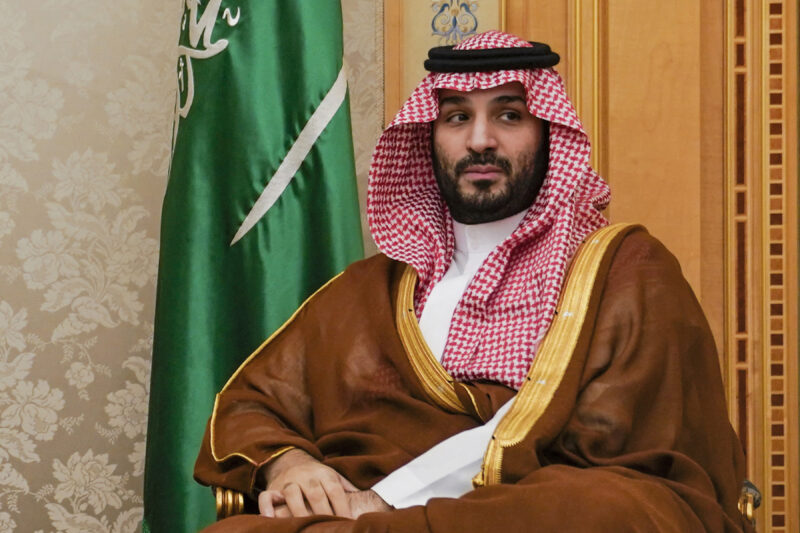
President Donald Trump and Saudi Crown Prince Mohammed bin Salman interact with officials during a “coffee ceremony” at the Saudi Royal Court on May 13, 2025, in Riyadh, Saudi Arabia.
Good Tuesday morning.
In today’s Daily Kickoff, we look at how economic and business opportunities are overtaking traditional foreign policy on President Donald Trump’s trip to the Middle East, and report on Israeli Prime Minister Benjamin Netanyahu’s call for Israel to “wean” itself off of U.S. military aid. We also talk to Leo Terrell about the Department of Justice’s efforts to address campus antisemitism, and spotlight an Israeli boarding school that works to promote a shared society in a post-Oct. 7 landscape. Also in today’s Daily Kickoff: Edan Alexander, Oskar Schindler and Sen. Jacky Rosen.
What We’re Watching
- President Donald Trump is in Riyadh, Saudi Arabia, today for meetings with senior officials. He met earlier today with Saudi Crown Prince Mohammed bin Salman.
- Also in Riyadh, the Saudi-U.S. Investment Forum kicked off earlier today. Speakers at the daylong summit include Treasury Secretary Scott Bessent, Commerce Secretary Howard Lutnick, the White House’s David Sacks, White House advisor Elon Musk, Palantir’s Alex Karp, Blackstone’s Stephen Schwarzman, Amazon’s Andy Jassy, FIFA President Gianni Infantino, LionTree’s Aryeh Bourkoff, BlackRock’s Larry Fink, Alphabet’s Ruth Porat, BDT & MSD Partners’ Dina Powell McCormick and the Saudi ministers of energy, sports, investment, finance, economy, tourism and housing.
- An Israeli delegation is in Doha, Qatar, today for renewed ceasefire and hostage-release talks.
- In Washington, the Senate Foreign Relations Committee is holding a hearing on East Africa. This afternoon, the Senate Armed Services Committee will hold a hearing on the U.S.’ missile defense budget request.
- At 10:45 a.m. ET, Sen. Mitch McConnell (R-KY) will deliver remarks during the Center for Strategic and International Studies’ Global Security Forum in Washington.
- Sens. Brian Schatz (D-HI), Cory Booker (D-NJ), Chris Coons (D-DE) and Chris Murphy (D-CT) are planning to force a floor vote as soon as today on condemning the potential gift of a Qatari luxury jet to President Donald Trump.
- Dan Senor will deliver 92NY’s annual State of World Jewry address tonight in New York.
What You Should Know
A QUICK WORD WITH Gabby deutch
President Donald Trump arrived in the Middle East today for the first major international trip of his second term, where he’ll visit Saudi Arabia, Qatar and the United Arab Emirates. He traveled to the region just as his administration secured a major diplomatic breakthrough: the release of Edan Alexander, the final living American hostage, from Hamas captivity in Gaza.
But Trump will not be visiting Israel to herald Alexander’s release. There will be no victorious photo shoot with Israeli Prime Minister Benjamin Netanyahu, because all reports indicate that the U.S. secured Alexander’s release without even informing the Israelis about the negotiations. Trump will not be visiting Israel at all, dealing another blow to America’s closest ally in the region at a time when ties appear to be straining between Jerusalem and Washington.
Instead, the president will be meeting with the leader of a country that serves as a chief sponsor of Alexander’s captors — just days after Trump accepted the gift of a $400 million luxury jet from the Qatari royal family to use as Air Force One, which quickly sparked concern from ethics experts, congressional Democrats and critics of the Gulf state, which has close ties to Hamas leaders.
The gift of the Qatari plane may be a harbinger of an administration that prioritizes business deals over national security. No further diplomatic victories are expected. After Trump said last week that he would make a “very, very big announcement” before his trip to the Middle East, many observers thought that news would be related to the region. But a White House spokesperson told Jewish Insider that it was instead referring to a drug-pricing executive order he signed on Monday.
The trip is generating a quiet panic of sorts among members of the pro-Israel and Jewish communal establishment over how the administration’s primary focus on mega dealmaking is eclipsing traditional foreign policy objectives — rendering moot much of the congressional lobbying and advocacy work promoting a strong U.S.-Israel relationship, as well as Israel’s own approach to its relationship with Washington.
A message circulating among insiders this week captures the mood: “All the investment in communal organizations and institutions like Congress are meaningless in this moment and pale in comparison to having a sovereign wealth fund that can get Trump to change his tune on Houthis, Iran, Gaza etc.” (Saudi officials reportedly backed a U.S.-Houthi ceasefire last week, and have been encouraging of U.S. nuclear talks with Iran in an effort to bring more economic stability to the region.)
Indeed, White House officials have said that national security is not expected to be a major part of Trump’s conversations this week. Rather, trade and investment deals are the focus of the visits, along with announcements of defense spending agreements.
In the recent past, a trip like this might have been likely to feature talk of normalization between Saudi Arabia and Israel. Steve Witkoff, Trump’s Middle East envoy, said last week that he expects to be able to announce progress on additional countries joining the Abraham Accords in the next year. But at least publicly, progress on normalization between Israel and Saudi Arabia has stalled.
“It looks like it fell off a cliff,” David Makovsky, a distinguished fellow at The Washington Institute for Near East Policy, told JI.
A report from Reuters indicates the U.S. might give Saudi Arabia what has been one of its primary asks of Washington — support for a civil nuclear program in the Gulf monarchy — without tying it to the demand that Saudi Arabia establish diplomatic ties with Israel, as was previously expected in a deal. The U.S. also recently approved a major arms sale to Riyadh.
“What you’re seeing is that President Trump has an idea of what is in our interest, and that comes first,” Dennis Ross, a former State Department official who worked in both Democratic and Republican administrations, told The Washington Post. “He defines the nature of our interests abroad not through a geopolitical or security context, but an economic, financial and trade frame. I think President Trump might have the view that ‘We give [Israel] $4 billion a year in military assistance. I do plenty to support the Israelis.’”
Leading up to the trip, reports emerged suggesting that Trump is unhappy with Netanyahu’s decision to launch another major offensive in Gaza. This isn’t just a policy disagreement; it’s about Trump’s personal interest in developing the region, according to NBC News, which reported that he thinks further destruction in Gaza will make it harder to rebuild.
Ultimately, it appears that this trip could be a harbinger for the second Trump administration’s approach to the region. With Trump-branded projects being announced in Saudi Arabia and Qatar, a Houthi-U.S. ceasefire secured and a potential Iran nuclear agreement on the horizon, the “art of the deal” is looking like it will leave Israel largely out of the equation.
legal crackdown

Leo Terrell, senior counsel to the assistant attorney general for civil rights, says he’s undeterred by critics of the Trump administration’s approach to combating antisemitism, arguing that those dissatisfied with its deportation strategy are “trying to justify, in my opinion, the antisemitic behavior” of those individuals. Terrell, who has a career spanning three decades as a civil rights attorney and a conservative media personality, sat down on Monday for his first interview with Jewish Insider since joining the Justice Department earlier this year — at a time when some mainstream Jewish organizations, including the Anti-Defamation League and the American Jewish Committee, have expressed concern that the administration’s approach has violated the due process rights of the individuals being targeted. The Trump administration has argued that non-citizens do not have the same constitutional protections as U.S. citizens, though the Fourteenth Amendment grants due process rights to all people regardless of status.
Due process: “That question is being asked quite often, and I think those people who are raising that issue are trying to justify, in my opinion, the antisemitic behavior,” Terrell said. “If you’re an American citizen, I have due process on a lot of different criminal issues if I’m arrested. I have due process. That term due process needs to be evaluated depending on the status of the individuals who assert it. I will submit to you that individuals who are here on, let’s say, for example, a student visa, who are not American citizens, who are here as a privilege by this country, do not have the same due process rights, do not have the same access to the court system as I do as an American citizen,” he continued, adding, “Your rights depend on your status in this country. You won’t hear that because it’s the truth, it’s not a talking point.”
DOHA DEALINGS

Though President Donald Trump’s plans to accept a lavish jumbo jet from Qatar are raising outrage among Democrats, the move isn’t prompting any notable political shifts in the U.S. views toward the Qatari regime, with some Democrats downplaying the relevance of Qatar’s specific role in the bargain and many Senate Republicans avoiding criticizing Trump or the offered gift, Jewish Insider’s Marc Rod reports.
Mixed reactions: Sen. Rick Scott (R-FL), long an outspoken critic of Qatar, was one of the few Senate Republicans to strongly argue that accepting the plane would be risky, pointing to Qatar’s support for Hamas. But Sen. Ted Budd (R-NC), one of the most vocal critics of Qatar’s relationship with Hamas on the Hill, told JI he’s “sure [the administration has] good legal advice and will follow the law.” On the Democratic side of the aisle, Sen. Brian Schatz (D-HI) plans to force a vote on a resolution objecting to the transfer of the plane. But Schatz told JI that the U.S.-Qatari relationship is not the crux of the issue.
Trump’s defense: The president called the move by Qatar to offer the plane a “very nice gesture” made out of gratitude for U.S. security assistance, in remarks to reporters in the Oval Office during an executive order signing yesterday, Jewish Insider’s Danielle Cohen reports.
RELATIONSHIP RESET

Israel needs to begin the move towards ending its reliance on U.S. military aid, Israeli Prime Minister Benjamin Netanyahu said in a meeting of the Knesset Foreign Affairs and Defense Committee on Sunday, amid disputes with the Trump administration over a wide range of national security issues. “We receive close to $4 billion for arms. I think we will have to wean ourselves off of American security aid, just as we weaned ourselves off of American economic aid,” Netanyahu said. He added that, just as stopping economic aid helped spur economic growth in Israel, stopping military aid could help the defense sector. The remark was made in the context of talks with the U.S. about the next 10-year aid package for Israel and was unprompted, his spokesman told Jewish Insider’s Lahav Harkov.
Context: Netanyahu previously spoke of phasing out U.S. military aid after his disputes with former President Joe Biden and his administration about delivering arms to Israel last year. The Trump administration removed some of the restrictions, but there are new tensions between Jerusalem and Washington about a long list of diplomatic and security matters. Israel’s defense establishment reportedly prepared plans to attack Iranian nuclear facilities in the coming months, while the Trump administration is now engaged in extensive diplomacy with Iran in hopes of reaching a deal over its nuclear program. The Trump administration is open to working with Saudi Arabia on a civilian nuclear program, something that Israel has had misgivings about and was previously meant to be part of a normalization deal between Jerusalem and Riyadh.
HOPE IN A TIME OF TURMOIL

“Be the change you want to see in the world.” The famous words, often attributed to Mahatma Gandhi, are scattered among various flags, including Israeli and Palestinian, at the entrance to the offices of the Younited school, nestled within the campus of Givat Haviva, Israel’s oldest and largest institution for Jewish-Arab shared society. Beneath the slogan, a yellow flag flutters in the wind — a quiet but searing reminder of the 58 hostages still held in Gaza. It’s a juxtaposition that captures the tension of the moment: the dream of a peaceful and equitable future, tested by the darkest day in recent Israeli history and the ensuing war in Gaza. On Oct. 7, 2023, as Israel reeled from the horrifying Hamas attacks, Givat Haviva found itself taking on roles that went far beyond its mandate — it became a refuge, a mirror for itself and wider society and a case study in whether hope can endure under siege. Interviews with eight students and five administrators at Givat Haviva’s Younited boarding school paint a portrait of an institution struggling to bridge a divide in Israeli society that often seems unbridgeable, Jewish Insider’s Tamara Zieve reports.
A place of refuge: The day after the onset of the attacks, dozens of people who had fled their homes near the Gaza border turned up at the gates of Givat Haviva. “People just showed up with no clothes — and nothing — and shaking kids,” Michal Sella, the CEO of Givat Haviva, told JI during an interview in her office last month. Givat Haviva opened its doors to the evacuees. Soon after, around 100 Jewish and Arab teenagers returned to their boarding school — followed by 300 Arab students from a seventh–12th grade school located on the campus. At a time of unprecedented communal tension, the school’s leadership faced enormous challenges. “It was seen as a very explosive environment. It was very hard to manage all this, and our goal was for all of them to get along, to be able to share this campus … We worked very hard to keep everything calm, and we were very, very cautious, even doing things that usually we will not do.” Sella recalled.
SCOOP

A Richmond, Va., judge has issued a new court order ruling that a pro-Palestinian advocacy group with alleged ties to Hamas must finally turn over closely guarded financial documents sought in an ongoing investigation brought by Virginia’s attorney general, Jewish Insider’s Matthew Kassel reports.
Legal setback: The decision, issued on Friday, is a major blow for American Muslims for Palestine, a Virginia-based nonprofit group that has drawn a growing number of legal challenges in the aftermath of Hamas’ Oct. 7, 2023, terror attacks and Israel’s ensuing war in Gaza.
SCOOP

A group of nine Jewish House Democrats wrote to President Donald Trump on Tuesday expressing “grave concerns” about reports that the Trump administration plans to seal a deal on nuclear energy cooperation with Saudi Arabia without Saudi-Israeli normalization, Jewish Insider’s Marc Rod reports.
Nonstarter: “This development would be a dramatic and unacceptable policy change that would drastically hamstring the Middle East peace process and undermine the successful Abraham Accords implemented during the first Trump Administration,” the Democrats’ letter reads. “We firmly believe that any discussion of nuclear talks or defensive treaties must explicitly be tied to the Kingdom’s recognition of Israel and normalization of relations between the two countries.”
Worthy Reads
Sana’a Showdown: The New York Times’ Helene Cooper, Greg Jaffe, Jonathan Swan, Eric Schmitt and Maggie Haberman do a deep dive into the Trump administration’s decision to reach a ceasefire with the Houthis in Yemen. “The sudden declaration of victory over the Houthis demonstrates how some members of the president’s national security team underestimated a group known for its resilience. Gen. Michael E. Kurilla, the head of Central Command, had pressed for a forceful campaign, which the defense secretary and the national security adviser initially supported, according to several officials with knowledge of the discussions. But the Houthis reinforced many of their bunkers and weapons depots throughout the intense bombing. … What’s more, Mr. Trump’s new chairman of the Joint Chiefs of Staff, Gen. Dan Caine, was concerned that an extended campaign against the Houthis would drain military resources away from the Asia-Pacific region. His predecessor, Gen. Charles Q. Brown Jr., shared that view before he was fired in February.” [NYTimes]
Turning on Their Former Boss: In The Wall Street Journal, Jamie Kirchick reacts to a recent smear campaign by former staffers for Sen. John Fetterman (D-PA) targeting the Pennsylvania Democrat. “Conflating Mr. Fetterman’s political evolution with his allegedly declining mental health (dressed up as concern for his well-being) is extremely cynical in light of the debate that ensued after he suffered a stroke during the 2022 Senate campaign. … At the time, progressives castigated anyone who questioned Mr. Fetterman’s fitness for office as an ‘ableist.’ Now, when he’s clearly improved, they claim he’s unfit to serve. Attributing Mr. Fetterman’s political maturation to mental illness is shameful considering the courage it has taken him to speak publicly about his depression. For elected officials especially, it can be difficult to broach such a personal subject. Mr. Fetterman should be commended for discussing it openly. He’s doing for mental health what former First Lady Betty Ford did for addiction, raising awareness about a problem suffered by millions in shame and silence. He is encouraging people to seek professional help. How quickly progressives, usually so careful not to stigmatize people for their mental health, do an about-face when the target of such accusations espouses political views opposing theirs.” [WSJ]
The Trump-Bibi Divide: The Atlantic’s Yair Rosenberg looks at the divergence of opinion between the Israeli public and the Israeli government on how Israel should pursue the release of the remaining 58 hostages. “The release was the result of a back-channel dialogue between the United States and the terrorist group ahead of Donald Trump’s arrival in the region this week. Announcing the news on social media, the president heralded the event not as a one-off, but as a step ‘to put an end to this very brutal war and return ALL living hostages and remains to their loved ones.’ Israel was not involved in the process and, according to Axios, found out about the negotiations only through its intelligence services. Some reports have cast this disconnect as indicative of a chasm between Trump and Israel. But this is a misreading. The divide is not between the president and Israel so much as between the president and Israel’s leader. Most Israelis support what Trump is doing — and oppose Prime Minister Benjamin Netanyahu’s approach to the war in Gaza.” [TheAtlantic]
Word on the Street
The Pentagon is downgrading its bomber fleet in the Indo-Pacific, replacing the B-2 bombers with B-52s, following the implementation of a ceasefire between the U.S. and the Iran-backed Houthis in Yemen…
The Trump administration levied sanctions on three Iranians and an Iranian company tied to Iran’s nuclear weapons program…
The State Department announced a roughly $1.4 billion arms sale to the United Arab Emirates on Monday, days before President Donald Trump is set to arrive in the Gulf nation…
The Wall Street Journal suggests that Trump “surprised and sidelined Israel” in the run-up to his Middle East trip, which does not include a stop in the Jewish state…
The negotiations to free American-Israeli hostage Edan Alexander reportedly originated with Hamas‘ outreach to former Arab Americans for Trump leader Bishara Bahbah…
A sweeping federal tax bill unveiled on Monday as part of Republicans’ budget reconciliation plan includes legislation that would expand the executive branch’s ability to revoke tax exemptions from nonprofits accused of supporting terrorism, a push that was once broadly bipartisan but ran into strong Democratic opposition at the end of the previous Congress, Jewish Insider’s Marc Rod reports…
A group of Senate Democrats led by Sen. Jacky Rosen (D-NV) wrote to President Donald Trump last week criticizing his decision to dismiss multiple members of the United States Holocaust Memorial Council appointed by President Joe Biden, Jewish Insider’s Marc Rod reports…
The Democratic National Committee is moving forward with an effort to void the election of DNC Vice Chairs David Hogg and Malcolm Kenyatta, the latter of whom is a Pennsylvania state representative, following allegations that the original February election was conducted in a flawed manner; Hogg accused the DNC of attacking him for his PAC’s strategy to back primary challengers to older elected Democrats…
Rob Sands, who as Iowa’s state auditor is the only Democrat to hold statewide office, announced his bid for governor following Gov. Kim Reynolds’ announcement that she will not seek a third term; Rep. Randy Feenstra (R-IA) also filed paperwork on Monday to enter the race…
The University of San Francisco has become the latest school to divest from Israel-related companies. The school’s endowment fund will sell off its direct investments in Palantir, L3Harris, GE Aerospace and RTX Corporation by June 1, the university confirmed, Jewish Insider’s Haley Cohen reports…
The former Czech textile factory where Oskar Schindler saved 1,200 Jews reopened as a museum honoring the efforts of Schindler, his wife Emilie and the family that owned the building…
An Iranian government spokesperson said that preparations for Russian President Vladimir Putin to visit Tehran at a still-undetermined date “are underway”…
The Kurdish PKK agreed to end its decades-long conflict against Turkey and dissolve itself, shortly after a call from its leader, Abdullah Ocalan, who is serving a life sentence in Turkey, to do so…
Writer and illustrator Jack Katz, who pioneered the graphic novel, died at 97…
Corporate executive and attorney Robert Shapiro, who popularized the use of aspartame through branding the sugar substitute as NutraSweet, died at 86…
Pic of the Day

Former Israeli American hostage Edan Alexander was reunited with his extended family on Monday night at Ichilov Medical Center in Tel Aviv, hours after being released from captivity in Gaza.
Birthdays
Retired NFL offensive lineman for seven NFL teams, now a regional manager at Rocksolid, Brian de la Puente turns 40…
South African-born attorney, now based in London, Sir Sydney Lipworth QC turns 94… Professor emerita of Yiddish literature at Harvard University, she is presently a distinguished senior fellow at The Tikvah Fund, Ruth Wisse turns 89… Emmy Award-winning film, television and stage actress, Zohra Lampert turns 88… Academy Award-winning actor and producer, Harvey Keitel turns 86… Ophthalmologist in South Florida, Dr. Joel Sandberg turns 82… Former dean of the College of Arts and Sciences at American Jewish University, Samuel Edelman turns 77… Professor of mathematics at Princeton since 1987, he was a winner of a 1991 MacArthur genius fellowship, Sergiu Klainerman turns 75… Former FDA commissioner during the 1990s, then chief scientific officer for COVID-19 response during the Biden administration, David A. Kessler turns 74… Retired editor and columnist for the New York Post, he was also managing editor of The Jerusalem Post, Eric Fettmann turns 72… Chief rabbi of the city of Shoham in central Israel, chairman of the Tzohar organization and rabbi for the Ezra youth movement, Rabbi David Stav turns 65… Founder and former CEO of LRN, a legal research, ethics and compliance management firm, Dov Seidman turns 61… Immediate past chair of JFNA’s National Women’s Philanthropy Board and past chair of the Hartford (Conn.) Federation, Carolyn Gitlin… Retired NFL defensive lineman, he has played for the Raiders and Panthers, Josh Heinrich Taves, aka Josh Heinrich, turns 53… Ice hockey player, she won a gold medal at the 1998 Winter Olympics and a silver medal at the 2002 Winter Olympics, Sara Ann DeCosta turns 48… U.S. senator (R-AR), Tom Cotton turns 48… Chief community and Jewish life officer at The Jewish Federations of North America, Sarah Eisenman… Former Israel director for J Street, then the chief of staff for Israel’s Ministry for Regional Cooperation, Yael Patir… Member of the U.K.’s House of Lords since February, she was previously a member of the House of Commons, Baroness Luciana Berger turns 44… Software entrepreneur, Google project manager, then Facebook engineering lead, and co-founder in 2008 of Asana, Justin Rosenstein turns 42… Israeli rapper, singer, songwriter and actor, known by his stage name Tuna, Itay Zvulun turns 41… Actress, writer, producer and director, best known as the creator, writer and star of the HBO series “Girls,” Lena Dunham turns 39… Hannah Sirdofsky… Co-founder in 2018 of Manna Tree Partners, Gabrielle “Ellie” Rubenstein… Chief of staff and senior program manager at Jigsaw, a unit within Google, Raquel Saxe Gelb… A clinical social work intern in Philadelphia, Bela Galit Krifcher… Graduating from Columbia Law School next Sunday, Dore Lev Feith turns 29… Director of external affairs at the Manhattan Institute, Jesse Martin Arm… Gold medalist for Israel in rhythmic gymnastics at the 2020 Olympics in Tokyo, Linoy Ashram turns 26…
Plus, Israel prepares for Edan Alexander's release

Joe Raedle/Getty Images
President Donald Trump gestures as he departs Air Force One at Miami International Airport on February 19, 2025 in Miami, Florida.
Good Monday morning.
In today’s Daily Kickoff, we look at the state of relations between Washington and Jerusalem ahead of President Donald Trump’s trip to Saudi Arabia, Qatar and the United Arab Emirates this week, and report on how Capitol Hill is reacting to Qatar’s plans to gift a $400 million luxury jet to Trump. We also do a deep dive into the ‘123 Agreement’ being pushed by GOP senators wary of nuclear negotiations with Iran, and report on the University of Washington’s handling of recent anti-Israel campus protests. Also in today’s Daily Kickoff: Iris Haim, Natalie Portman and Nafea Bshara.
What We’re Watching
- Middle East envoy Steve Witkoff is in Israel today following the announcement that Hamas will release Israeli American hostage Edan Alexander today. Adam Boehler, the administration’s hostage affairs envoy, arrived in Israel earlier today along with Alexander’s mother, Yael. More below.
- President Donald Trump is departing later today for his three-country visit to the Middle East. More below.
- An Israeli delegation will reportedly travel to Cairo today to renew negotiations with Hamas.
- Israeli President Isaac Herzog is in Germany today, where he is marking 60 years of German-Israeli relations.
- This afternoon in Tel Aviv, hostage families will march from Hostage Square to the U.S. Embassy Branch Office to call for a “comprehensive” agreement to free the remaining 59 hostages.
What You Should Know
A QUICK WORD WITH Melissa Weiss
“Donald, Bring Them Home” reads a sign in the window of a clothing boutique on Tel Aviv’s busy Dizengoff Street. It’s been in the store window since January, when a temporary ceasefire freed dozens of Israeli hostages, including two Americans, who had been held in captivity in Gaza for over a year. It’s a smaller sign than the billboard that read “Thank you, Mr. President” and for weeks was visible to the thousands of motorists driving on the busy thoroughfare next to the beach.
Returned hostages and hostage families have appealed to the Trump administration for assistance in securing their loved ones’ releases, expressing sentiments conspicuously absent in meetings between former hostages and Israeli government officials, including Prime Minister Benjamin Netanyahu. It’s a situation that underscores how the American efforts to secure the release of the remaining hostages have at times been done not only without Israeli buy-in, but with Israel finding out only after the negotiations concluded.
Such was the case yesterday, when Trump announced that Edan Alexander, the last living American hostage in Gaza, would be released.
The negotiations over the release of Alexander underscore the Trump administration’s “America First” approach to the region that has sidelined Israeli priorities on a range of issues, from the Houthis to Iran to the war in Gaza. It’s a splash of cold water in the face of a nation that largely celebrated Trump’s election six months ago.
The announcement of Alexander’s expected release came after a firehose of news in the days leading up to Trump’s visit to the Middle East, which begins tomorrow. First, the move toward allowing Saudi Arabia to have a civilian nuclear program. Then, the news, confirmed on Sunday by Trump, that Qatar is gifting the president a luxury plane to add to the Air Force One fleet, amid yearslong Boeing manufacturing delays. (More below.)
The Qatari gift alarmed Washington Democrats, with Rep. Ritchie Torres (D-NY) writing to Trump administration officials to express “alarm,” saying Qatar has a “deeply troubling history of financing a barbaric terrorist organization that has the blood of Americans on its hands. In the cruelest irony, Air Force One will have something in common with Hamas: paid for by Qatar.”
Only hours after the news of the gifted jet broke, Trump announced that the U.S., along with Egyptian and Qatari mediators, had reached an agreement to secure Alexander’s release, which he referred to as “the first of those final steps necessary to end this brutal conflict.” Israel was not mentioned a single time in the announcement.
Netanyahu himself conceded that the Americans had reached the deal absent Israeli involvement. “The U.S. has informed Israel of Hamas’s intention to release soldier Edan Alexander as a gesture to the Americans, without conditions or anything in exchange,” Netanyahu said on Sunday evening.
The news stunned observers and offered a measure of renewed hope to the families of remaining hostages, including the four Americans whose bodies remain in Gaza, but opened a deluge of questions about the diplomatic dance that led to an agreement over Alexander’s release.
The timing of the announcement – shortly after news of the gifted Qatari jet broke — raised questions about the potentially transactional nature of the discussions, and deepened concerns that the Trump administration could reach agreements that run counter to Israeli security priorities while the president travels the region (a trip that does not include a stop in Israel, despite Netanyahu’s two visits to the White House since Trump returned to office).
As Trump travels to Saudi Arabia, Qatar and the United Arab Emirates this week, the world will be watching closely. But perhaps nobody will be watching as closely — from more than 1,000 miles away — as Netanyahu.
FIRM FRIENDS?

The headlines in the Hebrew media, on the eve of President Donald Trump’s visit to the Middle East this week, played up what some see as an emerging rift between Israel and the U.S. “Concerns in Israel: The deals will hurt the qualitative [military] edge,” read one. The Trump administration has already made a truce with the Houthis and cut a deal with Hamas to release Israeli American hostage Edan Alexander — without Israel — and the concern in Jerusalem is that more surprises — good and bad — may be on the way. Yet insiders in both the Trump administration and the Netanyahu government speaking to Jewish Insider’s Lahav Harkov in recent days on condition of anonymity to discuss sensitive matters took a more sanguine view of the delicate diplomacy, saying that there is no rift, even if there are disagreements.
Calm but critical: Sources in Jerusalem pointed to Prime Minister Benjamin Netanyahu’s two visits to the White House in Trump’s first 100 days in office, as well as Israeli Strategic Affairs Minister Ron Dermer’s meeting with the president last week. A Trump administration source said the relationship remains positive and close, but also criticized Israel for not adapting to the president’s transactional approach to foreign policy. Gulf states are likely to announce major investments in the U.S. during Trump’s visit, while Israel has largely been asking the administration for help. Jerusalem could be putting a greater emphasis on jobs created by U.S.-Israel cooperation in the defense and technological sectors when they speak with Trump, the source suggested.
Signs of stress: The apparent divisions are especially notable in the context of the Iran talks — Israel largely opposes diplomacy with the regime and favors a military option to address Iran’s nuclear program, on which the Trump administration has not yet been willing to cooperate, Jewish Insider’s Marc Rod reports.
GIFT OR GRIFT?

Congressional Democrats are expressing outrage over reports that the Qatari government plans to give to President Donald Trump a luxury jet for use as Air Force One, which would reportedly continue to be available for Trump’s use after his presidency, and transferred to his presidential library, Jewish Insider’s Marc Rod reports.
What they’re saying: Senate Minority Leader Chuck Schumer (D-NY) said that accepting the jet would be “not just bribery, it’s premium foreign influence with extra legroom.” Rep. Ritchie Torres (D-NY) wrote to Trump administration officials to express “alarm,” calling the reported gift a “flying grift.” Torres condemned Attorney General Pam Bondi — who previously served as a lobbyist for Qatar — for approving the reported transfer, which Torres said “flagrantly violates both the letter and the spirit of the Constitution’s Emoluments Clause.” Some conservatives, including far-right influencer Laura Loomer, Rep. Warren Davidson (R-OH) and commentator Mark Levin, are also expressing concern.
Read the full story here with additional comments from Sens. Chris Murphy (D-CT) and Bernie Sanders (I-VT) and Rep. Jamie Raskin (D-MD).
The ABCs of 123s

Last week, a group of Senate Republicans introduced a resolution laying down stringent expectations for a nuclear deal with Iran. One of those conditions is a so-called “123 Agreement” with the United States, after “the complete dismantlement and destruction of [Iran’s] entire nuclear program,” Jewish Insider’s Marc Rod reports.
What it means: A source familiar with the state of the talks confirmed to JI that a 123 Agreement is a key part of the ongoing U.S.-Iran talks currently being led by U.S. Middle East envoy Steve Witkoff, though a Witkoff spokesperson said “The sources don’t know what they’re talking about.” Those agreements refer to Section 123 of the U.S. Atomic Energy Act, which lays out conditions for peaceful nuclear cooperation between the United States and other countries. Twenty-five such agreements are currently in place — but in most cases they pertain to U.S. allies and partners. A 123 Agreement was not part of the original 2015 Joint Comprehensive Plan of Action — they are only required in cases in which the U.S. is going to be sharing nuclear material or technology with a foreign country, directly or indirectly. The prospect of inking such a deal with Iran is meeting with surprise and heavy skepticism from experts.
DEM DIVIDE

A group of 25 Senate Democrats, comprising more than half of the caucus and led by several senior leaders, wrote to President Donald Trump on Friday condemning new plans for expanded Israeli military operations in the Gaza strip and accusing the Trump administration of failing to push for peace, Jewish Insider’s Marc Rod reports. Signatories include top lawmakers on some key Senate committees and senior members of the Democratic caucus.
What they said: “This is a dangerous inflection point for Israel and the region, and while we support ongoing efforts to eliminate Hamas, a full-scale reoccupation of Gaza would be a critical strategic mistake,” the lawmakers said, of Israel’s plan to expand military operations in Gaza. They also rejected a new plan for aid distribution in Gaza, which they described as an Israeli plan but which U.S. officials have described as American-led.
Hostage hopes: A bipartisan group of 50 House members wrote to President Donald Trump on Friday urging him to “prioritize the release of the five Americans” who remain hostage in Gaza.
Q&A

Most of the best-known hostage relatives in Israel are those who have led demonstrations and called to topple the government. But Iris Haim became renowned in Israel for taking a radically different approach. Haim’s son, Yotam, was kidnapped by Palestinian terrorists on Oct. 7, 2023. He and fellow hostages Samar Talalka and Alon Shimriz managed to escape captivity, only to be mistakenly killed by the IDF on Dec. 15, 2023. Yet days after Yotam was killed, rather than express anger or even anguish, Haim chose to send a message of forgiveness and encouragement to the troops. Since then, Haim has been lauded by many Israelis, even granted the honor of lighting a torch at Israel’s official Independence Day ceremony last year. Jewish Insider’s Lahav interviewed Haim at the Global Network for Jewish Women Entrepreneurs and Leaders’ 2025 Global Leadership Conference last week.
Haim’s philosophy: “I’m not avoiding life, but I’m choosing how to deal with it … I don’t blame anybody, because I don’t believe in that way … I have my philosophy of life. Life can be good for me. It all depends on me. I can find so much good, and I need to choose to see it. It depends on where we put our focus,” Haim told JI. “There is also a lot of bad. Yesterday we heard about two more soldiers who were killed … I cannot control this. What I cannot control, I’m not dealing with. I can’t change what [Israeli Prime Minister] Bibi [Netanyahu] thinks or what this government is doing. I can only vote differently next time, and that’s the way to keep myself normal and not go crazy.”
NEW DIRECTION

The University of Washington suspended 21 students who were arrested during anti-Israel protests at the Seattle campus earlier this week, according to the university, a marked shift from the school’s reaction to previous anti-Israel activity, Jewish Insider’s Danielle Cohen and Haley Cohen report. The suspended students, who are also now banned from all UW campuses, were among more than 30 demonstrators, including non-students, arrested for occupying the university’s engineering building on Monday night — causing more than $1 million worth of damage. Masked demonstrators blocked entrances and exits to the building and ignited fires in two dumpsters on a street outside. Police moved into the building around 11 p.m.
University response: After Monday’s events, the university’s president, Ana Mari Cauce, quickly denounced the “dangerous, violent and illegal building occupation and related vandalism” and condemned “in the strongest terms the group’s statement celebrating the Oct. 7, 2023, Hamas terrorist attacks against Israeli civilians.” Miriam Weingarten, co-director of Chabad UW with her husband Rabbi Mendel Weingarten, expressed gratitude to the school for its swift response to the latest incident, which she called “appalling and horrific.”
On the East Coast: Columbia University suspended more than five dozen students in connection with last week’s protest at the school’s main library; 33 other individuals were barred from the New York City campus over the incident.
Worthy Reads
Show of Force: Former Wall Street Journal publisher Karen Elliott House suggests that the U.S. and Israel mount a joint strike on Iranian nuclear facilities. “The only honorable option is to dismantle it. This can be done through diplomacy, which is highly unlikely, or with force. Any other outcome endangers both Israel and Saudi Arabia, key U.S. partners in the Middle East, and destroys Mr. Trump’s credibility with the world. The president adamantly — and repeatedly — has insisted he will accept nothing less than ‘total dismantlement’ of Iran’s nuclear program. The mullahs in Tehran will never agree to that. They saw what happened to Ukraine and Libya after giving up their nuclear ambitions. They think that enriching uranium for their nuclear reactors is a national right. Their real goal isn’t electricity generation but the ability to produce material for a bomb. … Destroying Iran’s nuclear capability involves risks, and Mr. Trump wants to avoid war. But if he believes Iran can be trusted to execute a new pact, he hasn’t done his homework.” [WSJ]
Altman’s Ascent: The Financial Times’ Roula Khalaf interviews OpenAI CEO Sam Altman in his California home about his rise in the tech industry and future plans for the AI company. “As we talk, I search for clues in his upbringing that hint at his future stardom. He says there are none. ‘I was like a kind of nerdy Jewish kid in the Midwest . . . So technology was just not a thing. Like being into computers was sort of, like, unusual. And I certainly never could have imagined that I would have ended up working on this technology in such a way. I still feel sort of surreal that that happened.’ The eldest of the four children of a dermatologist mother and a father who worked in real estate, Altman read a lot of science-fiction books, watched Star Trek and liked computers. In 2005, he dropped out of Stanford University before graduating to launch a social networking start-up. In those days, AI was still in its infancy: ‘We could show a system a thousand images of cats, and a thousand images of dogs, and then it [the AI] could correctly classify them, and that was, like, you were living the high life.’” [FT]
Word on the Street
A senior U.S. official said that American negotiators were “encouraged” by the fourth round of nuclear talks with Iran, held yesterday in Oman…
Members of the U.S. Holocaust Memorial Museum board clashed over the decision by the Trump administration to remove several board members appointed by former President Joe Biden, including former Second Gentleman Doug Emhoff and former White House Chief of Staff Ron Klain…
Rep. Marjorie Taylor Greene (R-GA) ruled out a Senate bid to challenge Sen. Jon Ossoff (D-GA), further narrowing the GOP field days after Gov. Brian Kemp announced he would not enter the Senate race; Rep. Buddy Carter (R-GA) became the first Republican to enter the race last week…
Rep. Randy Fine (R-FL) and Sen. Rick Scott (R-FL) introduced legislation to specifically ban religious discrimination under Title VI of the Civil Rights Act, a prospect that has been discussed on the Hill for several years to combat antisemitism on college campuses…
Rep. Michael Baumgartner (R-WA) introduced a resolution condemning Iran’s failure to fulfill its Nonproliferation Treaty obligations and comply with International Atomic Energy Agency inspectors, and supporting military force against Iran if it withdraws from the NPT or crosses the nuclear threshold…
Reps. Jerry Nadler (D-NY), Adam Smith (D-WA) and Jim Himes (D-CT) introduced legislation providing for sanctions on individuals involved in enabling violence or destabilizing activity in the West Bank, including government officials. The legislation echoes sanctions in place under the Biden administration…
A federal program that provides funding to help vulnerable nonprofits meet their security needs has again begun reimbursing recipients, after a funding freeze at the Federal Emergency Management Agency left the fate of the Nonprofit Security Grant Program in limbo, Jewish Insider’s Marc Rod and Gabby Deutch report…
As University of Michigan President Santa Ono is set to become president at University of Florida, he said on Thursday that “combating antisemitism” will remain a priority, as it has “throughout my career,” Jewish Insider’s Haley Cohen reports…
Rümeysa Öztürk, the Turkish student at Tufts University who was arrested in March and held in a detention center as she appealed the Trump administration’s deportation efforts, was released following a federal judge’s order…
The New York Times’ Jodi Rudoren reflects on her experiences saying Kaddish, the mourner’s prayer, after her father’s death…
The Wall Street Journal looks at the relationship between Amazon Web Services and Nafea Bshara’s Annapurna Labs, which “has become essential to the success of the whole company” since AWS purchased the startup, which was founded in Israel, a decade ago in a $350 million deal…
Actress Natalie Portman is slated to star in Tom Hooper’s “Photograph 51,” a biopic about British scientist Rosalind Franklin…
The Washington Post spotlights a WWII battalion comprised of first-generation Japanese American soldiers who played a role in the liberation of Dachau…
The Associated Press looks at a Dutch-led effort to digitize roughly 100,000 records from the Jewish community of Suriname, dating back to the 18th century…
U.K. Education Secretary Bridget Phillipson warned that antisemitism among British youth is experiencing a “horrific surge” and becoming a “national emergency”…
The Wall Street Journal reports on the sexual assault allegations made against Karim Khan, the International Criminal Court’s chief prosecutor, shortly before he announced his pursuit of arrest warrants for senior Israeli officials…
The IDF and Mossad recovered the remains of Sgt. First Class Zvi Feldman, who went missing along with two other soldiers during a battle in Lebanon’s Bekaa Valley during the First Lebanon War in 1982; a joint IDF-Mossad statement said that Feldman’s remains were recovered “from the heart of Syria” in a “complex and covert operation” that used “precise intelligence”…
Israel issued an evacuation warning for the Yemeni ports of Ras Isa, Hodeidah and Salif, days after carrying out strikes at the Sana’a airport targeting the Iran-backed Houthis…’
The Houthis fired a ballistic missile toward Israel on Monday morning; the missile fell short and landed in Saudi Arabia…
In his first Sunday address since being selected as pontiff, Pope Leo XIV called for a ceasefire in the Israel-Hamas war, the distribution of aid to Gaza and “all hostages be freed”…
Rob Silvers, the under secretary for policy at the Department of Homeland Security during the Biden administration, is joining Ropes & Gray as a partner, and will co-chair the firm’s national security practice…
Heavy metal band Disturbed frontman David Draiman is engaged following his proposal to model Sarah Uli at a show in Sacramento over the weekend…
Holocaust survivor Margot Friedländer, who returned in 2010 to live in Berlin, where she shared her story of survival with German audiences, died at 103…
Pic of the Day

Former hostage Emily Damari, visiting London on Sunday, attended her first Tottenham game since being released. Ahead of the game, Damari and her mother, Mandy Damari, met with supporters and called for the release of her friends Gali and Ziv Berman, twin brothers who were taken, alongside Damari, from Kibbutz Kfar Aza on Oct. 7, 2023, and remain in captivity.
Birthdays

Haifa-born actress and model, she is known for her lead roles in seven films since 2014, Odeya Rush turns 28…
Israeli agribusiness entrepreneur and real estate investor, he was chairman and owner of Carmel Agrexco, Gideon Bickel turns 81… World-renowned architect and master planner for the World Trade Center site in Lower Manhattan, he also designed the Jewish Museum in Berlin, Germany, Daniel Libeskind turns 79… Former member of the California state Senate for eight years, following six years as a member of the California Assembly, Lois Wolk turns 79… Chairman of the Israel Paralympic Committee, he served for four years as a member of the Knesset for the Yisrael Beiteinu party, Moshe “Mutz” Matalon turns 72… Former Washington correspondent for McClatchy and then the Miami Herald covering the Pentagon, James Martin Rosen turns 70… SVP and deputy general counsel at Delta Air Lines until 2024, now chief legal officer at private aviation firm Wheels Up, Matthew Knopf turns 69… Professor at Emory University School of Law, he has published over 200 articles on law, religion and Jewish law, Michael Jay Broyde turns 61… Actress known for her role as Lexi Sterling on “Melrose Place,” she also had the lead role in many Lifetime movies, Jamie Michelle Luner turns 54… Founder of strategic communications and consulting firm Hiltzik Strategies, Matthew Hiltzik turns 53… Communications officer in the D.C. office of Open Society Foundations until earlier this month, Jonathan E. Kaplan… First-ever Jewish governor of Colorado, he was a successful serial entrepreneur before entering politics, Jared Polis turns 50… Professor of mathematics at Bar-Ilan University and a scientific advisor at the Y-Data school of data science in Israel, Elena Bunina turns 49… Italian politician, she is the first-ever Jewish mayor of Florence, Sara Funaro turns 49… Israeli pastry chef and parenting counselor, she is married to former Israeli Prime Minister Naftali Bennett, Gilat Ethel Bennett turns 48… Author, blogger and public speaker, Michael Ellsberg turns 48… Senior advisor at Accelerator for America Action, Joshua Cohen… Technology and social media reporter at Bloomberg, Alexandra Sophie Levine… Senior director of government affairs at BridgeBio, Amanda Schechter Malakoff… Civics outreach manager at Google, Erica Arbetter…
Plus, Tehrangelenos on Trump's Iran tango

Office of Sen. Lindsey Graham (R-SC)
Sen. Lindsey Graham (R-SC) and Sen. Tom Cotton (R-AR) hold a joint press conference on Iranian nuclear negotiations at the U.S. Capitol on May 8, 2025.
Good Friday morning.
In today’s Daily Kickoff, we talk to members of the Persian American Jewish community about the Trump administration’s nuclear negotiations with Iran, and look at how Jewish interfaith leaders are responding to the selection of Pope Leo XIV, born Robert Francis Prevost in Chicago. We also report on former hostage Emily Damari’s response to the Pulitzer Prize Board’s awarding of its commentary prize to a Palestinian poet who disparaged victims of the Oct. 7, 2023, Hamas terror attacks, and cover bipartisan House pushback to President Donald Trump‘s decision to reach a ceasefire with the Houthis. Also in today’s Daily Kickoff: Judea Pearl, Ambassador Mike Huckabee and Jake Retzlaff.
For less-distracted reading over the weekend, browse this week’s edition of The Weekly Print, a curated print-friendly PDF featuring a selection of recent Jewish Insider and eJewishPhilanthropy stories, including: Israeli presence in Syria ‘a direct lesson of Oct. 7’; Washington Post’s Pulitzer finalist for Gaza coverage slams Israel’s military conduct in one-sided acceptance speech; and In this NJ election, antisemitism could decide the race — while dividing a Jewish community. Print the latest edition here.
What We’re Watching
- Defense Secretary Pete Hegseth’s planned trip to Israel was reportedly scrubbed today. Hegseth had been slated to meet with Prime Minister Benjamin Netanyahu and Defense Minister Israel Katz before joining President Donald Trump, who is traveling to Saudi Arabia, the United Arab Emirates and Qatar next week for his first trip abroad since reentering office.
- The Financial Times Weekend Festival is taking place tomorrow in Washington. Scheduled speakers include former White House Communications Director Anthony Scaramucci, U.K. Ambassador to the U.S. Peter Mandelson, UnHerd’s Sohrab Ahmari, Rev. Johnnie Moore and Steve Bannon.
What You Should Know
A QUICK WORD WITH JI’S HALEY COHEN
It’s not a coincidence that we’ve been focusing on Michigan a lot in these pages. It’s something of a battleground in the domestic politics surrounding antisemitism and the Middle East. Its universities have been among the epicenters of egregiously antisemitic activity. The state’s congressional delegation ranges from a stalwart ally of the state’s Jewish community in Rep. Haley Stevens (D-MI), to Rep. Rashida Tlaib (D-MI), one of the most radical anti-Israel voices in Congress.
So it shouldn’t have come as a surprise that one of the leading officials in the state, Michigan Attorney General Dana Nessel, found herself caught in political purgatory after abruptly dropping charges against seven University of Michigan students arrested for their role in anti-Israel demonstrations. The students were accused of assaulting police officers and engaging in ethnic intimidation.
Nessel, a Democrat, faced attacks from anti-Israel activists for bringing the case in the first place, and was subject to ugly smears that she only brought charges because of her Jewish identity. Tlaib has for months called on Nessel to recuse herself, arguing she only brought the case because of her “bias.”
But after Nessel blamed a local Jewish communal organization for playing a role in dropping the case, she’s been facing friendly fire from many of her erstwhile Jewish allies as well. After she dropped the charges on Monday, she criticized the Ann Arbor Jewish Community Relations Council for writing a letter to the court defending her against accusations of bias, claiming it was inappropriate and may have tainted the case.
In her statement, Nessel maintained the evidence against the suspects was strong, and otherwise would have led to a conviction.
Rabbi Asher Lopatin, director of community relations at the Jewish Federation of Greater Ann Arbor, told Jewish Insider that the organization has not heard from Nessel since releasing its statement. He said the letter was simply meant to “push back against these accusations against Nessel” and there is confusion over why or how it has compromised the case.
It’s fair to ask whether Michigan’s charged intra-Democratic politics also played a role in the decision to drop the charges. Nessel is one of the Democratic Party’s leading officials in the state, and didn’t get a lot of public backing from her colleagues when she first brought the case. The Arab American community in the state is significant — and was mobilized against Nessel — often drowning out the Jewish and more-moderate voices looking for accountability for those engaging in antisemitic activity.
On top of that, President Donald Trump’s aggressive (and arguably illiberal) actions against elite colleges with checkered records on antisemitism have made the enforcement against antisemitic hate crimes a more partisan issue, making it uncomfortable for a Democrat who’s tough on enforcement to stand their ground.
The dropped charges also raise legal questions about the validity of the case to begin with — and whether a new precedent is now set for anti-Israel activity in the state, which has seen a spate of antisemitic incidents since the Oct. 7 terrorist attacks in Israel.
“If the attorney general believes, as she said in her statement, that a reasonable jury would find the defendants guilty of the charges, we worry about the precedent this decision sets,” a spokesperson for the Michigan office of the Anti-Defamation League told JI.
HOLDING OUT HOPE

As nuclear talks between the United States and Iran enter their fourth round this weekend, WhatsApp groups within the Persian Jewish community in the United States are blowing up, as Iranian refugees and their first-generation American children try to decode Trump’s approach to the talks and figure out what to make of all of it. In conversations with Jewish Insider’s Gabby Deutch, several Jewish activists and leaders who were born in Iran or whose families fled the regime described confusion at Trump’s posturing on the issue, holding out hope for a strong deal — and trepidation that he might settle for something weak.
Shifting stance: To Jews whose families fled Iran out of concern for their lives, the prospect of Trump now negotiating with the rogue regime that wanted them dead is confounding, particularly since he took such a tough approach to Iran in his first term. “I think that the Jews from the Middle East, by and large, voted for Trump,” said Rabbi Tarlan Rabizadeh, a rabbi in Los Angeles whose family left Iran shortly after the Islamic Revolution in 1979. “The main reason was because of their support for Israel and hoping that that goes hand in hand, as Persian Jews, with his being hard on Iran, and that’s what he promised. He promised he was going to be tough on Iran. And he keeps saying that, and then floundering.”
PROMISING POPE

The election of Robert Francis Prevost as the first American pope on Thursday marked the beginning of a historic era for the Catholic Church, even as it also raised questions about the direction of Catholic-Jewish relations that had struggled under his predecessor. Prevost, a 69-year-old Augustinian cardinal from Chicago who took the name Leo XIV, brings to his new role no known history of involvement with the Jewish community or record of commentary on Israel and antisemitism, experts told Jewish Insider’s Matthew Kassel.
Positive predictions: Despite his apparent lack of engagement, Jewish leaders and scholars of Catholic-Jewish relations still expressed optimism that Prevost’s rise could help to smooth lingering tensions with the Jewish community — which had risen during the reign of Pope Francis, who died last month at 88. “I think the election of an American pope bodes well for the future of Catholic-Jewish relations,” Noam Marans, director of interreligious affairs for the American Jewish Committee, told JI on Thursday.
NUCLEAR NEWS

Sens. Lindsey Graham (R-SC) and Tom Cotton (R-AR) are cautioning that the Senate will not deliver President Donald Trump the 67 votes he needs to ratify a nuclear agreement with Iran if that deal does not require the “complete dismantlement” of Tehran’s current program. The senators issued the warning during a press conference at the Capitol on Thursday promoting their resolution affirming that the only acceptable outcome of U.S. nuclear talks with Iran would be the total dismantlement of its enrichment program, Jewish Insider’s Emily Jacobs reports.
What they said: Asked why the approval of the Senate is necessary when Trump could technically implement a deal without the legislative branch, both senators noted that his agreement would have no guarantee of surviving in future administrations if not ratified by Congress. “If they want the most durable and lasting kind of deal, then they want to bring it to the Senate and have it voted on as a treaty,” Cotton said. Graham noted another requirement of a deal getting congressional support would be its addressing Iran’s missile and terror proxy activities. He said that he told Secretary of State Marco Rubio that “a treaty with Iran in this space is only possible if you get 67 votes …You’re not going to get 67 votes for a treaty regarding their nuclear program unless they deal with the missile program and their terrorism activity. So is it possible? Yes, if Iran changes.”
Taking a stand: Sen. Ted Cruz (R-TX) argued on Thursday that Iran does not need a civilian nuclear energy program — a stance that would support a more stringent position on the ongoing nuclear negotiations than members of the Trump administration have outlined, Jewish Insider’s Marc reports.
pulitzer problems

A former British-Israeli hostage who was held by Hamas in Gaza for 15 months spoke out against the Pulitzer Prize Board on Thursday for bestowing an award to a Palestinian poet who has disparaged victims of the Oct. 7, 2023, attacks and appeared to legitimize the abduction of hostages, among other comments that have stirred controversy, Jewish Insider’s Matthew Kassel reports.
‘Shock and pain’: Emily Damari, who in January was released from Hamas captivity after she was shot and taken from her home in southern Israel on Oct. 7, expressed outrage at the Pulitzer board for honoring Mosab Abu Toha, a Gazan-born writer whose New Yorker magazine essays on the war-torn enclave won the award for commentary. In an anguished statement, Damari, 28, voiced “shock and pain” that Abu Toha had won the award, citing past remarks in which he denigrated Israeli captives abducted by Hamas and questioned their status as hostages, while casting doubt on Israeli findings that a baby and a toddler kidnapped by the terror group were “deliberately” murdered in Gaza with “bare hands.”
EXCLUSIVE
A group of 25 House Democrats led by Rep. Brad Schneider (D-IL) wrote to President Donald Trump on Friday urging him to call on Israeli Prime Minster Benjamin Netanyahu to resume aid flows into Gaza, Jewish Insider’s Marc Rod reports. The letter follows one from close to 100 House Democrats earlier in the week, backed by J Street, which described Israel’s blockade of aid as a moral failure that would also endanger Israel’s security. The Schneider-led letter is worded in a less strident manner toward Israel, and is framed as supportive of Trump’s own comments and efforts on the issue.
Pressure push: “Israel has the right and obligation to defeat Hamas and rescue the hostages,” the letter reads. “At the same time, it is critical that Israel enables entry of lifesaving humanitarian aid into Gaza. We respectfully urge you to call on Prime Minister Netanyahu to immediately address this humanitarian crisis and promote lasting peace.” The Democratic lawmakers highlighted that stores of food and water in Gaza are running short, and said that it is vital for humanitarian assistance to again get to those in need, even amid the ongoing conflict.
Huckabee presser: U.S. Ambassador to Israel Mike Huckabee said in a press conference in Jerusalem today that a humanitarian aid program to deliver food into Gaza has been launched and he hopes it will start to be implemented soon. Huckabee stressed that Israel will not be involved in distributing the aid but will be involved in security aspects.
SCOOP

A bipartisan group of House lawmakers blasted the Trump administration over its deal to cease attacks on the Houthis in Yemen, a ceasefire agreement that does not include any provisions requiring the Iran-backed terrorist group to end its attacks on Israel, Jewish Insider’s Marc Rod reports. The letter led by Reps. Josh Gottheimer (D-NJ) and Don Bacon (R-NE) to President Donald Trump and Secretary of State Marco Rubio, who is serving as acting national security advisor, is a new indication of congressional concern about the deal with the Houthis, which was met with skepticism by multiple Senate lawmakers when it was first announced.
Israel exclusion: “We are writing to express our serious concern over the agreement reached on May 6 with the Iranian-backed Houthi forces in Yemen, which halts U.S. strikes against Houthi targets without addressing the threat to Israel. Shortly after the announcement, the Houthis declared their intent to continue targeting Israeli civilians, despite the agreement with the United States,” the letter reads. “This decision leaves Israel dangerously vulnerable and fails to confront the broader threat posed by Iran’s proxy network.”
Envoy weighs in: “The United States isn’t required to get permission from Israel to make some type of arrangement that would get the Houthis from firing on our ships,” U.S. Ambassador to Israel Mike Huckabee said in a clip from an interview with Israel’s Channel 12 set to be aired over the weekend. He added, “There’s 700,000 Americans living in Israel, if the Houthis want to continue doing things to Israel and they hurt an American, then it becomes our business.”
Worthy Reads
Grays’ Anatomy of a Gift: eJewishPhilanthropy’s Judah Ari Gross reports on the recent $125 million gift by Jon and Mindy Gray to Tel Aviv University — the largest in both the school’s history and in the Grays’ giving to Israel causes. “For one of the largest donations ever made to Israeli academia, the ceremony marking the inauguration of the Gray Faculty of Medical and Health Sciences at Tel Aviv University on Thursday morning was an understated affair — at least as understated as an event can be when it’s attended by one of the world’s top hedge fund managers, Blackstone President and COO Jonathan Gray; Israeli President Isaac Herzog and First Lady Michal Herzog; the former U.S. ambassador to Israel, Blackstone Vice Chair Tom Nides; along with some of Israel’s top academics and medical professionals. … ‘We are American Jews who grew up on modest means far from Israel, in Chicago and Philadelphia. But thanks to our families, we have always known where our past was rooted: here in this sacred land, where orange trees were coaxed from the arid desert. Tragically, the unthinkable events of Oct. 7 awakened the need to express that connection in a far more concrete way,’ Jon Gray said, citing his family’s immigration to the United States at the end of the 19th century fleeing persecution in Eastern Europe.” [eJP]
Plan B, For Bomb: Washington Post columnist Marc Thiessen suggests that the U.S. should take military action against Iran if Tehran doesn’t agree to dismantling its nuclear program. “Trump understands the nature of an Iranian regime that has plotted to assassinate American officials on American soil — including him. Like presidents before him, he has pledged that Iran will not be allowed to possess a nuclear weapon. Unlike presidents before him, he is now poised to deliver on that pledge and actually stop them. I don’t believe Trump will agree to a deal with Iran that is weaker than the deal Bush negotiated with Libya. If Trump can convince Iranian officials to allow U.S. military aircraft to land in their country, load up all of their uranium, centrifuges, bomb designs and ballistic missiles, and fly them to Oak Ridge — and agree to cease its support for terrorism — then Trump should sign on the dotted line. If not, then it’s time for Plan B — and for the United States and Israel to, in Trump’s words, ‘bomb the hell out of them.’” [WashPost]
Harvard’s Defiance: In The Wall Street Journal, Roland Fryer, an economics professor at Harvard and senior fellow at the Manhattan Institute, considers the clash between “economic interests and principle” as the university’s battles with the Trump administration. “My hope is that Harvard has realized its past wrongs and will resist these pressures going forward — allowing the university to determine and uphold its own core values. But two other theories would explain Harvard’s recent behavior just as well. One is political bias. Harvard’s leadership leans decidedly to the left and will likely be far friendlier to pressure from that direction. Its spine could thus weaken again once the presidency changes hands. The other explanation is simple economics. Like any institution, Harvard seeks to maximize its utility — prestige, endowment growth, influence. That might mean resisting federal policy that threatens core funding, but yielding quietly on symbolic or lower-stakes issues. Behavior under this explanation is determined not by veritas — truth, Harvard’s motto — but by coldly calculated costs and benefits. … I hope that Harvard’s current defiance is a burning-bush moment: a real commitment to institutional independence and to the search for truth that will last beyond a single presidency. The economist in me worries that it’s only another move in a political chess match — one in which the board tilts depending on who’s in power and which way the wind blows.” [WSJ]
Portnoy’s Complaint: MSNBC columnist and New School professor Natalia Mehlman Petrzela considers how educators can combat antisemitism, following a recent antisemitic incident at a Philadelphia bar that garnered national attention. “Students should learn about Jewish history and identity as an important part of their study of the United States. Social studies curricula should teach about Jews as immigrants, Americans, athletes, artists, entrepreneurs, and as members of a diverse community from many national and ethnic backgrounds who hold a range of views on any given topic, including Israel, and most importantly, as everyday people deserving of respect and full civil rights. Understanding antisemitism is of paramount importance, but it should not be addressed only in response to incidences of Jew hatred, or uniquely in relation to the Holocaust. Rather, antisemitism should be explained as a centuries-old hatred that shape-shifts depending on the historical moment, to be about religion, biology or culture, and as still very much with us. Teaching about Jewish identities and experiences, both of perseverance and success and of facing persistent discrimination, is important to understanding, and improving, our pluralistic society.” [MSNBC]
Word on the Street
President Donald Trump met with Israeli Strategic Affairs Minister Ron Dermer on Thursday during Dermer’s trip to Washington to discuss Gaza and ongoing nuclear talks with Iran…
Judea Pearl, the father of murdered Wall Street Journal reporter Daniel Pearl, clarified reports on Thursday that a terrorist tied to his son’s death had been killed by Indian forces in Pakistan; Pearl said that Abdul Rauf Azhar’s group, Jaish-e-Mohammed, “was not directly involved in the plot to abduct Danny, it was indirectly responsible. Azhar orchestrated the hijacking [of IC-814 in 1999] that led to the release of Omar Sheikh — the man who lured Danny into captivity”…
EPA Administrator Lee Zeldin held a ceremony in his office with Rabbi Levi Shemtov, the executive vice president of American Friends of Lubavitch (Chabad) in Washington, to inscribe letters into The Washington Torah and affix a mezuzah to his office door…
The Trump administration canceled an additional $2.2 billion in grants to Harvard University amid a growing battle between the school and the White House…
Claire Shipman, the acting president of Columbia University, released a five-minute video stridently criticizing the anti-Israel campus activists who disrupted hundreds of students studying in the school’s main library during finals week…
Rep. Buddy Carter (R-GA) launched his Senate campaign challenging Sen. Jon Ossoff (D-GA); Carter is the first Republican to enter the race to unseat Ossoff…
Ivanka Trump made her first public appearance since President Donald Trump took office earlier this year, speaking with Arianna Huffington at the Heartland Summit in Bentonville, Ark., about Planet Harvest, the produce company she co-founded after leaving her White House role in the first Trump administration…
The Washington Post reviews British author Rachel Cockerell’s Melting Point: Family, Memory and the Search for a Promised Land, about her great-grandfather’s efforts to help Russian Jews emigrate to Galveston, Texas, in the early 20th century…
A British art dealer who appeared on the TV show “Bargain Hunt” pleaded guilty to a series of charges tied to his sale of art to a Hezbollah financier in violation of the country’s 2000 Terrorism Act…
Brigham Young University quarterback Jake Retzlaff is in Israel this week for his first trip to the Jewish state; Retzlaff, who is Jewish, is making the trip along with five teammates through an initiative run by Athletes for Israel…
The Adelson Family Foundation made a “transformative” seven-figure gift to the American Friends of Bar-Ilan University to help create the Israeli school’s Adelson Institute for Smart Materials, eJewishPhilanthropy’s Judah Ari Gross reports…
Former World Food Program head David Beasley, who won the Nobel Peace Prize in 2000, is in talks with key stakeholders, including the Trump administration and Israeli government, to lead the Gaza Humanitarian Foundation as the U.S., Israel and a number of aid groups work to address mounting food distribution challenges in Gaza…
The mother of Israeli hostage Tamir Nimrodi said her son, who was serving on the Nahal Oz base when he was taken captive alive by Hamas on Oct. 7, 2023, is one of three hostages whose status is unknown; Israeli Prime Minister Benjamin Netanyahu acknowledged earlier this week that Israel had not had signs of life since early in the war from three of the 24 hostages who were taken captive alive that day…
A Jewish jeweler from the Tunisian island of Djerba was injured in an axe attack days before thousands of Jews from around the world are slated to travel to the city for an annual Lag B’Omer pilgrimage; five people were killed in a terror attack targeting the city’s synagogue, the oldest in Africa, in 2023…
The Walt Disney Co. announced plans to open a theme park on Abu Dhabi’s Yas Island, which CEO Bob Iger said will be “authentically Disney and distinctly Emirati”…
Paul Singer is stepping down as chair of the Manhattan Institute after 17 years in the role, and will be succeeded by former Education Secretary Betsy DeVos…
Pic of the Day

Film director Ziad Doueiri, Forbes Executive Vice President Moira Forbes, staff from Iran International and Axel Springer CEO Mathias Döpfner were honored last night at the America Abroad Media awards in Washington. Döpfner was introduced by Sen. Dave McCormick (R-PA), who called him a “true groundbreaking innovator in the media landscape.”
Attendees at the dinner included U.S. Ambassador to Israel Yechiel Leiter, Deputy Middle East Special Envoy Morgan Ortagus, Brett Ratner, Elliot Ackerman, former Rep. Ed Royce (R-CA), Sara Bloomfield, Jan Bayer, Michael and Sofia Haft and Karim Sadjadpour.
Birthdays

Israeli actress, she appeared in 30 episodes of “Shtisel,” played the lead role in the Netflix miniseries “Unorthodox” and appeared as the Marvel superhero “Sabra” in the newest “Captain America” film, Shira Haas turns 30 on Sunday…
FRIDAY: Holocaust survivor, philanthropist and social activist, she marched in Selma, Ala., with Dr. Martin Luther King, Jr. in 1965, Eva Haller turns 95… Academy Award-winning director, producer and screenwriter, James L. Brooks turns 85… Guitarist and record producer, best known as a member of the rock-pop-jazz group Blood, Sweat & Tears, Steve Katz turns 80… Israeli rabbi who is a co-founder of Yeshivat Har Etzion, Yoel Bin-Nun turns 79… Mashgiach at Ner Israel Rabbinical College, Rabbi Beryl Weisbord turns 78… Winner of the 2013 Nobel Prize in chemistry, Michael Levitt turns 78… Pianist, singer-songwriter and one of the best-selling recording artists of all time, Billy Joel turns 76… Physician in Burlington, Vt., she was the first lady of Vermont from 1991 until 2003 when her husband (Howard Dean) was governor, Judith Steinberg Dean turns 72… Sharon Mallory Doble… Co-founder and board member of PlayMedia Systems, Brian D. Litman… Founding executive director of Chai Mitzvah, The Resource Center for Jewish Engagement, Audrey B. Lichter turns 70… Film director and producer, Barry Avrich turns 62… Staff writer at The Atlantic and author of five books, Mark Leibovich turns 60… Chair of Bain Capital and owner of a minority interest in the Boston Celtics, Jonathan Lavine turns 59… President of global affairs at Meta/Facebook, he was previously the White House deputy chief of staff for policy and a law clerk for Justice Scalia, Joel D. Kaplan turns 56… NYC-based celebrity chiropractor, Arkady Aaron Lipnitsky, DC… and his twin brother, managing director at Baltimore’s Pimlico Capital, Victor “Yaakov” Lipnitsky both turn 52… VP at the Foundation for Defense of Democracies, Lesli Rosenblatt Gillette… Owner of NYC’s Dylan’s Candy Bar, Dylan Lauren turns 51… Executive director of the Richardson Center and former IDF paratrooper, he has negotiated the release of political prisoners worldwide, Michael “Mickey” Bergman turns 49… Deputy assistant secretary in the Department of Veterans Affairs during the Biden administration, Aaron Scheinberg turns 44… Founder and managing member at Revelstoke PLLC, Danielle Elizabeth Friedman… Opinion columnist and podcast host at The New York Times, Ezra Klein turns 41… Jenna Weisbord… Principal at Blackstone Growth Israel, Nathaniel Rosen… Graduate of Harvard Law School, Mikhael Smits…
SATURDAY: Scion of a Hasidic dynasty and leader of the Beth Jehudah congregation in Milwaukee, Rabbi Michel Twerski… and his twin brother, who is a professor at Brooklyn Law School, following a career as dean at Hofstra University School of Law, Aaron Twerski, both turn 86… Real estate developer and principal owner of the NFL’s Miami Dolphins, Stephen M. Ross turns 85… Leading Democratic pollster and political strategist, Stanley Bernard “Stan” Greenberg turns 80… British actress, she is a vocal supporter of Israel, Dame Maureen Lipman turns 79… Israeli businessman and philanthropist, his family founded and owned Israel Discount Bank, Leon Recanati turns 77… Founder and CEO of OPTI Connectivity, Edward Brill… CEO of Medical Reimbursement Data Management in Chapel Hill, N.C., Robert Jameson… American-born Israeli singer, songwriter and music producer, Yehudah Katz turns 74… Claims examiner at Chubb Insurance, David Beck… Anchor for SportsCenter and other programs on ESPN since 1979, Chris “Boomer” Berman turns 70… Former NBA player whose career spanned 18 seasons on 7 teams, Danny Schayes turns 66… U.S. senator (R-MS), Cindy Hyde-Smith turns 66… U.S. senator (R-UT), John Curtis turns 65… Reform rabbi living in Israel, she is the sister of actress Laura Silverman and comedian Sarah Silverman, Susan Silverman turns 62… Brazilian businessman, serial entrepreneur and partner with Donald Trump in Trump Realty Brazil, Ricardo Samuel Goldstein turns 59… Neil Winchel… Attorney general of Colorado, elected in 2018 and reelected in 2022, he is running for governor of Colorado in 2026, Philip Jacob Weiser turns 57… Senior rabbi of Houston’s Congregation Beth Yeshurun, Brian Strauss turns 53… Israeli rock musician, singer-songwriter, music producer and author, Aviv Geffen turns 52… Editor-in-chief, recipe developer, art director and food stylist of Fleishigs, a kosher food magazine, Shifra Klein turns 43… Reporter for the Associated Press based in Israel, Melanie B. Lidman… Video games reporter at Bloomberg News, Jason Schreier turns 38… Manager of government affairs at the American Forest & Paper Association, Fara Klein Sonderling… Associate director of communications in the D.C. office of Pew Research Center, Rachel Weisel Drian… National correspondent for New York magazine, Gabriel Debenedetti… Editorial director at The Record by Recorded Future, Adam Janofsky… Actress who has appeared in many films and television series, Halston Sage (born Halston Jean Schrage) turns 32… Scriptwriter and actress, she is the daughter of Larry David, Cazzie Laurel David turns 31… Mollie Harrison…
SUNDAY: Israeli optical and kinetic artist and sculptor, born Yaacov Gibstein, Yaacov Agam turns 97… Sociologist and author, Pepper Schwartz, Ph.D. turns 80… Israeli social activist focused on issues of women’s and human rights, Iris Stern Levi turns 72… Treasurer and receiver-general of the Commonwealth of Massachusetts, Deborah Beth Goldberg turns 71… Past president and then chairman of AIPAC, Morton Zvi Fridman, MD turns 67… Copy chief at Random House until 2023 and the author of Dreyer’s English: An Utterly Correct Guide to Clarity and Style, Benjamin Dreyer turns 67… Brian Mullen… Howard M. Pollack… CEO of hedge fund Pershing Square Capital Management, William Albert “Bill” Ackman turns 59… Michael Pregent… Member of the California state Senate since 2016, he is a co-chair of the California Legislative Jewish Caucus, Scott Wiener turns 55… Co-founder and president of Omaha Productions, which he started with Peyton Manning, Jamie Horowitz… Filmmaker and podcast host, Dan Trachtenberg turns 44… Deputy chief of staff in the Office of the President at Carnegie Mellon University, Pamela Eichenbaum… Senior cost analyst at the Israeli Ministry of Defense, Michael Jeremy Alexander… PR and brand manager for overseas resource development at Leket Israel, Shira Woolf… Founder and CEO of the digital asset technology company Architect Financial Technologies, Brett Harrison turns 37… Staff writer at Time magazine, Olivia B. Waxman… Manager of paid search and e-commerce at Wavemaker, James Frichner… Paralympic track and field athlete, he is also a motivational speaker and disability rights advocate, Ezra Frech turns 20…
BIRTHWEEK (was yesterday): Founder of Follow Team Israel, David Wiseman…

MENAHEM KAHANA/POOL/AFP via Getty Images
Israeli National Security Minister Itamar Ben Gvir enters a district courtroom in Tel Aviv on December 10, 2024.
Good Tuesday morning.
In today’s Daily Kickoff, we report on Israeli National Security Minister Itamar Ben-Gvir‘s meetings in Washington, and cover Israel’s rejection of a ceasefire proposal that does not include the full disarmament of Hamas. We report on Rep. Ritchie Torres’ remarks at the American Jewish Committee’s Global Forum, and look at Fox News’ focus on issues critical to the Jewish community. Also in today’s Daily Kickoff: Sen. Andy Kim, Rep. Greg Landsman and Brandon Shorenstein.
What We’re Watching
- Yom HaZikaron, Israel’s day to memorialize fallen soldiers and victims of terror, begins today at sundown. At 8 p.m. local time and again tomorrow morning, a siren will sound across the country.
- The House Homeland and Armed Services Committees will hold reconciliation markups today.
- The American Jewish Committee’s Global Forum wraps up in New York today. More below.
What You Should Know
A QUICK WORD WITH JI’S JOSH KRAUSHAAR
President Donald Trump is facing growing political backlash to his aggressive agenda and executive actions, according to a flurry of new polling marking his 100th day in office. His job approval average has dipped to 44% (down from 52% when he took office), according to Nate Silver’s polling tracker, with sizable majorities now disapproving of his handling of the economy as well as many other pressing voter concerns.
The polling finds that even on issues Trump touted on the campaign trail to win support — tackling illegal immigration, providing economic security for the working class, targeting government waste and fighting antisemitism — the chaotic policy execution and championing of extreme solutions has sapped him of badly needed political capital.
The New York Times/Siena survey released last weekend finds that a majority of Americans (54%) believe Trump is exceeding the powers available to him as president, while only 43% believe he’s abiding within constitutional norms.
All told, the polling paints a picture of an administration that correctly identified the challenges the country faces, but has badly misdiagnosed the right solutions, Jewish Insider Editor-in-Chief Josh Kraushaar writes.
A few examples from the NYT/Siena survey: Even as most Americans favor tougher crackdowns on illegal immigration, only 10% said they favored sending U.S. criminals to jail in El Salvador, just 17% support deporting immigrants who protested Israel and just 32% approve of the administration’s deportation of Kilmar Abrego Garcia to El Salvador. Trump’s overall approval rating on immigration, once his strongest issue, is now underwater in most national polls.
While there’s been a populist undercurrent in the country in recent decades, Americans are nonetheless worried that Trump’s imposition of tariffs will only make the economy worse: A 56% majority said Trump’s tariff policies have “gone too far,” while only 8% said they haven’t gone far enough. All told, as economic experts warn of a possible recession amid stock market volatility, over half of Americans (55%) now disapprove of Trump’s economic performance, a marked reversal from his first term.
On foreign policy, only 40% of respondents said they approve of Trump’s handling of international conflicts, and just 35% expressed approval of his handling of the war between Russia and Ukraine. And more Americans said they prioritize maintaining important relationships with allies (52%) rather than making sure other countries are paying their fair share (44%).
And on the antisemitism front, the NYT/Siena poll findsthat only one-third of respondents favor withholding federal funds from certain universities, while 58% oppose Trump’s hardball tactics against such schools.
The results from the NYT/Siena poll, consistent with other national surveys, underscore that Trump misread his political mandate, assuming the views of his base matched the mood of the persuadable voters that swung his way. The new polling shows Trump has lost particularly significant ground since the election with Hispanics and Gen Z voters — two groups whose surprising levels of support secured Trump’s second term.
And while Democrats are facing historically low favorability ratings of their own amid a party-wide identity crisis, when voters are asked to look ahead to the 2026 midterms, they hold a three-point lead on the congressional ballot (47-44%). It’s a sign of how far Trump has fallen in the three months since his inauguration.
MEASURED ACCESS

Itamar Ben-Gvir, Israel’s firebrand national security minister, was in Washington on Monday to promote President Donald Trump’s plan for Gaza — and, in particular, to try to garner support for moving Arabs out of the embattled enclave. But while Ben-Gvir has branded himself a loyal soldier for Trump’s message, the far-right politician has yet to receive an invitation to discuss the matter with anyone in the Trump administration, Jewish Insider’s Gabby Deutch reports.
On the Hill: “We did not meet with anybody from the Trump administration. That wasn’t the main goal,” Ben-Gvir told JIin an interview on Monday on Capitol Hill, speaking through a translator. While the controversial minister did not succeed in reaching the White House, Ben-Gvir, who has long faced criticism over his embrace of Israeli extremists, had better luck in scoring meetings with congressional Republicans, including some in leadership positions. Ben-Gvir met on Monday with Reps. Claudia Tenney (R-NY), Jim Jordan (R-OH) and Mike Lawler (R-NY), as well as Rep. Brian Mast (R-FL), the chairman of the House Foreign Affairs Committee. Ben-Gvir traveled to Mar-a-Lago last week to meet with House Majority Whip Tom Emmer (R-MN), the third-most powerful House Republican, and Rep. Lloyd Smucker (R-PA).
NO DEAL

Israel will not accept a Hamas-proposed five-year ceasefire and hostage-release deal because it does not require the terrorist organization to disarm, a senior Israeli official said in a briefing to journalists on Monday. A Hamas official said on Saturday the group would release at one time all of the remaining hostages in Gaza — 59 total, including at least 21 living — in exchange for a five-year ceasefire. Hamas would not, however, agree to disarming and would only enter an agreement to end the current war in Gaza, rejecting a 45-day ceasefire and hostage deal proposal proffered by Israel earlier this month, Jewish Insider’s Lahav Harkov reports.
Red line: The Israeli official said that the five-year proposal has been “going around some Arab states.” He said, “There is no chance we will agree to a ceasefire with Hamas that will only allow it to rearm, recover and continue its war against Israel.” Regarding a recent report that Qatar encouraged Hamas to harden its stance in the negotiations, the official said that “the Qataris had a negative influence in the current negotiations.” The official said that the reason Israel has been fighting at a lower intensity in Gaza since the last ceasefire ended on March 18 was to give hostage negotiations a chance. ”We want to exhaust the effort to return the hostages and that influences our patterns of action,” he said.
AWARD ADDRESS
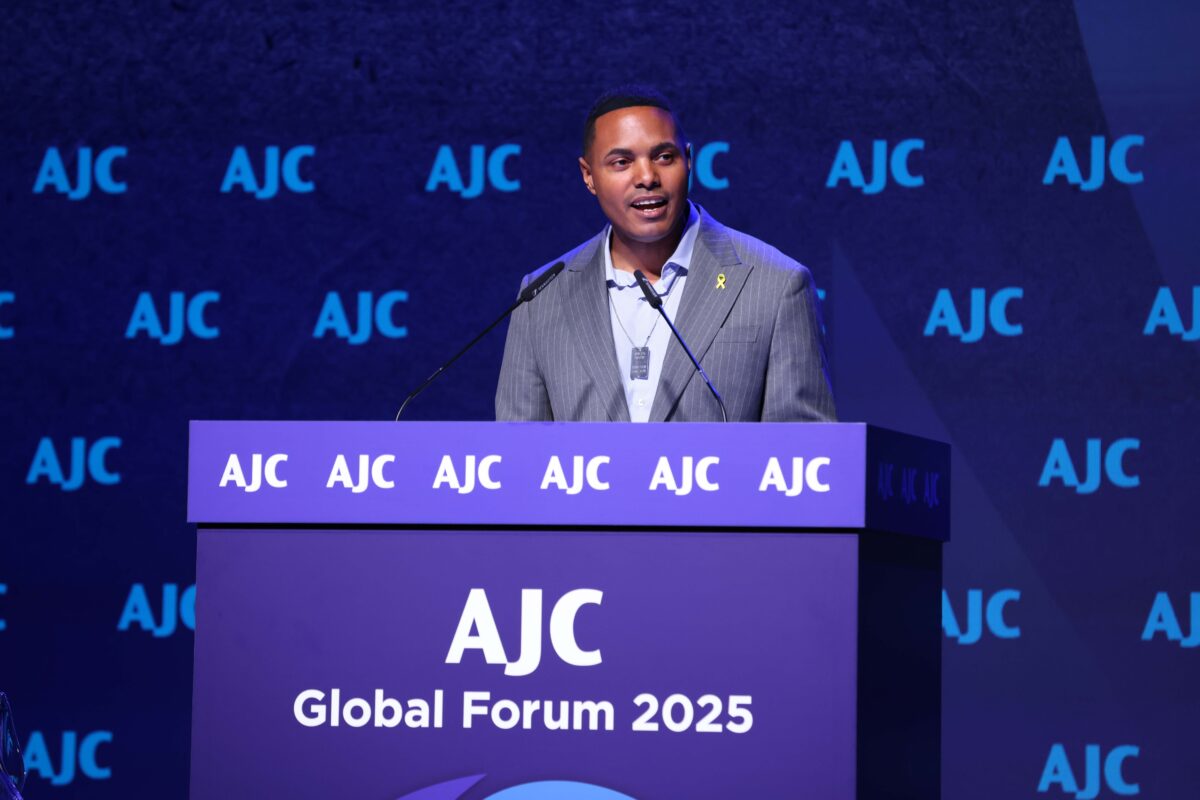
Rep. Ritchie Torres (D-NY) offered a message of hope that peace in the Middle East is “as close as we have ever been,” in remarks before more than 2,000 people from 60 countries gathered in Midtown Manhattan on Monday for the second day of the American Jewish Committee Global Forum, Jewish Insider’s Haley Cohen reports. Torres, who was honored with the group’s inaugural Nita M. Lowey Congressional Leadership Award, said that the “future of the Middle East does not belong to the Islamic Republic and its empire of terror.”
‘Abrahamic dream’: “The future of the Middle East belongs to Israel and the Abraham Accords. The future of the Middle East does not belong to hate. The future belongs to hope: hatikva,” Torres continued. “In the grand sweep of history, in the millennia-long Maccabean marathon that is the story of the Jewish people, we are as close as we have ever been to realizing the Abrahamic dream of a world where all the children of Abraham — Jews, Christians and Muslims — can coexist in peace and prosperity. A durable peace is possible, and we as Americans, in the greatest country on earth, have the power — indeed the responsibility — to make it so and make peace.”
hostage concerns

Sen. Andy Kim (D-NJ) has asked the State Department and intelligence community officials for a status update on the condition and whereabouts of Israeli American hostage Edan Alexander, a New Jersey native, after Hamas claimed it had lost contact with his captors inside Gaza, the senator told Jewish Insider’s Emily Jacobs.
Kim’s efforts: Speaking to JI at the Capitol on Monday, both Kim and Sen. Cory Booker (D-NJ) said they were seeking more information on Alexander from U.S. and international channels. “We’ve asked the State Department and intel community to try to provide us any and all information that they might have. I talked to his parents about this and we’re just trying to figure out what’s what. Also, we just met with the hostage office at the State Department to try to press on the necessity for us to have a sense of what’s true or not on that front. I’m trying to see if I can meet with the ambassadors of Egypt and Qatar as well to see if they have any information through their own routes in terms of engagement,” Kim told JI.
securing the neighborhood

Following a visit to Israel and Jordan last week, Rep. Greg Landsman (D-OH) told Jewish Insider’s Marc Rod that there is a “unique, potentially generational opportunity” to change the Middle East if the U.S. can help put an end to Iran’s nuclear weapons program and its support for regional terrorism. Landsman also told JI he’s working on legislation to create a bipartisan select committee focused on Middle East peace, an initiative he said would help elevate the issue and find bipartisan solutions.
Notable quotable: He said that eliminating Iran’s support for regional terrorism would radically change the lives of the Lebanese, Palestinian, Syria, Jordanian, Yemeni, Iraqi and Israeli people. “Everyone wins. Literally — everyone wins,” Landsman said. “That’s the key, and probably one of the most important things to Middle East peace. If [Middle East envoy Steve] Witkoff and the administration have those in play, and they’re willing to pull the right coalition together to get that done, that would be a game changer.” He emphasized that any deal must include ending Iran’s support for regional terrorism as well as any domestic nuclear enrichment and removing Iran’s nuclear stockpiles.
media matters

For Fox News host Dana Perino, supporting Israel has been a given since the early days of her career, when she visited the Jewish state multiple times with President George W. Bush as his press secretary. Perino, who first arrived at the White House while the nation was reeling from the Sept. 11 terrorist attacks, worked alongside Bush, initially as his deputy press secretary, throughout the early years of the war on terror. Two decades later, as co-anchor of Fox’s “America’s Newsroom,” Perino finds herself frequently drawing on those experiences, especially in the past year and a half as she’s reported on the aftermath Hamas’ Oct. 7, 2023, terrorist attacks in Israel, the ensuing war in Gaza and record-breaking levels of antisemitism in the U.S, Jewish Insider’s Haley Cohen reports.
Switching the channel: “Once you learn those issues, they are ingrained in you,” Perino told JI, referring to the threats Jews face, in Israel and around the world. “Plus, if you care about doing the right thing — and an additional plus is working for a place that encourages you to do the right thing, that news comes first.” The sentiment has increasingly caught the eye of liberal-leaning American Jews who believe that much of the mainstream media’s coverage is unfairly hostile to Israel. Weeks after Oct. 7, Fox Corp.’s CEO, Lachlan Murdoch, told shareholders at the annual meeting that the network must “stand up” to antisemitism.
Worthy Reads
Going Radical in Pittsburgh: Tablet’s Armin Rosen does a deep dive into the background of Talya Lubit, a Jewish anti-Zionist activist who along with Mohamad Hamad is facing federal charges tied to the vandalism of a Pittsburgh Chabad. “If Lubit became an anti-Israel radical, it did not happen as the sole result of anything she did or experienced at Dickinson [College] — just as it didn’t happen only because of her parents’ divorce, or the influence of her conspiratorial stepfather, or her horror at Israeli conduct in Gaza, or a romantically self-sacrificing male influence like Hamad. She was radicalized for reasons that are both convenient and inconvenient. Thousands of civilians really have died in Gaza, for instance, though the great majority of people who care about this fact, including ones who blame Israel for every single one of those deaths, haven’t vandalized a synagogue in response. At some point, Lubit’s sympathy for the vulnerable and her insistence on bold truth-telling devoured her sense of judgement and proportion. Long before that, she was a sociable person with a contrarian and humanistic streak who never really fit in. As one college classmate put it, ‘she is someone who I think is always looking for community and has been pushed away.’” [Tablet]
The Oldest Hatred, Anew: In The Washington Post, Clive Gillenson considers the millennia-old existence of antisemitism. “In the end, no theory can fully explain antisemitism, because it is not based on a rational cause. It adapts to each era’s anxieties and insecurities. When Jews are poor, they are despised as beggars; when they are rich, as exploiters; when they are religious, they are portrayed as fanatics; when they are secular, they are dangerous radicals. In every situation, antisemites have no problem adapting their prejudices. Thus, antisemitism, if it is about the need to have someone else to blame, may well not be about Jews at all. Jews have survived because they have no choice but to survive, and in doing so, they have outlasted every empire, ideology and movement that sought to erase them. Perhaps antisemitism still exists only because humanity has so often needed it.” [WashPost]
Class Crisis: The Wall Street Journal’s Matthew Hennessey laments the decline of respectful and thoughtful engagement across the political and media spectrums. “Personal qualities once synonymous with good character have fallen so far out of fashion as to seem like rumors from an ancient age. Did athletes really once accept defeat with dignity? Did people really restrain themselves from saying everything that popped into their heads? Did known philanderers refrain from trying to mount political comebacks? Did ex-presidents stay out of the limelight as a courtesy to their successors? Yes, kids, there was a time when prominent people were expected to exhibit grace. You couldn’t smack someone in the face on the Oscars broadcast and expect to resume your career in Hollywood. Shooting a CEO in cold blood earned you no fans. … Let it be acknowledged that the good old days weren’t all class, all the time. Politics, in particular, has always rewarded a degree of ruthlessness. Some of history’s greatest monsters hid their depravity behind a smile. But it was long said that hypocrisy is the tribute that vice pays to virtue. There was something laudable about the impulse to couch vulgarity with an apology. It seems we’ve lost even that.” [WSJ]
Word on the Street
President Donald Trump sat for a wide-ranging interview with The Atlantic’s Jeffrey Goldberg, Ashley Parker and Michael Scherer weeks after Goldberg was included on a Signal thread with senior Trump administration officials who discussed plans to strike Houthi targets in Yemen…
An F-18 fighter jet fell off the USS Harry S. Truman and sank in the Red Sea after the aircraft carrier was forced to make a sharp turn to avoid a missile that had been fired by the Iran-backed Houthis…
Canadian Prime Minister Mark Carney’s Liberal Party won the country’s federal elections on Monday, beating the Conservative Party and its leader, Pierre Poilievre, who is also projected to lose his own seat in Parliament…
New York Gov. Kathy Hochul and state legislators reached a compromise over proposed legislation around the use of face masks; the state will create a new charge for individuals who commit a crime while wearing a mask or flee the scene of a crime while masked…
House committees are beginning work this week on Republicans’ reconciliation package, the massive federal budget bill that would implement key elements of the Trump administration’s agenda, including extending tax cuts and implementing budget increases and reductions across the federal government, Jewish Insider’s Marc Rod reports…
Rep. Angie Craig (D-MN) launched her bid for the Senate seat being vacated by Sen. Tina Smith (D-MN)…
Rep. Gerry Connolly (D-VA), who had battled esophageal cancer, announced he will not seek reelection in 2026 following the disease’s return; Connolly said he will “soon” step down from his position as ranking member of the House Oversight Committee…
The New York Times profiles Rep. Greg Casar (D-TX), the head of the Congressional Progressive Caucus, as he and his supporters advocate for a “Resistance 2.0” approach to the Trump administration…
Justice Democrats is backing a primary challenger to Rep. Shri Thanedar (D-MI) in Michigan’s 13th Congressional District as the far-left group looks to target Democrats in the upcoming congressional elections cycle…
A new book by The Wall Street Journal’s Keach Hagey revealed that OpenAI CEO Sam Altman mulled running for political office, including president and governor of California; Altman has denied the claims…
House Education and Workforce Committee Chair Tim Walberg (R-MI) wrote to Northwestern University President Michael Schill on Monday summoning him to appear before the committee for a transcribed interview about alleged failures to protect Jewish students, nearly a year after he gave testimony at a committee hearing, Jewish Insider’s Marc Rod reports…
Harvard University rebranded its office of diversity, equity and inclusion as the Office of Community and Campus Life, headed by the school’s former chief diversity officer, whose new title will be chief community and campus life officer, amid growing tensions between the school and the Trump administration over Harvard’s handling of antisemitism…
Nike apologized for a recent billboard positioned at the end of the London Marathon that read “Never Again. Until Next Year,” following an outcry from Jewish communal leaders over the company’s use of the term, which is often associated with Holocaust remembrance…
Kiss’ Gene Simmons listed his Beverly Hills home for nearly $14 million; the musician purchased the home for $10.5 million in 2021…
The Wall Street Journal spotlights Brandon Shorenstein, who took over his family’s San Francisco-based property company shortly before the COVID-19 pandemic and has overseen it through years of market upheaval…
U.K. Prime Minister Keir Starmer and Foreign Secretary David Lammy met with Palestinian Authority Prime Minister Mohammad Mustafa in London on Monday…
International Criminal Court judges informed Karim Khan, the court’s chief prosecutor, that he cannot publicize or announce his pursuance of warrants for Israeli officials; the move comes ahead of plans by Khan to seek additional arrest warrants for Israeli officials, following the issuance last year of warrants for Prime Minister Benjamin Netanyahu and former Defense Minister Yoav Gallant…
Shin Bet head Ronen Bar said he will step down from his position on June 15, amid a public and polarizing clash with Israeli Prime Minister Benjamin Netanyahu, who tried to dismiss him in March, a move which was suspended by the Supreme Court…
Turkish Airlines, Pegasus and Virgin Atlantic will not resume direct flights to Israel; Virgin Atlantic will maintain its codeshare partnership with El Al despite the cessation of its own flights…
Iran proposed a meeting with British, French and German officials in Rome later this week, ahead of the next scheduled nuclear talks between Iranian and American negotiators…
The Financial Times looks at how Iran is addressing ground subsidence that is increasingly causing safety and infrastructure issues around the country…
The New York Times reports on distrust among the Kurdish population in Syria about the new government, backed by Ha’yat Tahrir al-Sham, with which the Kurds’ Syrian Democratic Forces have previously battled in northeastern Syria…
Pic of the Day

U.S. Ambassador to Israel Mike Huckabee (right) met this week in Tel Aviv with Emirati Ambassador to Israel Mohamed Al Khaja.
Birthdays

Israeli-born, NYC resident, stand-up comedian, actor and sometimes chazan, Modi Rosenfeld turns 55…
Nobel Prize-winning economist, professor at MIT, known for his analysis of Social Security policy, Peter Diamond turns 85… Co-founder of the NYSE-traded homebuilding company Toll Brothers, Bruce E. Toll turns 82… Retired U.S. senator (D-MI), she completed her 24 years in the Senate this past January, Debbie Stabenow turns 75… Marcy Smith… SVP of communications and journalist in residence at University of Maryland Global Campus, Michael Freedman… Comedian, actor, writer, producer and director, he is best known for playing a semi-fictional version of himself in the 180 episodes of the sitcom “Seinfeld,” Jerry Seinfeld turns 71… London-born actor with three Academy Awards for best actor, knighted at Buckingham Palace in 2014, Sir Daniel Day-Lewis turns 68… Sportscaster, best known as the radio and television play-by-play announcer for MLB’s New York Mets, Gary Cohen turns 67… Co-founder and first CEO of Netflix, Marc Bernays Randolph turns 67… Israeli diplomat, she was Israel’s ambassador to Latvia and then to Ireland, Lironne Bar Sadeh turns 66… Former NYC comptroller, now a candidate for mayor of NYC, Scott M. Stringer turns 65… CEO and chairman of 20th Century Fox until its acquisition by Disney, Stacey Snider turns 64… CEO of the United Democracy Project, Rob Bassin… Professor of psychology and behavioral economics at Duke University, he is the author of many books including Predictably Irrational, Dan Ariely turns 58… NYC-based award-winning artist who works with sound, kinetics, optics, magnetism and other materials to make sculptures and photographs, Julianne Swartz turns 58… Film and television actor, Paul Adelstein turns 56… Executive at a NYC-based investment management firm, Bennett J. Schachter turns 50… Minister of environmental protection in Israel’s prior government, Tamar “Tami” Zandberg turns 49… SVP of the Leon Levine Foundation and director of operations for the Levine family office, Justin Steinschriber… Israeli model and actress, she has appeared in many American movies, TV shows and advertisements, Bar Paly turns 43… Director of the office of government relations at the Smithsonian Institution, Anne Brachman… Commercial, industrial and residential real estate developer in the Mid-Atlantic region, Samuel A. Neuberger… Director of government affairs for Teach Coalition, Daniel Mitzner… Baseball pitcher for Team Israel at the 2020 Summer Olympics in Tokyo, Jonathan de Marte turns 32… Surfer, she represented Israel at the 2020 and 2024 Summer Olympics, Anat Lelior turns 25…

Anna Moneymaker/Getty Images
Rep. Debbie Wasserman Schultz (D-FL) speaks during a press conference on new legislation to support Holocaust education nationwide at the U.S. Capitol Building on January 27, 2023, in Washington, D.C.
Good Monday morning.
In today’s Daily Kickoff, we talk to Rep. Marlin Stutzman about his recent meeting with Syrian President Ahmad al-Sharaa in Damascus and Rep. Debbie Wasserman Schultz about her conversations with Israeli and Arab leaders during her recent trip to the Middle East. We report from a gathering in Denver of moderate Democratic elected officials from around the country, and interview former JFNA executive Elana Broitman about her newly released comic book about a menopausal superhero. Also in today’s Daily Kickoff: Nathan Fielder, Menachem Rosensaft and Hussein al-Sheikh.
What We’re Watching
- The American Jewish Committee’s Global Forum continues today. John Spencer, Ellie Cohanim and Bill Kristol will all speak on the main stage.
- Canadians head to the polls today in a federal election pitting Prime Minister Mark Carney and his Liberal Party against Conservative leader Pierre Poilievre.
- The Hostage and Missing Families Forum is hosting an event tonight at the Marlene Meyerson JCC Manhattan featuring former Israeli hostage Noa Argamani as well as the relatives of slain hostages Omer Neutra, Itay Chen and Shiri Bibas.
What You Should Know
A QUICK WORD WITH JI’S JOSH KRAUSHAAR
As official Washington spent this weekend at the parties surrounding the White House Correspondents Dinner, an intimate group of moderate Democratic elected officials, policy wonks and strategists met in Denver to present ideas for rehabilitating their party from the center, Jewish Insider Editor-in-Chief Josh Kraushaar reports in a dispatch from the event.
Will Marshall, president of the Progressive Policy Institute (PPI), gathered together a lineup of prominent Colorado centrists — Democratic Gov. Jared Polis and Sens. John Hickenlooper (D-CO) and Michael Bennet (D-CO), among them — along with some former red-state Democratic officials, including former Sen. Doug Jones (D-AL) and former Rep. Tim Ryan (D-OH) to brainstorm ideas for a new moderate movement.
Of note: Rep. Joe Neguse (D-CO), a rising star in the party who is rumored to be mulling a Senate bid as Bennet runs for governor, was in attendance and gave a paean to former President Bill Clinton’s brand of politics, directly quoting from a seminal speech from the then-candidate breaking with the left and calling for a more-mainstream direction for the party.
Neguse quoted from Clinton’s 1991 Democratic Leadership Council speech: “Our burden is to give the people a new choice rooted in old values, a new choice that is simple, that offers opportunity, demands responsibility, gives citizens more of a say, provides them responsive government.”
Neguse, Colorado’s first Black member of Congress, first ran for office as a progressive but has grown more pragmatic over time — and sounded like the type of future national leader the party is looking for. If Bennet wins the governorship in 2026, Neguse would be a strong contender to be appointed to his Senate seat.
Not at the moderate Democratic event: Colorado Attorney General Phil Weiser, who is running for governor and will be clashing with Bennet in the primary. In an interview with JI at an outreach event for Black voters, Weiser said he plans to position himself as a “populist problem solver” — while playing up his strong voice against President Donald Trump’s policies.
Weiser touted the fact that he’s already filed 13 lawsuits against the Trump administration, saying he’s on the front lines of fighting the “lawlessness of the White House.” In the campaign, he plans to contrast his active record litigating Trump’s immigration and tariff policies in the state with Bennet’s time as a lawmaker in Washington.
But Weiser also sounded like he would be tacking to the senator’s left in the primary.
Weiser’s speech on Saturday centered on how he would fight to protect DEI programs in the state. Asked about what he thought about the Democratic Socialists of America movement — which has a foothold within the party in Denver — he noted their “deep empathy for how working class people are struggling.” He also noted that he endorsed against a DSA-backed legislator who went on an anti-Israel, antisemitic rant in the state House.
Weiser, who speaks openly about his Jewish faith, also slammed the Trump administration for its overreach in cracking down against antisemitism, saying he was “horrified” about Trump’s actions. “Using antisemitism as a cudgel against marginalized individuals or to take away freedom is so horrifying to me,” he told JI.
Bennet, for his part, underscored how Colorado is one of the biggest Democratic success stories because it has nominated candidates who focus on returning results over red-meat slogans. On a PPI panel, he talked passionately about how the country’s health care and education systems are broken — and the Democratic Party has done little to fix it.
“Where is our agenda to reform the education system for the American people? Joe Biden said not a word about it, and these people deserve better than Donald Trump, who is destroying both what’s left of our health care system and what’s left of our education!”
He added: “Trump is not the cause of all our problems. He is the symptom of the lack of economic mobility that we have, the sense that people no matter how hard they work, can’t get ahead.”
peace prospects

New Syrian President Ahmad al-Sharaa last week discussed his conditions for normalizing relations with Israel with Rep. Marlin Stutzman (R-IN), who was one of the first American lawmakers to visit the country since the overthrow of the Assad regime, Jewish Insider’s Marc Rod reports.
Conditions: During a meeting at the presidential palace in Damascus, al-Sharaa told Stutzman that his concerns in Syria’s relationship with Israel are keeping Syria as a unified country and not allowing regions to be divided off, Israel’s military encroachment into Syria around the Golan Heights and the Israeli bombing campaign targeting Syrian military assets. Al-Sharaa said any agreement with Israel would have to address those points, but Stutzman told JI last week that al-Sharaa said that, “outside of those couple of items — and I’m sure there’s going to be other issues that he would bring to the table, but he was open to those conversations about normalizing relations with Israel.” Stutzman said he felt al-Sharaa was being honest and upfront about those conditions. He said they did not specifically address the issue of whether al-Sharaa’s government is seeking to reclaim the Golan Heights.
TAKING ON TEHRAN
Arab and Israeli leaders are insisting that any U.S. deal with Iran also include provisions to address Iran’s other malign activities in the region, including support for terrorist proxies, Rep. Debbie Wasserman Schultz (D-FL) told Jewish Insider’s Marc Rod following a trip earlier this month to meet with Israeli and Arab leaders in the Middle East. Wasserman Schultz traveled with Sen. Joni Ernst (R-IA) to the Middle East for the third time since Oct. 7, 2023, visiting Israel, the United Arab Emirates, Bahrain and Jordan.
Common goals: “There was a very clear urgency that the leaders we spoke to had to make sure that we … don’t let Iran up from their very weakened state. They’ve been badly pummeled and had significant defeats,” Wasserman Schultz told JI last week. “The consensus across the region, no matter where we went, was that we needed to make sure that continued and that we prevented them from achieving their nuclear weapons goals and that we particularly prevented them from continuing their support for terrorist activity.”
trump talks

President Donald Trump said he’d be open to meeting directly with Iran’s president or Supreme Leader Ayatollah Ali Khamenei, but also suggested that the U.S. could attack Iran to keep it from acquiring a nuclear weapon, in an interview with Time magazine, released on Friday. When asked if he would consider such a meeting, the president responded, “Sure,” Jewish Insider’s Danielle Cohen reports.
War stance: Pressed if he is worried Israeli Prime Minister Benjamin Netanyahu could “drag you into a war” with Iran, Trump responded, “No. By the way, he may go into a war. But we’re not getting dragged in.” The president clarified that he did not mean the U.S. wouldn’t join a war if Israel initiates one: “You asked if he’d drag me in, like I’d go in unwillingly. No, I may go in very willingly if we can’t get a deal. If we don’t make a deal, I’ll be leading the pack.”
BOOKSHELF

It’s an unlikely origin story for a comic-book superhero: standing at the front of a boardroom in a snazzy blazer, delivering an important presentation until it’s derailed by … a hot flash. That’s when she begins to discover her superpower. Meet Mina, the star of “Holy Menopause: Adventures of a Middle-Aged Superheroine,” a new comic book published by Bunny Gonopolskaya, the pen name of Elana Broitman, a former Jewish communal executive and government affairs consultant who is most familiar to Jewish communal leaders not as an artist or a writer, but as the former senior vice president of public affairs at Jewish Federations of North America until September 2023. Broitman talked to Jewish Insider’s Gabby Deutch about her new book.
Sexism shift: Broitman, 58, has held senior roles in the private sector, on Capitol Hill and at nonprofits. She never felt like sexism held her back in her career until she hit menopause — and sexism combined with more subtle ageism to make a potent, toxic combination. “I felt gaslighted and ignored,” Broitman told JI in an interview last week. “My way of working through emotions was always to just do some art. I started with a painting of an elderly Wonder Woman, because my whole concept was, Hey, we’re pretty badass, right? We’ve made it here. We have all this wisdom. We can do lots of things, and we’re not about to get dismissed.”
Worthy Reads
Power Chats: Semafor’s Ben Smith spotlights the growing use of “power group chats,” in which dozens, or sometimes hundreds, of power brokers and public figures engage in debate and conversation through the group messaging features of Signal and WhatsApp. “But their influence flows through X, Substack, and podcasts, and constitutes a kind of dark matter of American politics and media. The group chats aren’t always primarily a political space, but they are the single most important place in which a stunning realignment toward Donald Trump was shaped and negotiated, and an alliance between Silicon Valley and the new right formed. … The chats are occasionally marked by the sort of thing that would have gotten you scolded on Twitter in 2020, and which would pass unremarked-on on X in 2025. They have rarely been discussed in public, though you can catch the occasional mention in, for instance, a podcast debate between [Mark] Cuban and the Republican entrepreneur Vivek Ramaswamy, which started in a chat. But they are made visible through a group consensus on social media. Their effects have ranged from the mainstreaming of the monarchist pundit Curtis Yarvin to a particularly focused and developed dislike of the former Washington Post writer Taylor Lorenz.” [Semafor]
Has Ben-Gvir Really Changed?: The Atlantic’s Graeme Wood reflects on his interaction with Israeli National Security Minister Itamar Ben-Gvir at an event in New Haven, Conn., in which Ben-Gvir was pressed about his previous support for Jewish extremist Baruch Goldstein, whose portrait was displayed for decades in Ben-Gvir’s home. “[Ben-Gvir] framed his transformation as moral, and said he was not who he was when he was 17. Getting married and having six kids mellows a man out, he said. His whole answer took no more than a couple of minutes. I told Ben-Gvir that I found his contrition perfunctory and unconvincing, and I challenged him, if he was sincere, to prove it. I asked him to tell us all what it was like to idolize a murderer — and then to tell us what he would say to his younger self, or someone still in the thrall of a terrorist, to persuade him to give up violence and mellow out sooner rather than later. He couldn’t even bring himself to pretend. He just asserted that he had changed. ‘I’m sure you did things when you were 17 that you are not proud of,’ he said. (He removed the portrait when he was 44.) And he said again that time and family make a difference — but he added not a word about the inherent value of human life, or the disgrace brought upon religion and country by someone who massacres civilians, especially in a moment of total vulnerability.” [TheAtlantic]
Corbyn-ism Coming to America: In the Jewish Chronicle, Shany Mor raises concerns about the “Corbynization” of left-wing American circles. “As with so many more benign trends, Britain is just ten or so years ahead of the US. And the long march of geostrategic antisemitism’s institutional capture in the US is only about a decade behind Britain’s. Each major milestone – the capture of academia, the arts world, the various NGOs, a few major newspapers and journals of the smart set – was reached on these shores well before crossing the pond. And just as in Britain, so in the United States there is no realistic path to building a majority coalition around antisemitism either in its geostrategic or conventional forms. … American liberals, American Jews, and especially liberal American Jews would be well advised to be extra vigilant about this British import, which no tariff will protect them from. The British experience of the 2010s has a few useful lessons and warnings for what awaits the Americans in the 2020s.” [JewishChronicle]
Word on the Street
American and Iranian negotiators concluded a third round of nuclear talks in Oman over the weekend, amid disagreements over Iran’s domestic uranium enrichment; the parties will meet in Europe in the coming weeks…
The Trump administration restored thousands of foreign student visas — largely for students who had committed minor or dismissed infractions — that had been previously revoked…
Donald Trump Jr., alongside investment banker Omeed Malik and Alex Witkoff, the son of Middle East envoy Steve Witkoff, is opening a members club in Washington; Malik’s 1789 Capital had previously invested in Tucker Carlson’s new media company…
The chair of the United Arab Emirate’s Executive Affairs Authority met in Washington last week with senior Trump administration officials, including Treasury Secretary Scott Bessent and Commerce Secretary Howard Lutnick, National Security Advisor Mike Waltz and Middle East envoy Steve Witkoff…
Reps. Debbie Wasserman Schultz (D-FL), Mariannette Miller-Meeks (R-IA), Troy Carter (D-LA) and Brian Fitzpatrick (R-PA) introduced a resolution commemorating Jewish American Heritage Month…
Reps. David Kustoff (R-TN) and Wasserman Schultz introduced legislation to enable Holocaust survivors to recoup pre-Holocaust insurance policies, the latest in a long series of congressional attempts to move the issue forward…
The Los Angeles Times spotlights a lawsuit between Irish hotelier Patrick McKillen and members of the Qatari royal family over the alleged lack of payment for work done on the Maybourne Beverly Hills…
Israeli Foreign Minister Gideon Sa’ar spoke on Friday to Pennsylvania Gov. Josh Shapiro about the recent arson attack at the governor’s mansion in Harrisburg…
In The Wall Street Journal, Eugene Kontorovich calls on the Trump administration to again withdraw from UNESCO over what he alleges is antisemitism within the body, years after the Biden administration reversed a decision by the first Trump administration to pull out…
The NYPD is investigating clashes that took place last week outside of Chabad-Lubavitch headquarters in Crown Heights, Brooklyn, between demonstrators and counterprotesters during a surprise visit by Israeli National Security Minister Itamar Ben-Gvir…
“60 Minutes” correspondent Scott Pelley addressed the recent departure of the show’s executive producer in the final minutes of Sunday’s episode; Pelley cited disagreements with CBS parent company Paramount+ over the show’s coverage of “the Israel-Gaza war and the Trump administration”…
In the latest episode of HBO’s “The Rehearsal,” comic Nathan Fielder compared Paramount+ to Nazi Germany after discovering that a 2015 episode of his “Nathan for You” comedy series that dealt with antisemitism was removed from the streaming service…
NPR spotlights the “shlissel challah,” a key-shaped loaf that is traditionally made the Shabbat after Passover…
Israel slammed the Spanish government’s cancellation of a €6.6 million deal that would have seen Madrid purchase 15 million bullets from Israel’s IMI Systems…
Israel sent its envoy to the Vatican, Yaron Sideman, to attend the funeral of Pope Francis, opting against sending an official Israeli delegation, days after Israel’s Foreign Ministry deleted a post memorializing the pontiff, who died last week…
Israeli Prime Minister Benjamin Netanyahu accused Shin Bet head Ronen Bar of lying to an Israeli court that Netanyahu had demanded personal loyalty from him…
Senior Biden administration official Amos Hochstein said that Israel “missed” an opportunity to reach a normalization agreement with Saudi Arabia last year…
Hussein al-Sheikh was appointed vice president of the Palestine Liberation Organization amid an ongoing debate over who will succeed 91-year-old Palestinian Authority President Mahmoud Abbas…
Israel struck a Hezbollah facility in southern Beirut that contained precision missiles on Sunday evening…
At least 40 people were killed in an explosion at the port of Bandar Abbas in Iran following the outbreak of a small fire in a section of the port with large shipping containers…
Iran’s Infrastructure Communications Company said it repelled a large cyber attack the day after the port explosion…
Amateur golfer Jay Sigel, whose plans to go pro were deferred for several decades by a college injury, died at 81…
Pic of the Day

Attorney and professor Menachem Rosensaft, who was born in a displaced persons camp at Bergen-Belsen, spoke at a memorial ceremony on Sunday at the concentration camp marking the 80th anniversary of its liberation.
Birthdays

Comedy writer, television producer and showrunner, Daniel Joshua Goor turns 50…
Former Israeli ambassador to the U.S., he also served four terms in the Knesset, Zalman Shoval turns 95… White House chief of staff for Presidents Reagan and Bush 41, secretary of the Treasury and secretary of state, James Baker turns 95… Retired judge of the Maryland Court of Appeals (now known as the Supreme Court of Maryland), Judge Irma Steinberg Raker turns 87… Retired four-star United States Marine Corps general, Robert Magnus turns 78… Retired SVP and COO of IPRO and former president of the Bronx/Riverdale YM-YWHA and the Riverdale Jewish Center, Harry M. Feder… Cantor who has served in Galveston, Texas, Houston and Buffalo, N.Y., Sharon Eve Colbert… Criminal defense attorney, Abbe David Lowell turns 73… Director of congregational engagement at Temple Beth Sholom of Miami Beach, Fla., Mark Baranek… Associate Justice of the Supreme Court of the United States, Elena Kagan turns 65… American-born Israeli writer and translator, David Hazony turns 56… Director of criminal justice innovation, development and engagement at USDOJ during the Biden administration, Karen C. Friedman… Retired soccer player, she played for the U.S. Women’s National Soccer Team from 1997 to 2000, Sara Whalen Hess turns 49… Founder of GlobeTrotScott Strategies, Scott Mayerowitz… Actress and film critic, she is the writer and star of the CBC comedy series “Workin’ Moms,” Catherine Reitman turns 44… Model, actress and TV host, known for her role in the soap opera “Fashion House,” Donna Feldman turns 43… CEO and founder of The Branch, Ravi Gupta… Freelance journalist, formerly at ESPN and Sports Illustrated, Jason Schwartz… Senior editor at Politico Magazine, Benjamin Isaac Weyl… President of Saratoga Strategies, a D.C.-based strategic communications and crisis management firm, Joshua Schwerin… Head coach of the women’s soccer team at Yeshiva University, Ryan Alexander Hezekiah Adeleye turns 38… Israeli artist and photographer, Neta Cones… Marketing director at College Golf Experience, Jeffrey Hensiek… Associate in the finance department of Fried, Frank, Harris, Shriver & Jacobson, Robert S. Murstein… Senior reporter for Cybersecurity Dive, Eric J. Geller… Founder and CEO of Diamond Travel Services and CEO of A Better Way ABA, Ahron Fragin… Midfielder for Major League Soccer’s New York Red Bulls, Daniel Ethan Edelman turns 22…

MENAHEM KAHANA/AFP via Getty Images
Cardinal Pierbattista Pizzaballa, Latin Patriarch of Jerusalem, gestures during an interview at the patriarchate headquarters in the old city of Jerusalem on April 22, 2025.
Good Friday morning.
In today’s Daily Kickoff, we spotlight Cardinal Pierbattista Pizzaballa, the Latin Patriarch of Jerusalem who is a contender to be named the next pope, and report on the selection of Michael Anton to lead the U.S. delegation’s technical talks with Iran over its nuclear program. We also preview the American Jewish Committee’s annual Global Forum, which kicks off Sunday, and interview CEO Ted Deutch about the organization’s approach to the Trump administration’s efforts to address campus antisemitism. Also in today’s Daily Kickoff: Adam Neumann, Larry Summers and Ron Dermer.
For less-distracted reading over the weekend, browse this week’s edition of The Weekly Print, a curated print-friendly PDF featuring a selection of recent Jewish Insider and eJewishPhilanthropy stories, including: She forgot Yom Hashoah – then created a movement that changed the way Israel remembers the Holocaust; From seminary to secretary: How Uri Monson balances Pennsylvania’s budget and keeps Shabbat; and The quirky new VC being guided by Jewish values. Print the latest edition here.
What We’re Watching
- Technical talks on Iran’s nuclear program are taking place in Oman this weekend. More below.
- Elsewhere in the region, CENTCOM head Gen. Erik Kurilla is in Israel for meetings with senior officials to discuss Iran.
- The White House Correspondent’s Dinner will take place tomorrow night at the Washington Hilton in Dupont Circle.
- President Donald Trump will attend the funeral of Pope Francis tomorrow in the Vatican.
- Former Rep. George Santos (R-NY) is facing at least two years in prison when he is sentenced today for wire fraud and aggravated identity theft.
- The American Jewish Committee’s Global Forum kicks off on Sunday in New York. More below.
What You Should Know
A QUICK WORD WITH JI’S MARC ROD
The American Jewish Committee’s annual Global Forum Conference kicks off this weekend in New York. AJC’s CEO Ted Deutch told Jewish Insider that the organization is expecting over 2,000 attendees.
“It’s been clear since Oct. 7 [and] in everything we’ve seen since, the challenges that the Jewish community in Israel are facing are global challenges and they require global responses,” Deutch said. “AJC has people in 40 places around the world — 25 offices in the U.S., 15 more around the world — this is the opportunity for all of that global advocacy, all of those global advocates, to come together.”
Headline speakers will include Paraguayan President Santiago Peña, who moved his country’s embassy to Jerusalem last year and yesterday designated Iran’s Islamic Revolutionary Guard Corps as a terrorist organization and expanded Paraguay’s terrorist designations of the armed wings of Hezbollah and Hamas to encompass the entirety of both organizations. In addition, outspoken pro-Israel members of the European and Brazilian legislatures, as well as Rep. Ritchie Torres (D-NY) and Auburn University basketball coach Bruce Pearl, will address the gathering. John Spencer, the chair of urban warfare studies at West Point’s Modern War Institute, and former Council on Foreign Relations President Richard Haass will be speaking.
Deutch said there will be a significant focus on the hostages — Noa Argamani and the family of Edan Alexander will be in attendance.
The event will also feature a debate between Ellie Cohanim, the former deputy antisemitism envoy in the first Trump administration, and Bill Kristol, the former chief of staff to Vice President Dan Quayle, on American leadership in the world and the implications of Trump’s America First foreign policy.
While not yet confirmed, Deutch said that the Trump administration had “expressed great interest” in sending a representative to speak at the conference.
Deutch also teased the announcement of a new collaborative effort to “help document antisemitism and the need to really confront it in all of its contemporary forms.”
In total, attendees and speakers will hail from more than 60 countries, including a feature discussion with Jewish community members from France, Mexico and Australia. Students will come from 46 U.S. colleges and universities and 27 other countries including Mexico, South Africa, North Macedonia and Australia. Young leaders from 14 countries who are part of AJC’s Access Global program will also be in attendance.
Deutch told JI that seeing university students step up as leaders and work together to strengthen each other has become “one of my favorite parts of AJC.” He said that there will also be opportunities for AJC’s campus programs to work with the World Union of Jewish Students and the European Union of Jewish Students and meet with Deutch and other AJC leaders.
“We’ve continued to work under the firm belief that the most important battlefield in the fight against antisemitism in the United States right now is in education,” Deutch added. He said that the conference will feature conversations with officials and activists at all levels, with a focus on both college and high school.
Speaking to JI at AJC’s offices in Washington this week, Deutch also delved into the nuanced approach AJC is taking on the Trump administration’s high-profile actions on campus antisemitism, including stripping grants from colleges and large-scale deportations of student visa holders, as well as offering an outlook on the ongoing Iran talks. Read more below.
letter to the president

A group of Jewish Senate Democrats accused President Donald Trump of weaponizing antisemitism as a pretext to withhold funding from and punish colleges and universities, moves they said in a letter on Thursday “undermine the work of combating antisemitism” and ultimately make Jewish students “less safe,” Jewish Insider’s Marc Rod reports.
What they’re saying: “We are extremely troubled and disturbed by your broad and extra-legal attacks against universities and higher education institutions as well as members of their communities, which seem to go far beyond combatting antisemitism, using what is a real crisis as a pretext to attack people and institutions who do not agree with you,” the lawmakers, including Senate Minority Leader Chuck Schumer (D-NY), antisemitism task force co-chair Sen. Jacky Rosen (D-NV) and Sens. Richard Blumenthal (D-CT), Adam Schiff (D-CA) and Brian Schatz (D-HI), wrote to the president.
TEAM LEAD

The Trump administration tapped the State Department’s director of policy planning, Michael Anton, to lead a team of technical experts in negotiations with the Iranian regime about its nuclear program, Jewish Insider’s Marc Rod reports. According to Politico, Anton will lead a team of around 12 mostly career officials in discussions set to begin this weekend.
Anton’s record: Anton is a conservative essayist and speechwriter who served in the first Trump administration as a deputy assistant to the president for strategic communications on the National Security Council. In a 2020 Fox News interview, Anton said that the original Iran deal was flawed in part because it provided significant up-front financial benefits to Iran before the provisions more favorable to the U.S. took effect, which Iran used to fuel terrorism. He said President Donald Trump was “right to object to that” and reimpose sanctions. He said that cutting off Iranian resources would de-escalate, rather than escalate conflict.
Read the full story here.
ted talk

The Trump administration’s moves to cut billions in federal funding from colleges and universities and detain and deport foreign students have sparked fierce debate in the Jewish community in recent months, and opened fault lines among some who see the actions as necessary to fight antisemitism and others who argue that they’re an overreach. The American Jewish Committee is trying to take a more nuanced approach, the organization’s CEO Ted Deutch told Jewish Insider’s Marc Rod in an interview at AJC’s Washington office this week ahead of the group’s annual Global Forum conference, which starts this weekend.
Middle ground: Deutch emphasized that AJC is a “fiercely nonpartisan organization,” which means it must sometimes “hold competing thoughts” so that it can “speak with clarity about what we believe is in the best interests of the Jewish community” and represent “the vast middle of the Jewish community.” He added, “There are campuses [where] so many of the challenges should have been addressed by universities, and weren’t. We’ve been clear that it’s really important that the administration, that the president, is making this a priority. At the same time, as we’ve said, due process matters and obviously our democratic principles matter as well. We have to be able to both express appreciation and, when necessary, express concern.”
papal prospect

Cardinal Pierbattista Pizzaballa left the Church of the Holy Sepulcher in Jerusalem’s Christian Quarter on Wednesday to head to the Vatican for his first-ever conclave to select the next pope. He departed as the Latin Patriarch of Jerusalem, but some have speculated that he could have a new title — pope — in the coming weeks, Jewish Insider’s Lahav Harkov reports. Pizzaballa is widely viewed as one of the favorites to succeed Pope Francis, who died on Monday. The vast majority of popes have come from Italy, where Pizzaballa hails from, though he has lived in Israel for the past 35 years and is fluent in Hebrew. His knowledge of the Middle East, as well as his support for inter-religious dialogue, are viewed as advantages, while his age, 60, is seen as too young for a pope, according to Politico.
Background: Pizzaballa moved to Jerusalem in 1990, when he pursued a master’s degree in the Bible at Hebrew University while studying and teaching at the Franciscan Faculty of Biblical and Archaeological Sciences in Jerusalem. He later became responsible for the pastoral care of Hebrew-speaking Catholics and then was elected Custos of the Holy Land, a senior position in the church in Israel, Palestinian-controlled territories, Jordan, Syria, Cyprus, Rhodes and part of Egypt, from 2004-2016. Pope Francis appointed Pizzaballa to be the Latin Patriarch of Jerusalem in 2020, and made him the first-ever cardinal based in Jerusalem in 2023. Pizzaballa said that the appointment of a cardinal in the city elevated the “voice of Jerusalem” within the Catholic Church.
survey says

More than 7 in 10 American Jews disapprove of President Donald Trump’s job performance, a new poll found, but he is making some inroads with Jewish voters on his handling of antisemitism, compared to his first-term standing. The poll, administered by Democratic pollster Mark Mellman for the Jewish Electoral Institute (JEI) between April 15-18 and released on Wednesday, found that Trump’s overall approval rating among Jewish voters is at 24%, with 72% disapproving, Jewish Insider’s Danielle Cohen reports.
What this means: The results suggest there hasn’t been much of a shift since the election: Trump won 26% of the Jewish vote, according to Mellman’s post-election survey conducted last December. The poll also found large majorities of the 800 registered American Jewish voters who were surveyed opposing his policies on tariffs, cuts to the federal government and threats to law firms. “American Jewish voters are deeply distressed about the direction in which Donald Trump is taking the country and oppose many of his key policies. Indeed, a majority of Jewish voters disapprove of his job performance overall and disapprove of the way Trump is handling antisemitism,” Mellman said.
SCOOP

The World Zionist Congress’ election committee has identified thousands more suspicious votes that were cast in the ongoing American election after rejecting nearly 2,000 votes that were deemed to have been fraudulent, multiple sources in Israel and the United States told eJewishPhilanthropy’s Judah Ari Gross. The Area Election Committee, which oversees the election, has not identified the slates for whom the votes were cast.
Ramifications: Together with the original tossed votes — which represented more than 2% of the total votes at that point — these additional suspect ballots represent a significant percentage of the total votes cast, which will likely mean that there will be a delay in releasing the results of the election, which ends May 4, in order to conduct a thorough audit of ballots. The American Zionist Movement, which is running the election, did not immediately reply to a request for comment.
Read the full story here and sign up for eJewishPhilanthropy’s Your Daily Phil newsletter here.
Worthy Reads
The Last Waltz: The Atlantic’s Isaac Stanley-Becker does a deep dive into the recent upheaval and series of dismissals at the National Security Council coupled with President Donald Trump’s growing “distrust” of National Security Advisor Mike Waltz. “The result is that Waltz remains on the job even as he has effectively lost control over his own NSC. The erosion of his authority extends to both policy and personnel. On the priorities that matter most to the president, Waltz has less influence than Stephen Miller, the homeland-security adviser and deputy White House chief of staff for policy, whose team is part of the NSC. Miller treats the advisory body not as a forum to weigh policy options, current and former officials told me, but as a platform to advance his own hard-line immigration agenda. On the most sensitive geopolitical issues, including Russia’s war in Ukraine and U.S. interests in the Middle East, Trump’s longtime friend and special envoy, Steve Witkoff, sometimes draws on the support of the NSC staff but often operates independently, officials said.” [TheAtlantic]
The Dermer Doctrine: The Washington Post’s Shira Rubin looks at Israeli Strategic Minister Ron Dermer’s role in working to facilitate a potential U.S.-Saudi-Israeli mega-deal. “Dermer, 54, is technically Israel’s minister of strategic affairs, but he is widely viewed as Israel’s unofficial foreign minister, and his rise has helped shape the country’s relationship with Washington, the Palestinians and the wider Arab world. … While the Saudis have pinned their hopes on Dermer — seeing him as Netanyahu’s ‘right hand man, who is extremely influential and effective,’ according to Bernard Haykel, a professor of Near Eastern Studies at Princeton University — normalization is a harder sell than it’s been before, he said. The war in Gaza has made it more difficult for Saudi Arabia to pursue negotiations with Israel, as Saudi youth have increasingly taken up the Palestinian cause. And Netanyahu’s resistance to Palestinian statehood and the push by some members of his far-right government to resettle Gaza and expel its residents are a challenge to the kingdom’s ambitions to stabilize and modernize the region.” [WashPost]
Alternate Approach: In Foreign Policy, the Council on Foreign Relations’ Steven Cook argues against both military strikes and diplomacy to address Iran’s nuclear program. “Only once policymakers in Washington understand the Iranian sociopolitical order that Supreme Leader Ayatollah Ruhollah Khomeini and his successor built does a superior policy become clear: doing more of what Washington has already been doing. Maintaining sanctions on Iran, preventing the regime and its proxies from destabilizing the region, and responding to them when they try, as well as providing moral support for the Iranian opposition, provide the United States with the best chance for the regime to collapse in on itself. Such an approach is not without risk, however, as Iranian scientists continue to work diligently to develop their nuclear program. But it is the most realistic and feasible policy toward rendering Tehran’s nuclear program less worrisome.” [ForeignPolicy]
Hitting Harvard: In The Hill, attorney Mark Goldfeder reflects on Harvard’s response to the Trump administration’s funding cuts and freezes, which it has blamed on the school’s handling of campus antisemitism. “The bottom line is this: We are living at an inflection point in our country’s history, and it is time for everyone to take a long, hard look in the mirror to see where they stand. If you are fine with protesters using their free speech to incite anti-Jewish hate, but not with the government using its free speech to stand up for the Jews; if you are okay with the IRS revoking tax breaks for racist institutions, but not for ones who ignore antisemitism; if you romanticize leaders of groups that endorse the murder of Jews, yet call it ‘unlawful’ when the government enforces civil rights; and if you care so much about ‘illegal’ detentions that you simply must get on a plane and act, but only when the person being held is not Jewish, well, there is a word for that, and it isn’t pretty.” [TheHill]
Word on the Street
The Department of Health and Human Services Task Force to Combat Antisemitism said it was “cautiously encouraged” by Yale’s efforts in recent days to swiftly address anti-Israel activity, including the brief establishment of an encampment on the campus…
Ed Martin, the Trump administration’s pick to be U.S. attorney for Washington, D.C., who is currently serving in an interim role, apologized for his recent praise of a Nazi sympathizer with a history of making antisemitic comments…
Joe Kasper, who served as chief of staff to Defense Secretary Pete Hegseth, is departing the Pentagon entirely, days after reports that he would be reassigned out of Hegseth’s office…
The Financial Times spotlights Brian Ballard’s lobbying firm Ballard Partners, which previously employed several members of the Trump administration and includes clients in Israel, Turkey and Saudi Arabia…
Middle East envoy Steve Witkoff rejected a proposal from Iranian Foreign Minister Abbas Araghchi to attempt to reach an interim nuclear agreement, saying that the parties should work to reach a comprehensive deal by the end of the 60-day window given by the Trump administration…
Puck’s William Cohan interviews former Treasury Secretary Larry Summers, previously the president of Harvard, about the Trump administration’s approaches to tariffs and academia…
In Time, Democratic National Committee Chair Ken Martin called for the party’s senior officials to abstain from intervening in Democratic primaries, days after DNC Vice Chair David Hogg pledged to back insurgent candidates through an outside spending group…
Far-left New York state Assemblymember Zohran Mamdani, who is mounting a bid for mayor of New York City, released his first ad of the race, targeting front-runner and former New York Gov. Andrew Cuomo…
Adam Neumann’s real estate startup Flow raised over $100 million in a Series B funding round with backing from Andreessen Horowitz…
The Washington Post reviews Richard Kreitner’s Fear No Pharaoh, which spotlights Jewish American views on abolition in the Civil War era…
The International Criminal Court’s appeals chamber unanimously ruled to return to a lower chamber an Israeli challenge to a ruling regarding jurisdiction in the issuance of arrest warrants of senior Israeli officials to a lower court…
Israel acknowledged its responsibility for the death of a Bulgarian aid worker who was killed in a strike last month on a U.N. guesthouse in Gaza where the IDF said it had “assessed enemy presence”…
Documentarian Andrea Nevins, whose short film “Still Kicking: The Fabulous Palm Springs Follies” was nominated for an Oscar in 1998, died at 63…
Author and researcher Leonard Zeskind, whose work focused on far-right and white nationalist movements, died at 75…
Attorney and art collector Arthur Fleischer Jr. died at 92…
Nechama Grossman, the oldest Holocaust survivor in Israel, died yesterday, on Holocaust Remembrance Day, at 110…
Pic of the Day

Israeli Prime Minister Benjamin Netanyahu met in Jerusalem on Thursday with House Minority Leader Hakeem Jeffries (D-NY) and Reps. Ann Wagner (R-MO), Gregory Meeks (D-NY), Amata Coleman Radewagen (R-American Samoa), Madeleine Dean (D-PA), Marilyn Strickland (D-WA), Greg Landsman (D-OH) and Laura Friedman (D-CA).
Birthdays

Former chairman of the Conference of Presidents and previously president of Bed, Bath and Beyond, Arthur Stark turns 70…
FRIDAY: Retired attorney, Myron “Mike” Sponder… Social worker and former health spokesman of the Green Party of the U.K., he is the older brother of U.S. Sen. Bernie Sanders (I-VT), Larry Sanders turns 90… Co-founder of Lender’s Bagel Bakery, he was the national chair of UJA, Marvin Lender turns 84… Founder of Omega Advisors, Leon G. “Lee” Cooperman turns 82… Former CEO of Caravan Products and the H.C. Brill Co., Joseph (Joe) Weber turns 80… Founder of CAM Capital, Bruce Stanley Kovner turns 79… Rosh yeshiva at Yeshiva University and rabbi of the Young Israel of Riverdale Synagogue, Rabbi Mordechai Willig turns 78… David Handleman… Longtime chairman and CEO of Village Roadshow Pictures, now president of Through The Lens Entertainment, Bruce Berman turns 73… Administrative law judge at the California Unemployment Insurance Appeals Board, Beth A. Fox… Commissioner of the National Basketball Association, Adam Silver turns 63… Senior fellow at the Hudson Institute, Michael Scott Doran turns 63… Litigator at Quinn Emanuel, he served as U.S. ambassador to the Czech Republic in the Obama administration and clerked for Supreme Court Justice Harry Blackmun, Andrew H. Schapiro turns 62… Emmy Award-winning actor, comedian and producer, he is descended from a Sephardic family rooted in Thessaloniki, Hank Azaria turns 61… Infomercial pitchman, better known as Vince Offer, Vince Shlomi, or “The ShamWow Guy,” Offer Shlomi turns 61… Israeli diplomat who served as deputy head of mission at the Embassy of Israel in D.C., Benjamin Krasna turns 60…
CEO of the Jewish Federation of Greater Rochester (NY) since 2016, Meredith Dragon… New York Times-bestselling author and adjunct professor of neuroscience at Stanford University, David Eagleman turns 54… Deputy director of community health at the Utah Department of Human Services, David E. Litvack turns 53… Manager of the Oakland Ballers baseball team in the Pioneer League until last July, Micah Franklin turns 53… Democratic Party strategist, she is a co-founder of Lift Our Voices, Julie Roginsky turns 52… President of the Alliance for Downtown New York, the nation’s largest business improvement district, Jessica S. Lappin turns 50… Senior-editor-at-large for Breitbart News, Joel Barry Pollak turns 48… Attorney turned grocer and now professor at American University, she founded and sold Glen’s Garden Market north of Dupont Circle, Danielle Brody Rosengarten Vogel… Co-founder of WeWork and now Flow, Adam Neumann turns 46… Executive director at Yaffed, Adina Mermelstein Konikoff… Managing director, head of social, content and influencer at Deloitte Digital, Kenneth R. Gold… Spokesperson and director of public affairs and planning division at FEMA during the Biden administration, now SVP at Avoq, Jaclyn Rothenberg… Film and television actress, model and singer, Sara Paxton turns 37… Staff writer at Daily Kos, Emily Cahn Singer… Former NHL ice hockey defenseman, now a color analyst for Westwood One and ESPN, Colby Shane Cohen turns 36… TikTok Star with 10 million social media followers and over 3 billion annual views, he runs the culinary website CookWithChefEitan, Eitan Bernath turns 23…
SATURDAY: Computer expert, author, lecturer, Jewish genealogy researcher and publisher of Avotaynu, the International Review of Jewish Genealogy, Gary Mokotoff turns 88… Retired Federation executive in Los Angeles, Oakland and Sacramento, Loren Basch… Investment banker and chairman and CEO of Lehman Brothers through its bankruptcy filing in 2008, Richard S. Fuld Jr. turns 79… Professor of computer science and engineering at MIT, Hal Abelson turns 78… Chair of the Conference of Presidents, Harriet P. Schleifer… President of Brandeis University from 2016 until last November, Ronald D. Liebowitz turns 68… Moscow-born journalist and political activist in Israel, Avigdor Eskin turns 65… Senior fellow at the Brookings Institution and contributing editor of The Atlantic, Jonathan Rauch turns 65… London-based interfaith social activist, she founded and chaired Mitzvah Day International, Laura Marks turns 65… Journalist, biographer and the author of six books, Jonathan Eig turns 61… Former member of the Maryland House of Delegates for four years and then the Maryland State Senate for eight years, Roger Manno turns 59… Former member of the California State Assembly where he served as chairman of the California Legislative Jewish Caucus, Marc Levine turns 51… Member of the NYC Council for six years and now a recently elected member of the NY State Assembly, Kalman Yeger turns 51… General partner of Coatue Management, Benjamin Schwerin… Senior staff editor of the international desk of The New York Times, Russell Goldman turns 45… Senior director of federal government affairs at Jazz Pharmaceuticals, Karas Pattison Gross… Media relations manager at NPR, Benjamin Fishel… London-based reporter for The Wall Street Journal covering finance, he is the co-author of a book on WeWork, Eliot Brown… Male fashion model and actor, Brett Novek turns 41… Head coach of the UC Irvine Anteaters baseball program, he played for Team Israel in the 2012 World Baseball Classic, Ben Orloff turns 38… Communications director at the University of Florida College of Health and Human Performance, Alisha Katz… Product strategy services at Apple, Kenneth Zauderer… Washington correspondent for The Epoch Times, Jackson C. Richman… Board liaison at American Jewish World Service, he is also a part-time matchmaker at Tribe 12, Ross Beroff… Ahron Singer…
SUNDAY: Financial executive, he retired in 2014 as head of marketing for money manager Van Eck Global, Harvey Hirsch turns 84… Nonprofit executive who has managed the 92nd Street Y, the Robin Hood Foundation, the AT&T Foundation and Lincoln Center, Reynold Levy turns 80… U.S. senator (R-WV), Jim Justice turns 74… Physician and a former NASA astronaut, she is a veteran of three shuttle flights with more than 686 hours in space, Ellen Louise Shulman Baker, M.D., M.P.H. turns 72… Director-general of the Israel Antiquities Authority until 2020, he was previously a member of Knesset and deputy director of the Shin Bet, Yisrael Hasson turns 70… VP at Covington Fabric & Design, Donald Rifkin… Biologist and professor of pathology and genetics at Stanford University School of Medicine, he won the 2006 Nobel Prize for medicine, Andrew Zachary Fire turns 66… Co-founder of Casamigos Tequila and owner of restaurants, bars and lounges worldwide, Rande Gerber turns 63… Former member of the Knesset for the Shinui party, Yigal Yasinov turns 59… CEO of ZAM Asset Management, Elliot Mayerhoff… Showrunner, director, screenwriter and producer, Brian Koppelman turns 59… Founder and CEO of NYC-based Gotham Ghostwriters, Daniel Gerstein turns 58… Israeli actor, entertainer and television host, Yitzhak “Aki” Avni turns 58… Attorney and journalist, Dahlia Lithwick… Author, political analyst and nationally syndicated op-ed columnist for The Washington Post, Dana Milbank turns 57… U.S. senator (D-NJ) since 2013, he was previously the mayor of Newark, Cory Booker turns 56… Israeli television and radio journalist and former member of the Knesset for the Jewish Home party, Yinon Magal turns 56… Professor of science writing at MIT, Seth Mnookin turns 53… Cinematographer and director, Rachel Morrison turns 47… Identical twin brothers, between the two of them they won 11 Israeli championships in the triathlon between 2001 and 2012, Dan and Ran Alterman both turn 45… Israeli screenwriter and producer, she has written numerous advertisements and screenplays, Savion Einstein turns 43… Deputy regional director for AIPAC, Leah Berry… Television and film actress, Ariel Geltman “Ari” Graynor turns 42… Basketball coach, analyst and writer, Benjamin Falk turns 37… Senior creative director at Trilogy Interactive, Jessica Ruby… Head of data and climate science at Watershed, Jonathan H. Glidden… Associate at Kramer Levin Naftalis & Frankel, David Jonathan Benger… Investor and entrepreneur, Noah Swartz… MD/MPH candidate in the 2025 class at the University of Arizona College of Medicine, newly matched to be a medical resident at UCLA, Amir Kashfi…

Jeremy Moss State Senator/Bill Clark/CQ-Roll Call, Inc via Getty Images
Michigan state Senate president pro tempore Jeremy Moss and former Rep. Andy Levin (D-MI)
Good Wednesday morning.
In today’s Daily Kickoff, we do a deep dive into the Boim family’s lawsuit targeting American Muslims for Palestine’s ties to Hamas, and look at the divide over Israel taking shape in the race to succeed Rep. Haley Stevens in Michigan. We also look at how the State Department’s recently announced restructuring will affect the Office of the Special Envoy to Monitor and Combat Antisemitism, and report on an effort by the leadership of the Senate Foreign Relations Committee to provide additional sanctions relief to Syria. Also in today’s Daily Kickoff: Mark Mellman, Gov. Josh Shapiro and Eric Tulsky.
What We’re Watching
- Yom Hashoah, Israel’s Holocaust Memorial Day, begins today at sundown. The U.S. Holocaust Memorial Museum in Washington will hold a remembrance ceremony this morning. In Poland, the annual March of the Living begins today. Across Israel, people and organizations will participate in Zikaron BaSalon, a project that gives Holocaust survivors and their descendants the opportunity to share their experiences.
- A meeting between Boston city leadership and the Trump administration’s antisemitism task force that had been slated for today will no longer take place, after government task force representatives did not reply to a request from the city for details about antisemitic incidents they planned to discuss.
- Iranian Foreign Minister Abbas Araghchi is traveling to Beijing today, where he’s slated to meet with senior Chinese officials ahead of the start of technical talks between Tehran and Washington regarding Iran’s nuclear program. The talks, originally scheduled to take place today, are being delayed until the weekend.
- Semafor’s three-day World Economy Summit kicks off today in Washington. Speakers include Pfizer CEO Dr. Albert Bourla, Mubadala’s Ahmed Saeed Al Calily and Khaldoon Khalifa Al Mubarak, the Deputy Assistant to the President Seb Gorka, former White House senior envoy Amos Hochstein, Senate Minority Leader Chuck Schumer (D-NY), LinkedIn co-founder Reid Hoffman, former Commerce Secretary Penny Pritzker and Carlyle Group co-founder and Chairman David Rubenstein.
What You Should Know
A QUICK WORD WITH JI’S JOSH KRAUSHAAR
Michigan is once again emerging as a central battleground in the Democratic Party’s debate over its ideological future — especially when it comes to navigating a noisy anti-Israel faction that has drawn fuel from the state’s Arab American communities and left-wing college campuses, Jewish Insider Editor-in-Chief Josh Kraushaar writes.
Next year, the swing state will again be holding a consequential Senate race to fill the seat of retiring Sen. Gary Peters (D-MI), with the Democratic primary already shaping up as a battle between two Democrats broadly aligned with the Jewish community’s interests — Rep. Haley Stevens and state Sen. Mallory McMorrow — with a third announced candidate, Abdul El-Sayed, running on an anti-Israel platform.
It’s significant that two of the top Democratic contenders are wasting no time highlighting their support for Israel and unequivocal condemnation of antisemitism — a dynamic we haven’t always seen from leading Michigan Democrats.
Stevens is a longtime supporter of a close U.S.-Israel relationship during her tenure in Congress, and has been one of the state’s leading Democratic voices condemning the all-too-frequent antisemitic vandalism and harassment directed at Jewish individuals and institutions in the state. Stevens challenged one of the leading anti-Israel Democrats in Congress after redistricting in 2022, and comfortably prevailed.
McMorrow, in the early stages of her candidacy, reached out to pro-Israel Democratic groups to underscore her support for the Jewish state. She offered moral clarity in a statement to JI responding to the spate of anti-Israel harassment and threats against University of Michigan regents. “The harassment and antisemitism we’ve seen against University of Michigan regents in recent months is wrong, plain and simple … The attacks and intimidation need to stop now,” she said. (Stevens, for her part, also vociferously denounced the harassment to JI.)
Notably, El-Sayed’s campaign declined to respond when asked about his views over the threats to University of Michigan regents over their support for Israel.
Former Rep. Mike Rogers (R-MI), who ran for the state’s other Senate seat in 2022, has emerged as the Republican front-runner after narrowly losing to Sen. Elissa Slotkin (D-MI) last year. A traditional conservative, Rogers quickly secured the endorsement of former President Donald Trump. Rogers has been a vocal backer of Israel throughout his career and campaigned last year on taking a tougher stand against Iran and its nuclear program.
Stevens’ decision to run for the Senate is also creating the likelihood of a Democratic showdown over Israel in the primary to replace her in the House. Former Rep. Andy Levin (D-MI), who championed the anti-Israel ‘Uncommitted’ movement in the state after losing his House seat, is considering running again for his old seat. If he does, he’s expected to face spirited opposition from Jeremy Moss, a leading pro-Israel champion in the state Senate (with other candidates in the mix). More below.
Given the suburban Detroit district’s Jewish representation and moderate politics, Levin would face many of the same hurdles as when he lost to Stevens by 20 points in 2022.
As the party nurses its political wounds from last year, it’s notable that Michigan Democrats are among the first to course-correct from their past pandering of anti-Israel activists.
First, Gov. Gretchen Whitmer gave a pro-Israel speech to the Jewish Federations of North America’s General Assembly in one of the first big post-election moves from a national Democratic figure. Then, Slotkin delivered a well-received response to Trump’s address to Congress, with a Reaganesque message of “peace through strength.” And now, the early front-runners are campaigning as stalwart allies of the Jewish community in pivotal Democratic primaries for Congress.
It’s the kind of rhetoric that suggests that Michigan Democrats recognize they lost mainstream voters with outreach to the far left last year, and won’t get fooled again.
QUEST FOR JUSTICE

On the morning of Monday, May 13, 1996, David Boim, an American teenager studying abroad at a yeshiva in Israel, was waiting at a bus stop, en route to his parents’ home in Jerusalem, when two Hamas terrorists drove by and opened fire, shooting him in the head. Pronounced dead within an hour, Boim, who was 17, was one of the first Americans killed by Hamas, which the United States soon designated as a foreign terrorist organization. In the ensuing years, Boim’s parents, Stanley and Joyce, have continued to fight for a measure of accountability through the American court system. His parents’ quest for justice seems poised to finally reach its apex as their lawsuit against a leading pro-Palestinian advocacy group with alleged ties to Hamas nears a possible trial by what legal experts say could be the end of the year, Jewish Insider’s Matthew Kassel reports.
The case: With the discovery process recently closed, Daniel Schlessinger, the Boims’ lead attorney, believes his team has, since filing its lawsuit in 2017, built a convincing case against American Muslims for Palestine, accused of acting as an “alter ego” of a now-defunct group that shut down after it was found to have provided support to Hamas. Founded in 2006, AMP describes itself on its website as “a grassroots organization dedicated to advancing the movement for justice in Palestine by educating the American public about Palestine and its rich cultural, historical and religious heritage and through grassroots mobilization and advocacy.” But the group has recently come under intense scrutiny, owing in large part to its involvement in anti-Israel protests on college campuses that are a target of the Trump administration’s crackdown on foreign students accused of supporting terrorism. In constructing its argument, Schlessinger said his team has assembled “overwhelming” evidence that shows AMP is a continuation of the Islamic Association of Palestine, which was ruled liable for Boim’s murder in a related case nearly two decades ago.
MICHIGAN MOMENTUM

Michigan state Sen. Jeremy Moss and former Rep. Andy Levin (D-MI) are publicly floating runs for the House seat held by Rep. Haley Stevens (D-MI), who announced on Tuesday that she’s making a bid for Michigan’s open Senate seat — a Democratic primary battle that could rehash the bitter Israel policy divisions that characterized the 2022 race when Stevens defeated Levin, Jewish Insider’s Marc Rod reports.
Tea leaves: Both Moss and Levin are Jewish but have differing approaches to issues key to the Jewish community. Debates over Israel policy, an important issue in a district in the Detroit suburbs with a significant Jewish population, were a prominent feature of the 2022 primary between Stevens and Levin. The organized, mainstream Jewish community largely backed Stevens in that race, feeling betrayed by Levin’s increasingly antagonistic stances on Israel. From his current role, Moss has been outspoken against antisemitism and in support of the U.S.-Israel relationship. Levin, meanwhile, established himself as a left-wing Jewish voice against Israel while in Congress — and has become more radical on the issue since losing his re-election.
speaking out

Two of the leading Democratic hopefuls looking to replace retiring Sen. Gary Peters (D-MI) condemned anti-Israel protesters for harassing University of Michigan Regent Sarah Hubbard over the weekend, Jewish Insider’s Emily Jacobs reports. Protesters could be heard in video of the incident, which began circulating on social media on Sunday evening, shouting at Hubbard that she had “blood on [her] hands” along with other insults as she was guided away by a uniformed police officer. “Your money has gone to kill Palestinian children. Your money has killed our families. We are your students, you answer to us,” one protester shouted as they filmed Hubbard.
Reactions: The incident prompted quick statements of condemnation from Rep. Haley Stevens (D-MI) and state Sen. Mallory McMorrow, two of the Democratic Senate candidates looking to replace Peters. Abdul El-Sayed, a Bernie Sanders-endorsed progressive candidate, did not issue a statement and did not respond to JI’s request for comment.
TRANSITION

Democratic Majority for Israel’s founder and president, Mark Mellman, a pollster and decades-long fixture of Democratic politics who sought to counter a rising generation of Democratic politicians critical of Israel, is stepping down from his leadership of the pro-Israel organization six years after its founding. The organization did not give a reason for his departure, which will come at the end of this week, Jewish Insider’s Gabby Deutch reports.
Origin story: Mellman launched the organization in early 2019, soon after the first members of the Squad — Reps. Alexandria Ocasio-Cortez (D-NY), Rashida Tlaib (D-MI) and Ilhan Omar (D-MN) — took office, with the stated goal of fighting anti-Israel forces in the party and maintaining the Democratic Party’s historic support for Israel. DMFI did not announce a successor for Mellman but said in a press release that its board “will announce soon new leadership.”
SAFETY ZONE

A new organizational chart released by the State Department on Tuesday shows major changes to the department’s structure, including the elimination of the office where the special envoy to monitor and combat antisemitism’s team is located. But internal department communications affirmed that the office of the special envoy is still a department priority and will continue to exist, Jewish Insider’s Gabby Deutch reports.
New structure: Secretary of State Marco Rubio announced the major shake-up of the department’s organizational structure as seeking to counter what he described as left-wing orthodoxy in the department and “drain[ing] the bloated, bureaucratic swamp.” The changes include the elimination of the office of the under secretary for civilian security, democracy and human rights, where the office of the antisemitism envoy was previously placed.
DAMASCUS DEALINGS

Sens. Jim Risch (R-ID) and Jeanne Shaheen (D-NH), the chair and ranking member of the Senate Foreign Relations Committee, this week urged the Trump administration in a letter to consider expanded sanctions relief for Syria, Jewish Insider’s Marc Rod reports.
What they said: Risch and Shaheen urged the administration to “remove barriers to expanded engagement with the Syrian interim government,” with an aim of balancing “opportunity and risk” and providing opportunities for U.S. partners to engage in Syria even if the U.S. takes a more cautious approach. The two lawmakers said that the U.S. should also work to push the new government to intensify efforts to crack down on terrorism, prevent Iranian and Russian entrenchment, destroy remaining chemical weapons, eliminate narcotics and find missing U.S. citizens. The senators argued that the administration should reward “irreversible” progress on these issues with “fulsome sanctions relief,” and pursue “deeper economic and diplomatic isolation” if such progress does not materialize.
Worthy Reads
After the Seder Arson: In The New York Times, Pennsylvania Gov. Josh Shapiro reflects on the arson attack at the governor’s residence in Harrisburg, which occurred hours after Shapiro hosted a Seder on the first night of Passover. “And 13 hours after the arsonist invaded our home, I stood at the window that he had climbed through, receiving an update from the Pennsylvania State Police, and then made clear to the people of my state that nothing would deter me from doing my job — and nothing would deter me from practicing my faith openly and proudly. And I meant it. After I concluded my remarks, I rejoined my family to celebrate our second Passover Seder. That day, the police arrested the suspect, but as the investigation continued, people began to ascribe their own beliefs onto what they thought happened — and why. I believe in the rule of law, and for the rule of law to work, prosecutors and law enforcement officials need to be able to do their jobs and investigate without fear, favor or political pressure. It is not my job to opine on what the motive was or what the charges should be. As has become typical, people rushed to assert their uninformed opinions to get likes or make a headline or suit their own narrative, seeking some solace or validation that whatever motivated the arson suspect and his actions would suit their view of the world.” [NYTimes]
Soros, the Younger: New York magazine’s Simon van Zuylen-Wood, profiles Alex Soros, who in 2023 was named the successor to his father’s Open Society Foundations. “As invested as he is in the success of the Democratic mainstream, Alex is simultaneously supportive of the party’s progressive wing, via OSF-funded NGOs that advocate left-leaning stances on immigration, criminal justice, and other issues. As one donor adviser puts it, Sorosworld is the ‘metronome’ that sets the tempo of the progressive movement. When I ask him to respond to the critique that many of these groups — or the Groups, in Beltwayspeak — were responsible for pulling the party too far left and costing it the election, he is dismissive. ‘First of all, it’s not smart after an election to go after your base,’ he says. ‘Second of all, you know, the quick takes, the hot takes — let’s see which age well.’ …But Alex has a penchant for arguing both sides, like someone who enjoys playing chess with himself. Despite his reluctance to criticize the activists his foundation funds, he can seem out of sync with them, rolling his eyes at the advertising of one’s pronouns and the left-wing censoriousness of the past era.” [NYMag]
Hegseth Caught in the Middle: The Spectator’s Ben Domenech looks at the ideological divides within the Pentagon under Defense Secretary Pete Hegseth following a series of firings of senior officials. “Hegseth is widely viewed as someone at the hinge point of the Reaganite and MAGA right, existing in between the two wings. But according to multiple informed observers, in the wake of the Signal leaks, Hegseth drew the ire of the current faction of Trumpworld whose perspective on subjects like Iran emerge from the orbit of the Koch-funded foreign policy institutions. They view him as another obstacle to a dealmaking approach favored by current special envoy Steve Witkoff, after Hegseth appeared on Fox News the day after talks began in Oman to voice a demand for full dismantling of the Iranian nuclear program, telling Maria Bartiromo: ‘Iran, come to the table, negotiate full dismantlement of your nuclear capabilities.’” [Spectator]
The Road to Obamaland: In The Free Press, Michael Doran considers Israel’s options as the U.S. and Iran move forward on nuclear negotiations seven years after President Donald Trump first withdrew from the Obama administration’s Joint Comprehensive Plan of Action. “[Trump] has always claimed that President Barack Obama’s nuclear agreement was terrible. And he has always been right. But if Trump lets Steve Witkoff, his special envoy, continue to negotiate with Iran along the current lines, he will end up with an agreement even weaker than the JCPOA. Witkoff is driving Trump on the road to Obamaland. … If Trump opts for the deal that is in the works, Netanyahu will have no choice but to respond, but his options are limited. A unilateral military strike, like the planned May 2025 operation, is unlikely without Trump’s backing, as Israel needs U.S. aircraft and missile defenses to counter Iran’s retaliation with drones, ballistic missiles, and cruise missiles — a counterattack Israel cannot fend off alone. Covert action, drawing on Israel’s history of sabotage like the 2024 beeper explosions that crippled Hezbollah, is plausible but unattractive. Israel might plant explosives in equipment at Natanz or Fordow, or target scientists. Such operations, however, won’t eliminate the program.” [FreePress]
Word on the Street
President Donald Trump spoke by phone to Israeli Prime Minister Benjamin Netanyahu on Tuesday, saying after that the two “are on the same side of every issue”…
Netanyahu met on Monday night with U.S. Ambassador to Israel Mike Huckabee, who presented his credentials earlier in the day to President Isaac Herzog, and Sen. Bernie Moreno (R-OH), who is visiting Israel…
Pennsylvania Gov. Josh Shapiro said that Trump called him over the weekend, a week after an arson attack at the governor’s mansion on the first night of Passover; the two spoke for 15 minutes, during which Trump asked about the well-being of Shapiro’s family, who evacuated the residence after an arsonist threw molotov cocktails into the building over what he believed to be Shapiro’s support for Israel…
Politico interviews one of the architects of the Biden administration‘s national strategy to combat antisemitism about the Trump administration‘s approach to the issue…
The Treasury Department announced new sanctions on several Iranian individuals and companies tied to the country’s liquefied petroleum gas exports…
Bill Owens, the executive producer of CBS’ “60 Minutes,” resigned from the long-running show, citing his inability to make “independent decisions” about the show’s content; the news program came under fire earlier this year for a segment about the Israel-Hamas war that relied heavily on interviews with former State Department officials with ties to the Council on American-Islamic Relations…
Minnesota Twins outfielder Harrison Bader confirmed that he will play for Team Israel in the 2026 World Baseball Classic; Bader, whose father is Jewish, had planned to play in the 2023 tournament but was sidelined by an injury…
The New York Times profiles scientist and Carolina Hurricanes General Manager Eric Tulsky…
Police in Winnipeg, Manitoba, are investigating the vandalism of campaign signs promoting a Jewish candidate in the upcoming federal elections; some of Marty Morantz’s posters were defaced with antisemitic graffiti…
The Board of Deputies of British Jews suspended its vice chair and launched a probe into the recent open letter signed by three dozen members criticizing Israel’s domestic policies and prosecution of the war against Hamas; the Board of Deputies’ leadership said the suspension was due to the members’ speaking as representatives of the body, in violation of the Board of Deputies’ rules…
Israeli budget carrier Israir received a temporary, two-year approval from the U.S. Department of Transportation to begin flights between Israel and the U.S., with full approval expected in June…
Aliza Magen, who as deputy director of the Mossad was the highest-ranking woman in the Israeli intelligence agency, died at 97…
Cellist Joel Krosnick, who performed with the Juilliard String Quartet for more than 40 years, died at 84…
Artist Eunice Golden, whose work focused on the male body, died at 98…
Pic of the Day

The Rudlin Torah Academy in Richmond, Va., dedicated its gymnasium to Hersh Goldberg-Polin, who attended the school before moving with his family to Israel. Goldberg-Polin was killed by Hamas in August after nearly a year in captivity.
“Hersh’s story has become an international symbol of those being unjustly held hostage. A symbol of a family shattered and left to pick up the pieces,” Gov. Glenn Youngkin, who attended the ceremony, said. “As we celebrate Hersh’s life and commemorate all those lives that were lost, our thoughts must also turn to the hostages who Hamas is still brutally holding in captivity.”
Birthdays

Heiress and businesswoman, style and image director for the Estée Lauder Companies, Aerin Lauder Zinterhofer turns 55…
Stage, television and film actor, Alan Oppenheimer turns 95… Owner of Council Bluffs, Iowa-based Ganeeden Metals, Harold Edelman… Ohio resident, Patricia Ann Haumann… Retired real estate brokerage executive, he held leadership positions at Merrill Lynch Realty, Prudential California Realty and Fox & Carskadon, Terry Pullan… Retail industry analyst and portfolio manager at Berman Capital, Steve Kernkraut… Chair emeritus of Israel Policy Forum, he serves as chairman of Trenton Biogas, an organics recycling-to-energy business in Trenton, Peter A. Joseph… Health services researcher focused on smoking cessation programs for women, maternal health and child health, Judith Katzburg, PhD, MPH, RN… Deputy director of NCSEJ, the National Coalition Supporting Eurasian Jewry, Lesley L. Weiss… Principal of Philadelphia-based Ceisler Media & Issue Advocacy, Larry Ceisler turns 69… Gary Pickholz… Retail sales manager at Chrissy’s Collection, Janni Jaffe… Co-founder of Gryphon Software, he is the author of a book on the history of antisemitism, Gabriel Wilensky turns 61… CEO of Hermitage Capital Management, the primary proponent of the Magnitsky Act, Bill Browder turns 61… DC-based executive director of the Orthodox Union’s Advocacy Center, Nathan J. Diament… CEO of Aish HaTorah, Rabbi Steven Burg turns 53… President and CEO at Americans For Peace Now until four months ago, now president and CEO at New Jewish Narrative, Hadar Susskind… Founding member of the rock band the National, he was a collaborator on three of Taylor Swift’s studio albums, Aaron Brooking Dessner… and his twin brother, also a member of the National, Bryce David Dessner, both turn 49… Jewelry designer, Jennifer “Jen” Meyer turns 48… Director of viewpoint diversity initiatives at Maimonides Fund, Ariella Saperstein… Founder and CEO at 90 West, a Boston-based strategic communications firm, Alexander Goldstein… Co-founder of Edgeline Films, he co-directed and co-produced “Weiner,” a documentary about Anthony Weiner’s campaign for mayor of NYC in 2013, Joshua Kriegman… Vertical lead at Red Banyan, Neil Boylan Strauss… Israeli singer-songwriter, now based in Seville, Spain, known for Ladino music of the exiled Jews of Portugal and Spain, Mor Karbasi turns 39… Deputy director of the Mid-Atlantic region of J Street, Adi Adamit-Gorstein… Branded content editor at Axios, Alexis Kleinman… Former University of Michigan quarterback, now a fund manager in NYC, Alex Swieca… Director of the Jewish Renewal Administration, Elisheva Mazya… Executive editor and strategist at ILTV News, Maayan Jaffe-Hoffman…

Iranian Ministry of Foreign Affairs/Anadolu via Getty Images
Iranian Deputy Foreign Minister Abbas Araghchi meets with Italian Foreign Minister Antonio Tajani in Rome, Italy on April 19, 2025, as the second round of nuclear talks between Iran and the United States begins in the Italian capital, following the first round held in Oman.
Good Tuesday morning.
In today’s Daily Kickoff, we look at the state of the New York City mayoral race two months before the Democratic primary, and talk to former Obama administration officials about the Trump administration’s pursuit of a nuclear deal with Iran. We report on the firing of the Columbia Journalism Review’s executive editor in part over his concerns over the blurring of lines between activism and journalism, and cover the Anti-Defamation League’s new audit of antisemitic incidents. Also in today’s Daily Kickoff: Rep. Haley Stevens, Pierre Poilievre and Eden Golan.
What We’re Watching
- Secretary of State Marco Rubio and Middle East envoy Steve Witkoff are slated to meet this morning with Qatari Prime Minister Mohammed bin Abdulrahman Al Thani in Washington.
- The Vatican announced that the funeral for Pope Francis will be held on Saturday. President Donald Trump said that he and First Lady Melania Trump will attend, marking the president’s first overseas trip of his second term.
- Israeli Prime Minister Benjamin Netanyahu will convene the security cabinet this evening to discuss U.S.-Iran talks and Iran’s nuclear program.
- Israeli National Security Minister Itamar Ben-Gvir is in the U.S. this week for a multicity trip that includes events and meetings in Miami, Washington and New York.
- The National Press Club postponed a press conference featuring leaders of the Middle East Broadcasting Networks, which had been slated to take place this morning.
What You Should Know
In two months, New York City Democratic voters will head to the polls to vote for the candidate who will likely be the city’s next mayor. The primary, featuring former New York Gov. Andrew Cuomo and a cast of lesser-known local Democrats, will be one of the first tests for the party over its direction in the new Trump era, Jewish Insider Editor-in-Chief Josh Kraushaar writes.
The race pits a pragmatic, established figure in Cuomo, who has high name recognition but plenty of baggage stemming from allegations of sexual misconduct that led him to resign from the state’s governorship. One of his emerging opponents is a charismatic far-left candidate, state Assemblyman Zohran Mamdani, who, as The Free Press puts it, “wants to turn the Big Apple into a Havana on the Hudson.” Cuomo has been a pro-Israel stalwart, while Mamdani represents the Democratic Socialists of America wing of the party that is virulently anti-Israel.
There are many other candidates in the race, but few who are presenting the ideologically moderate profile that Cuomo brings to the table. Most are trying to capture the activist energy of the AOC wing of the party, even if their specific policy positions on local issues vary. This, despite the fact that the New York City electorate moved decidedly to the right in the 2024 elections, with working-class voters in particular rejecting the leftward drift of the party.
Polls have shown Cuomo with a significant advantage, but with elevated unfavorable ratings. A recent Siena poll conducted for the AARP found Cuomo leading Mamdani 34-16% on the first ballot, and by a substantial 64-36% margin at the end of the ranked-choice voting process. The poll found him dominating voters over 50 with 42% of the vote (with the next-closest challenger, Scott Stringer, only polling at 9% with older voters), but actually trailing Mamdani with younger voters between the ages of 18-49.
A separate statewide Siena poll, conducted in March, found Cuomo with just a plus-12 favorability (51-39% fav/unfav) among Democratic voters in the Empire State. Like many traditional Democratic figures, even as a front-runner, he’s struggling to win support among the younger voters whose anti-establishment views are disrupting the party.
The primary election will come as Democrats are trying to figure out the party’s future direction amid a humiliating defeat last November. The results showed that progressivism was a turnoff to swing voters, especially among nonwhite working-class voters that once made up the base of the party in cities like New York. Despite the Trump administration’s disruptiveness in its first months, there hasn’t been the same level of rallying against the White House, compared to the surge of activism after President Donald Trump’s first election.
Indeed, the moderates have the electoral momentum at their back. San Francisco Mayor Daniel Lurie, running on a Bloomberg-style technocratic message of competence over ideology, unseated a progressive incumbent last November. Two pragmatic pro-Israel Democrats ousted two of the most radical members of Congress, former Reps. Cori Bush and Jamaal Bowman, in primaries. Last week’s mayoral election in Oakland, Calif. — one of the most progressive cities in the country — nearly featured an upset from a moderate insurgent against former Rep. Barbara Lee (D-CA).
At the same time, the energy in the party has remained on the left’s side. Sen. Bernie Sanders (I-VT) and Rep. Alexandria Ocasio-Cortez (D-NY) have been rallying crowds to their side since the election, in one of the few displays of grassroots enthusiasm since November. Senate Minority Leader Chuck Schumer (D-NY), a political pragmatist at heart, drew the ire of many in his party for not initiating a government shutdown in protest of the president’s policies. Newly elected DNC Vice Chair David Hogg, a 25-year-old left-wing activist, is getting attention for backing primaries to incumbent Democrats in safe seats.
June’s New York City primary will be the biggest test of whether the loud left-wing activism actually reflects the sentiment of a majority of Democratic voters. It didn’t in the last mayoral race, where Eric Adams ran as the moderate, pro-law-and-order Democrat and prevailed over candidates who were more progressive.
If the left can’t make it in a Democratic primary in Gotham, it will have trouble making it anywhere else — especially when the biggest battlegrounds for the party will be for general election voters in much redder constituencies.
tehran tango

As nuclear negotiations between Washington and Tehran continue this week, foreign policy hawks who opposed the 2015 Joint Comprehensive Plan of Action are worried about the prospective nuclear deal, which former U.S. Ambassador to the U.N. Nikki Haley dubbed “Obama 2.0” on Saturday. They aren’t wrong to spot the similarities between what President Donald Trump’s team is reportedly negotiating now and what former President Barack Obama achieved a decade ago. Several left-leaning national security experts who served in the Obama administration and were staunch advocates for the JCPOA are now cautiously cheering on the emerging potential outline of Trump’s deal as his team shuttles between Rome and Oman for negotiations with the Iranian, Jewish Insider’s Gabby Deutch reports.
Catching up: “It’s hard not to take a jab at Donald Trump for walking away from the nuclear deal in the first place, because I think if we get to a deal it’ll probably be something pretty similar,” said Ilan Goldenberg, who served as an Iran advisor at the Pentagon in Obama’s first term and then worked on Israeli-Palestinian issues under former Secretary of State John Kerry. “I have a lot of other things that I can disagree with him on, but if he wants to do the right thing here, I’ll support that.”
SHE’S RUNNING

Rep. Haley Stevens (D-MI) announced Tuesday morning that she’s entering the Democratic primary for Michigan’s open Senate seat, setting up an intraparty showdown in one of the most consequential battleground states in the country, Jewish Insider’s Marc Rod and Josh Kraushaar report. Stevens is a leading contender for the seat of retiring Sen. Gary Peters (D-MI). She will be facing state Sen. Mallory McMorrow and Abdul El-Sayed, who led the Wayne County Department of Health, Human and Veterans Services. Former Michigan House Speaker Joe Tate, a former NFL player, is also seriously considering a run.
Jewish community perspective: Stevens is a favorite within the state’s Jewish community for her outspoken support for Israel and condemnation of high-profile antisemitic incidents at a time when many Michigan Democrats have pandered to anti-Israel activists. She represents a sizable Jewish community in the Detroit suburbs with which she forged a strong relationship in part during her successful primary campaign against then-Rep. Andy Levin (D-MI). But pro-Israel groups also view McMorrow as a reliable ally, and are more concerned with blocking the candidacy of El-Sayed, a Bernie Sanders-endorsed progressive who supports cutting off aid to Israel.
antisemitism audit

Jews in America faced more than 25 anti-Jewish incidents per day last year — more than one per hour. All told, as the war in Gaza raged on and campus protests exploded across the country, 2024 saw the largest number of reported antisemitic incidents on record, with over 9,000 incidents of antisemitic assault, harassment and vandalism in the U.S., according to the Anti-Defamation League’s annual Audit of Antisemitic Incidents, which was released on Tuesday, Jewish Insider’s Haley Cohen reports.
Driving force: It is the highest level recorded since the ADL first began collecting data in 1979. 2024 also marked the first year that Israel- and Zionism-related incidents made up a majority of all occurrences (58% of the total). “In 2024, hatred toward Israel was a driving force behind antisemitism across the U.S., with more than half of all antisemitic incidents referencing Israel or Zionism,” Oren Segal, the ADL’s vice president of the ADL Center on Extremism, said in a statement.
courtroom clash

Harvard University filed suit against the Trump administration on Monday in response to its multibillion-dollar cuts to the university — which came in part due to what the White House perceives as a failure to combat the rise of antisemitism that has roiled the Ivy League’s campus since the Oct. 7, 2023, terrorist attacks. The filing, which argues that the funding freeze violates the First Amendment by “imposing viewpoint-based conditions on Harvard’s funding,” comes one day after the Trump administration reportedly planned to cut another $1 billion in federal grants and contracts from Harvard, Jewish Insider’s Haley Cohen reports. The administration had already cut $2.2 billion last week and has put a total of $9 billion of its funding under review.
What they’re saying: An April 11 letter from the Trump administration called for reforms to Harvard’s governance structure, its hiring of faculty, its admissions policies and its approach to antisemitism, with stringent federal reporting requirements — demands were expected to be implemented by August. In the 51-page complaint filed in federal court in Massachusetts, Harvard’s lawyers wrote that “the tradeoff put to Harvard and other universities is clear: Allow the Government to micromanage your academic institution or jeopardize the institution’s ability to pursue medical breakthroughs, scientific discoveries, and innovative solutions.”
BACKLASH BEAT

After being let go from his post as executive editor of the Columbia Journalism Review last week, Sewell Chan pinned the firing — which he called “hasty” and “ill-considered” — in part on a recent interaction he had with a staff member “passionately devoted” to activism in support of Gaza on Columbia’s campus, Jewish Insider’s Haley Cohen reports.
Chan’s statement: Chan wrote that he was informed last Monday of complaints from staff regarding three separate interactions in the past weeks during which he gave what he described as “fair and critical feedback rooted in editorial rigor.” Among those communications, according to Chan, included a talk with a fellow who was “passionately devoted to the cause of the Gaza protests at Columbia.” The student journalist had written an article about the “recent detention of a Palestinian graduate student” for a publication that he had previously covered for CJR. Chan did not disclose the name of the student or the publication. “I told him there was a significant ethical problem with writing for an outlet he had just covered,” Chan wrote, adding that the other two interactions involved letting go a staff member who “declined” to come into the office and write at least one story a week, despite the journalism school’s attendance policy; as well as a second conversation with an editor working on a “sensitive” investigation about sexual harassment.
HUCKABEE IN THE HOLYLAND

U.S. Ambassador to Israel Mike Huckabee conveyed a message to the growing isolationist camp on the American right as he submitted his diplomatic credentials on Monday in Jerusalem: Maintaining close relations with Israel and countering the Iranian nuclear threat are beneficial to Americans. “The Iranian regime and all the hostility it has inflicted on the world for 46 years continues to threaten not only the peace of Israel but the peace of the United States,” Huckabee said in the ceremony at the residence of Israeli President Isaac Herzog, Jewish Insider’s Lahav Harkov reports. “Iranians have always said, ‘Death to Israel,’ and chapter two is ‘Death to America’… Israel is the appetizer, and the United States is the entree.” He added, “We care deeply about the threats that face Israel because those are also the threats that face our country.”
Two-way street: “It’s also important for Americans to know that, while we hope to be a good friend of Israel and provide assistance when we can, I never want Americans to think that we Americans are not greatly benefitted by our partnership with our ally Israel,” the ambassador stated. “We benefit dramatically in the sharing of intelligence, in the sharing of technology and in the sharing of agricultural innovation that Israel has led the world in creating.”
Worthy Reads
No Endgame in Sight: The Washington Post’s David Ignatius posits that both Israeli Prime Minister Benjamin Netanyahu and Hamas are refusing to take serious steps to reach the end of the war because such a deal would endanger each of their holds on power. “Wars end when public opinion demands peace. And there are new demands from Palestinians and Israelis alike to break the logjam and move toward a new ceasefire and hostage release. The anti-war protesters aren’t a majority on either side, but they illustrate the bitterness and exhaustion this conflict has produced. Thousands of Palestinians courageously joined anti-war protests in Gaza last month, according to Associated Press reporters there. … The awful truth at the center of this conflict is that Netanyahu has never had a plan for what happens when it’s over. He wants a Gaza that’s not governed by Hamas or reoccupied by Israel, but he refuses to create a pathway for eventual Palestinian governance because this would rupture his right-wing coalition.” [WashPost]
Job Insecurity: The Atlantic’s Rose Horowitch looks at the challenges facing Ivy League presidents, following Columbia University’s announcement that it would begin a search for the school’s next leader after the departure of its third president in as many years. “With declining trust in higher education, campuses fractured over the Israel-Hamas conflict, and a White House eager to wage populist war on elites (a White House run, incidentally, by Trump, a University of Pennsylvania graduate, and Yale Law alumnus J. D. Vance), the job of elite college president, formerly considered difficult but prestigious, has become, on many campuses, impossible and thankless. Presidents are charged with leading an inflexible organization made up of autonomous and competing constituencies through a period that requires immediate change. But they can’t do anything without angering either parents, students, professors, donors, administrators, or Trump. Any false step might cost them their position. … Universities searching for new presidents are now prioritizing candidates who can play politics on a national level — candidates with political acumen and crisis-management experience.” [TheAtlantic]
Split Screen: Tablet’s Park MacDougald looks at the ideological fights at the Pentagon that have fueled for the recent upheavals within the department. “We are not witnessing an ‘internal fight; within MAGA, because there is no MAGA beyond Trump. Instead, [writer Lee] Smith wrote, ‘What we’re seeing … is an external faction trying to attach itself to MAGA in order to strangle Trump’s America First foreign policy.’ With that faction now openly attacking the administration and making common cause with its enemies to undermine the administration, the only question is how much longer Trump can put up with it.” [Tablet]
Word on the Street
President Donald Trump is backing Defense Secretary Pete Hegseth amid discord within the Pentagon, investigations into leaks and security breaches and the departures of numerous senior Pentagon officials in recent weeks…
The House Committee on Education and the Workforce summoned DePaul University President Robert Manuel to testify in its upcoming hearing on campus antisemitism next month…
A federal jury found Nadine Menendez, the wife of former Sen. Bob Menendez (D-NJ), guilty of bribery and obstruction charges tied to money and gold bars her husband received while in office; Menendez will be sentenced in June, the same month her husband is slated to start his 11-year prison term…
In The Wall Street Journal, former White House staffer and presidential historian Tevi Troy looks at the history of Hollywood figures advising Democratic presidential candidates following the release earlier this month of Chris Whipple’s Uncharted: How Trump Beat Biden, Harris and the Odds in the Wildest Campaign in History…
Canadian Conservative Party leader Pierre Poilievre suggested that if his party wins the country’s upcoming elections, the government will consider funding cuts to universities that don’t act to address campus antisemitism…
Jason Horowitz, the Rome bureau chief for The New York Times, reflects on the time he spent covering and traveling with Pope Francis prior to the pontiff’s death earlier this week…
A new report from the Claims Conference found that 70% of the remaining 200,000 Holocaust survivors in the world will die in the next decade; the median age of survivors is 87…
Israeli cybersecurity startup Cyvore Security emerged from stealth mode with an initial investment of $2.5 million…
Shin Bet head Ronen Bar alleged in an affidavit that Israeli Prime Minister Benjamin Netanyahu had demanded Bar display personal loyalty to Netanyahu; among other scathing allegations, Bar, whom Netanyahu is attempting to dismiss, said that the prime minister had ordered him to spy on Israelis involved in anti-government protests…
Israeli Finance Minister Bezalel Smotrich told an Israeli radio station that bringing the hostages home was a secondary war aim to destroying Hamas…
Israel canceled the visas for 27 left-wing French lawmakers who had been slated to travel to the country this week, citing an Israeli law that allows for the revocation of visas to travelers who could act against the State of Israel…
An Israeli man is missing and feared dead after being filmed tussling with at least one shark off the coast of Hadera…
Palestinian media reported that Syrian officials arrested two senior leaders of Palestinian Islamic Jihad based in Syria…
Anne Neuberger, who served as deputy national security advisor for cyber and emerging technology in the Biden administration, was named the Frank E. and Arthur W. Payne Distinguished Lecturer at the Center for International Security and Cooperation at Stanford University…
Sociologist Herbert Gans, whose research focused on American society in the second half of the 20th century, an interest he attributed to the absence of culture in Germany, from which he escaped as a child, died at 97…
Pic of the Day

Eden Golan released the music video for her new song, “Pieces.”
Birthdays

Real estate developer and principal owner of the NFL’s Minnesota Vikings, Zygmunt “Zygi” Wilf turns 75…
Calgary-based CEO of Balmon Investments, Alvin Gerald Libin turns 94… Co-founder of Human Rights Watch and formerly national director of the ACLU, Aryeh Neier turns 88… English journalist and former anchor of BBC Television’s “Newsnight,” Adam Eliot Geoffrey Raphael turns 87… Conductor and professor of music at Boston University, Joshua Rifkin turns 81… Former longtime mayor of Madison, Wis., Paul R. Soglin turns 80… Managing director emeritus of Kalorama Partners, D. Jeffrey (“Jeff”) Hirschberg… Former chief economist at the World Bank, Sir Nicholas Herbert Stern turns 79… President and chief investment officer of Alphabet Inc. and its subsidiary Google, Ruth Porat turns 68… Three-time Pulitzer Prize-winning investigative reporter for The Washington Post, Sari Horwitz turns 68… NYC area accountant, he is a partner at EisnerAmper LLP, Edward Lifshitz… Chicago-based philanthropist who serves as president of the National Ramah Commission, Arnie Harris… New Zealand native now serving as the CEO of Australian-based job-board SEEK, Ian Mark Narev turns 58… Founder and editor of the data-journalism and research initiative themadad, Shmuel Rosner turns 57… NYC-based attorney, member of Kriss & Feuerstein LLP, Jerold C. Feuerstein turns 57… News director of The Forward, Benyamin Cohen turns 50… Russian and Israeli public figure, media manager and an art dealer, Yegor Altman turns 50… Member of the Knesset for the National Unity party, Yehiel Moshe “Hili” Tropper turns 47… Tel Aviv-based deputy bureau chief for The Wall Street Journal, Shayndi Raice… Managing director of external communications for the Jewish Federations of North America, Niv Elis… CEO of OpenAI, Sam Altman turns 40… Associate at Skadden, Arps, Slate, Meagher & Flom, Zachary Krooks… Competitive ice dancer, Elliana Pogrebinsky turns 27…
The president announced ‘very high-level’ negotiations with Iran to dismantle its nuclear weapons program during his Oval Office meeting with Netanyahu

Kevin Dietsch/Getty Images
President Donald Trump (R) speaks alongside Israeli Prime Minister Benjamin Netanyahu with a model of Air Force One on the table, during a meeting in the Oval Office of the White House on April 7, 2025 in Washington, DC.
High-level direct negotiations between the U.S. and Iran will begin on Saturday, President Donald Trump announced in an Oval Office meeting with Israeli Prime Minister Benjamin Netanyahu on Monday.
Netanyahu, who has historically expressed skepticism about the possibility of reaching an effective nuclear deal with Iran, raised the topic, saying that “Iran cannot have a nuclear weapon. If it can be done diplomatically as it was in Libya, that would be a good thing. But if it can’t, we have to ensure it has no nuclear weapons.”
In response, the president said: “We are having direct talks with Iran. It’ll go on Saturday.”
Iran, however, has yet to publicly agree to enter direct talks with the U.S.
”I think everybody agrees that doing a deal would be preferable to doing the obvious,” Trump added, a reference to a possible attack on Iran’s nuclear facilities. “And the obvious is not something I want to be involved with or frankly, that Israel wants to be involved with if they can avoid it.”
Trump said Iran’s nuclear program is “getting to be very dangerous territory.”
Asked the level of the delegation to the nuclear talks, Trump said “high level, very high level … almost the highest level.” He would not say where the talks will take place.
The president’s Middle East envoy, Steve Witkoff, said he had no comment when asked by Jewish Insider on Monday if he would be involved in the negotiations on Saturday.
Iranian state media reported on Tuesday that Iranian Foreign Minister Abbas Araghchi and Witkoff will lead the talks, characterized by Araghchi as “indirect,” in Oman. Omani Foreign Minister Badr al-Busaidi will reportedly serve as the mediator.
The president acknowledged that it’s “a possibility” that Iran is trying to buy time and does not plan to seriously negotiate.
“I think if the talks aren’t successful with Iran, I think Iran is going to be in great danger, and I hate to say it. Great danger,” he said. “Because they can’t have a nuclear weapon. You know, it’s not a complicated formula. Iran cannot have a nuclear weapon, that’s all there is.”
However, Trump stopped short of threatening to bomb Iran, as he did last week.
The president said that if he makes a deal with Iran, “it’ll be different and maybe a lot stronger” than the 2015 Joint Comprehensive Plan of Action.
Deputy Special Envoy Morgan Ortagus said in an interview with Al Arabiya that “what we’re not going to do is get into the Biden trap where you do indirect talks that last for years and the Iranians just string us along. Not happening in this administration.”
“If we’re going to have talks, they need to be quick, they need to be serious about dismantling their nuclear weapons program,” she said. “President Trump wants a peaceful future for both countries, but we’re not going to be extorted like the Biden administration was.”
Ortagus noted that the U.N. Security Council Resolution underpinning the JCPOA, which would allow parties to the deal to snap back all pre-deal sanctions on Iran, expires in October, and that there have long been grounds to bring back those sanctions, because Iran has been violating the terms of the agreement since 2021.
This story was updated at 4 a.m. ET
Orban says ‘Brussels elite’ won’t stop migration that ‘contributed to the rise of antisemitism’

AVI OHAYON/GPO
Israeli Prime Minister Benjamin Netanyahu and Hungarian Prime Minister Viktor Orban on April 3, 2025 in Budapest, Hungary.
BUDAPEST, Hungary — More countries plan to withdraw from the International Criminal Court, Israeli Prime Minister Benjamin Netanyahu said in remarks to the press on Thursday with Hungarian Prime Minister Viktor Orban, soon after Budapest announced that it would exit the court.
“You and your leadership have done remarkable things for Israel and the Jewish people,” Netanyahu said to Orban. “You stand with us at the EU and the U.N. You took a principled position on the ICC.”
Netanyahu called on “all democracies to stand up to this corrupt organization. It is important as we fight this battle against barbarism.”
“You are the first and dare I say not the last to walk away from this corruption, this rottenness,” he said to Orban.
Netanyahu and Orban spoke on the phone with President Donald Trump on Thursday about Hungary’s withdrawal from the ICC and possible next steps on the matter, according to a readout from Netanyahu’s office.
ICC Chief Prosecutor Karim Kahn issued warrants last year to arrest Netanyahu and former Israeli Defense Minister Yoav Gallant for alleged war crimes. In response, Hungary said at the time that it would not honor the warrant and invited Netanyahu to visit. Several other countries have said they would not arrest Netanyahu and Gallant were they to visit, but out of caution, the prime minister has thus far only traveled to the U.S. — which, like Israel, is not a party to the court — and Hungary.
In Budapest, Buda Palace rolled out the red carpet, receiving Netanyahu with an honor guard including a military marching band, cavalry and guards holding bayonets.
Orban said that he is “actually an expert when it comes to this matter” of the ICC because, as prime minister in 1999, he signed Hungary’s accession to the court.
“I am convinced that it has become a political court, not a court of the rule of law,” he said. “We do not wish to have any part of it in the coming period.”
Orban and Netanyahu also spoke of their countries as defenders of Western civilization.
“In recent years, Hungary has been an island of freedom in Europe, the standard-bearer of Judeo-Christian tradition … Israel can count on Hungary in the future as the impenetrable bastion of Judeo-Christian culture,” Orban declared.
The Hungarian prime minister tied issues on the continent to “illegal migration,” saying that it “contributed to the increase of antisemitism.”
“The Brussels elite does not move to stop [migration], however, Hungary does not accept any type of migration,” he said.
“There is a phenomenon that surprised all of us,” Orban said. “In Western Europe, antisemitism reached levels never before seen. People waving Hamas flags. There is zero tolerance in Hungary for antisemitism.”
Orban described the Hungarian Jewish community as the “third largest in Europe and the most safe in Europe.”
About 80,000-100,000 Jews live in Hungary, making it the third-largest community in the EU, and the country reports lower than the European average levels of antisemitism, according to a report published last year by the European Union Agency for Fundamental Rights.
Echoing Orban, Netanyahu said that “Western civilization is under assault from one powerful quarter: radical Islam.”
But rather than tie the issue to migration, Netanyahu said that the assault is “spearheaded by one country, Iran.”
”We were attacked by Iranian proxies in a murderous campaign, and we will smash the Iranian terror axis, which threatens not only us, but Europe and many of our neighbors in the Middle East. By doing that we are also protecting Europe,” he said, adding that Orban understands this while many other leaders do not.
More than half a million Hungarian Jews were murdered in the Holocaust, with the Hungarian government closely collaborating with the Nazis and killing tens of thousands on their own. Orban has faced accusations of whitewashing Hungarian complicity in the Holocaust.
The Hungarian prime minister briefly referenced the Holocaust in his remarks, saying that “Jews had a difficult past in Hungary [but] now regard it as their home.”
Netanyahu also downplayed Hungary’s role in the Holocaust. He recalled a visit to the country in 1991, when he was Israel’s deputy foreign minister and the countries were reestablishing relations.
“You had exited the ravages of World War II only to be under a new type of occupation, and it took many decades to liberate yourselves,” he said.
Netanyahu said that was reminiscent of the struggles of the Jewish people, which he acknowledged were at “another level,” and said “one-third of our people were murdered in the Holocaust, and we had to reestablish our historic homeland against all odds.”
He also praised Orban’s “bold stance against antisemitism,” including adopting the International Holocaust Remembrance Alliance’s working definition of antisemitism, which, he said, “says that if you think there shouldn’t be a Jewish state, you’re an antisemite.”
After Eli Sharvit’s writings about Trump resurfaced, Sen. Lindsey Graham called his appointment ‘beyond problematic’

ANDREW CABALLERO-REYNOLDS/AFP via Getty Images
President Donald Trump (R) meets with Israel's Prime Minister Benjamin Netanyahu in the Oval Office of the White House in Washington, DC, on February 4, 2025.
Israeli Prime Minister Benjamin Netanyahu announced on Tuesday that he was withdrawing the appointment of former Israeli Navy commander Eli Sharvit as the next chief of the Shin Bet, following pushback in the governing coalition as well as a public rebuke from Sen. Lindsey Graham (R-SC) over Sharvit’s past comments criticizing President Donald Trump.
Netanyahu announced early Monday that Sharvit was his choice to head the internal security agency — pending a Supreme Court case relating to the prime minister’s firing of Shin Bet head Ronen Bar.
The following morning, the prime minister released a statement that he had told Sharvit that “after further consideration, he intends to consider other candidates.”
Within hours of Sharvit’s appointment being announced, Cabinet ministers and Likud Knesset members came out against Sharvit, because, after his retirement from the military, Sharvit had participated in protests against Netanyahu’s policies.
Israeli Heritage Minister Amichay Eliyahu wrote in a post on X that “the main difficulty with Ronen Bar’s conduct is not the persona but the Kaplanist [anti-Netanyahu protester] worldview … Replacing a person with a Kaplanist worldview with another person with a similar worldview does not solve the problem but only perpetuates it.”
Hours later, Graham provided Netanyahu’s base with another reason to oppose Sharvit: He once recently spoke out against Trump.
Sharvit published an op-ed in January lambasting the 47th president’s environmental policies as short-sighted and profit-driven rather than focused on addressing climate change. “We live in an era where the public demands more accountability from governments and corporations. Trump’s choice to ignore these demands sends a message to the world that the United States is shirking its global leadership,” Sharvit wrote in the Jan. 23 piece, published in Calcalist.
“American leadership on climate and the environment failed under the previous Trump administration, and now it is our responsibility to ensure that it does not fail again,” Sharvit continued.
Graham wrote on X on Monday morning that Israeli leaders should rethink Sharvit’s hiring, which he described as “beyond problematic” because of the former naval commander’s past criticism of Trump.
“While it is undeniably true that America has no better friend than Israel, the appointment of Eli Sharvit to be the new leader of the Shin Bet is beyond problematic. There has never been a better supporter for the State of Israel than President Trump. The statements made by Eli Sharvit about President Trump and his policies will create unnecessary stress at a critical time,” Graham said.
“My advice to my Israeli friends is change course and do better vetting,” he continued.
Soon after, political analysts speculated on Israeli evening news that Graham was doing Netanyahu a favor that was likely coordinated, giving the prime minister a reason to reverse Sharvit’s appointment — because it may offend Trump — that would be more broadly accepted than doing so because of the former naval commander’s participation in protests against Netanyahu.
Responding to that chatter, the South Carolina senator wrote on X later Monday, “To my friends in the political punditry world in Israel: If you think the over the top criticism levied against President Trump’s energy policy by the Shin Bet nominee is no big deal, you have missed a lot.”
The post contained a screenshot from Sharvit’s Calcalist piece alleging Trump had “chosen to abandon critical net-zero emission targets for 2050 and focus on promoting polluting fuels, driven by a short-term conservative perspective aimed at maximizing immediate profits.”
“I believe that this policy is not just misguided but dangerous. Trump’s shortsightedness sends a shocking message of disregard for scientific reality, human well-being, and responsibility toward future generations. This approach is essentially a political version of ‘eat and drink, for tomorrow we die’ – an attempt to evade global consequences by prioritizing the immediate interests of polluting fuel industries,” Sharvit wrote.
Netanyahu fired Shin Bet chief Bar earlier this month, citing a lack of trust, while opposition figures accused the prime minister of pushing Bar out for political reasons.
There have been several petitions to the Supreme Court against the firing, and the court plans to hold a hearing on April 8. In the meantime, the dismissal is frozen, but Netanyahu has still been allowed to interview potential successors to Bar.
The prime minister said on Monday morning that he chose Sharvit out of seven candidates and that he was “convinced that Vice-Admiral Sharvit is the right person to lead the Shin Bet on a path that will continue the organization’s glorious legacy.”
This story was updated at 1:48 a.m. E.T.
Prime Minister Benjamin Netanyahu's plan for a lengthy war is running against political headwinds from a war-weary Israeli public

JACK GUEZ/AFP via Getty Images
An Israeli soldier operates a tank at a position along Israel's southern border with the northern Gaza Strip on March 19, 2025.
With ground troops and tanks returning to Gaza, Israel is hoping military pressure will force Hamas to free more hostages, while preparing to oust the Palestinian terror group from power, even if it requires a lengthy war, insiders and experts said.
Israeli Prime Minister Benjamin Netanyahu revealed some of his thinking to new recruits to the IDF Armored Corps on Sunday, telling them that Israel is “winning because we understand that, to defeat our enemies, those who are closing in on us, we must break through with crushing force … The tremendous crushing force is the tank corps.”
The prime minister vowed that Israel “will complete … victory as soon as possible.”
A source in the Knesset Foreign Affairs and Defense Committee, who was briefed after the fighting restarted, told Jewish Insider that while it may take many months to fully remove Hamas from power in Gaza, Netanyahu is likely to agree to a ceasefire as soon as the terrorist group is willing to release a “reasonable” number of the remaining 59 hostages taken on Oct. 7, 2023, of which as many as 24 are believed to be alive.
The source, who supports the government’s aim of ousting Hamas from power, expressed concern that Netanyahu would not continue the war to the total defeat of Hamas.
Michael Makovsky, president and CEO of the hawkish Jewish Institute for National Security of America, who met with senior officials and military figures in Israel last week, told JI that Israel is trying to put pressure on Hamas to release hostages.
“They’ll see in the next couple of weeks,” Makovsky said. “If they can get more live hostages, as many as they can, then there can be a ceasefire for a while.”
At the same time, he said he was not optimistic that all the hostages would be released: “I don’t know why Hamas would do that.”
While most Israelis support removing Hamas from power in Gaza, polls show that the prospect of a months-long war with no end in sight and without the remaining hostages released faces political headwinds from a war-weary Israeli public. The plan would require mobilizing a fatigued group of reservists, and would place additional challenges on the Israeli homefront.
Makovsky pointed out that continuing the war would be “tougher on the people” of Israel, and attributed the “fatigue” among reservists to mistakes made early in the war, which “went longer than it should have — for some legitimate reasons and some not — and this is one of the results, that people are tired.”
The Israeli public is divided. According to a poll conducted last month by the Israel Democracy Institute, 33% of Jewish Israeli support ending the war and seeking diplomatic arrangements, while 28% supported resuming full-scale war in Gaza. Netanyahu has faced protests from hostage families seeking an end to the war, and has faced opposition over his efforts to fire the head of the Shin Bet, who supports further diplomatic negotiations.
Makovsky said that despite the demonstrations in Tel Aviv against resuming the war, he saw a consensus among all military figures that “at some point, they’re going to have to go back in” to Gaza to defeat Hamas.
“They know they have to finish off Hamas as much as possible; that’s just a fact,” he said.
Retired IDF Maj.-Gen. Yaakov Amidror, a former Israeli national security advisor under Netanyahu and a distinguished fellow at JINSA, said that the new phase of the war and the final defeat of Hamas may take as long as a year.
Following heavy airstrikes in the first 24 hours last week, ground forces entered three areas — the Netzarim Corridor bisecting northern and southern Gaza, northwestern Gaza on the shore and the Shaboura area of Rafah, in southern Gaza. Israel has killed Hamas and Palestinian Islamic Jihad figures, including senior political figures in Hamas.
“If that doesn’t bring Hamas into negotiations [to release the hostages] in good faith, you’ll see more ground forces going in,” Amidror said in a JINSA webinar. “The purpose at the end is to eliminate Hamas totally … That will take a year.”
It will take a “slow process” for the IDF to eliminate Hamas as a leading force in Gaza, involving large numbers of ground troops, Amidror said.
“We don’t need to rush. We have all the time, and we need to do it cautiously,” he said.
The ceasefire between Israel and Hamas ended last week after lasting for two months. For the first six weeks, hostages were released each week in exchange for Palestinian prisoners, including mass murderers, and Israel’s withdrawal from parts — but not all — of Gaza.
At that point, negotiations were meant to continue for the second phase of the deal, which was expected to bring about the release of the rest of the hostages along with an Israeli withdrawal from much of Gaza, with Hamas relinquishing control of the enclave. Israel sought to extend the first phase of the deal, instead of negotiating the second phase, in which Hamas reportedly sought to effectively remain in power along with Israel’s withdrawal from all of Gaza.
U.S. negotiators subsequently suggested two interim deals with an aim to maintain a ceasefire through Ramadan and Passover, which ends in mid-April, but Hamas did not agree to the terms, insisting on continuing to the second phase of the original agreement.
Amidror said that “the idea was not a ceasefire. It was to release more hostages. What we wanted to achieve was an agreement about the period during which Hamas would release the hostages, and what we learned … is that is not Hamas’ intention. They want to achieve a total withdrawal of the IDF from Gaza without any plan for the future. The meaning of that is to allow Hamas to rebuild itself in Gaza.”
Once that became clear, Israel relaunched the fighting in Gaza to extricate itself from the “absurd situation in which we are limiting our efforts inside Gaza and at the same time not getting any hostages out.”
Now, Israel’s task is “to smash Hamas to a level at which they are no longer relevant inside the Gaza Strip,” Amidror said.
“To those who say ‘the IDF didn’t succeed, Hamas is still strong,’ yes, Hamas is still strong in the Gaza Strip,” Amidror explained. “They recruited young people with Kalashnikovs and RPGs and are the strongest force in Gaza … but Hamas is not relevant as an organization that can attack Israel. In the first days [of the renewed war] they only shot three or four missiles at Israel … They cannot provide new weapons systems to the people they recruited, because they cannot smuggle [arms] in from the Sinai.”
Amidror asserted that ground troops are necessary for Israel to win the war.
“This will not be a war that will be determined by intelligence,” he said. “We will have to go and fight in the Gaza Strip to find [Hamas terrorists] and kill them. It won’t end with intelligence and precise air raids. It will be a very hard, ground forces kind of urban war.”
The Hamas-run Health Ministry in Gaza, which does not differentiate between combatants and civilians and is not trusted as a reliable source by Israel, says 50,000 people have been killed since the beginning of the war. Israel says it has killed some 20,000 terrorists and more than 400 Israeli soldiers have been killed in the fighting.
The new IDF chief of staff, Lt.-Gen. Eyal Zamir, had a “much more aggressive orientation in Gaza” when he was the head of the IDF’s southern command, and as such, Makovsky said he’s “not surprised they’ve gone in decisively this time.”
Similar to earlier phases of the war, Israel is moving towards having Gazan civilians stay in humanitarian zones where they will have access to food and medical aid, overseen by Israel to prevent Hamas control, the Knesset source said.
“Control of aid has been empowering Hamas,” Makovsky said. “Israel has to disconnect the two.”
In that vein, Israel has dropped leaflets in Gaza and published warnings on social media.
Defense Minister Israel Katz said on Friday that the IDF would continue to capture territory in Gaza, evacuating the population, as long as Hamas continues to hold the hostages.
Makovsky said that “creating bigger, deeper buffer zones than the 1 kilometer they initially carved out … makes sense from an Israeli perspective.”
The Knesset source focused on the combination of splitting Gaza between its north and south with Israel blocking humanitarian aid, describing it as a “siege strategy” that is meant to lead to Hamas “begging on all fours for a ceasefire.”
The source noted that Israel was not previously able to try such a strategy because the Biden administration insisted on large quantities of humanitarian aid flowing into Gaza, but that the Trump administration supports Israel’s renewed fighting in Gaza.
However, Makovsky argued that early in the war, “the IDF was a bit cautious. They didn’t go into Rafah right away, they went point to point. They didn’t [have a] plan and they had to develop one. That’s not on Biden. It became more about Biden in January” — when the administration threatened to block arms to Israel if it went into Gaza. “I think the IDF and the war cabinet, for that matter, deserve some responsibility for that.”
Dermer’s ascension highlights the growing rift between the Israeli prime minister and the military and intelligence establishment

Michael Brochstein/SOPA Images/LightRocket via Getty Images
Ron Dermer, Israeli ambassador to the United States, seen speaking at an AIPAC Policy Conference in Washington, DC.
Israeli Prime Minister Benjamin Netanyahu’s decision to appoint Strategic Affairs Minister Ron Dermer — his elusive close political confidante and advisor — as the head of Israel’s hostage negotiations team touched off a political controversy in the country that underscores why Netanyahu selected him for the role.
By putting Dermer at the helm of the sensitive talks, Netanyahu ensured the negotiations are led by someone he trusts to align the Israeli team with the prime minister’s position: that the war against Hamas in Gaza cannot end unless his definition of “total victory” is achieved and the terror group is removed from power. The prime minister also hopes to plug the incessant leaks that have plagued the process.
Dermer’s new position was leaked to the press earlier this month when Netanyahu was in Washington, but it became official last week. Dermer entered the negotiations as the first phase of the cease-fire and hostage-release deal was winding down, with the clock ticking to secure an agreement on phase two. Dermer arrived in Washington days later for meetings with President Donald Trump’s Mideast envoy, Steve Witkoff.
A source with knowledge of the issue, who was granted anonymity to discuss the delicate situation, said that Netanyahu appointed a new lead negotiator “because this is a different negotiation with a new president of the U.S. The Biden deal is no longer valid. [The Trump administration] is backing Israel on everything, and I think that puts things in a different position. The Biden administration wasn’t backing us; they wanted a cease-fire. They didn’t care if Hamas remained in Gaza.”
Phase two of the cease-fire would involve ending the war, something that the government of Israel does not want to do because — as seen in the macabre displays of the handover of hostages — Hamas has not been eliminated as a governing or military force, even as it has been significantly weakened.
Israel would prefer to extend phase one, exchanging dozens of Palestinian terrorists and security prisoners for each hostage. Foreign Minister Gideon Sa’ar told Jewish Insider last Thursday, “Theoretically, it’s within the framework [of phase one]. This option exists.” He estimated that there are 21 living hostages in Gaza, though there are 24 hostages who have not officially been declared dead.
A source familiar with the view in the Prime Minister’s Office told JI this week that the members of the previous team “were terrible negotiators, just terrible. They didn’t get the idea you’re supposed to bargain, not ‘whatever you want, whatever conditions’ [to bring back the hostages]. Now, you don’t have any leaks — everything was leaking before. It’s like [the previous team] were on a different side or something.”
One challenge Dermer will face in the negotiations will be convincing Hamas to continue those lopsided trades without the promise of Israel ending the war. Hamas views the hostages as the terror group’s best leverage to get what it wants: Hamas’ survival and a complete Israeli withdrawal from Gaza.
***
Mossad chief David Barnea led the talks before Netanyahu replaced him with Dermer. Shin Bet chief Ronen Bar and IDF representative Maj.-Gen. Nitzan Alon were also on the team, and Netanyahu repeatedly sent with them his diplomatic advisor, Ophir Falk, to the talks in Cairo and Doha, Qatar.
The security chiefs often disagreed with Netanyahu about how the negotiations were handled, and there were frequent leaks to Israeli media from the previous team portraying the prime minister as obstructive.
“A senior source familiar with the details” of the negotiation sent a statement to reporters last week indicating that this was Netanyahu’s reason for replacing them with Dermer. The source said that “the achievement of the agreement to release six of our living hostages at one time” last Saturday — as opposed to the three originally planned — “is the result of the prime minister’s decision to change the makeup of the negotiating team. The new team changed the dynamic and led negotiations instead of concessions. It also stopped the practice of regular and biased briefings against the prime minister and the political echelon that only caused Hamas to entrench its position and add demands.”
Anonymous security officials pushed back in Hebrew media, calling the claim “a disgrace” and arguing that the sped-up hostage release was an option previously written into the deal. Yair Lapid, the opposition leader, and National Unity party leader Benny Gantz railed against Netanyahu for undermining the defense establishment.
Labor MK Merav Michaeli, a member of the Knesset Foreign Affairs and Defense Committee, said that “obviously [Dermer is] the go-to person as far as Bibi is concerned, and he is extremely well-connected in the [Trump] administration, so by all means, appoint a capable person who is well-connected and can get stuff done. But why does this have to include removing the professionals who are the ones with all the mileage, experience and knowledge?”
The Hostages and Missing Families Forum called on everyone sparring publicly to “stop this behavior immediately” and focus on the fate of the hostages.
The source familiar with the view in the Prime Minister’s Office told JI this week that the members of the previous team “were terrible negotiators, just terrible. They didn’t get the idea you’re supposed to bargain, not ‘whatever you want, whatever conditions’ [to bring back the hostages].”
“Now, you don’t have any leaks — everything was leaking before. It’s like [the previous team] were on a different side or something,” the source added.
Labor MK Merav Michaeli, a member of the Knesset Foreign Affairs and Defense Committee, said that “obviously [Dermer is] the go-to person as far as Bibi is concerned, and he is extremely well-connected in the [Trump] administration, so by all means, appoint a capable person who is well-connected and can get stuff done.”
“But why does this have to include removing the professionals who are the ones with all the mileage, experience and knowledge?” Michaeli asked.
Michaeli also pointed out that “the negotiation is not with the Americans, it’s with Hamas, Egypt and so forth, and theirs is a language Dermer doesn’t speak … Why throw out the people who know how to talk with the Arab side — Bar and Barnea?”
“The inevitable conclusion is that Netanyahu’s aim is not to bring back hostages … It is to remain prime minister, whether from reigniting the war in Gaza or another way,” she said.
***
Dermer, the former Israeli ambassador to the U.S., played a role in advancing hostage deals even before he led the negotiations. He was instrumental in convincing the Cabinet to accept the first cease-fire in November 2023, in which over 100 hostages were freed.
Shortly after Trump was reelected, he told Israeli President Isaac Herzog in a call that he thought nearly all of the hostages were dead, and Herzog told him he was mistaken. Dermer visited Trump in Mar-a-Lago days later to share Israeli intelligence that most of the hostages were alive, JI has learned.
“This is the highest moral imperative: to rescue them from the tunnels of hell,” Mossad chief David Barnea told the Institute for National Security Studies’ Annual Conference. “There is no greater feeling — not even when carrying out a highly impactful operation — than the sense of duty and purpose in bringing the hostages home.”
At the same time, Dermer has a proven record of loyalty to Netanyahu in the face of public pressure regarding the hostages. Protesters stand outside Dermer’s house regularly — in a group chat viewed by JI, they talked about having followed him to synagogue and the gym — but it has not swayed him from being Netanyahu’s loyal soldier.
In a heated security cabinet meeting in August, from which there were extensive leaks to the media, Dermer took Netanyahu’s side against the security establishment that sought further concessions to reach a hostage deal. Netanyahu wanted the ministers to vote that the IDF’s continued presence along the Philadelphi Corridor between Gaza and Egypt must be a condition of a hostage deal. IDF Chief of Staff Herzi Halevi and Mossad head Barnea argued that it was unnecessary. Then-Defense Minister Yoav Gallant reportedly shouted: “You are voting that if we decide that there are two options — either stay in Philadelphi or bring back hostages — you are deciding to stay in Philadelphi. Does that seem reasonable to you? There are people alive there!”
Dermer reportedly responded: “The prime minister can do what he wants.”
Barnea continued to push back against Netanyahu’s approach after being replaced as chief negotiator, telling the Institute for National Security Studies’ Annual Conference on Tuesday that returning the hostages has been his “foremost mission since Oct. 7.”
“This is the highest moral imperative: to rescue them from the tunnels of hell,” Barnea said. “There is no greater feeling — not even when carrying out a highly impactful operation — than the sense of duty and purpose in bringing the hostages home.”
Commenting on Barnea’s remarks, Michaeli said: “You understand his priorities and the prime minister’s are not aligned. The person brought to be in charge of the negotiations is the one implementing Netanyahu’s priorities.”
***
Trust is also key in Netanyahu’s choice of Dermer to lead the negotiations. Netanyahu has gone through dozens of advisors in his four decades in politics, and many have left only to speak out against him and, in some high-profile cases, run against him in elections.
Dermer, however, has been advising Netanyahu since 1999. He has, over the years, been called “Bibi’s brain,” and “the son Netanyahu wishes he had” (Netanyahu has two sons, Yair and Avner, as well as a daughter, Noa, from a previous marriage).
Netanyahu’s deep trust in Dermer is partly because he has proven less susceptible to public pressure than others in similar positions. Dermer shies away from the media and the public, has never run for office, and even now, when he is a Cabinet minister, operates like Netanyahu’s top advisor and envoy.
In a segment titled “Who are you, Ron Dermer?” on Israel’s most-watched news program last November, former Netanyahu Chief of Staff Ari Harow said that “one of the unique things about Ron is he never had his own political aspirations. He isn’t looking for promotions or titles. He’s not looking for a place in politics for himself; he is looking to help the State of Israel.”
Dermer gives even fewer interviews than Netanyahu, and only to foreign media. The most recent Hebrew interview Channel 12 could find for the segment about Dermer was from 2010.
As such, the minister is unknown to most Israelis. At the beginning of the segment, journalists walked around Jerusalem’s Machane Yehuda market with photos of Dermer and asked shoppers to identify him. Only two could — and they had accents from English-speaking countries. A recent sketch on “Eretz Nehederet,” Israel’s version of “Saturday Night Live,” featured the show’s first-ever impression of Dermer in honor of his appointment as the top hostage negotiator. The thrust of the sketch was his lack of communication with the Israeli public. The way they portrayed him — as somewhat of a frat boy and a sycophant to Netanyahu’s wife, Sara, and son, Yair Netanyahu, of whom he is known to steer clear — betrayed the writers’ unfamiliarity most of all.
Dermer has given one speech in the Knesset plenum, a rare occasion in which lawmakers availed themselves of the legislature’s tools to require him to appear before them. He has limited his submission to parliamentary oversight to the Knesset’s confidential Subcommittee on Intelligence.
‘I've been really fortunate to have the support of both Sen. Van Hollen and Sen. Cardin ... I will be Angela Alsobrooks as a senator,’ the Prince George’s County executive said

Kevin Dietsch/Getty Images
Maryland Democratic Senate candidate Angela Alsobrooks speaks to reporters following a Senate debate with Maryland Republican Senate candidate former Gov. Larry Hogan at Maryland Public Television on October 10, 2024 in Owings Mills, Maryland.
At the first and only Maryland Senate debate, held Thursday night, Prince George’s County Executive Angela Alsobrooks sidestepped a question on whether, as a senator, her position on Israel would be more aligned with retiring Sen. Ben Cardin (D-MD), a stalwart backer of Israel, or Sen. Chris Van Hollen (D-MD), who has emerged as one of the leading critics of the Jewish state in the Senate.
Alsobrooks, a Democrat, is running against former GOP Gov. Larry Hogan in the unusually competitive Senate race in the solidly-Democratic state.
“I’ve been really fortunate to have the support of both Sen. Van Hollen and Sen. Cardin, and we have a tremendous delegation who I’ve worked with over the years when it comes to this issue. I will be Angela Alsobrooks as a senator,” she said.
She later added that she would have attended Israeli Prime Minister Benjamin Netanyahu’s joint address to Congress, which Van Hollen skipped.
Hogan, the Republican former two-term governor, responded that he was “going to be a strong supporter of Israel, as I always have been. I’m going to be more like a champion for Israel like Ben Cardin, rather than trying to equivocate or do both side-isms or to follow Chris Van Hollen, who is probably the most anti-Israel member of the United States Senate.”
Alsobrooks further detailed her views on the Middle East: “Let me tell you what I believe: We recognize a horrific attack that occurred in Israel on Oct. 7, and I believe in this moment, we have an obligation to make sure that we’re getting those hostages home to their families, and that we get to a cease-fire, making sure as well that we get aid into Gaza for the Palestinians who are suffering. We’ve got to get to a two-state solution so that we have peace and security in Israel, peace, security and self-determination for the Palestinians in Gaza.”
Alsobrooks added that in the longer term, “Our multilateral relationships with UAE, Saudi Arabia, Jordan is going to be necessary for us to isolate Iran, to have the longterm sort of stability that we need. But I support Israel and support its right to defend itself, and I will continue to support that alliance.”
Taking aim at Alsobrooks for changing her position on offensive military aid to Israel, Hogan said, “I disagree with my opponent, who was calling for cutting off military aid to Israel and demanding an immediate cease-fire.” Alsobrooks said in May that she would vote against future arms sales to Israel if the IDF invaded Rafah and agreed with the Biden administration’s threat to withhold offensive weaponry.
“Just this week we celebrated the tremendous loss of life, the largest loss of Jewish life since the Holocaust, and we remember those victims and their families and those hostages that are still being held. It’s moments like this, people have to stand up and be counted, and we as a country have to stand with our allies, and Israel’s our most important ally, and we’ve got to stand up to our enemies. I don’t think you can try to walk down the middle of this issue. I think there’s no question we’ve got to back Israel,” he continued.
Good Tuesday morning.
In today’s Daily Kickoff, we interview Wesley Bell, a Missouri attorney mounting a primary challenge to Rep. Cori Bush, and profile former Texas Rangers All-Star Ian Kinsler, who in his post-playing days is the manager for Team Israel. Also in today’s Daily Kickoff: Jake Sherman, Dan Senor and Hillary Clinton.
The Senate is set to vote today on confirming Jack Lew as the next U.S. ambassador to Israel. Like the vote in the Senate Foreign Relations Committee last week, the floor vote is expected to fall mostly along party lines.
The fast-tracking of Lew’s nomination comes amid continued efforts by Israel to take out Hamas’ core infrastructure and rescue the more than 200 hostages still in Gaza.
Israeli Prime Minister Benjamin Netanyahu on Monday ruled out a cease-fire with Hamas, saying that calls for such an agreement “are a call for Israel to surrender to Hamas, to surrender to terror, to surrender to barbarism.”
“That will not happen,” Netanyahu said.
Netanyahu doubled down on his opposition to a cease-fire in an op-ed running in today’s Wall Street Journal. “Just as the U.S. wouldn’t have agreed to a cease-fire after the bombing of Pearl Harbor or after the terrorist attack on 9/11,” Netanyahu wrote, “Israel will not agree to a cessation of hostilities with Hamas after the horrific attacks of Oct. 7.”
Netanyahu reiterated his call for the international community to push for a release of the hostages being held by Hamas in Gaza. The IDF, which has been conducting small-scale ground operations in Gaza in recent days, rescued a woman who was taken hostage on Oct. 7 while serving on an army base in southern Israel.
Hamas released a video of three female hostages, the second time the terror group has filmed a hostage talking to the camera since Oct. 7 and disseminated the materials. Israeli news media largely refrained from airing the footage, and Netanyahu denounced the video as “cruel psychological propaganda.”
Missed yesterday’s edition of “Inside the Newsroom” with Jonathan Schanzer? Watch the full episode here.
funding fight

House Republicans’ proposal to split emergency Israel and Ukraine funding and offset it with funding cuts to the Internal Revenue Service is being criticized as political gamesmanship by House and Senate Democrats, even staunch supporters of Israel, Jewish Insider’s Marc Rod reports.
In the bill: The Republicans’ bill, which is set to come up for a vote later this week, would offset the $14.3 billion in proposed aid to Israel with equivalent cuts to funding for the IRS — an unusual provision for an emergency aid bill. IRS funding has been a particular target for congressional Republicans since it received significant increases as part of last year’s Inflation Reduction Act.
Bipartisan: Although most criticism has come from Democrats, a bipartisan group of House members including Rep. Joe Wilson (R-SC), the Republican chairman of House Foreign Affairs Committee’s Middle East, North Africa and Central Asia subcommittee, pro-Israel Democrats Reps. Brad Schneider (D-IL) and Debbie Wasserman Schutlz (D-FL) and Rep. Marcy Kaptur (D-OH), also critiqued the plan, JI scooped last night. “We beseech you not to separate aid for Israel’s fight to rescue its hostages and secure its borders from Ukraine’s fight to do the same, or from Taiwan’s efforts to deter a war,” the letter reads. “The introduction of offsets, or the potential deferral of our commitments, threatens not only our national interest, but also our long-term fiscal health.”
Outside the Hill: An official at a pro-Israel organization in contact with Capitol Hill told JI the proposal from House leadership was a misstep. “The House legislation puts Israel in a tough spot unnecessarily. There is no upside here,” the official told JI. “It is [dead on arrival] in the Senate all the while making the funding partisan and raising questions about setting a new precedent for emergency assistance to our most important ally in the region. A largely partisan vote at a time when Israel is fighting a war and recovering from burying 1,400 of its citizens sends the wrong signal to the world — including Israel’s enemies.”
no beating around the bush

Rep. Cori Bush (D-MO) has emerged as one of the most stridently anti-Israel voices in Congress since Hamas’ attack on Oct. 7 — to which Bush responded by calling for the end of U.S. aid to Israel. On Monday, Bush became the latest anti-Israel House member to pick up a primary challenger, Wesley Bell, who cites Bush’s stance on the Israel-Hamas conflict as one of the reasons he’s joining the race, Jewish Insider’s Marc Rod reports.
Quotable: “As a country, we have to be reliable partners. We have to stand by our fellow democracies, and we have to stand against terrorism,” Bell, the prosecuting attorney of St. Louis County, told JI on Monday afternoon. “Hamas is a terrorist organization and I will not waver in my support for Israel.”
Timing: Bell said that the Israel-Hamas war and Bush’s comments about it had factored into his decision to challenge her for her House seat. “It contributed to [my decision] for the surface reasons that those comments were offensive on many levels, but also from a national security level as well,” Bell said. “It’s going to take steady and effective leadership to ensure that we’re able to bring about peaceful resolutions and that often means standing with fellow democracies.”
Personal experience: Bell, who traveled to Israel in 2017 with the American Israel Education Foundation, a nonprofit linked to AIPAC, said he’d seen firsthand the importance of Israel’s Iron Dome missile-defense system. Bush voted against supplemental Iron Dome funding in 2021, after the last war between Israel and Hamas. “It’s one of those things that you have to be there to fully understand what our Jewish brothers and sisters and our Israeli brothers and sisters have to deal with,” he said.
Bonus: Rep. Alexandria Ocasio-Cortez (D-NY) said yesterday that “Now more than ever, we must emphasize the importance of separating people from governments. Antisemitism is disgusting and unacceptable. We have a responsibility to defend our Jewish brothers, sisters, and siblings from hatred. No movement of integrity should tolerate it. Ever.”
campus beat

Columbia University declined to comment to Jewish Insider after 144 members of its faculty signed an open letter on Saturday that called Israel an apartheid state while referring to Hamas’ terrorist attacks as a legitimate “military action.” The professors wrote that they are uneasy about students being deemed antisemitic if they “express empathy for the lives and dignity of Palestinians, and/or if they signed on to a student-written statement that situated the military action begun on Oct. 7 within the larger context of the occupation of Palestine by Israel,” eJewishPhilanthropy’s Haley Cohen reports forJI.
Protecting the protests: Even as some of the protests have turned violent, the letter defended the student demonstrators against the “egregious forms of harassment and efforts to chill otherwise protected speech on campus [that] are unacceptable.” Earlier this month, an Israeli student was beaten with a stick outside Columbia’s main library after confronting a woman ripping down flyers with names and pictures of Israelis kidnapped by Hamas.
No comment: Columbia’s faculty demanded that the administration “cease issuing statements that favor the suffering and death of Israelis or Jews over the suffering and deaths of Palestinians.” When asked whether administration condemns the letter and thinks it is antisemitic, a spokesperson for Columbia told JI, “on this, we have no comment.”
white house meeting

Jewish leaders suggested the Biden administration strip federal funding from universities that fail to address antisemitism on their campuses during a meeting at the Department of Education on Monday to discuss steps to counter the noted rise of antisemitic incidents on college campuses — which comes amid a 388% increase nationwide since the Oct. 7 terror attacks in Israel. Second Gentleman Doug Emhoff, Education Secretary Miguel Cardona, Special Envoy to Monitor and Combat Antisemitism Ambassador Deborah Lipstadt and other members of the administration met with 13 Jewish leaders – from across the political and religious range of the community – who have been focused on the rise of antisemitism on campus. The administration pledged to make a plan within two weeks to address the wave of antisemitism, eJewishPhilanthropy’s Haley Cohen reports.
Proposing consequences: Sheila Katz, CEO of the National Council of Jewish Women, proposed that universities lose their federal funding under Title VI of the Civil Rights Act, which prohibits discrimination on the basis of race, color or national origin. Nathan Diament, executive director of the Orthodox Union Advocacy Center — an organization that often does not see eye to eye with NCJW — said he had in mind to suggest the same. “The whole community is on the same page here,” he told eJP. “[Universities should be] made to understand that there are consequences to failing to serve your Jewish students appropriately.”
Taking it seriously: Several participants told eJP that the meeting provided the sense that the Biden administration is taking seriously the uptick in antisemitism. “It was very clear that both the Department of Education and the Biden administration saw this as a worthwhile use of their time and something they needed to be at,” Julie Rayman, managing director of policy and political affairs at the American Jewish Committee, said, adding that the discussion was a “combination of voicing angst and anxiety of the community but also trying to provide some real, tangible recommendations for what we hope to see from the Department of Education.”
pitch perfect

When former Texas Rangers All-Star Ian Kinsler took the field to throw out the first pitch at the American League Championship Series game against the Houston Astros last week — 10 days after Hamas’ deadly rampage in Israel — he looked fit and trim, like he could grab his cleats and glove and take up his old spot at second base. But Kinsler wasn’t wearing the Rangers uniform the home crowd was used to seeing him in for eight seasons, with its distinctive Old West lettering. Instead, he had donned the blue pinstriped jersey of Team Israel (along with a Rangers cap), part of an effort Kinsler has joined to rally support for the Jewish state since the Hamas attack on Oct. 7, Frederic J. Frommer reports for Jewish Insider.
Fighting the fiction: “There’s a lot of propaganda and there’s a lot of backlash towards Israel by people that aren’t really educated or don’t really understand what the country actually does in the relationship with the Palestinian people,” Kinsler, who manages Team Israel, told JI last week. “So I’m trying to bring awareness to that situation and hopefully people look into it a little bit deeper than just reading the headlines. I find it bizarre that when Hamas puts out a statement, that people read it and it makes them think different things. I mean, this is a terrorist group that you’re listening to.”
Coaching: The day after he threw out the first pitch, Kinsler appeared in a video along with 18 current and former Jewish major league players and coaches urging people to stand up against antisemitism – and with Israel. They are the Jewish boys of summer in an anguished autumn of war.
Worthy Reads
Warning to the West: The editorial board of The Wall Street Journalcautions about the rise in global antisemitism after the Oct. 7 attacks. “If protesters wanted to burn Israeli flags in a fit of wrong-headed pique about a two-state solution, that is one thing. Only anti-Jewish hate can explain how synagogues, children and airports are targets of this outrage. Yet many Western intellectuals — and a growing number of politicians — insist on maintaining this false distinction. They’ve seen what Hamas has done to innocent Israeli civilians, and what pro-Hamas protesters have said and done in Western streets. They’d nonetheless forgive any violence by Hamas or Hezbollah against Jews as anticolonial defiance. This is why Israel is fighting, and must fight, as hard as it is for its survival as a state. And why it’s inexcusable for any Western politician now to demand a cease-fire in Gaza. No leader who is demonstrably incapable of protecting Jews in his or her own country should try to prevent Israel from defending itself. This is how the West slips from ‘never again’ into ‘nowhere is safe.’” [WSJ]
Echoes of Oslo: The New York Times’ Serge Schmemann, who served for a time as the paper’s Jerusalem bureau chief, considers what lessons can be taken from the Oslo Accords 30 years after the agreements were made. “The question now is whether the terrifying new eruption of death and destruction in Gaza will harden hatreds on both sides, or whether it will eventually lead Israelis and Palestinians back to the realization of Oslo, that occupation and rejection cannot lead to peace. The battle is still unfolding, and the severity of the carnage and destruction will shape much of what follows. If Hamas is driven from power, the Israeli objective, the question is whether the Palestinian Authority would be capable of filling the vacuum; and if not, who then? Much depends also on whether West Bank Palestinians or Hezbollah in Lebanon are sucked into the fray, or remain on the sidelines, responding to pressure from the United States and others. Much will depend, too, on the intensive soul-searching that is inevitable in Israel when the guns fall silent, and whether the Israeli public will allow Mr. Netanyahu and the religious-nationalist extremists in his cabinet to stay in office.” [NYTimes]
Seeking Sherman: The Washington Post’s Jesús Rodríguez spotlights Punchbowl News co-founder Jake Sherman, who has gained a reputation as one of the most deeply sourced reporters covering Capitol Hill. “On the Hill, scoops and gaffes alike are subject to the same natural law: Next! There was the possibility of a government shutdown looming, presidential impeachment hearings in the mix, a Middle-East war and a(nother) fight over the House speakership over the horizon, just out of sight. And who’s going to tell you about it a few min before the rest? Sherman, a 5-foot-6, cherub-faced 37-year-old, has made it his business to become that guy on the Hill, where the currency is micro-scoops — news about extremely incremental developments that could be stale within hours. What this has brought him is a reputation as a primary narrator of major events and minor subplots driving the news in Congress, from Republican infighting over who should get to be Speaker of the House to the question of whether a member of Congress pulled the fire alarm before a crucial vote. In addition to his outlet’s newsletter dispatches, Sherman’s play-by-play of various Hill dramas go out to more than 420,000 followers on X, formerly known as Twitter — and into the bloodstream of Official Washington. These posts often have overtones of urgency.” [WashPost]
New Boebert?: The Associated Press’ Jesse Bedayn observes Rep. Lauren Boebert’s (R-CO) political transformation as she faces a rematch against former Aspen City Councilman Adam Frisch, who came within 600 votes of beating Boebert. “The congresswoman’s unapologetic, Trumpian style had propelled her to MAGA stardom nationwide; now, she’s fighting for political survival at home. Boebert, who defended former President Donald Trump’s claims of fraud in the 2020 presidential election and stood in the vanguard of his Make America Great Again movement, appears clear-eyed about the challenge ahead. She’s offered olive branches to local newspapers she once spurned as biased. So-called ballot harvesting, which she’s decried as an underhanded Democratic tactic, will be part of her campaign strategy. Her supporters can attend boot camps to become versed in her talking points, which have partly shifted from national priorities to more local matters, a strategy endorsed by the state GOP.” [AP]
Around the Web
Poll Surprise: A new poll from Cygnal found that Hamas head Ismail Haniyeh has a higher net favorability rating among American Muslims than President Joe Biden.
Urging Caution: The New York Times looks at how the Biden administration’s messaging on Israel has shifted from full-throttled support for Israeli actions to words of caution for Israel’s top brass.
On the Hill: Reps. Jim Banks (R-IN), Kevin Hern (R-OK) and Joe Wilson (R-SC) re-introduced the Maximum Pressure Act, which seeks to codify the Trump administration’s maximum pressure sanctions on Iran.
Out of the Race: Rep. Earl Blumenauer (D-OR) announced he will not seek reelection to a 15th term next year.
Rosen Targeted: A Nevada man was arrested and charged with making antisemitic death threats toward Sen. Jacky Rosen (D-NV).
Murphy Bid: New Jersey First Lady Tammy Murphy is moving closer to announcing a primary bid to challenge Sen. Bob Menendez (D-NJ).
Pelosi’s Pick: Rep. Nancy Pelosi (D-CA) is endorsing former Rep. Mondaire Jones (D-NY) in his bid to unseat Rep. Michael Lawler (R-NY).
Resilient Nation: Dan Senor spoke about his new book, co-written with Saul Singer, The Genius of Israel: The Surprising Resilience of a Divided Nation in a Turbulent World at the Tikvah Fund’s Jewish Leadership Conference on Sunday. In his speech, Senor discussed how the resilience of Israeli society and the Jewish state’s strong social solidarity reflects the impressive wartime mobilization in Israel — from Haredim enlisting to wealthy tech entrepreneurs volunteering to get critical supplies to soldiers.
Bloomberg Match: Former New York City Mayor Michael Bloomberg is making a $44 million donation to Magen David Adom, matching $44 million raised through a campaign run by the emergency services’ U.S.-based fundraising arm.
Building Bridges:eJewishPhilanthropylooks at the challenges and successes of Jewish Community Relations Councils across the U.S., which have for years emphasized coalition-building with local minority groups.
School for the Displaced: Israel’s Yad Vashem is using part of its museum campus in Jerusalem as a school for roughly 300 Israeli students displaced from their homes near the Gaza border.
View From Kfar Aza: The New York Times published video interviews with survivors from Kibbutz Kfar Aza, a largely dovish community, about their feelings toward Palestinians in Gaza following the Oct. 7 attacks.
Media Misinformation: The Washington Post’s technology reporter opines about how misinformation can quickly spread during war, spotlighting the recent coverage of an explosion at a Gaza hospital that was incorrectly reported as having resulted from an Israeli strike.
Anger Over Posters: Police in London are under fire for removing posters of missing Israeli hostages, a move they said was intended to avoid an escalation in tensions.
For the Record: The editors of the Yale Daily Newsissued a correction to an opinion piece about the Oct. 7 Hamas attacks, saying the piece had been “edited to remove unsubstantiated claims that Hamas raped women and beheaded men,” despite significant and substantiated evidence.
Clinton Controversy: Queen’s University in Belfast, Northern Ireland, is facing calls to cut ties with former Secretary of State Hillary Clinton, who serves as chancellor of the school, following comments Clinton made last week that a cease-fire would be “a gift” to Hamas.
Sound of Silence: The MTV Europe Music Awards, slated to be held next month in Paris, were canceled, with organizers citing the “volatility of global events” and saying that it “does not feel like a moment for a global celebration.”
Rising Regional Tension: Four Saudi soldiers were killed in clashes with Iran-backed Houthi rebels last week amid an escalation in tensions in the Gulf following Hamas’ Oct. 7 attack on Israel.
Pic of the Day

Israeli soldier Ori Megidish (center) poses for a photo with her family after IDF forces rescued her from Hamas captivity in Gaza yesterday.
Birthdays

CEO of Feld Entertainment, which operates the Ringling Bros. and Barnum & Bailey Circus and Disney on Ice, Kenneth Feld turns 75…
Actor with a lengthy career in film, television and theater, Ron Rifkin turns 84… British historian, born in Baghdad, emeritus professor of International Relations at Oxford, Avraham “Avi” Shlaim turns 78… Co-founder and co-chairman of Heritage Auctions, James L. Halperin turns 71… Author, historian and writer-at-large for the U.K.-based Prospect Magazine, Sam Tanenhaus turns 68… Staff writer for The New Yorker and author, Susan Orlean turns 68… Former owner of the Phoenix Suns, Robert Sarver turns 62… Managing partner of Arel Capital, Richard G. Leibovitch turns 60… PAC director at AIPAC, Marilyn Rosenthal… British lawyer who has served as CEO of the Board of Deputies of British Jews and COO of World ORT, Marc Jonathan (Jon) Benjamin turns 59… Former MLB pitcher, now a managing director at Rockefeller Capital Management in Boca Raton, Steven Allen Rosenberg turns 59… Founding partner at Lanx Management, former president of AIPAC and past chairman of the Orthodox Union, Howard E. (Tzvi) Friedman turns 58… Director of development for Foundation for Jewish Camp, Corey Cutler… Chief brand and innovation officer of Ralph Lauren, David Lauren turns 52… Founder and CEO of MercadoLibre, Marcos Eduardo Galperin turns 52… Film and television director and producer, Ruben Fleischer turns 49… Professor, attorney, author, political columnist and poet, Seth Abramson turns 47… Member of the California State Assembly since 2016, Marc Berman turns 43… Actor Eddie Kaye Thomas turns 43… CEO at Climate Club, he is the founder of Pencils of Promise, Adam Braun… Rabbi-in-residence at the Solomon Schechter School of Westchester (N.Y.), she is the founder of Midrash Manicures, combining Jewish education and creative nail art, Yael Buechler… General manager at Returnmates, Spencer Herbst… Director of institutional advancement at Yeshiva Schools of Pittsburgh, Masha Shollar… Wheelchair basketball player and social media personality, Peter Berry turns 22…
In his new memoir, former President Barack Obama shines a light on tensions with the Israeli premier and AIPAC

In a new book looking back at his eight years in the White House, former President Barack Obama details his sometimes turbulent relationship with Israeli Prime Minister Benjamin Netanyahu going back to 2009, when both world leaders took office. A Promised Land, the first of two memoirs the former president is writing about his time in office, is set to be released on Tuesday.
Obama describes Netanyahu as “smart, canny, tough and a gifted communicator” who could be “charming, or at least solicitous” when it benefited him, Obama writes in the book, a copy of which was reviewed in advance by Jewish Insider.
Obama points to a conversation the pair had in a Chicago airport lounge in 2005, shortly after Obama was elected to the Senate, in which Netanyahu was “lavishing praise” on him for “an inconsequential pro-Israel bill” the newly elected senator had supported when he served in the Illinois state legislature. But when it came to policy disagreements, Obama observed, Netanyahu was able to use his familiarity with U.S. politics and media to push back against efforts by his administration.
Netanyahu’s “vision of himself as the chief defender of the Jewish people against calamity allowed him to justify almost anything that would keep him in power,” Obama wrote.
The former president writes that his chief of staff at the time, former Chicago Mayor Rahm Emanuel, warned him when he took office, “You don’t get progress on peace when the American president and the Israeli prime minister come from different political backgrounds.” Obama said he began to understand that perspective as he spent time with Netanyahu and Palestinian Authority President Mahmoud Abbas.
Looking back, Obama wrote, he sometimes wondered whether “things might have played out differently” if there was a different president in the Oval Office, if someone other than Netanyahu represented Israel and if Abbas had been younger.
In the book, the former president also grumbles about the treatment he received from leaders of the American Israel Public Affairs Committee (AIPAC), who questioned his policies on Israel. Obama wrote that as Israeli politics moved to the right, AIPAC’s broad policy positions shifted accordingly, “even when Israel took actions that were contrary to U.S. policy” and that lawmakers and candidates who “criticized Israel policy too loudly risked being tagged as ‘anti-Israel’ (and possibly anti-Semitic) and [were] confronted with a well-funded opponent in the next election.”
Obama writes that he was “on the receiving end” of a “whisper campaign” that portrayed him as being “insufficiently supportive — or even hostile toward — Israel” during his 2008 presidential run. “On Election Day, I’d end up getting more than 70 percent of the Jewish vote, but as far as many AIPAC board members were concerned, I remained suspect, a man of divided loyalties; someone whose support for Israel, as one of [David Axelrod’s] friends colorfully put it, wasn’t ‘felt in his kishkes’ — ‘guts,’ in Yiddish.”
Obama wrote that former deputy national security advisor Ben Rhodes, who worked as a speechwriter for the 2008 campaign, told him that the attacks against him were a result of him being “a Black man with a Muslim name who lived in the same neighborhood as Louis Farrakhan and went to Jeremia Wright’s church” and not based on his policy views that were aligned with the positions of other political candidates.
The former president writes that while in college, he was intrigued by the influence of Jewish philosophers on the civil rights movement. He noted that some of his “most stalwart friends and supporters” came from the Chicago’s Jewish community and that he had admired how Jewish voters “tended to be more progressive” on issues than any other“ethnic group. Obama writes that a feeling of being bound to the Jewish community by “a common story of exile and suffering” made him “fiercely protective” of the rights of the Jewish people to have a state of their own, though these values also made it “impossible to ignore the conditions under which Palestinians in the occupied territories were forced to live.”

President Barack Obama talks with Israeli Prime Minister Benjamin Netanyahu, center, and White House Chief of Staff Rahm Emanuel in the Oval Office Monday, May 18, 2009.
According to Obama, while Republican lawmakers cared less about the right of Palestinians to have a state of their own, Democratic members of Congress — who represented districts with sizable Jewish populations — were reluctant to speak out about the matter because they were “worried” about losing support from AIPAC’s key supporters and donors and imperiling their reelection chances.
In the memoir, Obama recalled his visit to the Western Wall as a presidential candidate in the summer of 2008 and the publication of the prayer note he stuffed into the cracks of the wall by an Israeli newspaper. The episode was a reminder of the price that came with stepping onto the world stage, he wrote. “Get used to it, I told myself. It’s part of the deal.”
The book provides an inside look into the political jockeying between the Israeli government and the administration over the Israeli-Palestinian conflict. Obama maintains that he thought it was “reasonable” to ask for Israel, which he viewed as the “stronger party,” to take a “bigger first step” and freeze settlements in the West Bank. But “as expected,” Netanyahu’s response was “sharply negative.” That was followed by an aggressive pressure campaign by the prime minister’s allies in Washington.
“The White House phones started ringing off the hook,” Obama recounts, as his national security team fielded calls from lawmakers, Jewish leaders and reporters “wondering why we were picking on Israel.” He wrote that Rhodes once arrived late for a staff meeting “looking particularly harried” after a lengthy phone call with a “highly agitated” liberal Democratic congressman who pushed back against the administration’s attempt to stop settlement activity.
Obama accused Netanyahu of an “orchestrated” effort to put his administration on the defensive, “reminding me that normal policy differences with an Israeli prime minister exacted a domestic political cost” that didn’t exist in relations with other world leaders.
In 2010, when Netanyahu visited Washington to attend the annual AIPAC policy conference, media reports claimed that Obama deliberately “snubbed” Netanyahu by walking out from a tense meeting and leaving the Israeli leader and his aides in the Roosevelt Room until they came up with a solution to the impasse in peace talks.
But in the book, Obama insists he suggested to Netanyahu to “pause” their meeting and reconvene after he returned from a previously scheduled commitment. The discussion, the former president said, ran well over the allotted time, and “Netanyahu still had a few items he wanted to cover.” Netanyahu said “he was happy to wait,” Obama writes, and the second meeting ended on “cordial terms.” However, the next morning, Emanuel “stormed into” the Oval Office citing the media reports that he humiliated Netanyahu, “leading to accusations” that the president had allowed his personal feelings to damage the U.S.-Israel relationship. “That was a rare instance when I outcursed Rahm,” Obama writes, referencing Emanuel’s well-known use of profanity.
Sen. Kamala Harris tells Trump that such a move calls into question Israel's 'commitment to shared values of democracy and self-determination'

Perry Bindelglass
A group of Democratic House members are collecting signatures for a letter cautioning Israeli leaders against unilaterally annexing portions of the West Bank. Israeli Prime Minister Benjamin Netanyahu has said that the government could begin annexing territory as early as July 1, though efforts to finalize a plan have stalled in recent days.
The letter, authored by Reps. Jan Schakowsky (D-IL), Brad Schneider (D-IL), Ted Deutch (D-FL) and David Price (D-NC), and shared with Jewish Insider, warns Netanyahu and Defense Minister Benny Gantz that annexation is likely to jeopardize Israel’s warming ties with Gulf states, put Jordan’s security at risk and complicate Israel’s relationships in European countries and around the world. “We do not see how any of these acute risks serve the long-term interest of a strong, secure Israel,” the Democratic lawmakers write.
The letter was distributed to members of the Demcoratic caucus on Monday. JTA first reported the content of the letter.
Earlier this month, House Speaker Nancy Pelosi (D-CA) warned that unilateral Israeli annexation “puts the future [of peace] at risk and undermines our national security interest and decades of bipartisan policy.”
A similar letter from Democratic Senators garnered 19 signatures. The text of the letter, which was updated several times before being sent, cautioned the new Israeli government that “unilateral annexation puts both Israel’s security and democracy at risk” and “would have a clear impact on Israel’s future and our vital bilateral and bipartisan relationship.” Sens. Dianne Feinstein (D-CA), Bob Casey (D-PA) and Tina Smith (D-MN) sent individual communiques to Netanyahu and Gantz, similarly opposing the move. Sens. Michael Bennet (D-CO), Maggie Hassan (D-NH) and Amy Klobuchar (D-MN) addressed the matter in individual letters to Pompeo.
Sen. Kamala Harris (D-CA) sent a letter echoing those sentiments to President Donald Trump on Tuesday. “In recent months, your Administration appears to have given a green light to unilateral annexation, despite the risks to peace and Israel’s security and democracy,” the California senator wrote. Harris suggested that annexation “not only risks Israel’s security, but would also call into question this Israeli Government’s commitment to shared values of democracy and self-determination.”
In the House letter, the lawmakers implore the Israeli government, “as committed partners in supporting and protecting the special U.S.-Israel relationship,” to “reconsider” annexation plans before the target date. “We have consistently endorsed the pursuit of a negotiated peace agreement between Israel and the Palestinians resulting in two states for two peoples and a brighter future for the Israeli people and the Palestinian people. In that vein, we write today to express our deep concern that the push for unilateral annexation of territory in the West Bank after July 1st will make these goals harder to achieve,” the letter reads.
Rep. Yvette Clarke (D-NY) told JI in a recent interview that she would be open to signing such a letter. “While I do not generally believe that strict red lines aid the overriding effort towards a two-state solution, I do believe that there are some issues that have become so politically polarized that they risk politicizing the overall U.S.-Israeli relationship to the detriment of both nations,” Clarke explained.
Below is the full letter:
To:
Prime Minister Netanyahu
Alternate Prime Minister and Defense Minister Gantz
Foreign Minister Ashkenazi
We write as American lawmakers who are long-time supporters, based on our shared democratic values and strategic interests, of Israel and the U.S.-Israel relationship. We firmly believe in, and advocate for, a strong and secure Jewish and democratic State of Israel, a state able to build upon current peace treaties and expand cooperation with regional players and the international community. We have consistently endorsed the pursuit of a negotiated peace agreement between Israel and the Palestinians resulting in two states for two peoples and a brighter future for the Israeli people and the Palestinian people. In that vein, we write today to express our deep concern that the push for unilateral annexation of territory in the West Bank after July 1st will make these goals harder to achieve.
Longstanding, bipartisan U.S. foreign policy supports direct negotiations to achieve a viable two-state solution that addresses the aspirations of both Israelis and Palestinians, and their desire for long-term security and a just, sustainable peace. This position was twice reconfirmed by the U.S. House of Representatives last year. Our fear is that unilateral actions, taken by either side, will push the parties further from negotiations and the possibility of a final, negotiated agreement.
We remain steadfast in our belief that pursuing two states for two peoples is essential to ensuring a secure, Jewish, democratic Israel able to live side-by-side, in peace and mutual recognition, with an independent, viable, de-militarized Palestinian state.
Unilateral annexation would likely jeopardize Israel’s significant progress on normalization with Arab states at a time when closer cooperation can contribute to countering shared threats. Unilateral annexation risks insecurity in Jordan, with serious ancillary risks to Israel. Finally, unilateral annexation could create serious problems for Israel with its European friends and other partners around the world. We do not see how any of these acute risks serve the long-term interest of a strong, secure Israel.
As committed partners in supporting and protecting the special U.S.-Israel relationship, we express our deep concern with the stated intention to move ahead with any unilateral annexation of West Bank territory, and we urge your government to reconsider plans to do so.
28 Democratic senators and 8 Senate candidates in battleground states have publicly expressed opposition to Israeli annexation of parts of the West Bank

U.S. Senate Studio / Gage Skidmore
Minnesota Sens. Amy Klobuchar (D-MN) and Tina Smith (D-MN) have joined more than two dozen Senate Democrats publicly warning Israeli leaders of the implications of efforts to unilaterally annex portions of the West Bank. Israeli Prime Minister Benjamin Netanyahu has said that the government could start annexing territory as early as July 1.
In individual letters sent last month and made public over the weekend, both senators — Klobuchar addressed Secretary of State Mike Pompeo and Smith wrote to Netanyahu and Israeli Defense Minister Benny Gantz — posited that annexation would undermine efforts to attain a two-state solution.
Twenty-eight senators have so far spoken out against the annexation proposal.
Last month, 19 Democratic senators sent a letter to Netanyahu and Gantz urging the Israeli leaders not to move forward with the effort. That letter, which was updated several times before being sent, cautioned the new Israeli government that “unilateral annexation puts both Israel’s security and democracy at risk” and “would have a clear impact on Israel’s future and our vital bilateral and bipartisan relationship.” Sens. Dianne Feinstein (D-CA) and Bob Casey (D-PA) sent individual communiques to Netanyahu and Gantz, similarly opposing the move, and Sens. Michael Bennet (D-CO) and Maggie Hassan (D-NH) addressed the matter in individual letters to Pompeo.
In addition, Sens. Mark Warner (D-VA) and Catherine Cortez Masto (D-NV) issued statements against annexation, and Sen. Chris Coons (D-DE) indicated to Jewish Currents that instead of signing or authoring a letter on annexation, he would “communicate directly with [Israeli] Ambassador [Ron] Dermer and Israeli officials to express his concerns.”
On Monday, eight Senate candidates in battleground states are expected to join the list expressing their strong opposition to such a move. In statements provided to J Street and shared with Jewish Insider, the candidates — Cal Cunningham (North Carolina), Sara Gideon (Maine), Teresa Greenfield (Iowa), Al Gross (Alaska), Jaime Harrison (South Carolina), MJ Hegar (Texas), John Hickenlooper (Colorado), Amy McGrath (Kentucky) and Jon Ossoff (Georgia) — emphasized that annexation would put the future of a two-state solution at risk.
Read their statements in full here.
Earlier this month, House Speaker Nancy Pelosi (D-CA) warned that unilateral annexation “puts the future [of peace] at risk and undermines our national security interest and decades of bipartisan policy.” Presumptive Democratic presidential nominee Joe Biden also came out against annexation, saying it “will choke off any hope for peace.”
“From the presidential nominee to the speaker of the House and from the Senate to the senatorial campaign trail, Democratic leaders have now made absolutely clear that they do not and cannot support unilateral annexation in the West Bank,” J Street President Jeremy Ben-Ami told JI. “For annexation to move forward in the face of this overwhelming opposition would be incredibly harmful to the future of Israelis and Palestinians and to the US-Israel relationship.”
We need to give 'everyone a fair opportunity to pursue the American dream'

Adam Schleifer
Since he decided to give up his role as a federal prosecutor in the U.S. Attorney’s Office in Los Angeles, Adam Schleifer has been mistakenly identified on the street as Rep. Adam Schiff (D-CA), chairman of the House Intelligence Committee who led the impeachment process against President Donald Trump. In an interview with Jewish Insider, Schleifer explained the two share more than a similar name. Schiff and Schleifer both worked in the same major fraud section of the Los Angeles prosecutor’s office. “I will take it anytime because I am very proud of Adam Schiff and the work he has done,” he said. “The more people want to associate me with him, the prouder I will be.”
Crowded field: Schleifer, 38, is one of 14 Democrats in New York’s 17th congressional district seeking to succeed longtime Rep. Nita Lowey (D-NY), who announced in October that she would not be seeking re-election. Among the candidates running in the June 23 primary are former Defense Department official Evelyn Farkas, former NARAL chairwoman Allison Fine, New York State Assemblyman David Buchwald, New York State Senator David Carlucci, Westchester County Board of Legislators member Catherine Parker, and Mondaire Jones, an attorney who served in the Justice Department. Schleifer had the most cash-on-hand of all the candidates ($741,386), according to the latest FEC filing.
Bio: Schleifer clerked for federal judges in New York and California after graduating from Columbia Law School and before joining the law firm Wachtell, Lipton, Rosen & Katz as an associate focused on commercial litigation. After joining New York’s Department of Financial Services as a consumer protection and banking regulator in 2013, Schleifer served as an assistant U.S. attorney in Los Angeles from 2016 until 2019 where he specialized in major fraud, drug cartel and gun crime cases. One of his more notable cases was the investigation of Motti and Sassi Mizrahi, brothers who were charged with wire fraud for scamming members of their San Fernando Valley synagogue.
Day of reckoning: Schleifer told JI he decided to run for office the day after Yom Kippur, after hearing a sermon about ‘cancel culture’ and the divisions in our public discourse. “That sermon inspired me. I went up to the rabbi afterwards to say it was such an inspiring sermon, but by the time I finished saying that and said that we have to do something about it, he turned to the next person to shake his hand,” Schleifer recounted. “I don’t think he heard me, but I heard [myself]. The next morning I learned that Nita Lowey announced she would not seek re-election. For me it was sort of a ‘bashert’ moment. I felt maybe the universe was speaking to me.”
Day One Readiness: Schleifer believes his background in law and work in the private sector have taught him a set of skills to be an effective legislator. “Having state and federal experience and not being a lifetime politician, and based on the fact that I have devoted my public service to improving the community’s safety and working with both sides of the aisle, I think [I have] the right mix for the job.” Schleifer added that having a sibling with special needs and growing up in the presence of Holocaust survivors allowed him to understand the need to “[give] everyone a fair opportunity to pursue the American dream.”
Big shoes: Schleifer said he’s committed to continuing Lowey’s legacy of constituent services and empathy towards the people in her district, noting that her successor will have “tremendous shoes” to fill. He also highlighted Lowey’s bipartisan approach to legislation providing tax relief to homeowners in the district. “And she’s been a strong advocate for the Jewish community and for Israel, and that is central to who I am as a person and it’s very important to my identity and something that I plan to be focused on as a representative,” he added.
Family ties: Schleifer is the son of Harriet Schleifer, national president of the American Jewish Committee. His father, Leonard, is the billionaire founder and CEO of Regeneron Pharmaceuticals, a biotechnology company.
Frequent flyer: Schleifer noted that he “probably lived in Israel for a total of three months of my life” over multiple trips to the Jewish state. “I spent 6-8 weeks at an ulpan trying to learn Hebrew,” he said of his early 20s, but added that over the last 12 years he had largely forgotten what he had learned there.
Fun fact: In 2011, Schleifer was on the U.S. men’s national Maccabi team for fastpitch softball and travelled to Brazil to compete in that year’s Maccabi games, where he won a gold medal. Schleifer is still associated with the Maccabi program and plays from time to time in different tournaments.
U.S.-Israel relationship: Placing blame on both major U.S. political parties, Schleifer decried how the U.S.-Israel alliance “has been politicized in a dangerous way” in recent years. ‘I certainly think [President] Donald Trump has a big piece of that,” he said. “I think his style is concerning and dangerous. He tries to press any strategic and international relationship into a personal partisan, divisive issue at home.” But Schleifer also noted that some within his party have been “demonizing particular politicians who serve in temporary roles as heads of state,” a reference to recent criticism of Israeli Prime Minister Benjamin Netanyahu.
Ultimate deal: Schleifer says he wants to see a durable two-state solution in the long term, but that Trump’s “heavy-handed, unilateralist style” is unlikely to get to that. “I am not hopeful that Donald Trump or Jared Kushner are going to deliver anything that resembles a legitimate option of durable peace, in part because of their styles, but also because they haven’t really engaged all the partners in the right way,” he said.
Checks and balances: Schleifer suggested that the executive branch has too much power over foreign policy decisions that go beyond declaring war and issuing treaties — “We need to get back to giving Congress its due role in the constitutional structure” on foreign policy matters. With regard to conditioning military aid to Israel, Schleifer said it needs to be viewed as a bilateral benefit to both countries, “not as a carrot and stick to move a particular administration in Israel.”
Combating antisemitism: “Whether there is a far-left extremist in Paris or a far-right neo-Nazi in Germany, the one thing the two can agree on is that they hate Jews. That was troubling enough when it wasn’t on our doorsteps. But in Brooklyn, in Rockland, we see this now in our homes. If you are visibly Jewish in New York in 2020, you are a target. And there is nothing more important to me than using my experience as a prosecutor, my understanding of federal law to protect people from these kinds of hate crimes. I think I have the right skillset and background to actually speak to this exact issue at this exact time in this exact place.”
Favorite bagel? Schleifer is quick to answer “a pumpernickel or sesame bagel with lox from Mt. Kisco Smokehouse,” owned by two Latino brothers in his Westchester County. Schleifer boasted that the “best lox in the world” comes from his district. “It is so good that my in-laws from New Orleans ask us often to schlep it down with us when we travel down there,” he added.

Jacquelyn Martin/AP
Corey Lewandowski, former campaign manager for President Donald Trump, testifies to the House Judiciary Committee Tuesday, Sept. 17, 2019, on Capitol Hill in Washington.
Two former Trump campaign aides are visiting Israel this week to meet with Israeli Prime Minister Benjamin Netanyahu as Israel is likely heading for another election in March, Jewish Insider has learned.
Corey Lewandowski and David Bossie, respectively the President Donald Trump’s former campaign manager and deputy campaign manager, are being considered to join Netanyahu’s campaign as the embattled prime minister assembles a new strategy team.
Lewandowski and Bossie could not be reached for comment.
Changing of the guard: Republican pollster John McLaughlin served as Netanyahu’s campaign pollster in the last two elections this year, and is currently working for Trump’s re-election campaign. JI has learned that Netanyahu is no longer using McLaughlin’s services following two failed campaigns in which the Israeli leader fell short of a majority.
McLaughlin tells JI: “It’s been a humbling honor to work for such a historic and successful leader over these past 15 years. The prime minister has had many advisors over the years. I was just happy to be on his team. He has made the world a safer and better place.”
Breitbart News Middle East bureau chief Aaron Klein, a close ally of Steve Bannon, has been advising Netanyahu in the public relations campaign to counter his indictments, Israeli Channel 13 News reporter Barak Ravid reported last month.
This post was updated at 4:29 pm
2020 hopeful praises Joint List for backing Gantz as prime minister

Jeremy Hogan/SOPA Images/Sipa USA
South Bend, Indiana Mayor Pete Buttigieg campaigns in Clinton, Iowa on September 24, 2019.
WATERLOO, IOWA — Presidential hopeful Pete Buttigieg accused Donald Trump of taking “U.S. foreign policy steps for the purpose of intervening in Israeli domestic politics” on Monday. Trump has long been a vocal ally and supporter of Prime Minister Benjamin Netanyahu, and touted a potential defense treaty between the United States and Israel days before the recent election.
Speaking to reporters on his campaign bus, Buttigieg said Trump’s last-minute interjection was a “conflation of domestic and international politics.” The mayor of South Bend, Indiana, compared the president floating a potential Israeli treaty to Trump’s appearance with Indian Prime Minister Narendra Modi in Houston on Sunday at a campaign-style rally.
“There’s something deeply unhealthy in many different overlapping ways about [that] kind of conflation of U.S. policy and domestic politics on both sides,” he argued. Buttigieg pointed out that Trump has only contributed to the alliance between the United States and Israel “increasingly coming to be viewed as a partisan issue.”
The Democratic hopeful expressed skepticism that Trump’s remarks last week — appearing to distance himself from Netanyahu — would lead to any change in U.S. policy. “I don’t really find hope in anything this president is doing,” said Buttigieg, “but we’ll see what comes up.” The 2020 hopeful speculated that Trump “wants some level of credibility for whatever peace plan they are going to put out. I’m skeptical but we’ll see what they do or, as the president says ‘we’ll see what happens.’”
Buttigieg also hailed the decision of the Joint List, a coalition of Israeli Arab parties, to back Blue and White leader Benny Gantz as Israel’s next prime minister. “It’s remarkable,” said the South Bend mayor. “I don’t know how that reverberates in terms of the domestic calculations that Gantz has to make, but there is some possibility of growth and unity in that somewhere. I’d like to find out what it actually leads to.”
Former secretary of state says he told the president that Netanyahu was tricking him

State Department
U.S. Secretary of State Rex Tillerson shakes hands with Israeli Prime Minister Benjamin Netanyahu before their working dinner at the U.S. Department of State in Washington, D.C., on February 14, 2017.
Former Secretary of State Rex Tillerson claimed during a campus talk this week that Israeli Prime Minister Benjamin Netanyahu “played” President Donald Trump.
In an interview at the Harvard Kennedy School on Tuesday, the former top diplomat argued that Netanyahu — whom he described as an “extraordinarily skilled” politician — would share “misinformation” in meetings to get the Trump administration on board with his policy goals. “They did that with the president on a couple of occasions, to persuade him that ‘We’re the good guys, they’re the bad guys,’” Tillerson charged.
Tillerson, who clashed with Trump on decisions including moving the U.S. Embassy to Jerusalem and withdrawing from the Iran deal, explained that he “exposed” Netanyahu’s tricks to the president “so he understood: ‘You’ve been played.’”
“It bothers me that an ally that’s that close and important to us would do that to us,” Tillerson added.
Low turnout predicted with fewer parties, greater apathy and an uncertain future

Oded Balilty/AP
People walk by election campaign billboards showing Israeli Prime Minister Benjamin Netanyahu alongside the Blue and White party leaders in Tel Aviv in April.
It will have been just 161 days — five months, one week and one day — between Israel’s last national election and the one slated for Tuesday. For the first time in the country’s history, nobody was able to form a government after April’s vote, and a redo election was called. What has changed over the past five months and what remains the same? What are the likely outcomes of this week’s election — and could a third round be a possibility?
It’s unlikely that many Israelis have changed their political views over the past five months. Indeed, polls show that Prime Minister Benjamin Netanyahu’s Likud and Benny Gantz’s Blue and White are once again running neck-and-neck to become the largest party in the next Knesset. In April, they each garnered 35 seats, and the final polls published before the redo election showed them each poised to receive between 30-33 seats.
The overall party landscape is relatively similar as well, though there have been a few changes. Moshe Kahlon’s Kulanu merged with Likud. Naftali Bennett and Ayelet Shaked’s New Right Party — which didn’t pass the 3.25% electoral threshold in April — has joined back up with Jewish Home to form Yamina, this time excluding the far-right Jewish Power Party. Amir Peretz replaced Avi Gabbay as Labor head and merged with Orly Levy’s Gesher, which also missed the threshold earlier this year. The Arab parties reformed their merged Joint List, and Moshe Feiglin’s failed Zehut dropped out after cutting a deal with Netanyahu. Former Prime Minister Ehud Barak reentered politics and joined up with Meretz and renegade Labor MK Stav Shaffir to form the Democratic Union.
And while in April, a record 47 parties registered for the election, this time just 31 will be on the ballot. More than 350,000 votes — 8.4% of all ballots — were thrown out earlier this year after being cast for parties that fell beneath the threshold. With the number of competing parties dropping, that figure is likely to fall as well.
But perhaps the biggest change between the two elections is voter apathy. Israelis are largely sick and tired of the politicking, the campaigning and the money wasted in restaging the election. Anecdotally, many Israelis have indicated they will stay home from the polls come Tuesday, and voter turnout is predicted to drop significantly from April’s 68%. That drop in turnout is expected to strengthen the haredi parties, whose constituents tend to vote out of a sense of religious obligation — so much so that Yisrael Beytenu’s Avigdor Lieberman has been pushing for mandatory voting legislation to help counter the ultra-Orthodox voting edge.
In a twist of irony, while Lieberman is largely responsible for the redo election, and the do-over vote is unpopular, the former defense minister himself appears poised to benefit. In the April vote Yisrael Beytenu received 5 seats, but the latest polls show it getting 8-11 in next week’s election.
Lieberman heads one of the few parties that has not promised to join either Likud or Blue and White in a governing coalition. Instead, he has vowed to join the two parties together in a unity government that includes Yisrael Beytenu and leaves the haredi parties in the opposition.
By 10 p.m. on Tuesday evening, Israelis will have completed voting in their second national election of 2019. Exit polls will be published immediately, but official results will only begin trickling in overnight. Counting of the “double envelope” votes — from soldiers, prisoners and hospital patients — likely won’t be complete until Wednesday evening or Thursday morning.
Once the seats alloted to each party are finalized, party leaders will begin to meet with President Reuven Rivlin and recommend someone who will be tasked with forming a coalition. That person gets 28 days — plus a potential extension — to fashion a 61-seat majority government.
What are the likely outcomes?
The final polls published before the election show that both Netanyahu and Gantz are likely to struggle to build a coalition. Unless the right-wing and haredi parties vastly outperform the polls, Netanyahu will likely try once again to convince Lieberman to join a coalition with the ultra-Orthodox parties, which is exactly what he refused to do in April.
And unless the left-wing parties and Blue and White significantly surpass polling expectations, Gantz won’t be able to form a government either. Even with the support of the Arab parties — something Blue and White has dismissed and many of the Joint List members have derided — Gantz will be unable to form a coalition without Lieberman, who will never sit with the Arab factions.
Lieberman — who former Israeli Ambassador to the U.S. Michael Oren dubbed the potential kingmaker and the kingslayer in The Atlantic last month — appears to hold all the cards. And he has vowed to push Likud and Blue and White to sit together in a unity government. Likud has vociferously sworn against such a move, and Blue and White leaders have said they will never sit with Netanyahu. Speculation has also run rampant that somehow Netanyahu will be forced out of the Likud leadership, and a new party leader will agree to a unity coalition. That rumor spurred Netanyahu to force 40 members of the party to swear a loyalty pledge to him last month.
No matter the outcome, the normally quiet news period in Israel over the High Holidays will instead be dominated by headlines over coalition engineering. The only thing that appears clear ahead of the vote is that some — if not all — of the parties will be breaking their campaign promises.
And if no government is able to be built at all once more? That’s right — a third election.
By Jacob Kornbluh & JI Staff
DRIVING THE DAY: UPSET IN ISRAEL’S PRESIDENT ELECTION: Dovish Knesset member Meir Sheetrit surprised everyone this morning by surging to 2nd place in the first round of voting. Out of 117 qualified votes, frontrunner Reuven Rivlin came in first place with 44 votes, Sheetrit in second place with 31 votes and former Knesset speaker Dalia Itzik with 28 votes. The momentum has now shifted towards Sheetrit as the top two face each other in the second round. WATCH LIVE BROADCAST [Knesset Channel] (more…)
Watch Netanyahu’s Speech Here
I am pleased to be joining you today, even if I’m doing it by remote
satellite.
I remember the Willard Hotel when I came to Washington the first time in 1982, so this is – 30 years or more have passed and we know how the world has changed, but throughout that I think there’s been this strong U.S.–Israel relationship that taken on these complex issues that we face, and Haim, I want to express to you my personal appreciation for the fact that you are sponsoring the forum to address this complexity.
And it is legion, because the Middle East is undergoing great turmoil, great violence, great instability. But in this turbulence, the special bond between Israel and the United States is the crucial anchor of stability. I didn’t say just a crucial anchor; I think it is the crucial anchor, and I want to thank President Obama for his commitment to our strong alliance. He has repeatedly said that Israel must have the right to defend itself, by itself against all threats. I think that’s a very important statement. It will follow us 360 degrees. And on President Obama’s watch, defense, security and intelligence cooperation between the United States and Israel – this cooperation has reached new heights.
I want you to know that we can have different perspectives. I understand that the United States is a global power with global responsibilities. And President Obama understands that the Jewish state is a beleaguered democracy in a hostile region, threatened like no other country on earth. And though we have the different perspectives of a superpower and a regional power, most of the time and on most things, if not the major things, we see eye-to-eye because we share common values, because we’re anchored in deeply democratic societies, because there is a special bond between the people of Israel and the people of the United States of America. Sometimes we differ because we have these different perspectives. But we always share our views honestly, sincerely and respectfully. That’s what good friends do, and that’s what we’ll continue to do.
Since President Obama’s historic visit to Israel, we have often spoken at length about the pressing issues of our times. I don’t know if there are any other two leaders in the world today who speak more frequently and more openly on such crucial matters. This communication serves both our countries well.
I also want to take this opportunity to praise Secretary John Kerry for his tireless efforts for peace. Tireless. I mean, this man doesn’t sleep. I spend so much time speaking or meeting with John Kerry that some of my cabinet colleagues are starting to get jealous. They complain that I only have time for him. Well John, you have my thanks and the thanks of the people of Israel for your dedication and your commitment to peace.
A moment ago I mentioned that the Middle East is going through unprecedented volatility, violence and instability. Out of all this uncertainty, one thing has become absolutely clear: The Israeli-Palestinian conflict is not the source of the region’s problems. Today, for all but a few diehards, that reality has finally debunked that myth. The tragedy in Syria, the terrorism in Iraq, the nuclear weapons program in Iran, the instability in North Africa, the Shi’ite-Sunni conflict, the scourge of violent Islamic radicalism – none of these is rooted in our dispute with the Palestinians.
This is not to say that peace with the Palestinians is not important. It’s vital – first and foremost for Israel and the Palestinians. Achieving a genuine and enduring peace between us is a strategic goal of the State of Israel and of my government. I’ve made hard decisions to further peace negotiations. I’m willing to make even harder decisions to achieve peace.
I hope President Abbas also is willing to do so because peace can only be and must be a two-way street. I am ready for a historic compromise that ends the conflict between us once and for all. My willingness to make peace flies in the face of a second persistent myth – that peace has eluded us because Israel is not willing to demonstrate the necessary flexibility. That is not true. Under successive governments, Israel has demonstrated the flexibility and the willingness to make painful concessions. These will require discussing the issues of territory and settlements.
But the core of this conflict has never been borders and settlements. It is about one thing: The persistent refusal to accept the Jewish State in any border. The real key to peace is Palestinian recognition of the right of the Jewish people to national self-determination in this part of the world. This conflict didn’t begin because we denied the right of the Palestinian people to a state of their own. We agreed to that in 1937 in the Zionist Movement’s response to the Peel Commission’s partition proposal. The Palestinians refused. We agreed to that again when we accepted the UN partition proposal in 1947 for a Jewish state next to a Palestinian state. The Palestinians again refused.
And in the 20 years since the Oslo accords, every time we’ve offered a historic peace with a Palestinian state next to a Jewish state, the Palestinians still refused. Six successive Israeli Prime Ministers, myself included, have been ready for a historic compromise with the Palestinians. But it was never enough. Because all the Israeli proposals, all the Israeli concessions, were based on one premise: That the conflict would be over, that it would end and that there would be no further Palestinian national claims on the Jewish state. No right of return. No irredentist claims. No residual claims of any kind. And that the Palestinians have so far been unwilling to give.
So the question shouldn’t be, why does Israel make this demand? The question should be: why do the Palestinians consistently refuse to accept it? After all, we recognize that in peace there will be a nation-state for the Palestinian people. And surely we are entitled to expect them to do the same: to recognize the nation-state of the Jewish people.
And my friends, we’ve only been around here for 4,000 years – well, a little less, 3,700 years. We have to have the Palestinians come to grips with the fact that there is going to be a Jewish state, a Jewish nation-state here next to their state. It’s not too much to ask. It’s the minimal requirement for peace.
But it’s not the only requirement, because I don’t delude myself. I think that any kind of peace we’ll have is likely, initially at least, to be a cold peace. And it must withstand the forces of terrorism and the ravaging forces of radicalism and all the forces backed by Iran and others that will try to unravel the peace. And therefore any agreement that we make must enable us to protect the peace or conversely to protect Israel in case the peace unravels. That often happens in our region. So there must be iron-clad security arrangements to protect the peace, arrangements that allow Israel to defend itself by itself against any possible threats. And those security arrangements must be based on Israel’s own forces. There is no substitute for that.
Ladies and gentlemen,
Our best efforts to reach Palestinian-Israeli peace will come to nothing if Iran succeeds in building atomic bombs. A nuclear-armed Iran would give even greater backing to the radical and terrorist elements in the region. It would undermine the chances of arriving at a negotiated peace. I would say it would undermine those peace agreements that we have already reached with two of our neighbors.
Just three days ago Iran’s representative to the U.N. reiterated the regime’s refusal to even recognize Israel. This came a fortnight after the ruler of Iran referred to Israel as a “rabid dog” and to us as not worthy of being called human. He said we were doomed to “failure and annihilation”. And earlier in November, Khamenei called Israel “an illegitimate and bastard regime”. So the Iranian regime’s pursuit of nuclear weapons makes these remarks more than a simple matter of “sticks and stones”. People tend to discount rhetoric from rogue regimes, from radical regimes. They said, well, it’s just talk, but talk has consequences. We’ve learned that in history, especially when the regime that makes these statements is actually building the capability to carry it out.
This same regime supplies its terrorist proxies, Hezbollah, Hamas and Islamic Jihad, with thousands of rockets, rockets that are aimed at Israeli civilians, rockets that are precision-guided munitions that are increasingly lethal and deadly. This is a regime committed to our destruction. And I believe there must be an unequivocal demand alongside the negotiations in Geneva for a change in Iranian policy. This must be part and parcel of the negotiations. In other words, I’m saying that what is required is not merely a shift and a diminution of Iran’s capability and elimination of its capability to produce nuclear weapons, but also a demand to change its genocidal policy. That is the minimal thing that the international community must do when it’s negotiating with Iran.
And as you all know, it’s not just about Israel. Iran continues to trample the rights of its own people, to participate in the mass slaughter in Syria, to engage in terrorism across five continents and to destabilize regimes throughout the Middle East.
I don’t think I can overstate, I don’t think any of us can overstate the Iranian danger. So for the peace and security of the world, Iran must not be allowed to maintain the capability to produce nuclear weapons – not today and not tomorrow. The world must not allow Iran to be a threshold nuclear weapons state with the option to cross that threshold at a time of its choosing. Therefore, unlike the recent interim deal, any final deal must bring about the termination of Iran’s military nuclear capability.
I have expressed my concern since before Geneva that the sanctions would begin to unravel. I heard today that Iran’s president said that in fact the situation in Iran economically is already markedly improved since the accords were announced. They haven’t even been put in place yet. So steps must be taken to prevent further erosion of the sanctions. Because ultimately, the sanctions remain an essential element of the international effort to compel Iran to dismantle its nuclear military infrastructure: to take apart the centrifuges; to tear down the heavy water reactor; to eliminate the current stockpiles of enriched uranium; to cease the development of ballistic missiles and the work on weaponization, which by the way the Geneva agreement does not address. None of these things that Iran insists it must have – none of them is necessary for a peaceful nuclear program.
So while Israel is prepared to do what is necessary to defend itself, we share President Obama’s preference to see Iran’s nuclear weapons program end through diplomacy. But for diplomacy to succeed, it must be coupled with powerful sanctions and a credible military threat. Now let me repeat that: A diplomatic solution is better than a military option. But a military option is necessary for diplomacy to succeed, as are powerful sanctions.
We all agree that after a couple of years of tough sanctions, Iran finally began to negotiate seriously. Because of the pressure, what seemed impossible yesterday became possible today. We should not assume that more and tougher sanctions won’t lead to a better deal. What seems impossible today could become possible tomorrow.
My friends,
Preventing Iran from achieving a nuclear weapons capability is the paramount challenge of our generation because a nuclear-armed Iran would literally change the course of history. It would threaten the peace and security of us all by arming the world’s most dangerous regime with the world’s most dangerous weapons.
I think we’ve learned from history that regimes with unlimited appetites act out their fantasies and their made ideologies when they think they have the weapons of mass death or at least incalculable power. That’s what usually happens. Such power in the hands of such regimes unleashes the worst ambitions. It’s not that they don’t have diplomats – they do. They have diplomats, some of them even wear ties. They might speak English and they might make PowerPoint presentations where in the past they just spoke English and they spoke reasonably well. But when the powers behind the throne, the power on the throne is committed to a radical ideology and pursues it and talks about it again and again and again, then I say: Beware. We’ve learned in our experience, the experience of the Jewish people, to take seriously those who speak about our annihilation, and we will do and I will do what is necessary to protect the Jewish state and the future of the Jewish people.
Our best efforts, mine and those of President Obama, have yet to achieve the desired results. The jury is still out. Iran is perilously close to crossing the nuclear threshold. History will judge all of us on whether we succeed or not in rising to meet this greatest of all challenges.
President Obama and others have called the United States the “indispensable nation”. I agree. I believe though that in meeting this supreme challenge, Israel and the United States form the indispensable alliance. We will continue to work together to strengthen that indispensable alliance for the sake of peace, security and our common future.
Thank you all and good luck.
Please log in if you already have a subscription, or subscribe to access the latest updates.
 Continue with Google

 Continue with Apple