






















Jewish leaders express cautious optimism over Trump administration settlement with Columbia
Jewish students said their ‘support is contingent on enforcement’ and called the deal ‘not the end of the story’ but ‘an important start’
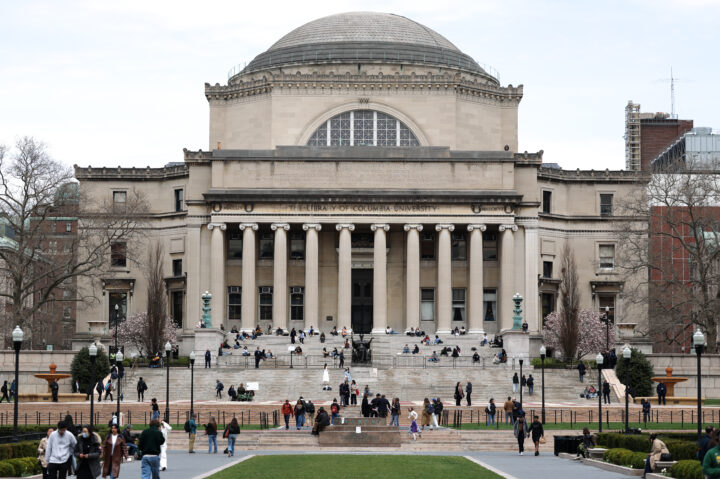
CHARLY TRIBALLEAU/AFP via Getty Images
Students are seen on the campus of Columbia University on April 14, 2025, in New York City.


 Add JewishInsider on Google
Jewish leaders on and off Columbia University’s campus praised the settlement reached last week between the university and the Trump administration to restore some $400 million in federal funding that was slashed in March due to the Ivy League’s record dealing with antisemitism.
While some Jewish leaders, students and alumni are taking a wait-and-see-approach, others expressed cautious optimism that the deal could lead to a safer environment for Jewish students following nearly two years of antisemitic protests and disruptions on campus in the aftermath of the Oct. 7, 2023, Hamas terror attacks in Israel.
“I am heartened to see the resolution agreement for several reasons,” Adam Lehman, president and CEO of Hillel International, told Jewish Insider last week. “It recognizes both the clear, egregious violations of the civil rights of Jewish students and staff at Columbia and Barnard [an affiliate of Columbia] during the past two academic years, and the concrete steps Columbia has recently pursued to address these issues.”
Those steps, publicized last week, included further incorporating the International Holocaust Remembrance Alliance’s working definition of antisemitism by requiring its Office of Institutional Equity to embrace the definition; appointing a Title VI coordinator to review alleged violations of the Civil Rights Act; requiring antisemitism training for all students, faculty and staff; and refusing to recognize or meet with Columbia University Apartheid Divest, a coalition of over 80 university student groups that Instagram banned earlier this year for promoting violence.
The school also announced last week that disciplinary action and rules surrounding student protests would be moved out of the purview of the faculty-run University Senate and into the provost’s office, a move called for by pro-Israel students. Columbia also agreed to pay a $200 million settlement over three years to the federal government.
“Importantly, it also restores the university’s ability to pursue essential medical and scientific research with access to federal funding support,” Lehman said. “I hope and trust that the university will use this important resolution to see through its recent commitments to foster a campus environment that will be safer and more welcoming for Jewish students, and all students, moving forward.”
Still, some said that key reforms are missing from the deal, which falls short of several demands initially made by the Trump administration. Among the demands were putting the Middle Eastern, South Asian and African studies department and the Center for Palestine Studies under the purview of a senior vice provost, who would be appointed by the university to supervise course material and non-tenure faculty hiring, as well as the formation of a presidential search committee to replace acting President Claire Shipman.
In addition to the fine, the university has agreed to settle investigations brought by the U.S. Equal Employment Opportunity Commission for $21 million. A number of open Title VI investigations into the university alleging harassment of Jewish students will also be settled and the university will abide by laws banning the consideration of race in admissions and hiring. Columbia, which did not admit to wrongdoing in the deal, said it will continue to have “autonomy and authority over faculty hiring, admissions, and academic decision-making.”
“I’m on board [with the settlement] but my support is contingent on enforcement,” said Shoshana Aufzien, an incoming sophomore in the dual program between Barnard College and the Jewish Theological Seminary. At the same time, Aufzien said that “the scope of the settlement is unclear” and “many of the reforms mentioned are existing legal obligations” for recipients of federal funding, such as the appointment of a Title VI coordinator.
Lishi Baker, a rising Columbia senior studying Middle East history, called the settlement “an important moment for the Jewish community, Columbia, higher education and the United States more broadly. Getting federal funding back and committing to the work of positive reform within the university is a good thing,” Baker told JI.
“This deal is not the end of the story. It is an important start. Reforming Columbia for the better is a long-term endeavor that could never be covered in one deal, and need not be overly intertwined with the government.”
Eden Yadegar, a former president of the Columbia chapter of Students Supporting Israel who graduated in the spring with Middle East studies and modern Jewish studies degrees, told JI she is “grateful to the federal government for prioritizing the fight against antisemitism in higher education, and hope this deal is the beginning of what will be sustained change at Columbia.”
“I’m holding my breath to see if and how things will change for Jewish and Israeli students in September. There is undoubtedly plenty more work to do and the Jewish community is not going to back down from doing it and holding Columbia accountable,” Yadegar said.
The Anti-Defamation League called the settlement “an important next step in fighting antisemitism and hate on their campus, along with restoring federal funding needed for critical research.”
But others raised concerns that the settlement does not include the structural reforms initially demanded in the Trump administration’s letter to Columbia in March.
“The deal stops short of necessary internal reforms, such as discipline and review of faculty leadership for those who participated in encampments or violated other campus policies,” Inbar Brand, who graduated in the spring from Columbia’s dual-degree program with Tel Aviv University, told JI. “Worst to me is that this deal is a closing of the Title VI investigation without any admission of guilt by Columbia.”
A source familiar with the negotiations told JI that “while the [Trump] administration spins the deal as a win, the reality is it caved and let Columbia pay a fine and continue business as usual under a toothless monitor with no meaningful reforms.”
The settlement “lets Columbia off the hook in advance of presidential selection, meaning [that there’s] no incentive to pick a president committed to reform,” the source said, referring to the ongoing search for a permanent president.
The Trump administration is in talks with several other universities that have faced similar funding cutoffs, including Harvard, Cornell and Northwestern.
More Stories
EDUCATION INVESTIGATION
House Education Committee finds systemic antisemitism in Philadelphia, Berkeley K-12 schools
SCOOP
AIPAC to end candidate endorsements, PAC contributions to allies
HILLTOP FORECAST
Democratic foreign policy veterans preview party’s shifts on Middle East policy
SECURITY SETBACK
Saudi Arabia postpones ‘Davos in the Desert’ until 2027 amid Houthi attacks

Daily Overtime
Hillel disputes fired rabbi’s claim
Daily Overtime
Deadlocked dash to Israeli elections
Please log in if you already have a subscription, or subscribe to access the latest updates.
 Continue with Google
 Continue with Apple