

























































Could another war with Iran be the October surprise of the Israeli election?
Speculation about a potential resumption of military hostilities with Iran ahead of the U.S. and Israeli elections has been fueled by increasingly pointed threats from Washington and Tehran
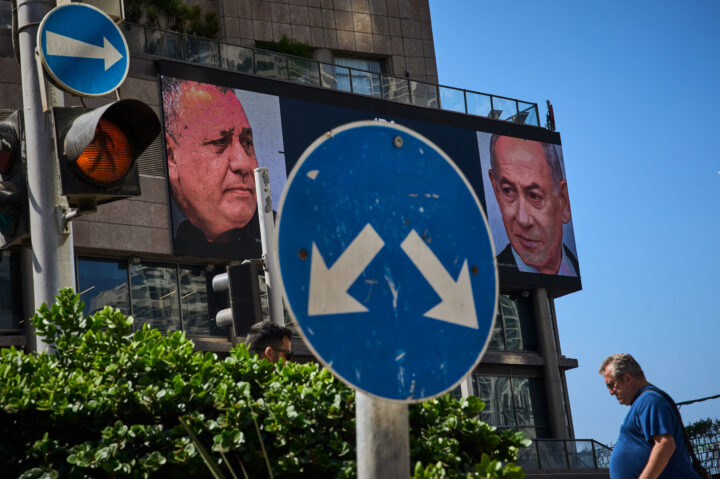
(Oded Balilty/AP)
A man walks past a television channel advertisement featuring Israeli Prime Minister Benjamin Netanyahu, right, and his main rival, opposition candidate Gadi Eisenkot, ahead of Israel's general election, in Ramat Gan, Israel, Wednesday, Sept. 23, 2026.


 Add JewishInsider on Google
Escalating threats between Washington, Jerusalem and Tehran seem to have raised the prospect of another military confrontation with Iran — an October surprise that could reshape Israel’s political landscape, as the country is set to head to the polls next week, and complicate President Donald Trump’s political calculations ahead of the midterm elections in November. Yet former Trump administration officials suggest that renewed hostilities are unlikely ahead of the upcoming U.S. and Israeli elections.
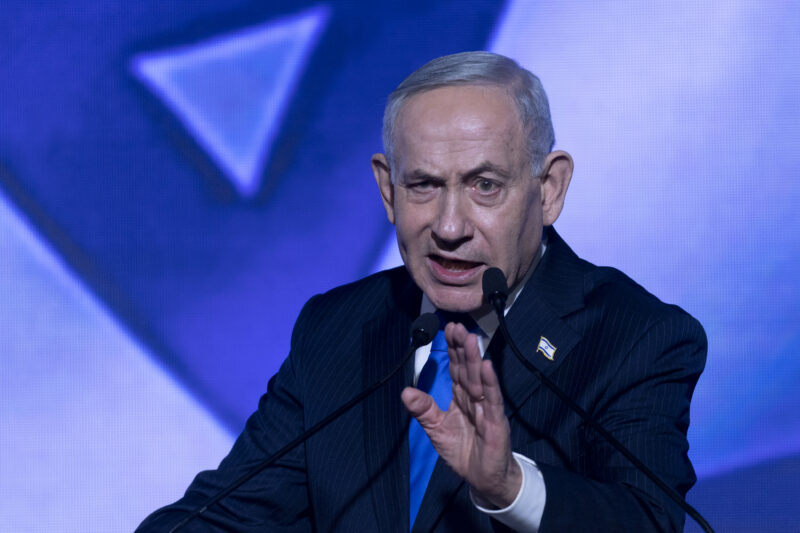
Speculation about a potential resumption of military hostilities with Iran ahead of the U.S. and Israeli elections has been fueled by increasingly pointed threats from Washington and Tehran — including a warning from Trump on Sunday that the U.S. could soon “finish the job” against Iran — as well as an unannounced visit to Israel by Defense Secretary Pete Hegseth on Monday, where he met with Israeli Prime Minister Benjamin Netanyahu and Defense Minister Israel Katz at Ovda Air Base. Netanyahu also said on Sunday that he and Trump would “complete the mission” against Iran.
Iranian officials have responded in kind: Iranian Foreign Minister Abbas Araghchi warned Sunday that Tehran had “unfinished jobs” of its own, while Iranian military officials have threatened to expand their targets in the event of renewed U.S. or Israeli strikes.
However, former Trump administration officials told Jewish Insider that they see little incentive for either Washington or Jerusalem to initiate another round of military hostilities with Iran ahead of their respective elections, citing the potential political and economic consequences of renewed fighting.
Lt.-Gen. Eyal Zamir, the IDF chief of staff, warned last week that “in light of increased warnings in every arena and the sensitivity of this time” — before the election — “the potential for an attack has increased.” Israel raised its security alert level, out of a concern that its enemies may attack before the election, though there is no concrete intelligence indicating Hezbollah or Iran are planning to do so, public broadcaster Kan reported.
The prospect of a resumption of hostilities could carry significant electoral consequences in Israel, where voters are set to head to the polls next week and the circumstances of a renewed confrontation could shape perceptions of Netanyahu’s motives.
Shmuel Rosner, who conducts polls for Israel’s Channel 13 and is a senior fellow at the Jewish People Policy Institute, told JI that if a war with Iran broke out in the week before Election Day, it may significantly impact the results.
“If Iran launches missiles at Israel tomorrow morning, everyone would understand that Israel has no option but to respond,” Rosner said. “It’s a different case if Israel launches an attack. That would be highly suspicious to many Israelis. Some supporters of the coalition will say it is necessary, but for the opposition, it will be further proof that Netanyahu is playing with fire to win the election.”
In his latest survey, Rosner asked respondents whether they would trust the government’s intentions if it were to attack Iran before next week’s election. Nearly half (47%) said they would not trust the government, while a third (33%) would. The rest did not know.
Richard Goldberg, a senior advisor at the Foundation for Defense of Democracies who previously served on the National Security Council, said the upcoming elections give both Washington and Jerusalem reasons to avoid another military confrontation, though the possibility of Iranian aggression remains a concern.
“The U.S. or Israel would only act militarily before their respective elections if there was an imminent threat of attack by Iran that forced preemptive action to save lives, or a surprise attack by Iran that required an immediate response,” Goldberg said.
“The statements and military movements you see from both the United States and Israel suggest this may be a contingency that remains under active consideration by the Iranian Revolutionary Guard Corps, so it remains something both President Trump and Prime Minister Netanyahu are watching closely,” he continued.
Goldberg also pointed to the potential political consequences of renewed fighting around both countries’ upcoming elections.
“It seems obvious from an energy market perspective that the U.S. would not want this to happen prior to the midterms, and Netanyahu also doesn’t want to deal with a delayed election due to major combat operations,” he said.
Alexander Gray, who served as National Security Council chief of staff during Trump’s first administration, suggested that the president’s economic pressure campaign against Iran could make further military action less likely in the immediate term.
“While President Trump has always used the perception of his unpredictability to advance American interests, the reality of the President’s successful economic strategy against Iran lends itself toward a delay in further kinetic operations,” Gray said. “In short, the economic strategy is working: Iranian supply chains, currency, reserves, and social cohesion are suffering immensely.”
“Though a future strike cannot be ruled out, the economic campaign can continue to run its course with success and offer additional options for the United States to conclude the conflict in ways amenable to Washington’s interests,” he added.
Another possible scenario would be a war with Iran taking place after the U.S. midterm elections, but before a coalition is formed in Israel. The process of building the alliances to form a coalition government in Israel — after the election takes place — promises to be as significant and eventful as the election results themselves.
Gil Hoffman, political analyst for i24 News and author of The Blood Libel Machine, discussed the scenario on the “Call Me Back” podcast, pointing out that Trump has been “talking about going to war with Iran again after the midterms in the United States, which are a week after our election. That could be the time when, if Netanyahu gets a couple more seats than [Yashar leader Gadi] Eisenkot’s bloc, Netanyahu is given the mandate [to form a coalition] by President [Isaac] Herzog.”
“If during that time the war with Iran starts, then maybe someone inside Gadi Eisenkot’s bloc, maybe only part of Eisenkot’s party, part of [Naftali] Bennett or [Avigdor] Liberman’s party, decides to join together with Netanyahu temporarily due to the war,” Hoffman said. “Let’s not forget that after Oct. 7 [2023, Hamas attacks, former Defense Minister] Benny Gantz and Gadi Eisenkot brought their party into the coalition, even though they said they wouldn’t.”
“War makes people break promises,” Hoffman added.
Rosner argued that a stalemate between Netanyahu and Eisenkot could motivate the former, who would remain caretaker prime minister at that point, to strike Iran.
“If the election ends without a clear outcome,” Rosner said, “Netanyahu has an incentive to launch an attack and call on the opposition to join an emergency government under him until the war is over. He may say, ‘This is not the time for coalition negotiations. Join me, and we’ll talk about the rest later.’”
Rosner was unsure that the gambit would work: “We’re all familiar by now with the bag of tricks that Netanyahu carries with him. … Will they be tempted again to go into a Netanyahu trap?”
He noted that “Eisenkot saw [Netanyahu] do this to Benny Gantz in 2020; he lured him into a coalition and then backed out of the rotation [for the job of prime minister]. After [Oct. 7], Gantz and Eisenkot joined the government and after a while they realized their ability to influence the government was not what they desired.”
More Stories
SECURITY SETBACK
Saudi Arabia postpones ‘Davos in the Desert’ until 2027 amid Houthi attacks

IN THEIR MEMORY
Administration officials join bereaved families for Oct. 7 commemoration event

Daily Overtime
Dublin hotel dumps antisemitism conference

REGGIO REGRETS
Reggio Emilia mayor walks back anti-Israel litmus test for preschool educators
HISTORY LESSON
Brett McGurk’s fact check of former Harris advisor Phil Gordon on hostage negotiations

DAYLIGHT DEBATE
Brett McGurk pushes back on former Biden WH colleagues who called for greater pressure on Israel
Please log in if you already have a subscription, or subscribe to access the latest updates.
 Continue with Google

 Continue with Apple