
















































Pope Leo affirms commitment to fighting antisemitism in meeting with AJC leaders
In the first meeting between the pontiff and a major AJC delegation since his election, Leo reaffirmed Nostra Aetate and, in a shift from Francis, steered clear of the Gaza war
Vatican Media
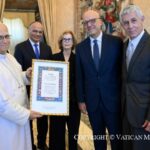
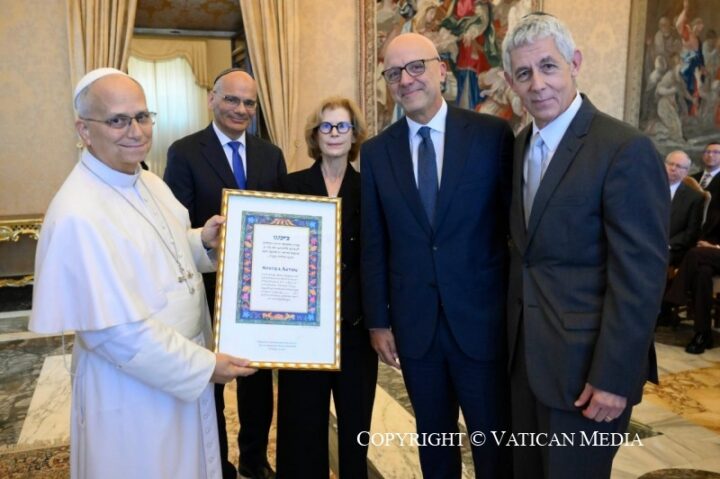
American Jewish Committee CEO Ted Deutch and other AJC leaders meet with Pope Leo XIV at the Vatican, Oct. 22, 2026


 Add JewishInsider on Google
In a meeting at the Vatican with American Jewish Committee CEO Ted Deutch and other AJC leaders from around the country on Thursday, Pope Leo XIV pledged to combat antisemitism.
“Rooted in our shared spiritual heritage, this friendship also calls us to defend human dignity, to serve the poor, to protect religious freedom and to promote justice and peace,” the pope told the Jewish leaders. “Essential to this commitment is the rejection of all forms of religious and ethnic hatred and discrimination.”
Speaking to Jewish Insider after the meeting, AJC leaders emphasized the significance of the meeting and of the pope’s commitment to rejecting antisemitism, given both the massive influence that the pope and the Catholic Church hold around the world and the Church’s own history of fomenting antisemitism.
Leo reaffirmed his commitment to the 1965 Nostra Aetate declaration, in which then-Pope Paul VI rejected antisemitism and the charge of deicide against Jews and highlighted the shared spiritual heritage between Jews and Catholics.
“Differences of opinion, however profound, must never give rise to prejudice and hostility, which undermine the moral foundations of our society,” Leo said.
Deutch told JI that the meeting was “very powerful because of what the Pope said to us about his commitment, the Church’s commitment to fighting antisemitism and ongoing commitment to engage in the dialogue that we participate in throughout the year.”
“There was a genuine connection as he spoke about the Church’s longstanding engagement with AJC and the importance of maintaining the strong relationship, and the importance of approaching these challenging issues with mutual respect,” Deutch continued.
Rabbi Noam Marans, the director of interreligious affairs for AJC, emphasized that Leo’s reaffirmation of Nostra Aetate is a declaration that “the millennia of demonizing Jews and Judaism was not in the spirit of the original Christian teaching.”
Given the pope’s and the Catholic Church’s influence with 1.4 billion Catholics worldwide as well as those of other religions who listen to and respect him, Marans added that “it’s impossible to overstate [their] power … to make a significant contribution in confronting antisemitism.”
The AJC and the United States Conference of Catholic Bishops have collaborated on a project that aims to teach about antisemitism and antisemitic sentiments through a specifically Catholic lens, and are launching an updated version of the project next month, according to Marans.
“We learned that the church is reaching out across the world to its leadership, to encourage them to prioritize the confronting of antisemitism and the development of Jewish friendships,” Marans said. “These are laudable, and we need more because of our belief that antisemitism is not a Jewish problem; it is a societal problem. The Catholic Church and its history has a particular responsibility. We’re grateful for what they’ve done, and we hopefully will do even more.”
Deutch said that AJC intends to continue conversations with the Church to ensure that its commitment to combating antisemitism “extends to all of the forces confronting the Jewish community today all around the world, and the different ways they manifest themselves,” and called the meeting with the pope “an opportunity” to deepen that work.
Deutch said that Pope Leo’s decision to meet with the group so soon after undergoing surgery for lung cancer is an “important statement” and a “powerful reminder of why dialogue matters” which created opportunities for “deeper engagement with the Catholic Church at a time when it’s never been more important.”
Though AJC and Marans have met with Pope Leo and other senior Catholic leaders, this was the first major AJC delegation to meet with the pope since he assumed his position last year.
The group presented Pope Leo with an artwork created in Jerusalem featuring an excerpt from the Nostra Aetate declaration in both the original Latin and in Hebrew. The piece is inspired by an Italian ketubah from 1822.
AJC leaders also had an opportunity to address the pope one-on-one to thank him for his comments and wish him well in his recovery. Deutch said that, based on what he’s read about Pope Leo’s surgery, the pope seemed remarkably healthy.
“He was engaged and personable, and warm, and seemed genuinely thrilled to be able to participate in the meeting with us,” Deutch said.
Marans said that Pope Leo “chose not to focus” on issues related to Israel and the war in Gaza while speaking with AJC, which proved to be a point of friction between his predecessor, Pope Francis, and the Jewish community and Israel.
Marans said he believes that Pope Leo has undertaken a “seemingly deliberate effort … to ease the tension” and shift away from Francis’ intense focus on the war in Gaza, at least in terms of the rhetoric that he and other Church officials use.
He said that Pope Leo has “focused on addressing the challenges and differences of opinion in the spirit of the 60-year dialogue” and using “careful language when talking about sensitive topics,” which Marans said has been helpful for Catholic-Jewish relations, “even when he has spoken about difficult issues regarding the Israeli-Palestinian conflict.”
The group also met with Cardinal Pietro Parolin, the functional head of government for the Holy See. During the meeting, Marans said that Parolin also delivered an “unequivocal commitment by the Church to combat antisemitism,” and also directly addressed the subject of Israel head-on, linking the Church’s diplomatic relationship with Israel directly to its commitment to fighting antisemitism.
“At a moment when we constantly face leaders in politics who attempt to distinguish between their so-called commitment to fighting antisemitism and their obvious disdain for the state of Israel, this was one of the leaders of the Vatican, specifically linking the commitment, the Church’s commitment to fighting antisemitism, with its [agreement establishing relations with Israel],” Deutch said. “It’s a very, very powerful statement.”
Marans said AJC has worked hard to convey to the Church the “indispensability of identification with the state of Israel and Zionism to modern Jewry.”
While in Rome, the AJC group also met with Rabbi Riccardo Di Segni, the chief rabbi of Rome, and will meet with other Vatican leaders, leaders of the Jewish community and Italian government officials, which Deutch said are critical at a time when antisemitic and anti-Zionist content has cropped up in sometimes-violent protests in Italy and throughout Europe.
Deutch said that AJC will communicate to Italian leaders the way that demonization of Israel, including accusations of genocide, have fomented rising antisemitism and highlight the need to continue to stand with Israel against those seeking to deny its right to exist.
Marans said that the group heard from Di Segni that the Jewish community in Italy is “deeply concerned” and “feel[s] threatened, particularly by the bleeding from the anti-Israel rallies into antisemitic tropes.”
Deutch said that the message from Italian Jewish community members has matched what AJC has been hearing across Europe, that the protests and riots have had a “dramatic” impact in the Jewish community and left it “very much on edge.”
He said he was particularly struck by seeing young Jewish students running from the school to their parents’ cars at the end of the day at a Jewish school in Rome — something they’ve been trained to do for decades since a 1982 terrorist attack on a synagogue in Rome. The school has also removed a Jewish insignia from students’ shirts out of concern about violent antisemitic attacks.
“This is not a world that we should have to live in, and that conversation that we had, and watching the young kids run, and older kids in their plain shirts, is something that I think is going to guide us in the work we do for some time to come,” Deutch said.
More Stories

Daily Overtime
Barrack says Iran-backed threats are ‘not America’s job’

Super Ball
Robert Kraft’s Blue Square gala pulls in $32 million as NYC’s Waldorf glows blue

NEW CHAPTER
High Line Publishing launches with fanfare to counter barriers for Jewish authors

POLL POSITION
U.S. experts split on Netanyahu’s prospects ahead of Israel’s election
DEBATE DIGS
Rogers describes El-Sayed as a national security threat in final Michigan Senate debate
UNKNOWN HORIZON
Final Israeli polls point to stalemate ahead of Tuesday’s election
Please log in if you already have a subscription, or subscribe to access the latest updates.
 Continue with Google

 Continue with Apple