



























How Israel’s parties say they would rebuild support in America
Likud insists Netanyahu can work with any White House, while opposition parties argue a new government is needed to win back Democrats and the broader public

(JACK GUEZ / AFP via Getty Images)
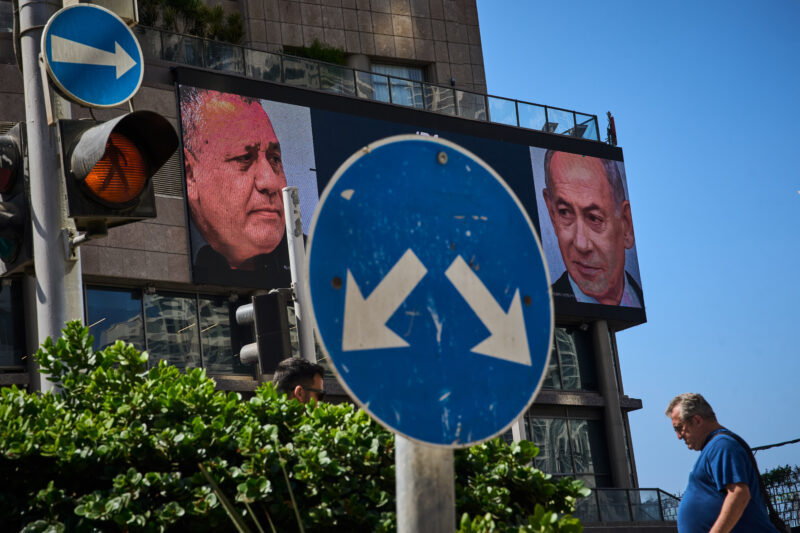
Commuters drive past an election billboard on a building bearing portraits of Israel's Prime Minister Benjamin Netanyahu and Israel's former chief of the general staff and leader of the Yashar centrist political party Gadi Eisenkot, ahead of country's legislative elections, in Tel Aviv on October 6, 2026.


 Add JewishInsider on Google
American views of Israel, particularly among progressives, have become increasingly negative in recent years, a trend that has impacted Democratic primaries ahead of the midterms this year, boosting candidates that are explicitly anti-Israel or who boast about rejecting AIPAC.
The Trump administration and Republicans on the Hill have maintained a close, positive relationship with Israel, but some of the American right’s vanguard and institutions have expressed views of concern to the Jewish state.
But the U.S.-Israel relationship has barely played a role in the Israeli election. Voters have consistently put security and the economy or cost of living at the top of their concerns in polls, but they’re almost never asked about Israel’s international standing.
One survey by the Israel Democracy Institute taken in late August and early September found that about half of Israelis said U.S.-Israel relations are very or fairly important to them in choosing a party, while 55% of Jewish Israelis said so. Voters for former Defense Minister Avigdor Liberman’s Yisrael Beiteinu (73%) and B’Yachad, the party led by former prime ministers Naftali Bennett and Yair Lapid, (66%) were most likely to view the issue as important.
Jewish Insider asked parties consistently polling above the electoral threshold for their strategy to turn the tide and improve U.S.-Israel relations, especially as the future of U.S. aid to Israel has become a flashpoint.
Likud (led by Prime Minister Benjamin Netanyahu):
Boaz Bismuth, chairman of the Knesset Foreign Affairs and Defense Committee and No. 21 on the Likud list, said that “when the Likud forms the next government together with its partners, it will maintain its principles and values and protect the state. That will not change, whoever is in power in America, whether Republican or Democrat.”
“Netanyahu has proven his capability of working with Democrats and Republicans, working with Presidents Clinton, Obama and Biden, and with President Trump … He knows the job. He protects Israel’s interests, whoever sits in the White House. … It was not always easy working with the Biden administration during the war [in Gaza], yet America has proven to be the best partner ever, not only because of shared interests, but because we share the same enemies, and we are fighting the same enemies.”
Asked about a possible turn against Israel in Congress after the midterms, particularly if Democrats regain the House and Senate, Bismuth added: “We see these apocalyptic prophesies, but in reality, in my committee, I know the events behind the scenes, and we can continue to trust our American allies just as they can trust us. … In meetings Netanyahu has with U.S. congressmen who come to Israel, he gives the same attention to Democrats as Republicans.”
Yashar (led by Gadi Eisenkot):
Lianne Pollak-David, No. 25 on the Yashar list, called the data showing 60% of Americans have negative views about Israel “scary,” and said, “We must take this very seriously.”
The best way to improve the relationship, Pollak-David argued, is to elect a different government. “American Jews and the American public understand the gap between the Israeli people and the government that led them until now, which followed the most extreme voices and did not represent the Israeli spirit or the deep values of the State of Israel as a Jewish and democratic state.”
“The alliance with the U.S. is Israel’s greatest strategic asset. We don’t take it for granted and we need to rebuild its foundations for the next generation. First and foremost, we need to bring back what was once a holy principle, bipartisan support, and go back to a special relationship based on shared values and deep cooperation that does not only depend on the personal connection between the heads of state,” she said.
Pollak-David called to “rehabilitate the connection with the broader American public and start turning Israel from a country that is increasingly seen as a burden by the American public into a strategic partner that is an asset. … Practically, that means a new model for security ties, gradually moving from aid to partnership in research and development and joint investment. We already started with Pax Silica [a U.S.-led initiative to secure supply chains needed for AI development with allied nations], but we need more.”
She also said Israel should send missions of young leaders, academics and others to meet with American Jewish communities, noting that polling also shows Israel’s favorability is in decline among young American Jews. “The current government is ignoring … the influence that everything that happens here has on [Diaspora Jewry], their personal security and antisemitism. We can’t control it, but there is no doubt the things are related.”
B’Yachad (led by Naftali Bennett):
MK Shelly Tal Meron, No. 29 on the list, also emphasized a need to return to a more bipartisan approach to the U.S.
“There is no question that the U.S. is Israel’s biggest, most important ally,” she said. Threatening our relations with the U.S. is a serious threat to our national security. During the last term, there were a lot of things said by different representatives of the government that insulted some of the people in the U.S. – more with the Biden administration than Trump.”
Meron argued that former Prime Minister Yair Lapid, No. 2 on the party list, would know how to repair the relationship as foreign minister. “He went to Lindsey Graham’s funeral – a great loss to the U.S.-Israel relationship – and made a point of speaking to Democrats, because we need to get everyone back on board supporting us.”
She also called for work to be done to improve Israel’s image among young Americans: “We need young influencers and people who are eloquent and know how to speak the language. … We need to get back to the basic values that we want to represent to the world and the U.S. … We need to go back to telling the liberal, democratic Israeli story that a lot of people around the world are not seeing.”
Meron also said that Israel needs to repair ties with American Jews, and have its representatives “respect them and respect the way they practice Judaism,” referring to derogatory remarks by Cabinet ministers about Reform Jewry.
The Democrats (led by Yair Golan):
Knesset candidate Emilie Moatti, former head of the Knesset Subcommittee on International Relations and No. 14 on The Democrats’ list, said that the current government turned Israel “into a central obstacle to the future of the Middle East. Every U.S. administration saw us as a top ally in the Middle East, [but this government] totally burned ties with the Democrats. Even Trump ignores us and set facts on the ground with his 20-point plan for Gaza, about Saudi Arabia [and its civilian nuclear program], and I am concerned he will do that soon in Iran.”
Moatti pointed to U.S. Ambassador to Israel Mike Huckabee’s condemnation of violence by Israelis against Palestinians in the West Bank, saying: “The Democrats condemn the violence by Jewish settlers in the territories. … The minute a change government [led by parties in the current opposition] rises, the violence in the territories will stop. It can end within 24 hours. It’s a matter of making a decision, and I’m certain it will be made.”
Moatti also emphasized a need for greater engagement with the Palestinians: “In the past, American deals with the Saudis were contingent on normalization with Israel … If the government continues to think the Israel-Palestinian conflict isn’t a factor, here comes the Trump administration, which is super-friendly to Israel, to say it’s impossible.”
She also expressed concern about losing liberal Diaspora Jews: “Protecting the well-being of Diaspora Jews is also Israel’s responsibility, and we cannot make them choose between being Jewish and being [American], British, French, Belgian. Liberal Jews are living with a feeling that the government of Israel is pushing them into a corner again and again.”
Yisrael Beiteinu (led by Avigdor Liberman):
Liberman released a lengthy statement last week in which he predicted the next U.S. administration will recognize a Palestinian state on pre-1967 lines and support U.N. Security Council sanctions on Israel if the next government does not change the way it relates to the conflict with the Palestinians.
“It didn’t happen before now because Israel successfully neutralized this dangerous stance with its strong approval rating among Americans and as such had broad political support in both parties,” he wrote. “But politics has an iron law: The moment you lose public support, you lose political support. Today, our situation in American public opinion is at an unprecedented low. … What Netanyahu is doing today is, in effect, knowingly helping bring about the establishment of a Palestinian state.”
“Israel’s endgame and goal must be eliminating Hamas in Gaza and dismantling the Palestinian Authority, including the Oslo Accords, but since there are no vacuums … we must coordinate in advance with the international community who takes control of Judea and Samaria and Gaza,” he added, saying he thinks Jordan is the right answer.
Liberman also called to establish an emergency team to raise awareness and improve Israel’s image in the world, with members from the Israeli government and Diaspora communities.
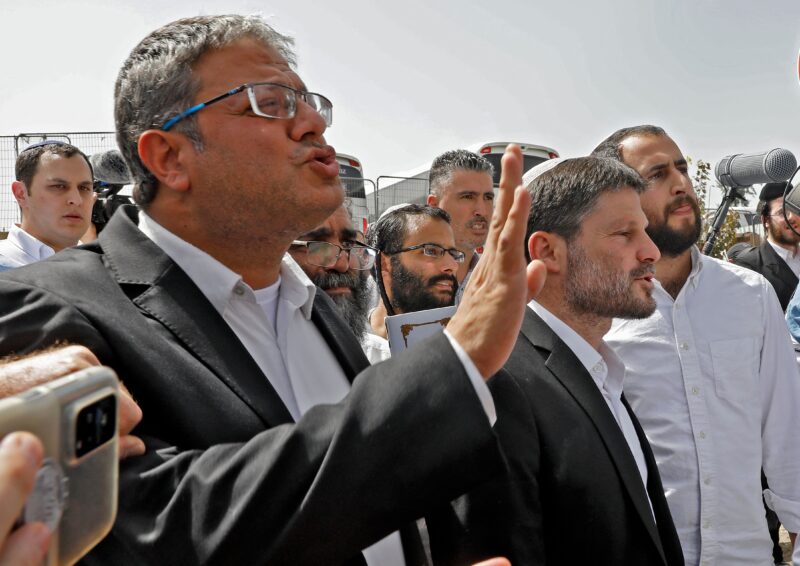
Otzma Yehudit (led by Itamar Ben-Gvir):
Yishai Fleisher, 12th on the party’s list and the longtime international spokesperson for the Hebron community, told JI: “I think that [National Security Minister] Ben-Gvir is basically a centrist Republican in terms of his policies, and they make sense when you put it into that kind of framework and not how it’s been portrayed by the international community. It’s simple: law and order; bad guys behind bars; Jews have guns; cut down on illegal construction; stop the jihadist onslaught we see around the world that they want to do here. That itself creates a relationship, because we have Texan values, basically.”
“These are very simple policies, but for some reason the international condemnation has gotten [in the] way, so people have lost the simple understanding of these policies and what they’re about, which is law and order.”
Religious Zionist Party (led by Bezalel Smotrich):
Smotrich, the finance minister, spoke about U.S.-Israel relations at the National Conservatism Conference in Jerusalem last week, saying that “the historic alliance between the countries is built on shared values, on faith and biblical tradition, on love of liberty and on the struggle against enemies who threaten the free world. Israel values America’s friendship and the support it has received over the years.”
“Because of that, the time has come to deepen the alliance and move from a relationship of dependence to partnership between two independent nations,” he stated. “Israel can and must take greater responsibility for its security, to develop its military and economic independence and stand up for its national interests by itself.”
Speaking to conservatives, Smotrich said that “Israel has an interest in the success of national conservatives in the U.S., as opposed to streams that seek to dismantle … families and nationalism, erase borders and blur the difference between democracy and terror. The world needs a strong, patriotic America that is connected to its values. We must strengthen our ties with the administration, with the central conservative camp and the American public to show that Israel is a strategic and security asset.”
***
The Joint List declined to comment. Ra’am, Shas and United Torah Judaism did not respond to requests for comment.
More Stories
AID ADJUSTMENT
Trump says he made deal ‘months ago’ with Netanyahu to end aid to Israel by end of year

STICKING POINTS
Arab parties still don’t meet Eisenkot’s coalition conditions

EXTREMIST EMBRACE
Florida voters elect Republican with neo-Nazi ties to state Legislature
RACES TO WATCH
Jewish Insider’s scorecard for the 2026 midterms
SORE WINNER
Mehdi Hasan tells Jewish advocates, lawmakers to ‘cry more’ after El-Sayed victory
FOLLOW THE MONEY
El-Sayed super PAC gets $50K from firm in Armenian mob money-laundering scheme
Please log in if you already have a subscription, or subscribe to access the latest updates.
 Continue with Google

 Continue with Apple