


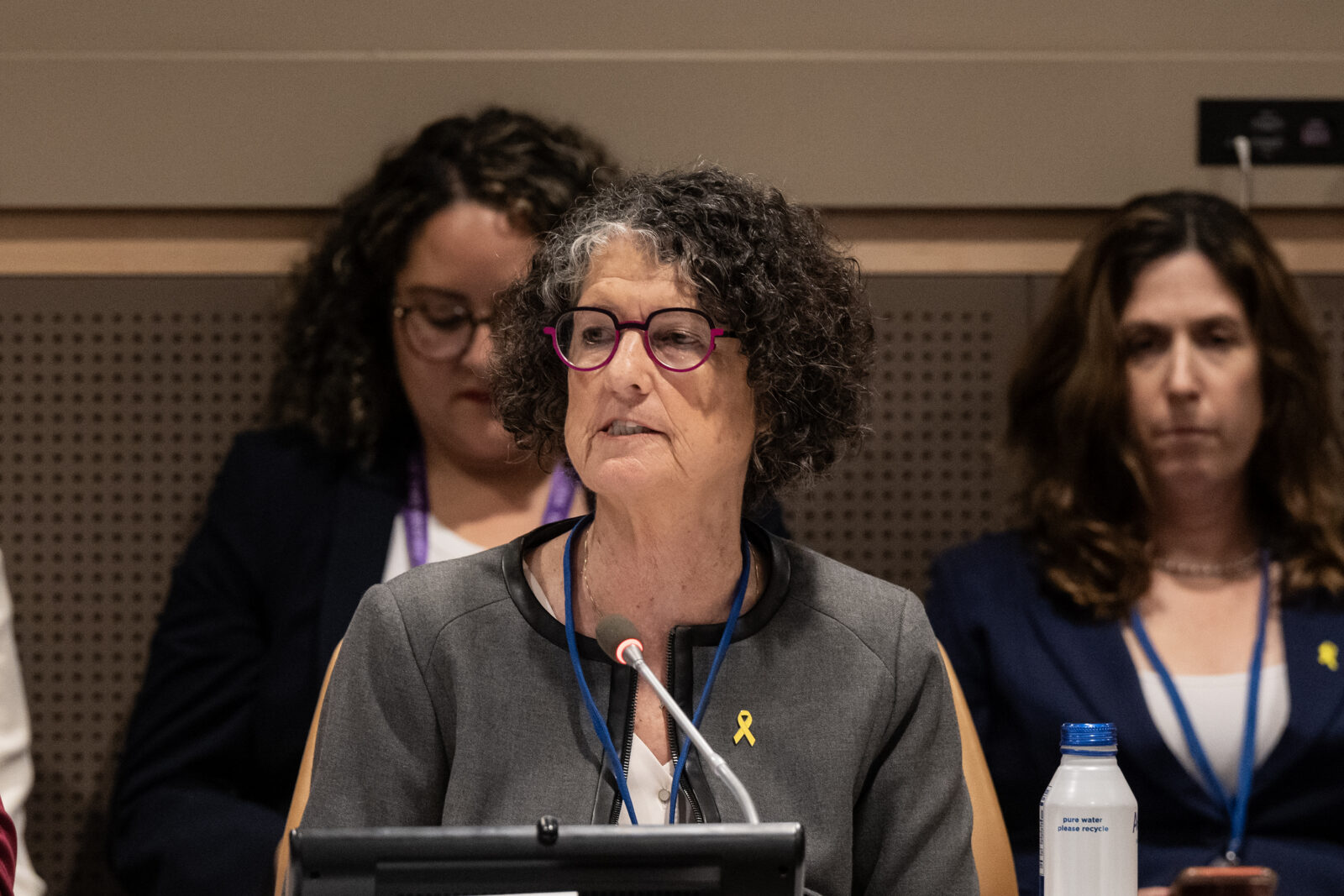
(Lev Radin/Pacific Press/LightRocket via Getty Images)
After years of hostage advocacy, Kibbutz Be’eri survivor turns toward the future
Shoshan Haran, who survived 50 days in Hamas captivity, talks to JI about her new memoir and what she calls a campaign to invert the truth about Oct. 7.


 Add JewishInsider on Google
For two years, Shoshan Haran thought of nothing except the hostages. After surviving 50 days in Hamas captivity, she spent much of the next two years traveling between the United States, Europe and Israel, meeting with lawmakers and government officials and pressing for the release of the remaining captives — including her son-in-law, Tal Shoham, who spent 505 days in Gaza, about half of that time in an underground tunnel.
Now, on the third anniversary of the Oct. 7, 2023, Hamas attacks and with every hostage either returned alive or brought home for burial, Haran is allowing herself to think about what comes next. “This is the first anniversary that we can start looking at the future,” she told Jewish Insider.
Her new memoir, Mission in Captivity: One Woman’s Struggle to Survive and Save Her Family in Gaza, is part of that next chapter — an effort to document what she experienced, mourn what she lost and make her voice heard about the events of Oct. 7 and their aftermath. Originally published in Hebrew, Mission in Captivity was released in English on Tuesday, one day ahead of the third anniversary of the attacks.
“I wrote the book so my voice will be heard,” said Haran, who was kidnapped from her home in Kibbutz Be’eri — the kibbutz her father founded after fleeing Nazi Germany and where she was born. Haran was taken alongside her daughter, Adi Shoham; her son-in-law, Tal; her grandchildren Yahel and Naveh (then aged 3 and 8); her sister-in-law Sharon; and her niece, Noam (then aged 12).The Shohams were visiting Haran to celebrate the holiday of Simchat Torah. Haran’s husband, Avshal Haran, and sister and brother-in-law, Lilach and Evyatar Kipnis, were murdered during the attack.
“It’s a platform and my way to communicate to the world,” Haran said of her book. She’s now living on a small kibbutz in northern Israel called Ma’ayan Tzvi, as Kibbutz Be’eri — where 101 civilians were murdered on Oct. 7, accounting for roughly 10% of the community’s population — is being rebuilt.
Haran initially assumed that Israelis did not need to be told what happened on Oct. 7. But writing the book changed her mind. “I was surprised because when I started to write the book, from my point of view, the goal was to address the world. I thought in Israel people knew what happened. But from the readers’ comments, I learned that it was not true.”
She also sees a vital global need for the book — particularly on Western college campuses, where distorted narratives about Israel have intensified since the attacks.
“For me what’s important is countering the inversion of the truth we are facing. The false campaign is working in a successful way to change the worldview of what happened. They depict the attackers as victims. This campaign started at 6:33 a.m. — four minutes after we heard the alarms on Oct. 7, they launched a heavily financed social media campaign saying Israel is doing genocide in Gaza. They twisted the worldview about what happened. There are two arms that are working against us — the terrorist jihadist arm led by Iran and its proxies: Hamas, Hezbollah, and the Houthis. And then you have soft jihad, spearheaded and financed by Qatar, which wages an awareness campaign designed to mislead the world.”
“I’m not afraid to talk to anyone, although I’m troubled by the aggression from those who call themselves liberals and progressives whenever they encounter facts that contradict their preconceived narrative,” said Haran, who is speaking to Jewish communities on her current book tour, but said she would like to do so at universities as well in the future.
In the book, Haran describes the period before Oct. 7 as one of “double blindness”: Israelis living near the Gaza border knew Hamas posed a threat, but could not imagine the scale of the danger, while the Hamas terrorists who held her captive, she said, had little understanding of why Jews live in Israel or the history of the Jewish people.
“We knew there was terror but we thought it was a small part of the population,” she said, describing life on Kibbutz Be’eri — about 3 miles from the Gaza border — as “98% paradise and two percent hell,” despite the constant missile threat. “Because of our own moral values, we were unable to comprehend that they really wanted to kill us,” she said. “As citizens, we didn’t see protection as our duty. This is the role of the IDF and Mossad.”
Her conversations with her captors revealed a similar gulf in understanding, she said. “They had no idea why Jews are living in Israel. They had no clue about the deep-rooted history of the Jewish people in Israel, and no clue about the Holocaust.”
Haran credits her work pre-Oct. 7, as an agronomist who founded the nonprofit Fair Planet to bring agricultural knowledge to farmers in Africa, for instilling in her the confidence to have those conversations with her captors — all while fighting not just for her own survival, but for the lives of her younger family members.
“At some point, I did tell the captors about Fair Planet,” she recalled. “They asked me, ‘Why don’t you come to help our farmers in Gaza?’ I told them I’d be glad to come once there is peace.”
“Being in Gaza with bombs all over us, with captors pointing guns at us, I was focused on the here and now,” she told JI. “I do think my life experience before Oct. 7 equipped me with the strength to look the captors in the eye and demand respect.”
Haran — who describes herself as someone who believed deeply in cooperation and peace — said her time in captivity changed the way she thinks about the possibility of peace, though she has not lost hope. “If we will be able to stop the funding of terror and change the education system in Gaza and the West Bank — which teaches children to hate Jews and trains them to be fighters from age 5 — peace could be possible. You need to address the roots that nourish the terror.”
“Many people ask me if I see any grounds for optimism,” she continued. “First of all, look at Israel’s Arab population; they make up about 20% of the country. They did not join the attack on Israel and since then, there has been a sharp rise in the number of young Israeli Arabs who join the civil service in Israel. Another reason for optimism is that quite a few Muslim nations are actively seeking ties with Israel. They recognize that ‘pro-Palestinian’ rhetoric often harms Palestinians, and they understand that Iran drives the region’s instability. I hope this momentum continues to build.”
Haran was released on Nov. 25, 2023, alongside Adi and her grandchildren, as part of a temporary ceasefire and hostage release agreement.
For Haran, the hardest part came after she returned home. During her 50 days in captivity, she had little understanding of the scale of the Oct. 7 attacks or what had happened to her husband, Avshal.
“During captivity we did not know the scope of the attack,” she said. “We didn’t know about the Nova music festival or other kibbutzim. And I didn’t know about my husband. I did suspect that my sister and her husband were murdered on the spot because their house was severely shattered. When we returned, we realized how hard it was going to be.”
“The second part is harder,” she said, referring to the aftermath of returning home. Her son-in-law Tal remained in captivity for another 455 days, until his release in February 2025. “That was my whole identity — the fight to release the hostages.”
Instead of being broken by catastrophe, Haran is determined to continue what she calls her “mission” — a nod to the book’s title. That mission now centers on a U.S. book tour speaking to Jewish audiences, which began on Sept. 30.
“I want the world to know what happened and how we got to this point,” she said. “I want readers to base their opinions and actions on facts and an understanding of the complexity of the issue; that’s why I wrote the book.”
Featured Stories



Please log in if you already have a subscription, or subscribe to access the latest updates.
 Continue with Google
 Continue with Apple