





























EU, Arab League lay out plan for Palestinian statehood despite U.S., Israeli opposition
The Arab League, in signing the declaration, condemned the Oct. 7 attack and called on Hamas to release the hostages to end the war for the first time
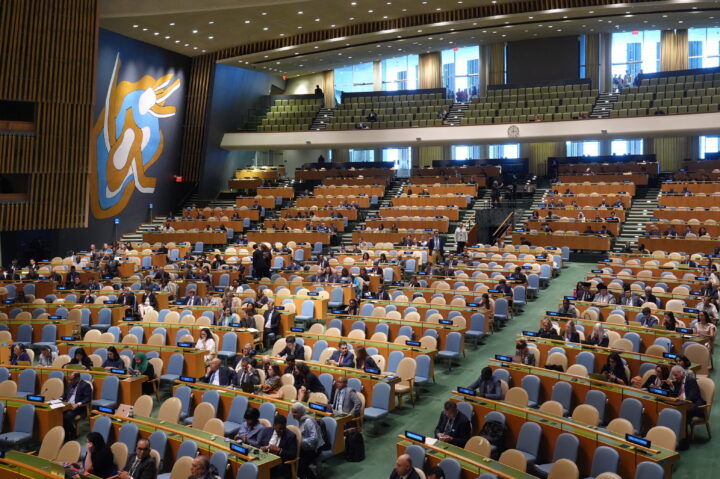
Selcuk Acar/Anadolu via Getty Images
A general view of hall at the High-Level International Conference on achieving a peaceful resolution to the Palestinian question and implementing a long-term sustainable peace, reviving the prospect of a two-state solution at the United Nations headquarters in New York, United States on July 29, 2025.


 Add JewishInsider on Google
Eleven countries declared their intention to recognize a Palestinian state in conjunction with Tuesday’s France and Saudi Arabia-sponsored conference at the United Nations on a two-state solution.
The Arab League, along with the entire European Union and seventeen additional countries, signed the “New York Declaration,” which details a plan starting with the immediate end of the war and concludes with an independent, demilitarized Palestinian state living peacefully next to Israel. The declaration calls for UNRWA — the U.N. agency for Palestinian refugees, some of whose employees participated in the Oct. 7 attacks — to take part in the transition, and for the Palestinian Authority to implement reforms and hold democratic elections within a year.
Notably, by signing the declaration, for the first time, the entire Arab League — including Hamas benefactor Qatar — condemned Hamas’ Oct. 7 attacks on Israel and called for the terrorist group to disarm, give up its rule over Gaza and release the hostages in order to end the war.
A separate statement, the “New York Call,” was signed by 15 Western countries, six of whom already recognized a Palestinian state, and another nine who “expressed or express willingness … to recognize the state of Palestine as an essential step towards the two-state solution, and invite all countries that have not done so to join this call.”
Most U.N. member states — 145 out of 193 of them — recognize a Palestinian state, the vast majority of them having followed the Soviet Union in doing so in 1988. Nine of them took the step after the Oct. 7 attacks and the start of the war in Gaza. Eleven more announced the intention to do so this week.
The countries that joined the “New York Call” were Andorra, Australia, Canada, Finland, Luxembourg, Malta, New Zealand, Portugal and San Marino.
The declaration came hours after British Prime Minister Keir Starmer said that his country will recognize a Palestinian state by September if Israel does not reach a ceasefire with Hamas — though Hamas is the one who rejected such a deal last week — and commit to not annexing the West Bank and agree to reviving the idea of a two-state solution.
Last week, ahead of the conference, French President Emmanuel Macron announced that Paris would also recognize a Palestinian state in September at the U.N. General Assembly.
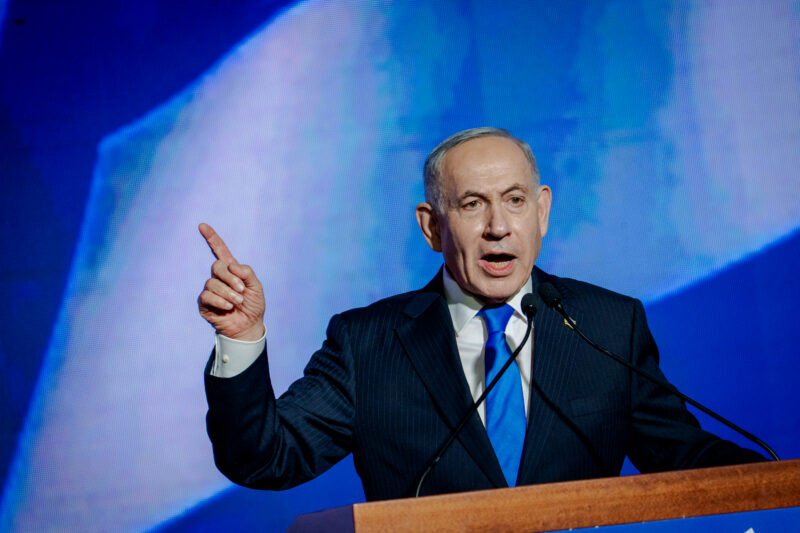
The response from Jerusalem was overwhelmingly negative, with Israeli Prime Minister Benjamin Netanyahu warning that recognizing a Palestinian state “rewards Hamas’s monstrous terrorism and punishes its victims … Appeasement towards jihadist terrorists always fails.” Foreign Minister Gideon Sa’ar called the statements “a reward for Hamas … at a time when Israel is still fighting in Gaza and there are still Israeli hostages there,” and “a rash and ill-considered decision, primarily driven by internal political considerations and pressures.”
Israeli opposition leader Yair Lapid wrote that “if Europe genuinely wants a Palestinian state to come into being one day, it needs to … demand that the Palestinians change … Declaring support for those who handed out candy in the streets of [the West Bank cities of] Nablus and Hebron on the morning of Oct. 7 does not advance a two-state solution. If anything, it pushes it further away.”
The State Department also called the conference an “unproductive and ill-timed publicity stunt” that will “embolden Hamas and … undermine real-world efforts to achieve peace … It keeps hostages trapped in tunnels.”
Former hostage of Hamas Emily Damari, a British citizen, posted on X that Starmer’s recognition of Palestinian statehood “risks rewarding terror [and] sends a dangerous message: that violence earns legitimacy … Recognition under these conditions emboldens extremists and undermines any hope for genuine peace. Shame on you.”
The Hostages Families Forum said that “recognizing a Palestinian state while 50 hostages remain trapped in Hamas tunnels amounts to rewarding terrorism … The abduction of men, women, and children, who are being held against their will in tunnels while subjected to starvation and physical and psychological abuse, cannot and should not serve as the foundation for establishing a state … The essential first step toward ensuring a better future for all peoples must be the release of all hostages through a single, comprehensive deal.”
Dan Diker, president of the Jerusalem Center for Security and Foreign Affairs, said in an interview with Jewish Insider that the move to recognize a Palestinian state emboldens Hamas, in that it convinces them that “they’re winning the long game. Hamas now says ‘The West is with us.’ This is exactly what they want, to pressure and corner Israel to succeed, and Hamas will say, ‘We’re not going to release the hostages.’ They’re just biding their time.”
Emmanuel Nahshon, the Israeli Foreign Ministry’s former deputy director for public diplomacy and a former ambassador to Brussels who resigned in protest against the government last year, told JI that 11 countries saying they’ll recognize a Palestinian state in one week creates “a slippery slope” towards diplomatic isolation for Israel.
“This enables countries that were friendly with Israel to criticize us publicly, and strengthens extremely radical elements in those countries,” Nahshon said. “It’s a kind of perfect storm with the purpose of delegitimizing Israel.”
Among those countries, he said, are Canada, the Netherlands and France.
“These are countries that we always considered to be like-minded, in terms of a point of reference for the State of Israel. We don’t want to compare ourselves to African dictatorships; rather, we see ourselves like Western European democracies. Now, Western European democracies are growing more and more distant from Israel,” Nahshon said.
Diker said that 11 countries recognizing a Palestinian state is “very dangerous in the perception war.”
“This is the greatest success for what was originally a Soviet plan, that the Palestinians under [PLO leader Yasser] Arafat and [Palestinian Authority President] Mahmoud Abbas and then Hamas inherited. The strategy is to divide … Western states from Israel, isolate Israel, and cause it to bleed to death,” he said.
Diker noted that France and the U.K.’s position is especially consequential because they are permanent members of the U.N. Security Council aligned with the U.S. If London and Paris follow through and recognize a Palestinian state, the U.S. will be the only permanent member of the UNSC not to do so.
Diker said that “what Starmer and Macron … [did] is an ill-advised move … The PA have not satisfied any of the requirements for statehood. They don’t have a functioning government; they don’t have control over the population or the ability to engage in international relations — they have 100 political warriors they call diplomats and all they do is subvert Israel.”
Nahshon added that the countries “are not stupid; they know that even if they recognize a Palestinian state it doesn’t mean there is a Palestinian state. You can trust the international community that they understand fully well that it won’t have practical, immediate implications, certainly not when Palestinians are unable to run their own state and possibly unwilling to have their own state, because if you ask most Palestinians, they would rather destroy Israel.”
Rather, he said the move to recognize a Palestinian state “sends a message to Israel of criticism and disapproval,” Nahshon said. “It’s addressed first and foremost at Israel … It’s a vote of no confidence addressed at the Israeli government saying, ‘We are very unhappy with the way you run the war in Gaza and with the free hand given to extreme settlers.’ The message is addressed to Netanyahu and his government.”
Diker pointed out that Starmer is “a well-heeled international lawyer, a human rights lawyer,” and that he and Macron “see themselves as being the human rights conscience of the Europeans” but put pressure mainly on Israel, “ironically, while Hamas kills and tortures its own people while they’re seeking humanitarian aid.”
“Israel has had a very serious problem in leading the narrative,” Diker said. “This is narrative warfare … [that] brought us to where we are … Israel has got to pull itself together and prosecute a soft power war.”
Diker called for there to be widely-released images of “Israeli soldiers handing food and aid to the Gazans. That is political, cognitive warfare. We should be seen doing that.”
Asked if that might be a domestic political risk to the current Israeli government, Diker said: “If we’re totally isolated internationally, it’s a fundamental threat to our existence. We can’t operate in a vacuum.”
More Stories

Super Ball
Robert Kraft’s Blue Square gala pulls in $32 million as NYC’s Waldorf glows blue

EDUCATION INVESTIGATION
House Education Committee finds systemic antisemitism in Philadelphia, Berkeley K-12 schools
SUNSHINE STATE RETREAT
House GOP leadership super PAC pulls ad spending against Jared Moskowitz
CALLING IT OUT
Rep. Don Bacon blasts Dan Osborn over ‘anti-Jewish’ ad
DFL DISCORD
Amy Klobuchar, Angie Craig condemn Hasan Piker ahead of Minneapolis event with Ilhan Omar

PIKER PROBLEM
Hasan Piker event in Minnesota with Ilhan Omar faces growing backlash
Please log in if you already have a subscription, or subscribe to access the latest updates.
 Continue with Google
 Continue with Apple