





















































Sen. Murphy accuses admin of ‘active cover-up’ of Iran war, vows to leverage funding to end war
The Connecticut senator also said he warned Saudi leaders that the proposed U.S.-Saudi nuclear deal would not survive into a Democratic presidency
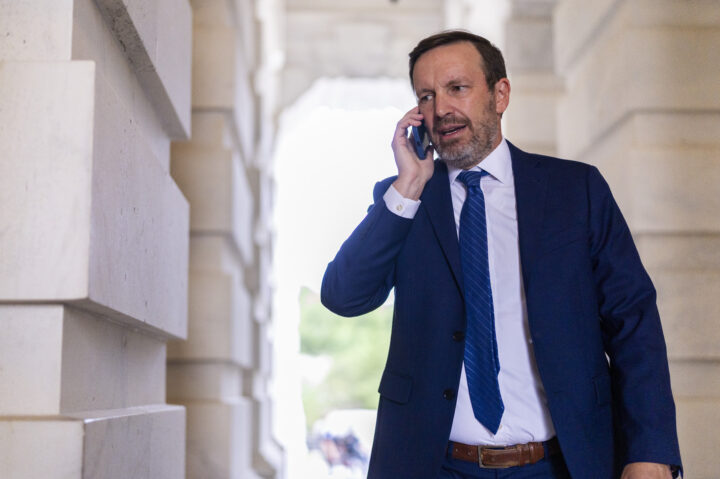
(Finn Gomez/Getty Images)
U.S. Sen. Chris Murphy (D-CT) enters the U.S. Capitol Building on August 07, 2026 in Washington, DC.


 Add JewishInsider on Google
Sen. Chris Murphy (D-CT) accused the Trump administration of an “active cover-up” of the costs of the war in Iran and vowed that Democrats would use funding and investigative authorities in the next Congress to force an end to the war.
He also said that he’d warned Saudi officials during his visit this week that the U.S.-Saudi nuclear deal, as currently constructed, would not survive under a Democratic president and urged them to renegotiate it.
The Connecticut senator told reporters on Thursday that Democrats next year should not appropriate funding for the Department of Defense or pass a National Defense Authorization Act without specific requirements to end the war.
He said Democrats will also conduct investigations of the administration and suggested that Democrats might break norms in the Senate requiring bipartisan agreement to schedule hearings and meetings in order to pursue investigations of “this mind-blowing corruption in our foreign policy.”
Murphy has said he was blocked from visiting military installations or receiving briefings from military leaders while in the region, which he described as unprecedented; he said that had not even occurred in Iraq and Afghanistan during the height of those conflicts while U.S. bases were under attack.
Murphy said he plans to draft legislation, and would be interested in using the appropriations and authorization process next year, to include language specifically requiring the Department of Defense to allow members of Congress to access military bases overseas.
Murphy said he saw “extensive damage” to the U.S. Embassy in Riyadh caused by Iranian drone strikes, and argued that the war should lead the U.S. to reassess and reduce its presence in the Middle East going forward.
“This is a moment for the United States to reconsider its footprint in the region,” Murphy said, calling U.S. bases “sitting ducks for the Iranians” that are “not protecting us” because the U.S. had to draw back from them as soon as the war with Iran began.
He said the U.S. may need to maintain some presence at its current bases, also noting Qatar’s strong desire to maintain al-Udeid, the largest U.S. air base in the region, but said it’s unclear whether the U.S. should rebuild its bases to the extent that they existed prior to the war.
In Riyadh, Murphy said he’d warned Saudi leaders that the recent nuclear deal, which would open the door to enrichment inside Saudi Arabia, may not last beyond the end of the Trump administration without the so-called “Gold Standard” provisions preventing enrichment and reprocessing of uranium and allowing at-will inspections of any site by the International Atomic Energy Agency.
Murphy himself has been seen as a potential Democratic presidential candidate in 2028.
“There is a risk that this could lead to the full nuclearization of the Middle East,” Murphy said. “The Emiratis will clearly come back and want the additional protocols dropped [from their agreement with the U.S.]. The Qataris and others are likely going to try to rush to the precipice of nuclear weapons power, and of course it is likely to be escalative, causing the Iranians to be less willing to do a nuclear deal with us.”
He said he told Saudi officials he might not even support the nuclear deal with those enhanced provisions, but that it would be more likely that the next Democratic president would uphold the deal if it meets those standards. He said Saudi Arabia’s objections to the enhanced inspection protocols “made no sense to me.”
He said that the visit to the region had shown him “how this war [in Iran] is spiraling downward very quickly” and that Saudi Arabia has the posture of a “country at war” as it resumes operations against the Houthis in Yemen alongside the Yemeni government.
He said that renewed conflict in Yemen will lead to the deaths and starvation of thousands and argued that Saudi Arabia should not be involved in the “Yemeni civil war” — despite repeated Houthi attacks on Saudi Arabia — and that the U.S. should stay out of the conflict as well.
Murphy acknowledged that the current phase of the war is “different” than the way the conflict was fought in the late 2010s, to significant criticism from Murphy and other U.S. lawmakers at the time. He argued that Saudi Arabia’s operations against the Houthis would not have restarted without the Iran war.
“It is true that this is now just one theater, and the Saudis, of course, have a right to try to protect themselves,” Murphy said. “In their mind, the only way to protect themselves is to run a ground operation inside Yemen.”
But he said he does not think that Saudi Arabia has a “clear set of objectives” in the conflict and instead plans to “push as far as they can,” and accused the Trump administration of entering the U.S. into the war by providing military advisors and aerial refueling to Saudi Arabia.
He warned that the war might provide an opportunity for al-Qaida to reform in the Arabian peninsula and that he believes congressional action will be necessary to prevent U.S. involvement in the war.
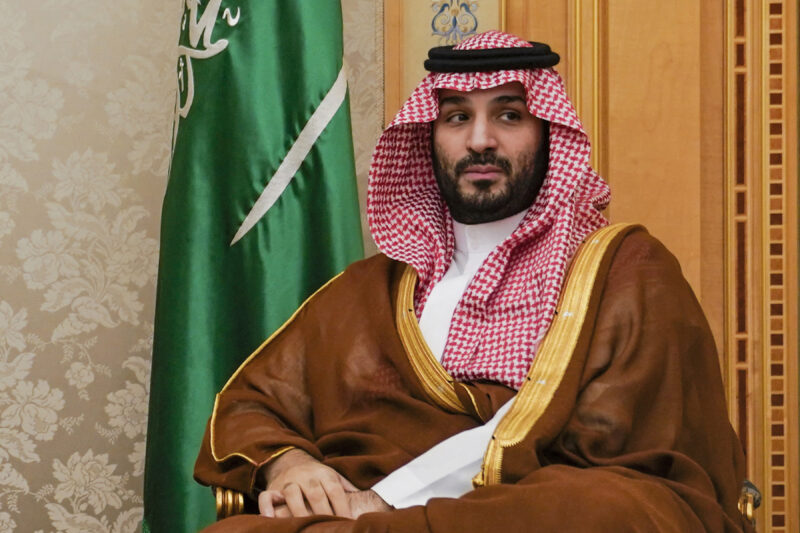
Murphy said he’d spoken to both Saudi Crown Prince Mohammed bin Salman and Qatari Emir Tamim bin Hamad Al Thani about “Trump’s foreign policy corruption.”
“I told the Qataris that no matter how much pressure they got from Donald Trump to gift that plane, they should have said no,” Murphy said. Public reporting has not indicated that Qatar was pressured to gift the jumbo jet now serving as Air Force One. “Knowing that this was a corrupt deal, the Qataris should have said no.”
He said that he also told MBS that his and Saudi Arabia’s investments in Jared Kushner’s private equity fund and his invitations to Trump and business affiliates to partner on projects in Saudi Arabia “was an enormous problem for the U.S.-Saudi relationship in the long run.”
“Both leaders told me that they believed this to be good business, and they claimed, of course, that they were doing nothing illegal on their end of the deal,” Murphy continued.
He said he saw a “legitimate social and cultural transformation happening in Saudi Arabia” but also said he spent a significant portion of his meeting with MBS pressing him over issues of free expression in the kingdom, which Murphy characterized as having backslid dramatically in the last decade.
“There is no room to dissent from the kingdom’s policies, and that’s unacceptable,” Murphy said. “MBS told me when I pressed him on this that he needed to eliminate the ability for political speech in order to get his social reforms done. … It seems to me just an excuse, a cover for what is a political campaign of repression designed to keep himself in power.”
He said that he had serious concerns about meeting with MBS at all, “given my criticism and given the legitimacy that sometimes comes with meetings with leaders in the United States,” but said that he’s concerned that Saudi leadership is “hearing only one view from the United States” and needs to hear more from Democrats about corruption concerns and political dissent.
Murphy also said, from his conversation with a Qatari official involved in negotiations between the U.S. and Iran, that negotiations over ending the war are far from complete, but would likely require the U.S. to give billions in sanctions relief and frozen funding in return for “relatively small commitments” from Iran on its nuclear program.
Murphy called Rep. Wesley Hunt (R-TX), the administration’s nominee for U.S. ambassador to Saudi Arabia, “a joke” who will cause more trouble in the U.S.-Saudi relationship.
More Stories
FLORIDA FACTOR
David Jolly looks to translate moderate, pro-Israel record in Congress to upset in Florida governor’s race
MENDING FENCES
Haley Stevens to campaign for El-Sayed after fiancé backs Rogers
MED MISSION
Rick Scott says Israel, Greece, Cyprus trip ‘reinforced’ his critical approach to Erdoğan
CROSSING OVER
Republican Jewish Coalition rallies bipartisan audience behind Mike Rogers
QATAR-ING FAVOR
KIND founder Daniel Lubetzky calls Semafor’s Qatar ties ‘downright unethical’
EL-SAYED'S TEST
Haley Stevens conditions support for El-Sayed on his condemnation of antisemitic ads
Please log in if you already have a subscription, or subscribe to access the latest updates.
 Continue with Google

 Continue with Apple