





































Netanyahu won’t rule out targeting ayatollah amid speculation about regime change
The Islamic Republic’s leadership is significantly weakened domestically by Israeli strikes, but experts differ on whether regime change is likely

Avi Ohayon/GPO
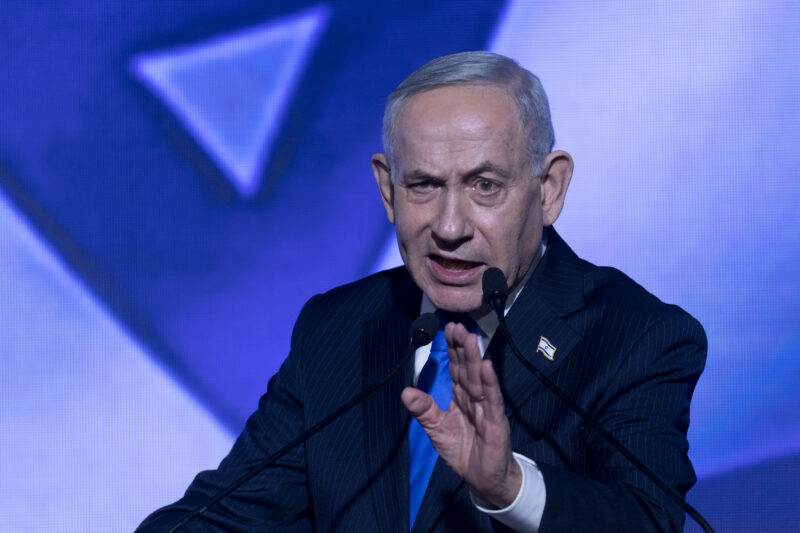
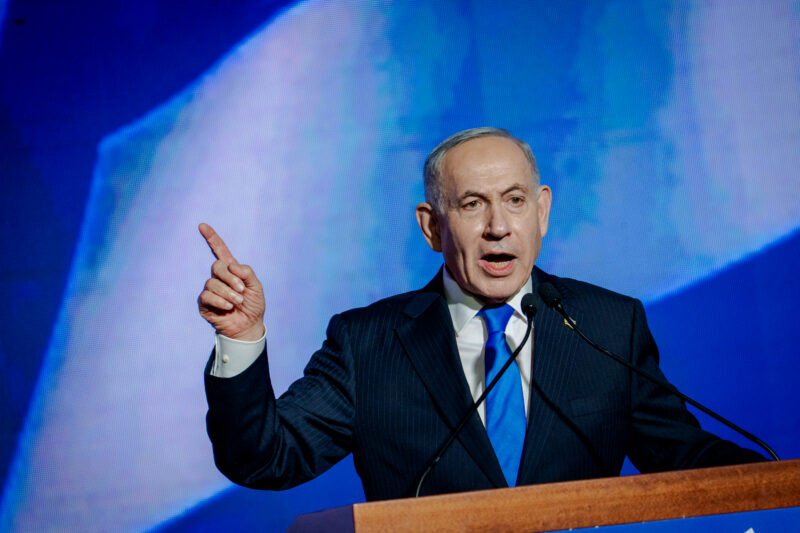
Israeli Prime Minister Benjamin Netanyahu manages Operation Rising Lion.


 Add JewishInsider on Google
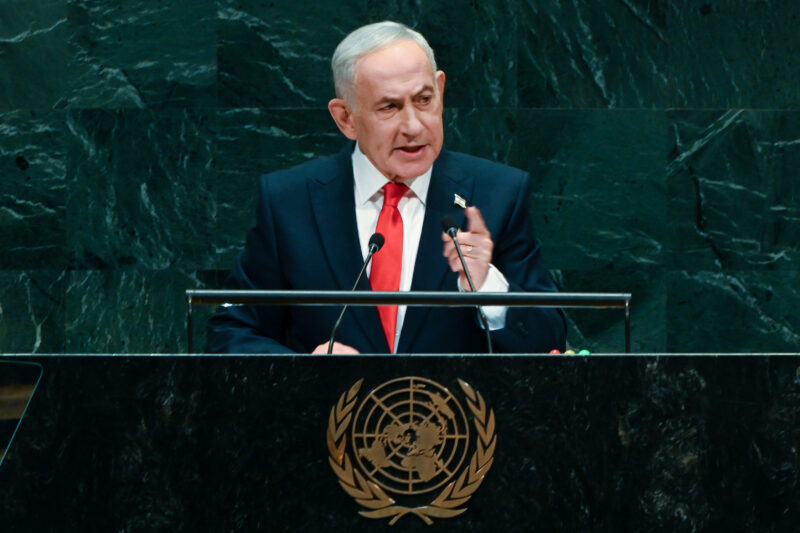
Israeli Prime Minister Benjamin Netanyahu did not rule out the possibility of targeting Iran’s supreme leader, Ayatollah Ali Khamenei, in an interview with ABC News on Monday, amid widespread speculation in Israel and beyond that the strikes on the Islamic Republic could pose an existential challenge to the regime.
Netanyahu said Israel was “doing what we need to do,” when asked if Khamenei would be targeted in the strikes.
Regarding reports that President Donald Trump vetoed plans for Israel to kill the ayatollah because it may lead to an escalation, Netanyahu said, “It’s not going to escalate the conflict, it’s going to end the conflict. We’ve had half a century of conflict spread by this regime that terrorizes everyone in the Middle East.”
Netanyahu said that the fall of the Iranian regime “could be a result, because this regime is weak, and suddenly understands how weak it is… We could see tremendous changes in Iran.”
Israel did not name overthrowing the ayatollah’s regime as one of the goals of its operation against Iran as authorized by Israel’s security cabinet, but Israeli airwaves have been full of enthusiasm for the prospect. An Israeli defense source told Jewish Insider earlier this week that regime change was not included in the war aims because it would not have “international legitimacy” to do so, but that Jerusalem would favor such an occurrence.
The nightly airstrikes on Iran since last Friday have degraded the regime by taking out some of its leading figures, including Islamic Revolutionary Guard Corps Commander Hossein Salami and the IRGC’s intelligence chief and his deputy.
“Every day [Israel is] bringing down the regime a little more,” Ben Sabti, an Iran expert at the Institute for National Security Studies at Tel Aviv University, told JI on Monday. “It’s like we are pushing them closer to the edge every day. It’s a big country, so it takes time.”
Sabti argued that “even if Israel isn’t aiming to bring down the regime, it is on the way to doing so, because it is hurting the basis on which it stands — the Islamic Revolutionary Guard Corps.”
He said that Israel’s targeting of key military and intelligence figures is “like killing nuclear scientists; the facilities are still there but there isn’t anyone to run it. The same is true with the government as more and more senior people fall.”
Khamenei handpicked the leading figures in the IRGC, and they also control Iran’s “resistance economy,” its circumvention of sanctions, as well as its oppression of the Iranian people, including enforced modesty, Sabti said.
”When you strike the IRGC, everything is shaken up,” he added. “It’s not like in a democratic state where, if a general is killed, they can still function.”
Israel struck the complex hosting Iranian state news channel IRINN on Monday, and the explosion could be heard live on the air. The IDF said that the building was “a communication center that was being used for military purposes by the Iranian Armed Forces … under the guise of civilian activity, covering up the military use of the center’s infrastructure and assets” and that the IDF sent advance warnings to the civilian population in the area. Israeli Defense Minister Israel Katz said that “the propaganda and incitement broadcast authority of the Iranian regime was attacked by the IDF after the broad evacuation of the residents of the area. We will strike the Iranian dictator everywhere.”
Sabti said that he saw many Iranians post on social media that they hoped that Israel would target the broadcast authority, and accused the regime of staging videos to make it seem like there are more civilian casualties in Iran.
“The public isn’t buying the propaganda,” he said.
In addition, Sabti noted, many senior Iranian officials, including Khamenei, have not been seen in public since the war began, which is being viewed as a sign of weakness.
Meir Javedanfar, a lecturer on Iranian politics at Reichman University, said that Israeli strikes have put “unprecedented pressure on the regime … People are fleeing Tehran; they are pulling their money out of the banks as much as they can. They are doing what Iranians do in crises, which is filling cars with petrol, and there’s not enough petrol. It’s difficult to see how the government can continue governing this way, because the pressures are tremendous.”
Sabti and Javedanfar both cited people fleeing Tehran in the largest numbers since the 1980-1988 Iran-Iraq War as an indication that the people of Iran do not support the regime.
”In the 1980s,” Sabti recounted, “I saw with my own eyes when we were attacked by missiles and planes, people made human chains around government buildings, to defend them. The Iraqis came and attacked anyway; we [Israelis] are more humane.”
Now, Sabti said, people are not showing that kind of support and “there is a disconnect between the people and the regime … The minorities are against the regime, women are against the regime, the general public is against the regime.”
That being said, Sabti estimated that the number of people hanging signs against the regime or shouting “death to Khamenei” is very small, and “there is not enough energy yet in the public for the regime to fall.”
Iranians, Javedanfar said, “don’t see this as a war they’re involved in. It’s not their responsibility. It’s between Khamenei and Israel. They are not going to do regime change for Israel. What they’re considering is that this is a regime invested more in Hamas and Hezbollah than in the domestic electricity production capability. Even before this crisis, there were electricity cuts.”
One thing that could encourage the fall of the Iranian regime, Sabti suggested, would be for Trump to say he wants that outcome.
“If Trump would talk about regime change, it would really happen. It would bring down the government,” Sabti, who grew up in Iran, predicted. “America is America, there is no one else like them.”
Javedanfar, however, said that the threat of regime change “is meant to get Khamenei to compromise on a nuclear agreement with Trump.”
The most important strategic goal, Javedanfar said, is for Iran to enter an agreement to end its uranium enrichment, which would mostly eliminate its nuclear program, and to make Iran reconsider and change its policies of aggression against Israel, directly and through proxies.
“There’s a proverb in Persian,” Javedanfar said: “‘You threaten someone with death so they will settle for a fever.’ You threaten the other side with something far worse to get them to agree to what you want. I think this is the strategy. Israel cannot overthrow the regime but it is using the threat to create conditions which could potentially make the regime believe that it could be overthrown, and that’s good enough for Israel.”
Javedanfar was skeptical about the possibility of regime change in the short term, because “to overthrow a regime, you need an alternative. Who’s going to take over?”
Sabti and Javedanfar both said that Prince Reza Pahlavi, the son of the deposed shah of Iran, who lives in the U.S. and has been giving interviews to the international media in recent days, does not appear to be leading an effort on the ground in Iran.
“It’s difficult to know how popular he is,” Javedanfar said. “There are enough reasons to say he’s a suitable alternative and reasons to say he isn’t, because he doesn’t have the capacity or the people.”
Pahlavi is “trying,” Sabti said, but would need outside help to take a leadership position, such as through outreach to the U.S. or Israel to back him, which Sabti thought would be very effective.
“The son of the king needs more energy. He is very beloved in Iran, I see a lot of posts about him, but that’s good for the Internet. How will he organize people? How will he organize demonstrations? How will he come back? The public is saying ‘come back,’ but he needs an organization. He would need to take things up a level,” Sabti said.
Another alternative to the current regime may be a dissident in an Iranian prison, Sabti said, noting that there have been many social media posts calling for Israel to target prisons so that people can escape.
Sabti pointed to a group of 14 political activists in prison since 2019 for writing a letter calling on Khamenei to resign and for the Islamic Republic to be replaced by a democratic, secular state.
”If they get out, there could be a massive change,” he said.
Sabti also speculated that an IRGC general may lead a coup “to save Iran, but more to save himself … Someone who is within the system, just like in the Soviet Union.”
More Stories
BIBI BOOST
Netanyahu bloc gains on Gadi Eisenkot’s opposition in latest Israeli polls
LESSONS LEARNED?
Three years after Oct. 7, Israel’s security is ‘much better,’ but risks loom

TORAH AND TAXES
First female Haredi candidate promises reform to ultra-Orthodox politics
NOT ON BOARD
Lansing Mayor Andy Schor, a Jewish Democrat, says he’s not supporting El-Sayed
Daily Overtime
New York braces for Oct. 7 protests

FUNDRAISER FALLOUT
Attendee at El-Sayed fundraiser bragged about beating up pro-Israel demonstrator
Please log in if you already have a subscription, or subscribe to access the latest updates.
 Continue with Google
 Continue with Apple