





















































Ro Khanna to urge negotiators to pull U.S.-Israel cooperation provisions from defense bill
The letter, championed by the Caliifornia Democrat, currently has 30 Democratic co-signatories
Andrew Harnik/Getty Images
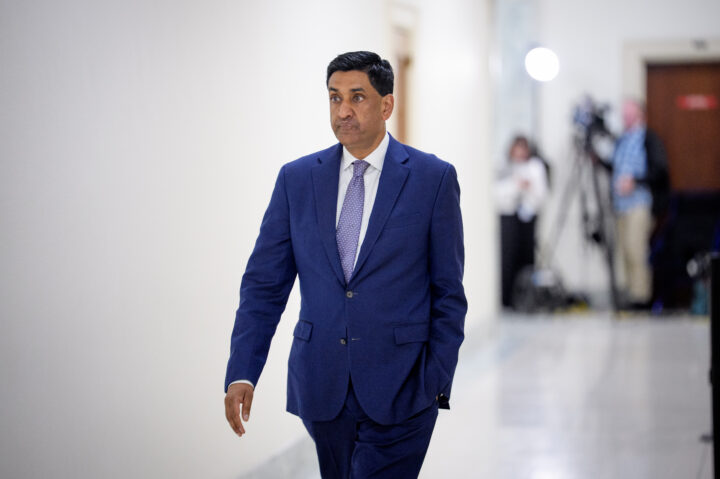
Rep. Ro Khanna (D-CA) on Capitol Hill on May 18, 2026, in Washington, DC.


 Add JewishInsider on Google
Rep. Ro Khanna (D-CA) and a group of at least 30 Democratic colleagues in the House and Senate are set to urge House and Senate leaders negotiating the 2027 National Defense Authorization Act to strip out a provision regarding U.S.-Israel cooperation that has drawn backlash from the far left and far right, according to a draft of the letter viewed by Jewish Insider.
Khanna has been a leading opponent of the provision since the NDAA came through the House Armed Services Committee, where his effort to remove the provision was defeated by a voice vote. House Republicans did not permit a vote on an amendment by Khanna and Rep. Thomas Massie (R-KY) to remove the provision when the bill came to the House floor.
The bill is likely to be largely finalized in negotiations between House and Senate committee leadership before it comes before both chambers for a final vote. Khanna’s letter, which is set to continue gathering signatures through Nov. 6, appeals to the chairs and ranking members of the House and Senate Armed Services Committees to strip the provision, versions of which have been included in both the House and Senate versions of the bill, as part of the negotiations.
The letter describes the provision as creating an “unprecedented integration of the United States defense industry with the defense industry of a foreign nation,” and describes the process to advance the provision as rushed and requiring greater deliberation as part of a “fundamental reassessment of the U.S.-Israel security relationship.”
“These provisions would significantly reduce Congress’ oversight of the U.S.-Israel defense relationship,” the letter states. “They would embed Israeli technology directly into acquisition programs and co-production lines, and once those commitments are made, the cost of reversing them may become prohibitive for any future President or Congress.”
The letter urges that, if the provision isn’t removed entirely, Congress should be required to reauthorize it annually, that human rights conditions should be added and that a counterintelligence certification should be required in advance of any technology transfer.
The provision, based on the U.S.-Israel FUTURES Act, would largely streamline and expand a variety of areas of cooperation that already exist between the U.S. and Israel. Its supporters, on a bipartisan basis, have argued that it significantly benefits the United States and its service members through access to Israeli technology and that opponents have misrepresented the provision and overstated the scope of its impact.
Supporters have emphasized that the provision would create no new programs nor provide for greater integration of the U.S. and Israeli militaries, and that it requires regular transparency reports to Congress and the public on the cooperative programs.
Khanna’s letter asserts that the provision would “reward” Israeli actions in Gaza, the West Bank and Lebanon, arguing, “These are not the actions of a government whose defense establishment should be granted deeper access to American military technology, nor rewarded with U.S. defense contracts.”
The letter further alleges that by utilizing Israeli technological innovations or working with Israel on such innovation, the U.S. would be “morally and legally implicate[d]” in alleged Israeli violations of international human rights law.
Though previous NDAAs already provided for U.S.-Israel cooperation on “emerging technologies” including artificial intelligence, cybersecurity, quantum computing and automation, with requirements to protect sensitive information and technology from adversaries, the letter frames the provision as a novel risk to U.S. technology security.
And it describes the provision as potentially damaging to American industry, though the cooperative programs are designed to support and grow the defense industrial bases of both countries.
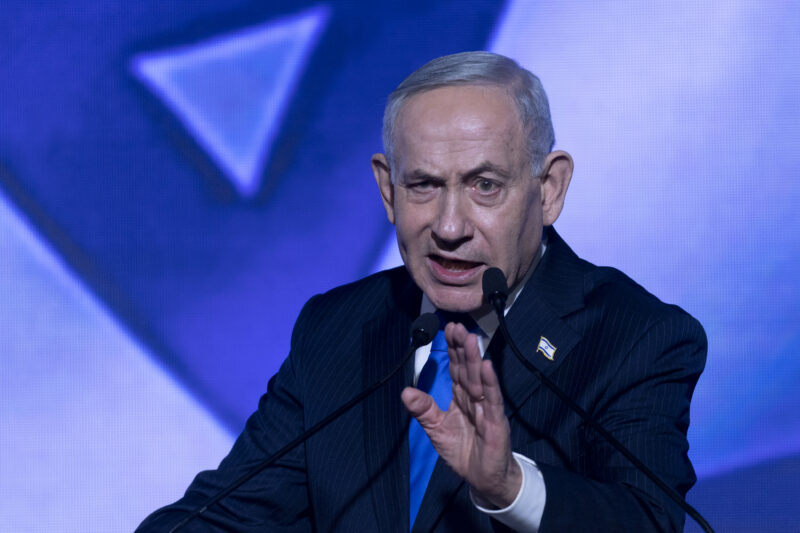
The letter also again links the NDAA provision to a letter by Israeli Prime Minister Benjamin Netanyahu supporting winding down direct U.S. aid, which referenced an entirely separate resolution.
Current signatories to the letter include Sens. Jeff Merkley (D-OR) and Bernie Sanders (I-VT) and Reps. Don Beyer (D-VA), Andre Carson (D-IN), Greg Casar (D-TX), Joaquin Castro (D-TX), Jasmine Crockett (D-TX), Madeliene Dean (D-PA), Chris Deluzio (D-PA), Mark DeSaulnier (D-CA), Maxine Dexter (D-OR), Veronica Escobar (D-TX), Valerie Foushee (D-NC), John Garamendi (D-CA), Val Hoyle (D-OR), Jared Huffman (D-CA), Jonathan Jackson (D-IL), Pramila Jayapal (D-WA), Zoe Lofgren (D-CA), Stephen Lynch (D-MA), Jim McGovern (D-MA), Analilia Mejia (D-NJ), Chellie Pingree (D-ME), Mark Pocan (D-WI), Emily Randall (D-WA), Lateefah Simon (D-CA), Melanie Stansbury (D-NM), Derek Tran (D-CA), Gabe Vasquez (D-NM) and Bonnie Watson Coleman (D-NJ).
More Stories

Daily Overtime
Syria’s new textbooks demonize Jews, report finds

FINAL SPRINT
DMFI to spend $7 million to support Reps. Don Davis, Shomari Figures
TEXTBOOK TEST
Syrian textbooks under al-Sharaa deny Israel’s right to exist and promote antisemitism, report finds

MAIL FAIL
El-Sayed letter to Jewish community on antisemitism fails to reassure skeptics
WAR WORRIES
Could another war with Iran be the October surprise of the Israeli election?
SCOOP
Chabad holding 250 menorah lightings in all 50 states to commemorate Chanukah, America’s 250th birthday
Please log in if you already have a subscription, or subscribe to access the latest updates.
 Continue with Google

 Continue with Apple