



























Plus, Rahm Emanuel says Israel support should come with strings
Joe Raedle/Getty Images
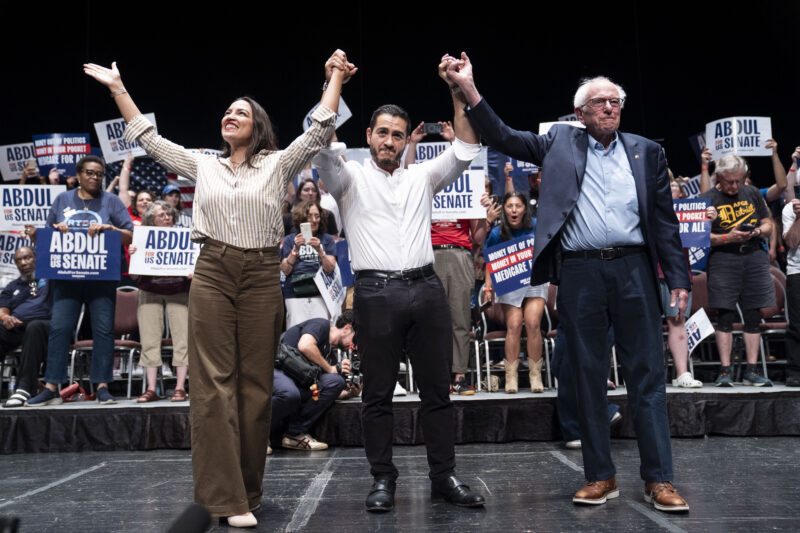
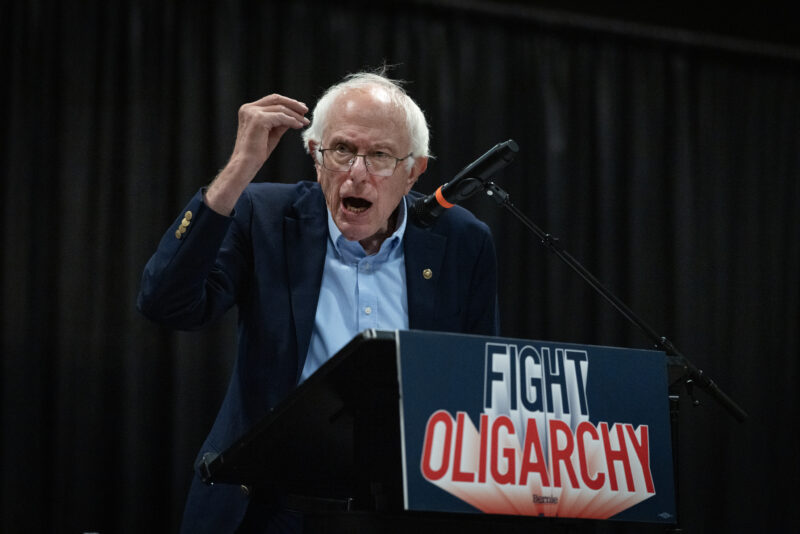
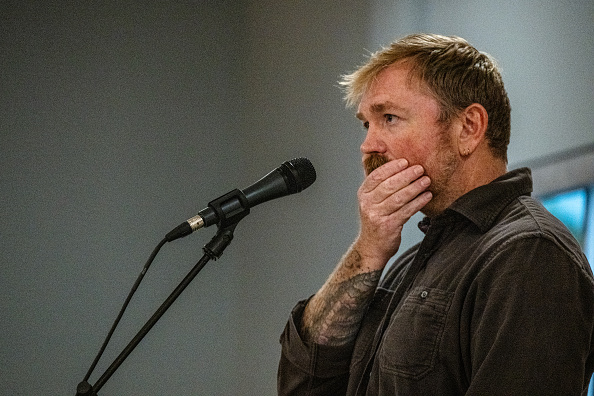
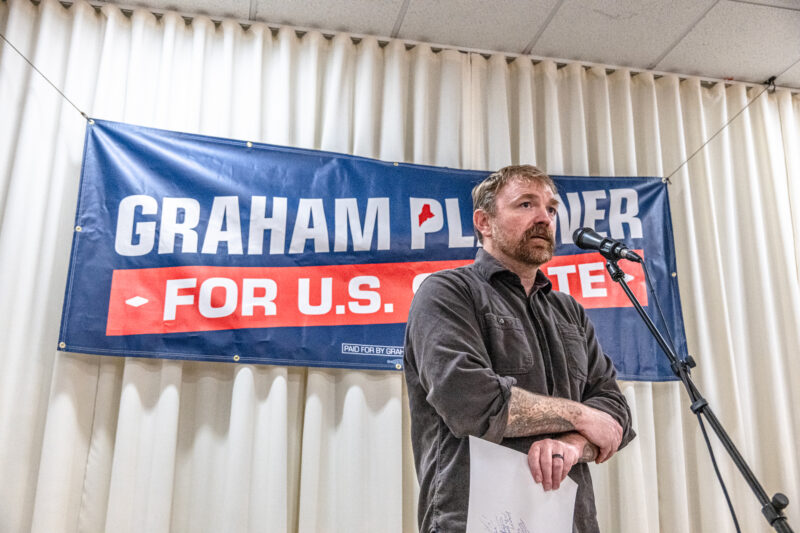
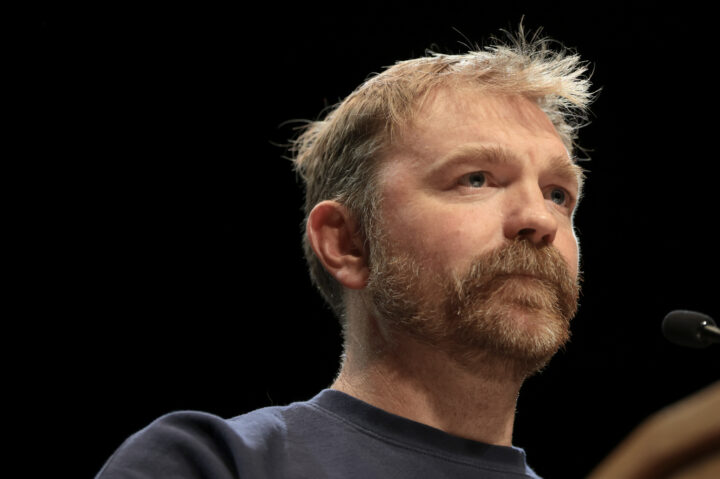
Democratic U.S. Senate candidate Graham Platner speaks at a “Fighting Oligarchy” tour stop held by Sen. Bernie Sanders (I-VT) at the Collins Center for the Arts on the University of Maine campus on May 24, 2026 in Orono, Maine.


 Add JewishInsider on Google
Good Monday afternoon.
This P.M. briefing is reserved for our premium subscribers like you — offering a forward-focused read on what we’re tracking now and what’s coming next.
Today’s Daily Overtime was curated by JI U.S. Editor Danielle Cohen-Kanik.
📡On Our Radar
Notable developments and interesting tidbits we’re tracking
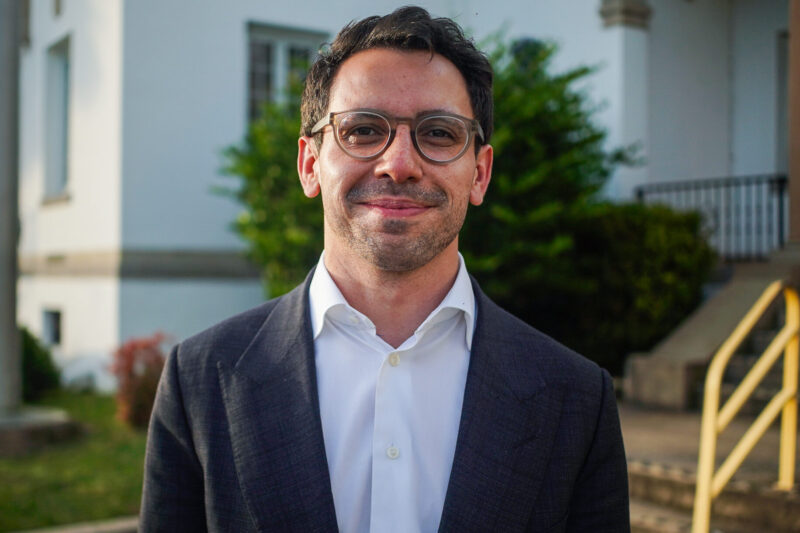
A woman who dated Maine Senate nominee Graham Platner alleged in a series of interviews with Politico that the Democrat sexually assaulted her in 2021, an account the outlet backed up with her correspondence and other interviews.The woman, Jenny Racicot, said Platner came into her home uninvited while intoxicated and forced himself on her despite her repeated objections.
In a video statement, Platner denied the accusation outright but said he’s “mindful of the political reality it will inflict” and would be “taking the time to reflect on the best path forward for the state that I love,” a different tone than Platner has struck in the aftermath of his previous controversies. The Maine Democratic Party can only choose a replacement nominee for the general election ballot if Platner voluntarily withdraws by July 13…
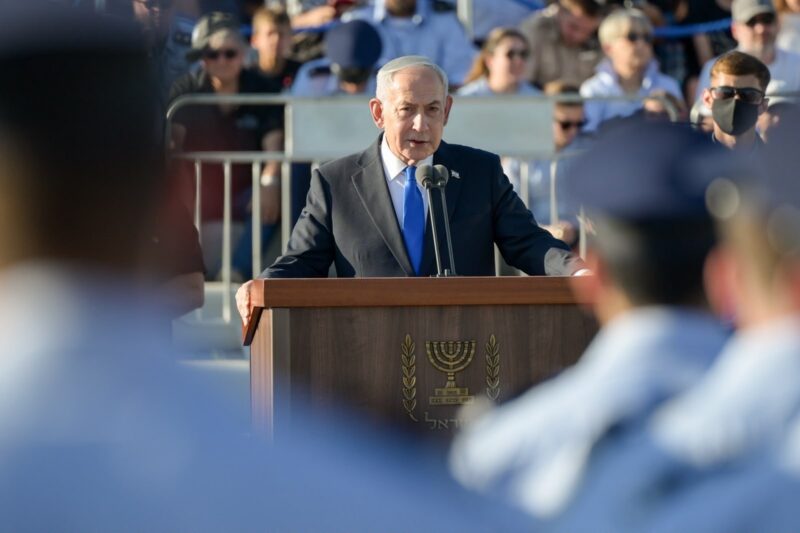
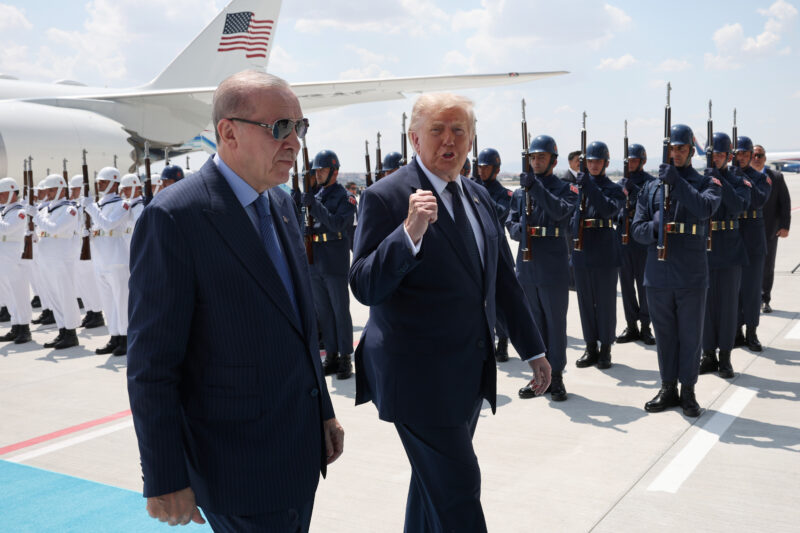
Israeli Prime Minister Benjamin Netanyahu voiced opposition today to the Trump administration’s sale of jet engines and potential sale of F-35 fighter jets to Turkey, hours before President Donald Trump was set to depart for the NATO summit in Ankara, Jewish Insider’s Christina Sher reports.
Netanyahu suggested on “Fox & Friends” that such moves “will upset the power balance in the Middle East, which is ultimately guaranteed by Israeli air superiority” and U.S. posture in the region. Axios reports that Netanyahu relayed the same message directly to Trump in a phone call last week and asked him to help address Turkish President Recep Tayyip Erdoğan‘s escalating anti-Israel rhetoric…
The percentage of Jewish Israelis who believe Israel’s security is a central consideration for Trump has reached a record low of 26%, according to a new survey from the Israel Democracy Institute, JI’s Matthew Shea reports. The figure marks a 15-point decrease from a month ago, during which time the Trump administration signed its memorandum of understanding with Iran…
Hamas spokesperson Hazem Qassem announced at a press conference in Gaza today that the terror group’s Emergency Committee — the administrative body that has governed the enclave for more than two decades — is dissolving and that its civil servants, who will remain in their roles, stand ready to work under the new technocratic government established by the Board of Peace.
The BoP expressed skepticism about the announcement, JI’s Emily Jacobs and Matthew Shea report, saying its “assessment will be guided by actions, not promises” and calling for a “genuine transfer of authority” and for Hamas to disarm. Israeli Foreign Minister Gideon Sa’ar dismissed the move outright, calling it a “trick … designed to prevent [Hamas’] own disarmament”…
Israeli Ambassador to the U.S. Yechiel Leiter said both Israel and Lebanon see the agreement signed between Jerusalem, Beirut and Washington earlier this month as “superseding” the first clause of the U.S.-Iran MOU, which calls for the end of hostilities on all fronts. “Whether or not the United States does, you’ll have to ask an administration spokesman,” Leiter said at an event with the Council on Foreign Relations.
Leiter also said he “can’t imagine that any ultimate agreement with Iran would be absent a clause limiting the development of ballistic missiles,” though the MOU did not mention Iran’s ballistic missile program…
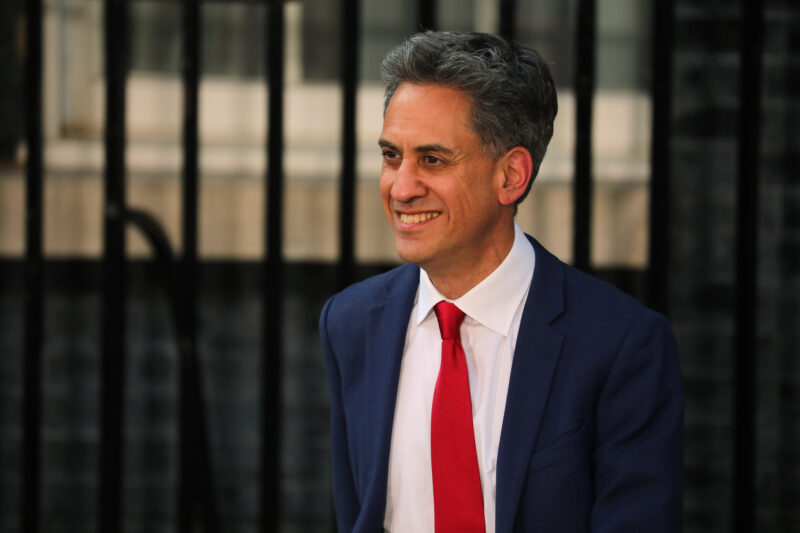
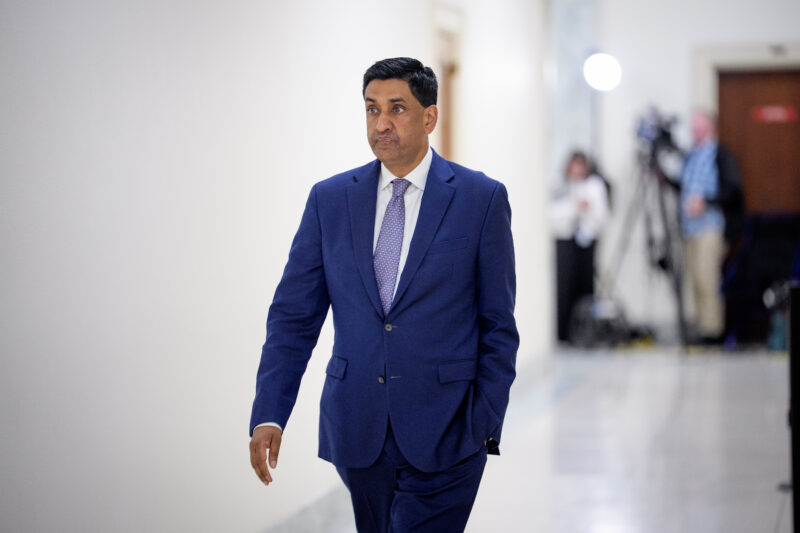
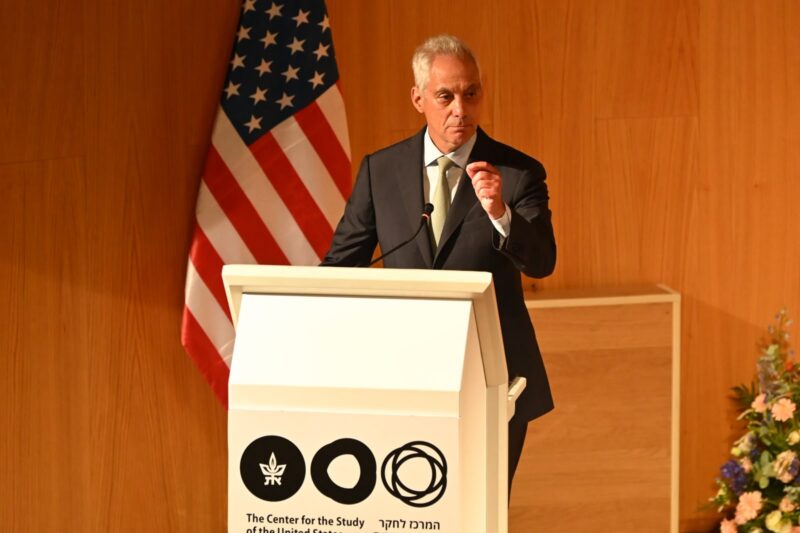
In a preview obtained by Politico of the speech former U.S. Ambassador to Japan Rahm Emanuel is set to deliver at Tel Aviv University on Wednesday, the prospective 2028 presidential candidate is set to say that the U.S. has spent too long “averting its eyes” from what he views as Israel’s misadventures, calling for “significant changes and a new direction” in the bilateral relationship.
“Going forward, Emanuel plans to say, Israelis should regard U.S. support as expressly contingent: On reviving a serious commitment to Palestinian sovereignty; On rejecting dreams of asserting dominion beyond official borders in pursuit of ‘Greater Israel’; On abandoning a security strategy that emphasizes brutally effective military force with scant attention to diplomacy or credible what-next plans in Gaza and Iran,” the outlet reported…
French President Emmanuel Macron became the first major Western head of state to visit Syria since the fall of dictator Bashar al-Assad in 2024, landing in Damascus today for meetings with Syrian leaders. Syrian President Ahmad al-Sharaa is also expected to meet with Trump on the sidelines of the NATO summit in Turkey this week…
⏩ Tomorrow’s Agenda, Today
An early look at tomorrow’s storylines and schedule to keep you a step ahead
The two-day NATO summit begins in Turkey tomorrow with leaders of all 32 NATO countries expected to attend, as well as a congressional delegation comprised of Sens. Dick Durbin (D-IL), Jeanne Shaheen (D-NH), Thom Tillis (R-NC), Chris Coons (D-DE) and Mike Rounds (R-SD) and Rep. Mike Turner (R-OH). At the top of the agenda are increasing defense investments, as Trump continues to press NATO allies to shoulder a greater share of the alliance’s defense burden and threatens to draw down U.S. troops from Europe, and continuing to support Ukraine in its war with Russia.
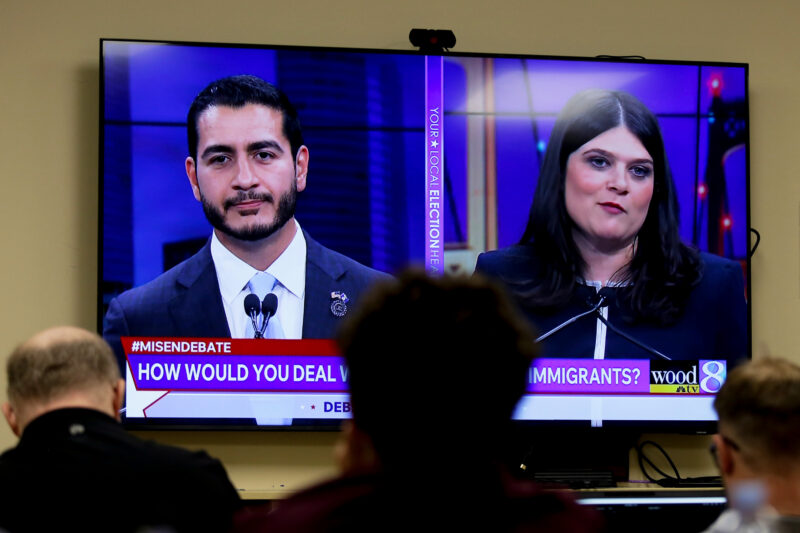
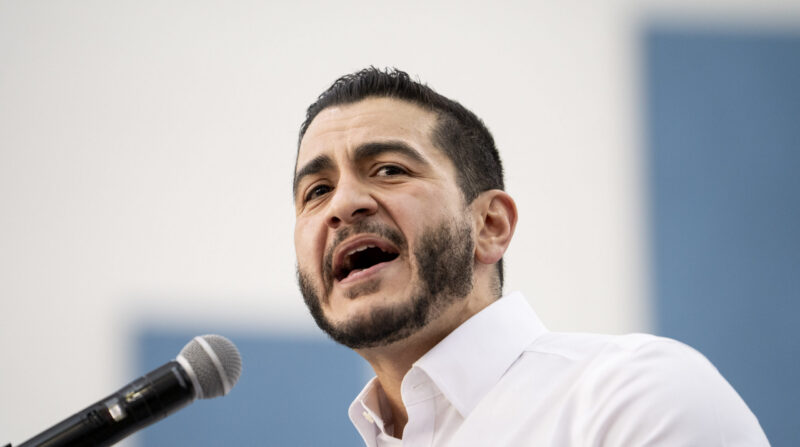
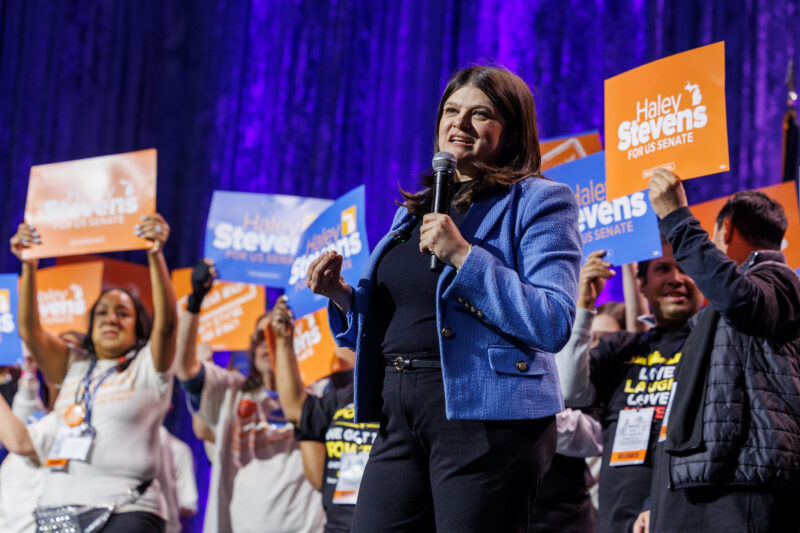
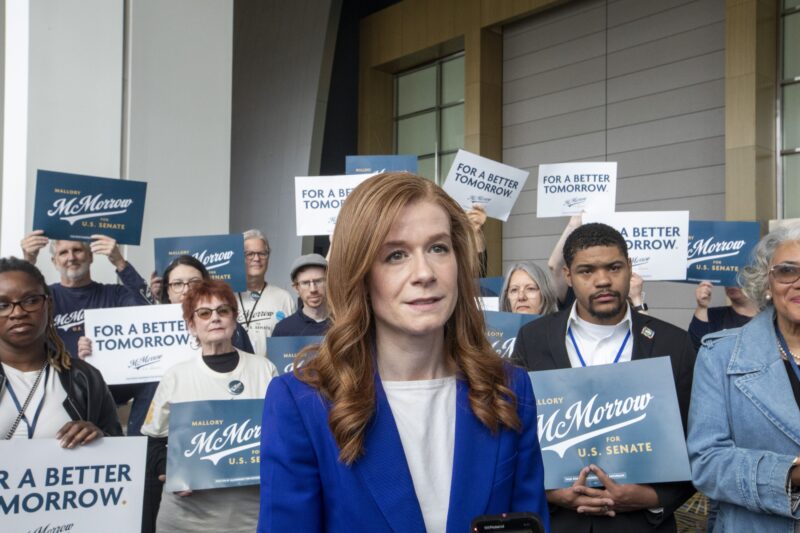
Rep. Haley Stevens (D-MI) and Abdul El-Sayed, now the only remaining candidates in Michigan’s Democratic U.S. Senate primary, will participate in a televised debate on local news tomorrow night, their first head-to-head matchup since state Sen. Mallory McMorrow suspended her campaign yesterday.
The annual Contemporary Antisemitism conference, which bills itself as the largest annual academic conference on contemporary antisemitism, will kick off tomorrow at the University of Haifa. The three-day summit will feature hundreds of academics and experts, with a keynote speech tomorrow from former State Department antisemitism envoy Deborah Lipstadt and a lifetime achievement award presented to Tel Aviv University professor emerita Dina Porat.
Stories You May Have Missed
NO FLIGHT PLAN
House Democrats introduce legislation to block sale of jet engines to Turkey

Rep. Dina Titus is leading the Joint Resolution of Disapproval against the Trump administration’s $700 million sale of F110 jet engines to Turkey despite legal restrictions on U.S. military sales to the country
TEACHING MOMENT
NEA adopts new rules ahead of convention — but union members are reserving judgment

Some Jewish Affairs Caucus leaders say they weren’t consulted about the changes, which are meant to prevent issues around antisemitism that occurred at last year’s assembly
Plus, Israel ally draws the line at Syria
Andrew Harnik/Getty Images
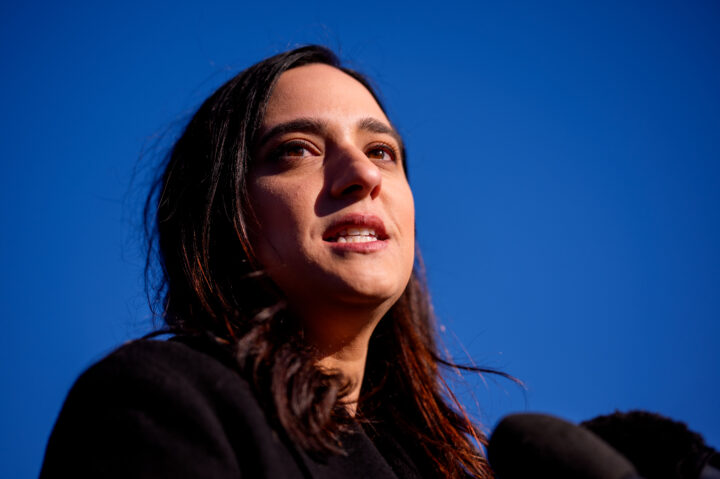
Rep. Yassamin Ansari (D-AZ) speaks during a news conference on Capitol Hill on November 13, 2025 in Washington, DC.
Good Thursday afternoon.
This P.M. briefing is reserved for our premium subscribers like you — offering a forward-focused read on what we’re tracking now and what’s coming next.
Today’s Daily Overtime was curated by JI U.S. Editor Danielle Cohen-Kanik.
📡On Our Radar
Notable developments and interesting tidbits we’re tracking
In their indirect talks in Doha this week, the U.S. offered Iran access to some of its$100 billion in frozen funds in exchange for Tehran not instituting a toll on the Strait of Hormuz, but Iranian officials have continued to signal they plan to proceed with the move. Continued fighting between Israel and Hezbollah in Lebanon also caused tension during the discussions, The Wall Street Journal reports…
U.S. officials told The New York Times that Washington believed Israel was plotting to assassinate Iran’s top negotiators — Foreign Minister Abbas Araghchi and parliament speaker Mohammad Bagher Ghalibaf — as they were engaged in recent talks with the U.S. over the memorandum of understanding…
Arizona Jewish and pro-Israel leaders told Jewish Insider’s Matthew Kassel that they feel misled by Rep. Yassamin Ansari (D-AZ), whom they supported in her contested 2024 primary but who has since turned away from the pro-Israel views she espoused during the campaign — including now rejecting support from Democratic Majority for Israel, which backed her with a surge of spending in 2024…
The AIPAC-linked United Democracy Project super PAC is up with its first negative ad against far-left Michigan Senate candidate Abdul El-Sayed, JI’s Marc Rod reports, hitting the Democrat in the initial $2 million ad buy for his “long history of disrespecting women.” Meanwhile, El-Sayed picked up a high-profile endorsement today from Rep. Alexandria Ocasio-Cortez (D-NY), her first in a contested Senate race this cycle.
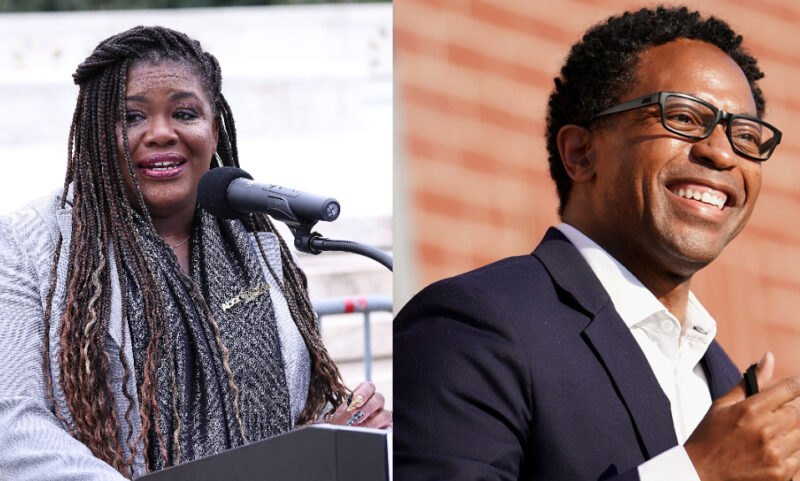
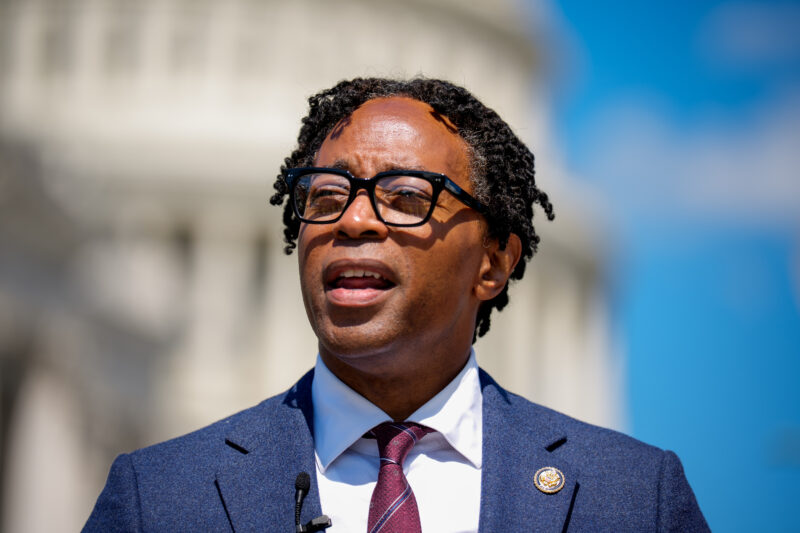
UDP also made $400,000 in advertising reservations to support Rep. Wesley Bell (D-MO) as he faces a comeback primary challenge from former Rep. Cori Bush (D-MO), whom UDP helped Bell defeat in 2024…
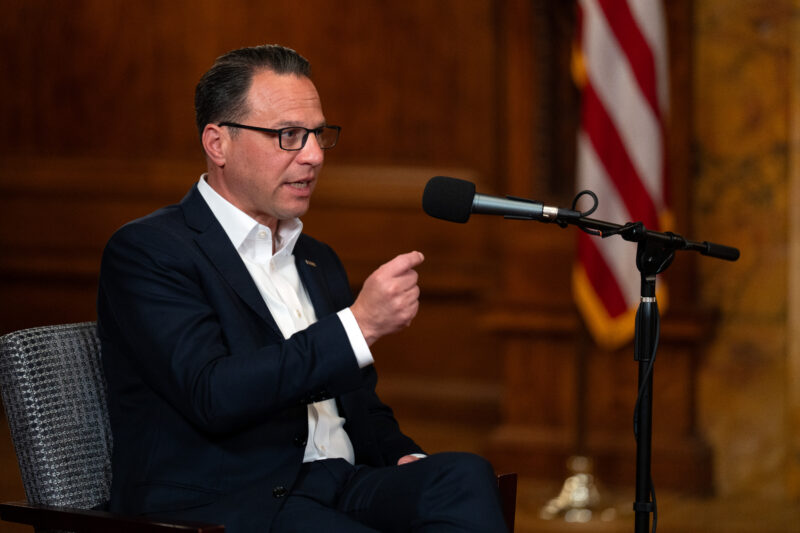
Colorado Attorney General Phil Weiser, the Democratic nominee for governor, criticized his party’s socialist congressional nominee, Melat Kiros, for her refusal to describe the deadly firebombing of a Boulder, Colo., hostage awareness march last year as an act of antisemitism, JI’s Marc Rod reports…
New York City congressional nominee Brad Lander published a response to Rabbi Elliot Cosgrove’s letter earlier this week in which Cosgrove predicted that Lander’s hostility to Israel would not be enough to protect him from being targeted by the far left. Lander argued in his response that criticism of Israel — including describing its war in Gaza as a genocide — is consistent with Jewish values and that excluding anti-Zionist Jews weakens the Jewish community…
New polling data shows that a sizable majority of Jewish voters disapprove of New York City Mayor Zohran Mamdani’s job performance and fear he is pushing the Democratic Party too far to the left, in contrast with non-Jewish voters who hold a largely favorable view of the democratic socialist, JI’s Matthew Kassel reports…
A bipartisan group of House lawmakers, led by Reps. Mike Lawler (R-NY) and Brad Sherman (D-CA), wrote to President Donald Trump today to “express deep concern about any effort” to sell F-35 fighter jets to Turkey, JI’s Marc Rod reports, after Trump and Vice President JD Vance indicated they were looking into it last week…
Rep. Joe Wilson (R-SC), the founder of the Republican Israel Caucus and a reliable ally of the Jewish state, called Israel’s “continuing aggressive operations” in Syria “deeply disturbing,” “counterproductive” and “irresponsible.” Wilson accused Israel of “taking Syrian land and attacking Syrian cities,” saying the operations “need to end immediately”…
Wilson, along with Sens. Jeanne Shaheen (D-NH) and Elizabeth Warren (D-MA), also sent a letter to Secretary of State Marco Rubio urging the administration to remove Syriafrom the State Sponsor of Terrorism list…
Israel marked 1,000 days today since the Oct. 7, 2023, Hamas terror attacks, with memorials and protests taking place around the country…
Far-right commentator Tucker Carlson told the Columbia Journalism Review that he plans to help start a new political party — after saying last month he was renouncing the Republican Party — but does not plan to run as a candidate. He repeatedly railed against Israel in the interview and accused it of “taking over my political system and destroying my country”…
Fanatics CEO Michael Rubin hosted his annual White Party at his Hamptons estate yesterday featuring a host of high-profile attendees, including Ivanka Trump, New England Patriots owner Robert Kraft, former quarterback Tom Brady, actor Leonardo di Caprio and more…
⏩ Tomorrow’s Agenda, Today
An early look at tomorrow’s storylines and schedule to keep you a step ahead
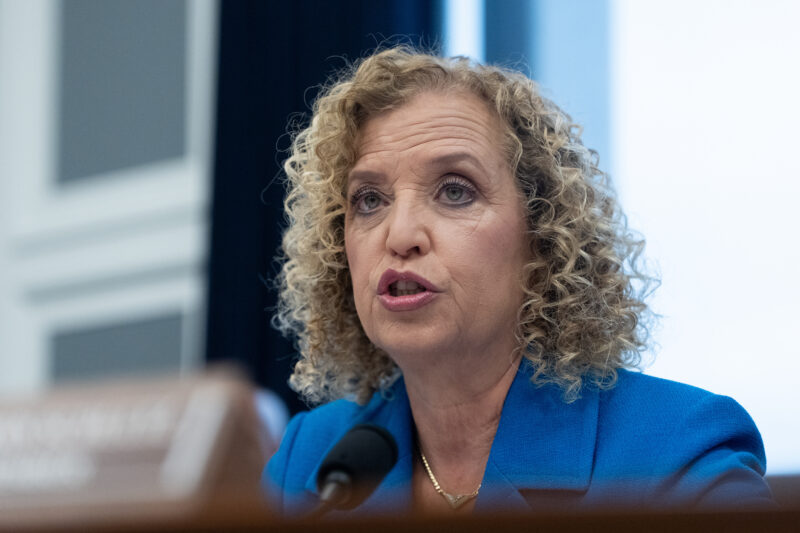
Keep an eye on Jewish Insider for a look at Rep. Debbie Wasserman Schultz’s (D-FL) contentious primary race in Florida’s 20th Congressional District.
Fourth of July celebrations in the nation’s capital are kicking off with a bang (literally — the fireworks show on the National Mall could break world records). President Donald Trump is slated to give a speech on the Mall ahead of the fireworks show on Saturday night, followed by a military flyover debuting the new Qatari-gifted Air Force One jet.
Iran is slated to hold a massive, dayslong funeral procession for the late Supreme Leader Ayatollah Ali Khamenei beginning on Saturday in Tehran and including cities across Iran and Iraq. Pakistan’s Foreign Ministry said Prime Minister Shehbaz Sharif, a top mediator between the U.S. and Iran, will attend the memorial, alongside officials from dozens of other countries.
Christians United for Israel’s annual summit in Washington will begin on Sunday. Speakers over the three-day confab include State Department antisemitism envoy Rabbi Yehuda Kaploun; former Auburn University basketball coach Bruce Pearl; Malcolm Hoenlein, vice chair of the Conference of Presidents of Major American Jewish Organizations; Georgia state Rep. Esther Panitch; and former Israeli hostage Yair Horn.
We’ll be back in your inbox with the Daily Overtime on Monday. Shabbat shalom and happy Fourth of July weekend!
Stories You May Have Missed
LAND OF THE FREE
Even in a fraught moment, American Jews embrace patriotism at the nation’s 250th

Rabbis, historians and communal leaders told JI that the nation’s semiquincentennial offers an opportunity to celebrate America’s promise even as they confront the antisemitism and political currents challenging Jewish life today
CAMPAIGN CONTROVERSY
DSA candidate for Wisconsin governor appears with streamer who called Jews ‘demonic’
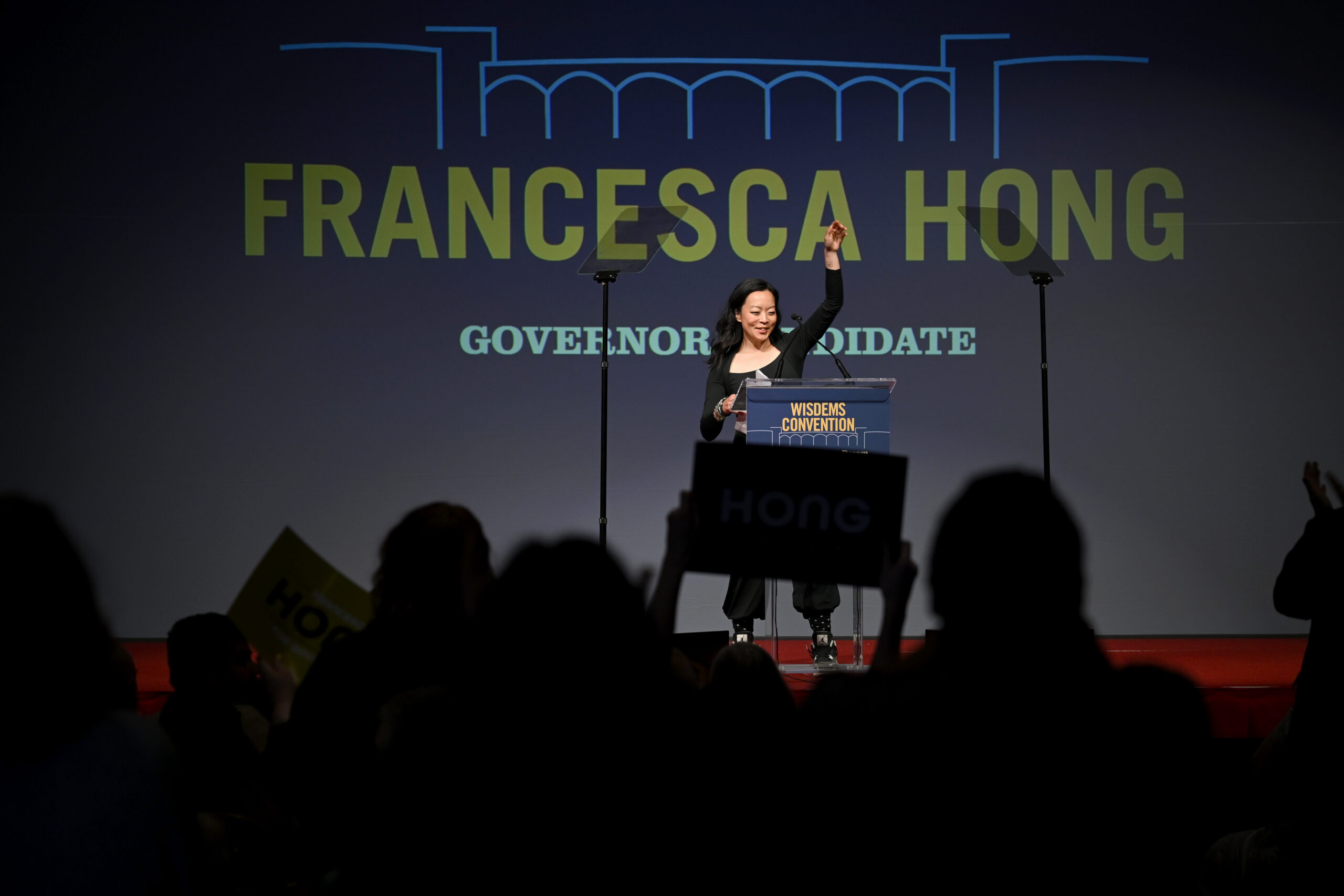
The same day Francesca Hong appeared on the livestream of antisemitic conspiracy theorist ‘Mike From PA,’ she also joined Hasan Piker’s Twitch show
Plus, NEA cracks down on antisemitism chaos

Amirhossein KHORGOOEI / ISNA / AFP via Getty Images
Vessels are pictured anchored in the Strait of Hormuz off Bandar Abbas in southern Iran on May 5, 2026.
Good Wednesday afternoon.
This P.M. briefing is reserved for our premium subscribers like you — offering a forward-focused read on what we’re tracking now and what’s coming next.
Today’s Daily Overtime was curated by JI U.S. Editor Danielle Cohen-Kanik.
📡On Our Radar
Notable developments and interesting tidbits we’re tracking
Talks in Doha about the U.S.-Iran memorandum of understanding have concluded, Iranian Deputy Foreign Minister Kazem Gharibabadi announced, with the countries agreeing to create a communication channel “by tomorrow” in order to address MOU violations.
The U.S. and Iran also agreed to “keep things quiet for the coming week,” a U.S. official told Axios, while Washington is reportedly continuing to press Tehran to abandon its plan to charge tolls in the Strait of Hormuz and “think bigger” on a nuclear deal. The sums Iran could generate from freely selling oil without sanctions under such a deal “would be 100 times more valuable to them,” the official said…
New York Times/Siena polls of the six Senate battleground states — Alaska, Iowa, Maine, North Carolina, Ohio and Texas — found that Democrats have a path, albeit an uphill one, to retake the chamber in November. All of the races are within the margin of error except in North Carolina, where former Democratic Gov. Roy Cooper leads Michael Whatley, former chair of the Republican National Committee, with the largest margin of seven points…
Poetica Coffee, the Brooklyn cafe that banned Rep. Dan Goldman (D-NY) last week over his support of Israel, claimed in an Instagram post today that Goldman intentionally “smear[ed]” the business in talking about his experience “possibly for election-eve media exposure”…
Rep. Adam Smith (D-WA), ranking member of the House Armed Services Committee, told CNN yesterday that some democratic socialist candidates have views that are “vastly more radical” than where the “Democratic coalition” stands, saying their support for communism, open borders and defunding the police represents “a fundamental attack on America itself”…
Asked about Republicans viewing him as easier to beat in a general election than his more-moderate primary opponents, far-left Michigan Democratic Senate candidate Abdul El-Sayed told Semafor, “The number of times I’m gonna define and redefine Mike Rogers!” referring to the GOP Senate front-runner and former Michigan representative. “By the time I’m done, his best friends are gonna look at him and think what I think, say what I say. I’m gonna define him into eternity”…
The National Education Association adopted new policies ahead of its convening this weekend in Denver after its Jewish Affairs Caucus and the Jewish Council for Public Affairs advocated for such changes, JCPA said, in response to last year’s assembly which grew contentious over antisemitism issues. The new changes include stronger conduct enforcement for delegates, electronic voting to reduce shouting on the floor during resolution votes, de-escalation training for NEA staff and repeated public reminders of the rules…
Loay Abdelfattah Alnaji was sentenced to one year in jail and two years of probation yesterday after pleading guilty to involuntary manslaughter and battery in the death of Paul Kessler, a 69-year-old Jewish man who died after Alnaji struck him with a megaphone at a protest in California shortly after the Oct. 7 Hamas attacks. The Anti-Defamation League’s California regional offices decried the sentence as “little more than a slap on the wrist” and expressed concern at the judge’s dismissive demeanor during sentencing…
A New York woman was arrested yesterday by the FBI for allegedly providing material support to the Palestinian Islamic Jihad, including over $30,000 in cryptocurrency. The woman is a leader of an extremist organization called the Direct Action Movement for Palestinian Liberation, according to the FBI, and had communicated with a person claiming to be a PIJ fighter in Gaza, whom she told she “wish[es] every day were October 7th”…
Speaking at the Herzliya Conference in Israel, Maj. Gen. (res.) Amir Baram, director general of the Israeli Ministry of Defense, addressed Israeli public criticism of the U.S.’ foreign policy, Jewish Insider’s Matthew Shea reports: “What some in Israel perceive as weakness or folly, an apparent disregard for every warning sign on the ground, is viewed in Washington as cold, calculated and clear-eyed risk management in an era of shifting global attention.”
“For us, Iran is an existential threat; for the United States, it is a chronic regional challenge,” Baram said of the countries’ differing priorities. “We think Tehran, they think Taiwan”…
U.S. Ambassador to Israel Mike Huckabee and Israeli Foreign Minister Gideon Sa’ar held a ceremony to sign the lease for the permanent new complex of the U.S. Embassy in Jerusalem; Huckabee handed Sa’ar a $1 bill as symbolic payment for the 99-year lease…
The New York Times looks at President Donald Trump’s insistence that Syria take over fighting Hezbollah in Lebanon from Israel, an idea that has been shot down by Syrian President Ahmad al-Sharaa and raised alarm across the Middle East…
CENTCOM hosted a regional security dialogue alongside the Bahrain Defense Force with participation from Egypt, Jordan, Kuwait, Lebanon, Oman, Qatar, Saudi Arabia, Syria, the UAE and Yemen — “the first time military leaders from Syria and Lebanon participated in a regional defense conference led by the United States,” CENTCOM said…
The U.S. Navy is searching for a missing aircrew member after a Sea Hawk helicopter made an emergency water landing in the Arabian Sea, with three of the four crew members rescued in stable condition. There’s no indication any hostile action was involved, the Navy’s 5th Fleet said…
⏩ Tomorrow’s Agenda, Today
An early look at tomorrow’s storylines and schedule to keep you a step ahead
Keep an eye on Jewish Insider for a look at how Jewish leaders are approaching America’s 250th birthday — and why many see the milestone, coming at a fraught moment, as a chance to reaffirm both their Jewish identity and their faith in the American experiment.
The Maccabiah Games, which kicked off today in Jerusalem with a grand opening ceremony, begin in earnest tomorrow as about 5,000 athletes — including 900 from the U.S. — compete in more than 30 sports over the next two weeks.
Stories You May Have Missed
PLATFORM PUNT
Top Democrats won’t commit to supporting Israel’s security in party platform

House Minority Leader Hakeem Jeffries and Reps. Alexandria Ocasio-Cortez and Greg Casar were noncommittal when pressed by JI
RED SCARE
Democratic leaders brush off Avila Chevalier’s posts praising communism, say she’s changed
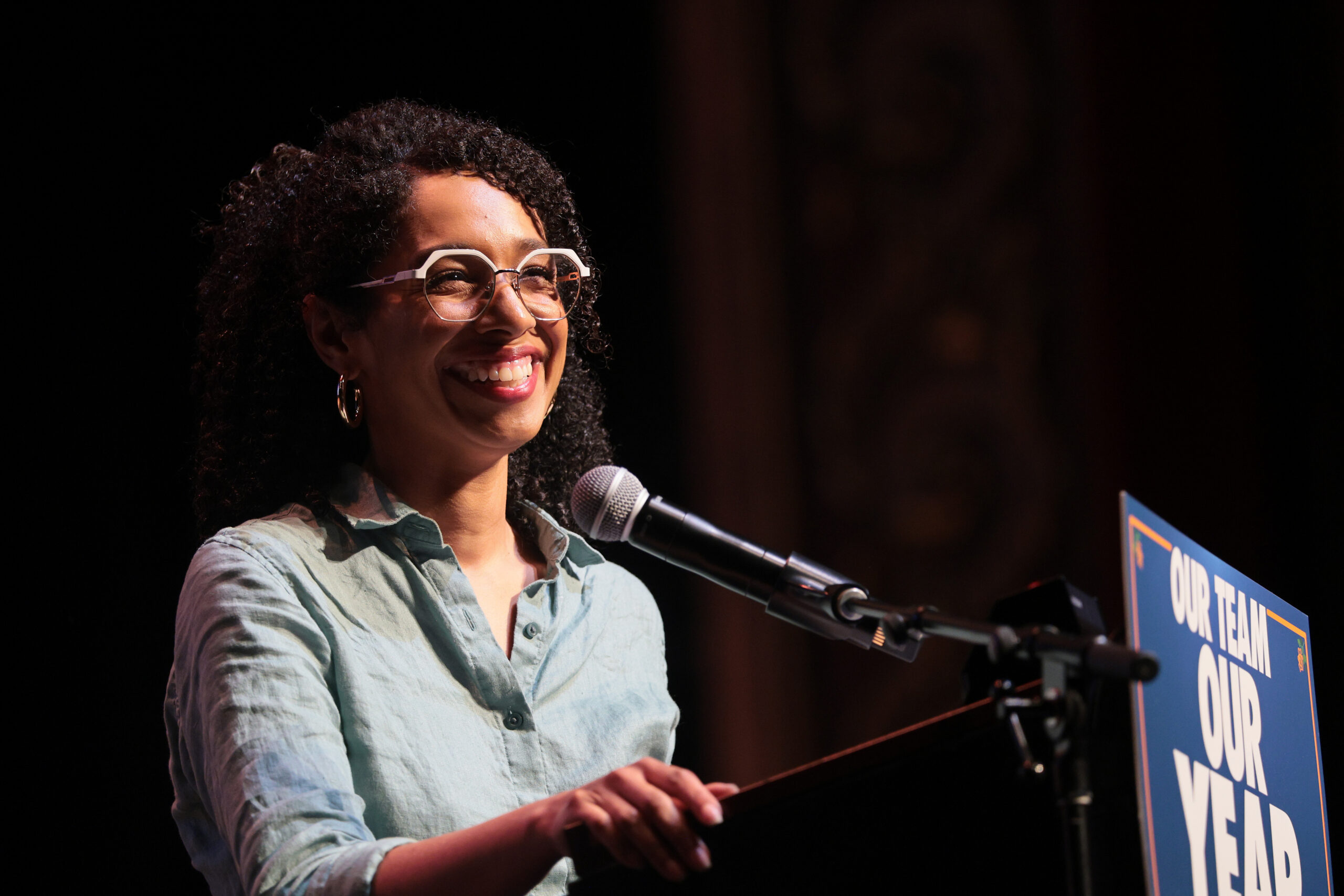
Jeffries said Avila Chevalier has ‘walked away from many of the things that have been unearthed’ following a CNN report on her past sympathetic posts about communism and Soviet figures
Plus, Menin's measured rebuke of antisemitic Brooklyn Dem

Jabin Botsford/The Washington Post via Getty Images
Rep. Rashida Tlaib (D-MI) speaks during a hearing on Capitol Hill on Wednesday, Dec. 01, 2021, in Washington, D.C.
Good Tuesday afternoon.
This P.M. briefing is reserved for our premium subscribers like you — offering a forward-focused read on what we’re tracking now and what’s coming next.
Today’s Daily Overtime was curated by JI U.S. Editor Danielle Cohen-Kanik.
📡On Our Radar
Notable developments and interesting tidbits we’re tracking
Nearly all House Democrats voted in favor of a war powers resolution this afternoon that aimed to block U.S. support for Israeli operations against Hezbollah in Lebanon, Jewish Insider’s Marc Rod reports, though the legislation failed to secure a House majority, with nearly all Republicans and 22 Democrats voting against the measure…
White House Special Envoy Steve Witkoff and Jared Kushner are in Doha, Qatari Foreign Ministry spokesperson Majed al-Ansari confirmed, where they were set to meet with Qatari Prime Minister Sheikh Mohammed bin Abdulrahman Al Thani and other mediators, but did not hold talks with Iranian officials. It’s a step back from the direct negotiations that took place in Switzerland just a week ago…
Al-Ansari said further that the $6 billion in frozen Iranian assets has not yet been released to Tehran. “Whether the funds are transferred depends on the agreement of both parties and the progress of negotiations, which has not yet occurred,” he announced at a press briefing today…
Meanwhile, Oman has submitted a proposal to the U.S. for Muscat and Tehran to collect service fees from shipping companies seeking to transit the Strait of Hormuz, The New York Times reports. One of Iran’s deputy foreign ministers, Kazem Gharibabadi, said yesterday if Iran was unable to come to an arrangement with Oman it would move forward on its own…
A small group of House Republicans, led by Rep. Don Bacon (R-NE), is threatening not to support the Trump administration’s $88 billion Iran war supplemental funding request unless the White House replaces more than 4,000 U.S. troops who were pulled out of Poland last month, Politico reports. The effort could hold up the supplemental, already expected to face a tough fight, given the GOP’s razor-thin majority in the chamber…
A 20-year-old U.S. citizen living in Jerusalem is set to be charged by Israeli prosecutors for spying on Iran’s behalf. The suspect, arrested earlier this month, was allegedly paid to take pictures and videos of “sensitive sites” in Israel over several months…
Iranian Foreign Minister Abbas Araghchi met with Iraqi leaders in Baghdad today as both countries prepare for a “mass funeral” for the late Iranian Supreme Leader Ayatollah Ali Khamenei, Araghchi said, after Khamenei was killed in February in a joint U.S.-Israeli operation…
The Israeli Ministry of Defense and defense manufacturer Rafael completed a successful test integrating the Iron Beam laser system into the Iron Dome missile-defense array, marking a “major breakthrough,” Rafael announced…
Ellie Cohanim, who served as deputy special envoy to monitor and combat antisemitism in President Donald Trump’s first term, recently joined his administration as a senior policy advisor to U.S. Ambassador to the U.N. Mike Waltz, Waltz announced today…
A New York Times/Siena poll of the race for U.S. Senate in Texas found Republican Attorney General Ken Paxton and Democratic state Rep. James Talarico in a dead heat, 47-47%, among likely voters. The seat, once considered a long shot for Democrats in the deep-red state, has emerged as a top-tier pickup opportunity, given Paxton’s ethical and legal baggage…
New York City Council Speaker Julie Menin — the first Jewish person to hold her role — slammed a newly elected Brooklyn Democrat’s promotion of antisemitic conspiracy theories, but declined to call her commentary disqualifying, JI’s Will Bredderman reports…
After a monthslong unexplained absence from Congress, Rep. Tom Kean Jr. (R-NJ) returned to the House floor today to disclose that he had been hospitalized for depression. Kean faces a competitive reelection race against Democratic nominee Rebecca Bennett in a key battleground district in Democrats’ bid to retake the House…
Prominent pro-Israel activist Arsen Ostrovsky, who was injured in the Bondi Beach Hanukkah shooting in Sydney last year, testified before Australia’s Royal Commission on Antisemitism about how he faced “relentless” and “vicious” harassment online after the attack, including AI-altered images of his injuries and accusations that he was a crisis actor…
In a series of high-profiledecisions today, the Supreme Court sided with Vice President JD Vance in a case he brought as a Senate candidate, along with other plaintiffs, and lifted federal limits on coordinated spending between political parties and candidates.
The court also struck down Trump’s attempt to end birthright citizenship — a move that garnered praise from Jewish groups including the American Jewish Committee, the Union for Reform Judaism and the Jewish Council for Public Affairs…
⏩ Tomorrow’s Agenda, Today
An early look at tomorrow’s storylines and schedule to keep you a step ahead
Keep an eye on Jewish Insider for a look at Democrats’ ongoing divisions over an effort to cut aid to Israel led by Rep. Thomas Massie (R-KY).
Technical delegations from the U.S. and Iran are expected to meet separately with Qatari and Pakistani mediators in Doha — still with no direct talks planned.
Hard-line Republicans upended business on the House floor for the second week in a row, blocking the procedural measure that would have teed up consideration of the 2027 State Department funding bill and the 2027 National Defense Authorization Act. After a final vote this evening, the House will head to recess early, until July 13.
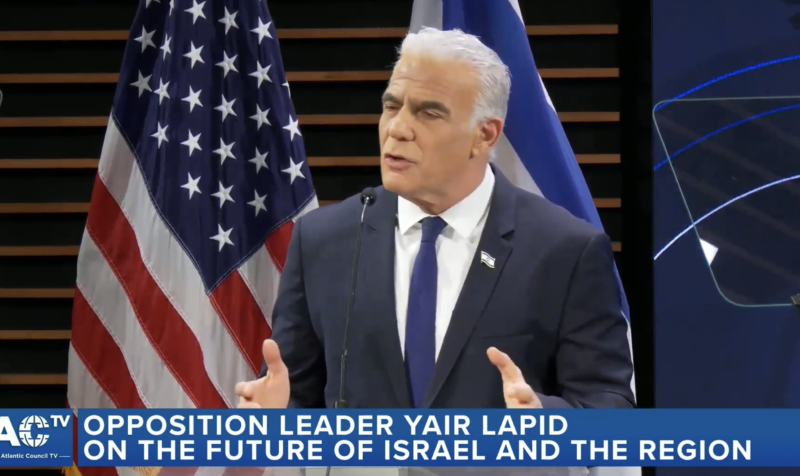
The Herzliya Conference continues in Israel: Among the many top national security and political officials speaking are former Prime Ministers Naftali Bennett and Yair Lapid; former Israeli Ambassadors to the U.S. Danny Ayalon and Michael Herzog; former U.S. Ambassador to Israel Dan Shapiro; EU Ambassador to Israel Michael Mann; Yashar party leader Gadi Eisenkot; Yisrael Beiteinu party leader Avigdor Liberman; Democrats party leader Yair Golan; Ra’am party leader Mansour Abbas; and Nadav Tamir, executive director of J Street Israel.
President Donald Trump is set to take his first trip on the jumbo jet gifted to him by Qatar as he travels to an event in North Dakota.
Stories You May Have Missed
PRIDE AND PREJUDICE
California Democrats divided over calling harassment of Scott Wiener antisemitic
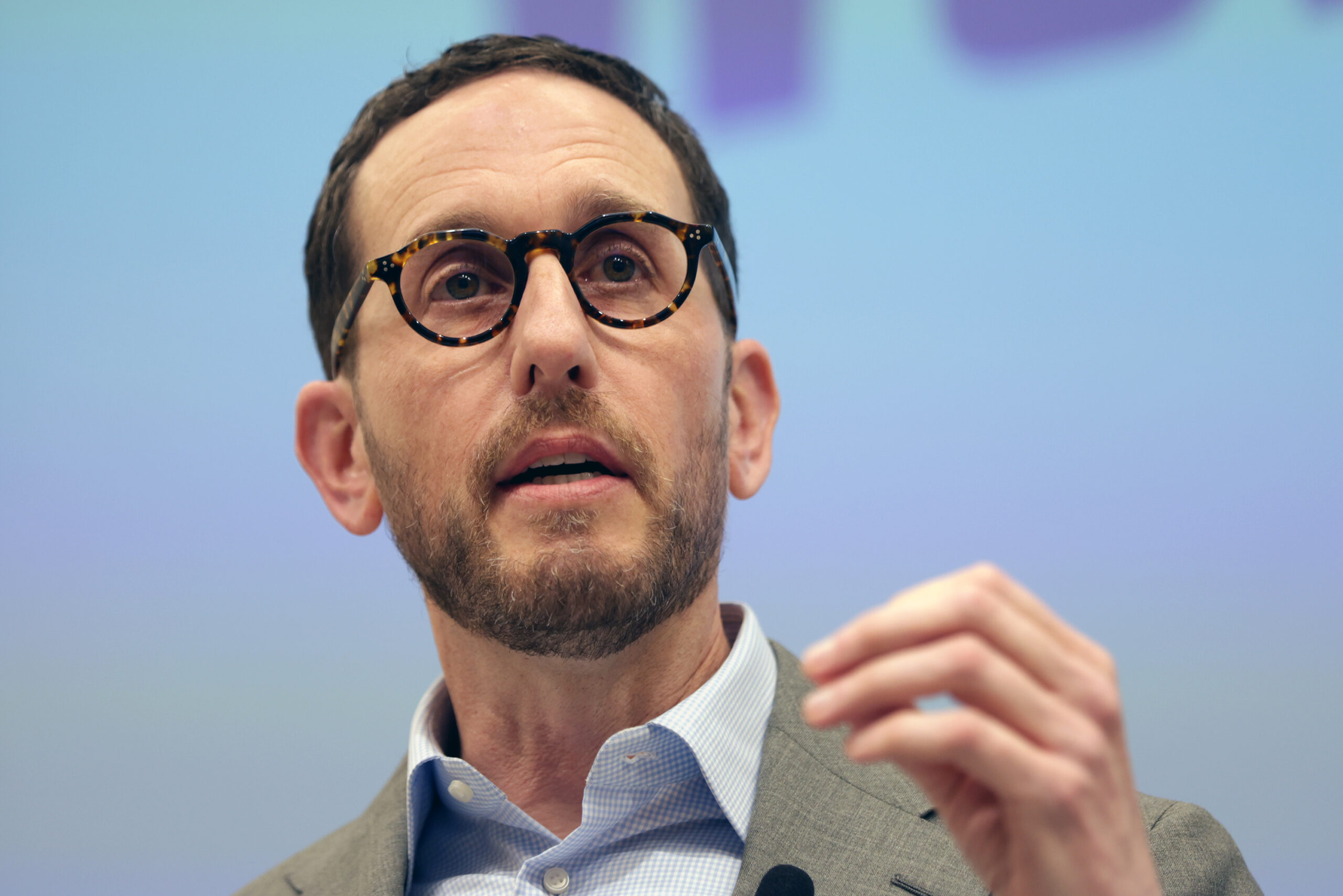
Wiener said the incident where he was accosted at a pride march was ‘absolutely’ antisemitic; only a few California elected officials said the same
WESTWARD BOUND
Former CENTCOM chief backs basing U.S. assets in Israel to counter Iran

Gen. Frank McKenzie revealed that CENTCOM had previously proposed a similar western contingency plan to the Biden administration which was shot down
Democrats on both sides of the vote argued that the U.S. is not actually engaged in hostilities in Lebanon, while Rep. Rashida Tlaib criticized Lebanon’s talks with Israel
Jabin Botsford/The Washington Post via Getty Images
Rep. Rashida Tlaib (D-MI) speaks during a hearing on Capitol Hill on Wednesday, Dec. 01, 2021, in Washington, D.C.
Nearly all House Democrats voted for a Lebanon war powers resolution on Tuesday that aimed to block U.S. support for Israeli operations against Hezbollah, though the legislation failed to secure a House majority, with nearly all Republicans and 22 Democrats voting against the measure.
It was the second time that Rep. Rashida Tlaib (D-MI) has forced a vote on a Lebanon war powers resolution, though her first resolution faced opposition from key Democratic leaders who viewed it as poorly drafted and overbroad.
Tuesday’s resolution directed the removal of U.S. armed forces from “any hostilities in Lebanon,” but included exemptions for continued security cooperation with the Lebanese Armed Forces and the protection of U.S. diplomatic facilities in Lebanon. Tlaib’s original resolution, which failed in early June, directed the administration more broadly to “remove the United States Armed Forces from Lebanon.”
Reps. Henry Cuellar (D-TX), Don Davis (D-NC), Laura Gillen (D-NY), Jared Golden (D-ME), Vicente Gonzalez (D-TX), Josh Gottheimer (D-NJ), Adam Gray (D-CA), Steny Hoyer (D-MD), Greg Landsman (D-OH), George Latimer (D-NY), Susie Lee (D-NV), Jared Moskowitz (D-FL), Donald Norcross (D-NJ), Jimmy Panetta (D-CA), Marie Gluesenkamp Perez (D-WA), Brad Schneider (D-IL), Brad Sherman (D-CA), Darren Soto (D-FL), Tom Suozzi (D-NY), Norma Torres (D-CA), Juan Vargas (D-CA) and Marc Veasey (D-TX) were the only Democrats to oppose the resolution.
Reps. Lauren Boebert (R-CO) and Thomas Massie (R-KY) were the only Republicans to support it.
In comments on the House floor on Monday evening, Tlaib appeared to criticize Lebanese diplomatic negotiations with Israel, which have been aimed at a shared goal of disarming and defanging Hezbollah.
“To the Lebanese government: Learn the lessons of the countries before you and the lessons of Lebanon’s own history. The Israeli government does not abide by any agreements. They have violated every single ceasefire in all the so-called peace agreements,” Tlaib said.
“Wake up, the so-called agreement is not protecting Lebanese people. This is about apartheid government and structure expanding into your country,” she continued. “Do not abandon your land and your people and become another subcontractor for the Israeli occupation.”
She asserted that the Lebanese government is letting “outsiders divide your people” and foment “greater instability and another civil war.” She continued to dismiss the role of Hezbollah in the conflict — including its own repeated violations of ceasefire agreements — and claimed that the Lebanese people broadly, rather than Hezbollah, are Israel’s target.
Tlaib argued that the U.S. “is currently engaged in illegal and unauthorized hostilities in Lebanon” by providing intelligence to and coordinating with Israel, further claiming that the U.S. is exercising command and control over Israeli operational decisions. She suggested that the U.S. provision of spare parts and maintenance for Israel’s Air Force also constitutes hostilities in Lebanon.
Rep. Greg Meeks (D-NY), the ranking Democrat on the House Foreign Affairs Committee, said that the updated resolution “corrected the flaws” of the previous one and “will not infringe upon America’s national security interests in Lebanon, while ensuring we stay out of another forever war that is not in our interest.”
But, unlike Tlaib, Meeks emphasized that he’s not aware of any U.S. forces engaged in hostilities in Lebanon. He said the resolution would prevent any forces from being deployed in such a capacity without congressional support.
Meeks expressed support for efforts by Israel and Lebanon to ensure their citizens’ safety and security but said “this does not justify disproportionate airstrikes which have killed too many civilians, including medical workers and journalists, as well as destroyed civilian infrastructure throughout Lebanon.”
He also praised the recent framework agreement between Israel and Lebanon, signed under the auspices of the U.S.
Schneider, one of the few Democrats who opposed the resolution, said that the resolution “has surprised many of my colleagues, who have noted that the U.S. is not engaged in hostilities in Lebanon,” and called it “unprecedented and deeply irresponsible.”
He said that Tlaib is “advancing a novel, controversial and counterproductive theory” that intelligence sharing and targeting assistance constitute U.S. involvement in hostilities in Lebanon, which would implicate the U.S. in hostilities in many places around the world, including in Russia. He said that passing such a war powers resolution “undermines the purpose” of the War Powers Act and “weakens Congress’ ability to check the Trump Administration.”
Schneider also warned that passing the resolution would embolden Hezbollah and Iran and undermine the recent Israel-Lebanon framework deal, potentially encouraging the two to launch a full-scale war against the Lebanese government.
Plus, Susie Wiles' Iran strike skepticism

Nathan Howard-Pool/Getty Images
Delegation staff members meet in the lobby during a quadrilateral meeting between the U.S., Iran, Pakistan, and Qatar at the Lake Lucerne Summit, aimed at advancing a deal to end the Middle East conflict at the Buergenstock Resort, Lake Lucerne on June 21, 2026 near Stansstad, Switzerland.
Good Monday afternoon.
This P.M. briefing is reserved for our premium subscribers like you — offering a forward-focused read on what we’re tracking now and what’s coming next.
Today’s Daily Overtime was curated by JI U.S. Editor Danielle Cohen-Kanik.
📡On Our Radar
Notable developments and interesting tidbits we’re tracking
The U.S. and Iran offered conflicting reports about whether talks will be heldthis week as the countries attempt to deescalate after a weekend exchange of military strikes: President Donald Trump claimed today that Iran had requested a meeting that would take place in Qatar on Tuesday, Jewish Insider’s Matthew Shea reports, while Iranian Foreign Ministry spokesperson Esmaeil Baghaei denied any scheduled meetings with the U.S…
White House Special Envoy Steve Witkoff and Secretary of State Marco Rubio briefed Congress this afternoon on the memorandum of understanding signed with Iran earlier this month, in the first member-wide update on the agreement…
CENTCOM head Adm. Brad Cooper met with Lebanese Armed Forces chief Gen. Rodolphe Haykal in Beirut today to discuss “implementing the security annex” to the Israel–Lebanon framework agreement signed on Friday, the LAF said in a statement. CENTCOM said Cooper also met with “senior civilian and military leaders” in Israel…
White House Chief of Staff Susie Wiles joined Vice President JD Vance in initially voicing skepticism to Israeli Prime Minister Benjamin Netanyahu’s pitch to Trump in February 2025 that the U.S. join Israel in striking Iran’s nuclear facilities, according to a new book by New York Times journalists Maggie Haberman and Jonathan Swan. Wiles feared that any involvement from the U.S. military could “spiral into an Israeli regime-change war,” the authors write…
The IDF’s Military Intelligence Directorate and Southern Command told Lt. Gen. Eyal Zamir, the IDF chief of staff, that Hamas is reconstitutingin order to resume war against Israel, according to Israeli media. The report indicates the IDF is urging a return to its campaign against the terror group, but the U.S. is opposed as it seeks to move forward with Trump’s Board of Peace…
Nika Soon-Shiong, the publisher of the Hamas-sympathetic outlet Drop Site News, claimed she was removed from the board of the Committee to Protect Journalists, sharing a letter she had written to the board objecting to CPJ’s announcement that it would audit its database of members of the media killed during the Israel-Hamas war. The move was undertaken after Hamas and Palestinian Islamic Jihad identified individuals CPJ listed as journalists as members of the terrorist groups…
In the lead-up to this summer’s primary elections, endorsement season is in full swing: In its first-ever endorsement, Jewish Voice for Peace Action, the political arm of the anti-Israel advocacy group, is backing far-left Abdul El-Sayed in the Democratic primary for U.S. Senate in Michigan. The Detroit Free Press, Michigan’s largest newspaper, endorsed one of his opponents, state Sen. Mallory McMorrow.
In Minnesota, Minneapolis Mayor Jacob Frey is backing Rep. Angie Craig (D-MN) for U.S. Senate against her more-progressive primary opponent, Lt. Gov. Peggy Flanagan, and in Massachusetts, Sen. Bernie Sanders (I-VT) endorsed Sen. Ed Markey (D-MA) as he fends off a generational primary challenge from Rep. Seth Moulton (D-MA)…
A new New York Times/Portland Press Herald/Siena poll shows Democratic candidate Graham Platner and Republican Sen. Susan Collins in a statistical tie, 49-47%, among likely voters in the Maine Senate race. The close margin reflects Platner’s struggles to consolidate Democratic support — 10% of voters who say they want Democrats to control the Senate indicated they plan to vote for Collins anyway.
Platner and the Democratic National Committee sent a joint fundraising email today, after Democratic leadership had hesitated to support him during the primary…
New York state Democratic Party Chairman Jay Jacobs acknowledged to The New York Post that the “Israel-Palestinian issue had an impact” in the state’s recent primary elections, where several socialist candidates prevailed. “It hurt establishment Democrats,” he said, including “people who may have voted against [Democratic incumbent Reps. Adriano] Espaillat and [Dan] Goldman because of it”…
Yair Rosenberg, a longtime journalist and commentator on American Jewry, is joining The New York Timesas a reporter covering Jewish American life, the Times announced today, amid criticism over the outlet’s alleged bias in covering antisemitism and Israel.
In the latest such incident, noted by Gabe Stutman, the former editor of J. The Jewish News of Northern California, the Times’ reporting on antisemitic harassment targeting California state Sen. Scott Wiener failed to mention Wiener is Jewish…
⏩ Tomorrow’s Agenda, Today
An early look at tomorrow’s storylines and schedule to keep you a step ahead
Keep an eye on Jewish Insider for a look at how California politicians are responding to the repeated harassment targeting Wiener, who is running to replace retiring Rep. Nancy Pelosi (D-CA) in Congress.
Witkoff and Jared Kushner are headed to Qatar in order to represent the U.S. in talks with Iran, White House spokesperson Karoline Leavitt told Fox News, as the status of the negotiations remains unclear.
The technical talks on the memorandum of understanding meant to be taking place separately are also up in the air — Iran’s Baghaei said an Iranian technical delegation will be in Doha this week but will not be meeting with American officials.
Colorado voters will head to the polls in tomorrow’s Democratic primaries, where moderate incumbents are fearing a far-left sweep similar to that of New York City’s primaries earlier this month. Internal polling from the campaigns of longtime state Democratic leaders Sen. Michael Bennet — who is running for governor — and Rep. Diana DeGette shows much tighter races than expected for the established politicians.
Russell Vought, director of the Office of Management and Budget, will testify before the House Appropriations Committee where he is expected to address the White House’s $88 billion supplemental funding request for the war with Iran and FY2027 budget request.
The Israeli Embassy in Washington will hold a “Zionist LGBTQ+ celebration” on the last day of Pride Month in memory of slain embassy staffer Sarah Milgrim’s allyship.
Reichman University’s Herzliya Conference kicks off in Israel, focusing this year on national security and national resilience. Israeli President Isaac Herzog will address the confab, as well as U.S. Ambassador to Israel Mike Huckabee; Amos Hochstein, who served as a Middle East envoy under former President Joe Biden; former Mossad chief Tamir Pardo; former Israeli National Security Advisor Tzachi Hanegbi; journalist Barak Ravid; and Aliyah Minister Ofir Sofer.
Stories You May Have Missed
WALK-BACK
Top Armed Services Democrat flips on U.S.-Israel cooperation provision in defense bill
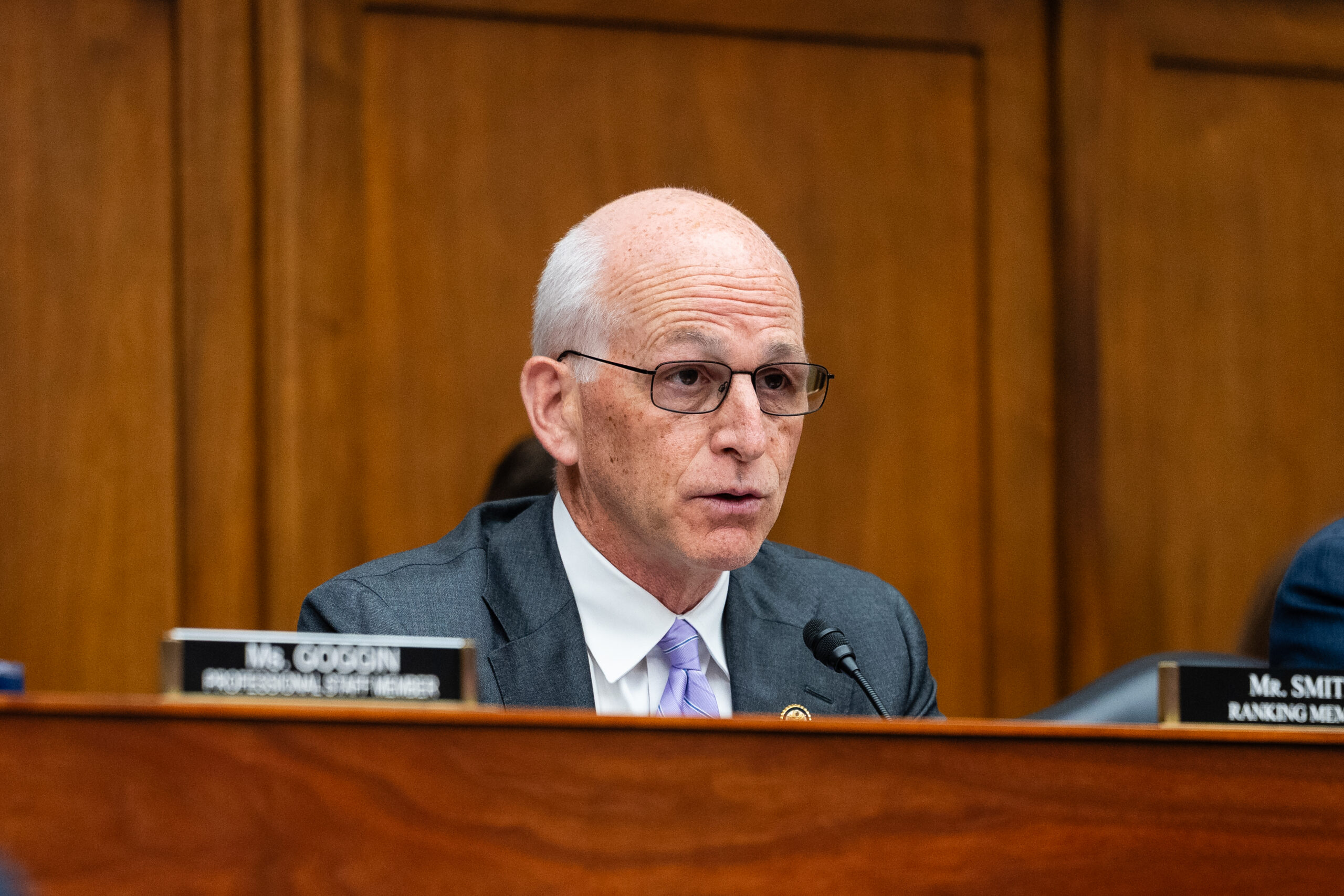
Adam Smith, a reliable supporter of Israel, said he would now join progressives in his party to oppose a provision bolstering a close U.S.-Israel alliance
POLICY PERSPECTIVE
At Aspen Ideas, Robert Kagan says U.S.’ Israel support was ‘never for strategic reasons’

In conversation with Biden foreign policy officials Jake Sullivan and Jon Finer, Kagan said, ‘Israel’s vision for the Middle East has never been a vision that the United States should sign up to’
Under the preliminary agreement, Israel will withdraw from two ‘pilot zones’ while maintaining its security zone in southern Lebanon
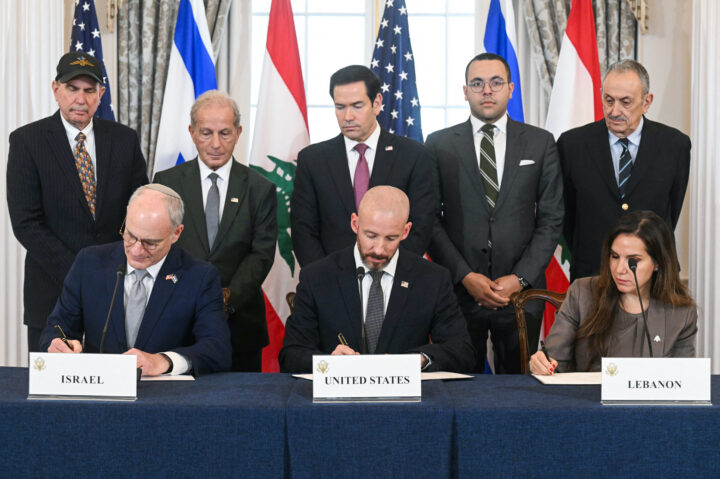
Photo by SAUL LOEB / AFP via Getty Images
Secretary of State Marco Rubio looks on as Israeli Ambassador to the U.S. Yechiel Leiter, State Department Chief of Staff Daniel Holler, and Lebanese Ambassador to the U.S. Nada Hamadeh sign a framework agreement at the U.S. Department of State in Washington, DC, on June 26, 2026.
Secretary of State Marco Rubio and the ambassadors of Israel and Lebanon signed a framework agreement in Washington on Friday aimed at scaling back Israel’s military presence in Lebanon, where the IDF has established a presence for the last three months as part of its campaign against Hezbollah.
Israeli Ambassador to the U.S. Yechiel Leiter and Lebanese Ambassador to the U.S. Nada Hamadeh Moawad announced the deal at a press conference with Rubio, following four days of negotiations in Washington during the fifth round of direct talks between Jerusalem and Beirut.
Under the deal, Israel will withdraw from two “pilot zones,” one north of the Litani river and one in southern Lebanon, and transfer administration of the areas to the Lebanese Armed Forces.
The preliminary deal between Israel, Lebanon and the U.S. is aimed at enabling a broader agreement in the future, a senior Israeli official told CNN.
Israeli Prime Minister Benjamin Netanyahu hailed the framework agreement as a “major blow to Iran,” emphasizing in a video statement that Israeli forces will maintain their presence in Israel’s security zone in southern Lebanon until Hezbollah is disarmed.
“Iran is trying to force us into a withdrawal from southern Lebanon by force. In effect, Israel, Lebanon and the United States are telling them: this is none of your business,” Netanyahu said.
Today is “the beginning of the beginning,” Rubio said at the signing ceremony. “There’s a lot of work ahead. We don’t, in any way, underestimate the difficulty of the task ahead. But we understand the importance of it, how vital it is. And we are honored to play a part in bringing this together.”
Moawad said at the signing that the agreement would be the “first step on the road to restoring Lebanese sovereignty and territorial integrity.”
The announcement comes after months of negotiations and on the heels of the Trump administration signing a memorandum of understanding with Iran and launching a deconfliction mechanism to end the fighting in Lebanon without Israel’s participation.
Plus, David Harris' message for Dems

Morteza Nikoubazl/NurPhoto via Getty Images
Islamic Revolutionary Guard Corps (IRGC) military personnel stand guard on an avenue in downtown Tehran during a rally commemorating the International Quds Day, also known as the Jerusalem day, on April 29, 2022.
Good Thursday afternoon.
This P.M. briefing is reserved for our premium subscribers like you — offering a forward-focused read on what we’re tracking now and what’s coming next.
Today’s Daily Overtime was curated by JI U.S. Editor Danielle Cohen-Kanik.
📡On Our Radar
Notable developments and interesting tidbits we’re tracking
Vice President JD Vance said in an interview released todaythat U.S. military officials are going to “hang out” with representatives of the Islamic Revolutionary Guard Corps, a U.S.-designated terror organization, in Qatar in an effort to establish a conflict-reduction mechanism, Jewish Insider’s Danielle Cohen-Kanik reports.
“[Iran was] like, ‘OK, fine, we’ll send somebody from the IRGC to go hang out in Doha with somebody from CENTCOM,’ and that’s how we’re going to settle a lot of these disputes,” Vance said. He added that officials from the UAE — “by far the most hawkish, by far the most pro-Israel country in the [Gulf Cooperation Council]” — are also in touch directly with the IRGC…
Meanwhile, the IRGC reportedly attacked a cargo ship in the Strait of Hormuz today after issuing a warning to commercial vessels “to strictly refrain from any movement outside the designated routes.”
Iranian officials are further considering a plan to charge for security and environmental services in the strait that would generate $40 billion a year, sources told The Wall Street Journal. Tehran is seeking buy-in from other countries bordering the waterway and offering to share the revenue…
Secretary of State Marco Rubio, speaking to reporters in Bahrain as he wrapped up his Middle East tour today, said that U.S., Israeli and Lebanese representatives meeting for their last day of negotiations in Washington were “very close in our hopes of getting a commitment of intent” — a formal document typically used to outline preliminary terms between parties…
Rubio also spoke at a meeting of GCC foreign ministers where he vowed that Washington would not strike a deal with Iran that undermines “the security, the stability or the prosperity of any of our partners in the Gulf region”…
Iranian parliament speaker and top negotiator Mohammad Bagher Ghalibaf denied President Donald Trump’s claim that the funds received by Iran under the memorandum of understanding will be used to buy American agricultural products. “The only crop we’re harvesting is what you planted: decades of mistrust,” Ghalibaf wrote on X, adding, “apparently the US only exports GMO soybeans, broken promises and trash talks”…
A new Quinnipiac University poll released yesterday found 48% of American voters say the U.S. is too supportive of Israel — the highest level since the survey started posing the question in 2017 — including 66% of Democrats and 20% of Republicans.
Fifty-nine percent of voters said they are “not so confident” or “not confident at all” that Trump’s deal with Iran will work, while 37% said they are “very” or “somewhat” confident…
The New York Times reports on a February meeting between Carl Heastie, speaker of the New York State Assembly, and officials from the New York City Democratic Socialists of America chapter, where Heastie reiterated his request that the group stop targeting incumbent Democrats.
“We told him then, and we’ll tell him now: That’s not something we can do. We have to continue to grow our numbers and grow our influence, and that means challenging incumbents,” recalled Grace Mausser, an NYC-DSA co-chair…
Nassau County Executive Bruce Blakeman, the long-shot GOP candidate for New York governor, lashed out at congressional candidate Brad Lander on Wednesday night, telling Newsmax that the Jewish nominee is “antisemitic” and “would be a camp guard in the concentration camp if he could.” Blakeman, who is also Jewish, dialed back his remarks somewhat in a subsequent statement, saying, “Maybe camp guard was too strong, but certainly collaborator.”
Lander responded, “We named our son after Marek Edelman, a leader of the Warsaw ghetto uprising. That’s how seriously I take the legacy of Jews who fought Nazis”…
Sen. Chris Van Hollen (D-MD) became the second senator to endorsefar-left Michigan Senate candidate Abdul El-Sayed today, after Sen. Bernie Sanders (I-VT) became an early backer of the physician’s campaign. El-Sayed, who has drawn criticism for his heated anti-Israel rhetoric and campaigning with antisemitic streamer Hasan Piker, has previously advocated for Van Hollen to replace Senate Minority Leader Chuck Schumer (D-NY) as the Democratic leader in the Senate, due to Schumer’s continued support for U.S. aid to Israel…
Andy Burnham, the presumptive next prime minister of the U.K., has tapped as his chief of staff James Purnell, a former member of Parliament and lobbying executive who previously served as head of Labour Friends of Israel more than 20 years ago. Purnell also served as a Cabinet minister under former Prime Minister Tony Blair, who is now leading efforts on the Board of Peace for Gaza…
MIT professor Yossi Sheffi talks to the NYT about his forthcoming book on antisemitism at the elite school in the aftermath of the Oct. 7 Hamas attacks: Unsafe at M.I.T.: A Chronicle of a Campus War on the Jews. Sheffi said his book takes the place of an official study and report on campus antisemitism, which many universities undertook after the disruptive student protests of 2023-2024, but MIT did not…
Some Texas Jewish leaders are objecting to proposals under consideration by the State Board of Education that would require public school students to read Bible passages in class, saying they misrepresent Jewish tradition, despite their supporters touting the promotion of “Judeo-Christian” values…
⏩ Tomorrow’s Agenda, Today
An early look at tomorrow’s storylines and schedule to keep you a step ahead
Keep an eye on Jewish Insider for an interview with David Harris, the longtime former CEO of the American Jewish Committee, about his book, Antisemitism: What Everyone Needs to Know.
Harris’ view: “Every Jewish organization looking for a Democrat from Washington lines up to invite Sen. John Fetterman (D-PA). If he’s not available, they’re all baffled as to who else to invite from the contingent of Democrats in the U.S. Senate.”
Amid gridlock on the House floor driven by some Republicans’ frustration with the Senate’s failure to pass President Donald Trump’s signature voter ID bill, the House canceled many of its expected votes this week, including those on the 2027 State Department budget and an effort to cut U.S. aid to Israel. The chamber will return next week with plans to work on the 2027 National Defense Authorization Act.
The Aspen Ideas Festival in Colorado continues, including a session on higher education with Princeton University President Chris Eisgruber and a live recording of “The Long Game” with former National Security Advisor Jake Sullivan and his deputy Jon Finer, the podcast’s co-hosts, with Brookings senior fellow Robert Kagan.
We’ll be back in your inbox with the Daily Overtime on Monday. Shabbat Shalom!
Stories You May Have Missed
TORRES TACTICS
How Ritchie Torres dodged the DSA wave in New York City

The pro-Israel congressman raised early campaign cash, defined his opponent aggressively and prioritized strong constituent services
ON THE HILL
Senate blocks effort to advance war powers resolution in reversal after heated GOP meeting with Trump
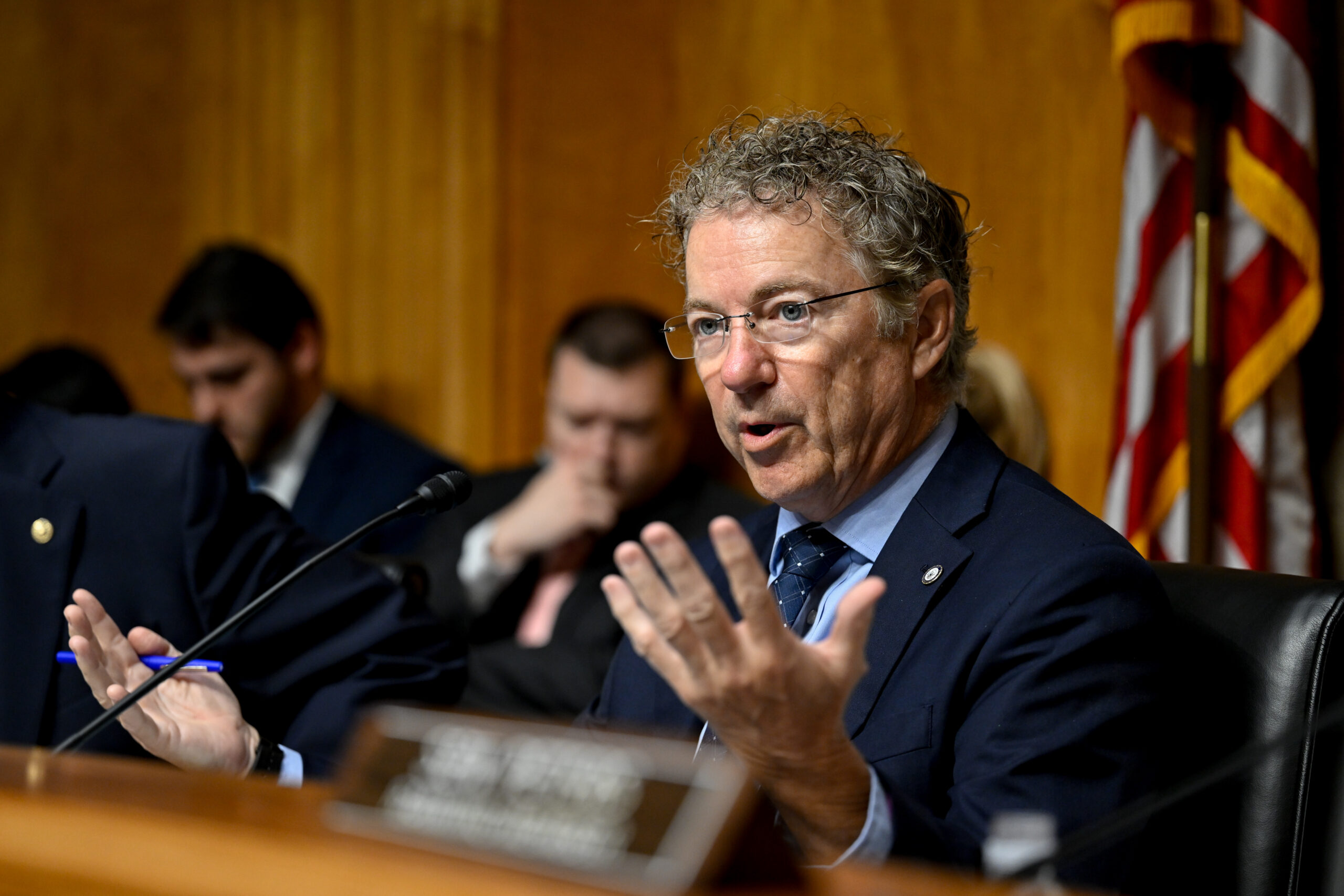
Sens. Bill Cassidy and Rand Paul, supporters of previous war powers efforts, changed their votes on the resolution, which had previously passed a procedural hurdle
Plus, Trump brings the heat to Capitol Hill
John Lamparski/Bloomberg via Getty Images
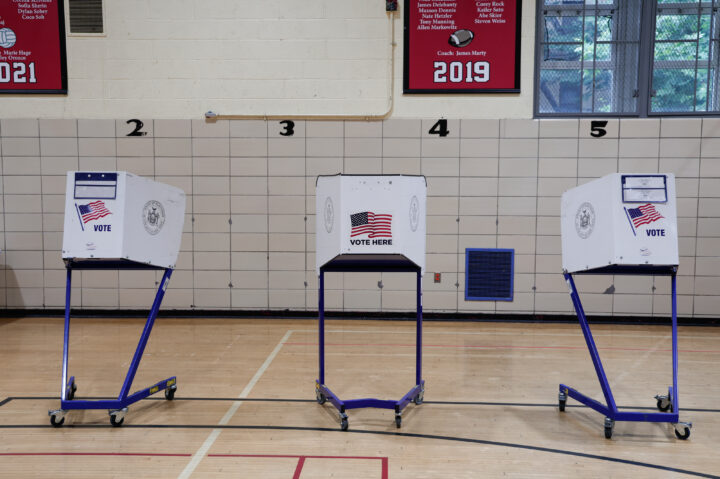
Voting booths at a polling location during a primary election in New York on June 23, 2026.
Good Wednesday afternoon.
This P.M. briefing is reserved for our premium subscribers like you — offering a forward-focused read on what we’re tracking now and what’s coming next.
Today’s Daily Overtime was curated by JI U.S. Editor Danielle Cohen-Kanik.
📡On Our Radar
Notable developments and interesting tidbits we’re tracking
Moderate House Democrats were shaken by the success of several Democratic Socialists of America-backed candidates in New York City primaries last night, and particularly the ouster of two incumbents by their left-wing challengers. “People who do not support the DSA wring their hands at cocktail parties, while the DSA is organizing,” Rep. Tom Suozzi (D-NY) told Axios. “You can’t win with these guys by playing patty cake,” another centrist House Democrat said…
Jewish leaders also expressed dismay at the election results: Rabbi Ammiel Hirsch of the Reform Stephen Wise Free Synagogue, an outspoken critic of New York City Mayor Zohran Mamdani, told The New York Times that “a lot of American Jews” woke up today to “a sense of sadness, a sense that we’re losing something important.”
Rabbi Andy Bachman, a former rabbi at Congregation Beth Elohim in Brooklyn, said the “most disturbing” thing about the election results was that “if you declare genocide in Gaza, despite a distinct lack of experience compared to people that you’re running against, it can win you an election”…
Fresh off his election night victories, Mamdani announced today he would be meeting with House Minority Leader Hakeem Jeffries (D-NY), Jewish Insider’s Will Bredderman reports.
Jeffries said earlier that he and Mamdani “agree to strongly disagree about some of his endorsements,” after the mayor helped unseat two New York City Democrats: Reps. Dan Goldman and Adriano Espaillat. “He’s got work to do in terms of the conversations that he’s going to have with members of Congress moving forward,” Jeffries said of Mamdani…
After blindsiding lawmakers today when he abruptly canceled a bill signing for a widely supported bipartisan housing bill, President Donald Trump attended a tense GOP Senate luncheon where he railed against the Senate’s passage of an Iran war powers resolution yesterday and got into a shouting match with Sen. Bill Cassidy (R-LA), who voted in favor.
When Trump asked why any Republican would have supported the measure, Cassidy, who was recently defeated by a Trump-backed challenger, recalled, “I stood and said, ‘You have not told the American people what’s going on’”…
Secretary of State Marco Rubio met with UAE President Sheikh Mohamed bin Zayed in Abu Dhabi this morning, where Rubio said he “thanked the UAE leadership for their unparalleled support, praised their courage and resilience in the face of Iran’s attacks, and reaffirmed our commitment to Emirati security”…
Pictured sitting next to the secretary of state in a working lunch with MBZ was Michael Boulos, Trump’s son-in-law whose father serves as a senior advisor to the president on the Middle East. Rubio said later that his “good friend” Boulos was not involved in the policy discussions…
Rubio then traveled to Kuwait, where he told reporters that technical talks with Iran are slated to resume next week and dismissed speculation that Israel is attempting to undermine the memorandum of understanding: “The Israelis exactly know what we’re working on. All of our partners in the region know what we’re working on”…
Yesterday’s discussions between Israeli and Lebanese representatives for their fifth round of negotiations at the State Department ended without progress and at some points became “ugly,” Axios reports, as military officials from both countries presented conflicting plans for the IDF’s withdrawal from southern Lebanon.
Rubio told reporters that Jerusalem and Beirut are still working to establish pilot zones under the control of the Lebanese Armed Forces where the IDF will pull back, saying, “The more of that area that the LAF is able to secure, the less of it is in Hezbollah’s control, the less Israel will be in Lebanon.” But Israeli Defense Minister Israel Katz stated today that the IDF will not withdraw from southern Lebanon “even if there is an American demand”…
Rubio also presided over the official reopening of the U.S. Embassy in Kuwait City after it was shuttered for security reasons several months ago amid the Iran war…
Iranian parliament speaker and chief negotiator Mohammad Bagher Ghalibaf called the agreement signed with the U.S. “a declaration of America’s defeat,” saying at a conference in Azerbaijan that it was reached as a “result of the resistance and authority” of Iran…
The Trump administration is planning to approve the sale of dozens of jet engines worth more than $700 million to Turkey, according to Reuters, ahead of the NATO summit in Ankara next month. The move comes despite reported security concerns from Congress…
FBI Director Kash Patel met with Qatari Interior Minister Sheikh Khalifa bin Hamad Al-Thani in Washington…
CENTCOM announced that the U.S. killed senior ISIS leader Ali Husayn al-‘Ulaywi in an airstrike in northwest Syria on Friday…
Iranian negotiators are consulting Trump’s book, The Art of the Deal, and psychologists in order to navigate the president’s shifting tone in negotiations, sources told The Wall Street Journal…
⏩ Tomorrow’s Agenda, Today
An early look at tomorrow’s storylines and schedule to keep you a step ahead
Keep an eye on Jewish Insider for a look at how Rep. Ritchie Torres (D-NY) avoided a similar fate to his pro-Israel House colleagues who were ousted from their seats as he overwhelmingly defeated a left-wing challenger who made Torres’ support for Israel central to his attacks.
The House Committee on Education and Workforce will mark up Rep. Randy Fine’s (R-FL) No Antisemitism in Education Act.
Homeland Security Secretary Markwayne Mullin will testify at an oversight hearing in the House Appropriations Committee.
The State Department will begin its two-day Pax Silica Summit at the U.S. Institute of Peace, hosted by Under Secretary of State for Economic Affairs Jacob Helberg, focused on strengthening cooperation in AI supply chains, critical minerals, energy and more. The event will be attended by representatives from the Pax Silica signatory countries — which include Israel, Qatar, the UAE, India, Germany and the U.K., among others — and senior business executives.
The Texas Democratic State Convention begins tomorrow, featuring remarks over the three-day event from Sens. Cory Booker (D-NJ) and Bernie Sanders (I-VT), Texas U.S. Senate candidate James Talarico, Illinois Gov. JB Pritzker and Democratic National Committee Chair Ken Martin. Activists will consider close to 20 resolutions critical of Israel — some of which condemn AIPAC and DMFI — introduced by seven individuals at a party convention in June.
The annual Aspen Ideas Festival will kick off in Colorado, bringing together leading figures from politics, business, media and academia for a week of discussions on global challenges including AI, economic policy and national security.
Stories You May Have Missed
MAMDANI MAM-ENTUM
Socialist sweep in New York as Mamdani candidates prevail
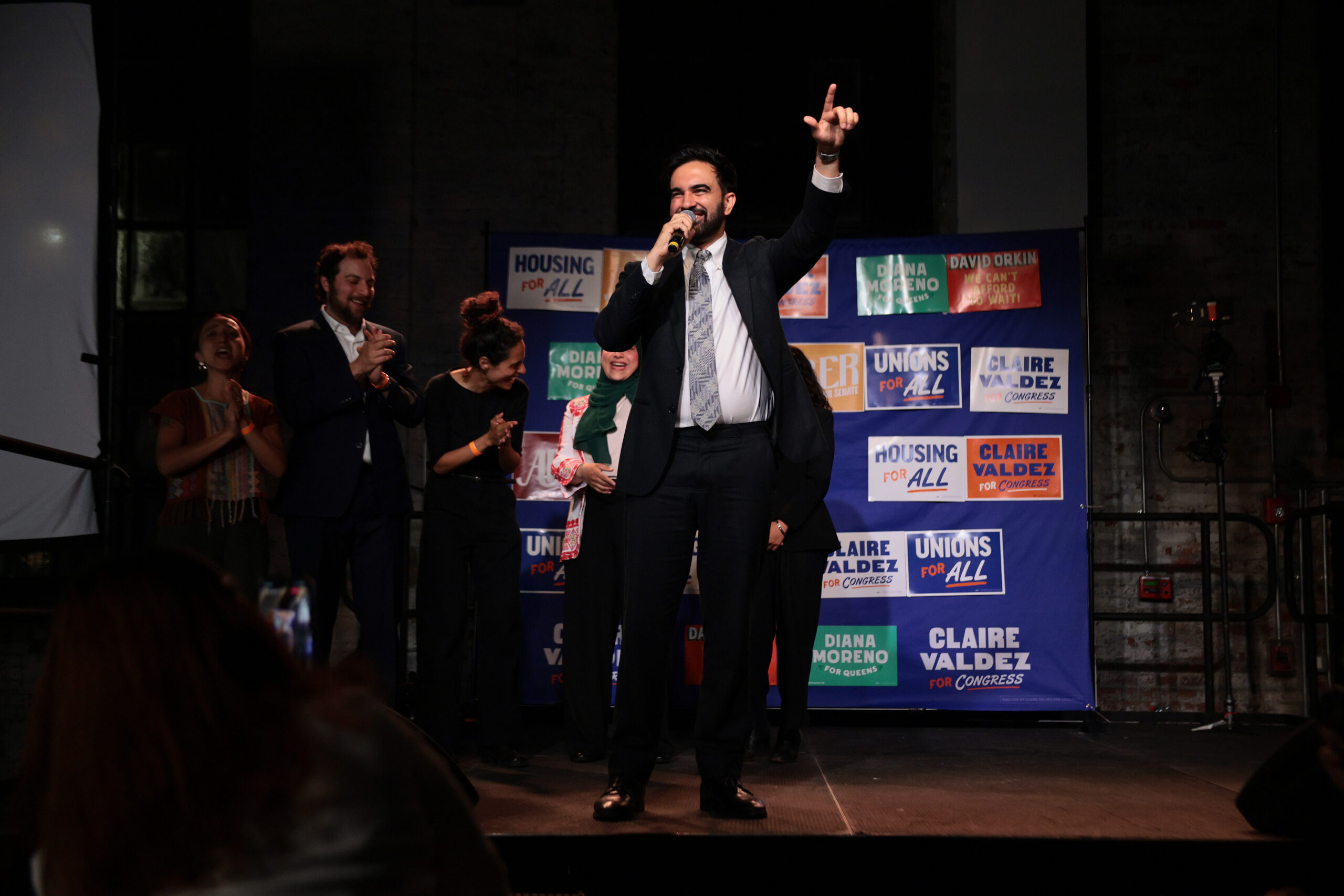
The mayor flexed his political muscle as Brad Lander, Claire Valdez and Darializa Avila Chevalier triumphed in their congressional primaries
2028 WATCH
Prospective 2028 Democrats rally against Trump’s Iran agreement
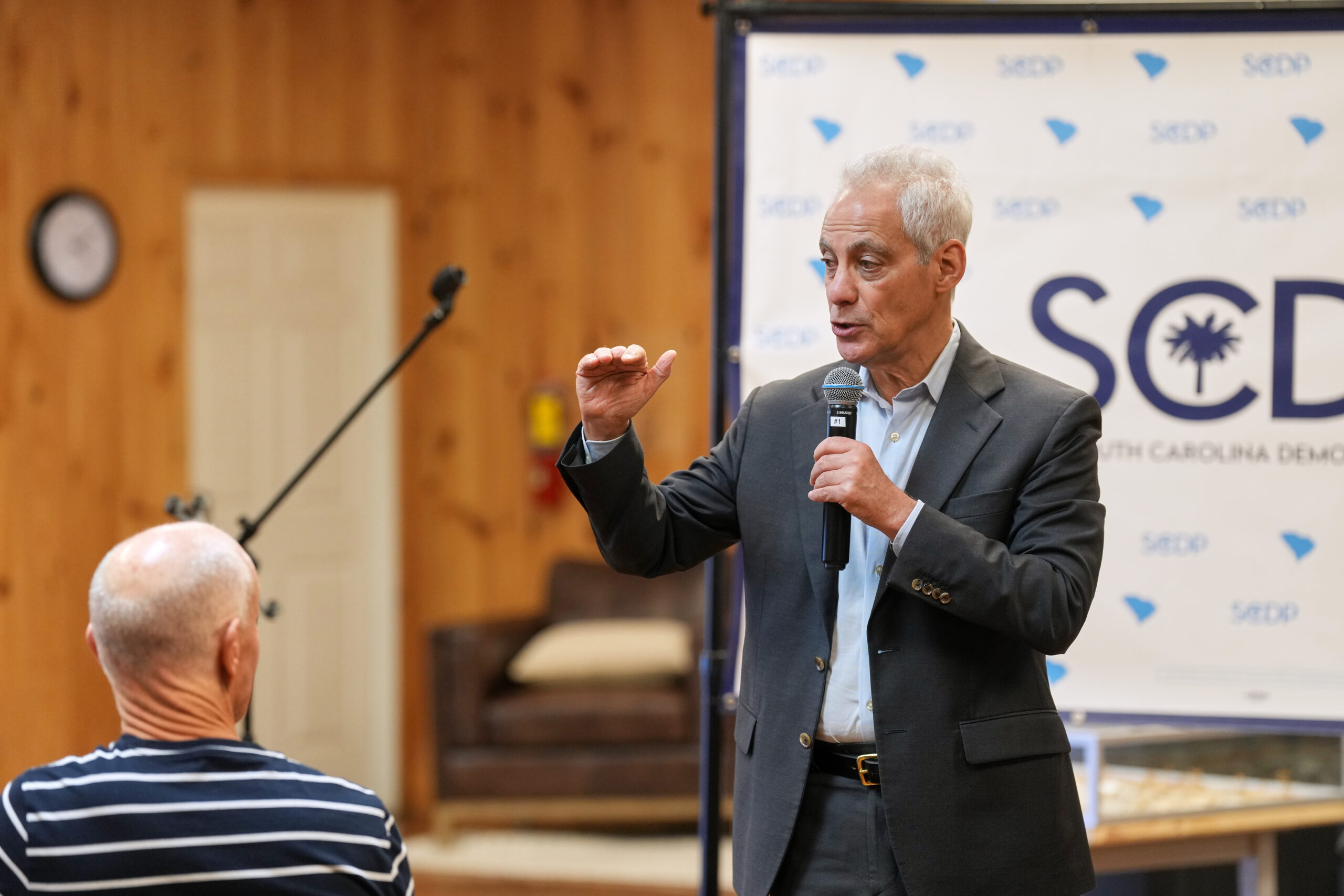
Several Democrats considering presidential bids have cast the Iran agreement as evidence of weak leadership, arguing that Trump has been outmaneuvered by Tehran
Plus, NYC first lady snubs Brad Lander on primary day
Oliver Contreras / AFP via Getty Images
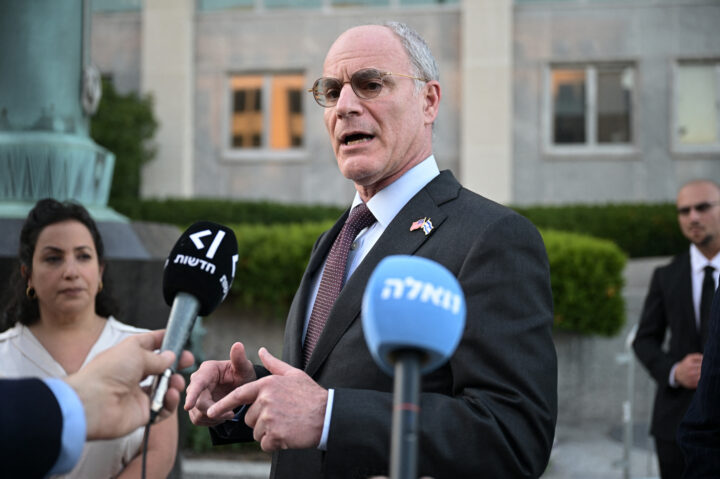
Israel's Ambassador to the U.S. Yechiel Leiter speaks to reporters after a meeting between Israeli and Lebanese delegations hosted by the United States at the State Department in Washington, DC, on June 3, 2026.
Good Tuesday afternoon.
This P.M. briefing is reserved for our premium subscribers like you — offering a forward-focused read on what we’re tracking now and what’s coming next.
Today’s Daily Overtime was curated by JI U.S. Editor Danielle Cohen-Kanik.
📡On Our Radar
Notable developments and interesting tidbits we’re tracking
The U.S. and Iran continued to offer conflicting accounts of the agreement reached over the weekend: President Donald Trump posted on Truth Social this morning that Iran “fully and completely agreed to highest level Nuclear inspections long into the future,” without which “there would be no further negotiations.” But Iranian Foreign Ministry spokesperson Esmail Baghaei said it was untrue and that the parties had not discussed any nuclear issues.
About Tehran’s denial, Secretary of State Marco Rubio said the U.S. “know[s] what [Iran] agreed to do, and now they’ll either do it or they won’t. And if they do, the process moves forward. And if they don’t, the president will have some decisions to make”…
Trump also said in his post that the funds received by Iran through the deal will go “into escrow, controlled by the U.S.A., and will be used for the purchase of food and medical supplies.” Yet the Treasury Department’s waiver of Iranian oil sanctions contains no such language and the text of the memorandum of understanding says unfrozen Iranian assets “shall be made fully usable” for “any ultimate beneficiary designated by the Central Bank of the Islamic Republic of Iran”…
Meanwhile, Iranian Parliament Speaker Mohammad Bagher Ghalibaf and Foreign Minister Abbas Araghchi were in Muscat speaking with Omani leaders about the Strait of Hormuz: In a joint statement, the parties said their foreign ministries will work towards an agreement on the “future administration” of the strait, the “services that will be provided in this regard and the costs associated with them,” as the Trump administration has repeatedly stated it will not accept any tolls placed on transit through the key waterway…
Iranian President Masoud Pezeshkian was also abroad, meeting in Islamabad with Pakistani Prime Minister Shehbaz Sharif, where Pezeshkian said Iran’s ballistic missile program “will never be” up for negotiation with the U.S…
Jerusalem is publicly expressing concern about the Lebanon deconfliction mechanism established by the U.S. and Iran for the first time, Jewish Insider’s Emily Jacobs reports: At the opening of Israel and Lebanon’s fifth round of direct talks taking place in Washington today, Israeli Ambassador to the U.S. Yechiel Leiter claimed the parties are “heading towards a train wreck.”
Leiter said he’s “concerned the concept of deconfliction is misplaced” because “Israel is not in conflict with Lebanon,” and that Israel had assumed “the central issue was Lebanon and Hezbollah — not the extent to which Iran could restrain Hezbollah. That is not Iran’s role”…
Rubio, arriving in Abu Dhabi, said the U.S.-Iran and Israel-Lebanon tracks “are separate because Lebanon is a sovereign country,” and that the U.S. is “going to negotiate a deal directly with the Lebanese government,” without mentioning Israel.
Rubio also made clear that Iran is responsible for much of the terror activity in the Middle East, striking a different tone than that of Vice President JD Vance, JI’s Danielle Cohen-Kanik reports, after Vance said yesterday the U.S. is counting on Iran to “rein in” Hezbollah…
The Senate passed a war powers resolution this afternoon directing the administration to withdraw U.S. forces from Iran, 50-48, with GOP Sens. Rand Paul (R-KY), Lisa Murkowski (R-AK), Susan Collins (R-ME) and Bill Cassidy (R-LA) voting in favor with Democrats,JI’s Marc Rod reports.
The resolution, now passed by both chambers, came as a concurrent resolution — meaning it will not be submitted to the president and, based on past court precedent, is not seen as carrying the force of law…
A manifesto allegedly left by the gunman behind yesterday’s rampage in Côte-des-Neiges, a heavily Jewish neighborhood in Montreal, repeatedly targeted Jews and Zionists, specifically identifying “influential Zionists” among his intended victims, JI’s Haley Cohen reports…
New York City First Lady Rama Duwaji posted an Instagram story today flashing an “I Voted” sticker and encouraging her followers to support two congressional candidates endorsed by Mayor Zohran Mamdani and the Democratic Socialists of America: Assemblymember Claire Valdez and doctoral candidate Darializa Avila Chevalier. Not receiving a mention was the only Jewish congressional candidate endorsed by her husband: former New York City Comptroller Brad Lander, JI’s Will Bredderman reports…
Ammar Campa-Najjar, a DSA-backed candidate who was recently defeated in his run for a California congressional seat, launched a new PAC called Democratic Majority for America — a counter to Democratic Majority for Israel, which organized against him in the June primary — to support progressive candidates who want to end aid to Israel, Politico reports.
The PAC, which Campa-Najjar said has about $100,000 in cash on hand, has already endorsed California congressional candidate Randy Villegas and far-left Michigan Senate candidate Abdul El-Sayed…
AIPAC’s super PAC, the United Democracy Project, has spent more than $38 million backing candidates this election cycle so far through direct and indirect spending, according to Politico, surpassing the $26 million it spent on the 2022 midterms…
The Blue Square Alliance Against Hate, headed by New England Patriots owner Robert Kraft, announced the formation of its inaugural advisory board, including Bank of America CEO Brian Moynihan, Dentons CEO Kate Barton, Salesforce CEO Marc Benioff, former Secretary of State Condoleezza Rice and Warner Bros. CEO David Zaslav…
⏩ Tomorrow’s Agenda, Today
An early look at tomorrow’s storylines and schedule to keep you a step ahead
Keep an eye on Jewish Insider for primary results from key races in New York and Maryland, as well as a postmortem on New York City Mayor Zohran Mamdani’s ability to wield his political capital in the three congressional races where he endorsed progressive candidates.
President Donald Trump is expected to attend a GOP Senate luncheon as he remains at odds with his party over several legislative efforts and as some Republicans speak out against his efforts to curb Israeli operations against Hezbollah.
In the afternoon, Trump will hold a rally on the National Mall to kick off his Great American State Fair in the lead-up to the country’s 250th anniversary.
Defense Secretary Pete Hegseth is slated to brief House Republicans tomorrow as the Pentagon gears up for a contentious fight over an expected $80 billion supplemental funding request tied largely to the Iran war.
The House Appropriations Committee will mark up the 2027 defense spending bill.
Sen. Jacky Rosen (D-NV) will speak in conversation with Jewish Council for Public Affairs CEO Amy Spitalnick as well as leaders from other religious groups, including the Union for Reform Judaism and Orthodox Union, about the Jewish American Security Act.
Stories You May Have Missed
ACROSS THE POND
Starmer’s resignation puts Burnham’s record on Israel, antisemitism in the spotlight

Jewish leaders view Andy Burnham as an ally in the fight against antisemitism, but his expected bid for the premiership is renewing scrutiny of his views on Israel and Labour’s post-Corbyn direction
RABBI ROADBLOCK
Another Mamdani primary election test: Keeping a rabbi out of the state Legislature
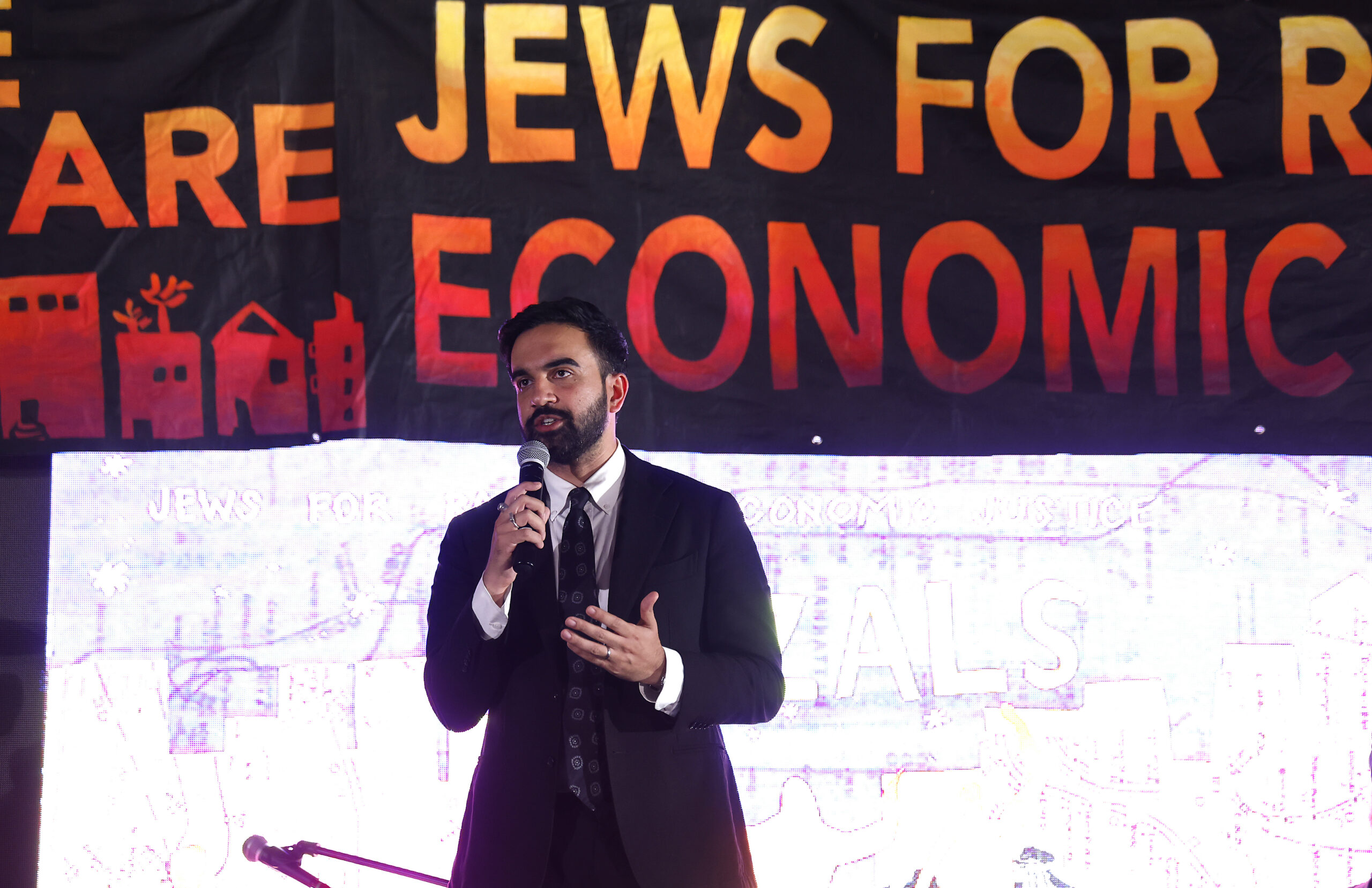
The mayor has inserted himself in the costly fight between Rabbi Stephanie Ruskay and lawyer Eli Northrup, spurning a key Jewish ally in the process
The vice president suggested Iran could help rein in Hezbollah, while the secretary of state emphasized Lebanon’s sovereignty and described the Iran and Lebanon talks as separate diplomatic tracks
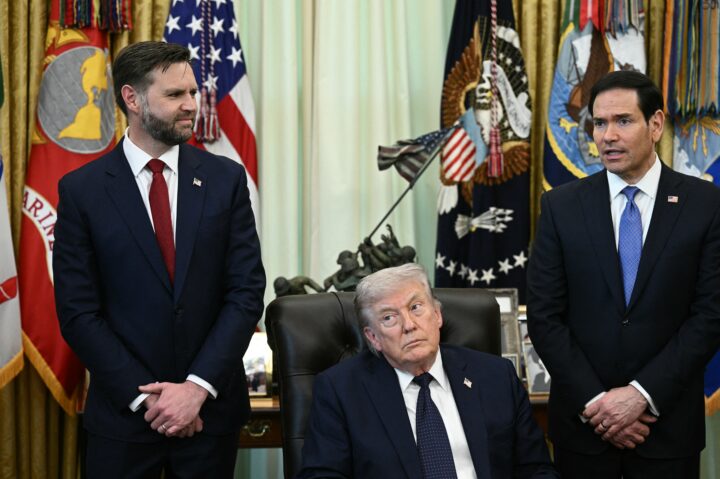
Photo by Brendan SMIALOWSKI / AFP via Getty Images
Vice President JD Vance and President Donald Trump listen to Secretary of State Marco Rubio speak during a meeting with Lebanon Ambassador to the U.S. and Israel Ambassador to the U.S., at the White House in Washington, D.C. on April 23, 2026.
As the details around the memorandum of understanding between the U.S. and Iran emerge, Vice President JD Vance, who has been deputized with leading the effort, and Secretary of State Marco Rubio, ostensibly the Trump administration’s top diplomat, have offered different messaging around the issue of Lebanon and Hezbollah being subsumed into discussions with Tehran.
After the U.S. and Iran agreed to create a “deconfliction cell” for military operations in Lebanon — a mechanism that, notably, does not include Israel — Vance said on Monday that the U.S. will be counting on Iran to “rein in” its proxy Hezbollah, without referencing Tehran’s material support for the terror group.
Vance called on Israel to respond to Hezbollah’s attacks “in the context of a conversation that’s ongoing between Hezbollah, Lebanon, Israel and other partners in the region.” He said the conflict is “a bit of a chicken and egg problem,” in which he claimed lower-level Hezbollah operatives are firing on Israel without approval from their superiors.
Rubio, meanwhile, has been clearer about Iran’s role in propagating terror in the Middle East. Arriving in the United Arab Emirates on Tuesday, he said a “complete end of hostilities in the entire region” is “not possible … as long as Iranian proxies are launching missiles and drones from Iraq and are participating in terrorism like Hamas did and like Hezbollah did.”
WATCH: Marco Rubio said upon arriving in Abu Dhabi that the U.S.–Iran and Israel–Lebanon diplomatic tracks “are separate because Lebanon is a sovereign country,” while adding that Iran’s “support and sponsorship of Hezbollah” will be part of “our conversations with the Iranians.” pic.twitter.com/iADhszGTZC
— Jewish Insider (@jewishinsider) June 23, 2026
Rubio also distanced the Lebanon conflict from negotiations with Iran: Asked if he believes the Israel-Lebanon peace process should be separate from the Iran discussions, Rubio said, “That process is separate.”
“It’s separate because Lebanon is a sovereign country. … When it comes to Lebanon and what’s happening inside of Lebanon, we’re going to negotiate a deal directly with the Lebanese government,” he continued, again without mentioning Israel.
“Now, there’s an Iranian issue with regards to Lebanon, and that is their support and sponsorship of Hezbollah. And so that factor will be discussed as part of our conversation with the Iranians, but … the future of Lebanon belongs to the Lebanese people, through their sovereign, elected government, and that’s who we’re going to be working with,” Rubio said.
He referenced a phone call he and Vance held earlier on Tuesday with Lebanese President Joseph Aoun, who said in a readout that the deconfliction mechanism will now include Lebanon as a party.
Olivia Wales, a White House spokesperson, told Jewish Insider, “Both Vice President Vance and Secretary Rubio are in lockstep with President Trump: Iran can never have a nuclear weapon and must stop their proxies in Lebanon from causing trouble. What President Trump and his entire national security team achieved on the battlefield and at the negotiating table is nothing short of remarkable and will strengthen American security for years to come.”
This story was updated on June 23 to include comment from the White House.
Plus, the White House amplifies Al Jazeera

Jonathan Raa/NurPhoto via Getty Images
The Brent crude oil price chart is displayed on a mobile screen on March 2, 2026.
Good Monday afternoon.
This P.M. briefing is reserved for our premium subscribers like you — offering a forward-focused read on what we’re tracking now and what’s coming next.
Today’s Daily Overtime was curated by JI U.S. Editor Danielle Cohen-Kanik.
📡On Our Radar
Notable developments and interesting tidbits we’re tracking
Three people were killed in a shooting attack today in Côte-des-Neiges, a heavily Jewish neighborhood in Montreal, Jewish Insider’s Haley Cohen and Tamara Zieve report. A civilian, a police officer and the suspect were confirmed dead by Montreal police, while one other police officer was seriously injured but in stable condition. Police said the suspect’s motive is still under investigation. Stay updated on this developing story with JI’s What We’re Watching briefing…
After the U.S. and Iran agreed to create a “deconfliction cell” for military operations in Lebanon during their negotiations yesterday, Vice President JD Vance said at a press conference today that the U.S. will be counting on Iran to “rein in” Hezbollah — without acknowledging that Tehran offers material backing to its proxy in Lebanon, JI’s Matthew Shea reports.
Vance called Hezbollah’s attacks on northern Israel and the IDF’s retaliation “a bit of a chicken and egg problem, that you’ve got a junior guy who fires a drone that didn’t have approval from the high command. Of course Israel has to respond to that,” he acknowledged, “but … we could actually have a better and more peaceful situation if Israel responds in the context of a conversation that’s ongoing between Hezbollah, Lebanon, Israel and other partners in the region”…
Israeli Prime Minister Benjamin Netanyahu appeared to push back on Vance’s framing, saying in a video statement this morning that his directive to the IDF “has not changed: Our fighters in southern Lebanon have full freedom of action to thwart any direct or developing threat to them or to the residents of the north. The IDF has no restrictions on this matter,” he said, while the tenuous ceasefire with Hezbollah appeared to hold today…
Vance also announced Iran had agreed to let U.N. nuclear inspectors back into the country, and President Donald Trump wrote on Truth Social that “everybody is fully aware” Iran will agree to “have Major Weapons Inspections in order to ensure ‘Nuclear Honesty’ long into the future,” but Esmail Baghaei, Iran’s foreign ministry spokesperson, told state media that Iran made “no new commitments” regarding inspections…
Pursuant to the agreement reached between the U.S. and Iran over the weekend, the Treasury Department issued a waiver lifting decades-old U.S. sanctions on Iranian oil for the next 60 days, permitting imports of Iranian oil directly to the U.S. and paying for the goods in U.S. dollars.
Asked this afternoon in the Oval Office if he can ensure that Iran won’t use the funds for military purposes, Trump said, “They’re not supposed to be doing that, so we’ll see, but they’re supposed to use the money to buy food for their people.” AIPAC described the waiver as “broader than the terms detailed in the MOU or what was included in the JCPOA”…
The White House’s “Rapid Response” X account boosted an Al Jazeera video interview about the negotiations with Qatari Prime Minister Sheikh Mohammed bin Abdulrahman Al Thani, calling it “the real story from people actually in the room”…
Avigdor Liberman, head of Israel’s Yisrael Beiteinu party and a leading opponent of Netanyahu, wrote in The Wall Street Journal that the “deal between Washington and Tehran won’t stop Iran from becoming a nuclear power. It will guarantee it.” He called for Jerusalem to “inform Washington that Israel won’t accept any linkage between Iran and Lebanon” and end its reliance on U.S. missile systems, preparing to attack key Iranian infrastructure if Tehran strikes Israel…
Asked about her stance on Israel in a rare nationally televised interview on Fox News today, Sen. Susan Collins (R-ME) said she “remain[s] a very strong supporter of Israel” despite rising hostility to Israel and AIPAC among the American public, which she said “sadly reflects rising antisemitism in our country that” her opponent, Democratic nominee Graham Platner, “certainly is part of.”
“It’s important to recognize that AIPAC is made up of Americans who care deeply about our relationship with Israel. Platner makes it sound like this is some sort of evil foreign influence and that is absolutely wrong,” Collins continued…
New York City Mayor Zohran Mamdani doubled down on his rhetorical assault on AIPAC today, JI’s Will Bredderman reports, after Jewish groups over the weekend criticized his comments about the pro-Israel organization at a rally last week that they argued evoked classic antisemitic tropes.
Mamdani defended naming AIPAC among the “monsters who move dark money” as a reference to a widely known misquote of 20th-century Marxist philosopher Antonio Gramsci, and backed up his argument with statistics from the Hamas-controlled Gaza Health Ministry alleging that the IDF has killed more than 1,000 Palestinians since the ceasefire last fall…
JI’s Christina Sher looks at the state of tomorrow’s Democratic primary for executive of Montgomery County, Md., as all three of the front-runners — County Councilmembers Will Jawando, Andrew Friedson and Evan Glass — have been outspoken against antisemitism, but diverge in their policy positions and views on Israel…
Three men killed in asmall plane crash in Bowie, Md., on Saturday night have been identified as Israeli citizens, JI’s Haley Cohen reports: Yoav Bomrind, 26, David Rabinovitz, 19, and Elad Neidik, 20, boarded the single-engine plane in Ocean City, N.J., for a training flight before it crashed just outside Washington, D.C…
Alan Greenspan — the influential economist who led the Federal Reserve across four presidencies and whose track record guiding economic growth earned him status as an economic “maestro” — died today at 100, JI’s Haley Cohen reports…
⏩ Tomorrow’s Agenda, Today
An early look at tomorrow’s storylines and schedule to keep you a step ahead
Keep an eye on Jewish Insider for a look at how pro-Israel groups’ intervention in the race to replace retiring Rep. Steny Hoyer (D-MD) — where they are supporting state Delegate Adrian Boafo — revealed a more proactive strategy for taking on the left than the one the groups have employed in New York City’s Democratic primaries, as voters in both states head to the polls tomorrow.
Israeli and Lebanese representatives are expected to meet in Washington to continue their direct negotiations, as the U.S. and Iran seek to intervene in ending military operations in Lebanon.
Secretary of State Marco Rubio will embark on a three-day trip to the United Arab Emirates, Kuwait and Bahrain to discuss issues including the memorandum of understanding with Iran and transit through the Strait of Hormuz.
Orthodox Union Advocacy will hold its annual lobbying day on the Hill, including a luncheon with senators from both parties and a speech by Israeli Ambassador to the U.S. Yechiel Leiter.
The Jerusalem News Syndicate’s policy summit continues in Jerusalem with remarks from former Israeli Prime Minister Naftali Bennett, former Defense Minister Benny Gantz, Foreign Minister Gideon Sa’ar, Diaspora Affairs Minister Amichai Chikli, Netanyahu advisor Michael Eisenberg and Magen David Adom President Gilad Erdan.
Stories You May Have Missed
WASHINGTON WATCH
D.C. Jewish leaders taking wait-and-see approach to Lewis George’s expected mayoralty
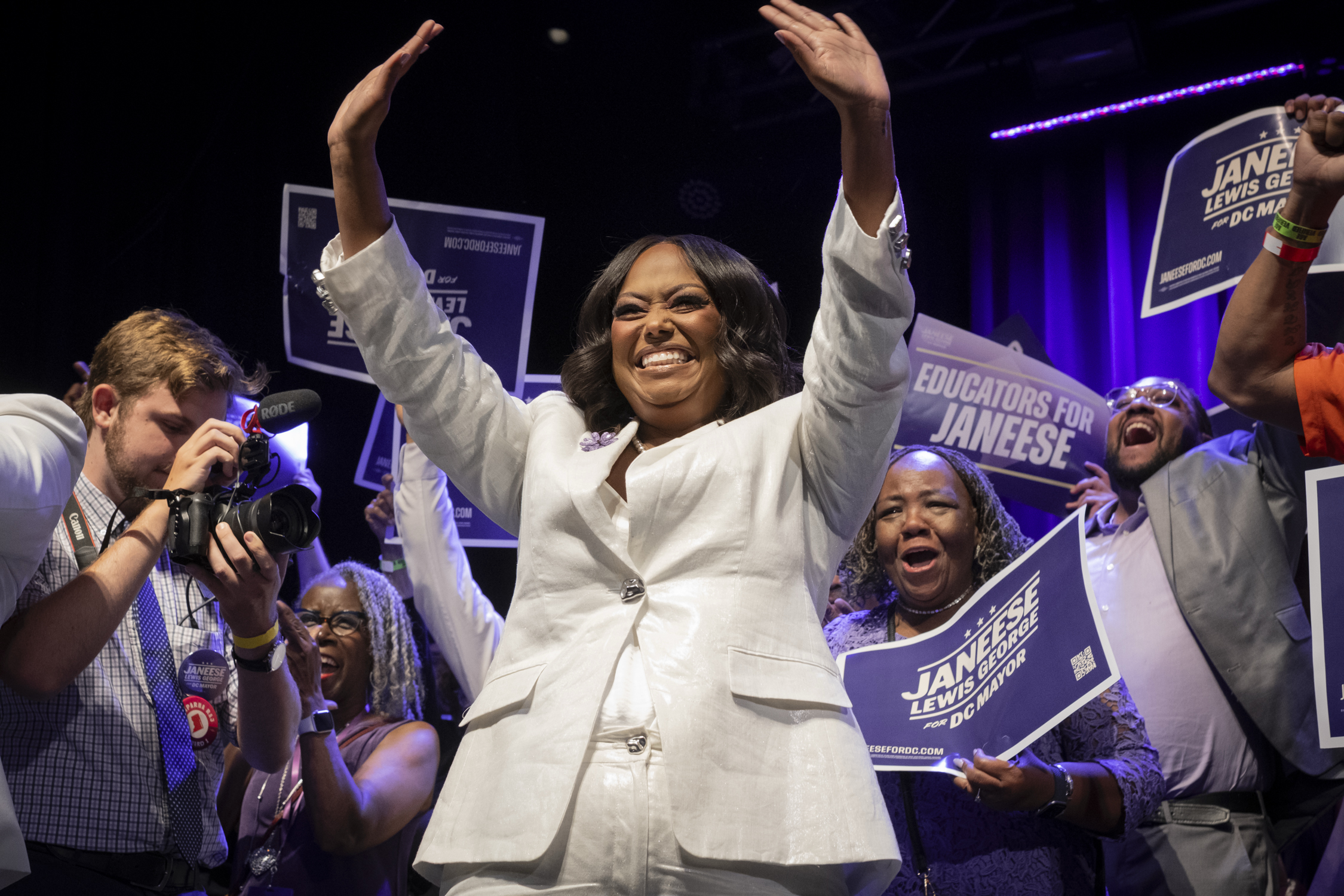
JCRC CEO Ron Halber said he hopes to work with the DSA member, despite his strident criticism of the group, while remaining vigilant
BLAME GAME
Israelis overwhelmingly believe Iran won the war, survey finds
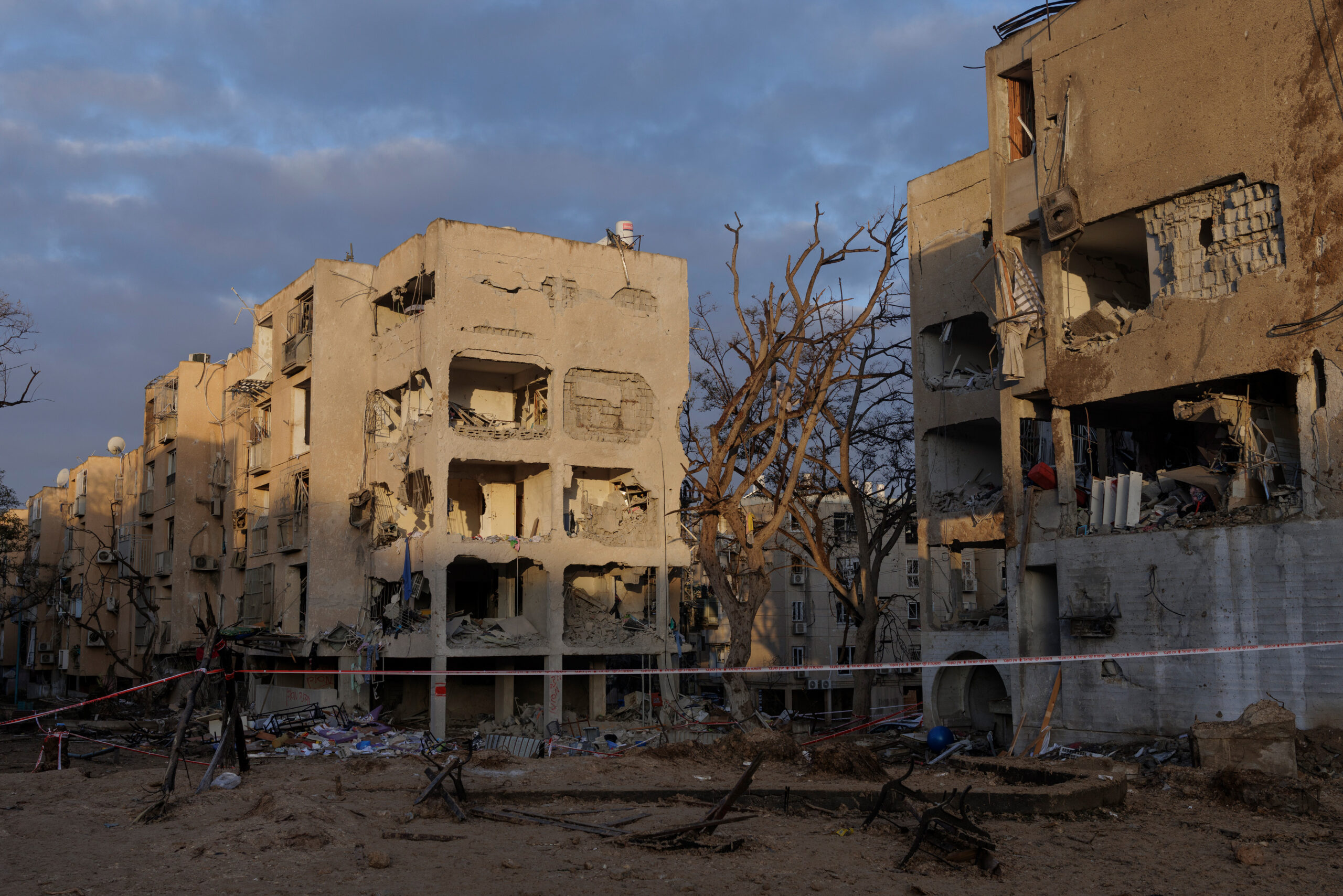
Nearly all Israelis surveyed said they believed Tehran was the victor, while 70% rated Trump’s management of the war as a failure or poor
Vance, announcing the deconfliction mechanism established with Iran, said, ‘We could have a better and more peaceful situation if Israel responds in the context of a conversation that’s ongoing between Hezbollah, Lebanon, Israel and other partners in the region’
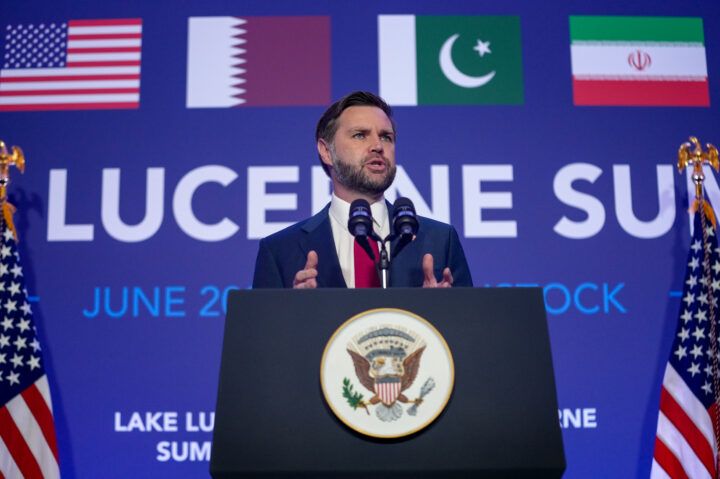
Nathan Howard-Pool/Getty Images
Vice President JD Vance speaks to members of the media at the Buergenstock Resort Lake Lucerne, after the U.S. and Iran held high-level talks at the Lake Lucerne Summit on June 22, 2026 near Stansstad, Switzerland.
Vice President JD Vance on Monday backed Iran’s participation in bringing about the end of Israel and Hezbollah’s military conflict, calling the terror group’s ongoing strikes and Israel’s response “a chicken and egg problem.”
Vance said at a press conference in Switzerland that the U.S. will be counting on Iran to “rein in” Hezbollah, after the U.S. and Iran agreed to create a “deconfliction cell” for military operations in Lebanon during negotiations on Sunday. The statement announcing the mechanism, released by mediating countries Pakistan and Qatar, did not reference Israel.
When asked if he expected Lebanon to be such a linchpin in negotiations, Vance said, “We want Hezbollah to stop firing at our friends in Israel. We want Israelis to be able to live in peace. We also want to make sure that … when things happen, they don’t spiral into a broader escalation, and so we’ve been, I think, very good at setting up what we’re calling a deconfliction mechanism.”
“Sometimes you’ve got a bit of a chicken and egg problem, that you’ve got a junior guy who fires a drone that didn’t have approval from the high command,” he continued, referring to Hezbollah’s ongoing attacks on northern Israeli towns.
“Of course, Israel has to respond to that, but … we could actually have a better and more peaceful situation if Israel responds in the context of a conversation that’s ongoing between Hezbollah, Lebanon, Israel and other partners in the region.”
Vance added that ongoing negotiations will require close coordination with the U.S.-backed Lebanese Armed Forces and will “also require the Iranians to rein in Hezbollah,” without acknowledging that Iran offers material backing to its proxy in Lebanon.
Reports have indicated that some Lebanese lawmakers have expressed dissatisfaction with the U.S. and Iran including Beirut in their negotiations, as opposed to leaving Lebanon to its separate U.S.-backed track directly with Israel, which is set to continue in Washington this week.
When asked whether the U.S. expects an Israeli withdrawal from Lebanon, Vance demurred, affirming instead that Israel has a “right to self-defense” and that the U.S. wants “Israel’s security to be protected.””
“We want Israel’s security to be protected, and we also want Lebanon’s sovereignty to be protected,” Vance said. “The Israelis have been very clear: they do not have territorial intentions on south Lebanon. The reason they feel they have to be there is because they’re worried about Hezbollah fighters in south Lebanon firing into Israel.”
Vance noted that the U.S. made additional “good progress” in the high-level talks over the weekend, claiming that Tehran has agreed to invite International Atomic Energy Agency inspectors back into the country to monitor its nuclear program.“That is a major milestone for the American people, and the first step in permanently denuclearizing, or permanently ending a nuclear weapons program in Iran,” Vance said at his press conference.
The IAEA inspectors would verify that Iran is only using nuclear material for peaceful purposes, a parameter that Vance noted was “exactly what we asked to happen.”
“In terms of when the nuclear inspectors are going to start … I expect that will happen at the minimum this week, but we think even some of those conversations with the inspectors and with the IAEA could happen as soon as today,” Vance said.
Vance said that talks will proceed on a “technical level” with diplomatic teams in Switzerland continuing negotiations “over the weeks and days to come.”
“The final deal is the house; we set the foundation,” Vance said. “We haven’t built the house, but we’ve laid a successful foundation to get to a good place for the American people. I think it’s important for all of us to appreciate how much was done, but honestly, there is still a lot to do.”
Vance also defended a social media post by President Donald Trump on Sunday, in which the president threatened to “hit Iran very hard again” if it did not “immediately stop” supporting regional proxies. The vice president argued the warning did not derail the diplomatic progress.
“We were negotiating well past one in the morning, so they didn’t walk out, and their technical team is still here working with our technical team as we speak,” Vance said. “What we told the Iranians yesterday is, ‘When you guys engage in what us millennials might call “trash talk,” you can’t expect the president of the United States not to respond and not to correct the record.’”
“So yes, there was a little bit of threatening, there was a little bit of whining, but at the end of the day, the talks continued and we made great progress,” he added.
Plus, Tirana points the finger at Tehran
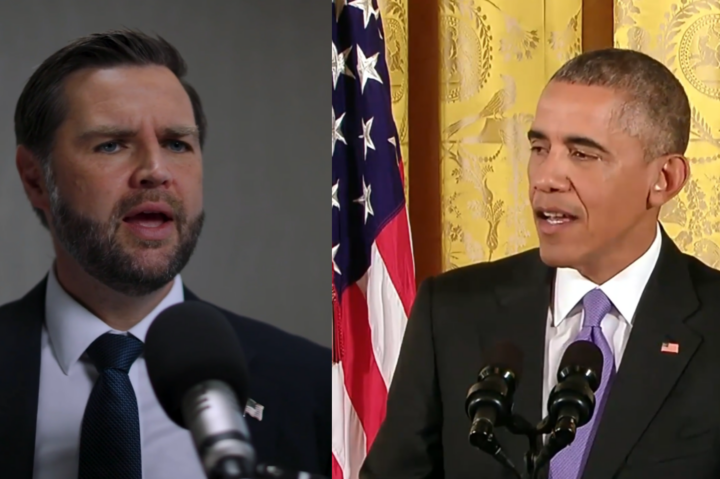
Screenshot
Vice President JD Vance and former President Barack Obama
👋 Good Friday morning!
In today’s Daily Kickoff, we have the latest on the scrapped U.S.-Iran talks that had been slated to begin this weekend in Switzerland and on the overnight attack by Hezbollah, in violation of the just-signed memorandum of understanding, in which four Israeli soldiers were killed. We look at how Vice President JD Vance’s rhetoric around the MOU mirrors how Obama administration officials talked about the 2015 Joint Comprehensive Plan of Action, and look at the divide among Jewish communal groups over the potential merger of the State Department’s antisemitism and Holocaust affairs offices. Also in today’s Daily Kickoff: Albanian Prime Minister Edi Rama, Yoav Gallant and Hillary Clinton.
Today’s Daily Kickoff was curated by JI Executive Editor Melissa Weiss and Israel Editor Tamara Zieve, with an assist from Marc Rod. Have a tip? Email us here.
For less-distracted reading over the weekend, browse this week’s edition of The Weekly Print, a curated print-friendly PDF featuring a selection of recent Jewish Insider and eJewishPhilanthropy stories, including: A Lebanese Zionist’s longshot bid to reshape the Middle East; ‘The single best diaspora experience’: Jewish leaders mark America’s 250th with open letter; and Ivanka Trump unveils Meta initiative to distribute AI glasses to visually impaired veterans. Print the latest edition here.
What We’re Watching
- Four Israeli soldiers were killed in a Hezbollah attack on an IDF tank in southern Lebanon overnight and five others injured in an additional attack in violation of the newly implemented memorandum of understanding, prompting dozens of retaliatory Israeli strikes in the area. The incident, which was the deadliest attack on Israeli troops by Hezbollah in months, came hours after Vice President JD Vance assailed Israeli government officials — one of whom, Finance Minister Bezalel Smotrich, warned that the Iranian-backed group would exploit the diplomacy between Tehran and Washington to attack Israel — for their opposition to the deal. Read more here.
- The escalation comes as Reps. Josh Gottheimer (D-NJ) and Mike Lawler (R-NY) circulate a resolution among lawmakers condemning Hezbollah for its “repeated violations of ceasefire agreements” through its attacks against Israel and calling for the terrorist group to be disarmed, Jewish Insider‘s Marc Rod and Emily Jacobs have learned.
- Vance had been scheduled to travel today to Switzerland, where he was set to begin talks with Iran, following the signing this week of the MOU between the countries. But the trip was scrapped overnight, with a White House spokesperson saying that “the logistics of these negotiations have never been simple or predictable.”
- Elsewhere in Washington, Bill Pulte, the Trump administration’s housing-finance regulator, takes over as interim director of national intelligence today, days after President Donald Trump postponed DNI nominee Jay Clayton’s confirmation hearing, drawing the ire of senators from both sides of the aisle concerned over Pulte’s potential access to classified documents.
- FII Priority Europe wraps up today in Rome. On the main stage yesterday, Albanian Prime Minister Edi Rama blasted Iran for stoking protests in the Balkan nation tied to efforts by Jared Kushner and Ivanka Trump to develop a new real estate project in the country. More below.
- In New York, the Jewish Food Society’s Great Nosh will take place on Sunday on Governors Island.
- The Jewish News Syndicate’s annual policy summit begins on Sunday in Jerusalem.
- Also Sunday, Orthodox Union Advocacy’s annual Attorneys Conference kicks off in Washington.
- We’ll also be keeping an eye on Colombia on Sunday, where far-right attorney Abelardo de la Espriella and far-left activist Iván Cepeda, backed by current President Gustavo Petro, will face off in a presidential runoff. De la Espriella, who has the endorsement of Trump, has also gotten support from Israeli Foreign Minister Gideon Sa’ar, with whom he met last year in Argentina. After the votes from the first round of voting were tallied, Sa’ar posted a photo of the two and congratulated de la Espriella.
What You Should Know
A QUICK WORD WITH GILI COHEN
The long love affair between Israelis and President Donald Trump, on the rocks over the last few weeks as the U.S. and Iran hammered out an end to the war, appears to be over, with humiliations mounting for Jerusalem. “I call all the shots,” not Israeli Prime Minister Benjamin Netanyahu, Trump said earlier this month. More recently, the Israeli leader’s bombing campaign in Beirut was “vicious,” Trump said. And perhaps most humiliating of all, Trump suggested that Syrian President Ahmad al-Sharaa could better take care of Hezbollah than the IDF.
The Israeli public — the spurned lover who once hailed the U.S. president with billboards hung in the center of Tel Aviv reading “Thank you God & Donald Trump” — is not taking it well. Former Israeli Ambassador to the U.S. Michael Herzog told JI, “President Trump, who has been a hero to many Israelis, is now openly criticized from within the Israeli government, including Netanyahu’s close circle.”
And this criticism is not only expressed behind closed doors. Channel 14, the popular right-wing outlet that promotes Netanyahu, has been criticizing Trump resolutely, with some of its anchors publicly cursing Vice President JD Vance and the president’s close advisors, White House Special Envoy Steve Witkoff and Jared Kushner.
It was not always this way. For most of the time since Trump reentered the White House in January 2025, he has been popular in Israel, with polls consistently showing high ratings for the American president.
For Israelis, Trump is the one who brokered the hostage-release agreement with Hamas; Trump is the one who made the strikes in Iran and the bombing of the nuclear enrichment facilities in Fordow and Natanz a reality; and Trump is the one who established the Abraham Accords and is willing to expand them, giving Israelis the chance to sunbathe in the UAE, and perhaps in other countries in the Gulf in the near future. And although some won’t admit it, many Israelis also like his tendency to speak very bluntly, and crudely: a president born in Queens, full of Israeli chutzpah.
NEW DEAL, SAME LYRICS
‘What is your alternative?’ — How Vance’s rhetoric to sell new Iran deal echoes Obama’s
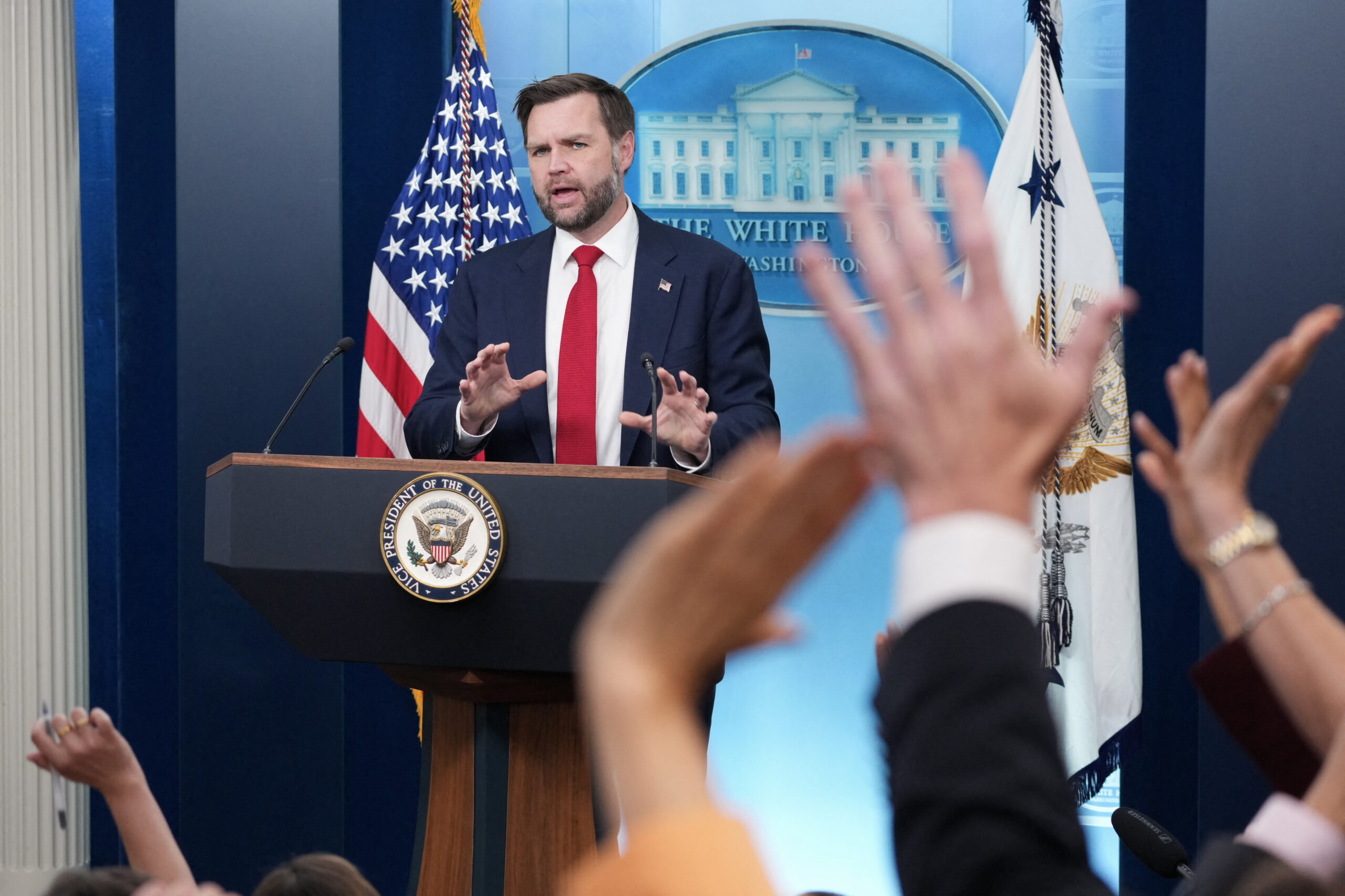
As Vice President JD Vance takes on the role of chief defender of the U.S.-Iran memorandum of understanding and forthcoming talks, he has begun to sound a lot like someone whom the Trump administration has lately spent a lot of time attacking: former President Barack Obama, Jewish Insider’s Gabby Deutch reports. Vance and President Donald Trump have both made clear that they view the MOU as fundamentally different from the 2015 Joint Comprehensive Plan of Action.
Sounds familiar: But as the White House faces criticism from hawkish members of the Republican Party, the language Vance is using to defend the burgeoning deal closely resembles the arguments made by Obama 11 years ago. “If you think this is a bad deal, what is your alternative?” Vance said in an interview this week with New York Times columnist Ross Douthat. Flashback to a 2015 press conference at the White House soon after the JCPOA was announced. “I’m hearing a lot of talking points being repeated about ‘this is a bad deal,’” Obama said. “What I haven’t heard is, what is your preferred alternative?”
Read the full story here and watch a side-by-side video comparison here.
Bonus: In The Washington Post, the Hudson Institute’s Douglas Feith, who served in the George W. Bush administration, posits that Vance’s defense of the agreement resembles “the standard reassurance Western leaders over the past century have offered when they make deals of this kind with bad actors — but it has generally proved hollow.”
DEAL DISCONTENT
‘I don’t know what Trump is thinking’: Jewish GOP donors down on Iran deal

Jewish Republican donors and activists are voicing their strong disappointment with President Donald Trump’s newly announced memorandum of understanding with Iran, which has been met with criticism from GOP lawmakers as well as influential hawkish conservatives, Jewish Insider’s Matthew Kassel reports.
Flagging concerns: In interviews with JI on Thursday, several Jewish conservatives who supported the war expressed misgivings about the deal that reopens the Strait of Hormuz, saying that it had granted too many concessions to a weakened Iran — including waiving sanctions on oil exports — while neglecting to broach the regime’s funding of terror proxies and its ballistic missile arsenal. They also raised concerns that the memorandum of understanding with Tehran had not been favorable to Israel, a U.S. partner in the war, pointing to a term of the preliminary agreement that calls for a permanent end to military operations in Lebanon, where Israel is fighting Hezbollah, a key Iranian ally.
MOU blues: Senate Republicans continued on Thursday to air concerns about the U.S. memorandum of understanding with Iran, in some cases fueled further by Vice President JD Vance’s comments dismissing the effectiveness of U.S. sanctions and lambasting Israeli government officials who have objected to the deal, JI’s Marc Rod and Emily Jacobs report.
TEHRAN STIRRING TIRANA
Albania blames Iran for fueling local protests against Jared Kushner’s development

Albanian Prime Minister Edi Rama on Thursday blamed Iran for what he described as “ruthless” cyberattacks, warning that Tehran has sowed unrest and amplified false information about environmental protests over a new luxury development project in the country from President Donald Trump’s daughter Ivanka Trump and son-in-law Jared Kushner, Jewish Insider’s Matthew Shea reports.
Details: The project, which has been preliminarily approved, has not obtained building permits, but has drawn fierce backlash and sparked daily protests from thousands of demonstrators outside Rama’s office due to environmental concerns. “The amount of posts that have been entering there from our enemy, we have only one enemy, which is the [Islamic] Republic of Iran, and they are engaged in three years in a ruthless cyber-attack against Albania,” Rama said. “They [Iran] entered also in this game…freedom of reach is what every regime, through every propaganda, has done to go in every brain and to put the lie in the brain.”
OFFICE SPACE
Jewish community divided over potential merger of State Dept.’s antisemitism, Holocaust affairs envoys

Jewish communal groups are at loggerheads over the possibility of merging two related but distinct State Department offices: the special envoy to monitor and combat antisemitism and special envoy for Holocaust issues. Some Jewish groups recently sent a letter to Secretary of State Marco Rubio in support of the concept of merging the two offices, while others have sent letters in recent months opposing such a move,Jewish Insider’s Marc Rod reports.
For and against: Proponents of combining the two offices say that doing so consolidates linked issues under the authority of one envoy with ambassador-rank status, while maintaining the work of both offices. Opponents say that combining the two teams would undermine and diminish the work of the Holocaust affairs envoy and risk politicizing critical work on Holocaust restitution. The reexamination of the two roles comes ahead of the expected retirement of Ellen Germain, who has served as special envoy for Holocaust issues since 2021.
PAC CONTRADICTIONS
Progressive anti-Israel super PAC backs candidates at odds with some of its donors

American Priorities, a new super PAC created as a progressive counterweight to pro-Israel spending in Democratic primaries, has drawn scrutiny in recent weeks for accepting contributions from donors who have given to Republicans — even as its allies on the far left have accused AIPAC, a chief rival, of serving as a Trojan horse to advance GOP-linked interests in safe blue districts, Jewish Insider’s Matthew Kassel reports.
Follow the money: Meanwhile, filings show that the anti-Israel group has received $250,000 from a tech executive whose firm is developing AI data centers in New York State. That money has boosted two democratic socialist House candidates in New York City who oppose efforts to expand data centers. Claire Valdez, a state assemblymember running to succeed retiring Rep. Nydia Velazquez (D-NY), and Darializa Avila Chevalier, an anti-Israel activist who is challenging Rep. Adriano Espaillat (D-NY), have benefited from over $2 million in estimated support from American Priorities in the final stretch of their closely contested primaries set for next Tuesday.
OFFSHORE ALLIANCE
Energy Department formalizes Eastern Mediterranean alliance with Israel, Cyprus and Greece at Houston hub
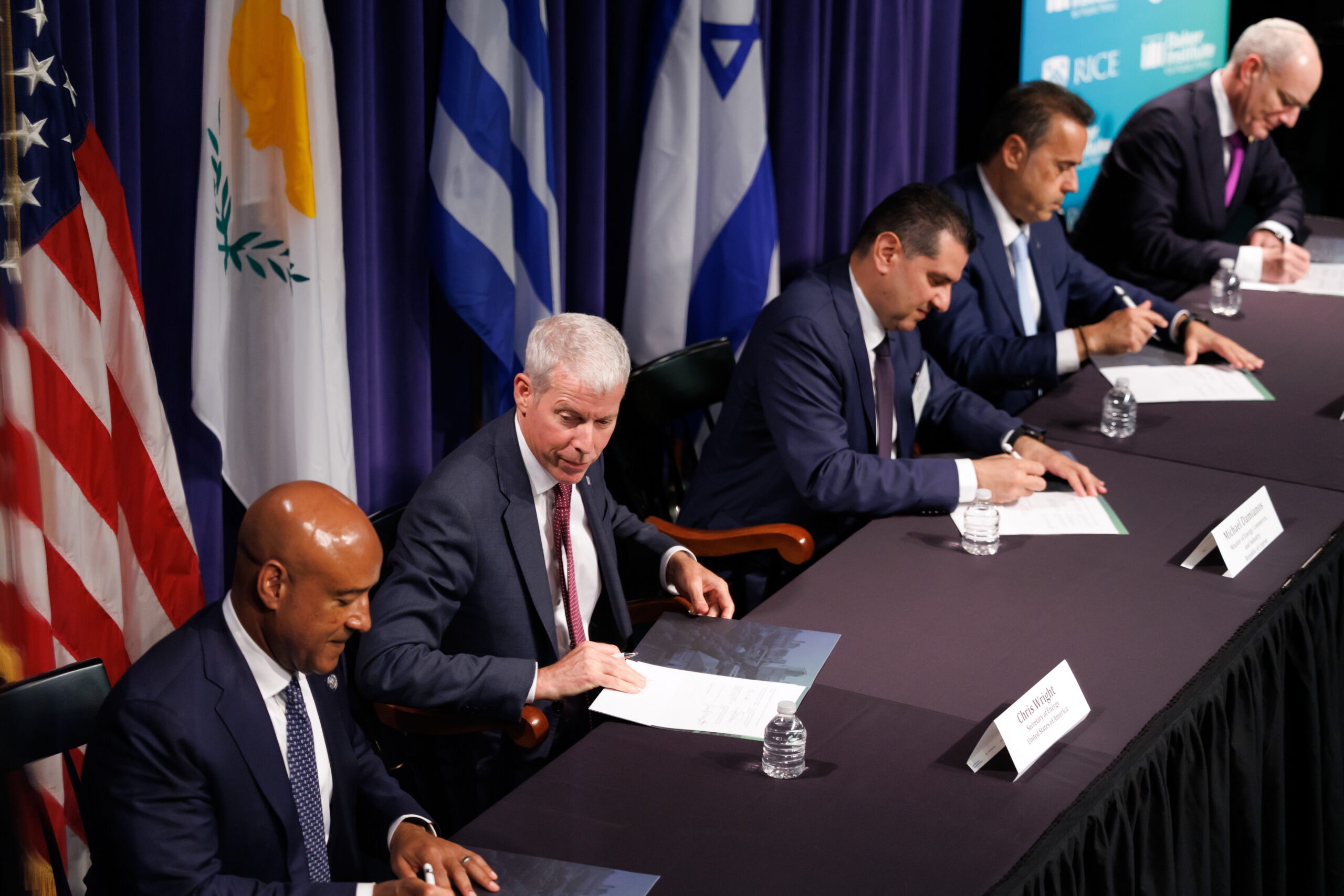
The Department of Energy is leaning on Israel’s offshore gas resources and cybersecurity prowess to help an emerging Eastern Mediterranean energy alliance, with officials telling Jewish Insider’s Matthew Sheathat Israeli participation uniquely “strengthens” the newly formed coalition. Earlier this month, the U.S., Cyprus, Greece and Israel formalized the partnership, announcing the establishment of the Eastern Mediterranean Energy Center (EMEC) on the campus of Rice University in Houston.
Aims: The center will serve as a permanent hub for research, policy dialogue, technical cooperation, and public‑private partnerships focused on infrastructure, investment, emerging technologies, and regional connectivity, according to the department. A spokesperson for the Department of Energy told JI that the agreement was part of a “longstanding effort to deepen cooperation” and that Israel’s involvement in the newly established EMEC partnership is vital to the coalition’s geopolitical objectives.
Worthy Reads
Getting Going in Gaza: In the Financial Times, former Secretary of State Hillary Clinton posits that the West should embrace the Trump administration’s 20-point peace plan for Gaza and the Board of Peace’s efforts in the enclave, arguing that they offer the most viable opportunity for progress. “The gleeful anticipation of failure is not just unhelpful. It is strategically self-defeating. The Board of Peace is an improbable vehicle, and the 20-point plan leaves many legitimate concerns unresolved. Governments will continue to disagree with important elements of both. But diplomacy rarely offers a choice between good options and bad ones. The international community cannot claim concern for Palestinian civilians while refusing to engage with the only mechanism currently capable of shifting conditions on the ground.” [FT]
Wrong on U.S. Aid: In The Free Press, former Israeli Defense Minister Yoav Gallant clarifies the contours of U.S. military aid to Israel. “No matter where you fall on this issue, almost everyone seems to agree on the premise that American support for Israel is a donation, and that the only remaining question is how generous the benefactor should be. But that premise is wrong. It has been wrong for a long time. And because it is wrong, the debate built on top of it misrepresents to the American people what their money has actually been doing for the past half-century. … But U.S. aid to Israel is not charity. American dollars flow into American factories; American assistance frees Israeli capital for innovation; and American forces eventually receive Israeli-developed capabilities refined in real combat.” [FreePress]
Strait Jacket: In The New York Times, Ed Fishman warns that other countries will use Iran’s closure of the Strait of Hormuz as a blueprint for exacting economic and military concessions of their own. “Even if the deal holds, Iran is poised to emerge from the war battered militarily and economically but strengthened strategically, the newly empowered gatekeeper of the world’s most important energy chokepoint. Other countries will take note — and seek their own chokepoints to exploit. … The irony is that Iran’s success at the Strait of Hormuz may set off a different kind of arms race — one in which every country searches for chokepoints to convert into money and power.” [NYTimes]
Wrong Turn for the Left: In The Atlantic, Adam Louis-Klein argues that anti-Zionism runs counter to progressive values. “How can it be that an ideology that has produced repeated acts of discrimination, dispossession, and violence now bears the mantle of progressivism in the West and has been normalized within the Democratic Party? Like Stalinism or the Khmer Rouge, anti-Zionism represents a wrong turn for the left. Anti-Zionism claims to be concerned with rights of minorities, opposition to racism, and universal justice. In truth, though, it has appropriated the language of anti-colonial liberation to justify oppression, transformed anti-racism into a racist accusation, and turned hatred of Israel into a global ritual.” [TheAtlantic]
Word on the Street
U.S. Ambassador to Israel Mike Huckabee responded rhetorically to French Foreign Minister Jean-Noël Barrot’s comments that Israel should halt its attacks on Hezbollah by asking, “Does France get all its info from Hezbollah?” adding that “Ceasefire happens when Hezbollah stops shooting & killing”…
The New York Times spotlights the “last-minute scramble” that produced the memorandum of understanding between the U.S. and Iran; at one point last weekend, the Times reports, President Donald Trump “placed a call to a New York Times reporter to explain the deal, even as, he said, his ‘wonderful family’ was waiting for his birthday dinner to begin”…
Spotted at the opening of the Obama Presidential Center in Chicago on Thursday: Former Presidents Bill Clinton, George W. Bush and Joe Biden; former Secretaries of State Hillary Clinton and Tony Blinken, former Vice President Kamala Harris and Doug Emhoff; Illinois Gov. J.B. Pritzker, former U.S. Ambassadors to Israel Dan Shapiro, Jack Lew and Tom Nides; former Commerce Secretary Penny Pritzker, former U.S. Ambassador to Japan Rahm Emanuel and Karlie Kloss…
J Street is slated to host a virtual briefing for congressional staff on the Trump administration’s memorandum of understanding with Iran featuring former Biden administration special envoy for Iran Rob Malley, who was suspended from his State Department role amid an investigation over his handling of classified materials, Jewish Insider’s Marc Rod reports…
The Associated Press projected Washington, D.C., Councilmember Janeese Lewis George, a democratic socialist, to win the city’s Democratic mayoral primary, shortly after former Councilmember Kenyan McDuffie conceded…
A federal grand jury indicted a Florida man facing hate crime charges over a foiled plot to attack Jewish employees of a pro-Israel nonprofit organization…
Lion Raisins condemned the recent antisemitic and racist behavior by Bruce Lion, one of the company’s heirs, who was arrested last week on charges of making criminal threats targeting a neighbor in his Pacific Palisades, Calif., community who is a rabbi; Lion, who was charged with three felony hate crimes, faces up to nine years in prison if convicted…
The New York Times Magazine does a deep dive into the term “goyslop,” which was popularized as an antisemitic trope by the far right and has increasingly become part of the discourse among the Zoomer generation…
Police in Canada arrested a 19-year-old man in connection with a shooting in March targeting the U.S. consulate in Toronto…
The U.K. government is pledging £1 million to support the Jewish Museum London; U.K. Culture Secretary Lisa Nandy said the funding would go to sharing the “stories, the connections and the understanding that are the basis of a cohesive society and the future of our country”…
U.K. Labour party member Andy Burnham won a special parliamentary election, positioning the Greater Manchester mayor to mount a challenge to Prime Minister Keir Starmer…
The Koum Family Foundation donated $36 million to Los Angeles’ Milken Community School, one of the largest non-Orthodox Jewish day schools in the country, as part of a major capital campaign, eJewishPhilanthropy’s Judah Ari Gross reports…
Shalev Hulio and Sebastian Kurz’s Israeli AI cybersecurity firm Dream, whose technology works to protect governments against cyberattacks, raised $260 million, at a $3 billion valuation, in a private round of funding…
Pic of the Day

Tens of thousands of people participated in this week’s annual pilgrimage to the grave of the Lubavitcher Rebbe, Menachem Mendel Schneerson, in Queens, N.Y., to mark the 32nd anniversary of his death yesterday.
Birthdays

Singer-songwriter known as Jeryko, Yaniv Hoffman turns 35 on Sunday…
FRIDAY: Attorney, investment banker, film producer and former deputy mayor of NYC, Kenneth Lipper turns 85… Rabbi emeritus of Anshe Emeth Memorial Temple in New Brunswick, N.J., Rabbi Bennett F. Miller… Historian of the Jews in Muslim lands in the modern era, he won the Israel Prize in 2025 for Jewish history, Yaron Tsur turns 78… Retired president and CEO of The Jewish Federation of Greater Los Angeles, he is now the president of American Jewish University, Jay Sanderson turns 69… Inna N. Zalevsky… Former director of communications for Kings Bay Y, Adrienne M. Knoll… Member of the European Jewish Parliament for Latvia, Valery Engel, Ph.D. turns 65… Physician specializing in reproductive endocrinology and infertility, Jessica Rosenberg Brown, MD… Co-founder of Centerview Partners, a boutique investment bank based in NYC, Blair Effron turns 64… Singer-songwriter, actor and television personality, she was a cheerleader for the Los Angeles Lakers at the age of 18, Paula Abdul turns 64… Former member of Knesset for the Zionist Union party, in the 1990s she was an assistant legal advisor to then Prime Minister Yitzhak Rabin, Ayelet Nahmias-Verbin turns 56… Human rights activist and advocate for women and minorities in Iran, Marjan Keypour Greenblatt… Co-founder of nine venture-backed companies in the telecom, high-tech, pharmaceuticals, energy, water and biotechnology industries, Andrew T. Perlman turns 51… Consul general of Israel to the Southeastern United States, Eitan Weiss… Staff writer at The New Yorker, Isaac Chotiner… Director of affinities and major gifts at the Minneapolis Jewish Federation, Tslil Shtulsaft… Founder of JSwipe, a Jewish dating app created in 2014, David Austin Yarus… Retired rhythmic gymnast from Israel who competed in the 2008 (Beijing), 2012 (London) and 2016 (Rio) Olympics, Neta Rivkin turns 35… VP at Jewish Federations of North America, Anna Langer… COO at Lightning Inspiration, Alex Jakubowski… Organization director at Senate Leadership Fund & One Nation, Cydney Couch… Singer, popular on video and streaming services, known as Skye for short, Daniel Skye turns 26… Vice president for education at the American Jewish Committee and director of its Center for Education Advocacy, Laura Shaw Frank…
SATURDAY: Weston, Fla., resident Harold Kurte turns 97… Former member of Knesset for the Meretz party, Ran Cohen turns 89… Owner of Schulman Small Business Services in Atlanta, Alan Schulman… Detroit-based pawnbroker, reality TV star, author and speaker, Leslie “Les” Gold turns 76… Chef, baker and author of eight books, she popularized sourdough and artisan breads in the U.S., Nancy Silverton turns 72… Writer of the “Bully Pulpit” Substack from Booksmart Studios, Bob Garfield turns 71… Former assistant managing editor for politics at NBC News, now an adjunct professor at the University of Florida and FIU, Gregg Birnbaum… Co-founder of Brilliant Detroit (helping children out of poverty) and owner of Riverstone Communities, James Bellinson… Rosh yeshiva at Yeshiva University and rabbi of Congregation Ohr HaTorah in Bergenfield, N.J., Rabbi Zvi Sobolofsky turns 61… Israeli-American screenwriter, film director, writer and producer of 20 films, Boaz Yakin turns 60… Senior legal affairs reporter at Politico, Josh Gerstein… Governor of Pennsylvania, one of three current Jewish governors that are named Josh, Joshua David Shapiro turns 53… U.S. Sen. Eric Stephen Schmitt (R-MO) turns 51… Singer, songwriter and hazzan, he is a co-founder of the band Moshav, Yehuda Solomon turns 49… Senior program director of civic initiatives at The Teagle Foundation, Tamara Mann Tweel, Ph.D…. Israeli author of crime and thriller books that have sold more than 2.5 million copies in more than 20 languages, Mike Omer turns 47… Journalist, blogger and EMT in NYC, formerly editor for Gawker and director of public relations for the Village Voice, Maggie Shnayerson turns 45… EVP of Moxie Strategies, Pearl Gabel… French-Israeli singer and songwriter, Amir Haddad turns 42… Deputy communications director in the Trump 45 White House, now head of corporate affairs at Standard Industries, Josh Raffel… Jennifer Bernstein… Photographer, producer and digital strategist, she is a supervising producer at HardPin, Sara Pearl Kenigsberg… Writer, director, comedian, YouTuber, podcaster and mental health advocate, Allison Beth Raskin turns 37… Team captain of Maccabi Tel Aviv of the Israeli Basketball Premier League and the EuroLeague, John DiBartolomeo turns 35… Chief campus and culture officer at Hillel Ontario, Bev Shimansky Ades… Development Director at Ashkenaz Foundation, Jaime Reich…
SUNDAY: Former member of the U.S. House of Representatives, she is the mother-in-law of Chelsea Clinton, Marjorie Margolies turns 84… Investment banker, he was the U.S. ambassador to El Salvador in the Bush 43 administration, Charles L. Glazer turns 83… Philanthropist, she is vice chair of the Museum of Jewish Heritage, Ingeborg Hanna Rennert… British businessman, co-founder with his brother Charles of advertising agency Saatchi & Saatchi which became the largest in the world, appointed to the House of Lords in 1996, Baron Maurice Saatchi turns 80… U.K. Cabinet minister in both the Thatcher and Major governments, Sir Malcolm Leslie Rifkind turns 80… Retired creditors rights attorney in the Chicago area, David Stephen Miller… Retired senior editor and writer at The Washington Post for 33 years, now chief editor at The Reis Group, Peter Perl… Member of the Knesset since 2013 for the Yesh Atid party, Mickey Levy turns 75… Susan Gutman… CEO of Amir Development Company in Beverly Hills, he is a member of the national council of AIPAC, Keenan L. Wolens… Punk rock singer and songwriter, known as the Gangsta Rabbi, Steve Lieberman turns 68… Washington Institute director and adjunct professor at Johns Hopkins SAIS, David Makovsky turns 66… Pulitzer Prize-winning journalist and author, David L. Marcus… Co-founder and executive editor of Axios since 2016, Mike Allen turns 62… National education writer for The Washington Post, Laura Meckler… Founder and leader of Beautifully Jewish, Tanya Rebecca Singer… Actor, singer and entrepreneur, who now raises awareness about amyotrophic lateral sclerosis, Aaron Scott Lazar turns 50… Yale Law School graduate, journalist and author, Abigail Krauser Shrier turns 48… Public affairs consultant based in Manhattan, Sam Nunberg turns 45… Co-founder and former CEO of Kaggle, a data science platform acquired by Google in 2017, Anthony Goldbloom turns 43… Former member of the Knesset where she was the first-ever Druze woman, she then became a Jewish Agency shlicha to Washington, Gadeer Kamal Mreeh turns 42… Head of Communications for Paramount+, Jacqueline (Jackie) Berkowitz… Chief of staff to the chairman and CEO at Saban Capital Group, Amitai Raziel… Award-winning Israeli classical pianist, Boris Giltburg turns 42… Executive director at Hunter Hillel, Merav Fine Braun… Editor for the global programming team at CNN, Madeleine Morgenstern… Singer-songwriter and actor, known by his mononym Max, Maxwell George Schneider turns 34…
The bipartisan measure calls on the Lebanese government and armed forces to ensure Hezbollah ‘immediately ceases all attacks and disarms’ in accordance with the U.S.-brokered ceasefire
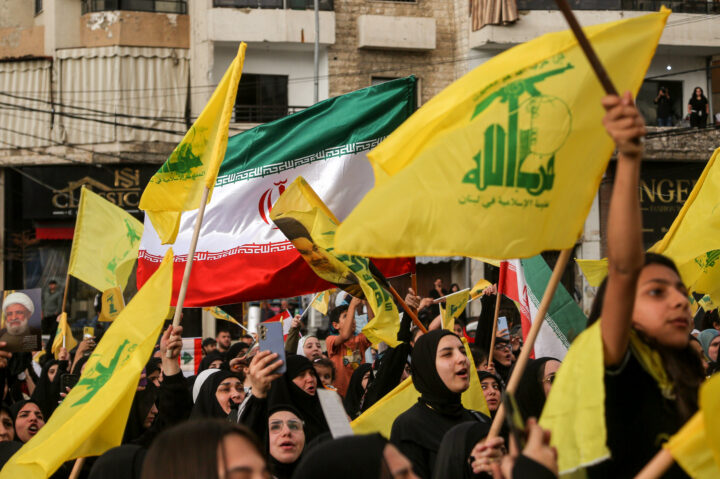
Marwan Naamani/picture alliance via Getty Images
Pro-Iranian Hezbollah supporters wave the party flags during a ceremony in a southern Beirut suburb on May 5, 2026.
Reps. Josh Gottheimer (D-NJ) and Mike Lawler (R-NY) have been circulating a resolution among lawmakers condemning Hezbollah for its “repeated violations of ceasefire agreements” through its attacks against Israel and calling for the terrorist group to be disarmed, Jewish Insider has learned.
The resolution calls on the Lebanese government and the Lebanese Armed Forces to “ensure Lebanese Hezbollah immediately ceases all attacks and disarms in accordance with the ceasefire” that the U.S. brokered between Israel and Lebanon as the Lebanese terror group continues to threaten the deal.
It also states that Hezbollah’s attacks on the Jewish state “serve the interests of the Islamic Republic of Iran, that has committed to the destruction of America’s ally Israel.”
“The Lebanese people have made clear that they do not wish to live under the influence of the Iranian regime, and the United States stands with the Lebanese people in their desire for a sovereign, stable, and peaceful Lebanon,” the resolution reads.
In the resolution, the lawmakers also push back on outside efforts, including by Iran, to determine the future of Lebanon — a criticism that has been leveled against the U.S.-Iran memorandum of understanding.
“The House of Representatives reaffirms, consistent with the June 3, 2026 Joint Statement, that the future of the relationship between Israel and Lebanon must be decided by the two sovereign governments and rejects any attempt by any state or non-state actor, including Iran or Lebanese Hezbollah, to deny the Lebanese people their sovereignty and freedom,” the resolution continues.
Former Israeli Ambassador to the U.S. Michael Herzog told JI, 'President Trump, who has been a hero to many Israelis, is now openly criticized from within the Israeli government, including Netanyahu's close circle.'

Jack GUEZ / AFP via Getty Images
A billboard depicting an image of President Donald Trump with a message thanking him, is displayed on the side of a building in the Israeli coastal city of Tel Aviv on March 12, 2026.
The long love affair between Israelis and President Donald Trump, on the rocks over the last few weeks as the U.S. and Iran hammered out an end to the war, appears to be over, with humiliations mounting for Jerusalem. “I call all the shots,” not Israeli Prime Minister Benjamin Netanyahu, Trump said earlier this month. More recently, the Israeli leader’s bombing campaign in Beirut was “vicious,” Trump said. And perhaps most humiliating of all, Trump suggested that Syrian President Ahmad al-Sharaa could better take care of Hezbollah than the IDF.
The Israeli public — the spurned lover who once hailed the U.S. president with billboards hung in the center of Tel Aviv reading “Thank you God & Donald Trump” — is not taking it well. Former Israeli Ambassador to the U.S. Michael Herzog told JI, “President Trump, who has been a hero to many Israelis, is now openly criticized from within the Israeli government, including Netanyahu’s close circle.”
And this criticism is not only expressed behind closed doors. Channel 14, the popular right-wing outlet that promotes Netanyahu, has been criticizing Trump resolutely, with some of its anchors publicly cursing Vice President JD Vance and the president’s close advisors, White House Special Envoy Steve Witkoff and Jared Kushner.
It was not always this way. For most of the time since Trump reentered the White House in January 2025, he has been popular in Israel, with polls consistently showing high ratings for the American president.
For Israelis, Trump is the one who brokered the hostage-release agreement with Hamas; Trump is the one who made the strikes in Iran and the bombing of the nuclear enrichment facilities in Fordow and Natanz a reality; and Trump is the one who established the Abraham Accords and is willing to expand them, giving Israelis the chance to sunbathe in the UAE, and perhaps in other countries in the Gulf in the near future. And although some won’t admit it, many Israelis also like his tendency to speak very bluntly, and crudely: a president born in Queens, full of Israeli chutzpah.
In recent weeks, the attitude toward Trump among the Israeli public, and the Israeli leadership, has radically and rapidly changed. But this process began even before the signing of the memorandum of understanding with Iran. Over the past few months, time and again, Netanyahu has tried to convince Trump to resume strikes on Iran, only to be rejected. A source familiar with the discourse between the two leaders described to JI a situation that has played out repeatedly since April: the Israeli prime minister explains why only the military option is the correct approach to Iran, while Trump listens but prefers the diplomatic path.
And then Trump, in his typical fashion, says that Netanyahu will do whatever the U.S. president tells him to do — which has some degree of truth — but is not a good look for a prime minister seeking reelection. Trump has repeatedly criticized Israeli policy in Lebanon and publicly reprimanded Netanyahu for not being responsible enough. When the U.S. president once again floated the possibility that al-Sharaa should handle Hezbollah, which has fired thousands of rockets and drones toward Israel and most recently killed four Israeli soldiers overnight Thursday, the criticism in Israel escalated.
Trump had previously suggested that the Syrians take on Hezbollah, as reported by Kann earlier this week, during an official meeting between the Israeli and Lebanese ambassadors in April, though those in attendance were unenthusiastic about the idea. To understand the Israeli approach toward Trump’s suggestion, one can look at what the chairman of the Knesset Foreign Affairs and Defense Committee, Likud MK Boaz Bismuth, posted on X: “President Trump, we don’t trust the terrorist Jolani, we have Golani,” referencing a well-known IDF combat infantry brigade.
The opinion within the Trump administration has been made clear. “Trump is the only head of state in the entire world who is sympathetic to the nation of Israel at this moment and time,” Vance told reporters on Thursday. “If I was in the Cabinet of the Israeli government, I might not be attacking the only powerful ally that I have left in the entire world,” he said. “The problem for Israel is not Donald J. Trump. And anybody in Israel who thinks their biggest problem is the president of the U.S. needs to wake up and smell the reality of the situation that country is in.”
Yet now, after the agreement has been published, the criticism remains unchanged. An Israeli official told JI that the agreement raises several troubling signs, among them: the uncertainty over whether all enriched uranium will be removed from Iran, or only the high-level uranium; under the terms of the agreement, Iran, it appears, will be allowed to enrich uranium at a low level on its soil, meaning it can continue to operate centrifuges; and the issue of oversight is not explained.
“The second shocking thing here is the betrayal of the Iranian people. The second clause in the MOU agreement states that neither country will interfere in the internal affairs of the other. This means the Iranians can execute protesters, and nothing will be done to them,” the Israeli official said. “This entire war started because Trump said that ‘help is on the way,’ and that we would not allow tens of thousands of protesters to be shot and slaughtered. Beyond the concern that Iran will remain a nuclear threshold state, there is also a moral problem here.”
Avner Vilan, a former senior security official and Iran expert, also raised concerns about the agreement. “Iran is receiving a great deal of relief right now, but there is still a long way to go to reach an agreement in the nuclear field. This is an agreement that gives the murderous terror regime in Iran infinite immunity and incentives, allowing it to survive almost indefinitely, while recognizing the strategic significance of Hormuz,” he told JI.
Vilan also referred to the statements made by Trump in recent days that sparked concern within the Israeli defense establishment. Trump has legitimized Iran’s ballistic missile arsenal, and this, as Vilan points out, despite the fact that Israel defined this threat as an existential threat almost on par with the nuclear one. “This is more disturbing than the state of relations between Trump and Netanyahu, and of course, it doesn’t help that the president calls the State of Israel a ‘very small partner.’ At the beginning of the war, we were a ‘Model Ally.’ Not a small partner,” Vilan notes. “Israel’s point of strength for years was that the way to D.C. goes through Jerusalem. Today, that is no longer the case at all.”
“Israelis expected that the amazing military achievements the U.S. and Israel scored together would be translated into a strong, enduring diplomatic outcome focused on the nuclear issue,” says former Ambassador Herzog. “Instead, the U.S. opted out of the war with a general MOU that focuses on the Strait of Hormuz and the global economy, in return for releasing generous funds to Iran and postponing the core nuclear negotiations. There is little reason to believe that the Iranian regime will now agree to give up the nuclear option or change its orientation, especially as the U.S. military option is taken off the table.”
What looked like a year of celebrating blue, white and red cooperation has been fading more and more in recent weeks. The disappointment among senior Israeli officials is likely intensifying, due in part to the widespread praise that Trump has long received in Israel. It wasn’t for nothing that Trump said last month that he could run in the upcoming elections for prime minister in Israel and win. Even if he were on the ballot, with the thrill now gone, he wouldn’t stand a chance.
Text of the 14-point MOU was read aloud to reporters on a phone call with a senior administration official
Daniel SLIM / AFP via Getty Images
The White House is seen in Washington, DC, on December 17, 2025.
The Trump administration on Wednesday shared with journalists the official text of the memorandum of understanding between the U.S. and Iran to establish a ceasefire with Iran, permanently end Israel’s war against Hezbollah in Lebanon, reopen the Strait of Hormuz while ending the U.S. naval blockade and kickstart a 60-day negotiation period on the future of Iran’s nuclear program and the possibility of lifting U.S. sanctions on Tehran.
The 14-point agreement was read aloud by a senior administration official on a call with reporters. The White House did not provide a written copy of the agreement after the readout.
Below is the agreement as delivered on the call:
The United States of America and the Islamic Republic of Iran, hereinafter referred to as the “Parties,” have jointly agreed in good faith on [Date] to the following:
Paragraph 1 – Cessation of Hostilities
The Parties and their respective allies in the current war, by signing this MOU, declare the immediate and permanent termination of all military operations on every front, including in Lebanon. The Parties undertake not to initiate any war or military operation against each other, to refrain from the threat or use of force against one another, and to respect the territorial integrity and sovereignty of Lebanon. The final deal will confirm the permanent termination of the war on all fronts, including Lebanon, and will incorporate the other provisions of this paragraph.
Paragraph 2 – Sovereignty and Non-Interference
The Parties undertake to respect each other’s sovereignty and territorial integrity and to refrain from interfering in each other’s internal affairs.
Paragraph 3 – Timeline for Final Deal
The Parties commit to negotiating and concluding the final deal within a maximum of 60 days, extendable only by mutual consent.
Paragraph 4 – Naval Blockade and Force Posture
Immediately upon signing this MOU, the United States shall begin removing its naval blockade and any other impediments or disturbances imposed on the Islamic Republic of Iran, and shall fully lift the naval blockade within 30 days. During this period, vessel traffic shall be progressively restored toward pre-war levels. The United States further undertakes to withdraw its forces from the proximity of the Islamic Republic of Iran within 30 days after the conclusion of the final deal.
Paragraph 5 – Strait of Hormuz and Maritime Security
Upon signing this MOU, the Islamic Republic of Iran shall, using its best efforts, arrange for the safe and free passage of commercial vessels through the Strait of Hormuz with no charge for a period of 60 days, in both directions (Persian Gulf to Sea of Oman and vice versa). Commercial vessel traffic shall resume immediately. Iran shall complete the necessary technical and military measures, including demining, within 30 days. The Islamic Republic of Iran will engage in dialogue with the Sultanate of Oman and other Persian Gulf littoral states to define future administration and maritime services in the Strait of Hormuz, in accordance with applicable international law and the sovereign rights of coastal states.
Paragraph 6 – Reconstruction and Economic Development
The United States, in coordination with regional partners, undertakes to develop a definitive, mutually agreed reconstruction and economic development plan for the Islamic Republic of Iran valued at a minimum of $300 billion (USD). The implementation mechanism for this plan shall be finalized as part of the final deal within 60 days. The United States shall grant all required licenses, waivers, and permissions necessary for the relevant financial transactions.
Paragraph 7 – Sanctions Termination
The United States undertakes to terminate all sanctions against the Islamic Republic of Iran — including UN Security Council resolutions, IAEA Board of Governors resolutions, and all unilateral U.S. primary and secondary sanctions — according to an agreed schedule to be included in the final deal. The Parties acknowledge the critical importance of the sanctions issue and express their intention to address it immediately in negotiations to reach mutual agreement.
Paragraph 8 – Nuclear Issues
The Islamic Republic of Iran reaffirms that it shall not procure or develop nuclear weapons. The Parties agree to resolve the disposition of Iran’s stockpiled enriched material through a mutually agreed mechanism, with the baseline method being on-site down-blending under IAEA supervision, in accordance with the sanctions-termination schedule in Paragraph 7. The Parties will also discuss Iran’s enrichment activities and other nuclear-related matters within a satisfactory framework to be agreed in the final deal. The final deal will confirm the provisions of this paragraph. The Parties acknowledge the critical importance of these nuclear issues and intend to address them immediately in negotiations.
Paragraph 9 – Status Quo Pending Final Deal
Pending the final deal, the Parties agree to maintain the status quo: the Islamic Republic of Iran will maintain the current status of its nuclear program, and the United States will not impose any new sanctions or deploy additional forces in the region.
Paragraph 10 – Oil Export Waivers
Immediately upon signing this MOU and until the termination of sanctions, the U.S. Department of the Treasury shall issue waivers authorizing the export of Iranian crude oil, petroleum products, derivatives, and all associated services (including banking, insurance, and transportation).
Paragraph 11 – Access to Frozen Funds and Assets
The United States shall make fully available all frozen or restricted Iranian funds and assets. Upon implementation of this MOU, the Parties will mutually agree on procedures for the release and use of these funds during negotiations. Such funds shall be usable for payments to any ultimate beneficiary designated by the Central Bank of the Islamic Republic of Iran. The United States shall issue all necessary licenses and authorizations to this end.
Paragraph 12 – Monitoring Mechanism
The Parties agree to establish an executive mechanism to monitor the implementation of this MOU and future compliance with the final deal.
Paragraph 13 – Sequencing of Negotiations
After signing this MOU, and subject to the commencement and continued implementation of Paragraphs 1, 4, 5, 10, and 11, the Parties shall begin negotiations on the remaining elements of the final deal.
Paragraph 14 – UN Security Council Endorsement
The final deal shall be endorsed by a binding United Nations Security Council resolution.
The proposed restrictions come after top Senate lawmakers publicly expressed frustration in recent months with the LAF’s failure to take concrete steps to fully disarm Hezbollah

MAHMOUD ZAYYAT / AFP via Getty Images
Lebanese army forces set up a checkpoint at the entrance of the village of Ghandourieh in southern Lebanon on June 15, 2026, preventing people from crossing towards villages the Israeli military is believed to have deployed.
The Senate’s version of the 2027 National Defense Authorization Act proposes sweeping new conditions on U.S. support for the Lebanese Armed Forces. The proposed restrictions come after top Senate lawmakers publicly expressed frustration in recent months with the LAF’s failure to take concrete steps to fully disarm Hezbollah, and argued that the U.S. should not provide unconditional funding for the LAF.
Sen. Roger Wicker (R-MS), the chair of the Armed Services Committee, which produces the NDAA, said in late April that “Congress should not support the LAF unless it acts to disarm Hezbollah completely — and immediately.”
Sen. Jim Risch (R-ID), who chairs the Foreign Relations Committee, echoed Wicker, adding that it was “well past time for the LAF to take tangible action to fully disarm Hezbollah and for the Lebanese government to follow through on long-promised economic reform. The era of complacency and unconditional bailouts must come to an end.”
Support for the LAF, which would be limited to no more than $36 million, is conditioned on the LAF’s work to disarm Hezbollah. No more than 5% of that funding can be provided until the administration certifies to Congress that Lebanon has outlawed Hezbollah’s activities and that the LAF is actively working to disarm Hezbollah, prevent the Iranian-backed group’s rearmament and prevent attacks on Lebanon’s neighbors — including Israel.
The administration would then be required to re-certify every 90 days to Congress that the LAF is continuing to act against Hezbollah to the full extent of its capabilities, with a mandatory suspension of aid if it cannot meet that certification.
The quarterly reports would also include specific data on the number of weapons seized from Hezbollah and other metrics regarding the LAF’s efforts to degrade Hezbollah, as well as the makeup and capacities of the LAF forces.
President Donald Trump on Tuesday publicly condemned Israel’s operations against Hezbollah, suggesting — in a move that baffled both lawmakers and experts — that Syria’s military could instead be called upon to deal with the Hezbollah threat.
The NDAA would block U.S. counterterrorism assistance to Syria until the administration can certify the Syrian government is taking action to demobilize, disarm and monitor foreign fighters and jihadists in the country, implement a system to “fairly integrate” the Kurdish-led Syrian Democratic Forces into the Syrian military and prevent attacks on minorities including Kurds and Druze.
The provision comes amid continued scrutiny on Capitol Hill of the Syrian government’s efforts to protect minorities after the U.S. withdrew sanctions on the Syrian government.
As previously reported, the NDAA, which was finalized last week but not released in full until Tuesday, includes a version of the FUTURES Act, which has become a hot-button issue in the context of the House version of the NDAA, seeking to centralize and expand existing defense collaboration efforts between the two partners.
But it also includes a second provision on joint development, requesting the administration provide Congress with a plan to establish a partnership between the U.S. and Israel on defense industrial priorities, with the goal of supporting the defense industrial bases in both countries, providing opportunities for industries in both countries to cooperate and collaborate and supporting defense development and startups in both countries.
The legislation additionally proposes boosting funding for cooperation on subterranean operations — previously billed as counter-tunnelling efforts — from $80 million to $100 million, and counter-drone programs from $70 million to $100 million. The bill also authorizes $1 million for cybersecurity cooperation with Israel.
That funding would still have to be approved separately in the appropriations process later this year.
The NDAA also includes two different provisions to enhance defense cooperation with both Israel and other Middle East allies.
One, the Abraham Accords Defense Cooperation Initiative, would establish a program to expand defense cooperation between the U.S. and the Abraham countries, to address various threats in the region. It encourages each country in the region to provide matching funds for the program.
The other, which pulls language from the OASIS in the Middle East Act, aims to develop a coordinated air- and missile-defense acquisition strategy alongside Israel, Abraham Accords members and other Middle East allies to ensure adequate resources to protect the U.S. and its allies in the event of future conflicts.
The provision further requires the administration to explain its work to replenish interceptor stockpiles that have reportedly been severely degraded in the war, assess the possibility for co-production with various Middle East allies of interceptor systems, consider an creating an air-defense stockpile in the Middle East and improve joint development and acquisition of low-cost interceptor options.
The NDAA, which provides formal congressional authorization for the Civil Military Cooperation Center overseeing the implementation of the ceasefire plan in Gaza, requires the administration to provide Congress with information on plans for and actual deployment of the International Security Force in Gaza and its involvement in disarming Hamas, as well as on granular, specific details on the amount and types of aid moving into Gaza.
Plans for the ISF have largely failed to materialize, and the force has not yet deployed inside Gaza, where efforts to disarm Hamas have stalled in light of the terrorist group’s intransigence.
The president said Netanyahu must be ‘more responsible’ on Lebanon and suggested Israel step back and let Syria confront Hezbollah

SAUL LOEB/AFP via Getty Images
President Donald Trump shakes hands with Israeli Prime Minister Benjamin Netanyahu during a meeting in the Oval Office of the White House in Washington, DC, on April 7, 2025.
President Donald Trump expressed disappointment on Tuesday with Israel’s recent military actions in response to Hezbollah, criticizing a strike on a Hezbollah stronghold in Beirut as “vicious” and suggesting that Israel step back and let Syria handle the fight against the Iranian-backed terror group.
Speaking with the Qatari emir Sheikh Tamim bin Hamad Al Thani on the sidelines of the G7 summit in France, Trump criticized Israeli Prime Minister Benjamin Netanyahu’s handling of Israel’s northern front, suggesting that the IDF’s response was unnecessary and disproportionate.
“I didn’t like that he [Netanyahu] did an attack based on … a very minor little thing with some drones that were released,” Trump said, referring to a Hezbollah drone strike on northern Israeli communities on Sunday. “I saw that [Israeli] attack, I saw where that bomb went. That was vicious, that was too much.”
While Trump emphasized that he maintains an “unbelievable” and “great” relationship with Netanyahu, he insisted that the Israeli leader must exercise more restraint.
“Bibi has to be more responsible with respect to Lebanon,” Trump said. “I’m not happy with the way Israel has handled themselves with Lebanon and Hezbollah. They should have been able to do the job faster.”
“You don’t have to knock down an apartment house every time you’re looking for somebody, because there are a lot of people in those apartment houses and they’re not all Hezbollah,” he added.
The president added that the protracted fighting “goes on forever” and threatens to cast a “negative light” on the newly announced memorandum of understanding between the U.S. and Iran.
Despite ongoing Hezbollah attacks targeting northern Israel, Trump proposed that Israel step back and let the government in Syria confront the group.
“I suggested to Israel to let Syria take care of Hezbollah, because to be honest with you, I think they do a better job of doing it,” Trump said.
The diplomatic fallout highlights a growing disconnect over the parameters of the broader regional agreement. Senior U.S. officials confirmed that an Israeli military withdrawal from southern Lebanon is not a condition of the U.S.-Iran MOU, a position firmly backed by Netanyahu, who insists such a provision should not apply to Jerusalem.
However, Hezbollah’s media relations office claimed on Tuesday that the group received explicit assurances from Tehran that Iran would refuse to sign a final, permanent nuclear deal with Washington unless Israeli forces completely withdraw from Lebanese territory.
Trump also noted that he intends to submit any final agreement aimed at ending the war with Iran and restarting formal nuclear negotiations to Congress for review.
Hagar Hajjar Chemali, who is half Jewish and half Christian, thinks she has a shot at helping break through the deep sectarianism that has led to distrust both within Lebanon and towards Israel

Courtesy
Hagar Hajjar Chemali
Hagar Hajjar Chemali is an American by accident — quite literally — of birth.
Her parents left their native Lebanon in 1981 as a civil war raged in the country. Chemali’s father, Hadi, had been kidnapped by a political group, and the young couple quickly left the country once he was released, with plans to move to Milan. While visiting friends in Greenwich, Conn., Chemali’s mother, Mirella, began experiencing pregnancy complications and chose to wait out the final months of her pregnancy there. Soon after, Chemali was born, followed quickly by a son. The family never left.
So began Chemali’s American story, the result of a potent combination of determination and coincidence. That’s the story of Chemali’s professional journey, too: a mix of persistence and being in the right place at the right time. She spent the first decade of her career helping steer U.S. foreign policy on the Middle East in the Bush and Obama administrations, ultimately becoming the spokesperson for former U.S. Ambassador to the United Nations Samantha Power. She spent the next decade as a consultant and communications expert, appearing regularly on cable news and a YouTube channel where she produces an occasionally satirical show explaining American foreign policy.
Now Chemali, 44, faces her biggest and most personal assignment yet: creating an unofficial backchannel to boost the ongoing peace talks between Lebanon and Israel, the first time that officials from the two countries have sat for direct talks since 1983. And Chemali, who is half Jewish and half Christian, thinks she has a shot at helping break through the deep sectarianism that has led to distrust both within Lebanon and towards Israel.
The deal between the U.S. and Iran that was announced on Sunday may complicate Chemali’s efforts. Iran’s attempt to link its own negotiations with the U.S. to developments in Lebanon could potentially complicate efforts to advance Israeli-Lebanese peace, and Iranian state media said on Sunday that Lebanon would be part of the new deal. Details remain scarce.
“It’s about the art of the possible. Lebanese-Israeli peace is not particularly easy to achieve,” said Daniel Glaser, a former assistant Treasury secretary for terrorist financing and financial crimes. He hired Chemali for her first job at the Treasury Department. “What’s going to get it done is the ability to understand what’s possible, and how to get to that possible within the U.S. system, within Israel and the Israeli system, within Lebanon and the infinitely complicated Lebanese system. There’s not a lot of people that have the ability to do that more than Hagar.”
In April, she announced the creation of an organization called LIPA, the Lebanon-Israel Peace Alliance. It’s a vessel for advocacy by Chemali and a cadre of Israeli, Lebanese and American foreign policy experts she colloquially describes as the “peace crew” — many do not yet want to publicize their involvement with the effort — who are working to keep the pressure on the U.S. government to help broker a deal between Lebanon and Israel.
The group has been collaborating since early last year, soon after Israel and Lebanon reached a ceasefire in late 2024 that ended the fighting between Israel and Hezbollah that began when the Iranian-backed group launched missiles at Israel on Oct. 8, 2023. The effort gained traction amid a broader shift in Lebanon: Hezbollah was weakened by the death of its longtime leader, Secretary-General Hassan Nasrallah, and newly elected Lebanese President Joseph Aoun moved to reassert state authority over Hezbollah’s power and influence.
“She was one of the very first people that said to me that I should go for peace,” said Morgan Ortagus, who served as deputy Middle East special envoy at the beginning of the Trump administration. Ortagus and Chemali have been friends since they worked in the Treasury Department together nearly 20 years ago. “I said, ‘Really, do you think they’re ready?’ And she was emphatic that she thought that it was the time to go for peace.”
The work of Chemali’s burgeoning “peace crew” solidified in March, at a dinner soon after the Iran war started. The geopolitical time crunch of a fast-moving war spurred the group to come up with a name to formalize the informal diplomacy they had been pursuing for more than a year.
“All this work actually helped bring the Israelis and the Lebanese governments to hold direct talks in Washington,” said Hanin Ghaddar, a senior fellow studying Lebanon at The Washington Institute for Near East Policy. “I don’t think this would have been possible without the whole year of work on the narrative and the policy and the recommendations and the shift on the ground, that this is where Lebanon and Israel finally decided, ‘Let’s do this.’”
After the U.S. and Iran agreed to a ceasefire in early April, Israeli Prime Minister Benjamin Netanyahu announced that Israel would open direct negotiations with Lebanon. It was the moment for which Chemali had yearned for over 18 months — or, perhaps, a whole lifetime. In the aftermath of the first round of talks, LIPA was launched in the way so many projects are: via a somewhat haphazard post on X. Chemali did not want to lose her chance at creating momentum for a window for peace that might soon close. She has not returned to Lebanon in 15 years due to security risks.
“As a comms person, I would never advise a rollout this way. This is like the opposite of what you do before a rollout. You have all your ducks in a row when you roll anything out,” Chemali told Jewish Insider in a recent interview at a Washington cafe. “We wanted to come out there and be like, we have an organization that exists that is there to support this process.”
For Chemali, the effort is a culmination of her own professional arc, as well as the choices her parents made in building a life here. Her family might be Lebanese, but this effort is all-American — something she can do because of where she was born and the circumstances that allowed her to rise to a public, senior government role without having to worry about the strict sectarian divisions that govern Lebanese society and the country’s government.
But there was a piece of Chemali’s story that was missing, something that now makes her uniquely positioned to serve as a convener of Lebanese and Israelis here in the U.S.
“She’s half-Jewish and half-Christian,” said Hussain Abdul-Hussain, a Lebanese-Iraqi researcher at the Foundation for Defense of Democracies. “She has the highest pedigree for someone to be working on this issue.”
Chemali did not know about her Jewish roots when she was growing up. Her father is a Maronite Christian, a Catholic sect with deep roots in the Levant. The family attended a nondenominational church in Connecticut. When Chemali was 11 or 12, her mother revealed a secret she had kept since her children were born: She was Jewish.
“I think she just couldn’t take it anymore. She was just like, ‘Actually, I’m Jewish,’” Chemali recalled. “My brother and me, being raised in the United States, we were like, ‘That is so cool. Does that mean we get Hanukkah gifts?’”
Her mother, Mirella, grew up in Wadi Abu Jamil, Beirut’s Jewish neighborhood. She attended a Catholic school at the urging of the family of her late father. The nuns at her school would tell Mirella that “she had evil in her blood because she was Jewish,” according to Chemali. “So [her family] practiced Judaism in secret at home.”
The revelation from her mother intrigued Chemali. Why didn’t she tell them sooner? Mostly Chemali ignored it, until she came to Washington during the George W. Bush administration. She joined the Treasury Department in 2006, in the newly created Office of Terrorist Financing and Financial Crimes, where many of her colleagues were Jewish. They started inviting her to Shabbat dinners and Jewish holidays. Chemali learned more about Judaism, and began to feel proud of that part of her identity. When she moved back to Greenwich, she asked her mom to teach her more about her family’s traditions.
“I told my mom, ‘These traditions die with you. You didn’t raise me with these traditions. I only know what I know from books and from going with friends to their houses for events,’” Chemali said. So her mom bought a menorah, and they lit candles together for Hanukkah.
“She starts singing in Hebrew, and I was like, ‘Who is this woman who sings in Hebrew?’ As far as I knew, she speaks a lot of languages — actually, she speaks five languages — but Hebrew was not one of them,” said Chemali.
Chemali has not abandoned the Christian faith she was raised with, even as she grapples with her identity.
“What I tell people of where I am at the moment, but it is always an evolution, is that I am of Christian faith and feel very much a Jew,” said Chemali. “I always tell people I’m a member of every tribe.”
Lebanon is so beset by tribal division that different government positions are reserved for people from different religious sects: the president is required to be a Maronite Christian, the prime minister is a Sunni Muslim and the speaker of parliament is a Shia Muslim. Chemali has refused to diminish any part of her identity, even as her home country all but demands she pick a side.
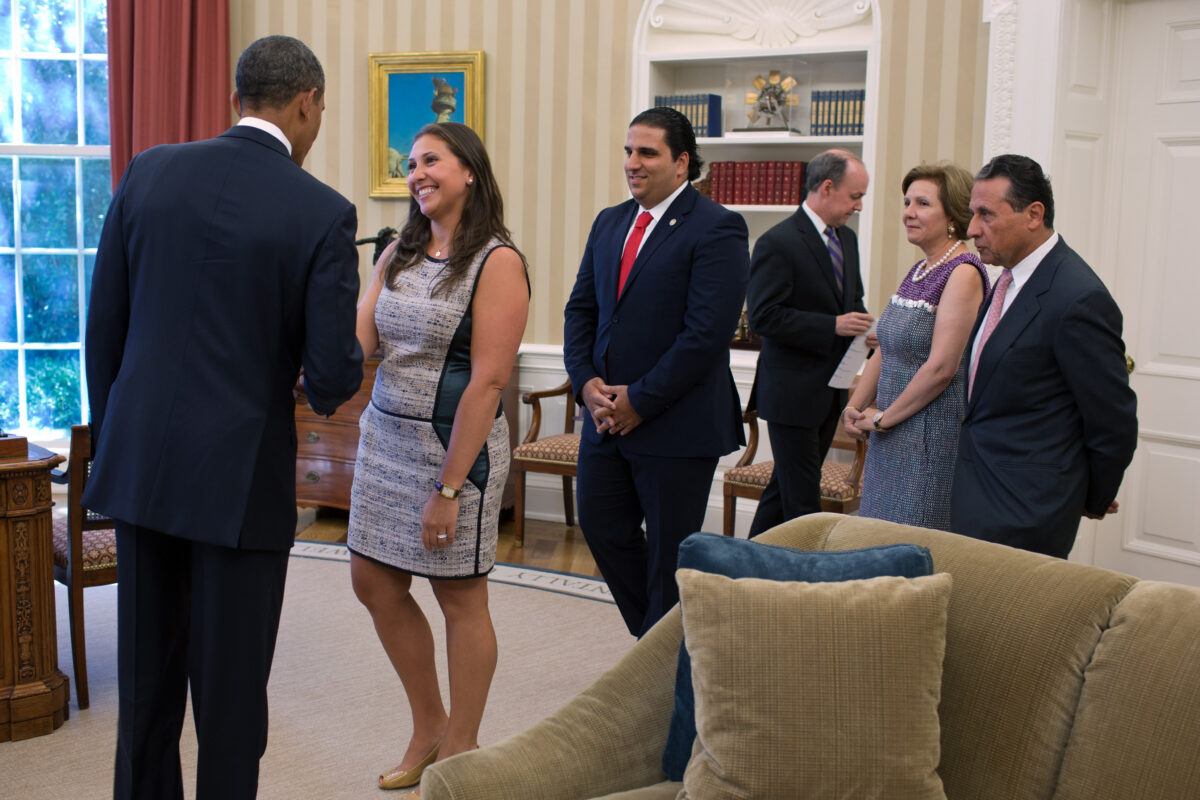
“She’s someone who can actually speak to everyone. She’s not there to take sides,” said Ghaddar. “She really sees the whole picture, and I think that’s what this kind of initiative really needs. It’s someone who has a stake in everyone and everything.”
Chemali retains the idealism that so many lose after decades in Washington. She described herself as a “Lebanese Zionist,” a position she said she has stuck by even amid the polarization that crept into her family after Oct. 7.
“This is the thing that sets me apart from the rest of my family. There’s a chunk of my family that unfriended me on social media after Oct. 7 because of my statements — and by the way, my statements are not like, ‘Yeah, go into Gaza and get ‘em.’ That’s not what I’m saying. My statements were more posting about the hostages,” said Chemali. “There’s one chunk of my family from Syria on my dad’s side that, straight up, they will lecture me at any opportunity they have. I view them as brainwashed, to be perfectly honest, and they probably view me as brainwashed.”
Chemali recalled a trip to Lebanon during her time as the National Security Council’s director for Lebanon and Syria in the Obama administration. A Lebanese friend advised her not to share that she’s Jewish.
“I was like, ‘Look, that’s not how I operate,’” said Chemali. “First, I really make sure religion doesn’t come up in my government work, because I don’t want anyone ever accusing me of seeing something through a religious lens. But secondly, if it comes up, I don’t hide. That’s not how I roll, ever.”
Still, she understands that not everyone can be as visible as she is. Chemali gave up her Lebanese citizenship before entering the U.S. government, but ordinary Lebanese people face steep prison sentences simply for talking to Israelis because of the country’s anti-normalization laws. Free from these restrictions, Chemali has recently taken to setting up discreet dinners between Lebanese and Israelis in Washington.
“We are trying to come up with creative ways to work around these laws,” she said. “We have to pick locations where nobody will see them or recognize them, so it makes it much more difficult.”
One of LIPA’s priorities is urging the U.S. to pressure Lebanon to repeal those laws. Chemali holds meetings with members of Congress on both the left and right. She talks to contacts at the State and Treasury Departments regularly, advocating for new sanctions on Hezbollah. She’s a fixture in Foggy Bottom and at wonky Middle East conferences, on cable news and in cafes, all from her home base in Connecticut.
“The ideal is a warm peace where you have thriving business relations, and that’s how our efforts are geared, toward that vision,” said Chemali. “That will hopefully undermine Hezbollah’s presence.”
After a new round of talks early this month, the governments of Lebanon, Israel and the U.S. released a joint statement in which Lebanon’s army agreed to create “pilot zones” where it will exert control and ban Hezbollah, the Iran-backed militia that uses southern Lebanon as a base to attack Israel. The diplomats will meet again later this month, and military representatives from each country will hold their own parallel track. The talks are testing the Lebanese government’s appetite for taking a stand against the militia. Meanwhile, Israel and Hezbollah continue to trade blows even as the talks proceed.
That negotiations are happening at all reflects unprecedented discontent within Lebanon toward Hezbollah. Until now, Lebanon’s leaders have been unable or unwilling to exert the strength needed to push back on Hezbollah’s grip over the country’s politics. Earlier this month, Aoun, the country’s president, took the unusual step of criticizing Iran, Hezbollah’s primary backer: “It’s not your country, it’s our country,” he told CNN.
Former U.S. Ambassador to Israel Dan Shapiro called the peace talks a “tremendous opportunity” for both countries.
“Maybe more for Lebanon than for Israel, because it really would mean breaking free from the handcuffs of Hezbollah and Iran,” said Shapiro. He hired Chemali for her job at the Obama White House and said he is encouraged by her efforts with LIPA.
“Having a strong advocacy body in the United States perhaps buttressed by those in Europe and elsewhere in the region is important fuel to that process,” said Shapiro. “She’s got just endless energy and creativity and a real commitment.”
The biggest challenge is that Lebanon’s leadership does not control Hezbollah. Peace between Israel and Lebanon would still be momentous even without dealing with Hezbollah, but it would leave the most intractable issue unresolved.
“It’s not the elephant in the room, because they all talk about it. But the crux of this is Hezbollah and Hezbollah’s weapons, and it’s not just the disarmament of them, it’s ensuring that they’re never able to rearm again,” said Chemali.
Washington is easily distracted; Trump is no exception. For Chemali, who is not directly involved in the talks, perhaps the most urgent task is to make sure the people in the room do not move on. She needs to remind them that the Lebanon-Israel file remains important, and worth pursuing — and that it should not be subsumed up by negotiations between the U.S. and Iran.
“We keep our fingers crossed, we advocate, we speak up, publish op-eds, you name it. Go on interviews, whatever it takes, just to make sure that things keep on going in the peace direction,” said FDD’s Abdul-Hussain, who is friends with Chemali but is not formally collaborating with her. “People like us, who are not governments, who are just regular people, we have a bigger margin. We have a lot of freedom to move. We have a lot of freedom to explain things, or to oppose things.”
But even in the perpetually explosive Middle East, where the talks could easily fall apart, Chemali believes something fundamental has changed.
“No matter what happens with the talks, there’s a reason I have hope,” she said. “Because you see this taboo in Lebanon has broken.”
Plus, Ron Klain goes to bat for Platner
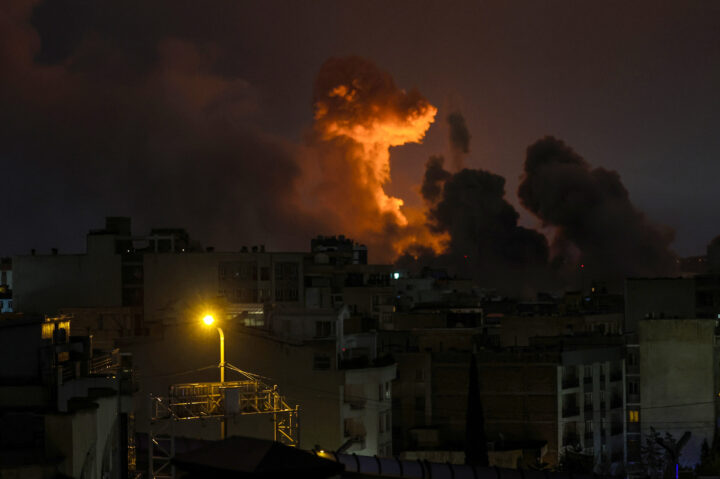
Getty Images
A large plume of smoke rises over Tehran after explosions were reported in the city during the night on March 28, 2026 in Tehran, Iran.
This P.M. edition is reserved for our premium subscribers like you — offering a forward-focused read on what we’re tracking now and what’s coming next.
Today’s Daily Overtime was curated by JI U.S. Editor Danielle Cohen-Kanik.
📡On Our Radar
Notable developments and interesting tidbits we’re tracking
After the U.S. conducted strikes yesterday in Iran, President Donald Trump said from the Oval Office this morning that the U.S. would “hit them hard again today” and told Fox News that he may target Iranian power plants and bridges because Tehran is “tapping the United States along” in negotiations.
As Trump convened his national security team in Washington this afternoon to discuss military options, Defense Secretary Pete Hegseth told reporters CENTCOM will be “busy tonight” with “bombs dropping on key facilities in Iran”…
Trump also revealed today that he directed the U.S. military last month to “execute a secret mission” to assist oil tankers and other commercial vessels in transiting the Strait of Hormuz, an effort that “has resulted in more than 100 MILLION Barrels of Oil” and over 200 commercial ships moving through the waterway. His Truth Social post was a clarification of earlier comments that seemed to suggest the U.S. was stealing this oil directly out of Iran; U.S. operations to facilitate passage in the strait have been previously reported…
Trump provided Fox News with new details of the downing of the U.S. Army helicopter earlier this week, describing how an Iranian drone became lodged between the two pilots in the cockpit who guided the helicopter into the sea, where they were rescued “for the first time in U.S. military history” by an unmanned sea drone…
Qatari mediators visited Tehran today in the hopes of pushing Iranian officials to engage more effectively in negotiations with the U.S., Axios reports, after Trump had grown increasingly frustrated with their intransigence over the last two weeks, even as he continued to signal the two sides were approaching a deal…
U.S. Ambassador to the U.N. Mike Waltz met with UAE Foreign Minister Abdullah bin Zayed Al Nahyan in Abu Dhabi, the highest-level U.S. official to publicly visit the Gulf since the Iran war began…
Israeli Prime Minister Benjamin Netanyahu blasted Turkish President Recep Tayyip Erdoğan as an “antisemitic dictator” today after Erdoğan condemned Israel’s “network of murder” in Syria and Lebanon and threatened a “very clear and strong response” if Turkish interests in the region were jeopardized. Netanyahu said Erdoğan, whom he accused of supporting Hamas, lacks the moral authority to criticize Israel.
Trump, when asked in the Oval Office about the potential for war between Israel and Turkey, described Erdoğan as a “hell of a leader” and said, “I don’t think that will happen as long as I’m president”…
More than 20 countries, including the U.S., issued a joint statement condemning “lethal plotting and malign actions” by Iran’s security forces working with international and local criminal groups in Europe, North America and Australia, including their efforts to target “Iranian dissidents, journalists and Jewish and Israeli communities and interests”…
The Department of Justice indicted eight individuals associated with the University of Michigan for allegedly threatening university leaders, law enforcement, businesses and the Jewish Federation of Metropolitan Detroit over the conspirators’ perception of their “purported financial support of Israel.”
The individuals “discussed methods by which to harm the targets and their families, including poison, bombs, and psychological torture,” engaged in extensive vandalism and threw jars filled with noxious chemicals into homes, according to the department…
An immigration judge ordered earlier this month that Columbia University anti-Israel protest leader Mohsen Mahdawi be deported to Jordan, after a lengthy legal battle in which the Trump administration claimed Mahdawi has been involved in and supported terrorist violence. Mahdawi, who has not been charged with a crime, is still seeking review of his removal proceedings in federal court…
The Senate Education and Natural Resources Committee advanced the Holocaust Education and Antisemitism Lessons (HEAL) Act by a voice vote…
The National Republican Senatorial Committee, in a memo to donors, acknowledged that the “political fundamentals in Maine remain challenging” for Sen. Susan Collins (R-ME) to retain her seat against scandal-plagued challenger Graham Platnerand called it a “fatal mistake to assume Platner is too damaged to win”…
Trump offered Collins his backing today after having long been at odds with the senator: Asked if she has his full endorsement, Trump said, “She does, because she’s a sane woman. She’s not my best friend at all … but she’s a sane person and she’s a respected person.” He called Platner a “thug,” a “phony” and a “bad person”…
Ron Klain, the former chief of staff to President Joe Biden, defended Platner’s tattoo of a Nazi symbol in a comment responding to the Republican Jewish Coalition on Instagram, Jewish Insider’s Marc Rod reports: Klain claimed the Totenkopf “was a skull and crossbones to remember [Platner’s] fallen comrades from his service in Afghanistan,” an explanation Platner’s campaign has not previously offered…
Former New York City Comptroller Brad Lander, running against Rep. Dan Goldman (D-NY) in the 10th Congressional District, denied to JI’s Will Bredderman that he’s backing Darializa Avila Chevalier in her race against Rep. Adriano Espaillat (D-NY) — even as the two appeared together in an ad paid for jointly by both of their campaigns…
Kennedy scion Jack Schlossberg, running in the Democratic primary for New York’s 12th District, came out yesterday in support of the Block the Bombs Act, JI’s Matthew Kassel reports, despite having previously expressed skepticism about the bill seeking to broadly restrict weapons sales to Israel…
Meanwhile, Public First Action, the PAC linked to AI giant Anthropic, is spending $1.2 million on a Knicks-themed ad in support of Schlossberg’s opponent, Alex Bores, who has become a leading advocate for AI regulation on the campaign trail. The ad is set to air tonight during Game 4 of the NBA Finals, Politico reports…
⏩ Tomorrow’s Agenda, Today
An early look at tomorrow’s storylines and schedule to keep you a step ahead
Keep an eye out in Jewish Insider for a look at the state of play in Israel’s elections, taking place this fall.
The House Appropriations Defense Subcommittee will hold a closed-door markup of the 2027 defense spending bill.
Reps. Don Beyer (D-VA) and Ritchie Torres (D-NY) will speak at a Progressive Policy Institute event on “Working Toward a New Era of Patriotism and Democratic Renewal” at the National Press Club in Washington.
Stories You May Have Missed
SIDESTEPPING QUESTIONS
Senior House Democrats profess ignorance of Hamawy’s controversial past
House Foreign Affairs Committee ranking member Greg Meeks said of the Democratic N.J. congressional nominee, ‘I don’t like to talk about somebody I don’t know’
LASHING OUT
Micah Lasher says he’s ‘exhausted’ by political ‘obsession’ with Israel

The Democratic congressional hopeful aired his frustration when asked about his stance regarding U.S. aid to the Jewish state at a candidate forum
Plus, Israeli confidence in Trump hits new low

U.S. Navy via Getty Images
A U.S. Sailor signals the launch of an MH-60R Sea Hawk helicopter, attached to Helicopter Maritime Strike Squadron 70, on the flight deck of the world's largest aircraft carrier, USS Gerald R. Ford (CVN 78), while supporting Operation Epic Fury on February 28, 2026.
This P.M. edition is reserved for our premium subscribers like you — offering a forward-focused read on what we’re tracking now and what’s coming next.
Today’s Daily Overtime was curated by JI U.S. Editor Danielle Cohen-Kanik.
📡On Our Radar
Notable developments and interesting tidbits we’re tracking
President Donald Trump announced today that Iran was responsible for downing a U.S. Apache helicopter over the Strait of Hormuz last night, and vowed to respond out “of necessity.” Trump had reportedly told aides his “red line” for resuming military action would be if Iran killed any more Americans, though he confirmed in his post on Truth Social that both American pilots involved were “safe and uninjured.”
Later, however, in a call with The Wall Street Journal, Trump appeared to downplay the incident, saying it “wasn’t a big deal” and that “the pilot is fine”…
Top GOP lawmakers echoed Trump’s initial assessment that the U.S. must respond: Sen. Ted Cruz (R-TX) told Jewish Insider’s Matthew Shea that Iran should face “significant consequences.” Rep. Mike Rogers (R-AL), chairman of the House Armed Services Committee, similarly said the U.S. must “vigorously respond,” and Sen. Ted Budd (R-NC) pushed for “decisive action”…
Iranian Foreign Minister Abbas Araghchi signaled that Tehran is distancing itself from the episodeand not claiming it as a direct attack on the U.S. He said in a statement, “Foreign forces in proximity to our territory are at constant risk on account of their own human errors, plain accidents, or potentially being caught in crossfire. To reduce risk, best solution is for them to leave”…
Trump, speaking to ABC News, openly mused about whether Israeli Prime Minister Benjamin Netanyahu “even wants to continue” and run in Israel’s upcoming elections, slated to take place this fall. “He’s a wartime prime minister. We will very shortly win the war one way or the other, and you know he’s a wartime prime minister,” Trump said…
A gunman from Lebanon entered Israeli territory and fired on IDF troops, who killed him before he crossed the border fence, the IDF said. The infiltration set off a widespread search for potential accomplices, though none were found…
Before the latest round of missile fire between Israel and Iran, U.S. and Iranian negotiators had focused their discussions on four major elements of a nuclear deal, officials told The New York Times, even as the Trump administration has said nuclear issues will be discussed in a subsequent round of negotiations.
The key points reportedly include how long Iran will suspend uranium enrichment, diluting the country’s stockpile of already enriched uranium, dismantling three of its major nuclear facilities and “snap” inspections of all relevant sites inside the country…
A new survey from the Israel Democracy Institute found the share of Israelis who believe the country’s security is a primary consideration for Trump has plummeted to 44%, down from 60% who said the same in March at the beginning of the Iran war, JI’s Matthew Shea reports.
It’s the lowest level of Israeli trust in Trump since the institute began tracking the metric when he was elected to a second term in November 2024, coming as Washington and Jerusalem seemingly diverge on their strategies and ultimate goals of the war with Iran…
Twenty-one countries issued a joint statement urging Israel not to implement a new law requiring international NGOs wanting to operate in the West Bank and Gaza to register with and be vetted by the Israeli government, calling the law “part of a broader pattern of restrictive measures” that “constrain the urgently needed humanitarian response.”
Israel’s Foreign Ministry dismissed the concerns and claims of the countries as “completely unfounded and detached from reality” as it said there are “immense amounts of humanitarian aid entering the Gaza Strip”…
Randy Villegas, a left-wing Democrat running to unseat Rep. David Valadao (R-CA) in California, claimed victory today in the jungle primary over Jasmeet Bains, a moderate Democrat who had been favored by pro-Israel leaders as well as the party’s national leadership, JI’s Matthew Kassel reports. Democratic Majority for Israel’s super PAC had spent heavily to help Bains with a $500,000 TV ad buy opposing Villegas…
United Democracy Project, the AIPAC-affiliated super PAC, is spending $2 million on an initial ad buy this week to boost Rep. Haley Stevens (D-MI) in the Democratic primary for Michigan’s open Senate seat, a UDP spokesperson confirmed to JI’s Matthew Kassel. The ad touts Stevens’ record fighting for the auto industry, opposing Medicare cuts and working to cap insulin prices in Congress…
⏩ Tomorrow’s Agenda, Today
An early look at tomorrow’s storylines and schedule to keep you a step ahead
Keep an eye out for timely analysis of today’s primary election results in Maine, Nevada and South Carolina from Jewish Insider Editor-in-Chief Josh Kraushaar — premium JI subscribers like you will receive it first.
The Senate Energy & Natural Resources Committee will hold a markup of the HEAL Act, a bipartisan bill examining Holocaust education efforts across the country.
The Culture for Peace Institute will hold a conference in Washington with speakers including State Department antisemitism envoy Rabbi Yehuda Kaploun; Sens. John Fetterman (D-PA) and Dan Sullivan (R-AK); and Reps. Nick LaLota (R-NY), Randy Fine (R-FL), Andy Barr (R-KY), Mike Lawler (R-NY), Max Miller (R-OH), Tom Suozzi (D-NY), Elise Stefanik (R-NY) and Derrick Van Orden (R-WI).
Elsewhere in Washington, Iran International will hold a town hall focused on the conflicts in Lebanon and Iran, featuring the Middle East Institute’s David Hale and Alex Vatanka as well as Dan Diker, president of the Jerusalem Center for Security and Foreign Affairs.
In the evening, lawmakers will take the field for the annual Congressional Baseball Game at Nationals Park.
In New York, the Conference of Presidents of Major American Jewish Organizations will hold its annual antisemitism convening, bringing together communal professionals, experts and others to discuss efforts to combat antisemitism.
New York state Assemblymember Claire Valdez, Brooklyn Borough President Antonio Reynoso and City Councilmember Julie Won — the top Democratic candidates for New York’s 7th Congressional District to replace retiring Rep. Nydia Velázquez (D-NY) — will face off for a debate on local news channel PIX11.
The Auschwitz Jewish Center Foundation will honor New York City Council Speaker Julie Menin, former Israeli hostage Elkana Bohbot and Gazan human rights lawyer Moumen Al-Natour at its gala in Manhattan.
Stories You May Have Missed
MOUNTING SCRUTINY
Will Avila Chevalier’s ‘beyond the pale’ views sink the DSA challenger’s campaign against Espaillat?
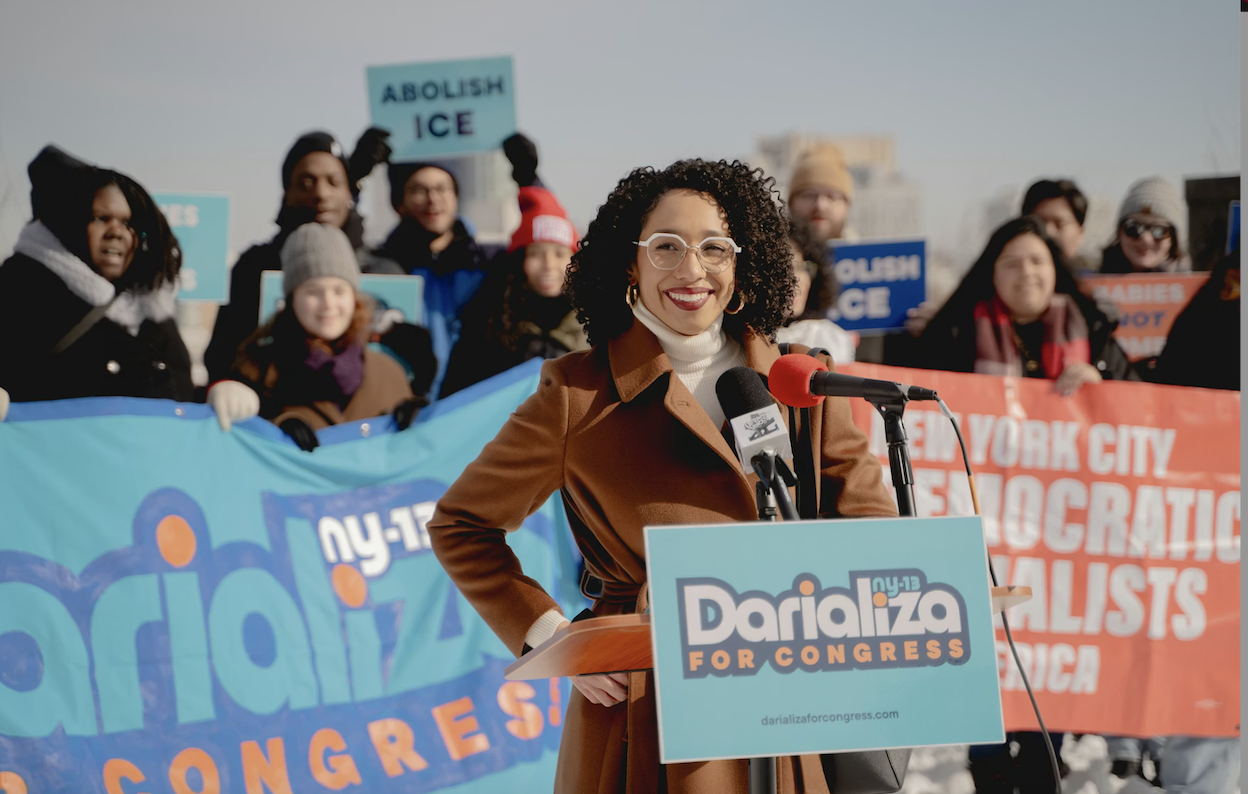
Avila Chevalier has a long record of extreme views, including calling for the abolition of police, voicing pro-Russia sentiment and rejecting Israel’s existence
SPECTATOR SPECTACLE
A who’s who of notables packed Madison Square Garden for Game 3 of the NBA Finals
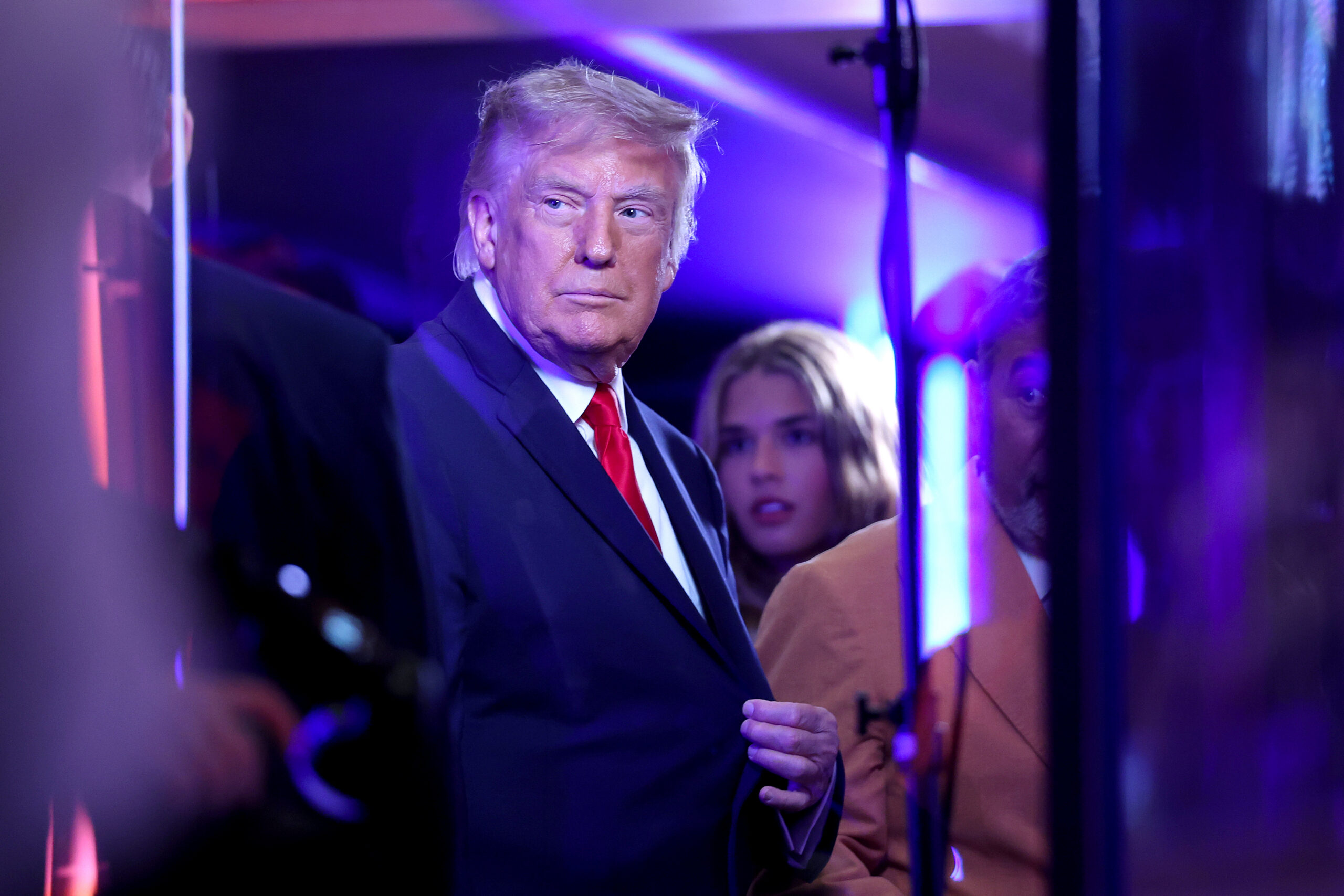
Trump, Mamdani, Witkoff, Kraft, Lutnick and more watched the game
Plus, AIPAC wades into Mich. Senate race
SAUL LOEB/AFP via Getty Images
President Donald Trump shakes hands with Israeli Prime Minister Benjamin Netanyahu during a meeting in the Oval Office of the White House in Washington, DC, on April 7, 2025.
This P.M. edition is reserved for our premium subscribers like you — offering a forward-focused read on what we’re tracking now and what’s coming next.
Today’s Daily Overtime was curated by JI U.S. Editor Danielle Cohen-Kanik.
📡On Our Radar
Notable developments and interesting tidbits we’re tracking
President Donald Trump cautioned Israeli Prime Minister Benjamin Netanyahu that if Israel went forward with a plan to escalate its strikes on Iran today, “you will be on your own very soon,” the president recalled in an interview with Axios, after which the Israeli leader reportedly called off the attack. Trump also claimed the U.S. and Iran are nearing a “phenomenal deal. We are getting everything we wanted”…
Netanyahu subsequently said in a video statement that, while Israel is “holding its fire” against Iran, Jerusalem has “a full right to self-defense” and is “exercising it to the extent necessary” — a message he said he relayed “with appreciation and respect in my good conversations with my friend President Trump.” But Netanyahu warned that if Iran resumes its attacks on Israel, the IDF would respond with “overwhelming force”…
Mohammad Bagher Ghalibaf, the speaker of the Iranian parliament, said in an address today that Iran’s simultaneous military strikes and diplomacy are part of an intentional strategy and that, though Tehran is seeking to end the war, it does not want to normalize relations with Washington…
U.S. forces disabled another empty oil tanker attempting to sail to Iranian ports today after it failed to disobey orders to stop by firing a precision munition into the ship’s engineering and steering spaces, CENTCOM announced. It’s the seventh such vessel U.S. forces have disabled since the blockade began…
Thirty-eight Senate Democrats, led by Sens. Adam Schiff (D-CA), Tim Kaine (D-VA) and Minority Leader Chuck Schumer (D-NY), demanded in a letter to Trump that the administration provide Congress with the legal opinion backing its determination that U.S. hostilities against Iran have ended, given the ongoing strikes and U.S. presence in the region…
At next week’s G7 summit in France, which Trump will be attending, European leaders will attempt to secure the president’s support for a U.K. and France-led effort to de-mine the Strait of Hormuz, Bloomberg reports…
The J7, a coalition of Jewish communal organizations representing the seven largest Jewish Diaspora populations, urged Canadian Prime Minister Mark Carney to prioritize action over further study after he announced Ottawa’s new Ministerial Advisory Council on Rights, Equality and Inclusion would examine rising antisemitism in the country.
Arguing that the problem has already been well documented, the groups called for a “whole-of-government” response focused on enforcement and countering extremist ideologies and terror movements…
United Democracy Project, the AIPAC-aligned super PAC, began buying ad time in Michigan today, in what appears to be the pro-Israel group’s first foray into the state’s heated Democratic Senate primary…
The Wall Street Journal interviews activists Daniel Moraff and Leanne Fan, who, along with consultant Morris Katz, recruited Graham Platner to run for Senate in Maine. The two said that their own vetting process of Platner did not turn up the Nazi tattoo he had on his chest, nor the full extent of his controversial Reddit posts, but they believed none of what they had seen at the time “will or should stop him from becoming a U.S. senator”…
The two factions of Williamsburg, Brooklyn’s Satmar community united behind Brooklyn Borough President Antonio Reynoso in the race to succeed retiring Rep. Nydia Velazquez (D-NY). Reynoso, a native of the district, clashed with some of the Hasidic sect’s leaders as a city councilmember but rebuilt relationships in subsequent years. New York City Mayor Zohran Mamdani, who has found allies in the Satmar sect while in office, is backing Reynoso’s opponent, Assemblymember Claire Valdez…
Ahead of tonight’s Knicks NBA Finals game against the San Antonio Spurs at Madison Square Garden, The Forward examines the chant sweeping New York City — “My mayor Muslim, my bagel Jewish, my Christian Dior, Knicks in four!” — and what it says about the city’s identity…
⏩ Tomorrow’s Agenda, Today
An early look at tomorrow’s storylines and schedule to keep you a step ahead
Keep an eye out in Jewish Insider for a look at the view from Washington on Trump’s attempt to pressure Netanyahu not to retaliate to Iran’s recent ballistic missile attacks.
Maine, Nevada, North Dakota and South Carolina will hold their primary elections tomorrow.
The House Foreign Affairs Committee will hold a markup of various bills, including one to direct the State Department to impose sanctions on the leaders and family members of the Rapid Support Forces (RSF) and the Sudanese Armed Forces (SAF) responsible for genocide, war crimes and crimes against humanity in the Sudanese civil war.
The House Appropriations Committee will mark up the FY 2027 spending bills for Labor, Health and Human Services and Homeland Security.
The Atlantic Council will kick off its two-day Global Energy Forum with remarks from Energy Secretary Chris Wright; Ben Black, CEO of the U.S. International Development Finance Corporation; Alaska Gov. Mike Dunleavy; and representatives from Kuwait, Egypt, Syria and more.
Agudath Israel of America will celebrate the opening of its new office on Capitol Hill with a tribute to its longtime vice president for government affairs, Rabbi Abba Cohen, who is set to step down after 37 years at the organization.
Stories You May Have Missed
PROMISES AND PERILS
As AI reshapes society, Jewish leaders grapple with what comes next

Rabbi Mordechai Lightstone: ‘When we ascribe human attributes — emotions, consciousness and soul — to AI, we risk transforming a sophisticated instrument into an idol’
GOLDEN MEMORIES
In Altneu art exhibit, artists grapple with the end of American Jewry’s ‘Golden Age’

A new exhibition at the Upper East Side synagogue uses paintings of everyday Jewish life to explore nostalgia and identity as Jewish artists increasingly feel unwelcome in cultural spaces
Iran had said it would not continue striking Israel as long as the IDF ceased its campaign against Hezbollah

Wisam Hashlamoun/Anadolu via Getty Images
Missiles launched from Iran toward Israel are seen in the sky over Hebron on June 7, 2026
Israel will abide by a request from the Trump administration to pause its strikes on Iran, two Israeli sources told CNN, though Jerusalem plans to continue its operations against Hezbollah targets in southern Lebanon.
The halt comes after Iran announced earlier Monday that it would suspend its military operations against Israel, after having launched a number of missile barrages at the Jewish state since Sunday evening. However, Tehran has threatened to resume strikes should Israel continue its campaign in Lebanon, which the IDF did on Monday after Hezbollah fired rockets at Israeli troops in southern Lebanon.
Israeli Defense Minister Israel Katz said in a statement on Monday that “any attack on [northern Israel] will lead to a strike on Dahiyeh,” referring to the Beirut suburb and Hezbollah stronghold that the IDF struck on Sunday in response to Hezbollah attacks targeting northern Israel earlier in the day. “We completely reject Iran’s threat,” Katz added. “Any Iranian attempt to link Lebanon and Iran and attack Israel will be met with great force, as happened yesterday.”
Israel had fired on Iranian strategic air defense systems and an Iranian petrochemical plant earlier on Monday after Tehran launched waves of ballistic missiles at northern and central Israel, the first such attacks since the U.S. and Iran reached a ceasefire in early April. Iran said it was retaliating for IDF strikes in Dahiyeh, which came after Hezbollah fired on northern Israeli towns.
After Israel’s strikes on Iran, the Houthis, an Iran-backed proxy group in Yemen, launched a ballistic missile at Israel and declared a ban on Israeli shipping in the Red Sea.
The exchange marked the most significant military hostilities between the two sides in months and prompted immediate diplomatic intervention from President Donald Trump, who called on both sides on Monday to “stop shooting.”
He had also reportedly urged Israeli Prime Minister Benjamin Netanyahu in a phone call to hold off on retaliatory strikes against Iran, though Israel fired on Iran afterwards. Trump also said that “Israel and Iran must immediately stop ‘shooting,’” in a post on Truth Social early Monday morning.
Although a U.S. official initially told CNN that American forces played no role in intercepting the Iranian missiles, officials later confirmed that Washington did fire interceptors at the incoming projectiles. The success of those intercept attempts remains unclear. The U.S. military stated it did not conduct any joint strikes in Iran alongside Israel.
Trump also said he was “not happy” about the Israeli strikes in Beirut on Sunday, after he attempted to broker a ceasefire between Israel and Hezbollah last week, which the terror group quickly rejected.
Netanyahu will reportedly convene a full Security Cabinet meeting Monday evening local time.
The diplomatic scramble unfolds as the U.S. and Iran attempt to maintain a fragile truce while negotiators seek to hammer out a comprehensive end to the conflict. Iranian President Masoud Pezeshkian stated that his nation has “abandoned neither the battlefield nor the negotiating table.”
“Our priority is national security and the peace of our people. We will firmly defend the rights of the nation and will not back down in the face of any threat,” Pezeshkian wrote on X on Monday, describing diplomacy and defense as the “two wings of national power.”
This story was updated on June 8 to reflect an updated CNN report that U.S. forces did attempt to assist Israel in intercepting Iranian missiles.
House Democratic leadership opposed Tlaib’s resolution, but said they’ll support a different effort of hers to block U.S. support for Israeli operations against Hezbollah

Tom Williams/CQ-Roll Call, Inc via Getty Images
Rep. Rashida Tlaib (D-MI) attends the House Financial Services Committee on Wednesday, March 29, 2023.
The House rejected a war powers resolution by Rep. Rashida Tlaib (D-MI) on Thursday that aimed to block U.S. support for Israeli operations against Hezbollah in Lebanon, after House Democratic leaders publicly came out against the effort.
But the Democratic leaders said they would support a future effort by Tlaib along similar lines that will include carveouts for other U.S. operations inside Lebanon, indicating that Tlaib’s next effort is likely to pick up greater Democratic support.
The resolution failed by a vote of 324-92, with most votes in favor of the resolution coming from progressive House Democrats, though several more moderate lawmakers also voted in favor. The Congressional Progressive Caucus whipped in favor of the resolution. Rep. Thomas Massie (R-KY) was the only Republican who supported the effort, and 117 Democrats — a majority of the caucus — voted against it.
Reps. Betty McCollum (D-MN) and Derek Tran (D-CA) voted present.
Tlaib’s resolution, which directed the administration to “remove the United States Armed Forces from Lebanon” within seven days, aimed to cut off U.S. logistical and intelligence support for Israeli operations against Hezbollah. Tlaib has consistently ignored or downplayed Hezbollah’s role in the conflict, describing Israel’s operations as being against Lebanon and the Lebanese people writ large.
Democratic critics said that the legislation would also require the U.S. to remove military guards from its diplomatic facilities and U.S. servicemembers that train and advise the Lebanese Armed Forces. Tlaib insisted that other U.S. operations would be able to continue, in spite of the strict wording in her legislation that indicated they would be impacted.
House Democratic leaders Reps. Hakeem Jeffries (D-NY), Katherine Clark (D-MA) and Pete Aguilar (D-CA) said in a joint statement that they support efforts by the LAF to defeat Hezbollah — making no mention of Israel — and said that they “do not support any effort by the Trump administration to entangle the United States in a war in Lebanon or other parts of the Middle East.”
They said that, since there are no U.S. troops involved in hostilities in Lebanon, a more prudent path would be to pursue an alternative resolution Tlaib introduced, with support from Rep. Greg Meeks (D-NY), the ranking member of the House Foreign Affairs Committee.
The statement came after multiple days of behind-the-scenes wrangling and negotiations over the legislation.
Tlaib’s alternative resolution directs the administration to remove U.S. forces “from any hostilities in Lebanon” within seven days, and includes a specific carveout for diplomatic protection and cooperation with the LAF.
Despite introducing the alternative resolution herself, Tlaib said on X, “The people of Lebanon can’t wait another month for Congress to act.”
Rep. Brad Schneider (D-IL), who said Tlaib denied him the opportunity to speak on the House floor on the legislation, emphasized in a video statement that the legislation might impact U.S. support for the LAF and U.S. diplomatic security and highlighted that Hezbollah is a threat to the Lebanese people, in addition to attacking Israel since early February.
“We need to find a path where Lebanon and Israel can live in peace, and this resolution doesn’t help us. It doesn’t send a message to the president or the Trump administration. It doesn’t send a message to the Netanyahu government,” Schneider said. “It sends a message to Lebanon and Hezbollah that what they’re doing is acceptable. It sends a message to the Lebanese people that once more they’re pawns in someone else’s fight.”
Rep. Jared Moskowitz (D-FL) told Jewish Insider, “The United States is not at war with Lebanon nor is there any indication that we’re going to war with Lebanon. So it’s an unnecessary war powers vote.”
Debate over the resolution on Tuesday turned heated when Rep. Max Miller (R-OH) accused Tlaib of “advocat[ing] for terrorists on a daily basis” and of “hang[ing] out with” with Hezbollah “butchers.”
His remarks were struck from the congressional record with an objection from Tlaib, but he said in a statement read out on the House floor by a colleague that he stood by his remarks.
Plus, John's bolting to a guilty plea

Daryn Slover/Portland Press Herald via AP
Senate candidate Graham Platner acknowledges the large crowd that attended Platner's town hall, Sept. 25, 2025, at Bunker Brewing in Portland, Maine.
This P.M. edition is reserved for our premium subscribers like you — offering a forward-focused read on what we’re tracking now and what’s coming next.
Today’s Daily Overtime was curated by JI U.S. Editor Danielle Cohen-Kanik.
📡On Our Radar
Notable developments and interesting tidbits we’re tracking
Three women who were romantically involved with Maine Senate candidate Graham Platner told The New York Times in a detailed exposé that the presumptive Democratic nominee had been “toxic,” physically threatening, misogynistic and unfaithful during their yearslong relationships.
One former partner, Lyndsey Fifield, confirmed Jewish Insider’s reporting from October that Platner had known what the Nazi symbol tattooed on his chest represented and had taught her the word for it, calling it “my Totenkopf”…
John Bolton, President Donald Trump’s national security advisor during his first term, intends to plead guilty to illegally retaining sensitive national security information, CNN reports, a charge that could carry up to five years in prison…
Trump told aides he would only consider resuming military action against Iran — besides the skirmishes in the Strait of Hormuz, which the administration has insisted do not qualify as warfare — if Iran were to kill American troops, U.S. officials told The Wall Street Journal…
Trump lambasted the House’s “meaningless vote” yesterday passing an Iran war powers resolution “right in the middle of my final negotiations to end the War with the Islamic Republic of Iran. Who would do such an unpatriotic thing,” he mused…
Lebanese President Joseph Aoun told reporters today that the ceasefire announced yesterday with Israel would take effect only after Hezbollah approved of the proposal, given that it’s contingent on the terror group’s disarmament and withdrawal from southern Lebanon; Hezbollah leader Naim Qassem then rejected the agreement, calling the negotiations “absurd, humiliating and insulting,” and claiming Hezbollah’s withdrawal at this time would mean “surrender, defeat and achieving the enemy’s goals”…
Israel and Hezbollah then continued to exchange fire in southern Lebanon, where a UNIFIL peacekeeper was killed today after a mortar shell struck a U.N. position in the area. The IDF said the launch trajectory of the mortar “clearly indicates” it was launched by Hezbollah…
The House rejected a war powers resolution by Rep. Rashida Tlaib (D-MI) that aimed to block U.S. support for the Israeli operations in Lebanon, after House Democratic leaders publicly came out against the effort. But the Democratic leaders said they would support a future effort by Tlaib along similar lines that will include carveouts for other U.S. operations inside Lebanon, indicating that Tlaib’s next effort is likely to pick up greater Democratic support…
Iran and Russia signed a $25 billion memorandum of understanding on nuclear cooperation, Iranian state media reported…
The Times takes a look at how Qatar and the U.S. came to dominate the global liquefied natural gas market and how disruptions to Qatari exports amid the Iran war are exposing the risks of that concentration while potentially increasing America’s energy and geopolitical leverage…
In its markup of the 2027 National Defense Authorization Act, the House Armed Services Committee blocked by a voice vote an effort to strip out a relatively routine provision on cooperation with Israel, which has become the subject of criticism and misinformation online. Both the chairman and ranking member of the committee said that critics were misrepresenting the provision and what it entails…
Republicans on the House Appropriations Committee proposed providing $315 million for the Nonprofit Security Grant Program in 2027, a slight increase from 2026 funding levels but far below the $1 billion that supporters of the program in the House and Jewish and other faith communities have advocated for, JI’s Marc Rod reports. Jewish groups called the proposal appreciated, but vastly inadequate, given the current threat level…
Sen. Chris Van Hollen (D-MD) called out recent AIPAC and crypto-linked spending in the crowded Democratic primary to replace retiring Rep. Steny Hoyer (D-MD), where AIPAC’s super PAC has invested heavily in support of Hoyer-endorsed Adrian Boafo, JI’s Matthew Kassel reports. Van Hollen accused the “outside groups” of “trying to buy this congressional seat,” and said the groups “do not have the voters’ interests at heart”…
A week after winning his primary runoff against anti-Israel Rep. Al Green (D-TX), Rep. Christian Menefee (D-TX) co-sponsored the Block the Bombs Act. Menefee was seen as the more pro-Israel choice in the race, who Jewish community leaders hoped would provide a fresh start after their relationship with Green collapsed…
Israeli Prime Minister Benjamin Netanyahu appointed Brig. Gen. Guy Markizeno as his military secretary, after his previous military secretary, Maj. Gen. Roman Gofman, became director of the Mossad earlier this week. Markizeno, who currently serves as military secretary to Defense Minister Israel Katz, has “extensive experience in coordinating between the political echelon and the military echelon,” Netanyahu said in a statement…
Israeli Foreign Minister Gideon Sa’ar announced Israel will open its first embassy in the Slovenian capital of Ljubljana, calling the rise of center-right Prime Minister Janez Janša, whose government was approved by the country’s parliament today, a “new chapter” in Israel-Slovenia relations after “years of the hostility of the previous government”…
The Times interviews Iranian soccer federation head Mehdi Taj, who said the Iranian national team’s U.S. visas have still not been approved less than two weeks before the team is set to play its first World Cup match in the country, while the team trains in Mexico rather than its planned home base in Arizona. Taj was formerly a commander in Iran’s Islamic Revolutionary Guard Corps…
⏩ Tomorrow’s Agenda, Today
An early look at tomorrow’s storylines and schedule to keep you a step ahead
Keep an eye out in Jewish Insider for a look at the new art exhibit at Manhattan’s Altneu synagogue grappling with the end of American Jewry’s “golden age.”
We’ll be watching to see how the latest revelations about Platner‘s past play out on the campaign trail ahead of Tuesday’s primary election, where Democratic Gov. Janet Mills is still on the ballot. Rep. Ro Khanna (D-CA) is expected to join Platner at his Get Out the Vote rally in Bar Harbor, Maine, tomorrow evening.
We’ll be back with the Daily Overtime on Monday. Shabbat Shalom!
Stories You May Have Missed
SITTING IT OUT
UDP faces questions from N.J. Jewish leaders why it stayed on sidelines against Hamawy

Hamawy, despite his past ties to a convicted terrorist, faced minimal scrutiny from outside groups — including many of his primary rivals
CAPITOL CONCERNS
GOP lawmakers argue Hamawy’s terror ties could pose national security risk in House
‘Anybody that’s tied to that should never be elected to Congress, and if he is, I think should never serve on a national security committee,’ Rep. Michael McCaul told JI
The tense nature of the Trump-Netanyahu call this week underscores the increasingly divergent tactics the two are taking to ongoing conflicts in the Middle East
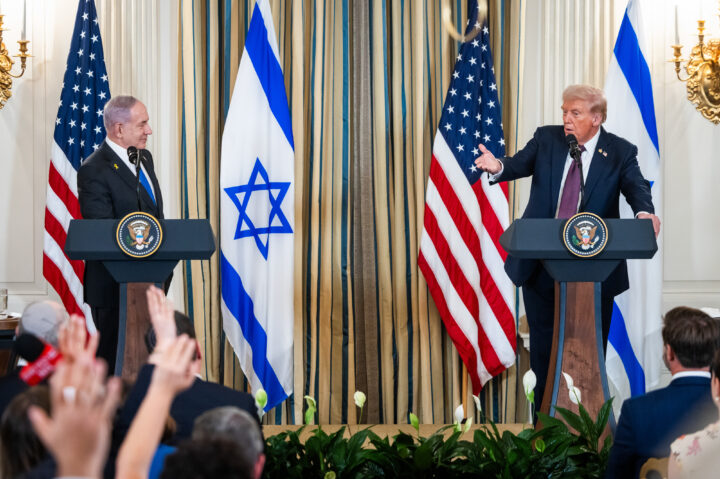
Jim Lo Scalzo/EPA/Bloomberg via Getty Images
President Donald Trump, right, and Benjamin Netanyahu, Israel's prime minister, during a news conference in the State Dining Room of the White House in Washington, DC, US, on Monday, Sept. 29, 2025.
It’s a strange moment when the leader of the free world explains to a reporter why he cursed out the prime minister of a major ally.
But we live in an increasingly strange moment, one in which President Donald Trump confirmed to the New York Post this week that he had indeed called Israeli Prime Minister Benjamin Netanyahu “f***ing crazy” during a discussion about Israel’s plans to expand operations in Lebanon, even as he stressed that he and the Israeli leader have “worked very well together.” (Trump’s confirmation came after Netanyahu’s office denied the remarks.)
The tense nature of the Trump-Netanyahu call this week underscores the increasingly divergent tactics the two are taking to ongoing conflicts in the Middle East as Trump leans into diplomacy while Netanyahu pushes for intensified military action — and as questions loom over the future of U.S. aid to Israel.
With the House’s passage of a war powers resolution yesterday (with four Republicans breaking with House GOP leadership), and a Senate vote on the issue still pending, the Trump administration’s appetite for a resumption of hostilities is even smaller than it was last month (when, as we reported, it was already quite low, owing to rising gas prices and the approaching midterms).
And it’s not just Trump distancing the U.S. from renewed all-out conflict. Speaking before the Senate Foreign Relations Committee on Wednesday, Secretary of State Marco Rubio told lawmakers that the Iran war was “over.”
The comments come even as Iran continues to scale up its attacks in the region, in some cases prompting a U.S. response. Early Wednesday morning, the Islamic Republic launched a drone attack targeting Kuwait’s main airport, killing one person and injuring at least 60.
Trump has reportedly set a red line on Iran, telling aides that he could end the ceasefire — which, while not a technical halting of all fire, has resulted in far fewer exchanges of fire and destruction than at the height of the war in March and early April — if U.S. troops are killed.
Meanwhile, Netanyahu told CNBC on Wednesday that he wants to start the process of winding down U.S. military aid to Israel over the next two years — the final years of Trump’s term — in a way that would shift the relationship, according to the prime minister, “from aid to a partnership where we both invest equal amounts and both share equally in the fruits of our innovators and technologies.” Such a move, Netanyahu added, “will also take away the myth that Israel is depleting America’s coffers” — a popular talking point among opponents of U.S. aid to Israel on Capitol Hill and beyond.
On paper, Washington and Jerusalem do appear in lockstep — alongside Beirut — on deepening relations between Israel and Lebanon and rooting out Hezbollah. To that effect, the White House announced in a joint statement with Lebanese and Israeli officials on Wednesday that the parties had agreed to a renewed ceasefire — though it is contingent on the cooperation of Hezbollah, which did not take part in the talks and continues to launch drones and missiles at northern Israel.
But even as officials in Washington reach an accord on Lebanon, the challenges on the ground remain much the same. It was, after all, the issue of Lebanon — and Netanyahu’s announcement that the IDF would attack Hezbollah strongholds in Beirut — that triggered Trump’s expletive-laden outburst on Monday, causing Netanyahu to walk back Israel’s military plans in Lebanon.
And while Netanyahu needs to stay in Trump’s good graces, it is voters in Israel — including those in the country’s north who are living under daily Hezbollah fire — whom Netanyahu will need to sway ahead of the fall elections.
Israeli Ambassador Yechiel Leiter said the two sides are working to ensure Hezbollah's permanent removal from the border area, warning fighters who remain will ‘know exactly what's coming.’
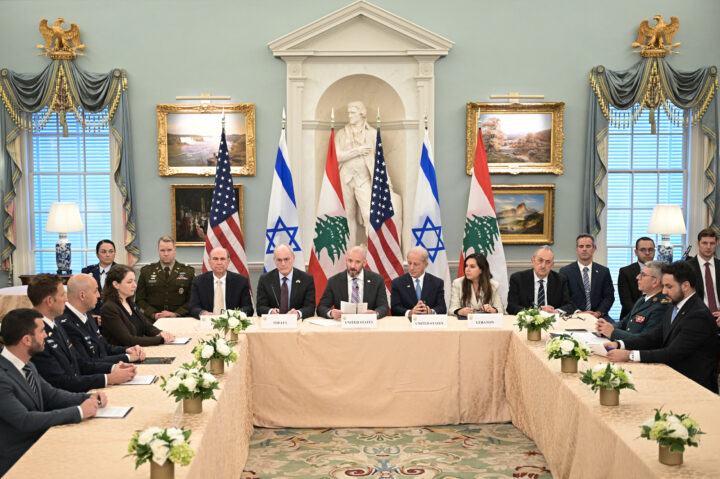
Oliver Contreras/AFP via Getty Images
Israeli Ambassador to the US Yechiel Leiter, State Department Chief of Staff Daniel Holler, US Ambassador to Lebanon Michel Issa and Lebanese Ambassador to the US Nada Hamadeh attend a meeting between Israeli and Lebanese delegations hosted by the United States at the State Department in Washington, DC, on June 3, 2026.
Israel and Lebanon agreed on Wednesday to extend their ceasefire — which in practice has been tenuous — on the condition that Hezbollah disarms and withdraws from Israel’s northern border, and to jointly establish “pilot zones” where the Lebanese Armed Forces “will take exclusive control of the territory.”
The parties, together with the U.S., announced the developments in a joint statement at the conclusion of the second and final day of the fourth round of peace talks between Israeli and Lebanese officials at the State Department.
State Department Counselor Dan Holler, Israeli Ambassador to the U.S. Yechiel Leiter, Lebanese Ambassador to the U.S. Nada Hamadah, U.S. Ambassador to Lebanon Michel Issa and several U.S. military representatives participated in Wednesday’s talks. The group will reconvene for the next round of talks the week of June 22 “with a view toward reaching a comprehensive agreement,” the statement said. A State Department official told JI that the exact time and venue for the upcoming discussions have not yet been decided.
Speaking to reporters in Foggy Bottom, Leiter touted Wednesday’s agreement as a “relatively unprecedented” achievement.
“Israel entered Lebanon after Hezbollah decided to join the war of Iran against Israel, and we’re pushing Hezbollah back. We’ve brought the people of Lebanon to the understanding that we’re not the enemy, Hezbollah is,” Leiter said in response to a question from Jewish Insider. “Now, we’re going to work together to rid the country of this Iranian proxy on Israel’s border, which deprives Israel of its security and the Lebanese people of their freedom.”
On the creation of the “pilot zones,” Leiter said the effort “will be guided by the United States. Special units in the Lebanese army will take control of various areas and gradually spread out throughout the south, so we don’t go into another pattern where Israel leaves, Hezbollah comes back and we go through the same thing from the last 40 years.”
Leiter also noted that Israel would allow Hezbollah terrorists to evacuate from southern Lebanon to the country’s north for a brief, unspecified period of time.
“The first step is that the Hezbollah fighters, these terrorists who have come down to the south, have to go back to the north. They came down recently. We’re talking about some 2,000-plus terrorists,” the Israeli ambassador said. “So we’re going to see them go back to the north. We will guarantee them safe passage as long as they leave, but after a certain amount of time, which is not very long, if they don’t make their way back to the north, then they know exactly what’s coming, and Lebanon understands what’s coming.”
Asked by JI what Israel believes President Donald Trump’s red line is when it comes to their ability to go after Hezbollah in Beirut or elsewhere in Lebanon, Leiter said that Trump, Israeli Prime Minister Benjamin Netanyahu and Lebanese President Joseph Aoun are in agreement about Israel’s right to respond to attacks from the Lebanese terrorist group.
“If Hezbollah is intent on disrupting the ceasefire, the result is going to be on them, and that’s something that President Trump, Prime Minister Netanyahu and President Aoun have made very clear,” Leiter said. “We are together on this agenda to see to it that Iran is not to be allowed any longer to facilitate violence against Lebanon, against Israel through Hezbollah.”
The Israeli ambassador credited the Lebanese government for “trying for several weeks now to get Hezbollah to stop firing” at Israel and “to assert within Lebanon that there is a legitimate government, they are in control and Iran doesn’t control Lebanon.”
Leiter dismissed the suggestion that Trump and Netanyahu’s tense phone call on Monday, during which the president referred to the Israeli prime minister as “f***ing crazy” over Israel’s military escalation in Lebanon, impacted the outcome of this week’s talks or indicated a split between the two on the security concerns posed by Hezbollah.
“Prime Minister Netanyahu and President Trump have met seven times over the past year, more than any other foreign leader, and President Trump visited Jerusalem. They’ve spoken on the phone about 60 times, so we’re talking about hours and hours and hours of conversation,” Leiter said. “Taking out one ‘bleep’ from all those conversations and making that the hallmark of their relationship is a mistake. Lovers have spats. They may have had a little lovers’ spat this week, that’s OK.”
“When we’re so close, we’re going to have conversations that sometimes are heated, but the bottom line is that America, Israel, Lebanon are united on keeping Iran out of the equation. That’s the most important thing,” he continued.
Plus, Rubio defends Israel's Lebanon strikes
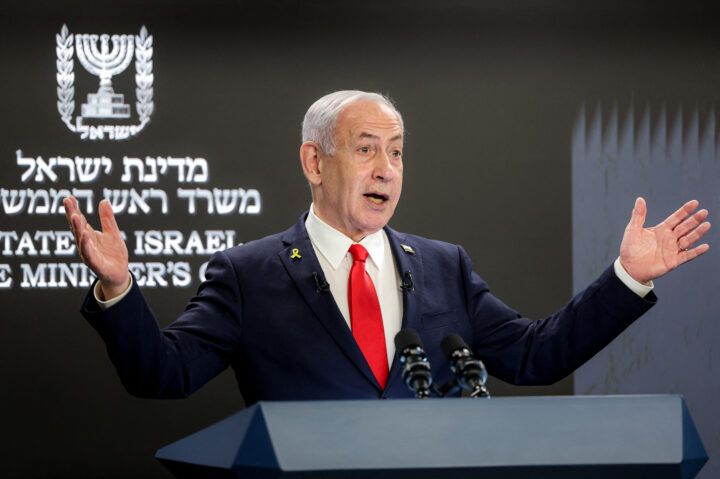
ABIR SULTAN/POOL/AFP via Getty Images
Israel's Prime Minister Benjamin Netanyahu gives a press conference at the Prime minister's office in Jerusalem on August 10, 2025.
This P.M. edition is reserved for our premium subscribers like you — offering a forward-focused read on what we’re tracking now and what’s coming next.
Today’s Daily Overtime was curated by JI U.S. Editor Danielle Cohen-Kanik.
📡On Our Radar
Notable developments and interesting tidbits we’re tracking
Israeli Prime Minister Benjamin Netanyahu told CNBC’s Sara Eisen today that he wants to start the process of winding down U.S. aid to Israel in the final two years of the Trump administration, as both countries work toward reaching a new memorandum of understanding, Jewish Insider’s Emily Jacobs reports.
“We’re now working on a memorandum of understanding which will bring down the aid,” Netanyahu said. “I want it to start in the last two years of the Trump administration and I want it to keep going down, coming to zero.” His comments suggest he’s looking to begin phasing out aid even while the current MOU is set to provide Israel with $3.8 billion in U.S. military assistance annually through FY 2028…
Despite President Donald Trump’s public acknowledgement of a confrontational phone call with Netanyahu regarding Israeli operations in Lebanon, Secretary of State Marco Rubio largely defended Israel’s attacks against the Lebanese terrorist group, JI’s Marc Rod reports.
Rubio said at a House Foreign Affairs Committee hearing today that Hezbollah reached out to the U.S. government through Lebanese authorities and said that it would stop launching missiles into Israeli territory if Israel did not attack Beirut, but Hezbollah went back on that agreement and launched rockets at Israel within hours…
Trump avoided directly answering a question from reporters this afternoon if the U.S. ceasefire with Iran still stands, after Iran launched several ballistic missile attacks around the region last night.
“There is a reason for certain things, and there’s usually a reason that sometimes makes sense. We got it, we nipped it in the bud very quickly … but some people would say they were slightly provoked because we took a strong action for a different reason. So they were reciprocating,” the president said…
Sens. John Fetterman (D-PA) and Dave McCormick (R-PA) told JI’s Emily Jacobs on Tuesday that they both believe antisemitism is worse on the left than on the right, arguing that the electoral success of far-left candidates with antisemitic records in Democratic primaries distinguishes the left from the right, as similarly controversial candidates have struggled in GOP primary contests…
The anti-Israel American Priorities super PAC pledged to spend $2 million backing New York City Mayor Zohran Mamdani’s chosen congressional candidates: former City Comptroller Brad Lander, running to unseat Rep. Dan Goldman (D-NY); Darializa Avila Chevalier, challenging Rep. Adriano Espaillat (D-NY); and Claire Valdez, running to succeed Rep. Nydia Velazquez (D-NY). All three candidates have denounced super PAC spending in the past…
Maine Senate candidate and presumptive Democratic nominee Graham Platner released an internal poll showing he still leads his general election opponent, Sen. Susan Collins (R-ME), by a margin of four points after potential voters are told about his most recent scandals. The latest figures from Platner’s camp mark a drop from the roughly eight-point advantage the Democratic candidate has held in previous polls…
In the race to succeed retiring Rep. Nancy Pelosi (D-CA), state Sen. Scott Wiener and Connie Chan, a member of the San Francisco Board of Supervisors who was endorsed by Pelosi, will advance to the general election. With half of votes counted so far in the jungle primary, Wiener won 41% and Chan received 28%, while Saikat Chakrabarti, a wealthy tech entrepreneur aligned with the anti-Israel left, came in third with 15%…
In Montana’s 1st Congressional District, where Rep. Ryan Zinke (R-MT) is retiring, smokejumper Sam Forstag prevailed in the Democratic primary, where several of the candidates, including Forstag, had expressed views critical of Israel. Forstag now faces an uphill battle against Trump-endorsed Republican military veteran Aaron Flint in the general election, given the district’s GOP leanings…
The NYPD arrested an NYU student today for raising a flag that displayed swastikas and a Star of David atop a university building last month. The perpetrator was a fourth-year NYU student at the time of the incident and has not yet received a diploma, a university spokesperson told JI’s Haley Cohen. The New York Times reported that the man is named Alexander Stepnowsky, a music technology student who was charged with a hate crime and trespassing…
⏩ Tomorrow’s Agenda, Today
An early look at tomorrow’s storylines and schedule to keep you a step ahead
Keep an eye out in Jewish Insider for a look at why pro-Israel groups chose not to engage in New Jersey’s 12th Congressional District to oppose anti-Israel Democratic nominee Adam Hamawy in yesterday’s primary election.
The House Armed Services Committee will hold a markup of the 2027 National Defense Authorization Act, where Rep. Ro Khanna (D-CA) said he will attempt to strip out a routine provision facilitating expanded U.S.-Israel cooperation.
Treasury Secretary Scott Bessent will testify before the House Ways & Means Committee.
New York City Council Speaker Julie Menin and City Councilmember Virginia Maloney will meet with Manhattan Holocaust survivors at UJA-Federation of New York headquarters to mark Holocaust Survivor Day.
Brandeis University’s Jonathan Sarna will sit in conversation with Princeton’s Laura Arnold Leibman at Temple Emanu-El in New York City to discuss the Jewish experience of the American Revolution, a month ahead of the U.S. Semiquincentennial.
UN Watch will hold its annual gala in Geneva, where the group will honor free speech and women’s rights activists Abnousse Shalmani and Ayaan Hirsi Ali.
Stories You May Have Missed
PAC PLAY
AIPAC betting big on pro-Israel Democrat and party favorite in Maryland
State Del. Adrian Boafo is Steny Hoyer’s favored candidate, and is getting support from Democratic leaders across the state
PLATNER POSITIONS
Senate Dems wary after latest Platner revelations, but stick by him
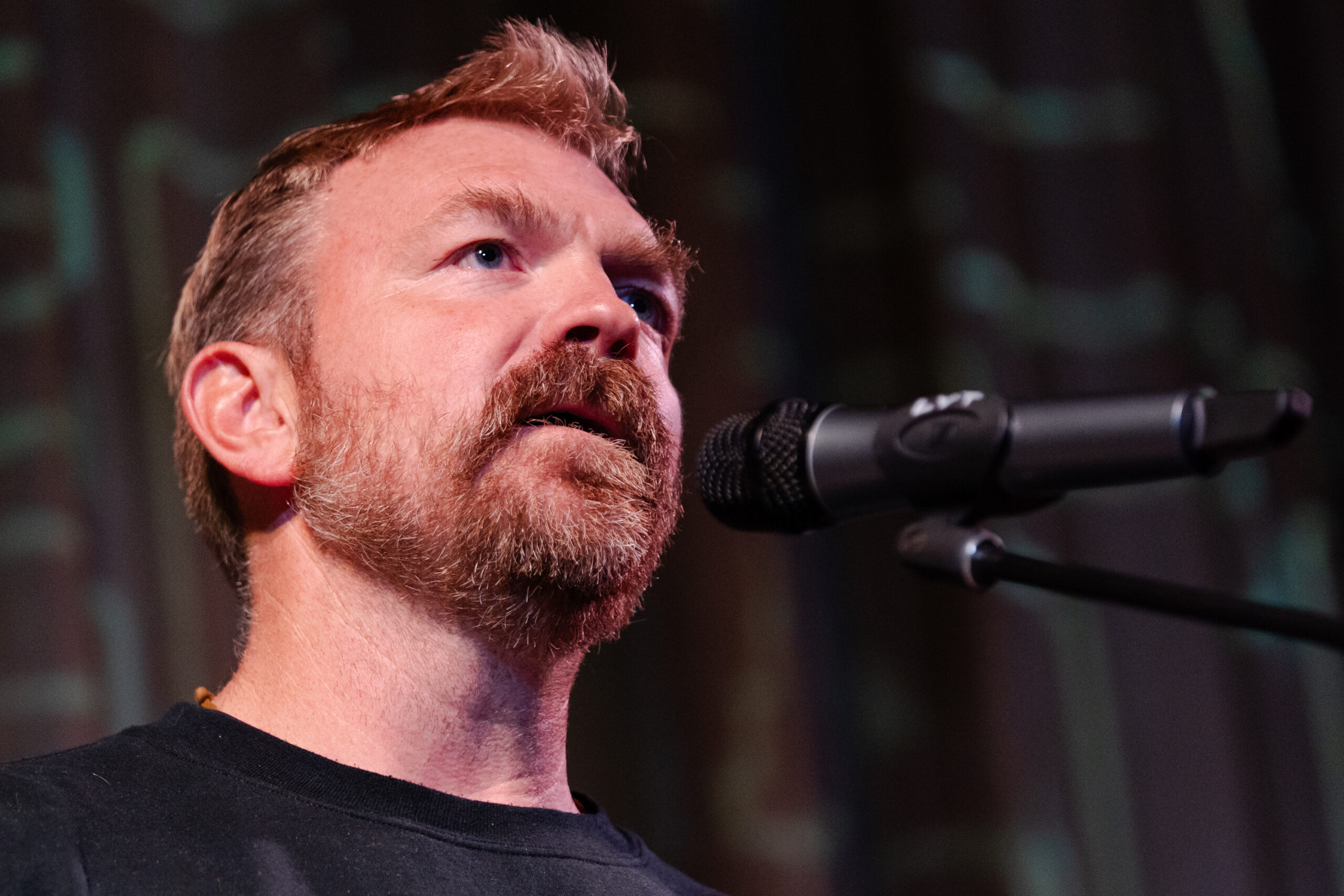
Most aren’t calling for him to leave the race, or throwing their support behind Gov. Janet Mills, who still remains on the primary ballot even after suspending her campaign
The secretary of state largely defended Israel’s strikes in response; ‘Israel has a right to act in its defense’
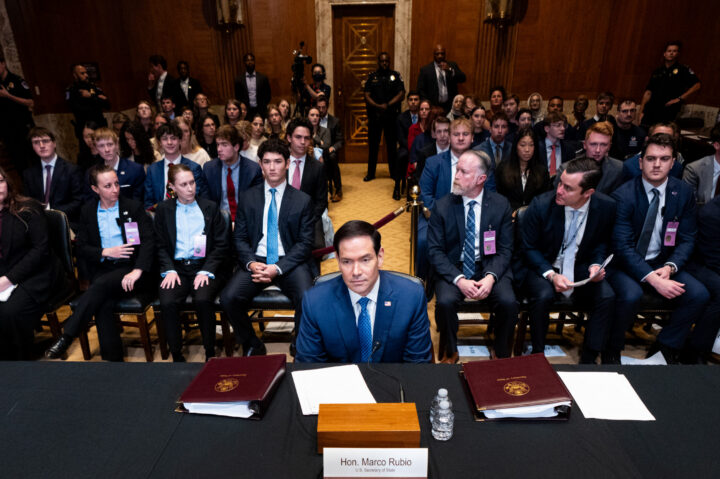
Bill Clark/CQ-Roll Call, Inc via Getty Images
Secretary of State Marco Rubio appears before the Senate Appropriations Subcommittee on State, Foreign Operations, and Related Programs hearing on the State Department budget request on Wednesday, June 3, 2026.
Despite President Donald Trump’s public acknowledgement of a confrontational phone call with Israeli Prime Minister Benjamin Netanyahu regarding Israeli operations in Lebanon, Secretary of State Marco Rubio on Wednesday largely defended Israel’s attacks against the Lebanese terrorist group.
He said that Hezbollah reached out to the U.S. government through the Lebanese authorities approximately two weeks ago and said that it would stop launching missiles into Israeli territory if Israel did not attack Beirut. But Rubio said that Hezbollah went back on that agreement and launched rockets at Israel within hours.
“Israel has not conducted massive operations in Beirut for some time,” Rubio said at a House Foreign Affairs Committee hearing. “Israel has a right to act in its defense.”
Israeli strikes have taken place largely to prevent imminent attacks by Hezbollah forces preparing to attack Israel, Rubio said. He said that Israel’s seizure of territory in southern Lebanon has been intended to deny Hezbollah freedom to operate and launch missiles, and that Israel has not been conducting large-scale operations in Beirut.
Pressed on the current U.S. position in negotiations with Iran, particularly in comparison to the first Trump administration’s condemnation of the 2015 Iran nuclear deal, Rubio largely focused on the nuclear elements of the deal, but said that Iran’s missile program would also be discussed.
He said that Iran would not receive money or sanctions relief unless it agrees to dispose of its highly enriched uranium and give up its enrichment program.
Asked whether the administration would submit any deal reached to Congress, he said that the administration would comply with the Iran Nuclear Agreement Review Act, which requires such review. He said in a Senate Appropriations Committee hearing in the afternoon that the bill, known as INARA, has “very specific requirements about elements of the nuclear program that would have to be noticed to Congress.”
Pressed by Sen. Lindsey Graham (R-SC) on whether Iran’s support for proxy terrorism would be part of any deal, Rubio said that the U.S. would like to see limits on that activity in a deal, but said that there could also be U.S. sanctions “just on that.”
He also suggested at the House hearing the U.S. is seeking to address Iran’s supply of 20% enriched uranium, in addition to 60% enriched uranium.
Asked about recent comments by Trump describing the Iranian military as moderate, and saying that the U.S. has left it “alone,” Rubio drew a distinction between military equipment and capabilities, which the U.S. has targeted, and certain figures inside the regime who have been more open to negotiations with the U.S. or a more conciliatory posture.
He also framed all U.S. operations since the ceasefire as defensive — retaliatory attacks to respond to or prevent attacks on commercial shipping, to which Iran has responded with strikes on facilities throughout the region.
“These are completely defensive in nature. But they are happening in response to an Iranian action. If they don’t shoot at those ships, we don’t shoot. But we have to respond,” Rubio said. “You have a civilian commercial vessel transiting the straits and they’re being targeted by drones.”
He denied a report that Iran had threatened to test a nuclear weapon if the U.S. does not make concessions in negotiations.
Asked about congressional action on Iran, Rubio noted that Iranian state media has framed congressional votes in favor of war powers resolutions to block operations against Iran as a victory which would tie the U.S.’ hands.
He also said that the administration does not feel it needs an Authorization for Use of Military force to carry out any potential further operations against Iran, but said that the administration would engage with Congress if that occurs and that it would welcome any further congressional authorities.
Pressed by Rep. Joaquin Castro (D-TX) about Israel’s alleged nuclear capabilities, Rubio emphasized that Israel has never acknowledged that it has a nuclear program, though most of the world believes it does. “But they’ve never acknowledged that publicly, and as a feature of our foreign policy, for a variety of reasons, we don’t discuss it in that way either,” he said.
He said that the State Department might be able to discuss the issue further in a closed session and in a different context than a letter Castro and other Democrats sent to Rubio on the subject.
Rubio also affirmed that Turkey is currently not eligible to receive F-35 fighter jets as long as it operates a Russian S-400 missile defense system, under U.S. statute.
Plus, Trump's unconventional pick for intel chief
Brooks Kraft LLC/Corbis via Getty Images
International flags at the State Department in Washington.
This P.M. edition is reserved for our premium subscribers like you — offering a forward-focused read on what we’re tracking now and what’s coming next.
Today’s Daily Overtime was curated by JI U.S. Editor Danielle Cohen-Kanik.
📡On Our Radar
Notable developments and interesting tidbits we’re tracking
President Donald Trump again dismissed reports that Iranian negotiators have cut off dialogue with the U.S. as “false and erroneous,” writing in a post on Truth Social that discussions have continued “four days ago, three days ago, two days ago, one day ago, and today”…
About the current talks, Secretary of State Marco Rubio told the Senate Foreign Relations Committee today that the U.S. is not offering Iran any sanctions relief in exchange for reopening the Strait of Hormuz, and that sanctions relief would only be on the table if Tehran makes concessions related to its nuclear program in the next phase of negotiations, Jewish Insider’s Marc Rod reports…
The Trump administration sent a fresh slate of diplomatic nominations to the Senate for approval today, but noticeably absent was a full-throated push to fill critical ambassadorial vacancies across the Middle East and North Africa, even as the Iran conflict has increased the need for coordination and dialogue in the region, JI’s Matthew Shea reports.
The newest list of nominees included only two names for the MENA area: Donald Blome, tapped to serve as assistant secretary of state for Near Eastern affairs — a role that acts as the principal advisor on U.S. foreign policy across the region — and Nick Oberheiden, nominated to be U.S. ambassador to Egypt…
In a highly unusual move, Trump appointed Bill Pulte, the director of the Federal Housing Finance Agency and chairman of Fannie Mae and Freddie Mac, as acting director of national intelligence, after DNI Tulsi Gabbard announced she will resign effective June 30. Pulte, who has no prior experience in an intelligence role, has been a staunch Trump loyalist and led some of the president’s retribution efforts against his political adversaries…
The fourth round of Israel-Lebanon diplomatic talks began at the State Department today, and is expected to last through tomorrow…
At an emergency meeting of the U.N. Security Council yesterday requested by France, every country except for the U.S. called for Israel to immediately withdraw from southern Lebanon and deescalate military hostilities in the country…
The heads of the Conference of Presidents of Major American Jewish Organizations met today with Egyptian President Abdel Fattah El-Sisi and Maj. Gen. Hassan Rashad, head of the country’s General Intelligence Service, in Cairo, where they discussed U.S.-Egypt relations and Middle East security…
A new poll of 600 likely voters in the Michigan Senate Democratic primary conducted for the campaign of physician Abdul El-Sayed found him leading the pack with 34% of the vote, two months ahead of Election Day. Rep. Haley Stevens (D-MI) came in second with 31% and state Sen. Mallory McMorrow trailed at 19%…
Harmeet Dhillon, the assistant attorney general for civil rights, appearing at the American Jewish Committee’s Global Forum in Washington, condemned the “egregious examples of antisemitism that have transpired here at home on American soil” since the Oct. 7, 2023, attacks on Israel as “devastating and antithetical to our values as a nation,” JI’s Emily Jacobs reports…
The backlash to the participation of Israeli Finance Minister Bezalel Smotrich and other far-right Israeli politicians in the Israel Day on Fifth parade in New York City over the weekend continues: Mark Treyger, the head of the Jewish Community Relations Council of New York, which organizes the parade, told The New York Times that he had been blindsided by their attendance.
“There was a complete lack of transparency here,” Treyger said, adding that the Israeli consulate in New York had declined to share with him who would be attending. Dan Rosenthal, a top official at the UJA-Federation of New York, wrote on X that both New York City Mayor Zohran Mamdani and Smotrich “believe in a one-state solution”…
White House Correspondents’ Association President Weijia Jiang announced that the Correspondents’ Dinner will be rescheduled for July 24, after April’s event was cut short by a shooting attack. Trump said he will once again give remarks at the gathering, which will take place at the Waldorf Astoria hotel in Washington…
⏩ Tomorrow’s Agenda, Today
An early look at tomorrow’s storylines and schedule to keep you a step ahead
Keep an eye out in Jewish Insider for the results of today’s high-stakes Democratic primary in New Jersey’s 12th Congressional District, where plastic surgeon Adam Hamawy, whose past terror ties have raised red flags about his candidacy, is the favorite to win.
Secretary of State Marco Rubio will be back on the Hill testifying before the House Foreign Affairs Committee and a Senate Appropriations subcommittee, while Homeland Security Secretary Markwayne Mullin will appear before the House Homeland Security Committee.
State Department antisemitism envoy Yehuda Kaploun and the Argentine Embassy in Washington will co-host a commemoration ceremony at the U.S. Institute of Peace marking the 32nd anniversary of the bombing of the Argentine Israelite Mutual Association (AMIA), with remarks from House Foreign Affairs Committee Chairman Brian Mast (R-FL) and AMIA President Osvaldo Armoza.
The Jewish Democratic Council of America will host a candidate forum for the New York 12th Congressional District Democratic primary at the Streicker Center in New York City.
Stories You May Have Missed
Hard Ro To Hoe
Khanna’s hostile turn towards Israel divides Silicon Valley Jews

His critics once saw him as an ally, but fear he’s pandered to extremists as he raises his national profile ahead of the 2028 presidential election
GROWING THREAT
Cheap, deadly and hard to spot: Hezbollah’s drones create urgent security threat for Israel

‘You just have Israeli soldiers completely unaware. If you can’t hear the drone, if you don’t know that it’s there until it’s too late, it’s too late,’ said FDD’s David Daoud
‘You just have Israeli soldiers completely unaware. If you can’t hear the drone, if you don’t know that it’s there until it’s too late, it’s too late,’ said FDD’s David Daoud

Ayal Margolin/Flash90
An explosive drone launched by Hezbollah is seen near the Israeli border with Lebanon during a Hezbollah attack in northern Israel, May 19, 2026.
One of Israel’s most urgent emerging security threats is not a sophisticated missile or advanced weapons system, but a small, cheap drone that can be bought online and easily assembled.
Hezbollah’s use of first-person view drones (FPVs) — a battlefield tactic widely utilized in the Russia-Ukraine war and now adopted by the Iran-backed terror group — has caused Israeli casualties, threatens civilians and exposed vulnerabilities in Israel’s air-defense systems, including the Iron Dome.
The drones are small and inexpensive, but difficult to detect, experts say. The growing threat has caught the IDF off guard and is forcing Israeli officials to rethink how they protect soldiers, border communities and critical defense infrastructure during the fragile partial ceasefire between Israel and Hezbollah.
Last Wednesday, a drone attack near the Israeli border community of Shomera killed one soldier and wounded two others. Since the ceasefire between Israel and Lebanon began in April, experts have recorded more than 100 drone attacks on communities inside Israel. On Monday, an IDF soldier was killed in southern Lebanon after being struck by an explosive drone sent by Hezbollah.
“These are very simple, unsophisticated drones,” Yaakov Katz, a senior fellow at the Jewish People Policy Institute, told Jewish Insider. “Imagine a person can watch with goggles almost and be the eyes of the drone, see what the drone sees and literally fly it to wherever it wants its target to be.”
Experts said that Hezbollah can purchase commercial drones, or assemble them inside Lebanon using imported parts. But despite their low cost and relative simplicity, the drones are proving difficult for Israel to defend against.
“These are small, they fly very low, so they’re not seen or detected mostly by radar,” Katz said. “Even if you saw them, you can’t necessarily intercept them or destroy them with traditional means of scrambling their radar signal or other electronic warfare capabilities. That is what’s making this so complicated for Israel.”
The drones have been particularly effective against Israeli soldiers operating in the open, Katz said, turning what was once a secondary concern into “one of the most pressing issues for Israel.” He noted that the drones come in various sizes and carry explosives, including grenades, that are flown directly into Israeli soldiers or other targets.
David Daoud, a senior fellow at the Foundation for Defense of Democracies, said this appears to be the “first real conflict” in which Hezbollah has employed these kinds of drones at scale.
“These drones are basically loitering around for a while,” Daoud said. “They’re not moving at particularly high speeds and you just have Israeli soldiers completely unaware. If you can’t hear the drone, if you don’t know that it’s there until it’s too late, it’s too late.”
Daoud said he has seen footage of drones flying within “a foot or two” of Israeli soldiers who appeared unaware of their presence. That low detectability, he said, can increase the danger not only to soldiers but also to civilians and infrastructure.
“This kind of feeds into the idea that their detectability is very low by design,” Daoud said. “Hezbollah has also talked about disabling some of the early warning systems. If Israel’s Red Alert is knocked out in a certain area and then Hezbollah fires a barrage of 100 rockets, suddenly people don’t have the ability to know that the attack is incoming. You increase the possibility of Israeli casualties.”
Katz said the threat has also taken on a deeply personal dimension for many Israelis. “I have two nephews who are in Lebanon right now,” he said. “Everyone knows someone in Lebanon and you’re concerned, and that creates a level of anxiety.”
“Unfortunately, it’s almost every day that we wake up, or in the middle of the day, get reports of another soldier who’s been killed by one of these drones,” he added. “It just wasn’t as important, but now it is, because it’s killing people. That now made it one of the most pressing issues for Israel.”
Ari Cicurel, associate director of foreign policy at the Jewish Institute for National Security of America, said the drones are also effective because they allow operators to strike with “greater precision and accuracy.” He said that Hezbollah has deployed FPV drones similar to those used by Russia against Ukraine, adding that the group has adopted fiber‑optic control cables to mimic Russian tactics and evade electronic countermeasures.
“Even if they are smaller, the operator can focus in on sites, loiter, wait for an individual or a site to be a desirable target, and then hit them,” Cicurel said. “What we’re seeing in particular recently is adding fiber optic cables to them. That is another clear lesson that both Iran and Hezbollah have learned from Russia’s use of these drones against Ukraine.”
He said the cables help prevent electronic countermeasures from disrupting the drone’s communications, creating “a greater challenge” for Israeli forces trying to intercept them.
Daoud said another factor complicating the issue for Israel is that Hezbollah’s drones are relatively easy to import from abroad or produce domestically, which makes it easier to conceal them.
“These things can probably be produced [regularly] given how cheap they are, how easy they are to manufacture, given how unsophisticated they are,” Daoud said. “When we talk about these factories, we’re not talking about something that requires a high level of sophistication. I could sit at my desk and make 30 of these a day.”
One of the most concerning targets is the Iron Dome, Israel’s primary air-defense system. Footage released by Hezbollah earlier this month appeared to show a drone striking an Israeli Iron Dome launcher, though experts said the extent of the damage remains unclear.
“In Hezbollah’s propaganda they talked about having drones that would be able to disarm the Iron Dome and that’s obviously an issue,” Daoud said. “The Iron Dome operates off of a radar. If you’ve made these drones able to go undetected by radar, then a few well-placed drones could either throw off Iron Dome or disable an Iron Dome battery or disable the radar.”
“The more these drones are developed by Hezbollah to become more able to evade radar, the more of a problem you’re going to have when it comes to Iron Dome,” he added. “Israel doesn’t have thousands of Iron Dome batteries. Most of them have been deployed to the north. If Hezbollah is able to knock them out, then that’s a massive security risk for Israel.”
Still, Daoud noted that the Iron Dome remains the “most effective” counter to FPVs despite the liability.
Experts also said Israel was not fully prepared for the scope of the FPV drone threat and is now trying to adapt quickly. But they cautioned that there is unlikely to be a single solution.
“I think they were underprepared,” Katz said. “What Israel underestimated was the extent, the numbers, the ranges and its inability to defend itself from them. And that is how we found ourselves in this current situation.”
Israel has already adopted some defensive measures used by Ukraine, including establishing protective netting around military vehicles. However, Daoud said there is a trade-off.
“If the IDF decides to put all of its Humvees in Lebanon in protective netting, that means they’re going to move slower, and when they move slower they’re open to different threats from Hezbollah,” Daoud said. “So the question is what tactic do you adopt that plugs up one problem and doesn’t open you up to another problem.”
Other options could include targeting Hezbollah launch areas and strongholds in Lebanon, Daoud said, though he cautioned that Israel’s room to maneuver could be limited by diplomatic considerations, including pressure from Washington to halt hostilities in Lebanon amid negotiations with Iran.
“I think it goes back to the defensive adaptations in terms of needing to prepare for a variety of defenses against the kind of projectiles that our adversaries could be launching,” Cicurel said, noting that he believed “putting netting around air defenses” would “prevent drones from reaching them.”
Experts said it remains unclear whether Hamas, Palestinian Islamic Jihad or other Iranian-backed groups will adopt the same tactics in future conflicts. But Katz said Israel cannot assume the threat will remain limited to Hezbollah.
“It would be negligent to think that they [other Iranian-backed groups] do not have it,” Katz said. “It is easy. It can be bought off of Amazon or at a drone store. You can buy parts and smuggle them in and assemble them on your own without anyone even knowing.”
That leaves Israel facing a difficult question: how to defend against a threat that is cheap, widely available and hard to detect, but potentially devastating when used effectively.
“This has to be something that needs to be thought about very seriously,” Katz added, “… and I would even say with urgency.”
According to Trump and Netanyahu, Israel will refrain from striking Beirut but continues to operate in southern Lebanon, while Hezbollah has agreed to cease its attacks against northern Israel
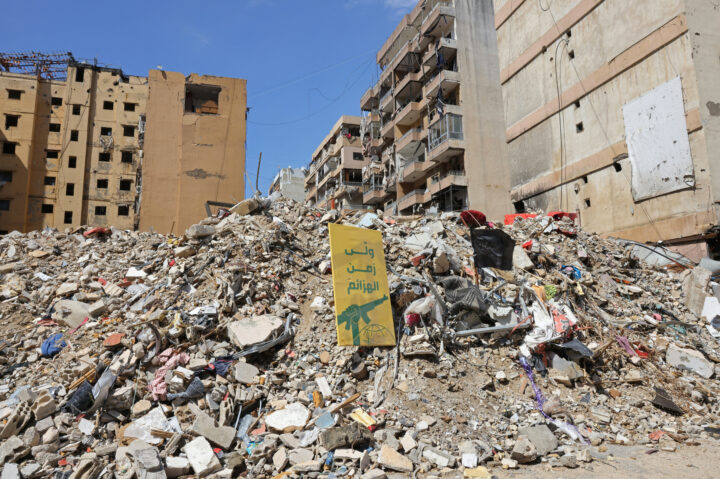
Anwar AMRO / AFP via Getty Images
A Hezbollah banner placed amid the rubble of a destroyed building near Sayyid al-Shuhada complex in Beirut's southern suburbs on May 6, 2026.
President Donald Trump announced on Monday that Israel would not carry out strikes against Hezbollah in Beirut in exchange for the terror group halting its persistent attacks on northern Israel and IDF soldiers, cutting off imminent Israeli plans to expand its operations against Hezbollah in the Lebanese capital.
Trump made the announcement in a post on Truth Social where he touted successful phone calls earlier Monday with Israeli Prime Minister Benjamin Netanyahu and “highly placed representatives” representing Hezbollah. In a subsequent post, he added that he had asked Netanyahu “not to go into a major raid of Beirut” and Netanyahu “turned his Troops around.” Hezbollah likewise “agreed to stop shooting at Israel, and its soldiers.”
“Let’s see how long that lasts — Hopefully it will be for an ETERNITY!” Trump wrote.
Netanyahu, who had said in a video statement hours earlier that he had “instructed the IDF to strike terrorist targets in Beirut,” seemingly confirmed the deal, saying after Trump’s announcement that Israel would stop firing on Hezbollah targets in the capital for as long as the terrorist group ceased its attacks on Israel.
“I spoke this evening with President Trump and told him that if Hezbollah does not stop firing at our cities and civilians, Israel will strike terrorist targets in Beirut. This position remains unchanged,” Netanyahu said. “At the same time, the IDF will continue operating in southern Lebanon as planned.”
The Lebanese Embassy in Washington said on Monday that, “Lebanese authorities received confirmation of Hezbollah’s agreement to the U.S. proposal calling for a mutual cessation of attacks.”
The embassy said the “scope of the ceasefire” will “subsequently [be] expanded to encompass the entirety of Lebanese territory,” a provision that Netanyahu made no mention of.
The announcement came hours after Iranian state media reported that Tehran had suspended peace talks with the U.S. over Israel’s expanding military campaign in Lebanon. Iranian Foreign Minister Abbas Araghchi wrote on X on Monday that, “a ceasefire between Iran and the United States constitutes, without any ambiguity, a comprehensive ceasefire across all fronts, including Lebanon.”
Trump dismissed this reporting, writing on Truth Social that “talks are continuing, at a rapid pace, with the Islamic Republic of Iran.”
Plus, Huckabee says next MOU will end Israel aid
Marwan Naamani/picture alliance via Getty Images
Pro-Iranian Hezbollah supporters wave the party flags during a ceremony in a southern Beirut suburb on May 5, 2026.
This P.M. edition is reserved for our premium subscribers like you — offering a forward-focused read on what we’re tracking now and what’s coming next.
Today’s Daily Overtime was curated by JI U.S. Editor Danielle Cohen-Kanik.
📡On Our Radar
Notable developments and interesting tidbits we’re tracking
President Donald Trump announced that Israel would not carry out strikes against Hezbollah in Beirut in exchange for the terror group halting its attacks on northern Israel, hours after Israeli Prime Minister Benjamin Netanyahu made a statement instructing the IDF to strike Hezbollah targets in the Lebanese capital.
While Trump said he had a “very good call with Hezbollah” as part of the negotiations, the Lebanese Embassy in Washington later clarified that the message was relayed through Lebanese officials rather than communicated directly from the president to the terror group.
Netanyahu said after the announcement that he had informed Trump that “if Hezbollah does not stop attacking our cities and civilians, Israel will strike terrorist targets in Beirut,” while the IDF will continue hitting targets in southern Lebanon as planned…
The news came hours after Iranian state-linked media reported that Tehran had suspended negotiations with the United States and warned it could direct its proxies, including the Houthis in Yemen, to target shipping through the Bab el-Mandeb Strait — another critical global trade route — in response to Israel‘s continued military operations against Hezbollah…
Trump disputed the reporting, writing on Truth Social this afternoon that “talks are continuing, at a rapid pace, with the Islamic Republic of Iran,” despite having told NBC News earlier in the day that he would welcome a pause in talks if the reports were accurate. “I think we’ve been talking too much, if you want to know the truth,” Trump told the outlet. “I think going silent would be very good, and that could be for a long time”…
Amid the diplomatic dance, military operations have escalated: The U.S. struck several sites in Iran over the weekend after Iran downed an American MQ-1 drone. U.S. forces also intercepted two Iranian ballistic missiles targeting American forces based in Kuwait last night, CENTCOM said…
Michael Makovsky, the president and CEO of the Jewish Institute for National Security of America, criticized the Trump administration’s recent handling of the U.S. war in Iran, telling Jewish Insider’s Emily Jacobs on Friday, before the events of this weekend, that the “U.S. has lost the plot on Iran” and that a deal with the regime now “wouldn’t be worth the paper it’s written on”…
Responding to claims from former National Counterterrorism Center head Joe Kent that U.S. aid to Israel does not confer benefits to America, U.S. Ambassador to Israel Mike Huckabee defended the relationship and said the next U.S.-Israel memorandum of understanding, after the current one expires in 2028, will end aid to Israel and “be based on trade”…
Republican Jewish Coalition CEO Matt Brooks celebrated his group’s role in ousting Rep. Thomas Massie (R-KY) in his primary election earlier this month at the organization’s “America 250”-themed gala held last night in Manhattan, JI’s Haley Cohen reports.
“Being anti-Israel in today’s Republican Party is not — unlike the Democratic Party — a path to success,” said Brooks, who called defeating Massie a “critical victory” for the direction of the GOP and conservative movement…
Pennsylvania Gov. Josh Shapiro told CNN that he believes Israel is being unfairly singled out for criticism as a Jewish state: “For those who do not want there to be a Jewish state, oftentimes they will predicate their views on this notion that being grounded in a religion and being a democracy can’t coexist,” he said.
“I think it’s important to point out the hypocrisy of that view when there are 46 majority Muslim nations, 23 of which have Islam as their official religion … and only one has Judaism as their official religion, and yet we’re focused on just the Jewish state,” Shapiro continued. (Important to note: While Israel has a Basic Law declaring it the nation-state of the Jewish people, the country does not have an official state religion)…
El Al announced it will restart nonstop flights between Israel and San Francisco on Oct. 25, citing high demand for the route between the tech hubs, which was paused in 2020 at the beginning of the COVID-19 pandemic. The three weekly flights will be numbered LY49, in a nod to the San Francisco 49ers NFL team…
The Israeli Ministry of Defense said France has barred Israeli officials from participating in the Eurosatory defense show in Paris later this month. Israeli defense firms, which can participate but will not have a dedicated Israeli national pavilion, can only showcase air-defense systems and are prohibited from displaying offensive weapons systems…
⏩ Tomorrow’s Agenda, Today
An early look at tomorrow’s storylines and schedule to keep you a step ahead
Keep an eye out in Jewish Insider for coverage of tomorrow’s key primary elections across the country — including House races in New Jersey, California, Montana, Iowa, New Mexico and South Dakota, California’s gubernatorial race and Montana’s open-seat Senate race — several of which will serve as a referendum on the Democratic Party’s progressive versus establishment divide.
On the Hill, Secretary of State Marco Rubio will appear before the Senate Foreign Relations Committee and the House Appropriations Committee. Homeland Security Secretary Markwayne Mullin will testify at a Senate Appropriations Committee hearing, and acting Attorney General Todd Blanche will speak at a House Appropriations Committee hearing. The Senate Select Committee on Intelligence will also hold a closed intel hearing.
Israeli Prime Minister Benjamin Netanyahu and President Isaac Herzog will attend a command change ceremony at Mossad headquarters to inaugurate Maj. Gen. Roman Gofman as the new head of the agency, after the Israeli High Court rejected petitions today calling for Gofman’s appointment to be annulled on ethical and procedural grounds.
The Israel Democracy Institute will kick off its two-day Eli Hurvitz Conference on Economy and Society in Jerusalem.
Stories You May Have Missed
ANGELENO AFFAIRS
Wide-open Los Angeles mayoral race could hinge on support from Jewish voters

The race features an embattled Mayor Karen Bass facing a spirited challenge from her right in reality TV star Spencer Pratt, and from her left in City Councilmember Nithya Raman
BIG SKY BATTLE
Most Montana Democrats running for Rep. Ryan Zinke’s seat slam U.S.-Israel relationship
Two of the four Democrats in the race have also faced scrutiny over antisemitic activity online
The congressional frontrunner bashed Israel’s campaign against Hezbollah in an address at the Al Khoie Islamic Center in Queens
Ryan Murphy/Getty Images
Former New York City Comptroller Brad Lander speaks to members of the media, alongside supporters, before appearing in court on February 12, 2026 in New York City.
Former New York City Comptroller Brad Lander — favored to defeat Rep. Dan Goldman (D-NY) in next month’s Democratic primary — broadened his already sweeping criticism of Israel in a speech to a Queens mosque earlier this month, suggesting the country’s actions against Hezbollah in Lebanon could constitute genocide.
As shown in a video of May 15 services posted to the Al-Khoei Islamic Center’s YouTube page, Lander told worshippers that he is “a very proud Jewish New Yorker,” quoted a Quranic verse on unity and recalled his cross-endorsement in the 2025 election with now-New York City Mayor Zohran Mamdani.
He drew a parallel with the Jewish concept of B’tzelem Elohim, or the creation of humanity in the divine image — and pivoted then to a topic that has animated his campaign: what he called “Israel’s genocide in Gaza,” which Lander described as “a Jewish requirement” to denounce.
He also repeated a pledge to vote against further military aid to Israel in Congress, but went even farther in his criticism of the country than he has in the past.
“I will not vote for any more U.S. military aid to Israel, not the bombs that are destroying the hospitals and schools in Gaza, not the occupation in Lebanon which is now I believe on its way potentially to being a genocide as well,” he said from the pulpit. “I pray for the day when Palestinians and Lebanese and Israelis can come to know one another, recognize each other’s equal humanity, the spark of divine image, the need for safety and peace and not for occupation and apartheid and genocide and oppression and war.”
He further vowed to work closely with anti-Israel Reps. Rashida Tlaib (D-MI) and Ilhan Omar (D-MN) if elected to Congress.
The comments mark an even further swing leftward for Lander, who has long identified as a “progressive Zionist” and once drew fire from now-allies like Jewish Voice for Peace for participating in a City Council delegation to Israel.
Goldman, who has been a reliable supporter of Israel in Congress, has also grown increasingly critical of the Jewish state but remains supportive of continued U.S. military aid.
Al Khoei, a Shi’ite mosque named for a rival to late Iranian Ayatollah Ruhollah Khomeini, sits well outside the Brooklyn-Manhattan House district Lander hopes to represent but has been a common stop for politicians, including former Mayor Michael Bloomberg.
Rep. Kristen McDonald Rivet said some of her party’s nominees are ‘out of step with my values and those of Democrats across our state’
Rep. Kristen McDonald Rivet (D-MI) speaks to the press during a press conference for the New Democrat Coalition outside of the U.S. Capitol in Washington, DC on November 21, 2024. (Photo by Nathan Posner/Anadolu via Getty Images)
Rep. Kristen McDonald Rivet (D-MI), a Democrat representing a swing district in Michigan, condemned the state party for nominating an attorney who expressed support for Hezbollah for the University of Michigan Board of Regents, as well as other harassment and divisive tactics delegates targeted at pro-Israel candidates at the party convention last weekend.
She argued that such activity and decisions will ultimately help Republicans in the November midterm elections.
“What I saw on the MDP Convention floor is deeply troubling — for what it says about who we are, how we win, and whether we will be able to meet this urgent moment,” McDonald Rivet said on X on Tuesday, emphasizing that, coming from the only Trump-won district held by a Democrat in the state, she “know[s] how hard it is to win.”
She said that while she is “excited” to run alongside “many” of those nominated, “the Convention nominated others with extreme positions and records — like calling Tucker Carlson ‘a real one,’ Hezbollah leaders ‘martyrs,’ or amplifying Qasem Soleimani — that are out of step with my values and those of Democrats across our state.”
Her comments are a reference to Makled, who has run on an anti-Israel platform and had an endorsement from the SEIU labor union pulled over past social media posts expressing support for Hezbollah. Makled’s nomination ousted Jewish regent Jordan Acker, who was repeatedly harassed and had his home vandalized by anti-Israel demonstrators.
McDonald Rivet said she was also concerned that “too much of the behavior we saw on the floor is not acceptable.” Pro-Israel candidates and those supporting them, including a supporter of Acker and Rep. Haley Stevens (D-MI), faced aggressive boos at the party convention, to the extent that Abdul El-Sayed, the far-left Senate candidate who many of those vocal demonstrators are supporting, called out their behavior.
“We don’t name-call. We don’t belittle and bully. We don’t shout people down. We don’t make them feel unwelcome or unsafe based on who they are,” McDonald Rivet said. “We reject all forms of hate, including both antisemitism and Islamophobia.”
She said that the Democrats “will never beat MAGA by practicing their division.” She pointed to comments by Michigan Republicans celebrating the chaos and welcoming Jewish Democrats into the fold as proof that the events at the convention will “[make] it much, much harder for us to win back power this November” and make Republicans’ “jobs easier.”
“On Sunday, we saw a troubling step in the wrong direction. But it isn’t too late to course correct. Michigan Democrats, we can’t afford any less,” she concluded.
McDonald Rivet called for the Democratic Party to come together around a “unifying agenda” and to create spaces where everyone feels “respected, liked, and welcome.”
Michigan is a closely watched bellwether of the direction of the Democratic Party, and the latest developments underscore that a more radical faction of the party appears to be growing

Al Drago/Bloomberg via Getty Images
Democratic National Convention (DNC) at the United Center in Chicago, Illinois, US, on Thursday, Aug. 22, 2024.
Events in recent days may well be marking a tipping point in the decline of the Democratic Party — at least when it comes to its treatment of Jews, on top of its growing hostility toward Israel.
The weekend ended with the news that Michigan Democratic delegates, at their statewide convention Sunday, nominated a Hezbollah supporter, Amir Makled, to the University of Michigan Board of Regents, choosing to oust a Jewish member, Jordan Acker, whose home and car were repeatedly vandalized with antisemitic graffiti and his family threatened.
Acker’s offenses? He backed efforts to hold anti-Israel campus protesters at the University of Michigan accountable for assaulting police and engaging in intimidation of Jewish students, among other instances of student misconduct. He declined to support efforts to divest university funds from Israel, along with other members of the Board of Regents, as a radical faction of students had demanded.
Acker’s non-Jewish Democratic ticketmate, Paul Brown, who also supported discipline against anti-Israel students, wasn’t targeted and was renominated for election. But the Democratic delegates ousted Acker in exchange for Makled, who has posted on social media with comments praising Hezbollah’s leaders and retweeted antisemitic messages from the conspiracy-theorizing influencer Candace Owens.
The results mark a new low for Michigan Democrats. Also over the weekend, Michigan Senate candidate Abdul El-Sayed told CNN that he believes the Israeli government is just as evil as Hamas.
In the same interview, El-Sayed also said that Sen. Chris Van Hollen (D-MD) should replace Senate Minority Leader Chuck Schumer (D-NY) as the Democratic leader in the upper chamber, citing Schumer’s continued support for U.S. aid to Israel. Van Hollen is among the most vocal critics of Israel in the Senate.
Michigan is a closely watched bellwether of the direction of the Democratic Party, and the latest developments underscore that a more radical faction of the party appears to be growing. This, in the state where dozens of Jewish preschoolers were nearly killed in a terrorist attack last month by a Hezbollah sympathizer who targeted the state’s largest synagogue.
But it’s not just in Michigan where the weekend’s developments suggest an ominous turn in the Democratic Party’s evolution.
Today’s Daily Kickoff includes comments made by Sen. John Fetterman (D-PA), one of the few pro-Israel Democratic stalwarts left, who blasted his party for tolerating antisemitism, calling out Democrats’ acceptance of Senate candidates with checkered histories, including Graham Platner in Maine and El-Sayed.
In particular, Fetterman expressed shock that party leaders had nothing to say about revelations that Platner praised Hamas’ tactics in a 2014 Reddit forum that shared video of the terrorist group killing several Israeli soldiers.
We cover the implications of the election results from New Jersey’s 11th Congressional District, a moderate-minded, affluent suburb, where voters elected a far-left Israel critic who withheld criticism of Hamas after the Oct. 7, 2023, attacks — except for the Jewish Democrats in the district, who swung decidedly to the right.
And we report on the pained comments from Yehuda Kurtzer, the president of the Shalom Hartman Institute (a liberal, pluralistic think tank dealing with issues affecting the Jewish community), who called on American Jews to “embrace political homelessness” as part of a pointed perspective on how badly things have gotten within the progressive movement, the longtime home for many American Jews.
“We’re stuck as an American Jewish community between an illiberal argument on the right, which is currently in power, and an illiberalism of the left,” he said.
Also notable from the weekend: Likely Democratic presidential candidate Rahm Emanuel, who is portraying himself as a bold, moderate truth teller against the left wing of his party, championed the fact on HBO’s “Real Time with Bill Maher” that he wants to cut off all U.S. military aid to Israel — in a clear political pander to the growing anti-Israel wing of his party. Truth-telling only goes so far when public opinion against Israel within the Democratic party has grown to such a high level.
It’s surely comforting to believe that Israel’s aggressive war against Hamas and Hezbollah in Gaza and Lebanon and tough tactics against Iran or Israeli Prime Minister Benjamin Netanyahu’s haughty approach to his engagement with Washington are the main factors driving the Democratic Party towards its estrangement of Israel. Maybe then, after a possible change of Israeli leadership in the country’s October elections, Democratic public opinion would shift.
But if that was truly the case, you wouldn’t see the party tolerating candidates with neo-Nazi tattoos who “dig” Hamas’ terror tactics and ones who compare the mistakes of a democratic state with a terrorist group that seeks in its charter to eliminate all Jews.
You wouldn’t see a Jewish regent of the University of Michigan and a Jewish Michigan attorney general being personally threatened for enforcing the law — with little protest from party leadership.
And you wouldn’t see Hasan Piker, an antisemitic social media figure with a laundry list of terror-justifying rhetoric, become the progressive movement’s trendy surrogate, in this fraught moment for American Jews.
Kurtzer is right that illiberalism is rising on all sides. But when the party that has long positioned itself as the bulwark against bigotry now tolerates terrorist apologists and antisemitic hate — while abandoning pro-Israel Jews who long called it home — it should be a wake-up call that something is broken.
The most recent poll on the matter, taken before the Lebanon ceasefire was announced, found that 51% of Israelis oppose a ceasefire with Hezbollah and only 29% support it
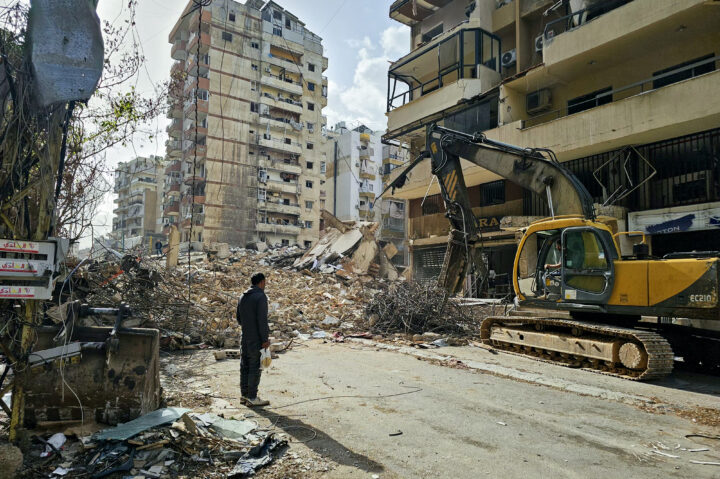
AFP via Getty Images
A bulldozer clears the rubble from the site of an Israeli airstrike as people return to Beirut's southern suburbs on April 19, 2026.
A weekend of diplomatic turbulence has deepened fault lines in Israel over the ceasefires in Lebanon and Iran, with public opinion split along political lines over whether President Donald Trump is serving Israeli interests — or overriding them.
The most recent poll on the matter, taken before the Lebanon ceasefire was announced and published by Israel’s Channel 12 on Thursday, found that 51% of Israelis oppose a ceasefire with Hezbollah and only 29% support it. Among voters for Netanyahu’s government, 64% oppose a ceasefire and 18% support it. Nearly half (48%) of Israelis do not trust President Donald Trump to consider Israeli interests in negotiations with Iran, while 33% do trust him. Most voters for Netanyahu’s coalition (59%) trust Trump while 24% do not.
Trump’s announcement of a ceasefire in Lebanon on Thursday, before any known progress had been made in talks between Jerusalem and Beirut toward dismantling Hezbollah, already made waves in Israel.
Israeli Prime Minister Benjamin Netanyahu attempted on Friday to draw the same delicate balance as he had regarding Iran the previous week, asserting that Israel has “brought about monumental achievements” in Lebanon, created a buffer zone along the northern border and destroyed much of Hezbollah’s missile stockpile. However, he added, “we have not yet finished the job,” but said Israel was “provid[ing] an opportunity to advance an integrated diplomatic and military solution with the Lebanese government,” at Trump’s request.
Within an hour of the release of Netanyahu’s statement, Trump published a Truth Social post in which he “PROHIBITED” Israel from continuing to bomb Hezbollah targets, adding: “Enough is enough!!!”
Jerusalem reportedly asked the Trump administration for clarifications in light of the strong language in the post, which contradicted language in the ceasefire allowing Israel to act “in self-defense, at any time, against planned, imminent or ongoing attacks.”
Two IDF soldiers were killed in Lebanon over the weekend by explosive devices planted by Hezbollah. The IDF continued striking terror targets in Lebanon, such as “a loaded and ready-to-fire launcher,” saying that “Hezbollah has continued its terrorist activity, in violation of the [ceasefire] agreement.” On Monday morning, IDF Arabic Spokesperson Avichay Adraee urged residents of dozens of areas of southern Lebanon to stay away for their safety.
Trump said in his Friday Truth Social post that “the U.S.A. will get all nuclear ‘dust’ created by our great B2 bombers,” apparently referring to Iran’s stockpile of highly enriched uranium. Yet, Iran has denied any concessions on the nuclear file, and resumed its blockade of the Straits of Hormuz as long as the U.S. continued to block vessels going to and from the Islamic Republic. Israel’s Channel 12 reported that the U.S. and Iran are negotiating a 15-year suspension of uranium enrichment and the conversion of highly-enriched uranium into fuel, rather than removing it from Iran, as well as lifting sanctions.
With the ceasefire in Iran due to end on Tuesday night, Vice President JD Vance is set to travel to Pakistan for a second round of talks on Monday, but Iranian state media has said officials do not plan to attend.
Shira Efron, a senior fellow at RAND who serves as the think tank’s distinguished chair for Israel policy, told Jewish Insider that “there is no question that the tone – ‘prohibited’ in upper case, ‘enough is enough’ – struck a sensitive note in Israel, and people are talking about a vassal state.”
Efron tied Trump’s comments from Friday to those at the end of last year’s 12-day war against Iran, when he said “I’m not happy with Israel … They don’t know what the fuck they’re doing.” She also connected the comments to the pressure Trump has put on Israeli President Isaac Herzog to pardon Netanyahu, who is on trial for corruption charges, as well as Israeli and American flags lining some of Israel’s busiest highways for much of the last two months.
“These are things that make Israelis say, ‘Have we lost our agency?’” she said.
Israelis are also disappointed because they feel the government overpromised to bring security to the residents of the country’s north, Efron said, noting that “it takes a long time to disarm terrorist organizations.”
“There is a sense of confusion as to how the president, who has been so tightly aligned with Prime Minister Netanyahu, could issue a blanket, almost punitive warning to Israel to stop bombing Hezbollah, that had been bombing Israel incessantly with hundreds of missiles and drones,” Dan Diker, president of the Jerusalem Center for Security and Foreign Affairs told JI.
Efron said that the ceasefires are “the package deal. We’re clearly the junior partner here. The U.S. wants us to stop in Lebanon because that’s what’s required to give the Islamabad talks a chance to succeed.”
Dan Diker, president of the Jerusalem Center for Security and Foreign Affairs, called Trump’s remarks “draconian.”
“There is a sense of confusion as to how the president, who has been so tightly aligned with Prime Minister Netanyahu, could issue a blanket, almost punitive warning to Israel to stop bombing Hezbollah, that had been bombing Israel incessantly with hundreds of missiles and drones,” he told JI.
“This is not a ceasefire by Hezbollah,” Diker added. “Israel agreed to back off to see what the Americans would do. We’re in this waiting period.”
Diker argued that Netanyahu “played it extremely well in going with the president, while maintaining very strict red lines about Israel’s demands to continue to be able to defend itself against Iranian aggression and Hezbollah.”
The mandate of negotiations between Israel and Lebanon “is to try to separate Hezbollah from its Iranian patrons and try to coalesce the Lebanese government that had reached out to Israel,” Diker said.
Efron called the negotiations between the Lebanese government and Israel, including possible peace and normalization, “a stab in the eye for the Iranians. It’s not what they want,” but tying a ceasefire in Lebanon to the talks with Iran — or the resumption of fighting with Hezbollah in the event of the war in Iran starting up again — is a “strategic negative … connecting two fronts, which you want to prevent.”
Efron argued that “Trump is doing Israel a favor” in pushing the Lebanon ceasefire, because “there is a declining marginal utility in continuing the military effort beyond what was done at first. … It’s better to try serious negotiations with Lebanon that are required if we are ever to disarm Hezbollah.”
“This has become the war of Hormuz, not what Israel was concerned with. Israel is concerned with three threats,” Shira Efron, a senior fellow at RAND who serves as the think tank’s distinguished chair for Israel policy said, naming Iran’s nuclear weapons, ballistic missiles and proxy war.
Diker, however, said it was unclear whether the Lebanese government would be able to help disarm Hezbollah, pointing out that the Iranian ambassador remains in Beirut even though he was nominally expelled by the government weeks ago. “From a perception standpoint, that tells the whole story,” he said.”
With regard to negotiations with Iran for a longer-term ceasefire, Efron said that “Israel is almost a bystander. Clearly, its positions are factored in, but Israel is not at the table.”
“This has become the war of Hormuz, not what Israel was concerned with. Israel is concerned with three threats,” Efron said, naming Iran’s nuclear weapons, ballistic missiles and proxy war.
“If the reports are accurate, Israel is getting far less than it wanted,” she added. “If the best we get is no enriching uranium for 15 years and some deal about highly enriched uranium, nothing about missiles and proxies, and Iran will get all this money from frozen funds – How is that much better than the [2015 Iran Deal]? … It’s a little too early to say, but if this is the agreement, clearly there will be a sourness on the part of Israel. Even the biggest cheerleaders of this war are not happy about it. … It will be hard to sell to the people as an actual victory.”
Diker said “clearly Israel has not finished the mission to deny the Iranian regime of highly-enriched uranium, ballistic missiles or its proxy strategy. It has not accomplished any of those goals.”
That being said, Israel “achieved Prime Minister Netanyahu’s immediate goal … act[ing] heroically in seriously degrading the Iranian regime’s ballistic capabilities … [and] definitely achieved the goal of preventing an immediate existential threat from being carried out,” Diker said. “Clearly Israel is in a much better position today, having destroyed the majority of [Iran’s] ballistic missiles, which were a shield for the nuclear weapons program.”
From the Iranian perspective, however, the regime “succeeded very consequentially, stood up to the ‘Big Satan’ and ‘Little Satan’ in a six-week war, and they’re still standing,” Diker added. “That, in my assessment, has caused them to act in a far more daring way. That’s why they closed the Strait [of Hormuz] again, because they figured they brought Donald Trump to heel and Israel to heel.”
“I do think they’re overplaying their hand as an apocalyptic jihadistic Islamic regime, because they are driven primarily by ideological religious fervor. They are not primarily rational actors,” he added.
Efron noted that it is “difficult to assess the outcome of war in the short term,” and “Israel may be really happy because in two or three years Iran will be done for.” That being said, Efron said she is “dreading the [regime’s] revenge on the Iranian people.”
Diker said that Israel is still “determined to dismantle this apocalyptic regime … [otherwise] we are going to be in this for another four, five, six years. We can’t afford to allow this window of opportunity to close.” He referred to outgoing Mossad Director David Barnea’s speech at a Holocaust Remembrance Day ceremony last week, in which he said that Israel’s mission in Iran will end “only when this radical regime is replaced.”
“We hope that the president will be in it for the long run,” Diker added.
Any potential agreements between Jerusalem, Beirut and Washington will ultimately hinge on whether Hezbollah can be fully disarmed
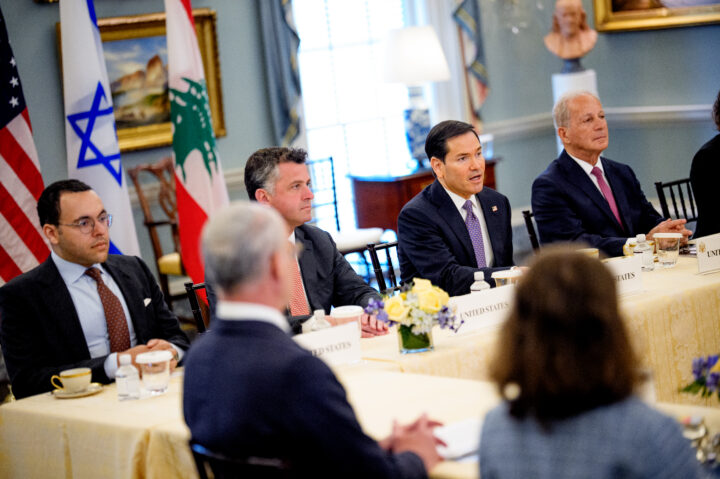
Andrew Harnik/Getty Images
U.S. Secretary of State Marco Rubio (2nd-R), accompanied by U.S. State Department Counselor Michael Needham (C), and U.S. Ambassador to Lebanon Michel Issa (R), speaks as they begin working-level peace talks with Lebanese Ambassador to the U.S. Nada Hamadeh Moawad and Israeli Ambassador to the U.S. Yechiel Leiter at the U.S. State Department on April 14, 2026 in Washington, DC.
The first round of direct talks between Israel and Lebanon has been received positively by diplomats, pro-Israel lawmakers and experts, who see it as a sign of Hezbollah’s waning influence in Lebanon. But despite the optimism surrounding the discussions, experts caution that disarming the terrorist group remains a daunting obstacle that stands in the way of any meaningful change — one that would require a significant shift from the Lebanese government and its armed forces.
On Tuesday, Israeli and Lebanese leadership convened at the State Department in Washington for the highest-level direct discussions in more than 30 years, aiming to outline a framework for “lasting peace” and a “permanent end” to Hezbollah’s influence, according to Secretary of State Marco Rubio.
Rep. Jared Moskowitz (D-FL) told Jewish Insider that “it is great” that talks are taking place, expressing hope that “the Lebanese government, the United States and the Israeli government make a deal, and collectively, they push Hezbollah out.”
“That way the Lebanese people can be freed from the Iranian extremism that they have in their country,” Moskowitz said. “The Lebanese people are being held captive by the Iranian government because of Hezbollah. It’s obviously good for the United States, it’s good for Israel, but more importantly, I think it’s good for the people of Lebanon. I think disarming Hezbollah is obviously key to all this.”
Moskowitz added that while the Lebanese government appears to want to disarm Hezbollah, “they probably need help.”
“It’s not going to happen overnight, but I think it’s historic, and this is what the entire region wants,” he said. “This is what the Gulf states want. Everybody wants to come out of the extremism and the terrorism that Iran is trying to spread in the region.”
Sen. Rick Scott (R-FL) similarly told JI that Hezbollah disarmament is an important factor in talks.
“Why would you have talks if they [Hezbollah] are not going to disarm?” Scott said. “I’m not the prime minister of Israel but my condition would be that Hezbollah has got to disarm.”
Scott dismissed the notion that the Lebanese government and the Lebanese Armed Forces have not done enough to disarm the group, stating that the main problem is “not caused by Lebanon or by the military of Lebanon, it’s caused by Hezbollah.”
Sen. John Cornyn (R-TX) said that disarming Hezbollah should be a “red line” for Israel in talks. He added that Israel “needs a buffer zone so Hezbollah can’t continue to rain down terror on Israelis.”
“Hezbollah has historically been the best trained, best equipped opponents to Israel,” Rep. Don Bacon (R-NE) said. “Israel’s done a great job with them over the last two years, but they’re hardcore fervent believers in destroying Israel.”
Experts similarly described the talks as a meaningful development. John Hannah, a senior fellow at the Jewish Institute for National Security of America, called the discussions an “important breakthrough” and a sign of Hezbollah’s diminishing influence.
“Everyone should welcome the opening of a direct political dialogue between Israel and Lebanon,” Hannah said. “The fact that [the talks are] occurring at all is an important sign of Hezbollah’s declining hegemony over the Lebanese state.”
Robert Satloff, executive director of the Washington Institute for Near East Policy, described the talks as a “win-win-win” in a social media post, adding that Hezbollah emerged as a “big loser.”
“Today is a day to celebrate — we all saw a glimpse of what is possible after so much violence and conflict,” Satloff wrote on Tuesday. “That is a very good thing.”
Still, experts say disarming Hezbollah, which parties agree is necessary for any lasting piece, remains highly difficult and uncertain.
Even before Tuesday’s opening round of discussions, Hezbollah senior member Wafiq Safa said Hezbollah is “not bound” by any deals reached between Israel, Lebanon and the United States.
“It’s hard to be an optimist when it comes to the core question of Hezbollah’s disarmament,” Hannah said. “Even after all that’s been done over the past few years to weaken the group and its Iranian sponsors — including the loss of its legitimacy in the eyes of a majority of Lebanese — it’s not at all apparent that the raw balance of forces inside Lebanon has shifted sufficiently to favor Hezbollah’s near-term demise.”
Hannah described disarming Hezbollah as “worth trying,” but ultimately a “long shot.”
“Since the war against Iran broke out on Feb. 28, Hezbollah has shown through its sustained attacks on Israel that, while much diminished, its forces retain far more significant capabilities than many believed,” he said. “And in the wake of its battle against Israel, Hezbollah is making clear that if push comes to shove, it’s prepared to burn down the state before surrendering its weapons.”
Blaise Misztal, JINSA’s vice president for policy, said the task cannot be accomplished through Israeli military action alone and will ultimately depend on whether Lebanon and the LAF are willing to act.
“[Disarming Hezbollah] can only be fully done by a strong and committed Lebanese government,” Misztal said. “Israel can secure southern Lebanon with ground operations and strike Hezbollah sites in Beirut or the Bekaa Valley, but that will merely distance and degrade the threat, never fully remove it.”
“The question is whether the Lebanese government is, or can be convinced to be, strong and committed enough to take on the task of asserting its control over its own territory,” he added. “Thus far, it has failed to demonstrate either the political will or military capability to do so.”
Hannah similarly noted that “Israel is rightly unwilling to pay the necessary cost in blood, treasure and diplomatic opprobrium” required to fully dismantle Hezbollah, leaving the responsibility to Lebanon and its armed forces.
“The factor that has truly held Lebanon back from disarming Hezbollah has been Hezbollah’s retention of, as far as we can tell, overwhelming support among Lebanese Shiites,” David Daoud, a senior fellow at the Foundation for Defense of Democracies, said. “Having retained that popular support, it can deter the government from pursuing forcible disarmament by dangling the threat of civil war.”
But experts weren’t optimistic that the Lebanese government and LAF are capable — or willing — to take on that role. Hannah said Lebanon’s military “doesn’t appear to have the stomach to truly confront Hezbollah and dismantle the group’s armed wing,” noting that it has already “failed” to disarm the group in southern Lebanon, “much less the rest of the country.”
“It seems even less likely than before the Iran war that the LAF would now be willing to take on the risk of massively confronting Hezbollah,” he said, “in spite of the misery Hezbollah’s unilateral decision to enter the conflict on Iran’s behalf is now inflicting on the rest of Lebanon.”
David Daoud, a senior fellow at the Foundation for Defense of Democracies, also said Beirut “ultimately holds the key” to resolving the issue of Hezbollah’s disarmament. He said that while Lebanon has taken “immense and commendable” steps in “proscribing Hezbollah’s military activities,” the country’s “unwillingness to act against Hezbollah has been missing from the equation” and has “allowed the group to regenerate in the past.”
He added that Hezbollah still “retains enough military strength to make disarmament daunting” for Lebanese forces and the LAF, and that the group continues to wield significant political power.
“The factor that has truly held Lebanon back from disarming Hezbollah has been Hezbollah’s retention of, as far as we can tell, overwhelming support among Lebanese Shiites,” Daoud said. “Having retained that popular support, it can deter the government from pursuing forcible disarmament by dangling the threat of civil war.”
Daoud also raised concerns about Lebanon’s intentions in negotiations, arguing that Beirut may not truly be seeking meaningful change.
“A good test will be the extent to which the LAF fulfills the Lebanese government’s order from early April to put all of Beirut under its full control,” John Hannah, a senior fellow at the Jewish Institute for National Security of America, said. “Will the LAF truly confront and disarm Hezbollah in the capital or simply repeat the phony disarmament it claimed to have completed in the south?”
“Lebanon is seeking to use the negotiations to return to the status quo, and is willing to ‘pay the price’ of a joint photograph with an Israeli ambassador to achieve that objective,” he said. “This is because the situation in Lebanon is indeed dire — economic collapse compounded by war, the direct impact of the war itself and the emergence of sectarian tensions that could boil over into full-on conflict.”
If those dynamics remain unchanged, he warned that Hezbollah could indefinitely delay disarmament and eventually rebuild its strength.
“A good test will be the extent to which the LAF fulfills the Lebanese government’s order from early April to put all of Beirut under its full control,” Hannah said. “Will the LAF truly confront and disarm Hezbollah in the capital or simply repeat the phony disarmament it claimed to have completed in the south?”
Satloff said the challenge will ultimately require translating diplomacy into “practical steps,” including a shift in how the Lebanese military approaches disarmament.
“While some of this can happen in the negotiating room when the parties meet again, nothing can substitute for strong measures by the Lebanese state to isolate, weaken, delegitimize and disarm Hezbollah while promoting the idea of peace,” he said.
He suggested that turning Beirut into a “true weapons-free zone” is necessary “but not sufficient,” pointing to additional steps such as removing Hezbollah officials from government, expelling Iranian operatives from the country and shutting down the group’s financial and institutional networks.
The current geopolitical conditions laid the groundwork for yesterday’s State Department summit
Andrew Harnik/Getty Images
U.S. Secretary of State Marco Rubio (2nd-R), accompanied by U.S. State Department Counselor Michael Needham (C), and U.S. Ambassador to Lebanon Michel Issa (R), speaks as they begin working-level peace talks with Lebanese Ambassador to the U.S. Nada Hamadeh Moawad and Israeli Ambassador to the U.S. Yechiel Leiter at the U.S. State Department on April 14, 2026 in Washington, DC.
A popular “domino effect” meme circulates online every few months, linking slain Hamas leader Yahya Sinwar’s decision to launch the Oct. 7, 2023, attacks — the smallest domino — to a series of major geopolitical shifts across the Middle East. While both simplified and exaggerated, the meme underscores the dramatic reshaping of Middle Eastern power dynamics.
The next domino may be the decades-long fraught relationship between Israel and Lebanon, as Iran’s ironclad grip over the region loosens and its most powerful proxy, Hezbollah, finds itself increasingly weakened and marginalized in Lebanon, where it has for decades played a key role in the country’s politics and military.
Those current geopolitical conditions — Iran at its weakest point in decades, successive levels of Hezbollah leadership removed from power through Israeli military actions, the degradation of Hamas and a new government in Syria that has separated itself from Tehran — laid the groundwork for yesterday’s State Department summit, convened by Secretary of State Marco Rubio, between Israel and Lebanon.
The State Department meeting between the ambassadors from Lebanon and Israel took place as the U.S. navigates stalled talks and a tenuous ceasefire with Iran — which was initially on unstable ground as Iran demanded that Israel cease its targeting of Hezbollah as part of the ceasefire.
A senior Israeli official told Jewish Insider on Wednesday that Iran’s effort to link the two conflicts was “a strategic trap with long-term ramifications.”
“There was real pressure to link the Lebanon front to the Iran ceasefire,” the official said. If President Donald Trump had acquiesced to the Iranian demand to link the two conflicts, the official continued, “We would not be on the path to peace that we’re on now. Keeping the arenas separate ultimately means that the fate of Lebanon is no longer dictated by Iran.”
Former Israeli Prime Minister Naftali Bennett — now mounting a comeback bid ahead of elections later this year — has often used the “Octopus Doctrine” to describe a security approach to tackling Iran’s decades-long control over the region. Cut off the head of the octopus — Tehran — and the tentacles will be easier to tackle, the logic goes.
Israel, having severed the metaphorical octopus’ head on the opening day of the recent war with Iran, is now continuing its work to degrade and dismantle Iranian proxies — a process that began two and a half years ago, triggered by the Oct. 7 attacks.
“One of the most significant developments in the Middle East since Oct. 7 has been the steady dismantling of that axis — separating arenas that sought to bind their fates together,” the senior Israeli official said.
The talks are not without risk. Lebanese Prime Minister Nawaf Salam called off a planned trip to the U.S. over the weekend out of concerns of potential domestic unrest — amid the still very real risk that Hezbollah, albeit weakened, could attempt a power grab in his absence. Recall that in 2005, former Lebanese Prime Minister Rafic Hariri was killed in a car bombing, with a Hezbollah operative convicted by a U.N. tribunal in absentia for the assassination.
The talks were hailed by Israeli Ambassador to the U.S. Yechiel Leiter, who said that the parties “discovered today that we’re on the same side of the equation” and “are both united in liberating Lebanon from an occupation power dominated by Iran called Hezbollah.”
Rubio delivered a measured assessment of the goals of yesterday’s talks: “This is about bringing a permanent end to 20 or 30 years of Hezbollah’s influence in this part of the world,” he said at a roundtable ahead of the meeting. “This will take time, but we believe it is worth this endeavor.”
Beirut has in recent years — and with varying degrees of seriousness and success — worked to disentangle itself from Iran and Hezbollah. Now, the U.S.-Israeli military pressure on Iran, combined with the Trump administration’s zest for dealmaking and the degradation of Hezbollah, could create the right environment to bring peace to the Mediterranean Riviera.
The secretary of state emphasized that all ‘the complexities are not going to be resolved in the next six hours’ but that he was hopeful talks could create a ‘framework’ to progress from
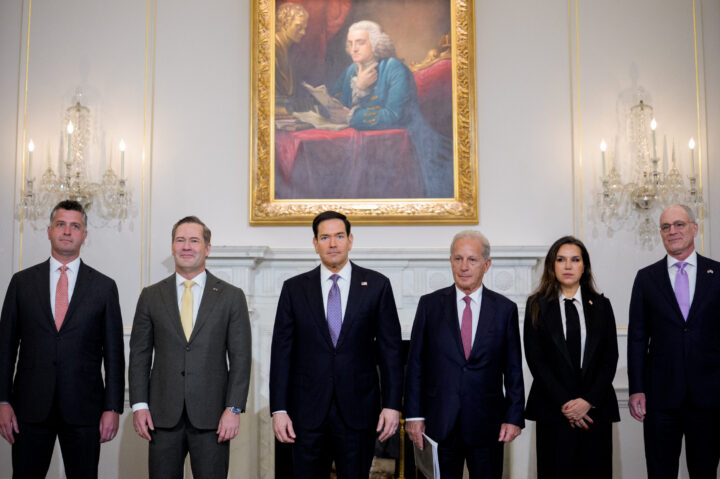
Andrew Harnik/Getty Images
(L-R) Counselor of U.S. State Department Michael Needham, U.S. Ambassador to the United Nations Michael Waltz, U.S. Secretary of State Marco Rubio, U.S. Ambassador to Lebanon Michel Issa, Lebanese Ambassador to the U.S. Nada Hamadeh Moawad and Israeli Ambassador to the U.S. Yechiel Leiter pose for photos before beginning working-level peace talks at the U.S. State Department on April 14, 2026 in Washington, DC.
Sitting at a roundtable of Israeli, Lebanese and American officials, Secretary of State Marco Rubio emphasized at the outset of negotiations between Jerusalem and Beirut that the talks are a “process” that will “take time,” stating that the objective of Tuesday’s meeting, the highest-level direct talks between the countries in over 30 years, is to “outline a framework upon which a permanent and lasting peace can be developed” and bring a “permanent end to Hezbollah’s influence” in the region.
“This is a process, not an event. This is more than just one day,” Rubio said. “All of the complexities are not going to be resolved in the next six hours … This will take time, but we believe it’s worth this endeavor and it’s a historic gathering that we hope to build on.”
“We understand we’re working against decades of history that have led us to this unique moment and opportunity here,” Rubio added. “We have to remember, the Lebanese people are victims of Hezbollah. The Lebanese people are victims of Iranian aggression, and this needs to stop.”
Rubio said the parties want to provide the people of Lebanon “the kind of future they deserve, and so that the people of Israel can live without fear of being struck by rocket attacks from a terrorist proxy of Iran.”
Taking part in the high-level talks between Israel and Lebanon on Tuesday in Washington were Israeli Ambassador to the U.S. Yechiel Leiter, Lebanese Ambassador to the U.S. Nada Hamadeh, U.S. Ambassador to Lebanon Michel Issa and State Department Counselor Michael Needham.
In a statement released by the State Department following the meeting, Washington indicated that any agreement “must be reached between the two governments, brokered by the United States, and not through any separate track.” The U.S. also expressed “support for further talks,” however it is not yet clear when the next round of discussions are expected to take place.
“All sides agreed to launch direct negotiations at a mutually agreed time and venue,” the statement read. It also indicated that Israel “expressed its commitment to working with the Government of Lebanon to achieve … security for the people of both countries” as well as a “commitment to engage in direct negotiations to resolve all outstanding issues and achieve a durable peace that will strengthen security, stability and prosperity in the region.”
In his opening statement ahead of the talks, Leiter commended Lebanese President Joseph Aoun and his government “for not allowing itself to be held hostage to the threats of Hezbollah’s leader,” adding that the group belongs “to the past.”
“I believe that we can, in good faith, accomplish the following interrelated goals: the complete dismantlement of Hezbollah, the freeing of Lebanon from Iran’s terror proxy and the achievement of a real, lasting and mutually celebrated peace for the benefit of our people,” Leiter said. “We also have the courage to pursue peace through strength, and to work tirelessly for tranquility and prosperity for all. Today, we pursue those values for ourselves and especially for our Lebanese neighbors of all ethnic denominations.”
After negotiations wrapped, Leiter struck a positive tone and said he was “honored” to sit at the negotiating table with Lebanese officials.
“We discovered today that we’re on the same side of the equation,” Leiter told reporters. “That’s the most positive thing we could have come away with. We are both united in liberating Lebanon from an occupation power dominated by Iran called Hezbollah.”
Similarly, Hamadeh also called the preliminary meeting “positive” and indicated that another round of talks is likely to take place. She stated that “the date and location of the next meeting will be announced at a later time.”
Tuesday’s negotiations were expected to focus on how Israel and Lebanon can work together to disarm Hezbollah and make peace between the countries. Israeli Prime Minister Benjamin Netanyahu announced the talks last week, saying he had shifted his position once the scope of the negotiations were expanded beyond just a ceasefire to also include disarming Hezbollah and working toward peaceful relations. Lebanese Foreign Minister Youssef Raggi indicated that the direct talks are meant to show that the “Lebanese state alone holds the authority to negotiate on behalf of Lebanon,” rather than Hezbollah.
The two nations currently share no formal diplomatic relations.
Hezbollah, however, has signaled it will not abide by any agreements and called on the Lebanese government to cancel the talks. Wafiq Safa, a high-ranking member of the group’s political council, stated prior to the meeting that the terrorist organization is “not interested or concerned with” the negotiations, saying the group is “not bound by what they [Israel, Lebanon and the U.S.] agree to.”
The negotiations took place against the backdrop of a massive Israeli strike in Beirut last week targeting Hezbollah. The recent round of hostilities was triggered on March 2 when Hezbollah launched rockets at northern Israel days after Israel and the U.S. launched strikes on Iran.
The talks have also received significant support from European and Western nations, with foreign ministers from 17 countries, including the U.K. and France, calling on the two countries to “seize the opportunity presented by the U.S.-Iran ceasefire,” per a joint statement.
Even if a deal is reached, major hurdles lie ahead as it remains unclear whether Lebanon possesses sufficient influence to hold Hezbollah to any potential agreements. While the group is a major political party with seats in the Lebanese parliament, its militia operates largely independently of the government, receiving funding and direction from Iran. Although a growing number of Lebanese officials and civilians view Hezbollah as an intrusive arm of Iranian interference, the group remains a powerful, independent force within the country.
The negotiations will mark the highest-level direct talks between the countries in over 30 years
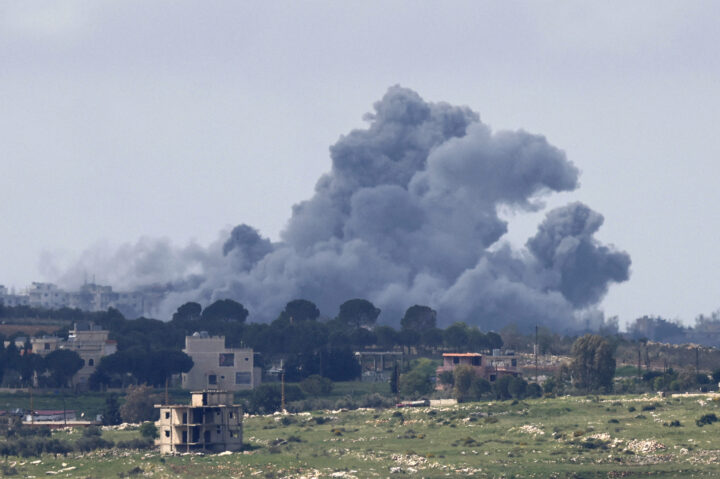
Jalaa MAREY/AFP via Getty Images
Smoke rises following Israeli strikes in southern Lebanon near the border as seen from the Upper Galilee, in northern Israel on April 10, 2026
Secretary of State Marco Rubio will convene the ambassadors from Israel and Lebanon in Washington on Tuesday for the highest-level direct talks between the countries in over 30 years.
Israeli Ambassador to the U.S. Yechiel Leiter and Lebanese Ambassador to the U.S. Nada Hamadeh will represent their countries, with U.S. Ambassador to Lebanon Michel Issa and State Department Counselor Michael Needham also taking part in the meeting.
The negotiations are meant to focus on how Israel and Lebanon can work together to disarm Hezbollah and make peace between the countries.
A State Department official said the talks are “a direct result of Hezbollah’s reckless actions,” and “will scope the ongoing dialog about how to ensure the long-term security of Israel’s northern border and to support the Government of Lebanon’s determination to reclaim full sovereignty over its territory and political life.”
“Israel is at war with Hezbollah, not Lebanon, so there is no reason the two neighbors should not be talking,” the State Department official said.
Lebanese Prime Minister Nawaf Salam canceled a planned visit to the U.S. this week to monitor the situation from Beirut and “safeguard the security of the Lebanese people and preserve national unit,” he wrote on X.
Israeli Prime Minister Benjamin Netanyahu announced the talks last week, marking a shift in his position from earlier in the Lebanon campaign that began after Hezbollah joined Iran in attacking Israel in late February. Netanyahu said over the weekend that he had agreed to the talks because they would not only be about a ceasefire, but about disarming Hezbollah and working toward peace with Lebanon. President Donald Trump said at the time that he asked Israel to “low-key a bit” the strikes in Lebanon.
Lebanese Foreign Minister Youssef Raggi posted on X that the direct talks “in practice reinforced the separation between the Lebanese file and the Iranian track. … The Lebanese state alone holds the authority to negotiate on behalf of Lebanon.”
The talks are set to take place as Hezbollah continues to launch rockets and drone attacks at northern Israel on a daily basis and the IDF continues to target Hezbollah in southern Lebanon. The IDF said it struck about 150 Hezbollah targets on Monday, and it continues its ground operations in the Iran-backed terrorist organization’s stronghold of Bint Jbeil.
The IDF cleared for publication on Tuesday the name of Sgt.-Maj. Ayal Uriel Bianco, who was killed in battle in Lebanon.
Netanyahu visited IDF troops in Lebanon over the weekend, and praised them on Monday for “pushing the enemy away from the border” and creating “a solid, deeper security zone that both prevents the danger of invasion and distances the anti-tank missile threat.”
Israelis uncertain if Iran war made them safer after ceasefire brings combat to an inconclusive halt
After the ceasefire went into effect, there was a pervading feeling in Israel that the war with Iran was not complete, and the return to routine life may be short-lived

Alexi Rosenfeld/Getty Images
People run to take shelter as sirens sound during incoming missile fire, without an early warning, from Hezbollah, just after midnight on the third day of the U.S. Israel Iran Ceasefire on April 10, 2026 in Tel Aviv, Israel.
For many Israelis who were awoken by rocket sirens just before 3 a.m. Wednesday, only to see the headline on their phones that a two-week ceasefire between the U.S. and Iran had been reached, the news was met with mixed feelings of relief and concern.
For most Israelis, the ceasefire has brought tangible relief: an end to regular missile alerts, the prospect of uninterrupted sleep (though Hezbollah swiftly shattered that hope for many on Thursday night), and children back in school. Yet for residents of Israel’s north who continue to live under frequent Hezbollah rocket fire, even this fragile respite remains out of reach.
After the ceasefire went into effect, there was a pervading feeling in Israel that the war with Iran was not complete, and the return to routine life may be short-lived. An overwhelming majority of Israelis supported the war a month after its late-February start, and just over half supported its continuation, according to the Israel Democracy Institute. Those views remained relatively steady after Iran stopped shooting missiles: A poll broadcast on Israel’s Channel 13 news on Thursday found that 51% of Israelis opposed President Donald Trump’s agreement to a ceasefire.
Israelis’ support for the war effort despite the challenges on the home front was strong because its aims — eliminating the Iranian nuclear threat and severely degrading the ballistic missile threat — were meant to ultimately make them safer, along with the hope, bolstered by statements from Israeli Prime Minister Benjamin Netanyahu and President Donald Trump, that the mullahs’ regime would be toppled.
Yet, according to the Channel 13 poll, Israelis ranked their sense of security after the war at 5.36 out of 10, and gave Israeli Prime Minister Benjamin Netanyahu a grade of 5.56. Only slightly more Israelis (33%) thought that Israel and the U.S. won the war, as opposed to Iran (28%); a plurality (39%) were not sure.
“Israel did not meet its war aims, and the cost is expected to be high,” Yoav Limor, the main military analyst of Adelson-owned Israel Hayom wrote on Thursday. The Times of Israel’s Lazar Berman lamented that “another war ends without a decisive win.” Even the pro-Netanyahu Channel 14 featured the headline “This is how wars are lost: Stopping a moment before victory” on its homepage, and another, more positive, article about the war’s achievements, still admitted “‘total victory’ was not reached.”
Israeli opposition leader Yair Lapid went as far on Wednesday as to call the ceasefire “a diplomatic disaster at a level that I cannot remember. … Of all possible results, Netanyahu reached the worst.”
Shas leader Aryeh Deri, a Security Cabinet observer and one of Netanyahu’s closest political allies, accused Lapid and others who made similar comments of “acting against the country for narrow, short-term political gain.”
On Wednesday evening, Netanyahu made a live statement to reassure the public.
“Iran is weaker than ever, and Israel is stronger than ever,” the prime minister said. “This is the bottom line … We have set the terrorist regime in Iran back many years. We have shaken its foundations. We have crushed it.”
However, Netanyahu added, “We still have goals to complete, and we will achieve them either by agreement or by the resumption of fighting. We are ready to return to combat at any necessary moment. … This is not the end of the campaign; this is a way station on the way to achieving all of our goals.”
The mixed feelings from the public and the mixed messages from Netanyahu were backed up by experts who spoke to Jewish Insider on Thursday.
Brig.-Gen. (res.) Amir Avivi, chairman of the Israel Defense and Security Forum, told JI that “it’s too early to sum up, because we need to see the results of the negotiations over the next two weeks, and what happens in Iran when the dust settles.”
Brig.-Gen. (res.) Assaf Orion, a senior researcher at the Institute for National Security Studies at Tel Aviv University, said that it is “too early to say” whether Israel is safer now than it was six weeks ago.
“We are at halftime,” Orion said. “The first part was military … but wars are not just a military competition, they are diplomatic and military. …The reality after exhausting the negotiations is how we will judge the war.”
Brig.-Gen. (res.) Amir Avivi, chairman of the Israel Defense and Security Forum, told JI that “it’s too early to sum up, because we need to see the results of the negotiations over the next two weeks, and what happens in Iran when the dust settles.”
That being said, Avivi was confident that Israel is safer than before the war began.
“The last six weeks were a huge drama, a total military defeat of a regional power,” he said. “Iran’s military industry, steel plants, petrochemical plants, navy, were almost entirely eliminated. … Essentially, Israel and the U.S. did whatever they wanted for the past month and a half. They attacked wherever they wanted. If they wanted to turn off the country’s electricity, they could have. … [Iran is] crushed militarily and economically.”
Avivi did not view Israel as having been stopped by the U.S. mid-fight, citing the IDF as saying that they hit all the targets they had defined as important and reached a stage where the remaining targets were energy and economic sites. “That’s why the Iranians broke and wanted a ceasefire,” Avivi said.
“The nuclear project was harmed, but the enriched uranium is still in Iran, and it is unclear if they are closer to giving it up than before,” Brig.-Gen. (res.) Assaf Orion, a senior researcher at the Institute for National Security Studies at Tel Aviv University, said. “That needs either a military solution or a deal, or the situation will get worse. … [Iran] may change its nuclear strategy for the worse, because with fewer capabilities, they are more motivated [to break out to nuclear weapons], and the knowledge and materials remain.”
This was the right time for a ceasefire, Avivi posited, because the fighting had gotten to a point where the remaining targets were Iran’s economic abilities, and the Islamic Republic “basically surrendered,” and decided to agree to the U.S. demand to reopen the Strait of Hormuz without concessions from the U.S.
Orion, however, said that “Israel did very serious damage to Iran [which will last] for many years,” but still viewed the results of that damage as inconclusive.
“The nuclear project was harmed, but the enriched uranium is still in Iran, and it is unclear if they are closer to giving it up than before,” he said. “That needs either a military solution or a deal, or the situation will get worse. … [Iran] may change its nuclear strategy for the worse, because with fewer capabilities, they are more motivated [to break out to nuclear weapons], and the knowledge and materials remain.”
As for Iran’s ballistic missile capabilities, Orion said, “their industry is damaged and unable to produce large quantities … [but] they still retain about half of their capabilities, something like 1,200 missiles and over 200 launchers. It’s clear they can still create the terror effect and harass Israel and neighboring countries. … They can buy [drones] from Russia to threaten the Gulf states.”
A central question pertaining to Iran’s ballistic missiles and other conventional capabilities, Orion said, is what it will rebuild, how quickly and whether China will help Tehran.
Avivi said he views Iran’s ballistic missile strategy as “totally ineffective, influencing nothing … sporadic and not targeted,” and noted that it did not damage Israeli military capabilities, while “every Israeli strike is a death blow to the regime, its industries or senior officials.”
As for regime change, which was not an official war aim, Orion argued that it’s too early to know whether it will happen. “Trump said it already happened, but it’s really just a shift change. The [remaining] people are no less extreme,” he said.
Avivi said that reaching a ceasefire with the regime does not undermine the effort to change it: “The people can still take to the streets, and Israeli and American drones can back them up. This regime will crumble in the end, but it’s a process. It won’t happen in a day.”
One major downside of the war for Israel may be a deterioration in U.S. public opinion towards the Jewish state.
“On the one hand,” Orion said, “Israel proved itself as a military partner with capabilities and prowess to significantly help the U.S. with what it wanted to achieve. Israel was there from day one and took on most of the mission of clearing out Iran’s air defenses … It did a lot of the work when NATO didn’t want to.”
However, Orion pointed to a recent New York Times article that portrayed Israel as “dragging the U.S. into the war, even though it was a presidential decision in the end, contrary to the stances of senior [American] figures and public opinion on the left and right. It will take time to see the aftershocks.”
As to whether the ceasefire will last, Orion said that, while nothing is certain, a ceasefire is generally called when both sides “estimate that conditions would be improved by talking,” and noted that at the outset of the war, the Trump administration said it would likely take four to six weeks.
Avivi said that “Israel and the U.S. now have two weeks to regroup and rearm, which Iran isn’t able to do because it doesn’t have a military industry anymore.”
Iran can spend the ceasefire “taking stock of the disaster that happened to them,” Avivi added.
Officials revealed the assailant had recorded a video stating, ‘This is the largest gathering place for Israelis in the State of Michigan … God willing, I will kill as many of them as I possibly can’

Emily Elconin/Getty Images
Law enforcement respond near Temple Israel following reports of an active shooter on March 12, 2026 in West Bloomfield, Michigan.
The FBI determined that the attack on Temple Israel in West Bloomfield Township, Mich., earlier this month was “a Hezbollah-inspired act of terrorism purposely targeting the Jewish community and the largest Jewish temple in Michigan,” officials said on Monday.
Jennifer Runyan, head of the FBI in Detroit, said during a news conference that the assailant, Ayman Mohamad Ghazali, made a video stating, “This is the largest gathering place for Israelis in the State of Michigan in the United States. I have booby-trapped the car. I will forcefully enter and start shooting them. God willing, I will kill as many of them as I possibly can.”
On March 12, Ghazali rammed a truck full of explosives and weapons into Temple Israel, one of the largest Reform synagogues in the country, which has an active early childcare center. Armed security stationed at the synagogue engaged with Ghazali inside the vehicle, who killed himself after his truck caught fire during the gunfight. No one else was killed.
Ghazali, 41, was born in Lebanon and entered the U.S. in 2011 on an IR1 immigrant visa as the spouse of a U.S. citizen. He was granted U.S. citizenship in 2016, according to the Department of Homeland Security.
Ghazali was the brother of a Hezbollah commander who was killed by the IDF in Lebanon the week before the attack.
In the days following the attack, US officials said Ghazali was flagged by federal government databases as having connections to “known or suspected terrorists” associated with Iranian-backed terrorist group Hezbollah in Lebanon, the FBI revealed on Monday.
If he survived, he would have been charged with providing material support to Hezbollah, Jerome Gorgon, U.S. attorney for the Eastern District of Michigan, said.
“This man acted under Hezbollah’s direction and control,” Gorgon said. “He intended to kill others, not just himself.”
Experts told JI the war in Iran may give Hamas breathing room in Gaza but could also leave it more isolated as Iran weakens
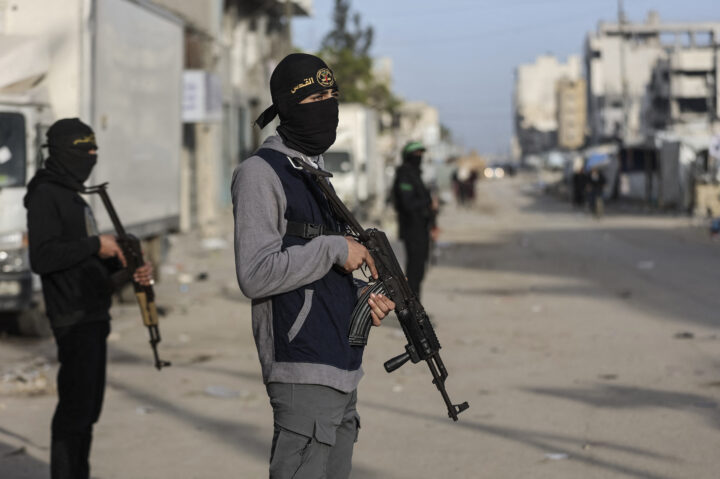
Omar AL-QATTAA / AFP via Getty Images
Members of Palestinian Hamas' Ezzedine Al-Qassam Brigades and Islamic Jihad's Quds Brigades are deployed at intersections in Gaza City on March 20, 2026.
As the conflict between the United States, Israel and Iran nears the one-month mark, experts say the war has diverted diplomatic and military attention away from Gaza, creating a mixed picture: Hamas has used the pause in sustained Israeli military pressure to reassert control in areas it still governs, while the degradation of Iran’s capabilities could ultimately leave the group weaker and more isolated once the conflict subsides.
“I think it’s safe to say that Israeli and American attention has been significantly diverted to the Iran war, and as a corollary to the second front, meaning the war with Hezbollah, at the expense of full time attention to Hamas,” said Matthew Levitt, director of The Washington Institute for Near East Policy’s program on counterterrorism and intelligence. “But it’s not like nothing’s happened in the interim, both for good and for bad.”
Some ceasefire efforts remain ongoing, even as the war continues: Earlier this week, Nickolay Mladenov, the Board of Peace’s high representative for Gaza and a former senior United Nations official, briefed the U.N. Security Council on the board’s progress in implementing elements of President Donald Trump’s 20-point Gaza plan, outlining early reconstruction efforts and a phased proposal for disarmament.
According to experts familiar with the briefing, those efforts have focused in part on areas of Gaza under Israeli control, where work has begun on clearing debris, addressing unexploded ordnance and laying the groundwork for new housing and infrastructure projects.
Gaza currently remains divided among the Hamas-controlled western part of the enclave, referred to by some experts as the “red zone,” while the IDF controls the eastern side, or “yellow zone.” Levitt said that work is being done to “build what is being described as new Rafah, as well as an Emirati-funded city, so that hopefully in the not too distant future, Gazans who are in the area of the enclave controlled by Hamas can be vetted and moved into these new communities.”
The National Committee for the Administration of Gaza — a new technocratic Palestinian governing body launched under the peace plan — has also begun vetting thousands of candidates for a new civilian police force, while several countries, including Indonesia, Morocco, Kazakhstan, Kosovo and Albania, have committed troops to a proposed International Stabilization Force, according to the UN.
However, experts and former White House officials also noted that the diverted attention from Gaza has had negative effects as well, most notably creating conditions for Hamas to “reassert its very physical presence” in the part of the enclave it controls.
Elliott Abrams, Iran envoy under the first Trump Administration and a senior fellow at the Council on Foreign Relations, said the U.S., Israel and Arab states focusing elsewhere “is temporarily an advantage for Hamas. For Gaza, the issue is whether the [Board of Peace] member states, led by the U.S., will insist on Hamas disarmament — without which all the plans for rebuilding Gaza will fail, and no country will send its troops there as a peace force.”
Ghaith al-Omari, a senior fellow at the Washington Institute, also noted that “Hamas has certainly been taking advantage of the shift of attention to the Iran war.”
“Last week, [Mladenov] presented Hamas with a proposal for disarmament. The proposal calls for gradual disarmament but makes it emphatically clear that Hamas needs to fully disarm by the end of the process,” he said.
“Because of lack of international attention, the tools needed to implement this — namely the creation of a new Palestinian police force — have been stalled,” al-Omari continued. “Hamas itself is unlikely to respond to the disarmament proposal until it sees how the Iran war ends. If Iran is not decisively weakened by the end of the war, Hamas will likely adopt a more hardline position when it comes to disarmament.”
Levitt said that while Hamas’ retrenchment in the enclave may cause concern, “the reality is [Hamas is] not able to expand beyond the less than half [of the enclave] that it controls.” He also noted that the current conflict in Iran may actually create the conditions to further weaken, pressure and isolate the terrorist group when the war subsides.
“[Hamas is] not getting the money they once did on a regular basis from Iran or from Qatar,” Levitt said. “It has limited resources, and when the war ends I think that authorities will still have a lot of the same leverage that they did before the war, and in a situation where perhaps Iran’s capabilities to fund and arm its proxies are sufficiently degraded.”
He also noted that there could be more “interest” from other countries in aiding in the Gaza peace process once the Iran war dies down.
“Sure, there’ll be parties who are angry at the United States, who are angry at Israel, and feel this was a war of choice,” Levitt said. “But once the war ends, I think there will be a lot of people who are going to be eager to try and do what they can to try and stabilize the region after these years of severe instability and suffering, and I think there’s going to be a focus on Gaza once the war ends.”
Daniel Shapiro, a former U.S. ambassador to Israel under President Joe Biden, agreed that the war may weaken Iran’s ability to support Hamas and that “some regional players might be newly committed to seizing the opportunity to disarm this branch of the Iranian axis of resistance.”
But the assistance of Gulf countries is not guaranteed, he said. “Others may pause their involvement in post-war Gaza for various reasons, ranging from the need to focus on their own recovery from the war, to unhappiness with Israel’s role in starting a war they hoped to avoid, to continuing opposition to Israel’s policies in the West Bank and opposition to a credible pathway to a Palestinian state,” Shapiro said.
Rachel Brandenburg, a senior policy analyst at Israel Policy Forum, also argued that the war in Iran could impact “regional stakeholders’” involvement in post-war Gaza, “particularly across the Gulf.” She noted that “when the dust settles on this war, it is also likely to detract from the funds and attention Gulf countries had pledged for Gaza and to support the Palestinian Authority.”
“[Gulf countries] will not only have to confront the losses from physical infrastructure destruction but also from a pause on investments, business, tourism, and energy resources,” Brandenburg said. “I expect they will reconsider how much money is left for Gaza and the Palestinian Authority.”
Meanwhile, Jason Greenblatt, former White House envoy to the Middle East under the first Trump administration, argued that the “focus has not shifted” from combating Hamas and has instead “sharpened.”
“Dismantling the Iranian regime’s capacity to arm, fund and direct Hamas is critical for Gaza’s future,” Greenblatt said. “But in my view, there is a difference between temporary humanitarian relief and meaningful rebuilding. The first can and should continue. The second cannot move forward until Hamas disarms and stops threatening Israel.”
Alexander Gray, former chief of staff to the National Security Council during Trump’s first term and now a senior fellow at the Atlantic Council, echoed those sentiments, telling Jewish Insider that the Trump administration is “smartly treating many of the Middle East’s challenges as inherently interconnected.”
“There will never be peace in Gaza without destroying the ability of Iran to fund and deploy proxies like Hamas to destabilize the region,” Gray said. “The president’s focus on dismantlement of the Iranian proxy network is not accidental: without it, peace from Gaza to Lebanon to Syria to Iraq to Yemen will be elusive.”
An Iranian missile struck Dimona, about eight miles from Israel’s Shimon Peres Negev Nuclear Research Center, wounding 31 people
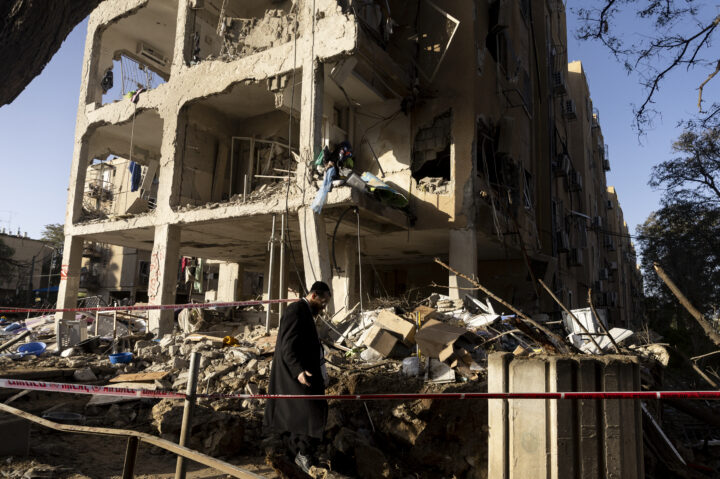
Amir Levy/Getty Images
A man looks at destroyed buildings after an Iranian missile strike on March 22, 2026 in Arad, Israel. Iran has continued firing waves of drones and missiles at Israel after the United States and Israel launched a joint attack on Iran early on February 28th.
Missile strikes from Iran and Hezbollah in Lebanon resulted in over 100 casualties between Saturday night and Sunday morning.
One person was killed and another injured after two cars caught fire in the Upper Galilee from errant IDF shells that fell inside Israel, rather than Lebanon, an investigation by the military found on Monday.
MDA reported 15 wounded from missile fragments landing in numerous sites in Tel Aviv and central Israel on Sunday.
EMTs from the Magen David Adom emergency services, Taysir Subah and Safa Abu Rafea, said they “arrived at the scene and saw two vehicles on fire. During the firefighters’ extinguishing operations, we identified a man in the driver’s seat. We conducted medical assessments, he had no signs of life, and we had to pronounce him dead.”
On Saturday night, an Iranian missile struck the city of Dimona, about eight miles from Israel’s Shimon Peres Negev Nuclear Research Center. The direct hit caused extensive damage to several buildings in the city, injuring 31 people, including one who is in serious condition, according to MDA.
MDA EMTs Shai Binyamin and Gadot Vaknin said they were alerted by civilians on the street to elderly residents trapped in a safe room, whom they helped treat.
Three hours later, an Iranian missile struck Arad, a city near the Dead Sea. Emergency services in the area, which has seen fewer alerts than the rest of the country, evacuated 84 patients to Soroka Medical Center in Beersheba, including 10 in serious condition, among them children as young as four years old.
Yakir Talker, an MDA EMT, described “extensive destruction and chaos” at the scene. Another EMT, Riyad Abu Ajaj, said that “together with security forces, we conducted searches to locate additional patients. We provided medical treatment to many patients, including children.”
At both scenes in southern Israel, the IDF Home Front Command led efforts to free people trapped in the rubble.
Schools in much of the Negev, which had been hit by fewer missiles than Israel’s center and north, were meant to reopen on Sunday. The IDF Home Front Command revised its guidelines to keep schools closed after Saturday night’s strikes. Schools have been closed since the start of the war with Iran late last month, and gatherings have been limited to 50 people near a shelter or safe room.
IDF Chief of Staff Eyal Zamir met with the mayors of Metula and Kiryat Shmona, on the Lebanon border, saying that the IDF is “prepared for the enhancement of the forward defensive posture in the north.” In a later statement on Saturday, he added: “There is no more containment; there is initiative; there is preemptive action.” Last week, the IDF said it would increase ground operations in Lebanon.
“The more we strike and weaken Iran, the more we weaken Hezbollah,” Zamir added.
He also praised the “steadfastness and the resilience” of Israelis in the north, saying that they “enable us to continue striking and degrading the enemy.”
“We will not stop until the threat is pushed away from our border and long-term security is ensured for our residents,” he said.
This story was updated on March 23, 2026, to add the IDF investigation findings.
Ibrahim Muhammad Ghazali was responsible for launching rockets at Israeli civilians during the war

Emily Elconin/Getty Images
Law enforcement respond near Temple Israel following reports of an active shooter on March 12, 2026 in West Bloomfield, Mich.
The suspect in the attack last week at Temple Israel in West Bloomfield Township, Mich., was the brother of a Hezbollah commander, the IDF said on Sunday.
The IDF announced in an X post on Sunday that Ibrahim Muhammad Ghazali, the brother of Ayman Mohammad Ghazali, “was responsible for managing weapons operations within a specialized branch of [Hezbollah’s] Badr Unit. The unit is responsible for launching hundreds of rockets toward Israeli civilians throughout the war.”
“Ibrahim was eliminated in an IAF strike on a Hezbollah military structure last week,” the IDF said.
After Thursday’s attack, in which Ayman Ghazali drove his vehicle through the doors of the synagogue and preschool building and killed himself after his truck caught fire, some media outlets noted that relatives of the attacker had been killed in recent Israeli airstrikes in Lebanon.
A New York Times article initially headlined “The Michigan Synagogue Attacker Was a Quiet Restaurant Worker” focused on Ghazali’s response to the deaths of his brother and his brother’s two children. “The auditorium at the Islamic Institute of America in Dearborn Heights, Mich.,” the paper reported, “was packed” the night of the family’s memorial.
Hezbollah called Ghazali’s two brothers, Qasim and Ibrahim, “martyrs” after they were killed in an Israeli strike, and noted that Ibrahim “kill[ed] 10 Zionists.”
CBS reported that another of Ghazali’s brothers, Qasim, was also a member of a Hezbollah rocket unit.
According to CNN, Ghazali appeared in federal government databases as having ties to “known or suspected terrorists” associated with Hezbollah. He had been questioned upon his return from his last trip to Lebanon in 2019.
The IDF has been carrying out airstrikes on Hezbollah targets since the beginning of the month, after the Iran-backed terrorist group joined the Islamic Republic in its attacks on Israel, following the launch of Operation Lion’s Roar two weeks ago.
Plus, Israel strikes back after 200-missile Hezbollah barrage

Zach D Roberts/NurPhoto via Getty Images
Nick Fuentes, the leader of a Christian based extremist white nationalist group speaks to his followers in Washington D.C. on November 14, 2020
👋 Good Thursday morning!
In today’s Daily Kickoff, we look at the ties between neo-Nazi influencer Nick Fuentes and Kai Schwemmer, the newly named political director of College Republicans of America, and spotlight the pro-Israel positions taken by Clay Fuller, who is expected to succeed Rep. Marjorie Taylor Greene following next month’s runoff in Georgia. We report on the escalation between Israel and Hezbollah following the terror group’s launching last night of 200 missiles at Israel, and look at the degree to which the United Arab Emirates is absorbing much of Tehran’s missile and drone attacks. Also in today’s Daily Kickoff: Howard Schultz, Adm. Brad Cooper and Dorothy McAuliffe.
Today’s Daily Kickoff was curated by JI Executive Editor Melissa Weiss and Israel Editor Tamara Zieve, with assists from Danielle Cohen-Kanik and Marc Rod. Have a tip? Email us here.
What We’re Watching
- The Senate Health, Education, Labor and Pensions Committee is holding a hearing this morning on the influence of foreign funding in higher education. National Association of Scholars President Peter Wood, Foundation for Defense of Democracies Senior Fellow Craig Singleton and The Asia Society’s Robert Daly are slated to testify.
- The annual weeklong SXSW festival kicks off today in Austin, Texas. Mahmoud Khalil, the controversial former leader of Columbia’s anti-Israel protest movement who is facing possible deportation over his activities, will, according to the festival schedule, participate in a conversation this weekend “on the cost of dissent,” alongside his lawyer and The Guardian’s Betsy Reed. More below.
- First in JI: The Republican Jewish Coalition is set to announce endorsements of 16 House Republicans running for reelection, mostly in swing districts: Reps. Tom Barrett (R-MI), Rob Bresnahan (R-PA), Juan Ciscomani (R-AZ), Gabe Evans (R-CO), Brian Fitzpatrick (R-PA), Tom Kean Jr. (R-NJ), Mike Lawler (R-NY), Ryan Mackenzie (R-PA), Mariannette Miller-Meeks (R-IA), Zach Nunn (R-IA), David Valadao (R-CA) and Derrick Van Orden (R-WI).
- RJC also endorsed the four incumbent Jewish House Republicans: Reps. David Kustoff (R-TN), Max Miller (R-OH), Randy Fine (R-FL) and Craig Goldman (R-TX) — the largest group of Jewish Republicans in the House since the 1980s, Jewish Insider’s Marc Rod reports.
What You Should Know
A QUICK WORD WITH JI’S MATTHEW KASSEL
In a low-profile electoral upset that defied the difficult national political environment facing the GOP, a Republican candidate declared victory this week in a down-ballot race for a seat on the Prince William Board of County Supervisors in Virginia — for the first time in nearly 40 years.
But while Republicans are now rejoicing over their narrow win, it otherwise largely demonstrated how Democratic leaders effectively sacrificed the seat to the GOP rather than elevate an extremist member of their own party who had claimed the nomination.
The result underscored the extent to which local Democrats had swiftly mobilized to oppose their own nominee, Muhammed Casim, who faced backlash over a series of recently uncovered past social media comments in which he used racist, misogynistic and antisemitic language. The posts, written more than a decade ago, used the n-word as well as demeaning rhetoric targeting women. He also accused Israel of genocide and promoted a conspiratorial post about U.S. financial assistance to the Jewish state, among other extreme comments.
More broadly, the outcome is an atypical example of how the Democratic Party worked to meaningfully confront extremism within its own ranks, even if its efforts came at the expense of an easily winnable local seat that instead flipped to Republicans for the first time in decades.
Casim apologized for his comments but refused bipartisan calls to drop out of the race, which had motivated a Democratic challenger to launch a write-in campaign that ultimately helped siphon votes away from his embattled bid. He lost to Republican Jeannie LaCroix by a margin of 258 votes. Write-in candidates pulled in 744 votes — a relatively sizable total that appeared to have made a difference in the closely contested race.
“Opposing antisemitism, racism or misogyny isn’t a partisan position,” Marc Broklawski, a Jewish vice chair of the Virginia Democratic Party, told Jewish Insider on Wednesday. “It’s a floor, not a ceiling, and the least we should expect from any party, official candidate or voter. When Democrats hold that floor even when it’s costly, that’s something to be proud of. When we don’t, voters notice that too.”
NORTHERN FRONT
Israel expands strikes in Lebanon after major Hezbollah barrage
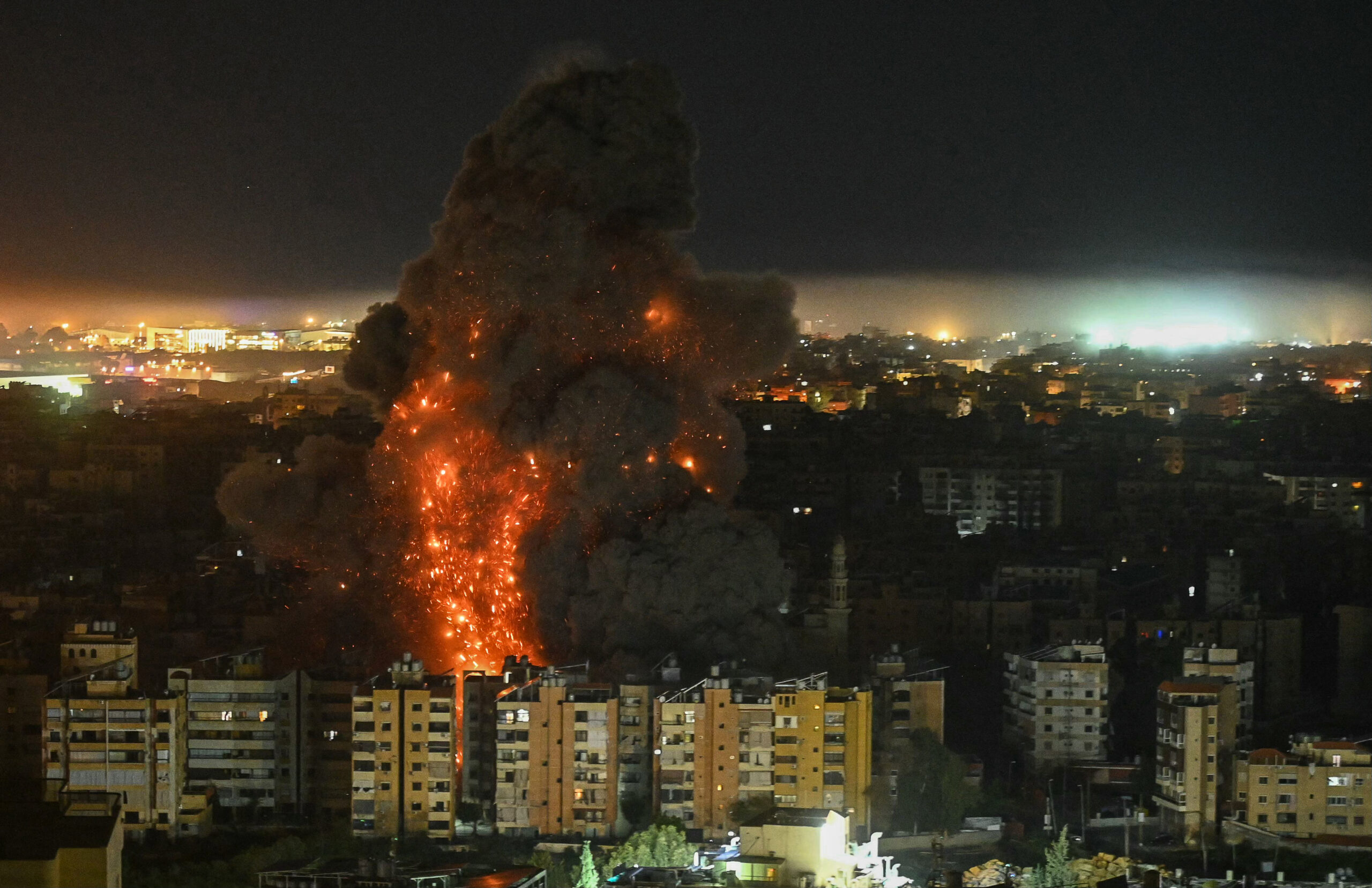
Israel continued extensive strikes on Lebanon on Thursday morning, after Hezbollah shot about 200 projectiles at northern Israel the night before. About 120 of the rockets and missiles crossed from Lebanon into Israel during the Wednesday night barrage, with those not intercepted mostly striking Israel’s north, Jewish Insider’s Lahav Harkov reports.
State of play: The Magen David Adom emergency service treated two individuals with mild injuries following the missile fire from Lebanon. A home, with the exception of its safe room, was destroyed, and two others were damaged in Moshav Haniel in Emek Hefer, a region of Israel 70 miles from the Lebanon border. Soon after, Iran launched missiles at Israel, a move officials said likely indicated that the two Wednesday night barrages were coordinated between Tehran and Beirut. A senior Israeli official briefed the media on Thursday morning that a significant expansion of operations in Lebanon would soon take place, but did not say whether that would include a broad ground invasion.
Bonus: In Al Arabiya, former White House Middle East envoy Jason Greenblatt calls on Beirut to decisively crack down on and disarm Hezbollah, arguing that the Iranian proxy is at a particularly weak moment: “The aura of invincibility that Hezbollah cultivated for decades has faded. The pillars that sustained Hezbollah for years, money from Tehran, military dominance and political intimidation, have dramatically weakened.”
CAMPUS CONTROVERSY
Conservative students alarmed about College Republicans leader with Nick Fuentes ties

Some pro-Israel conservative students are voicing concern over the College Republicans of America’s new political director, citing his ties to neo-Nazi influencer Nick Fuentes as evidence of the party’s increasingly “alarming” shift towards extremism, Jewish Insider’s Haley Cohen reports. Kai Schwemmer was tapped last week as political director of the campus group, which has grown to more than 200 active chapters across U.S. universities since it was established in 2023 as an offshoot from the College Republican National Committee.
Friend of Fuentes: Schwemmer, known on social media as Kai Klips, has a channel on Fuentes’ invitation-only streaming platform Cozy, which he launched with far-right conspiracy theorist Alex Jones. Schwemmer appeared in a 2021 video promoting Fuentes’ “White Boy Summer” tour and was featured as a “special guest” at Fuentes’ 2022 APFAC III conference, the progressive advocacy organization People for the American Way reported. Schwemmer has also been outspoken about his affiliation with Fuentes’ political movement, “America First.” “It’s alarming but not surprising,” College Republicans of America would select a Fuentes ally as its leader, Felipe Avila, a senior studying nursing at Catholic University of America, who identifies as conservative, told JI.
FRESH PERSPECTIVE
Israel supporter Clay Fuller expected to replace MTG on Capitol Hill
Clay Fuller, a veteran and district attorney, is expected to succeed former Rep. Marjorie Taylor Greene (R-GA) in the House, bringing a pro-Israel voice to replace one of the House’s most anti-Israel Republicans, Jewish Insider’s Marc Rod reports. Fuller led all Republicans on the all-party primary ballot in Georgia’s 14th Congressional District, winning 35% of the vote. Even though he finished narrowly behind Democrat and military veteran Shawn Harris, the Republican vote is likely to consolidate behind Fuller in next month’s runoff election.
Fuller’s positions: Fuller has expressed support for Israel and for the U.S. strikes on Iran. “President Trump tried the peace route with Iran not once, not twice, but THREE separate times — and they refused. He’s the peace President, but you can’t negotiate with a death cult,” Fuller said in a post on X last month, emphasizing he had supported operations against Iran during his time in the military and that the regime and its proxies had killed many Americans. The day after Hamas’ Oct. 7, 2023, attacks on Israel, Fuller blasted the Biden administration for unfreezing $6 billion in Iranian funds as part of an earlier hostage deal, highlighting Iran’s support to Hamas.
President’s pitch: President Donald Trump ripped into Rep. Thomas Massie (R-KY) during a campaign rally in Hebron, Ky., on Wednesday to support Ed Gallrein, his endorsed candidate to take on the incumbent, describing Massie as “disloyal,” a “loser,” the “worst person” and a “disaster as a congressman,” JI’s Emily Jacobs reports.
ON THE TRAIL
Pro-Israel Democrats walking a fine line on U.S. operation in Iran
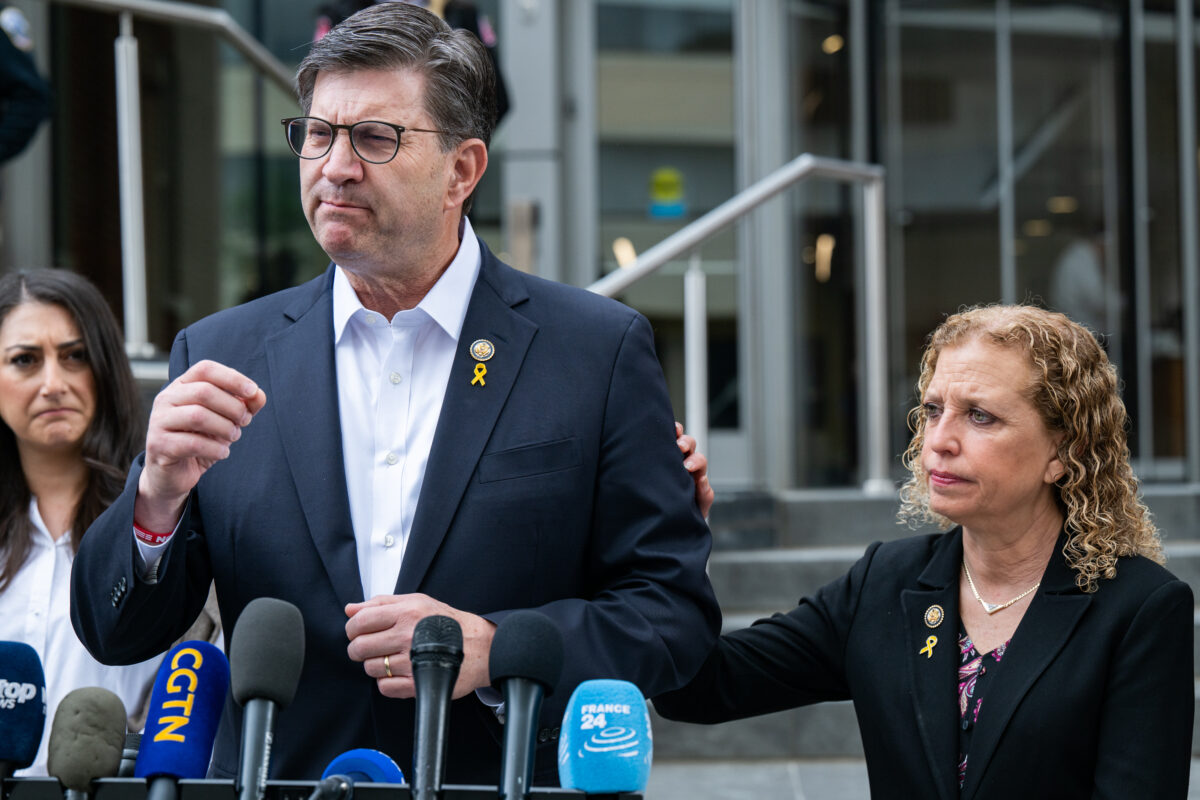
Remarks by pro-Israel stalwarts Reps. Debbie Wasserman Schultz (D-FL) and Brad Schneider (D-IL) on a Jewish Democratic Council of America webinar on Wednesday highlighted the delicate line that some pro-Israel Democratic lawmakers are walking on the war in Iran, Jewish Insider’s Marc Rod reports.
Notable quotable: “I can tell you assuredly: had I been presented with an Authorization for Use of Military Force, that made sense, and that we were properly briefed, and there was a demonstrative, imminent threat — which we have really yet to be shown — I am someone on our side of the aisle that likely would have voted for an AUMF if all of those things were in place,” Wasserman Schultz said. “Instead, [President Donald Trump] has blown an opportunity to go in in the most prepared way. … I have been careful about just blanket-ly condemning everything [Trump is] doing here, but most certainly, the way that we got into this was really unacceptable, and my constituents are very concerned.”
Friendly fire: A former top Obama administration foreign policy official said on Wednesday that any Democratic lawmakers who vote to support U.S. strikes on Iran should be primaried. “If you vote for the funding of this war, you should be primaried. I don’t want you in the Democratic Party,” said Ben Rhodes, co-host of the “Pod Save the World” podcast and former deputy national security advisor under President Barack Obama, JI’s Gabby Deutch reports.
CENTER STAGE
Mahmoud Khalil to speak at South by Southwest festival
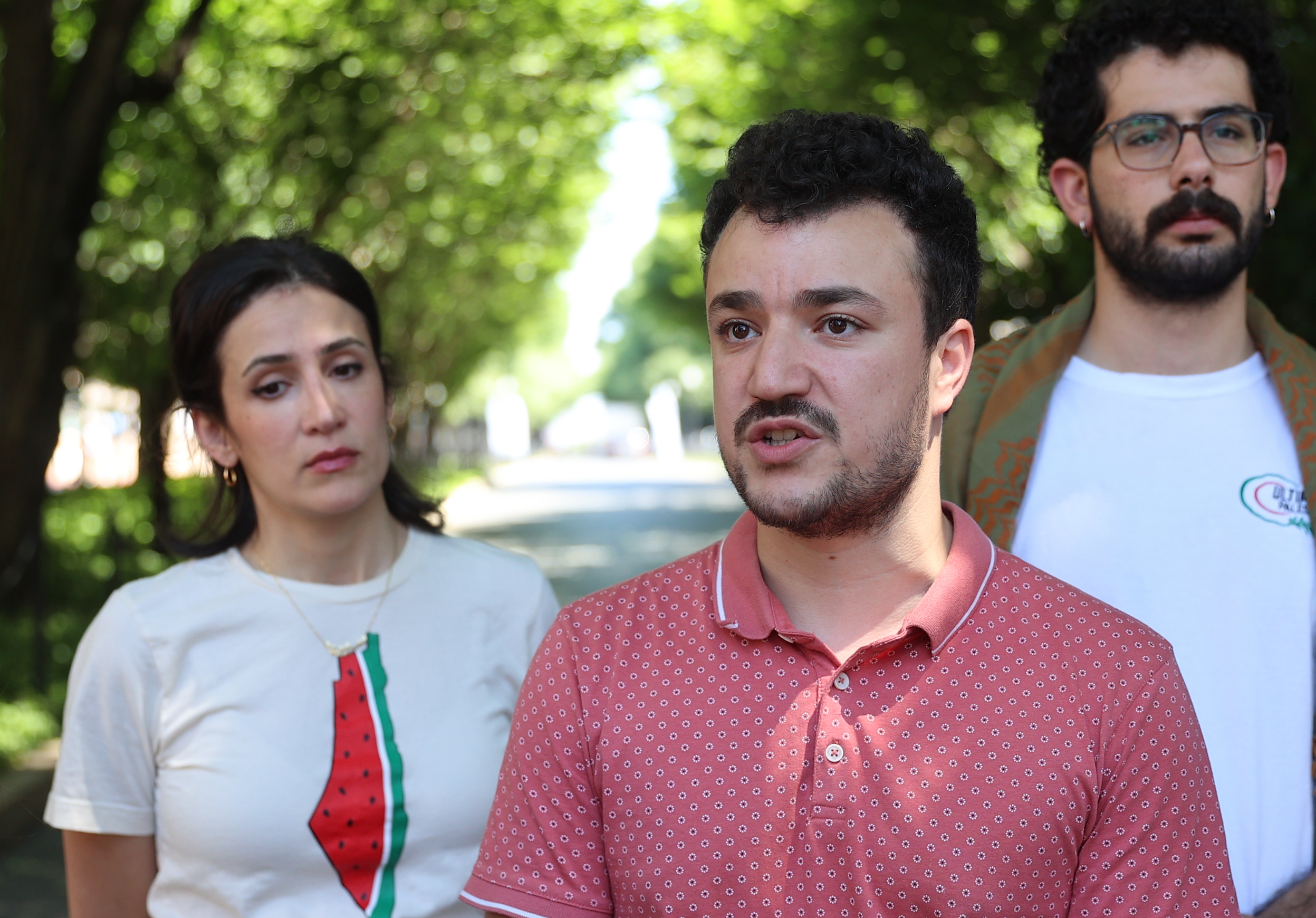
Columbia University anti-Israel protest leader Mahmoud Khalil is scheduled to speak at this week’s annual South by Southwest (SXSW) festival in Austin, Texas, Jewish Insider’s Haley Cohen reports. Khalil will participate on Sunday in a conversation “on the cost of dissent,” with The Guardian Editor Betsy Reed and Baher Azmy, legal director of the Center For Constitutional Rights who was a lawyer for Khalil in his deportation proceedings, according to the SXSW schedule.
Details: The weeklong festival each March convenes around 300,000 guests, including film and media professionals, executives and politicians to discuss culture, technology and innovation. “Khalil joins The Guardian for an unflinching conversation on his ordeal, the system that tried to silence him, and the personal and political stakes of resistance,” SXSW’s website states. At Columbia, Khalil was a key organizer of the anti-Israel encampment in April 2024, a two-week demonstration in the center of campus during Israel’s war in Gaza.
FEELING THE HEAT
UAE, more than Israel, absorbing bulk of Iranian strikes in war’s early weeks
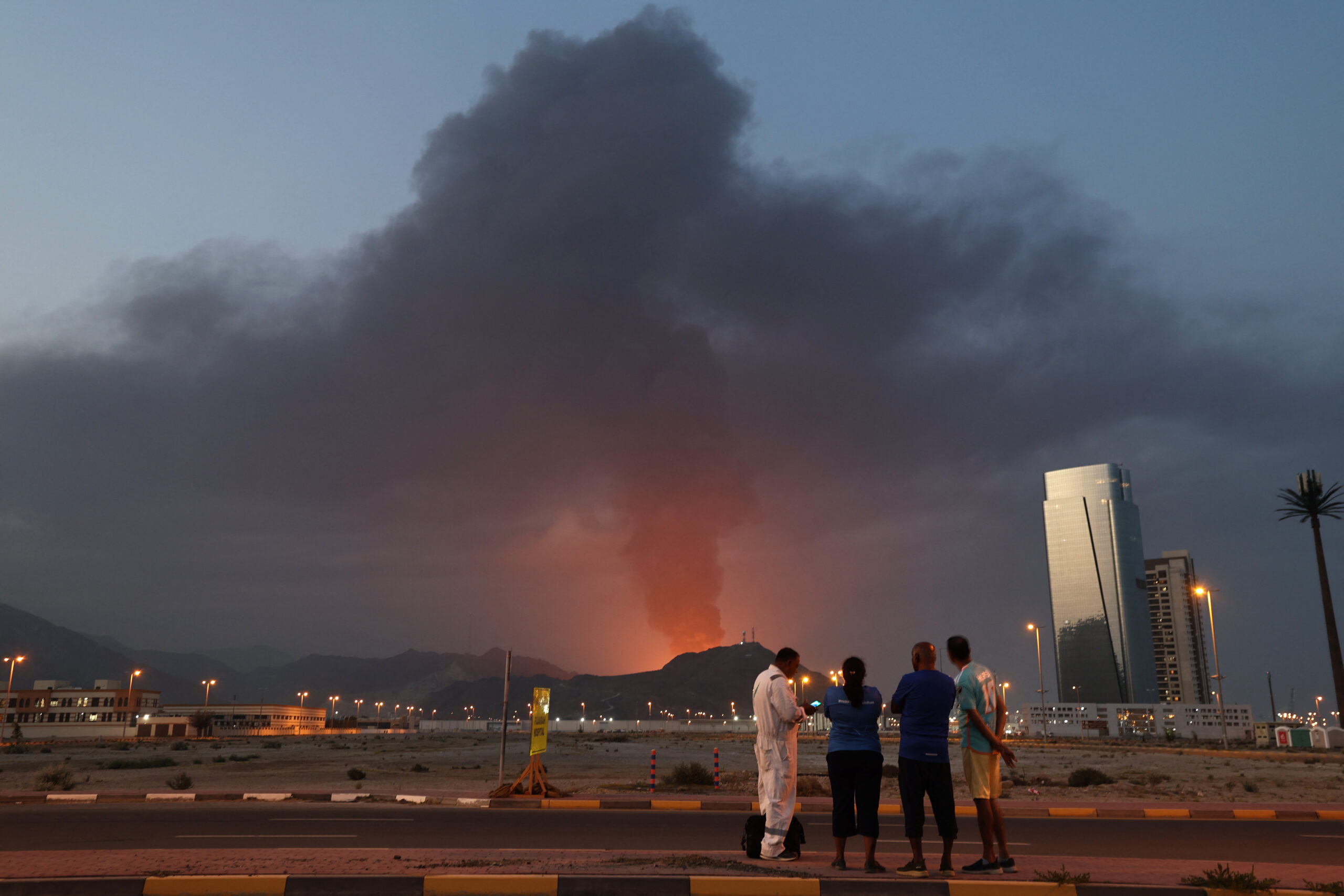
As Iran retaliates against the U.S. and Israel’s joint military campaign, findings have revealed that the United Arab Emirates — not Israel — has thus far faced the majority of Tehran’s missile and drone attacks, Jewish Insider’s Matthew Shea and Marc Rod report. As of March 11, the UAE’s Ministry of Defense reported that its air defenses had “engaged” 268 ballistic missiles, 15 cruise missiles and 1,514 UAVs.
Bearing the brunt: Iranian strikes have targeted American assets in the country, such as the U.S. consulate in Dubai, but also a range of civilian targets, including Dubai International Airport, where a drone attack wounded four people. Reports have indicated that Abu Dhabi has faced more than three times the number of Iranian drones and missiles launched toward Israel. The attacks come as Gulf allies are running short on missile interceptors. Sens. Mike Rounds (R-SD) and Rick Scott (R-FL) argued to JI on Wednesday that, ultimately, the U.S. campaign against Iran will be to the benefit of the UAE and other Gulf allies, even if they’re feeling pain in the short term.
Winds of change: Despite Qatar’s anger with Iran over the regime’s continued attacks on its territory and civilian infrastructure, experts are divided over whether the conflict will ultimately force Doha to reconsider its long-standing policy of hosting Iranian-backed Hamas officials, JI’s Matthew Shea reports.
Worthy Reads
The War on Antisemitism: In Time, State Department antisemitism envoy Rabbi Yehuda Kaploun explains the Trump administration’s approach to fighting antisemitism. “Antisemitism proliferates from an ever-multiplying list of sources: voices from all sides of the political spectrum spew antisemitic rhetoric; foreign terrorist organizations espouse violent antisemitic ideologies; and online radicalization increasingly incites real-world antisemitic attacks against Jewish individuals and institutions globally.” [Time]
This War Has Roots: In The Washington Post, Geoffrey Corn and Orde Kittrie argue that the U.S.-Israeli war against Iran is a continuation of hostilities that have been ongoing for years. “International law does not require a distinct self-defense justification for every attack conducted once the right of self-defense is triggered. Once that right is initiated, military action is justified to achieve the overall self-defense objective, in this case terminating Iran’s capacity to strike the United States and its allies. … These facts justify the conclusion that the U.S. and Iran were already engaged in an armed conflict when the current round began. As a result, international law does not require the U.S. to refrain from further military action against Iran until just before the IRGC launches another assault.” [WashPost]
Risk Assessment: The Wall Street Journal‘s Yaroslav Trofimov looks at the risks Washington and American allies face if the war ends with the Iranian regime intact. “But leaving in place Iran’s theocratic regime — angry, defiant and in possession of its nuclear stockpile and what remains of its arsenal of missiles and drones — would essentially grant Tehran control over the world’s energy markets. It would also sacrifice the security of America’s partners and allies, and possibly make another, more devastating, regional war likely.” [WSJ]
Get Out of Jail Free: The Atlantic’s Graeme Wood considers the utility of former Iranian President Mahmoud Ahmadinejad, who has evolved from being the face of the Islamic Republic to an opponent of the regime and was rumored to have been killed by Israel early in the war. “ Contrary to early reports, Ahmadinejad is alive, his associates say. … The circumstances of his survival may prove significant as the war drags on. Whatever the intent, Ahmadinejad’s associates say the strike was in effect a jailbreak operation that freed the former president from regime control. Their description of the chaotic sequence of events that began before the war suggests that Ahmadinejad has friends on the outside.” [TheAtlantic]
Word on the Street
President Donald Trump announced his endorsement of Brandon Herrera, the far-right social media influencer who is the presumptive Republican nominee in Texas’ 23rd Congressional District, following Rep. Tony Gonzales’ (R-TX) announcement that he was dropping his reelection bid, Jewish Insider’s Marc Rod reports…
The Cook Political Report moved the Pennsylvania governor’s race from “Likely Democrat” to “Solid Democrat,” citing Pennsylvania Gov. Josh Shapiro’s 60% approval rating, cash on hand and significant polling lead over his Republican challenger, state Treasurer Stacy Garrity…
Dorothy McAuliffe, the wife of former Virginia Gov. Terry McAuliffe, announced her bid for Congress in a potential new district that is expected to favor Democrats, the status of which will be determined in a statewide vote next month…
Nearly all Senate Democrats wrote to Secretary of Defense Pete Hegseth on Wednesday to raise “grave concern” about a strike on a girl’s school that killed at least 168 people in the opening phase of the U.S.-Israeli war on Iran, Jewish Insider’s Marc Rod reports…
The letter came amid findings from a preliminary U.S. military investigation indicating that the U.S. was at fault for the bombing, which took place on the same block as a number of buildings used by the Islamic Revolutionary Guard Corps…
Federal and state officials in California sought to assuage concerns after the FBI’s Los Angeles division sent out a bulletin that Iran could conduct retaliatory drone attacks on the West Coast, with a law-enforcement official telling CBS News that there was no credible intelligence that prompted the bulletin, which had predated the Iran war…
The Department of Justice is probing Iran’s use of Binance to evade U.S. and international sanctions after an internal investigation at the cryptocurrency company found that the platform had been used to funnel more than $1 billion to terror proxies…
The New York Times reports on Iran’s use of cluster bombs to strike Israel in violation of international law…
The Swiss Embassy in Tehran, which has historically served as an interlocutor for U.S. interests in the Islamic Republic, announced it is temporarily closing, citing “the war in the Middle East and the increasing security risk,” but “will continue to maintain an open line of communication” between Washington and Tehran…
The Wall Street Journal spotlights CENTCOM head Adm. Brad Cooper, whom associates described as “thoughtful, decisive and cool under pressure” as he leads U.S. operations in the Middle East…
Yeshiva University is establishing the first new dental school in Manhattan in more than a century, with plans to enroll 150 students in an accelerated three-year program on its Midtown Manhattan campus…
Starbucks owner Howard Schultz became the latest executive to relocate to South Florida, purchasing a $44 million penthouse in Surfside, Fla….
The California Department of Education filed a lawsuit against the Oakland Unified School District, alleging that administrators failed to address “pervasive antisemitism” in schools in the Bay Area district following a directive in January to do so…
A judge in the U.K. tossed out the government’s appeal of a court ruling dismissing its case against Irish band Kneecap over a group member’s support for Hezbollah; the lower court had dismissed the case over a governmental procedural error…
Google completed its $32 billion purchase of Israeli cybersecurity startup Wiz, started in 2020 by Unit 8200 veterans Assaf Rappaport, Yinon Costica, Ami Luttwak and Roy Reznik; the deal marks the largest purchase of an Israeli-founded company in nearly a decade…
Iran’s sports minister said that the Islamic Republic’s national soccer team could not play in this summer’s World Cup, a number of games of which are being played in the U.S….
Spain is permanently withdrawing its ambassador from Israel, months after Ambassador Ana Maria Salomon Perez was recalled to Madrid; the country’s embassy in Israel going forward will be led by a charge d’affaires…
Bloomberg looks at Israeli efforts to establish an intelligence base on the coast of Somaliland months after Israel became the first country to formally recognize the African nation, which is separated from the Yemen-based Houthis by the Gulf of Aden…
Axios reports on the role that hackers are increasingly playing in the war between the U.S., Israel and Iran, following a cyberattack on Wednesday targeting the U.S.-based medical device company Stryker that disabled employees’ phones and laptops…
The Qatari-backed Irth Capital Management submitted a bid to take over Papa Johns, in a deal that would give the pizza chain a $1.5 billion valuation…
Bernard Haykel is joining the Foundation for Defense of Democracies as a senior fellow…
Angelika Saleh, the namesake of the Angelika Film Center, which she opened in 1989 with her then-husband, Joseph Saleh, died at 90…
Pic of the Day

UJA-Federation of New York announced last night it was committing $1.3 million to build the Shalva Sharabi Family Center in Ashkelon, Israel, a new center dedicated in memory of the wife and daughters of former hostage Eli Sharabi, who were killed during Hamas’ Oct. 7, 2023, attacks. The pledge for the center, which will support individuals with disabilities and trauma victims, was made at Shalva’s 36th anniversary gala, held at Gotham Hall in Manhattan, Jewish Insider’s Haley Cohen reports for eJewishPhilanthropy.
Birthdays
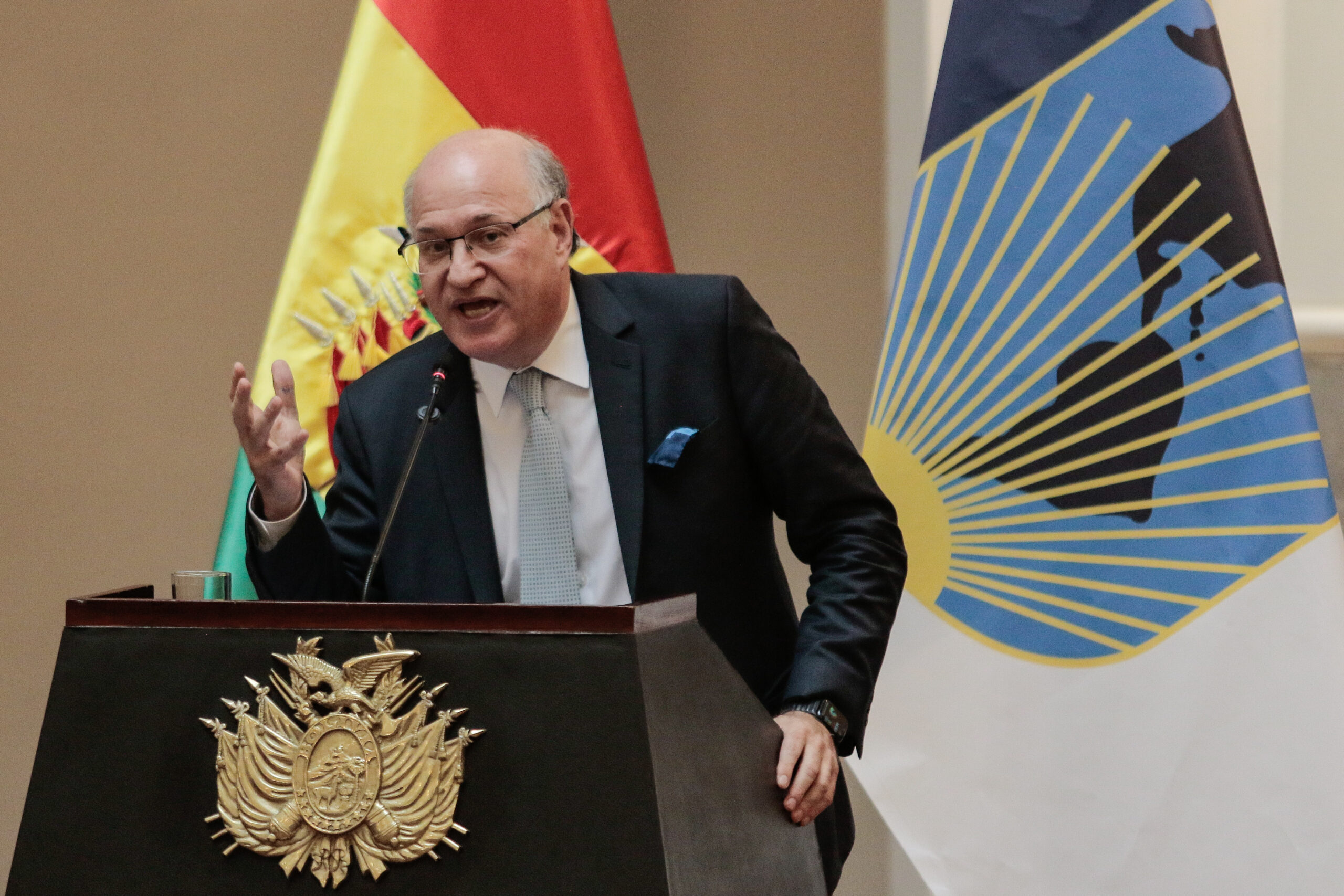
Born in Haifa, he served as president of the Central Bank of Brazil and is now president of the Inter-American Development Bank, Ilan Goldfajn turns 60…
Photographer, musician and author of 15 children’s books, Arlene Weiss Alda turns 93… Carol Margolis… Retired U.S. Sen. Mitt Romney (R-UT) turns 79… Director, producer and screenwriter of movies and television including directing the first of “The Fast and the Furious” film franchise, Rob Cohen turns 77… British sculptor, he won the 2017 $1 million Genesis Prize for “commitment to Jewish values, the Jewish community and the State of Israel,” Sir Anish Kapoor turns 72… Pitching coach who has worked for the Yankees, Reds, Braves, Marlins, Cubs and Padres, Larry Rothschild turns 72… Past president of AIPAC, he is the founder and CEO of R.A. Cohen & Associates, Robert A. Cohen… Former member of the Knesset for the Likud party, he is from the Israeli Druze community, Ayoob Kara turns 71… Founder of hedge fund Lone Pine Capital, Stephen Mandel turns 70… Sales representative at Paychex, Lynne Blumenthal… Director of constituency engagement at the United States Holocaust Memorial Museum, Diane Saltzman… Senior attorney in the D.C. office of Squire Patton Boggs, Stacey Grundman… Sportscaster for ESPN and a host of “SportsCenter,” Steve Levy turns 61… U.S. Sen. Tammy Duckworth (D-IL) turns 58… Chief Washington correspondent for CNN and co-host of the Sunday morning program “State of the Union,” Jacob Paul “Jake” Tapper turns 57… Founder and CEO at Miller Strategies, Jeff Miller… Israeli film and television actor, Tzachi Halevy turns 51… SVP of communications at the Alliance for Automotive Innovation, Brian T. Weiss… Founder and publisher of Fleishigs, a kosher food magazine, Shlomo Klein… Actor and comedian, Samm Levine turns 44… Writer, artist and social media personality, she is best known for her Daf Reactions series of videos explaining passages from the Talmud posted to TikTok, Miriam P. Anzovin… Senior public affairs specialist at the Association of American Medical Colleges, Talia Schmidt… Member of Congress (D-NY-15) since 2021, Ritchie Torres turns 38… Senior Middle East intelligence specialist at Vcheck, Aaron Magid… Founder and CEO of Serotonin and co-founder and president of Mojito, Amanda Gutterman Cassatt turns 35… CEO and co-founder of Wonder Media Network, Jennifer Manning Kaplan… Figure skater who won the 2016 World Junior championship, he competed for Israel at the 2018 Winter Olympics, Daniel Samohin turns 28… Israeli internet personality, model and singer, Anna Zak turns 25…
About 120 of the rockets and missiles crossed from Lebanon into Israel during the Wednesday night barrage, with those not intercepted mostly striking Israel’s north
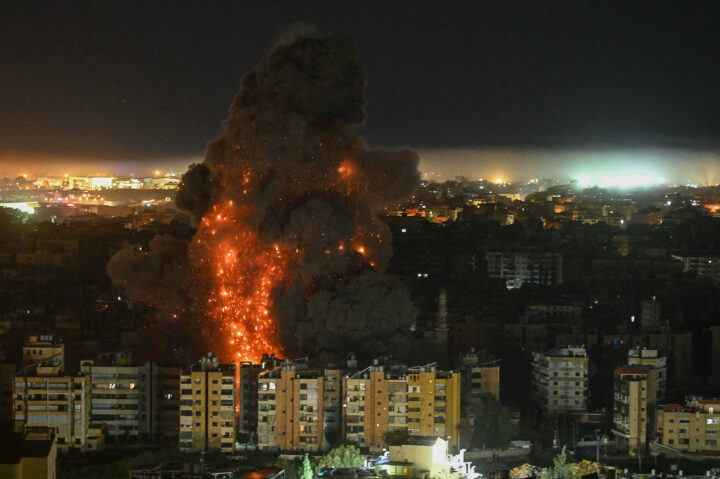
FADEL itani/AFP via Getty Images
A fireball rises from the site of an Israeli airstrike that targeted an area in Beirut's southern suburbs overnight March 10 to 11, 2026.
Israel continued extensive strikes on Lebanon on Thursday morning, after Hezbollah shot about 200 projectiles at northern Israel the night before.
About 120 of the rockets and missiles crossed from Lebanon into Israel during the Wednesday night barrage, with those not intercepted mostly striking Israel’s north.
The Magen David Adom emergency service treated two individuals with mild injuries following the missile fire from Lebanon.
A home, with the exception of its safe room, was destroyed, and two others were damaged in Moshav Haniel in Emek Hefer, a region of Israel 70 miles from the Lebanon border.
Soon after, Iran launched missiles at Israel, a move officials said likely indicated that the two Wednesday night barrages were coordinated between Tehran and Beirut.
A senior Israeli official briefed the media on Thursday morning that a significant expansion of operations in Lebanon would soon take place, but did not say whether that would include a broad ground invasion.
Shortly after Wednesday night’s barrage began, the IDF announced “a large-scale wave of strikes on Hezbollah infrastructure in the Dahieh area of Beirut” while “interception efforts [were] ongoing.”
As part of that wave, the IDF struck 10 Hezbollah sites within 30 minutes, including an intelligence base and headquarters of the elite Radwan unit. On Thursday morning, the IDF reported launching 200 munitions from air and sea at 70 Hezbollah targets in Beirut.
“The Hezbollah terrorist organization has embedded its terrorist infrastructure in the heart of Beirut under the cover of the civilian population,” the IDF Spokesperson’s Office said.
IDF Spokesperson in Arabic Avichay Adraee posted evacuation warnings on social media throughout the night and morning. Over half a million residents of Lebanon have evacuated since Hezbollah joined the war on Iran’s side last week.
In addition, troops of the IDF’s Mountain Brigade operated in Lebanon near the border with Israel to locate and destroy rocket launchers and weapons storage facilities.
The IDF reported “a wide-scale wave of strikes in Iran” on Thursday. In addition, according to Israeli and other Middle Eastern media, Israeli drones have been striking checkpoints manned by Iranian paramilitary militia Basij. The checkpoints had been set up on central arteries throughout Iran to try to suppress an uprising and limit movement.
The IDF intercepted Iranian missiles headed for Jerusalem on Thursday.
In addition to the two mild injuries from Lebanese missiles, Magen David Adom treated 45 people who were injured on their way to shelters or suffered from anxiety on Wednesday.
Since the start of Operation Lion’s Roar, MDA reported 759 physical casualties, of which 169 were caused by missile fire, including 12 fatalities.
Iran struck an oil tanker off the coast of the United Arab Emirates on Thursday, the sixth such ship targeted in the Gulf over two days, after attacking two vessels in Iraqi waters overnight, killing one. Iranian drones struck an oil facility in Bahrain, an airport in Kuwait, an Italian military base in Iraqi Kurdistan and a tower in Dubai on Thursday morning. The Saudi Defense Ministry said it intercepted a UAV targeting an oil field.
Also Thursday, Israeli Education Minister Yoav Kisch said that schools in northern Israel and the coastal strip, including Tel Aviv, are not expected to reopen in the coming days, while in other areas, school may reopen gradually, starting Monday.
IDF chief announces offensive campaign against Hezbollah after overnight attacks against Israeli by the Iranian proxy

Stringer/picture alliance via Getty Images
Smoke from an Israeli air raid billows from Hezbollah positions in the southern Lebanese village of Dier Siran
Israel expanded its war effort against Iran to southern Lebanon on Monday after Iranian proxy Hezbollah launched rockets and drones at Israel overnight.
“We have launched an offensive campaign against Hezbollah,” Lt.-Gen. Eyal Zamir, the IDF’s chief of staff, said in a situational assessment on Monday. “We are not only operating defensively — we are now going on the offensive as well. We must prepare for many prolonged days of combat ahead.”
The war against Iran and Hezbollah “requires strong defensive readiness and sustained offensive readiness, operating in continuous waves while constantly utilizing opportunities,” Zamir said.
On Sunday, Zamir also spoke of Israel’s “close cooperation with our most important partner — the United States of America. We are working in coordination with CENTCOM, with AFCENT, CENTCOM’s Air Force, and there is undoubtedly tremendous force here.”
Hours after Hezbollah launched rockets and drones at Israel at about 1 a.m. Monday, the IDF carried out strikes against dozens of Hezbollah targets in southern Lebanon and as far north as Beirut that extended into the morning. Targets included senior Hezbollah terrorists, command posts, infrastructure and a vehicle carrying operatives from the Sh’ia militia’s elite Radwan force.
Israeli Defense Minister Israel Katz said on Monday that Hezbollah leader Naim Qassem “decided on the attack under pressure from Iran [and] is from this moment a marked target for elimination.”
The IDF will “act forcefully against Hezbollah,” Katz added, “while continuing to advance the primary objective: crushing and defeating the Iranian terror regime and neutralizing its capabilities in Operation Lion’s Roar in order to remove the threats against the State of Israel and enable the citizens of Iran to rise up against the regime and overthrow it.”
The IDF’s Arabic-language spokesperson issued evacuation notices for 53 villages in southern Lebanon.
“The IDF had previously prepared for the possibility of Hezbollah joining the hostilities,” the military spokesperson’s office stated. “In the Northern Command, combat forces were significantly reinforced along the border with both defensive and offensive capabilities. This preparation enabled a rapid and robust counterattack while maintaining full operational protection across all scenarios.”
The expansion of the war to a second front followed a month of smaller IDF strikes in southern Lebanon, as Hezbollah continued efforts to rebuild after Israel killed Hezbollah leader Hassan Nasrallah and many other leading figures in the Iranian proxy group in late 2024.
As Operation Roaring Lion, as the IDF called its strikes on Iran, was launched on Saturday, the IDF called up 70,000 reservists to bolster its forces in all sectors, including the northern border, as well as Central Command, focusing on counterterrorism activity in the West Bank, and Southern Command, to defend the Yellow Line in Gaza and protect residents of southern Israel.
The IDF continued intercepting Iranian missiles on Monday, including over Jerusalem, where the Iranian Revolutionary Guard Corps said it was targeting the Prime Minister’s Office and the home of Air Force Commander Tomer Bar.
Israel confirmed that on the first day of the war, it eliminated 40 commanders, including the Iranian Armed Forces’ Chief of Staff Abdolrahim Mousavi, whose predecessor was eliminated by the Israeli Air Force last year.
In addition, the IDF targeted the Iranian Intelligence Ministry, killing Sayed Yahya Hamidi, deputy minister of intelligence for ‘Israel affairs,’ who directed attacks on Jews around the world, and Jalal Pour Hossein, head of the espionage division, among others.
The Intelligence Ministry reported directly to Iran’s supreme leader and was also a central tool through which Iran monitored citizens and provided intelligence for the violent suppression of protests. It has long been under U.S. sanctions.
The IDF said that, in addition to missiles, the air force and navy have intercepted dozens of Iranian drones launched toward Israel.
Late Sunday and early Monday, Iranian missiles struck Jerusalem twice, including one that landed right outside the walls of the Old City.
The second strike, in a residential neighborhood, injured five, Magen David Adom reported.
On Sunday, 10 were killed as a result of missile strikes, mostly in a barrage that decimated a residential area in Jerusalem suburb Bet Shemesh.
Since the beginning of Operation Roaring Lion, there have been 12 fatalities in Israel. MDA reported 228 injuries.
Also Monday, Israel’s Energy Ministry instructed a halt on gas production at the Leviathan platform in the Mediterranean Sea.
Graham ended the meeting when Chief of Defense Gen. Rodolphe Haykal refused to call Hezbollah a terrorist organization
Andrew Harnik/Getty Images
Sen. Lindsey Graham (R-SC) walks into the Senate Chamber on December 11, 2025 in Washington, DC.
Sen. Lindsey Graham (R-SC) abruptly ended his meeting with Gen. Rodolphe Haykal, the head of the Lebanese Armed Forces, on Thursday after Haykal declined to refer to Hezbollah as a terrorist organization.
Graham met with Haykal in his Senate office for a planned discussion on the latest military developments in Lebanon and the LAF’s approach to Israel and Hezbollah. The South Carolina senator wrote on X that he asked the Lebanese military official at the start of the meeting if he viewed Hezbollah as a terrorist organization, and did not appreciate the response he received.
“I just had a very brief meeting with the Lebanese Chief of Defense General Rodolphe Haykal,” Graham said. “I asked him point blank if he believes Hezbollah is a terrorist organization. He said, ‘No, not in the context of Lebanon.’ With that, I ended the meeting.”
“They are clearly a terrorist organization. Hezbollah has American blood on its hands. Just ask the U.S. Marines. They have been designated as a foreign terrorist organization by both Republican and Democrat administrations since 1997 — for good reason,” he added. “As long as this attitude exists from the Lebanese Armed Forces, I don’t think we have a reliable partner in them. I am tired of the double speak in the Middle East. Too much is at stake.”
Haykal has been in Washington this week for meetings with U.S. lawmakers and Trump administration officials. Aside from Graham, Haykal met with Sen. Jeanne Shaheen (D-NH), the top Democrat on the Senate Foreign Relations Committee, and Reps. Brian Mast (R-FL) and Gregory Meeks (D-NY), respectively the chairman and ranking member of the House Foreign Affairs Committee, respectively. Haykal also met with Joint Chiefs Chairman Gen. Dan Caine and officials at the CIA, the Pentagon and the National Security Council.
He was previously slated to visit the U.S. in November, but scrapped the trip after Graham and others canceled their meetings over a statement Haykal released weeks prior that blamed Israel for the unrest in Lebanon without mentioning Hezbollah. Graham, who has visited Lebanon multiple times in the last year to encourage the Lebanese government to disarm Hezbollah and stabilize its border with Israel, warned in numerous statements responding to Haykal at the time that his position toward U.S.-Lebanon relations would likely shift if changes were not made.
“It is clear that the Lebanese Chief Head of Defense — because of a reference to Israel as the enemy and his weak almost non-existent effort to disarm Hezbollah — is a giant setback for efforts to move Lebanon forward,” Graham wrote on X in November. “This combination makes the Lebanese Armed Forces not a very good investment for America.”
“The idea of the Lebanese military joining forces with Hezbollah to combat Israel would put in jeopardy everything that I and many others are trying to do to help Lebanon move forward,” he cautioned in another tweet.
The U.S., along with Graham, has been pushing Lebanon to follow through on its commitment to disarm Hezbollah, made as part of the Trump administration’s ceasefire deal between Israel and Hezbollah in 2024. The first phase of the deal, which went into effect in November of that year, called for the Lebanese military to remove Hezbollah from the territory south of the Litani River, near Israel’s border, by the end of 2025. The second phase would then focus on Hezbollah’s disarmament north of the Litani.
The Lebanese government announced it accomplished that goal in early January, though Israel has disputed that claim, with Prime Minister Benjamin Netanyahu’s office saying, “Efforts made toward this end by the Lebanese Government and the Lebanese Armed Forces are an encouraging beginning, but they are far from sufficient, as evidenced by Hezbollah’s efforts to rearm and rebuild its terror infrastructure with Iranian support.”
Graham said while in Israel in late December that the “trend lines in Lebanon” were “optimistic” following months of public statements from several senior Lebanese government officials calling for Hezbollah to be disarmed.
“If you want peace, deal with the people who do not. Take them out of the game. Get your head out of the sand,” Graham said at a press conference in Tel Aviv. “If you want a peaceful Lebanon, you need to find a way to deal with Hezbollah because they don’t want peace with Israel. They want to destroy Israel. Most people in Lebanon don’t want to destroy Israel.”
Washington Institute expert witnesses argue that the U.S. should condition security assistance to Lebanon on further progress in disarming Hezbollah
Bill Clark/CQ-Roll Call, Inc via Getty Images
Rep. Mike Lawler (R-NY) speaks to reporters as he leaves the House Republican Conference meeting in the U.S. Capitol on December 10, 2025.
Lawmakers and expert witnesses at a House Foreign Affairs Committee subcommittee hearing on Tuesday highlighted the ongoing challenges and delays in the disarming of Hezbollah in southern Lebanon, but also argued that there is tremendous opportunity in the country if Hezbollah’s influence can be defeated — including potential moves in the near term toward normalization with Israel.
“Right now, we have the chance to help this government break free of the shackles of Iran’s malign influence. Hezbollah’s influence is vastly diminished thanks in large part to decisive Israeli action. But difficult choices now need to be made to permanently block Hezbollah’s path to power,” Rep. Mike Lawler (R-NY), the Middle East subcommittee chair, said in his opening statement.
He said that the Lebanese Armed Forces have made strides in disarming Hezbollah but the ceasefire plan’s implementation “has been haphazard at best,” also emphasizing the ongoing economic difficulties and widespread corruption that continue to plague the country and provide Hezbollah and its Iranian backers opportunities to rebuild.
Lawler also emphasized that significant reforms are needed, particularly in southern Lebanon, to ensure that the same corrupt systems that allowed Hezbollah to flourish do not return. In the long term, Lawler said that he hopes to see Lebanon become a “true partner” in the region and normalize its relationship with Israel.
Rep. Brad Sherman (D-CA), the ranking member, said that there is a “historic opportunity” in Lebanon but “[t]hat window of opportunity, however, is narrow. Hezbollah is working hard to rebuild, rearm and to reconstitute itself as a major terrorist organization.”
Sherman accused the Trump administration of a “lack of urgency and a lack of the necessary support” to groups working to counter Hezbollah in the country, particularly following cuts to foreign assistance.
He said that comments by the Trump administration “have often sent the wrong signals, particularly when Special Envoy Tom Barrack downplayed Hezbollah and described it as a political party that also has a — let me quote him exactly — ‘a political party that also has a militant aspect to it,’” Sherman continued.
During the hearing, expert witnesses, all from The Washington Institute for Near East Policy, warned that the disarmament process is not proceeding smoothly or entirely as expected. All three agreed that the U.S. should condition security assistance to Lebanon on progress in disarming Hezbollah, among other steps. And they each said the U.S. should ramp up its sanctions efforts, targeting Hezbollah and malign actors in the Lebanese government.
David Schenker, a senior fellow at The Washington Institute and former Trump administration official, emphasized that the Lebanese Armed Forces (LAF) are encountering ongoing obstacles including Hezbollah’s use of human shields, a lack of political will, ongoing Hezbollah penetration of the LAF, ongoing LAF deference to Hezbollah and threats to LAF forces’ safety.
He said the Lebanese government has not deployed as many troops to southern Lebanon to carry out the disarmament mission as it had promised.
Hanin Ghaddar, a senior fellow at The Washington Institute and longtime Lebanese journalist, said that the lack of a concrete timeline for disarmament “has produced a de facto freeze,” in which neither the LAF nor Hezbollah are moving forward. She called for outside pressure, including conditions on U.S. aid, to pressure the LAF into continuing with its obligations to disarm Hezbollah.
Dana Stroul, the research director at The Washington Institute and a former Biden administration official, said that defanging Hezbollah requires not only disarming the group but also “addressing the political, social and economic system within which Hezbollah has thrived.” She called for expanded U.S. engagement in the country outside of the security realm.
Stroul, differing from the other witnesses, argued that the U.S. should offer reconstruction assistance — in addition to military aid — to offset the unconditional aid flowing in from Qatar and Turkey and ensure oversight and safeguards. She said that waiting to contribute to reconstruction efforts until after disarmament is complete risks locking the U.S. out of the process and preventing it from enforcing its own conditions.
Schenker argued that the current “division of labor” between the LAF and Israel, which maintains positions inside Lebanon and continues to carry out strikes on Hezbollah outposts, should continue pending further LAF progress. He said that many in the LAF are quietly “very pleased” about the Israeli action, in contrast with their public protests.
In spite of the ongoing issues, the witnesses said that the new Lebanese government is an improvement over previous ones and that there are people within the Lebanese government with whom the U.S. can work and who are making real strides. The witnesses noted that other regional and global developments are also depriving Hezbollah of its key allies.
Schenker and Ghaddar said that, if the Iranian regime were to fall, Hezbollah would be significantly weakened, though Schenker warned that it would not fully disappear due to its various money-generating ventures inside Lebanon and foreign supporters.
The witnesses said that Lebanese normalization with Israel could be achievable.
“Peace between Lebanon and Israel is not separate from this effort, it is what sustains it,” Ghaddar said, adding that such an outcome is “closer than many may assume” but only with a forceful U.S. policy approach. She said that “peace is no longer taboo” and that the “Lebanese street is ready” for such a step. She said that the peace process should begin immediately.
“Peace raises the political cost of re-armament, strengthens state legitimacy, unlocks economic recovery and deprives Hezbollah of its core justification. Without a credible peace horizon, disarmament and economic reform will be temporary,” Ghaddar continued. “With one, they become structural.”
She said that the U.S. should focus on eroding the Lebanese anti-normalization law by offering incentives to not enforce the law, and sanctioning those involved in its enforcement. She also called for continued discussions on economic cooperation between Lebanon and Israel.
Stroul similarly said that a Lebanese government publicly considering normalization with Israel is “not any policy opportunity that, before Oct. 7, we could have imagined,” providing a “tremendous reason for hope,” alongside other improvements in the leadership in Beirut.
Rep. Ryan Zinke (R-MT) raised concerns about the role of the Muslim Brotherhood, backed by Turkey and Qatar, in Lebanon.
Schenker said that the Muslim Brotherhood-affiliated party in Lebanon has been “making slow but steady progress.” Ghaddar said that Turkey and Qatar “play a very bad role in Lebanon in terms of supporting the Muslim Brotherhood” and that the Muslim Brotherhood branch, which she described as “Lebanese Hamas,” is a “very dangerous phenomenon.”
Ghaddar added that the Muslim Brotherhood has been treating Hezbollah as a “strategic ally” and that they might form an alliance in the upcoming elections.
Lawmakers and experts highlighted those upcoming Lebanese elections as a potential pivot point for anti-Hezbollah efforts.
Ghaddar warned that, if Hezbollah is able to win all of the Shia seats in the next parliament and the Iranian regime does not fall, the political situation would functionally return to the pre-Oct. 7 status quo.
Stroul said the “U.S. must do more than insist that elections take place on time. Signaling U.S. interest in a parliamentary outcome that demonstrates a break with the pre-Oct. 7 governmental paralysis is critical. The worst case outcome would be a parliamentary makeup that leaves in place Hezbollah-affiliated politicians.”
Ghaddar and Schenker emphasized that the Lebanese diaspora could be a key deciding factor in the upcoming election, but it is unclear if they will be able to vote as required by Lebanese law. The millions of Lebanese citizens living abroad “will have a real impact on whether this government stays or whether we go back to business as usual,” Schenker said.
Rep. Darrell Issa (R-CA) highlighted legislation he introduced with Rep. Darin LaHood (R-IL) ahead of the hearing to authorize sanctions on any individuals involved in blocking Lebanese citizens abroad from voting in the elections or who are otherwise obstructing the Lebanese elections.
Schenker called for the U.S. to press allies to fully designate Hezbollah as a terrorist organization and repudiated Barrack’s comments about Hezbollah having political and military elements — a stance mirroring that of some European countries.
He said the U.S. needs to be clear that the entire group is a terrorist organization if it wants to see its allies agree to such a designation. But he was skeptical that France, in particular, would be willing to proceed with such a step.
Stroul argued the U.S. needs more technical experts and diplomats focused on Lebanon, noting the repeated turnover in U.S. envoys working on the portfolio. She also urged the Trump administration to welcome Lebanese President Joseph Aoun to the White House for a meeting.
The Lebanese Armed Forces said it took operational control south of the Litani River, but has fallen well short of fully disarming the terrorist group

Stringer/Anadolu via Getty Images
Lebanese soldiers take security measures as the Israeli army extended the deadline for its withdrawal from the southern region in Lebanon on January 26, 2025.
The Lebanese Armed Forces announced Thursday that it had taken operational control of the south of the country and successfully completed the first phase of its operation to disarm Hezbollah — a claim that experts say is unlikely to satisfy Israel and could risk further escalation.
Under the November 2024 ceasefire agreement between Israel and Hezbollah, the Lebanese government was tasked with removing the terror group south of the Litani River, near Israel’s border, with a deadline of Dec. 31, 2025, before moving to the second phase of disarmament north of the Litani.
Experts told Jewish Insider that the Lebanese army’s claim has done little to quell Israeli concerns. In response to the announcement, Israeli Prime Minister Benjamin Netanyahu’s office said the efforts by Lebanon’s government and army thus far were “far from sufficient.”
“Despite the statements published today in Lebanon, the facts remain that extensive Hezbollah military infrastructure still exists south of the Litani River,” Israel’s foreign ministry stated in a post on X on Thursday. “The goal of disarming Hezbollah in southern Lebanon remains far from being achieved.”
The foreign ministry also cited concerns over “cooperation between elements within the LAF and Hezbollah,” calling such coordination “regrettable.”
Former IDF intelligence chief Tamir Hayman, head of the Institute for National Security Studies at Tel Aviv University, called Lebanon’s announcement “an illusion … far from the truth.”
“On the ground, south of the Litani River, remain thousands of Hezbollah sites that were not cleaned of arms,” Hayman wrote in an analysis for Israel’s Channel 12.
The ceasefire agreement followed more than a year of war that erupted after the Oct. 7, 2023, Hamas attacks on Israel, which displaced more than 60,000 residents from northern Israel.
While Israel significantly degraded Hezbollah during the 2024 fighting — taking out the group’s leadership and destroying much of its arsenal — concerns have remained over the group’s continued presence near the Israeli border and rearmament during the ceasefire.
“My view is that the ceasefire itself, at the time it went into effect, was a mistake, because you had Hezbollah on the ropes,” said David Daoud, a senior fellow at the Foundation for Defense of Democracies. “There was no indication that the Lebanese were going to start moving against Hezbollah if a ceasefire was going to go into effect.”
Daoud added that the ceasefire gave Hezbollah “breathing room.” Israel has remained skeptical of Lebanon’s ability to fully disarm the terrorist group, even with Hezbollah’s weak stature.
Hayman warned that “Hezbollah is not extinct. It is in an accelerated recovery process,” backed by Iranian funding, which includes training officers, opening small workshops that manufacture drones and procuring Syrian Army weapons on the black market.
Since the establishment of the ceasefire, Israel has continued to strike inside Lebanon, citing Hezbollah’s violations and efforts to rebuild its military capabilities.
Most recently, the IDF struck “Hezbollah infrastructure” in southern Lebanon on Sunday, citing “continuous violations of ceasefire understandings.”
“A short while ago, the IDF struck shafts used for storing weapons in several military sites belonging to Hezbollah in southern Lebanon,” the IDF said in a statement. “Hezbollah’s terror activity at these sites constitutes a violation of the understandings between Israel and Lebanon. The IDF will continue to operate to remove any threat posed to the State of Israel.”
The announcement about disarmament is “a stunt meant to get what they want out of the Israelis, meaning an end to the attacks [on Hezbollah military infrastructure],” said Daoud. “The Lebanese talk about it and nothing ever gets done.”
Daoud added that Lebanon has “not done anything to counter Hezbollah,” even in “minimal areas.”
Hanin Ghaddar, a senior fellow at the Washington Institute for Near East Policy, said the situation has become increasingly tense because there is “no indication” that Lebanon will move forward with the next phases of disarmament and that it is “more likely” the country is “not going to move north of Litani” in order to avoid confrontation with Hezbollah.
Analysts said this inaction could prompt Israel to resume broader military strikes against Hezbollah targets, potentially reigniting tensions along the border.
“The reaction would be another escalation, and that’s what everybody is expecting, including the Lebanese government, president, army, etc.,” said Ghaddar. “It seems to me they know this is going to be the reaction of the Israelis. They know that there will be escalation if they don’t do more [to confront Hezbollah].”
Daoud agreed that further rounds of hostilities are “possible,” adding that the Israelis “have been talking about amping up escalation.” However, he noted that he does not expect a return to war.
“My sense is we’ll see punctuations of escalation, maybe some weeks where there’s more intense bombing, more wide-scale bombing, maybe some more operations, more targeted killings, but that remains short of war … [and] short of provoking Hezbollah into a massive response,” said Daoud.
“If it continues to remain true that Lebanon is not going to act against Hezbollah in a meaningful way, then the necessary evil, if you will, of military escalation by Israel is the only option to prevent Hezbollah from regenerating,” said Daoud.
Hayman said that Israel will need to take action, but should weigh the right timing to ensure it doesn’t draw attention away from the mass protests currently taking place in Iran.
In addition, he wrote, Israel must find a way to ensure the next operation against Hezbollah brings long-term safety to northern Israel.
Reports have indicated that Washington has also been unsatisfied with the Lebanese government’s efforts to confront Hezbollah. Israeli media reported that Netanyahu told members of his Cabinet that President Donald Trump gave him the “green light” for further operations in Lebanon to counter the group.
However, Daoud said the Trump administration would likely prefer to avoid the resumption of hostilities between Israel and Hezbollah, noting that Trump’s “green light” likely refers to strategic operations rather than all out conflict.
“I don’t think President Trump wants to see another war,” said Daoud. “The administration wants to free up attention and resources to deal with bigger problems [such as Gaza or Iran], rather than what is perceived as a small fish like Lebanon, despite the fact that I would say Hezbollah is a significant threat to the United States.”
The terrorist group has thus far refrained from responding to Israeli strikes in what Daoud described as an effort to rebuild, prepare for the “long run” and not provoke Jerusalem or the U.S.
“[Hezbollah is] far from done. What they want is to stanch the bleeding as much as possible,” said Daoud. “That’s why they’ve been taking all these assassinations very quietly. Their calculus is: ‘Do we lose five guys a week maximum, or do we trigger the Israelis with the Trump administration in office to the point where we lose 100 guys a week?’”
JI’s senior political correspondent Lahav Harkov contributed to this report.
The Maryland Democrat, rumored as a potential presidential candidate, said he wants Maryland to be a ‘shining example’ where ‘hate will absolutely find no oxygen’
Jewish Community Relations Council of Greater Washington
Maryland Gov. Wes Moore speaks at the Jewish Community Relations Council of Greater Washington's annual Maryland "Lox & Legislators" breakfast on Dec. 3, 2025.
Speaking to the Jewish Community Relations Council of Greater Washington’s annual Maryland legislative breakfast on Wednesday, Maryland Gov. Wes Moore, touted as a prospective presidential candidate, offered support for Israel and for members of the Jewish community facing antisemitism.
“Today, I want to be loud and clear, that Maryland stands with the Israeli people and we support their right to exist in the region with the same sense of safety and security that we all want,” Moore said, echoing remarks he made at a memorial days after the Oct. 7, 2023, Hamas attacks on Israel, which had been his most recent address to the JCRC.
Pointing to his background as a veteran and a Rhodes scholar who studied the rise of Islamism in the Western Hemisphere, Moore emphasized that he understands clearly the threat of groups like Hamas and Hezbollah, and that Hamas “has not been and will never be a faithful partner in any peace process.”
He said that lasting peace requires “humane leadership” for the Palestinians, as well as by Israel, the United States and any other countries involved in the future of Gaza.
“The safety and the peace and security of all people has got to be something that we not just believe in, but we advocate for,” Moore said. “A very clear understanding that the safety of Palestinians is also the safety of Israelis, and the safety of Israelis is the safety of Palestinians.”
“The message that I had on Oct. 13, 2023, has not changed, because I understand that it’s rooted in an internal sense of who I am,” Moore added, explaining that his “foundation comes from faith and with that, an understanding of our commitment to humanity.”
Moore emphasized that many of his ancestors have been ministers, and also recounted the story of how his great-grandfather and his family, who lived in South Carolina, were forced to leave the United States for Jamaica when they faced threats because his great-grandfather preached a message of equality.
He said that his patriotic foundation comes from his grandfather, who witnessed that rejection from the United States, but later returned to the U.S. anyway. “It birthed an unbelievable love that he held on to [for] the remainder of his life.”
Moore also expressed a strong commitment to ensuring the safety of the Jewish community in Maryland, saying that he wants to see Maryland be a “shining example” where “hate will absolutely find no oxygen.”
He announced that, in his 2027 budget request to the state legislature, he would be maintaining support for $10 million in funding for Maryland’s Protecting Against Hate Crimes Grant Program, which offers funding for nonprofits and religious organizations.
The program, with Moore’s support, was doubled in the 2026 budget from $5 million in the 2026 budget.
“We are going to make sure that people know that not only do we believe in being a loving community, but that we also believe in consequences for those who don’t,” Moore said. “Because as Dr. [Martin Luther] King said, ‘Laws don’t change the heart, but laws do protect it from the heartless.’ For those in our society that choose to foment hate … I want to be very clear, in the state of Maryland, you will find accountability, and in the state of Maryland, you will find consequences.”
He also made reference to the partnership between Black and Jewish leaders in the Civil Rights Movement, who he said were pursuing that same goal, to ensure that everyone can feel safe and have their voice and vote counted.
“We are going to ensure that every single Marylander, including our Jewish Marylanders, that they know that they are coming up in a state that’s loving and supportive … and knows that people should be able to relish in support of their God without knowing that it’s something that is going to cause them to be a target,” Moore said.
Moore said he’d been inspired by a meeting with Sigal Manzuri, who lost two daughters in the Nova Music Festival massacre on Oct. 7. He said he met Manzuri alongside Pennsylvania Gov. Josh Shapiro, and has kept in touch with her since.
“She said to me, as we were praying together, ‘Keep searching for love, because in love there is light,’” Moore said. “I think about her words oftentimes because we’ve seen dark times before, in this state and in this country.”
He connected Manzuri’s words to the need to recognize the dark parts in Maryland and U.S. history, while also recognizing that American democracy is “still the greatest experiment in world history. … Nobody here can argue that our history has been neat, that our history has not had hills and valleys, but it’s always been a history that has been worth fighting for, and it’s always been a history where we fought together.”
Moore also generally praised the attendees — leaders in the Jewish community in various capacities — for choosing to “lean in” in “dark, challenging, difficult times.”
“I’m grateful to walk hand in hand with you today, tomorrow and always to make sure that in this moment we fulfill our promise, tikkun olam,” Moore concluded, using the Hebrew phrase for repairing the world.
Moore and his speech were met with an enthusiastic reception from the crowd.
Several members of Maryland’s congressional delegation also addressed the breakfast meeting.
Notably, Sen. Angela Alsobrooks (D-MD) — who reneged on her pledge as a candidate to support U.S. aid to Israel when she voted earlier this year to suspend some weapons sales to the Jewish state — and Rep. Jamie Raskin (D-MD) — who has supported various measures against Israel, including a bill that critics have described as an effective arms embargo for key systems — received warm welcomes and standing ovations from the JCRC crowd.
Alsobrooks made only a brief mention of Israel during her remarks — praising the ceasefire agreement between Israel and Hamas — focusing otherwise on her efforts to combat antisemitism and other broader policy goals and initiatives.
“I know that I am not alone in welcoming the ceasefire in Gaza, urging, still, the return of the final two hostages,” Alsobrooks said, in comments that were made hours before the body of Thai hostage Sudthisak Rinthalak was identified. “It is my profound prayer as we go into 2026 that a permanent end to the war will be there, and that the beginning of healing that leads to a durable peace and the security that Israelis deserve. Peace and security and self-determination for our Palestinians, brothers and sisters as well. This is a fight that must continue every single day.”
She said that the wounds of Oct. 7 have not yet healed, and have continued to fester in part through the surging antisemitism seen across the country.
Alsobrooks said it is “our profound duty to speak up in this moment against rising antisemitism, at a time when we are seeing the vitriol and the violence against our Jewish brothers and sisters rising in a way that we have never, ever seen before.”
Raskin, speaking about security grants for Jewish institutions, said, “We’ve seen a sequence of racist and antisemitic hate crimes around the country that constitute a direct threat to people’s safety and security in their homes, in synagogues, in churches, at nursery schools and so on. … That’s a tremendously valuable investment of money.”
Reps. Glenn Ivey (D-MD) and April McClain Delaney (D-MD) also spoke on a panel alongside Raskin, also offering support for the security grant program.
Despite having publicly spoken out against Raskin for sponsoring legislation that would severely restrict U.S. aid to Israel and expressed concerns about Alsobrooks’ votes to halt certain arms sales to Israel, JCRC CEO Ron Halber said he believes both remain friends and supporters of Israel.
“Jamie Raskin, I believe, is a friend of the Jewish community and I believe he is a supporter of Israel,” Halber insisted to reporters at the close of the breakfast. “We haven’t been happy with some of his votes, but he does it in a thoughtful style. … He is a progressive Zionist who’s disappointed with the Israeli government, but he’s not disappointed with the entire State of Israel.”
He said he’d had an hourlong conversation with Alsobrooks after her votes on the aid measures, and said, “I think that that vote did not represent a shift in her commitment to Israel’s strategic qualitative edge and support for Israel militarily.”
“I consider Angela Alsobrooks a friend of the Jewish people and a friend of the state of Israel,” he added later.
He pointed blame for her and other Democrats’ votes to block arms shipments toward rhetoric online accusing Israel of genocide and deliberate starvation of Palestinians, adding, “those combined created an enormous groundswell that senators who normally wouldn’t have voted that way, voted that way.”
That stands in stark contrast to Halber’s description of Sen. Chris Van Hollen (D-MD) as the most problematic anti-Israel leader in the Senate and who has left the “overwhelming majority” of the Maryland Jewish community feeling “betrayed.”
Among the 306 American plaintiffs are the families of Israeli Americans Hersh Goldberg-Polin and Itay Chen

Singapore Press via AP Images
Binance founder and CEO Zhao Changpeng on July 12, 2021.
A new federal lawsuit filed on behalf of families of victims of Hamas’ Oct. 7, 2023, attacks accuses the crypto giant Binance of knowingly facilitating the transfer of hundreds of millions of dollars to U.S.-designated foreign terror organizations on an “industrial scale,” helping contribute to the deadly incursion in Israel that killed around 1,200 people and took more than 250 hostages.
According to the complaint, Binance, the world’s largest cryptocurrency exchange, “deliberately” failed “to monitor inbound funds” to such terror groups as Hamas, Hezbollah, Palestinian Islamic Jihad and the Islamic Revolutionary Guard Corps, ensuring “that terrorists and other criminals could deposit and shuffle enormous sums on the exchange with impunity.”
“Moreover, when specific customers were designated or particular accounts were subject to seizure orders, Binance allowed those customers and accounts to shift the assets into other Binance accounts, thus negating the effect of any ‘blocking’ or ‘seizing’ of the account,” the complaint states.
Such a policy “demonstrates Binance’s deliberate and conscious effort to enable users to operate on the Binance platform and clearly helps facilitate financial crime on an industrial scale,” the filing adds.
Among the 306 American plaintiffs are the families of Hersh Goldberg-Polin, an Israeli-American hostage murdered by Hamas in Gaza; Itay Chen, an Israeli-American IDF soldier whose body was returned to Israel this month; Eyal Waldman, an Israeli philanthropist whose U.S.-born daughter, Danielle, was killed at the Nova music festival during the Oct. 7 attacks; and Yechiel Leiter, the Israeli ambassador to the U.S.
“The lawsuit details how Binance knowingly facilitated the transfer of hundreds of millions of dollars between 2021 and 2023 that helped enable the terrorist organizations responsible for the Oct. 7 attacks,” Gary Osen, an attorney representing the plaintiffs who specializes in civil terror cases, said in a statement to Jewish Insider. “One of our goals is to cast a public spotlight on specific ways in which the Binance platform has been used by Iran, Hezbollah and Hamas to finance terrorism.”
The 284-page complaint, filed Monday in U.S. District Court for the District of North Dakota under the Anti-Terrorism Act, targets Binance as well as its founder and former CEO, Changpeng Zhao, and Guangying Chen, a close associate of Zhao whom the lawsuit identifies as the crypto exchange’s “de facto chief financial officer.”
Zhao and Chen could not be reached for comment regarding the lawsuit.
A Binance spokesperson said the company “cannot comment on any ongoing litigation.”
“However, as a global crypto exchange, we comply fully with internationally recognized sanctions laws, consistent with other financial institutions. For context, the heads of the U.S.Treasury’s FinCEN and OFAC have confirmed that cryptocurrency is not widely used by Hamas terrorists,” the spokesperson told JI in a statement, referring to the Financial Crimes Enforcement Network and Office of Foreign Assets Control. “Most importantly, we hope for lasting peace in the region.”
The company’s “conduct was far more serious and pervasive than what the U.S. government disclosed during its 2023 criminal enforcement actions,” the complaint says, claiming that Binance “knowingly sent and received the equivalent of more than $1 billion to and from accounts and wallets controlled by the FTOs responsible for the Oct. 7 attacks.”
That figure, the filing states, vastly outnumbers a previous amount of more than $2,000 in known transactions for Hamas disclosed by the federal government in 2023.
In November 2023, Zhao pleaded guilty to money laundering charges and agreed to step down from his executive role. He served four months in federal prison and was pardoned last month by President Donald Trump. Binance itself also pleaded guilty to federal charges and paid over $4 billion in fines.
Last May, Binance participated in a $2 billion business deal with World Liberty Financial, a new crypto company founded by the families of Trump and Steve Witkoff, the president’s special envoy.
“To this day,” the complaint states, “there is no indication that Binance has meaningfully altered its core business model.”
Citing a complex forensic money laundering analysis, the lawsuit identifies a wide range of Binance accounts with alleged terror links and spanning multiple locales, including Venezuela, Gaza, Lebanon and even North Dakota, where an account connected to Hamas was accessed several times from a small city outside Fargo.
The suit refers to Gaza money exchanges, a gold smuggling operation in South America with ties to Hezbollah and a purported Venezuelan livestock entrepreneur allegedly moving millions of dollars for known terror organizations in the Middle East, among other illicit transactions.
“Every tunnel, every missile, every bullet, every attack is paid for by someone,” Izhar Shay, a plaintiff whose son Yaron died defending Kibbutz Kerem Shalom in Israel on Oct. 7, said in a statement shared with JI. “Companies like Binance cannot keep profiting if they enable terrorists to operate in the shadows. This case is about making sure that those who enabled Hamas’ evil are held to account.”
Netanyahu vows Israel will not allow the terror group to rebuild; Hezbollah official says the leadership is assessing its response

Scott Peterson/Getty Images
Hezbollah members and Lebanese Army soldiers secure the location and clear away debris after a deadly Israeli strike on an apartment building on November 23, 2025 in Beirut, Lebanon.
Amid indications that Hezbollah is rearming itself, Israel assassinated a top official of the Lebanese terrorist group in an airstrike on Sunday in Beirut. The strike, which killed Haytham Ali Tabatabai, the group’s chief of staff, was the first such attack in the Lebanese capital in five months and part of a recent escalation in Israeli strikes to blunt Hezbollah’s rebuilding.
Tabatabai served as Hezbollah’s chief of staff for the last year, when a ceasefire agreement was reached between Israel and Lebanon, according to the Israel Defense Forces. Before that, the army said, Tabatabai oversaw Hezbollah’s combat operations against Israel and had held a series of senior positions since he joined the group in the 1980s, including commander of the Radwan Force unit and head of Hezbollah’s operations in Syria.
“Tabatabai is a mass murderer,” Israeli Prime Minister Benjamin Netanyahu said in a statement on Sunday evening.
“His hands are soaked in the blood of many Israelis and Americans, and it is not for nothing that the U.S. put a bounty of five million dollars on his head,” Netanyahu said, in reference to a 2016 decision designating Tabatabai as a Specially Designated Global Terrorist.
“Tabatabai served as a senior commander in the Radwan Force. This is the force that prepared to conquer the Galilee and slaughter many of our citizens,” Netanyahu added. “Recently, he led Hezbollah’s renewed efforts to rearm, this is of course after the heavy blows Hezbollah suffered in the ‘Pager Operation,’ in the damage to its missile stockpiles, and of course, in the elimination of [Hezbollah Secretary-General Hassan] Nasrallah,” the prime minister said, stressing that Israel would not allow the group to rebuild and calling on the Lebanese government to “fulfill its commitment to disarm Hezbollah.”
Israel reportedly did not notify the U.S. in advance of the strike.
The strike killed five people and wounded 25 others, according to Lebanon’s Health Ministry.
Lebanese President Joseph Aoun condemned the strike and called on the international community to intervene “to stop the attacks on Lebanon and its people.”
The Israeli army said in its statement that it “will act against efforts to rebuild and rearm the Hezbollah terrorist organization and will operate to remove any threat posed to Israeli civilians,” adding that it “remains committed to the understandings reached between the State of Israel and Lebanon.”
“Hezbollah’s leadership is studying the matter of response and will take the appropriate decision,” Mahmoud Qamati, deputy chair of Hezbollah’s political council, told reporters, according to the Associated Press.
Israeli intelligence officials told Haaretz they believe that Hezbollah may retaliate with attacks on Jewish, Israeli or Israeli-linked targets in foreign countries, rather than directly attacking Israel.
The LAF said ‘The Israeli enemy persists in its violations of Lebanese sovereignty’
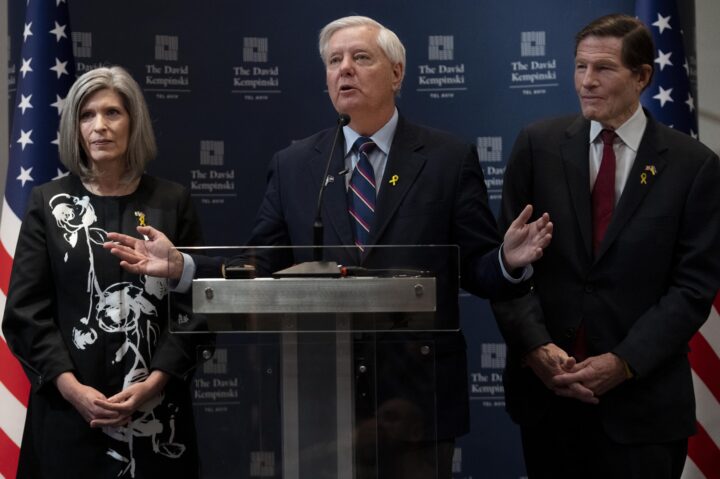
Maya Alleruzzo/AP photo
Sen. Lindsey Graham, R-S.C., center, speaks to journalists at a press conference with Sen. Joni Ernst, R-Iowa, left, and Sen. Richard Blumenthal, D-Conn., as part of a bipartisan U.S. Senate delegation during their visit to Israel, in Tel Aviv, Monday, Feb. 17, 2025.
The Lebanese Armed Forces is facing pushback from two U.S. lawmakers over a statement it posted to social media on Sunday blaming Israel for flare-ups with Hezbollah in southern Lebanon.
The LAF wrote in a post on X, “The Israeli enemy persists in its violations of Lebanese sovereignty, causing instability in Lebanon, obstructing the completion of the army’s deployment in the south.”
“The latest of these condemned aggressions was its targeting of a patrol of the United Nations Interim Force in Lebanon” on Sunday, the post added.
The IDF said that the U.N. soldiers had been “classified as suspects due to poor weather conditions” and that the incident was under investigation.
The LAF post went on to state that it is “working in coordination with friendly countries to put an end to the ongoing violations and breaches by the Israeli enemy, which require immediate action as they represent a dangerous escalation.”
The Lebanese government has agreed to begin efforts to disarm Hezbollah, though reports indicate the terror group is attempting to rebuild its stockpiles after Israel degraded its weapons capabilities over the past several years.
Sen. Joni Ernst (R-IA) responded to the post later that night, writing that she was “disappointed by this statement.”
“The LAF are a strategic partner, and — as I discussed with the CHOD in August — Israel has given Lebanon a real opportunity to free itself from Iran-backed Hezbollah terrorists,” Ernst wrote. “Instead of seizing that opportunity and working together to disarm Hezbollah, the CHOD [Chief Head of Defense] is shamefully directing blame at Israel.”
Sen. Lindsey Graham (R-SC) also weighed in, criticizing the LAF for the statement and its failure to target Hezbollah militarily.
“It is clear that the Lebanese Chief Head of Defense — because of a reference to Israel as the enemy and his weak almost non-existent effort to disarm Hezbollah — is a giant setback for efforts to move Lebanon forward,” Graham wrote on X.
“This combination makes the Lebanese Armed Forces not a very good investment for America,” he added.
Ernst and Graham have both visited Lebanon in recent months amid efforts to encourage Lebanon to disarm Hezbollah and stabilize its border with Israel.
The bipartisan Senate International Narcotics Control Caucus convened the hearing to explore the expansion of Hezbollah’s influence in Latin America

AP Photo/Jesus Vargas
Venezuela's President Nicolas Maduro points at a map of the Americas during a news conference in Caracas, Venezuela, Sept 15, 2025.
The first congressional hearing on Hezbollah’s malign activities in the Western hemisphere in a decade took place this week, highlighting Venezuela’s embrace of Iran as a geopolitical partner and the Maduro regime’s efforts to transform the country into a regional hub for narcoterrorism.
The bipartisan Senate International Narcotics Control Caucus convened the hearing, titled “Global Gangsters: Hezbollah’s Latin American Drug Trafficking Operations,” on Tuesday, to explore how Hezbollah’s influence in the region had expanded and determine the most effective ways for the U.S. to respond. Witnesses included Amb. Nathan Sales, who served as the State Department’s counterterrorism coordinator in the first Trump administration; Marshall Billingslea, the special envoy for arms control and a former Treasury official during President Donald Trump’s first term; Matthew Levitt, the director of the Reinhard Program on Counterterrorism and Intelligence at The Washington Institute for Near East Policy; and Robert Clifford, a former FBI official who worked in the counterterrorism space.
Senators and counterterrorism experts warned that Venezuela had established itself as the narcoterrorism epicenter of Latin America, and predicted that Hezbollah would deepen financial ties with Venezuelan leader Nicolás Maduro as a result. Senators on both sides of the aisle and hearing witnesses urged a hawkish approach to quell Venezuela’s behavior.
“We have long known that Hezbollah is one of Iran’s tools to destabilize and terrorize the Middle East. Until 2023, about 70% of Hezbollah’s finances came from Iran. Hezbollah held up its side of the transaction,” Sen. Sheldon Whitehouse (D-RI), the top Democrat in the caucus, said. “Over the last two years, both Iran and Hezbollah have suffered significant setbacks. Iran is now looking more inward and Hezbollah is cash starved. If we target Hezbollah’s financing, we can deny them the opportunity to rebuild.”
“Where will Hezbollah look for money? Hezbollah has operated in Latin America for almost 50 years, cultivating ties with drug traffickers and developing illicit finance and trade networks. Modern drug cartels and terrorist groups run more like Fortune 500 conglomerates than street gangs,” he continued. “If we want to be serious about fighting the drug traffickers behind American deaths, we must strike their financial networks.”
Sen. Bernie Moreno (R-OH), the newest member of the caucus, asked witnesses for their take on the U.S. potentially declaring Venezuela as a state sponsor of terrorism, to which Billingslea and Sales both responded that the South American country’s behavior met the legal standard.
“Maduro should know his days are numbered,” Moreno, who was born in Colombia, said.
Sales also suggested that more Latin American countries should “designate Hezbollah in its entirety as a terrorist organization. Not just its so-called military wing, all of it.”
“During the first Trump administration, five Latin American countries did exactly that. Argentina, Colombia, Guatemala, Honduras and Paraguay,” Sales said. “According to a recent RAND study, the Latin American countries that sanctioned Hezbollah during the first [Trump] term have generally seen a drop in activity by the terror group. By contrast, Hezbollah has been more active in the countries in the region that haven’t designated it.”
Levitt noted that narcotics trafficking had become a key source of income for Hezbollah as Iran’s other financing wells dried up.
“Hezbollah has a long history of turning to its diaspora networks when it’s facing financial stress. Iran is still believed to provide Hezbollah with about the same amount of money today that it did before the Oct. 7 attacks, but that is not enough money to do what it needs to do today. And Iran is having a much harder time getting that money to Hezbollah in a timely manner,” Levitt explained.
“When Hezbollah is under stress, they traditionally reach out to their illicit financial networks around the world. We can expect that they will do the same today,” he continued. “If you need big money real fast, you turn to illicit activities and especially to narcotics trafficking. Hezbollah has demonstrated its ability to play an important and lucrative, niche role in laundering the proceeds of narcotics trafficking for a wide array of cartels.”
The Ohio Democrat said that withholding aid from Israel would 'undermine' the country 'in a way that is really significant'
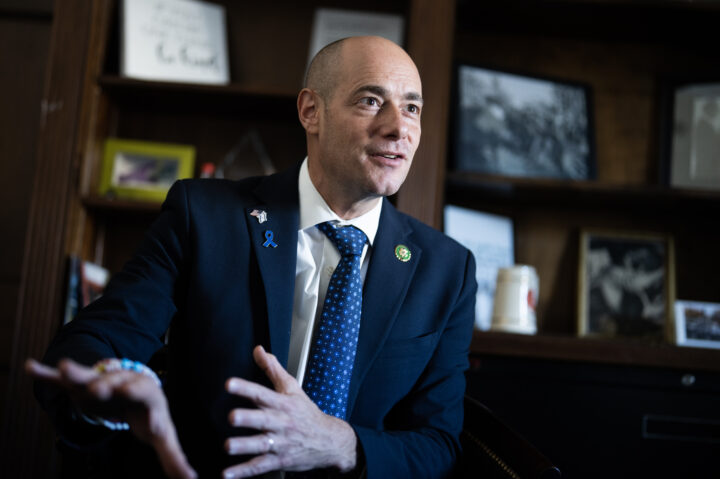
Tom Williams/CQ-Roll Call, Inc via Getty Images
Rep. Greg Landsman (D-OH) is interviewed by CQ-Roll Call, Inc via Getty Images in his Longworth Building office on Friday, November 3, 2023.
Rep. Greg Landsman (D-OH), in a webinar with Democratic Majority for Israel on Tuesday, emphasized that colleagues who push to block aid to Israel or recognize a Palestinian state risk emboldening Hamas, Hezbollah and Iran when they are on their back foot.
Landsman also laid out what he sees as preconditions for rebuilding Democratic support for the Jewish state.
“Saying, ‘We’re going to withhold aid, we’re going to unilaterally call for a Palestinian state’ — which exists where? Is that all of Israel? What are you talking about? — that suggests to Hamas, ‘Maybe we should keep fighting,’” Landsman said. “I don’t think that’s their intent. I think that it’s entirely appropriate to be critical of the government and decisions … without abandoning our ally.”
“Witholding aid does undermine our ally in a way that is really significant,” Landsman continued.
He said he’s trying to push colleagues in that direction. He added later that he believes that the war in Gaza is a “just war,” even if “it needs to come to an end.”
Asked about the longer-term path toward rebuilding Democratic support for Israel, Landsman said that an end to the war and new leadership in Israel would likely be critical steps in that direction.
“Once we get on the other side of this and we have a government that’s really actively pursuing peace, then the path for a lot of these folks who have felt alienated, to come back. I think is pretty clear,” Landsman said.
He added that peace must also come alongside continued efforts to beat back threats. “You do have to take out these terror armies, and you have to marginalize and completely sideline Iran as a threat, which is going to require constant work.”
He said he was encouraged to see the deal put forward by the Trump administration on Monday, arguing that the war “needs to end for a whole host of reasons,” including freeing the hostages and surging aid into Gaza.
“Israel’s standing in the international community has been diminished, which is a key strategy for Hamas. And this is one of the reasons why I think Netanyahu has got to figure out a way to end this war, because Hamas is succeeding at delegitimizing Israel in a way that is really harmful, way more so than anything it could do militarily,” Landsman said. “I think you’ve got to take that off the table, and that means ending the war.”
Landsman also said that “there’s still limited pressure on Hamas to end this war” and called on the Trump administration to employ “maximum leverage, maximum pressure” on the group, including by detaining Hamas leaders in Qatar.
He added that surging aid is “the right thing to do, it’s the Jewish thing to do and it’s also just strategically what has to happen if Israel is going to maintain its standing in the world and continue to get support.”
He said that positive steps are being taken but added that there are “serious issues with UNRWA that the U.N. and the international community have not gotten serious about.”
He also emphasized the need for an Arab-nation compact to bring the war to an end and deradicalize and rebuild Gaza with a new government that seeks peace with Israel.
“Get all 22 of them involved in a very formal and committed, long-term, sustainable way,” Landsman said. “I think that helps achieve the goals that we collectively have for ending this war and getting Gaza to a place where Hamas is gone, the strip is deradicalized and we’re in a position to help them rebuild with a new governing authority that wants peace with the state of Israel.”
Landsman suggested that such an effort could also unlock Arab-Israeli peace.
“An Israel that’s seeking peace is quite popular. I think that’s what [Saudi Crown Prince Mohammed bin Salman] would support. Once this war is over and there is a pathway to peace because these terror armies have been defeated … I think these folks do come back and say, ‘Okay, let’s be part of something,’” Landsman continued.
He said that the Trump administration needs a larger team, working full-time, on pursuing Middle East peace in the longer term. “You’ve got to get ironclad commitments from all of these countries. It’s got to be formal. They’ve got to come together in a formal, sustainable way.”
Without continuous White House pressure and attention, he warned that any peace that is reached is likely to crumble.
Sen. Lindsey Graham sounded skeptical that Hamas would accept the deal: ‘Distrust and verify with these guys’

Amir Levy/Getty Images
Senator Lindsey Graham (R-SC) speaks at a press conference on US-Israel relations on February 17, 2025 at the Kempinski Hotel in Tel Aviv, Israel.
Senators reacted with cautious optimism — and a degree of skepticism — to President Donald Trump’s announcement on Monday of a sweeping deal that would end the war in Gaza, see the release of the remaining hostages and facilitate reconstruction of the Gaza Strip.
Sen. Lindsey Graham (R-SC) warned that the execution of the deal would require close monitoring of Hamas’ compliance and that long-term peace in the region will likely require eliminating Iran’s other proxies, in addition to Hamas.
“I hope Hamas agrees — we’ll get the hostages home. Distrust and verify with these guys,” Graham said. “A lot of loopholes if you don’t watch it, but I hope we can land this deal.”
“When you talk about normalizing the Mideast, I’m all for that. But after Oct. 7, we have to learn one thing: As long as radical Islamic terrorist groups exist, you can’t have a normal Mideast,” Graham continued. “I hope we can land this deal and bring the hostages home and start a new chapter in Gaza and the West Bank, but I will never support normalization until Hezbollah is dealt with. You cannot say the Mideast is a normal place as long as Hezbollah is a threat the way it is today.”
He said that he’s concerned that Hezbollah would replicate Hamas’ Oct. 7 attack if Israel and Saudi Arabia again begin to move toward normalization again before the Lebanese terror group is eliminated.
“If we do the Hamas deal, we should insist that the region deal with Hezbollah and take them both down, then eventually the Houthis,” he continued. “My takeaway of Oct. 7 is if you don’t have these radical groups in a box, you can never really achieve peace.”
Sen. John Cornyn (R-TX) said that there are “some details to be filled in, but I think by and large this seems like a very encouraging development.”
Sen. Rick Scott (R-FL) was hesitant to offer an assessment of the deal before Hamas had agreed to the terms.
“It’s the deal that hasn’t happened yet. It’d be nice. I mean, I guess it would be great if we get the hostages back and we get a ceasefire and we get to rebuild Gaza. That all sounds really good. I’m glad that Trump cares about this. It seems optimistic,” he told JI.
Sen. Kevin Cramer (R-ND) expressed some hesitation about engaging with the Qataris and taking a deal, but suggested Trump was ready to bring the conflict to a close.
“It’s bold. It’s gutsy on the president’s part. I just will believe it when I see it. I’m just so skeptical of one side in this, getting Qatar in there and involved,” Cramer told JI. “Clearly we’re playing along a little. I don’t know. I just don’t know. I think the timing for Trump is sort of like, ‘Okay, now’s the time [for a ceasefire]. We’ve done the dance long enough.’”
Sen. Ted Budd (R-NC) said he’s reviewing the plan, adding that the elimination of Hamas is a necessity.
“You can’t have Hamas promising the destruction of Israel,” he continued. “As long as there’s no threat, I see an opportunity here, but you can’t make a deal with somebody that wants to exterminate you.”
Senate Foreign Relations Committee chair Jim Risch (R-ID) praised the plan on X. “President Trump again shows his commitment to peace with his plan to bring all the hostages home, end the war in Gaza and transition to a future that allows the Palestinian people to prosper without Hamas’ terror schemes,” Risch said. “Anyone who wants a better future for the Palestinian people should join this pursuit of peace.”
Sen. John Kennedy (R-LA) told Jewish Insider he’s “glad they look like they’re moving toward peace.”
“I don’t think Israel is worried any longer about being popular. I think Israel was worried about its survival, and I respect that. And they’re going to do whatever it takes,” Kennedy continued. “Now, will Hamas accept it? I don’t know. I really don’t know. I hope they do. But if they don’t, I think Israel needs to continue to do what it’s been doing and wipe Hamas off the face of the earth.”
Democrats expressed hope that the deal would bring the war to a close.
Sen. Chris Coons (D-DE) told JI, “I’m encouraged the president’s engaging directly and saying this war must end. Humanitarian relief needs to go in, hostages need to come out, there needs to be a plan going forward for Gaza,” but said he hadn’t seen the details of Trump’s announcement.
Sen. Richard Blumenthal (D-CT) said that he was not familiar with the specifics of the plan. “If there’s a ceasefire and return of the hostages and humanitarian relief, bravo,” Blumenthal said.
Sen. Peter Welch (D-VT), one of the most vocal critics of Israel’s Gaza operations in the Senate, told JI he hadn’t reviewed the plan but “my main concern [is to] start getting food and medicine in. That has to happen immediately.”
Sen. Jeanne Shaheen (D-NH), the ranking member of the Foreign Relations Committee, said in a statement. “I call on Hamas to accept, and Israel to faithfully implement, the proposal laid out by the United States.”
Prior to the meeting, leading Senate Democrats had urged Trump to press Israeli Prime Minister Benjamin Netanyahu to accept a hostage deal that ends the war, as well as to pressure Netanyahu to rule out annexation of the West Bank.
The Israeli PM said the country’s ‘support quickly evaporated when Israel did what any self-respecting nation would do in the wake of such a savage attack: We fought back’
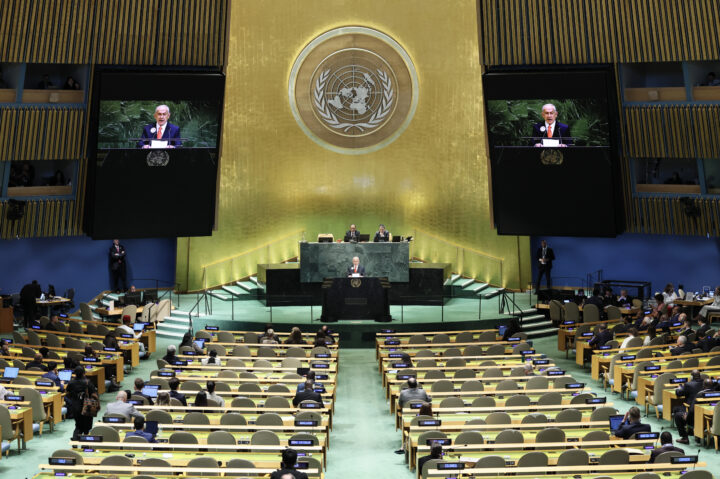
Michael M. Santiago/Getty Images
Israeli Prime Minister Benjamin Netanyahu addresses world leaders during the United Nations General Assembly (UNGA) at the United Nations headquarters on September 26, 2025 in New York City.
In Israeli Prime Minister Benjamin Netanyahu’s address to the United Nations General Assembly on Friday morning, he painted a picture of a nation abandoned by its allies, who he said had caved to “radical Islamist constituencies and antisemitic mobs” — a message underscored by the backdrop of a mostly empty General Assembly room, following the walkout of dozens of diplomats at the start of his speech.
Netanyahu began with a victory lap, hailing Israel’s military successes against Hezbollah, Iran and even Hamas over the past year. But much of the speech was defensive in nature, relying on rhetoric he has invoked frequently over the last two years. He articulated the reasons why Israel is still fighting Hamas, despite the fact that Israel “crushed the bulk of Hamas’ terror machine.” And he attacked the U.N. and the countries that he said had shown up for Israel in the days after the Oct. 7 attack but that have since changed course.
“In the days immediately following Oct. 7, many of them supported Israel. But that support quickly evaporated when Israel did what any self-respecting nation would do in the wake of such a savage attack: We fought back,” he said.
He defended Israel’s handling of the war in Gaza as moral and appropriate, saying the nation faces “the false of charge of genocide.”
“The truth has been turned on its head. Hamas is a genocidal terrorist organization whose charter calls for the murder of all Jews on the planet. This genocidal organization is given a pass while Israel, which does everything it can to get civilians out of harm’s way, Israel is put in the dark. What a joke,” said Netanyahu.
Known for his theatrics in his annual U.N. address, Netanyahu wore a large button with a QR code that linked to a website featuring gruesome videos of Hamas’ attack on southern Israel two years ago. He also told the crowd that he had directed the IDF to set up loudspeakers to broadcast his speech out loud on the Gaza border, a measure he said was meant as an attempt to reach Israeli hostages still held in Gaza — and that the remarks were being carried live on the cell phones of Gazans, to convince Hamas to “lay down your arms.”
Netanyahu repeatedly invoked the Sept. 11 terror attacks and the global war on terror as proof of the depravity Israel is fighting in Gaza.
“Giving the Palestinians a state one mile from Jerusalem after Oct. 7 is like giving Al-Qaida a state one mile from New York City after Sept. 11. This is sheer madness. It’s insane, and we won’t do it,” said Netanyahu. The Israeli prime minister has doubled down in his pledge to never allow the creation a Palestinian state after France, the United Kingdom, Australia and Canada unilaterally recognized a Palestinian state this week.
He slammed those nations, saying their move “reward[s] the worst antisemites on earth.” They chose to recognize a Palestinian state, Netanyahu said angrily, even though “nearly 90% of Palestinians supported the attack on Oct. 7 … just the way they celebrated another horror, 9/11.”
Netanyahu offered little to those who want to see Israel present a plan for the end of the war and for the governance of Gaza without Hamas, though he said Israeli “victory” would open opportunities for peace in the region.
“Victory over Hamas will make peace possible with nations throughout the Arab and Muslim world. Our victory would lead to a dramatic extension and expansion of the historic Abraham Accords, which President Trump brokered between Arab leaders and myself five years ago,” said Netanyahu. He did not address whether he would move to annex parts of the West Bank, which Saudi Arabia — Israel’s top target for normalization — said earlier this week would be a “red line,” and that President Donald Trump said yesterday he will not allow.
He closed with a prayer for a speedy victory, even if Israel has to achieve it alone.
“The rise of Israel did not mean that the attempts to destroy us would end. It meant that we could fight back against those attempts, and that is exactly what Israel has done since Oct. 7,” said Netanyahu. “Two years later, the resolve of Israel and the strength of Israel burn brighter than ever. With God’s help, that strength and that resolve will lead us to a speedy victory into a brilliant future of prosperity and peace.”
Plus, Patel probes far-left protest funding

Good Wednesday morning.
In today’s Daily Kickoff, we interview Sen. Steve Daines about his weekend visit to Israel and have the scoop on a letter signed by 50 Senate Republicans urging the foreign ministers of the U.K., France and Germany to hold firm in triggering snapback sanctions on Iran. We report on FBI Director Kash Patel’s comments that federal investigators are probing the funding sources of left-wing protest movements and highlight a call by House Republicans on the White House to probe far-left billionaire Neville Roy Singham’s ties to China. We also cover a press conference held yesterday by Israeli Prime Minister Benjamin Netanyahu to clarify his previous comments that the Jewish state will need to be like “super-Sparta” and adapt to “autarkic characteristics.” Also in today’s Daily Kickoff: Gov. Josh Shapiro, Rep. Josh Gottheimer and Alex Karp.
Today’s Daily Kickoff was curated by Jewish Insider Israel Editor Tamara Zieve and U.S. Editor Danielle Cohen-Kanik, with an assist from Marc Rod. Have a tip? Email us here.
What We’re Watching
- President Donald Trump and First Lady Melania Trump are spending the day in England for a royal visit, where they will be welcomed by King Charles III and Queen Camilla at Windsor Castle.
- This morning, the House Foreign Affairs Committee will hold a markup of bills aimed at reorganizing and reforming the State Department. Read JI’s breakdown of the legislation here.
- The Senate Foreign Relations Committee will vote to advance a series of nominees out of committee, including Michel Issa to be ambassador to Lebanon; Richard Buchan to be ambassador to Morocco; Ben Black to lead the U.S. International Development Finance Corporation; and a second vote on the nomination of Mike Waltz, the former national security advisor, to be U.S. ambassador to the U.N., in order to prevent a procedural challenge from Democrats.
- Also on the Hill, the U.S. Helsinki Commission will hold a briefing on “conspiracy theories, antisemitism and democratic decline.”
- The annual Defense of Freedom-Federalist Society Education, Law & Policy Conference examining the most pressing legal and policy issues in education kicks off today in Washington. Featured speakers include Secretary of Education Linda McMahon and Brandeis Center Chairman Kenneth Marcus. One of the panels will focus on discussing the federal government’s efforts to combat antisemitism.
What You Should Know
A QUICK WORD WITH JI’S JOSH KRAUSHAAR
A new poll of young conservatives between the ages of 18-34 commissioned by the Washington Free Beacon shows that Gen Z Republicans are decidedly more supportive of Israel than their liberal counterparts, but that there is a notable faction of those who take a more critical view towards the Jewish state.
The Echelon Insights poll also found that anti-Israel and antisemitic podcasters like Nick Fuentes, Tucker Carlson and Candace Owens are viewed favorably by this right-wing cohort — even among many of the respondents who say they support Israel and recognize antisemitism is a problem.
Carlson’s favorability rating among these Gen Z conservatives, for instance, is 50%, with only 11% viewing him unfavorably. Owens has a similarly strong 49/14% favorability rating. The Holocaust-denying podcaster Darryl Cooper isn’t nearly as well-known, but is viewed positively by those who listen to him, holding a 26/8% favorability rating.
At the same time, pro-Israel podcasters like Ben Shapiro are also viewed very favorably; Shapiro’s favorability rating with this cohort is 50/16%. Fox News host Mark Levin isn’t quite as well-known, but holds a stellar 29/7% favorability rating. Asked about “Jews” generally, half of respondents hold a favorable view with only 12% holding an unfavorable opinion.
The encouraging news? A number of these podcast listeners are tuning in to these transgressive shows featuring conspiracy theories, anti-Israel views and some antisemitism, but many are not being persuaded by them. For all their vitriolic attacks against the Jewish state, 54% of Carlson’s viewers and 58% of Owens’ audience have a favorable view towards Israel.
But the gloomier finding is that a notable minority on the right holds bigoted views towards Jews and is critical of Israel. Between 20-25% of these Gen Z conservatives consistently express anti-Israel or antisemitic views — while support for Israel is not nearly as widespread as it is among older conservatives. While 40% of respondents said they side with Israel in its current conflict, about one-fifth (22%) said they side with the Palestinians. About the same percentage of Gen Z conservatives said they agree that “Israel is a colonizer built on the suffering of others.”
KARP’S CALL
Palantir’s Alex Karp says Jews need to ‘leave their comfort zone’ to defend community

Palantir CEO Alex Karp called for the Jewish community to step outside its “comfort zone” and look for new strategies to defend itself amid rising antisemitism, during a speech on Tuesday at the American Friends of Lubavitch (Chabad) annual Lamplighter Awards in Washington. Karp, who was honored at the Chabad gala, also framed the battle against antisemitism as part of a broader fight for Western civilization and societies, Jewish Insider’s Marc Rod reports.
What he said: “Lessons that we’ve learned at Palantir … might be valuable for defending the West, in this particular case a particular tribe of people that are equally associated with the West, the Jewish people,” Karp said. “Palantir is a metaphor for working when there’s no playbook, and currently there is no playbook because institutions that have historically effectively defended people who’ve been discriminated against, especially Jewish people, are kind of not working.” Karp continued, “If we’re going to have a meaningful chance of fighting, everybody’s going to have to leave their comfort zone a couple times a year. It’s our job and my job to remind people [of] that, especially younger people here.”
trip talk
Following visit to Israel, Sen. Daines reemphasizes the need to ‘eradicate’ Hamas
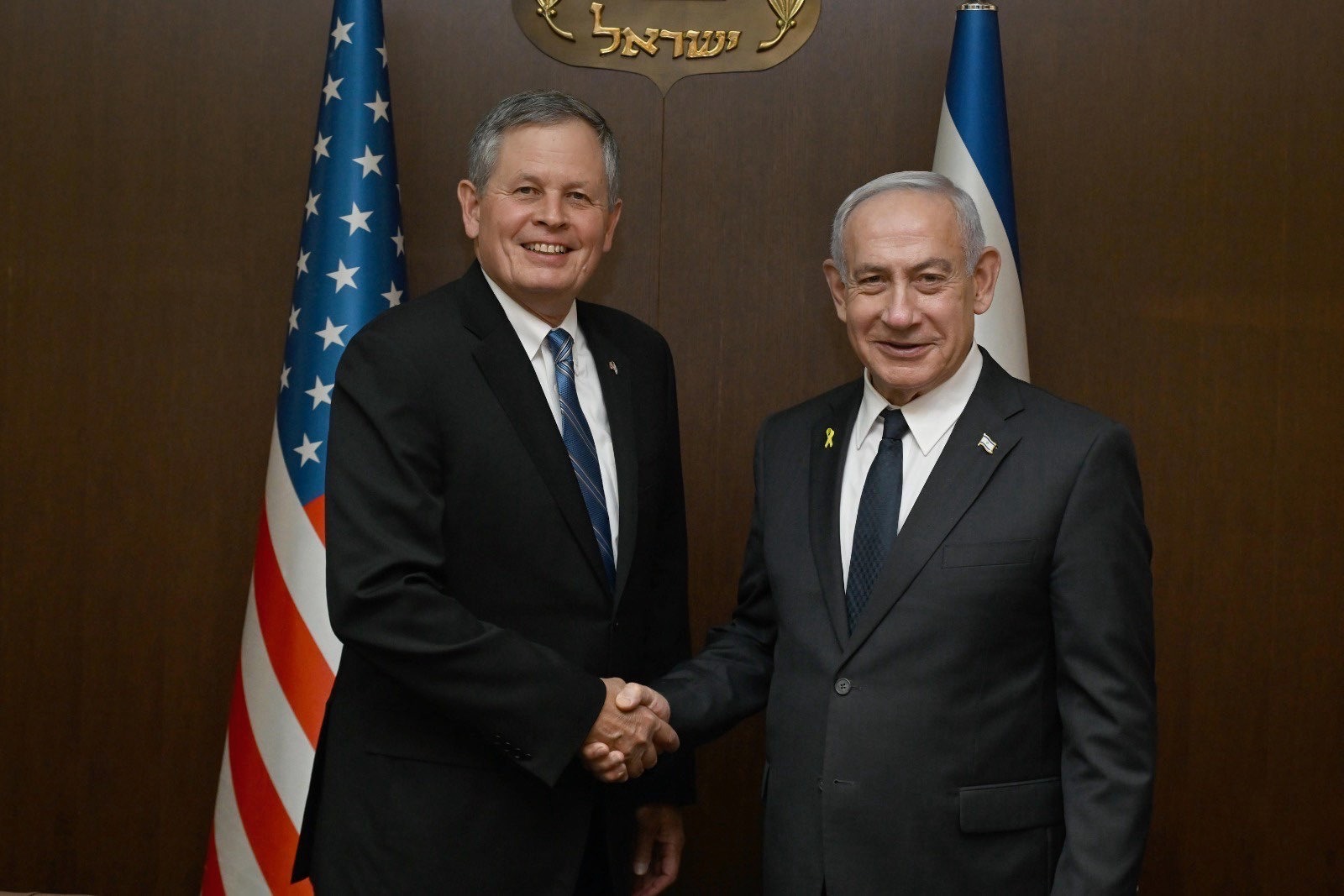
Sen. Steve Daines (R-MT) said he left Israel from a weekend visit with a renewed belief in the U.S.-Israel relationship and the necessity of fully eradicating Hamas, as the IDF begins expanded operations in Gaza City, Jewish Insider’s Marc Rod reports.
Doubling down: “It just reinforced my position of the importance that the United States stands with Israel, and in supporting Israel in their mission to eradicate Hamas in Gaza,” Daines said in an interview with JI this week, reflecting on a meeting with Israeli Prime Minister Benjamin Netanyahu. “There will never be true peace in Gaza and peace with Israel until Hamas is eradicated.” He said that it’s also crucial for innocent Palestinians that Israel be successful in its mission to defeat Hamas. Daines said that he didn’t discuss the postwar vision for Gaza with Netanyahu, “but clearly the important first step will be eradicating Hamas.”
SCOOP
Fifty Senate Republicans call on European foreign ministers to hold firm on snapback, enforce Iran sanctions

Fifty Senate Republicans wrote to the foreign ministers of the U.K., France and Germany on Tuesday urging them to hold firm in triggering snapback sanctions on Iran and requesting their cooperation in sanctions enforcement, Jewish Insider’s Marc Rod reports.
Notable quotable: “While we back diplomatic efforts to restore Iran’s compliance with its International Atomic Energy Agency (IAEA) commitments, the international community should not allow hollow gestures and cynical threats from Tehran to stop the snapback process,” the lawmakers wrote. “The regime has abused diplomatic processes for years to avoid penalties. Sanctions relief should only be negotiated after snapback is fully implemented.”
COMMENT CLEAN-UP
Netanyahu does damage control after saying Israel to be like ‘super-Sparta,’ ‘autarky’
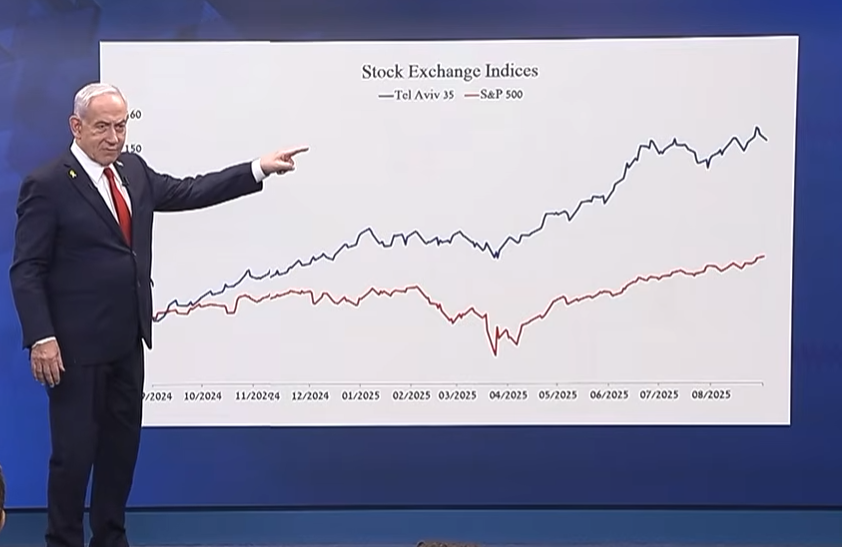
Israeli Prime Minister Benjamin Netanyahu clarified his remarks that Israel’s economy may “need to adapt to … autarkic characteristics” on Tuesday, after a dip in the Tel Aviv Stock Exchange and after business and industry leaders came out against Netanyahu’s remarks, saying that “an autarkic economy will be a disaster for Israel,” and “this vision … will make it hard for us to survive in a developing globalized world,” Jewish Insider’s Lahav Harkov reports.
Damage control: A day later, Netanyahu called a press conference amid widespread concern in Israel, clarifying that his comments were specific to the Israeli defense industry. In the defense industry, he said “there are limitations that are not economic, but political.” He stated, “If there’s one lesson from this war, it is that we want to be in a situation where we are not limited. We want to defend ourselves by ourselves and with our own weapons. We are going to produce an independent arms industry that is very strong that can withstand any political constraints.”
WH invite: In the press conference, Netanyahu also said he had spoken on the phone with President Donald Trump several times since Israel’s strike aimed at Hamas leaders in Qatar last week, including one in which the president invited him to the White House. Netanyahu said he will be meeting with Trump in Washington on Sept. 29.
PROTEST PROBE
Kash Patel vows to investigate funding for left-wing protest movements
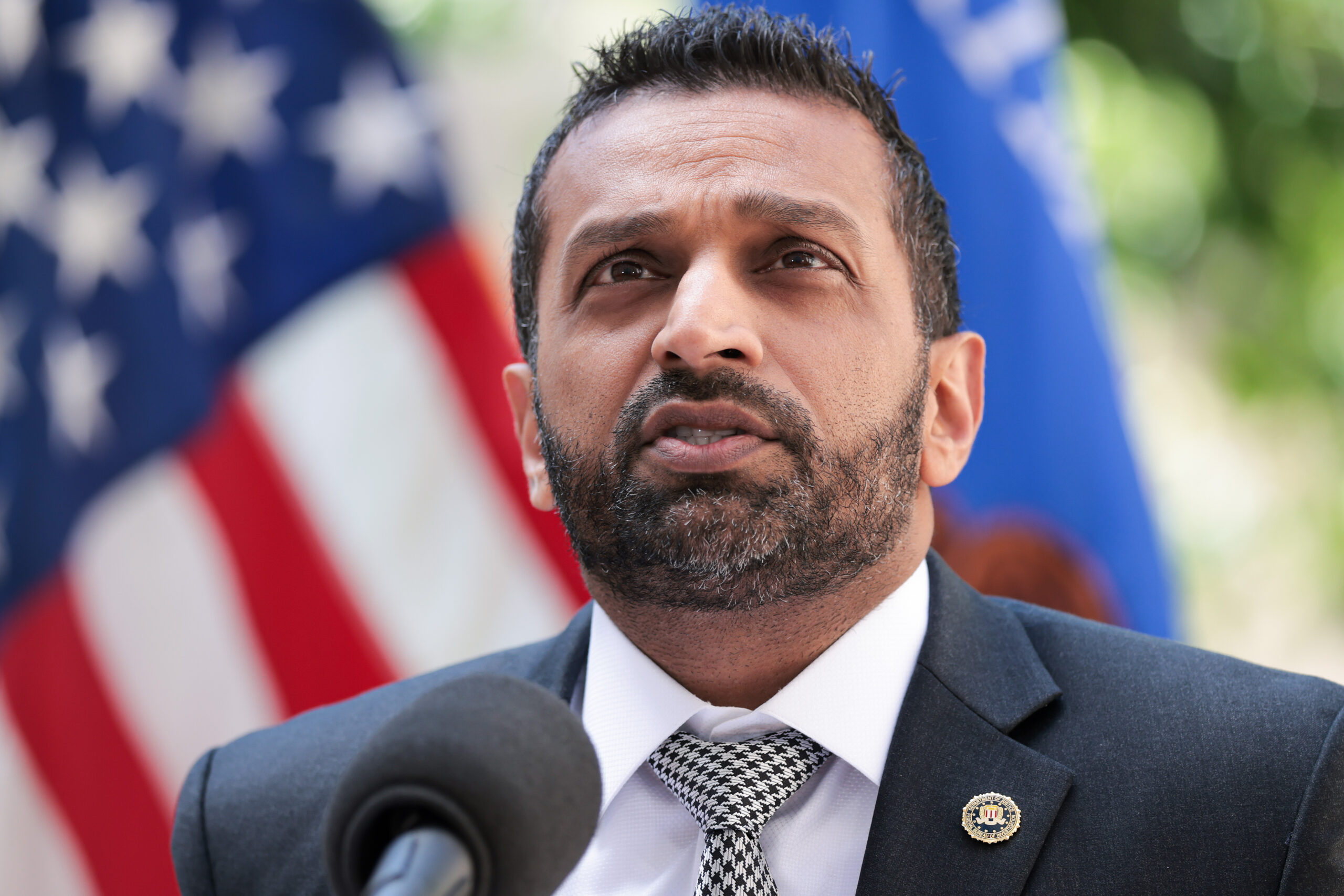
FBI Director Kash Patel said on Tuesday that federal investigators were looking into the funding sources for left-wing groups behind organized protest movements that have resulted in rioting on city streets and civil rights violations on college campuses. Patel made the comments while appearing before the Senate Judiciary Committee for a marathon oversight hearing, where he faced dozens of questions from Democrats and Republicans about the assassination of conservative influencer Charlie Kirk last week, Jewish Insider’s Emily Jacobs reports.
Follow the money: Sen. Ted Cruz (R-TX) urged Patel to investigate the financing of far-left groups that the Texas senator said may have influenced the suspected shooter and supported protests in recent years that saw instances of rioting or other illegal activity. “As I’ve always said, Senator, money doesn’t lie. We’ve been following the money, and that’s what we’re doing, issuing a lawful process to organizations involved with criminal activity because the money has got to come from somewhere,” Patel told Cruz.
Money matters: The House Oversight Committee asked the Trump administration on Monday to investigate if far-left billionaire Neville Roy Singham’s bankrolling of “extremist organizations fueling division and civil unrest across the United States” would qualify him for federal sanctions or make him eligible for criminal or legal penalties.
SHAPIRO’S SERMON
Drawing on Jewish blessing, Shapiro offers ‘words of healing’ to a nation on edge

Amid an alarming rise in political violence, Pennsylvania Gov. Josh Shapiro said Tuesday that the way to combat extremism and division is by bringing people together and restoring their faith in the government — a civic-minded strategy that included some thinly veiled swipes at President Donald Trump and the hard-line rhetoric he has adopted since conservative activist Charlie Kirk was killed in Utah last week, Jewish Insider’s Gabby Deutch reports.
What he said: “I believe we have a responsibility to be clear and unequivocal in calling out all forms of political violence, making clear it is all wrong,” Shapiro, a Democrat, said in a keynote address at the Eradicate Hate Global Summit, a Pittsburgh conference created in the aftermath of the 2018 mass shooting at the Tree of Life synagogue. “Unfortunately some, from the dark corners of the internet all the way to the Oval Office, want to cherry pick which instances of political violence they want to condemn.” Shapiro leaned on Jewish teachings in his speech, referring as he often does to how his faith underpins his public service.
Worthy Reads
Out in Left Field: Former Obama administration official Ken Baer writes in the Washington Post about how DSA-affiliated New York City mayoral nominee Zohran Mamdani is an affront to Democratic Party principles. “It is “spineless politics” to do precisely what [Sen. Chris] Van Hollen, [Gov. Kathy] Hochul and other Democrats have done — and that more Democrats presumably will do in coming days — by casting aside the party’s time-honored liberal principles to back Mamdani. Addressing the affordability crisis is noble. But who’s against affordability? What matters is not just a party’s policy ends, but also its means and its rationale for pursuing them. In the months since President Donald Trump’s victory, Democrats have made no progress in articulating what they are for — and why … At best, this failure presents Democrats as inauthentic as they explain and backpedal when confronted with extreme beliefs from the party’s left but offer nothing in replacement. At worst, it allows the left — within and outside the party — to define the party” [WashPost]
Good Cop, Bad Cop: In The Free Press, Michael Doran, senior fellow and director of the Center for Peace and Security in the Middle East at the Hudson Institute, weighs in on what he describes as President Donald Trump and Israeli Prime Minister Benjamin Netanyahu’s “good cop-bad cop” routine. “Israel’s ability to go on offense places it in a rare category among U.S. allies. Most lack the will or capacity to wage war independently. Critics like Tucker Carlson depict Israel’s independence as a liability, dragging America into fights that don’t serve its interests. Trump sees the reverse: Unilateral Israeli military operations spare American forces and serve U.S. strategic goals. In just two years, Israel has blunted Iran’s nuclear ambitions, hammered Hezbollah, neutered Hamas, and weakened the Houthis—achievements many Americans view as enhancing their own security.” [FreePress]
History Lesson: In The Atlantic, Arash Azizi revisits the history of Zionism amid growing use of the term as a slur. “One summer in Brooklyn, a controversy broke out in my dog-park group chat. Dedicated to the upkeep of the park and welfare of our canines, our chat had never indulged in politics before. But someone was now complaining that a dog-insurance company was ‘Zionist,’ and a passionate debate ensued … To criticize someone for supporting, say, the Israeli government or its war in Gaza is one thing. But this charge is broader and vaguer, uttered sometimes in circumstances with no reference to Israel, and in many cases as little more than an anti-Semitic dog whistle. I’m probably the only Middle Eastern member of that park group chat. I’m also a historian by training. I jumped in to say that I didn’t think Zionist should be used as a term of derision. Zionism is a nationalist movement, I insisted, and like other nationalist movements, it has a story rooted in the 19th century—one that is neither all good nor all bad. To call someone a Zionist as an insult is as strange as attacking someone for being a Ghanaian or Chinese nationalist. I’m not sure how many people I convinced. But to me the history of Zionism bears revisiting as a reminder of its impetus and early diversity.” [Atlantic]
Word on the Street
Israeli and U.S. officials continue to lament the failure of the Israeli strike in Doha, Qatar, both substantively and diplomatically, with one Israeli official telling Axiosthat “none of the top Hamas leaders were killed” and an American official saying they’d advised Israel to take steps to rectify its relationship with the Trump administration…
Rep. Josh Gottheimer (D-NJ) wrote to Kathy Goldenberg, the president of the New Jersey State Board of Education, on Monday urging the state to reject calls from the New Jersey chapter of the Council on American-Islamic Relations for the state’s education boards to cut ties with the Anti-Defamation League, Jewish Insider’s Marc Rod reports…
Advocates with the Anti-Defamation League are set to lobby lawmakers this week on a series of actions related to antisemitism, including a push to jump-start the stalled Antisemitism Awareness Act, Jewish Insider’s Marc Rod reports…
A new plaintiff was added to a lawsuit brought by the Louis D. Brandeis Center for Human Rights under Law against the Massachusetts Institute of Technology. The complaint alleges that a Jewish graduate student was cornered in a campus parking lot by masked individuals calling for death to Israel and Zionists and faced a “campaign of hostility” inside his lab, and the university took no action when it was reported. The original complaint focused on a tenured linguistics professor who publicly harassed an Israeli postdoctoral researcher at the school…
Jerry Greenfield, co-founder of Ben & Jerry’s, has quit the ice cream company, saying that the business has been “silenced” by parent company Unilever on social issues; Unilever and Ben & Jerry’s have clashed in recent years over issues related to the Israeli-Palestinian conflict…
Israel presented Syria with a new security agreement several weeks ago, Axios reports, and Syria is now preparing a counterproposal. Israeli Strategic Affairs Minister Ron Dermer, Syrian Foreign Minister Asaad al-Shaibani and U.S. envoy Tom Barrack are set to meet in London on Wednesday to discuss the proposal…
Israeli strikes in Gaza City have reportedly cut off internet and telephone services in the city…
Iran executed Babal Shahbazi, whom it accused of spying for Israel, Iranian state media reported today…
The U.S. and China are finalizing a deal to transfer 80% of ownership of TikTok’s U.S. business to an investor consortium including Oracle, Silver Lake and Andreessen Horowitz. The new U.S. app will still utilize ByteDance’s algorithm, and Oracle will handle its user data in Texas…
Carl Heastie, the Democratic speaker of the New York State Assembly, is expected to endorse New York City Democratic mayoral nominee Zohran Mamdani this week, The New York Times reports, one of several state leaders in the party who have thus far resisted doing so, while Jay Jacobs, chair of the New York Democratic Party, told several people he does not plan to endorse Mamdani. Rep. Yvette Clarke (D-NY), chair of the Congressional Black Caucus, is reportedly set to endorse him on Monday…
Rep. Elise Stefanik (R-NY) introduced a bill that would “prohibit state and local law enforcement from arresting foreign nationals within the United States” solely based on warrants from the International Criminal Court, as Mamdani has threatened to do to Israeli Prime Minister Benjamin Netanyahu…
Sens. John Fetterman (D-PA) and Dave McCormick (R-PA) appeared on Fox News’ “Special Report” with Bret Baier on Tuesday evening for a discussion on improving political civility, where the duo condemned the use of political rhetoric equating one’s political opponents to Nazis or Adolf Hitler. “When you see dangerous rhetoric like fascist and Nazism and authoritarianism, and the end of democracy, that’s a permission, that takes us down a path where the inevitable next step is violence, and that’s what we see,” McCormick said…
The Democratic PR firm SKDK terminated its contract with the Israeli government, which was meant to run until March 2026. Originally contracted to raise the profile of the Bibas family tragedy, a spokesperson for the firm declined to tell Politico why the deal was cut short…
Gordon Gee, who served as president of five universities, is joining Brownstein as a strategic consulting adviser for the firm’s higher education task force…
Israeli Transportation Minister Miri Regev cleared Uber for entry into Israel’s taxi market, a significant move for the country, which has a strong taxi drivers union…
Ecuadorian President Daniel Noboa signed an executive order on Tuesday designating the Islamic Revolutionary Guard Corps, Hamas and Hezbollah as terrorist organizations…
The Wall Street Journal reviews Yaakov Katz and Amir Bohbot’s new book, While Israel Slept: How Hamas Surprised the Most Powerful Military in the Middle East, calling it “an agonizing litany of might-have-beens” and saying “Katz and Bohbot could have titled their book ‘While Israel Was Busy Doing Other Things.’” Read JI’s Lahav Harkov’s interview with Katz here…
Speaking at The Jerusalem Post Diplomatic Conference yesterday, U.S. Ambassador to Israel Mike Huckabee called out European countries for pushing for a unilateral recognition of a Palestinian state, charging that “it destroyed the negotiations for the hostages.” …
Political commentator, author and former host of “The View,” Meghan McCain accepted the Champion of Israel Award yesterday at the American Friends of Magen David Adom Gala at Cipriani Wall Street in New York City…
The Air Force said it has started upgrading the luxury jet donated by Qatar for use as Air Force One…
The New York Times reports on growing turmoil at Manhattan’s iconic Pierre Hotel, where Commerce Secretary Howard Lutnick, the building’s largest shareholder, now faces backlash from residents over a proposed $2 billion sale involving foreign investors that could force them out…
The Wall Street Journal spotlights the transformation of Manhattan’s 666 Fifth Avenue, once a high-profile real estate debacle under Jared Kushner’s ownership, now rebounding under Brookfield’s leadership with major renovations and new tenants…
TikTok recently removed at least two antisemitic items from TikTok Shop, a spokesperson told Axios, in a sign of the platform’s recent attempts to address antisemitism…
A new Broadway play, “Giant,” will explore the life of children’s author Roald Dahl and his controversial moments around antisemitism and Israel, in particular, including incendiary comments about the First Lebanon War and the Holocaust…
Pic of the Day
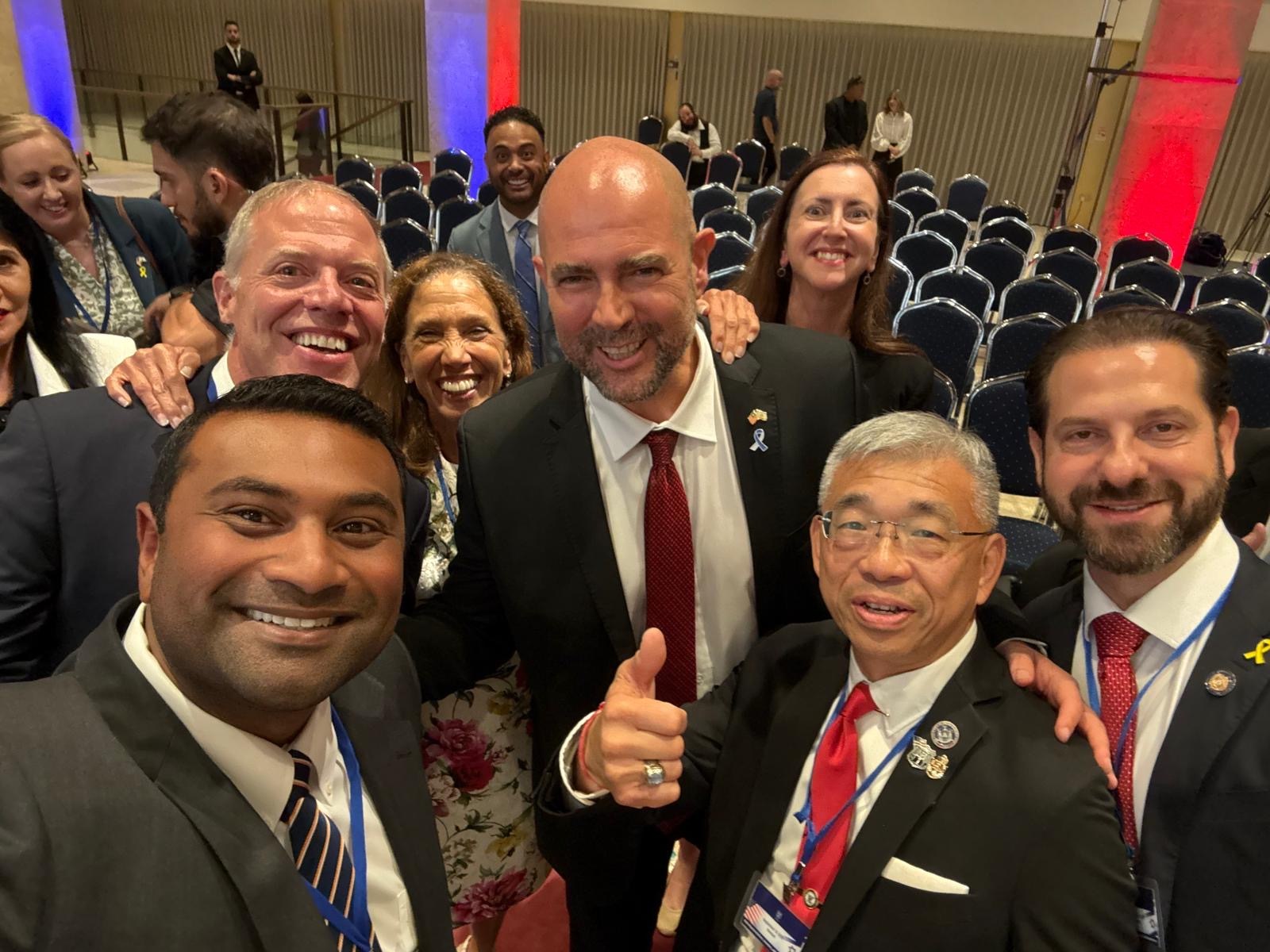
A delegation of New York State legislators met with Knesset Speaker Amir Ohana (center) in Jerusalem on Monday. From left: Assemblyman AJ Beephan, Minority Leader Will Barclay, Assemblywoman Amy Paulin, Assemblywoman Nily Rozic, Assemblyman Lester Chang and Assemblyman Daniel Norber.
Birthdays

Comedian, writer and actress, she was a frequent guest of Johnny Carson on the “Tonight Show,” Rita Rudner turns 72…
Fashion designer, known worldwide for his leading-edge corporate uniforms, Stan M. Herman turns 97… U.S. senator (R-IA) since 1981, Chuck Grassley turns 92… Investment banker who once served as a NYC deputy mayor, Peter J. Solomon turns 87… Newbery Honor-winning author of many young adult books, Gail Carson Levine turns 78… Author of 11 books, Joshua Muravchik turns 78… Former president of the National Technical Institute for the Deaf and then president of Gallaudet University, T. Alan Hurwitz turns 78… Rochester attorney, he has held positions at the UJA-Federation of New York and the Rochester Jewish Federation, Frank Hagelberg… Retired judge on the U.S. District Court for the Northern District of California, Jeremy Don Fogel turns 76… Professional tennis player who achieved a world ranking of No. 5 in 1980, Harold Solomon turns 73… Author, comic book writer and editor, best known as group editor of the Spider-Man books at Marvel Comics, Daniel Fingeroth turns 72… Israeli businessman with real estate holdings in Israel and NYC, Mody Kidon turns 71… Author and graphic designer, Ellen Kahan Zager… Former member of the Knesset for the Yesh Atid party, Rina Frenkel turns 69… Rabbi of the New North London Synagogue with over 3,700 members, Jonathan Wittenberg turns 68… Former consultant at Quick Hits News, Elliott S. Feigenbaum… Journalist, best-selling author including two books on the Obama presidency and Emmy Award-winning executive producer, Richard Wolffe turns 57… Director of the Centers for Disease Control and Prevention (CDC) for the last 18 months of the Biden administration, Mandy Krauthamer Cohen turns 47… Former regional communications director and spokesperson for President Obama, now a partner at Seven Letter, Adam Abrams… Member of the Los Angeles Unified School District’s Board of Education, Nick Melvoin turns 40… Former Obama White House speechwriter who has since written a best-selling comedic memoir, David Litt turns 39… Principal product manager for CathWorks, Adina Shatz… National health-care reporter The Washington Post covering the FDA, Rachel Roubein… Associate at Strand Partners in London, Natalie Edelstein Jarvis… Founder of the Israel Summit at Harvard and board member of the IDF Widows and Orphans Organization, Max August…
‘The full disarmament of Hezbollah is not optional. It is essential,’ Michel Issa said
Screenshot/YouTube
Michel Issa, nominee to be U.S. ambassador to Lebanon, speaks to the Senate Foreign Relations Committee during his confirmation hearing on July 29, 2025.
Michel Issa, the Lebanese-American businessman nominated by the Trump administration to serve as U.S. ambassador to Lebanon, said Tuesday that the Lebanese government and armed forces must act swiftly and decisively to disarm Hezbollah and remove its influence across Lebanese society.
Issa argued at his Senate Foreign Relations Committee confirmation hearing that the war between Israel and Hezbollah, “while devastating, has opened a narrow but meaningful window for progress,” in combination with the Israel-Lebanon ceasefire deal, the fall of the Assad regime in Syria and recent blows to Iran’s military and nuclear program.
He praised the new Lebanese government as a “promising development,” saying it has made progress in combating Hezbollah’s influence.
“The Iran-Israel escalation is a reminder of how delicate an opportunity this is that could be squandered if Iran drags Lebanon back down to the path of conflict,” Issa continued. “The government has made clear it will not tolerate any violation of the cessation of hostility, and since implementation, they have begun to curb Hezbollah’s influence. But more must be done. Urgently. The full disarmament of Hezbollah is not optional. It is essential. The time to act is now.”
Finishing that job and rooting out Hezbollah’s influence across Lebanon will be difficult and take time, he added, given its decades of influence and domination across Lebanese society.
“Hezbollah needs to go. Hezbollah needs to be disarmed to bring some kind of hope to Lebanon,” he said. As long as supply lines from Iran remain cut and with continued support from the United States and other partners, he continued, he believes that over time Hezbollah’s influence can be minimized and the government can secure its hold on power.
Issa said that it’s critical that the Lebanese government maintain full control of rebuilding efforts in southern Lebanon, and that it cannot allow Hezbollah to “hijack” that work as it has in the past. He added that the country must work to ensure governance reform and financial stability, accountability and growth.
He also argued that the U.S. should continue to push for a final settlement regarding the borders between Israel and Lebanon and ultimately normalize relations between the two countries.
Issa spoke highly of the Lebanese Armed Forces, saying that they will be critical to efforts to combat Hezbollah and have been a partner to the United States, which the LAF should continue to support and cooperate with. He said that the LAF is one of the few institutions that enjoys widespread trust and support within Lebanon.
“They are doing a great role in creating stability that is very well needed in Lebanon,” Issa said. “I believe they are ready to do whatever they need to do, to take over and to become the sole military power for the Lebanese government.”
Asked about whether the mandate for the United Nations peacekeeping force in Lebanon, UNIFIL, should be extended, Issa did not offer a definitive answer, saying that its role is changing with the LAF stepping up its role in monitoring the border with Israel and ensuring that Hezbollah does not continue to threaten the Jewish state.
Issa, who was born in Beirut, said that he had renounced his Lebanese citizenship in connection with his nomination, to show his commitment to the American people and the U.S.’ interests.
Duke Buchan, an investment banker who served as U.S. ambassador to Spain in Trump’s first term and is now nominated to be U.S. ambassador to Morocco, testified alongside Issa.
Buchan said repeatedly that he would work to support the Abraham Accords, both to expand the relationship between Israel and Morocco and to urge Morocco to encourage other countries to normalize relations with Israel.
He said it would be one of his “highest priorities” to work to reestablish the Negev Forum dialogue among Israel and its Arab allies, and to convince Morocco to “step up even more.”
Buchan said he supports U.S. recognition of Moroccan sovereignty over the Western Sahara, a former Spanish colony claimed by both Morocco and the indigenous Sahrawi people, a significant contingent of whom are refugees living in Algeria. The U.S. agreed to recognize Moroccan sovereignty over the territory when the country joined the Abraham Accords in 2020.
“Secretary [of State Marco] Rubio reiterated that the United States recognizes Moroccan sovereignty over Western Sahara and supports Morocco’s serious, credible and realistic autonomy proposal as the only basis for a just and lasting solution to the dispute,” Buchan said. “If confirmed, I will facilitate progress towards this goal.”
But pressed later in the hearing on bipartisan concerns about the U.S.’ decision to recognize Moroccan sovereignty, Buchan said he was not familiar with those concerns and that he would defer to the president and secretary of state to set policy.
The former Biden administration official said that the Israel-Hamas war 'could have stopped multiple times if Hamas stopped the war and released hostages — multiple, multiple times'
Aspen Security Forum
Former national security official Brett McGurk speaks at the Aspen Security Forum on July 16, 2025.
ASPEN, Colo. – Former U.S. and Israeli officials speaking at the Aspen Security Forum on Wednesday emphasized that Hamas bears responsibility for the failure of hostage release and ceasefire talks, and discussed the possible paths to ending the war in Gaza.
Brett McGurk, the top National Security Council official responsible for the Middle East under the Biden administration, argued on Wednesday that the history of ceasefire talks between Israel and Hamas “is being rewritten by people that weren’t involved in this.”
He emphasized that Hamas repeatedly ignored and rejected proposals that fulfilled many of its demands over the course of the last year, arguing that Israel’s attacks on Hezbollah had helped force Hamas’ hand to a temporary ceasefire deal that went into effect in early 2025.
“The moral toll of this awful situation tears at the soul of anyone who’s worked on this, anyone,” McGurk said. “But this war could have stopped multiple times if Hamas stopped the war and released hostages — multiple, multiple times.”
He said that, to this day, the “fundamental issue” is that the pressure for the deal has been on Israel, with “no pressure on Hamas.” He said the group has “not budged” on its demand to be allowed to remain in power in exchange for the release of hostages.
“Hamas started the war on Oct. 7, this panel is about Israel, but the enemies of Israel have agency,” McGurk said, emphasizing that Hamas made a choice to start the war, joined by Hezbollah and various Iranian proxies, in addition to Iran itself.
McGurk said he believes that if both sides accept the current U.S.-sponsored proposal to pause the war for 60 days while negotiating a permanent ceasefire, the war would end.
Former Israeli Ambassador to the U.S. Michael Herzog said that Israel “never developed a coherent plan [of] alternatives to Hamas.”
Herzog argued that Israel needs to propose an end to the war in exchange for the release of hostages, and that Hamas can be dealt with again at a later point while Israel focuses in the short term on Iran, normalization with Arab countries in the region and beginning to heal its own people and society.
Herzog framed the ceasefire deal with Hezbollah as a potentially successful model.
Former IDF Intelligence Directorate head Amos Yadlin said that the Gaza war is the “most justified war ever; however, at this moment, continuing the war is not serving Israeli interests.”
He said Israel should agree to end the war in exchange for a one-time release of all remaining hostages and the exile of some Hamas leaders, and work to bring in Arab partners to demilitarize the territory, with the understanding that Israel will continue to attack Hamas forces that reemerge as it has done with Hezbollah in Lebanon. Even if some Hamas forces remain, he said, they will not have the strength or capabilities they did before the war.
Yadlin also emphasized that Hamas leaders are to blame for the civilian casualties in Gaza, since they could have ended the war by releasing the hostages at any time.
Author and “Call Me Back” podcast host Dan Senor noted that Israel’s military was ill-prepared for the kind of extended, grinding, close-to-home war it is fighting in Gaza, and described the challenges of Hamas’ diversion of humanitarian aid and hostage-taking as unprecedented. And, he said, fear of Hamas has hampered efforts to cultivate alternative civilian leadership in Gaza.
“I think the idea that we could have a permanent ceasefire would only work if Israel would agree for Hamas to stay in Gaza and … in terms of the objectives of war, there is no world in which Israel can agree to Hamas staying in power in Gaza,” Senor said.
Pushing back on the comparisons between a potential Hamas deal and the Hezbollah ceasefire, Senor noted that in Lebanon, the Lebanese government and Lebanese Armed Forces provide a domestic counterweight to Hezbollah able to enforce demilitarization. In Gaza, no Arab states have stepped forward to carry out governance and demilitarization.
At the same time, Senor said that President Donald Trump’s proposal of mass relocation of the Palestinian population is not a realistic solution. He added that Israel will need a substantial buffer zone between its population in the south and the population in Gaza to feel safe in returning people to communities close to the Gaza border.
Yadlin pushed back, arguing that the relocation threat would provide Arab states the necessary motivation to become directly involved.
Yadlin added that Trump’s work to cultivate investments from the Gulf in combination with the strikes on Iran have shown the American people that the Middle East does not have to only be a region of loss and suffering, but one that has real promise.
Asked if Israel and the United States’ quick and devastating military campaign against Iran was a signal that the world had overestimated the threat from Iran, the panelists argued that was not the case. Instead, they said, many had underestimated Israel’s own capabilities and preparations, and the destruction of Iran’s proxies significantly undermined Iran’s ability to threaten Israel.
“You have to remember that Israel has prepared this war for decades, for many, many years, especially the last few months, but for decades,” he said.
McGurk added that the U.S. and Israeli interceptions of missiles fired during Iran’s October 2024 attack on Israel and Israel’s subsequent destruction of Iran’s air defense systems under the Biden administration set the stage for last month’s strikes, which he characterized as the result of close coordination across multiple administrations for years.
Looking ahead, Herzog said that there are not yet clear answers on the extent to which Iran maintains nuclear capabilities, but said that the strikes’ impact on Iran’s decision-making is also critical: whether it will race to a nuclear device to protect itself or — as Herzog said he believes — it is deterred and will move slowly and carefully if it attempts to resume its nuclear program.
He said there are two paths ahead: a new nuclear deal, including no enrichment and with intrusive inspections, which is nevertheless controversial in Israel because it would provide Iran with sanctions relief to rebuild its capabilities, or Israel’s continued use of force, which brings its own set of questions and challenges.
Herzog also said he’s hopeful that the strikes have deepened the divide between the Iranian regime and the Iranian people.
Yadlin similarly argued that the timetable for Iran’s nuclear program is less important than what kind of agreement can now be reached.
He said that the attacks had disproven Iran’s key calculus about its nuclear program: that Israel had the will but not the capabilities to do significant damage to the program, and that the U.S. had the capabilities but not the will.
McGurk and Herzog both spoke about the initial hours of the Oct. 7, 2023, attacks on Israel and their perspectives as the situation developed. Herzog, who was serving as the Israeli envoy in Washington at the time, said he received a call shortly after the onset of the attacks on Israel from a senior general shouting, “Mike, this is war, it’s not another round. It’s a war.”
McGurk said that Herzog had informed him about the attack, relaying along that same message: “It’s a massive attack, this is war.”
Herzog described McGurk, who has remained one of the most vocally pro-Israel members of President Joe Biden’s team since leaving office, as “the best partner that I could wish for,” adding that the then-White House official immediately offered full U.S. support for Israel.
McGurk emphasized that, early in the war, there were significant fears that Hezbollah and other Iranian proxies, or even Iran itself, would also mobilize against Israel, which would constitute an “existential threat.”
He recounted a call between Biden and Israeli Prime Minister Benjamin Netanyahu in the first days of the war. “Netanyahu said, ‘Joe, we’re in the Middle East, and in the Middle East, if you’re weak, you’re roadkill.’ Everybody sharpened their knives, and that’s what was happening,” McGurk said.
He said that intelligence showed early signs Hezbollah was preparing a ground invasion, and that Israeli and American officials had intensively discussed the possibility of a preemptive, Israeli attack in Lebanon, ultimately deciding against it due to Hezbollah’s strength at the time and Israel’s need to focus on Gaza. McGurk said he still believes that was the right decision.
McGurk, seen as one of the strongest champions in the Biden administration for the expansion of the Abraham Accords to include Saudi Arabia, said he’d been in discussion on Oct. 6 with visiting Saudi and other Middle Eastern leaders about “some things that were potentially going to be quite positive over the coming six months a year.”
He also pushed back on narratives from critics that the normalization efforts were a “white whale” that the U.S. chased in spite of reality. Instead, he said, the talks began because the Israelis and Saudis both approached the U.S. and asked them to mediate. He said the constant media leaks about the talks had hampered the process, and that they should have been conducted more privately.
“I think ultimately it will happen,” McGurk said. “What knocked it off was Hamas.”
Addressing the global spread of antisemitism and anti-Israel sentiment, Herzog said that “we [Israel] should do a better job” of pushing back on anti-Israel narratives, describing the public and diplomatic debate as an additional front in the war Israel is fighting.
Senor added that the Oct. 7 attack “brought something to the surface that was not about the way Israel should operate in Gaza,” appearing to be a “trigger moment for trying to drive Jews underground” in a way he had not expected.
Looking particularly at college campuses, Senor urged Jews to turn to alternative schools than the higher education institutions where they have faced harassment and discrimination, and to invest in those institutions rather than the ones that have not served them well in recent years.
The U.S. envoy to Syria has proposed a roadmap to the Lebanese government to disarm the terrorist group as part of a comprehensive regional plan
IBRAHIM AMRO/AFP via Getty Images
Lebanese Prime Minister Nawaf Salam (R) meets with U.S. envoy Thomas Barrack in Beirut on July 7, 2025.
U.S. Ambassador to Turkey Thomas Barrack, who is serving as special envoy to Syria, said on Monday that Hezbollah could have a future in Lebanese politics, despite the organization’s designation by the U.S. State Department as a Foreign Terrorist Organization.
“Hezbollah is a political party. It also has a militant aspect to it,” Barrack said at a press conference on Monday morning in Beirut, following a meeting with Lebanese President Joseph Aoun. “Hezbollah needs to see that there is a future for them, that the road is not not harnessed just solely against them, and that there’s an intersection of peace and prosperity for them also.”
Barrack said he was “unbelievably satisfied” with the Lebanese government’s response to the U.S.-proposed peace plan for the country, which includes the complete disarmament of Hezbollah and Israel ceasing airstrikes within the country.
Looking forward, Barrack emphasized that Hezbollah’s role within a new governing structure would be decided by the Lebanese government alone, with the U.S. playing a supporting role.
“Nobody is better than the Lebanese in choosing opportunities,” Barrack said. “The region is changing, everything is moving at warp speed. All of the countries around us are changing, are morphing. You have a president of the United States who has committed to saying he has great respect for Lebanon, that he is behind it, and he wants to help in peace and prosperity.”
In May, Lebanese Prime Minister Nawaf Salam said 80 percent of the government’s objectives in disarming Hezbollah were met, reportedly with assistance from Israel, including intelligence and military support.
The Oklahoma senator also relayed a message from his trip to Iraq that Iran is not budging on its insistence on maintaining nuclear enrichment capacity

Andrew Harnik/Getty Images
Sen. James Lankford (R-OK) speaks during a news conference on Capitol Hill on May 1, 2024 in Washington, DC.
Following a visit to the Middle East, Sen. James Lankford (R-OK) said he’s very “optimistic” about the future of Lebanon under its new government, describing the country’s leaders as serious about centralizing power and demilitarizing Hezbollah.
Lankford and Sen. Angus King (I-ME) traveled last week to Baghdad and Erbil in Iraq, Beirut and Amman, Jordan. Lankford continued on to Jerusalem while the Maine senator went on to Turkey.
Lankford, in an interview with Jewish Insider in his Senate office on Thursday, said that he also heard from Iraqi partners that Tehran is not budging on its commitment to uranium enrichment and that regional leaders are supportive of sanctions relief for Syria.
Lankford pointed to reforms in banking rules to help allow for international investment and concerted action by the Lebanese government and Lebanese Armed Forces against Hezbollah as reasons for optimism.
“The Lebanese Armed Forces and the president were very clear: ‘We will be the defender of Lebanon. There’s not two armies, there’s one army,’” Lankford said. “They are working to demilitarize Hezbollah and to be able to make sure that they are the one army … I think there’s real progress and real opportunity.”
He said the LAF has undertaken hundreds of operations to move into and take over Hezbollah strongholds — which he said had been confirmed by U.S. military leadership — and Lebanese leaders were clear that they plan to continue to advance, seize weapons in Palestinian refugee areas and ultimately move into the Beqaa Valley, where many Hezbollah fighters have fled.
“[Lebanese leaders] don’t want to be at war with Israel and they don’t want to have two militaries in their country,” Lankford emphasized. “They want to be Lebanon and have peaceful relationships with their neighbors.”
At the same time, he said that the prospect of normalization between Lebanon and Israel floated by some Trump administration officials appears further off. He said the issue came up in his discussions, but that Israel’s military presence inside Lebanon is a “sticking point” for Lebanon’s leadership.
“The Lebanese leadership is saying, for Israel, ‘We understand that you’re wanting to be able to have some leverage here to be able to get us to do our work. We are doing our work. This is our country, you need to back across the Blue Line,’” Lankford said, referring to the border between the Golan Heights and Lebanon. “What we all understand is that boundary, and they’re working to be able to solidify that. And I believe they’re very close.”
He said that on both the Israeli and Lebanese sides, officials volunteered their “overwhelming support” for Morgan Ortagus, the Trump administration’s deputy Middle East envoy, who sources said will depart her post soon. Lankford said that regional leaders viewed Ortagus as an “honest broker, someone who is legitimately working to try to get to a resolution in the area.”
He said that discussions about Iran’s nuclear program were a primary focus for many in the region, adding that he “heard loud and clear” from leaders in Iraq who have been in close contact with Tehran that Iran is not budging on its insistence on maintaining enrichment capacity.
“[Leaders in Iraq] said, ‘All they want is peaceful [enrichment] purposes and [Iran is] hopeful that they’re going to keep that and they’re hopeful for the negotiations,’” Lankford said. “And I just said, ‘I’m not in the negotiations but I could tell you, there’s not an interest in having a uranium enrichment program in Iran at all.’”
Asked about recent reports that the U.S. has put forward proposals that would allow Iran to continue enriching, either in an interim capacity or as part of a regional consortium, Lankford said that Iran’s centrifuges cannot continue operating.
He also said, in response to comments by Secretary of State Marco Rubio that Iranian proxy terrorism and ballistic missile development are not part of the ongoing talks, that the proxies and missiles are central to the U.S.’ issues with Iran, and “it all needs to be addressed.”
Lankford added that Iran cannot be allowed to continue developing a missile capable of delivering a nuclear weapon while it continues to enrich uranium.
“I can remember saying [in 2015] that the problem with JCPOA is that they can continue to do their weapons development towards a weapon that can deliver a nuclear weapon, while they have time to be able to [do] more study,” Lankford said. “So it provides them the two things they need, money and time, and they don’t have to slow down their weapons development.”
Lankford said that, throughout the region, he heard support for sanctions relief for the new leadership in Syria to allow the fledgling government a chance to coalesce.
“There’s also cautious skepticism about the new leadership there, to say they need to have a chance, but they need to pull together a government that respects the rights of the minority,” Lankford said. “Everybody was focused in on, how do you get a unified Syria so it’s not split up? With so much diversity in Syria, how do you actually make that work?”
He said he hadn’t discussed the prospect of sanctions relief directly with Israeli leaders, but said that Israeli leaders are very wary of Turkish influence in Syria, and of Ankara effectively attempting to annex the country.
“That’s a real threat if the Turks decide they’re just going to keep moving south and dominate that, the Israelis are not comfortable with that at all,” Lankford said. “Syria needs to be Syria, and not Turkey South, and the prime minister [Benjamin Netanyahu] was very, very clear about that.”
He said that the president of Iraq’s Kurdistan region, Nechirvan Barzani, said he’s encouraging Syrian Kurds to focus their attention on the new Syrian government in Damascus and on establishing themselves as “part of the new Syria, not a separate entity … and that’s not going to happen if they just stay to the east and don’t actually go engage with the new government.”
Lankford said Israeli leaders were “skeptical” that a ceasefire and hostage-release deal with Hamas, as pushed by the Trump administration, is achievable, and said Israeli leaders told him they plan to continue military operations until Hamas agrees to release the hostages, though he said all parties involved want to see a ceasefire and hostage release.
“[Hamas] could turn over the hostages at any moment and they’ve chosen not to do that, and so we’re going to go get our hostages,” he said, characterizing Israeli leaders’ position on the issue, adding that Hamas cannot remain in power.
He said that Israel is also focused on eliminating remaining Hamas fighters and weapons and said that Israel still has “a long way to go in the tunnels,” but is working to create “safe areas for people to live free of Hamas” and receive food aid.
The Gaza Humanitarian Foundation, the new U.S. and Israeli-backed aid delivery mechanism in Gaza, began operations while Lankford was in Israel, and he said that it was achieving its desired results in getting food to Palestinians free of Hamas control.
Please log in if you already have a subscription, or subscribe to access the latest updates.
 Continue with Google
 Continue with Apple