










































































As the Iran war rages, who’s watching Gaza?
Experts told JI the war in Iran may give Hamas breathing room in Gaza but could also leave it more isolated as Iran weakens
Omar AL-QATTAA / AFP via Getty Images
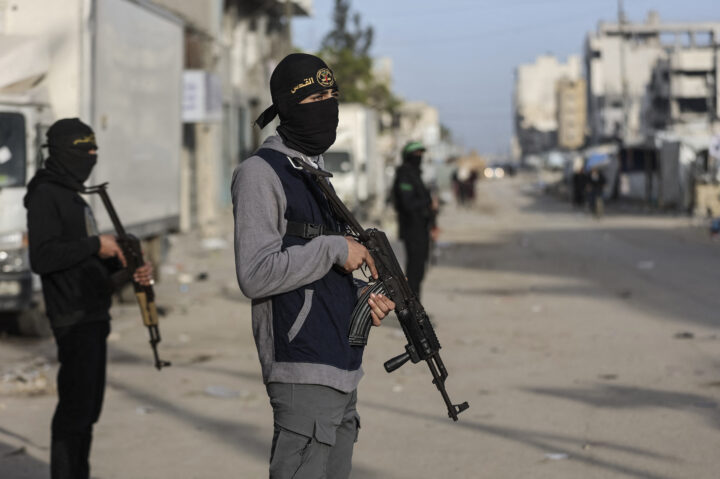
Members of Palestinian Hamas' Ezzedine Al-Qassam Brigades and Islamic Jihad's Quds Brigades are deployed at intersections in Gaza City on March 20, 2026.


 Add JewishInsider on Google
As the conflict between the United States, Israel and Iran nears the one-month mark, experts say the war has diverted diplomatic and military attention away from Gaza, creating a mixed picture: Hamas has used the pause in sustained Israeli military pressure to reassert control in areas it still governs, while the degradation of Iran’s capabilities could ultimately leave the group weaker and more isolated once the conflict subsides.
“I think it’s safe to say that Israeli and American attention has been significantly diverted to the Iran war, and as a corollary to the second front, meaning the war with Hezbollah, at the expense of full time attention to Hamas,” said Matthew Levitt, director of The Washington Institute for Near East Policy’s program on counterterrorism and intelligence. “But it’s not like nothing’s happened in the interim, both for good and for bad.”
Some ceasefire efforts remain ongoing, even as the war continues: Earlier this week, Nickolay Mladenov, the Board of Peace’s high representative for Gaza and a former senior United Nations official, briefed the U.N. Security Council on the board’s progress in implementing elements of President Donald Trump’s 20-point Gaza plan, outlining early reconstruction efforts and a phased proposal for disarmament.
According to experts familiar with the briefing, those efforts have focused in part on areas of Gaza under Israeli control, where work has begun on clearing debris, addressing unexploded ordnance and laying the groundwork for new housing and infrastructure projects.
Gaza currently remains divided among the Hamas-controlled western part of the enclave, referred to by some experts as the “red zone,” while the IDF controls the eastern side, or “yellow zone.” Levitt said that work is being done to “build what is being described as new Rafah, as well as an Emirati-funded city, so that hopefully in the not too distant future, Gazans who are in the area of the enclave controlled by Hamas can be vetted and moved into these new communities.”
The National Committee for the Administration of Gaza — a new technocratic Palestinian governing body launched under the peace plan — has also begun vetting thousands of candidates for a new civilian police force, while several countries, including Indonesia, Morocco, Kazakhstan, Kosovo and Albania, have committed troops to a proposed International Stabilization Force, according to the UN.
However, experts and former White House officials also noted that the diverted attention from Gaza has had negative effects as well, most notably creating conditions for Hamas to “reassert its very physical presence” in the part of the enclave it controls.
Elliott Abrams, Iran envoy under the first Trump Administration and a senior fellow at the Council on Foreign Relations, said the U.S., Israel and Arab states focusing elsewhere “is temporarily an advantage for Hamas. For Gaza, the issue is whether the [Board of Peace] member states, led by the U.S., will insist on Hamas disarmament — without which all the plans for rebuilding Gaza will fail, and no country will send its troops there as a peace force.”
Ghaith al-Omari, a senior fellow at the Washington Institute, also noted that “Hamas has certainly been taking advantage of the shift of attention to the Iran war.”
“Last week, [Mladenov] presented Hamas with a proposal for disarmament. The proposal calls for gradual disarmament but makes it emphatically clear that Hamas needs to fully disarm by the end of the process,” he said.
“Because of lack of international attention, the tools needed to implement this — namely the creation of a new Palestinian police force — have been stalled,” al-Omari continued. “Hamas itself is unlikely to respond to the disarmament proposal until it sees how the Iran war ends. If Iran is not decisively weakened by the end of the war, Hamas will likely adopt a more hardline position when it comes to disarmament.”
Levitt said that while Hamas’ retrenchment in the enclave may cause concern, “the reality is [Hamas is] not able to expand beyond the less than half [of the enclave] that it controls.” He also noted that the current conflict in Iran may actually create the conditions to further weaken, pressure and isolate the terrorist group when the war subsides.
“[Hamas is] not getting the money they once did on a regular basis from Iran or from Qatar,” Levitt said. “It has limited resources, and when the war ends I think that authorities will still have a lot of the same leverage that they did before the war, and in a situation where perhaps Iran’s capabilities to fund and arm its proxies are sufficiently degraded.”
He also noted that there could be more “interest” from other countries in aiding in the Gaza peace process once the Iran war dies down.
“Sure, there’ll be parties who are angry at the United States, who are angry at Israel, and feel this was a war of choice,” Levitt said. “But once the war ends, I think there will be a lot of people who are going to be eager to try and do what they can to try and stabilize the region after these years of severe instability and suffering, and I think there’s going to be a focus on Gaza once the war ends.”
Daniel Shapiro, a former U.S. ambassador to Israel under President Joe Biden, agreed that the war may weaken Iran’s ability to support Hamas and that “some regional players might be newly committed to seizing the opportunity to disarm this branch of the Iranian axis of resistance.”
But the assistance of Gulf countries is not guaranteed, he said. “Others may pause their involvement in post-war Gaza for various reasons, ranging from the need to focus on their own recovery from the war, to unhappiness with Israel’s role in starting a war they hoped to avoid, to continuing opposition to Israel’s policies in the West Bank and opposition to a credible pathway to a Palestinian state,” Shapiro said.
Rachel Brandenburg, a senior policy analyst at Israel Policy Forum, also argued that the war in Iran could impact “regional stakeholders’” involvement in post-war Gaza, “particularly across the Gulf.” She noted that “when the dust settles on this war, it is also likely to detract from the funds and attention Gulf countries had pledged for Gaza and to support the Palestinian Authority.”
“[Gulf countries] will not only have to confront the losses from physical infrastructure destruction but also from a pause on investments, business, tourism, and energy resources,” Brandenburg said. “I expect they will reconsider how much money is left for Gaza and the Palestinian Authority.”
Meanwhile, Jason Greenblatt, former White House envoy to the Middle East under the first Trump administration, argued that the “focus has not shifted” from combating Hamas and has instead “sharpened.”
“Dismantling the Iranian regime’s capacity to arm, fund and direct Hamas is critical for Gaza’s future,” Greenblatt said. “But in my view, there is a difference between temporary humanitarian relief and meaningful rebuilding. The first can and should continue. The second cannot move forward until Hamas disarms and stops threatening Israel.”
Alexander Gray, former chief of staff to the National Security Council during Trump’s first term and now a senior fellow at the Atlantic Council, echoed those sentiments, telling Jewish Insider that the Trump administration is “smartly treating many of the Middle East’s challenges as inherently interconnected.”
“There will never be peace in Gaza without destroying the ability of Iran to fund and deploy proxies like Hamas to destabilize the region,” Gray said. “The president’s focus on dismantlement of the Iranian proxy network is not accidental: without it, peace from Gaza to Lebanon to Syria to Iraq to Yemen will be elusive.”
More Stories

CATCHING HEAT
Pro-Israel Democrats blast Mamdani for Oct. 7 anniversary statement

analysis
Could these two small parties be Israel’s kingmakers?

EXCLUSIVE
Colorado senators introduce bill to expand federal security grant program

TISCH TENSIONS
Mamdani stands by NYPD’s Tisch as his allies demand her removal
Mayor Unmoved
Mamdani brushes off pro-Hamas heckling at Oct. 7 vigil

TWO JEWS, THREE OPINIONS
Jewish podcast ‘Chosen People Problems’ finds new home with Ark Media
Please log in if you already have a subscription, or subscribe to access the latest updates.
 Continue with Google
 Continue with Apple