






































Top GOP lawmakers call for ‘powerful response’ to Iran downing U.S. Army helicopter
Trump said that the U.S. must respond to the military provocation
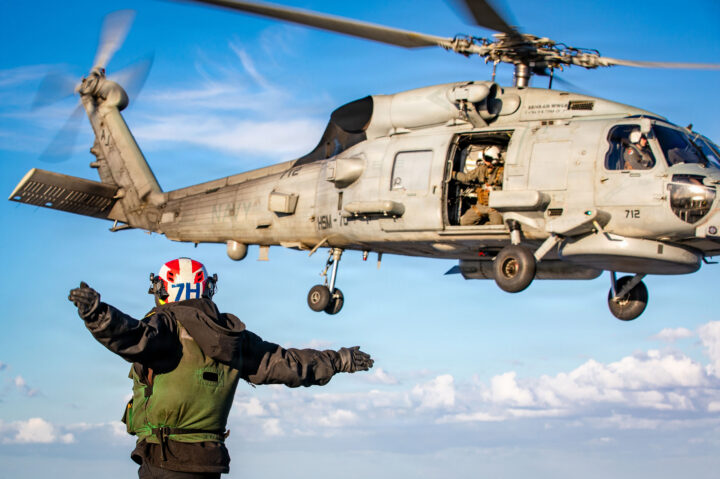
U.S. Navy via Getty Images
A U.S. Sailor signals the launch of an MH-60R Sea Hawk helicopter, attached to Helicopter Maritime Strike Squadron 70, on the flight deck of the world's largest aircraft carrier, USS Gerald R. Ford (CVN 78), while supporting Operation Epic Fury on February 28, 2026.


 Add JewishInsider on Google
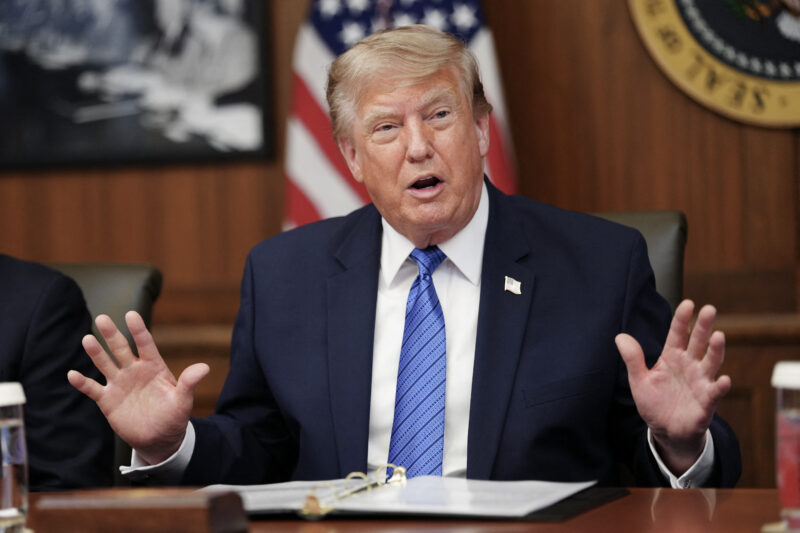
President Donald Trump’s declaration that the U.S. “must, of necessity, respond” to Iran’s downing of a U.S. Army Apache helicopter off the coast of Oman on Monday evening received support from GOP lawmakers on Capitol Hill, several of whom called for a powerful military retaliation.
U.S. officials confirmed to CNN that the attack helicopter — whose pilots Trump said were successfully rescued — was brought down by an Iranian one-way attack drone. The high-stakes incident marks the most serious uptick in direct hostilities between Washington and Tehran in weeks, occurring amid diplomatic efforts to end the regional war and begin negotiations to curb Tehran’s nuclear program.
“I agree with the president, there should be significant consequences,” Sen. Ted Cruz (R-TX) told Jewish Insider.
“Enough is enough,” Cruz later wrote on X. “President Trump and our Armed Forces decimated Iran militarily, but the Iranian regime has been trying to rebuild and now they’ve taken down an American Apache. President Trump is absolutely right. There is a pressing necessity for the U.S. to respond to this attack.”
Rep. Mike Rogers (R-AL), who chairs the House Armed Services Committee, also called for a powerful response, urging Trump to look at “meaningful options.”
“We need to vigorously respond,” Rogers said. “We can’t let anybody shoot down one of our helicopters and it not be responded to.”
Sen. Ted Budd (R-NC) similarly pushed for “decisive action” in order to put the looming Iranian threat “behind us.”
“I think America would be in a better place if we had this behind us and clear, decisive action that would bring an absolute end to this so we don’t have to do it again,” Budd told JI. “They [Iran] cannot persist to threaten us and then develop nuclear weapons. … They should never ever have a nuclear weapon.”
While some regional experts agreed that the Iranian attack necessitates a firm U.S. military reaction, they argued that any such response is likely to be limited in scope and is not anticipated to trigger a return to full combat operations, nor is it expected to derail ongoing negotiations given the president’s focus on a diplomatic exit.
“If information is correct, that Iran shot down a U.S. helicopter, then the president is correct, the United States does need to respond,” said former U.S. Ambassador to Israel Dan Shapiro, who later served as deputy assistant secretary of defense in the Biden administration. “That’s a very serious attack, which thankfully did not seem to take the lives of the two aviators, but it needs a response.”
Shapiro noted that while U.S. action is necessary, the retaliation will likely be calibrated to avoid escalation, as Trump remains intensely “motivated” to secure a broader deal that would reopen the Strait of Hormuz.
“U.S. Central Command will be able to give [Trump] options that will include a meaningful response against an Iranian military target, but one that does not necessarily produce a strong Iranian response that leads to an escalatory cycle,” Shapiro explained. “If he wants to succeed in negotiations, say, on the war, he needs to respond, but do it in a way that leads to a de-escalation.”
Alexander Gray, who served as chief of staff on the National Security Council during Trump’s first administration, also anticipates a precise, “proportional blow against key Iranian targets.”
“The president has responsibly maintained considerable American military power in the vicinity of Iran, both conducting the U.S. Navy’s successful blockade, but also being held in reserve should the need arise to continue kinetic military operations,” Gray said. “The president will likely strike a proportional blow against key Iranian targets, while keeping in mind the broader American strategic imperative of concluding this conflict with a diplomatic solution that advances American interests in the region.”
Steven Cook, a senior fellow for Middle East studies at the Council on Foreign Relations, agreed that failing to respond would be a political and strategic impossibility for the White House.
“It would be hard for the president not to respond, though I suspect that this is not a return to combat,” Cook observed. “Trump will likely direct CENTCOM to take out one or several high-value targets.”
Analysts noted that the exchange is unlikely to impact the high-level talks or alter the calculations of either side, as negotiators continue to work out an agreement.
“It doesn’t necessarily push a deal further off the table,” Shapiro said. “It sounds like negotiators are close to a deal. Until there is a deal, though, exchanges in a ceasefire that has seen numerous violations of it are not surprising, but if both sides are motivated to get a deal, this will not prevent it from happening.”
Cook said that a minor strike could solidify Tehran’s perception of American vulnerability.
“I don’t believe that a tit-for-tat exchange will significantly alter Iran’s view that it has time on its hands and that the president is desperate for a deal,” Cook said. “It seems clear that the president does not want anything to upset negotiations and the chances of a negotiated way out of the conflict. The Iranians do not seem willing to give him anything that he could call a victory, however. The result is likely to be a continued stalemate.”
Iran has similarly appeared to prefer a diplomatic exit over renewed escalation. Iranian Foreign Minister Abbas Araghchi on Tuesday said that Iranian leaders “prefer language of diplomacy but speak other languages too.”
“Foreign forces in proximity to our territory are at constant risk on account of their own human errors, plain accidents, or potentially being caught in crossfire,” Araghchi posted on X following the incident. “To reduce risk, best solution is for them to leave.”
Aaron David Miller, a senior fellow at the Carnegie Endowment for International Peace and a former State Department negotiator, said the incident reflects a “manifestation of how emboldened [the Iranians] are and how willing they are to take risks.”
While Miller warned against a heightened response, he noted that even restrained exchanges could lead to eventual escalation if a final diplomatic breakthrough is not reached soon.
“If [Trump] doesn’t [limit the response], then what he’s going to trip into is a very hard response if he goes after directly Iranian targets on the mainland,” Miller warned. “The longer this goes on without having an agreement, it’s inevitable that this is going to escalate.”
The core parameters of a potential deal have been “evident for quite some time,” Miller added, but concluded it will ultimately require a painful political calculation from both Washington and Tehran.
“Both sides must be prepared to accept a situation in which they’re going to perceive to have given something up,” Miller said.
Senior congressional correspondent Marc Rod contributed reporting
More Stories
OCEAN STATE OF PLAY
Antisemitism roils Providence mayoral race
LONDON'S GAMBLE
Former Trump official: U.K. sanctions will render Europe ‘less relevant in Middle Eastern affairs’

SAFETY SURGE
Hochul announces security funding, enhanced police presence ahead of High Holy Days
FLAGGING FICTION
Blinken denies report he delayed Hamas offer to free hostages
A FATHER'S LOVE
After son’s remains returned from Gaza, Ruby Chen continues his fight in Washington and beyond

EMIRATI ENGAGEMENT
Antisemitism envoy Kaploun meets with Emirati President MBZ in Abu Dhabi
Please log in if you already have a subscription, or subscribe to access the latest updates.
 Continue with Google
 Continue with Apple