


Andrew Harnik/Getty Images
Experts welcome rare Israel-Lebanon talks but caution on Hezbollah disarmament
Any potential agreements between Jerusalem, Beirut and Washington will ultimately hinge on whether Hezbollah can be fully disarmed


 Add JewishInsider on Google
The first round of direct talks between Israel and Lebanon has been received positively by diplomats, pro-Israel lawmakers and experts, who see it as a sign of Hezbollah’s waning influence in Lebanon. But despite the optimism surrounding the discussions, experts caution that disarming the terrorist group remains a daunting obstacle that stands in the way of any meaningful change — one that would require a significant shift from the Lebanese government and its armed forces.
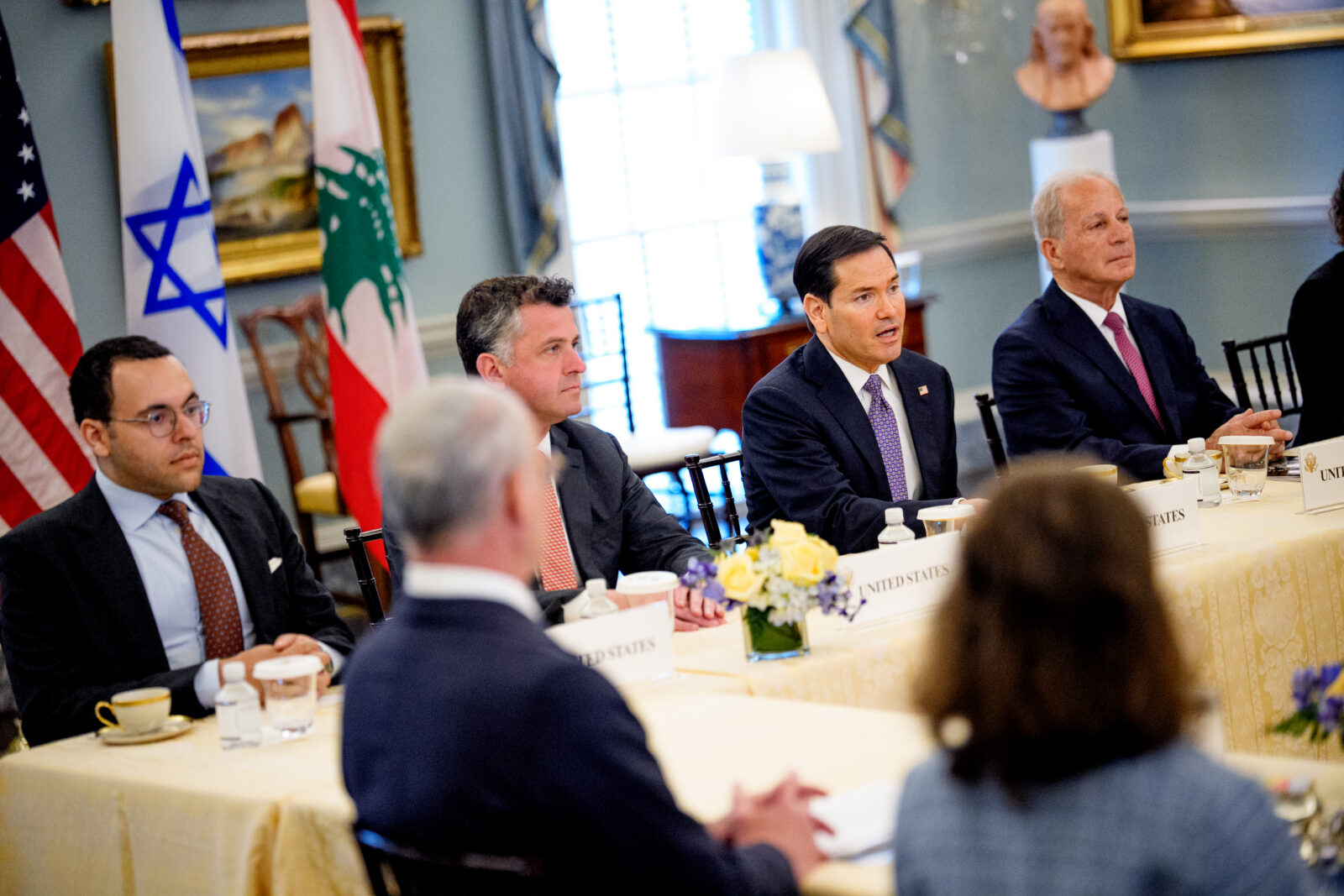
On Tuesday, Israeli and Lebanese leadership convened at the State Department in Washington for the highest-level direct discussions in more than 30 years, aiming to outline a framework for “lasting peace” and a “permanent end” to Hezbollah’s influence, according to Secretary of State Marco Rubio.
Rep. Jared Moskowitz (D-FL) told Jewish Insider that “it is great” that talks are taking place, expressing hope that “the Lebanese government, the United States and the Israeli government make a deal, and collectively, they push Hezbollah out.”
“That way the Lebanese people can be freed from the Iranian extremism that they have in their country,” Moskowitz said. “The Lebanese people are being held captive by the Iranian government because of Hezbollah. It’s obviously good for the United States, it’s good for Israel, but more importantly, I think it’s good for the people of Lebanon. I think disarming Hezbollah is obviously key to all this.”
Moskowitz added that while the Lebanese government appears to want to disarm Hezbollah, “they probably need help.”
“It’s not going to happen overnight, but I think it’s historic, and this is what the entire region wants,” he said. “This is what the Gulf states want. Everybody wants to come out of the extremism and the terrorism that Iran is trying to spread in the region.”
Sen. Rick Scott (R-FL) similarly told JI that Hezbollah disarmament is an important factor in talks.
“Why would you have talks if they [Hezbollah] are not going to disarm?” Scott said. “I’m not the prime minister of Israel but my condition would be that Hezbollah has got to disarm.”
Scott dismissed the notion that the Lebanese government and the Lebanese Armed Forces have not done enough to disarm the group, stating that the main problem is “not caused by Lebanon or by the military of Lebanon, it’s caused by Hezbollah.”
Sen. John Cornyn (R-TX) said that disarming Hezbollah should be a “red line” for Israel in talks. He added that Israel “needs a buffer zone so Hezbollah can’t continue to rain down terror on Israelis.”
“Hezbollah has historically been the best trained, best equipped opponents to Israel,” Rep. Don Bacon (R-NE) said. “Israel’s done a great job with them over the last two years, but they’re hardcore fervent believers in destroying Israel.”
Experts similarly described the talks as a meaningful development. John Hannah, a senior fellow at the Jewish Institute for National Security of America, called the discussions an “important breakthrough” and a sign of Hezbollah’s diminishing influence.
“Everyone should welcome the opening of a direct political dialogue between Israel and Lebanon,” Hannah said. “The fact that [the talks are] occurring at all is an important sign of Hezbollah’s declining hegemony over the Lebanese state.”
Robert Satloff, executive director of the Washington Institute for Near East Policy, described the talks as a “win-win-win” in a social media post, adding that Hezbollah emerged as a “big loser.”
“Today is a day to celebrate — we all saw a glimpse of what is possible after so much violence and conflict,” Satloff wrote on Tuesday. “That is a very good thing.”
Still, experts say disarming Hezbollah, which parties agree is necessary for any lasting piece, remains highly difficult and uncertain.
Even before Tuesday’s opening round of discussions, Hezbollah senior member Wafiq Safa said Hezbollah is “not bound” by any deals reached between Israel, Lebanon and the United States.
“It’s hard to be an optimist when it comes to the core question of Hezbollah’s disarmament,” Hannah said. “Even after all that’s been done over the past few years to weaken the group and its Iranian sponsors — including the loss of its legitimacy in the eyes of a majority of Lebanese — it’s not at all apparent that the raw balance of forces inside Lebanon has shifted sufficiently to favor Hezbollah’s near-term demise.”
Hannah described disarming Hezbollah as “worth trying,” but ultimately a “long shot.”
“Since the war against Iran broke out on Feb. 28, Hezbollah has shown through its sustained attacks on Israel that, while much diminished, its forces retain far more significant capabilities than many believed,” he said. “And in the wake of its battle against Israel, Hezbollah is making clear that if push comes to shove, it’s prepared to burn down the state before surrendering its weapons.”
Blaise Misztal, JINSA’s vice president for policy, said the task cannot be accomplished through Israeli military action alone and will ultimately depend on whether Lebanon and the LAF are willing to act.
“[Disarming Hezbollah] can only be fully done by a strong and committed Lebanese government,” Misztal said. “Israel can secure southern Lebanon with ground operations and strike Hezbollah sites in Beirut or the Bekaa Valley, but that will merely distance and degrade the threat, never fully remove it.”
“The question is whether the Lebanese government is, or can be convinced to be, strong and committed enough to take on the task of asserting its control over its own territory,” he added. “Thus far, it has failed to demonstrate either the political will or military capability to do so.”
Hannah similarly noted that “Israel is rightly unwilling to pay the necessary cost in blood, treasure and diplomatic opprobrium” required to fully dismantle Hezbollah, leaving the responsibility to Lebanon and its armed forces.
“The factor that has truly held Lebanon back from disarming Hezbollah has been Hezbollah’s retention of, as far as we can tell, overwhelming support among Lebanese Shiites,” David Daoud, a senior fellow at the Foundation for Defense of Democracies, said. “Having retained that popular support, it can deter the government from pursuing forcible disarmament by dangling the threat of civil war.”
But experts weren’t optimistic that the Lebanese government and LAF are capable — or willing — to take on that role. Hannah said Lebanon’s military “doesn’t appear to have the stomach to truly confront Hezbollah and dismantle the group’s armed wing,” noting that it has already “failed” to disarm the group in southern Lebanon, “much less the rest of the country.”
“It seems even less likely than before the Iran war that the LAF would now be willing to take on the risk of massively confronting Hezbollah,” he said, “in spite of the misery Hezbollah’s unilateral decision to enter the conflict on Iran’s behalf is now inflicting on the rest of Lebanon.”
David Daoud, a senior fellow at the Foundation for Defense of Democracies, also said Beirut “ultimately holds the key” to resolving the issue of Hezbollah’s disarmament. He said that while Lebanon has taken “immense and commendable” steps in “proscribing Hezbollah’s military activities,” the country’s “unwillingness to act against Hezbollah has been missing from the equation” and has “allowed the group to regenerate in the past.”
He added that Hezbollah still “retains enough military strength to make disarmament daunting” for Lebanese forces and the LAF, and that the group continues to wield significant political power.
“The factor that has truly held Lebanon back from disarming Hezbollah has been Hezbollah’s retention of, as far as we can tell, overwhelming support among Lebanese Shiites,” Daoud said. “Having retained that popular support, it can deter the government from pursuing forcible disarmament by dangling the threat of civil war.”
Daoud also raised concerns about Lebanon’s intentions in negotiations, arguing that Beirut may not truly be seeking meaningful change.
“A good test will be the extent to which the LAF fulfills the Lebanese government’s order from early April to put all of Beirut under its full control,” John Hannah, a senior fellow at the Jewish Institute for National Security of America, said. “Will the LAF truly confront and disarm Hezbollah in the capital or simply repeat the phony disarmament it claimed to have completed in the south?”
“Lebanon is seeking to use the negotiations to return to the status quo, and is willing to ‘pay the price’ of a joint photograph with an Israeli ambassador to achieve that objective,” he said. “This is because the situation in Lebanon is indeed dire — economic collapse compounded by war, the direct impact of the war itself and the emergence of sectarian tensions that could boil over into full-on conflict.”
If those dynamics remain unchanged, he warned that Hezbollah could indefinitely delay disarmament and eventually rebuild its strength.
“A good test will be the extent to which the LAF fulfills the Lebanese government’s order from early April to put all of Beirut under its full control,” Hannah said. “Will the LAF truly confront and disarm Hezbollah in the capital or simply repeat the phony disarmament it claimed to have completed in the south?”
Satloff said the challenge will ultimately require translating diplomacy into “practical steps,” including a shift in how the Lebanese military approaches disarmament.
“While some of this can happen in the negotiating room when the parties meet again, nothing can substitute for strong measures by the Lebanese state to isolate, weaken, delegitimize and disarm Hezbollah while promoting the idea of peace,” he said.
He suggested that turning Beirut into a “true weapons-free zone” is necessary “but not sufficient,” pointing to additional steps such as removing Hezbollah officials from government, expelling Iranian operatives from the country and shutting down the group’s financial and institutional networks.

Please log in if you already have a subscription, or subscribe to access the latest updates.
 Continue with Google
 Continue with Apple