















































Vance calls on Israel to respond to Hezbollah attacks ‘in the context of a conversation’
Vance, announcing the deconfliction mechanism established with Iran, said, ‘We could have a better and more peaceful situation if Israel responds in the context of a conversation that’s ongoing between Hezbollah, Lebanon, Israel and other partners in the region’
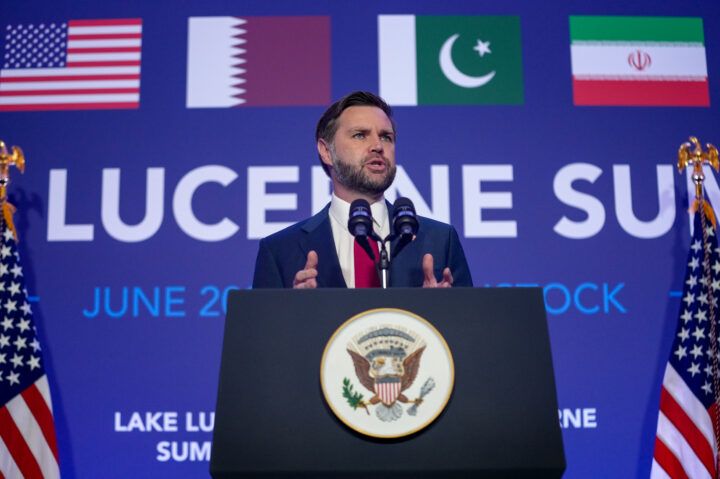
Nathan Howard-Pool/Getty Images
Vice President JD Vance speaks to members of the media at the Buergenstock Resort Lake Lucerne, after the U.S. and Iran held high-level talks at the Lake Lucerne Summit on June 22, 2026 near Stansstad, Switzerland.


 Add JewishInsider on Google
Vice President JD Vance on Monday backed Iran’s participation in bringing about the end of Israel and Hezbollah’s military conflict, calling the terror group’s ongoing strikes and Israel’s response “a chicken and egg problem.”
Vance said at a press conference in Switzerland that the U.S. will be counting on Iran to “rein in” Hezbollah, after the U.S. and Iran agreed to create a “deconfliction cell” for military operations in Lebanon during negotiations on Sunday. The statement announcing the mechanism, released by mediating countries Pakistan and Qatar, did not reference Israel.
When asked if he expected Lebanon to be such a linchpin in negotiations, Vance said, “We want Hezbollah to stop firing at our friends in Israel. We want Israelis to be able to live in peace. We also want to make sure that … when things happen, they don’t spiral into a broader escalation, and so we’ve been, I think, very good at setting up what we’re calling a deconfliction mechanism.”
“Sometimes you’ve got a bit of a chicken and egg problem, that you’ve got a junior guy who fires a drone that didn’t have approval from the high command,” he continued, referring to Hezbollah’s ongoing attacks on northern Israeli towns.
“Of course, Israel has to respond to that, but … we could actually have a better and more peaceful situation if Israel responds in the context of a conversation that’s ongoing between Hezbollah, Lebanon, Israel and other partners in the region.”
Vance added that ongoing negotiations will require close coordination with the U.S.-backed Lebanese Armed Forces and will “also require the Iranians to rein in Hezbollah,” without acknowledging that Iran offers material backing to its proxy in Lebanon.
Reports have indicated that some Lebanese lawmakers have expressed dissatisfaction with the U.S. and Iran including Beirut in their negotiations, as opposed to leaving Lebanon to its separate U.S.-backed track directly with Israel, which is set to continue in Washington this week.
When asked whether the U.S. expects an Israeli withdrawal from Lebanon, Vance demurred, affirming instead that Israel has a “right to self-defense” and that the U.S. wants “Israel’s security to be protected.””
“We want Israel’s security to be protected, and we also want Lebanon’s sovereignty to be protected,” Vance said. “The Israelis have been very clear: they do not have territorial intentions on south Lebanon. The reason they feel they have to be there is because they’re worried about Hezbollah fighters in south Lebanon firing into Israel.”
Vance noted that the U.S. made additional “good progress” in the high-level talks over the weekend, claiming that Tehran has agreed to invite International Atomic Energy Agency inspectors back into the country to monitor its nuclear program.“That is a major milestone for the American people, and the first step in permanently denuclearizing, or permanently ending a nuclear weapons program in Iran,” Vance said at his press conference.
The IAEA inspectors would verify that Iran is only using nuclear material for peaceful purposes, a parameter that Vance noted was “exactly what we asked to happen.”
“In terms of when the nuclear inspectors are going to start … I expect that will happen at the minimum this week, but we think even some of those conversations with the inspectors and with the IAEA could happen as soon as today,” Vance said.
Vance said that talks will proceed on a “technical level” with diplomatic teams in Switzerland continuing negotiations “over the weeks and days to come.”
“The final deal is the house; we set the foundation,” Vance said. “We haven’t built the house, but we’ve laid a successful foundation to get to a good place for the American people. I think it’s important for all of us to appreciate how much was done, but honestly, there is still a lot to do.”
Vance also defended a social media post by President Donald Trump on Sunday, in which the president threatened to “hit Iran very hard again” if it did not “immediately stop” supporting regional proxies. The vice president argued the warning did not derail the diplomatic progress.
“We were negotiating well past one in the morning, so they didn’t walk out, and their technical team is still here working with our technical team as we speak,” Vance said. “What we told the Iranians yesterday is, ‘When you guys engage in what us millennials might call “trash talk,” you can’t expect the president of the United States not to respond and not to correct the record.’”
“So yes, there was a little bit of threatening, there was a little bit of whining, but at the end of the day, the talks continued and we made great progress,” he added.
More Stories

PENSION POLITICS
Former NYC comptroller denounces Levine’s decision not to reinvest in Israeli bonds
PEACH STATE POLITICS
Ossoff defers to ICC on Israel genocide accusations, but says IDF violated int’l law

EMPIRE STATE EDUCATION
Hochul will opt New York into education tax credit that will help fund Jewish education

IN THEIR MEMORY
Administration officials join bereaved families for Oct. 7 commemoration event

Go Blue, but blue and white?
Michigan Hillel’s break with Israel advocacy groups raises questions about where it stands

Cross-Party Call
JCPA urges candidates in both parties to reject antisemitism ahead of midterms
Please log in if you already have a subscription, or subscribe to access the latest updates.
 Continue with Google
 Continue with Apple