


Kristen Norman/AP
Jewish leaders worried about Michigan’s prime position on Dems’ 2028 calendar
The state has been the epicenter of the anti-Israel movement, and will play a key role in nominating the next Democratic presidential candidate


 Add JewishInsider on Google
The selection of Michigan as an early Democratic primary state in the 2028 presidential nominating contest, approved on Friday by a panel of the Democratic National Committee, is prompting some concerns among Jewish and pro-Israel activists who fear the party’s sharp divisions over Israel and its recent controversies over antisemitism could create a volatile political landscape during the key contest.
In recent years, Michigan has been at the center of some of the fiercest fights over Israel animating the Democratic Party. In the 2024 presidential race, for instance, the battleground state first laid the ground for the “uncommitted” movement that urged primary voters not to vote for former President Joe Biden as a protest against his support for Israel during the war in Gaza.
At Michigan’s state party convention in April, meanwhile, pro-Israel candidates were heckled by far-left activists, while an attorney with a history of praising Hezbollah was nominated for a position on the University of Michigan Board of Regents, episodes that left Jewish voters questioning if they belonged in a party they had long called home.
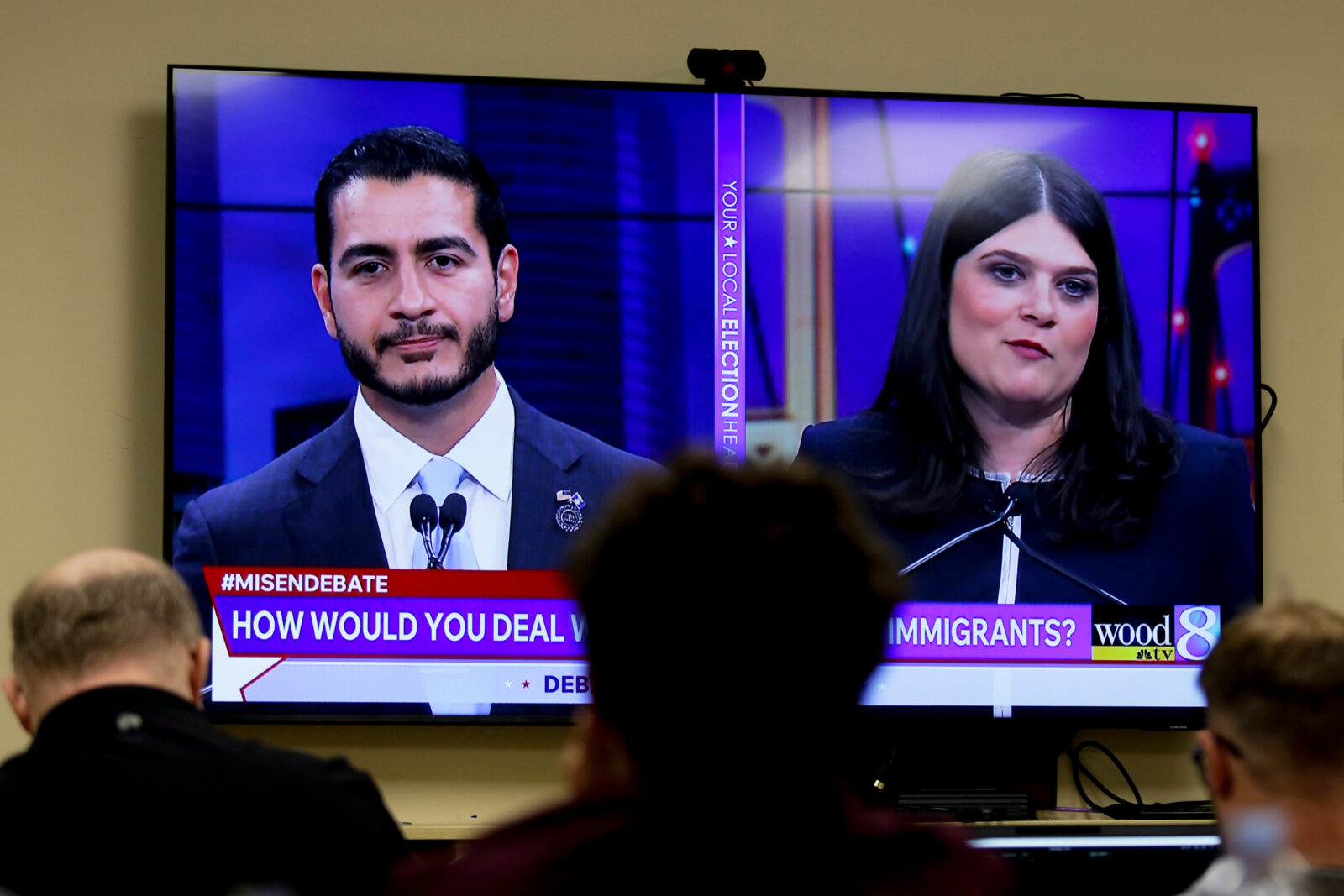
The state’s Democratic Senate primary, set for Aug. 4, has emerged as the latest high-profile proxy battle between the party’s mainstream and far-left factions. The most heated clashes have revolved around Israel and AIPAC, the pro-Israel advocacy group that is now spending millions to help Rep. Haley Stevens (D-MI), a close ally, in a bitter race against Abdul El-Sayed — whose rhetoric targeting Israel and ongoing refusal to recognize its right to exist has alarmed Jewish voters.
Michigan’s presidential primary will now tentatively go fifth among the six states chosen for early primaries, on Feb. 22 — a week after New Mexico and a week before Virginia. South Carolina will kick off the nominating contest on Jan. 22, followed by Nevada and New Hampshire. The newly proposed calendar will need to be ratified by DNC members at a meeting in Austin next month.
If the schedule is officially locked in, Michigan, which has the most delegates of the states chosen, “figures to be one of the first anti-Israel or antisemitic states that has a vote,” Dennis Bernard, a Jewish leader in Michigan who helps advise members of both parties, said in an interview with Jewish Insider on Sunday.
“I do think we will be very much a bellwether state” that “could be the first true test of the Democratic Party and how big their tent is,” added Bernard, the national chair of government relations for the Jewish Federations of North America. “You will potentially see a continuation of that war going on right now.”
Several Jewish leaders in Michigan said the Senate primary outcome would likely help crystallize their expectations about the degree to which Democratic conflict over Israel, and the state’s role in elevating that battle to the forefront, may end up influencing the presidential election.
“Those results will give us a better indication of 2028,” said Michael Horowitz, one such Jewish leader in Michigan, noting the positions espoused by El-Sayed are not a “national trend yet,” despite a recent series of primary wins by anti-Israel Democrats who ran in progressive House districts. “We’ll see how deep this well is. I’m not naive, but I don’t know.”
Still, the Democratic Party and pro-Israel community “have to get together and take control of the narrative again, because they’re winning the narrative,” he told JI, referring to the far left. “We have got our work cut out for us. We’ve lost the narrative.”
“If you talk to major Democratic donors, they’re concerned about Michigan because the moderate wing of the party is disappearing,” Ed Sarpolus, a Democratic pollster in the state, told JI. “Democrats could be worse off in 2028 if they don’t get back to the issues.”
By contrast, Asher Lopatin, a rabbi who serves as director of community relations at the Jewish Federation of Greater Ann Arbor, cited Gov. Gretchen Whitmer’s endorsement of Stevens last week as a sign that “may indicate the direction Michigan Democrats are going in for 2028,” which he called “not falling into the anti-Israel obsession trap.”
“I realize it’s a rosy scenario, but I am hopeful,” he told JI.
Political strategists who spoke with JI shared mixed predictions about Michigan’s early place on the 2028 primary calendar. Ed Sarpolus, a Democratic pollster in the state, said it could “exacerbate tensions within the Democratic Party” over Israel, disrupting a fragile effort to show unity ahead of what is expected to be a bruising general election to reclaim the White House.
“If you talk to major Democratic donors, they’re concerned about Michigan because the moderate wing of the party is disappearing,” Sarpolus told JI. “Democrats could be worse off in 2028 if they don’t get back to the issues.”
But Adrian Hemond, a Democratic strategist in Michigan, said it “is way too early to predict with confidence” how Israel “will play as an issue” in the 2028 Michigan presidential primary, arguing that “a lot will depend on how hard candidates lean into the issue.”
“If the situation in the Middle East deteriorates further,” he explained to JI, “this issue could look very different.”
Some experts have also speculated that Michigan’s position could lead to uncomfortable confrontations for pro-Israel centrists like Pennsylvania Gov. Josh Shapiro, a Jewish Democrat who is frequently cited as a prospective presidential candidate and who has faced antisemitism over his views on the Middle East.
Some Jewish leaders, however, said a pro-Israel win in Michigan could help defang the far left at what may be a key inflection point in the race. If an openly pro-Israel candidate emerged in the state, “I think it would be a surprise as to the traction they got,” since it “would stand out as authentic,” said one prominent pro-Israel activist in Michigan, granted anonymity to speak candidly about a sensitive issue.
He was not hopeful that such a candidate would step up. “I don’t see why Michigan is the venue in which someone does a complete paradigm shift” on Israel, he told JI, citing the existing political headwinds. “I think we are kind of a laboratory for the Democratic Party across the nation.”
One pro-Israel strategist in Michigan, speaking on condition of anonymity, said that several potential 2028 contenders have already visited the state and have had private meetings with Jewish donors and groups — including Rahm Emanuel, the Democratic operative and former Chicago mayor, and Maryland Gov. Wes Moore.
“A couple others have had meetings with prominent Jews while in Michigan, but I can’t say for sure if the reason for meetings was to lean into the Jewish vote,” the strategist told JI.
While Michigan also went fifth in 2024 after it had lobbied for an early slot, the state promises to play a more consequential role in the next election because it will be a competitive primary, as opposed to the last cycle in which Biden faced no serious opposition before dropping out of the race.
Anti-Israel activists have insisted that former Vice President Kamala Harris lost Michigan, home to the largest concentration of Arab American voters in Dearborn, due to her alignment with Biden’s support for Israel during the war in Gaza.
But many Jewish Democrats in Michigan, who make up a sizable and politically engaged constituency, say the left’s vilification of Israel as well as AIPAC is not only misguided but also a distraction from more urgent concerns that are much more relevant to swing voters who will ultimately decide the election. Some suggested that Michigan’s status in 2028 as an early nominating state could stoke those tensions and overshadow other issues, in a repeat of the last cycle.
“The antisemitic rhetoric that we have observed on the right and the left, the attacks on Israel’s right to exist as a Jewish state, are, sadly, going to be issues that both parties have to address in 2028,” Robert Zimmerman, a longtime DNC member, told JI while assessing the 2028 primary landscape. “Democrats have to do a much better job of standing up to that hateful rhetoric.”
“It means that the real issues facing Michigan will continue to be less important” than the hostility to Israel now energizing the activist left, Hannan Lis, a Democratic fundraiser and Jewish community leader in the state, told JI. “I cannot tell you I’m optimistic. I’m a realist,” he said.
Even as he acknowledged “two years is a long time,” he voiced anxiety that “support for Israel has become a litmus test for a lot of Democratic candidates,” as it has grown increasingly politicized in party primaries.
“The antisemitic rhetoric that we have observed on the right and the left, the attacks on Israel’s right to exist as a Jewish state, are, sadly, going to be issues that both parties have to address in 2028,” Robert Zimmerman, a longtime DNC member, told JI while assessing the 2028 primary landscape. “Democrats have to do a much better job of standing up to that hateful rhetoric.”
Despite reservations about Michigan’s potentially divisive role in the presidential race, some Jewish leaders in the state and beyond said they were still staying positive.
In a statement to JI, Jessica Alexander, chair of the Michigan Democratic Jewish caucus and a vice chair of the Michigan Democratic Party, said party activists had “worked hard to make the case for Michigan to be an early primary state, because the state reflects the country’s diverse demographics culturally and geographically.”
“Yes, there is a vocal virtual subset of folks who want to make not the Middle East, but Israel and the U.S.’s engagement in and with it the center” or “soul” of the campaign, she said, “but the reality on the ground is that it’s not the most formidable issue no matter how the press skews it.”
Noah Arbit, a Jewish Michigan state representative who has been outspoken against rising antisemitism in his own party, said that the Democratic Socialists of America and other groups “seem to feel that Israel is a galvanizing wedge issue they can employ to take over the Democratic Party” and for now “seem intent on putting it at the forefront of the primary debate in 2028, regardless of Michigan’s place in the calendar.”
“I’m resigned to the issue being at the forefront of the primary conversation,” he told JI last week, “despite the fact that I would argue Americans have far more pressing concerns about the state of and future of our country than an interminable conflict 5,000 miles away.”


Please log in if you already have a subscription, or subscribe to access the latest updates.
 Continue with Google
 Continue with Apple