













































At Aspen Ideas, Robert Kagan says U.S.’ Israel support was ‘never for strategic reasons’
In conversation with Biden foreign policy officials Jake Sullivan and Jon Finer, Kagan said, ‘Israel's vision for the Middle East has never been a vision that the United States should sign up to’

Screenshot/YouTube
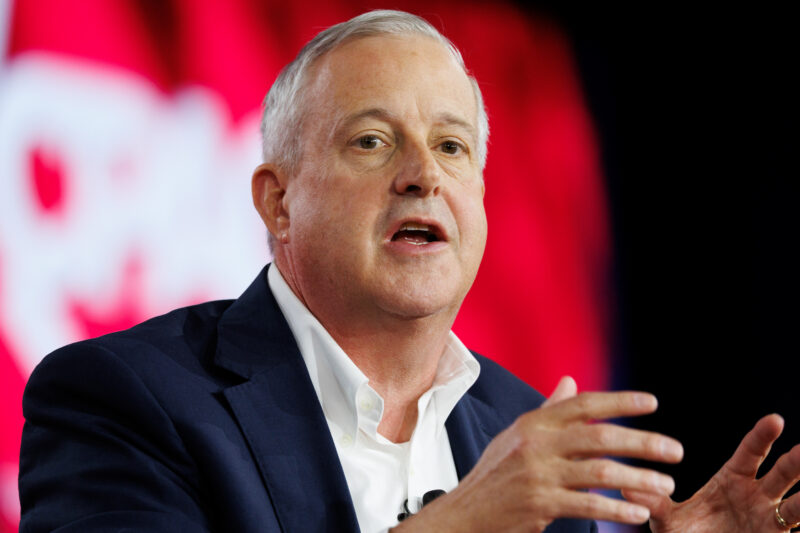
Robert Kagan speaks at Aspen Ideas Festival on June 26, 2026.


 Add JewishInsider on Google
Historian and prominent neoconservative foreign policy analyst Robert Kagan claimed the U.S. was “never supporting Israel for strategic reasons” and that American strategy in the Middle East has come “to be about defending the interests of Israel,” during a live taping on Friday of “The Long Game” podcast — hosted by former National Security Advisor Jake Sullivan and Jon Finer — at the Aspen Ideas Festival in Colorado.
Finer, who served as principal deputy national security advisor in the Biden administration and also worked with Sullivan under President Barack Obama, asked Kagan if he believes Israel is still a democracy and if Israel is still a U.S. ally, “given [their] increasingly divergent interests.”
Calling Israel “at least an imperfect democracy,” Kagan said, “Our discussion of Israel [has become] one in which we began to believe that we had a vital interest in supporting Israel. We started supporting Israel out of a sense of moral obligation. And I think that was a noble thing to do after World War II and the Holocaust, etc. But we never were supporting Israel for strategic reasons.”
“In fact, much of our strategy in the region came to be about defending the interests of Israel, because they were an ally, because we felt an obligation to them,” Kagan, who has been a vocal critic of President Donald Trump and Israeli Prime Minister Benjamin Netanyahu, continued.
“I’ve always felt about Israel roughly the way I feel about Taiwan, you know, that we have an obligation as a defender of a country that we have the responsibility for, but not that, you know, not that it somehow transcends basic understanding of our interests.”
Kagan said that in his view, “Israel’s vision for the Middle East has never been a vision that the United States should sign up to, because Israel’s attitude is basically the Arab Muslim peoples can’t — ‘we don’t want them in democracies, we want them ruled by strong men who can control them. We fear a public opinion among Arabs and Palestinians, and therefore we don’t want to give them that opportunity.’”
“I just don’t think that is a sustainable position to take over the long run in the Middle East, and it should never have been America’s position,” he contended.
Kagan rose to prominence as a co-founder of the Project for the New American Century, the influential neoconservative think tank that advocated for an assertive American global role, and helped shape Republican foreign policy debates before and after the 9/11 attacks. He generally viewed Israel as a key U.S. democratic ally in the Middle East and supported a close U.S.-Israel strategic partnership.
Kagan later became one of Trump’s earliest conservative critics, leaving the Republican Party in 2016 as he argued that Trump’s “America First” foreign policy represented a break with decades of U.S. global leadership.
On the war with Iran and the U.S.’ involvement in the Middle East generally, Sullivan read from Kagan’s March 2026 piece in The Atlantic, where he argued that American intervention in the region is a causal factor of terrorism: “Had the United States not been deeply and consistently involved in the Muslim world since the 1940s, Islamic militants would have little interest in attacking an indifferent nation 5,000 miles and two oceans away. Contrary to much mythology, they have hated us not so much because of ‘who we are’ but because of where we are,” he wrote in the piece.
“The thing that I find surprising about Americans is that we’re constantly shocked that others are reacting to us,” Kagan said in response on Friday, saying the same dynamic was at play in Japan’s 1941 attack on Pearl Harbor, which the U.S. “brought on” by embargoing Japan.
He said U.S. involvement in the Middle East made more sense “when America was solidly behind the American world order, when we were solidly behind supporting our allies in Europe and Asia, when we took it on as responsibility to maintain the overall security of our allies.” But “when we are actively abandoning any thought of supporting the international system we’ve supported” under Trump, “the one place we’re going to go to war is in the Persian Gulf? That’s what makes no sense to me.”
More Stories

LONDON'S GAMBLE
Former Trump official: U.K. sanctions will render Europe ‘less relevant in Middle Eastern affairs’

GRANITE GAMBIT
Stefany Shaheen’s anti-AIPAC attacks haven’t boosted her fortunes in New Hampshire
Daily Kickoff
Longhorns lock horns over Piker

OCEAN STATE OF PLAY
Antisemitism roils Providence mayoral race
SURVEY SAYS
New poll shows Vance with very low support among Jewish voters
CAMPUS CAUCUS
Gottheimer, Stefanik launch caucus to combat antisemitism on college campuses
Please log in if you already have a subscription, or subscribe to access the latest updates.
 Continue with Google
 Continue with Apple