








































































House passes war powers resolution to block military action against Iran
The resolution passed 215-208, with four Republicans breaking ranks to vote for the resolution, and all present Democrats remaining united on the issue for the first time since the war began

Kevin Carter/Getty Images
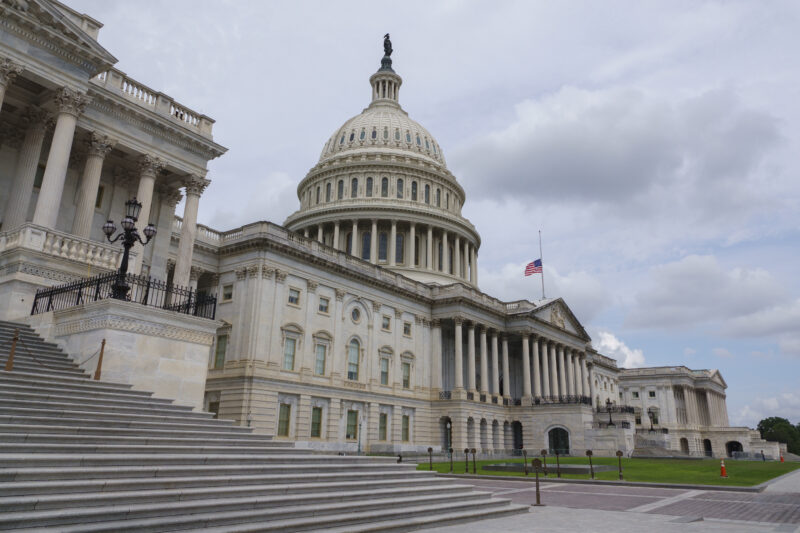
U.S. Capitol Building on January 18, 2025 in Washington, DC.


 Add JewishInsider on Google
The House passed a war powers resolution on Wednesday that would halt U.S. military operations against Iran, after House Republicans postponed an expected vote on the resolution for more than a week, in an ultimately futile effort to stave off defeat.
The resolution passed 215-208, with four Republicans breaking ranks to vote for the resolution, and all present Democrats remaining united on the issue for the first time since the war began. Six Republicans and one Democrat were absent for the vote — so the resolution likely still would have passed even with full attendance.
The vote comes after the Senate advanced a procedural vote on a similar resolution, and is a notable signal of opposition from Congress to the war in Iran, even if President Donald Trump can veto such a resolution if it passes the Senate. Some Republicans have suggested that the underlying 1973 War Powers Act is unconstitutional or invalid, and should be challenged in court or ignored by the administration.
A final Senate vote on the war powers resolution that advanced last month is still pending.
Republican Reps. Warren Davidson (R-OH), Thomas Massie (R-KY), Tom Barrett (R-MI) and Brian Fitzpatrick (R-PA) broke ranks to support the resolution. Davidson and Massie are libertarian-leaning isolationists, while Barrett and Fitzpatrick represent hotly contested swing districts.
Davidson voted for a war powers resolution at the outset of the conflict, but voted present and then against subsequent resolutions, before flipping his vote back to yes on the latest vote.
Fitzpatrick told reporters his vote was an issue of the law. The War Powers Act gives the administration 60 days to conduct military operations without congressional approval.
“We’re past the 60 days, so you have two choices: you either follow the law or you change the law,” Fitzpatrick said. “You can’t violate the law, that’s not an option. … I don’t see what’s complicated about it. Bring it to Congress, debate it on the merits and have us vote. That’s the way the system’s supposed to work.”
The administration has claimed that its military operations against Iran that began in February have concluded, and that its continued limited strikes against Iranian targets do not qualify as warfare.
Barrett, who introduced a limited Authorization for Use of Military Force in Iran, offered a similar stance in a statement.
“Congress has the exclusive authority under the Constitution to declare war and authorize the use of force,” Barrett said. “The War Powers Act of 1973 delegates some of that authority to the president for a limited period of time. That authority has expired, so my consistent belief is that it is time for Congress to decide the scope of the mission and the appropriate limits on the use of force in Iran.”
Other Republicans argue the legislation sends a message of weakness and division and strips the U.S. of leverage in the midst of negotiations.
“I think what it signals to Iran is that, especially from the Democratic standpoint, it gives them confidence to try and drag these negotiations out. So I think it undermines the position of the United States of America,” Rep. Mike Lawler (R-NY), who chairs the Foreign Affairs Committee’s Middle East subcommittee, told reporters. “They’re actively undermining the United States position in these negotiations, so, from my standpoint, I think it’s foolish, and that’s why I voted no.”
Rep. Jared Golden (D-ME), the sole Democratic holdout on previous votes, also flipped his vote to support the resolution in Wednesday’s vote.
Golden said that, after the 60-day mark of the Iran war passed, the statutory cutoff for military operations undertaken without congressional authorization, he believed the war could not continue without such approval. But he described a war powers resolution the House voted on last month as textually flawed and outdated.
“The passage of my War Powers Resolution is a significant bipartisan rebuke of President Trump’s illegal and costly war in Iran, and the first step toward ending it once and for all,” House Foreign Affairs Committee Ranking Member Greg Meeks (D-NY) said in a statement. “The passage of this WPR today signals a significant turning point: more and more Republicans are listening to their constituents who do not want another open-ended war in the Middle East. Now the Senate must take up this measure and make clear to the President that enough is enough.”
More Stories

Daily Overtime
New York braces for Oct. 7 protests

KINGS COUNTY KERFUFFLE
Treasurer for anti-AIPAC PAC behind effort to unseat Brooklyn Republicans

DOHA DEALINGS
Moskowitz challenger visited Qatar in 2024, photographed with Qatari official

Life after captivity
The Siegels lost their home and community on Oct. 7. Now they’re finding their way forward

Cross-Party Call
JCPA urges candidates in both parties to reject antisemitism ahead of midterms

analysis
From Oct. 7 to FlyDubai, ordinary Israelis keep filling the gaps left by the government
Please log in if you already have a subscription, or subscribe to access the latest updates.
 Continue with Google
 Continue with Apple