











































































House Democrats attempt to appease party base in voting for resolution cutting off aid to Israel
Over a dozen Democrats recently supported by AIPAC swung to support the amendment by far-right GOP Rep. Massie in a move that would have been unimaginable not long ago

Photo by Kevin Carter/Getty Images
The sun sets behind the U.S. Capitol Building on July 8, 2026 in Washington, D.C.


 Add JewishInsider on Google
More than 100 House Democrats — just under half of the party’s caucus — voted to cut off all U.S. aid to Israel on Wednesday, marking another flashpoint in the party’s growing disillusionment with the Jewish state. It’s a result that would have been almost unimaginable even a year ago.
The fact that the number of anti-Israel votes included several longtime pro-Israel Democrats who had previously been endorsed by AIPAC — like Reps. Jake Auchincloss (D-MA), Glenn Ivey (D-MD), Maggie Goodlander (D-NH) and Pat Ryan (D-NY) — is a sign that even some members in the mainstream wing of the party are running scared of a potential primary threat from the left.
Combined with the Senate vote earlier this year in which 40 Democrats voted for a measure led by Sen. Bernie Sanders (I-VT) to block shipments of some weapons to the Jewish state, the message is clear: Israel can no longer count on reliable support from the Democratic Party.
And voting for the equivalent of a wrecking ball to the U.S.-Israel relationship — an amendment that even vocal critics of Israel described as flawed and a calculated political stunt by Republicans — is no longer a nonstarter for congressional Democrats. With a more carefully crafted amendment presented by a member without Rep. Thomas Massie’s (R-KY) baggage, the margin in support could have been greater.
Despite the significance of the Democratic defections on Israel, it’s also notable that nearly all of the Democrats in swing districts or running in closely watched battleground Senate races stood by their support of Israel and voted against the amendment.
Only two of the 16 House Democrats facing the most competitive races — districts the Cook Political Report rates as “Lean Democratic,” “Toss Up” or favoring Republicans — voted for the Massie amendment.
Those lawmakers were Reps. Derek Tran (D-CA) and Gabe Vasquez (D-NM). Rep. Don Davis (D-NC) was absent, but would have opposed the amendment.
Expand that out to include “Likely Democratic” districts, and only two of those 10 lawmakers voted for the amendment: Goodlander and Rep. Steven Horsford (D-NV). Rep. Janelle Bynum (D-OR) voted present.
And nearly all of the Democratic candidates facing challenges from their left over their support for Israel stood their ground, even those running in deep-blue districts. That list includes Reps. Haley Stevens (D-MI) and Angie Craig (D-MN), who are both running for the Senate and facing fierce challenges from anti-Israel challengers. It also includes Reps. Wesley Bell (D-MO), Shri Thanedar (D-MI) and Debbie Wasserman Schultz (D-FL), who have faced strong pushback from their opponents over their pro-Israel stances, but held firm on the issue.
The results mark a significant setback for AIPAC, which is struggling to maintain influence within the Democratic Party as support for Israel becomes a more partisan issue. More than a dozen of its endorsed candidates voted against its most central policy priority, including lawmakers like Ivey who won their House seats with significant AIPAC backing and had been seen as close to the group. A handful of others voted present.
Ryan, a onetime moderate who has drifted toward the left, also publicly went on the attack against AIPAC, engaging with the anti-Israel account TrackAIPAC, which has faced accusations of antisemitism, to declare that he no longer wants AIPAC’s support and plans to return donations from the group.
“We are deeply appreciative of the 314 Republicans and Democrats who voted to reject Thomas Massie’s latest anti-Israel effort and are disappointed by the 103 Democrats who voted with Massie to weaken America and our ally Israel,” AIPAC said in a statement.
AIPAC also warned that it and its members aren’t backing down and “will be actively engaged throughout this election cycle, and future election cycles, to support members of Congress of both parties who support a strong U.S.-Israel alliance and oppose those who don’t.”
It’s important to keep in mind that lawmakers’ stated rationale for supporting the amendment varies: some do seek to cut off any U.S. support for Israel and sever the relationship as we know it; some seek changes to how the relationship functions; and others sought to send a signal of their frustration with the current Israeli government and its prosecution of the war in Gaza with a largely symbolic vote they knew would not pass.
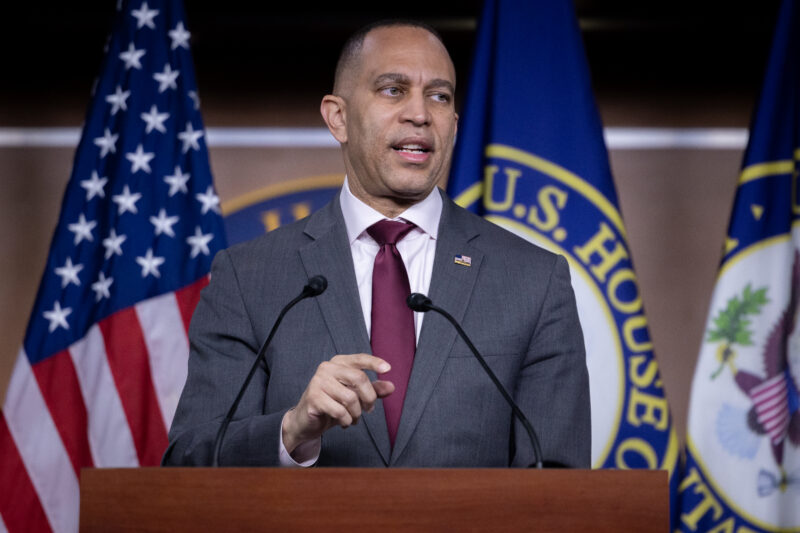
By the same token, many Democrats who voted against the amendment made clear that their votes were in part a reflection of their concerns with Massie’s approach, rather than a full-throated endorsement of the U.S.-Israel relationship as it currently exists. That was the position held by Minority Leader Hakeem Jeffries (D-NY), whose opposition to the amendment belied his overall concerns about the U.S.-Israel relationship.
Many Democrats called for changes in the relationship going forward, with Jeffries and other party leaders indicating they want direct military aid to end at the expiration of the current memorandum of understanding.
Observers also noted that the Congressional Black Caucus, which has traditionally held strong relationships with the Jewish community and pro-Israel world, was closely divided on the vote. Many of the caucus’ older or longer-tenured members voted to preserve aid to Israel, while newer and younger members for the most part voted against it.
The vote also underscored just how much of a role extreme voices have played within both parties in undermining relationships with allies under military threat. The right-wing grassroots hostility to Ukraine led to a number of party leaders — including a few Senate hawks — to vote against a 2024 funding bill for aid to Ukraine and Israel.
But even as there has been a strain of GOP opposition to Ukraine assistance, the Democrats’ turn against Israel has been more widespread. The fact that relatively few of the Democratic lawmakers who voted against the amendment offered a clear-throated defense of U.S. aid to Israel is a sign of just how politically toxic Israel has become within the party.
“This vote should serve as a wake-up call [to Israel] that significant work is needed to repair its relationship with Democrats — not only to preserve bipartisan support in the United States, but also to protect Israel’s long-term security and prosperity,” Democratic Majority For Israel CEO Brian Romick said in a statement.
More Stories

Arrivederci, Reggio
Jewish preschool educators forced to condemn Israel to attend Reggio Emilia conference

EMBASSY COMMEMORATION
Deputy national security advisor emphasizes shared civilizational fight at Oct.7 anniversary event

Cross-Party Call
JCPA urges candidates in both parties to reject antisemitism ahead of midterms

Daily Kickoff
Three years, familiar fears on 10/7 anniversary
CATCHING HEAT
Pro-Israel Democrats blast Mamdani for Oct. 7 anniversary statement

CITY HALL CRITICISM
Mamdani’s Oct. 7 statement assailing ‘genocide in Gaza’ provokes outrage from Jewish groups
Please log in if you already have a subscription, or subscribe to access the latest updates.
 Continue with Google
 Continue with Apple