























































Senate rolls Iran sanctions extension into Russia sanctions bill
The five-year extension of the Iran Sanctions Act of 1996 was included into the hard-fought bill at Trump’s urging

Tim Graham/ Getty Images
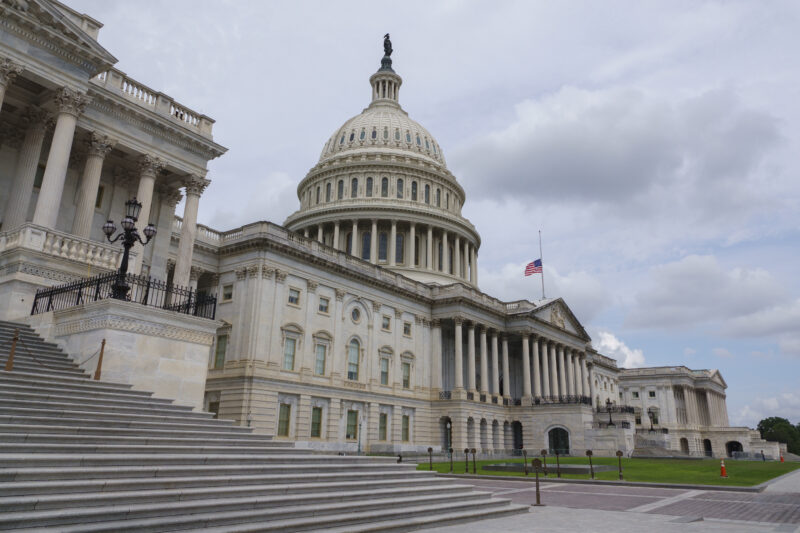
U.S. Capitol Building


 Add JewishInsider on Google
The Senate on Tuesday advanced a major Russia sanctions package, negotiated and championed by Sen. Lindsey Graham (R-SC) before his death, to which lawmakers added a provision extending longstanding sanctions on Iran, currently set to expire at the end of the year.
The addition of the five-year extension of the Iran Sanctions Act of 1996 to the package is a relatively minor change to the hard-fought bill, which will extend a key piece of the U.S. economic pressure campaign on Iran and address President Donald Trump’s late-stage demands that threatened to upend a bipartisan agreement.
Lawmakers have been working for years on a bipartisan basis to extend the Iran sanctions past 2026 and they have been extended on a bipartisan basis in the past.
“We are proud to announce an agreement on legislation to stop purchasers of Russian oil and gas from fueling Putin’s war machine and to continue restricting the Iranian regime’s ability to support terrorism and build its nuclear program,” Sens. Jim Risch (R-ID), Richard Blumenthal (D-CT), Darline Graham (R-SC), Katie Britt (R-AL), Jeanne Shaheen (D-NH) and Roger Wicker (R-MS) said in a joint statement on Tuesday. “There is no greater way to honor Senator Graham’s legacy than to move forward with this bipartisan agreement, and we look forward to today’s vote.”
The bill advanced by an 86-12 procedural vote. Sens. Bernie Sanders (I-VT), Elizabeth Warren (D-MA), Maggie Hassan (D-NH), Jon Ossoff (D-GA), Lisa Blunt Rochester (D-DE), Andy Kim (D-NJ), Mazie Hirono (D-HI), Ed Markey (D-MA), Alex Padilla (D-CA), Ron Wyden (D-OR) and Rand Paul (R-KY) voted no.
Blumenthal, the lead Democrat on the bill, had initially reacted negatively to Trump’s efforts to include Iran sanctions, warning against further changes to the bill, which took months to negotiate.
The bill “was the result of painstaking, sometimes painful negotiation involving leadership here, the White House, the U.S. trade representative over many months. I personally would like to see it passed as is,” Blumenthal said earlier this month after Trump initially began pushing for changes. “There may be other provisions that are worthwhile which should be passed separately.”
Asked Tuesday about the decision to add the Iran sanctions provisions, Blumenthal told Jewish Insider, “Darline Graham asked us — asked me — to do it. And by the way, that Iran provision was in the bill as originally written, so restoring it was a pretty simple yes.”
Blumenthal also told reporters that, during a closed-door meeting with senators shortly before the vote, Ukrainian President Volodymyr Zelensky emphasized the role that Ukrainian drone technology has been playing in assisting the U.S. with defending its bases from Iranian attacks.
Prominent House Democrats have raised concerns about the bill, which provides tariff authority to the administration to target importers of Russian oil, concerns shared by some of the bill’s Senate opponents, even as some of them expressed strong support for Ukraine. Critics worry that the bill would allow Trump to impose punishing tariffs on the U.S.’ European allies, but Democratic supporters insist that the authority is carefully tailored and limited.
Alexandria Paolozzi Moore, the senior director of government relations at FDD Action, said the extension is “a critical, bipartisan win. ISA is a foundational tool for countering Iran’s WMD proliferation, ballistic missile program, and support for terrorism.”
More Stories
SCOOP
Ro Khanna to urge negotiators to pull U.S.-Israel cooperation provisions from defense bill

ALBANY ALLIANCE
Jewish New York Dems launch PAC to counter antisemitism and anti-Zionism

EDUCATION INVESTIGATION
House Education Committee finds systemic antisemitism in Philadelphia, Berkeley K-12 schools

Daily Overtime
Syria’s new textbooks demonize Jews, report finds
POLL POSITION
U.S. experts split on Netanyahu’s prospects ahead of Israel’s election

COMINGS AND GOINGS
Heritage Foundation taps critic of U.S. involvement in Middle East as distinguished fellow
Please log in if you already have a subscription, or subscribe to access the latest updates.
 Continue with Google
 Continue with Apple