







































































Nearly half of House Democrats vote to cut off aid to Israel
Even as the amendment was overwhelmingly rejected, the vote underscores the anti-Israel mood within the Democratic Party is growing
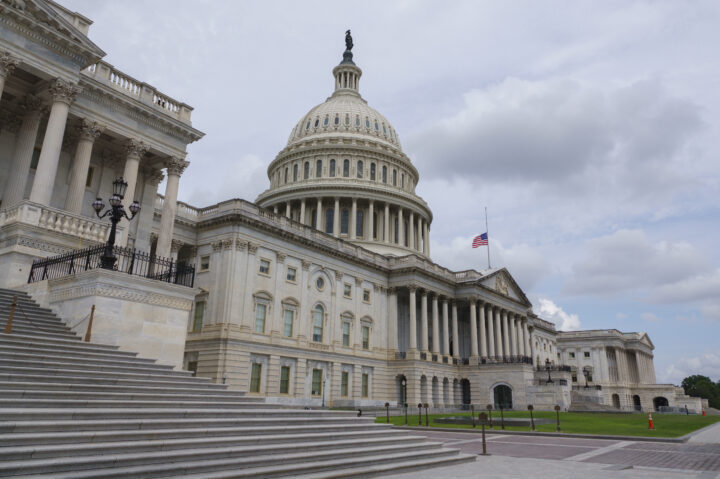
Kevin Carter/Getty Images
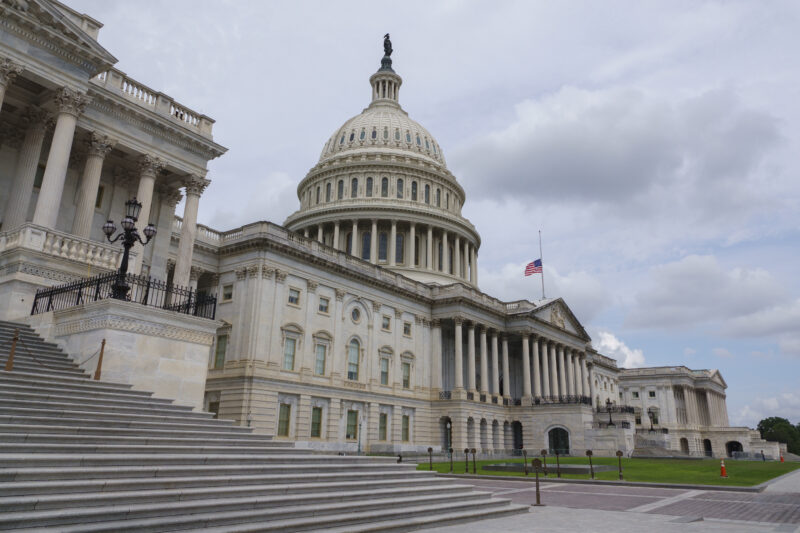
U.S. Capitol building on July 12, 2026 in Washington, DC.


 Add JewishInsider on Google
The House voted 314-104 on Wednesday to reject an amendment to the 2027 State Department appropriations bill that would have cut all $3.3 billion in annual U.S. aid to Israel. However, 103 Democrats, a near-majority of the caucus, voted in favor of the measure, with 98 others voting no and 10 voting present.
The record number of Democrats voting in favor of cutting off U.S. aid to Israel highlights the extent to which Democratic support for the Jewish state has eroded, and comes months after a vote in which 40 Senate Democrats backed blocking some weapons sales to Israel.
Rep. Thomas Massie (R-KY) introduced the amendment last month to eliminate the $3.3 billion in annual foreign military financing provided by the U.S. to Israel as laid out in the 2016 memorandum of understanding between the two countries. The Kentucky lawmaker, who was defeated in his GOP primary this year, was the only Republican member to support the amendment.
Some Democratic officials — on both sides of the issue — described Massie’s amendment as poorly drafted and overly broad, warning that it would also impact non-military aid as well as U.S. Embassy operations in Israel. Democratic leadership ultimately did not whip members for or against the vote.
House Minority Leader Hakeem Jeffries (D-NY) said in a letter on Tuesday that he planned to oppose the amendment and efforts to strip all U.S. aid to Israel, despite also noting that the relationship between the two countries requires “urgent change.”
House Democratic Caucus Chairman Rep. Pete Aguilar (D-CA) also voted no on the amendment. Aguilar told Jewish Insider last month that support for Israel’s right to exist in safety and security should continue to be a policy position of the Democratic Party, but cautioned that support for Israeli government policies would not be unconditional.
Meanwhile, House Minority Whip Rep. Katherine Clark (D-MA), in announcing she would vote yes, noted that the measure was “overly broad” and “not an attempt to have a serious and necessary debate about offensive military aid to Israel.” Despite her criticisms, she said her vote was a signal that the relationship needs to change.
Former House Speaker Nancy Pelosi (D-CA), once a reliable supporter of Israel, supported the Massie amendment, but called it an “unfortunate choice.”
“The United States must be a force for security and stability. The American people are rightly demanding an end to a perpetual cycle of war, and the Netanyahu government cannot maintain its current course,” Pelosi said. “Therefore, while this amendment is ill-conceived, I vote yes for the message that it sends.”
Rep. Alexandria Ocasio-Cortez (D-NY), a critic of Israel who is a potential Democratic candidate for president in 2028, called the vote a “very important moment.”
“A majority of Democrats voted in favor of this Massie amendment. To me what this says is that the majority of the Democratic party is most in touch with the American electorate writ large … and the Republicans are not,” Cortez said. “This has been an issue where both parties have been resistant to change.”
Ocasio-Cortez said lawmakers who voted against the amendment are “stuck in the past.”
Rep. Greg Casar (D-TX), who chairs the Congressional Progressive Caucus, said in a statement on Tuesday that he would support the amendment because the “American people are crying out for an end to U.S. tax dollars subsidizing Israel’s military.” Casar and the CPC whipped Democrats to support the amendment.
“At a time when millions are struggling to make ends meet, we are sending billions of dollars to a military that has killed tens of thousands of civilians in Gaza, the West Bank, and Lebanon,” Casar wrote. “I am aware House Democratic leadership has a different position on this amendment … I respect their leadership.”
Rep. Steny Hoyer (D-MD), the former No. 2 House Democrat and a staunch supporter of Israel, opposed the amendment and argued it would “dangerously undermine America’s national security,” limit the U.S.’ ability to counter terrorist organizations and make it harder to leverage the U.S. relationship with Israel toward peace.
“I understand the frustration many members feel with some of the policies and actions of the current Israeli government — as well as their concerns about its commitment to the peace process and a two-state solution,” Hoyer said. “However, this amendment would embolden the enemies of peace, those who seek the complete elimination of Israel, and those looking for an excuse to murder Jews. It is a vote to weaken our ability to engage in the region, and it is a vote against American security, against American interests, and against Americans’ safety.”
Rep. Brad Schneider (D-IL), who voted no, lambasted the amendment as having no legislative impact or role in helping the prospects for Middle East peace.
“This cynical Republican amendment was put forward to stoke division and divide people here in the United States, not end the conflict between Israelis and Palestinians or provide a path forward,” Schneider said. “I will seek to understand how such a flawed legislative proposal — one that would hurt Israelis and Palestinians, as well as America’s standing in the world — generated support.”
He said that supporters of Israel must work to “rebuild a bipartisan consensus” in support of Israel as well as Palestinian self-determination.
Rep. Eugene Vindman (D-VA), who ultimately voted against the amendment, said that under Israeli Prime Minister Benjamin Netanyahu, “Israel has lost its way,” suggesting that Netanyahu had undermined Israeli security and damaged the U.S.-Israel alliance.
“Yet, as a Jewish refugee who fled oppression in the Soviet Union, I have long believed that Israel is a refuge for many families like mine,” Vindman said. “These convictions made this one of the most difficult votes I’ve cast because Israel needs to change course. However, I could not support an amendment as poorly written as this one that would eliminate key funding provisions that support Palestinian security forces, humanitarian aid, and defensive systems to protect innocent civilians.”
Key Democratic committee leaders, including the ranking members of the Appropriations, Foreign Affairs and Intelligence committees, all voted against the amendment, while Rep. Adam Smith (D-WA), the ranking member on the Armed Services Committee, voted in favor.
Several pro-Israel House Democrats who are facing contentious primary challenges in which Israel has become a key issue — including Reps. Wesley Bell (D-MO), Shri Thanedar (D-MI) and Ed Case (D-HI) — voted against the amendment.
Reps. Haley Stevens (D-MI) and Angie Craig (D-MN) also voted against the amendment, while Rep. Chris Pappas (D-NH) voted present. All three are running for the Senate.
But Rep. Seth Moulton (D-MA), who is running against Sen. Ed Markey (D-MA) in Massachusetts and has tried to tack to the progressive Markey’s left, said in a statement released prior to the vote that he would support the amendment, writing, “We simply cannot continue to condone Netanyahu’s actions that are against our moral conscience and our own national security interests by perpetuating the status quo.”
Other lawmakers who have generally been reliable supporters of Israel — including Reps. Jake Auchincloss (D-MA), Glenn Ivey (D-MD), Pat Ryan (D-NY), Laura Friedman (D-CA) and Brittany Pettersen (D-CO) — voted for the amendment.
“I just voted to block sending $3.3 billion of our taxpayer dollars to Netanyahu’s government. It’s wrong on every level,” Ryan said. “I expect groups like AIPAC will not support me in my future elections and frankly, I don’t want their support. Hardline stances that refuse to stand up to a corrupt and increasingly dangerous Netanyahu regime have no place in our politics.”
Auchincloss said that his vote to cut funding to Israel was designed to send a message to both President Donald Trump and Netanyahu.
“With their disastrous war against Iran, their empowerment of settler violence in the West Bank, and their strategic incoherence against Islamist terrorism, both President Trump and Prime Minister Netanyahu have sacrificed [Congress’] trust,” Auchincloss said.
He said that the amendment is “not the ideal mechanism of action,” and raised concerns about Massie’s use of antisemitic tropes in his reelection campaign.
“I have weighed these problems against the central thrust of the amendment: there must be consequences for Trump and Netanyahu,” Auchincloss continued. “Those consequences should not impair the State of Israel’s right to defend itself against the atrocities of the terrorist regimes that threaten it. Israel and the United States have common interests, shared values, and a long history. Israel and the United States are allies.”
He also said that upcoming Israeli elections, the next memorandum of understanding with Israel and the long-term impacts of the Iran war offer “an opportunity to renew the U.S.-Israel alliance on shared principles and a bipartisan basis going into the 2027 appropriations process.”
Groups including AIPAC, J Street, the Jewish Democratic Council of America, Democratic Majority for Israel and the American Jewish Committee all opposed the amendment, though J Street said the result sent a “strong message” that Democrats agree that the party should pursue a “fundamentally different American approach to the U.S.-Israel relationship and the region.”
Over a dozen Democrats previously endorsed by AIPAC, including Auchincloss, Clark, Friedman, Pelosi, Pettersen, Ryan, Smith and Reps. Gabe Amo (D-RI), Maggie Goodlander (D-NH), Julia Brownley (D-CA), Josh Harder (D-CA), Steven Horsford (D-NV), Julie Johnson (D-TX), Bill Keating (D-MA), Seth Magaziner (D-RI), Richard Neal (D-MA) and Joe Neguse (D-CO), voted for the amendment.
More Stories

TORAH AND TAXES
First female Haredi candidate promises reform to ultra-Orthodox politics

ACCUSATION AFTERMATH
El-Sayed denies Muslim Brotherhood ties after Rogers debate claim

EVENT RESCHEDULED
State Department to hold Oct. 7 commemoration event on Wednesday

NEXT CHAPTER
After years of hostage advocacy, Kibbutz Be’eri survivor turns toward the future
CATCHING HEAT
Pro-Israel Democrats blast Mamdani for Oct. 7 anniversary statement

Daily Kickoff
Three years, familiar fears on 10/7 anniversary
Please log in if you already have a subscription, or subscribe to access the latest updates.
 Continue with Google
 Continue with Apple