




































































Far left, far right rebel over defense bill provision on U.S.-Israel cooperation
Former U.S. Ambassador Daniel Shapiro called the provision largely ‘unremarkable,’ countering claims from the extremes that it would mark a surrender of U.S. sovereignty

Zack Frank
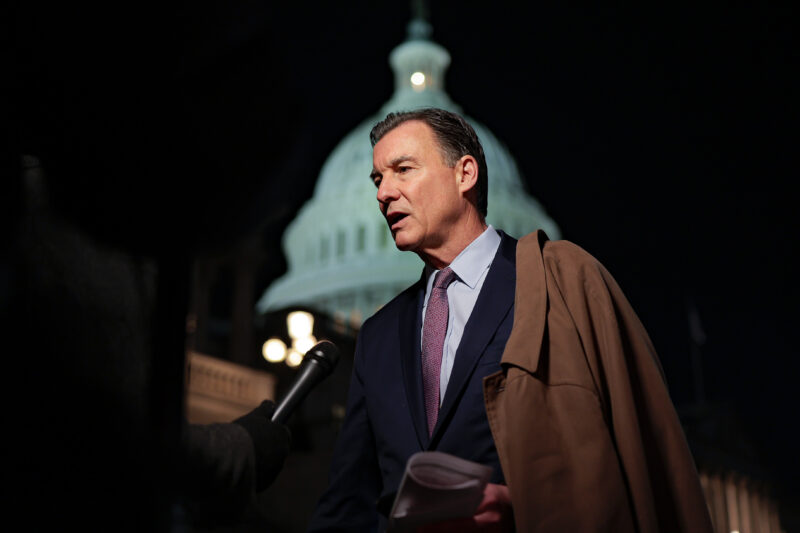
Capitol Building


 Add JewishInsider on Google
A relatively routine provision that aims to facilitate expanded U.S. cooperation with Israel in the House’s draft of the 2027 National Defense Authorization Act has fueled outrage from the far left and far right, with some prominent figures making inaccurate claims that the provision would subjugate the U.S. military to Israel or otherwise compromise U.S. sovereignty.
The turmoil appears to have begun with an article published in the isolationist Quincy Institute’s Responsible Statecraft journal that claimed the legislation “would all but fuse the two countries’ armed forces together.”
The backlash has gained widespread attention, from current and former lawmakers, anti-Israel commentators and even a celebrity news account with more than 3.5 million followers on X — an unusual series of events for the wonky annual defense policy bill.
Critics are objecting to a provision in the bill, the “United States-Israel Defense Technology Cooperation Initiative,” which aims to expand and accelerate joint U.S.-Israel technological development and industrial cooperation; allow the U.S. to quickly adopt proven Israeli technologies; and promote joint training exercises, information sharing and co-production in areas including defense manufacturing, anti-tunneling, air- and missile-defense and various advanced technologies.
But the U.S. already has established cooperative programs in Israel in many of the areas enumerated in the bill, set up in previous years’ NDAAs and defense budget bills, without much fanfare — so the sort of cooperation laid out in the bill is hardly new, unprecedented or a significant change.
The language also closely hews to bipartisan legislation in both chambers, the U.S.-Israel FUTURES Act, which has 46 co-sponsors in the House and 11 in the Senate. Those bills aim to leverage U.S. and Israeli technology and innovation to assist in the defense of both countries.
“This provision promotes ongoing, and in some ways, expanded cooperation between the United States and Israel in developing key military technologies. It is quite unremarkable,” Daniel Shapiro, a former U.S. ambassador to Israel and senior Pentagon official who is now a distinguished fellow at the Atlantic Council, told Jewish Insider. “Those describing it as promoting ‘integration’ between the U.S. and Israeli militaries are making a mountain out of a molehill. But these days, there are a lot of people trying to make molehills into mountains in this arena.”
Critics on both sides of the aisle are mobilizing against the legislation.
Rep. Thomas Massie (R-KY) suggested that the legislation would undermine American sovereignty and vowed to introduce an amendment to strip it out of the bill if it makes it through the committee process.
Rep. Ro Khanna (D-CA), who sits on the Armed Services Committee, said he’ll try to remove the provision during the committee markup later this week. “Trump can’t kill the Massie/Khanna partnership no matter how much he posts on Truth Social,” Khanna said.
“Looking forward to posting that roll call vote from the Armed Services committee,” Massie responded. “Maybe they’ll go ahead and strip the provision instead of taking the vote, now that people are on to them.”
Anti-Israel commentators have also seized on the provision.
“This is what complete capture to a foreign government looks like and there hasn’t been a single shot fired,” former Rep. Marjorie Taylor Greene (R-GA) declared.
Former State Department official Josh Paul, an anti-Israel activist, claimed the provision would “intertwine our military with Israel’s” and give Israel “incredible leverage over America’s own defense priorities.”
The condemnation of this provision also foreshadows potential objections to future efforts to shift the U.S.-Israel relationship away from direct aid and toward jointly funded cooperative programs.
Indeed, Paul highlighted that likely shift as a reason to oppose this provision in a video on the subject.
In addition to the new cooperation provision, the NDAA draft includes language extending the U.S. weapons stockpile in Israel, counter-tunneling cooperation programs and counter-drone cooperation programs through 2029.
It authorizes $50 million for cooperative programs in emerging technology, as well as $100 million for each of the counter-drone and counter-tunneling programs and an annual $300 million for cooperative air defense systems including Iron Dome. All of that funding would still have to be appropriated separately.
It also praises the U.S. relationship with Jordan and urges efforts to expand cooperation with Amman, including on integrated air- and missile-defense systems and cybersecurity cooperation efforts.
Democrats are likely to push a range of other amendments related to the war in Iran at Thursday’s markup.
Notably, the bill backed by House Republicans also includes several provisions designed to hamstring isolationist-minded moves by the Trump administration, including limiting troop drawdowns from Europe and South Korea. It would also freeze construction of the “Trump-class” battleship until the technology is better developed.
More Stories

analysis
Texas Jewish voters at a loss in the state’s hotly contested Senate race

PLAYING DEFENSE
Zohran Mamdani defends his plan to combat antisemitism amid criticism

MEDIA MOMENT
New York magazine editor seeks to reassure Jewish leaders but stands by contentious cover issue

Daily Kickoff
Chris Murphy’s Doha double standard

TAKING AIM
House Democrats introduce sanctions bill targeting settlement expansion

BUSY IN BEIRUT
Reps. Gottheimer, LaHood visit Lebanon, meet President Aoun
Please log in if you already have a subscription, or subscribe to access the latest updates.
 Continue with Google
 Continue with Apple