


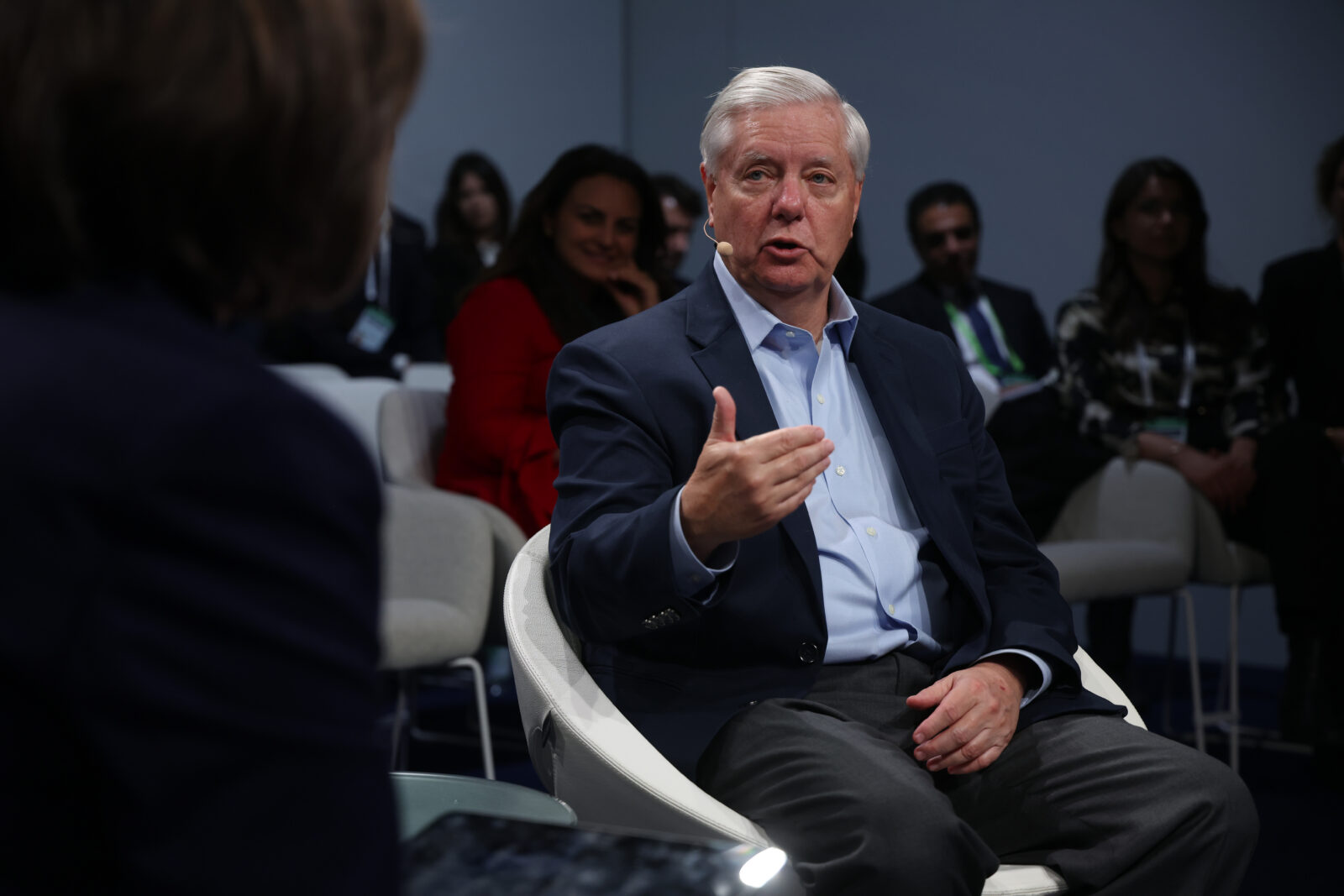
Sean Gallup/Getty Images
Tributes pour in after death of Lindsey Graham, Israel’s staunch defender in the Senate
Trump, Cruz, Fetterman, Coons and Jewish organizations remembered the South Carolina Republican, who died suddenly at 71


 Add JewishInsider on Google
As President Donald Trump returned to Washington on the first Sunday of the new year, he was joined by Sen. Lindsey Graham (R-SC), who had traveled to the president’s Mar-a-Lago estate a day earlier to be with Trump after he ordered the operation that deposed Venezuelan President Nicolás Maduro.
Graham, 71, had been encouraging Trump since returning to office last January to take a more aggressive posture toward the Maduro regime, and vigorously defended the president’s decision to launch a series of strikes targeting Venezuelan boats that the Trump administration alleged were carrying drugs meant to reach U.S. soil. By late October, he was calling on Maduro to flee Venezuela and cede power as tensions between Trump and the dictator escalated.
During an impromptu press conference aboard Air Force One, Trump and Graham defended the merits of the operation and predicted that the Cuban regime was likely to fall as a result of the mission. The South Carolina senator, one of the most hawkish Republican lawmakers on foreign policy, grinned as he heralded the mission as a success.
“When I was on Air Force One with the president flying back and we did that news conference, if you thought I was smiling big on the outside, you have no idea how much I was smiling on the inside,” Graham told Jewish Insider in an interview shortly after arriving in Washington with the president. “This is the best time in my political life because I’ve aligned myself with the strongest president in modern times. We’re getting results that are making this world safer and America more prosperous.”
By that time, more than 10 years after rejecting Trump’s candidacy and decrying him as a “race-baiting, xenophobic bigot” whose rhetoric would “kill my party,” Graham had become one of the president’s closest allies in the Senate and a close confidante on foreign policy matters.
“This is what happens when you stay in his orbit, realizing there’s far more good than bad and understanding that this man has magic that nobody on the planet has,” the South Carolina senator told JI. “It’s not so much that I’m on a roll. It’s the fact that talking with President Trump, he is embracing policies that he calls common sense, and the small part I play on the end of this, I’m so proud of.”
Following Graham’s sudden passing this weekend, Trump somberly reflected on the loss of his friend, political confidante and golfing partner, praising the late senator for his political acumen and his patriotism in a pair of media interviews and two social media posts.
“He’s a tough one to lose. He was great. He was unique in every way, actually,” Trump told NBC’s “Meet the Press” on Sunday morning of Graham. “He was really a worker. … He was a great politician, actually.”
“He was such an advocate if he wanted to get something. He had a unique ability, he was able to deal with Democrats. If I had a problem, a real problem, I wouldn’t often ask, but if I had a problem with a Democrat, he could work it out,” he continued. “There was nobody like him. He loved being a politician, and he was going to win his election [in November for a fifth Senate term]. … He just had it made.”
Graham passed away on Saturday evening after returning from a congressional delegation that included stops in Kyiv, Ukraine, and Ankara, Turkey, for last week’s NATO summit.
The South Carolina senator arrived to his Capitol Hill townhome late Saturday afternoon and began making phone calls to Republican political allies in the early evening about legislative business, developments in the Middle East and to share details of his recent trip, according to two sources with direct knowledge.
One of those calls was to the president. Another was to Morgan Ortagus, the former deputy presidential envoy for Middle East peace in the second Trump administration and one of Graham’s closest confidantes in Washington. The president said that Graham mentioned being “tired” during their conversation, but noted that “he was fine” and expressed shock at his sudden passing. Ortagus told JI on Sunday afternoon that Graham was upbeat during their final conversation, expressing optimism that Trump was coming around on supporting his Russia sanctions bill and with resuming military operations in Iran.
“Nobody was expecting this. That’s for sure. Not even Lindsey was, or he wouldn’t have been running for another term,” Sen. Kevin Cramer (R-ND), who has had close relationships with both Graham and Trump, said of the senator’s sudden passing. “When a person cuts as wide a swath as Lindsey cuts, it is shocking. It will take some time to process the reality of it. It should really hit on Monday when we show up for work.”
It came as a shock to Trump, Ortagus and everyone else in Graham’s orbit when his office announced his passing in the early hours of Sunday morning, which the Washington D.C. medical examiner’s office, in a preliminary autopsy report, attributed to aortic dissection caused by arteriosclerotic cardiovascular disease.
“He was extremely jazzed up in our last conversation. He had just gotten off the phone with the president, and he was super excited about the Russia sanctions bill and the president deciding to go back into Iran,” Ortagus told JI. “He could not have been happier when I spoke to him last night. He was in the best mood and in a great place. He spoke about how he felt like he was doing consequential work.”
“Nobody was expecting this. That’s for sure. Not even Lindsey was, or he wouldn’t have been running for another term,” Sen. Kevin Cramer (R-ND), who has had close relationships with both Graham and Trump, said of the senator’s sudden passing. “When a person cuts as wide a swath as Lindsey cuts, it is shocking. It will take some time to process the reality of it. It should really hit on Monday when we show up for work.”
Asked about his phone call with Graham during his “Meet the Press” appearance — on which Graham had been scheduled to appear — Trump said, “I just can’t believe it. He was like a member of the family to me. It’s very tough, actually. It’s amazing.”
Trump and Graham formed an unlikely relationship over the course of the first Trump administration, finding common ground with the establishment of the Abraham Accords and the confirmation of the president’s Supreme Court nominees.
Graham briefly broke with Trump in the immediate aftermath of the Jan. 6, 2021, Capitol riot, condemning the attack and recognizing Biden’s 2020 victory. But within months, Graham was regularly visiting Trump at his Mar-a-Lago estate in Palm Beach, Fla., and publicly urging his party to rally around the president’s bid for a second term in 2024.
“He genuinely had a fantastic relationship with President Trump. They really actually liked each other a lot. I think Trump was his best friend in many ways,” Ortagus said. “He loved the president. It was genuine. They were incredibly good friends.”
Sen. Ted Cruz (R-TX) and Graham got to know each other as members of the Senate Judiciary Committee and on the presidential campaign trail in 2016. The two developed a close working relationship in the last decade, finding common ground on economic and foreign policy issues that pitted them against the expanding populist wing of the GOP.
Speaking to JI on Sunday, Cruz said that Graham and Trump “became close friends. Lindsey would call the president early in the morning, late at night and at every hour in between. And the president listened to him. He didn’t always agree, but he trusted him and he knew that Lindsey was speaking from the heart.”
“[Senate Majority Leader] John Thune (R-SD) is going to miss him terribly. Donald Trump is going to miss him terribly,” Cramer told JI. “It confounds them, MAGA world. They love Donald Trump and can’t stand Lindsey Graham, so they’re befuddled by the relationship.”
Cramer noted that Trump has developed political alliances with several former critics, the most notable example being Vice President JD Vance, who was similarly disapproving of the president during the 2016 election. Like Graham, the vice president became an avid defender of Trump during the president’s first term.
While both men found their way into the president’s orbit, they remained on opposing sides of the conservative movement, with Vance becoming one of the leading GOP voices wary of U.S. military engagement abroad and Graham emerging as a leading force behind the effort to maintain an engaged foreign policy.
“With Lindsey, he was talented,” Cramer said. “He was bright and he knew things that a lot of people don’t know. He had a historical perspective a lot of people don’t have. He had a Rolodex that’s probably in several languages, and he called you from all kinds of time zones. You never knew where he was when he called.”
Despite having those conservative detractors, following his death, Graham was lauded for his humor, his friendship and his public and private support for Trump by those in the president’s orbit — including Vance and other prominent Trump administration officials who were not often ideologically aligned with the late senator.
“Early in my Senate tenure, I remember getting into a shouting match with Lindsey about a Ukraine funding bill at lunch and then learning the very next day that he was pushing rail legislation I really cared about behind the scenes,” Vance wrote on X. “That was Lindsey Graham. He fought like hell for the things he believed in, and he was just as willing to go to bat for you when it counted.”
“Lindsey had the best sense of humor in the Senate. He loved the game of politics. He was constantly asking which races were up and down, and how he could help,” the vice president continued. “As he liked to say, ‘I don’t care if you’re an isolationist or a religious fanatic, so long as you have an R next to your name, I want you to win.’ We certainly had our disagreements. But I couldn’t help but like him. A one of a kind figure in our politics.”
Stephen Miller, the White House deputy chief of staff for policy and a longtime Trump advisor, described Graham as a cherished ally to the president in implementing the administration’s policy goals and spoke of telling the late senator “what his friendship meant to me and to us all.”
“I cannot describe to you how much joy President Trump’s leadership and friendship brought to Lindsey,” Miller wrote on X. “Meetings with Graham at the White House were filled with camaraderie, kinship and uproarious laughter.”
“The fact that Lindsey started out as a political opponent only to become one the President’s most steadfast and faithful supporters underscores that Lindsey believed emphatically in the voice of the people,” he explained.
Miller described Graham as “a senator’s senator” and praised his ability to “move a room,” calling it “a glorious thing to witness.”
Sander Gerber, the CEO of Hudson Bay Capital and the architect of the Taylor Force Act, the passage of which Graham championed, told JI, “Lindsey was a maverick. He didn’t care about convention. He cared about doing what was right. When Lindsey set his mind to something, he was going to deliver on it, and he had a keen sense of the politics to be successful at that. He should be remembered as one of the greatest champions for Israel among members of Congress.”
“As heartbreaking as his sudden passing is, I hope it will bring some measure of comfort to those who cherished him to know just how much he was living his dream every day,” Miller said. “Very rarely in life do you get to be exactly where you want to be, when you want to be there, with who you want to be with, doing precisely what you want to do — that was every moment for Lindsey.”
Many of those who spoke about Graham after his passing described the South Carolina Republican, who spent more than two decades in the Senate, as a professional at navigating choppy political waters
“He wasn’t just a good talker, he had depth,” Cramer said. “He knew what the hell he was talking about. He had interesting insights.”
Sander Gerber, the CEO of Hudson Bay Capital and the architect of the Taylor Force Act, the passage of which Graham championed, told JI, “Lindsey was a maverick. He didn’t care about convention. He cared about doing what was right. When Lindsey set his mind to something, he was going to deliver on it, and he had a keen sense of the politics to be successful at that. He should be remembered as one of the greatest champions for Israel among members of Congress.”
“In order to get things done in Congress, to actually make a difference, you need to have the relationships,” Gerber said. “Lindsey was able to cultivate those relationships, and that’s what enabled him to get things done. There are 100 senators, but he was able to get his voice to stand out and to drive policy forward.”
Republicans and Democrats alike predicted Graham would be remembered as a legendary American political figure known for his ability to take political risks and find common ground in unexpected places.
“There was not a fight on domestic or foreign affairs that he didn’t want to jump into,” Ortagus said of Graham. “If he believed in an issue and believed that a particular policy was the right thing, he really didn’t care about the politics. Ultimately, he wouldn’t change what he believed was right based on politics, and that’s in very short supply politically right now.”
Ret. Gen. David Petraeus, the former director of the CIA and head of U.S. Central Command, told JI that Graham’s legacy would be “that of someone who was fiercely committed to the enduring principles, values and freedoms that we cherish, and who had the political skills and determination to see what he supported promoted by legislation, policies and strategies.”
“Sen. Graham’s dedication to the state of Israel and to the Jewish people was deeply sincere. We talked about it all the time. I went to Israel with him many times,” said Morgan Ortagus, the former deputy presidential envoy for Middle East peace in the second Trump administration and one of Graham’s closest confidantes in Washington. “He was a Southern Baptist and believed in the importance of the Jewish state to his core, and was willing to defend it.”
“I think he would be pleased to hear me say that he was not just adept, but was diabolically creative when necessary to achieve the outcomes to which he was committed,” Petraeus said.
Many of Graham’s allies said they expect his longstanding support for Israel and his commitment to aiding Ukraine in Russia’s war against it to be signature pieces of his foreign policy legacy.
“Sen. Graham’s dedication to the state of Israel and to the Jewish people was deeply sincere. We talked about it all the time. I went to Israel with him many times,” Ortagus said. “He was a Southern Baptist and believed in the importance of the Jewish state to his core, and was willing to defend it.”
“We talked a lot in the past year about the rise of antisemitism and anti-Zionism in both parties. He was very close to my daughter and she called him ‘Uncle Lindsey,’” she continued. “I would always remind him that I have a Jewish daughter and that throughout our history, the Jewish people have always thought we were safe until we weren’t.”
Ortagus said she and Graham “agreed that we have to fight antisemitism back in our party, that it can’t be allowed to fester. He would always talk about how important it was. He had deeply held personal beliefs on what America’s relationship with Israel should be. There was nothing cynical or craven about it.”
Cruz described Graham as “a passionate and formidable defender of Israel” and noted that Israeli Prime Minister Benjamin Netanyahu “trusted Lindsey and listened to him.”
“Lindsey loved the nation of Israel. He loved the people of Israel, and he believed ferociously in defending and strengthening America’s friendship and alliance with Israel,” the Texas senator said of his late colleague. “Now, Lindsey would sometimes tell his friends messages they didn’t want to hear. Lindsey was not one to just blow smoke. He would tell people exactly what he thought, but that made him an incredibly effective advocate for Israel.”
“Lindsey understood that standing with Israel is overwhelmingly in America’s national security interests,” he continued. “He and I collaborated very closely on articulating why standing with Israel makes America safer, that the enemies of Israel, whether Hamas or Hezbollah or Iran, are the enemies of America as well.”
Sen. Chris Coons (D-DE) credited Graham with doing “a masterful job of pulling” senators from across the ideological spectrum “in the same direction” in the immediate aftermath of Hamas’ Oct. 7, 2023, attacks on Israel, swiftly organizing a bipartisan congressional delegation alongside former Sen. Ben Cardin (D-MD) to Israel, Saudi Arabia and Egypt as he sought to salvage his longstanding efforts to achieve Saudi-Israeli normalization.
“It was an incredible trip, and all of us said it was just one of the most consequential, constructive trips we’d ever been on,” Coons told JI. “[Sen.] Katie Britt (R-AL) came on the trip. It was one of her first trips as a senator, I think. Think about the range of members who we had. We had [Sens.] Chris Murphy (D-CT) and Dan Sullivan (R-AK) in the same meeting.”
“Even though it was two weeks after Oct. 7 and it was in the middle of that shock, he knew what he was doing,” Coons continued. “He was building a coalition of supporters for the deal that he was hoping he could pull off.”
Coons was one of several people to point to Graham’s well-documented friendships with the late Sens. John McCain (R-AZ) and Joe Lieberman (I-CT), known as the Senate’s “three amigos,” as an important part of his legacy.
“I think he continued McCain’s legacy of fighting for freedom, and he never gave up on the possibility of ending the Arab-Israeli conflict,” Coons said. “That was his prize.”
“He was not afraid to be critical and he was never uncritical of friends. He believed that friends owe it to each other to try to enable them to do better,” Sen. Richard Blumenthal (D-CT) said. “He had a vision, which was in effect the normalization of relationships throughout the Middle East, an extension of the Abraham Accords. He pursued it relentlessly.”
Sen. Richard Blumenthal (D-CT), who maintains a similarly bipartisan reputation in Congress, worked with Graham frequently on foreign policy matters. Blumenthal began traveling abroad with Graham in 2012, two years after being elected to the Senate. Their first trip together was a congressional delegation to the Middle East organized by McCain. The two traveled repeatedly to Ukraine and its European neighbors since Russia’s invasion, and to the Middle East since Oct. 7.
“He loved the Jewish people and he loved the Jewish state, which was so striking to me when I first traveled with him and John McCain to Israel,” Blumenthal told JI. “He and McCain loved the faith of the Jewish people, which of course is so much a part of life in Israel, but Sen. Graham also loved Israel’s ingenuity and inventiveness and the prowess and scrappiness of its military.”
“He was not afraid to be critical and he was never uncritical of friends. He believed that friends owe it to each other to try to enable them to do better,” he continued. “He had a vision, which was in effect the normalization of relationships throughout the Middle East, an extension of the Abraham Accords. He pursued it relentlessly.”
On the Taylor Force Act, Gerber noted that he convinced Graham to push for the Palestinian Authority to end its controversial payment program to Palestinian terrorists and their families, also known as “pay-for-slay,” after showing the senator video footage of the Palestinian Authority celebrating the terrorist who murdered Taylor Force, a U.S. army veteran killed by a Palestinian while visiting Israel in 2016.
“I’d shown this to many other senators, but no one was as upset as Lindsey. I remember him shaking when he saw the footage,” Gerber said. “Originally, I just wanted to educate Congress about what was going on, so I was trying to meet with as many members as I could to let them know the Palestinian Authority had this institutional infrastructure in place.”
Leading Jewish and pro-Israel organizations praised Graham in statements on his passing as a champion for the Jewish state and in the fight to combat rising antisemitism.
“For more than two decades in the United States Senate, his voice was a constant reminder that a strong Israel is firmly in America’s national security interest, and his commitment to these principles never wavered,” AIPAC said. “His many visits to Israel and his love for the Israeli people reflected not just a policy position, but a deep personal connection to the Jewish state and its citizens.”
The American Jewish Committee described the late senator as “a powerful advocate for many of the issues AJC champions, including American global leadership, Israel’s security, a robust North Atlantic Treaty Organization, and Ukraine’s defensive fight against Russian aggression.”
AIPAC called Graham “a great friend and true champion of the U.S.-Israel relationship.”
“For more than two decades in the United States Senate, his voice was a constant reminder that a strong Israel is firmly in America’s national security interest, and his commitment to these principles never wavered,” the organization said. “His many visits to Israel and his love for the Israeli people reflected not just a policy position, but a deep personal connection to the Jewish state and its citizens.”
The Republican Jewish Coalition released a statement from Matt Brooks, the organization’s CEO, and former Sen. Norm Coleman (R-MN), the organization’s national chairman, describing the late senator as “a dear friend” to both men personally and the organization as a whole.
“On a personal level, Lindsey was a man of deep loyalty, humor, and heart. He treated everyone, ally or adversary, with warmth and respect, and he built friendships across the aisle that many said were impossible in today’s Washington,” the statement read.
The GOP senator’s slow embrace of Trump earned him criticism from constituents and lawmakers on both sides of the aisle. As a former conservative House lawmaker who had fought the rise of the Tea Party movement in the early 2010s, Graham had built a reputation as a defense hawk with a penchant for bipartisanship when Trump was first elected in 2016.
Some Democrats were angered by his political pivot, especially during and after the first Trump administration, but Graham maintained strong relationships with his Democratic colleagues and continued working with them frequently on efforts to support Ukraine and other areas of agreement.
“He deeply, genuinely loved the Senate. He tried really hard to do positive things for the institution at the same time that he was a fierce partisan,” Coons said of Graham. “Our fight over Kavanaugh was one of the worst I’ve ever had.”
Another of those Democrats is Sen. John Fetterman (D-PA), who became close with Graham in the two-and-a-half years since the Oct. 7 attacks. Graham and Fetterman, whose decision to vocally support Israel amid declining support in the Democratic Party prompted his relationship with the progressive left to collapse, frequently engaged on foreign policy matters, especially related to developments in the Middle East.
Fetterman described Graham to JI as “warm, friendly and thoughtful” and called his passing “a tragedy.”
“Israel lost a huge champion with Lindsey Graham,” the Pennsylvania senator said.
Libertarian and isolationist Republicans, meanwhile, grew frustrated that such a hawkish voice was being consulted so closely on foreign policy matters in an America First administration.
“There should be a law that Lindsey Graham can only enter the White House every other week, and that he’s only to meet with under mid-level people, not the president. No more golf outings,” Sen. Rand Paul (R-KY), a foe of Graham’s in the Senate Republican Conference who opposed the president’s actions in Venezuela, told reporters in January.
Across the political spectrum, those who knew Graham described him as an irreplaceable fixture in the Senate and predicted that his loss would cause many voids in the upper chamber, where the late senator was supposed to take over as the top Republican on the Senate Judiciary Committee next year.
“He links so many things and so many people that without him, there’s a missing link in a lot of relationships between Middle Eastern countries between members of the Senate, between Budget Committee members and leadership, between the Republicans and Democrats,” Cramer said of Graham’s expansive presence in the Senate. “We’ll find out the consequences of losing him in time like this soon, but it’ll be hard to navigate to be sure.”
“I don’t know who can play this role going forward. I just don’t see it,” Sen. Chris Coons (D-DE) said. “He’s just not replaceable. There’s not going to be anyone like him again.”
Cruz told JI that, “nobody will fill that void” left by Graham’s absence, citing the respective impacts of McCain and the late Sen. Orrin Hatch (R-UT) to the upper chamber.
“When John McCain passed away, that was a void that was never filled. When Orrin Hatch, another longtime legend of the Senate, passed away, that was a void that was never filled,” Cruz said. “Nobody will fill Lindsey’s shoes. Others will step up and lead in different ways, but Lindsey left an indelible mark on the Senate, on the nation and on the hearts of his colleagues.”
“I don’t know who can play this role going forward. I just don’t see it,” Coons said. “He’s just not replaceable. There’s not going to be anyone like him again.”



Please log in if you already have a subscription, or subscribe to access the latest updates.
 Continue with Google
 Continue with Apple