

























Rubio says Israel-Lebanon talks are a ‘process, not an event’ as diplomats meet
The secretary of state emphasized that all ‘the complexities are not going to be resolved in the next six hours’ but that he was hopeful talks could create a ‘framework’ to progress from
Andrew Harnik/Getty Images
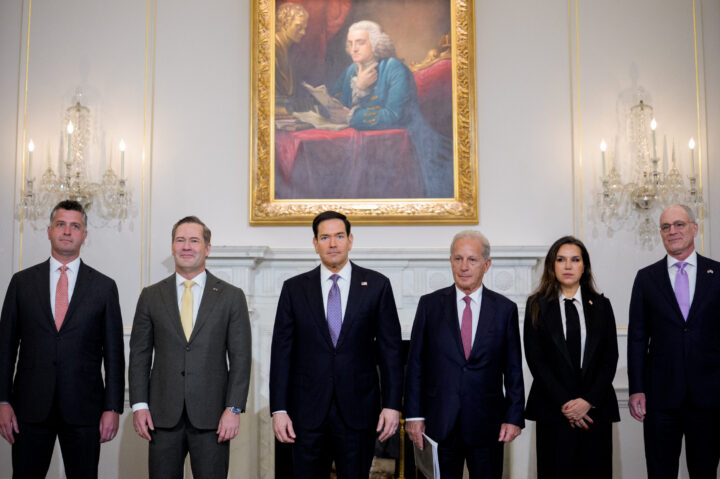
(L-R) Counselor of U.S. State Department Michael Needham, U.S. Ambassador to the United Nations Michael Waltz, U.S. Secretary of State Marco Rubio, U.S. Ambassador to Lebanon Michel Issa, Lebanese Ambassador to the U.S. Nada Hamadeh Moawad and Israeli Ambassador to the U.S. Yechiel Leiter pose for photos before beginning working-level peace talks at the U.S. State Department on April 14, 2026 in Washington, DC.


 Add JewishInsider on Google
Sitting at a roundtable of Israeli, Lebanese and American officials, Secretary of State Marco Rubio emphasized at the outset of negotiations between Jerusalem and Beirut that the talks are a “process” that will “take time,” stating that the objective of Tuesday’s meeting, the highest-level direct talks between the countries in over 30 years, is to “outline a framework upon which a permanent and lasting peace can be developed” and bring a “permanent end to Hezbollah’s influence” in the region.
“This is a process, not an event. This is more than just one day,” Rubio said. “All of the complexities are not going to be resolved in the next six hours … This will take time, but we believe it’s worth this endeavor and it’s a historic gathering that we hope to build on.”
“We understand we’re working against decades of history that have led us to this unique moment and opportunity here,” Rubio added. “We have to remember, the Lebanese people are victims of Hezbollah. The Lebanese people are victims of Iranian aggression, and this needs to stop.”
Rubio said the parties want to provide the people of Lebanon “the kind of future they deserve, and so that the people of Israel can live without fear of being struck by rocket attacks from a terrorist proxy of Iran.”
Taking part in the high-level talks between Israel and Lebanon on Tuesday in Washington were Israeli Ambassador to the U.S. Yechiel Leiter, Lebanese Ambassador to the U.S. Nada Hamadeh, U.S. Ambassador to Lebanon Michel Issa and State Department Counselor Michael Needham.
In a statement released by the State Department following the meeting, Washington indicated that any agreement “must be reached between the two governments, brokered by the United States, and not through any separate track.” The U.S. also expressed “support for further talks,” however it is not yet clear when the next round of discussions are expected to take place.
“All sides agreed to launch direct negotiations at a mutually agreed time and venue,” the statement read. It also indicated that Israel “expressed its commitment to working with the Government of Lebanon to achieve … security for the people of both countries” as well as a “commitment to engage in direct negotiations to resolve all outstanding issues and achieve a durable peace that will strengthen security, stability and prosperity in the region.”
In his opening statement ahead of the talks, Leiter commended Lebanese President Joseph Aoun and his government “for not allowing itself to be held hostage to the threats of Hezbollah’s leader,” adding that the group belongs “to the past.”
“I believe that we can, in good faith, accomplish the following interrelated goals: the complete dismantlement of Hezbollah, the freeing of Lebanon from Iran’s terror proxy and the achievement of a real, lasting and mutually celebrated peace for the benefit of our people,” Leiter said. “We also have the courage to pursue peace through strength, and to work tirelessly for tranquility and prosperity for all. Today, we pursue those values for ourselves and especially for our Lebanese neighbors of all ethnic denominations.”
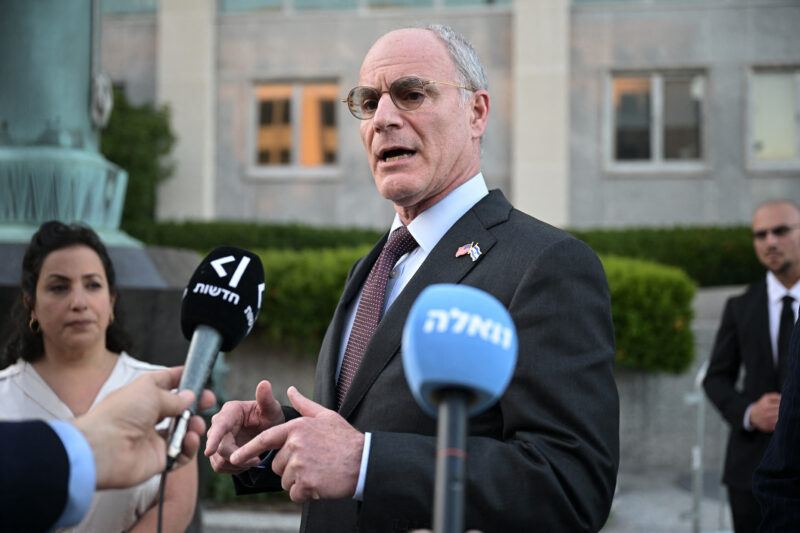
After negotiations wrapped, Leiter struck a positive tone and said he was “honored” to sit at the negotiating table with Lebanese officials.
“We discovered today that we’re on the same side of the equation,” Leiter told reporters. “That’s the most positive thing we could have come away with. We are both united in liberating Lebanon from an occupation power dominated by Iran called Hezbollah.”
Similarly, Hamadeh also called the preliminary meeting “positive” and indicated that another round of talks is likely to take place. She stated that “the date and location of the next meeting will be announced at a later time.”
Tuesday’s negotiations were expected to focus on how Israel and Lebanon can work together to disarm Hezbollah and make peace between the countries. Israeli Prime Minister Benjamin Netanyahu announced the talks last week, saying he had shifted his position once the scope of the negotiations were expanded beyond just a ceasefire to also include disarming Hezbollah and working toward peaceful relations. Lebanese Foreign Minister Youssef Raggi indicated that the direct talks are meant to show that the “Lebanese state alone holds the authority to negotiate on behalf of Lebanon,” rather than Hezbollah.
The two nations currently share no formal diplomatic relations.
Hezbollah, however, has signaled it will not abide by any agreements and called on the Lebanese government to cancel the talks. Wafiq Safa, a high-ranking member of the group’s political council, stated prior to the meeting that the terrorist organization is “not interested or concerned with” the negotiations, saying the group is “not bound by what they [Israel, Lebanon and the U.S.] agree to.”
The negotiations took place against the backdrop of a massive Israeli strike in Beirut last week targeting Hezbollah. The recent round of hostilities was triggered on March 2 when Hezbollah launched rockets at northern Israel days after Israel and the U.S. launched strikes on Iran.
The talks have also received significant support from European and Western nations, with foreign ministers from 17 countries, including the U.K. and France, calling on the two countries to “seize the opportunity presented by the U.S.-Iran ceasefire,” per a joint statement.
Even if a deal is reached, major hurdles lie ahead as it remains unclear whether Lebanon possesses sufficient influence to hold Hezbollah to any potential agreements. While the group is a major political party with seats in the Lebanese parliament, its militia operates largely independently of the government, receiving funding and direction from Iran. Although a growing number of Lebanese officials and civilians view Hezbollah as an intrusive arm of Iranian interference, the group remains a powerful, independent force within the country.
More Stories
REGIONAL SHIFT
Amb. Kaploun: More Latin American countries plan to adopt IHRA definition of antisemitism
LOOKING FORWARD
DMFI lays out proposal for future of U.S.-Israel relationship
Daily Overtime
New York braces for Oct. 7 protests
KINGS COUNTY KERFUFFLE
Treasurer for anti-AIPAC PAC behind effort to unseat Brooklyn Republicans

Go Blue, but blue and white?
Michigan Hillel’s break with Israel advocacy groups leaves students questioning where it stands
CAMPAIGN OFFENSIVE
Rogers calls El-Sayed ‘threat to our national security’ in new ad
Please log in if you already have a subscription, or subscribe to access the latest updates.
 Continue with Google
 Continue with Apple