


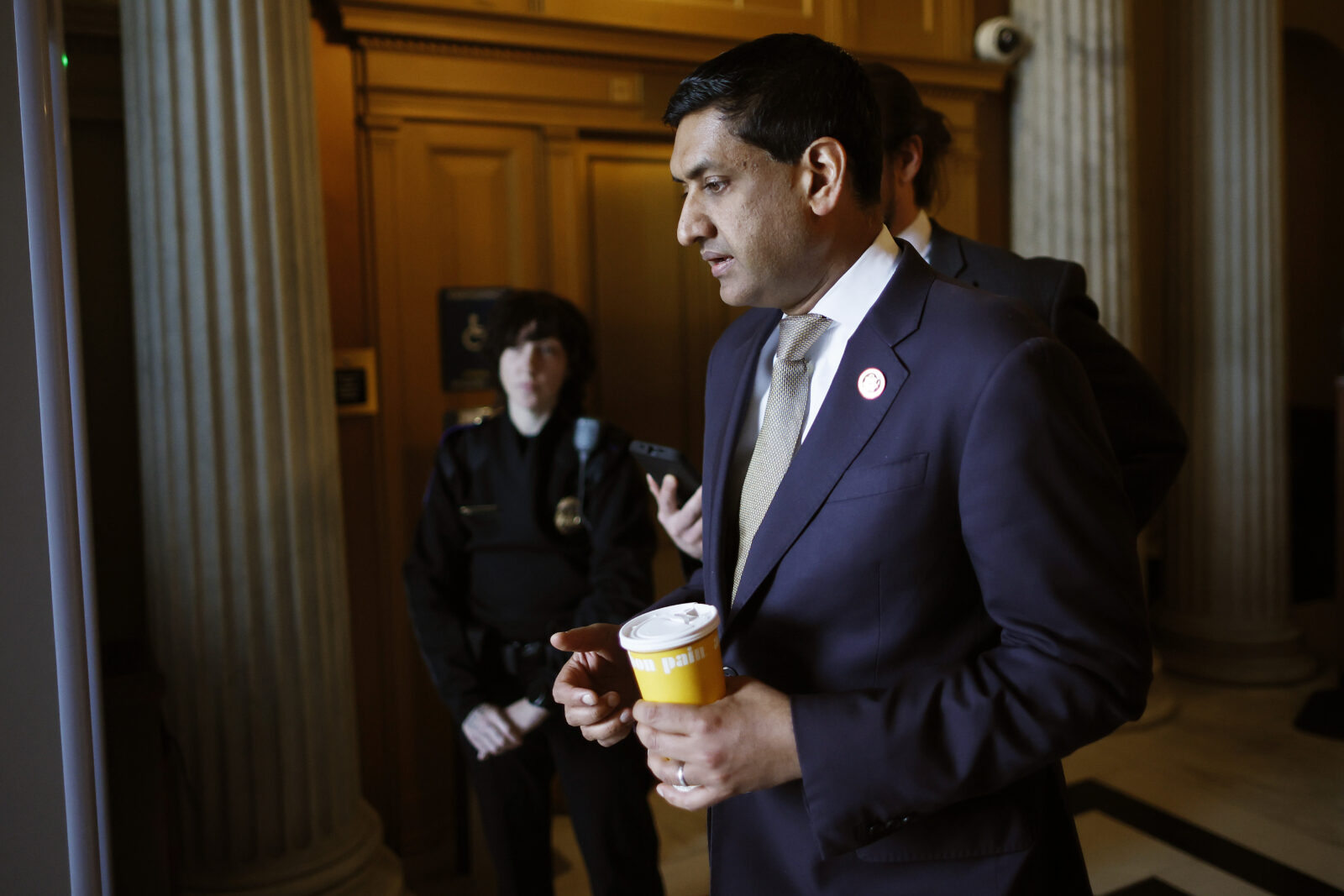
Chip Somodevilla/Getty Images
Khanna’s hostile turn towards Israel divides Silicon Valley Jews
His critics once saw him as an ally, but fear he’s pandered to extremists as he raises his national profile ahead of the 2028 presidential election


 Add JewishInsider on Google
Rep. Ro Khanna’s (D-CA) emergence as a leading Democratic party critic of Israel — while affiliating with and embracing individuals and groups that have been accused of antisemitism and support for terrorism — is creating divisions within the local Jewish community in his Silicon Valley-centered district.
While Khanna maintains unified support from Jewish elected officials in the district, other Jewish community leaders say they feel abandoned, ignored and even attacked by their congressman, whom they once saw as an ally, as he faces what could be his most credible primary challenge in years.
For some in the district, ties with the congressman have been strained for years, and were further inflamed by the March attack on two Israeli Americans in San Jose’s Santana Row shopping district.
Khanna strongly condemned the attack but some in the community said his words rang hollow after months of escalating anti-Israel rhetoric. Some Jewish leaders in the district say that they saw a direct connection between Khanna’s incendiary language condemning the Jewish state and attacks such as the one their community experienced.
Two days after the attack, Khanna posted about how he is “proud to stand” with Maine Senate candidate Graham Platner and New York Mayor Zohran Mamdani, as well as to join far-left streamer Hasan Piker’s show, all of whom have faced criticism from the Jewish community — comments that prompted condemnation by Anti-Defamation League CEO Jonathan Greenblatt.
Jewish leaders in the district who are now critical of the congressman said the community’s relationship with Khanna started out strong when he was first elected in 2016, but has significantly deteriorated over time, particularly in the past few years. Khanna’s Silicon Valley district includes substantial, concentrated Jewish and Israeli-American communities.
Tali Klima, a spokesperson for Bay Area Jewish Coalition Action, a local grassroots advocacy group, said that Khanna was “warmly welcomed” by the Jewish community when he was first elected and that many in the community had supported him.
Khanna traveled to Israel three times while in office, and has expressed support for the Abraham Accords, voted in 2019 to condemn the Boycott, Divestment and Sanctions movement, condemned calls to “globalize the intifada,” voted in early 2024 to condemn the slogan “from the River to the Sea, Palestine will be free” and introduced a Holocaust education resolution in 2024. Amid rising antisemitism in recent years, he has touted appointing a point of contact for addressing antisemitism in the district on his congressional team.
But, Klima and other critics said, they’ve seen the congressman’s posture change over time.
“He’s become more and more divisive and more extremist in his views, that we never heard when he was first elected, especially since Oct. 7. It’s been a massive shift in the way that he communicates about things that we care about,” Klima continued.
“At this point, the community has really lost trust in him,” Klima said. “Much of the community is afraid of him, and much of the community is also very angry and feels betrayed by him.”
“Having participated in local town halls with Representative Khanna and spoken with him about various community concerns, I am thankful for his commitment to open dialogue and remaining accessible even when we disagree,” Assemblymember Patrick Ahrens said. “His dedication to peace and justice for all people and support for a two-state solution is laudable. He has been a leader for accountability and transparency with the Trump Administration, particularly with the bipartisan push for the release of the Epstein files.”
Khanna has frequently and repeatedly accused Israel of genocide, was among the first lawmakers to endorse calls for cutting off U.S. support for Israel’s Iron Dome missile-defense system and led an effort for U.S. recognition of a Palestinian state, among a range of other stances and votes, and has repeatedly faced scrutiny for his affiliations with groups and individuals condemned by the Jewish community.
Later this week, he’s set to offer an amendment to strip a provision advancing U.S.-Israel cooperative programs out of the 2027 defense bill. Though one former Biden administration called the provision “quite unremarkable” and in keeping with existing programs, Khanna called it a “fusion” of the U.S. and Israeli militaries to prevent scrutiny and accountability for U.S. aid to Israel.
Jewish elected officials supporting Khanna, in statements shared with Jewish Insider, praised the congressman for his support for a two-state solution and for engaging with local Jewish communities.
“Having participated in local town halls with Representative Khanna and spoken with him about various community concerns, I am thankful for his commitment to open dialogue and remaining accessible even when we disagree,” Assemblymember Patrick Ahrens said. “His dedication to peace and justice for all people and support for a two-state solution is laudable. He has been a leader for accountability and transparency with the Trump Administration, particularly with the bipartisan push for the release of the Epstein files.”
State Sen. Josh Becker added, “While Congressman Khanna gets a lot of ink for his criticism of Israel he gets less for his vocal support of a two state solution and Israel as a safe democratic Jewish state.”
Others, such as San Jose City Councilmember David Cohen, more broadly praised him for his work on local issues.
“The fact that an elected official like Khanna defends [people like Hasan Piker and Zohran Mamdani] and their dangerous antisemitic views is not only shameful — but it also actively endangers the lives of Jewish people both in his district and around the country,” Oleg Ivanov, executive director of StandWithUs Northern California, said.
“Times are very difficult these days in Washington D.C., and Congressmember Khanna remains a steady advocate for our region and economy. We need people who understand the tech industry and also who bring money back to our community from the federal budget,” Cohen said. “He has shown courage and has been willing to face his constituents at monthly town hall meetings ever since he was elected. While I don’t agree with every position he takes, I admire his thoughtfulness and transparency.”
Cohen declined to speak further on Khanna’s foreign policy work or his relationship with the local Jewish community.
But others in the community feel that their concerns aren’t being heard or listened to by the congressman. Daniel Klein, CEO of Jewish Silicon Valley, a Jewish nonprofit which runs a local JCC and other community programs and resources, said he’s communicated to Khanna directly that he thinks the legislator is out of step with his constituents.
“The fact that an elected official like Khanna defends [people like Hasan Piker and Zohran Mamdani] and their dangerous antisemitic views is not only shameful — but it also actively endangers the lives of Jewish people both in his district and around the country,” Oleg Ivanov, executive director of StandWithUs Northern California, said.
Ivanov also accused Khanna of spreading a “blood libel” in accusing Israel of genocide in Gaza.
Oded Shekel, executive director of Bay Area Jewish Coalition Action, emphasized that members of the Jewish and Israeli community in Khanna’s district feel afraid, isolated and that they have to hide who they are, and don’t feel they’re getting the support they expect from their congressman.
Shekel said that he doesn’t necessarily think Khanna is personally or openly antisemitic, but that he is supporting and rationalizing extreme voices, to the point that has made many Jews like him feel that Khanna is the “strongest voice [that] hurts Jews in his district.”
Khanna joined a town hall in 2024 hosted by the Bay Area Jewish Coalition — a separate entity from Bay Area Jewish Coalition Action led by the same individuals — but the relationship has soured since then.
Sunnyvale Mayor Larry Klein, a Khanna supporter, said he’d attended the BAJC town hall, and met with Jewish community members alongside Khanna to discuss the challenges that Jewish high schoolers were facing from antisemitism in the district, and how the congressman could address them.
“Good to hear directly from High School Students and their parents on the district issues,” Mayor Klein said in a statement. “It was valuable to hear firsthand about the harassment that Jewish Students had endured.
Mayor Klein also praised Khanna’s “bipartisan approach to leadership” on issues including “working to halt reckless foreign intervention” and the release of the Epstein Files, saying that Khanna, “consistently puts principles over politics.” He also praised Khanna’s engagement with constituents more broadly and work on securing federal funding for the district.
Daniel Klein of Jewish Silicon Valley described Khanna’s stances and statements as hostile to the Jewish community. He said that the violent attack in Santana Row, and other similar incidents, are the “natural maturation” of the rhetoric Khanna has used and elevated.
“I appreciate the congressman being outraged” about the Santana Row attack, “but statements and what he normalizes and who he platforms before these incidents, and then who he chooses to stand with and platform and normalize after these incidents, makes the community feel unseen and unsupported by the congressman,” Klein said he told Khanna’s office in the wake of the attack.
Yet, Klein said, Khanna’s rhetoric does not appear to have shifted substantially since the March attack.
“I’m a big fan of Congressman Khanna,” Ben Linder, a J Street board member who lives just outside Khanna’s district, told JI. “The majority of the Jewish community is squarely behind him and very aligned with him,” Linder continued, emphasizing that he has seen Khanna speak on multiple occasions to busy synagogue audiences.
Klima echoed that, expressing frustration that Khanna’s condemnation of the attack was quickly followed by a return to his usual rhetoric and activity.
In addition to Jewish elected officials backing him, Khanna maintains support among segments of the local Jewish community. Ben Linder, a J Street board member who lives just outside Khanna’s district, told JI he continues to strongly support the congressman. J Street has endorsed Khanna, but Linder spoke to JI in a personal capacity, not on behalf of the progressive Israel advocacy group.
“I’m a big fan of Congressman Khanna,” Linder, who was born in Israel and moved to the U.S. in high school, said. “The majority of the Jewish community is squarely behind him and very aligned with him,” Linder continued, emphasizing that he has seen Khanna speak on multiple occasions to busy synagogue audiences.
He called critics “out of touch with the view of the majority of Jews right now” both in Khanna’s district and nationally, pointing to a Washington Post poll last year that found a majority of Jews are critical of the way the war in Gaza has been conducted.
He asserted that discontent with Khanna traces to a “vocal minority in the district, mainly led by right-wing Israeli expats that dislike Congressman Khanna” and are “out of touch with where our community is.”
“I consider Ro Khanna very pro-Israel. He is clearly anti-Netanyahu and anti- the policies of Israel’s right wing government, but so am I, and, I think, so are the majority of Jews in this district,” Linder said.
Critics of Khanna said that the congressman’s activity following the Santana Row attack matches a pattern they’ve observed repeatedly when Khanna is called out for conduct or statements they find offensive — Khanna will apologize, or offer targeted condemnations, but won’t substantially change his behavior, and ultimately continues doubling down.
They said this pattern ignores the way that Khanna’s own rhetoric is fueling antisemitism.
Klima emphasized that Khanna’s constituents have come to him on numerous occasions asking him to dial down his rhetoric. At this point, she said, his “symbolic condemnations” of antisemitism “ring very hollow.”
“He’s speaking out of both sides of his mouth, basically,” she said, adding that, as a longtime congressman, his comments “[legitimize] this rhetoric,” driving similar activity from other local officials as well.
Ivanov said it’s easy for Khanna to denounce antisemitic attacks or vandalism, “but as soon as he does that, he continues to spread the antisemitic conspiracy theories, to defend antisemitic speakers that are out there every day, fueling the antisemitism that leads to these actions.”
“We will not accept Khanna’s pro-forma denunciation of antisemitic incidents while he himself continues to fuel antisemitism and defend antisemites,” Ivanov said.
Linder, the Khanna supporter, argued that Khanna has made clear that he “will speak with anyone” and “dialogues with people he disagrees with, and I respect that.” Khanna has expressed similar sentiments to JI in the past.
Linder said he strongly disagreed with the notion that Khanna’s rhetoric is fueling violence, and emphasized that the Santana Row attack was not charged as a hate crime.
“I don’t believe there was sufficient evidence to show that it was hate-motivated,” Linder said. “The congressman came out very quickly and denounced that attack, denounced the violence, and I fundamentally am not a subscriber to the notion that criticizing Israel fuels antisemitism. I see a clear delineation between criticism of Israel and Jew hatred. I don’t believe the two are connected. As a matter of fact, I think some of the actions of Netanyahu and the Israeli government, the extreme right Israeli government foment antisemitism.”
Shekel, a Khanna critic, said that, during conversations with Khanna about antisemitism that community members are facing, Khanna has expressed sympathy while pivoting to emphasize his disputes with various Israeli government policies.
“We feel that he is fixated, obsessed with Israel,” Klima added.
“The organized Jewish community is telling you exactly where the majority of the Jewish community stands, and if you choose not to listen, it is not due to lack of knowing where your constituents are. It’s a choice,” Daniel Klein, CEO of Jewish Silicon Valley, said. “It’s a choice at that point, and then that begs the question of why the member of Congress is choosing to ignore the Jewish community while also at the same time saying he’s being responsive to the Jewish community. That’s a contradiction I don’t have the answer to.”
Klein said that some in the community see Khanna as not only ignoring their concerns but attacking the Jewish community for elevating those issues in the first place. He pointed to an incident in which Khanna shared on his X account a clip of Holocaust denying social media influencer Ian Carroll as one such instance.
Klein said he and representatives of the local Jewish Community Relations Council sat down in person with Khanna’s staff about the video — “not only the fact that this person was platformed, the person wasn’t taken down immediately, and instead of listening to the Jewish community’s concerns, at least publicly, he seemed to attack the Jewish community instead.”
Klein also characterized Khanna as deflecting the concerns of the local Jewish community in conversations, offering a variety of excuses, including pointing to national polling on Israel policy issues.
“The organized Jewish community is telling you exactly where the majority of the Jewish community stands, and if you choose not to listen, it is not due to lack of knowing where your constituents are. It’s a choice,” Klein said. “It’s a choice at that point, and then that begs the question of why the member of Congress is choosing to ignore the Jewish community while also at the same time saying he’s being responsive to the Jewish community. That’s a contradiction I don’t have the answer to.”
Critics in the district see a political motivation behind Khanna’s rhetoric and positioning.
Ivanov said that he first met Khanna several years ago, when Ivanov was working for the American Jewish Committee. The congressman at the time emphasized “the importance of maintaining progressive support for Israel in American society. That has obviously changed over the past few years, where he has embraced this tide of vilification of Israel as a way to appeal to the rising popularity of bashing Israel among certain voters,” Ivanov said.
Klima said that the “general sentiment” among members of the Jewish community is that Khanna’s stance is “opportunistic” and that he’s following anti-Israel trends for the sake of popularity, rather than any “deeply held view.”
“We feel like he’s throwing us, his constituents, under the bus for his political game, because he feels like this is a win for progressives,” she said.
The congressman is widely seen as preparing for a presidential campaign in 2028.
Khanna’s frequent commentary about the “Epstein Class” — he was one of the leading advocates in the House for releasing files related to sex offender Jeffrey Epstein — has also set off alarm bells for Khanna’s critics.
Klima said that many in the Jewish community read those references as code for the Jewish community writ large, “because of our history with him, our recent history with him.” She said that Khanna’s pattern of rhetoric and actions has sowed distrust of him and his motives.
Khanna has dismissed the notion that the phrase is antisemitic, pointing to Jewish elected officials who have also spoken about the “Epstein Class.”
Critics in the district say that Khanna has a lot of work to do to repair his relationships with the Jewish community — and that it will take more than the pro forma condemnations of antisemitism that they feel he’s been offering over the past few years.
Klein encouraged Khanna to “stop feeding the extreme left and the alt-right” on social media and called on him to apologize for “ignoring the Jewish community,” and “actually start listening to the organized Jewish community,” rather than the “fringes.”
Klima said that she is fed up with what she sees as “symbolic gestures” by the congressman.
“We feel like we’re just pawns in his political game, because the very next day, he’s back to the ‘genocide’ and his political obsession,” she said. “[He] is clearly hurting us and it needs to be something much deeper than just a statement.”
Featured Stories

Please log in if you already have a subscription, or subscribe to access the latest updates.
 Continue with Google
 Continue with Apple