

























































Israeli Defense Ministry head urges Israelis to understand U.S. perspective amid MOU negotiations
‘We think Tehran, they think Taiwan,’ Maj. Gen. (res.) Amir Baram said of diverging U.S.-Israeli foreign policy at the Herzliya Conference at Reichman University
Israeli Ministry of Defense/LinkedIn
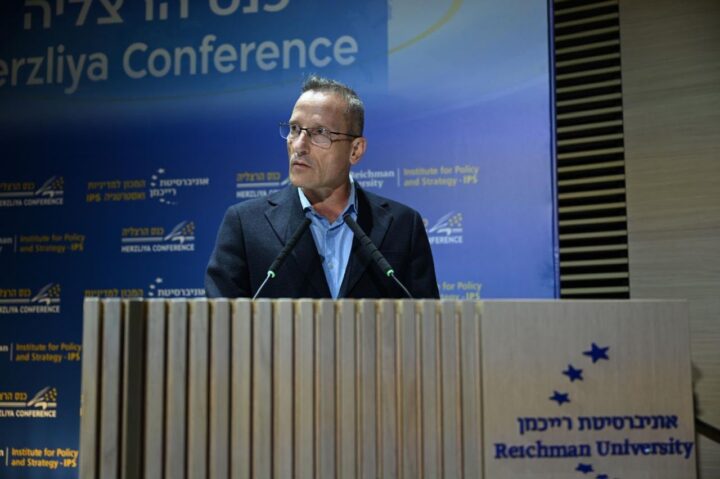
Maj. Gen. (res.) Amir Baram, director general of Israel’s Ministry of Defense, speaks at the Herzliya Conference at Reichman University on July 1, 2026.


 Add JewishInsider on Google
The director general of Israel’s Ministry of Defense, Maj. Gen. (res.) Amir Baram, urged Israelis on Wednesday to understand Washington’s perspective as the U.S. and Israel negotiate the next memorandum of understanding, cautioning against judging American policy through a purely “provincial lens.”
“What some in Israel perceive as weakness or folly, an apparent disregard for every warning sign on the ground, is viewed in Washington as cold, calculated and clear-eyed risk management in an era of shifting global attention,” he said at the annual Herzliya Conference at Reichman University.
The divergence between the two allies, he concluded, is not a misunderstanding of the fundamental threat, but rather a byproduct of different national security priorities.
“For us, Iran is an existential threat; for the United States, it is a chronic regional challenge, while China and the Indo-Pacific theater remain the core concern,” Baram said. “We think Tehran, they think Taiwan.”
“At the same time, based on my deep familiarity with the range of views within the American system, if there is one thing Americans hate more than this war that has dragged on for them, it is losing a campaign they have already won,” he added of the conflict with Iran.
Ultimately, Baram asserted that as Washington increasingly operates under an “America First” framework, the historic bilateral relationship must pivot toward concrete, mutually beneficial strategic dividends.
“Our partnership cannot rest on shared values alone. It must also rest on hard interests: a strong, independent, and proactive Israel that stabilizes the Middle East is the very asset that allows the United States to redirect resources toward Asia,” Baram stated. “This is the foundation of the next memorandum of understanding on security cooperation now being formulated. The agreement will need to generate security, economic, and strategic benefits for both countries for years to come.”
The director general also noted that he understands the differing strategic realities in Washington, including a growing American desire to avoid prolonged Middle East entanglements while prioritizing competing global theaters.
“From the Pentagon’s perspective, with American munitions stretched between supporting current wars and preparing for a potential confrontation in the Taiwan Strait, a prolonged war in the Middle East runs counter to America’s global posture,” Baram observed.
Baram emphasized that the war with Iran has fundamentally transformed Jerusalem’s strategic military calculus, warning that an escalating Iranian threat necessitates a sweeping, expanded regional security alliance.
“The war has sharpened, for every actor in the region, the price of Iran’s military buildup,” Baram said. “It has created a shared interest in forging a broader alliance, from India through the UAE to Greece and Cyprus. Israel’s strengths in technology, proven operational experience, and defense innovation, combined with the Gulf’s financial power, could enable a new security-economic front.”
Baram said that building these alternative multilateral partnerships is “not a substitute” for Israel’s bedrock security relationship with the United States. Rather, he argued, the strategy allows Israel to “broaden its room to maneuver and its standing on the international stage, and allow us to diversify our strategic footing.”
More Stories

BREAKING
Israel-bound FlyDubai flight makes emergency landing in Saudi Arabia after suspected terror attack by co-pilot
TAKING AIM
House Democrats introduce sanctions bill targeting settlement expansion
exclusive
Gottheimer urges DOJ to investigate N.J. city for antisemitic discrimination

printing pressure
Inside New York magazine’s anti-Israel shift — and the Jewish staffers left behind

Daily Kickoff
FlyDubai hero credits TV crash course

LOOKING FORWARD
DMFI lays out proposal for future of U.S.-Israel relationship
Please log in if you already have a subscription, or subscribe to access the latest updates.
 Continue with Google
 Continue with Apple