


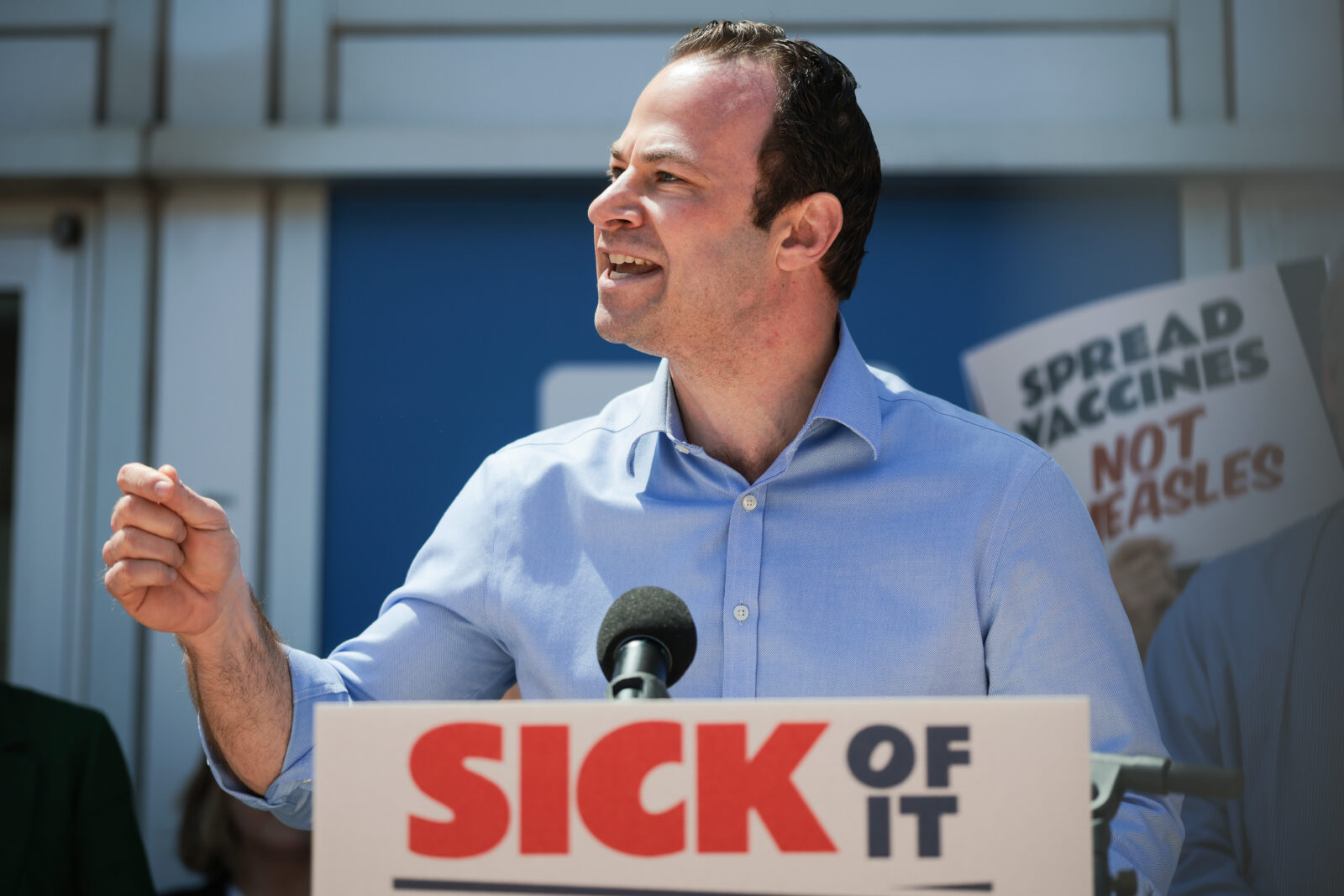
Kayla Bartkowski/Getty Images
Montgomery County, Md., exec candidates clash over antisemitism records as Jewish vote looms large
While all three of the leading candidates have denounced Jewish hate, progressive Will Jawando has taken a more hostile stance towards Israel, leading his opponents Andrew Friedson and Evan Glass to jockey for the more moderate vote


 Add JewishInsider on Google
Ahead of Tuesday’s primary election for executive of Montgomery County, Md., progressives have largely broken for Montgomery County Councilmember Will Jawando, leaving the more moderate Councilmembers Andrew Friedson and Evan Glass to jockey for the remaining undecided voters.
In a tight three-way race, the vote of the Jewish community — which is, according to a source familiar with the race, expected to account for more than one-fifth of primary turnout in the county with Maryland’s largest Jewish population — could be especially critical. Jewish leaders have raised the alarm on antisemitism in the deep-blue county — which saw the highest rate of incidents in the state in 2025 — and the particular issue of antisemitism in the area’s public schools.
Ron Halber, CEO of the Jewish Community Relations Council of Greater Washington, told Jewish Insider that Jawando, Glass and Friedson “have all denounced antisemitism during their eight-year terms in the council” and said he hopes that other community leaders “awake from their slumber” to speak out against hate without needing to be prompted by the Jewish community.
“As County Executive, I will work with our Jewish leaders and faith leaders and leaders of all our communities to ensure that we protect our diversity,” Glass told JI, while Friedson said being executive would give him “a greater bully pulpit,” in addressing antisemitism in schools.
Earlier this month, the advocacy group EndJewHatred sent a letter to school district officials, including Jawando, who is chairman of the county council’s education and culture committee. The group called for the district to adopt the International Holocaust Remembrance Alliance’s working definition of antisemitism and to adopt lesson plans to address current trends in antisemitism.
In a forum hosted by the JCRC last month, all three candidates pledged to address the rise of antisemitism within the local K-12 school system if elected as executive.
All of the front-runners voted in favor of the IHRA definition when it was adopted unanimously by the council in 2022, after months of community protests, two postponements and a council session disrupted by audience protest.
But “people who are running in this race were not helpful in that effort,” Friedson told JI. A Jewish communal activist said that “Will has stood up against antisemitism, but even if you review the way he spoke before the IHRA vote definition was taken, he was conflicted.” Jawando had said he thought the council “missed an opportunity here to find common ground.”
Rabbi Adam Raskin of Congregation Har Shalom in Potomac, Md., just outside of Washington, was in the council chamber the night the IHRA resolution passed, part of a cohort of Jewish leaders convened by the JCRC to help shepherd it through. “He encountered a tremendous amount of resistance,” Raskin said of Friedson.
Friedson himself said he had “experienced quite a bit of antisemitism as part of that conversation,” telling JI that “there was a screaming crowd in the council chambers as we were taking this up, and it was heartbreaking to me.” Jewish day school students were in attendance when “other members of the community were screaming.”
“We need to ensure the safety of our Jewish residents, and we also need to ensure that everyone has the right to peacefully protest,” Glass said of the IHRA unrest.
During his time in office, Friedson has championed the county’s Nonprofit Security Grant Program, a relatively rare local initiative designed to supplement the federal program, which has been criticized for failing to meet the needs of faith-based institutions. Jewish groups have been among the top beneficiaries of the Montgomery County program, which saw nearly $1.2 million has been awarded across 90 institutions in Fiscal Year 2026.
“Colleagues did not agree with me at first, including the colleagues who are running in this race,” Friedson told JI, “and I regrouped and was able to work together with Asian American leaders” on the initiative.
Glass, the first openly gay Jewish person elected to the county council, frequently leads with his Jewish identity on the campaign trail. His signature initiative on these issues is the Anti-Hate Task Force, a body he convened as council president that consists of a variety of identity-based cohorts, including one Jewish-specific. A source familiar with Glass’ campaign said he joined a synagogue after announcing his run for county executive.
Friedson and his family, meanwhile, are “three-generation members” of Har Shalom, according to Raskin. He has previously served on the boards of Jewish Council for Public Affairs and Hillel Maryland. “Andrew is motivated first and foremost by a sense of justice that was forged by his Jewish identity,” Raskin told JI, “both growing up in this synagogue and growing up with Jewish teachings and values.”
One Jewish activist who’s reached out to all three regarding collaboration on issues of antisemitism shared that Glass’ staff has been fairly responsive, especially in comparison to Jawando’s team.
While the candidates have all spoken out against antisemitism, they hold diverging views on Israel. Jawando is supported by several anti-Israel organizations, including the Council on American–Islamic Relations, the Working Families Party and Our Revolution, as well as the Montgomery County Educators Association union, which Jewish leaders have condemned for its hostility towards Israel. The Jews United for Justice Campaign Fund also endorsed Jawando, after JUFJ fought to strip Israel-related language from the IHRA resolution.
Jawando did not respond to JI’s request for comment on the race.
In vetting candidates, “several organizations in their questionnaires specifically ask about foreign policy in Israel,” Friedson told JI. “They ask about support for Israel. They ask about all kinds of different things that are completely unrelated to the roles of county executive and county council,” he continued.
In September, Jawando made a statement against funding the Maryland Israel Development Center, an organization promoting bilateral trade and economic development. In emails with Saqib Ali, a former Maryland delegate-turned-activist in favor of the Boycott, Divestment and Sanctions movement, Jawando’s chief of staff wrote: “Will has committed to vote against any future funding for this organization.”
Jawando later clarified his position, saying, “We should never use Montgomery County tax dollars to support the development or production of offensive weapons,” declaring intent to look into how MIDC funds are used.
Around the same time, Jawando joined then-County Executive Marc Elrich on an economic development trip to China, subsidized by the Montgomery County Economic Development Corporation.
MIDC received roughly $47,206 from Montgomery County in Fiscal Year 2026, out of the county’s nearly $8 billion budget.
Glass has been deliberate about drawing a boundary between local governance and foreign policy pressures that have seeped into the race. “I do not support all the actions that [Israeli Prime Minister] Benjamin Netanyahu has taken, and that’s okay,” he told JI. “I’m running to be county executive, not secretary of state.”


Please log in if you already have a subscription, or subscribe to access the latest updates.
 Continue with Google
 Continue with Apple