


































Senate Republican concerns over Iran MOU continue
Armed Services Committee chair Roger Wicker broke his silence on Thursday, warning the deal would make Iran’s Obama-era payoff ‘look like a pittance’

Tom Williams/CQ-Roll Call, Inc via Getty Images
Senate Armed Services Committee Chairman Roger Wicker (R-MS) arrives for a confirmation hearing in Dirksen building on Tuesday, May 13, 2025.


 Add JewishInsider on Google
Senate Republicans continued on Thursday to air concerns about the U.S. memorandum of understanding with Iran, in some cases fueled further by Vice President JD Vance’s comments dismissing the effectiveness of U.S. sanctions and lambasting Israeli government officials who have objected to the deal.
Sen. Roger Wicker (R-MS) — the chairman of the Senate Committee on Armed Services — issued a statement ripping into the agreement, saying he’s “concerned [it] negotiates away the victories of Operation Epic Fury in ways that are completely out of step with the president’s goals.” Wicker had for days told reporters he was “withholding comment” on the MOU.
He said that, even though the $300 billion reconstruction fund outlined in the deal is not coming from U.S. taxpayer money, it “would make Iran’s payoff under President [Barack] Obama’s 2015 deal look like a pittance by comparison” and that it “would be an error to force Israel to stand down against Hezbollah.”
He said he also opposes any sanctions relief or unfreezing of funds for Iran “in exchange for Iran’s mere agreement to negotiate for another 60 days. The Iranian regime has not renounced its ultimate goal — ‘Death to America, Death to Israel.’ The regime will invest every penny it receives to further that aim.”
But Wicker pointed ultimate blame for the final shape of the deal at the “intermediaries,” rather than Trump himself.
Wicker told reporters he expects to hear from Vance about the deal but that no briefings have yet been arranged or scheduled.
Reiterating a stance he expressed a day prior, Sen. Ted Cruz (R-TX) said, “History demonstrates giving billions of dollars to theocratic lunatics who want to kill you is an exceptionally bad idea. So I hope we don’t do that.”
Asked about the comments by Vance — a potential candidate in the 2028 GOP presidential primary — Cruz, who mounted his own presidential bid a decade ago and is rumored to be considering a 2028 run, said, “I think the vice president can speak for himself.”
Sen. Thom Tillis (R-NC) said that he plans to go through the agreement in detail to compare it to the 2015 Joint Comprehensive Plan of Action because “what we don’t want to do is repeat that mistake.”
Tillis rejected Vance’s comments that sanctions have not been effective. “You’ve seen all kinds of their behavior changes in reaction to sanctions,” Tillis told Jewish Insider. “To suggest it’s not working would suggest that broadly sanctions don’t work, and we all know that that’s just factually incorrect.”
He told JI that “clearly any sanctions that are subject to congressional approval, he needs to come to Congress. Pretty straightforward. They covered that on ‘Schoolhouse Rock.’”
Tillis, who is retiring, also called the deal a “very important moment” for Vance. “It’s definitely a two-edged sword. Coming up short’s probably not good for him, but it could be a great achievement for him.”
Sen. Mike Rounds (R-SD) told JI he hadn’t heard Vance’s comments on sanctions, but he said that “it seems to me that there are billions of dollars that have been held from Iran, which has not gone to terrorist activities, and I think that is a good thing. So, with regard to that, it clearly had an effect. Whether or not it was completely effective is debatable.”
Rounds said he was concerned that Israel was not a party to the negotiations but “there’s an expectation somehow that there would be a limitation on activity going on in Lebanon that we’re not involved with at all, but that Israel is.”
He emphasized that “the Israeli government has a right to defend its people” from the yearslong ongoing attacks from Hezbollah, “and I don’t see that necessarily correctly addressed within this original memorandum. Perhaps there’ll be more meat on it in an actual agreement.”
The senator said he’s unsure whether the Iran Nuclear Agreement Review Act, which blocks the lifting of sanctions or unfreezing of funds for a congressional review period on any deal pertaining to Iran’s nuclear program, would be applicable, or what legislative steps would be involved if it were.
“We need to learn more about what [Trump’s] intent is and how permanent the two parties expect this to be,” Rounds said. “There’s a lot of questions we don’t have answers to yet, but it’s early in the process.”
He raised concerns about how the agreement would be enforced “particularly if you release all of their funds immediately, they’re allowed to do with it whatever they want. In the past, they’ve used that to fund terrorist activities. The first one that comes to mind is Hezbollah, which sits in Lebanon right now and has been attacking Israel relentlessly for years.”
Sen. John Cornyn (R-TX) said that “everything I’ve heard about it causes me concern” and he believes the president agreed to the deal because he was “concerned about the midterm elections and gas prices and blockage of the Strait of Hormuz.”
“This gets that open, but I think he’s had to pay a very deal price to get that done, and I think we should be clear-eyed and realistic that this isn’t going to persuade the Iranian regime to go in peace,” Cornyn, who is retiring after being defeated by a Trump-backed primary challenger, said.
He said that the steps taken by U.S. military operations to degrade Iran’s ballistic missile program and military-industrial base and delay its nuclear program were positive, but “I think we ought to be realistic about where we are. It’s temporary. It’s certainly not a permanent solution.”
Cornyn said he does not believe that Trump was joking when he said on Wednesday that he would blame Vance if the deal goes awry, and that the outcome of the deal might affect Vance’s prospects in the 2028 presidential race.
Cornyn said he expects that Congress, in its oversight role, will be examining the release of sanctions and whether the administration has the ability to lift those sanctions unilaterally.
Sen. Tom Cotton (R-AR), the Senate Intelligence Committee chair who also had not yet commented on the deal, said on Thursday that he has “concerns” over the MOU, warning that “certain aspects of this deal are a step in the wrong direction.”
The Arkansas senator told Fox News’ “The Story with Martha MacCallum” that Trump “deserves enormous credit for making Iran weaker than it’s been in decades, and we need to make sure that we don’t squander the leverage that we’ve built.” Cotton said he wished that the president “had continued with Project Freedom when it was announced a couple months ago.”
He also called on Trump to “use our military to force the Strait open and to keep it open, in addition to reimposing the blockade in the event that “Iran doesn’t keep its end of the bargain.”
Cotton pointed to the immediate lifting of sanctions on Iran’s oil exports, suggesting the funding would go toward malign activities, and raised concerns about the long-term control of the Strait of Hormuz.
“There’s certain parts of this memorandum that are a bit vaguer about Iran’s ability to access up to $100 billion of frozen funds or whether Iran can impose tolls on the Strait of Hormuz after two months,” Cotton said. “We’ll need more explanation there. I hope President Trump won’t allow those things to happen.”
Sen. Joni Ernst (R-IA) said that lawmakers had “very serious problems” with the JCPOA and the administration will need to come explain the deal because “I don’t want to see JCPOA 2.0.”
Sen. Lisa Murkowski (R-AK) told JI that she expects to find out “a lot more about the real details and particulars in these next 30 days.”
The Alaska senator said Congress needs “to make sure that the way that the president and the United States are interpreting this is in sync with how Iran is interpreting this, and I’m not certain yet that we’re at that place.”
Murkowski said “they can’t tell me” how the sanctions relief and reconstruction funding will work “so I certainly have a lot of questions that have yet to be resolved, but I also appreciate that the agreement allows for this next 30 days to work through reaching it.”
Asked about Trump’s suggestion on Wednesday that he wasn’t opposed to Iran possessing ballistic missiles, Murkowski replied, “That wasn’t helpful.”
Murkowski responded affirmatively when pressed on if those types of comments from the president and senior administration officials gave her pause about what the final agreement could look like.
Sen. Jim Justice (R-WV) said that “if we don’t have absolute assurances” that Iran can never obtain a nuclear weapon “then we lose,” though he said that “there’s still work to be done” in further negotiations.
“If it were to come to pass that we still have all kinds of concerns and no assurances and everything else, then it’s not good at all,” Justice said. “We have to have control one way or another” of Iran’s nuclear materials.
He said he couldn’t address disputes with Israel about the deal directly but said “the Israelis have been wonderful allies, and we’re going to stay arm-in-arm with them, period.”
Democrats, meanwhile, continued to lambast the agreement.
Sen. Richard Blumenthal (D-CT) told JI the administration is “desperate” and “flailing” and criticized the exclusion of Israel from the negotiations given that it continues to face attacks from Hezbollah, from which he said it must defend itself.
He said the agreement’s reliance on the U.N. as an enforcement and verification mechanism also hurts Israel.
“How can Israel trust the U.N.? Working with Israel is simply not in their toolkit. With the hundreds of billions of dollars provided, the unfreezing of sanctions immediately, the lifting of the freeze on assets, I don’t know how Republicans who attacked us with the JCPOA are going to handle that,” Blumenthal said. “This is a regime that continues to call the United States ‘the Great Satan.’ I don’t know what they’re thinking.”
And, he argued, the agreement effectively requires nothing of Iran: “I know the vice president’s line has been, ‘They only get the benefit of the bargain if they keep their side of it,’ but there is no side of it for them. They’re under no obligations here. It keeps the status quo for nuclear arms, lifting sanctions, lifting the freeze on assets, the $300 billion dollars.”
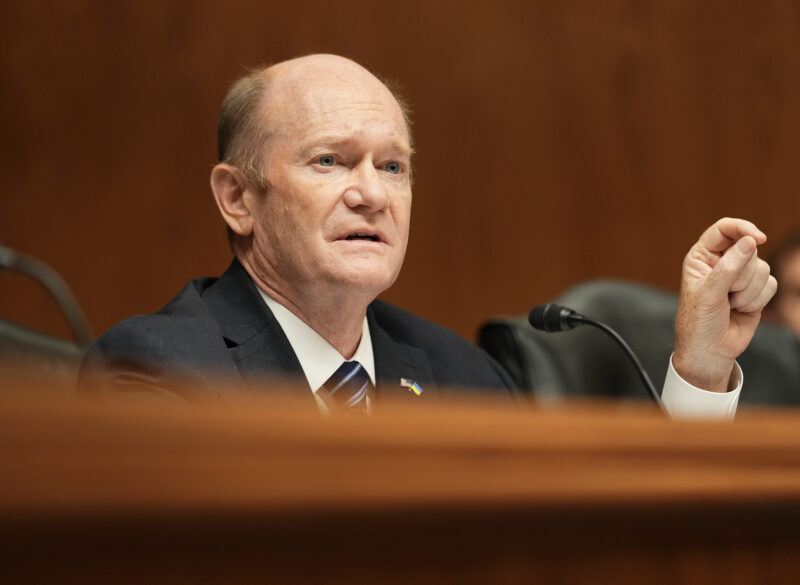
Sen. Chris Coons (D-DE) called the deal “appalling, flawed, pathetic failure” but “the inevitable conclusion of a combination of never making the case to the American people, flawed strategic provision, lack of grasp of the regional dynamics. How many ways can I say bad, bad, bad.”
On the issue of sanctions, Coons told JI, “President Trump cut a horrible deal where he is giving to Iran an enormous amount of released assets that have been frozen, sanctions relief that will generate tens of billions, if not hundreds of billions, and this reconstruction fund In combination, this is a massive infusion of cash to the mullahs and the IRGC. History shows the mullahs will not primarily use this money to build health clinics and schools.”
He said that Vance’s criticisms of Israeli officials are part and parcel of his efforts to sell an unsatisfactory agreement.
“I think JD Vance has been tasked with trying to sell a really bad deal and he is being as aggressive as he possibly can in knocking down one of the more obvious critics — a country that has a lot to lose,” he added. “If their opposition to the JCPOA was in any way principled, then they have to criticize a deal that’s worse than the JCPOA.”
Coons pointed responsibility for countering the deal toward Republicans, emphasizing that Iran will use the funding it receives under the deal for malign purposes. The Delaware senator said that there are “some things” Congress can do including conduct oversight of the congressional sanctions that the deal seeks to lift.
Sen. Cory Booker (D-NJ) echoed colleagues in describing the agreement as an “unconditional surrender” by the U.S. ‘because we get nothing from this deal.”
“All the specific benefits go to Iran. We get vague promises for potentially in the future hundreds of billions of dollars,” Booker said. “We’re allowing an extreme, terrorist supporting regime, that’s more extreme than when we began this, that chant ‘Death to America,’ to have more resources to do more things. So this is perhaps one of the biggest presidential blunders and failures in the last 20 years.”
He said that whether Senate Republicans stand firm and refuse to allow the administration to lift sanctions requiring congressional approval “is going to be the big test.”
“Will they just roll over and lay down for him, or will they stand up and provide the kind of checks, balances, oversight, and accountability when it comes to Iran, that they should be doing?” Booker asked. “They have a lot of levers to pull on the Republican side, where they right now control the Senate and control the House.”
He did not address what Democrats plans’ or role might be.
In the House, pro-Israel Democrats are also outraged by the deal and vowed not to support when it comes before Congress, which they said it must under INARA.
Rep. Josh Gottheimer said he is “totally dumbfounded by this agreement, and, like many, in a state of disbelief,” adding that the U.S. “got nothing” and “not one core objective was meaningfully met.”
He predicted that the next phase of the deal will never come about, and said the U.S. is “selling out Israel” and “kowtowing to Hezbollah terrorists, by tying Israel’s hands in Lebanon.”
Rep. Brad Schneider (D-IL) called it a “surrender agreement” and an “unacceptable capitulation without achieving any of our objectives” that will “facilitate the rebuilding” of Iran’s military and support for proxy groups.
“Unless the agreement is changed to actually close and permanently block Iran’s path to nuclear weapons, I will vote against it,” Schneider said.
More Stories

booking bias
Irish Jewish leader says Dublin hotel canceled guest rooms for conference on fighting antisemitism
TWO JEWS, THREE OPINIONS
Jewish podcast ‘Chosen People Problems’ finds new home with Ark Media

PACKED PEWS
Scholten, Gottheimer and Bret Stephens join Dan Senor before packed Michigan crowd
SHARING A STAGE
Top N.J. Dem recruit campaigned alongside New Jersey mayor accused of antisemitism
PEACH STATE POLITICS
Ossoff defers to ICC on Israel genocide accusations, but says IDF violated int’l law

analysis
Could these two small parties be Israel’s kingmakers?
Please log in if you already have a subscription, or subscribe to access the latest updates.
 Continue with Google
 Continue with Apple