





















































Over 100 injuries reported following Iran, Hezbollah strikes in Israel’s north and south
An Iranian missile struck Dimona, about eight miles from Israel’s Shimon Peres Negev Nuclear Research Center, wounding 31 people
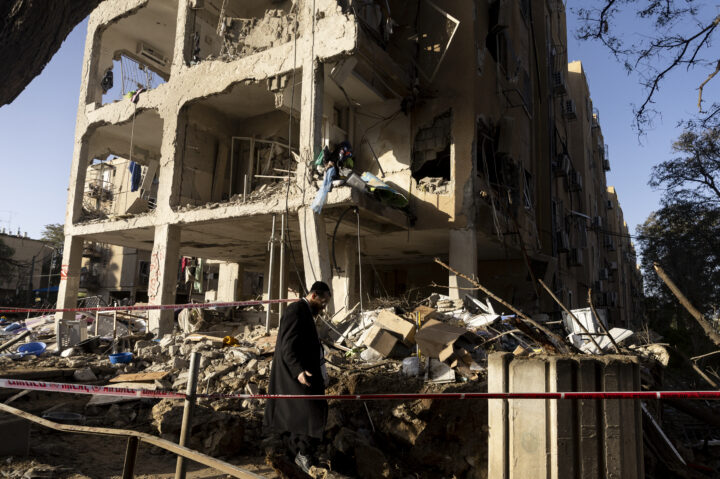
Amir Levy/Getty Images
A man looks at destroyed buildings after an Iranian missile strike on March 22, 2026 in Arad, Israel. Iran has continued firing waves of drones and missiles at Israel after the United States and Israel launched a joint attack on Iran early on February 28th.


 Add JewishInsider on Google
Missile strikes from Iran and Hezbollah in Lebanon resulted in over 100 casualties between Saturday night and Sunday morning.
One person was killed and another injured after two cars caught fire in the Upper Galilee from errant IDF shells that fell inside Israel, rather than Lebanon, an investigation by the military found on Monday.
MDA reported 15 wounded from missile fragments landing in numerous sites in Tel Aviv and central Israel on Sunday.
EMTs from the Magen David Adom emergency services, Taysir Subah and Safa Abu Rafea, said they “arrived at the scene and saw two vehicles on fire. During the firefighters’ extinguishing operations, we identified a man in the driver’s seat. We conducted medical assessments, he had no signs of life, and we had to pronounce him dead.”
On Saturday night, an Iranian missile struck the city of Dimona, about eight miles from Israel’s Shimon Peres Negev Nuclear Research Center. The direct hit caused extensive damage to several buildings in the city, injuring 31 people, including one who is in serious condition, according to MDA.
MDA EMTs Shai Binyamin and Gadot Vaknin said they were alerted by civilians on the street to elderly residents trapped in a safe room, whom they helped treat.
Three hours later, an Iranian missile struck Arad, a city near the Dead Sea. Emergency services in the area, which has seen fewer alerts than the rest of the country, evacuated 84 patients to Soroka Medical Center in Beersheba, including 10 in serious condition, among them children as young as four years old.
Yakir Talker, an MDA EMT, described “extensive destruction and chaos” at the scene. Another EMT, Riyad Abu Ajaj, said that “together with security forces, we conducted searches to locate additional patients. We provided medical treatment to many patients, including children.”
At both scenes in southern Israel, the IDF Home Front Command led efforts to free people trapped in the rubble.
Schools in much of the Negev, which had been hit by fewer missiles than Israel’s center and north, were meant to reopen on Sunday. The IDF Home Front Command revised its guidelines to keep schools closed after Saturday night’s strikes. Schools have been closed since the start of the war with Iran late last month, and gatherings have been limited to 50 people near a shelter or safe room.
IDF Chief of Staff Eyal Zamir met with the mayors of Metula and Kiryat Shmona, on the Lebanon border, saying that the IDF is “prepared for the enhancement of the forward defensive posture in the north.” In a later statement on Saturday, he added: “There is no more containment; there is initiative; there is preemptive action.” Last week, the IDF said it would increase ground operations in Lebanon.
“The more we strike and weaken Iran, the more we weaken Hezbollah,” Zamir added.
He also praised the “steadfastness and the resilience” of Israelis in the north, saying that they “enable us to continue striking and degrading the enemy.”
“We will not stop until the threat is pushed away from our border and long-term security is ensured for our residents,” he said.
This story was updated on March 23, 2026, to add the IDF investigation findings.
More Stories
analysis
Attack on Ambassador Leiter’s son casts pall over Netanyahu’s abbreviated UNGA visit
REGIME RECKONING
El-Sayed avoids acknowledging Iranian protester deaths, condemns Iran war instead

WAKE-UP CALL
Cruz warns Christian leaders are ‘asleep’ on antisemitism among youth

DIPLOMACY DIARIES
AJC plans ‘diplomatic marathon’ amid U.N. General Assembly in New York
Daily Overtime
Amb. Leiter’s son seriously wounded in terror attack

NO COMPROMISE
El-Sayed refuses to tone down Israel attacks despite prompting from Democratic podcast hosts
Please log in if you already have a subscription, or subscribe to access the latest updates.
 Continue with Google
 Continue with Apple