















































































Israel prepares for broader ground incursion against Hezbollah in Lebanon
The IDF said on Monday that it is planning for 'continued limited, targeted operations,' but there are clear signs that something more expansive is on the way
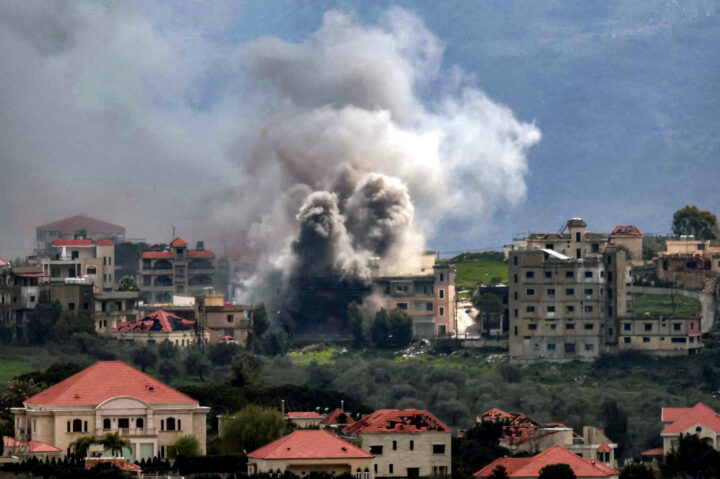
AFP via Getty Images
Smoke plumes rise following Israeli bombardment on the village of Khiam in southern Lebanon near the border with Israel, as seen from nearby Marjayoun, on March 16, 2026.


 Add JewishInsider on Google
Israel has a long history of conflict and military operations in Lebanon, and the IDF is now preparing for a broader ground incursion against Hezbollah.
What started with Operation Peace in the Galilee in 1982 to eliminate Palestinian Liberation Organization terrorist cells attacking Israel’s north turned into an 18-year military occupation of southern Lebanon. It ended with a retreat under public pressure and a return to power for the enemy — Hezbollah, which was founded soon after the war began. Six years later, Hezbollah abducted two Israeli soldiers, leading to the Second Lebanon War, and the terrorists attacked Israelis in Israel and abroad periodically over the subsequent 17 years.
After Hezbollah joined Hamas in attacking Israel a day after the Oct. 7, 2023, attacks, Israel launched a ground invasion into southern Lebanon and airstrikes against Hezbollah targets throughout the country, most famously killing the terrorist organization’s then-leader Hassan Nasrallah, and conducting its exploding pager operation in the fall of 2024. But a few months after taking out the group’s entire leadership, leaving in place an uncharismatic and apparently flailing Naim Qassem in charge, Israel, at the behest of the Biden administration, reached a ceasefire with Lebanon in November 2024.
According to that ceasefire, the Lebanese government and military were meant to disarm Hezbollah and ensure it stays out of the area south of the Litani River, some 17 miles north of the border with Israel. Late last year, Israel started to voice concerns that Beirut was not keeping its commitments and that Hezbollah was regrouping.
Now, Israelis are experiencing deja vu: Once again, Hezbollah joined an attack on Israel a day later — this time, from its main patron, Iran — and has frequently launched rockets and missiles at Israel’s north. Israel started out with airstrikes in response, then, over a week later, began limited ground incursions into southern Lebanon. The Lebanese government said a million residents — 20% of the country’s population — have been evacuated; the IDF has acknowledged about half that number. Israelis have not been evacuated from Israel’s north — the 2023-2024 policy was unpopular and many residents have not returned — but they are living under constant attack.
The IDF said on Monday that it is planning for “continued limited, targeted operations,” but there are clear signs that something more expansive is on the way. The IDF announced on Tuesday morning that Division 36 forces have joined the expansion of ground operations in southern Lebanon.
IDF Chief of Staff Eyal Zamir said he is sending “additional troops in order to strengthen the forward defensive posture, deepen the damage to Hezbollah and push the threat away from the communities in the north.” According to Israeli Defense Minister Israel Katz, “hundreds of thousands of Shi’ite residents of southern Lebanon … will not return to their homes south of the Litani until the safety of residents of [northern Israel] is ensured.” Katz said Israel will “destroy terrorist infrastructure in the villages abutting the border,” comparing the effort to the war against Hamas in Gaza.
Tal Beeri, head of research for the Alma Center, a think tank focused on Israel’s northern border, and himself a resident of Israel’s north, told Jewish Insider, “We can’t have another [military] campaign every few months or two years. There’s a whole region of Israel that can’t be dragged into war again and again. The blow that Hezbollah must receive right now must be strong enough.”
At the same time, Beeri said he is not under illusions that Israel can eliminate Hezbollah: “Hezbollah is here to stay. It won’t disappear, even if the Iranian regime falls. … It will be much weaker, but it will exist. Therefore, Israel must continue a policy of strategically weakening Hezbollah. … Israel must be prepared to act to stop Hezbollah at any moment in the future.”
Based on the assumption that Hezbollah will survive, but must be kept “small and weak,” Beeri co-wrote Alma Center recommendations that would require long-term Israeli involvement in Lebanon, but less intense and ground-based than the quagmire Israelis remember from the 80s and 90s.
“There needs to be a buffer zone of at least 10 km [6.2 miles] from the border … with no civilian presence, because we learned … the villages become human shields for Hezbollah bases,” Beeri said. “The Lebanese government can’t maintain it.”
Still, he said, while the IDF must retain its current five positions on the Lebanese side of the border, a buffer zone “doesn’t require the permanent, physical presence of the IDF. It requires control that can be remote … with intelligence and observation points. ‘Presence’ doesn’t have to mean one thing; it can be flexible.”
That flexibility should depend on how much responsibility the Lebanese government is able to take for southern Lebanon, once Hezbollah has been disarmed, though Beeri was skeptical that Beirut is able or even will want to do that in the short term — or ever.
For now, Beeri said, “Israel is expanding the [buffer zone] to distance the immediate threat from the north. … It will take time, one way or another.”
More Stories

Daily Overtime
Miznon’s U.S. Open upset

Daily Kickoff
Longhorns lock horns over Piker

Settlement Showdown
U.K. Foreign Secretary Ed Miliband announces sanctions against Israeli settlements

Pappas romps, ‘shill for AIPAC’ smear flops

BOOKSHELF
New book ‘In the War Room’ offers candid look at Netanyahu’s wartime decisionmaking

Daily Kickoff
Not Sheeran the stage no more
Please log in if you already have a subscription, or subscribe to access the latest updates.
 Continue with Google
 Continue with Apple