






































































Cheap, deadly and hard to spot: Hezbollah’s drones create urgent security threat for Israel
‘You just have Israeli soldiers completely unaware. If you can’t hear the drone, if you don’t know that it’s there until it’s too late, it’s too late,’ said FDD’s David Daoud
Ayal Margolin/Flash90
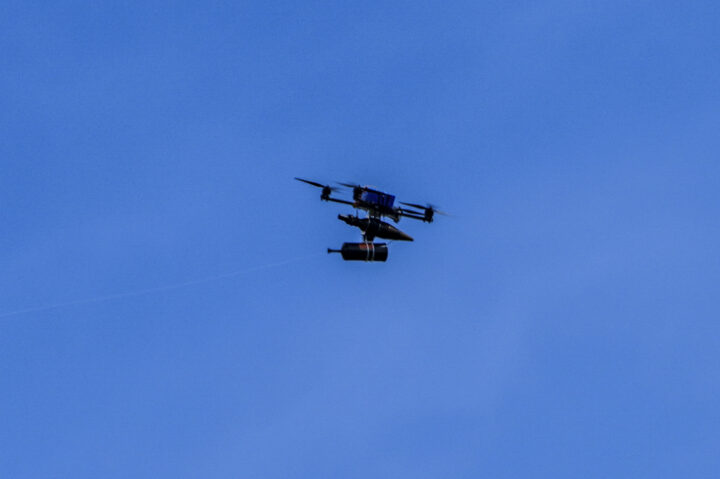
An explosive drone launched by Hezbollah is seen near the Israeli border with Lebanon during a Hezbollah attack in northern Israel, May 19, 2026.


 Add JewishInsider on Google
One of Israel’s most urgent emerging security threats is not a sophisticated missile or advanced weapons system, but a small, cheap drone that can be bought online and easily assembled.
Hezbollah’s use of first-person view drones (FPVs) — a battlefield tactic widely utilized in the Russia-Ukraine war and now adopted by the Iran-backed terror group — has caused Israeli casualties, threatens civilians and exposed vulnerabilities in Israel’s air-defense systems, including the Iron Dome.
The drones are small and inexpensive, but difficult to detect, experts say. The growing threat has caught the IDF off guard and is forcing Israeli officials to rethink how they protect soldiers, border communities and critical defense infrastructure during the fragile partial ceasefire between Israel and Hezbollah.
Last Wednesday, a drone attack near the Israeli border community of Shomera killed one soldier and wounded two others. Since the ceasefire between Israel and Lebanon began in April, experts have recorded more than 100 drone attacks on communities inside Israel. On Monday, an IDF soldier was killed in southern Lebanon after being struck by an explosive drone sent by Hezbollah.
“These are very simple, unsophisticated drones,” Yaakov Katz, a senior fellow at the Jewish People Policy Institute, told Jewish Insider. “Imagine a person can watch with goggles almost and be the eyes of the drone, see what the drone sees and literally fly it to wherever it wants its target to be.”
Experts said that Hezbollah can purchase commercial drones, or assemble them inside Lebanon using imported parts. But despite their low cost and relative simplicity, the drones are proving difficult for Israel to defend against.
“These are small, they fly very low, so they’re not seen or detected mostly by radar,” Katz said. “Even if you saw them, you can’t necessarily intercept them or destroy them with traditional means of scrambling their radar signal or other electronic warfare capabilities. That is what’s making this so complicated for Israel.”
The drones have been particularly effective against Israeli soldiers operating in the open, Katz said, turning what was once a secondary concern into “one of the most pressing issues for Israel.” He noted that the drones come in various sizes and carry explosives, including grenades, that are flown directly into Israeli soldiers or other targets.
David Daoud, a senior fellow at the Foundation for Defense of Democracies, said this appears to be the “first real conflict” in which Hezbollah has employed these kinds of drones at scale.
“These drones are basically loitering around for a while,” Daoud said. “They’re not moving at particularly high speeds and you just have Israeli soldiers completely unaware. If you can’t hear the drone, if you don’t know that it’s there until it’s too late, it’s too late.”
Daoud said he has seen footage of drones flying within “a foot or two” of Israeli soldiers who appeared unaware of their presence. That low detectability, he said, can increase the danger not only to soldiers but also to civilians and infrastructure.
“This kind of feeds into the idea that their detectability is very low by design,” Daoud said. “Hezbollah has also talked about disabling some of the early warning systems. If Israel’s Red Alert is knocked out in a certain area and then Hezbollah fires a barrage of 100 rockets, suddenly people don’t have the ability to know that the attack is incoming. You increase the possibility of Israeli casualties.”
Katz said the threat has also taken on a deeply personal dimension for many Israelis. “I have two nephews who are in Lebanon right now,” he said. “Everyone knows someone in Lebanon and you’re concerned, and that creates a level of anxiety.”
“Unfortunately, it’s almost every day that we wake up, or in the middle of the day, get reports of another soldier who’s been killed by one of these drones,” he added. “It just wasn’t as important, but now it is, because it’s killing people. That now made it one of the most pressing issues for Israel.”
Ari Cicurel, associate director of foreign policy at the Jewish Institute for National Security of America, said the drones are also effective because they allow operators to strike with “greater precision and accuracy.” He said that Hezbollah has deployed FPV drones similar to those used by Russia against Ukraine, adding that the group has adopted fiber‑optic control cables to mimic Russian tactics and evade electronic countermeasures.
“Even if they are smaller, the operator can focus in on sites, loiter, wait for an individual or a site to be a desirable target, and then hit them,” Cicurel said. “What we’re seeing in particular recently is adding fiber optic cables to them. That is another clear lesson that both Iran and Hezbollah have learned from Russia’s use of these drones against Ukraine.”
He said the cables help prevent electronic countermeasures from disrupting the drone’s communications, creating “a greater challenge” for Israeli forces trying to intercept them.
Daoud said another factor complicating the issue for Israel is that Hezbollah’s drones are relatively easy to import from abroad or produce domestically, which makes it easier to conceal them.
“These things can probably be produced [regularly] given how cheap they are, how easy they are to manufacture, given how unsophisticated they are,” Daoud said. “When we talk about these factories, we’re not talking about something that requires a high level of sophistication. I could sit at my desk and make 30 of these a day.”
One of the most concerning targets is the Iron Dome, Israel’s primary air-defense system. Footage released by Hezbollah earlier this month appeared to show a drone striking an Israeli Iron Dome launcher, though experts said the extent of the damage remains unclear.
“In Hezbollah’s propaganda they talked about having drones that would be able to disarm the Iron Dome and that’s obviously an issue,” Daoud said. “The Iron Dome operates off of a radar. If you’ve made these drones able to go undetected by radar, then a few well-placed drones could either throw off Iron Dome or disable an Iron Dome battery or disable the radar.”
“The more these drones are developed by Hezbollah to become more able to evade radar, the more of a problem you’re going to have when it comes to Iron Dome,” he added. “Israel doesn’t have thousands of Iron Dome batteries. Most of them have been deployed to the north. If Hezbollah is able to knock them out, then that’s a massive security risk for Israel.”
Still, Daoud noted that the Iron Dome remains the “most effective” counter to FPVs despite the liability.
Experts also said Israel was not fully prepared for the scope of the FPV drone threat and is now trying to adapt quickly. But they cautioned that there is unlikely to be a single solution.
“I think they were underprepared,” Katz said. “What Israel underestimated was the extent, the numbers, the ranges and its inability to defend itself from them. And that is how we found ourselves in this current situation.”
Israel has already adopted some defensive measures used by Ukraine, including establishing protective netting around military vehicles. However, Daoud said there is a trade-off.
“If the IDF decides to put all of its Humvees in Lebanon in protective netting, that means they’re going to move slower, and when they move slower they’re open to different threats from Hezbollah,” Daoud said. “So the question is what tactic do you adopt that plugs up one problem and doesn’t open you up to another problem.”
Other options could include targeting Hezbollah launch areas and strongholds in Lebanon, Daoud said, though he cautioned that Israel’s room to maneuver could be limited by diplomatic considerations, including pressure from Washington to halt hostilities in Lebanon amid negotiations with Iran.
“I think it goes back to the defensive adaptations in terms of needing to prepare for a variety of defenses against the kind of projectiles that our adversaries could be launching,” Cicurel said, noting that he believed “putting netting around air defenses” would “prevent drones from reaching them.”
Experts said it remains unclear whether Hamas, Palestinian Islamic Jihad or other Iranian-backed groups will adopt the same tactics in future conflicts. But Katz said Israel cannot assume the threat will remain limited to Hezbollah.
“It would be negligent to think that they [other Iranian-backed groups] do not have it,” Katz said. “It is easy. It can be bought off of Amazon or at a drone store. You can buy parts and smuggle them in and assemble them on your own without anyone even knowing.”
That leaves Israel facing a difficult question: how to defend against a threat that is cheap, widely available and hard to detect, but potentially devastating when used effectively.
“This has to be something that needs to be thought about very seriously,” Katz added, “… and I would even say with urgency.”
More Stories
FUNDRAISER FALLOUT
Attendee at El-Sayed fundraiser bragged about beating up pro-Israel demonstrator

ON THE HILL
Republicans squabble over pro-Israel provision in NDAA

TORAH AND TAXES
First female Haredi candidate promises reform to ultra-Orthodox politics

CAMPAIGN TRAIL
‘There is no Palestinian nation,’ Ofer Winter says as party dips in polls

DEBATE DEBACLE
El-Sayed dodges Rogers’ attacks on terrorism ties during heated Senate debate

chesapeake challenge
Maryland GOP gubernatorial nominee Dan Cox says he disagrees with son’s antisemitic posts
Please log in if you already have a subscription, or subscribe to access the latest updates.
 Continue with Google
 Continue with Apple