































Weakened Iran, shaken Hezbollah: A rare opening for Israel-Lebanon diplomacy
The current geopolitical conditions laid the groundwork for yesterday’s State Department summit
Andrew Harnik/Getty Images
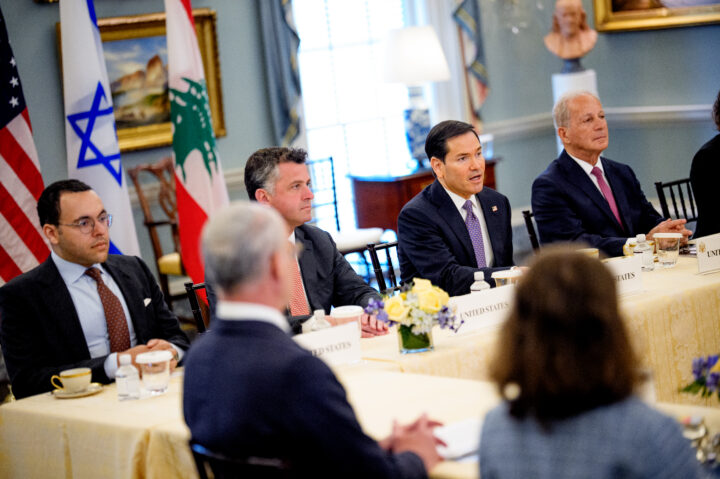
U.S. Secretary of State Marco Rubio (2nd-R), accompanied by U.S. State Department Counselor Michael Needham (C), and U.S. Ambassador to Lebanon Michel Issa (R), speaks as they begin working-level peace talks with Lebanese Ambassador to the U.S. Nada Hamadeh Moawad and Israeli Ambassador to the U.S. Yechiel Leiter at the U.S. State Department on April 14, 2026 in Washington, DC.


 Add JewishInsider on Google
A popular “domino effect” meme circulates online every few months, linking slain Hamas leader Yahya Sinwar’s decision to launch the Oct. 7, 2023, attacks — the smallest domino — to a series of major geopolitical shifts across the Middle East. While both simplified and exaggerated, the meme underscores the dramatic reshaping of Middle Eastern power dynamics.
The next domino may be the decades-long fraught relationship between Israel and Lebanon, as Iran’s ironclad grip over the region loosens and its most powerful proxy, Hezbollah, finds itself increasingly weakened and marginalized in Lebanon, where it has for decades played a key role in the country’s politics and military.
Those current geopolitical conditions — Iran at its weakest point in decades, successive levels of Hezbollah leadership removed from power through Israeli military actions, the degradation of Hamas and a new government in Syria that has separated itself from Tehran — laid the groundwork for yesterday’s State Department summit, convened by Secretary of State Marco Rubio, between Israel and Lebanon.
The State Department meeting between the ambassadors from Lebanon and Israel took place as the U.S. navigates stalled talks and a tenuous ceasefire with Iran — which was initially on unstable ground as Iran demanded that Israel cease its targeting of Hezbollah as part of the ceasefire.
A senior Israeli official told Jewish Insider on Wednesday that Iran’s effort to link the two conflicts was “a strategic trap with long-term ramifications.”
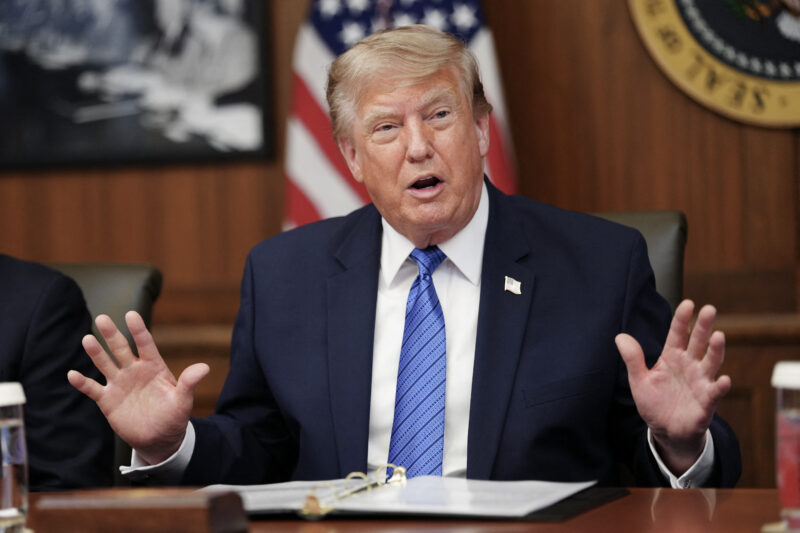
“There was real pressure to link the Lebanon front to the Iran ceasefire,” the official said. If President Donald Trump had acquiesced to the Iranian demand to link the two conflicts, the official continued, “We would not be on the path to peace that we’re on now. Keeping the arenas separate ultimately means that the fate of Lebanon is no longer dictated by Iran.”
Former Israeli Prime Minister Naftali Bennett — now mounting a comeback bid ahead of elections later this year — has often used the “Octopus Doctrine” to describe a security approach to tackling Iran’s decades-long control over the region. Cut off the head of the octopus — Tehran — and the tentacles will be easier to tackle, the logic goes.
Israel, having severed the metaphorical octopus’ head on the opening day of the recent war with Iran, is now continuing its work to degrade and dismantle Iranian proxies — a process that began two and a half years ago, triggered by the Oct. 7 attacks.
“One of the most significant developments in the Middle East since Oct. 7 has been the steady dismantling of that axis — separating arenas that sought to bind their fates together,” the senior Israeli official said.
The talks are not without risk. Lebanese Prime Minister Nawaf Salam called off a planned trip to the U.S. over the weekend out of concerns of potential domestic unrest — amid the still very real risk that Hezbollah, albeit weakened, could attempt a power grab in his absence. Recall that in 2005, former Lebanese Prime Minister Rafic Hariri was killed in a car bombing, with a Hezbollah operative convicted by a U.N. tribunal in absentia for the assassination.
The talks were hailed by Israeli Ambassador to the U.S. Yechiel Leiter, who said that the parties “discovered today that we’re on the same side of the equation” and “are both united in liberating Lebanon from an occupation power dominated by Iran called Hezbollah.”
Rubio delivered a measured assessment of the goals of yesterday’s talks: “This is about bringing a permanent end to 20 or 30 years of Hezbollah’s influence in this part of the world,” he said at a roundtable ahead of the meeting. “This will take time, but we believe it is worth this endeavor.”
Beirut has in recent years — and with varying degrees of seriousness and success — worked to disentangle itself from Iran and Hezbollah. Now, the U.S.-Israeli military pressure on Iran, combined with the Trump administration’s zest for dealmaking and the degradation of Hezbollah, could create the right environment to bring peace to the Mediterranean Riviera.
More Stories
RED SEA RECKONING
Houthi gains leave Saudi Arabia short on options and looking to Washington
NOT SO FAST
Democrats push back on White House’s planned $2.8 billion sale of bombs to Israel
The JD doctrine
Vance likens U.S.-Israel ties to NATO, says U.S. policy ‘cannot’ be ‘subservient’ to Israel
SHOW OF SUPPORT
Suozzi, Knott, Jewish groups rally for Right to Worship Act
Protest politics
Mamdani says he won’t protest Netanyahu — and doesn’t urge New Yorkers to, either
Daily Kickoff
Vance’s Shabbos Shuva
Please log in if you already have a subscription, or subscribe to access the latest updates.
 Continue with Google
 Continue with Apple