


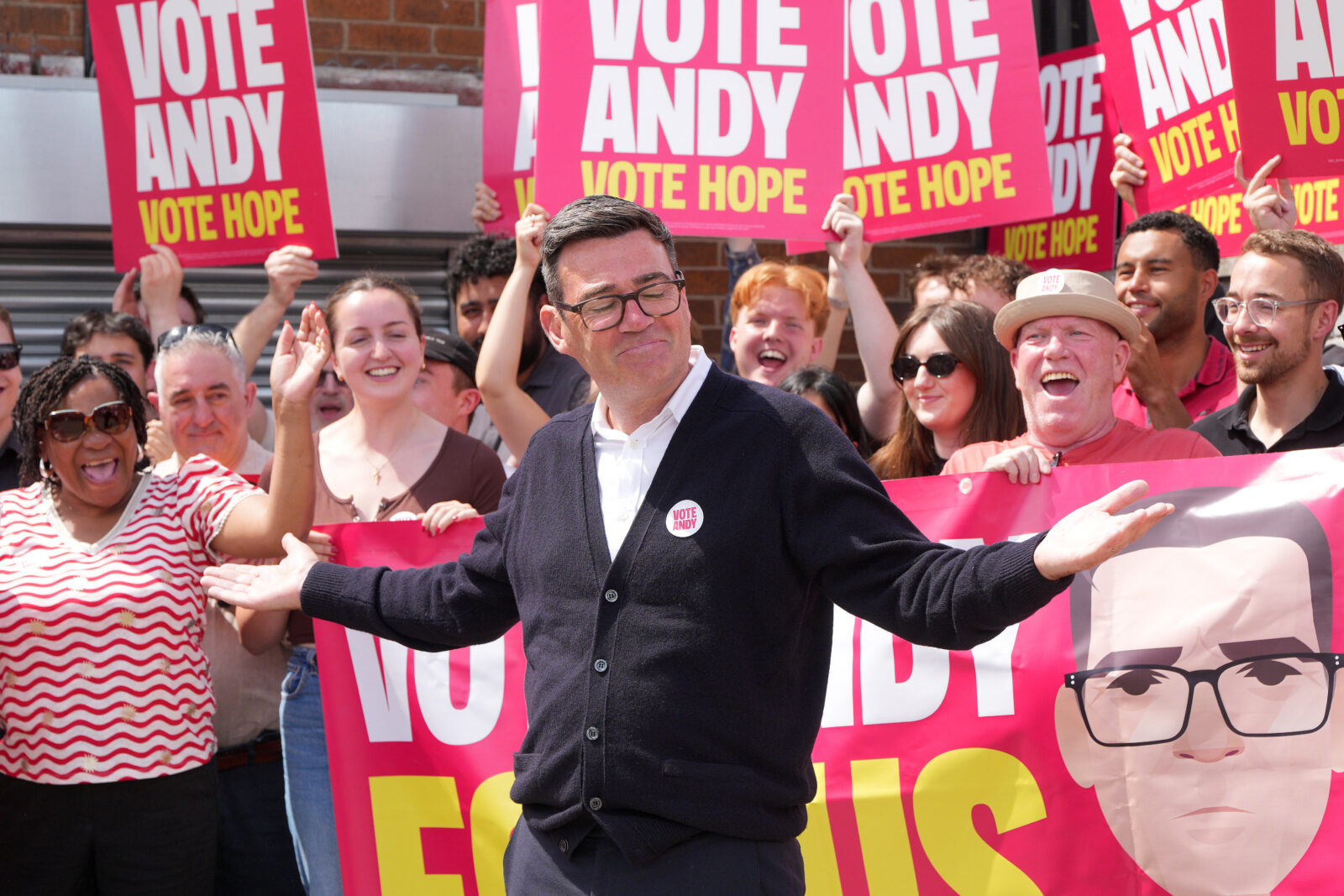
Christopher Furlong/Getty Images
Starmer’s resignation puts Burnham’s record on Israel, antisemitism in the spotlight
Jewish leaders view Andy Burnham as an ally in the fight against antisemitism, but his expected bid for the premiership is renewing scrutiny of his views on Israel and Labour’s post-Corbyn direction


 Add JewishInsider on Google
British Prime Minister Keir Starmer announced his resignation on Monday, setting up a leadership battle within the Labour Party and raising the question of how his likely successor will deal with one of the issues that brought Starmer to office in the first place: combating antisemitism.
Starmer was elected as leader of the Labour Party in 2020, inheriting a party in disarray after it had faced electoral losses the year before and was navigating an internal crisis over former party leader Jeremy Corbyn’s approach to antisemitism. In his victory speech in April 2020, Starmer pledged to address the deep-seated antisemitism that had led many Jews to exit the party.
Starmer’s successor is likely to be Andy Burnham, a newly sworn-in Labour MP representing a district that includes parts of the Greater Manchester region. He spent the last nine years as mayor of Greater Manchester, the city with the second-largest Jewish community in the U.K. He declared his intent to run for Labour leader on Monday and quickly earned the backing of Wes Streeting, a former health secretary who was rumored to also be considering a run.
In 2019, as Corbyn’s leadership faced an antisemitism scandal, Burnham met with 80 members of the Board of Deputies of British Jews, the community’s largest institutional voice.
“It is inconceivable to me that a party which has prided itself on its record on racism could have become embroiled in an antisemitism crisis,” Burnham said at the meeting. “Racism needs to be dealt with firmly, quickly and decisively. I’m afraid that this hasn’t been the response so far and I hope from this point forward this has been understood.”
He said at the time that he still supported Corbyn, “but that support is not unconditional or unchallenged.”
Jewish community leaders in Manchester have close ties with Burnham, whom they view as an ally. In particular, he earned praise for strongly supporting the community after a terror attack on Manchester’s Heaton Park Hebrew Congregation last year on Yom Kippur, in which two congregants were murdered.
“In the aftermath of the Heaton Park synagogue terrorist attack, which was incidentally my synagogue, he was an incredible support to the community,” Raphi Bloom, director of fundraising and marketing at the Fed, a Jewish social services charity in Manchester, told Jewish Insider. “He has been an excellent friend to the Jewish community.”
Burnham’s record on Israel is relatively short — he has not brought Middle East politics into his mayoralty in the way that some other local leaders have focused on the issue. He spoke at a vigil days after the Oct. 7 attacks in 2023, but he also butted heads with the local Jewish Representative Council when he signed onto a petition calling for a ceasefire less than three weeks later.
“At a moment when we felt isolated and vulnerable, he demonstrated that Greater Manchester’s leadership understood the scale of the tragedy and how it affects Jewish people in the U.K.,” Mark Adlestone, chair of the Manchester JRC, wrote in an op-ed in Britain’s Jewish News on Monday. “However, it would be disingenuous to suggest there have not been times when there have been disagreements. Andy led a call from local authority leaders calling for a ceasefire post 7 October, whilst hostages remained in captivity.”
Burnham also served in Parliament from 2001 to 2017, and when he unsuccessfully ran for Labour Party leader in 2015, he expressed strong support for Israel. “I’ve always been a friend of Israel and the Jewish community — that will never change,” he said at the time, and promised that his first foreign trip as party leader would be to Israel.
But even his supporters in the Jewish community acknowledge that the politics surrounding the issue have changed a great deal since then. While remaining outspoken against antisemitism, Starmer has sought to cut off some arms sales to Israel. In September 2025, the U.K. unilaterally recognized a Palestinian state, and Starmer presided over sanctions against Itamar Ben-Gvir and Bezalel Smotrich, two far-right ministers in Israeli Prime Minister Benjamin Netanyahu’s Ccabinet.
“I think he’ll be strong on antisemitism, on Holocaust education and on tackling Jew hatred, but it remains to be seen about Israel. I don’t think he’ll change the government’s position much, if at all,” said Bloom, who directs the Fed’s My Voice project, which preserves and shares the stories of Holocaust survivors. “We’re not looking at Andy with rose-tinted spectacles when it comes to Israel, and we will deal with that when it happens as a community.”
In the final days of his recent campaign for Parliament, Burnham was asked if Israel’s actions in Gaza amounted to a genocide, a word Starmer declined to use. Burnham similarly declined to answer but hinted that he may be more willing to engage on the issue once he enters Parliament.
“I can’t judge things of that enormity from where I am as mayor of Greater Manchester,” he said. “But I do have concerns about the disproportionate nature of what has happened in terms of the destruction, and there has to be a full process of investigation and accountability.”
Starmer, in an emotional speech announcing his resignation on Monday, touted his record on antisemitism as one of his signature achievements. Jewish communal leaders said they don’t expect Burnham to return to the Corbyn era, but questions remain about his approach to the party’s past fissures over antisemitism and Israel.
“He probably is more to the left than Starmer is, and so perhaps the people that he will surround himself with, some of them will be more to the left of Starmer, and how that plays out for the Jewish community and for Israel is unknown at this stage,” said Bloom. “I’m 100% sure he won’t be reopening the door to Jeremy Corbyn or Corbynistas to come back into the party.”
Ella Rose-Jacobs, national chair of the Jewish Labour Movement, urged Burnham to follow Starmer’s path.
“Keir Starmer did a lot of the institutional work, but any future leader of the party will also need to vanguard and safeguard the process and the progress that has been made. Progress can be backslid,” Rose-Jacobs told JI on Monday. “The thing that I hope for the future government — and obviously there might be another contender in the race, we don’t know that yet — is that it doesn’t import the politics of foreign conflicts to our shores.”
Featured Stories


Please log in if you already have a subscription, or subscribe to access the latest updates.
 Continue with Google
 Continue with Apple