























































Adam Smith blasts progressive left for enabling harassment of pro-Israel lawmakers
Smith sparred with ‘Breaking Points’ co-host Krystal Ball over Palestinians’ right of return, the 1948 War and illiberal tactics used by the far-left
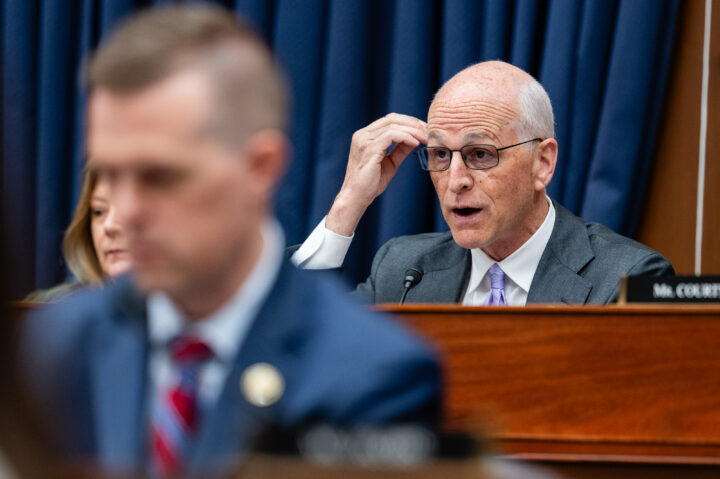
Eric Lee/Bloomberg via Getty Images
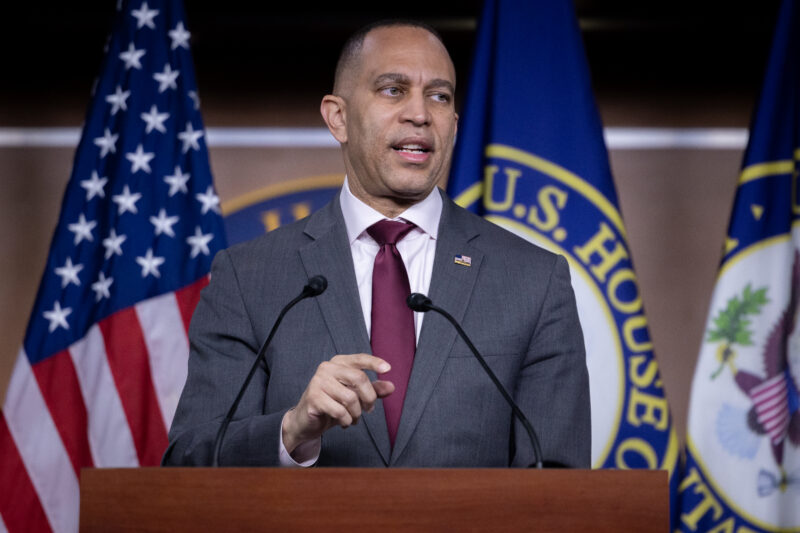
Representative Adam Smith, a Democrat from Washington and ranking member of the House Armed Services Committee, during a hearing in Washington, DC, on May 14, 2026.


 Add JewishInsider on Google
Rep. Adam Smith (D-WA), the top Democrat on the House Armed Services Committee, accused the progressive left of acting in “illiberal” ways by perpetrating and ignoring the harassment of Democratic lawmakers and candidates in recent years.
Smith made the comments in an interview with the far-left “Breaking Points” podcast, released Tuesday, where he called out critics of Israel who refuse to recognize that Israel’s creation came about in part because of the Palestinians’ refusal to offer them the equal rights that leftists now demand Israel provide to them.
Smith and “Breaking Points” co-host Krystal Ball sparred throughout their 45 minute conversation, with the Democratic congressman arguing that progressive commentators have shrugged off the harassment of pro-Israel Democratic lawmakers by far-left actors while embracing candidates who believe Israel does not have the right to exist.
“The biggest thing that I want in all this is the ability to have a conversation, and this is where this is my biggest problem with the left,” Smith said. “I have been unable to hold a town hall meeting for a year because a bunch of leftists show up and scream at me and don’t let anyone else speak.”
“You talk about illiberal? OK, having people stand out in front of my house screaming death threats at me and threatening my wife,” he continued. “The left goes, ‘Oh well of course we don’t support that. We’re peace activists. We would never do something like that.’ How about you just say, ‘No, they did it. It’s wrong. We’re against it. We are going to be liberal. We’re going to stand up for stuff.’ I think that whole thing has created a major problem as well, and that’s why I try to have these conversations.”
Smith went on: “So much of the left, and certainly we experienced this in Seattle, became an academic exercise,” he said. “They were spending all day long talking about the history of racism as opposed to going out into the community and saying, ‘These are people who have been discriminated against. Let’s get them access to capital so they can start businesses. Let’s get them access to capital so they can get homes. Let’s do workforce development so they can get jobs.’”
Smith disputed Ball’s assessment that Israel had become a litmus test in Democratic primaries, instead arguing that “the belief that we have not effectively fought” President Donald Trump and the failure of both parties to address income inequality were “driving the anti-establishment feelings in primaries.”
Israel is “not the most important issue,” Smith said. “It’s not even close to the most important issue in these primaries.” Still, he acknowledged that Israel was “becoming more important” to voters.
The Washington Democrat also explained his reversal on Sec. 224 in the National Defense Authorization Act, which passed the House on Wednesday afternoon. Smith told Ball he changed his opposition to oppose Sec. 224, which expands U.S.-Israel defense co-development programs, because he disagrees with how Israeli Prime Minister Benjamin Netanyahu’s government has conducted itself in recent years.
On his similar switch-up in supporting Rep. Thomas Massie’s (R-KY) amendment cutting off all $3.3 billion in aid to Israel, Smith argued that he struggled with his support for “what Israel has historically been” and recognition of “the reality of what Israel is living in” with the actions of the Netanyahu government.
Smith added that while he voted for the Massie amendment because of his opposition to Israel’s conduct in its war against Hamas in Gaza, he reiterated he also has “concerns about Hamas, about Hezbollah, that people don’t seem to share.”
Smith said he was unlikely to support future U.S. aid packages for Israel until the Israeli government were to “actually go forward with something where they create a reasonable alternative for the Palestinians in Gaza, if they actually stop what they’re doing in the West Bank and get to peace in Lebanon, that may change. I don’t see that happening.”
The two sparred over the consequences of the Palestinian people being granted the right of return to Israel, with Smith arguing that, “You have a situation where Israel is threatened on all sides — and I know it’s not saying they don’t have a right to exist, just that they have to let all the Palestinians back in, and then effectively the Jews no longer control Israel.”
“The practical result of this is — and there should be equal rights within Israel — but if Israel allows it they cease to exist as a country,” Smith said.
Smith continued: “Maybe that’s just what has to happen in the minds of some people, but understand the consequences of it, understand why Israel was created in the first place, so that the Jews would have some place to go. And to just blithely say, ‘Well, yeah, it’ll go away and it’ll be fine.’”
“Let’s say this plays out how you describe and there is no ‘Jewish ethnostate.’ The consequence of that is there is no Jewish state,” Smith argued. “You have the Palestinians and they would now be governing that area, and that means Hamas would be governing that area. Do you have any problem with that? Do you have any problem with Hamas suddenly becoming a much more powerful entity and having the country ‘from the river, to the sea’?”
Ball said she wasn’t convinced that the series of events Smith was laying out “would be the reality” and said she did not understand how the House Democrat could “get away from how illiberal it is to not support equal rights for people regardless of if they’re Jewish, Arab, Muslim, Christian, etc.”
“Totally with you, but Hamas doesn’t support equal rights either,” Smith responded.
The pair did find common ground on their opposition to continued U.S. aid to Israel over its conduct in Gaza. Smith also said he supported the concept of a two-state solution, but acknowledged that it’s not currently viable.
Smith also outlined the history of Israel’s creation, often expressing frustration that Ball wasn’t aware of basic facts surrounding the history of the creation of Israel.
“I know people say, ‘Well, this is a war to drive the Palestinians out,’” Smith said of Israel’s 1948 War for independence. “It was also a war to eliminate Israel, to basically kill Israel in the crib in 1948. They fought and they fought and they fought and they fought and at no point was there ever anything carved out for the Jews, and so the Jews have been fighting an existential fight.”
After Ball expressed confusion at how Smith could consider himself a classical liberal while supporting Israel’s existence as a Jewish state, the House lawmaker said in an exasperated tone: “There’s no liberal option on the table here. That’s what I’m telling you. You keep saying, ‘No illiberal Jews, illegal Jews we cannot have. Illiberal Palestinians are fine.’”
More Stories

DIPLOMATIC PUSH
Miliband agrees to host international antisemitism meeting at urging of J7 Task Force

SCOOP
Rep. Lawler urges Treasury to reopen investigation into Swiss bank’s Nazi ties

EVENT RESCHEDULED
State Department to hold Oct. 7 commemoration event on Wednesday

analysis
Could these two small parties be Israel’s kingmakers?

COURSE CORRECTION
ADL, Gratz College launch antisemitism training for college administrators, faculty

CAMPAIGN BLITZ
AIPAC’s super PAC wades into Michigan Senate race
Please log in if you already have a subscription, or subscribe to access the latest updates.
 Continue with Google
 Continue with Apple