

































‘I don’t know what Trump is thinking’: Jewish GOP donors down on Iran deal
Jewish Republican donors said the agreement grants too many concessions to Tehran, though the Republican Jewish Coalition said it trusts Trump ‘to finish the job’
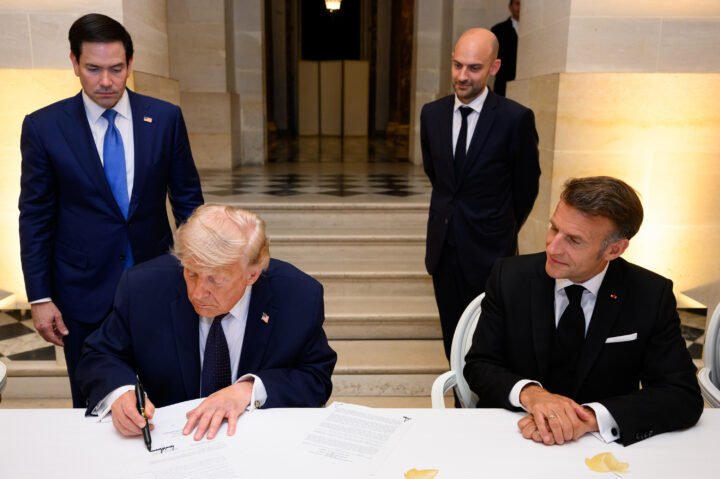
Official White House Photo by Daniel Torok
President Donald J. Trump signs a Memorandum of Understanding between the Islamic Republic of Iran and the United States of America at the Palace of Versailles, France on Wednesday, June 17, 2026. French President Emmanuel Macron and First Lady Brigitte Macron of were also in attendance.


 Add JewishInsider on Google
Jewish Republican donors and activists are voicing their strong disappointment with President Donald Trump’s newly announced memorandum of understanding with Iran, which has been met with criticism from GOP lawmakers as well as influential hawkish conservatives.
Trump has fiercely defended the deal to end the war with Iran, the text of which was released Wednesday, claiming it is superior to the nuclear agreement with Tehran that was reached by former President Barack Obama in 2015.
But in interviews with Jewish Insider on Thursday, several Jewish conservatives who supported the war expressed misgivings about the deal that reopens the Strait of Hormuz, saying that it had granted too many concessions to a weakened Iran — including waiving sanctions on oil exports — while neglecting to broach the regime’s funding of terror proxies and its ballistic missile arsenal.
They also raised concerns that the memorandum of understanding with Tehran had not been favorable to Israel, a U.S. partner in the war, pointing to a term of the preliminary agreement that calls for a permanent end to military operations in Lebanon, where Israel is fighting Hezbollah, a key Iranian ally.
And they expressed serious doubts over Iran’s willingness to finalize a nuclear agreement during the 60-day negotiating period, fearing it could be indefinitely extended by “mutual consent,” per the terms of the MOU.
Their reactions highlight a rare point of tension between Trump and pro-Israel Republicans, who have long applauded his commitment to upholding a close alliance with the Jewish state, even amid rising hostility to Israel from the populist far right opposed to foreign wars.
Vice President JD Vance, who had initially been skeptical of the war, delivered a scathing public rebuke of Israeli officials who had criticized the agreement, saying on Thursday that Trump is “the only head of state in the entire world who is sympathetic to the nation of Israel at this moment in time” and warning Israeli detractors against “attacking the only powerful ally” they have “anywhere left in the entire world.”
But Eric Levine, a top GOP fundraiser who is on the board of the Republican Jewish Coalition, said that the war “achieved none of its stated aims,” including Trump’s pledge to liberate Iranians from a theocratic regime and nuclear disarmament. “We ran 26 miles, and then chose to stop at the last 385 yards,” he told JI. “I don’t understand why.”
“The most disturbing thing about the deal is that we have conceded to the Iranians up front that they can leave Lebanon alone,” Levine added, saying the deal effectively constrained Israel’s right to defend itself.
Levine predicted a future scenario in which Hezbollah would be “lobbing missiles into Israel” before the upcoming elections in Israel and the United States, prompting a disastrous chain reaction that could lead to the collapse of the deal and result in widespread GOP losses in November.
“Call me disappointed that we’re going down this road,” he sighed.
The RJC, for its part, was more positive about the deal, saying on Thursday that it had confidence in Trump’s decision, even as it was “deeply skeptical that the Islamic Republic has a genuine interest in peace or will abandon its Islamist, hegemonic malign ambitions in the region.”
The group said it was reassured that Trump had threatened to strike Iran again if it reneged on the agreement. “We take the president at his word and trust him to finish the job in the best interests of the United States and our allies in the region,” the RJC wrote in a lengthy statement.
Other Jewish leaders, however, have not been as charitable in assessing Trump’s motivations. One prominent Jewish Republican donor criticized the deal, speculating it had only come as a response to Trump’s fears about GOP losses in the midterms, as the war and rising gas prices have emerged as potent sources of Democratic attacks.
Gabriel Groisman, a Republican donor in Florida, said the terms of the deal were “certainly worrisome,” noting that “there is still no agreement on the major issues” such as “uranium enrichment, Iran’s ballistic missile program and its funding of terrorist proxies,” even as “sanctions relief appears poised to take effect immediately.”
“This MOU is not the end of the war and it unfortunately will not bring lasting peace,” he told JI. “Instead,” he added, “it appears to signal a significant realignment of American policy in the region, which raises serious concerns for many Americans, for U.S. allies and of course for American Jews, who have a special interest in the safety and security of the world’s only Jewish state.”
Joshua Katzen, the publisher of the Jewish News Syndicate and an RJC board member, echoed that sentiment, saying that he was “disappointed to see” Trump “apparently throwing away the leverage he has painstakingly accumulated and trading it for promises that are likely to be broken.”
“The worst aspect is that by relieving sanctions and allowing Iran to sell oil before they have performed more than letting a few ships through Hormuz,” he added, “Trump had given them the funds to rebuild and reconstitute the threat that he just spent billions of dollars to degrade.”
Katzen expressed hope that Trump was “playing four-dimensional chess here, as he often has in the past, but right now, I’m not so sure his horizon is larger than temporarily reducing oil prices while giving Iran the funds and time to renew their existential threat.”
While many Jewish Republicans acknowledged that Trump had been a strong friend to Israel and praised his initial decision to attack Iran, they were otherwise largely baffled about his decision to end the war, even as some attempted to put a positive spin on the move.
“I’m on a bunch of various threads and the majority are not happy, to say the least,” Alan Sager, a Jewish Republican donor and activist based in Texas, told JI. “I’m a wait-and-see guy.”
Still, he added that he was confused with Trump’s decision and doubted the Iranians would operate in good faith — particularly with regard to nuclear talks that have long proven to be unfruitful. “I don’t know what Trump is thinking,” he told JI. “I don’t trust the Iranians as far as I can throw them.”
Brad Kastan, a GOP donor in Ohio, said he was “taken aback like everybody else” when he learned about the deal, while acknowledging there was “no doubt” Trump ceded valuable leverage in readily agreeing to a range of key concessions.
“But as in most things in life, things are never as good as you hoped or as bad as you feared,” he told JI, speculating that perhaps Trump agreed to an end to the war in order to “buy more time” for the United States and Israel to replenish their eroding munitions reserves. “Why would you let them off the mat unless you needed to?”
“For every disappointment, I can’t help but think of all the good that happened. There are a lot of people rushing to jump to conclusions” while ignoring “the bigger picture,” Kastan said. “To conclude we are not better off today than we were a year ago is objectively false,” he argued, claiming “Iran is back on its heels.”
Marc Zell, an Israeli-American lawyer and chairman of Republicans Overseas Israel, said in a social media post on Friday that he did not “like the content of the MOU or the tone of certain statements from the” White House “defending it, but that’s politics in an election year.”
“The bottom line is the relationship between Israel and the U.S. is strong and inviolable,” Zell wrote.
One top Jewish Republican bundler said he was also more sanguine about Trump’s deal. “He took a huge risk for Israel, and people need to see what happens and calm down,” the bundler told JI, referring to the start of the war in February. “No president has done more than him or would do more.”
But Joel Geiderman, an RJC board member in Los Angeles, argued that “Israel’s last reliable ally seems to have abandoned her,” telling JI that he was “very disappointed” with the recently approved agreement.
Another top GOP donor, who also spoke with JI on condition of anonymity to address a sensitive subject in the wake of the deal, suggested that he was looking at the agreement through a realist’s lens.
In initially launching the war, Trump had “greatly underestimated Iran’s capabilities and willingness to stick with it,” and “put himself in a box where he had to make a deal,” the donor explained. “Every time he announced we had won the war, they’d shoot another ballistic missile.”
“Do I like this deal? Hell no. Nobody thinks he made a great deal. But there’s a difference between making a great deal and making the only deal you can make,” he told JI. “Knowing Donald Trump, he was going to make a deal.”
More Stories
LAST STRAW
Democratic leaders begin to abandon Graham Platner amid sexual assault allegations
CALLING IT QUITS
Platner suspends campaign, blames organized conspiracy for forcing him out
SANCTIONS STANDOFF
Lawmakers divided over Trump’s plan to lift sanctions on Turkey
scoop
New Ted Cruz-aligned organization takes aim at right-wing antisemitism
LOSING FAITH
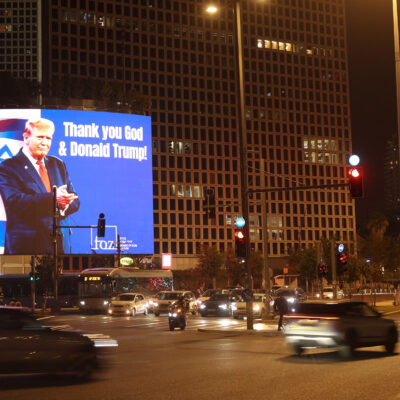
Israeli confidence in Trump drops to new low amid Iran negotiations

DISARMAMENT DOUBTS
American and Israeli officials skeptical as Hamas pledges to hand over governing authority
Please log in if you already have a subscription, or subscribe to access the latest updates.
 Continue with Google
 Continue with Apple