























































The left’s real test isn’t the primaries. It’s November
The anti-Israel activists have certainly captured a faction of the Democratic Party, but their ties to so many unpopular views and causes make the whole movement politically toxic in middle America
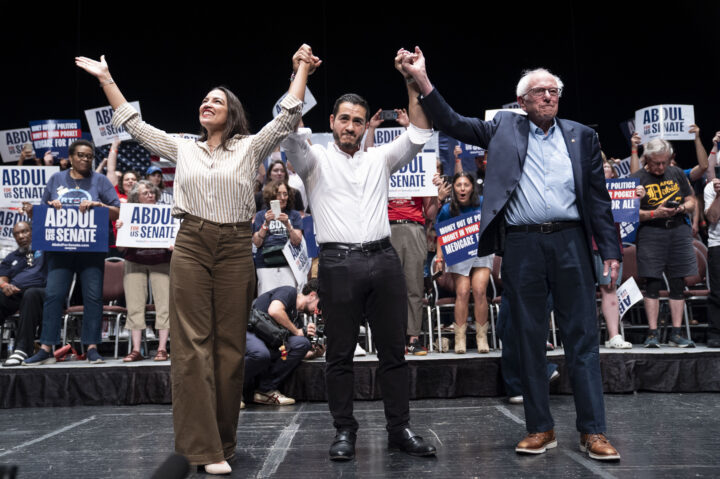
(Sarah Rice/Getty Images)
U.S. Rep. Alexandria Ocasio-Cortez (D-NY), Michigan Democratic candidate for Senate Abdul El-Sayed and U.S. Sen. Bernie Sanders (I-VT) greet the crowd after El-Sayed spoke at The People V. The Powerful rally at the Detroit Opera House on July 18, 2026 in Detroit, Michigan.


 Add JewishInsider on Google
So far, the success of far-left, anti-Israel candidates has been confined to Democratic primaries in deep-blue districts largely in big cities or college towns. The biggest test ahead for the socialist movement is whether it can prevail in primaries outside its geographic base, and more importantly, if such candidates can win general elections in battleground states or districts.
All of the available evidence and recent history suggests that nominating extreme candidates in enough key races would threaten Democrats’ chances of winning a Senate majority and would dampen the party’s pickup potential in the House.
Indeed, the victories by radical nominees in recent House primaries — combined with the high-profile collapse of the like-minded Graham Platner’s Maine Senate campaign — are already doing damage to the Democratic Party’s brand.
Looking at the big picture: In poll after poll, Democrats are now underperforming expectations on the generic congressional ballot — and have lost notable ground over Republicans in the last month alone.
In his analysis of congressional polling, Nate Silver documented that the Democrats’ advantage on the generic ballot in the polling average declined by one point since June, from seven points to six. At this point in the 2018 cycle, the Democrats’ generic ballot advantage was close to eight points, according to Silver’s analysis.
Democrats still hold a decided edge, but the massive blue wave that could have emerged in this year’s midterms is now looking a bit more modest. That means it’s much more difficult for Democrats to overcome their partisan disadvantage in the red states they need to retake the Senate, while Republicans may have some outside hope that redistricting and enough flawed Democratic candidates could keep the House majority in play.
CNN political analyst Ron Brownstein also notes that Democrats are failing to win over as many voters who disapprove of President Donald Trump as they did during the 2018 midterms — another signal that the party’s negative image and leftward lurch is costing them among the swing-voting suburbanites who formed a critical mass of the anti-Trump movement in the president’s first term.
Recent history also points to candidates significantly underperforming if they are ideologically out of step with their constituents. In the 2018 midterms, Democrats swept the vast majority of competitive battlegrounds, riding the wave of anti-Trump sentiment even in some districts that had long been held by Republicans.
There were two notable outliers in that year’s Democratic wave — very winnable races that Democrats lost because they nominated progressives in swing districts. In that election, Rep. Don Bacon (R-NE) faced a challenger (Kara Eastman) who ran what Politico called a “Brooklyn-style campaign” in the Omaha-based district that former President Joe Biden comfortably carried. Bacon prevailed by three points.
The other missed opportunity that year for Democrats was in a Syracuse-area district that favored their party. Despite the blue wave, the party’s decision to nominate an outspoken progressive (Dana Balter) cost them a victory against a vulnerable House Republican, former Rep. John Katko.
This year, the party has lurched further to the left and is likely to nominate more ideologically extreme candidates in even bigger races.
Michigan is a swing state, but Democrats are at risk of handing their Senate nomination to Abdul El-Sayed, a Bernie Sanders acolyte whose incessant animus against Israel has defined his campaign message. If he’s the nominee, some Democrats believe their shot at a Senate majority could be lost. (The RealClearPolitics polling average shows that El-Sayed, in a general election, is statistically tied with expected GOP nominee Mike Rogers — a notable underperformance given the national environment.)
In the state’s biggest swing district, which is currently held by Rep. Tom Barrett (R-MI), Democrats are so concerned about the far-left candidacy of Will Lawrence that even Rep. Alexandria Ocasio-Cortez (D-NY) snubbed him at the El-Sayed rally this past weekend. Two other mainstream candidates — former U.S. Ambassador to Ukraine Bridget Brink and former Navy SEAL Matt Maasdam — are splitting the moderate vote.
And there are numerous other contests, from the Senate races in Maine and Minnesota to House races in California, Colorado and Maine, where left-wing candidates threaten to jeopardize the party’s prospects.
Ultimately, the most consequential political test of the anti-Israel movement will come in this November’s general election. The anti-Israel activists have certainly captured a faction of the Democratic Party, but their ties to so many unpopular views and causes make the whole movement politically toxic in middle America.
More Stories
MONEY MATTERS
Treasury moves to terminate tax-exempt status for some universities, private schools

Daily Kickoff
Politico’s Yom Kippur schmear job

Daily Overtime
Amb. Leiter’s son seriously wounded in terror attack

analysis
Attack on Ambassador Leiter’s son casts pall over Netanyahu’s abbreviated UNGA visit

RIYADH'S RECKONING
Saudi Arabia’s Houthi crisis is partly of its own making, analysts say

Daily Kickoff
Vance’s Shabbos Shuva
Please log in if you already have a subscription, or subscribe to access the latest updates.
 Continue with Google
 Continue with Apple