





























































Dems facing tension between their principles and primary politics
How largely pro-Israel Democrats in solidly-blue districts balance the pressures from the base against their longstanding principles will speak volumes about whether the U.S.-Israel relationship can maintain support within their party
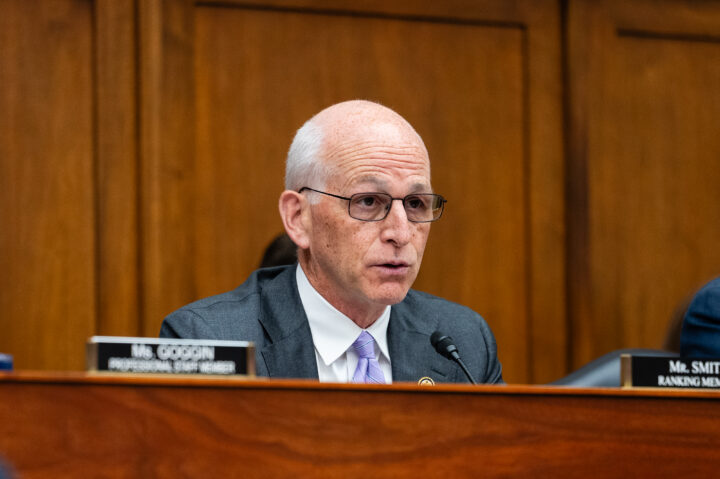
Eric Lee/Bloomberg via Getty Images
Rep. Adam Smith (D-WA), ranking member of the House Armed Services Committee, during a hearing on May 14, 2026.


 Add JewishInsider on Google
President Donald Trump’s capture of the Republican Party did not happen at once, and was memorably met with resistance from some lawmakers who would later become his allies.
Many Republicans, during the rise of Trump, cast mostly party-line votes alongside the president and rarely spoke out publicly when they disagreed. But there were notable times when prominent party leaders used their political capital to stand up for their principles on key issues, such as then-Senate Majority Leader Mitch McConnell’s (R-KY) outspoken advocacy for Ukraine funding or Sen. Susan Collins’ (R-ME) decisive vote against repealing Obamacare.
There may be a similar political calculus at play for some typically pro-Israel Democrats, who are facing immense political pressure from loud activists in their party base to turn against the Jewish state. Nearly half of the House Democratic caucus voted to cut off aid to Israel last week, a record number that included 18 lawmakers who had previously been endorsed by AIPAC and were seen as strong allies of the U.S.-Israel relationship.
AIPAC cut off fundraising to their reelection campaigns after the vote, and how these lawmakers will position themselves on Israel policy going forward is now uncertain.
Not all of the Democrats who supported the amendment have adopted an anti-Israel worldview. Some said that they still support Israel, but wanted to make a statement, via a bill that was certain to fail, that they disagree with many recent actions of the Israeli government.
It’s also possible that some of them — especially those in districts where they face a credible primary threat from the left — took the vote to attempt to placate anti-Israel activists without making any real change in policy, like the Republicans who would offer an olive branch to their right-wing base by voting contrary to their longstanding beliefs.
For instance, in April 2024, then-Sen. Marco Rubio (R-FL) and Sen. Ted Cruz (R-TX) voted against a sweeping foreign aid package for Israel and Ukraine in the face of rising isolationist sentiment in the party, despite their hawkish records. But politically speaking, it helped maintain their credibility with a MAGA base skeptical of any foreign assistance without jeopardizing the funding.
A similar dynamic appears to be taking place among the generally pro-Israel Democrats who are trying to hold onto their place in the party as anti-Israel voices are on the rise.
Rep. Adam Smith (D-WA), for instance, described his “yes” vote as an attempt to “to try to get the attention of the Netanyahu government to force them to change their actions.” He also said he still supports Israel and expressed concern “about the tactics used by those on the far left to advocate for cutting off aid to Israel,” including vandalizing his family’s home. Days later, he spent time on a far-left podcast attacking the host’s anti-Israel views and explaining to her why he’s been such a strong supporter in his career of the Jewish state.
Far from sounding like an anti-Israel convert, Smith sounded like he wanted to throw the left-wing activists a bone by voting for the symbolic anti-Israel resolution without fundamentally shifting his longstanding views on Middle East policy.
In the liberal Boston suburbs, Rep. Jake Auchincloss (D-MA) — a Jewish Democrat and strong supporter of the U.S.-Israel relationship — surprised many by voting for the amendment. But in an interview with Jewish Insider’s Marc Rod this week, he asserted that the vote was in line with his pro-Israel beliefs.
“I represent a pro-Israel, anti-Netanyahu district and this is a pro-Israel, anti-Netanyahu vote,” Auchincloss said, adding that he believes “a majority of my Jewish constituents would agree with me.”
How largely pro-Israel Democrats in solidly blue districts such as those represented by Smith and Auchincloss balance the pressures from the base against their longstanding principles will speak volumes about whether the U.S.-Israel relationship can maintain support within their party.
More Stories

STUDENT SAFETY
Federal civil rights complaint accuses Montgomery County, Md., schools of ignoring antisemitic harassment

SANCTIONS SUPPORT
Lander endorses settlement sanctions bill while on West Bank trip

FINAL SPRINT
DMFI to spend $7 million to support Reps. Don Davis, Shomari Figures

MAIL FAIL
El-Sayed letter to Jewish community on antisemitism fails to reassure skeptics
analysis
Democrats hope to ride a historic Senate wave, but face several speed bumps

Super Ball
Robert Kraft’s Blue Square gala pulls in $32 million as NYC’s Waldorf glows blue
Please log in if you already have a subscription, or subscribe to access the latest updates.
 Continue with Google
 Continue with Apple