


Christina Sher
How Debra Band revives a dying Jewish artform
Band spent 30 years in health policy before turning full-time to Judaica; now, the Library of Congress houses five of her books


 Add JewishInsider on Google
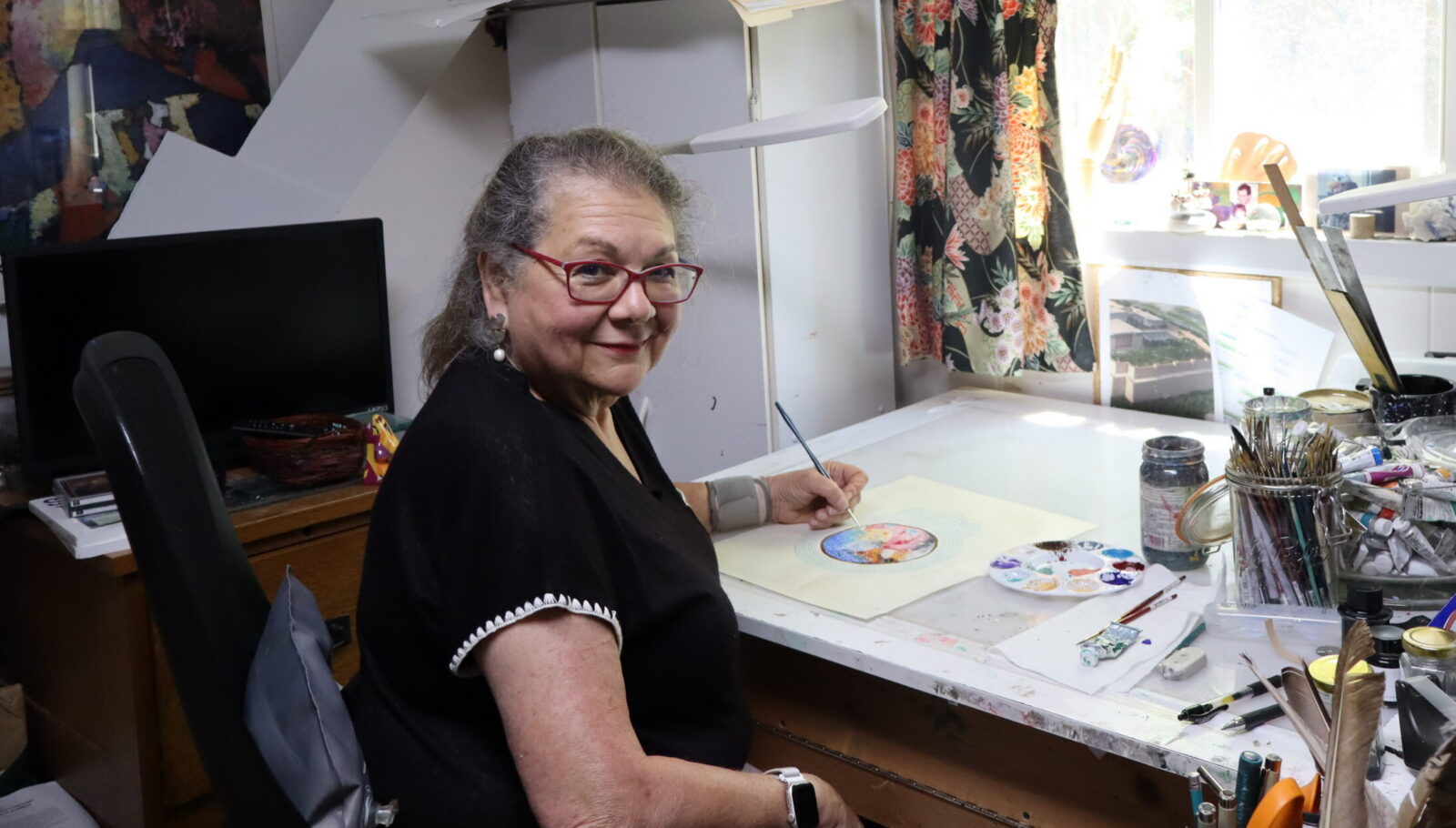
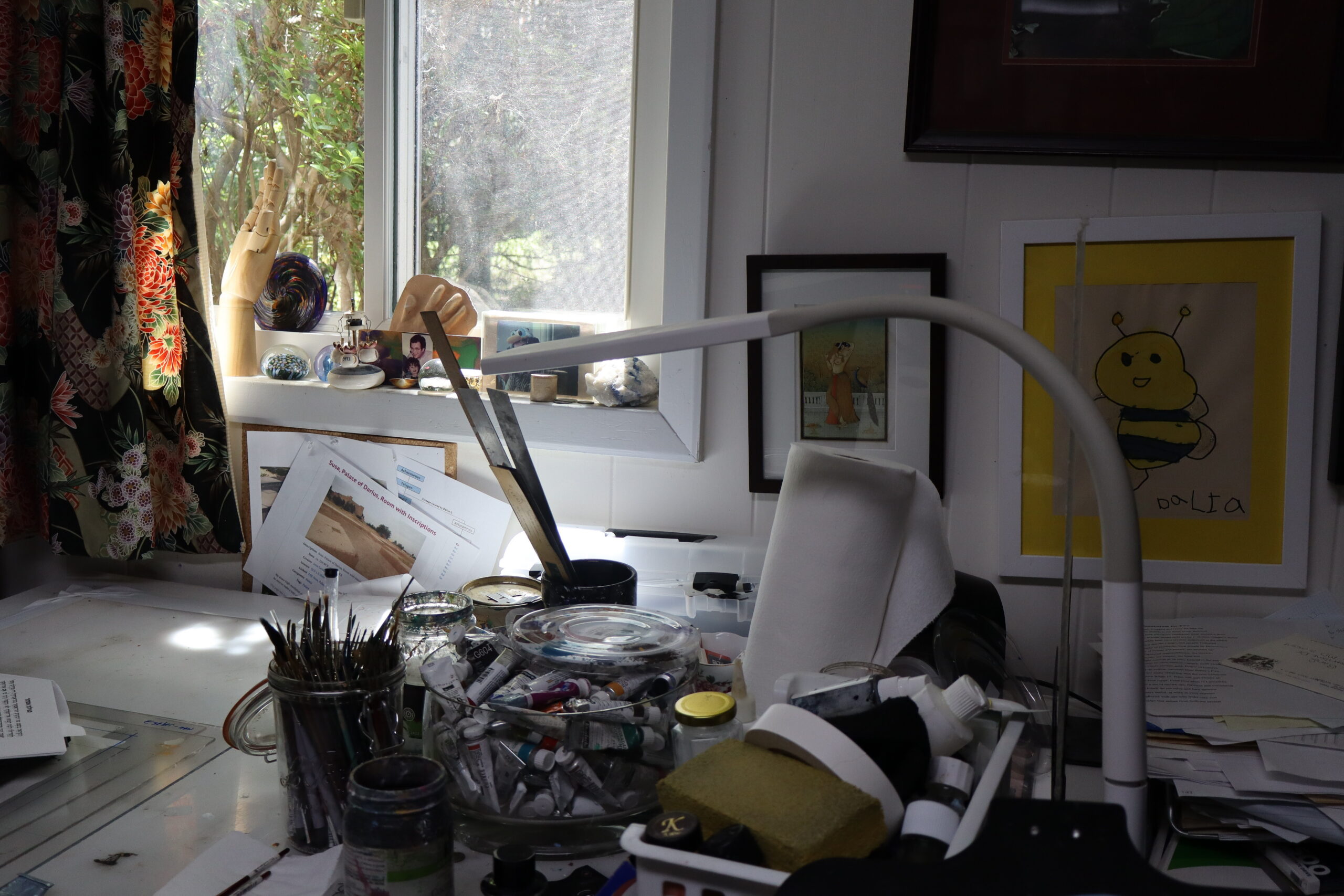
POTOMAC, Md. — Debra Band’s art studio sits at the back of her Maryland home, a room crowded with kosher parchment, jars of 23.75-karat gold leaf, the parrot she recently fostered and the unfinished pages of three books she’s working on simultaneously. It is, by her coy admission, a mess. “It’s chaos,” she said humbly, “that’s what makes it so great.”
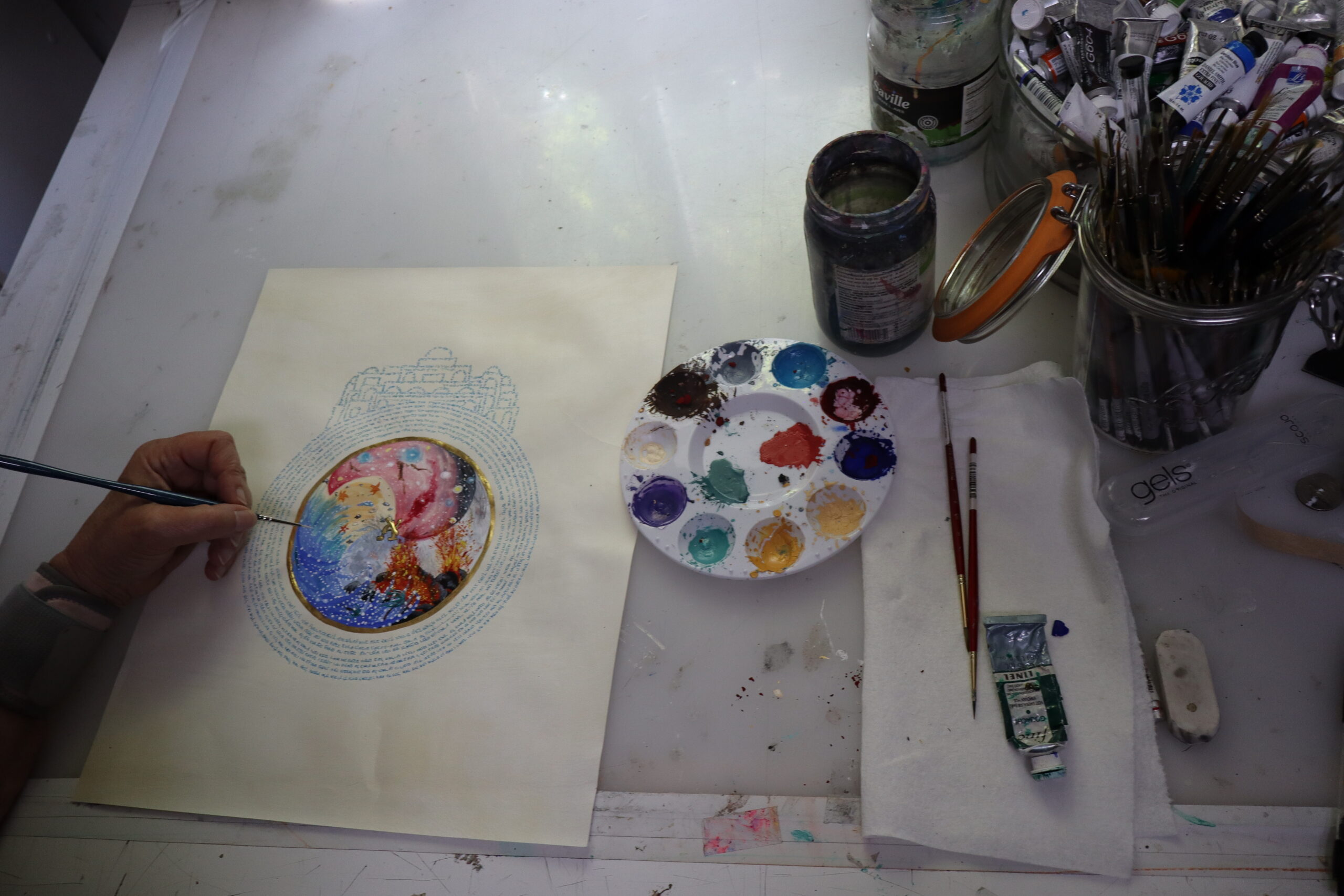
Earlier this year, the Library of Congress acquired five of Band’s illuminated biblical manuscripts, which carry her visual interpretations of Shir HaShirim, Tehillim, Sefer Shoftim, and more. The books now sit in the permanent collection of the Library’s Africa and Middle East Division.
Twenty-five years ago, when Band first brought her Song of Songs book to the library to show its then-head of the Hebraica section, she watched him lay all 65 pages out on a long table and pull out a jeweler’s loupe. She assumed he was hunting for errors in her calligraphy, and started speaking quickly, over-explaining the iconography.
In an interview with Jewish Insider, Band recalled him cutting her off and saying: “Don’t worry, if anyone in the country reads this book when it comes out, it will be me. Right now, I just need to look for the honeybees.”
The bees are Band’s signature; her Hebrew name is Devorah — honeybee. As a private joke with herself, she tucks a small painted bee into nearly every manuscript page she makes.
Her other influences are more concrete. In one of her pieces, Band used a pattern she believes decorated Solomon’s Temple in her work, and imagery drawn from the ruins of Persepolis for her project on Esther. “There’s actually very little left from Susa other than the footprints,” she said of the more-famous setting of the Esther story.
Band has a history degree from Concordia University and a master’s in political science from MIT. She spent her 20s and 30s in health policy work and early Health Maintenance Organization management.
The pivot to art happened almost by accident, and by embarrassment. Pregnant with her first son, Band used adhesive Hebrew press-on lettering and Letraset, a pre-desktop-publishing staple, to make his birth announcement herself rather than hire a calligrapher.
She was, she says, “mightily ashamed” of the result, despite having read and written Hebrew before she could do either in English. While pregnant with her second son, she enrolled in Hebrew calligraphy classes at a Jewish learning center in Berkeley. Within a few months, she had her first commissions. Her early work was shown at the Jewish museum there.
Judaism, in Band’s view, never built the kind of widely recognized visual vocabulary that other traditions have.
“The church has always had illuminated manuscripts since the early medieval years,” she told Washington Jewish Week in 2023. “They had a very sophisticated visual vocabulary that was necessary because very few Christians until the modern era were literate. Jews were literate to a much higher degree, so there wasn’t the same need for visual imagery.”
The result, in a lot of surviving Jewish manuscripts, was imagery that stayed at the level of “either narrative or just sheer decoration,” rather than developing into a fuller symbolic language.
Illuminated ketubot flourished for centuries in Sephardic communities, but no example survives from the medieval Ashkenazi world most American Jews descend from. The practice only returned in the late 1960s. Band sees other attempts since then as partial at best: “David Moss has done a little bit along those lines,” she said, “but not a systematic vocabulary.”
Band’s source material is midrash, which she describes as “incredibly visual — lots and lots of imagery.”
“So what I started doing was going into midrash to pull out imagery that could be used to illustrate not only historical but also abstract stuff,” she told JI, calling the process a “teaching impulse” aimed at bringing “certain kinds of rabbinic thought into public view.”
Band also makes custom ketubot, for which she and the client “have a talk about the couple’s lives and interests, and from that first discussion I take away ideas that I work together into a sketch.”
She prefers clients arrive open-minded. “I actually ask people to come into the process with as few preconceived notions about what they’re going to end up with as possible,” she said. “Forget about the ketubah, forget about weddings, and just talk to me about themselves, about their relationship.”
For Mitch Rales, founder of the Glenstone museum in Potomac, Md., she designed a ketubah “very much of the earth of the place” — wood-grain patterns and small pieces of the same marble quarried for the Washington Monument. “That’s when I can really stretch out,” she said, “and we do something really imaginative that is great fun.”
A commission for Randy Schoenberg, the attorney in the Klimt restitution case portrayed in “Woman in Gold” and grandson of composer Arnold Schoenberg, drew inspiration from his grandfather’s music. “My job in this ketubah was going to be to convert Schoenberg’s twelve-tone scale into color,” she said. “And it came out great.”
She prefers a long runway on these projects. “I like to have about six months before the wedding to work,” she told JI, “I really work very hard to have the ketubah to people at least a month before the wedding — this should not be one of those last-minute details.”
Band traces the impulse behind all this less to a single moment than to her upbringing. Both her parents were children of rabbis, and after settling in Chattanooga, Tenn., they worked hard, she says, “to give us a very strong sense of Jewish identity and learning and life.”
As a child, she was the one who carried a box of matzah into her overwhelmingly non-Jewish classroom before every Passover to explain the holiday to her classmates. “This has been my thing since I was a kid,” she shared.
“Each group should learn enough about the other to be demystified,” she said.
Featured Stories

partnership pitch
Somaliland president discusses expanded military cooperation with U.S. officials

ENVOY DEBATE
Congressional Jewish Caucus opposes proposal to combine State Dept. Holocaust, antisemitism offices

FAMILY TRAGEDY
Israeli ambassador’s son seriously wounded in West Bank car-ramming attack
Please log in if you already have a subscription, or subscribe to access the latest updates.
 Continue with Google
 Continue with Apple