










































































The STOP HATE Act would require social media companies to publicize policies on the use of their platforms by designated terrorists

Getty Images
Some of the most popular social media apps by number of monthly active users, including Facebook, YouTube, Instagram, WhatsApp, TikTok, WeChat, Telegram, Messenger, and Snapchat, are seen on an iPhone.


 Add JewishInsider on Google
Reps. Josh Gottheimer (D-NJ) and Don Bacon (R-NE) on Wednesday announced the reintroduction of the STOP HATE Act, which aims to crack down on antisemitism on social media. The legislators announced the bill’s reintroduction at a press conference alongside Anti-Defamation League CEO Jonathan Greenblatt.
The bill, which was first introduced in November 2023 but failed to progress in the previous Congress, would require social media companies to publicize specific policies on their standards and restrictions for their platforms by designated terrorists, report to the federal government on content flagged and/or removed under these policies and publicly report on incidents which violate their policies.
The bill would also demand that platforms publish contact information for users to ask questions about the companies’ terms of service, a description of how users can flag violative content and a description of how the companies will respond to such content.
Companies would face fines up to $5 million per day if they violate these policies.
The bill would also require administration officials to issue a public report on the use of social media platforms by terrorist groups.
“There is no reason why anyone, especially terrorists or anyone online, should have access to social media platforms to promote radical, hate-filled violence,” Gottheimer said, highlighting that extremist groups had capitalized on the May attack on the Capital Jewish Museum in Washington to promote antisemitic incitement. “There’s a massive disinformation campaign influencing us each day.”
Bacon said, “We need to work with our social media companies to clean this up, because what is going on is wrong, and I think it’s further influencing other young people that could be influenced by what they’re seeing. … We need to hold these companies accountable and work with them to take it off the airwaves.”
He also noted that lawmakers had faced antisemitic harassment at the Capitol this week from protesters.
Greenblatt said that antisemitism has “gone viral in large part because of social media,” adding that bigots and extremists “exploit social media to recruit, to radicalize and to incite violence, often in violation of the companies’ own terms of service. It’s not just theoretical. This is a real concern.”
Asked about the Trump administration’s continued delays of the U.S. ban on TikTok, flouting a bipartisan law on the platform, both lawmakers said that President Donald Trump should enforce the law and require TikTok’s owners to sell the site or shut it down.
Greenblatt said that “at the end of the day, the ownership of TikTok matters, but the actions matter more,” noting that American-owned platforms have also had significant antisemitism problems, and that a sale would not be a “panacea.”
Good Tuesday morning.
In today’s Daily Kickoff, we talk to Jewish Capitol Hill staffers in Democratic offices who feel increasingly isolated at work over their colleagues’ growing antipathy toward Israel and antisemitism, and report on the Young Democrats of America’s decision to accuse Israel of genocide in its updated foreign policy plank. We report on the latest developments following Israel’s just-launched ground operations in Deir al-Balah, Gaza, and look at the critical approaches to Israel being taken by GOP challengers to freshman Rep. Nellie Pou in New Jersey. Also in today’s Daily Kickoff: David Ellison, Sam Altman and Rep. Andrew Garbarino.
What We’re Watching
- A number of House committees are meeting for hearings and markups this week. This morning, we’re keeping an eye on a House Foreign Affairs Committee markup that includes a bill expediting arms sales to Abraham Accords signatories. Read more here.
- At 10:30 a.m. ET, the House Financial Services Committee is holding a markup that includes new legislation introduced by Rep. Mike Lawler (R-NY) that aims to create oversight and set conditions for lifting sanctions on Syria. Read more here.
- On the Senate side of the Capitol, the Senate Armed Services Committee is holding a confirmation hearing for the Navy’s Vice Adm. Frank Bradley to be head of Special Operations Command.
- At noon, the American Jewish Congress is holding a virtual briefing with Gaza Humanitarian Foundation Executive Director Johnnie Moore.
- Elsewhere in Washington, OpenAI CEO Sam Altman will appear today at a Federal Reserve conference to push the economic benefits of artificial intelligence.
- Tonight, UJA-Federation of New York is hosting a bnai mitzvah party for more than three dozen Israeli teenagers who have lost a parent on or since Oct. 7, 2023. The IDF Widows and Orphans Organization facilitated the trip.
- And in Israel, the Israel Democracy Institute is holding a conference in Jerusalem focused on the Knesset’s upcoming summer recess, which begins on Sunday.
What You Should Know
A QUICK WORD WITH JI’S MELISSA WEISS
It’s a scenario that has played out many times over since Oct. 7, 2023: Against the backdrop of ceasefire and hostage-release negotiations, Israeli actions in Gaza draw widespread condemnation. World leaders call for a ceasefire. Amid that growing criticism, Hamas, sensing increased pressure on Israel, responds by escalating its demands or backing away from negotiations entirely.
This week is no different, with Israel’s launch on Monday of a ground operation in central Gaza’s Deir al-Balah, where it had not previously operated, the same day that more than two dozen Western countries released a joint statement calling for “unconditional and permanent ceasefire.” Hamas negotiators in Doha, Qatar, have reportedly spent the last two weeks dragging out ceasefire talks, over issues ranging from the number of Palestinian prisoners to be released to the areas where the IDF is allowed to operate.
In yesterday’s statement, the countries’ demand of Hamas is only for the “immediate and unconditional release” of the remaining 50 hostages, with no mention of disarmament or the terror group’s removal from power — key Israeli demands since Hamas’ brutal attacks on the Jewish state almost two years ago.
Hamas has since October 2023 faced limited pressure to acquiesce to Israeli and American demands. The terror group’s backers in Doha, where senior Hamas officials have long lived in opulence and security, have similarly faced little international pressure — even as Qatar plays a key role in negotiations. Israel has not been a perfect actor, and at times has walked away from the negotiating table. But Jerusalem’s refusals have been outpaced by Hamas’ intransigence, the latter of which has frustrated White House officials in both the current and former administrations.
CAPITOL CLIMATE

Many of the liberal-minded Jewish staffers on Capitol Hill came to Washington to work on issues such as reproductive rights, access to health care and environmental policy. But for nearly two years — following the Oct. 7, 2023, Hamas attacks on Israel and the ensuing war in Gaza — they have had to navigate a professional environment that demands an air of detached professionalism while their fellow staffers and Democrats writ large adopt a more critical approach to Israel and antisemitism. Several Democratic Jewish staffers, ranging from junior aides to chiefs of staff — most of whom requested anonymity, wary of being made a target of antisemitism and concerned about putting themselves at risk professionally at a time when Democratic jobs are hard to come by — told Jewish Insider’s Gabby Deutch and Danielle Cohen-Kanik that, in the face of growing antipathy to Israel and continued antisemitic terror and threats, they have turned to each other to build a tight-knit community among Jews working on Capitol Hill.
Ties that bind: “It has led to increased camaraderie and dialogue and kind of just a common understanding and bond … We work for a lot of different members: members who are Jewish, members who are not Jewish, members who one of their main issues is the U.S.-Israel relationship, members who are not mainly concerned with it,” a legislative aide for a Democratic member of Congress. “But nonetheless, I think a lot of us are united and brought together by the aftermath of Oct. 7.”
POLICY SHIFT
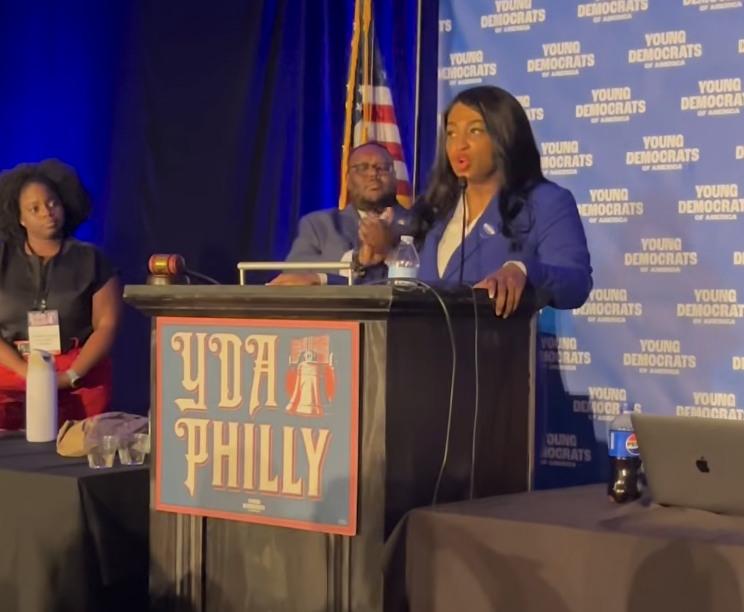
The Young Democrats of America, a leading youth advocacy group representing party members under the age of 36, approved a new platform at its recent national convention accusing Israel of “genocide” in Gaza, raising long-simmering internal tensions over Middle East policy, Jewish Insider’s Matthew Kassel reports.
Amendment: The organization, whose biennial convention concluded in Philadelphia on Saturday, narrowly passed an amendment expressing opposition to the “Israeli government’s ongoing genocide in Gaza, its occupation of the West Bank, and its denial of civil and political rights on an equal basis in the territories it militarily occupies,” according to an updated foreign policy plank reviewed by JI. The change, which added the “genocide” reference to an existing amendment, was proposed “to reflect current events and align with present-day actions,” according to a platform committee document from the convention.
MILITARY MANEUVERS

The IDF entered the central Gaza city of Deir al-Balah for the first time on Monday, amid stalled hostage and ceasefire negotiations in Doha, Qatar. The maneuver in Deir el-Balah began a day after an evacuation order from the city, built on the Mediterranean coast around an UNRWA refugee camp. Israeli officials believe some of the remaining 50 hostages may be held in the area. In June 2024, the IDF freed four hostages, Noa Argamani, Shlomi Ziv, Almog Meir Jan and Andrey Kozlov in a raid in adjacent Nuseirat, Jewish Insider’s Lahav Harkov and Tamara Zieve report.
Background: Deir el-Balah has been relatively unscathed during the war that began after the Hamas terrorist attacks on southern Israel on Oct. 7, 2023. The April 2024 incident in which the IDF killed World Central Kitchen aid workers whom it had mistakenly identified as terrorists took place near Deir el-Balah. Before the latest operation in the Gaza war began in May, a senior defense official told JI that the plan was to start from Gaza’s perimeter and work its way to the center, which the military now appears to be doing.
Presidential surprise: White House Press Secretary Karoline Leavitt said on Monday that President Donald Trump was “caught off guard” by recent Israeli actions in Syria and Gaza, noting that he had called Israeli Prime Minister Benjamin Netanyahu to air his concerns, Jewish Insider’s Emily Jacobs reports.
representation consternation
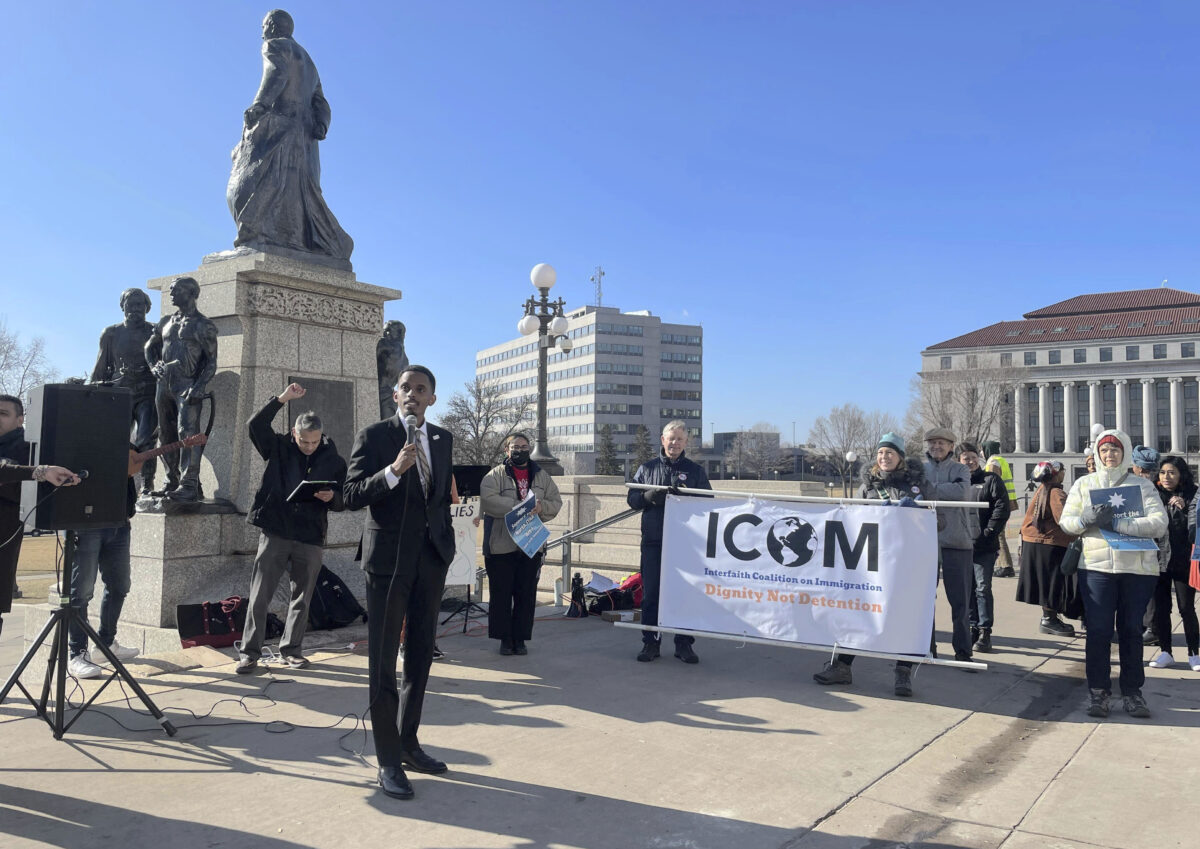
Jewish community activists in Minneapolis are voicing concerns about the rise of state Sen. Omar Fateh, a far-left lawmaker who, in a surprise upset, narrowly clinched the state Democratic Party endorsement on Saturday against incumbent Mayor Jacob Frey, Jewish Insider’s Matthew Kassel reports. Fateh, a 35-year-old democratic socialist, has rarely commented on Israel or rising antisemitism during his time in the state Senate, even as he called for a ceasefire in the war between Israel and Hamas just 10 days after the Oct. 7, 2023, terror attacks.
Community concerns: Fateh’s close alliances with anti-Israel voices such as the Twin Cities arm of the Democratic Socialists of America — which backs efforts to boycott and divest from Israel — have raised questions over his approach to key issues and his potential outreach to the organized Jewish community as he vies for the mayorship. In its mayoral endorsement questionnaire, the DSA asked candidates to pledge “to refrain from any and all affiliation with the Israeli government or Zionist lobby groups” — citing AIPAC, J Street and even the nonpartisan Jewish Community Relations Council.
pino’s positions
The leading Republican candidates in a New Jersey swing district that President Donald Trump narrowly carried in 2024 hold questionable track records on Israel and antisemitism — in sharp contrast to most GOP candidates across the country, Jewish Insider’s Marc Rod reports.
The latest: Rosemary Pino, the Clifton, N.J., City Council member who recently entered the race against Rep. Nellie Pou (D-NJ), posted a video last month from a Palestinian flag-raising event in Clifton where speakers accused Israel of genocide, though she told JI her attendance at the event did not signal support for the sentiments expressed, and that she supports the U.S.-Israel relationship. Pino also expressed concerns in 2023 about city council legislation that would have adopted the International Holocaust Remembrance Alliance’s working definition of antisemitism. She told JI she “strongly condemn[s] antisemitism in all shapes and forms.”
GEN Z OUTREACH
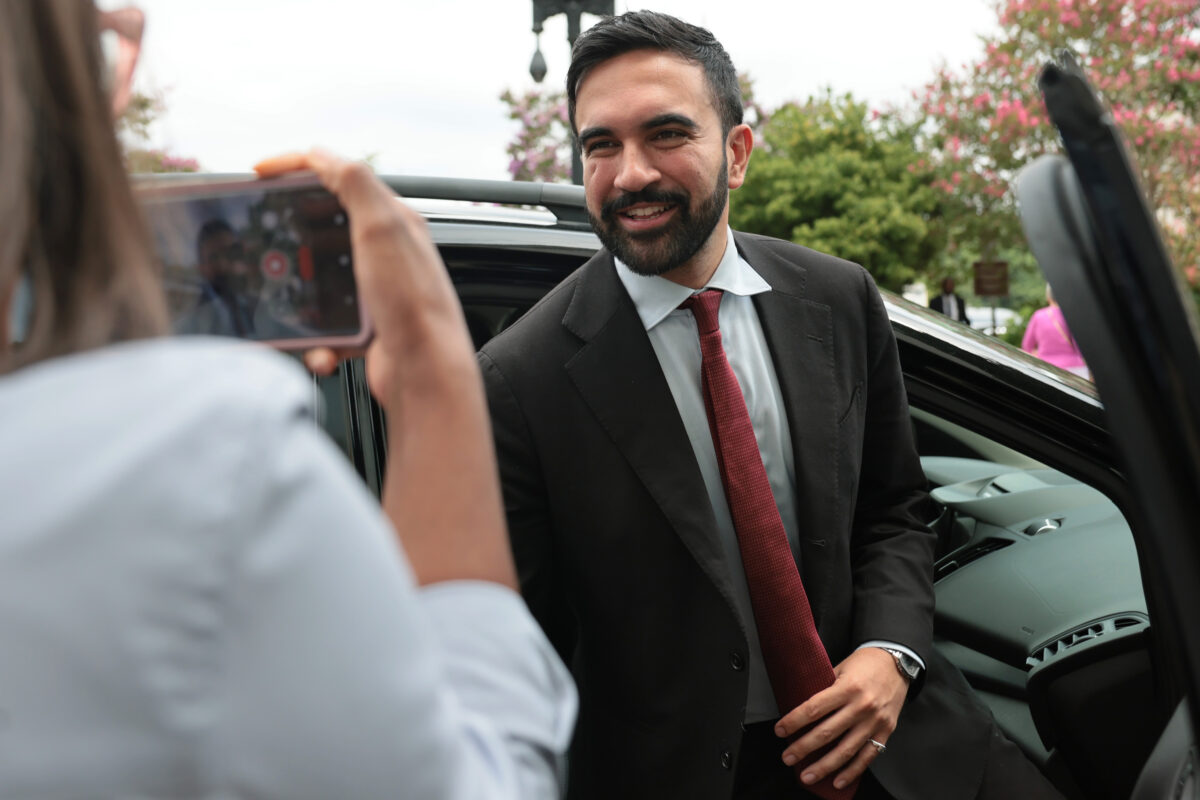
Israeli Prime Minister Benjamin Netanyahu argued that young people in America are won over “pretty quickly” by the truth about the situation in Israel, when discussing New York City Democratic mayoral candidate Zohran Mamdani on a podcast released Monday, and suggested that Mamdani’s policies would be unpopular if he’s elected, Jewish Insider’s Marc Rod reports.
Quotable: “A lot of people have been taken in by this nonsense,” Netanyahu said, on the “Full Send” podcast, hosted by a social media influencer group called the Nelk Boys popular with young men. “Sometimes folly overtakes human affairs for a while, but not for long, because reality steps in,” Netanyahu continued. “I’m obviously not happy with it, but I’m less concerned with it, because I think if we can speak the truth to the young people of America, they wise up pretty quickly.”
Worthy Reads
Postwar Patriotism in Tehran: The New York Times’ Erika Solomon and Sanam Mahoozi look at how Iran has channeled its recent military losses and attacks on its nuclear program into a resurgent nationalism. “Iran has emerged from its war with Israel — briefly joined by the United States — deeply wounded. … Amid that bleak outlook, the country’s leaders see an opportunity. Outrage over the attacks has sparked an outpouring of nationalist sentiment, and they hope to channel that into a patriotic moment to shore up a government facing daunting economic and political challenges. The result has been an embrace of ancient folklore and patriotic symbols that many of Iran’s secular nationalists once saw as their domain, not that of a conservative theocracy that often shunned Iran’s pre-Islamic revolutionary heritage.” [NYTimes]
The Gaza Tragedy: The Washington Post’s David Ignatius considers how the humanitarian situation in Gaza has approached the brink of collapse. “At the heart of this catastrophe is that Hamas and Israel seem unable to end a war that has been ruinous for both sides. Hamas is beaten but won’t surrender, and it seems eager to manipulate the chaos. Israel has won but has failed to consolidate its victory with a transitional scheme for governance that would replace Hamas with an Arab force backed by the Palestinian Authority. Meanwhile, the remaining Israeli hostages are trapped in this unending nightmare.” [WashPost]
Mandy’s Wrong Note: In his Substack, Michael Granoff responds to actor Mandy Patinkin’s recent comments critical of Israeli Prime Minister Benjamin Netanyahu and Israel’s war against Hamas. “Finally, Mandy, one of my favorites of your recording, is your brilliant medley of ‘Everybody Says Don’t,’ from Sondheim’s ‘Anyone Can Whistle,’ and ‘The King’s New Clothes.’ The emotion you convey at the climax of the latter number, ‘…one little boy who for some reason didn’t know what he was SUPPOSED TO SEE…’ I bet you always fancied yourself that virtuous little boy. But you know what? You are actually with ‘the Ministers, the Ambassadors, the Counts and the Dukes,’ who repeat the lie promulgated by terrorists and by institutions like the United Nations, the International Criminal Court, Al Jazeera, and more. The King’s new clothes? Those are the accusations against us – apartheid, war criminals, baby killers, genocide. Lies just as naked as the king.” [Substack]
Messing’s Message: In The Times of Israel, actress Debra Messing reflects on the rise of antisemitism in the progressive movement where she had long found a political home. “What troubles me most is not the presence of hate. Hate has always found a way to survive. What troubles me is the way it is being rationalized. Dismissed. The way it is reframed as something noble. The way it becomes invisible, especially to those who should know better. Jewish safety and progressive values should never be in conflict. If they are, we have to ask whether we’ve drifted from our humanity. The test is whether progressivism stands firm, not just when it is easy but when it’s hard; when it forces us to confront multiple truths. In the end, every movement tells you who belongs by what it is willing to protect. I still believe in the progressive vision. But I’m watching closely, because if it can’t make space for my community, then it’s not what it claims to be.” [TOI]
Word on the Street
The Trump administration is reportedly planning to withdraw the U.S. from UNESCO over what it alleges is the body’s anti-Israel and pro-China bias, as well as its focus on diversity, equity and inclusion initiatives…
Rep. Andrew Garbarino (R-NY) was elected chair of the House Homeland Security Committee, following committee chair Rep. Mark Green’s (R-TN) resignation from Congress on Monday…
In a letter to members of the House Homeland Security Committee’s Counterterrorism and Intelligence subcommittee, the Jewish Federations of North America highlighted the significant security costs facing the Jewish community, as advocates push for additional security assistance from the federal government at a time of heightened antisemitism,Jewish Insider’s Marc Rod reports…
The Bronx campaign office of Rep. Alexandria Ocasio-Cortez (D-NY) was vandalized with anti-Israel graffiti days after the New York Democrat voted against an amendment pushed by Rep. Marjorie Taylor Greene (R-GA) to end funding for Israel’s missile-defense programs…
Larry Ellison’s Oracle is in talks with Skydance Media, founded and led by Ellison’s son, David, over a potential $100 million annual deal that would take shape following Skydance’s acquisition of Paramount; the deal would see Paramount use Oracle’s cloud-sharing software…
The Wall Street Journal looks at the legal and financial battle between Fortress Investment Group and real estate investor Charles Cohen as Fortress attempts to seize hundreds of millions of dollars it says it is owed by Cohen…
The CEO and board chair of Friends of the IDF are stepping down, weeks after the leak of an internal report alleging internal dysfunction, inappropriate spending and a toxic work environment, eJewishPhilanthropy’s Judah Ari Gross reports…
An anti-Israel activist in New York City was arrested and charged with setting nearly a dozen police vehicles on fire last month; Jakhi McCray had previously been arrested in 2024 for torching Israeli and American flags outside the Israeli consulate in New York…
In its “Overlooked” series, The New York Times spotlights Soviet aviator Polina Gelman, who during World War II was part of an elite group of female navigators known as the “Night Witches”; Gelman, who died in 2005, was the only Jewish woman to earn the USSR’s Hero of the Soviet Union medal during the war…
A federal appeals court overturned the conviction of the man found guilty of kidnapping and killing 6-year-old Etan Patz in 1979; Pedro Hernandez will have a new trial — his third, after the first was deadlocked, prompting the 2017 trial that found him guilty…
Former Brigham Young University quarterback Jake Retzlaff is transferring to Tulane, following a seven-game suspension for violating BYU’s honor code…
The Washington Post looks at Hamas’ deepening financial crisis, as the terror group, which had not prepared for its war with Israel to extend past a year, finds itself unable to pay salaries and rebuild its vast underground tunnel system…
Israeli officials warned that the country’s port in Eilat is at risk of shutting down entirely unless it receives financial assistance, citing the impact of the Houthis’ constant ballistic missile attacks that have caused a 90% drop in activity at the Red Sea port…
Iranian Foreign Minister Abbas Araghchi told Fox News that Tehran will not give up its nuclear enrichment program, while an Iranian Foreign Ministry spokesperson said that the country will not resume nuclear talks with the U.S., despite planning to continue talks with European powers…
Iran launched a suborbital test flight satellite carrying Ghased rockets, the first time since last month’s war with Israel that Tehran has launched such a test…
Government offices, businesses and banks across Tehran will shutter tomorrow as the region faces a heat wave, with temperatures expected to exceed 104 degrees Fahrenheit…
Turkey is closing in on an agreement to purchase up to 40 Eurofighter Typhoon fighter jets; Ankara has been waiting on required approval from Germany, which had been stalled since 2023 over Berlin’s opposition to some elements of Turkish foreign policy…
Egyptian Prime Minister Mostafa Madbouly directed his government to prepare a package of joint Egypt-U.S. investment opportunities, as part of a broader effort to deepen Egyptian relations with Washington…
Real estate mogul Don Soffer, a key driver behind the establishment and development of Aventura, Fla., died at 92…
Former University of Baltimore Law School Dean and president of the Charles Crane Family Foundation, Larry Katz died at 85…
Pic of the Day

A delegation from the Conference of Presidents of Major American Jewish Organizations met on Monday with Israeli Foreign Minister Gideon Sa’ar in Jerusalem.
Birthdays

British biochemist and professor at the University of Dundee in Scotland, Sir Philip Cohen turns 80…
Actress, prominent in Israeli theater, television and film, Gila Almagor turns 86… British Conservative Party member of Parliament for 36 years until 2010, a leading figure in the fight against human trafficking in the UK and worldwide, Anthony Steen CBE turns 86… Historian, author and professor emerita at the University of Wisconsin-Madison, Judith Walzer Leavitt turns 85… Actor, director and comedian, Albert Brooks (born Albert Lawrence Einstein) turns 78… Past president of the Jewish Community Relations Council of Detroit, owner of Nodel Parks (operator of 37 manufactured home parks in nine states), Richard Martin Nodel… One of only 21 EGOT winners, including eight Academy Awards and 11 Grammy awards, pianist and composer of many Disney movie musical scores, Alan Menken turns 76… Owner of Baltimore’s Seven Mile Market, Hershel Boehm… Managing director of a German public affairs firm, he works to ensure that the Holocaust and its many victims are not forgotten, Terry Swartzberg turns 72… Publisher of the 5 Towns Jewish Times, Larry Gordon turns 72… Judge of the U.S. District Court for the District of Columbia since 2011 (senior status since May 2023), Judge Amy Berman Jackson turns 71… Canadian sports journalist, radio host and mental health advocate, Michael Elliott Landsberg turns 68… Member of the board of governors of the American Jewish Committee, Cindy Masters… Secretary of veterans affairs in the first year of the Trump 45 administration, David Jonathon Shulkin turns 66… Director of government relations for the Zionist Organization of America, Dan Pollak turns 66… Federal prosecutor for 25 years, she was the U.S. attorney for the Northern District of Alabama throughout the Obama administration, Joyce Alene Vance turns 65… Founding partner of the D.C.-based intellectual property law firm, Greenberg & Lieberman, Stevan Lieberman turns 60… Democratic member of the West Virginia House of Delegates since 2018, Evan Hansen turns 59… Television journalist, David Shuster turns 58… CEO of Leviathan Productions, focused on Jewish history, folklore and literature, Ben Cosgrove… Pentagon speechwriter during the prior administration, Warren Bass… Owner of West Bloomfield, Mich.-based Saltsman Industries and Saltsman Financial Group, Daniel A. Saltsman… Branch chief and senior advisor for policy and readiness at the U.S. Army, Jonathan Freeman… Contemporary artist, he is the founder and director of Pioneer Works, a cultural institution in Brooklyn, Dustin Yellin turns 50… Manager of global issues for ExxonMobil, Elise Rachel Shutzer… Associate justice on the New Jersey Supreme Court, Rachel Wainer Apter turns 45… Former White House assistant press secretary, now the executive producer for news and politics at Crooked Media, Reid Cherlin… White House correspondent at The Independent, Andrew Grant Feinberg turns 43… Member of the House of Representatives (D-RI) since 2023, Seth Michael Magaziner turns 42… Executive director of the American Sephardi Federation since 2014, Jason Guberman-Pfeffer… Actor best known for his role in the Freeform series “Pretty Little Liars,” Keegan Phillip Allen turns 36… Director at the Peterson Health Technology Institute, Maor Cohen… Talia Joyce Thurm Abramson… Serial entrepreneur, software consultant and product strategist, Yoela Palkin… Actor, his career started when he was 10 years old, he played Jimmy Olson in the 2025 version of “Superman,” Skyler Gisondo turns 29…
Facing antisemitism in the workplace, these staffers have turned to each other in group chats and at the Shabbat dinner table for comfort

Kevin Carter/Getty Images
The U.S. Capitol Building is seen at sunset on May 31, 2025 in Washington, DC.
On the night of May 21, several dozen young diplomats and political aides gathered at the Capital Jewish Museum in Washington for a reception focused on humanitarian aid efforts in Gaza.
The event was one of dozens of similar programs that happen around Washington, offering networking opportunities and social connection (alongside tasty hors d’oeuvres) to the overworked, largely underpaid employees that power Congress and the federal bureaucracy. But this event imprinted on the minds of young Jewish politicos because of what happened as it was ending, when Sarah Lynn Milgrim and Yaron Lischinsky, two Israeli Embassy staffers, were shot and killed just after leaving the American Jewish Committee event by an assailant who said that he carried out the attack “for Gaza.”
“I saw the news and I said, ‘Could’ve been any of us,’” a legislative aide for a Democratic member of Congress, who had a ticket to that night’s event, told Jewish Insider last week.
For that staffer, the event brought back to the fore the kind of visceral pain and discomfort that Jewish congressional aides — especially those in Democratic offices and social circles — have gotten used to dealing with since the Oct. 7, 2023, Hamas terror attacks in Israel.
Confronting the aftermath of that day and the ongoing war in Gaza has been a challenge for American Jews in all fields, many of whom have had to face growing antisemitism and antipathy to Israel in their professional lives. But in the Democratic spaces of Capitol Hill — one of the most consequential and most scrutinized workplaces in the country, which is in large part managed by young staffers in their 20s and 30s — the issue is inescapable.
Many of the liberal-minded Jewish staffers on the Hill came to Washington to work on issues such as reproductive rights, access to health care and environmental policy. Now, for nearly two years, they have had to navigate a professional environment that demands an air of detached professionalism while their fellow staffers and Democrats writ large adopt a more critical approach to Israel and antisemitism.
A June poll showed Democratic sympathy toward Israel at an all-time low, with 12% saying they sympathize more with Israelis, and 60% saying they sympathize more with Palestinians. That was a major drop from November 2023, when 34% of Democrats said they were more sympathetic to Israelis and 41% said they were more sympathetic to Palestinians.
Several Democratic Jewish staffers, ranging from junior aides to chiefs of staff — most of whom requested anonymity, wary of being made a target of antisemitism and concerned about putting themselves at risk professionally at a time when Democratic jobs are hard to come by — told JI that, in the face of growing antipathy to Israel and continued antisemitic terror and threats, they have turned to each other to build a tight-knit community among Jews working on Capitol Hill.
“It has led to increased camaraderie and dialogue and kind of just a common understanding and bond … We work for a lot of different members: members who are Jewish, members who are not Jewish, members who one of their main issues is the U.S.-Israel relationship, members who are not mainly concerned with it,” said the legislative staffer. “But nonetheless, I think a lot of us are united and brought together by the aftermath of Oct. 7.”
“If you’re just going to pick up lunch, and you just hear something about ‘apartheid Israel’ in the cafeteria, that hurts. You feel something on that,” said one former senior Jewish staffer who no longer works on Capitol Hill.
Laurie Saroff spent more than 20 years on Capitol Hill, most recently as chief of staff to Rep. Lou Correa (D-CA). When she left Congress in 2022, she started a bipartisan networking organization called the Capitol Jewish Women’s Network.
“So many of us, which is something people don’t understand, are grieving. We’ve been grieving for 650-plus days. Everyone is touched at a different level, but it’s very personal, and sometimes I’m with people who are not Jewish and don’t understand how this impacts us so much,” Saroff told JI. “I think there’s a need for people to come together that I hadn’t seen in the past.”
Part of that desire to connect came from a feeling of alienation from other colleagues on Capitol Hill. Encountering charged anti-Israel rhetoric in the hallways of the Capitol and its fortress of office buildings has become commonplace.
“If you’re just going to pick up lunch, and you just hear something about ‘apartheid Israel’ in the cafeteria, that hurts. You feel something on that,” said one former senior Jewish staffer who no longer works on Capitol Hill. Whenever the war in Gaza intensifies, congressional offices face a barrage of angry, often confrontational phone calls seeking to pressure the members not to support Israel, which the Jewish staffer called “absolutely brutal” for the interns tasked with picking up the phone.
“The things that we hear in our day-to-day about the way that people talk about Jewish communities or Israel groups is so outside the boundaries of what could be considered polite or not antisemitic statements – ‘AIPAC controlling the government,’ AIPAC’s money in races where they don’t even spend it, and yet it’s blamed on AIPAC,” a Jewish foreign policy staffer told JI. “We hear from callers all day long about AIPAC money. Clearly at this point, it’s just a stand-in for saying Jewish money. That’s how I hear it.”
Soon after the Oct. 7 attacks, some Democratic congressional staffers began to pressure their bosses to call for a ceasefire between Israel and Hamas. “Dear White Staffers,” an Instagram account that first went viral several years ago for revealing allegations of lawmaker misconduct, has taken a sharply anti-Israel turn, frustrating many Jewish aides who see their colleagues continuing to follow and engage with the account.
In 2024, some staffers who wanted the U.S. to take a tougher line against Israel created a website that they dubbed the Congressional Dissent Channel. “We are congressional aides dedicated to changing the paradigm of U.S. support for the genocide against Palestinians in Gaza being carried out by the state of Israel,” the organizers wrote on the website, which has since been taken offline.
“I also have had a lot of Dem staff who are not Jewish — who kind of privately don’t agree with this sort of orthodoxy on the topic that is emerging — reach out to me and be like, ‘This is kind of crazy,’” a Jewish Democratic staffer said. “And it’s really nice to hear that. And I’ve definitely gotten closer to some people for that reason,” she told JI, though she added that the anti-Israel contingent in the Democratic Party and on the Hill “feel like there’s a lot of permissiveness for them to say things that are really not acceptable.”
“It’s the small things, like Dear White Staffers. You can’t even explain to your colleagues how repugnant some of these posts are. For any other group, it feels like they would be disciplined. The post would be removed. There would have to be apologies,” the foreign policy staffer told JI. “It’s no secret that — how do I say this? — that diversity is something that seems to be really valued, except for when it comes to Jewish voices.”
Another Jewish Democratic staffer wanted to make clear that many of her non-Jewish colleagues were similarly alarmed by the language that other Hill staffers had adopted after Oct. 7.
“I also have had a lot of Dem staff who are not Jewish — who kind of privately don’t agree with this sort of orthodoxy on the topic that is emerging — reach out to me and be like, ‘This is kind of crazy.’ And it’s really nice to hear that. And I’ve definitely gotten closer to some people for that reason,” she told JI, though she added that the anti-Israel contingent in the Democratic Party and on the Hill “feel like there’s a lot of permissiveness for them to say things that are really not acceptable.”
A senior staffer for a pro-Israel member of Congress said that when their office interviewed potential new hires after Oct. 7, the interviewers began asking job candidates — mostly younger people seeking early career roles — if they were comfortable with the member’s views on Israel and other topics, and what they would do if they disagreed.
“You had to walk on eggshells with your staff, because staff are way more progressive than the offices we were representing. It was a very, very challenging thing, while you’re also dealing with the personal ramifications and trauma of the actual events that happened,” said the former senior staffer who no longer works on the Hill. “I remember there was this one junior staff walkout, and it was the craziest thing to me, because if you’re not from the community, if you’re not a constituent, what are you trying to do? Members are trying to represent the interests of their district, not what their staff or interns want them to do.”
With these experiences casting a shadow over Jewish staffers’ time on the Hill and their understanding of politics and identity, they’ve found comfort in each other and in Jewish tradition.
“There’s a deep desire amongst people to lean on the most beautiful parts of the [Jewish] identity,” a Jewish policy staffer told JI. “I think that gives people a lot of strength because it’s really hard to hear all these things about your community all the time, and then you go to something like a Shabbat dinner … and you’re really reminded that this negative barrage is something that you have to endure for the sake of something that is really meaningful and powerful.”
The legislative aide who had purchased a ticket to the Capital Jewish Museum event said that the aftermath of Oct. 7 and rising antisemitism are “not theoretical and are extraordinarily personal,” which “is a theme that I have found has united and brought together a lot of Jewish staffers on the Hill.” The past two years have also led to “increased camaraderie and dialogue and a common understanding and bond,” bringing these staffers together both inside and outside the workplace.
The staffer who found solidarity with some non-Jewish colleagues said Jewish staff “have formed group chats to support each other and check in and … vent about frustrating experiences that they’re having, stuff like that. So I definitely think professionally and personally the community has deepened a lot and people are really leaning on each other.”
“Shabbat has really been an anchor, I think,” the aide told JI. Congressional staffers endure “lots of busy weeks, lots of long weeknights.” Joining together for a Shabbat meal, as groups of staffers do frequently, becomes “an intentional place to kind of withdraw from that and exist in our Jewish selves.”
The staffer said that, in attending Shabbat dinners, “there’s a deep desire amongst people to lean on the most beautiful parts of the [Jewish] identity. I think that gives people a lot of strength because it’s really hard to hear all these things about your community all the time, and then you go to something like a Shabbat dinner … and you’re really reminded that this negative barrage is something that you have to endure for the sake of something that is really meaningful and powerful.”
Shabbat, she added, is “a good antidote for the constant gaslighting.”
Many lawmakers from both parties known for their pragmatism and moderation struggled to raise big bucks for their campaigns

Andrew Harnik/Getty Images
Sen. Joni Ernst (R-IA) speaks during a Congressional Gold Medal ceremony on Capitol Hill on June 26, 2025 in Washington, DC.
The latest round of fundraising reports for members of Congress paints a concerning picture about the future of the ideological center. Many lawmakers from both parties known for their pragmatism and moderation struggled to raise big bucks for their campaigns, while a number of insurgent candidates on the left and the right wings of their parties scored significant fundraising hauls.
Some of the middling fundraising numbers from experienced, establishment-oriented lawmakers will lead to speculation they are considering retirement.
On the GOP side, Sen. Joni Ernst (R-IA), a senator deeply immersed in national security issues, only raised $723,000 in the last three months — barely inching past two of her Democratic opponents. That’s an underwhelming sum for Ernst, who has typically been a strong fundraiser but has been taking heat from both the right and left. It will only raise speculation about her political future.
Sen. John Cornyn (R-TX), facing a primary challenge from right-wing Texas Attorney General Ken Paxton, also didn’t hit the $1 million mark in fundraising, bringing in just $804,000. Paxton, despite worries about his electability and scandals surrounding him, raised $2.9 million.
In the House, Rep. Mike McCaul (R-TX), the respected former chairman of the House Foreign Affairs Committee, raised just $93,000 for the quarter, with less than $100,000 in his campaign account. While he’s not in a competitive district, that small sum has raised retirement speculation as well.
On the Democratic side, there were some fresh signs that mainstream, pro-Israel candidates aren’t getting quite the same fundraising traction as they have in the past.
We noted earlier in these pages that in the Michigan Senate Democratic primary, pro-Israel stalwart Rep. Haley Stevens (D-MI), was outraised by both state Sen. Mallory McMorrow and Abdul el-Sayed, an outspoken anti-Israel voice.
In the race to succeed retiring Rep. Jan Schakowsky (D-IL), the two Democratic candidates running as progressive critics of Israel — Evanston Mayor Daniel Biss and social media influencer Kat Abughazaleh — outdistanced state Sen. Laura Fine, a strong supporter of Israel in the state Legislature.
There were some encouraging signs from several moderate Democrats in high-profile races: Rep. Angie Craig (D-MN) outraised progressive Lt. Gov. Peggy Flanagan, $1.47 million to $917,000, in the Minnesota Senate race. Rep. Raja Krishnamoorthi (D-IL), a suburban congressman with a generally pro-Israel record, led the Illinois Senate field in fundraising. And Rep. Chris Pappas (D-NH), a battle-tested pragmatic lawmaker, raised a solid $1.8 million without much primary opposition in the New Hampshire Senate race.
But the party’s biggest fundraisers remain the true-blue left-wingers: Rep. Alexandria Ocasio-Cortez (D-NY) raised a whopping $5.8 million in the last three months as she receives more and more presidential buzz. Sen. Bernie Sanders (I-VT), despite not even running for reelection next year, brought in more than $4.5 million in the second quarter.
House Minority Leader Hakeem Jeffries (D-NY), by comparison, raised less than half of AOC’s second quarter total — at $2.37 million. And Senate Minority Leader Chuck Schumer (D-NY), who isn’t in cycle until 2028, brought in just $155,000 to his campaign account.

BRENDAN SMIALOWSKI/AFP via Getty Images
Qatar's Emir Sheikh Tamim bin Hamad al-Thani (L) and Prime Minister and Minister of Foreign Affairs Sheikh Mohammed bin Abdulrahman Al-Thani talk to US President Donald Trump as he prepares to leave at the end of the Qatari leg of his regional tour, at the Al-Udeid air base southwest of Doha on May 15, 2025.
Good Wednesday morning.
In today’s Daily Kickoff, we cover yesterday’s antisemitism hearing on Capitol Hill with the leaders of Georgetown University, the City University of New York and the University of California, Berkeley, as well as the suspension of Georgetown professor Jonathan Brown following his call for Iran to strike the U.S. We also report on steps taken by Columbia University to try to reach a deal with the Trump administration on its handling of antisemitism and report from the Pennsylvania Energy and Innovation Summit in Pittsburgh. Also in today’s Daily Kickoff: Ambassador Mike Huckabee, Albert Bourla and Richard Attias.
What We’re Watching
- President Donald Trump is slated to host Qatari Prime Minister Mohammed bin Abdulrahman Al Thani tonight at the White House. More below.
- At the Aspen Security Forum this afternoon, Amos Yadlin, the former head of the IDF’s Intelligence Directorate; former Israeli Ambassador to the U.S. Mike Herzog; Brett McGurk, the former National Security Council coordinator for the Middle East and North Africa; and author and “Call Me Back” podcast host Dan Senor are set to take the stage for a conversation about Israel’s future.
- This morning in Washington, the Senate Foreign Relations Committee is slated to hold a business meeting followed by a full committee hearing on State Department reform.
- This afternoon, the House Foreign Affairs Committee’s Middle East and North Africa subcommittee is holding its own hearing on State Department management.
- Also today, Rep. Mark Harris (R-NC) is holding a press conference with other members of Congress calling for the National Education Association’s congressional charter to be revoked following the organization’s adoption of a measure effectively banning cooperation with the Anti-Defamation League.
What You Should Know
A QUICK WORD WITH jI’S MELISSA WEISS
Ceasefire and hostage-release talks have been ongoing in Doha, Qatar, for the last week. But one of the most consequential meetings in the negotiations could be happening tonight in Washington, when President Donald Trump hosts Qatari Prime Minister Mohammed bin Abdulrahman Al Thani for dinner at the White House.
This continues a new tradition for Trump of hosting prominent Gulf royals who aren’t the heads of state of their respective countries for dinner at the White House. In March, Trump hosted a dinner in the White House’s State Dining Room for Sheikh Tahnoon bin Zayed Al Nahyan, the United Arab Emirates’ national security advisor and chairman of several sovereign wealth funds.
Qatari officials have been in the U.S. all week. Qatari Emir Sheikh Tamim bin Hamad Al Thani was rumored to have met with Trump on the sidelines of the FIFA finals in New Jersey on Sunday, after being spotted in New York over the weekend.
White House Middle East envoy Steve Witkoff, whose trip to Doha last week was postponed over stalled talks, told reporters over the weekend that he planned to meet with Qatari negotiators on the sidelines of the match. And Trump shared a suite with senior Qatari sports officials at the match, including Nasser bin Ghanim Al-Khelaifi, the president of the Paris Saint-Germain team who played in New Jersey on Sunday and chairman of beIN Sports, previously known as Al Jazeera Sport. (In a weekend interview at the FIFA match, Trump even noted Qatar’s “big presence.”)
Qatar also loomed large in Washington this week, where legislators on the House Education and the Workforce Committee pressed university leaders from Georgetown, CUNY and the University of California, Berkeley about their foreign funding sources during a hearing about antisemitism in higher education. (More below on the hearing.) Former Rep. Jim Moran (D-VA), one of Qatar’s top lobbyists in Washington, was seen sitting right behind Georgetown University interim President Robert Groves as Groves testified on Tuesday. The school has received over $1 billion from Qatar, and has a campus in Doha.
Qatar’s be-everywhere, invest-in-everything strategy has allowed Doha to gain footholds across the global economy and in diplomatic circles. And since the start of the war, it has sought to highlight its role as a facilitator of ceasefire talks between Israel and Hamas, the latter of which Doha supports financially and diplomatically.
Doha has the power to push Hamas to accept a ceasefire. Whether tonight’s dinner will exact a change in Qatar’s approach to Hamas remains to be seen. The sit-down between Trump and the Qatari prime minister could change the tide in the 21-month war, or it could serve as yet another missed opportunity in a war full of stalemates and diplomatic posturing — with fresh casualties mounting on both sides and 50 hostages still languishing in captivity.
TESTIMONY TALK

When the leaders of Georgetown University, the City University of New York and the University of California, Berkeley sat down on Tuesday morning to testify at a congressional hearing about antisemitism, they clearly came prepared, having learned the lessons of the now-infamous December 2023 hearing with the presidents of Harvard, the University of Pennsylvania and MIT, each of whom refused to outright say that calls for genocide violated their schools’ codes of conduct. Georgetown interim President Robert Groves, CUNY Chancellor Felix Matos Rodriguez and UC Berkeley Chancellor Rich Lyons were all quick to denounce antisemitism and even anti-Zionism at Tuesday’s House Education and Workforce Committee hearing examining the role of faculty, funding and ideology in campus antisemitism. But while the university administrators readily criticized antisemitism broadly, they struggled to apply that commitment directly to their field of academia, Jewish Insider’s Gabby Deutch reports.
Mind the gap: Lyons in particular offered a revealing look at the gulf between a university’s stated values and its difficulty in carrying them out. He was asked to account for the promotion of Ussama Makdisi, a Berkeley history professor who described the Oct. 7, 2023, Hamas terror attacks as “resistance” and later wrote on X that he “could have been one of those who broke the siege on October 7.” Why, Lyons was asked by Reps. Randy Fine (R-FL) and Lisa McClain (R-MI), did Berkeley announce last September that Makdisi had been named the university’s inaugural chair of Palestinian and Arab studies? Lyons first defended Makdisi: “Ussama Makdisi, Professor Makdisi, is a fine scholar. He was awarded that position from his colleagues based on academic standards,” Lyons said. Later, when McClain followed Fine’s line of questioning, Lyons went to great lengths to avoid criticizing Makdisi.
Given the boot: Jonathan Brown, a tenured Georgetown University professor who came under fire last month for a social media post in which he called for Iran to conduct a “symbolic strike” on a U.S. military base, has been placed on leave and removed as chair of the school’s Department of Arabic and Islamic Studies, Georgetown’s Groves said Tuesday at the congressional hearing.
CAMPUS BEAT

Columbia University announced on Tuesday it would implement several measures to confront antisemitism in an effort to reach a deal with the Trump administration to restore the $400 million in federal funding that was cut by the government in March due to the university’s record dealing with the issue, Jewish Insider’s Haley Cohen reports.
The measures: The steps include the university further incorporating the International Holocaust Remembrance Alliance’s working definition of antisemitism by requiring its Office of Institutional Equity to embrace the definition; appointing a Title VI coordinator to review alleged violations of the Civil Rights Act; requiring antisemitism training for all students, faculty and staff; and refusing to recognize or meet with “Columbia University Apartheid Divest,” a coalition of over 80 university student groups that Instagram banned for promoting violence.
MIKE’S MOMENT

Former White House National Security Advisor Mike Waltz laid out an aggressive approach to countering anti-Israel sentiment at the United Nations during his Senate confirmation hearing on Tuesday to be U.S. ambassador to the global body, accusing the organization in his opening statement of “pervasive antisemitism,” Jewish Insider’s Matthew Kassel reports.
Setting goals: Waltz, a staunch supporter of Israel and an outspoken critic of Iran who was nominated for the U.N. post in May after being removed from his position as national security advisor, said he would seek to block “anti-Israel resolutions” in the General Assembly and would push for the dismantlement of the United Nations Relief and Works Agency over some of its employees’ involvement in the Oct. 7, 2023, Hamas attacks.
SMART STATE

Pennsylvania’s top lawmakers put up a united front on Tuesday to emphasize to the hundreds of tech and energy investors at Sen. Dave McCormick’s (R-PA) inaugural innovation summit the benefits of working with states that embrace bipartisanship and the national security imperatives of investing domestically, Jewish Insider’s Emily Jacobs reports from Pittsburgh. The Pennsylvania Energy and Innovation Summit brought top tech and energy executives to Carnegie Mellon University’s campus, home to one of the world’s most advanced AI programs. Tuesday’s gathering also included the state’s two leading Democrats, Gov. Josh Shapiro and Sen. John Fetterman (D-PA), and President Donald Trump, all of whom praised the conference as a strategic way to promote U.S. investment to the scores of foreign and American leaders in attendance.
Better together: Amazon Web Services’ $20 billion investment last month in three computing and AI campuses in the Keystone State was “an indicator of all that we can be when we harness the new things that we have going for us, and when we have government and the private sector working together, not at odds, and when we pull in our educational institutions … in a way that really helps move Pennsylvania forward,” Shapiro said during a panel discussion with McCormick and AWS CEO Matt Garman.
STRAIGHT TALK

U.S. Ambassador to Israel Mike Huckabee on Tuesday called on Israel to “aggressively investigate” the death of Saif Musallet, a Palestinian-American man from Florida who was killed by Israeli settlers in the West Bank last Friday. In a statement posted to X, Huckabee called the incident a “criminal and terrorist act” and said “there must be accountability.” Musallet, 20, was attacked by Israeli settlers while visiting his family in Sinjil, a village north of Ramallah. The Palestinian Authority Ministry of Health reported a second man was also shot and killed during the incident, Jewish Insider’s Danielle Cohen-Kanik reports.
Weighing in: Democratic lawmakers in Washington also weighed in on the attack. Rep. Brad Schneider (D-IL), a pro-Israel stalwart, said on Tuesday that he was “appalled and heartbroken” by the news, adding he had “repeatedly called on the Israeli government to address the growing number of violent attacks by Israeli settlers in the West Bank.” House Minority Leader Hakeem Jeffries (D-NY) called the “brutal killing” of Musallet “shocking and appalling” and said the Israeli government “must thoroughly investigate this killing and hold any and all settlers responsible.”
EXCLUSIVE
A new bipartisan House bill set to be introduced on Wednesday aims to expand U.S.-Israeli research and development cooperative programs in the medical field. The BIRD Health Act, led by Reps. Randy Weber (R-TX) and Chris Pappas (D-NH), builds on the long-running Binational Industrial Research and Development Foundation program, Jewish Insider’s Marc Rod reports.
Moving forward: Around a third of BIRD projects in the past decade have been related to the health-care sector, and the U.S. and Israel have pursued growing cooperation in the field in recent years. The bill would further formalize those efforts by establishing a new $10 million annual funding stream and joint management structure between the Department of Health and Human Services and the Israeli Ministry of Health specifically focused on supporting such projects. It would support research and development between institutions and companies in both countries, including startups, as well as health systems, telemedicine, disease prevention efforts and biological product manufacturing.
Worthy Reads
NEA’s Lesson Plan: In The Wall Street Journal, Anti-Defamation League CEO Jonathan Greenblatt responds to the National Education Association’s recent adoption of a measure targeting the ADL. “This wasn’t about the ADL. It was a clear and unambiguous statement to Jewish educators, parents and children: You don’t count. And it perversely takes this stance at a time when anti-Jewish hate is skyrocketing. … Unfortunately, the NEA vote is symptomatic of a larger problem of intensifying antisemitism in our K-12 schools. Specifically, antisemitism cloaked in the rhetoric of anti-Zionism. A generation of teachers has been educated on college campuses where this poison has festered and spread. It has been normalized. Now its purveyors want to bring this bigotry into your children’s classrooms.” [WSJ]
Pressing Putin: The Washington Post’s David Ignatius looks at President Donald Trump’s new approach to Russia, following Trump’s support for sending offensive weapons to Ukraine. “Trump decided to escalate for three reasons, according to a source familiar with administration discussions. First, he believed that Putin was disrespecting him, feigning a readiness to make peace but ignoring the U.S. president’s call for a ceasefire. Second, he saw the efficacy of U.S. military power in the use of B-2 bombers and Tomahawk missiles against Iran. And third, he thought Putin would only negotiate if threatened with greater force. As the Russians like to say, Trump decided to ‘escalate to de-escalate.’ Trump has made a sound choice in recognizing that Putin won’t make concessions without more pressure. But the president has also embarked on an escalatory course whose risks are unknowable.” [WashPost]
Mamdani’s Gift … to the GOP: The New York Times’ Bret Stephens posits that a victory in November by New York City Democratic mayoral candidate Zohran Mamdani would be a positive outcome for Republicans nationwide who are likely — and in some cases, have already begun — to push Mamdani as the future of the Democratic Party. “Among the reasons the Democratic Party’s brand has become toxic in recent years is progressive misgovernance in places like Los Angeles; San Francisco; Oakland, Calif.; Portland, Ore.; Seattle; and Chicago. If Mamdani governs on the promises on which he’s campaigned, he’ll bring the same toxicity to America’s biggest city. … A Mamdani mayoralty would be the political gift that keeps on giving. The state of the city would become a reflection of the Democratic Party writ large. Every Mamdani utterance would become a test for every Democratic politician, starting with Senator Chuck Schumer on Israel.” [NYTimes]
Word on the Street
The FBI released new images of three Iranian intelligence agents believed to be involved in the kidnapping and disappearance of retired special agent Bob Levinson, who was last seen on Iran’s Kish Island in 2007; Levinson is believed to have died in Iranian custody sometime prior to the onset of the COVID-19 pandemic…
Adelita Grijalva was declared the winner of the Democratic primary special election in Arizona’s 7th Congressional District to succeed her father, Rep. Raúl Grijalva, who died earlier this year; the special election in the deep-blue district will take place in September…
Former Washington, D.C., Councilmember Trayon White, who was expelled last year over an ongoing bribery case, was reelected to his seat in a special election on Tuesday; White had previously promoted antisemitic conspiracy theories while in office…
New York City Democratic mayoral candidate Zohran Mamdani told business leaders on Tuesday that he would “discourage” the use of the “globalize the intifada” slogan and not use the phrase himself, but said the term was used by many to show support for Palestinians; among the attendees in the 90-minute meeting was Pfizer CEO Albert Bourla, who, according to The New York Times, “pushed Mr. Mamdani about the meaning of genocide and defended Israel’s war in Gaza”…
Former Future Investment Initiative Institute CEO Richard Attias is rejoining the Saudi Arabian conference network as interim CEO, replacing Penny Richards, who is departing after six months in the position…
The United Synagogue of Conservative Judaism ended its contract last month with an interfaith advisor who had been working with the group for several years, in a potential indication that it is moving away from previous plans to allow rabbis within the movement to officiate interfaith weddings, eJewishPhilanthropy’s Jay Deitcher reports…
The Washington Post reports on the recent reunion between a 97-year-old Holocaust survivor and one of the American soldiers involved in the liberation of the Buchenwald concentration camp; the reunion was facilitated by the USC Shoah Foundation…
British police cautioned that Russia, China and Iran were behind an increasing number of sabotage, espionage and kidnapping plots in the U.K….
France, Germany and the U.K. will bring back sanctions on Iran via the U.N. Security Council if a nuclear deal is not reached by the end of August, French Foreign Minister Jean-Noel Barrot warned on Tuesday, Jewish Insider’s Lahav Harkov reports…
The Wall Street Journal looks at how Iran struck Israeli targets with increasing success during the 12-day war between the countries, as Tehran used trial and error to adapt its military strategy by using more advanced weaponry and firing from more locations toward the end of the war…
The Financial Times reports on tensions between Iranian hard-liners and the country’s reformists following the country’s war last month with Israel, with the country’s hard-line faction opposing engagement with the Trump administration that President Masoud Pezeshkian has supported…
The U.N.’s special representative for Afghanistan warned that the country’s support systems were under strain amid an influx of Afghans returning to the country following the implementation of new immigration laws in Iran; more than 1 million Afghans illegally living in Iran have been repatriated this year amid the crackdown…
The three members of the U.N.’s Commission of Inquiry on the Occupied Palestinian Territory reportedly resigned from their positions in rapid succession earlier this month; the resignations come amid an effort by the Trump administration to sanction officials who have targeted Israel in international institutions…
Twenty Palestinians were killed in a crowd rush at a Gaza Humanitarian Foundation distribution site in Khan Younis, Gaza; the organization said the “chaotic and dangerous surge” was “driven by agitators in the crowd”…
Pic of the Day

The Argentine Embassy in Washington held a commemoration event at the Capitol last night ahead of the 31st anniversary of the bombing of the AMIA Jewish community center in Buenos Aires, in which 85 people were killed.
Birthdays

World-renowned violinist, violist and conductor, Pinchas Zukerman turns 77…
One of the three co-founders of Comcast Corporation, he served as its chief financial officer and vice chairman, Julian A. Brodsky turns 92… Senior U.S. district court judge for the Southern District of New York, Judge Sidney H. Stein turns 80… President of an eponymous communications firm, public speaker and coach, Betsy R. Sheerr… Co-creator of the first-ever spreadsheet program (VisiCalc), he currently serves as the chief technology officer of Alpha Software, Daniel Singer “Dan” Bricklin turns 74… Former high ranking civilian official in the Pentagon during the Bush 43 administration, now a senior fellow at the Hudson Institute, Douglas J. Feith turns 72… Senior rabbi since 1997 at Temple Beth Avodah in Newton Centre, Mass., Rabbi Keith Stern… Los Angeles-based attorney, she is the president emerita of the LA chapter of the Jewish National Fund, Alyse Golden Berkley… Past vice chair of the Board of Trustees of The Jewish Federations of North America, Cynthia D. Shapira… British solicitor, he represented Princess Diana in her divorce and Ambassador Deborah Lipstadt in a libel case, Anthony Julius turns 69… Pulitzer Prize-winning and Tony Award-winning playwright and screenwriter, Tony Kushner turns 69… U.S. ambassador to the EU in the Trump 45 administration, Gordon David Sondland turns 68… Former airline executive at Northwest and Delta, now on the board of Spirit Airlines, Andrea Fischer Newman… Former president of Viacom Music and Entertainment Group, Douglas Alan Herzog turns 66… Businessman and philanthropist, owner of interests in many Israeli firms including IKEA Israel, Matthew Bronfman turns 66… Canadian journalist, he worked for CNN International for 30 years, Jonathan Mann turns 65… Former Israeli minister of science and technology, now a venture capitalist, Yizhar Nitzan Shai turns 62… Chief of staff of the Jewish United Fund of Metropolitan Chicago, Jim Rosenberg… Chicago-based entrepreneur and philanthropist, Victoria Rivka Zell… Former NFL offensive lineman, he is now the president of Collective Mortgage in Colorado, Ariel Mace Solomon turns 57… Senior scholar at the Fuchsberg Jerusalem Center, a home for Conservative Judaism in Israel, Rabbi Joshua Kulp turns 55… Israeli former professional tennis player, in 2003 she was ranked 15th in the world, Anna Smashnova turns 49… Founder of Pinkitzel, a cupcake cafe, candy boutique and gift store located in three Oklahoma cities, Jonathan Jantz… U.S. senator (R-IN) since the beginning of this year, Jim Banks turns 46… National political correspondent for The New York Times, Shane Goldmacher… Co-founder of Los Angeles-based Meteorite Social Impact and Health Action Alliance Advisors, Steven Max Levine… White House liaison to the Jewish community in the Bush 43 administration, now managing partner at Arogeti Endeavors, Scott Raymond Arogeti… Features reporter for Jewish Insider, Matthew Kassel… Founder and managing partner at Vine Ventures, Eric M. Reiner… Registered nurse and an internationally board-certified lactation consultant, Chantal Low Katz…
The leaders of Georgetown, CUNY and UC Berkeley condemned antisemitism generally at a Capitol Hill hearing, but struggled to criticize antisemitic professors

Win McNamee/Getty Images
Dr. Robert Groves, Interim President of Georgetown University, Dr. Félix Matos Rodríguez, Chancellor of The City University of New York, and Dr. Rich Lyons, Chancellor of the University of California, Berkeley, testify during a House Committee on Education and Workforce hearing in the Rayburn House Office Building on July 15, 2025 in Washington, DC.
When the leaders of Georgetown University, the City University of New York and the University of California, Berkeley sat down on Tuesday morning to testify at a congressional hearing about antisemitism, they clearly came prepared, having learned the lessons of the now-infamous December 2023 hearing with the presidents of Harvard, the University of Pennsylvania and MIT, each of whom refused to outright say that calls for genocide violated their schools’ codes of conduct.
Georgetown interim President Robert Groves, CUNY Chancellor Felix Matos Rodriguez and UC Berkeley Chancellor Rich Lyons were all quick to denounce antisemitism and even anti-Zionism at Tuesday’s House Education and Workforce Committee hearing examining the role of faculty, funding and ideology in campus antisemitism.
But while the university administrators readily criticized antisemitism broadly, they struggled to apply that commitment directly to their field of academia.
Lyons in particular offered a revealing look at the gulf between a university’s stated values and its difficulty in carrying them out.
He was asked to account for the promotion of Ussama Makdisi, a Berkeley history professor who described the Oct. 7, 2023, Hamas terror attacks as “resistance” and later wrote on X that he “could have been one of those who broke the siege on October 7.” Why, Lyons was asked by Reps. Randy Fine (R-FL) and Lisa McClain (R-MI), did Berkeley announce last September that Makdisi had been named the university’s inaugural chair of Palestinian and Arab studies?
Lyons first defended Makdisi: “Ussama Makdisi, Professor Makdisi, is a fine scholar. He was awarded that position from his colleagues based on academic standards,” Lyons said.
Later, when McClain followed Fine’s line of questioning, Lyons went to great lengths to avoid criticizing Makdisi.
“I want to separate the phrase from the person. If I heard some other person —” he said, before McClain cut him off. What, McClain asked, did Lyons think Makdisi meant with his tweet?
For five seconds, Lyons sat in silence.
“I believe it was a celebration of the terrorist attack on Oct. 7,” he replied slowly.
He shared that he had spoken to Makdisi about the social media post. Pressed to share what the conversation was like, Lyons returned to an earlier line: “He’s a fine scholar,” Lyons said.
Lyons, like Matos Rodriguez and Groves, acknowledged that antisemitism exists at his campus. But they all struggled to reckon with what Republican lawmakers alleged was an explosion in antisemitism at each of the three schools after Oct. 7.
“I believe that most Jewish students feel safe on our campus,” Lyons said, though he also said that he knows some do not feel safe. When asked why they may not feel safe, he demurred.
“Well, I think there are Jewish people that don’t feel safe in lots of parts —” he said, cut off again by McClain, who asked him to speak specifically about UC Berkeley.
“I think there is antisemitism in society,” Lyons said, before he was cut off again.
Lyons repeatedly attempted to make the same point: “I do believe that public universities are reflections of society, and I believe the antisemitism in society is present on our campus,” Lyons said. Asked whether the actions that he takes or that his faculty take can influence the campus environment, he said yes. McClain accused him of “avoiding the question,” and asked: Would he commit to act to make sure all Jewish students and all students feel safe?
“I’m committing to striving to reach that goal,” said Lyons.
Each of the university leaders was asked, at different occasions, to account for faculty members who had shared antisemitic or pro-Hamas rhetoric. Matos Rodriguez, the CUNY chancellor, did not deny that the New York City university system employs antisemitic faculty, though he did not specify whether any action would be taken against them.
“We have faculty that might conduct themselves in antisemitic behavior, and we have no tolerance for it, and we’re clear about the expectations to follow all our rules and policies,” Matos Rodriguez said. “If any individual breaks those rules, they will be investigated, and the appropriate disciplinary action will be taken if warranted.”
Presented with the cases of two faculty members who had shared pro-Hamas content on social media, Matos Rodriguez condemned Hamas, but did not say specifically if their rhetoric violated codes of conduct or led to any consequences.
“I have been very clear that Hamas is a horrible terrorist organization, and we have no tolerance at the City University of New York for anyone who would embrace that support of Hamas,” said Matos Rodriguez. “I clearly condemn the statements, and it’s been my testimony here, and our practice, that if any member of the City University community violates our policies and our code of conduct, we will conduct an investigation, and if discipline is warranted, we will take it, and we will not hesitate to do that, and we have done so.”
Groves, Georgetown’s president, shared early in the hearing that the university had taken action against Jonathan Brown, a tenured professor who faced criticism last month for a tweet calling for Iran to conduct a “symbolic strike” on a U.S. military base after Washington struck Iranian nuclear sites. Brown is no longer the chair of the university’s Arabic and Islamic studies program, Groves said, and he has been placed on leave pending an investigation.
Groves, who faced several questions about Georgetown’s ties to Qatar, pledged to commit to disclosing every dollar that Georgetown receives from foreign sources.
At the same time, he stood by Georgetown’s decision to award Sheikha Moza bint Nasser, the mother of the Qatari emir, with the university’s president’s medal in April. Sheikha Moza has a history of incendiary anti-Israel commentary on social media, including several posts praising the Oct. 7 attacks and Hamas leader Yahya Sinwar, who orchestrated the violence. Rep. Mark Harris (R-NC) asked Groves why Georgetown gave her a medal, given those posts.
The medal was awarded because of her “decades-long work for educating, getting access to education, to the poorest children around the world,” Groves said.
“I don’t support that tweet,” he added, when asked if Georgetown’s values include calls for the destruction of Israel. “That tweet is not consistent with Georgetown policy. We honored her for her decades of work in access to education to the poorest children of the world.” Georgetown would not consider revoking the award, he added.
Groves’ stated commitment to transparency about its sources of foreign funding — the university’s 20-year relationship with Qatar is well-documented and oft-criticized — stood in contrast to Lyons’ response to questions about whether he would disclose all foreign funding to Berkeley.
“As a public university, I am not ready to commit to that on the fly. There are different donors to the university who request anonymity,” Lyons said. “What I’d be very, very happy to be very transparent about is exactly what is our process for vetting those things. We say no to a lot of foreign money. I promise you that.”
He would not give an example of foreign money he had rejected.
Democrats at the hearing mostly used their time to criticize President Donald Trump’s approach to higher education, and his funding cuts that are affecting scientific and medical research at top universities. They highlighted his administration’s massive cuts to the Education Department, including at the Office for Civil Rights, the division tasked with investigating civil rights violations — including antisemitism — at American schools and universities.

Chip Somodevilla/Getty Images
U.S. Census Bureau Director Robert Groves holds a news conference at the National Press Club August 25, 2011, in Washington, D.C.
School may be out of session for the summer, but officials from Georgetown University, the University of California, Berkeley and the City University of New York will be in the hot seat this week when they testify on Tuesday before the House Education and Workforce Committee.
This is not the first time that university officials have appeared in front of Congress to account for the situations on their campuses, but this week’s hearing aims to focus on more than just the anti-Israel activism that has permeated many campuses since the Oct. 7, 2023, Hamas terror attacks on Israel and the ensuing war in Gaza to focus on root issues, including foreign funding in higher education as well as faculty anti-Israel organizing efforts.
With that as the backdrop, Georgetown’s interim president, Robert Groves, is likely to face hard-hitting questioning about the school’s donations from authoritarian regimes.
Nearly a decade ago, Georgetown took a $10 million donation from an organization connected to Beijing’s ruling Chinese Communist Party — more specifically, according to The Washington Post, to “the specific CCP organizations that manage overseas influence operations” — to establish the Initiative for U.S.-China Dialogue on Global Issues.
But that $10 million is a drop in the bucket compared to the amount of money Qatar is alleged to have sent to Georgetown. According to a study by the research institute ISGAP — which primarily focuses on progressive and Islamist antisemitism — Qatar has donated more than $1 billion dollars to the Jesuit school in recent decades. In addition, Qatar has long had a partnership with Georgetown that includes an outpost of the school in Doha. Earlier this year, the school extended its contract with Doha for another decade.
UC Berkeley’s own handling of foreign funding will be under the microscope during Tuesday’s hearing. Earlier this year, the Department Education launched an investigation into the school’s alleged failure to report hundreds of million dollars in foreign funding — including $220 million from China for the creation of a Berkeley-linked campus in the city of Shenzhen.
The CUNY system doesn’t receive foreign funding. But it is likely to face scrutiny for its handling of campus antisemitism issues, which date back long before the Oct. 7 attacks. A decade ago, CUNY’s graduate student union was one of the first to push an anti-Israel vote on Shabbat.
In the years since, the school has seen a number of issues across its campuses and disciplines. CUNY Law School’s 2022 commencement speaker, Nerdeen Kiswani, said from the lectern that she had been targeted by “well-funded organizations with ties to the Israeli government.”
Kiswani, one of the founders of the far-left anti-Israel Within Our Lifetime organization, was a national leader of Students for Justice in Palestine when she was an undergraduate attending both Hunter College and the College of Staten Island.
We also expect a number of committee members to grill Georgetown and Berkeley leaders on their handling of campus incidents, such as the Georgetown’s support for a professor earlier this year who was alleged to have ties to Hamas, as well as the more recent call last month by the chair of the school’s Islamic studies department to call for “symbolic” Iranian strikes on American bases in the Middle East.
Past hearings have proven to be significant moments for some of those testifying, as well as members of Congress. Rep. Elise Stefanik’s (R-NY) profile was elevated following her grilling of University of Pennsylvania, Massachusetts Institute of Technology and Harvard leaders — two of whom resigned shortly after appearing before the committee.
But they are perhaps most consequential for the Jewish students on those campuses — many of whom matriculated amid the COVID-19 pandemic after having lost out on key adolescent and teenage experiences. For some of these students, their desire to have a “normal” college experience was taken from them by the protests and anti-Israel activity that swept across campuses nearly two years ago. But still, many continue to apply to these schools, hopeful that the worst is in the past.
There’s a saying that has floated around many a conference, Jewish organizational board meeting and Shabbat dinner table in recent years: Jews endow buildings, their enemies endow what happens inside of them. Tomorrow’s hearing will see just how deeply those efforts have permeated.
A senator in attendance told JI that Netanyahu took a different tone discussing negotiations with Hamas: ‘It sure felt like he'd been told by Trump to get to a ceasefire’
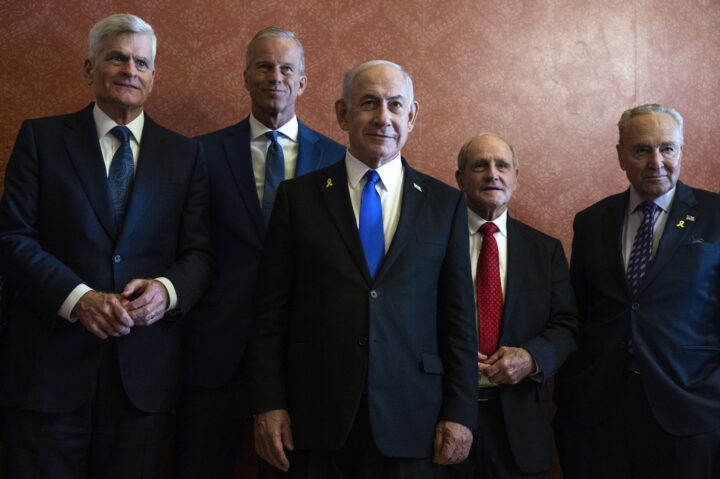
Tom Williams/CQ Roll Call via AP Images
Israeli Prime Minister Benjamin Netanyahu, center, is seen during photo op before a bipartisan meeting with senators in the U.S. Capitol on Wednesday, July 9, 2025. Also appearing are, from left, Sen. Bill Cassidy, R-La., Senate Majority Leader John Thune, R-S.D., Sen. Jim Risch, R-Idaho, and Senate Minority Leader Charles Schumer, D-N.Y.
Israeli Prime Minister Benjamin Netanyahu gathered with Senate leaders on Capitol Hill on Wednesday to discuss the ongoing efforts to reach a ceasefire in Gaza and expand the Abraham Accords.
Among those in attendance at the meeting, which was rescheduled from Tuesday, were Senate Majority Leader John Thune (R-SD), Senate Minority Leader Chuck Schumer (D-NY), Sens. Jim Risch (R-ID), Ted Cruz (R-TX), Steve Daines (R-MT), Bill Cassidy (R-LA), Chris Coons (D-DE), Jacky Rosen (D-NV), Maria Cantwell (D-WA), Amy Klobuchar (D-MN), Cory Booker (D-NJ) and Adam Schiff (D-CA).
The prime minister was joined by Israeli Ambassador to the U.S. Yechiel Leiter, Israeli Strategic Affairs Minister Ron Dermer and advisor Caroline Glick.
Netanyahu projected unity with President Donald Trump in comments to reporters just before the meeting, dismissing media reports “about the great tension between us, about the great disagreements between us” in the lead-up to Israel launching its attack on Iran’s nuclear facilities and on the ongoing ceasefire and hostage-release talks with Hamas, which Trump has been eager to finalize.
“President Trump and I have a common goal. We want to achieve the release of our hostages. We want to end Hamas rule in Gaza. We want to make sure that Gaza does not pose a threat to Israel anymore. In pursuing this common goal, we have a common strategy. Not only do we have a common strategy, we have common tactics. This doesn’t involve pressure, doesn’t involve coercion, it involves full coordination,” Netanyahu said.
“President Trump wants a deal, but not at any price. I want a deal, but not at any price. Israel has security requirements and other requirements, and we’re working together to try to achieve them. Everything else that you hear and are being briefed on is folly,” Netanyahu continued.
Behind closed doors, Netanyahu spoke for around 30 to 40 minutes about the rationale for Israel’s actions in Iran and Gaza and his vision for the Middle East, including the normalization of ties with Saudi Arabia and Syria through an expanded Abraham Accords, before taking questions from the group, two senators in attendance told Jewish Insider on condition of anonymity.
On Gaza, Netanyahu said that he and the U.S. were trying to reach a ceasefire deal with Hamas and did not suggest he had any opposition to the push, something one of the senators described as a shift in tone for the Israeli prime minister.
The senator noted that Netanyahu was “very clear [that] we are actively negotiating towards a ceasefire without the usual, predictable litany of reasons why we can’t [agree to a deal]. It sure felt like he’d been told by Trump to get to a ceasefire. It felt that way.”
Netanyahu also addressed criticisms of how Israel has handled the distribution of humanitarian aid in Gaza by pointing to Hamas’ seizure of relief packages and criticizing what he called the “humanitarian aid industrial complex,” according to the senators.
“Netanyahu said that one of the sticking points with Hamas is that they want to control the distribution of food. That’s how they make their money and get their recruits, and so they don’t want them to have control of the distribution of food,” one senator said.
“He told us, ‘We don’t want anyone to starve. We’re going to be delivering more humanitarian aid. We recognize people here are critical of how we’ve delivered humanitarian aid.’ But it was all wrapped in Hamas stealing everything we send in,” the other senator quoted Netanyahu as saying, adding that Dermer also answered several questions on the subject.
On the issue of Saudi normalization, Netanyahu outlined a plan for new energy cooperation through the region.
“He said if there was not the destabilization of Iran, without their proxies in Gaza, Syria and Lebanon, then the Saudis could run a pipeline through the desert, through Israel, to the Mediterranean,” one senator told JI. “So instead of having to go through the Suez Canal, you could just take it straight to the Mediterranean. Think about what that would do to international energy security and even to energy prices.”
Other topics touched upon were ways to address the threats from the Houthis and Hezbollah, as well as the best approach to Iraq.
Publicly, lawmakers said little about the sit-down. Thune called it “good,” while Schumer said that “there were a lot of comments back and forth,” declining to comment further.
Schiff said the meeting was “fine” and “informative.” He said he hadn’t had a chance to ask questions because the meeting was cut short by a Senate vote. “We covered the waterfront of issues.”
Sen. John Fetterman (D-PA) met privately with the Israeli leader on Tuesday.
“My meeting with Netanyahu was a great opportunity to discuss and congratulate Israel’s total domination over Iran and its proxies,” Fetterman told JI. “I expressed my admiration for the sacrifices of the IDF, my support for bringing the hostages home and my hope for the possibility of true peace in the region.”
Earlier Wednesday, Netanyahu met off Capitol Hill with Sens. Lindsey Graham (R-SC), Tom Cotton (R-AR) and Richard Blumenthal (D-CT).
“We discussed the importance of keeping the Iranian regime in a weakened state until they change their behavior toward Israel and the region, and toward the United States,” Graham said on X. ”We also talked about the mutual desire to continue to integrate the region politically and economically, moving toward the light away from the darkness. I completely support Israel’s position that Hamas must be removed from Gaza as part of any peace agreement and that Iran should recognize Israel’s right to exist as a prerequisite to any peace negotiations.”
Graham said that Netanyahu had also celebrated Graham’s birthday — his 70th — with cake and a rendition of “Happy Birthday.”
The texts from Claire Shipman, published in a letter by the House Education Committee, call a Jewish board member a ‘mole’ and ‘extremely unhelpful’

Alex Wong/Getty Images
Acting Columbia University President Claire Shipman testifies before the House Committee on Education & the Workforce at Rayburn House Office Building on April 17, 2024 in Washington, DC.
Text messages obtained by the House Committee on Education and Workforce published in a letter on Tuesday revealed that Claire Shipman, acting president of Columbia University, suggested that a Jewish trustee should be removed over her pro-Israel advocacy and called for an “Arab on our board,” amid antisemitic unrest that roiled the university’s campus last year.
“We need to get somebody from the middle east [sic] or who is Arab on our board,” Shipman, then the co-chair of Columbia’s Board of Trustees, wrote in a message to the board’s vice chair on Jan. 17, 2024. “Quickly I think. Somehow.”
Shipman said in a follow-up message days later that Shoshana Shendelman, a Jewish board member who frequently condemned campus antisemitism, had been “extraordinarily unhelpful” and said, “I just don’t think she should be on the board.”
In another communication on April 22, 2024, according to the texts obtained by the committee, Wanda Greene, vice chair of the board of trustees, asked Shipman — referring to Shendelman — “do you believe that she is a mole? A fox in the henhouse?” Shipman agreed, stating, “I do.” Greene added, “I am tired of her.” Shipman agreed, “so, so tired.”
The messages were referenced in the letter, first obtained by Free Beacon, sent to Columbia on Tuesday by the committee’s chairman, Tim Walberg (R-MI), and Rep. Elise Stefanik (R-NY) as part of the committee’s ongoing investigation into whether the school is violating Title VI of the Civil Rights Act of 1964 by allowing harassment of Jewish students.
The lawmakers wrote in the letter, which was addressed to Shipman, “These exchanges raise the question of why you appeared to be in favor of removing one of the board’s most outspoken Jewish advocates at a time when Columbia students were facing a shocking level of fear and hostility.”
Columbia responded to the letter, in a statement to Free Beacon, claiming that the text messages were taken out of context.
“These communications were provided to the Committee in the fall of 2024 and reflect communications from more than a year ago,” the university said. “They are now being published out of context and reflect a particularly difficult moment in time for the University when leaders across Columbia were intensely focused on addressing significant challenges.”
Shipman, a former ABC News reporter, stepped into the role in March after interim President Katrina Armstrong’s abrupt resignation. At the time, Stefanik called the choice of Shipman “untenable.” On campus, the news of Shipman’s hiring was met with cautious optimism from pro-Israel student leaders.
Last April, Shipman testified at a congressional hearing regarding antisemitism at Columbia alongside then-Columbia President Minouche Shafik, who resigned from her post in August, and board co-chair David Greenwald. Shipman told members of the House Committee at the time that she knew Columbia had “significant and important work to do to address antisemitism and to ensure that our Jewish community is safe and welcome.”
Plus, Bibi plans a Beltway blitz

Jemal Countess/Getty Images for Fair Share America
Sen. Chris Murphy (D-CT) speaks at the U.S. Capitol on April 10, 2025 in Washington, DC.
Good Tuesday morning.
In today’s Daily Kickoff, we look at Sen. Chris Murphy’s leftward shift on Israel, and spotlight Rep. Raja Krishnamoorthi’s congressional votes and relations with Illinois’ Jewish community as he mounts a bid for Senate. We cover Israeli Prime Minister Benjamin Netanyahu’s upcoming trip to Washington, and report on a new lawsuit alleging the Nysmith School in Northern Virginia discriminated against Jewish students. Also in today’s Daily Kickoff: Doron Spielman, Karen Diamond and Susan Rice.
What We’re Watching
- Secretary of State Marco Rubio is meeting in Washington today with his counterparts from Japan, China and Australia.
- The Carnegie Endowment for International Peace’s Aaron David Miller is hosting a web event this morning with former CIA Director David Petraeus and analyst Karim Sadjadpour focused on Israel, Iran and the U.S.
- Former U.S. Ambassador to Israel Dan Shapiro is speaking this morning at a Center for International & Strategic Studies event on ties between North Korea and Iran.
- The Christians United For Israel summit continues today in Washington. Virginia Attorney General Jason Miyares, the Brandeis Center’s Ken Marcus and Israel Ambassador to the U.N. Danny Danon are slated to speak today.
- The Aspen Ideas Festival in Colorado wraps up today.
- New York City is slated to release the first round of ranked-choice voting results from last week’s primaries
What You Should Know
A QUICK WORD WITH JI’S JOSH KRAUSHAAR
The political developments over the last week couldn’t send a more dispiriting message about the viability of the political center — in both parties.
Last Tuesday, a self-proclaimed democratic socialist, Zohran Mamdani, who campaigned on a far-left agenda on issues ranging from the economy, crime and antisemitism, emerged as the Democratic standard-bearer for mayor of New York City.
Over the weekend, Sen. Thom Tillis (R-NC), one of the most pragmatic Republicans in the upper chamber, announced he wouldn’t be running for reelection after signaling he’d be one of two GOP votes against President Donald Trump’s “big, beautiful” budget reconciliation bill. His decision to retire came after Trump, in a Truth Social post, threatened to support a primary challenger.
Tillis, notably, was the deciding Republican vote scuttling the nomination of interim D.C. U.S. Attorney Ed Martin for, among other issues, his associations with a Nazi sympathizer.
And on Monday, Rep. Don Bacon (R-NE), one of only three House Republicans who represents a district that former Vice President Kamala Harris won in 2024, formally announced his retirement, making it all the more likely a more-partisan Democratic lawmaker will succeed him in the seat.
These are just the latest developments that underscore that moderation, pragmatism and bipartisanship are becoming endangered principles in a polarized political environment that rewards extremism and hot takes over thoughtful policymaking.
SOLIDARITY SNUB

Two days after the Oct. 7, 2023, Hamas terror attacks, Sen. Chris Murphy (D-CT) spoke emotionally at the “Rally for Israel” in West Hartford, Conn. “This is a moment where we are going to have to stand as a nation with greater force, with greater purpose than ever, to make sure that Israel has what it needs,” Murphy said. But members of Connecticut’s Jewish community say Murphy strayed from that promise just weeks later. In late November 2023, Murphy said on CNN that he was open to placing conditions on U.S. aid to Israel, a position that astounded many of the people who had stood with him in West Hartford not long before. Since then, he has emerged as a vocal critic of Israel’s handling of the war in Gaza, and more than 18 months after the attack, the Connecticut Jewish community’s frustration with him has only grown, Jewish Insider’s Gabby Deutch reports.
Veering off: Murphy voted twice in support of resolutions put forward by Sen. Bernie Sanders (I-VT) that would block certain arms sales to Israel. Following Israel’s strikes on Iranian nuclear facilities, Murphy slammed Israeli Prime Minister Benjamin Netanyahu for sending the Middle East into a “new, deadly conflict.” His shift to the party’s left flank on Israel comes as Murphy positions himself as a leading voice in the Democratic Party in opposition to President Donald Trump’s policies and builds a stronger public profile for himself. He’s a regular on cable news shows and recently created a new political action committee to encourage protests against Trump, with plans to spend $2 million in the 2026 midterms, sparking rumors that he could mount a presidential bid in 2028. It’s not just Murphy’s foreign policy views that are concerning his Jewish constituents. Recently, the senator has emerged as one of the most prominent boosters of presumptive New York City Democratic mayoral nominee Zohran Mamdani, even as some of his Democratic colleagues have raised concerns about Mamdani’s refusal to condemn the phrase “globalize the intifada.”
Communal concerns: Rabbi Tuvia Brander, the spiritual leader of Young Israel of West Hartford, told JI that Murphy’s praise of Mamdani is “so beyond the pale of what is just in the basic interests of many of his constituents.”
PRAIRIE STATE OF PLAY

As he competes for Illinois’ open Senate seat, Rep. Raja Krishnamoorthi (D-IL) is hoping that the state’s sizable Jewish community, concentrated in the Chicago area, will help him chart a path to victory in the Democratic primary, Jewish Insider’s Marc Rod reports.
Making his pitch: “I do think that [Jewish voters] have a desire for a strong U.S.-Israel relationship,” Krishnamoorthi said, “and I don’t think there’s anybody else with the track record in this race that I possess, showing strong support for that relationship, but also knowing why that relationship needs to continue to be strong on a bipartisan basis, and we need to take this out of politics.” Krishnamoorthi spoke to JI about his approach to antisemitism, Iran and the U.S.-Israel relationship.
WAR OF WORDS

Several Senate Democrats told Jewish Insider’s Emily Jacobs and Marc Rod on Monday that calls to “globalize the intifada” are unacceptable and must be condemned, amid concerns from Jewish leaders and organizations over presumptive New York City Democratic mayoral nominee Zohran Mamdani’s defense of the slogan.
Mamdani musings: Senate Minority Leader Chuck Schumer (D-NY), who has thus far not endorsed Mamdani, told JI he plans to meet with Mamdani in a few weeks, when asked about Mamdani’s refusal to condemn the slogan. “Sen. Schumer condemns the phrase ‘Globalize the Intifada’ and believes it should not be used because it has such dangerous implications. As Senator Schumer said after the death of Karen Diamond, the attack in Boulder continues to serve as a grave reminder of the deadly consequences of the rise in antisemitism,” a spokesperson for Schumer told JI. “I don’t know what [Mamdani’s] position is on it, but I certainly think that the call to spread the intifada is the kind of incitement that can lead to extremist violence,” Sen. Richard Blumenthal (D-CT) told JI.
Read the full story here with additional comments from Sens. Jacky Rosen (D-NV), John Fetterman (D-PA) and Kirsten Gillibrand (D-NY) and Rep. Ritchie Torres (D-NY).
TRIP TALK

Israeli Prime Minister Benjamin Netanyahu’s White House visit next week is a chance to “take advantage of the victory” in Iran, he said at the start of a Cabinet meeting on Tuesday,Jewish Insider’s Lahav Harkov reports.
On the agenda: The trip to Washington “comes as a continuation of the great victory we achieved in Operation Rising Lion,” Netanyahu said, referring to Israel’s 12-day operation against Iran’s nuclear and ballistic missile program, which the U.S. joined. “Taking advantage of the victory is no less important than achieving the victory.” An Israeli official told JI on Tuesday that “everything” is on the agenda, including U.S.-Israel cooperation to stop Iran from rebuilding its nuclear program, next steps in Gaza and the possibility of establishing diplomatic relations with Syria and other Arab and Muslim countries.
Meanwhile at Aspen: Susan Rice, who served as national security advisor during the Obama administration’s inking of the nuclear deal with Iran, sharply criticized Trump’s decision to strike Tehran’s nuclear program while defending the 2015 agreement during a panel discussion at the Aspen Institute’s Ideas Festival on Monday,Jewish Insider’s Jake Schlanger reports. Rice joins a chorus of former Obama and Biden administration officials who have criticized Trump’s decision to strike Iran’s nuclear facilities, despite many experts concluding the damage to the program was significant.
Worth noting: The New York Times’ David Brooks, writing in a piece headlined “I Detest Netanyahu, but on Some Things He’s Actually Right,” adds context to consider when evaluating the strikes. “We may know in time what the bombings accomplished. In the meantime, we do know that Israel and the United States have the will and capacity to attack Iran anytime and anyplace. We do know that if Iran reconstitutes its nuclear program, Israel and America have the capacity to deliver a much more devastating and regime-threatening blow. We also know that Iran and its proxies have made some insanely self-destructive miscalculations since Oct. 7, 2023, and they must know that, too. These are ominous omens for the theocrats in Tehran.”
HOSTILE ENVIRONMENT

The parents of an 11-year-old Jewish student at a private school in Northern Virginia say their daughter faced months of antisemitic harassment that went unaddressed by school officials, who also cancelled an annual event featuring a Holocaust survivor due to concerns that the event might exacerbate tensions related to the Israel-Hamas war. Days after the parents addressed the campus environment with school leadership, all three of their children were expelled, according to a complaint filed on Tuesday with the Office for Civil Rights in the Virginia Attorney General’s Office, Jewish Insider’s Haley Cohen has learned.
The allegations: According to the complaint, Kenneth Nysmith, headmaster and owner of The Nysmith School for the Gifted in Herndon, Va., canceled the event with the Holocaust survivor and expressed concern that it might inflame tensions within the school community in light of Israel’s ongoing war against Hamas in Gaza. The complaint, filed by the Louis D. Brandeis Center for Human Rights under Law and Washington-based firm Dillon PLLC, alleges several antisemitic incidents that the parents of the 11-year-old Jewish student say she faced in the months leading up to the cancellation of the Holocaust survivor event. The complaint recounts that in October 2024, their daughter’s history teacher asked students to work together on an art project to create a large drawing featuring the attributes of “strong historical leaders.” The students collaborated on a large artistic rendering of a strong leader, featuring Adolf Hitler’s face.
Elsewhere: The Brandeis Center, working with the Anti-Defamation League and Mayer Brown, filed a brief on Monday with the Department of Education’s Office for Civil Rights, alleging that officials in a Massachusetts school district did not adequately protect Jewish students from antisemitic harassment and discrimination.
BOOK REVIEW
After Israel waged war against an Iranian regime that has vowed to destroy the Jewish state and diaspora Jews face a heightened atmosphere of antisemitism stemming from the Israel-Gaza war, a new book aims to equip Israel supporters with “a foundation” to refute claims that Jews do not have ancient roots in the land of Israel. When the Stones Speak: The Remarkable Discovery of the City of David and What Israel’s Enemies Don’t Want You to Know, written by former IDF spokesperson Doron Spielman, does so by recounting discoveries made in Israel’s largest excavation site, the City of David, where Spielman has worked closely with archaeologists for two decades to uncover and promote the site’s historical significance. The book, Spielman suggested in an interview with Jewish Insider’s Haley Cohen, is aimed at what he calls “the middle group of people” — “logical, reasonable people” who don’t know whether they’re pro-Israel or anti-Israel.
Lay of the land: “When they understand that ‘when the stones speak,’ they tell the story of the truth of the Jewish people’s connection to the land,” that could help sway the conversation on college campuses. This middle group will come to understand, he said, that “at the very least [the Israeli-Palestinian conflict] is a fight between two people who think they’re indigenous, and at the very best they understand the Jews are people who have only one land, they’ve been there for 3,800 years and therefore they have a right to defend it.”
New York state of mind: Spielman hopes the book’s impact will also reach supporters of New York City mayoral candidate Zohran Mamdani, the presumptive winner of the Democratic primary last week amid his refusal to condemn the phrase “globalize the intifada” and denial that Israel has a right to exist as a Jewish state. “He’s denying the Jewish people their right to live as a nation in the one place they ever called home,” Spielman told JI. “When the Stones Speak cuts through the lies with facts on the ground — literally.”
Worthy Reads
Knockout Blow, But Not the End: The Times of Israel’s David Horovitz reflects on the 12-day war between Israel and Iran. “There is, however, absolutely no room or reason for hubris. Israel allowed itself to slip into existential peril, and the astounding success of the 12-day war is a temporary accomplishment. Iran is not going anywhere. And so long as the ayatollahs retain power, they can be relied upon to recommit to their efforts to wipe out Israel. … Along with delight and profound relief at the achievements of the war, the military and security top brass are resolved not to underestimate the regime and its single-minded determination to destroy Israel. This was a knockout blow in a life-or-death fight. But it is not the end of the existential struggle.” [TOI]
Not Science Fiction: In The Free Press, Matti Friedman considers the impact of Iran’s ballistic missile attack on the Weizmann Institute of Science. “When [neurobiologist Oren Schuldiner] heard that his lab was hit, he said, he had trouble grasping what this meant, and kept texting colleagues to ask what could be salvaged — there were two microscopes in the lab, for example, each worth nearly $1 million, and thousands of fruit fly specimens that he uses to map neural changes that may one day help us better understand diseases like schizophrenia and autism. Finally, a colleague who’d lost her own lab sent him a link to the Wikipedia page detailing the five stages of grief. ‘I understood that I was in denial,’ he said. Only when he made it back did he understand that the lab wasn’t damaged — it was gone, along with most of his work of the past 17 years.” [FreePress]
Lula’s Lurch:The Economist spotlights Brazilian President Luiz Inácio Lula da Silva, whose declining domestic popularity has coincided with his country’s deepening ties with Iran, Russia and China. “On June 22nd, hours after the United States struck Iranian nuclear sites with huge bunker-buster bombs, Brazil’s foreign ministry put out a statement. It said that Brazil’s government ‘strongly condemns’ the American attack, and that the strikes were a ‘violation of Iran’s sovereignty and international law.’ This strength of language put Brazil at odds with all other Western democracies, which either supported the strikes or merely expressed concern. Brazil’s friendliness with Iran is set to continue on July 6th and 7th when the BRICS, a group of 11 emerging-market economies including Brazil, China, Russia and South Africa, holds its annual summit in Rio de Janeiro. Iran, which became a member of the BRICS in 2024, is expected to send a delegation. The club is currently chaired by Brazil’s president, Luiz Inácio Lula da Silva, known as Lula. Originally, being a member had offered Brazil a platform from which to exert global influence. Now it makes Brazil look increasingly hostile to the West.” [TheEconomist]
Word on the Street
President Donald Trump signed an executive order lifting the majority of sanctions imposed on Syria over the last 50 years; the executive order includes steps to lift the Foreign Terrorist Organization status of the Hayat Tahrir al-Sham group that Syrian President Ahmed al-Sharaa previously led, as well as a review of Damascus’ role as a state sponsor of terror…
An Iran-linked hacking group that had previously accessed email accounts associated with Trump’s 2024 campaign threatened to release a new tranche of emails sent from Trump aides…
Satellite images obtained by CNN over the weekend indicate “ongoing activity at and near the ventilation shafts and holes caused by last week’s airstrikes” on Iran’s Fordow nuclear facility…
The Department of Health and Human Services’ Office for Civil Rights issued a 57-page report accusing Harvard of having acted with “deliberate indifference” toward antisemitism and anti-Israel discrimination on the Cambridge campus…
Elon Musk said he planned to support Rep. Thomas Massie (R-KY), who is facing an effort by the White House to recruit a primary challenger over Massie’s refusal to back the administration’s budget reconciliation bill; Musk was prompted by a social media post from former Rep. Justin Amash (R-MI) calling on the X owner to back Massie, but is already facing pushback from some in the Kentucky Jewish community…
Former Rep. Colin Allred (D-TX), who fell short in his bid to unseat Sen. Tex Cruz (R-TX) last year, announced his entry into Texas’ Senate race; Allred is seeking to challenge Sen. John Cornyn (R-TX), who is already facing a tough primary battle…
Karen Diamond, one of the more than two dozen people injured in last month’s antisemitic firebombing attack targeting a Boulder, Colo., march in support of the remaining Israeli hostages, died from her injuries, Jewish Insider’s Gabby Deutch reports…
Unilever cut off financial support for the charitable arm of its Ben & Jerry’s subsidiary, alleging that the ice cream company foundation’s trustees “have continued to resist basic oversight” and refused to provide audit documents…
A British court rejected a legal challenge by the Palestinian NGO Al-Haq that sought to stop the government’s exports to Israel of components of F-35 fighter jets; the court determined it lacked jurisdiction over the U.K.’s defense sector…
British musical group Bob Vylan is facing a criminal investigation over chants the duo led at the weekend Glastonbury music festival calling for “death to the IDF”; U.K. Prime Minister Keir Starmer also denounced the chants, which resulted in the State Department’s canceling of group members’ visas ahead of a planned U.S. tour…
An Australian court ordered a Sydney imam to remove from the internet past speeches that the court said were “fundamentally racist and antisemitic”; the cleric was also instructed to refrain from making similar speeches in the future…
The newly created Kinetica VC fund, founded by Yoav Knoll, Aaron Applbaum, Yitz Applbaum and Frederic Landau, is raising $150 million for investments focused on Israel’s tech industry; the firm has also recruited former U.S. Navy Secretary Kenneth Braithwaite, Joe Lonsdale and former Sen. Norm Coleman (R-MN) to join its advisory board…
Former Israeli hostages Liri Elbag, Karina Ariev, Naama Levy, Danielle Gilboa and Agam Berger visited the set of “Fauda” as the series films its fifth season…
Pic of the Day

Auburn men’s basketball coach Bruce Pearl spoke on Monday at the Christians United For Israel conference in Washington.
Birthdays

Television, film and theater actor, including early career roles in Yiddish theater, Michael Burstein turns 80…
Applied mathematician, statistician and physicist, professor emeritus at both MIT and Harvard, Herman Chernoff turns 102… Former U.S. assistant aecretary of education and research professor at NYU, Diane Silvers Ravitch turns 87… Nobel laureate in economics for 1997 and co-creator of the Black-Scholes model for valuing options and other derivatives, Myron Scholes turns 84… Noted British art dealer and founder of an eponymous London art gallery, Victoria Marion Miro turns 80… Born in a DP camp to her Holocaust survivor parents, she was the first Jewish woman to serve on the Canadian Supreme Court, Rosalie Silberman Abella turns 79… Israeli-Russian businessman, with holdings in energy and international real estate development, Shalva Chigirinsky turns 76… Partner in the Encino, Calif.-based law firm of Nolan Heimann, Douglas E. Mirell… Hall of Fame player and coach in the Women’s National Basketball Association and now an NBA broadcaster, Nancy Lieberman turns 67… Attorney and longtime Democratic activist in Pittsburgh, he is a regional chair of the ADL, Steven D. Irwin turns 66… Contributing editor at The Forward and CEO of the A-Mark Foundation, Rob Eshman… President emeritus of the Orthodox Union and a retired partner at Ropes & Gray, Mark (Moishe) Bane… Undersecretary of state for political affairs during most of the Biden administration, Victoria Jane Nuland (family name was Nudelman) turns 64… Journalist, filmmaker and educator, he is the co-founder of Aish[dot]com, Shraga Simmons turns 64… Professor of Jewish thought at Hebrew University, Benjamin Brown turns 59… Member of the Virginia House of Delegates since 2014, Marcus Bertram Simon turns 55… U.S. senator (R-IA), Joni Ernst turns 55… Screenwriter, producer and film director known for romantic comedy films, Marc Silverstein turns 54… Los Angeles resident, Adam B. Siegel… NASA astronaut, on her 2019 trip to the International Space Station she took novelty socks with Stars of David and menorahs, Jessica Meir turns 48… Co-founder of Edgeline Films, Elyse Steinberg… Hasidic musician mixing elements of dancehall, reggae, hip-hop and R&B, known by his stage name DeScribe, Shneur Hasofer turns 43… Rising senior and president of the school of business and finance at Ocean Township High School in Oakhurst, N.J., Samuel Peretz Fields…
The Indiana senator tells JI: ‘I do not believe this resolution is necessary at this time’

Samuel Corum/Getty Images
The move to oppose a war powers resolution represents a shift for Todd Young (R-IN), shown here in the Capitol in a photo from 2020.
Sen. Todd Young (R-IN) will oppose Sen. Tim Kaine’s (D-VA) war powers resolution blocking the U.S. from taking further military action against Iran, he revealed to Jewish Insider ahead of Friday’s vote.
The position is a shift for Young, who partnered with Kaine in early 2023 to successfully pass legislation repealing the 1991 and 2002 Authorizations of Military Force to formally end the Gulf and Iraq wars. The two introduced their first joint war powers repeal bill in 2019, and Young voted for an amended version of Kaine’s 2020 war powers resolution following President Donald Trump’s decision to assassinate Iranian Gen. Qassem Soleimani after initially opposing the Virginia Democrat’s original language.
The Indiana senator, who has been a leader on the GOP side in efforts to update and enforce Congress’ war-making powers, told JI on Friday that he will vote no on Kaine’s latest resolution, citing his belief that Iran’s nuclear program was a direct threat to the U.S. meriting a targeted response.
“Following recent briefings, I feel confident that Iran was prepared to pose a significant threat to the security of the United States and Israel, making the president’s decision to pursue limited, targeted action necessary and based on the appropriate legal foundation. America and the world are safer because of the skill and determination of our military personnel who acted last Saturday,” Young said in a statement.
Young also said that given President Donald Trump’s push for a ceasefire rather than an escalation of U.S. military action in Iran, he did not view the resolution as needed. Still, he cautioned that the Trump administration should engage with Congress on any future military actions.
“Based on President Trump’s stated goal of no further military action against Iran and conversations with senior national security officials regarding the administration’s future intentions, I do not believe this resolution is necessary at this time,” Young said.
“Should the administration’s posture change or events dictate the consideration of additional American military action, Congress should be consulted so we can best support those efforts and weigh in on behalf of our constituents. I am prepared to work with the Trump administration to advance a targeted authorization for the use of military force against Iran should the situation require it,” he continued.
The White House denied Trump’s comments signaled any policy change or the lifting of U.S. sanctions

ATTA KENARE/AFP/Getty Images
Oil tanker SC Hong Kong is seen off the port of Bandar Abbas, southern Iran, on July 2, 2012.
President Donald Trump announced Tuesday that he would allow China to continue to purchase oil from Iran, though a senior White House official denied there had been any change in policy or that sanctions would be lifted.
Trump’s comments appeared to many observers to be a reversal of his own administration’s actions just months ago and in contravention of congressionally approved sanctions designed to cut off the Iran-China oil trade, one of Iran’s most critical sources of funding.
Trump’s comments drove concern among supporters of the sanctions and Iran analysts, who believe that loosening sanctions on Iran now will help it gather funding to rebuild its nuclear program.
“China can now continue to purchase Oil from Iran,” Trump posted on Truth Social on Tuesday morning, following the implementation of a ceasefire between Iran and Israel. “Hopefully they will be purchasing plenty from the U.S., also. It was my Great Honor to make this happen!”
Congress last year passed two separate bills with broad bipartisan support, the SHIP (Stop Harboring Iranian Petroleum) Act and the Iran China Energy Sanctions Act, which were specifically designed to choke off the oil trade between Iran and China. A third bill, the Enhanced Iran Sanctions Act, to place additional sanctions on the trade, has been advancing in the House with strong bipartisan support.
Trump’s announcement appears to mark a striking turnaround from his commitment to “maximum pressure” on Iran. Just months ago, the administration imposed sanctions on Chinese “teapot” refineries for importing Iranian oil for the first time, with the goal of pressuring Iran.
“The President is committed to drive Iran’s illicit oil exports, including to China, to zero,” State Department spokesperson Tammy Bruce said in April. “All sanctions will be fully enforced under the Trump Administration’s maximum pressure campaign on Iran.”
A senior White House official told JI on Tuesday that “The President was simply calling attention to the fact that, because of his decisive actions to obliterate Iran’s nuclear facilities and broker a ceasefire between Israel and Iran, the Strait of Hormuz will not be impacted, which would have been devastating for China.”
The official continued, “The President continues to call on China and all countries to import our state-of-the-art oil rather than import Iranian oil in violation of U.S. sanctions.”
“China is the main consumer of Iranian oil. Enabling China to continue purchasing Iranian oil violates existing sanctions and will allow Iran to rebuild its capabilities, including its nuclear program,” Rep. Josh Gottheimer (D-NJ), the lead Democratic sponsor of the Iran China Energy Sanctions Act, told Jewish Insider.
“With the regime now significantly weakened, we must continue applying maximum pressure and cut off its sources of funding. Doing so will help protect America, our military and diplomatic assets, and our allies around the world.”
Rep. Mike Lawler (R-NY), the lead sponsor of both bills, did not respond to a request for comment.
Trump’s announcement is also driving concern from Iran analysts.
“China purchasing oil from Iran allows it to rearm, refinance and rebuild making future conflict with Israel more likely. It also gives Tehran resources to rebuild its nuclear program,” Jason Brodsky, the policy director for United Against Nuclear Iran, warned. “Also if your goal is zero enrichment in Iran, allowing China to flood Iran with resources makes that goal harder to achieve.”
Brodsky added: “The calculus behind getting China to curtail its purchases of Iranian oil is to achieve zero enrichment in Iran, which has been the president’s longstanding and rightful position.”
“If ever there was a time for more maximum pressure, it would be in a post-strike scenario to contain or roll back the Islamic Republic and prevent China and Russia from helping it ‘build back better,’” Behnam Ben Taleblu, the senior director of the Iran program at the Foundation for Defense of Democracies, said.
Ben Taleblu also noted the sanctions “[undermine] the spirit and letter” of the administration’s executive order and national security memorandum on oil sanctions, while FDD’s CEO Mark Dubowitz highlighted that the trade “violate[s] U.S. sanctions — passed by Congress on a bipartisan basis.”
AIPAC, which urged lawmakers to support the SHIP Act, said in a statement, “We must continue to apply maximum pressure on Iran to ensure that it cannot rebuild its nuclear and ballistic missile capabilities.”
This story was updated at 5:50 p.m. on Tuesday to include comments from a White House spokesperson.

Daniel Torok/The White House via Getty Images
U.S. President Donald Trump, White House Chief of Staff Susie Wiles, Chairman of the Joint Chiefs of Staff Dan Caine, Vice President JD Vance, and Secretary of State Marco Rubio sit in the Situation Room as they monitor the mission that took out three Iranian nuclear enrichment sites, at the White House on June 21, 2025 in Washington, DC.
Good Monday morning.
In today’s Daily Kickoff, we look at how Capitol Hill is responding to the U.S. strikes on Iran’s nuclear facilities over the weekend and report on this morning’s Israeli strikes on Iran’s notorious Evin Prison. We talk to nuclear proliferation experts about Iran’s lesser-known underground nuclear site, Pickaxe Mountain, which is deeper than Fordow, and cover the Supreme Court ruling allowing American families of victims of Palestinian terror to sue the Palestinian Authority and Palestine Liberation Organization. Also in today’s Daily Kickoff: Rahm Emanuel, Barbra Streisand and Keith Siegel.
What We’re Watching
- President Donald Trump is holding an Oval Office meeting this afternoon with National Security Council officials as the administration mulls its next moves following the weekend strikes on Iranian nuclear facilities.
- Iranian Foreign Minister Abbas Araghchi is in Moscow today, where he’s meeting with Russian President Vladimir Putin.
- Attorney General Pam Bondi is slated to testify this afternoon before the House Appropriations Committee on the Justice Department’s FY2026 budget.
- The Foundation for Defense of Democracies is holding a situational update this morning looking at the fallout from the weekend strikes on Iran.
What You Should Know
A QUICK WORD WITH JI’S JOSH KRAUSHAAR
In my years of covering politics, it’s pretty rare for mainstream Jewish organizations to be wildly out of step with the predominant views of the Democratic Party. But in the aftermath of President Donald Trump’s decision to order bunker-busting strikes against Iran’s nuclear sites over the weekend, the views of the institutional Jewish community and many rank-and-file Democrats couldn’t have been more divergent.
Consider: The American Jewish Committee’s CEO Ted Deutch, a former Democratic congressman, praised Trump’s decision and called it “an historic moment for the United States, Israel and the world.” Anti-Defamation League CEO Jonathan Greenblatt thanked Trump for “holding true to the commitment that the United States will not stand by and watch the world’s leading state sponsor of terrorism and antisemitism develop nuclear weapons.”
Even the more-partisan Democratic pro-Israel group DMFI, which normally can be counted on to criticize the president, rejected its own party’s predominant view that further congressional approval should have been received before the strikes. “Iran was unwilling to give up its nuclear program through diplomatic negotiations across three different administrations, so the United States was left with no choice but to take decisive military action,” DMFI CEO Brian Romick said.
By contrast, it was tough to find many Democratic lawmakers — even among the many who are typical allies of Israel — to offer praise of the strikes severely degrading Iran’s nuclear program.
IRAN-ISRAEL WAR, DAY 11

Israel on Monday bombed the gates of Iran’s notorious Evin Prison and conducted follow-up strikes near the Fordow nuclear facility a day after it was bombed by the U.S., Jewish Insider’s Lahav Harkov reports. Evin has been a symbol of the regime’s oppression for decades. The Tehran prison is where the regime has incarcerated activists, protesters, journalists, dual nationals and others, and used torture methods including beatings, solitary confinement and sexual abuse. Iran expert Ben Sabti told JI last week that Iranians have called on Israel to strike prisons so that dissident leaders held inside could escape and push for the toppling of the regime.
Additional targets: The strike on the prison was one of several by Israeli fighter jets, targeting “bodies of government oppression in the heart of Tehran,” Israeli Defense Minister Israel Katz said on Monday morning. The military struck the headquarters of the Basij, the regime’s internal enforcement arm, which has been instrumental in enforcing Islamic law and suppressing protest, the Islamic Revolutionary Guard Corps’ internal security command center, the Alborz Corps, responsible for security and regime stability in the Tehran district, and a clock in the city’s Palestine Square counting down to Israel’s destruction by 2040.
Crystal ball: Iran is unlikely to initiate attacks against the U.S. after the American strike on Islamic Republic nuclear sites, but it will continue to launch missiles at Israel, experts told JI on Sunday.
PROGRESS REPORT

Gen. Dan Caine, the chairman of the Joint Chiefs of Staff, said on Sunday that the U.S. operation in Iran overnight had hit all of its planned targets and that initial assessments showed that the strikes had inflicted extensive damage on Iran’s nuclear facilities. But Caine said that a full assessment of whether the Iranian nuclear program had been fully destroyed would take more time, Jewish Insider’s Marc Rod reports.
Unknown details: “Final battle damage will take some time, but initial battle damage assessments indicate that all three sites sustained extremely severe damage and destruction,” Caine said. Pressed on whether Iran retains any nuclear capability, Caine said that a full assessment “is still pending, and it would be way too early for me to comment on what may be there.” Secretary of Defense Hegseth added that the U.S. believes it “achieved the destruction of capabilities” at the Fordow nuclear facility, which he described as the “primary target.”
Vance’s view: Vice President JD Vance emphasized that the United States is “not at war with Iran” but instead “at war with Iran’s nuclear program,” in an interview with NBC News’ “Meet the Press” Sunday.
MAGA’s mood: The Washington Post looks at how supporters of President Donald Trump are viewing the weekend strikes.
DEMOCRATIC DEBATE
House Minority Leader Hakeem Jeffries (D-NY) and Senate Minority Leader Chuck Schumer (D-NY) criticized President Donald Trump for carrying out strikes on Iranian nuclear facilities without congressional authorization, a voice of opposition that was echoed by many leading Democrats on Capitol Hill, Jewish Insider’s Marc Rod reports.
In opposition: Jeffries said in a statement less than two hours after Trump announced the strikes that Trump “misled the country about his intentions, failed to seek congressional authorization for the use of military force and risks American entanglement in a potentially disastrous war in the Middle East.” Schumer, in a similarly critical statement, said that “no president should be allowed to unilaterally march this nation into something as consequential as war with erratic threats and no strategy” and said he would be urging all lawmakers to support war powers legislation to block further military action against Iran, and called for an immediate vote.
Steny signs off: Rep. Steny Hoyer (D-MD), a former House majority leader, backed the U.S. strikes on Iranian nuclear facilities.
HEARD OF PICKAXE?

Among the Iranian nuclear facilities the U.S. reportedly targeted in the Sunday morning attack was the Pickaxe Mountain Facility. Iran has not acknowledged the site’s development or construction and it has retained a lower public profile, with the Institute for Science and International Security first discovering its existence in 2023. The facility, just south of the Natanz nuclear facility and buried roughly 330 feet below the mountain itself, was particularly concerning to experts due to its depth, which is between 30 to 70 feet deeper than Fordow. This is said to exceed the striking depth of the most powerful bunker-busting weapons in the U.S. arsenal, Jewish Insider’s Jake Schlanger reports.
Another space: Recent Iranian announcements stating the government planned to open a new facility heightened fears that Iran could take the site online in the near future, according to Andrea Stricker, the deputy director of the nonproliferation and biodefense program at the Foundation for Defense of Democracies. “There’s concern that Iran was creating the floor space for another secret enrichment facility,” Stricker told JI. “And so when the [International Atomic Energy Agency] Board of Governors passed a resolution finding Iran in noncompliance with the Nuclear Non-Proliferation Treaty a couple of weeks ago, the Iranians threatened to build another or to open another enrichment facility, and people immediately feared that this would be the site of it.”
Containment: Sen. Lindsey Graham (R-SC) on Sunday dismissed claims that President Donald Trump’s decision to help Israel take out Iran’s nuclear program would lead to a wider war requiring U.S. troops, Jewish Insider’s Emily Jacobs reports. Graham made the comments after being asked about the military implications of the strikes during an appearance on NBC’s “Meet the Press.” The South Carolina senator told anchor Kristen Welker that while he does not see U.S. servicemembers being sent to Iran, he believed Israel would target the regime itself.
MIDEAST MANEUVERS

Reps. Brad Schneider (D-IL), Don Bacon (R-NE) and Jimmy Panetta (D-CA), who traveled to the Middle East last week on a trip sponsored by the Atlantic Council’s N7 Initiative and the Jeffrey M. Talpins Foundation, told Jewish Insider’s Marc Rod on Friday that Arab leaders expressed to them concern about a potential broadening of the conflict between Israel and Iran, even as they acknowledged the threat posed by Iran and its nuclear program.
Reporting back: “We heard quite a bit about their concerns with respect to a nuclear-armed Iran that would be an existential threat to every one of those countries,” Schneider said, “but also a desire to de-escalate what’s happening because they rightly see [that] every day the war goes on is another day for an unintended consequence or an inadvertent escalation that could directly involve any of the Gulf countries.” Schneider noted that the countries, particularly Saudi Arabia, have publicly strongly condemned Israel’s attacks but he said that the lawmakers heard a more nuanced message and stronger opposition to Iran’s nuclear program in private. “While they’re not going to celebrate what Israel is doing, certainly they are not going to cry over Israel’s success in handling Iran’s nuclear program,” he said.
CASE CLOSED
The Supreme Court ruled unanimously in favor of the victims of Palestinian terrorist groups on Friday in a case regarding the constitutionality of a U.S. law allowing lawsuits against the Palestinian Authority and Palestine Liberation Organization in American courts over payments to terrorists and their families through the “pay-for-slay” program, Jewish Insider’s Marc Rod reports.
Long battle: The Supreme Court victory in Fuld v. Palestine Liberation Organization is a hard-fought win for the families, and comes following a decades-long series of efforts by American terror victims and their families to sue the Palestinian groups. Previously, the 2nd Circuit had repeatedly ruled that legislation passed by Congress to assert U.S. jurisdiction over the PLO and PA, designed to allow victims to sue the groups, was unconstitutional.
Worthy Reads
Whipping ‘Six Armies’: The Wall Street Journal’s Elliot Kaufman looks at how Israel destroyed Iran’s planned multifront onslaught against the Jewish state. “In Israel, where everyone has had to become an Iran expert, a video clip has been making the rounds. It’s from a 2021 speech by Gholam Ali Rashid, commander of Iran’s joint military headquarters, whom Israel killed in early strikes on June 13. Three months before the 2020 U.S. killing of Qassem Soleimani, Rashid recounts, the legendary Quds Force commander laid out his life’s work. ‘I have assembled for you six armies outside Iran and I have created a corridor 1,500 kilometers long and 1,000 kilometers wide, all the way to the shores of the Mediterranean,’ Soleimani told Iran’s army chiefs. ‘Any enemy that decides to fight against the Islamic Revolution, and against the sacred regime of the Islamic Republic of Iran, will have to go through these six armies. It won’t be able to do so.’ Yet Israel did.” [WSJ]
The Inevitable War: In The Times of Israel, Yossi Klein Halevi posits that the military confrontation between Israel and Iran was an inevitable byproduct of Tehran’s intransigence over its nuclear program. “Israel’s strike on Iran is the culmination of the war that began on October 7. Hamas’s massacre of Israelis was not an expression of an oppressed people revolting against occupation, as much of the world believes; it was the latest phase of the radical Islamist war against Israel’s existence. What began on October 7 was the Israeli-Iranian war. For the last 18 months, we have been fighting Iran’s proxies. Now, finally and inevitably, we have taken the war to its source.” [TOI]
The Coup Plotters: The Atlantic’s Arash Azizi talks to Iranian insiders in the Islamic Republic about covert conversations about potential regime change in Tehran. “Among the details they shared with me are that former President Hassan Rouhani, who is not involved in the discussions, is being considered for a key role on the leadership committee, and that some of the military officials involved have been in regular contact with their counterparts from a major Gulf country, seeking buy-in for changing Iran’s trajectory and the composition of its leadership. ‘Ours is just one idea,’ one person involved in conversations told me. ‘Tehran is now full of such plots. They are also talking to Europeans about the future of Iran. Everybody knows Khamenei’s days are numbered. Even if he stays in office, he won’t have actual power.’” [TheAtlantic]
Civilizational Struggle: The New York Times’ Thomas Friedman considers the global forces at play following the U.S. bombing of three of Iran’s nuclear sites. “To my mind, Vladimir Putin’s invasion of Ukraine in 2022, with the sole aim of wiping its democracy off the map and absorbing it into Russia, and the attacks on Israel in 2023 by Hamas and Iran’s proxies in Lebanon, Yemen and Iraq, were manifestations of a global struggle between the forces of inclusion and the forces of resistance. That is a struggle between countries and leaders who see the world and their nations benefiting from more trade, more cooperation against global threats and more decent, if not democratic, governance — versus regimes whose leaders thrive on resisting those trends because conflict enables them to keep their people down, their armies strong and their thieving of their treasuries easy.” [NYTimes]
Word on the Street
The FBI is ramping up its surveillance of Hezbollah-linked “sleeper cells” operating in the U.S., amid broader concerns that the Iran-backed group could attack domestic targets…
President Donald Trump’s campaign operation launched Kentucky MAGA, a super PAC targeting Rep. Thomas Massie (R-KY), as it looks to find a challenger to the Kentucky Republican, who has frequently voted against measures supporting Israel and combating antisemitism…
The Trump administration officially terminated the majority of Voice of America’s staff, including a number of employees from the network’s Persian-language service who were briefly reinstated last week…
Former U.S. Ambassador to Japan Rahm Emanuel told CNN he’s mulling a 2028 presidential bid, saying he believes he has “something I think I can offer” but has not made a decision about launching a bid, Jewish Insider’s Jake Schlanger reports…
A new Emerson/Pix11/The Hill poll found New York state Assemblymember Zohran Mamdani beating former New York Gov. Andrew Cuomo in New York City’s Democratic mayoral primary; in the survey, Mamdani bests Cuomo 52%-48% in the eighth round…
One day after former Columbia University graduate student Mahmoud Khalil was released from the immigration detention center where he had been held for three months, the anti-Israel activist appeared at a rally in New York City organized by a group accused of ties to the Iranian regime protesting the U.S.’ weekend airstrikes on Iran’s nuclear facilities, Jewish Insider’s Haley Cohen reports…
U.S. Capitol Police announced that 36-year-old Feras Hamdan was arrested Thursday and charged with aggravated menacing for an altercation between himself and Rep. Max Miller (R-OH), in which Miller said Hamdan ran him off the road and threatened to kill him and his family members. Hamdan reportedly surrendered to police…
Eitan Fischberger reveals in his Substack that a Twitter account of supposed AIPAC lobbyist Jay Sullivan was created using a fake name and AI as part of a disinformation campaign against Jews…
The New York Times interviews Barbra Streisand about her penchant for duets ahead of the release of her upcoming album, “The Secret of Life: Partners, Volume Two”…
The IDF recovered the bodies of three hostages — Ofra Keidar, Jonathan Samerano and Shay Levinson – from the Gaza Strip; all three had been killed on Oct. 7, 2023, and their bodies brought to Gaza…
AFP interviews former Israeli American hostage Keith Siegel about the torture and abuse he suffered and witnessed while in Hamas captivity…
The Associated Press reports on what are suspected to be Iranian AI chatbots responding to calls from abroad that were diverted by Iranian phone companies…
New York City architect and author Nathan Silver, who chronicled the history of the city’s since-demolished buildings, died at 89…
Pic of the Day

The Great Nosh Picnic, a new Jewish food festival, premiered in New York on Sunday with collaborations from some of the city’s top chefs, Jewish Insider’s Gabby Deutch reports.
Birthdays

Actress and comedian, best known for playing Dr. Bernadette Rostenkowski-Wolowitz on CBS’ sitcom “The Big Bang Theory,” Melissa Rauch turns 45…
Professor emeritus of medicine and health care policy at Harvard, he was previously president of Brandeis University and Massachusetts General Hospital, Samuel O. Thier, M.D. turns 88… Real estate developer and co-founder of Tishman Speyer, Jerry Speyer turns 85… Associate justice of the Supreme Court of the United States, Justice Clarence Thomas turns 77… Senior advisor at Eurasia Group and author of 23 books on foreign affairs, global politics and travel, Robert D. Kaplan turns 73… Novelist and journalist, Roy Hoffman turns 72… Los Angeles-based socialite, restaurateur and breast cancer fundraiser, a 2008 Lifetime Television movie starring Renée Zellweger portrayed her cancer fighting efforts, Lilly Tartikoff Karatz turns 72… Klezmer expert, violinist, composer, filmmaker, writer, photographer and playwright, Yale Strom turns 68… Senior director of health policy at the National Consumers League until 2024, Robin Strongin… President of the Harrington Discovery Institute at Case Western Reserve, Dr. Jonathan Solomon Stamler turns 66… Sports memorabilia marketer, his firm sold all of the seats, signs and lockers from the old Yankee Stadium in 2009, Brandon Steiner turns 66… Member of the Pennsylvania State Senate until 2020, now president of Cannabis GPO, Daylin Leach turns 64… Editorial director of Ben Yehuda Press, Lawrence Yudelson… Former teacher for 19 years at Golda Och Academy in West Orange, N.J., Stephanie Z. Bonder… Israeli-American professor, journalist and filmmaker, Boaz Dvir turns 58… Film and television actress, Selma Blair Beitner turns 53… U.S. special envoy for hostage response with the rank of ambassador, Adam Seth Boehler turns 52… EVP and general manager of the NFL’s Philadelphia Eagles, Howie Roseman turns 50… President of D1 Capital Partners, he was deputy director of the White House National Economic Council in the Trump 45 administration, Jeremy Katz… Founder of Innovation Africa, Sivan Borowich-Ya’ari turns 47… Actress, singer and model, Marielle Jaffe turns 36… Operations manager at LimitlessCNC, Gila Bublick turns 36… Ethiopian-born Israeli model who won the title of Miss Israel in 2013, Yityish Aynaw turns 34… Senior director of major gifts at OneTable, Ely Benhamo… MBA candidate at Columbia Business School, Josh Lauder… T.C. Gross…
Rep. Hoyer: ‘The U.S. strike on Iranian nuclear facilities at Fordow, Natanz, and Isfahan yesterday was essential to preventing Iran from developing a nuclear weapon’
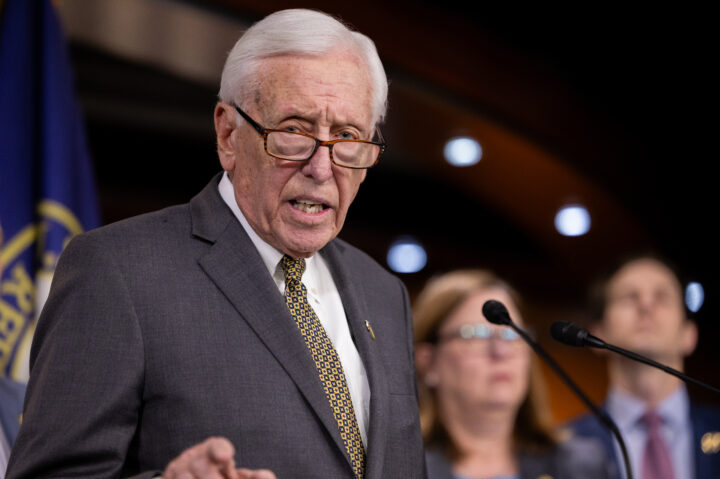
Nathan Posner/Anadolu via Getty Images
Congressman Steny Hoyer (D-MD) speaks at a press conference in Washington, DC on February 24, 2025.
Rep. Steny Hoyer (D-MD), a former House majority leader, backed the U.S. strikes on Iranian nuclear facilities, a position that puts him at odds with many other Democrats in Congress, including current Democratic leadership.
“The U.S. strike on Iranian nuclear facilities at Fordow, Natanz, and Isfahan yesterday was essential to preventing Iran from developing a nuclear weapon,” Hoyer, the longtime former No. 2 House Democrat, said in a statement released on Sunday.
He said that Iranian leaders had made clear they were not going to comply with U.S. demands to dismantle their nuclear program and had been censured by the International Atomic Energy Agency.
“Israel believed that Iran was on the verge of achieving its goal and struck Iranian nuclear sites,” Hoyer said. “Yesterday, the United States did the same, bombing Iranian nuclear facilities at Fordow, Natanz, and Isfahan. That was in keeping with our stated position against Iran’s nuclear ambitions.”
The operation, he said, “helped counter” the Iranian nuclear threat, “but America must continue working to close Iran’s path to nuclear weapons permanently.”
Hoyer characterized the strikes as a “limited, one-time operation.” Many other Democrats have raised concerns that the operation violated congressional war powers.
“These strikes were designed to dismantle Iran’s nuclear program, but neither the U.S., nor Israel, nor any other nation wants to go to war with the Iranian people, or Iran itself,” he continued.
Hoyer has long been among the most steadfast pro-Israel Democrats in Congress.
At the same time, Hoyer argued that “the threat of a nuclear-armed Iran became this dire because the Trump Administration chose to back out” of the 2015 Iran nuclear deal.
A handful of other pro-Israel congressional Democrats have come out largely in support of the strike since it took place.
Rep. Josh Gottheimer (D-NJ) described the raid as “critical and decisive action to protect America, and freedom and democracy at home and around the world.”
“The destruction of Iran’s nuclear program is essential to ultimate peace in the Middle East,” Gottheimer continued. “This is not a Democratic or Republican issue — dealing with the Iranian threat is central to America’s national security.”
Rep. Ritchie Torres (D-NY) was one of the first Democrats to support the strike against Iran Friday night. “The world can achieve peace in the Middle East, or it can accept a rogue nuclear weapons program—but it cannot have both.
The decisive destruction of the Fordow Fuel Enrichment Plant prevents the dangerous spread of nuclear weapons in the world’s most combustible region. No one truly committed to nuclear nonproliferation should mourn the fall of Fordow,” Torres wrote on X.
Sen. John Fetterman (D-PA) said “this was the correct move” by Trump and said he’s “grateful for and salute the finest military in the world.”
Rep. Jared Moskowitz (D-FL) said, “Today, the President made what appears to be a targeted strike to defend the U.S., Israel, and allies throughout the region and the world” and that he’s hopeful that Iran “no longer has the capabilities to continue its nuclear program.”
He said Iran must now commit to negotiations and make a deal. But he also warned against continued military action without congressional approval.
“I am also a firm believer in congressional authority & oversight. Any offensive action must come to Congress for a vote,” Moskowitz said. “I hope this is contained, but we are living in unprecedented times—and it’s critical our leaders work on a bipartisan basis to protect our nation.”
The top House Democrat warned that the attacks could ‘risk American entanglement in a potentially disastrous war in the Middle East’

(Photo by Drew Angerer/Getty Images)
House Minority Leader Hakeem Jeffries (D-NY) speaks during the March for Israel on the National Mall November 14, 2023 in Washington, DC.
House Minority Leader Hakeem Jeffries (D-NY) and Senate Minority Leader Chuck Schumer (D-NY) criticized President Donald Trump for carrying out strikes on Iranian nuclear facilities without congressional authorization, a voice of opposition that was echoed by many leading Democrats on Capitol Hill.
Jeffries said in a statement less than two hours after Trump announced the strikes that Trump “misled the country about his intentions, failed to seek congressional authorization for the use of military force and risks American entanglement in a potentially disastrous war in the Middle East.”
He said that the Trump administration must explain to the country why it carried out the strikes and brief Congress.
“Donald Trump shoulders complete and total responsibility for any adverse consequences that flow from his unilateral military action,” Jeffries continued.
Schumer, in a similarly critical statement, said that “no president should be allowed to unilaterally march this nation into something as consequential as war with erratic threats and no strategy” and said he would be urging all lawmakers to support war powers legislation to block further military action against Iran, and called for an immediate vote.
He said Trump must explain his actions to the American people.
“Confronting Iran’s ruthless campaign of terror, nuclear ambitions, and regional aggression demands strength, resolve, and strategic clarity,” Schumer said. “The danger of wider, longer, and more devastating war has now dramatically increased.”
Senior congressional Democrats were largely left out of the loop about the strikes before they occurred, while Republican leaders have said they were briefed.
Administration officials traditionally brief “Gang of Eight” officials — the top Republican and Democrat in each chamber and the chairs and ranking members of the Intelligence Committees — before carrying out major sensitive operations.
Sources familiar with the situation told Jewish Insider that Jeffries received a notification after the operation was likely already underway, but had not been fully briefed, and Sen. Mark Warner (D-VA), the ranking member of the Senate Intelligence Committee, was not briefed prior to the strikes.
Sources familiar with the situation told JI that House Speaker Mike Johnson (R-LA), Senate Majority Leader John Thune (R-SD) and Senate Intelligence Committee Chair Tom Cotton (R-AR) were briefed before the strikes.
Johnson pushed back on claims that the administration had illegally sidestepped Congress, saying, “Leaders in Congress were aware of the urgency of this situation and the Commander-in-Chief evaluated that the imminent danger outweighed the time it would take for Congress to act.”
“The President fully respects the Article I power of Congress, and tonight’s necessary, limited, and targeted strike follows the history and tradition of similar military actions under presidents of both parties,” Johnson continued.
Rep. Mike Lawler (R-NY) called Jeffries’ statement “an embarrassment,” saying Trump had prevented Iran from obtaining a nuclear weapon.
Many Democrats in both chambers have gone further than Jeffries in their responses, explicitly describing the strikes as unconstitutional.
“The power to declare war resides solely with Congress. Donald Trump’s unilateral decision to attack Iran is unauthorized and unconstitutional,” Rep. Katherine Clark (D-MA), the House minority whip, said. “In doing so, the President has exposed our military and diplomatic personnel in the region to the risk of further escalation. The American people, our men and women in uniform, and their families deserve answers.”
Some Democrats have also raised the prospect of impeaching Trump over the action.
“The President’s disastrous decision to bomb Iran without authorization is a grave violation of the Constitution and Congressional War Powers,” Rep. Alexandria Ocasio-Cortez (D-NY) said. “He has impulsively risked launching a war that may ensnare us for generations. It is absolutely and clearly grounds for impeachment.”
Several pro-Israel Democrats, like Sen. John Fetterman (D-PA) and Rep. Ritchie Torres (D-NY) have fully backed the strike.
“We don’t yet know what this means for the regime’s nuclear work or ambitions, but it absolutely means that the regime has been further weakened — which is good for those who want peace,” Rep. Greg Landsman (D-OH) said.
“It’s time for the Iranian regime to agree to the removal of all enriched uranium, comprehensive, around-the-clock inspections, and the full dismantling of their terror armies from Hamas to Hezbollah and the Houthis. That will end this conflict, and put the entire region on the path to a real and sustainable peace.”
“Iran is a terrorist nation, and we must do everything we can to stop it from acquiring a nuclear weapon,” Rep. Tom Suozzi (D-NY) said. “Debates will now ensue about presidential authority and the President working with Congress. The President should work with Congress, especially those of us who recognize how important it is to finally stop Iran.
Rep. Jake Auchincloss (D-MA) said that Iran should immediately end its nuclear program and stop funding terrorism, but also called for Congress to repeal the 2001 and 2002 authorizations for use of military force “so that the American public can get an open & thorough debate on war-making.”
Jewish Insider Congressional correspondent Emily Jacobs contributed to this report
‘I think I can play that role. I'm willing to do it. Certainly happy to share the spotlight with the other three [Jewish Republicans] if they wish to do it, but, but this is deeply personal to me,’ Fine told JI

Kayla Bartkowski/Getty Images
Rep. Randy Fine (R-FL) holds a seal of the House that he bought 30 years ago after he is sworn in by U.S. Speaker of the House Rep. Mike Johnson (R-LA) at the U.S. Capitol on April 02, 2025 in Washington, DC.
Rep. Randy Fine (R-FL) believes that he was sent to Congress, at least in part, to take a leading role in fighting for the Jewish community against antisemitism.
Fine, during a lengthy interview with Jewish Insider in his congressional office earlier this month, said he sees himself as having a mostly unique ability among House members to help tackle the rise of antisemitism nationwide, as one of only four Jewish Republicans in the lower chamber.
“I think I can play that role. I’m willing to do it. Certainly happy to share the spotlight with the other three [Jewish Republicans] if they wish to do it, but, but this is deeply personal to me,” the Republican firebrand said. “This affects my children and so I understand it better than others.”
He has recently taken to wearing a kippah on the Hill at the request of one of his sons, as a symbol for those in the Jewish community for those who do not feel safe doing the same.
“I believe that God puts us where he wants us to be,” Fine said, describing his quick rise from the Florida House to the state Senate — where he served for only a few months — and then to an unexpected vacancy in Congress. “This must be why. This is what He wants me to do. … I think this is one of the reasons that I am here, to solve this problem, much like we did in Florida.”
He said that he is in Congress to fight for his district, but that he believes can also be a fighter for the entire Jewish community and “everyone who believes in the idea of Judeo-Christian values.”
Fine sees the war in Gaza and the global rise of antisemitism as a civilizational battle against extremist groups — both Hamas and anti-Israel forces in the United States — that want to see a global Islamic caliphate and are “spiritual cousins” of the Nazi regime. His often-hardline rhetoric on these issues has frequently sparked controversy.
He argued that it “remains to be seen” if the House Republican caucus and leadership are serious about the issue, saying that there has been a “great willingness to pass strongly worded letters, but I didn’t come here to do strongly worded letters.”
Asked about Trump administration officials with a history of antisemitic rhetoric such as Pentagon press secretary Kingsley Wilson and Office of Special Counsel nominee Paul Ingrassia, Fine demurred, saying he wasn’t familiar with the officials or their backgrounds and would want to examine them further before speaking about them.
At another point in the interview, Fine said that President Donald Trump and members of his team know that he’s not “afraid to call [antisemitism and anti-Israel attitudes] out on our side.”
“I’ve been very critical publicly of Thomas Massie, who I think is an embarrassment to the Republican Party,” Fine volunteered, referring to the libertarian-minded House member from Kentucky. “The guy makes me sick that I have to be in the same room with him at times.”
Massie did not respond to a request for comment.
He also said that, while he hasn’t had a chance to meet many of the Jewish Democrats in Congress yet, he’s willing to “work with anyone who wants to solve this problem, but I think that it helps to have someone in the majority to take the lead.”
He named Rep. Jared Moskowitz (D-FL), a former colleague in the Statehouse and his neighbor in the House offices, as a likely Democratic partner on future efforts. He said he’d also spoken on occasion with Rep. Dan Goldman (D-NY), whose office is across the hall from Fine’s. Goldman also co-chairs the House antisemitism task force.
”The fight against antisemitism is a moral one that must cross party lines and transcend political divisions,” Goldman told JI. “I am eager to work with Congressman Fine and anyone else committed to the fight against bigotry and hate towards the Jewish community and anyone else.”
Fine argued that Florida, his home state, has developed a successful strategy for dealing with antisemitism and antisemitic violence, a trend for which he believes he holds significant responsibility, pointing to multiple pieces of legislation he passed while in the Statehouse.
Antisemitic incidents in Florida dropped 24% in 2024, but were still up 277% from 2020, according to Anti-Defamation League statistics.
“This can all be done. We largely solved this problem in Florida,” Fine said in a prior interview with JI. “If you are willing to fight, if you do not let Muslim terrorists scare you, you can win. … We do not have these same problems in Florida and it is because I fought for this for eight and a half years. This is fixable, but not if we continue to be afraid to face evil and not be afraid to call it evil.”
“All the antisemites discover free speech when it comes to the Jews. You can’t call a black student the N word and go, ‘Free speech,’” Fine said. “We said, ‘You’ve got to treat antisemitism the same way. You don’t get to discriminate in how you deal with discrimination.’ We’ve identified certain behaviors, not speech, but certain behaviors that antisemites used to target Jews. We made them illegal, and we put in huge penalties for doing them. They stopped.”
He offered as one example legislation allowing people to run over demonstrators blocking roads — ”blocking roads is a form of terrorism,” Fine said — which he said had stopped that issue in Florida.
As another example, he said that antisemitism is treated “the exact same way as racism” on college campuses in Florida. He argued that free speech has been used as a cover for antisemitic activity that would be unequivocally condemned if it targeted another minority group.
“All the antisemites discover free speech when it comes to the Jews. You can’t call a black student the N word and go, ‘Free speech,’” Fine said. “We said, ‘You’ve got to treat antisemitism the same way. You don’t get to discriminate in how you deal with discrimination.’ We’ve identified certain behaviors, not speech, but certain behaviors that antisemites used to target Jews. We made them illegal, and we put in huge penalties for doing them. They stopped.”
He added that rhetoric like “globalize the intifada” constitutes a call for violence and should be an imprisonable offense.
Fine also noted that he passed legislation to provide dedicated security funding for Jewish day schools in Florida, the first state to do so.
The newly-elected congressman told JI, in the sit-down in his congressional office, that he’s entering Congress in a different position than he did in the Florida House in 2016, when antisemitism was not an issue he expected to work on.
That changed six months into his term, when a spate of bomb threats targeted Jewish day schools in Florida. He said the Orthodox Union approached him at that time to ask him to lead the security legislation for Jewish day schools. He said he was initially reluctant to do so, given that his district contained no Jewish day schools, but was told that “you’re the only one who can.”
“It was incredibly hard to get the funding,” Fine said. “I learned from that, ‘If I don’t do this, no one else will.’ And the difference in coming to Congress is I knew walking in the door that this would be part of what I came here to do.”
His work in Florida earned him the nickname “the Hebrew Hammer,” from a friend in the Florida legislature, Sen. Joe Gruters. That nickname now adorns a plaque gifted to him by the Orthodox Union’s Teach Coalition that hangs on his congressional office’s wall — next to shofar — as well as a mezuzah on his office door.
Fine said he was initially reluctant to accept the nickname, but it caught on anyway.
Looking toward the Middle East, the Florida congressman has attracted controversy for his calls for an aggressive bombing campaign in Gaza to force Hamas into an unconditional surrender. (Contrary to some reports, Fine has denied that he wants to see the territory nuked.)
He has also argued that “Palestinians in Gaza are on a level of evil that we saw in Japan and we saw in Germany back in World War II.”
Fine’s comments about Palestinians and Muslims — he argues that support for peace and coexistence is more “radical” and unusual in the Muslim community than extremist ideologies — have elicited repeated accusations of Islamophobia.
Asked about the administration’s push for a negotiated cease-fire with Hamas, Fine described Trump as a dealmaker who believes that any deal is possible “and I hope that he’s right.” He said he believes Trump is also focused on returning the hostages.
Fine said some interim deals with Hamas may be possible along the way, but he does not anticipate that Hamas will agree to a final and full surrender “unless the pain is sufficiently great to do that.”
Beyond the war, he said that there must be a “deprogramming” effort in Gaza, similar to that undertaken in post-World War II Germany, to counter the antisemitic hate and violence inculcated in the Palestinian population. It’s a process that he said may take a long time.
“One of the biggest problems we have in the world is there is evil in this world and people refuse to acknowledge it,” Fine said, pointing to audio that circulated following the Oct. 7, 2023, Hamas-led terrorist attacks on Israel of a Palestinian mother and her son crying with joy as the son exclaimed that he had murdered Jews in the attack. “These are not like us. This is not someone that you can sit down and break bread with and just talk it out. This is someone who must be defeated,” Fine said.
Though Fine argues that extremist antisemitic sentiments are mainstream among Muslims, he said that there are countries like the United Arab Emirates that are safe for Jews, and he’d like to see a similar change among Palestinians.
He said he doesn’t have the answers at this point on which country our countries can organize and lead the deprogramming effort — in an “ideal world, it might be a UAE or a Saudi Arabia,” but they may not “want the headache.”
“It might be Israel. There are 2 million Muslims who live in Israel,” Fine said. “I don’t think Israel wants the job, but that may be the only solution. I don’t know, but what you can’t do is you can’t have terrorists run the show. That much I know.”
“What I think we need to be doing is taking out Iran’s nuclear capabilities and hope that in the process of that, the Iranian people, who are a great people, will rise up and make Persia great again,” Fine said on CNN.
Asked about the future of the West Bank — which Fine refers to as Judea and Samaria — Fine said that he would prefer that Israelis and Palestinians be able to live in peace, but he is not sure that is a possibility, suggesting that the Palestinians “may have to go to the Palestinian country and live there,” referring to Jordan, which has a large Palestinian population.
“Right now, they live in the Jewish country, so I think the best outcome is they say, ‘Hey, we want to be happy, collaborative, constructive members of Israeli society,’” Fine said. “That’s what I hope happens. I don’t think there’s any reason why everyone shouldn’t be able to get along … But I think you have something broken in that society.”
Fine, who spoke to JI prior to the start of Israel’s military campaign in Iran, has repeatedly praised Israel’s strikes, backing President Donald Trump’s approach to the conflict.
“What I think we need to be doing is taking out Iran’s nuclear capabilities and hope that in the process of that, the Iranian people, who are a great people, will rise up and make Persia great again,” Fine said on CNN.
“The overwhelming majority of Republicans stand with Israel and support what I’m supporting, which is supplying Israel with the material they need to beat this genocidal Iranian regime,” Fine added.
He has criticized individuals like Tucker Carlson who have called for the U.S. to abandon Israel, characterizing opposition to the operation as fueled by “Qatar-funded troll farms.”
“The bombings will continue until morale improves,” Fine has also said, repeatedly invoking one of his catch-phrases: “bombs away.”
Prior to the strikes, Fine said he was skeptical of Iran’s willingness to abandon its pursuit of a nuclear weapon through talks, but said he was going to trust Trump to try to reach a deal, describing a deal as preferable to a war. He emphasized that Iran cannot, under any circumstances, be allowed to have a nuclear weapon.
And he said he would not support a deal with Iran that does not address its support for terrorism — which Secretary of State Marco Rubio has said was not part of the talks — arguing that funding from sanctions relief is fungible and Iran can divert it toward malign activities.
But he also said that he did not want to “judge until I see the end product,” saying he has “a lot of confidence in the president. He has been Israel’s greatest champion, American Jews’ greatest champion. And I don’t think he’s going to sell us out.”
He noted as well that he is close to Trump and members of the administration and that Trump knew he would be coming to Congress as a Jewish member and a champion for Israel.
The freshman congressman expressed deep criticisms of Qatar, saying he was “convinced” that opposition to him in his congressional special election race, totaling around $10 million in support of his opponent’s campaign, was “largely funded by Qatar.” He suggested that out-of-state volunteers for his opponent he met on the campaign trail had been paid to come to the district.
Democrats, energized by opposition to Trump, mobilized for the race, bringing it closer than most anticipated it would be.
Asked how his views of Qatar color his opinion of the Gulf state’s offer of a Boeing 747 to the administration for use as Air Force One and Trump’s dealmaking with the Qatari government, Fine said, “I think the president, to try to resolve issues, believes sometimes in offering big carrots. He’s a big guy, big carrot, big stick. I think he’s trying to embrace them into our way of thinking. Maybe it will work.”
He said that giving the jet to the United States, purported to be worth around $400 million, will, at minimum, deprive the country of $400 million it could otherwise provide to Hamas, “but I do have real reservations about Qatar. I think there’s a lot of bad that comes out of there, and it’s a concern that I have.”
He said that the kingdom must stop its donations of millions of dollars to U.S. universities and the U.S. should dig into the Muslim Brotherhood and Qatar’s relationship with it. He suggested that Qatar’s army of lobbyists in Washington might attempt to block impending efforts to designate that organization as a Foreign Terrorist Organization.
“I don’t back down from a fight … I’m not here focused on what’s next or [an] election. I’m here to do the right thing,” Fine said. “I don’t engage in political calculations to do what I do. I think Qatar is a problem, and I think we’re gonna have to deal with it.”
‘We are deeply concerned about a lack of preparation, strategy, and clearly defined objectives, and the enormous risk to Americans and civilians in the region’

Aaron Schwartz/NurPhoto via Getty Images
Senate Democratic Leader Chuck Schumer speaks to the media during a weekly press conference in the Capitol Building in Washington DC, on Tuesday, March 12, 2024.
Asserting that President Donald Trump “owes Congress and the American people a strategy for U.S. engagement” in the Middle East, top Senate Democrats on Wednesday cautioned against potential U.S. strikes on Iran and argued that the president would need congressional authorization to conduct such an operation.
The signatories to the statement include Senate Minority Leader Chuck Schumer (D-NY) and Sens. Chris Coons (D-DE), Patty Murray (D-WA), Jack Reed (D-RI) and Mark Warner (D-VA), the top Democrats on several key Senate committees and subcommittees. The statement suggests that a direct U.S. military intervention in Iran would see little support among Senate Democrats.
Trump has indicated that he is considering carrying out strikes inside Iran but has yet to make a final decision.
“Intensifying military actions between Israel and Iran represent a dangerous escalation that risks igniting a broader regional war,” the statement reads. “As President Trump reportedly considers expanding U.S. engagement in the war, we are deeply concerned about a lack of preparation, strategy, and clearly defined objectives, and the enormous risk to Americans and civilians in the region.”
The lawmakers said they are “alarmed by the Trump administration’s failure to provide answers to fundamental questions” and demanded that the president seek authorization from Congress “if he is considering taking the country to war.”
“Congress has not provided authorization for military action against Iran – we will not rubberstamp military intervention that puts the United States at risk,” the Democrats said. “Our foremost duty is to safeguard American citizens wherever they reside and to protect our troops serving on the front lines. The United States cannot sleepwalk into a third war in as many decades. Congress has a critical role to play in this moment.”
Legislation has been introduced in the Senate to bar military action against Iran, which could come up for a vote as soon as next week.
“[Trump] owes Congress and the American people a strategy for U.S. engagement in the region. We need a clear, detailed plan outlining the goals, risks, cost, and timeline for any proposed mission, as well as how he will ensure the safe evacuation of Americans in harm’s way all across the region,” they continued. “We demand immediate, detailed answers on these and other urgent matters to determine the way forward.
At the same time, the statement describes Iran as a threat to the U.S. and its allies that “must not be allowed to attain a nuclear weapon.”
“The United States stands firm in our support for the continued defense of Israel, our partner and ally,” they said. “Our commitment to Israel remains ironclad and we urge the administration to defend Israel against the barrage of Iranian airstrikes, including through the provision of additional air defense capabilities.”
‘It was just astonishing to see colleagues criticizing these things,’ Fetterman told JI

Lev Radin/Pacific Press/LightRocket via Getty Images
Senator John Fetterman speaks during the grand opening of The Altneu synagogue.
Sen. John Fetterman (D-PA) criticized his Democratic colleagues in Congress who have spoken out against Israel’s attack on Iran, calling it “astonishing” to see members of his party treat Israel’s actions as escalatory.
Fetterman spoke to Jewish Insider on Friday for an interview in the wake of Israel launching its military operation to take out Iran’s nuclear facilities and prevent the regime from acquiring a nuclear weapon.
The Pennsylvania senator said he could not fathom how some Democrats on Capitol Hill could accuse the Jewish state of launching the strikes to upend the Trump administration’s nuclear negotiations with Tehran.
Fetterman didn’t mention any of his Democratic colleagues by name, but many have been critical of the Iranian strikes. Sen. Chris Murphy (D-CT), for instance, went on MSNBC’s “Morning Joe” Friday morning and said that Israel’s strike on Iran was “pretty transparent that this was an effort to submarine, to undermine our diplomacy.”
“It was just astonishing to see colleagues criticizing these things. It’s like, do you think you can negotiate with that regime? Do you think you want to run that scenario and allow them to acquire 1,000 pounds of weapons grade uranium? I can’t understand, I can’t even begin to understand that,” Fetterman told JI.
“I can’t imagine why they would say that. Remember, Iran tries to acquire nuclear weapons. Iran has created and spent billions of dollars to build those destructive proxies like Hamas or Hezbollah or the Houthis. Why can’t we talk about that? Why can’t we talk about the absolute imperative to keep Iran accountable for what they’ve done? That’s exactly part of what Israel did last night, as well,” he continued.
The Pennsylvania Democrat praised the opening salvos of the operation as “absolutely spectacular,” citing the “precision in targeting people.”
”They eliminated the generals and those scientists in their beds at their building, and they didn’t take out the whole building. It was just their specific apartments. I mean, that is truly remarkable. … It’s like Beepers 2.0, the kind of things they’ve done. Like I said, I am constantly blown away by the sophistication and their lethality,” Fetterman said, referring to the Israeli pager operation that took out senior Hezbollah leaders.
“I think I might have been the only one openly calling for that [striking the nuclear facilities now]. I’m never going to negotiate with that regime. You can never trust them, and the only thing they’re going to respond to, that they respect, are exactly the kind of things that [Israel] did last night. … Any potential path for an enduring peace in the Middle East, these are the kind of steps that do that,” he added.
Fetterman disputed the narrative that the U.S. supporting Israel in targeting Iran’s nuclear facilities could increase the prospect of a regional war. “If Iran is going to take their big, big swing, they would have done that by now. Just imagine how exposed they are, even how [exposed] they were earlier this year after what Israel had done taking out Hezbollah,” he told JI.
“Hezbollah ain’t talking tough anymore. They’re not talking about any kinds of actions, they’re just whimpering, and that’s my point. Iran can’t fight for s**t. … They just shot their big shot, a couple junkie rockets, and it’s like, that’s what you’ve got?” Fetterman asked.
'I think the timing just becomes all that much more important,' Rep. Brad Schneider (D-IL), who is leading the trip, told JI

Alex Brandon/AP Photo
Israeli Prime Minister Benjamin Netanyahu, United Arab Emirates Foreign Minister Abdullah bin Zayed al-Nahyan and Bahrain Foreign Minister Khalid bin Ahmed Al Khalifa, stand on the Blue Room Balcony during the Abraham Accords signing ceremony on the South Lawn of the White House, Tuesday, Sept. 15, 2020, in Washington.
A bipartisan group of lawmakers is departing today for Saudi Arabia, the first leg of an Abraham Accords-themed congressional delegation that also plans to visit Bahrain, the United Arab Emirates and Israel and meet with leaders in each country. Rep. Brad Schneider (D-IL), who is leading the delegation, told Jewish Insider that the trip will take place even as Israeli strikes against Iran continue.
“I think the timing just becomes all that much more important,” Schneider said in an interview on Friday. “Last night, Iran took a significant hit to its nuclear program and its military. So I think and hope maybe it opens up possibilities. We’ll find out.”
Other members attending the trip, which is hosted by the Atlantic Council’s N7 Initiative, include Reps. Don Bacon (R-NE), Jimmy Panetta (D-CA) and Zach Nunn (R-IA).
“During these times of instability in the region, support for the Accords is necessary to enhance Israel’s security and stability, as well as a way to counter threats posed by Iran,” Bacon said in a statement.
It has been nearly five years since Israel normalized ties with the UAE, Bahrain and Morocco in the Abraham Accords, which were widely viewed not just as a diplomatic accord but also a counterweight to Iran’s influence in the region.
“The Arab countries around Israel remain committed to this idea of a better future, a pathway to peace, and I believe the Abraham Accords are that path,” said Schneider. “The purpose of the trip, before the strikes against Iran, was to talk about that. That doesn’t change.”
Plus, will the Knesset dissolve today?

Tom Williams/CQ-Roll Call, Inc via Getty Images
Speaker of the House Mike Johnson (R-LA)
Good Wednesday morning.
In today’s Daily Kickoff, we report on CENTCOM head Gen. Erik Kurilla’s comments that the Trump administration has been presented with a military option to eliminate Iran’s nuclear program, and spotlight Wayne Wall, who is now leading Middle East policy at the National Security Council. We cover last night’s Capitol Hill vigil for the Israeli Embassy staffers killed in a terror attack at the Capital Jewish Museum last month, and report on the Treasury Department’s levying of sanctions on charities and individuals with ties to Hamas and the People’s Front for the Liberation of Palestine. Also in today’s Daily Kickoff: Argentine President Javier Milei, Michael Bloomberg and Ben Black.
What We’re Watching
- The House Homeland Security Committee’s Subcommittee on Counterterrorism and Intelligence will hold a hearing this morning probing the rising influence of anti-Israel extremist groups as a threat to U.S. national security. Representatives from the Anti-Defamation League, Secure Community Network, American Jewish Committee and Heritage Foundation are slated to testify. Read more here.
- Defense Secretary Pete Hegseth will testify this morning before the Senate Appropriations Committee on the Pentagon’s FY 2026 budget, the second of three hearings for Hegseth this week.
- The House Ways and Means Committee is holding a hearing this morning with Treasury Secretary Scott Bessent. In the afternoon, Bessent will appear before the Senate Appropriations Committee to discuss the Trump administration’s FY 2026 budget for the Treasury Department.
- The Auschwitz Jewish Center Foundation is celebrating its 25th anniversary gala dinner tonight in New York City, where the organization will honor CNN commentator Van Jones.
- Elsewhere in New York, United Hatzalah is holding its annual gala. Middle East envoy Steve Witkoff is slated to address the gathering, which is chaired by Dr. Miriam Adelson.
- In Israel, a preliminary vote will be held today on a motion to dissolve the Knesset. More on this below.
- Also in Jerusalem, Argentine President Javier Milei will be awarded the Genesis Prize at the Knesset this evening.
What You Should Know
A QUICK WORD WITH JOSH KRAUSHAAR
Rep. Mikie Sherrill (D-NJ) comfortably prevailed in New Jersey’s Democratic gubernatorial primary last night, translating strong fundraising and backing from numerous party leaders into a double-digit margin of victory in the six-candidate field. With most of the ballots tallied, Sherrill won just over one-third of the Democratic vote.
Sherrill, a pragmatic suburban lawmaker and military veteran, will face Republican former state Rep. Jack Ciattarelli in the November general election. Boosted by President Donald Trump’s endorsement, Ciattarelli easily won the GOP nomination.
Sherrill continues the trend of moderate-minded candidates prevailing in recent Democratic primary fights. Three of her Democratic opponents ran to the congressman’s left, with left-wing Newark Mayor Ras Baraka even getting arrested at a federal immigration facility. That activist messaging didn’t end up winning him much traction in the race.
Baraka’s anti-Israel record and past praise of Louis Farrakhan concerned Jewish leaders, but he ultimately finished well behind Sherrill, in second place with 20% of the vote.
Rep. Josh Gottheimer (D-NJ) ran to the center in the race, spent heavily and worked hard to win over the significant Jewish vote in the state, landing key endorsements from several Orthodox groups. But aside from handily winning his home county of Bergen, he struggled to make inroads in other parts of New Jersey, tallying 12% of the vote. (In Ocean County, where the congressman picked up a key endorsement of the Lakewood Vaad, he lagged in third place.)
TEHRAN TACTICS

Gen. Michael “Erik” Kurilla, the top U.S. military commander in the Middle East, said Tuesday under questioning from the House Armed Services Committee that he had provided “a wide range of options” to Secretary of Defense Pete Hegseth and President Donald Trump for carrying out U.S. military strikes on Iran’s nuclear program if negotiations with Tehran fail to achieve the dismantlement of its nuclear program, Jewish Insider’s Marc Rod reports.
Houthi headache: Asked about the U.S. ceasefire with the Houthis, Kurilla and another Pentagon official said that the U.S. bombing campaign had achieved the goal Trump had set out of restoring freedom of navigation for U.S. ships through the Red Sea. While the ceasefire made no provisions to halt Houthi attacks on Israel, which have continued, Kurilla insisted that the U.S. is continuing to defend Israel through the operation of an American THAAD missile defense system in Israel and other efforts to intercept Houthi missiles and drones. He acknowledged that normal commercial traffic through the region has not yet resumed, but said that it would be a “lagging indicator” that would increase over time.
Scoop: Sen. Lindsey Graham (R-SC) is set to introduce a resolution affirming that the only acceptable outcome of U.S. nuclear talks with Iran would be the total dismantlement of its enrichment program. Graham says he hopes to introduce the legislation on Thursday, Jewish Insider’s Emily Jacobs has learned.
going nuclear

With a cryptic video that Director of National Intelligence Tulsi Gabbard posted on X on Tuesday morning, the Democratic-congresswoman-turned-America-First-advocate reignited simmering concerns about the unorthodox intelligence chief among both her longtime detractors and some Republicans who voted to confirm her earlier this year, Jewish Insider’s Gabby Deutch and Emily Jacobs report. In the social media video, Gabbard describes a recent visit to Hiroshima, Japan, where she learned about the toll of the atomic bomb dropped on the city by American troops in 1945, which spurred a Japanese surrender and the end of World War II. She warned that the world faces another “nuclear holocaust” unless people “reject this path to nuclear war.”
Backlash: “She obviously needs to change her meds,” Sen. John Kennedy (R-LA) told JI of Gabbard. Kennedy, like all Republicans except Sen. Mitch McConnell (R-KY), voted to confirm Gabbard in February. “I only saw a post that she did, which I thought was a very strange one since many people believe that, unfortunate though it was, the nuclear bomb that was dropped in World War II at Hiroshima actually saved a lot of lives, a lot of American lives,” Sen. Susan Collins (R-ME) told JI of Gabbard’s video.
Defense: Alexa Henning, Gabbard’s deputy chief of staff, declined to say whether Gabbard was referring in the video to a specific nation or to specific people. “Acknowledging the past is critical to inform the future. President Trump has repeatedly stated in the past that he recognizes the immeasurable suffering, and annihilation can be caused by nuclear war, which is why he has been unequivocal that we all need to do everything possible to work towards peace,” Henning said in a statement. “DNI Gabbard supports President Trump’s clearly stated objectives of bringing about lasting peace and stability and preventing war.”
Read the full story here with additional comments from Sens. John Cornyn (R-TX), Lindsey Graham (R-SC) and Markwayne Mullin (R-OK).
WAYNE’S WORLD

Wayne Wall, an under-the-radar former military and intelligence official, is now the National Security Council’s senior director for the Middle East, a source familiar with the situation told Jewish Insider’s Marc Rod.
New face: Wall’s public record and online presence is minimal — a LinkedIn page matching his background appears to have recently been deleted, and his X account has no active posts. Searches indicate that he was, until earlier this year, active on the platform but has since deleted all of his posts and replies. Several conservative and pro-Israel leaders outside of government and on the Hill contacted about Wall said they were not familiar with him until rumors began to circulate about his appointment to the NSC, which was not announced publicly. The NSC has not responded to requests for comment about his appointment.
Rayburn roadblocks: Joel Rayburn, the Trump administration’s nominee to be assistant secretary of state for Near Eastern affairs, faces a difficult path to confirmation, with no Democrats on the Senate Foreign Relations Committee expected to support him, leaving the vote to move him to full Senate consideration deadlocked, Jewish Insider’s Marc Rod reports.
REMEMBRANCE AND VIGILANCE

House Speaker Mike Johnson (R-LA) sharply denounced the anti-Israel movement on Tuesday, describing it as making common cause with terrorists and putting “a bounty on the heads of peace-loving Jewish Americans,” Jewish Insider’s Marc Rod reports.
Notable quotable: “‘Free Palestine’ is the chant of a violent movement that has found common cause with Hamas,” Johnson said. “It’s a movement that has lost hold of the difference between right and wrong, between good and evil, between light and darkness … They proclaim that violence is righteous, that rape is justice and that murder is liberation. They have created a culture of lies that puts a bounty on the heads of peace-loving Jewish Americans.”
Bonus: Punchbowl News reports this morning that Johnson is slated to travel to Israel, arriving on June 22. Johnson will reportedly meet with Israeli Prime Minister Benjamin Netanyahu and address the Knesset in a rare Sunday session.
COALITION CRISIS

The Knesset is set to hold a preliminary vote today to trigger an early election — and crucial partners in Israeli Prime Minister Benjamin Netanyahu’s coalition are threatening to support it. For the past week, Haredi parties have said they would vote in favor of legislation that would dissolve the Knesset and schedule an election for this fall. The parties, Shas and United Torah Judaism, are threatening to jump ship because the coalition has not passed a law to continue the long-standing exemption for full-time yeshiva students from IDF conscription, Jewish Insider’s Lahav Harkov reports.
Scrambling for a solution: Without Shas and UTJ, Netanyahu’s coalition would be left with 50 members, far short of the 61-seat majority he needs to keep his government afloat. As such, Netanyahu and his allies have been frantically trying to negotiate a compromise that will keep the Haredi parties in the fold. Past laws exempting young Haredi men from military service have expired and a new one has not been passed, leading the High Court of Justice to order the government last year to actively conscript them.
Meanwhile: The IDF plans to send 54,000 draft notices in July to Haredim, who will be given conscription dates spread over the next year, the head of the IDF Personnel Directorate’s Planning and Personnel Management Division, Brig.-Gen. Shay Tayeb, told a Knesset committee this morning. The IDF plans to stop allowing institutions to report that their students will not be enlisting and instead have individuals be responsible for their own response, which Tayeb said is meant to streamline enforcement against those who avoid the draft. In addition, the military plans to scale up its enforcement efforts, including greater cooperation with the civilian police to arrest draft-dodgers throughout the country as opposed to mostly at Ben Gurion Airport, currently the major site of enforcement.
terror tag

The Treasury Department imposed sanctions on Tuesday on several individuals and charities that the U.S. alleges are connected to the terrorist groups Hamas and the Popular Front for the Liberation of Palestine, Jewish Insider’s Haley Cohen reports.
Treasury statement: “Today’s action underscores the importance of safeguarding the charitable sector from abuse by terrorists like Hamas and the PFLP, who continue to leverage sham charities as fronts for funding their terrorist and military operations,” Michael Faulkender, the department’s deputy secretary, said in a statement. “Treasury will continue to use all available tools to prevent Hamas, the PFLP, and other terrorist actors from exploiting the humanitarian situation in Gaza to fund their violent activities at the expense of their own people.” The sanctions will target “five individuals and five sham charities located abroad that are prominent financial supporters of Hamas’s Military Wing and its terrorist activities,” the Treasury Department said, as well as a separate fraudulent charity linked to the PFLP.
Worthy Reads
Name the Oct. 7 Terrorists: In The Washington Post, Patrick Desbois, a Catholic priest whose Yahad-In Unum organization investigates mass killings, calls for the names of the perpetrators of the Oct. 7, 2023, Hamas terror attack to be made public. “Every terrorist who has imprisoned, assaulted or killed a hostage has a name. An address. A job. A family. A life story that should be made public. Each murder, rape and kidnapping on or since Oct. 7 was a terrorist act, but it was also a crime. And while terrorists should be neutralized, crimes should be investigated. Otherwise, deniers will flourish because, without a criminal, there is no crime.” [WashPost]
Iran Deal Déjà Vu: The New York Times’ David Sanger and Farnaz Fassihi look at the similarities between the Obama administration negotiations with Iran that led to the 2015 Joint Comprehensive Plan of Action and President Donald Trump’s efforts to reach a nuclear agreement with Tehran. “To Mr. Trump and his special envoy, Steve Witkoff, the negotiations with Iran are a new experience, and Iran’s insistence that it will never surrender its ability to enrich uranium on its soil threatens to scuttle an agreement that the president only a few weeks ago confidently predicted was within reach. But it is almost exactly the same vexing dilemma that President Barack Obama faced a decade ago. Reluctantly, Mr. Obama and his aides concluded that the only pathway to an accord was allowing Iran to continue producing small amounts of nuclear fuel, keeping its nuclear centrifuges spinning and its scientists working.” [NYTimes]
Word on the Street
President Donald Trump said that Iran has been acting “much more aggressive” in recent days, ahead of the next round of nuclear talks, slated to begin on Thursday…
Iranian Defense Minister Aziz Nasirzadeh threatened that Tehran could strike American bases in the region if nuclear talks fail and a military conflict with the U.S. arises…
U.S. Ambassador to Israel Mike Huckabee told Bloomberg there is “no room for” a Palestinian state, “unless there are some significant things that happen that change the culture,” suggesting that such a scenario was unlikely to happen “in our lifetime”; Huckabee also suggested that a Palestinian state could be created elsewhere in the Arab world, rather than in the West Bank…
The House Appropriations Committee‘s proposal for 2026 Defense funding suggests providing a total of $122.5 million for U.S.-Israel cooperative development programs, in addition to the regular $500 million for joint missile defense programs…
Ben Black, President Donald Trump’s nominee to lead the U.S. International Development Finance Corporation, had his confirmation hearing before the Senate Foreign Relations Committee on Tuesday, Jewish Insider’s Emily Jacobs reports…
Former New York City Mayor Michael Bloomberg endorsed former New York Gov. Andrew Cuomo ahead of the city’s upcoming Democratic mayoral primary; Bloomberg praised Cuomo’s for having “governed as a pragmatist, focused on solving problems rather than engaging in ideological or partisan warfare”…
The majority Satmar faction in Brooklyn, which represents the largest Hasidic voting bloc in New York City, is backing Cuomo for mayor, lending what is likely to be a major boost to his campaign in the final days of the increasingly competitive Democratic primary, Jewish Insider’s Matthew Kassel reports…
Arizona Gov. Katie Hobbs vetoed legislation that would have prohibited educators in the state from, among other things, teaching or promoting antisemitism and advocating for antisemitic points of view…
A recently unsealed criminal complaint against a Pakistani national revealed that the man, who had been residing in Canada, had planned to carry out a “coordinated assault” on Jewish targets in New York City; Muhammad Shahzeb Khan was apprehended in September 2024, weeks before he planned to carry out an attack on the anniversary of the Oct. 7, 2023, Hamas terror attack…
Protests against Immigration and Customs Enforcement deportations that have engulfed San Francisco’s streets this week took an antisemitic turn on Monday night when a local Jewish-owned civic engagement hub and community space had its windows smashed and walls defaced with slurs including “Die Zio,” “The Only Good Settler is a Dead One,” “Death 2 Israel is a Promise” and “Intifada,” Jewish Insider’s Haley Cohen reports…
Leaders of the Executive Council of Australian Jewry are suing a Muslim cleric in Sydney, Australia, alleging he used dehumanizing language in his sermons that “denigrate[d] all Jewish people”…
Australia, Canada, New Zealand, Norway and the U.K. jointly announced sanctions on Israeli Finance Minister Bezalel Smotrich and National Security Minister Itamar Ben-Gvir, saying the two members of Israel’s ruling coalition had repeatedly “incit[ed] violence against Palestinians”…
The Wall Street Journal looks at the Gaza Humanitarian Foundation’s operations amid mounting distribution, logistical and leadership challeges…
Andreessen Horowitz is looking to recruit veterans of elite IDF units for its a16z speedrun accelerator program…
Calcalist reports on the draft agreement between the Jewish National Fund and Gary Barnett’s Extell Israel that would exchange JNF’s rights to some of its land in Jerusalem for some of Barnett’s high-profile properties in the city, and the larger debate over housing and urban renewal in the Israeli capital…
Argentina’s Supreme Court upheld former President Cristina Fernández de Kirchner’s six-year prison sentence and lifetime ban on holding political office; Kirchner is facing additional legal issues, including allegations that she conspired with Iran to hide its ties to the 1994 bombing of the AMIA Jewish community center in Buenos Aires…
Pic of the Day

Israeli President Isaac Herzog (right) met with Argentine President Javier Milei on Tuesday in Jerusalem. Herzog presented Milei with a replica of a silver amulet that was discovered in the upper Hinnom Valley that contained a fragment of the Jewish “Priestly Blessing” prayer.
Birthdays

Columbus, Ohio-based retail mogul, chairman of American Eagle Outfitters, Value City Department Stores, DSW and others, sponsor of ArtScroll’s translation of the Babylonian Talmud, Jay Schottenstein turns 71…
Heir to the British supermarket chain Sainsbury’s, minister in two British governments under prime ministers Major and Thatcher, Sir Timothy Alan Davan Sainsbury turns 93… Executive director of NYC-based government watchdog Citizens Union, she was elected as NYC’s public advocate in 2001 and reelected in 2005, Elisabeth A. “Betsy” Gotbaum turns 87… Chief spokesperson for AIPAC since 2012, Marshall Wittmann turns 72… Member of the Knesset for the Agudat Yisrael faction of the United Torah Judaism party, Meir Porush turns 70… Hedge fund manager and owner of MLB’s New York Mets, Steven A. Cohen turns 69… Past president and national board member of AIPAC, he is a senior advisor to Illinois Gov. JB Pritzker, Lee “Rosy” Rosenberg… Former director of the Israeli Shin Bet, Yuval Diskin turns 69… Member of the Knesset for the Shas party, now serving as minister of labor, Yoav Ben-Tzur turns 67… New Windsor, N.Y., attorney, Barry Wolf Friedman… Political and social justice activist, she served as Illinois state representative and as human rights commissioner, Lauren Beth Gash turns 65… Opinion columnist for The Washington Post until earlier this year, now writing on Substack, Jennifer Rubin turns 63… Partner in the D.C. office of worldwide consulting firm, Brunswick Group, Michael J. Schoenfeld… President of J Street, Jeremy Ben-Ami turns 63… Deputy director of the CIA in the Biden administration, he held the same role in the last two years of the Obama administration, David S. Cohen turns 62… Deputy assistant secretary in the Office for Civil Rights at the U.S. Department of Education during the Biden administration, Matt Nosanchuk… Professor of Jewish thought at the University of Haifa, Josef Hillel “J.H.” Chajes turns 60… Founder of Shabbat[dot]com, he also serves as the national educational director for Olami Worldwide, Rabbi Benzion Zvi Klatzko… Dean of TheYeshiva[dot]net, Rabbi Yosef Yitzchak (YY) Jacobson turns 53… Commissioner of the Food and Drug Administration from 2017 until 2019, now a senior fellow at the American Enterprise Institute, Dr. Scott Gottlieb turns 53… Budget director at the City Council of the District of Columbia, Jennifer Budoff… Israeli businesswoman and philanthropist, she participated in two seasons of the Israeli reality show “Me’usharot,” Nicol Raidman turns 39… Director of communications and programming at Academic Engagement Network, Raeefa Shams… Actor, performance artist and filmmaker, Shia LaBeouf turns 39… Retired figure skater who competed for Israel in the team event at the 2018 Winter Olympics, Aimee Buchanan turns 32… Olympic medalist in canoe slalom in London, Rio, Tokyo and Paris, Jessica Esther “Jess” Fox turns 31… Israeli attorney and CEO of Dualis Social Venture Fund, Dana Naor…
Gen. Erik Kurilla, the top U.S. commander in the Middle East, said he’d presented a ‘wide range of options’ for strikes on Iran’s nuclear program if talks fail to achieve dismantlement

Department of Defense/EJ Hersom via AP
U.S. Army Gen. Michael E. Kurilla, commander of U.S. Central Command, testifies before the House Armed Services Committee, March 21, 2024, on Capitol Hill in Washington.
Gen. Michael “Erik” Kurilla, the top U.S. military commander in the Middle East, said on Tuesday that he had provided “a wide range of options” to Secretary of Defense Pete Hegseth and President Donald Trump for carrying out U.S. military strikes on Iran’s nuclear program if negotiations with Tehran fail to achieve the dismantlement of its nuclear program.
Kurilla affirmed, under questioning from the House Armed Services Committee, that the military is prepared for a strong show of force against Iran if it refuses to give up its nuclear program. He said that Iran is continuing to increase its stockpiles of uranium enriched to 60% purity, for which he said there are no legitimate civilian uses.
Kurilla added that Iran is in a “weaker strategic position” than it was pre-Oct. 7, but still maintains “a lot of operational capabilities, in terms of their long-range weapons.”
He also emphasized that China, in purchasing the majority of Iran’s exported oil, is “effectively supporting and financing Iran’s malign behavior.” He said that the administration’s moves to sanction “teapot refineries” in China were a major step.
Kurilla said that a stand-alone Israeli strike on Iran’s nuclear program would increase the risk of attacks on U.S. forces in the region, but added that “every day, we’re making assessments of our posture and our risk to force, and we made adjustments based on those. We’re fielding new systems and new equipment and making adjustments every single day.”
Pressed by Rep. Pat Ryan (D-NY) about Michael DiMino, the deputy assistant secretary of defense for the Middle East, who had previously downplayed U.S. interests in the region and opposed action against Iran and its proxies, Katherine Thompson, the acting assistant secretary of defense for international security affairs, largely demurred, saying that she was not involved in DiMino’s hiring and could not speak to his positions.
She said that her superior, Elbridge Colby, the undersecretary of defense for policy who himself made comments opposing strikes on Iran, which he walked back during his confirmation process, is in line with the administration’s policy.
“We support the president’s objective to not only, first and foremost, defend the State of Israel but second, of course, deny Iran the ability to obtain a nuclear weapon. That is something that we are 100% committed to,” Thompson said. “I will also note that we support the president’s objectives and stand ready to provide military options should his strategy of pursuing peace with Iran through a negotiated solution [fail].”
Ryan said that he was concerned that “dissonance” and “lack of clarity” in the administration’s public statements on its willingness to allow Iran to enrich uranium as part of an agreement was signaling “division and weakness to our adversaries.”
Asked about the U.S. ceasefire with the Houthis, Kurilla and Thompson said that the U.S. bombing campaign had achieved the goal Trump had set out of restoring freedom of navigation for U.S. ships through the Red Sea. Kurilla pointed to a recent transit of U.S. and allied naval vessels through the Red Sea as evidence.
While the ceasefire made no provisions to halt Houthi attacks on Israel, which have continued, Kurilla insisted that the U.S. is continuing to defend Israel through the operation of an American THAAD missile defense system in Israel and other efforts to intercept Houthi missiles and drones fired at the Jewish state.
He acknowledged that normal commercial traffic through the region has not yet resumed, but said that it would be a “lagging indicator” that would increase over time as insurance rates for commercial ships transiting the region drop.
Thompson said that the U.S. is not fully withdrawing from the Houthi issue, noting that the group is still designated as a Foreign Terrorist Organization by the U.S., and said the administration continues to pursue a “whole of government approach” to the Iran-backed group.
She said the U.S. is working to have Gulf partners take a greater role in countering the Houthis and “develop a regional solution that empowers our Gulf partners … to tackle the long-term elements of the problem set.”
Kurilla said that permanently ending the Houthi threat will require stopping covert shipments of weapons and weapon components from Iran to Yemen.
“They would die on the vine without Iranian support,” Kurilla said, adding that Islamic Revolutionary Guard Corps personnel remain on the ground in Yemen assisting with assembling and operating those weapons.
Pressed at one point by Rep. Derek Van Orden (R-WI) on why the U.S. is not sinking ships bringing weapons to the Houthis, Kurilla responded that the key challenge has been identifying the ships and the weapons among the many ships transiting the vast area of the Red Sea. But he said that when such ships are identified, the U.S. can and has intercepted and captured them.
Thompson said that European allies have taken positive steps toward collaborating on this mission and Kurilla said that the United Nations’ inspection mechanism for Yemen had also recently taken steps to increase inspections of containers, though he said that it should require the full unloading of all containers to verify their contents.
He also noted that the Houthis have been spreading across the region their knowledge and expertise gained from upgrading Iranian drones to attack Israel. He said the group and its personnel have a presence in Iraq and are sharing technical expertise with Iranian personnel as well as members of Iranian proxy groups in Iraq and Lebanese Hezbollah.
He said that the Houthis also maintain cells in Syria and Lebanon and have conducted diplomatic outreach to Russia and China.
But, Kurilla continued, Iran’s vision of a “Shia crescent” through the Middle East has collapsed with the fall of the Syrian government — ”probably the single biggest event that has happened in the Middle East” — and the degrading of Hezbollah and other Iranian proxies.
He praised Israel’s success against Iran’s proxies, at one point describing its “disintegration” of Hezbollah as “brilliant” and saying that it should be studied by every military in the world.
He said that Iran is attempting to make inroads into Iraq, but that the Iraqi government has largely rejected them.
“I would offer there has rarely been a time with greater opportunity to protect [our] national interests [in the Middle East], but only if we have the courage to step through that window,” said Kurilla, who will soon be retiring after 37 years in military service.
According to public reporting, Kurilla has largely been seen as a hawkish voice in the Trump and Biden administrations and a close ally of Israel.
Kurilla said the U.S. is “transitioning from security guarantor to security integrator” in the Middle East, which requires the U.S. to maintain a “sufficient and a sustainable posture” in the region, as well as to improve foreign military sales to partners in the region.
Asked at multiple points about Qatar’s reliability as a U.S. ally, Kurilla defended Doha as a reliable and eager partner. He said that the U.S. is working to bring Qatar into the military supply chain to repair and manufacture shared weapons systems, noting that it had been enlisted to repair a component of a Patriot missile defense system the previous week.
“We have a phenomenal relationship with them, military-to-military,” Kurilla said. “They have been incredibly supportive of everything we do. Generally, the answer is, ‘Yes, what is the question,’ when I talk to them.”
Kurilla said that U.S. partners are also critical to anti-terrorist missions in places such as Syria and Iraq, and allow the U.S. to keep its operating force in the Middle East relatively small, even as those troops in the Middle East have repeatedly been on the front lines in the past year.
In Syria, he said that the U.S. is working with Kurdish partners, the Syrian Democratic Forces, to integrate them into the new Syrian government, and said that Turkey is playing a positive role in those efforts.
But he also warned that the current Syrian government is being run by a small group of individuals and that he is deeply concerned about its stability, saying President Ahmed al-Sharaa may also bring foreign terrorist fighters, who helped bring his government to power, into the fold.
He said that U.S. troops remain in-country for counterterrorism missions, including one carried out against ISIS forces the morning of the hearing. But he said the U.S. is currently undertaking a process to review and consolidate its forces inside Syria into a smaller number of bases.
Kurilla further said that a key obstacle for U.S. relationships and goals in the region has been delays in U.S. foreign military sales to allies, frustrating those partners and imperiling efforts to integrate U.S. and allied systems across the region. He cited obstacles in the Defense Department, Congress and the defense production industry.
For the U.S.’ own purposes, he also noted that U.S.-produced air-defense systems are significantly more expensive than systems such as the Arrow, which is co-produced with Israel.
He added that the U.S. had learned much, particularly in improving technical and software capacities for air defense systems, from its ongoing operations in the Middle East.
Multiple Democrats pressed Kurilla on what role the U.S. military could play in delivering aid to civilians in Gaza. Kurilla said that the U.S. government is currently not involved in aid delivery, but highlighted the efforts of the Gaza Humanitarian Foundation as a positive step.
“Hamas hates that because Hamas no longer has control over that distribution,” Kurilla said.
He said the military would be prepared to assist if asked to do so.
The House speaker joined Minority Leader Hakeem Jeffries and others for a vigil honoring Yaron Lischinsky and Sarah Milgrim, killed in the Capital Jewish Museum shooting

Marc Rod
Lawmakers gather on the Capitol steps on June 10, 2025 for a vigil for Yaron Lischinsky and Sarah Milgrim, Israeli Embassy staffers who were killed in an anti-Israel attack.
House Speaker Mike Johnson (R-LA) sharply denounced the anti-Israel movement on Tuesday, describing it as making common cause with terrorists and putting “a bounty on the heads of peace-loving Jewish Americans.”
Johnson gathered on the steps of the Capitol with House Minority Leader Hakeem Jeffries (D-NY), dozens of members of Congress, Israeli Ambassador to the U.S. Yechiel Leiter, American Jewish Committee CEO Ted Deutch, hostage family members including Ronen Neutra and staff from the Israeli Embassy and AJC for a vigil honoring Yaron Lischinsky and Sarah Milgrim, the Israeli Embassy employees killed by an anti-Israel activist outside an AJC event at the Capital Jewish Museum last month.
“It’s a dangerous time to be a Jewish American,” Johnson said, noting that the House had taken extra precautions to keep the event under wraps for security reasons. Visible and covert security surrounded the gathering.
“The monster who murdered [Lischinsky and Milgrim] was not motivated by peace, [but] something very different. He went to a Jewish museum to hunt down Jewish people, and we want to be crystal clear tonight: This is targeted antisemitic terrorism,” Johnson said. “There are no shades of gray. There is no other way to describe it, as we’ve seen in the weeks since this violence is definitely not isolated.”
He said that the D.C. shooter and the individual who attacked a march for the hostages in Gaza in Boulder, Colo., were “united in their sick hatred of the Jewish people.” He highlighted that both shouted “Free Palestine” during their attacks, a slogan he noted has proliferated at protests on college campuses and in American cities.
“‘Free Palestine’ is the chant of a violent movement that has found common cause with Hamas,” Johnson said. “It’s a movement that has lost hold of the difference between right and wrong, between good and evil, between light and darkness … They proclaim that violence is righteous, that rape is justice and that murder is liberation. They have created a culture of lies that puts a bounty on the heads of peace-loving Jewish Americans.”
Jeffries described the shooting as domestic terrorism and said Lischinsky and Milgrim were “victims of the same deadly antisemitism that fueled the attacks in Boulder, the attack at Gov. Josh Shapiro’s home in Pennsylvania, at synagogues, yeshivas, businesses and communities all across America.”
“Antisemitism has been a painful reality of Jewish life throughout the world for thousands of years, but now too many of our Jewish brothers and sisters here in America fear for their safety,” Jeffries said. “In this country, antisemitism has been metastasizing like a malignant tumor, and we must all work together to eradicate this cancer.”
Referencing the week’s Torah portion, when God instructed Moses to appoint elders to help him lead the Jewish people through the desert after leaving Mount Sinai, Jeffries said that lawmakers from both parties need to step up to help the Jewish community fight antisemitism.
“We will not let you shoulder this burden alone,” Jeffries said. “That’s a moral necessity here in the United States of America.”
Leiter said that “the intifada has been globalized, and like [George] Orwell’s ‘1984,’ ‘Free, free Palestine’ means ‘Death, death Israel,’ and it is now incumbent upon all of us to confront it,” Leiter said. “Today we are challenged to act, to honor the fallen, not just with words, but with a renewed commitment to fighting the scourge of hate, fighting the demonization and delegitimization of the State of Israel.”
AJC’s Deutch said that “antisemitism is antisemitism, period. There should be no more debate about which kind of antisemitism is more dangerous, or which we need to be more afraid of.”
“It is clear every antisemitism is and has been deadly, from the extreme left to the extreme right,” Deutch said. “Both must be condemned by everyone, no excuses, because if you can only see antisemitism when it is convenient then you’re not seeing it at all.”
He described the demonization of Israel and trends of blaming it for “every injustice in the world” as the “current socially acceptable form of antisemitism,” which has “sanitized” the hatred.
“There is a straight line from the demonization of Israel, the dangerous lies that people peddle about the one Jewish state to the antisemitic violence that impacts real people,” Deutch said. “When calls to globalize the intifada and chants [of] ‘from the river to the sea’ are screamed at protests, these must be called out for what they are. They are not slogans for a social justice movement. They are incitement to violence. Everyone must call that out forcefully and with clarity.”
Deutch said he appreciates Congress’ work to improve Jewish communal security, but argued that it is not normal nor acceptable for any religious group to need armed guards and security checkpoints to gather and practice their faith.
Lischinsky and Milgrim’s supervisors at the embassy shared statements from their families, highlighting their lives, the positive impacts they had on their communities and their passion for their work at the Israeli Embassy.
Fine also called for deporting all undocumented immigrants and taking aggressive actions against college campuses with antisemitism problems

Joe Raedle/Getty Images
Rep. Randy Fine (R-FL)
Rep. Randy Fine (R-FL), the newest Jewish Republican member of Congress, argued on Monday, following an antisemitic attack on a group marching in support of the hostages in Gaza in Boulder, Colo., that the federal government should take aggressive action against groups such as the Council on American-Islamic Relations whose executive director said he was “happy to see” the Oct. 7 terror attack.
Fine added that the federal government also should be deporting all undocumented immigrants and take a strong hand toward college campuses in order to fight rising antisemitism..
“I’m angry that we’ve allowed this to get there, I’m angry that we’ve allowed Muslim terror to operate unfettered in this country,” Fine said in an interview with Jewish Insider on Monday. “Make no mistake, the Palestinian cause is fundamentally a broken, evil philosophy … It’s time to realize there is evil in this world and we have to fight it.”
He said that institutions tied to that ideology, including CAIR, the Muslim Brotherhood and Students for Justice in Palestine, should not be allowed to operate in the United States, and should be designated as terrorist organizations, “because that’s what they are.”
He noted that the executive director of CAIR had celebrated the Oct. 7 attack, and remains in his position. Nihad Awad had in November 2023 said he “was happy to see people breaking the siege and throwing down the shackles of their own land and walk free into their land that they were not allowed to walk in.”
Fine also said that the U.S. must deport “every illegal immigrant,” as well as closely examine individuals entering the country “from these places that hate us.” The Boulder attacker, Mohamed Sabry Soliman, was an Egyptian immigrant who overstayed a tourist visa and was subsequently granted a work permit, which expired in March, according to Fox News.
Fine said that, while security funding is important, it’s impossible to provide individual security to every Jewish American, making it critical to go on the offensive.
“What we need to do is hunt bad guys,” Fine said. “And we can start by throwing out every illegal immigrant. And we can start by taking a hard look at people who are here on visas from Egypt.”
He said the U.S. must also move to stop countries such as Qatar and China “who are not our friends,” from “buying our universities and buying off our media outlets,” and take action to protect Jewish students.
He noted that he has introduced legislation that would explicitly make antisemitism and other forms of religious discrimination illegal on college campuses. Currently, based on guidance in executive orders, antisemitism is banned as a form of discrimination based on shared ancestry. Fine argued that his legislation would “create real legal courses of action” for Jewish students to protect themselves.
Though Elias Gonzalez — who killed two Israeli Embassy staffers outside of the Capital Jewish Museum last month — was not a student or an undocumented immigrant, Fine argued that campuses and immigrants are epicenters of antisemitic incitement and that addressing those would address larger trends.
“When these people hear that the nation’s best universities are saying that Israel is engaged in a genocide or 14,000 babies are going to die, they are radicalizing people through false information with the stamp of approval of universities,” Fine said. “So this guy [Gonzalez] was involved with organizations that are tied back to universities.”
“Also, he may not be an illegal immigrant, he may not be on a visa from another country, but I guarantee he was hanging around people who were and they’re going to rub off,” Fine continued.
Fine said he expects that antisemitic rhetoric and attacks will only get worse after Sunday’s attack in Boulder. He said he hadn’t slept the night after the attack because he was afraid of what might come next.
“What the Muslim terrorists will do is they’ll do what they did before — they double down, they get more aggressive with the rhetoric afterwards,” Fine said. “That’s part of the strategy. Punch and then punch harder … Muslim terrorists have declared open season on Jews. And I think that is a frightening thing. And I think the people who need to be hunted are the Muslim terrorists.”
Pressed on the fact that Rodriguez was not Muslim, Fine responded, “there are white supremacists who aren’t white … it is terrorism that is rooted in the Muslim faith.”
“They call it Christian nationalism, I don’t think every Christian is a bad person, I think very few of them are,” Fine continued.
Fine argued that surveys show a substantial portion of American Muslims are sympathetic to Hamas, that leading Muslim organizations like CAIR have supported Hamas and antisemitism, that there are few in Gaza who have stood up against Hamas and that many of those who participated in the Oct. 7 attack were not Hamas fighters.
“We are told, ‘No, no, no, it’s this tiny, tiny fringe.’ It is not a tiny fringe,” Fine said. “I don’t know whether it’s 30 or 40 or 70 or 90%, I don’t know. But I know it’s not 1% that are bad, and it’s time for us to stop pretending that it is.”
Despite calls from lawmakers and Jewish groups for significant investment, the administration recommended holding funding for the program flat at $274.5 million

MARCO BELLO/AFP via Getty Images
A Miami Beach police patrol drives past Temple Emanu-El synagogue in Miami Beach, Florida, on October 9, 2023, after Hamas launched an attack on Israel.
President Donald Trump’s full budget request to Congress on Friday recommended Congress hold the Nonprofit Security Grant Program at its current level of $274.5 million, in spite of chronic funding shortages and pressure from both lawmakers and the Jewish community for substantially increased funding at a time of rising antisemitism.
In 2024, at that funding level, and with an additional $180 million available from the national security supplemental bill last year, just 43% of funding requests were fulfilled. Supporters of the program in the House and Senate have urged Appropriations Committee leaders and the administration to allocate $500 million for the program, while Jewish groups asked for $1 billion in the wake of the murder of two Israeli Embassy employees at the Capital Jewish Museum.
The budget requests no funding for two hate crimes prevention grant programs, the Khalid Jabara and Heather Heyer NO HATE Act Program and the Matthew Shepard and James Byrd, Jr. Hate Crimes Prevention Grants Program.
The administration indicated in the budget top lines it submitted earlier in May that it aimed to eliminate unspecified Department of Justice hate crimes grant programs, which it said had violated free speech rights.
As previewed in the top lines, Trump recommended a cut in funding to the Office for Civil Rights at the Department of Education, responsible for investigating antisemitism claims, from $140 million to $91 million.
The request also proposes cuts to Federal Bureau of Investigation intelligence and counterterrorism and counterintelligence programs.
The proposal would also significantly cut U.S. military aid to Jordan, cut funding to the State Department by nearly half and ban funding for the United Nations Human Rights Council or United Nations Relief and Works Agency.
The bill ‘is among some of the most concerning anti-Israel legislation we’ve seen in recent years,’ FDD’s Bradley Bowman said

Valerie Plesch via Getty Images
The U.S. flag flies in front of the U.S. Capitol.
A group of 22 left-wing House Democrats introduced legislation pushing for a series of sweeping and unprecedented new restrictions on U.S. aid to Israel, requiring specific authorizations from Congress for each transfer of numerous key weapons and guarantees from Israel about their use.
The legislation would prohibit the administration from transferring or selling a series of arms to Israel including several types of bombs, bomb guidance kits and tank and artillery ammunition without the passage of a distinct law from Congress authorizing the individual transfer.
The bill would require Congress, in those authorizations, to identify “the specific purpose or purposes for which such articles or services may be used for.” And Israel would have to provide “written assurances satisfactory to the President” that the weapons would be used in accordance with those specified purposes, as well as in line with existing U.S. arms sales law — which is already binding on Israel — and international law.
The proposal, which stands no chance of passing in the current Congress, goes beyond the conditions that have previously been proposed for U.S. arms sales to Israel or in place for any other recipients of U.S. aid. It contains no emergency waiver provision for the administration, should Israel face an attack.
Bradley Bowman, senior director of the Foundation for Defense of Democracies’ Center on Military and Political Power and a former Senate staffer, told Jewish Insider that the bill “would be an extraordinary measure targeting Israel alone in a unique manner with the clear purpose of depriving Israel of some of the munitions it needs most” and is “among some of the most concerning anti-Israel legislation we’ve seen in recent years.”
He said that, while Congress has placed conditions on arms transfers to other nations in the past, the requirement of specific congressional approval for each transfer is “particularly aggressive.” He described the bill as “part of a campaign on the far left in this country focused on depriving the world’s only majority Jewish state of the means of self defense.”
“If it were to become law, it essentially is an arms embargo against Israel for these munitions,” Bowman said, making it “incredibly time consuming” to provide those weapons and slow the transfers down by months, and giving anti-Israel members opportunities to further derail the process through procedural means.
The bill is led by Rep. Delia Ramirez (D-IL) and co-sponsored by Reps. Sara Jacobs (D-CA), Pramila Jayapal (D-WA), Mark Pocan (D-WI), Becca Balint (D-VT), Andre Carson (D-IN), Greg Casar (D-TX), Lloyd Doggett (D-TX), Veronica Escobar (D-TX), Maxwell Frost (D-FL), Chuy Garcia (D-IL), Jonathan Jackson (D-IL), Hank Johnson (D-GA), Summer Lee (D-PA), Alexandria Ocasio-Cortez (D-NY), Ilhan Omar (D-MN), Ayanna Pressley (D-MA), Jan Schakowsky (D-IL), Lateefah Simon (D-CA), Rashida Tlaib (D-MI), Nydia Velazquez (D-NY) and Bonnie Watson Coleman (D-NJ).
A Ramirez spokesperson told JI that Ramirez introduced the legislation prior to the news of the murder of two Israeli Embassy staffers in Washington last week. “Out of an abundance of respect and care for the communities and loved ones impacted by the murders of Yaron Lischinsky and Sarah Milgrim, Ramirez and the cosponsoring legislators decided to hold any plan to discuss it publicly, honoring the intention of the legislation to uphold our shared humanity and interconnectedness. We will be sharing more information on the legislation once members return to DC,” the spokesperson said.
Bowman noted that the group in support of this bill is nowhere near a majority in either chamber, but “could be increasingly problematic” as their numbers grow and members gain leadership roles in key committees.
He said the weapons in question are critical for Israel’s operations against Hamas and Hezbollah, as well as for preventing imminent launches of rockets toward Israeli cities. And, he noted, some of the weapons included, like the bomb guidance kits, are designed to improve targeting and decrease civilian casualties, making the effort counterproductive.
Plus, new UCLA chancellor calls out campus antisemitism

GETTY IMAGES
A general view of the U.S. Capitol Building from the National Mall, in Washington, D.C., on Thursday, May 29, 2025.
Good Friday morning.
In today’s Daily Kickoff, we look at how Congress has increasingly ceded its authority over foreign policy to the White House, and interview UCLA Chancellor Julio Frenk about his efforts to address antisemitism at the school. We also talk to Rep. Mike Lawler about his recent trip to the Middle East, and report on President Donald Trump’s plan to nominate far-right commentator Paul Ingrassia to a senior administration post. Also in today’s Daily Kickoff: Rep. Greg Landsman, Mia Schem and Michael Bloomberg.
Ed. note: In observance of Shavuot, the next Daily Kickoff will arrive on Wednesday, June 4. Chag sameach!
For less-distracted reading over the weekend, browse this week’s edition of The Weekly Print, a curated print-friendly PDF featuring a selection of recent Jewish Insider and eJewishPhilanthropy stories, including: Hostages’ long-lasting mental and physical scars of Gaza captivity are treated at ‘Returnees Ward’; Israel can’t compete in checkbook diplomacy. These tech leaders have other ideas; and Sen. Dave McCormick, in Israel, talks about Trump’s Iran diplomacy, Gaza aid. Print the latest edition here.
What We’re Watching
- We’re keeping an eye on ceasefire and hostage-release negotiations, amid reports yesterday that Israel and Hamas were close to reaching an agreement that would have included the release of 10 living hostages and the bodies of 18 deceased hostages. A senior Hamas official last night rejected the U.S.-proposed ceasefire deal that had already been agreed to by Israel.
- Fox News Channel will air a wide-ranging interview tomorrow night with Sara Netanyahu, in which she’ll discuss with Lara Trump how life in Israel has changed since the Oct. 7, 2023, Hamas terror attacks.
What You Should Know
A QUICK WORD WITH JOSH KRAUSHAAR
Pore over the latest round of polling in the New York City mayoral primary, and it is something of a political analyst’s Rorschach test. The question is what will be a bigger turnoff for Gotham voters: extremism or personal scandal?
Will Zohran Mamdani’s radicalism make it difficult for the DSA-affiliated assemblyman — polling in second place — to win an outright majority of the Democratic vote? Candidates from the far-left wing of the party typically have a hard ceiling of support, but the latest polls suggest he’s not yet facing the elevated negative ratings that candidates in his ideological lane typically encounter. There hasn’t yet been a barrage of attack ads reminding voters about his record, as he slowly inches closer to former Gov. Andrew Cuomo.
Will Cuomo’s personal baggage ultimately be a bigger factor for Democratic voters? Cuomo has been leading the race since jumping in, but holds elevated unfavorability ratings, predominantly stemming from the scandal over sexual misconduct allegations, which he continues to deny, that forced him to resign as governor.
The city’s ranked-choice voting system requires the winner to receive an outright majority of the vote, and build a broader coalition than would be necessary if one only needed a plurality to prevail. In theory, that would advantage Cuomo, given his high name identification, moderate message and ample fundraising resources. In nearly every contest held under a ranked-choice system across the country, moderates have gotten a significant boost, including in the 2021 NYC mayoral primary, when Eric Adams prevailed.
But if there’s a broad antipathy to Cuomo that goes beyond ideological lines, it’s plausible that any alternative to Cuomo could benefit, simply because they’re running as a candidate of change. It’s hard to overlook Cuomo’s underwater favorability rating among primary voters; a new Emerson poll found a near-majority (47%) of NYC Democrats viewing Cuomo unfavorably, with 40% viewing him favorably.
Cuomo’s lead over Mamdani in the final round of ranked-choice voting, according to the poll, stood at eight points (54-46%). It’s a lead that is outside the margin of error, but a little too close for comfort considering Cuomo’s other advantages. The poll found Mamdani winning more of the votes from the third-place finisher (Comptroller Brad Lander) in the final round, suggesting that Cuomo could be vulnerable to opponents framing their campaigns as part of an anti-Cuomo coalition.
Cuomo’s strongest support comes from the Black community (74% support over Mamdani), voters over 50 (66%) and women (58%). Mamdani’s base is among younger white progressives, leading big over Cuomo with voters under 50 (61%).
Cuomo’s margin for success could end up coming from the city’s sizable Jewish community — many of whose members view Mamdani’s virulently anti-Israel record and pro-BDS advocacy as a threat — even though he’s currently winning a fairly small plurality of Jewish votes, according to a recent Homan Strategy Group survey.
Cuomo only tallied 31% of the Jewish vote, according to the poll, but has a lot of room for growth, especially since he still has potential to make inroads with Orthodox Jewish voters, many of whom became disenchanted with him as governor due to his aggressive COVID restrictions. (For instance: A significant 37% share of Orthodox Jewish voters said they were undecided in the Homan survey; 0% supported Mamdani.)
If those Cuomo-skeptical Orthodox voters swing towards the former governor in the final stretch, especially as the threat of Mamdani becomes more real, that may be enough for Cuomo to prevail. But it’s a sign of the times — and the state of the Democratic Party — that this race is as competitive as it is, given the anti-Israel record of the insurgent.
IN THE BACK SEAT
For decades, Jewish and pro-Israel groups invested significant resources in building bipartisan relationships with key members of Congress to steer legislation, while helping secure foreign aid and blocking unfavorable initiatives concerning the Middle East, Jewish Insider’s Matthew Kassel reports. But that long-standing playbook has appeared less effective and relevant in recent years as Congress has increasingly ceded its authority on foreign policy to the executive branch, a trend that has accelerated with President Donald Trump’s return to office. The dynamic is frustrating pro-Israel advocates who had long prioritized Congress as a vehicle of influence, prompting many to reassess the most effective ways to advocate for preferred policies.
‘Increasingly irrelevant’: There are any number of reasons why Congress has taken a back seat in shaping foreign affairs, experts say, including Trump’s efforts to consolidate power in the executive branch, most recently by gutting the National Security Council. And Trump’s own power in reshaping the ideological direction of his party, preferring diplomacy over military engagement, has made more-hawkish voices within the party more reluctant to speak out against administration policy. “Congress is increasingly irrelevant except on nominations and taxes,” Elliott Abrams, a senior fellow at the Council on Foreign Relations who served as a special envoy for Iran in the first Trump administration, told Jewish Insider. “It has abandoned its once-central role on tariffs, and plays little role in other foreign affairs issues. That’s a long-term trend and we saw it in previous administrations, but it is worsened by the deadlocks on Capitol Hill, the need to get 60 votes to do almost anything, and by Trump’s centralization of power in the White House.”
UNIVERSITY RECKONING

After Oct, 7, 2023, Julio Frenk, then-president of the University of Miami, was swift and clear in his unequivocal condemnation of the Hamas terror attacks on Israel, and in his guidance about the university’s rules around protesting, harassment and violence, and continued disavowals of antisemitism. Now, in his new role as chancellor of the University of California, Los Angeles, Frenk is attempting to bring some Florida to deep-blue California as he wraps up his first semester. “When we engage with each other, we do that respectfully and without — obviously no hatred, no harassment, no incitement to violence, but also no expressions that are deeply offensive to the other side,” Frenk told Jewish Insider’s Gabby Deutch in an interview this week.
Protest problems: During UCLA’s large anti-Israel encampment last spring, Jewish students were barred from accessing parts of campus by the protest organizers. The tents popped up just days after Frenk had accepted the offer from Michael Drake, president of the University of California system. “I had already said yes, and he said, ‘Are you going to change your mind?’ And I said, ‘No, I’m not going to change my mind. I think this is a very important challenge to face and fix if I can, and I’m going to give it my all,’” Frenk recalled. “What drew me here is just the reputation, the standing, and I know that that spring, the images of UCLA going to the world were not very enticing. But to be honest, facing that challenge was something that attracted me.”
STANDING TOGETHER

As visitors entered the Capital Jewish Museum on Thursday morning, open for the first time after an antisemitic attack killed two Israeli Embassy staffers steps from its doors last week, they walked past a makeshift memorial to Sarah Lynn Milgrim and Yaron Lischinsky before security guards wanded them down and checked their bags. The museum might be reopening, but its staff — and the broader Washington Jewish community — now feel a heaviness that did not exist last week, when the museum was on the cusp of unveiling a major new exhibit about LGBTQ Jews ahead of the World Pride Festival next month. The presence of police officers and heightened security precautions in the newly reopened space were stark reminders of the violence perpetrated by a radicalized gunman who said he killed the two young people “for Gaza,” Jewish Insider’s Gabby Deutch reports.
Stop by: A brief ceremony marking the museum’s reopening began with a cantor leading the crowd in singing songs for peace. D.C. Mayor Muriel Bowser pledged to continue to support the Jewish community and called on all Washingtonians to do the same. “It is not up to the Jewish community to say, ‘Support us.’ It is up to all of us to denounce antisemitism in all forms,” Bowser told the several dozen people at the event. Bowser, who was instrumental in the creation of the museum, which opened in 2023, urged people in the local community to visit.
SEEING THE SIGNS

For Rep. Greg Landsman (D-OH), the murder of two Israeli Embassy employees outside the Capital Jewish Museum last week brought to life fears he has harbored for months, amid rising extremism in anti-Israel demonstrations, Landsman told Jewish Insider’s Marc Rod in an interview on Wednesday.
Worst fears: The Jewish Ohio congressman said that days before the shooting, while attending a public event in downtown Cincinnati, he had a “really vivid image of being shot in the back of the head. What I saw was myself laying on the ground in the way in which you would be if you had been shot in the head … I wasn’t alive, I was dead.” Landsman continued, “And then, literally two or three days later, that’s what happened outside the Jewish museum. That’s what happened to these two innocent people.” He said he feels the country has been on a “trajectory” toward such violence by anti-Israel agitators, and that it will continue without a change in course.
CONTOVERSIAL COMMENTATOR
President Donald Trump announced his intention to nominate far-right commentator Paul Ingrassia to head the agency tasked with rooting out corruption and protecting whistleblowers in the federal government, Jewish Insider’s Danielle Cohen reports. Ingrassia, 29, currently serves as the White House liaison for the Department of Homeland Security. He briefly served as the White House liaison to the Department of Justice early in Trump’s second term, but was reassigned after clashing with the DOJ’s chief of staff after urging the president to hire only individuals who exhibited what Ingrassia called “exceptional loyalty,” according to ABC News.
Part of a pattern: Ingrassia has trafficked in a number of conspiracy theories, as have several other controversial administration appointees, including Department of Defense Press Secretary Kingsley Wilson and Acting Under Secretary for Public Diplomacy Darren Beattie. On Oct. 7, 2023, as the Hamas attacks were still underway, Ingrassia posted on X calling illegal immigration to the U.S. “comparable to the attack on Israel,” writing, “The amount of energy everyone has put into condemning Hamas (and prior to that, the Ukraine conflict) over the past 24 hours should be the same amount of energy we put into condemning our wide open border, which is a war comparable to the attack on Israel in terms of bloodshed — but made worse by the fact that it’s occurring in our very own backyard. We shouldn’t be beating the war drum, however tragic the events may be overseas, until we resolve our domestic problems first.”
TEHRAN TALK
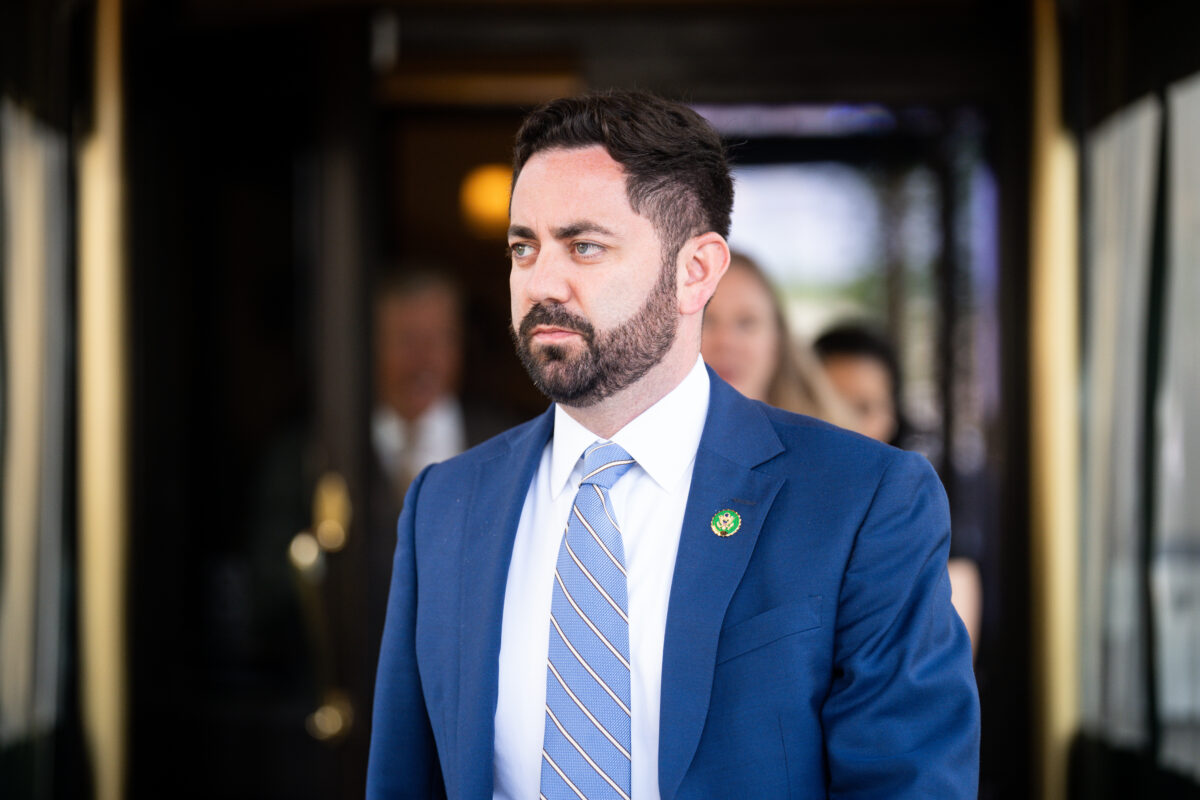
Rep. Mike Lawler (R-NY), returning from a trip to Israel, Saudi Arabia and Jordan, characterized leaders in the region as being open to the Trump administration’s efforts to reach a new nuclear deal with Iran, but also suggested that they are skeptical that Iran will actually agree to a deal that dismantles its nuclear program, Jewish Insider’s Marc Rod reports.
What he said: “I think folks are realistic about the prospects of Iran coming to an agreement, but still want to give the process a chance and try to avoid a conflict if possible,” Lawler told JI on Thursday. “But ultimately, you know, I think everybody is very clear about the fact that Iran cannot have a nuclear weapon.” Asked about the potential contours of a deal, Lawler said, “my general view is that the nuclear program, obviously, is a major threat, but so too is their continued funding of terrorism, and all of these issues are going to have to be addressed, one way or the other.”
Worthy Reads
Gaming Out the Jewish Future: eJewishPhilanthropy’s Judah Ari Gross spotlights an initiative launched by philanthropist Phil Siegel using “war games” that simulate potential future scenarios facing the American Jewish community to get leaders to think more about long-term planning. “The Jewish community may not have direct control over nuclear war, global demographic trends or international trade wars, for instance, even though these have a profound influence on the Jewish community. (Most of the scenarios include a geopolitical element as well, such as peace in the Middle East in the first one or an acute housing crisis in Israel that prevents American Jews from emigrating despite harsh conditions in the U.S. in the third scenario.) However, the Jewish community does have control over creating new organizations and initiatives or coordinating existing ones. ‘The game itself and the scenario itself were less important. It was more about how people think — What types of things influence us? Do we have more or less agency over them?’ [Israeli educator Barak] Sella said. ‘Is there an optimal scenario and does the Jewish community have a 2050 outcome that we are working toward?’” [eJP]
Delay of (End) Game: The Washington Post’s David Ignatius calls for an end to the Israel-Hamas war, positing that Israeli Prime Minister Benjamin Netanyahu has for a year rejected subordinates’ suggested strategies for winding down the conflict. “What’s agonizing is that Israeli military and intelligence leaders were ready to settle this conflict nearly a year ago. Working with U.S. and Emirati officials, they developed a plan for security ‘bubbles’ that would contain the violence, starting in northern Gaza and moving south, backed by an international peacekeeping force that would include troops from European and moderate Arab countries. … The Israeli-Palestinian dispute might seem intractable, but ending this conflict would be relatively easy. I’m told that Israeli military officials keep working on ‘day after’ plans, honing details as recently as this week. But they have had no political support from Netanyahu. ‘The “exit ramp” has been staring us in the face for a long time,’ argues Robert Satloff, director of the Washington Institute for Near East Policy. It’s a mix of Arab states and Gaza Palestinians, operating under a Palestinian Authority umbrella, he explains. “It is messy, with overlapping responsibilities and lots of dotted lines. But it checks all the boxes to enable the process of reconstruction and rehabilitation to get off the ground.’” [WashPost]
Mumbai Makeover: In The Wall Street Journal, Howard Husock interviews Rabbi Yisroel Kozlovsky of the Chabad House of Mumbai, India, about the city’s Jewish revival since the terror attack in 2008 in which Rabbi Gavriel Holtzberg and his wife and unborn child were killed. “Now in his 12th year in Mumbai, the rabbi recalls his unease upon receiving the assignment from Chabad’s headquarters in New York. He arrived in 2013 to find the building untouched since the terror attacks, its walls still bloodstained. His successor had been forced to live and hold services in rented apartments for the Jewish visitors and expats. (There are reportedly no more than 5,000 ethnic Indian ‘Bene Israel’ Jews in the country.) ‘Imagine our feelings when we walk in and see the destruction firsthand. It was still one big mess,’ Rabbi Kozlovsky says. ‘We knew immediately, though, we wanted to bring life back to the building.’ … Rabbi Kozlovsky has nevertheless decided not to shy away from the events of 26/11, as the locals refer to the attack, but to make it the basis of a mission. He has set out to build an artistic multimedia memorial to educate the hundreds of visitors, almost all non-Jewish Indians, who come here each week, mainly through class trips. ‘Restoration and resilience are not good enough responses to terror,’ he says of the project. ‘We are building a memorial and museum to teach history, to be a beacon of light.’” [WSJ]
Word on the Street
U.S. Ambassador to Turkey Thomas Barrack, who is also serving as Syria envoy, said in Damascus on Thursday that relations between Syria and Israel are a “solvable problem” that “starts with a dialogue”; Barrack also raised the U.S. flag over the ambassador’s residence in Damascus for the first time since the embassy’s closure 13 years ago…
Iranian Foreign Minister Abbas Araghchi said that any nuclear agreement with the U.S. must include the full lifting of sanctions and preservation of Tehran’s enrichment capabilities…
Saudi, Qatari and Emirati leaders reportedly told President Donald Trump during his trip to the region last week that they opposed military strikes on Iran’s nuclear program…
The Wall Street Journal reports on Israeli concerns over Washington’s ongoing nuclear talks with Iran, positing that a deal could put Israel “in a bind with its most important ally on its most pressing national security question”…
Columbia University reached a settlement with a Jewish social work student who had filed a lawsuit against the school alleging antisemitic discrimination…
California’s state Assembly unanimously advanced antisemitism legislation backed by Jewish groups in the state; AB715 would improve the process for making discrimination complaints, as well as create an antisemitism coordinator position for the state’s K-12 schools…
A Yonkers, N.Y., man was sentenced to six years in prison after pleading guilty to attacking a Jewish barber last year…
A Michigan man who in 2022 threatened parents and students at a synagogue preschool pleaded guilty to a federal gun charge…
The Wall Street Journal reports on the efforts of small wine importer and distributor Victor Owen Schwartz to challenge the Trump administration’s tariffs in court…
The board of Ben & Jerry’s issued a statement labeling Israel’s actions in Gaza a genocide, setting up another battle with parent company Unilever, which has for years clashed with the ice cream company’s independent board over its approach to social issues, including Israel…
CBS News profiles Karin Prien, the first Jewish federal cabinet member to serve in post-WWII Germany; the daughter of Holocaust survivors who was born in the Netherlands, Prien moved to Germany with her family when she was 4 and now serves as the country’s minister for education, family affairs, senior citizens, women and youth…
Former NYC Mayor Michael Bloomberg met with United Arab Emirates National Security Advisor Sheikh Tahnoon bin Zayed Al Nahyan for a conversation largely focused on the opportunities presented by AI technology…
The Associated Press reports on efforts to free Israeli-Russian Princeton researcher Elizabeth Tsurkov, who was kidnapped by an Iranian-backed militia group in Iraq in 2023…
Iran’s embassy in India said it is investigating the disappearance of three Punjabi men who went missing earlier this month in Tehran while transiting through Iran en route to Australia, where a local travel agent had promised them jobs…
An increasing number of oil tankers are turning off their transponders as they near Malaysia, an area used to transfer Iranian oil bound for China, as Tehran continues to work to evade U.S. sanctions…
Missouri philanthropist Bud Levin died at 88…
Former New York City Police Commissioner Bernie Kerik, who headed the NYPD during the 9/11 terror attacks, died at 69…
Dr. Robert Jarvik, who oversaw the design of the first artificial heart, died at 79…
Pic of the Day

Following her return to Israel, Mia Schem — who was kidnapped from the Nova music festival in southern Israel on Oct. 7, 2023, and spent 55 days in Hamas captivity — famously had the phrase “We will dance again” tattooed on her arm. On Thursday night, approximately 800 New Yorkers joined Schem in dancing again at the sold-out inaugural Tribe of Nova Foundation benefit held at Sony Hall, a concert venue in Times Square.
The event was held with the goal of raising at least $1 million to aid families of victims and survivors of Nova, where 411 festivalgoers, mostly young people, were killed and 44 were taken hostage, Jewish Insider’s Haley Cohen reports.
Birthdays

Medical director of the American Jewish Joint Distribution Committee’s Ethiopia spine and heart project, Dr. Richard Michael Hodes turns 72…
FRIDAY: Santa Monica, Calif.-based historian of Sephardic and Crypto-Jewish studies, Dolores Sloan turns 95… Real estate developer, landlord of the World Trade Center until 9/11, former chair of UJA-Federation of New York, Larry A. Silverstein turns 94… Partner in the NYC law firm of Mintz & Gold, he is also a leading supporter of Hebrew University, Ira Lee “Ike” Sorkin turns 82… Board member of the Collier County chapter of the Florida ACLU and the Naples Florida Council on World Affairs, Maureen McCully “Mo” Winograd… Cape Town, South Africa, native, she is the owner and chef at Los Angeles-based Catering by Brenda, Brenda Walt turns 74… Former professional tennis player, he competed in nine Wimbledons and 13 U.S. Opens, now the varsity tennis coach at Gilman School in Baltimore, Steve “Lightning” Krulevitz turns 74… Former chief rabbi of France, Gilles Uriel Bernheim turns 73… Encino, Calif.-based business attorney, Andrew W. Hyman… Literary critic, essayist and novelist, Daphne Miriam Merkin turns 71… Israeli physicist and philosopher, Avshalom Cyrus Elitzur turns 68… Former member of Congress for 16 years, since leaving Congress he has opened a bookstore and written two novels, Steve Israel turns 67… Former science editor for BBC News and author of six books, David Shukman turns 67… Founder of Krav Maga Global with 1,500 instructors in 60 countries, Eyal Yanilov turns 66… Editorial writer at The New York Times, Michelle Cottle… Film, stage and television actress; singer and songwriter, she sang the national anthem at Super Bowl XLIX in 2015, Idina Menzel turns 54… Writer, filmmaker, playwright and DJ, known by his pen name Ithamar Ben-Canaan, Itamar Handelman Smith turns 49… Member of Knesset who served as Israel’s minister of agriculture in the prior government, Oded Forer turns 48… Director of engagement and program at NYC’s Congregation Rodeph Sholom, Scott Hertz… Chief of staff for Sen. Brian Schatz (D-HI), Reema Dodin turns 45… Tsippy Friend… Israeli author, her debut novel has been published in more than 20 languages around the world, Shani Boianjiu turns 38… Rapper, singer, songwriter and record producer, known professionally as Hebro, Raphael Ohr Chaim Fulcher turns 38… Senior counsel at Gilead Sciences, Ashley Bender Spirn… Ice hockey defenseman, he has played for four NHL teams and is now in the Deutsche Eishockey Liga, David Matthew Warsofsky turns 35… Deputy chief of staff for U.S. Sen. Jon Ossoff (D-GA), Miryam Esther Lipper… Senior reporter for CNN, Eric Levenson… Challah baker, social entrepreneur and manager at Howard Properties, Jason Friend…
SATURDAY: Investment advisor at Wedbush Securities in Los Angeles, Alfred Phillip Stern turns 92… Businessman and philanthropist, Ira Leon Rennert turns 91… Professor at Yale University and the 2018 winner of the Nobel Prize in economics, William Dawbney Nordhaus turns 84… Food critic at Vogue magazine since 1989 and judge on “Iron Chef America,” he is the author of the 1996 award-winning book The Man Who Ate Everything, Jeffrey Steingarten turns 83… Founder and retired CEO of the Democratic Leadership Council, Alvin “Al” From turns 82… Author, political pundit and a retired correspondent for HBO’s “Real Sports with Bryant Gumbel,” he has won 14 Emmy Awards during his career, Bernie Goldberg turns 80… Comedian, actress and TV producer, Susie Essman turns 70… Founder and chairman of the Katz Group of Companies with operations in the pharmacy, sports (including the Edmonton Oilers), entertainment and real estate sectors, Daryl Katz turns 64… Reality television personality, best known for starring in and producing her own matchmaking reality series, “The Millionaire Matchmaker” on Bravo TV, Patti Stanger turns 64… Jerusalem-born inventor, serial entrepreneur and novelist; founder, chairman and CEO of CyberArk Software, one of Israel’s leading software companies, Alon Nisim Cohen turns 57… Entrepreneur, best known as the co-founder of CryptoLogic, an online casino software firm, Andrew Rivkin turns 56… Former Democratic mayor of Annapolis, Md., now head of policy at SWTCH, Joshua Jackson “Josh” Cohen turns 52… Program director of synagogue and rabbinic initiatives at the Board of Rabbis of Southern California, Melissa York… Israeli actress, singer and dancer, she played a Mossad agent in the espionage TV series “Tehran,” Liraz Charhi turns 47… Author of the “Money Stuff” column at Bloomberg Opinion, Matthew Stone Levine turns 47… Freelance writer in Brooklyn, Sara Trappler Spielman… Attorney and NYT best-selling author of the Mara Dyer and Shaw Confessions series, Michelle Hodkin turns 43… Senior advisor at the U.S. Department of Commerce until earlier this year, Bert Eli Kaufman… Senior product manager at Tel Aviv-based Forter, Zoe Goldfarb… Stephanie Oreck Weiss… Chief revenue officer at NOTUS, Brad E. Bosserman… Senior rabbi and executive director of Jewish life at D.C.’s Sixth & I, Aaron Potek… Managing editor at Allbritton Journalism Institute, Matt Berman… Medical student in the class of 2027 at the University of Nicosia Medical School, Amital Isaac… Brad Goldstein… Basketball player in Israel’s Premier League until recent years, while at Princeton he won the Ivy League Player of the Year award, Spencer Weisz turns 30… Professional golfer on the PGA Tour, Max Alexander Greyserman turns 30… Rapper, singer, songwriter and producer, known by his stage name, King Sol, Benjamin Solomon turns 27…
SUNDAY: Pulitzer Prize-winning composer, pianist and conductor, he has taught at Yale, SUNY Purchase, Cornell, Brandeis and Harvard, Yehudi Wyner turns 96… Holocaust survivor as a child, he served as the Ashkenazi chief rabbi of Israel for 10 years and twice as Chief Rabbi of Tel Aviv for 16 years, Rabbi Yisrael Meir Lau turns 88… NYC-based attorney, author of two books regarding the history and operations of El Al, owner of 40,000 plus pieces of memorabilia related to El Al, Marvin G. Goldman turns 86… Grammy Award-winning classical pianist, Richard Goode turns 82… Former member of the Knesset for the Yisrael Beiteinu party, Shimon Ohayon turns 80… Retired attorney in Berkeley, Calif., Thomas Andrew Seaton… Pediatrician in the San Francisco Bay area, Elliot Charles Lepler, MD… Former member of the Knesset for the Shinui and the Hilonit Tzionit parties, Eti Livni turns 77… Founding editor of The American Interest, Adam M. Garfinkle turns 74… Former editor-in-chief of Bloomberg News and co-author with Michael Bloomberg of Bloomberg by Bloomberg, Matthew Winkler turns 70… Contributing editor at The Free Press, Uri Paul Berliner… Founding rabbi of Congregation Aish Kodesh in Woodmere, N.Y., Rabbi Moshe Weinberger turns 68… Former IDF officer and now a London-based political scientist and journalist, Ahron “Ronnie” Bregman turns 67… Member of the Knesset for the Shas party for 16 years ending in 2015, Amnon Cohen turns 65… Owner of MLB’s Athletics (temporarily playing in Sacramento), he is the chair of Knowledge is Power Program (KIPP) Foundation, John J. Fisher turns 64… Poet, performance artist and essayist, Adeena Karasick turns 60… Founding editor and publisher of the Dayton Jewish Observer, Marshall J. Weiss… Television personality and matchmaker, Sigalit “Siggy” Flicker turns 58… Actress, voice actress and film director, Danielle Harris turns 48… Pulitzer Prize-winning journalist and writer, Spencer J. Ackerman turns 45… Comedian, writer, actress, director and producer, Amy Schumer turns 44… Partner in Oliver Wyman, a global management consulting firm, Daniel Tannebaum… President and CEO of the International Fellowship of Christians and Jews, Yael Eckstein turns 41… Musician, songwriter, author, actor and blogger, Ari Seth Herstand turns 40… CEO of The Good Food Institute, Ilya Sheyman turns 39… Political reporter for NBC News and MSNBC until earlier this year, now a newspaper editor in Maine, Alex Seitz-Wald… Senior writer at Barron’s covering the Federal Reserve, Nicole Goodkind… Former engineering lead at Palantir Technologies, now in a MPP program at Yale Jackson School of Global Affairs, Naomi S. Kadish… Executive business partner at Lyft, Isabel Keller… NYC-born Israeli pair skater, she competed for Israel at the 2022 Winter Olympics, Hailey Esther Kops turns 23…
As the Oval Office dominates foreign policy, pro-Israel advocates rethink their Congress-focused playbook
GETTY IMAGES
A general view of the U.S. Capitol Building from the National Mall, in Washington, D.C., on Thursday, May 29, 2025.
For decades, Jewish and pro-Israel groups invested significant resources in building bipartisan relationships with key members of Congress to steer legislation, while helping secure foreign aid and blocking unfavorable initiatives concerning the Middle East.
But that long-standing playbook has appeared less effective and relevant in recent years as Congress has increasingly ceded its authority on foreign policy to the executive branch, a trend that has accelerated with President Donald Trump’s return to office. The dynamic is frustrating pro-Israel advocates who had long prioritized Congress as a vehicle of influence, prompting many to reassess the most effective ways to advocate for preferred policies.
That Congress had no formal role in Trump’s recent decisions to unilaterally reach a ceasefire with the Houthis in Yemen and to lift sanctions on Syria, for example, has stoked speculation that legislators could also be sidelined from ratifying a potential nuclear deal with Iran.
There are any number of reasons why Congress has taken a back seat in shaping foreign affairs, experts say, including Trump’s efforts to consolidate power in the executive branch, most recently by gutting the National Security Council. And Trump’s own power in reshaping the ideological direction of his party, preferring diplomacy over military engagement, has made more-hawkish voices within the party more reluctant to speak out against administration policy.
“Congress is increasingly irrelevant except on nominations and taxes,” Elliott Abrams, a senior fellow at the Council on Foreign Relations who served as a special envoy for Iran in the first Trump administration, told Jewish Insider. “It has abandoned its once-central role on tariffs, and plays little role in other foreign affairs issues. That’s a long-term trend and we saw it in previous administrations, but it is worsened by the deadlocks on Capitol Hill, the need to get 60 votes to do almost anything, and by Trump’s centralization of power in the White House.”
Previously, “when there was real power in the departments, congressional oversight meant a lot more,” Abrams added. “If you’re a foreign ambassador in Washington, there’s no one to talk to at the NSC, lots of vacancies at State, and while there are plenty of people to meet with on the Hill, what are they going to do for you? You need to see Trump” Abrams said, or Steve Witkoff, the special envoy to the Middle East leading the negotiations with Iran.
The executive branch, to be sure, has long held significant control over foreign policy but it has expanded considerably in the decades following the 9/11 attacks. Since then, a law passed by Congress to authorize the invasion in Iraq in 2003 has been used — and, critics allege, abused — by successive administrations to initiate military action abroad without first seeking approval from lawmakers who are constitutionally empowered to decide when the country goes to war and oversee defense spending.
Still, Congress has also long shown “disinterest” in exercising its power over foreign policy, said Brian Katulis, a senior fellow at the Middle East Institute. “This was a preexisting condition,” he explained to JI. “By and large, Congress abdicated its oversight role before Trump even came to office,” especially as national security matters have been overshadowed by competing domestic issues such as inflation and immigration, which “resonate more saliently” with voters.
“Trump’s dominance over the Republican Party accounts for much of the acquiescence on the part of his Congress,” observed Stephen Schlesinger, a historian who specializes in international affairs. “But let us not forget that recent Democratic presidents have practically had a free hand, too, in pursuing their own global policies — with little reaction or opposition from their party members.”
Among other examples, Schlesinger cited former President Barack Obama’s nuclear deal with Iran — brokered without consent from Congress — as well as former President Joe Biden’s “total support” for Ukraine in its war against Russia.
Republican deference to Trump, however, has set a new standard for such acquiescence, Schlesinger argued, particularly on talks with Iran. “Given the past obsessive Republican fury against a deal with Iran during Democratic administrations, still none in Trump’s party have objected to a nuclear deal with Tehran under Trump, or, for that matter, his solo decision to lift sanctions on Syria, a country led by a former radical Islamic leader,” Schlesinger noted.
“Certainly the reality of governance in Washington today is that Congress may not be totally irrelevant, but they’re an appendage to the whims and desires of the Trump presidency,” said Norman Ornstein, a senior scholar at the American Enterprise Institute. “There is little if any pushback or oversight of what Trump” and his advisors “involved in foreign policy and diplomacy are doing — and that’s a change.”
The new dynamic has forced pro-Israel groups to adapt to a new political landscape in which their traditional advocacy has been weakened by Congress’ diminished clout and lack of interest in asserting meaningful supervision over Trump’s recent Middle East policy decisions.
“There are very few remedies for this kind of a standoff where the executive branch has arrogated to itself so much power that Congress is essentially marginalized,” said Danielle Pletka, a senior fellow at the American Enterprise Institute who previously worked on the Hill. “When you look at the question of Israel, you have to see it in the context of much broader trends.”
Marshall Wittmann, a spokesperson for AIPAC, argued that both “the administration and Congress play a critical role in strengthening and expanding the U.S.-Israel relationship, and AIPAC works with key leaders in power, on both sides of the aisle and both sides of Pennsylvania Avenue, to build support for the mutually beneficial alliance between America and Israel.”
The absence of congressional influence has come as disagreements have emerged between the Trump administration and the Netanyahu government over ending the war in Gaza and nuclear diplomacy with Iran. Trump’s recent trip to the Middle East — where he met with a range of Arab leaders but did not stop in Israel — was one of the latest indications of deprioritization of America’s closest ally in the region.
Tensions have also surfaced amid ongoing negotiations with Iran. Pro-Israel advocates have voiced concerns that Trump’s negotiating team is nearing an agreement that could simply reinstate the deal brokered by the Obama administration a decade ago — which detractors had criticized as a pathway to a nuclear weapon since it allowed Iran to continue enriching uranium.
The Trump administration has indicated it will not permit Iran to retain domestic nuclear enrichment — even as some officials have sent mixed signals on the matter, contributing to a sense of confusion over the ultimate terms of an agreement. Trump pulled out of the original deal — which was widely opposed by Republicans — during his first administration.
For pro-Israel groups, the risks of clashing with Trump on key issues likely outweigh the benefits, observers contend. “Any organization has to very carefully weigh its equities before publicly taking on the administration,” Daniel Silverberg, a former top foreign policy advisor to Rep. Steny Hoyer (D-MD), told JI.
The pro-Israel lobbying group AIPAC has recognized that it is now operating in a unique landscape, according to Manny Houle, a Democratic pro-Israel strategist who previously served as the group’s progressive outreach director in the Midwest. Before Trump was elected, Howard Kohr, AIPAC’s former president, frequently said the group “was all about Congress,” Houle recalled in a recent interview with JI. “Then, Trump was in office and he said we’re going to be dealing with the White House.”
Marshall Wittmann, a spokesperson for AIPAC, argued that both “the administration and Congress play a critical role in strengthening and expanding the U.S.-Israel relationship, and AIPAC works with key leaders in power, on both sides of the aisle and both sides of Pennsylvania Avenue, to build support for the mutually beneficial alliance between America and Israel.”
“President Trump has a strong pro-Israel and anti-Iran record, but his administration evinced early on a lack of expertise and consistency in its policy toward Iran’s nuclear program,” said Michael Makovsky, president and CEO of the Jewish Institute for National Security of America. “But recently that position has evolved and strengthened due in no small part to feedback it has gotten.”
“We applaud the administration’s strong statements and actions in support of our ally, commend Congress for passing pro-Israel legislation such as the annual appropriation for lifesaving security assistance to Israel, and appreciate President Trump and congressional leaders both making clear last week that Iran must completely dismantle its nuclear program,” Wittmann said in a statement to JI last week.
Even as Congress has failed to take formal action over points of disagreement with Trump’s recent Middle East directives, some pro-Israel activists suggested their outreach to lawmakers on the Iran talks in particular has yielded substantive results in recent weeks.
“President Trump has a strong pro-Israel and anti-Iran record, but his administration evinced early on a lack of expertise and consistency in its policy toward Iran’s nuclear program,” said Michael Makovsky, president and CEO of the Jewish Institute for National Security of America. “But recently that position has evolved and strengthened due in no small part to feedback it has gotten.”
In public and private settings, JINSA and other pro-Israel groups, as well as Israeli officials and congressional Republicans, “have made the case that Trump needs to stick to his initial policy of dismantlement of Iran’s enrichment facilities,” Makovsky said.
“This has contributed to Trump officials pivoting in the past couple weeks to a tougher ‘no enrichment’ stand,” Makovsky told JI last week.
Eric Levine, a top GOP fundraiser and a board member of the Republican Jewish Coalition who recently launched a federal lobbying practice, said “the most important voice Congress will have is if the president makes a deal with Iran. I think that it’s really important that the Senate remains steadfast and safeguards its powers and insists, if there is a deal, it should be counted as a treaty. If he thinks it’s an amazing deal, he should have no trouble passing it.”
Still, it remains to be seen if the toughest voices against Iran in the Senate who have expressed reservations with enrichment limits and other perceived weaknesses of a potential deal will push back against Trump if he lands on an agreement that does not meet their standards. While some Republican lawmakers have spoken out in recent weeks to set expectations for a deal, including Sens. Ted Cruz (R-TX), Tom Cotton (R-AR) and Lindsey Graham (R-SC), observers say they are skeptical that Congress will ultimately seek to flex its authority if an agreement comes forward.
“The ultimate test will be if there’s a vote on Iran,” said former Rep. Steve Israel (D-NY), a pro-Israel Democrat who opposed Obama’s deal in 2015. “As Congress has grown more performative, it has become less deliberative on foreign policy,” he added. “The speaker’s gavel has become a rubber stamp. The result is an abdication by Congress of its delineated responsibilities.”
Eric Levine, a top GOP fundraiser and a board member of the Republican Jewish Coalition who recently launched a federal lobbying practice, said “the most important voice Congress will have is if the president makes a deal with Iran.”
“I think that it’s really important that the Senate remains steadfast and safeguards its powers and insists, if there is a deal, it should be counted as a treaty,” said Levine. “If he thinks it’s an amazing deal, he should have no trouble passing it,” Levine said of Trump’s efforts to reach what he has suggested is an imminent accord.
It is unclear if the White House will seek approval from Congress for a deal, even as lawmakers have recently stressed that an agreement would have no guarantee of surviving in future administrations if not ratified by the legislative branch.
Secretary of State Marco Rubio affirmed during hearings on Capitol Hill last week that U.S. law requires that any deal with Iran be submitted to Congress for review and approval, noting that he had been in Congress when that law, the Iran Nuclear Agreement Review Act, was passed. A White House spokesperson declined to confirm if Trump plans to present a potential deal to Congress when reached by JI on Wednesday, deferring to the president and Witkoff’s remarks from the Oval Office — which did not address the matter.
With Congress increasingly on the sidelines, some pro-Israel groups have turned to alternative forms of advocacy to buttress their lobbying efforts in recent years.
“Advocacy tactics are always changing,” James Thurber, a distinguished professor of government at American University and a leading expert on federal lobbying, told JI. “It is like war where opponents must be flexible, try new tools, assess and adjust. It is essential to be persistently focused on the best strategy, theme and message and to not rely on outdated lobbying tactics.”
“Our world has changed,” said Ann Lewis, a veteran Democratic advisor and a former co-chair of Democratic Majority for Israel, whose formidable political arm has actively engaged in congressional primaries featuring sharp divisions over Israel. “Any definition of advocacy that begins post-election is less effective than it deserves to be.”
Indeed, AIPAC’s foray into campaign politics four years ago, marking a major tactical shift for the organization, was a sign of the changing power dynamics in Washington. The group has since helped to elect a range of congressional allies, while working to unseat some of the fiercest critics of Israel in the House and blocking potential antagonists from getting elected.
“Advocacy tactics are always changing,” James Thurber, a distinguished professor of government at American University and a leading expert on federal lobbying, told JI. “It is like war where opponents must be flexible, try new tools, assess and adjust. It is essential to be persistently focused on the best strategy, theme and message and to not rely on outdated lobbying tactics.”
But as most foreign policy decisions now emanate from the White House, some pro-Israel activists say they remain frustrated by the lack of will from Congress to assert its authority, even as they vow their efforts will continue.
“It is tragic that Congress has so blatantly shirked its responsibility to act as a check and balance on the executive branch,” a senior political operative involved in pro-Israel advocacy recently lamented. “But under no circumstances does that mean we stop fighting for the future of the U.S.-Israel relationship.”
‘I’m running for my community, my congregation and my country,’ former journalist Mike Sacks, running in New York’s 17th Congressional District, said in an interview with JI

Courtesy Mike Sacks
Mike Sacks
Mike Sacks was taught as a child to fight antisemitism — literally — with left jabs and left hooks and right crosses.
His father, he said, taught him to box as an elementary schooler “because [my father] had to fight back against Jew hatred as a kid and as a young man,” having been subjected to antisemitic taunts.
Now, the former political journalist turned Democratic candidate in New York’s 17th Congressional District told Jewish Insider, rising antisemitism is a factor in his bid to unseat Rep. Mike Lawler (R-NY). But he also accused Republicans of cynically weaponizing the issue with no intent to actually address the problem.
Sacks told JI in an interview earlier this month that local and nationwide antisemitism was a major reason he decided to run, saying “I’m running for my community, my congregation and my country.”
“As a Jewish father raising my kids in the Jewish faith, this is my community. It’s not a political issue for me. It’s personal,” Sacks said. “When I go to Congress, this is not an issue I’ll take on to score political points, but for the rights of my community and my faith.”
“I was raised with an understanding that what is good for the Jews is what’s also good for the community and for the country, and to seek out and vindicate those universal values from which this country is founded,” Sacks continued, “that has helped make it a haven for Jews since we first started arriving in this country.”
“Under the guise of addressing antisemitism, [President Donald] Trump is attacking American values and violating our Constitution in the Jewish people’s name,” Sacks said. “These are values — free speech, due process — that we’ve learned from history, when turned on other people will be turned on us too. It’s un-American, and that’s not how we overcome antisemitism.”
He said that his patriotism and his sense of civic pride is deeply entwined with his Jewish identity, and said he wants to ensure that everyone, regardless of background, can share that sense of pride.
Sacks called antisemitism on college campuses a real problem that must be addressed, but argued that the Trump administration’s policies stripping research funding from universities and rescinding visas from anti-Israel demonstrators are not serious efforts to combat antisemitism.
“Under the guise of addressing antisemitism, [President Donald] Trump is attacking American values and violating our Constitution in the Jewish people’s name,” Sacks said. “These are values — free speech, due process — that we’ve learned from history, when turned on other people will be turned on us too. It’s un-American, and that’s not how we overcome antisemitism.”
If elected, he said he’d speak out against antisemitism, work to facilitate dialogue and support Nonprofit Security Grant Funding. And he said he’d support any legislation to combat antisemitism that he believed was sincere and would be effective, and was not aimed at scoring “political points off our people’s plight and peril.”
He didn’t speak specifically on whether he would support Lawler’s Antisemitism Awareness Act, but accused Republicans of trying to protect those making antisemitic accusations that Jews killed Jesus in amendments to the legislation.
Sacks also accused Republicans of weaponizing antisemitism in the 17th District race, referring to an incident in which a National Republican Congressional Committee spokesperson called out Sacks and the other 17th District candidates over the vandalism of an Albany GOP headquarters building with the word “Nazis.” The spokesperson demanded the candidates condemn the vandalism, which occurred more than 100 miles away, in another part of the state.
“What will guide my response to any threat to Israel is … where to find that solution that can lead us back to a path of peace and a path of coexistence where it all might seem bleak and dark and gone in those moments of greatest peril,” Sacks said.
Sacks called the move “cynical” and in “bad faith,” adding, “we need to confront these efforts to use our own identities against us head-on.”
He hinted toward his family’s Jewish background in his campaign launch video, which includes a shot of Sacks working on a Hebrew workbook with one of his sons at their dinner table, a scene that a campaign spokesperson described as a weekly occurrence.
Sacks described himself as a “proud Zionist guided by my belief in our need for a Jewish democratic state,” adding that he associates himself with “the 69% of Israelis who want to bring all the hostages home and have a ceasefire.”
He said he “stand[s] against those on the far left who deny the necessity of a Jewish state” as well as those on the far right who would “sacrifice Israel’s democracy to extend control over all the Palestinian territories.” Sacks said he would oppose any efforts to block weapons shipments to Israel.
Sacks associated himself with those protesting against Israeli Prime Minister Benjamin Netanyahu in Israel and Yair Golan, the leader of a left-leaning opposition party in Israel. (This interview took place before recent comments by Golan sparked widespread backlash.) He described Israeli figures like Yitzhak Rabin and author Amos Oz as his “heroes,” condemning the “racist extremism” of National Security Minister Itamar Ben-Gvir and blasting Lawler for meeting with Ben-Gvir during his trip to the U.S. last month.
He said that a two-state solution is the best path to ensure Israel’s security and existence as a Jewish state, which he emphasized must include removing Hamas from leadership in Gaza and fighting for a pathway to Palestinian statehood. “I do not believe [the two-state solution] is dead. I do not believe that it can’t be resurrected if it is dead. I believe that is the only way forward,” he said.
“What will guide my response to any threat to Israel is … where to find that solution that can lead us back to a path of peace and a path of coexistence where it all might seem bleak and dark and gone in those moments of greatest peril,” Sacks said.
Sacks argued that new leadership is needed in the U.S. to help move back toward a two-state solution, arguing “the U.S. needs to be led by a government that does not sympathize with those in Israel who would follow in the footsteps of Yitzhak Rabin’s assassin,” referring to Ben-Gvir.
Sacks traveled to Israel in December 2008, as Israel was launching Operation Cast Lead in Gaza. He said that his takeaway from those operations, after which attacks from Gaza on Israel resumed, is that “the answer is not whether to respond, but how. And the solution is political, not military.”
“What will guide my response to any threat to Israel is … where to find that solution that can lead us back to a path of peace and a path of coexistence where it all might seem bleak and dark and gone in those moments of greatest peril,” Sacks said.
Addressing the ongoing nuclear talks between the U.S. and Iran, Sacks emphasized that Tehran has “never been weaker” and described the Islamic Republic as a decaying and “sclerotic” regime. He said the U.S.’ path forward should be calibrated to protect Israel from “any rash decision by a wounded Iranian regime looking to stay relevant in the region.”
He expressed skepticism that Trump would be able to achieve an effective deal that would ensure peace and security, pointing to the president’s decision to pull out of the original 2015 nuclear deal during his first term, adding that Trump now appears to be renegotiating something along the same lines.
Sacks said that the original nuclear deal was “a great deal for the time,” but said that the state of affairs now and when he would be in Congress would be very different, and his support for any potential deal would “depend on the details of the deal in context with that geopolitical moment and the security demands of our allies in the region.”
Addressing his candidacy more broadly, Sacks said that his prior career as a reporter gave him a “front row seat to the deterioration of our democracy and billionaires profiting at our expense” and the deep issues in U.S. politics. He said rising costs and the “tepid” response from Democrats to Republican policies were other contributing factors to his run.
He framed himself as fighting to restore American democracy against a “would-be king seizing power for himself from the people to enrich his billionaire best friends at our expense.”
"The Obama administration invented the category of 'nuclear sanctions’ as an excuse to give the Ayatollah whatever he wanted for a nuclear deal," Sen. Ted Cruz said

Tom Williams/CQ-Roll Call, Inc via Getty Images
Sen. Ted Cruz (R-TX) is seen outside a Senate Judiciary Committee markup on Thursday, November 14, 2024.
Sen. Ted Cruz (R-TX) argued on Wednesday that sanctions on Iran’s nuclear program can’t be separated from other sanctions on the regime as part of a nuclear deal, comparing the approach apparently being taken by the Trump administration to that of the Obama administration.
Secretary of State Marco Rubio has said in congressional testimony this week that talks with Tehran have revolved solely around Iran’s nuclear program and have not addressed its sponsorship of terrorism or its ballistic missile program, but said that sanctions related to terrorism and missiles would remain in place if those issues are not addressed in a potential deal.
“The Obama administration invented the category of ‘nuclear sanctions’ as an excuse to give the Ayatollah whatever he wanted for a nuclear deal,” Sen. Ted Cruz (R-TX) said to Jewish Insider.
“It has nothing to do with how Congress passed or past presidents implemented sanctions against the Iranian regime, which was to use our most powerful sanctions against the full range of Iran’s aggression. President Trump rightly refused to certify and then withdrew from the deal because he said that lifting these ‘nuclear sanctions’ gave Iran too much for too little benefit,” he continued.
Congressional Republicans argued in the past, when the original nuclear deal included a similar formula, that the distinctions between nuclear and non-nuclear sanctions were largely specious. Those same lawmakers have maintained that any new funding the regime received would ultimately fuel proxy terrorism and regional destabilization, regardless of the targets of those sanctions.
Sen. Thom Tillis (R-NC) expressed confidence that the Trump administration understood that any deal must be multi-faceted, though he noted that Congressional Republicans haven’t been briefed on the talks.
“I have to believe at the end of the day, they realize that it’s not just about enrichment, but it’s all the other enabling capabilities, because the reality is the world’s a dangerous place and if they had that underlying capability, maybe then they’ll build their own bomb,” Tillis told JI.
“We got to support Israel. Iran uses proxies to attack America and Israel, they chant ‘Death to America.’ So what they’ve got to do is they’ve got to stop enriching uranium, that’s number one. And number two, we’ve got to make sure they have no money to give their proxies,” Sen. Rick Scott (R-FL) said when asked his position on a deal.
Sen. James Lankford (R-OK) told JI he hadn’t kept up with Rubio’s testimony, but said that addressing Iran’s proxy terrorism is crucial.
“Iran’s the largest state sponsor of terrorism. Israel is fighting proxies all the way around them. The entire region’s destabilized. Egypt is struggling economically because of the Houthis and what they’re doing,” Lankford said. “The proxies are the problem in the area and you can’t disconnect Iran and the regime and what they’re doing in the entire region to destabilize the region.”
Another Senate Republican, speaking on condition of anonymity to speak candidly, said he has faith in Rubio, but that an arrangement as outlined by Rubio would require “an awful lot of trust built into it, and I don’t trust Iran.”
“Money is obviously fungible. And the whole point of proxies is you can do whatever you want without doing whatever you want [directly],” the senator said. “There’s just an awful lot of trust built into.”
The senator said, “There’s probably a time where I’d be willing to give them a little bit of room, but they’re an awfully long ways down the road, so I don’t know. I just hope they keep a very, very tight grip on a very, very short leash.”
Sen. Lindsey Graham (R-SC) told JI that, “I like the American position, the administration’s position of no enrichment, complete dismantlement … and [would] have to include their missile program.”
“Anything short of that would be inadequate,” he added.
Sen. Mike Rounds (R-SD) similarly argued that a deal around Iran’s nuclear weapons would likely include addressing Iran’s pursuit of intercontinental ballistic missiles. He added that Iran should not receive any sanctions relief without addressing its nuclear buildup.
Other senators seem to be focusing their attention more on ensuring that dismantling Iran’s enrichment remains a red line for the United States.
“At the end of the day, we’ve got to see what the final package is,” Sen. Pete Ricketts (R-NE), who recently led nearly all Senate Republicans on a letter insisting on full dismantlement, said. “The biggest issue is going to be the enrichment part. If we can crack the enrichment nut, that’s a big deal.”
Sen. John Kennedy (R-LA) similarly said, “The president’s been very clear. I think the Republican side of the aisle in the Senate has been very clear. No enrichment, zero, zilch, nada, no centrifuges. The Iranian leadership doesn’t need it. They can import uranium for civil nuclear energy, so they can either take it or leave it. We can do it the easy way, the hard way.”
The secretary of state also assured lawmakers that all Trump administration officials are unified in their opposition to Iran maintaining domestic nuclear enrichment capabilities
BRENDAN SMIALOWSKI/AFP via Getty Images
Secretary of State Marco Rubio testifies before a House Subcommittee on National Security, Department of State, and Related Programs hearing on the budget for the Department of State, on Capitol Hill in Washington, DC on May 21, 2025.
In his second consecutive day of hearings on Capitol Hill, Secretary of State Marco Rubio said that he expects that additional Arab countries will join the Abraham Accords by the end of the year, if not earlier.
“We do have an Abraham Accords office that is actively working to identify a number of countries who have lined up and already I think we may have good news, certainly before the end of this year, of a number of more countries that are willing to join that alliance,” Rubio said a House Foreign Affairs Committee hearing on Wednesday.
The comments are consistent with other recent remarks by President Donald Trump and Middle East envoy Steve Witkoff.
Rubio added that the administration is currently working on selecting an ambassador for the Abraham Accords, as required under law, to submit for congressional confirmation.
He said that there is “still a willingness” in Saudi Arabia to normalize relations with Israel, but “certain conditions are impediments,” including the Oct. 7, 2023, Hamas attacks on Israel and the ensuing war.
Rubio’s testimony largely reinforced and added on his comments the day before, on issues including Iran and Syria.
He again insisted that all elements of the Trump administration, including Vice President JD Vance and Witkoff, are unified behind the position that Iran cannot be allowed to maintain its capacity to enrich uranium.
And he affirmed that U.S. law requires that any deal with Iran be submitted to Congress for review and approval, noting that he had been in Congress when that law was passed.
At an afternoon hearing with the House Appropriations Committee, Rubio again said that sanctions relating to Iranian proxy terrorism or other malign activities will not be impacted by a nuclear deal that does not address those subjects. Republicans in the past have questioned the distinction between nuclear and non-nuclear sanctions, particularly as part of the original 2015 nuclear deal, which took a similar approach. And they’ve argued that any sanctions relief would allow Iran to expand its support for regional terrorism.
Rubio said the administration is continuing to ramp up sanctions on Iran, and said that European parties to the deal are “on the verge” of implementing snapback sanctions on Iran. He said that the administration would support legislation to implement additional sanctions on Iran’s oil sector.
He denied knowledge of a Tuesday leak by administration officials that Israel was making plans to strike Iran’s nuclear program, adding, “I also don’t think it’s a mystery, though … that Israel has made clear that they retain the option of action to limit Iran from ever gaining a nuclear capability.”
Expanding on comments he made the day before, Rubio said that he favors moving the mission of U.S. security coordinator for Israel and the Palestinian territories under the authority of the U.S. ambassador to Israel so that it can be a better-integrated part of the U.S.’ Israel policy. But he vowed that the core function of the office will continue.
Rubio denied reports of talks between the United States and Saudi Arabia about potential nuclear cooperation outside of a “gold standard” deal, which would include banning domestic enrichment.
The secretary of state reiterated comments about the critical necessity of providing sanctions relief to Syria to help contribute to stability, but he said that continued sanctions relief “does have to be conditioned on them continuing to live by the commitments” that the Syrian government has made verbally, including to combat extremism, prevent Syria from becoming a launchpad for attacks on Israel and form a government that represents, includes and protects ethnic and religious diversity.
He indicated that the U.S. is not actively working to shut down the United Nations Relief and Works Agency, but pledged that the United States will not be providing any further aid to or through that organization and will use its power and funding to look for alternatives.
He said it will be up to other countries whether they continue working with UNRWA, though he noted that the U.S. has been the agency’s largest donor.
Rubio said that he would be supportive, in concept, of legislation to expand current U.S. anti-boycott laws to include compulsory boycotts imposed by international organizations. That legislation was pulled from a House floor vote after right-wing lawmakers falsely claimed it would ban U.S. citizens from boycotting Israel.
Pushing back on calls for the U.S. to withhold weapons sales to the United Arab Emirates over its support for one of the parties involved in the Sudanese Civil War that the U.S. has found is committing genocide, Rubio said that the U.S. is not fully in alignment with the UAE but argued that it’s critical for the U.S. to continue engaging with and maintain a strong relationship with the UAE for its broader foreign policy goals in the Middle East.
He said that maintaining such a relationship and expanding the U.S.’ diplomatic and economic relationship with Abraham Accords countries is also important to ensuring that the Accords continue to be successful.
Rubio said that the State Department had approved restarting aid programs for Jordan that remained frozen — though he noted most were initially exempted from the administration’s blanket freeze. He acknowledged that the frozen programs had been “a source of frustration for [Jordan], and frankly for me.” He continued, “Ultimately, we’re going to get all those programs online, if they’re not online already.”
In a heated back-and-forth with Rep. Pramila Jayapal (D-WA), who was brandishing a pocket Constitution, Rubio again defended the administration’s policy of revoking student visas from individuals accused of involvement in anti-Israel activity on college campuses, saying that they are coming to the United States to “tear this country [apart]” and “stir up problems on our campuses.”
Addressing the case of Rümeysa Öztürk, a Tufts University graduate student that supporters have said was detained solely for writing an op-ed in a student newspaper criticizing Israel, Rubio claimed the situation is not as has been represented. “Those are her lawyers’ claims and your claims, those are not the facts,” Rubio said.
Asked by Jayapal about a comment — “Jews are untrustworthy and a dangerous group” — made by an Afrikaner refugee recently admitted to the United States from South Africa, Rubio said that he would “look forward to revoking the visas of any lunatics you can identify.”
But when presented with the fact that the individual in question was admitted as a refugee, not on a visa, Rubio said that refugee admissions are “a totally different process,” adding “student visas are a privilege.”
The secretary of state said that terrorism and weapons sanctions would remain in place if Iran’s other malign activity is not addressed under a nuclear deal

Anna Moneymaker/Getty Images
Secretary of State Marco Rubio speaks during a Senate Foreign Relations Committee hearing in the Dirksen Senate Office Building on May 20, 2025 in Washington, DC. Rubio testified on President Trump's FY2026 budget request for the State Department.
Secretary of State Marco Rubio said in his first appearance on Capitol Hill since being confirmed as secretary of state that Iran’s support for regional terrorist proxies has not been part of the ongoing talks between the Iranian government and Middle East envoy Steve Witkoff, which Rubio said have been focused wholly on Iran’s nuclear program and enrichment capabilities.
At the same time, Rubio insisted that any sanctions related to terrorist activity and weapons proliferation would remain in place if such issues are not part of the nuclear deal.
Rubio’s comments indicate the deal might still be subject to what some critics in the United States and the region described as a key flaw of the original nuclear deal — that it failed to address other malign activity by the regime. One U.S. lawmaker who traveled to the Middle East recently said that U.S. partners in Israel and the Arab world had argued that any deal must include non-nuclear provocations.
Rubio added that sanctions will remain in place until a deal is reached, and that European partners are working separately on re-implementing snapback sanctions, potentially by October of this year, when such sanctions expire.
He also said that Iran cannot have any level of nuclear enrichment under a nuclear deal, as it would inevitably provide a pathway for Iran to enrich to weapons-grade levels.
“About 90% of the work of enrichment is getting to that 3.67% level [necessary for civilian nuclear power]. After that, the rest of it is just a matter of time,” Rubio said. “They [Iran] claim that enrichment is a matter of national pride. It is our view that they want enrichment as a deterrent. They believe that it makes them a threshold nuclear power, and as a result, [become] untouchable.”
Rubio said that reaching a nuclear deal will not be easy, but that it is the administration’s preference. He reiterated that Iran can be permitted to have nuclear energy for civilian use, but only if it imports nuclear material from elsewhere. He said at a second hearing later in the day that a so-called 123 Agreement for civilian nuclear cooperation with the United States or an equivalent deal would be possible if Iran dismantles its enrichment capacity.
Addressing the war in Gaza, Rubio said that the U.S. is ultimately hoping to end hostilities, adding that ending the war will require Hamas freeing the hostages and ensuring that Hamas and similar terrorist groups do not maintain power in Gaza. He placed blame on Hamas for failing to agree to a ceasefire.
Rubio said that regional partners are willing to step up to help support the reconstruction of Gaza, but said that the territory’s future governance will be the key question going forward. He said that a stable governing authority capable of providing peace and security will be necessary to keep Hamas out of power.
Rubio also denied any plans for forcible or permanent relocation of Palestinians in Gaza, but said that the administration had been engaged in discussions with other regional partners about allowing Gazans who want to temporarily relocate to do so. He said he was not aware of any such conversations with Libya, as a recent NBC News report suggested.
“You don’t want people trapped [in Gaza]. They may want to come back, they may want to live there in the future, but right now, they can’t,” Rubio said. “And if there’s some nation willing to accept them in the interim period, yes, we’ve asked countries preliminarily whether they would be open to accepting people, not as a permanent situation, but as a bridge towards reconstruction.”
He said that the U.S. was “pleased to see that aid is starting to flow” into Gaza, after Israel had blocked it for 11 weeks.
He rebutted accusations that Israel is seeking to destroy Gaza, saying that Israel has told the U.S. and the world that “they need to root out the remaining elements of Hamas — who, by the way, have been an impediment to multiple ceasefires.”
Later in the day, Rubio reiterated that the U.S. sees resuming humanitarian aid as a priority and has encouraged Israel to allow aid into Gaza — a divergence from some Israeli officials and congressional Republicans who have opposed allowing aid into Gaza. He appeared to acknowledge that the humanitarian situation in Gaza is dire.
“Many of you have noticed there’s been a growing number of anti-Hamas protests and demonstrations as well. So there are people there that understand that this is a root cause of it,” Rubio said. “That said, you have this, you have this acute, immediate challenge of food and aid not reaching people, and you have existing distribution systems that could get them there.”
He said that Israel can defeat Hamas and prevent diversion of aid while still permitting “sufficient quantities” of aid to move into the territory. He said that organizations like the World Food Program have the capacity to immediately begin distributing aid, reflecting the reticence of Israeli and U.S. officials to rely on the U.N. for distribution.
The secretary of state continued to embrace the administration’s policy of revoking student visas and residency permits from individuals alleged to be involved in anti-Israel activity on college campuses, adding that such revocations will continue.
“We’re going to do more. There are more coming. We’re going to continue to revoke the visas of people who are here as guests and are disrupting our higher education facilities,” Rubio said. “I want to do more, I hope we can find more.”
Rubio said later in the day that thousands of student visas have been revoked, but many for reasons unrelated to anti-Israel activity.
He denied reports that the administration is planning to eliminate the position of U.S. security coordinator for Israel and the Palestinian territories, saying that there had instead been discussions about bringing the mission under the authority of the U.S. embassy in Jerusalem.
Rubio also pushed back on accusations from Sen. Jacky Rosen (D-NV) that the administration was “abandoning” a push for normalization of relations between Israel and Saudi Arabia, saying instead that “the Saudis are the ones that have expressed their inability to move forward on it, so long as the conflict is happening in Gaza. But we would love to see normalization.”
The secretary of state spoke at length about the situation in Syria and the administration’s decision to remove sanctions on the country. He acknowledged that, even with U.S. engagement, the situation in Syria could still collapse, but argued that collapse would have been a certainty if the U.S. had not chosen to engage and lift sanctions.
“It is our assessment that, frankly, the transitional authority, given the challenges they’re facing, are maybe weeks, not many months, away from potential collapse and a full scale civil war of epic proportions, basically the country splitting up,” Rubio said.
Despite President Donald Trump’s announcement that the U.S. would remove “all” sanctions from Syria, Rubio said in the second hearing that the sanctions would be removed “incrementally.” He said that Syria’s designation as a state sponsor of terrorism should be removed if Syria meets the conditions for such a move.
Rubio said that resolving internal divisions, restoring a unified Syrian national identity and creating a situation in which millions of displaced persons can return will be critical challenges going forward.
Rubio described the fall of the Assad regime and the possibility of a stable and peaceful Syria as an “opportunity for Israel,” despite the Israeli government’s deep concerns about the new Syrian government and its leader’s past jihadi loyalties.
“They’re not viewing themselves as a launch pad for revolution. They’re not viewing themselves as a launch pad for attacks against Israel,” Rubio said. “So we think this is an extraordinary thing, if, in fact, you have in Syria a stable government that encompasses all the elements of their society and has no interest whatsoever in fighting wars with Israel over borders or anything else. I think that’s an extraordinary achievement for Israel’s security.”
He said that the U.S. has been working to mediate conflicts between Turkey and Israel inside Syria, but added that Syrian government decisions in the medium term about whether to allow Turkey or Russia to maintain bases inside Syria will be a key issue going forward.
He said Iran is still working to foment violence inside Syria, which he characterized as one of the most critical threats to the new government’s stability.
Rubio said Trump had moved more quickly than anticipated in meeting with Syrian President Ahmed al-Sharaa, but said that removing sanctions will allow regional partners to surge aid in, helping to build a more stable government and unify armed forces in the country.
But Rubio also said that action from Congress will be needed to repeal other sanctions legislation like the Caesar Act that can only be temporarily waived by the president, pending performance from the Syrian government.
He described the situation in Syria as the “first test” of what he characterized as a new approach to U.S. foreign aid and engagement driven more by local personnel and bureaus than Foggy Bottom.
Rubio said that the U.S. Embassy in Syria remains closed due to concerns about potential attacks from other armed groups in the country, explaining that the U.S. does not see the new government led by former jihadist fighters as a security threat.
He said that ISIS, with which al-Sharaa was previously affiliated, “hates the transitional authority, and they hate al-Sharaa, and they hate everybody in his government and I think pose a grave risk to them.”
He said that the Syrian government is willing to take over counter-ISIS operations but currently lacks the capacity to do so.
He added that stability in Syria would help bring stability in Lebanon, and if those two countries become stabilized, it “opens up incredible opportunities around the region for all kinds of peace and security and the end of conflicts and wars.”
Rubio denied any knowledge related to a potential gift of a Boeing 747 jet from Qatar to Trump or the U.S. government.
Asked about the situation, the secretary of state declined to speak publicly about conversations with the United Arab Emirates regarding its backing of one of the warring parties in Sudan that the U.S. has found is committing genocide, but said that it doesn’t “serve the interests” of international parties to back belligerents in the conflict “because instability there is going to create a breeding nest for radicalism.”
The close Trump ally highlighted Israeli concerns about the new Syrian government and said any sanctions relief should be coordinated with Israel and other allies

Photo by Kevin Dietsch/Getty Images
Sen. Lindsey Graham (R-SC) speaks during a news conference at the U.S. Capitol on July 30, 2021 in Washington, DC.
Sen. Lindsey Graham (R-SC), a close ally of President Donald Trump, called for a cautious and deliberate approach to removing sanctions on Syria and emphasized that Congress has a significant oversight role to play, hours after Trump announced he plans to lift “all” U.S. sanctions on Syria.
Graham’s statement on sanctions relief came as he touched down in Turkey for a trip aimed at evaluating the situation in Syria and appeared aimed at pumping the brakes on Trump’s sweeping declaration. Reactions from others on Capitol Hill to the news have been decidedly mixed across both parties.
Graham said that he’s “very inclined to support sanctions relief for Syria under the right conditions,” but also cautioned that the Syrian government took power through force.
“Waiving congressionally passed sanctions is a complicated process. While I would like to empower the new players in Syria, it has to be done in a coordinated fashion with our allies — especially our friends in Israel — so that numerous security concerns can be addressed,” Graham said in the statement.
“This newly formed government in Syria may be a good investment and could be the pathway to unifying Syria, making it a stable part of the region. However, there is a lot that must be learned before making that determination,” he continued. “A stable Syria would be a game changer for the region, but given its past, their progress must be evaluated closely.”
Graham highlighted that Congress has a role to play in any sanctions relief and noted that the administration must submit a report to Congress outlining substantive changes to the situation on the ground in Syria before its designation as a state sponsor of terrorism can be lifted.
“That report has not been received and Congress has the opportunity to review this action if it chooses,” Graham continued. “The designation of Syria as a state sponsor of terrorism has tremendous ramifications apart from the sanctions. I am certain that Congress would need to be informed of changes in conditions placed on Syria and how they have met those conditions before Congress can make an informed decision on whether or not it should approve the change in designation.”
Graham also noted that Israeli officials are “extremely concerned about the state of play in Syria,” and said that he plans to discuss those concerns and keep in close touch with Israeli officials during the trip, “so that we can fully understand the implications of sanctions waivers.”
He noted that attacks on Israel have been launched from Syria in the past. Israel has deployed troops to a buffer zone over the Syrian border and conducted strikes on military infrastructure in the country since the fall of the Assad regime.
Reactions from others on Capitol Hill have been mixed, across both parties.
Sen. Jim Risch (R-ID), the chairman of the Foreign Relations Committee, who had pushed for phased, conditional sanctions relief for Syria, said he deferred to Trump’s decision on the issue without strongly endorsing it. He said he’d discussed the subject with Trump and Secretary of State Marco Rubio prior to Trump’s conversation with Saudi Crown Prince Mohammed Bin Salman.
“It sounded as if they had some negotiations on it. He is the president of the United States and I respect his judgement,” Risch said.
Sen. Jeanne Shaheen (D-NH), the ranking member of the Senate Foreign Relations Committee, who had joined with Risch in calling for conditional sanctions relief, praised Trump’s decision.
“I commend President Trump’s decision to lift all sanctions on Syria,” Shaheen said. “These sanctions succeeded in their original goal of aiding in the downfall of the brutal Assad regime. I welcome their removal now to give the new Syria a chance to develop into a free and prosperous state independent of the malign influence of Russia, Iran and China.”
She said the U.S. should “move expeditiously” to lift sanctions and “increase our engagement with the Syrian authorities” alongside allies and partners.
“Stability and security in the heart of the Middle East will pay dividends for U.S. interests and along Syria’s borders, including for our friends in Israel, Lebanon, Türkiye, Iraq and Jordan,” Shaheen continued. “We must do all we can to ensure Syria continues to move in the direction of democracy, stability and security.”
Sen. Richard Blumenthal (D-CT) fell closer to Graham’s view of the situation, emphasizing that Trump “has to come to Congress” and that sanctions relief should be conditional to achieve concessions from the Syrian government.
“He has no explanation for why he’s just unilaterally surrendering all of this leverage,” Blumenthal said. “For the guy who talks about the art of the deal, he’s gotten nothing for it in the way of any sort of guarantees about what the Syrian government’s going to do.”
He said that whether Congress would repeal the sanctions would depend on what the Syrian government commits to do.
“This regime is basically an unknown — a vast unknown — headed by someone who was regarded as a terrorist until just months ago,” Blumenthal said. “I want some more security guarantees and also other conditions.”

Anna Moneymaker/Getty Images
President Donald Trump delivers remarks during a swearing-in ceremony for Special Envoy to the Middle East Steve Witkoff in the Oval Office at the White House on May 06, 2025 in Washington, where he provided an update on the Houthi conflict in the Middle East.
Good Wednesday morning.
In today’s Daily Kickoff, we look at how Capitol Hill is responding to the Trump administration’s Houthi ceasefire agreement, and report on a Washington Post correspondent’s condemnation of Israel’s military conduct following the paper’s citation by the Pulitzer Prize Board for its Gaza reporting. We preview today’s House Education & Workforce Committee hearing on campus antisemitism, and report on Sen. James Lankford’s voicing of frustration over the stalled Antisemitism Awareness Act. Also in today’s Daily Kickoff: Education Secretary Linda McMahon, Jessica Tisch and Jonathan and Mindy Gray.
What We’re Watching
- The House Education & the Workforce Committee is holding a hearing on campus antisemitism. The presidents of Haverford College, DePaul University and California Polytechnic State University (San Luis Obispo) as well as Georgetown professor David Cole, the former national legal director of the American Civil Liberties Union, are slated to testify.
- In the afternoon, the House Appropriations Committee is holding a hearing on FEMA.
- Later tonight, Israeli Ambassador to the U.S. Yechiel Leiter is hosting a Yom Ha’atzmaut celebration at the ambassador’s residence.
- Israeli Strategic Affairs Minister Ron Dermer is in Washington today for meetings with senior officials, including Secretary of State Marco Rubio and Middle East envoy Steve Witkoff.
- The Milken Global Conference wraps up in Los Angeles today with a three-part series on Israel in a post-Oct. 7 world. Former hostage Noa Argamani is slated to speak in conversation with Milken’s Richard Sandler, followed by author Noa Tishby. A third session, focused on the Israeli economy, will feature Pinegrove Venture Partners’ Tilli Kalisky-Bannett, Apollo Global Management’s Michael Kashani, Tel Aviv Stock Exchange Chairman Eugene Kandel and Israel Securities Authority Chairman Seffy Zinger. Earlier in the day, Rabbi Sharon Brous will sit in conversation about her book, The Amen Effect.
- The papal conclave to select the successor to Pope Francis, who died last month, began today. More below on Vatican-Jewish relations.
What You Should Know
A QUICK WORD WITH JI’S TAMARA ZIEVE AND MELISSA WEISS
President Donald Trump surprised lawmakers in Washington — as well as senior officials in Israel — with his announcement on Tuesday that the U.S. had reached an agreement with the Houthis to end strikes on the Iran-backed terror group in Yemen in exchange for the group’s cessation of attacks on vessels in the Red Sea.
The Houthis said that Trump’s claim related only to the group’s attacks in the Red Sea, and that the group’s “operations to support Gaza” — i.e. attacks targeting Israel — would continue, days after a Houthi ballistic missile struck the Ben Gurion Airport complex, injuring six.
Trump’s decision to strike a deal with the Houthis — even as the group vowed to continue its attacks on Israel — underscores the growing influence of isolationist thinking in the administration, raising questions about how U.S. leadership might redefine its commitments to allies under fire and the message this sends to Israel’s adversaries.
Pressed by reporters in the Oval Office yesterday about how Israel’s security might be affected by the deal, Trump replied that the issue was not a term of this agreement. “No, I don’t know about that frankly, but I know one thing: they [the Houthis] want nothing to do with us, and they’ve let that be known through all of their surrogates and very strongly,” Trump said.
“Trump’s announcement that the US will stop attacking the Houthis is a resounding message to the entire region: attack Israel, just leave us Americans alone,” Israeli political analyst Amit Segal wrote on X. “If I were Iranian, that’s how I’d interpret it.”
The move also calls into question the strength of the relationship between Trump and Israeli Prime Minister Benjamin Netanyahu. Barak Ravid wrote in Walla, “The fact that the ceasefire was agreed upon behind Israel’s back during the very days that the Houthis were launching missiles at Ben Gurion Airport and the IDF was bombing Sana’a indicates extremely serious coordination and trust issues between the Netanyahu government and the Trump administration.” A senior official in Jerusalem was still unsure of the announcement’s impact on Israel as of Wednesday morning.
“No attacks on US ships is good news,” Dan Shapiro, who served in senior roles in both the Biden and Obama administrations, including as U.S. ambassador to Israel from 2011-2017, said. “But the win is modest if attacks on others’ ships or on Israel continue. A terror org launching missiles around the region (incl to Israel’s airport) can’t continue.” He said that Israeli strikes may need to continue.
Another close ally of the U.S. involved in striking the Houthis was also not informed before Trump’s statement, and Secretary of Defense Pete Hegseth received at least one angry phone call from a foreign counterpart on Tuesday, an Israeli defense source told JI.
The pushback on Capitol Hill was swift. “Clearly, that’s a problem,” Sen. James Lankford (R-OK) said of the deal excluding terms ensuring the Houthis would stop firing at Israel. “The initial statement was they’ve got to stop firing at American ships. As much as I know is what’s actually printed. But clearly, they shouldn’t be able to shoot at us, our allies or any of the shipping in the area.” Read the full story here with additional comments from Sens. Rick Scott (R-FL), Lindsey Graham (R-SC), Thom Tillis (R-NC), Ted Cruz (R-TX), Richard Blumenthal (D-CT), Chris Coons (D-DE) and Chris Murphy (D-CT).
Jonathan Schanzer, the executive director of the Foundation for Defense of Democracies, told JI that decreased Houthi attacks on targets in the Red Sea might not necessarily lead to an uptick in attacks against Israel, noting that the ballistic missiles often used to target Israel are different weapons than those the Houthis have frequently used in the Red Sea. But, he continued, if U.S. strikes drop off, it could give the Houthis more ability and opportunity to maneuver weapons to launch sites.
Trump’s announcement also comes days after Mike Waltz’s ouster as national security advisor. Waltz, a former Green Beret who has advocated for a tougher U.S. stance against the Houthis and their Iranian sponsor, was a leading voice backing military action against the Yemeni group, which has fired dozens of ballistic missiles at Israel since December and significantly disrupted shipping routes in the Red Sea.
MEDIA MATTERS

A Washington Post correspondent who has faced scrutiny over major factual errors in her reporting on Gaza gave a scathing critique of Israel’s military conduct on Monday after the paper’s war coverage was named as a Pulitzer Prize finalist for international reporting — even as it has drawn accusations of bias stemming from its handling of the war with Hamas, Jewish Insider’s Matthew Kassel reports.
Critical comments: Louisa Loveluck, a London-based correspondent focusing on the Middle East who was cited among several Post journalists in the Pulitzer announcement for their reporting about the ongoing conflict, delivered virtual comments to the paper’s newsroom during which she decried Israel’s military actions in the wake of Hamas’ Oct. 7 terror attacks, according to audio of her remarks obtained by JI.
VATICAN VIEWS
Catholic cardinals shared Italian Jews’ concerns that pope ‘abandoned’ them, veteran journalist says

Italian Catholic cardinals showed solidarity with the local Jewish community, many of whose members felt Pope Francis was insensitive to the suffering of Israelis in the ongoing war, Maurizio Molinari, former editor-in-chief of major Italian daily la Repubblica, told Jewish Insider’s Lahav Harkov on Monday. Speaking as the cardinals began to gather in Rome to choose a new pope to replace Pope Francis, who died last month, Molinari noted that Italian Jewish and Catholic leaders have “historical strong relations.” Community leaders held one of their annual interfaith meetings in February, during which, Molinari said, “one of the rabbis who was there in the framework of this dialogue told the other side, the priesthood, ‘We felt that you abandoned us.’”
A journalist’s insights: Molinari said that the rabbi in the Jewish-Catholic interfaith meeting represented “the feeling that many [Italian] Jews had that after Oct. 7, the pope didn’t dedicate so much attention to the suffering of the Israeli victims as he did with the suffering of the Palestinian victims. No one is raising objections to solidarity towards the Palestinian victims. The question comes when there is no balance. That was the point raised.” While it is a taboo for senior figures in the Catholic Church to publicly criticize the pope, Molinari said that as part of his own reporting he found that “some of the most important cardinals that will sit inside the conclave to choose the pope share this feeling. They are well aware of the feeling of the Italian Jews, and they share it.”
The next pope: In The Atlantic, Vatican reporter Francis X. Rocca writes that with a globally diverse and unfamiliar College of Cardinals, the media is playing an outsized role in shaping the papal conclave, where Pope Francis’s successor remains uncertain.
campus questions

The House Education and Workforce Committee is holding the latest in its series of hearings on campus antisemitism with college presidents on Wednesday, this time focusing on colleges and universities outside of the most elite circles, Jewish Insider’s Marc Rod reports.
What to watch: The hearing will feature the presidents of Haverford College, California Polytechnic State University (San Luis Obispo) and DePaul University. David Cole, the former national legal director of the American Civil Liberties Union, is also set to testify. “This isn’t just an Ivy League issue,” Rep. Lisa McClain (R-MI), the new chair of the House Republican Conference, told Jewish Insider on Tuesday. “This is a widespread issue across academia. This shouldn’t be about partisanship, this is about public safety … My hope for tomorrow is that we get some actionable change from the universities.”
Protest pandemonium: After more than 30 anti-Israel demonstrators were arrested for occupying a University of Washington engineering building — causing more than $1 million worth of damage — the Trump administration announced on Tuesday night that the public university in Seattle would be the latest target in its widespread investigations of colleges for not doing enough to combat antisemitic activity, Jewish Insider’s Haley Cohen reports.
POLICY STANDOFF

Sen. James Lankford (R-OK) expressed frustration on Tuesday about the debate in the Senate Health, Education, Labor and Pensions Committee last week that added poison-pill amendments to and stymied a vote on the Antisemitism Awareness Act, potentially halting its progress in the Senate, Jewish Insider’s Marc Rod reports.
What he said: “In the past week, I watched our committee here break into a battle about, ‘Does this interrupt free speech?’ which just makes me scratch my head and say, ‘Of course it does not,” Lankford said of the AAA at an Orthodox Union event. “This just protects the speech that we all have, and protects the rights of every single individual and clearly puts a definition of what antisemitism looks like.” He also discussed the conversations he’d had with the administration regarding the freeze in reimbursements for Nonprofit Security Grant Program funding for synagogues and other institutions facing security threats, and his initial concerns — now allayed — that the administration might cancel grant programs wholesale.
ANSWERS FOR ACADEMIA

University leaders sparred over the direction of higher education in the era of the second Trump administration at the Milken Institute’s Global Conference on Tuesday, largely agreeing that universities have not done enough to maintain freedom of expression but differing over ways to address it, Jewish Insider’s Danielle Cohen reports.
Addressing antisemitism: Speaking on a panel titled “Hurdles and Hopes in American Higher Education,” Yeshiva University President Ari Berman argued that universities and their formal bodies, including the American Association of Universities, need to more clearly denounce antisemitism in the name of academic freedom. “There’s certainly no place in the academy [for antisemitism], because the core of the academy is academic freedom. … And that needs to be said. Tenured professors need to know it. The presidents need to say it: that antisemitism is hate, and that hate attacks the foundation of the university, which is academic freedom,” Berman said.
Coalition admonition: The American Jewish Committee — together with major groups representing U.S. universities — on Tuesday released a statement asking the Trump administration to reconsider its approach to combatting campus antisemitism, which it said involves steps that “endanger” academic freedom, Jewish Insider’s Haley Cohen reports.
MILKEN MOMENT

Secretary of Education Linda McMahon said on Tuesday that she was inspired by a program by PragerU to teach American children and families the history of the Fourth of July like the “Seder in the Jewish religion” where “once a year families share the stories of their heritage.” McMahon made the comment at the Milken Institute Global Conference in Los Angeles, prompted by a question from moderator Nina Rees about promoting civics education, Jewish Insider’s Melissa Weiss reports.
What she said: “Civics has just been removed from so many schools’ curriculums,” McMahon said, noting that she had visited PragerU earlier in the day and learned about the conservative organization’s “4th of July Declaration Ceremony,” the brainchild of PragerU founder Dennis Prager, who first advocated for the idea in 2007. “To have a similar kind of a program that kind of brings it back to ‘let’s start it at home,’” McMahon told Rees. “And then let’s spread to all of the different schools that we have.”
Worthy Reads
Damascus Debate: In Foreign Affairs, The Washington Institute for Near East Policy’s David Makovsky and Simone Saidmehr look at Israel and Turkey’s diverging interests and goals in Syria, which borders both countries, following the ascension of Hayat Tahrir Al-Sham leader Ahmed al-Shara as Syria’s president. “Turkey is clearly the power behind the new Syrian regime, largely because of its long-standing ties to HTS, and has helped Syria’s new leaders plan for reconstruction. Ankara also appears to be pursuing a defense pact with Syria that would expand Turkey’s influence, currently concentrated in the north, to the rest of the country. Israel is deeply alarmed by this trajectory. Two competing schools of thought have emerged on how to manage relations with Syria’s new regime. One set of Israeli officials holds that Israel should try working with Shara before deciding that he is an enemy. But another set, which includes Israeli Prime Minister Benjamin Netanyahu, believes that a moderate, centralized Syrian government is unlikely to emerge under Sunni Islamist leadership and that Israel should prepare itself for hostility by establishing informal spheres of influence.” [ForeignAffairs]
Charity Case: In The Wall Street Journal, Ira Stoll considers the legality of the Trump administration’s efforts to revoke Harvard’s 501(c)3 status. “On the education-or-propaganda question, first-year Harvard medical students were required to take a course on the ‘principles of advocacy and activism’ while focusing on ‘a most consequential public health threat — climate change.’ A high-profile Harvard task force recently reported ‘that certain faculty were injecting highly partisan discussions of the Israeli-Palestinian conflict and of American Jewish groups in courses that had no direct connection with these subjects.’ The task force described a divinity school program on religion and public life as ‘one-sided, ideologically partisan, and biased.’ At the education school, some sections of a required course featured a ‘pyramid of white supremacy’ illustrating ‘the day-to-day racist norms’ at work in American culture. Examples include the Anti-Defamation League, opposition to boycotting Israel, Wall Street, the war on terror and community policing.” [WSJ]
Word on the Street
President Donald Trump is expected to announce plans to rename the Persian Gulf when he travels to Saudi Arabia next week; the president will announce that the U.S. will refer to the area as the Arabian Gulf or the Gulf of Arabia…
Trump declined the suggestion that he might add a stop in Israel to his trip to the region next week — an idea first proposed by Israeli Ambassador to the U.S. Yechiel Leiter — but said a trip could happen in the future…
The State Department is shuttering the Office of Palestinian Affairs and merging the office into the U.S. Embassy in Jerusalem; the office was opened by the Biden administration in June 2022 to work with Palestinians following the first Trump administration’s moving of the Embassy from Tel Aviv to Jerusalem…
Sen. Jim Risch (R-ID) and 19 Senate Republicans, as well as nine House members, re-introduced the No Official Palestine Entry (NOPE) Act, cutting U.S. funding to any U.N. Agency that provides additional rights or privileges to the Palestine Liberation Organization…
NYPD Commissioner Jessica Tisch met on Tuesday with Chabad-Lubavitch officials at Chabad World Headquarters…
A new campaign is targeting Hasidic and Orthodox Jewish voters in Monsey, N.Y., with ads calling on voters to contact Rep. Mike Lawler (R-NY) to oppose proposals cutting Medicaid funding. But the group behind those ads has its own checkered history with Jewish community issues, Jewish Insider’s Marc Rod reports…
A federal judge in Washington state ruled that a lawsuit filed by former Israeli hostages against the Palestine Chronicle can move forward; the nonprofit news site had employed a Palestinian man who held hostages in his Gaza home at the time he worked as a correspondent for the outlet…
Police in Philadelphia are investigating a weekend incident at a bar, owned by Barstool Sports’ Dave Portnoy, where servers held an antisemitic sign requested by patrons; Portnoy slammed one of the patrons, a Temple University student, for crowdfunding in the wake of the incident…
Howell Township, N.J., is facing a religious discrimination lawsuit after members of the town’s zoning committee rejected an application to build a Jewish cemetery…
The Wall Street Journal spotlights Penny Pritzker, the senior fellow on Harvard Corporation who “stands at the center of the most consequential battle between a school and the U.S. government in more than half a century” as the Trump administration and Harvard administrators battle over federal funding and campus oversight…
Blackstone President Jonathan Gray and his wife, Mindy, are donating $125 million to Tel Aviv University’s health science and medical school, eJewishPhilanthropy’s Judah Ari Gross reports…
Friedrich Merz, of Germany’s Christian Democratic Union party, won the Bundstag’s second round of voting to become Germany’s next chancellor, hours after falling short by six votes in the first round…
An American F-18 fighter jet fell off the USS Harry S. Truman as it was landing, the second time in two weeks that a fighter jet on the aircraft carrier has been lost in the Red Sea…
A federal judge ordered the NSO Group to pay Meta $167 million in damages over the cybersecurity firm’s hacking of 1,400 WhatsApp accounts of journalists, human-rights activists and government officials through its Pegasus spyware…
Israeli Prime Minister Benjamin Netanyahu spoke on Tuesday with Russian President Vladimir Putin, during which time Netanyahu thanked Moscow for its assistance in securing the release of Russian-Israeli hostage Sasha Trufanov…
An American-Jewish man was reportedly killed while visiting Turkey to photograph wildlife; the Yeshiva World reported that Yitzchak Alishayiv, a former gabbai of the Vorhand Shteibel on Manhattan’s Upper West Side, was fatally stabbed by his host in the country…
Dr. Philip Sunshine, a pioneer in the field of neonatalology, died at 94…
Holocaust survivor Eve Kugler, who escaped Nazi Germany as a 10-year-old when she and her sister were sent to live with foster families in the U.S., died at 94…
Pic of the Day

U.S. Ambassador to Israel Mike Huckabee met former Israeli hostage Omer Shem Tov at an event on Tuesday night hosted by the Friends of Zion Heritage Center in Jerusalem welcoming Huckabee to Israel.
Birthdays

President of Harvard University, Alan Michael Garber turns 70…
Member of the New York State Assembly from 1993 to 2022, Sandra R. “Sandy” Galef turns 85… Senior member of the Mobile, Ala. law firm of Silver, Voit & Thompson, Irving Silver turns 85… Napa, Calif.-based media executive and podcast host, Jeffrey Schechtman… Theatrical producer at Press the Button Productions in Monterey, Calif., Jane J. Press… Former member of the Knesset for the Shas party, Rabbi Meshulam Nahari turns 74… Former deputy secretary of state, deputy national security advisor, currently the dean of Johns Hopkins SAIS, James Braidy “Jim” Steinberg turns 72… Director of films including “Fast Times at Ridgemont High,” “National Lampoon’s European Vacation,” “Look Who’s Talking” and “Clueless,” Amy Heckerling turns 71… Mayor of El Paso, Texas, from 2013 to 2017 and again from 2021 to 2025, Oscar Leeser turns 67… Professional poker player and hedge fund manager, Daniel Shak turns 66… CEO of Rationalwave Capital Partners, Mark Rosenblatt… Emmy Award-winning film, television and music video director, Adam Bernstein turns 65… Mexican actor best known for his work in telenovelas and the stage, Ari Telch turns 63… Founder of JewBelong, an organization to introduce people to the joy, meaning, relevance and connection that Judaism has to offer, Archie Gottesman… Chairman and CEO of Hertz from 2022 to 2024, Stephen Scherr turns 61… Former member of the Virginia House of Delegates, Mark H. Levine turns 59… CEO of the American Jewish Committee, he was previously a member of Congress for 12 years, Ted Deutch turns 59… Principal at Cornerstone Government Affairs, Keith Stern… Chief judge of the United States Court of Federal Claims, Matthew Hillel Solomson turns 51… Former member of the Knesset who served as interior minister and justice minister, she now chairs Kardan Real Estate Group, Ayelet Shaked turns 49… AIPAC leader and activist, Yana J. Lukeman… VP of sales at Harvey, Robert Warren Saliterman… Head of school at Manhattan Day School, Dr. Pesha C. Kletenik… Social entrepreneur, winemaker and CEO of Napa Valley’s OneHope, Jake Kloberdanz turns 42… Director of government affairs for the Port of Los Angeles, Arthur L. Mandel turns 40… CEO of Austin-based Harris Media, he has worked on four presidential campaigns, Vincent Robert Harris turns 37… Adventurer, dogsled racer, advice columnist and writer, she raced in and completed the 2019 dog sled Iditarod, Blair Braverman turns 37… Las Vegas-based fashion blogger, model, DJ and writer, known as Bebe Zeva, Rebeccah Zeva Hershkovitz turns 32… Film and television actress, Dylan Nicole Gelula turns 31… Actor and singer, Andrew Barth Feldman turns 23…
Reps. George Latimer (D-NY), Johnny Olszewski (D-MD), Julie Johnson (D-TX) and Sarah McBride (D-DE) are also joining the committee

Kevin Dietsch/Getty Images
Rep. Pramila Jayapal (D-WA) questions a witness in the House Judiciary Committee on April 28, 2022, in Washington, D.C.
Rep. Pramila Jayapal (D-WA), the former chair of the House Progressive Caucus who has been a leading supporter of efforts to block weapons sales to Israel, is set to join the influential House Foreign Affairs Committee, House Democratic leadership announced on Tuesday.
Jayapal will join Reps. George Latimer (D-NY), Johnny Olszewski (D-MD), Julie Johnson (D-TX) and Sarah McBride (D-DE) as the new Democratic members of the key House committee.
Since Oct. 7, 2023, Jayapal has repeatedly voted against legislation to support Israel, counter Iran and combat antisemitism, including supplemental U.S. aid for Israel’s war effort, and has called on the U.S. to withhold aid, accusing Israel of violating arms sales law and serious human rights violations.
Weeks after the Hamas attack, Jayapal voted present on a widely bipartisan resolution expressing support for Israel and condemning Hamas, even though she initially sponsored it. She was among the earliest lawmakers to call for a cease-fire, sponsoring a resolution to that effect on Oct. 18, 2023.
She also faced accusations that she had equivocated about or downplayed Hamas’ use of sexual assault as a weapon of war in public comments.
Prior to Oct. 7, Jayapal described Israel as a “racist state,” comments she walked back under criticism from Democratic leadership, and suggested that the Progressive Caucus might ban members from taking funding from the pro-Israel advocacy group Democratic Majority for Israel. She also voted against a resolution supporting the Abraham Accords and the U.S.-Israel relationship and pushed for the State Department to consider controversial alternative definitions of antisemitism.
She suggested as early as 2020 that the U.S. should consider conditioning aid to Israel if it pursued annexation of the West Bank.
She has also led efforts to restore funding for the United Nations Relief and Works Agency and opposed U.S. strikes against the Houthis as unconstitutional.
Outside of Middle East policy, in 2022, Jayapal led Progressive Caucus members on a letter calling for direct talks between Russia and Ukraine for a peace deal that was quickly disavowed by some of its key signatories.
Jayapal did not immediately provide comment.
Latimer, also joining the committee, was elected on a staunchly pro-Israel platform — ousting anti-Israel Rep. Jamaal Bowman (D-NY) — with the support of the large Jewish community in Westchester, NY. He voted last week in favor of sanctions on the International Criminal Court.
Olszewski also ran on a pro-Israel platform and has ties to the Maryland Jewish community. He voted against the ICC sanctions but signed a letter to the ICC condemning its efforts to arrest Israeli leaders, as did Johnson and McBride.
In her campaign, McBride also expressed strong support for Israel, a stance that earned her the particular ire of some in the progressive community.
Johnson holds the seat of Rep. Collin Allred (D-TX), a former HFAC member.
Elsewhere, Democrats announced that Reps. Jason Crow (D-CO), Gil Cisneros (D-CA), Eric Sorensen (D-IL), Maggie Goodlander (D-NH), Sarah Elfreth (D-MD), George Whitesides (D-CA), Derek Tran (D-CA), Eugene Vindman (D-VA) and Wesley Bell (D-MO) will join the Armed Services Committee.
Crow has repeatedly led letters accusing Israel of violating U.S. arms sales law.
Among the freshmen members, Cisneros and Bell voted for the ICC sanctions, while Cisneros, Elfreth, Tran and Vindman voted against. Whitesides was not present for the vote.
Vindman, a former military war crimes prosecutor and investigator, ran as a supporter of Israel but has also called for caution in Israeli military operations. He was one of the leaders of the letter condemning the ICC arrest warrants. Cisneros, Sorensen, Goodlander and Elfreth all signed it as well.
Goodlander, the wife of Biden national security adviser Jake Sullivan, is a former congressional national security adviser and intelligence officer in the Navy Reserves, who conducted research fellowships in the Middle East. She expressed support for Israel and continued U.S. aid on the campaign trail.
Elfreth received support from the AIPAC-affiliated United Democracy Project super-PAC and said she opposes conditions on U.S. aid, though she appeared to indicate support for such efforts at a candidate forum last year. A spokesperson said after that event that she supports the existing, universally applicable regulations on U.S. aid, not new conditions.
Bell ran on a staunchly pro-Israel platform, with support from St. Louis’ Jewish community, to oust anti-Israel former Rep. Cori Bush (D-MO).
Reps. Greg Casar (D-TX), Summer Lee (D-PA) and John Mannion (D-NY) are set to join the House Committee on Education and the Workforce, the committee that investigated campus antisemitism.
Former state Rep. Rick Becker opposes most U.S. foreign aid; he expressed skepticism of aid to Israel in a recent interview but told JI he wants to continue it for now

AP Photo/Jack Dura/Tom Stromme/The Bismarck Tribune via AP File
North Dakota Republican Public Service Commissioner Julie Fedorchak steps up to a lectern to announce her U.S. House candidacy at Republican Party headquarters in Bismarck, N.D., Thursday, Feb. 15, 2024/In this Nov. 9, 2015 photo, North Dakota state Rep. Rick Becker, R-Bismarck, speaks in Bismarck, N.D.
In North Dakota, the race for the state’s sole House seat is set to play out as another battle between the Republican Party’s traditional wing and the Freedom Caucus-aligned insurgent right wing.
North Dakota Public Service Commissioner Julie Fedorchak faces former state Rep. Rick Becker, a plastic surgeon, in the primary. Fedorchak is defending U.S. engagement around the world, while Becker is pushing for scaled back U.S. involvement globally and opposes most foreign aid.
Fedorchak has backing from GOP leaders including Gov. Doug Burgum, former Gov. Ed Schafer, Sen. John Hoeven (R-ND), Attorney General Drew Wrigley and a slew of state officials, as well as House Republican Conference Chair Elise Stefanik (R-NY).
Becker, meanwhile, is endorsed by various right-wing leaders at the federal level including Sen. Rand Paul (R-KY), Vivek Ramaswamy and Reps. Bob Good (R-VA), Chip Roy (R-TX), Lauren Boebert (R-CO), Matt Gaetz (R-FL), Paul Gosar (R-AZ), Scott Perry (R-PA), Thomas Massie (R-KY) and Warren Davidson (R-OH), as well as former Rep. Ron Paul (R-TX). Becker challenged Hoeven in the 2022 North Dakota Senate race, first as a Republican and subsequently as an independent.
He significantly led Fedorchak in fundraising as of the end of March, with $828,000 raised throughout the campaign to her $449,000 raised. The primary election will be held on June 11.
One of the sharpest divides between the two Republicans is over foreign policy. Fedorchak is leaning into traditional conservative views on foreign policy in her campaign — expressing staunch support for continued U.S. assistance to Israel and Ukraine — while Becker favors dramatically cutting foreign aid.
“I think Israel needs to have the resources necessary to properly secure its safety and stability and help reinforce the stability in the broader region as a whole and the Middle East,” Fedorchak told Jewish Insider, adding that she’s “committed to ensuring the continuation of foreign aid to Israel.”
Speaking more broadly about the recent foreign aid bill, Fedorchak said, “We have to support our allies around the world and help them defend their democracies and stave off the aggressors that are anti-democracy and anti-American.”
She declined to weigh in specifically on the humanitarian Palestinian aid in the bill, but said that there need to be mechanisms to “ensure that it’s going to the right places to help the women and children” impacted by the war and will not ultimately be used against Israel.
She called Iran “the trouble source in the Middle East,” emphasizing the need to work with U.S. allies to crack down on Iran, its nuclear program and its regional influence, using “the strongest diplomatic and economic sanctions.”
Fedorchak said U.S. energy independence and production is a critical method to ensure that U.S. allies globally aren’t dependent on countries like Iran and Russia for their energy supplies.
She said stronger U.S. energy production could also stave off price fluctuation driven by Saudi Arabia and other oil-producing gulf states. She described herself as “very excited to join forces with President Trump and support his America First energy policy.”
When he spoke to JI, Becker said that he is “very much in favor of pulling foreign aid,” particularly from U.S. adversaries, but that “Israel should be the last place that we pull foreign aid” and he is “completely in favor” of continuing that aid in the near term.
Ultimately, he continued, he wants to see Israel in “a position where Israel no longer even desires or needs aid from the United States.” He said Israel’s continued reliance on the U.S. may not be in Israel’s “best interest” because it “makes them susceptible to these changes that we have whenever we get a new administration.”
Becker’s support for continued near-term aid for Israel appears different from a view he has expressed in at least one other interview.
In a Feb. 17 interview with The Dakotan, Becker said that foreign aid “is a bunch of bullcrap for the most part.”
“I respect Israel and I respect Israel’s right to defend itself completely but sending billions and billions of dollars to Israel — they are less in debt than we are. I understand they may even have a surplus, I don’t know,” he said. “But the point is we’re in the hurt bay. There’s no place for us to be lending money, even to our friends, Israel.”
He said the U.S. should stop sending money ”to both Israel and Israel’s enemies” and “just maybe let the taxpayers keep it.”
Pressed on the apparent contradiction between those past comments and his position expressed to JI, Becker said he didn’t recall having made them and suggested they were taken out of context, insisting that he’s been consistent in his views.
“It’s crazy to me that we will go further into debt and then send money overseas… that is the starting point of the principle from where I’m coming,” Becker said. “But we have the conundrum that we have an ally which we have put into a precarious position because of funding her neighbors.”
When he spoke to JI, he said he supported the $14.3 billion in U.S. military aid for Israel passed by Congress, but said he would have preferred to see it voted on by itself and is not sure how he would have voted on the full Israel portion of the aid package.
Many of Becker’s congressional allies voted against the Israel aid bill.
He called humanitarian aid for the Palestinians, also included in the bill, potentially problematic, adding that he’s “very skeptical that the humanitarian aid money is going to where it’s supposed to go and isn’t just funding Hamas.” But he said he might be supportive of purely humanitarian support like food and medical supplies.
He also said cuts to the U.S.’ own defense budget must be in consideration, arguing that there’s “very likely inefficiency and waste,” and overall advocated for scaled-back U.S. military involvement globally.
Becker said he wants to avoid direct armed conflict with Iran, and that sanctions, whenever possible and effective, should be used. He said he’s more open to direct military action against the Houthis.
He said unequivocally that he opposes additional U.S. aid for Ukraine and that he’s “very reluctant” to support aid to Taiwan without receiving intelligence briefings on the nature of the threat and the planned “endgame.” He said he wants to see action to “calm the waters” and avoid a military conflict between China and Taiwan.
In the Dakotan interview, Becker further claimed the U.S. had “manipulated the Ukraine government since 2014,” when a pro-Western protest movement overthrew the Russian-backed government, and said that the U.S. may have “set up a situation that puts Russia in a position where they maybe feel like they have to do this.”
Addressing antisemitism at home, Fedorchak told JI that the current wave of antisemitism “just can’t be tolerated in our country.”
She said that colleges need to “get tougher” on protests that are “getting out of hand,” and said that federal aid for colleges that support anti-Israel and anti-American agendas should be reexamined.
Becker said he sees fighting antisemitism as “much more of a state issue and maybe even much more of a local issue.” He said he’s concerned that powers granted to the federal government to fight antisemitism “can be used elsewhere… perhaps one day against us.”
But he said that if he were running for a state office, like governor, he’d be pushing to “get some bulldozers and clear the encampment.” He said that leveraging education funding would be the limit of federal government action.
Told about the Nonprofit Security Grant Program, which provides funding to religious institutions and nonprofits, Becker said it sounded like it is “outside of the scope” of proper federal authority and spending, and that the federal government should instead reduce taxes to allow people to choose to spend their money on increasing their institutions’ security themselves.
The two GOP rivals also view their priorities in Washington very differently. In the interview with JI, Fedorchak highlighted her background in business and public service, and said she believes she has “a lot of good experience” and “the passion for conservative solutions” to solve issues like energy policy and border security. Her in-state work has focused heavily on energy policy.
She said she’d be a “very serious-minded problem-solving member of Congress who’s ready to get to work on day one.”
Becker told JI he’s running for Congress because “the entire country is in a very precarious position,” warning that federal spending is “effectively sending America over a cliff.”
He said he wants to work with lawmakers like those who’ve endorsed him to help rein in spending, describing himself as having been “very principled and very consistent” in his time in state government. In North Dakota, he founded an ultra-conservative legislative caucus, the Bastiat Caucus, named for 19th-century French economist Frederic Bastiat, famous for his free trade theories.
“I am happy to label myself America First,” Becker said. “For me it means refocusing on American sovereignty and moving away from some of these international treaties” and organizations, warning that the executive branch is implementing a “very globalist agenda.”
Dexter had been floated as a potential pro-Israel recruit against Rep. Pramila Jayapal’s sister

Maxine for Oregon campaign website
Maxine Dexter
In Oregon’s 3rd Congressional District, the candidacy of Susheela Jayapal, a Multnomah County commissioner and sister of Congressional Progressive Caucus Chair Rep. Pramila Jayapal (D-WA) — a leading advocate for suspending U.S. arms sales to Israel — quickly raised concerns in the pro-Israel community.
Democratic state Rep. Maxine Dexter, a pulmonologist who had been floated as a potential pro-Israel recruit against Jayapal, has seen an influx of support for her campaign in the run-up to the May 21 primary. Dexter told Jewish Insider earlier this year she wants to see a permanent end to the war in Gaza, but also said she opposes new conditions on U.S. aid to Israel.
On the campaign trail, Jayapal has supported conditions on U.S. aid to Israel and an immediate cease-fire between Israel and Hamas. She has said she opposes anti-Boycott, Divestment and Sanctions measures without directly offering her own views. She said she’d reject donations from anyone who “donates to or is allied with AIPAC.”
Jayapal also voted against a resolution in the Multnomah County board expressing support for Israel days after Oct. 7.
A third candidate, Gresham City Councilor Eddy Morales, did not address questions from JI late last year about his positions on U.S. aid to Israel, and conducted a joint press conference with Jayapal to condemn outside spending backing Dexter in the race.
The Dexter campaign has received more than $4 million in assistance from outside groups, which Jayapal and Morales have claimed are being funded by donors connected to AIPAC.
AIPAC declined to comment. Jayapal and Morales did not respond to requests for comment.
Dexter has herself denounced the outside spending as “a prime example of how broken our campaign finance system is,” while also highlighting the lack of “hard evidence” for her opponents’ claims about the groups’ supporters.
Dexter is endorsed by The Oregonian and Willamette Week, as well as some local unions and current and former elected officials.
Dexter has seen a late surge in fundraising as well, raising nearly three times the amount of money between March and April ($581,000) than she did in the three months prior ($184,000), according to federal filings. She now is the leading overall fundraiser, surpassing Jayapal and Morales.
Some of the recent donations to Dexter have come from donors who have also given to AIPAC.
One of the outside groups spending in the race is a science-focused PAC, 314 Action, which says it’s backing Dexter because of her background as a doctor. Another is a new, California-based group called Voters for Responsive Government, which has so far only opposed Jayapal.
A Dexter campaign adviser accused Jayapal and Morales of hypocrisy, noting that both are benefiting from outside spending as well — albeit in much smaller quantities; the adviser noted that Morales is being backed by a real estate industry group that has backed Republicans.
Shaughnessy Naughton, founder and president of 314 Action, told JI in a statement the group has long supported Dexter, dating back to her state House run, due to her medical and scientific background and work in the state House.
“We also are bumping our heads up against federal preemptions that are absolutely in need of being addressed across those issues,” Dexter told JI in an interview earlier this year, saying she’s running for Congress primarily due to her experiences as a physician, focusing on issues including addiction, homelessness, reproductive rights, the environment, housing and medical costs, mental health and gun control. “I needed to step in. I know that I’m an effective leader, I’m experienced and my physician hat allows me to make policy that continues to be people-focused.”
“The insinuation that we are a front group for any other organization is not only false, but also insulting to our mission and our successful track record of electing over 300 Democratic scientists to office,” he said. “Our mission at 314 is to elect Democratic scientists and our movement is fueled by over 6 million grassroots supporters who are energized by that mission to elect Democratic scientists to public office at every level, from the U.S. Senate to school boards.”
Voters for Responsive Government did not respond to a request for comment.
Thirty of Dexter’s colleagues in the state House and Senate, including the leaders of both chambers, also put out a statement defending her from her opponents’ attacks, arguing, “The idea that she would ever do the bidding of any group or special interest is offensive and wrong.”
Dexter told JI in an interview earlier this year she’s running for Congress primarily due to her experiences as a physician, focusing on issues including addiction, homelessness, reproductive rights, the environment, housing and medical costs, mental health and gun control.
“We also are bumping our heads up against federal preemptions that are absolutely in need of being addressed across those issues,” Dexter said. “I needed to step in. I know that I’m an effective leader, I’m experienced and my physician hat allows me to make policy that continues to be people-focused.”
“What happened on Oct. 7 was horrific. There was a cease-fire on Oct. 6, and Hamas killed 1,200 people brutally, created so much pain in people’s homes within a secure border of their nation. That was horrific,” Dexter said. “And of course, Israel had the right to defend itself, they were obligated to defend itself.”
She said her experience in health care is a key advantage to her among the candidates; she also pointed to her experience as a member of the Oregon state House on issues including housing and homelessness. She voted earlier this year in favor of legislation that re-criminalized possession of small amounts of illegal drugs in Oregon.
“I am truly here because I believe our country is on the wrong track,” she said. “I know I have the integrity, the courage and the compassion to lead well.”
Dexter said she’s been in conversation with leaders in the Jewish community since before she entered the race about the Hamas attack and its ongoing impacts, both in the Middle East and at home, as well as working to educate herself on the conflict.
“What happened on Oct. 7 was horrific. There was a cease-fire on Oct. 6, and Hamas killed 1,200 people brutally, created so much pain in people’s homes within a secure border of their nation. That was horrific,” Dexter said. “And of course, Israel had the right to defend itself, they were obligated to defend itself.”
She also expressed concern, as a physician, about a lack of access to medical care in Gaza and widespread civilian deaths, as well as Hamas’ construction of tunnels underneath Gaza hospitals.
“We need a negotiated cease-fire and long-term peace and two-state solution and end to the violence, and get food and humanitarian aid to people in Gaza, urgently,” Dexter said, calling humanitarian aid shortages, “deeply concerning, morally, just untenable in my mind.”
She added that her priority, as a doctor and a mother, is “protecting and saving human life” and the “families who did not ask their homes to become a battleground.”
But Dexter said it’s difficult to see Hamas as a “viable component” of a negotiated agreement, and that the Palestinian Authority, Arab states and other parties need to be involved in the talks in order to secure a viable and durable peace.
She said she likewise is “really challenged with [Prime Minister Benjamin] Netanyahu’s leadership” because she doesn’t “believe that he wants peace.”
Dexter added that she wants to see both the Israeli and Palestinian sides be committed to peace, but said that it’s up to the Israeli people to decide their leadership.
The state lawmaker has sought to highlight her position on the conflict, running a Facebook ad in late April and early May, reading, “Every day without a ceasefire that returns hostages to their families and rushes humanitarian aid into Gaza is one day too many.”
Jayapal has advertised herself as the only candidate supporting a cease-fire.
“Dexter has been clear about her values and commitment to supporting the US-Israel relationship and fighting antisemitism, both important issues right now,” Pro-Israel America’s executive director, Samantha Garelick, said in a statement to JI.
Dexter said she’s supportive of the Biden administration’s decision to impose new conditions and oversight provisions on arms sales globally — a move primarily prompted by congressional pressure over the war in Gaza — but said she doesn’t believe there should be additional conditions on aid to Israel that don’t apply to all allies.
Dexter spoke to JI well in advance of the administration’s decision to pause some arms transfers to Israel and threaten others if Israel conducts a full-scale invasion of Rafah.
Dexter added that she thinks congressional oversight is important to ensure that all aid recipients comply with U.S. law and international humanitarian law, as mandated by existing U.S. law.
Pro-Israel America is the only Jewish or pro-Israel group that has made an endorsement in the race, supporting Dexter.
“Dexter has been clear about her values and commitment to supporting the US-Israel relationship and fighting antisemitism, both important issues right now,” PIA’s executive director, Samantha Garelick, said in a statement to JI.
J Street and Peace Action are backing Jayapal.
Domestically, Dexter expressed deep concern about “heartbreaking” antisemitism and hate crimes impacting the Jewish community, as well as attacks on the Muslim community. This month, a Jewish student at Portland’s Reed College was struck in the head by a rock thrown into the student’s dorm room — an incident that occurred a day after the student’s mezuzah affixed to the door was removed and destroyed.
“This is not who we are as Americans,” Dexter said. “Actually — it is who we are, but we as leaders must lean into the humanity of the people across our communities and uphold the necessity of treating everyone with respect and understanding, and not allowing hate to be propagated, and not speaking up.”
She particularly highlighted incidents impacting young children and their parents, at children’s swimming lessons and elementary schools. She said she’s heard troubling stories from her own son and other parents and community members about incidents in the district.
“This is absolutely a moment where we as leaders need to step in and acknowledge that this behavior is happening and to stand up against it,” Dexter said. “I just want us to center everyone’s humanity. My Jewish neighbor walking their child to school should not fear in their own community any more than anyone else does.”
Days after Oct. 7, Susheela Jayapal declined to sign onto a statement condemning Hamas and standing with Israel

Susheelaforcongress website
Susheela Jayapal
Pro-Israel activists in Portland, Ore., are bracing for what could be a bitterly divided House race as longtime Rep. Earl Blumenauer (D-OR) prepares to retire at the end of his current term, opening up a rare vacancy in one of the state’s most progressive districts.
The Democratic primary field, which is expected to grow in the coming weeks, has so far drawn two candidates, most prominently Susheela Jayapal, a former Multnomah County commissioner whose younger sister, Rep. Pramila Jayapal (D-WA), leads the Congressional Progressive Caucus and is among the most outspoken critics of Israel in the House.
While the elder Jayapal, 61, had no discernible history of public engagement on Middle East policy until recently, her approach to the war between Israel and Hamas suggests there is little distance between the two siblings on such matters — fueling concerns among local pro-Israel advocates who have yet to coalesce behind a viable candidate.
One major source of contention stems from an emotionally charged county board meeting days after Hamas’ Oct. 7 terror attack, when Jayapal, who stepped down as commissioner last month to launch her campaign, voted to reject a resolution seeking to show unified support for lighting a Portland bridge in blue and white.
“I don’t think I can acknowledge [the] loss of one group when there are Palestinian lives being lost as well,” Jayapal said of the resolution, even as she endorsed illuminating the Morrison Bridge in solidarity with Israel.
Later that day, Jayapal drew heightened scrutiny from Jewish and pro-Israel leaders after she chose not to include her name on a joint statement — signed by two commissioners and the county chair — condemning Hamas and standing with Israel as well as Portland’s Jewish community.
“We were disappointed that she didn’t sign on,” Bob Horenstein, the director of community relations at the Jewish Federation of Greater Portland, told Jewish Insider in a recent interview. “I can only surmise that she didn’t feel like it was balanced.”
Sharon Meieran, the lone Jewish commissioner on Multnomah County’s board, who led the statement, said that Jayapal had initially seemed open to adding her name but ultimately pulled out “at the very last minute,” even after some of the language had been revised at her behest during a strained editing process.
In written comments to JI last week, Meieran alleged that Jayapal had also tried to remove a Holocaust reference from the draft statement, creating further tension behind the scenes. “I was somewhat reassured when Commissioner Jayapal indicated she would consider signing on to the statement,” Meieran said. “But then I heard that she had sought to remove reference to the Holocaust.”
“I refused to remove the reference,” Meieran said, noting that the request had been conveyed by her communications director. “As someone who had numerous family members murdered in the Holocaust, one of the most terrifying aspects of the Hamas attack was the scale and targeting of innocent civilians because they were Jewish. No one affected by the Holocaust could fail to feel the connection.”
Meieran said she could not speculate about Jayapal’s reasons for backing out of the statement but explained that she was “surprised” and “deeply saddened” by her former colleague’s decision. “The situation in the Middle East is complicated beyond measure at every possible level,” she acknowledged. “But issuing a statement seemed like the least our board could do.”
In a statement shared with JI on Sunday, Jayapal said it was “unequivocally false” that she had sought to excise the Holocaust reference. “In fact, I had suggested the language that was ultimately used (‘the deadliest day for Jewish people since the Holocaust’) as an alternative to the original language, which I feel made an equivalency with the Holocaust, which is a singularly horrific event on an incomparable scale,” she countered.
“While working on edits with my colleagues, it became clear that the urgency of the moment superseded the time it would take for us to agree on what words to use to describe our strong condemnation of terror and violence against civilians,” Jayapal continued. “That’s why there were separate statements. My views then and now are largely shaped by my conversations with Jewish community members in Multnomah County.”
Jayapal’s response, which was more broadly worded and released the same day as the joint statement, denounced Hamas while expressing support for the bridge lighting as “a symbol of our absolute condemnation of violence in all its forms, and of our solidarity with the people of Israel in this moment of their grief.”
“My heart breaks for all those across Israel and Palestine who are living in a state of war and continued violence,” Jayapal said in her Oct. 12 statement, which did not mention the Holocaust or explicitly cite the Jewish community, “and for the loss and fear that all their families and friends here in Multnomah County are experiencing. It is unimaginable.”
“What I make of it is that she is running for Congress and is weighing the political implications of what she might say,” said a person familiar with some of the deliberations behind Jayapal’s recent comments on the Hamas attack, who requested anonymity to discuss a sensitive topic. “She was going to try very hard to issue a statement that she hoped would appease both sides.”
Despite her opposition to the board resolution, Jayapal insisted in a separate statement to JI last week that she had been “clear and consistent” about her support for lighting the bridge. “I said so from the dais in the public meeting, I said so in my statement afterwards, and I said so in local news interviews.”
Hannah Love, Jayapal’s campaign spokesperson, clarified in an email to JI that the former commissioner’s “position was that lighting the bridge was within the county chair’s authority, not the board’s.”
As Israel’s war against Hamas shapes the trajectory of several Democratic primaries across the country, Jayapal’s recent maneuvering — and the resulting fallout — underscores the perils some progressive candidates are now facing as they navigate a politically charged issue that is sowing increasingly sharp divisions among party members.
“There are strongly felt perspectives on both sides of the conflict here locally,” said Jake Weigler, a Democratic strategist in Oregon, speculating that Portland’s activist community may push candidates “to stake out a clear position that could then drive national groups to get more involved in the race.”
“What I make of it is that she is running for Congress and is weighing the political implications of what she might say,” said a person familiar with some of the deliberations behind Jayapal’s recent comments on the Hamas attack, who requested anonymity to discuss a sensitive topic. “She was going to try very hard to issue a statement that she hoped would appease both sides.”
The Portland contest is among a few House races in the Pacific Northwest that Democratic strategists and Jewish activists in the region expect to draw spending from leading pro-Israel groups, even as they have yet to disclose their plans.
“There are strongly felt perspectives on both sides of the conflict here locally,” said Jake Weigler, a Democratic strategist in Oregon, speculating that Portland’s activist community may push candidates “to stake out a clear position that could then drive national groups to get more involved in the race.”
But while pro-Israel groups are already setting their sights on House races where far-left incumbents have been among the most strident critics of Israel, it is unclear how such organizations are assessing a growing number of open-seat races fueled by a new burst of impending retirements.
Democratic Majority for Israel is “closely” following the Portland race but is still weighing where it will direct its resources, according to a source familiar with internal deliberations. A spokesperson for AIPAC, meanwhile, said in an email to JI that the group is “in the process of evaluating congressional races” but has “made no decisions at this time.”
With six months to go until the May primary, the race is almost certain to draw more candidates, setting up a potential clash between “an anti-Israel progressive and a pro-Israel progressive,” as one pro-Israel leader in Portland who opposes Jayapal put it in a recent conversation with JI.
One likely candidate who could possibly gain traction within the pro-Israel community is state Rep. Maxine Dexter, who has been characterized as a pragmatic progressive but does not appear to have issued any statements on Middle East policy. In a recent email to JI, Dexter, who is expected to launch a campaign soon, said she has received “strong encouragement” to run and will be announcing her plans this week.
While Dexter did not address questions on her approach to Israel — and local Jewish activists surveyed by JI were unaware of her positions — Meieran said she is “excited about her potential candidacy.”
“I can’t speak to her views on Israel, but I was impressed that she attended an event hosted by Congregation Beth Israel in Portland last night to learn about the Zioness movement,” Meieran told JI on Saturday. “The focus was on intersectional identities and how standing up for social justice and Zionism are not mutually exclusive, but rather are inextricably linked. Showing up and being willing to listen and learn matters, now more than ever, and Maxine walks that walk.”
Eddy Morales, a Gresham City councilman with ties to national Democratic leaders, is also running for the seat held by Blumenauer — who has embraced more critical positions on Israel — for more than 25 years.
In an email to JI last week, Morales, who has visited a kibbutz that was targeted during the Oct. 7 attack, shared his own views on the Israel-Hamas war, which he addressed on social media days before Jayapal released her own statement.
A pro-Israel leader in Portland, who asked to remain anonymous to protect his privacy, said there is growing concern among other like-minded local activists that Jayapal’s Middle East policy positions “will not differ that much from her sister.”
“We must do everything we can to prevent any further atrocities and crimes against civilians, no matter what they look like or where they live,” he said. “Today, as people in Palestine and Israel mourn and seek safety, we must demand that our leaders support immediate steps to help those in danger, like continuing to bring hostages home, preventing and stopping massive civilian deaths and restoring food, water and electricity in Gaza.”
He added that the U.S. “must also demand long-term solutions for people of the whole region, whether they’re Palestinian or Israeli, and support those who simply want to live their lives and raise their families in peace.”
As the race unfolds, the pro-Israel leader in Portland, who asked to remain anonymous to protect his privacy, said there is growing concern among other like-minded local activists that Jayapal’s Middle East policy positions “will not differ that much from her sister,” who faced bipartisan backlash last summer for calling Israel “a racist state,” remarks she later walked back. The progressive leader also drew scrutiny on Sunday for comments that some House colleagues accused of equivocating over Hamas’ use of sexual violence against Israeli women.
For her part, Jayapal’s rhetoric as an aspiring congresswoman has been more carefully worded than that of her sister, who has endorsed her campaign. Still, her comments so far have indicated that they are aligned on hot-button issues including calls for a cease-fire and conditioning aid to Israel.
In a statement shared on social media last week after JI had reached out to her campaign for comment, Jayapal voiced hope that the now-broken truce between Israel and Hamas would be “a step towards a more long-term and mutual cessation of hostilities, or ceasefire.”
During an interview with a local TV station last month, Jayapal, a former corporate lawyer, also suggested that she is in favor of reconsidering the continuation of U.S. funding to Israel, noting that she supports humanitarian and military assistance “where necessary and with appropriate conditions.”
Morales, for his part, did not address requests for comment from JI regarding his positions on such issues. Dexter declined to weigh in on specific policy questions until she makes a decision about whether to run.
The Jewish federation in Portland is planning to organize a forum to hear candidates’ views on Israel and other subjects of interest to Jewish voters in the coming months, according to a spokesperson for the organization.
Elizabeth Mazzara Myers, a Democratic strategist in Portland, said she assumes that the war in Gaza will “play a role” in the race, especially if candidates stake out contrasting views. “I expect many of the candidates in this district are going to be shades of gray in terms of progressive Democrat policy differences,” she told JI last week, “so that actually may be a space where there are differences.”
Separately, seven lawmakers have so far joined a statement on the Congressional Progressive Caucus chair’s remarks about Israel
Kevin Dietsch/Getty Images
Rep. Pramila Jayapal (D-WA) questions a witness in the House Judiciary Committee on April 28, 2022, in Washington, D.C.
The House Democratic leadership team, Reps. Hakeem Jeffries (D-NY), Katherine Clark (D-MA), Pete Aguilar (D-CA) and Ted Lieu (D-CA), in a joint statement issued on Sunday evening rejected comments by Congressional Progressive Caucus Chair Rep. Pramila Jayapal (D-WA) describing Israel as a “racist state.”
Jayapal, speaking at the Netroots Nation conference in Chicago on Saturday, said, “I want you to know that we have been fighting to make it clear that Israel is a racist state, that the Palestinian people deserve self-determination and autonomy, that the dream of a two-state solution is slipping away from us, that it does not even feel possible.” Jayapal’s remarks came in response to chants from pro-Palestinian protesters who interrupted the event.
“Israel is not a racist state,” the Democratic leaders said. “As House Democratic leaders, we strongly support Israel’s right to exist as a homeland for the Jewish people.”
“Certainly, there are individual members of the current Israeli governing coalition with whom we strongly disagree. That is also the case with respect to some on the other side of the aisle who we serve with in the United States Congress,” they continue. “Government officials come and go. The special relationship between the United States and Israel will endure. We are determined to make sure support for Israel in the Congress remains strongly bipartisan.”
They also stated that they “look forward to welcoming Israeli President Isaac Herzog” for his speech before a joint session of Congress this week. At least four Democrats are expected to boycott Herzog’s speech. Lieu is a CPC member, the first to publicly distance himself from Jayapal’s comments.
Jayapal walked back her remarks on Sunday evening, stating, “I do not believe the idea of Israel as a nation is racist. I do, however, believe that [Israeli Prime Minister Benjamin] Netanyahu’s extreme right-wing government has engaged in discriminatory and outright racist policies and that there are extreme racists driving that policy within the leadership of the current government.”
She said that she was attempting to “defuse a tense situation” and was “on a very human level… responding to the deep pain and hopelessness for Palestinians and their diaspora communities when it comes to this debate, and I in no way intended to deny the deep pain and hurt of Israelis and their Jewish diaspora community.”
Separately, seven pro-Israel Democratic lawmakers have signed onto a draft statement saying they are “deeply concerned about” Jayapal’s “unacceptable comments about our historic, democratic ally Israel.”
The statement, which was still circulating for additional signatories as of Sunday evening, has been signed so far by Reps. Josh Gottheimer (D-NJ), Debbie Wasserman Schultz (D-FL), Greg Landsman (D-OH), Brad Schneider (D-IL), Dean Phillips (D-MN), Jared Moskowitz (D-FL) and Kathy Manning (D-NC). A draft was obtained by Jewish Insider.
The International Holocaust Remembrance Alliance’s working definition of antisemitism provides as an example of antisemitism, “denying the Jewish people their right to self-determination, e.g., by claiming that the existence of a State of Israel is a racist endeavor.”
In the joint statement, the lawmakers said they “appreciate [Jayapal’s] retraction.”
They continued, “Regardless of extremist views from groups aligned with either party, efforts to rewrite history and question the Jewish State’s right to exist, or our historic bipartisan relationship, will never succeed in Congress. We remain committed to peace between Israel and the Palestinians to establish two-states that exist side-by-side in peace, prosperity, and mutual security.”
They also state that they “will never allow anti-Zionist voices that embolden antisemitism to hijack the Democratic Party and country” and that “efforts to delegitimize and demonize [Israel] are not only dangerous and antisemitic, but they also undermine America’s national security.”
Anti-Defamation League CEO Jonathan Greenblatt said in a statement that Jayapal’s initial comments were “rashly inaccurate” and “reckless,” adding that ADL “welcome[s] Rep. Jayapal’s clarification.”
“We see again and again how hostile rhetoric can spawn hateful actions, so we would hope that an elected official at her level would choose her words far more carefully,” Greenblatt said. “While we vehemently disagree with many of Rep. Jayapal’s characterizations of Israel and its policies, we share her hope of an ultimate two-state solution to the conflict.”
Greenblatt also offered to travel to Israel with Jayapal “to share with her a diverse, vibrant country where Jews, Muslims, Christians and Bahais; Arabs and Israelis; gay and straight; and essentially people of all ethnicities, faiths and persuasions are living and working side by side.”
Jeremy Ben-Ami, the president of J Street, which has endorsed Jayapal, praised her walk-back statement.
“Thank you @RepJayapal. You are staking out a thoughtful space on a tough issue,” Ben-Ami tweeted. “You’re defending @janschakowsky, expressing your support for the state of Israel and voicing important critiques of its government’s policies. Twitter may not value nuance but the world needs it.”
Banning endorsees from accepting pro-Israel Democratic donations would be ‘repudiating a core element of the Democratic platform and the Biden-Harris agenda’
Kevin Dietsch/Getty Images
Rep. Pramila Jayapal (D-WA) questions a witness in the House Judiciary Committee on April 28, 2022, in Washington, D.C.
Mark Mellman, the president of Democratic Majority for Israel’s political arm, warned leaders of the Congressional Progressive Caucus that it would be engaging in potentially discriminatory behavior if it changes its endorsement rules to exclude members who accept campaign contributions from the pro-Israel group.
The idea was recently floated as a possibility by Rep. Pramila Jayapal (D-WA), the CPC chairwoman.
“Reforming our campaign finance system as a whole is a laudable goal,” Mellman explained to Jewish Insider on Tuesday morning. “But I don’t think the progressive caucus is going to want to allow endorsees to ‘accept’ anti-Israel money, but then turn around and discriminate against pro-Israel Democratic money, especially since they’d be repudiating a core element of the Democratic platform and the Biden-Harris agenda, which is support for a strong U.S.-Israel relationship.”
Mellman was responding directly to comments from Jayapal, who suggested to Punchbowl News on Monday that caucus leaders had been weighing the imposition of such a provision. Her remarks came amid rising tensions between far-left and moderate Democrats over the CPC’s recent endorsement of DMFI-backed Rep. Shontel Brown (D-OH), who is seeking reelection today in the Cleveland-area primary.
Jayapal said the CPC’s executive board had been mulling the possibility of revising its political action committee’s endorsement process “based on,” among other things, “whether somebody accepts this kind of giant PAC money, whether it’s from the crypto billionaires or whether it’s from DMFI.”
DMFI has spent more than $1 million on Brown’s behalf as she faces a primary rematch with Nina Turner, a former Ohio state senator and presidential campaign surrogate for Sen. Bernie Sanders (I-VT). Turner had earned an endorsement from the CPC’s PAC when she unsuccessfully campaigned for the seat in a heated special House election last year.
Brown, who prevailed with support from establishment Democrats and pro-Israel groups, among others, joined the progressive caucus after she assumed office in November. She was endorsed by the CPC PAC last month, though not without some apparent resistance from left-leaning members who had previously supported Turner. Rep. Alexandria Ocasio-Cortez (D-NY), for instance, announced on Monday night that she was again endorsing Turner.
While Jayapal had also personally supported Turner in 2021, she has defended the CPC’s decision to back a fellow incumbent “in good standing for four months.” Still, speaking with Punchbowl, the chairwoman acknowledged “the frustration” among critics of the endorsement and said she is now reviewing the process behind it.
“Should we have a certain period of time,” Jayapal said, “whether it’s six months or a year or something, that you have to be a member of the CPC and [in] good standing?”
How DMFI fits into the equation is somewhat more opaque and may hint at deeper fissures within the party — particularly as Israel has increasingly become a litmus test for progressives who are critical of American support for the Jewish state.
If adopted, the DMFI rule change would likely alienate a large and diverse swath of CPC members who have earned support from the pro-Israel group, including Reps. Jerry Nadler (D-NY), Ritchie Torres (D-NY), Lois Frankel (D-FL), Brendan Boyle (D-PA), Teresa Leger Fernandez (D-NM) and Katie Porter (D-CA), among others.
At least 20 members of the CPC — which includes nearly 100 House Democrats — have earned endorsements from DMFI in recent years.
Asked for comment, a spokesperson for Jayapal deferred to a CPC communications director who suggested reaching out to CPC PAC Executive Director Evan Brown. He did not respond to email inquiries from JI.
DMFI is by no means new to intra-party conflict. The pro-Israel group has often squared off against progressive primary challengers, including Rep. Jamaal Bowman (D-NY), who unseated former Rep. Eliot Engel (D-NY), a longtime pro-Israel stalwart.
Last year in Ohio’s 11th District, DMFI spent more than $2 million in an effort to boost Brown over Turner, who argues that she was misrepresented as anti-Israel by outside groups. In her concession speech last year, she criticized the “evil money” that “manipulated and maligned” the election.
“Obviously this race sent a very powerful message over the summer when Shontel Brown won and Nina Turner lost,” Mellman said in an interview with JI on Monday. “It was very important to us to make sure that message was confirmed in this election.”
DMFI has invested fewer resources this election, but still boasted in a memo that it is the top outside spending group in the race, ahead of Protect Our Future PAC, Mainstream Democrats PAC and United Democracy Project, the super PAC recently created by AIPAC.
“It’s a similar message that we had during the special election, but the difference before was it was all prospective, and now we’ve got some actual facts,” Mellman told JI, praising Brown as a “pro-Israel champion” in the House.
In her second attempt, Turner has engaged in more direct outreach to Jewish voters in Cleveland while appearing to fine-tune her messaging on Israel.
But many community members continue to side with Brown. Pinchas Landis, an Orthodox Jewish rabbi from University Heights, says the congresswoman has remained outspoken in her support for the Jewish state, even amid resistance from what he characterized as “anti-Israel tendencies” within the party.
“We really feel that in the four months she’s been there that she’s really keeping that promise of standing strong,” he told JI. “There’s a lot of pressures right now in the different caucuses.”
The funding level sought by the letter would double the amount approved for 2021

U.S. House of Representatives
Reps. John Katko (L) and Bill Pascrell (R)
A large bipartisan contingent of House members is calling to double funding for the Nonprofit Security Grant Program (NSGP) for a second year to $360 million for the 2022 fiscal year, citing a “lethal threat to faith-based communities.”
A letter obtained by Jewish Insider, which was signed by 145 members of the House — approximately a third of the chamber — shows broad House support for increasing funding to the Department of Homeland Security grant program, which provides funding for nonprofits and faith-based organizations to improve their security programs. The letter was led by Reps. Bill Pascrell (D-NJ) and John Katko (R-NY), the ranking member of the House Homeland Security Committee, and lays out in stark language the threats facing the Jewish community and Congress’s need to stay vigilant.
Last year, the House approved $360 million in funding for the program for the 2021 fiscal year — quadrupled from $90 million for 2020 — but the Senate initially approved only $90 million. The two chambers ultimately compromised at $180 million.
“The rise of domestic extremism is a threat to every community in our entire country. It is one of the challenges of our time. Increasing this funding is essential to protecting our neighbors and houses of worship, especially synagogues and Jewish community centers,” Pascrell told JI. “The terrible growth of antisemitic incidents and violence is an outrage, and I am leading my colleagues to secure this support to keep our Jewish neighbors safe. The need is unfortunately out there, and I am fighting in Congress to meet it.”
The letter, addressed to Reps. Lucille Roybal-Allard (D-CA) and Chuck Fleischmann (R-TN), the chair and ranking member of the House Appropriations Committee’s Subcommittee on Homeland Security, specifically requests $180 million for each of two NSGP sub-funds, the Urban Area Security Initiative NSGP and the State Homeland Security Grant Program NSGP.
“Today’s threat environment provides a compelling public interest in protecting against attacks on the nonprofit sector that would disrupt the vital health, human, social, cultural, religious, and other humanitarian services and practices they provide to communities, and which threaten the lives and well-being of millions of Americans who operate, utilize, live, and work in proximity to them,” the letter reads.
The letter highlights assessments from the Office of the Director of National Intelligence and the Department of Homeland Security about the pressing threat from domestic extremists and foreign terrorist organizations — particularly to the Jewish community. It notes that the FBI and other agencies have noted that domestic violent extremists “will continue to pose a lethal threat to faith-based communities, particularly the Jewish community,” while warning that Iran “could act directly or enlist the cooperation of its proxies,” including Hezbollah, to attack “U.S.-based Jewish individuals and interests.”
Demand for NSGP grants has typically far outstripped funding availability, a trend which is expected to continue this year despite the funding increase. Grant awards for 2021 have not yet been announced.
The letter is signed by a broad spectrum of members of Congress, including progressive Reps. Barbara Lee (D-CA) and Jamaal Bowman (D-NY) as well as conservative Reps. Rodney Davis (R-IL) and Steve Stivers (R-OH).
In the Senate, progress on considering NSGP funding for 2022 appears to be moving more slowly. When contacted by JI last week, senators from both parties who had been particularly vocal in favor of increased NSGP funding in the past declined to provide specific funding targets for the coming year, but emphasized their commitment to the program.
“Just as I have for years, I will be leading the fight for critical [fiscal year 2022] Nonprofit Security Grant Program (NSGP) funding again this year after securing a historic high of $180 million last year due to increased threats against the Jewish community,” Sen. Kirsten Gillibrand (D-NY) told JI last week. “The recent antisemitic attacks in Riverdale and across the country are concerning, and warrant a strong response from legislators. I will always stand with and fight for the safety of Jewish people. No one should fear for their lives because of how they worship and who they are.”
The $360 million funding target has received support from a range of Jewish groups lobbying on the issue, including the Anti-Defamation League, the Jewish Federations of North America, the Orthodox Union and Agudath Israel of America.
The letter calls for the State Department to consider both the Nexus Document and the Jerusalem Declaration on Antisemitism

Keith Mellnick
Rep. Jan Schakowsky (D-IL)
A group of progressive House Democrats plans to encourage Secretary of State Tony Blinken to consider alternatives to the International Holocaust Remembrance Alliance working definition of antisemitism, suggesting two definitions that allow for broader criticism of Israel.
A draft of a letter to Blinken obtained by Jewish Insider, which is being led by Rep. Jan Schakowsky (D-IL), and has been signed by Reps. Mark Pocan (D-WI), Andy Levin (D-MI), Jamie Raskin (D-MD) and Pramila Jayapal (D-WA), urges Blinken to “consider multiple definitions of antisemitism, including two new definitions that have been formulated and embraced by the Jewish community,” pointing to the Nexus Document and the Jerusalem Declaration on Antisemitism.
The IHRA definition, first developed in the mid-aughts by a collective of government officials and subject experts, was used as guidance by successive Republican and Democratic administrations dating back to the George W. Bush administration, and codified by a 2019 executive order from former President Donald Trump. The push to codify the definition was born out of a 2014 meeting in then-Senate Majority Leader Harry Reid’s (D-NV) office.
While there is some overlap between the two more recent definitions and the IHRA working definition of antisemitism — which has been adopted by dozens of countries, many of them European — both the Jerusalem Declaration on Antisemitism, a majority of whose signatories are academics, and the Nexus Document, which was authored by U.S.-based academics, allow more space for criticism of Israel. The Jerusalem Declaration describes the Boycott, Divestment and Sanctions movement as “not, in and of themselves, antisemitic.”
The Nexus Document pushes back on the idea — included in some of the IHRA definition’s associated examples — that applying double standards to Israel is inherently antisemitic. The Nexus Document argues instead that “paying disproportionate attention to Israel and treating Israel differently than other countries is not prima facie proof of anti-Semitism” and that “there are numerous reasons for devoting special attention to Israel and treating Israel differently.” The Jerusalem Declaration similarly argues that boycotts of Israel are not inherently antisemitic.
“While the IHRA definition can be informative, in order to most effectively combat antisemitism, we should use all of the best tools at our disposal,” the letter argues. The letter will remain open for signatures until Tuesday.
Left-wing Jewish groups, including J Street, have been vocal about their concerns with the IHRA definition.
Abe Foxman, the former director of the Anti-Defamation League who led the organization while the IHRA definition was being developed, argued that this criticism stems from disagreements with Israeli policy, rather than legitimate issues with the IHRA definition itself.
“The common denominator of all the groups who don’t like the current definition are groups that have issues with Israel,” Foxman said. “[The IHRA definition] included a new dimension of antisemitism which was anti-Israel and anti-Zionism because in the last 20 years or so, antisemitism metastasized to use Israel as a euphemism for attacking Jews.”
In a letter to the American Zionist Movement in February, Blinken said that the Biden administration “enthusiastically embraces” the IHRA definition, indicating that efforts to implement alternative definitions may struggle to gain traction at the State Department.
Foxman told JI that he is concerned that considering other definitions of antisemitism, as Schakowsky’s letter urges, would “water down” the State Department’s efforts to fight antisemitism and could also lead the range of other governments and private institutions that have adopted the IHRA definition to reconsider doing so.
Other House Democrats have defended the IHRA definition in the past and its adoption by the federal government. In a 2019 Times of Israel op-ed, Rep. Ted Deutch (D-FL) urged the government to adopt the IHRA definition as “an important tool to guide our government’s response to antisemitism.”
“Opponents of this definition argue that it would encroach on Americans’ right to freedom of speech,” Deutch wrote. “But this definition was drafted not to regulate free speech or punish people for expressing their beliefs, however hateful they may be. It would not suddenly make it illegal to tweet denial of the Holocaust or go on television accusing Jews of being more loyal to Israel than the United States. But it would identify those views as anti-Semitic.”
In January, the Conference of Presidents of Major American Jewish Organizations adopted the IHRA definition, and it has the support of major mainstream Jewish organizations including the American Jewish Committee and the Anti-Defamation League.
Read the full text of the letter here:
Dear Secretary Blinken:
We write to thank you and the entire Biden Administration for your commitment to fighting against the rising threat of antisemitism, both globally, and here in the United States. We applaud your prioritization of combatting this ancient hatred. In carrying out this critical work, we urge you to consider multiple definitions of antisemitism, including two new definitions that have been formulated and embraced by the Jewish community.
In 2016, the International Holocaust Remembrance Alliance (IHRA), of which the United States is a member, adopted a non-legally binding definition of antisemitism. The Department of State began using this working definition at this time. In September of 2018, the Trump Administration announced that it was expanding the use of the IHRA definition to the Department of Education. This was followed by the 2019 “White House Executive Order on Combatting Antisemitism” that formally directed federal agencies to consider the IHRA working definition and contemporary examples of antisemitism in enforcing Title VI of the Civil Rights Act.
While the IHRA definition can be informative, in order to most effectively combat antisemitism, we should use all of the best tools at our disposal. Recently, two new definitions have been introduced that can and should be equally considered by the State Department and the entire Administration. The first is the Nexus Document, drafted by the Nexus Task Force, “which examines the issues at the nexus of antisemitism and Israel in American politics.” The Task Force is a project of the Knight Program on Media and Religion at the Annenberg School of Communication and Journalism at USC. The definition is designed as a guide for policymakers and community leaders as they grapple with the complexities at the intersection of Israel and antisemitism.
Another valuable resource is the recently released Jerusalem Declaration on Antisemitism (JDA). The JDA is a tool to identify, confront and raise awareness about antisemitism as it manifests in countries around the world today. It includes a preamble, definition, and a set of 15 guidelines that provide detailed guidance for those seeking to recognize antisemitism in order to craft responses. It was developed by a group of scholars in the fields of Holocaust history, Jewish studies, and Middle East studies to meet what has become a growing challenge: providing clear guidance to identify and fight antisemitism while protecting free expression.
These two efforts are the work of hundreds of scholars and experts in the fields of antisemitism, Israel and Middle East Policy, and Jewish communal affairs, and have been helpful to us as we grapple with these complex issues. We believe that the Administration should, in addition to the IHRA definition, consider these two important documents as resources to help guide your thinking and actions when addressing issues of combatting antisemitism.
Once again, we thank you and President Biden for prioritizing this important matter and urge you to use all tools at your disposal to combat the threat of antisemitism.
Two longtime Louisiana Democrats — State Sens. Troy Carter and Karen Carter Peterson — will face off this Saturday in a special election

Melinda Deslatte/AP
State Sens. Karen Carter Peterson and Troy Carter
Two longtime Louisiana Democrats — State Sens. Troy Carter and Karen Carter Peterson — will face off this Saturday in a special election runoff to fill the congressional seat for Louisiana’s deep blue second district. The seat, which encompasses most of New Orleans and part of Baton Rouge, was previously held by former Rep. Cedric Richmond (D-LA), who left Congress to lead the White House Office of Public Engagement.
The two Democrats have staked out positions reflecting what’s become a familiar battle in the Democratic Party: Carter fills the mainstream/establishment lane and Carter Peterson has claimed the progressive lane. And as Carter pulled ahead in the race, progressive groups threw their support behind Carter Peterson.
In the all-candidate election on March 20, Carter led by more than 10 points, with 36.4% of the vote to Carter Peterson’s 22.9%. The third-place candidate, progressive activist Gary Chambers, who came in at 21.3% of the vote, has endorsed Carter Peterson, likely helping her narrow the gap with Carter.
The race has been shaped in part by the endorsements and outside support each candidate has received. Carter Peterson has been endorsed by former Georgia gubernatorial candidate Stacey Abrams, EMILY’s List, the Congressional Progressive Caucus, Peace Action and several other outside groups. Late-breaking endorsements have also arrived in the past week from Sen. Elizabeth Warren (D-MA) and Rep. Alexandria Ocasio-Cortez (D-NY). EMILY’s List and the League of Conservation Voters have poured money into boosting Carter Peterson — EMILY’s List had spent $600,000 as of March and the LCV spent $400,000.
Carter is endorsed by Richmond, Democratic Whip Rep. Jim Clyburn (D-SC) and Democratic Caucus Chair Hakeem Jeffries (D-NY), in addition to a score of local officials and unions.
“This is a classic race of D.C. versus the locals,” Dane Strother, a Democratic political strategist who has worked closely with officials in Louisiana, told Jewish Insider, referring to the apparent dichotomy between the high spending from outside groups on Carter Peterson’s behalf and Carter’s endorsements from local officials.
Some similar dynamics are playing out in the special election in Ohio’s 11th district, where progressive donors are boosting State Sen. Nina Turner.
Since the initial election, Carter Peterson has significantly accelerated her fundraising — at the time of the election, she had raised $450,000 to Carter’s $924,000. She now heads into Saturday’s election having raised $830,000 to Carter’s $1.1 million.
Ahead of Saturday’s election, experts generally agree that it’s anyone’s race and, without any public polling, it’s difficult to pinpoint a clear frontrunner. “My guess is it’s dead even,” said Strother.
The fact that neither candidate has released any internal polling indicates that both campaigns believe the race is neck-and-neck, added Brian Brox, a professor of political science at Tulane University in New Orleans.
Neither Carter nor Carter Peterson agreed to numerous interview requests from JI.
The election, local observers said, is likely to come down to the most committed activists and which candidate has best been able to mobilize them. Strother predicted that turnout will be 10% or less of eligible voters.
“This is a special election when you’ve just come off of having several elections. There is a bit of voter fatigue,” Robert Hogan, a professor of political science at Louisiana State University, told JI.
Even the weather this weekend in the New Orleans area — rain is forecast for Saturday — could affect the ultimate result, given the already-low expected turnout.
“If we have a bad weather day on Saturday, then… I would be worried about some rather low turnout,” Brox said. “The winner will be determined by who is best able to mobilize those absolute core supporters who will go out in bad weather and vote regardless.”
Despite the energy that progressive groups have dedicated to this race, local observers have raised questions about their ultimate impact.
“I see this as primarily a fight among factions within, or at least the results of voting will be a fight amongst factions within the New Orleans area,” Brox said. “It’s an intra-Democratic Party fight, but it’s a local Democratic Party fight. So I think that to the extent that a national group is getting involved, it’s only because they would have people in town that appreciate the help or are kind of on the same page, but I’m not sure that any of these voters are looking to either the Biden administration or to other progressive groups to take their cue; I think that this is very much inward-looking.”
Experts also say that, despite Carter Peterson’s efforts to frame herself as more progressive than her opponent, the two are not, in practice, very far apart on policy issues, and would likely vote similarly in Congress.
“There might be some subtle differences in terms of the kinds of legislation that they would author, but I would suspect that they would be… highly correlated in terms of the votes that they would cast in Congress,” Brox said. “You see this tension between establishment and the progressive wings, even though I think the actual distance isn’t that great.”
Recent debates have reflected the broad agreement between the two candidates on a range of issues, at times turning acrimonious as the two have sought to draw distinctions between themselves. Carter Peterson has attempted to tie Carter to former President Donald Trump, who is widely unpopular in the solidly blue district, and Carter has accused Carter Peterson of opportunistic faux-progressivism.
Both candidates, however, have also been in local politics since the mid-1990s, meaning they are well-known and well-established in the district, regardless of broader national political trends and the mutual attacks.
“They’re just both so well-known that the ability to change the narrative on one or the other is going to be somewhat limited,” said Robert Mann, a former Louisiana politics reporter who is now a professor at Louisiana State University.
The lopsided national spending in support of Carter Peterson also makes the outcome of the race an imperfect predictor of trends in the Democratic Party in the Biden era, suggested Strother.
“I don’t know that this is a proxy fight. There’s been no real expenditure from the moderates in support of Troy Carter… I think you’d have to have money on both sides to determine if this is a predictor for the future,” he explained. “And you don’t. You only have money on one side.”
Even so, for Louisiana’s 2nd district, the race is likely to carry significant consequences.
“The person who’s going to win is going to be an incumbent in a safe district for a long time, unless they get caught up in a scandal or decide to run for something else,” said Brox. “So the stakes are pretty high.”
There is substantial bipartisan support for repealing the 2002 Iraq AUMF, but some disagree about its implications

Spc. Hubert Delany III/U.S. Army
Paratroopers assigned to 1st Brigade Combat Team, 82nd Airborne Division walk as they prepare equipment and load aircraft bound for the U.S. Central Command area of operations from Fort Bragg, N.C., Saturday, Jan. 4, 2020.
A House push to repeal the 2002 Authorization for Use of Military Force (AUMF) has picked up support across the political spectrum as President Joe Biden begins taking significant steps to extract the U.S. from Middle East conflicts that date back to his time in the Senate, leaving some legislators concerned that a full repeal could open the U.S. and its assets to future attacks.
Last month, the House Foreign Affairs Committee voted to advance a bill that would fully repeal the 2002 AUMF, originally passed to allow the U.S. to wage war on Saddam Hussein’s regime. The legislation was introduced by Rep. Barbara Lee (D-CA), the only lawmaker at the time to vote against the post-9/11 2001 AUMF targeting terror groups and the 2002 AUMF. The current bill is cosponsored by 114 members reflecting a rainbow of ideological viewpoints, from House Freedom Caucus Chair Rep. Andy Biggs (R-AZ) to progressive “Squad” members such as Rep. Rashida Tlaib (D-MI) and Democratic moderate Rep. Abigail Spanberger (D-VA).
Such repeal efforts passed the House on multiple occasions during the 116th Congress, but faced opposition in the Senate — largely from Republicans — and from the Trump administration. This term, Sens. Todd Young (R-IN) and Tim Kaine (D-VA) are pushing similar legislation to repeal the AUMFs from both 2002 and 1991, the latter of which authorized the Gulf War.
Repealing the 2002 AUMF, Lee told Jewish Insider, “is a no-brainer. It does nothing to support troops in the field; it is only a temptation for abuse. [The] 2002 repeal passed the House twice in the 116th Congress. It is past time to get it off the books,” she said, adding: “The 2002 AUMF was intended to enforce UNSC [United Nations Security Council] resolutions regarding Saddam Hussein’s WMD programs. Those programs have been dismantled; the UNSC resolutions have expired; and Saddam himself has been dead for 15 years.”
Rep. Mike Gallagher (R-WI), who introduced a separate bill to repeal the 2002, 1991 and 1957 AUMFs, described the repeal efforts as “a matter of basic constitutional hygiene.” The Cold War-era 1957 AUMF authorized activity against communists in the Middle East, but was never directly invoked.
“These authorizations are no longer relevant, and their repeal would not impact ongoing operations,” Gallagher told JI. “War powers are Congress’s most important constitutional responsibility, and it’s critical we take this small but significant step forward to reassert our authority.”
Both inside and outside of Congress there remains considerable debate over the continued necessity of the 2002 AUMF. During a House Foreign Affairs Committee meeting last month, Republicans argued that repealing the 2002 AUMF without a broader reform of presidential war powers, including the 2001 AUMF — a much more difficult prospect — could prevent the president from responding to threats to the United States.
The 2002 AUMF was most notably cited in recent years as part of former President Donald Trump’s legal justification for the 2020 strike on Iranian Gen. Qassem Soleimani in Iraq.
“It signals unilateral disarmament. The fact that it has been used, the fact that it has been referenced, the fact that it remains there is a deterrent in and of itself to those would-be actors that think they can potentially operate with impunity without it,” Rep. Scott Perry (R-PA), a member of the Foreign Affairs Committee and a vocal opponent of repealing the 2002 AUMF alone, said in an interview with JI.
Some outside analysts, like John Hannah, a senior fellow at the Jewish Institute for National Security of America, agree with Perry that repealing the 2002 AUMF would tie Washington’s hands, particularly in fighting Iranian proxies that have established a foothold in Iraq.
“I do think that the most energetic opponents of an aggressive U.S. policy to combat Iranian regional aggression are the same people who want to either do away with those AUMFs entirely, or to drastically reform them or amend them in such a way that they really limit the ability of any president to take action against the Iranian threat,” Hannah said. “Once you begin getting rid of the AUMFs, the real purpose behind [that] is to tie the president’s hands to address the ongoing threat from Iran and its proxies throughout the region.”
Others say that repealing the 2002 AUMF would have little to no practical effect on U.S. engagement with Iranian proxies in Iraq, given that presidents can continue to cite Article II self-defense powers.
“If you look at the legal justifications associated with military strikes in the Middle East, the primary justification is almost always either the 2001 AUMF or Article II authority,” Gallagher said. “Where the 2002 AUMF is cited, it’s a secondary source of legal authority that is ultimately unnecessary.”
Richard Fontaine, the CEO of the Center for a New American Century, echoed Gallagher.
“You have to ask yourself, would they not have targeted Soleimani if the 2002 AUMF had been repealed prior to it? And my guess is that they would have done exactly the same thing,” Fontaine said. “I don’t think at the end of the day it will make that much difference.”
Of the Trump administration’s argument that the 2002 AUMF allowed the Soleimani strike, Fontaine added, “I don’t know how many people found that terribly persuasive.”
Still others, like Lee, say that the Iranian threat is irrelevant to the debate over the 2002 AUMF.
“The argument that the 2002 AUMF is somehow a tool to be used against Iranian militias that did not exist when it was passed 19 years ago is a complete red herring,” the California Democrat said. “If some members feel that we should authorize force for a proxy war with Iran, they should have the courage to introduce a new authorization to enable that. Otherwise, they are just contributing to the dereliction of responsibility we’ve seen from Congress for 20 years.”
Despite bipartisan agreement among a number of legislators that the 2002 AUMF should be repealed, it is not clear if they will be successful in these efforts.
“There’s nothing that’s not going to be difficult [regarding AUMF reform],” said former Ambassador Dennis Ross, a fellow at the Washington Institute for Near East Policy, adding that efforts to move the issue forward may require the Biden administration to expend political capital in Congress — something it may not be willing to do on this contentious issue so early in the president’s tenure. The Biden administration has expressed support for AUMF repeal efforts.
Fontaine said 2002 AUMF repeal is “possible” but added “there’s a certain ‘Groundhog Day’ quality to some of these debates, because every few years the drive for a new AUMF sort of gathers steam. It’s never actually been successful.”
Even if the 2002 AUMF repeal efforts do succeed, lawmakers are likely to face a nearly insurmountable challenge in reforming the 2001 AUMF, on which there is much less agreement, including among legislators backing 2002 AUMF repeal.
“I think it’s inconceivable that they’ll repeal the 2001 AUMF without replacing it with something,” said Fontaine, “and I think the difficulty of replacing it is so profound that it’s unlikely that it will be repealed,.”
Members of both parties from both chambers of Congress are supporting the legislation

Courtesy
Sen. Jacky Rosen
A bipartisan group of House and Senate lawmakers is introducing legislation that would provide $30 million over five years to facilitate joint cybersecurity partnership programs between the United States and Israel.
The legislation comes as Washington continues to grapple with an escalating series of cyberattacks in which Russian intelligence was able to compromise scores of government agencies and private companies. The U.S. and Israel’s common enemy, Iran, has also been implicated in a series of cyber attacks in recent years.
In the Senate, the bill is sponsored by Sens. Jacky Rosen (D-NV), Susan Collins (R-ME), Sheldon Whitehouse (D-RI) and Todd Young (R-IN), joined by Reps. Jim Langevin (D-RI) and Andrew Garbarino (R-NY) in the House.
The legislation would establish a Department of Homeland Security grant program to fund research by a range of actors, including government entities, private companies, nonprofits and academic institutions, under the condition that they partner with corresponding entities in the other country.
Grants would be assigned by the secretary of Homeland Security, advised by a three-member board made up of one federal government representative and two members recommended by other preexisting U.S.-Israel cooperative groups.
“As cybersecurity threats continue to grow in scale, frequency, and sophistication, it’s critical that we find innovative solutions to acquire new technologies,” Rosen said in a statement. “To help us stay ahead of the curve, this bipartisan legislation would enable greater collaboration between the United States and Israel — a major hub for new and emerging cybersecurity technologies. Together, we can develop forward-thinking cybersecurity technologies and initiatives that protect both nations from malicious cyber actors.”
Collins highlighted the effect last year’s SolarWinds breach had on the security and intelligence communities.
“Cyberattacks pose a grave risk to our national security, intellectual property, personal data, and public safety. The recent SolarWinds hack demonstrated how vulnerable U.S. networks are to cyberattacks and should serve as a wake-up call about the need to address our glaring vulnerabilities,” Collins said in a statement.
Langevin has twice introduced this legislation in the House, in 2016 and 2017, following a fact-finding visit to Israel and it passed both times by voice vote. The Senate did not take action on the bill on either occasion.
This is also not Rosen’s first attempt to establish a binational cybersecurity partnership between the U.S. and Israel. In 2019, she introduced a bill that would have required the State Department to explore establishing a joint cybersecurity research center. That bill did not pass out of committee during the previous congressional session.
The bill requires the State Department to assess the content of Palestinian Authority and UNRWA curricula to monitor for anti-Israel bias

Paul Morigi
Rep. Brad Sherman (D-CA) speaks at a Brookings Institution panel discussion.
A bipartisan group of House legislators reintroduced a bill on Monday calling for a State Department assessment of lesson plans created by the Palestinian Authority and United Nations Relief and Works Agency (UNRWA). The legislation comes as UNRWA faces criticism for including material that encourages violence and intolerance in its curricula.
The bill was first introduced in late 2019, during the previous congressional session, and was reported out of the House Foreign Affairs Committee without opposition, but failed to reach the House floor before the end of session.
The Peace and Tolerance in Palestinian Education Act was reintroduced this week by Reps. Brad Sherman (D-CA), Lee Zeldin (R-NY), Josh Gottheimer (D-NJ), Brian Mast (R-FL) and David Trone (D-MD).
“Our bill… requires the State Department to issue a report on the curriculum and textbooks used by the PA and UNRWA, including the United States’ diplomatic efforts to encourage peace and tolerance in Palestinian education,” Sherman told Jewish Insider. “The U.S. should review the curricula in both PA- and UNRWA-controlled schools periodically to ensure that Israel is not demonized, and that tolerance, not violence, is being taught to the students in those schools. Our goal is to ensure we have an accurate picture of the curricula and textbooks in PA and UNRWA schools so that any problems can be fixed.”
The bill would mandate annual State Department reports to Congress for 10 years on whether curricula produced by the PA and UNRWA contain “content and passages encouraging violence or intolerance toward other nations or ethnic groups,” what steps the organizations are taking to reform curricula and whether U.S. assistance is directly or indirectly funding curricula containing hateful material.
Sherman told JI that the bill failed to make it to the floor last term due to the COVID-19 pandemic, which has slowed legislative progress in the House. But the bill’s backers are optimistic for a better result this term.
“I find it hard to believe that any real, genuine objection to it can be expected,” said Marcus Sheff, the CEO of IMPACT-se — which monitors the content of school textbooks for compliance with international standards. “From speaking to congresspeople on both sides of the aisle, there is absolute support that [education supporting peace and tolerance] is the education that Palestinian children really need.”
Sherman said that a number of Senate offices have expressed support for the legislation. Sheff told JI that IMPACT-se has been communicating with senators about the legislation as well, and expects the introduction of a Senate companion to Sherman’s bill.
Recent reports from IMPACT-se have found that the Palestinian curriculum, which was modified in 2016 and 2017, still contains material which “incites young people to acts of violence, to jihad and to martyrdom” and “rejects absolutely the possibility of peace,” Sheff said.
The bill’s reintroduction comes on the heels of reports that the Biden administration has quietly allocated more than $100 million in aid to the Palestinians since taking office, after the Trump administration cut off aid to Palestinian Authority.
“Resumption of assistance to the Palestinians, particularly in light of COVID-19, is important,” Sherman said. “The purpose of this bill is to respond to well-founded concerns with respect to the content in PA-produced textbooks, and the use of those textbooks by UNRWA.”
Sheff indicated that the administration’s moves toward resuming aid make the legislation all the more pressing.
“I think that clearly there is an added impetus for this legislation to be in place if indeed there is going to be a resumption of aid to the Palestinian Authority and to the schools,” he said.
Susan Wright is expected to garner a plurality of the vote in the May 1 election

Courtesy
Susan Wright
In early February, Rep. Ron Wright (R-TX), who was entering his second term in the House of Representatives, became the first sitting member of Congress to die from COVID-19 complications. Wright’s death kicked off a stampede of candidates — including his widow, longtime local GOP operative Susan Wright, who is considered to be a favorite in the crowded field — hoping to fill his Dallas-area congressional seat.
Nearly two dozen candidates — 11 Republicans, 10 Democrats and two independents — have announced their candidacies for the May 1 special election in Texas’s 6th congressional district. For any candidate to win outright on May 1, they’ll have to gain more than 50% of the vote in the all-party, all-candidate election, which analysts see as unlikely given the wide field. Should no candidate clear 50%, the top two vote-getters, regardless of party, will face each other in a runoff later this year.
Mark Jones, a political science fellow at Rice University, explained to Jewish Insider that Wright’s experience in area politics, as well as the spate of endorsements she’s received from local politicians, make her a formidable candidate.
Matthew Wilson, a political science professor at Southern Methodist University, added that widows of deceased members of Congress “have a pretty good track record” of winning the seats, given their existing connections within the party and public sympathy. In Louisiana on Saturday, Republican Julia Letlow won the special election to fill the seat that would have been held by her husband, Luke Letlow, who died of COVID-19 complications days before taking office.
Wright said that in her late husband’s last days, he, as well as their friends, encouraged her to run for his seat, and she seeks to honor her husband’s service.
“I really admired his commitment to his constituents. I admired his style. He was a statesman and I want to continue that,” Wright told JI. She added that her experience as a congressional spouse has given her unique insights into how Congress operates, and that she and her husband were “pretty much the same ideologically.”
Wright emphasized that she has been active politically in the district for 30 years, including as a staffer for state representatives. “I understand the constituent work and the outreach and bringing people together with their government to address their problems and access to services,” she added.
Wright’s husband served on the House Foreign Affairs Committee, and she traveled with him to Israel on a trip with the AIPAC-linked American Israel Education Foundation in 2019.
Wright described her visit as “the trip of a lifetime” and said she would be excited to return. “The people were delightful, the food was delightful. The hospitality was wonderful. I was very intrigued and found it very captivating. The people were just so welcoming,” she said.
***
Other than Wright, State Rep. Jake Ellzey and former U.S. Department of Health and Human Services Chief of Staff Brian Harrison are two of the most competitive candidates on the GOP side, analysts told JI.
Ellzey’s district overlaps with a portion of the 6th congressional district, where he ran in 2018, losing to Ron Wright in the primary. His previous congressional bid, during which he fell short of Wright by just over 1,000 votes, provides him with a potential advantage, said Cal Jillson, a professor of political science at SMU. Harrison has put up strong early fundraising numbers, and may be able to use his service in the Trump administration to mobilize some supporters — particularly if the former president offers his endorsement, Jones and Jillson explained.
Jillson and Jones both regard retired professional wrestler Dan Rodimer — who drew media attention for relocating from Nevada to run for the seat just before the filing deadline, claiming to have the support of Sen. Ted Cruz (R-TX) and the Trump family — as a sideshow in the race. Rodimer was the Republican Party’s candidate in Nevada’s 3rd congressional district in November, losing to Rep. Susie Lee (D-NV).
On the Democratic side, political organizer and former journalist Jana Lynne Sanchez, who was the 2018 Democratic nominee for the seat, and Lydia Bean, an author and sociology professor who has previously run for state office within the district, are the top contenders, according to Jones. Shawn Lassitier, a former teacher from outside the district, is also running, with endorsements from local education officials.
A Sanchez campaign poll of 450 likely voters in the district conducted from March 9 to 12 found Wright leading the race with 21% support, tailed by Sanchez at 17%, Ellzey at 8% and Bean at 5%. The margin of error for the poll was 4.6% — meaning Wright and Sanchez are statistically tied.
***
In interviews with JI this week, the other candidates laid out a range of reasons for jumping into the crowded candidate field.
Sanchez, who lost to Ron Wright 53-45 percent in 2018, told JI that she entered the race because “our democracy [is] at great risk.”
“We need to have people like me who will stand up for what’s right and stand up for the people in the district,” said Sanchez, who is banking on name recognition from her earlier congressional bid. She is hoping that recent challenges for the GOP — including the Jan. 6 riot at the Capitol — will tilt the scales in Democrats’ favor. The last Democrat to represent the district was Rep. Phil Gramm, who switched parties in 1983, going on to serve one term as a Republican.

Jana Lynne Sanchez (Courtesy)
Ellzey’s military service — he was a Navy fighter pilot from 1992 to 2012, serving tours in Iraq and Afghanistan — has played a central role in his desire to run for public office.
“I’ve just never been one who feels like I can just sit back and enjoy life living in the United States without giving back,” Ellzey told JI. “I’ve seen my enemies. Our environment right now in the culture of politics is one of contempt. And I don’t work that way. So I think I have a unique voice.”
Ellzey also said that his experience as a veteran and member of the Texas Veterans’ Commission gives him a “unique perspective” on issues like defense and the national debt.
Bean cited recent challenges in Texas — particularly the state’s handling of the COVID-19 pandemic and widespread blackouts that left millions of Texans without power for days after a February ice storm — as motivation to run for the seat. “Texans are dealing with a situation where our leaders are completely and catastrophically failing us,” Bean explained. “I just can’t stand by while Texas Republicans continue to fail.”
Harrison said that he has deep roots in the district, where he went to high school and ran a small business, and that people familiar with his work in Washington encouraged him to run.
“I believe deeply in America, I believe she is worth saving, but that we’re on the wrong course, perhaps faster than ever, and that the time we have to course-correct is limited,” Harrison said. “I think that Texas needs not somebody that just believes the right thing but who’s been tested and been proven able to go to Washington and actually make government more accountable.”
Harrison pointed to his work tackling COVID-related issues while working for the administration, noting his involvement in the Operation Warp Speed vaccination development program and implementing a border shutdown using public health authorities.
Wright, Sanchez and Bean all said that COVID-related challenges would be among their top priorities if elected. Wright said that she wants to help her constituents safely return to work and reopen schools.
Sanchez said she’d focus on ensuring that COVID aid goes to businesses that need it and that constituents are receiving vaccines. She also expressed concern about healthcare inequities in the Black and Latino communities. More broadly, she framed herself as a moderate looking to join the Problem Solvers Caucus or the New Democrat Coalition.
Harrison said that he seeks to “maximize Americans’ freedom and… protect this country” through initiatives like immigration reform, expanding healthcare choice and decreasing taxes and regulation.
Ellzey expressed deep concern about border security and the Biden administration’s cancellation of the Keystone XL pipeline, a planned high-speed rail project through his district.
***
All five candidates expressed concern about Iran’s nuclear activities — but each offered a different take on how to address the regime.
Wright said the U.S. needs to strictly enforce sanctions against the regime to force Iran to come to the negotiating table, and argued that Iran continued to expand its nuclear program despite the 2015 nuclear deal.
Ellzey was also critical of the 2015 deal, and said he wants any future deal to be ratified by the Senate as a treaty. “You don’t treat them as though we just need to normalize relations with them… Until they start acting as a responsible world actor, which they haven’t, we don’t deal with them,” Ellzey added.

Jake Ellzey (Courtesy)
Harrison called the 2015 deal “even worse” now than when it was first inked, and said that strengthening U.S. relationships with other nations in the region through agreements like the Abraham Accords can limit Iran’s potential to destabilize the region.
Sanchez said that, prior to rejoining the Joint Comprehensive Plan of Action, the U.S. needs to address Iran’s violations of the enrichment limits in the original agreement, as well as shortcomings in the verification process that were in the 2015 deal. “Whatever deal we go back into, it must be verified. We must have the opportunity to demonstrate and to be sure that Iran is not developing nuclear capabilities,” she said.
Bean was more bullish, saying that the Trump administration was “extremely short-sighted” to pull out of the JCPOA, and that she “[supports] rejoining it now.”
All five candidates also framed themselves as supporters of the U.S.-Israel relationship, and said they support a two-state solution to the Israeli-Palestinian conflict.
Wright wants the U.S. to remain at the table facilitating peace talks, and added that she sees the Abraham Accords as a “perfect roadmap” for Israeli-Palestinian peace. “That is positive progress towards peace, that uses diplomacy and not violence,” she said. “The Abraham Accords initiated a new chapter of Mideast peace, and I would encourage the current administration to follow that same pattern.”
Harrison also called the Abraham Accords a “template” for a two-state solution, and emphasized his support for the defense relationship between the U.S. and Israel.
Sanchez broadly expressed support for the U.S. to continue “its role as a peacemaker” between the two sides, as well as continuing to support Israel.
Bean agreed that the U.S. should be facilitating diplomacy by “encouraging” but not pressuring the sides to come to the table. “No third party can make these two groups come together. They have to come together on their own,” she said. “The best thing we can do is support diplomacy as an ally of Israel.”
Ellzey told JI that “the two-state solution has been proposed many, many times and rejected by the Palestinians. So it’s not that offers haven’t been made to make peace.” He added that the U.S. must support Israel and let the Israeli government take the lead in determining what a final agreement between the two parties should entail.
Harrison and Sanchez have, like Wright, traveled to the Jewish state — Harrison as part of a Defense Department delegation with then-Vice President Dick Cheney in 2008 and Sanchez as a reporter and tourist in 1997.
Harrison called his Israeli hosts “welcoming and hospitable” and said that the trip underscored the importance of a “cooperative” relationship between the U.S. and Israel, rather than “one or the other sort of dictating the terms of our relationship.”
A Sanchez campaign spokesperson told JI, “What [Sanchez] took away from the trip was a deeper sense of the strength and resilience of the Israelis, as well as the [country’s] enormous economic potential.”
Within the U.S., none of the candidates said they see antisemitism as a pervasive issue within their own parties, although some of them acknowledged some concerns.
“I have not experienced that in the circles I’ve been in,” Wright said of the GOP. “But I do believe that there certainly could be some and obviously some people hold those views. So I would hesitate to say that it’s an issue within the party as a whole. From top to bottom, nationally, and locally, the Republicans that I deal with… are very supportive of Israel.”
“I haven’t been thrilled with some of the language that has come out of some sections of the Democratic Party, I must say,” Sanchez said. “But I do believe that the Democratic Party in main is not supportive of these comments.” Sanchez and Bean also both told JI they oppose the Boycott, Divestment and Sanctions movement targeting Israel.
***
Heading into May 1, analysts are primarily working to determine who are the most likely candidates to advance to a runoff.
“The real focus here is not so much on who’s going to finish first, but who’s going to finish first and second,” Jones said “The most likely scenario is that one of the two candidates in the runoff will be Susan Wright.”
Jones and Jilson both noted that the district has been trending more Democratic in recent elections, but said it currently remains a red district.
“A weaker Republican candidate and a good race by Sanchez, if she turns out to be the leading Democrat — or Bean — could produce a close race, but you sort of expect a Republican win somewhere in the mid- to upper-single digits,” Wilson said.
“Realistically, if Susan Wright is a candidate in the runoffs, she’s likely to win,” Jones added.
If Democratic voters are divided on May 1, they risk being shut out of the runoff entirely, with two Republicans advancing to that round, Cook Political Report U.S. House editor Dave Wasserman noted. He argued that Sanchez is likely Democrats’ best hope for a runoff slot.
A Trump endorsement could also dramatically reshape the race, Wasserman added, although Trump does not appear to be particularly engaged at this point.
Regardless, given Democrats’ razor-thin majority in the House and the relative competitiveness of the district compared to other upcoming special elections, this race is likely to be closely watched both in and out of the Lone Star State.
As chief of staff for freshman Rep. Michelle Steel, Arie Dana makes history on Capitol Hill

Hilary Eldridge/Jewish Insider
Arie Dana
When Arie Dana walked up to a Capitol Hill coffee shop on a recent spring morning, I called him over to my table. “How’d you know it was me?” he asked. “Because I look like the Jewish guy?”
In a fitted blue suit, a navy sweater and light brown oxfords, Dana looked the part of a young, ambitious congressional staffer. He wore round tortoiseshell glasses; his combed-back graying hair appeared perfectly in place.
What gave Dana away as “the Jewish guy” — even more than the yarmulke on the back of his head — was his beard. In some places it extended more than a foot, the dark brown hair interspersed with gray. Dana has an identical twin brother, but “I’m the only bearded one of the family,” he told me, smiling. During our conversation, a young man with unkempt curly hair walked by and shouted “Nice beard, dude!” Dana thanked him.
Nine days after his December 2020 wedding to a woman he met at the University of Southern California Chabad house on Rosh Hashanah, Dana moved to Washington D.C. to serve as the chief of staff for newly elected freshman Rep. Michelle Steel (R-CA), for whom he has worked since graduating college more than a decade ago.
***
Dana’s journey to this moment began during his freshman year at USC. “I was a College Republican, and one of my fellow College Republican friends was Michelle [Steel]’s daughter,” Dana said.
After graduating, he took an internship with a California state assemblyman, until he received a call from his College Republicans friend. “Michelle’s daughter said to me, ‘Hey, I think my mom is looking for a communications director, are you interested in applying?’” Dana had previously volunteered on her 2006 campaign for the State Board of Equalization, the only elected tax commission in the country. He took the job.
Last November, Steel, then a member of the Orange County Board of Supervisors, beat incumbent first-term Democrat Harley Rouda (D-CA) to become one of the first three Korean-born members of Congress. (Young Kim (R-CA) also represents parts of Orange County, while Marilyn Strickland (D-WA) represents the area around Tacoma, Wash.)
“I was actually in Crown Heights” — the Brooklyn neighborhood home to the global headquarters of the Chabad-Lubavitch movement — “doing some pre-wedding shopping with my fiancée, and I got an email: ‘Arie, book your flight to D.C. for orientation,’” he recounted. He got on a plane to Washington, and “by the end of the orientation, she asked me to be her chief of staff,” Dana recalled.
“Arie has been a dedicated member of my team for more than 10 years in three different elected positions,” Steel told JI. “Arie is the one who introduced me to Orange County’s Jewish community, and I’m grateful for his leadership, which is needed here in Washington.”

Dana is far from the first Orthodox Jew to work on the Hill. There was Peter Deutsch, a former member of Congress who now lives in Israel, and of course Sen. Joe Lieberman (I-CT), who went on to serve as Al Gore’s running mate on the 2000 Democratic ticket. Before Jack Lew served as Treasury secretary under Barack Obama, he was a staffer for House Speaker Tip O’Neill.
But according to Rabbi Levi Shemtov, executive vice president of American Friends of Lubavitch (Chabad) and Washington’s most prominent Chabad rabbi, “there has never before been a chief of staff to a member — which is the most senior position you get — who was Hasidic in appearance and in observance.” Put more bluntly: “You’ve had many people who were shomer Shabbas, but they were not as outwardly recognizable as observant as Arie Dana,” Shemtov explained. “This speaks volumes about what it is possible to achieve in America without compromising religious principles.”
***
When Dana was a freshman at USC, he met Rabbi Dov Wagner, the school’s Chabad rabbi. “We always do, on Sukkot, a sukkah in the middle of campus, and offer students the opportunity to make a blessing over the lulav and etrog,” Wagner told JI. “He stopped by the sukkah at that time and made a little connection.” Dana would not reconnect with Wagner in a serious way until after he graduated.
Raised by Mexican parents in the Brentwood neighborhood of Los Angeles, Dana did not grow up Orthodox. “In Mexico, some of the different Jewish denominations that you see in [the U.S.] don’t really exist,” he explained. “There’s less religious and there’s more religious, but it’s a very traditional environment.”
Dana had his bar mitzvah at a Reform congregation. “We were the first people, I think, who put on tefillin, ever, in this temple for our bar mitzvah, and it was something that I kept up doing,” Dana said. In college, “I was looking for ways to be more religiously involved. But I also had my parents at home, and we had Shabbat dinner every Friday night,” which did not leave much time for him to get involved with Jewish groups on campus.
Both Dana and his twin brother started at USC as architecture majors, though Arie later changed his major to religion. (His brother and his sister-in-law, who is also an architect, are now working on an expansion for the USC Chabad house.)
Dana’s family was not politically active when he was growing up. He was a teenager on Sept. 11, 2001, “which was a very transformative thing to happen your freshman year of high school,” Dana noted. He started reading up on the Middle East, terrorism and foreign affairs, before expanding into other topics.
“I started reading a lot of libertarian thinkers and philosophers and got into the idea of the free market [as] a great way to help individuals from all backgrounds earn their own success,” Dana explained. “Freedom — in that sense of letting people on their own choose how they want to create their own communities without external force — made me really interested in the political world.”
Apparently, it’s a value espoused by Steel as well: Years later, when she was elected to Congress, she joined the “Freedom Force,” a group of Republican members formed to counter Alexandria Ocasio-Cortez’s progressive “Squad.”
But first, at the State Board of Equalization, Dana received an education in big government. There’s “this big state agency,” Dana explained, that, in his view, could get in the way of “allow[ing] people to have the most freedom possible to live their lives the way they want to.”
At the same time, he was also receiving a new religious education. “I had this great idea that I was going to be an Orthodox Sephardic Jew,” Dana said. But there was no Sephardic community near where he was living, so he began learning again with Rabbi Wagner from USC. They had reconnected when Dana came to Chabad alumni events with a woman he was dating at the time.
“He had this incredible journey of really engaging in his Judaism very seriously and making it an important part of his life,” said Wagner, the USC rabbi. Dana and Wagner would study the teachings of the Lubavitcher Rebbe, Menachem Mendel Schneerson, together. “Learning those things drew me into starting to study chassidus more. And then over time, I was just like, ‘Oh, I think I think this is where I’m supposed to be,” he noted.
He began to observe Shabbat and keep kosher, which is when people close to him noticed his new observance. “With friends, it was a little bit harder than it was at work,” Dana recounted. “The standard thing is to go out to dinner, or [hang out on] Friday nights, and you can’t do any of those things anymore.”
At work, “it started out with me just turning off my phone on Friday evenings. I didn’t really say so much about it,” he recalled. “Then [Steel] asked me, ‘Hey, why do you wait and not answer your phone until Saturday night?’” [I responded] ‘Oh, because I’m starting to keep the Sabbath.’”
Last winter, Dana and Steel “already had a general understanding of many years,” he said. So when Orange County officials had to have an emergency press conference about the coronavirus, Steel knew not to call Dana. “It ended up being a Saturday morning press conference in Orange County, where they ended up announcing that there was going to be a state of emergency,” Dana explained. “I found out about it Saturday night. I was like, okay, it’s gonna be a busy week,” he said.
It ended up being not just a busy week but a busy year, as the virus spread and Steel’s campaign for Congress heated up. “It was a lot of work in those days. I was leaving barely enough time to get home, and I would just rush home and change quickly and go to synagogue — or not go to synagogue; I stayed at home because everything closed, which in a way makes it easier,” he said.
“Arie has been a dedicated member of my team for more than 10 years in three different elected positions,” Steel told JI. “Arie is the one who introduced me to Orange County’s Jewish community, and I’m grateful for his leadership, which is needed here in Washington.”
One silver lining of the pandemic was the Rosh Hashanah dinner where Dana met his soon-to-be wife. “Even during COVID,” said Wagner, “the right people come together.” Dana had been spending a lot of time with Wagner, with most other Jewish organizations not holding events. On Rosh Hashanah, his future wife Chana “just showed up at our door, looking for a place” to celebrate the holiday, Wagner recalled. “Of the very few guests there, two of them met and, thankfully, hit it off.”
They got married in December, and nine days later moved across the country to the first place Dana had ever lived outside of Los Angeles. About a week later, rioters stormed the Capitol.
Dana and his team were in Steel’s office, trying to get the congresswoman out of the Capitol complex — she had tested positive for the coronavirus that morning and did not want to infect her staffers. “We had doctor’s orders, of course, to get her out of the Capitol as fast as we could so that she could go isolate,” Dana said. But when he called the sergeant-at-arms’ office to ask for the best way out, the response was: “There is no safe way out at this time.” So Dana and the other staffers stayed in one wing of the office while Steel isolated in her personal office, keeping the door closed for the next 10 hours that they were trapped together. Her case ended up being mild, and no one else in the office got sick.
Insurrection aside, Dana has also missed the celebrations and events that typically mark the beginning of a new congressional session. He had to a hire an entirely new team, looking for people who “have experience on what the Hill is like” and understand things like ”what the schedule for a day is like, what do the votes mean, the procedural rules.” Back in Orange County, “there aren’t 2 a.m. votes on Friday night,” Dana explained. “Official business was a lot more regimented and scheduled.” Amid all the new things to learn, he at least knew that his boss understood why he could not be present during those rare Friday night votes.
The new job brings new policy areas for Dana to learn about, but “we’re trying to be focused on local issues anway,” he said. “The foreign policy side is probably the biggest single change,” he added, but “with the congresswoman being very involved in the Asian-American community,” she already had some experience in foreign affairs. Since coming to Washington, Steel has joined with other Asian American members of Congress to call out violence against the Asian American Pacific Islander community, including after the mass shooting at a series of Asian-owned massage parlors in Atlanta this week. “What happened in Atlanta last night was senseless and tragic, and unfortunately only adds to a long list of recent violent crimes against our Asian American and Pacific Islander community,” Steel said in a statement, before testifying yesterday at a congressional hearing on anti-Asian American discrimination.
According to Dana, Steel also sees collaboration with Israel as a priority. “Water issues are something that’s a huge deal in California, and we have hi-tech and biomedical innovation,” said Dana. “She’s talked a lot about trying to find priorities of places to work together with Israel and the United States to advance that type of innovative spirit and find solutions to those types of issues.”
Dana is excited to explore Washington’s Jewish community more as the weather improves and the pandemic subsides. “I’m really eager to see what the Jewish community is like,” Dana said. Capitol Hill is not known for having a large Orthodox community, but “we’ve had a very warm welcome from the community that there is.” On a typical Saturday, Dana normally walks across town to Chabad in Dupont Circle.
The lack of kosher restaurants in the District is also an adjustment, with the presence of just a single kosher meat restaurant, CharBar. But in some ways, that reminds Dana of home: “Orange County also had only one kosher restaurant.”
GOP lawmakers are making concerted efforts to put the brakes on the Biden administration’s efforts to reenter the Iran deal

House Television via AP
Members of the House of Representatives vote on legislation at the U.S. Capitol in Washington on March 27, 2020.
Republican lawmakers in the Senate and House have introduced a surge of legislation in recent weeks seeking to further crack down on Iran and put the brakes on the Biden administration’s efforts to rejoin the 2015 nuclear deal.
The eight pieces of legislation address issues including tightening sanctions enforcement, expressing disapproval of the 2015 Joint Comprehensive Plan of Action (JCPOA), opposing easing sanctions on Iran and seeking to block the U.S. from reentering the JCPOA entirely.
Some of the measures have gained minimal traction, but others have found support among GOP lawmakers.
In the Senate, a bill sponsored by Sen. Bill Hagerty (R-TN) seeking congressional oversight over sanctions reductions has gained 27 cosponsors. A resolution introduced by Sen. Tom Cotton (R-AR) opposing any form of sanctions reduction that does not address both Iran’s nuclear program and its other provocations — such as its recent attack on U.S. personnel in Iraq and its exporting of terrorism through its Middle East proxies — has gained 31 cosponsors. The House companion legislation to Hagerty’s bill and Cotton’s resolution have 24 and 30 GOP sponsors, respectively.
Rep. Michael McCaul (R-TX), who sponsored the House version of Hagerty’s bill, told JI that the legislation seeks to give congressional oversight on sanctions relief in order to give the American people a voice in the process.
“I don’t want to see us again fall back into the scheme of Tehran blackmailing us and extorting us and us giving up sanctions for really very little of anything,” Hagerty said in an interview with Jewish Insider last week. “The concern I’ve got is that the Biden administration wants to roll back our sanctions, just in exchange for reentering the deal. It took us a long time to get the sanctions in place. We’ve got pressure on Iran now that is like never before. And this is not the time to be backing off.”
Rep. Andy Barr (R-KY), who introduced a House bill that seeks to compel the Biden administration to submit any replacement agreement for Senate consideration as a treaty, offered a similar argument.
“If the Biden administration wants to jeopardize the national security of Israel, one of our greatest allies, they should go through Congress to do so,” Barr told JI. “The Biden administration should work with Congress and our allies in the international community to construct similar sanctions implemented at the beginning of the Obama administration that proved effective, instead of accepting as a foregone conclusion that the Iranians will eventually become a nuclear power.”
Hagerty said Iran’s continued provocations under the Trump administration’s “maximum pressure” sanctions regime served as evidence that the U.S. should not back down on sanctions.
“I certainly would not want to provide more resources to Iran to do this,” he said, emphasizing that the 2015 deal had freed up funds to the regime.
The Tennessee senator said he expects sanctions to have more long-term success in curbing Iranian activities.
“We need to continue to put pressure on them,” he said. “Their economy is contracting, that has got to be felt broadly, in Iran, and that’s going to put pressure on the regime much more than anything else we could do right now.”
McCaul said that by limiting the Iranian regime’s access to funds — particularly $70 billion in oil revenue — sanctions created leverage for the U.S. in negotiations with Iran.
“I hope the Biden administration will use that leverage to secure a better, comprehensive deal with Iran,” he said. “President Trump’s crippling sanctions gave the Biden administration an opportunity we cannot afford to squander.”
Barr echoed McCaul’s sentiments. “Iran came to the negotiating table in the first place [in 2015] because of the crushing economic sanctions imposed by the United States and our allies,” he told JI.
Hagerty indicated that he believes the 2015 deal’s European signatories — France, the United Kingdom, Germany and Russia — have fundamentally different interests in negotiations than the U.S. does.
“Think about what the incentives are here: The Europeans want us to get into this deal because they want the sanctions released because they want to be back doing business with Iran again,” he explained.
The Tennessee Republican said the U.S. should not reengage in talks with Iran until the regime stops all of its attacks on U.S. forces, allies and contractors, and halts nuclear enrichment. Iranian officials have said that they will not return to the negotiating table until the U.S. has lifted sanctions on Tehran.
“They need to take a step back themselves, rather than expecting us to step up and fund them and make concessions without them doing anything,” Hagerty said.
Secretary of State Tony Blinken has pledged repeatedly that the U.S. will not withdraw any sanctions against Iran until it brings its nuclear enrichment back to compliance with the 2015 deal, but has also said that the U.S. is ready for talks to resume.
Hagerty argued that his legislation “ought to be widely bipartisan,” noting that it follows a similar framework to the 2017 Countering America’s Adversaries Through Sanctions Act, a provision of which prevented the president from repealing sanctions against Russia without congressional approval.
But bipartisan support has thus far not been forthcoming for Hagerty’s bill, nor any of the other GOP-led legislation addressing Iran’s nuclear program and the 2015 agreement. Without any Democratic support, the legislation is unlikely to pass through either chamber of Congress.
Nevertheless, the deluge of legislation reflects deep GOP opposition to and concern about the Biden administration’s approach to Iran — which has also taken center state during recent congressional hearings with Biden’s foreign policy appointees. “Members of Congress feel strongly about the Iran issue given the national security implications,” McCaul said “For an issue as important as this, we need all hands on deck.”
Democrats have been comparatively much less active in terms of legislative action on Iran. In the House, a bipartisan group of five centrist Democrats and one Republican introduced a resolution last week condemning Iran’s nuclear program. Senate Democrats introduced a resolution in late February calling for “a diplomatic resolution to Iran’s nuclear program”; it has 11 Democratic cosponsors but no GOP support.
Two other pieces of Iran-related legislation in the House — one calling for an inquiry into potential additional sanctions that could be placed on Iranian leadership and another calling, in broad terms, for a “democratic, secular, and non-nuclear” Iran — have bipartisan support, but do not directly address Iran’s nuclear program.
In addition to the resolutions, House members have also issued at least four letters regarding Iran since the 2020 election, including one from Democratic lawmakers urging sanctions relief and a quick reentry into the 2015 deal, one from Republicans urging a more aggressive approach to the Iranian regime and two bipartisan letters — one laying out a middle path and the other urging continued pressure on Iran.
Bill includes expanded PPP eligibility, unemployment reimbursements, state and local aid and direct aid to non-public schools

Associated Press
Senators stand and applaud support staff before the final vote on the Senate version of the COVID-19 relief bill in the Senate on March 6, 2021.
The Senate’s 50-49 passage of a $1.9 trillion coronavirus relief package on Saturday was hailed as a significant victory by Jewish community leaders who had lobbied legislators to include more provisions to support nonprofits and human services.
The package includes a range of provisions for which the nonprofit community had advocated, including an expansion of the Paycheck Protection Program allowing larger nonprofits operating in multiple locations to qualify for loans as long as they do not have more than 500 employees in any one location. It also provides a significant increase in unemployment reimbursements for self-insured nonprofits, as well as aid to state and local governments and an increased child tax credit.
The package’s passage came at the conclusion of an amendment process that ran for more than 24 hours into midday Saturday, which included the longest single vote in modern history of the Senate.
“We’re delighted,” Elana Broitman, Jewish Federations of North America’s senior vice president for public affairs, told Jewish Insider. “This is another major bill that addresses the difficulty of the pandemic on the communities we serve… and also the bottom line of the nonprofits that need to keep their doors open to continue to provide… services.”
Jody Rabhan, the chief policy officer for the National Council of Jewish Women, said the bill “will do more for the economy, families, individuals, than any legislation in the last 20-some years.”
Although the bill passed with only Democratic votes in both houses, Broitman said that the provisions of interest to the nonprofit community were “true bipartisan efforts.” Polling has indicated that the bill is popular with the American public broadly.
“The appropriators definitely understood the need for some of the PPP provisions, the tax provisions,” Broitman explained. “The heads of those committees, the chairs and ranking members of those committees, and [Senate] Majority Leader [Chuck] Schumer — his office really understood the need of the nonprofits.”
In a win for religious schooling advocates, the Senate also added an additional $2.75 billion in designated aid for non-public schools — matching the amount included in the December 2020 relief bill and replacing a more limited funding stream that the House had included in its relief bill. Under the provisions in the Senate bill, non-public schools also deal directly with state education agencies to apply for funding, rather than going through local school districts to determine what spending is covered. Orthodox Union Advocacy Center Executive Director Nathan Diament credited Schumer, as well as Sen. Ben Cardin (D-MD), for spearheading the effort to include the funding.
“Much of what we were seeking is in the bill, and I will say very significantly thanks to the leadership of Senator Chuck Schumer, but also with the help of Senator Cardin as well as some others,” Diament said. “We’re very grateful to Senator Schumer for having led this particular piece. It was not without resistance.”
Schumer told JI that he sought to ensure that all students had access to sufficient resources to weather the crisis.
“The bottom line is that this pandemic has hurt every school and every schoolkid, and we should do all we can to help each and every one of them confront and overcome the COVID crisis, both public and private,” the New York senator said. “This fund, without taking any money away from public schools, will enable private schools, like yeshivas and more, to receive assistance and services that will cover COVID-related expenses they incur as they deliver quality education for their students.”
Broitman emphasized that the funding will especially help non-public schools serving low-income families.
The provision in the latest bill is not identical to the one included in the December 2020 bill — it does not lay out what expenses are eligible for funding, as the December bill did. The bill also prohibits the money from going towards reimbursements for COVID-related expenses, a change from how many state education departments are distributing funding from the December package, according to Diament.
“We’re going to have to work with the Department of Education to put it in a format that’s workable for the schools,” Diament said. “Senator Schumer’s staff has said he put the money in so he’s committed to helping us work with Secretary [of Education Miguel] Cardona and his team on implementation.”
Republican Sen. Bill Cassidy (R-LA) proposed an amendment that would have changed the bill’s language to apply the rules for non-public school funding included in the December package, but the Senate voted it down along party lines at 3:35 a.m. on Saturday.
“It would have been much more clear and simple,” Diament said. “It’s kind of a shame that it was done at the point where basically Democrats were voting down all amendments, even though we had expected that some Democrats would have voted for the amendment.”
The inclusion of dedicated funding for non-public schools riled the National Education Association — the nation’s largest teachers’ union — which released a statement “convey[ing] our strong disappointment in the Senate’s inclusion of a Betsy DeVos-era $2.75 billion for private schools — despite multiple avenues and funding previously made available to private schools.”
According to a lobbyist familiar with the negotiation process, Sen. Patty Murray (D-WA), the assistant Senate Democratic leader, sided with teachers’ unions as a vocal opponent of the non-public school funding during negotiations.
“She is an advocate for the views of the public sector unions like the NEA and the [American Federation of Teachers],” the lobbyist said. “They’re opposed to any money going to help any kind of non-public schools in any circumstances, including a global pandemic. They don’t really believe that we’re all in this together.”
Murray did not respond to a request for comment.
JFNA’s Broitman highlighted other provisions of interest to the federations’ umbrella group in the package, including ones she said could give homebound seniors access to vaccines through both transportation to vaccine sites and mobile vaccinations; she also cited programs including increased funding for older Americans, nutrition assistance and child-care block grants.
The bill also provided an additional $510 million for the Emergency Food and Shelter Program, which JFNA has “been a key proponent of,” Broitman said. The EFSP program supports programs like food pantries and rent assistance.
“We’ve all seen the stories about the long food lines, the worries about eviction,” she said. “There are a number of Jewish human service agencies that serve these populations, so being able to get the data about the suffering of the communities [to lawmakers] was really helpful.”
Despite these victories, Jewish nonprofits were not able to push through all of the changes they’d hoped would be incorporated into the final legislation. JFNA had been lobbying senators for further increases in unemployment insurance reimbursements — from 75% in the bill as passed by the House to 100% — as well as an extension of the application deadline for PPP loans, but neither change was included in the Senate’s finalized bill.
With no further COVID relief bills on the immediate horizon, Broitman acknowledged there may not be another opportunity to push these changes through in the near future. But, she added, JFNA will monitor data from federations and agencies to assess future needs and pass that information along to lawmakers as they contemplate future legislation.
Despite her praise for the bill, NCJW’s Rabhan explained that the legislation was limited in what it could accomplish because it was passed under budget reconciliation, a method allowing the Senate to bypass the filibuster on certain tax and spending bills.
Reconciliation rules forced the Senate to strip a federal minimum wage increase out of the bill, and led the House to set aside national paid leave from the start, according to Rabhan.
“There are limitations to reconciliation,” she said. “It’s like all things in politics and you’re weighing the pros and cons. The Democrats determined the best way to get the president’s rescue plan through was through reconciliation.”
During last-minute negotiations on Friday, the Senate also scaled back plans for unemployment benefits, primarily because Sen. Joe Manchin (D-WV) opposed Senate Democrats’ original, more ambitious plan. Under the terms of the current bill, the Senate may have to scramble to pass another extension of unemployment insurance, which currently runs out in early October before going on recess in September, Rabhan noted.
Since the Senate made revisions to the version of the package the House passed in late February, it will now return to the House for expected final passage on Tuesday, before Congress sends it to President Joe Biden for his signature.
eJewish Philanthropy’s Helen Chernikoff contributed reporting.
Concerted efforts from Sen. Jacky Rosen and outside groups helped push the long-delayed measure through a divided Congress
Courtesy
Sen. Jacky Rosen
A bill elevating the State Department’s special envoy to monitor and combat antisemitism to the rank of ambassador passed Congress on Thursday, nearly two years after first being introduced. Prior to its passage, the legislation appeared to stall in the Senate, raising concerns in the final days of the 116th Congress that legislators might have had to start over in the new Congress.
The House of Representatives first passed its version of the bill on Jan. 11, 2019. But — despite broad bipartisan support for the legislation — procedural issues bogged down the bill once it reached the Senate.
Several proponents of the bill both inside and outside Congress told JI that they believed the bill was going to die in the Senate, forcing a reset in the new session of Congress, which began January 3. This characterization was disputed by other Hill staffers and activists who had been communicating with senators to advance the legislation.
“I wouldn’t say it was dead, but it needed outside help,” a Republican aide told JI.
The bill was hampered by a dispute over whether to pass an amended version of the House bill or an identical bill that originated in the Senate, according to two Senate aides familiar with the bill, as well as American Jewish Congress President Jack Rosen.
Rosen, who spoke to several senators in an effort to move the bill forward, said Foreign Relations Committee ranking member Sen. Bob Menendez (D-NJ) preferred to pass the bill as a Senate measure. Menendez did not respond to a request for comment.
Backers of the legislation told JI that Sen. Jacky Rosen (D-NV) was critical to clearing the roadblocks that stood in the way of the bill’s passage.
“Rosen became incredibly engaged and helpful,” a Senate Republican aide familiar with the bill told JI. Both Senate staffers familiar with the bill said that the senator had aggressively pushed colleagues to pass the legislation.
“Senator Rosen… moved this up in her agenda and began to push her colleagues,” Karen Barall, director of government relations for Hadassah, told JI. “She was very effective in ensuring this was understood to be an important measure. Without her, this would not have passed the Senate.”
Rosen told JI she was pleased that the bill passed through both chambers by unanimous consent — a procedure used to expedite legislation without requiring a formal vote. “In the Senate, I was able to build on my bipartisan record of working with colleagues to fight antisemitism by ensuring this critically important bill was brought to the floor and passed,” she said.
The Senate passed the bill on December 16, leaving a narrow window for the House to pass the amended bill and send it to the president’s desk before the end of the 116th Congress.
To ensure the bill made it through the House, supporters had to contend with a chamber focused on urgent debates over government funding and COVID-19 relief payments, as well as disputes between Republican and Democratic leadership, generating concerns that the bill would not make it back through the House before the end of session.
“The issue that came up was not a substantive issue related to the text of the legislation, but rather they got caught up in Republican and Democratic food fight over other issues,” a pro-Israel activist involved in discussions about the bill said.
In addition to Rosen and the bill’s lead sponsors in the House, Reps. Chris Smith (R-NJ) and Brad Schneider (D-IL), a number of Jewish advocacy organizations joined the effort, including the Anti-Defamation League, Hadassah, the Orthodox Union, American Jewish Congress, American Jewish Committee, Jewish Federations of North America and the Conference of Presidents of Major American Jewish Organizations.
“After the Senate voted, there was very little time for the House leadership to act and major legislation — the NDAA, the omnibus, COVID relief — were understandably top priorities for House leadership,” said Barall. “Hadassah and other organizations made an aggressive push to get this done though, and send the bill to the president.”
The pro-Israel activist who asked not to be named credited Smith and Schneider for winning the support of their respective parties’ leaders to allow the bill to pass by unanimous consent on December 31.
Assuming President Donald Trump signs the bill, President-elect Joe Biden will become the first president to nominate a special envoy on antisemitism for Senate confirmation, although it will likely take time before he announces a pick for the spot, and even longer for the nominee to be confirmed.
Trump took 23 months to nominate the current special envoy, Elan Carr, for the position. An individual involved in discussions over the bill told JI that he expects an extended delay to fill the slot, noting that Senate-confirmed nominees face a more expansive background check process, and must go through the lengthy confirmation process, which can take months.
Given that Biden still has yet to nominate some Cabinet secretaries and a range of other high-level appointees that will require Senate confirmation, it’s unlikely the president-elect will name his pick for the position before his inauguration on January 20, the source added.
Among the names said to be under consideration by the Biden transition team are former ADL national director Abe Foxman, past envoy Ira Forman, Emory University professor and noted Holocaust historian Deborah Lipstadt, University of California, Berkeley professor Ethan Katz and ADL senior vice president of international affairs Sharon Nazarian. Foxman and Katz declined to comment to JI. Lipstadt did not respond to a request for comment.
Nazarian confirmed to JI she has spoken to members of the Biden transition team about the role and is submitting a formal application. She posited that her experience at ADL, as well as her personal experiences as an Iranian-born Jew, uniquely qualify her to expand and advance the special envoy’s office.
“My number one mission every day… is to advocate and to monitor and to educate, and to train as many people, stakeholders, government officials, as I can to first of all, make them aware of the threat of global antisemitism, and how it manifests in our lives today,” Nazarian said. “I feel like I’m well-positioned both as a practitioner of this work, as someone who’s led a very large team at ADL at the senior executive level, and also [as] someone who’s lived it through my own intersectional identity.”
Nazarian argued that the special envoy’s office, to date, has not taken a sufficiently modern or forward-looking approach to antisemitism, and has relied too heavily on 20th-century understandings of and approaches to global antisemitism.
Forman, who served as special envoy under former President Barack Obama from 2013 to the end of Obama’s term, declined to say if he was in consideration for the slot, but told JI, “I know there are a number of highly qualified people who could undertake this critical work and I am confident the Biden team will make an excellent choice.”
Festive swearing-in process roiled by discord over election results, COVID precautions

Bill Clark/AP
House Speaker Nancy Pelosi administers the oath of office to members of the 117th Congress.
The deep divisions that marked the 116th Congress showed no signs of abating on the first day of the 117th session on Sunday. As new members in both houses were sworn in, Capitol Hill was focused on challenges to the results of the November election and discord over congressional COVID-19 protections.
In the Senate, all four first-term GOP senators are joining a long shot effort by Sen. Ted Cruz (R-TX) to delay the counting of the Electoral College votes.
Sen. Roger Marshall (R-KS), said that he felt voters wanted representatives to continue to “follow through” on “irregularities” in the election.
“This is a decision of the heart that we need to follow through on some of these irregularities,” Marshall said Sunday in a press gaggle. “We want our day in court where everybody’s in the same room, put all the facts down and then let America decide.”
State and federal courts nationwide have repeatedly thrown out a series of lawsuits from President Donald Trump and his allies over the election results. Despite the dismissal of dozens of related court cases, Marshall insisted: “I don’t think that the courts have heard all of the facts.”
The Kansas freshman demurred when asked if he thought Senate Majority Leader Mitch McConnell (R-KY) had erred in attempting to quash the election challenges in the Senate, adding that he thinks the divisions in the conference will “make us stronger” and “prove that we can listen to each other and still come to some type of agreement that we’re professionals and we can respect each other’s opinion.”
Shortly afterward, Sen. Roy Blunt (R-MO), who opposes the election challenges, took a different tone, remarking that efforts to overturn the results are bound to fail. “I actually like to come up with plans that have a chance of being successful,” he said.
Sen. Tom Cotton (R-AR), usually a close ally of the president and a likely 2024 presidential hopeful, broke with Trump Sunday night, announcing he would also oppose the election challenge.
Incoming Democrats also faced questions about Republican moves to overturn the election results.
Sen. John Hickenlooper (D-CO), the only Senate Democrat to flip a Republican-held seat this cycle, cast an optimistic tone despite the tension in the chamber.
“Many Republicans are being torn in different directions. This is a great experiment in democracy. And this is a test and I think we’re going to get through it,” Hickenlooper said.
On the other side of the Capitol, House Speaker Nancy Pelosi (D-CA) eked out another term as speaker of the House — one she previously said would be her last — with the votes of 216 Democrats, having secured support from several representatives who opposed her in the past.
Two Democrats voted for alternative picks — Rep. Jared Golden (D-ME) cast his vote for Sen. Tammy Duckworth (D-IL), while Rep. Conor Lamb (D-PA) voted for Rep. Hakeem Jeffries (D-NY). Reps. Mikie Sherrill (D-NJ), Elissa Slotkin (D-MI) and Abigail Spanberger (D-VA) — all centrist Democrats with backgrounds in national security — voted present.
All 209 Republicans present for the vote backed House Minority Leader Kevin McCarthy (R-CA).
Res. Alexandria Ocasio-Cortez (D-NY) and Rep. Cori Bush (D-MO) — a progressive upstart who unseated a longtime Democratic congressman in Missouri’s first district — cast their votes for Pelosi late in the afternoon, after missing their assigned voting time — which had been divvied up alphabetically to limit the number of representatives on the floor and allow for social distancing.
Ocasio-Cortez’s delayed vote prompted questions about whether she had been holding out for concessions from Pelosi, something Ocasio-Cortez rejected after casting her vote. Ocasio-Cortez told The Intercept last month that she thought the House leader and other top Democrats needed to be replaced, but that there were currently no viable alternatives.
“We are just an extremely slim amount of votes away from our side risking the speakership to the Republican Party,” Ocasio-Cortez said Sunday. “This is bigger than any one of us and that is consequential… This is not just about being united as a party. It’s about being united as people with basic respect for rule of law, our Constitution and the actual underpinnings of American democracy.”
The New York congresswoman added that she believed Trump should be impeached over his call with Georgia Secretary of State Brad Raffensperger, reported by the Washington Post on Sunday, during which Trump suggested that Raffensperger “find” enough votes to reverse his defeat in Georgia.
“If it was up to me, there’ll be articles on the floor quite quickly,” Ocasio-Cortez said.
Rep. Ilhan Omar (D-MN) similarly called for Trump’s impeachment, and criminal prosecution, on Twitter on Sunday night.
Hostilities in the House began even earlier in the day, during the early afternoon quorum call to open the new session of Congress, when Rep. Marjorie Taylor Greene (R-GA) — who has promoted antisemitic conspiracy theories — and another incoming Republican legislator prompted a “screaming match” between Republican and Democratic staffers by refusing to wear masks on the House floor, in violation of House coronavirus rules.
House Republicans also objected to a new plexiglass enclosure on the House floor designed to allow House members who are nominally quarantining for COVID-19 exposure but have tested negative to vote on the floor, prompting a dispute between Rep. Rodney Davis (R-IL), the ranking member of the Committee on House Administration, and attending physician Brian Monahan.
Davis described Monahan’s explanations of the setup as “horseshit” and claimed that the “only reason this is happening is because Speaker Pelosi needs to be re-elected speaker.”
Once the speaker election wrapped up in the late afternoon, the House hit another snag when Rep. Chip Roy (R-TX) forced a recorded House vote on whether to swar in elected members from Arizona, Georgia, Michigan, Nevada, Pennsylvania and Wisconsin, which was widely viewed as an attempt to put his GOP colleagues on record as accepting all the election results in these states, despite disputing the results of the presidential race.
“It would confound reason if the presidential results of these states were to face objection while the congressional results of the same process escaped public scrutiny,” he explained on Twitter. Two Republicans, Reps. Morgan Griffith (R-VA) and Andy Harris (R-MD) voted against swearing in all new members of Congress.
Roy was one of seven House members, including Reps. Thomas Massie (R-KY), Tom McClintock (R-CA), Ken Buck (R-CO), Kelly Armstrong (R-ND), Mike Gallagher (R-WI) and Nancy Mace (R-SC) who released a joint statement Sunday afternoon denouncing their colleagues’ challenge to the election results.
The day’s events concluded when Pelosi swore in the new Congress — mostly in one large group of members who had rushed to the floor to vote on the swearing-in issue — scrapping a previous plan to swear in members in small groups.
After the first swearing-in, hundreds of representatives flooded out of the House chamber, packing nearly shoulder-to-shoulder into the hallway outside, social distancing forgotten.
Advocacy groups say a potentially divided government will not change their approach, priorities

Amos Ben Gershom/GPO
Israeli Prime Minister Benjamin Netanyahu and his wife, Sara, meet with U.S. Vice President Joe Biden and his wife, Jill, at the Prime Minister’s Office in Jerusalem on March 9, 2016. (Amos Ben Gershom/GPO)
As President-elect Joe Biden’s cabinet shapes up and the final few days of the 116th Congress tick by, national Jewish and pro-Israel groups are planning out their agendas for the next administration and new Congress.
Priorities and approaches, laid out in a series of interviews with Jewish Insider, vary from group to group, but frequent themes for at least three — including J Street, the American Jewish Committee and the Jewish Federations of North America — unsurprisingly include diplomacy with Iran, the Israeli-Palestinian peace process and tackling domestic antisemitism.
Some of the organizations, like JFNA, have communicated with Biden’s transition team in the weeks following the election. The group laid out a detailed set of priorities in a memo to Biden’s transition team, according to Elana Broitman, JFNA’s senior vice president for public affairs, that fall into several categories including COVID relief, increasing nonprofit security funding and fighting antisemitism. Broitman added that the organization is pushing legislators to codify the International Holocaust Remembrance Alliance working definition of antisemitism, prioritize healthcare and increase efforts to support Holocaust survivors.
J Street’s policy agenda includes reentering the 2015 nuclear deal with Iran and deescalating military tensions, rolling back Trump administration actions the organization sees as antithetical to Israeli-Palestinian peace, opposing annexation and settlement expansion and otherwise promoting peace.
Dylan Williams, J Street’s senior vice president for policy and strategy, told JI the Biden administration should take a number of major early steps toward peace, including reestablishing a separate consulate in Jerusalem to serve Palestinians, reissuing State Department guidance on discussing settlements and reinstating and expanding humanitarian aid to the Palestinians, including through the U.N. agency tasked with working with Palestinians.
Williams added that the organization has urged Palestinian leadership to “take advantage of the opportunity that this new administration provides” and change its policy of paying Palestinian prisoners jailed for terrorist activities — something the Palestinian Authority is reportedly working toward.
“I think that you will see a vast amount of opportunity for improvements in U.S.-Palestinian relations, in the event that Palestinian leadership follows through on those discussions,” he added.
In the longer term, Williams argued that Congress will be critical in pushing back against “deepening occupation and creeping annexation,” and called for legislators to investigate the Trump administration’s efforts to “blur the distinction between Israel and the settlements,” introducing new measures to clarify that distinction and conducting oversight of how Israel is using American aid.
J Street communications director Logan Bayroff added that he’s hopeful the Biden transition team and Congress will signal their commitment to re-entering the Iran deal to counter what he described as the Trump administration’s efforts to foreclose the possibility of diplomacy with Iran.
“Trump’s trying to start a lot of fires and deliberately trying to provoke the Iranians into saying, ‘Well, we can’t work with any American administration,’” Bayroff said.
The American Jewish Committee, which opposed the JCPOA in 2015, is taking a more restrained approach. “We had grave concerns about the Joint Comprehensive Plan of Action,” said Jason Isaacson, the group’s chief policy and political affairs officer. “We will be urging the Biden administration to work in close coordination with our European and Middle East allies.”
The group — in contrast with J Street — will encourage the administration not to “remove from the U.S. negotiating arsenal the leverage that exists because of the sanctions imposed under President Trump,” Isaacson added.
AJC intends to focus on two pieces of legislation it supported during the current session of Congress in the event that they do not pass this year: the Jabara-Heyer NO HATE Act and the Partnership for Peace Act.
AIPAC declined to discuss its policy agenda until it announces its priorities for the new Congress next year, but spokesman Marshall Wittmann said: “We look forward to working with the incoming administration and Congress on an agenda of further strengthening the U.S.-Israel relationship and advancing our mutual interests in the region.”
Each group will also have to contend with a potentially divided Congress, should Democrats not sweep January’s Senate run-offs, and a shrunken Democratic majority in the House, which will likely create hurdles for lawmaking on a range of issues.
While Williams was not optimistic about the possibility of bipartisan compromise, he noted that a divided Congress is “a situation we’ve been in for some time.”
“I can’t point to anything that we’re not pushing for anymore, just because the Senate doesn’t happen to be held by Democrats,” he added.
Leaders from AJC and JFNA highlighted their groups’ abilities to work with both Republicans and Democrats.
“AJC has always been an organization that values nonpartisanship, that worked with members of Congress from both sides, administrations of both parties, that hews to the center representing the broad mainstream of the American Jewish community,” Isaacson said. “I believe that in the center lie solutions to many of the problems we’re discussing.”
“We’ve been in the business of advocacy on issues of concern to our community for more than a century… We have found ways over the years to work with leaders on both sides of the Hill and both sides of the aisle,” Isaacson continued. “I believe the message from the voters is stop playing games. Try solutions.”
JFNA President Eric Fingerhut said his organization is in a similar position.
“Our strength is in bipartisan work,” he said, noting JFNA’s longstanding relationships with officials in Washington and among state and local legislators.
“This is, I think, the moment when the longstanding work of our community to build relationships on all sides comes to fruition,” Fingerhut said. “We’re in a very strong position to put forward the priorities of the Jewish community… We have leaders who are on both sides of the aisle, and we’ve always had that.”
The case concerns a collection of art sold to the Nazis by Jewish art dealers in 1935

Kjetil Ree
Supreme Court of the United States
A bipartisan group of lawmakers is raising concerns over efforts by the German government to petition the Supreme Court to dismiss a case involving property purchased from Jews by the Nazis in 1935.
In a strongly worded letter to German Ambassador to the U.S. Emily Haber, members of Congress expressed concern about Berlin’s petition to the Supreme Court in relation to more than half of the famed Guelph Treasure, a collection of more than 80 pieces of medieval art. The German government has argued that it cannot be sued under U.S. law over the pieces, sold in 1935 by a collective of Jewish art dealers to Nazi agents, and now displayed in a German museum.
Heirs of the items’ Jewish owners are suing in U.S. court to recover the 42 pieces of art, arguing that they were sold under duress for far less than their true value.
In their letter, the representatives — including Reps. Jim Banks (R-IN), Abigail Spanberger (D-VA), Elaine Luria (D-VA), Josh Gottheimer (D-NJ) and Debbie Wasserman Schultz (D-FL) — express concerns about the German government’s arguments in the case, claiming that suits over stolen property during the Holocaust are permitted under U.S. law.
The letter highlights concerns regarding the German brief filed in the case, which argues in part that the transfer did not occur under duress and that the forcible seizure of artwork does not constitute an act of genocide.
“We are concerned that the brief your government has filed has attempted to distinguish the forced sale of the cultural artwork collection in question from ‘expropriation’ under international law,” the letter reads. “Putting aside the legal argument… your government seems to be arguing that forced sales of art to the Nazi regime do not constitute takings at all and that the definition of genocide does not include… the full elimination of Jews from German economic life starting in 1933.”
“The brief your government filed seems to suggest that genocide is understood as involving infliction of physical killing and harm, but not economic crimes,” the letter continues. “This is deeply concerning.”
The German Embassy did not immediately respond to a request for comment.
Spanberger explained to JI that a rabbi in her district, Dovid Asher, brought the issue to her attention. She emphasized that legislators sought specifically to raise concerns about “the missing historical context” in the German government’s brief, and not to weigh in on the case as a whole.
The letter seeks to “reiterate the U.S. Congressional record on the Holocaust and genocide more broadly,” Spanberger said in a statement. “As the international community continues to work toward justice and to educate people of all backgrounds and generations about the Holocaust, it is important that we recognize the full-scope of systemic persecution that took place.”
In a statement to JI, Banks expressed support for the families suing the German government.
“The U.S. Congress can’t give back the millions of lives taken during the Holocaust and it can’t come close to righting Nazi Germany’s wrongs, but we can do our part to give the victims’ ancestors back a small part of what was stolen from them,” he said.
Asher told JI that he approached Spanberger because she had been receptive and approachable on a variety of issues of concern to the Jewish community since being elected in 2018.
“She is incredibly thoughtful, incredibly sensitive, and incredibly kind,” he said. “Whether the issue pertains to Israel or to antisemitism in the U.S. or abroad or Holocaust issues, I knew that I would have somebody in our corner who would fight on behalf of what’s right.”
Oral arguments in the case are set for Dec. 7.
‘We know that what may begin as online threats in the virtual world can lead to violence in the real world,’ Rep. Ted Deutch tells JI

YouTube
Rep. Ted Deutch (D-FL)
A bipartisan group of members of Congress will announce on Tuesday the creation of a new global inter-parliamentary task force to combat digital antisemitism.
Members of the task force include Reps. Ted Deutch (D-FL), Debbie Wasserman Schultz (D-FL), Chris Smith (R-NJ) and Mario Diaz-Balart (R-FL), along with elected officials from major parties in Canada, the U.K. and Australia. Another member of the panel is member of Knesset Michal Cotler-Wunsh from Israel’s Blue and White Party, the daughter of former Canadian Justice Minister Irwin Cotler. In July, Cotler-Wunsh challenged a Twitter spokesperson during a Knesset hearing over the company’s decision not to delete or flag a post by Iran’s Ayatollah Ali Khamenei that she said was “calling for genocide.” In a May tweet, Khamenei called for “firm, armed resistance” to bring about the “elimination of the Zionist regime.”
In an interview with Jewish Insider, Deutch said the lawmakers coalesced around the issue of online antisemitism because as social media continues to grow, “it’s unfortunately more and more being used to spread hatred and antisemitism. And we know that what may begin as online threats in the virtual world can lead to violence in the real world.”
Deutch said conversations about combatting global antisemitism began when he attended the World Holocaust Forum at Yad Vashem in Jerusalem earlier this year, and felt “compelled to move forward” with more action after social media platforms — including Twitter, Facebook, TikTok and Google — failed to counter it. “We are aware that there are efforts by multiple groups, and non-governmental organizations who are trying to address this,” Deutch said. “We think that it’s important for elected officials from countries that are experiencing concerning and really upsetting increases in antisemitism to speak out.”
The goals set by the task force, as reviewed by Jewish Insider, include raising awareness about online antisemitism and establishing a consistent message in legislatures across the world to hold social media platforms accountable. The group will also work to adopt and publish transparent policies related to hate speech.
“Always and at this time in particular as we stand united in fighting a global pandemic, another virus rages that requires global collaboration and cooperation,” Cotler-Wunsh said in a statement. “By working with multi-partisan allies in parliaments around the world, we hope to create best practices and real change in holding the social media giants accountable to the hatred that exists on their platforms.”
Deutch maintained that “the power of having a group of elected officials” from different parties across the globe come together on this issue “will highlight the need for action by the companies and the need for action by our respective legislative bodies.” He added: “And most importantly, we hope this will help advance the conversation that’s premised upon the fundamental understanding that we just shouldn’t accept this spread of antisemitism that we’ve seen on social media platforms.”
The Florida congressman told JI that as the group gains traction, its organizers will look to expand “into many more countries.”
Resolution honors Teaneck, N.J., resident Sara Duker — killed in a Jerusalem bus bombing in 1996

Tom Williams/CQ Roll Call via AP Images
Rep. Josh Gottheimer (D-NJ) holds a news conference in the Capitol on Wednesday, December 4, 2019.
A resolution introduced on Tuesday by Rep. Josh Gottheimer (D-NJ) criticizes the Palestinian Authority for payments to terrorists and honors a woman from his district killed in a suicide bombing.
“I think you need to keep a spotlight on this until the Palestinian Authority comes out and renounces martyr payments to terrorists,” Gottheimer told Jewish Insider. “And I just don’t understand why that hasn’t happened. And we need to keep the pressure on to get them to do that.”
Sara Duker, 22, of Teaneck, N.J., was killed in a bus bombing in Jerusalem on February 25, 1996, which also took the lives of 25 other people. Two other Americans were also killed in the attack, and are referenced in the bill, which is cosponsored by Reps. Tom Reed (R-NY) and Max Rose (D-NY).
Gottheimer linked the bill to this week’s divestment referendum at Columbia University. Duker graduated from Barnard College the year before her death.
“The BDS movement, which many, like me, believe is antisemitic, are trying to praise and trying to make it as if the Palestinian Authority is being attacked,” he said. “But actually the Palestinian Authority is the one that continues, as we see in this case, to reward terrorists with payments.”
Gottheimer said he sees a “double standard” at play in this incident and other scenarios involving the Boycott, Divestment and Sanctions movement, which he said turns “a complete blind eye on rewarding terrorists.”
“The reality is there’s still so much that we must stand up to when it comes to the [Palestinian Authority],” he continued, “and this is just an example of that.”
The resolution calls on the international community to condemn Palestinian Authority payments to terrorists and reaffirms the penalties for such activity as laid out in the Taylor Force Act.
“I think you’ve got to continue to shine a spotlight on the behavior,” Gottheimer said. “And the fact that this individual, this terrorist who killed Sarah Duker — the family’s still getting money every single month while in jail because of the pay schedule. I don’t think people realize that.”
The far-right candidate is banking on a win in the Republican primary, but the general election will be more of a challenge in a solidly blue South Florida district

Loomer for Congress
Laura Loomer shot to fame in far-right circles as a kind of viral stunt performer who seemed unusually intent on staging random acts of provocation. Three years ago, the 27-year-old conservative agitator disrupted a “Julius Caesar” production — heavy on Trump allusions — in Central Park, and was promptly removed by security officers. In 2018, Loomer handcuffed herself to Twitter’s New York headquarters after she was kicked off the site for tweeting, among other things, that Rep. Ilhan Omar (D-MN) was “anti Jewish.” The list goes on.
“I’m literally the most censored person in the world,” claimed Loomer, adding that she has been banned from virtually every mainstream social media platform, including Instagram, Facebook and Periscope, as well as other services like Uber, Lyft and PayPal.
Now, Loomer is hoping she can pull off what may be her biggest stunt yet: running for Congress in South Florida’s solidly blue 21st congressional district, which includes President Donald Trump’s official Palm Beach residence, Mar-a-Lago. The seat is currently held by four-term incumbent Rep. Lois Frankel (D-FL).
Despite Loomer’s fringe status, experts in Florida state politics believe that she has a solid chance of winning the Republican primary today. Loomer, who entered the race last August, has racked up endorsements from the likes of Rep. Matt Gaetz (R-FL) and Roger Stone. Though Trump has not made an endorsement, he has tweeted in support of the candidate. And Loomer has outraised all of her opponents, having pulled in nearly $1.2 million, according to the latest filings from the Federal Election Commission.
Loomer has taken donations from some high-profile contributors on the right, including the deplatformed conspiracy theorist Alex Jones; Lydia Brimelow, who is married to the founder of the white nationalist website VDARE; Home Depot co-founder Bernie Marcus; and former U.S. ambassador Eric Javits.
“When I filed to run, people were mocking me on the left and the right because, I guess you could say, I’ve been a controversial figure, and a lot of people have very strong feelings about me because of the way that big tech and the media have demonized me,” Loomer told Jewish Insider in a recent interview, adding: “Now they just have egg on their face because I’m the frontrunner.”
Still, Loomer’s war chest is not a sure sign of voter support, as many of the donations she has received have come from outside the state, according to former Florida Congressman Ron Klein, who chairs the Jewish Democratic Council of America. “People think she’s a viable candidate, but that’s not necessarily the case,” he told JI. “If she was raising money in the district, it would mean she had more momentum.”
“Her game is to be the shock candidate,” Klein added. “She says things that will shock the conscience, and that’s what makes it newsworthy.”
Born and raised in Arizona, Loomer attended Barry University in Miami Shores. Previously, she worked for James O’Keefe’s guerilla journalism outfit, Project Veritas, as well as Rebel Media, a right-wing Canadian news operation. Loomer moved to Palm Beach, she said, about two-and-a-half years ago after a stint in New York.
Loomer, who is active on right-wing social media sites like Parler and Gab, decided to run for Congress because of her experiences being booted from online platforms. “I do believe that big tech censorship is the most pressing issue this election cycle, along with restoring law and order,” said Loomer, who alleges, without evidence, that social media sites including Twitter and Facebook have enabled protest movements like Black Lives Matter, which she describes as antisemitic, while silencing its critics.
Loomer, who is Jewish, said she feels a strong sense of connection with her faith. “I’m not a hyper-religious person,” she said. “I’m Jewish, but for me, it’s an identity. You know, being Jewish is also — it’s cultural, it’s political, and it’s a race. They classify being Jewish as a race now. And so you’re ethnically Jewish.”
Her grandfather, the late Harry Loomer, was a pioneering psychiatrist who was born in Brooklyn and earned his medical degree in Vienna, where he witnessed the Nazi annexation of Austria in 1938 and was arrested by the Gestapo only to be released when the U.S. consulate intervened.
Loomer describes herself as an “open Zionist” and has been to Israel, she estimated, five times — first on a Birthright trip in college and subsequently with the United West, a Florida-based nonprofit that the Southern Poverty Law Center has classified as an “active anti-Muslim group.”
“What we do is we take people to Israel to learn about national security and Zionism,” said Loomer, adding that last year’s trip was focused on border security.

Loomer poses with Roger Stone (Loomer Campaign)
Loomer is one of several far-right Republican candidates this cycle who have emerged as contenders in congressional elections, including Marjorie Taylor Greene, a QAnon believer who recently won her runoff in Georgia’s 14th district and is expected to claim victory in the general election.
Joseph Uscinski, an associate professor of political science at the University of Miami who specializes in conspiracy theories, said that candidates like Greene and Loomer have been able to harness support by taking advantage of low-turnout elections. “These alt-right and QAnon people can win because primaries attract very few voters,” he told JI.
But even if Loomer advances beyond her primary, she will have a hard time defeating Frankel in a district rated “solid Democratic” by The Cook Political Report. “In that district, it’s almost impossible to see how Loomer pulls it off,” said Rick Wilson, a former Republican strategist and so-called “Never Trumper,” who is based in Florida.
Loomer’s incendiary comments will also likely alienate her from voters in the district, according to Steven Tauber, a professor of political science at the University of South Florida. “Loomer certainly has supporters,” he said, “but she is extremely divisive because of her bigoted statements against Muslims and her outrageous claims that mass shootings, including Parkland, were staged.”
Steven Schale, a Democratic strategist in Florida, was more emphatic in his appraisal of Loomer’s chances. “Do I think a candidate whose views and public statements are so absurdly loony that she’s even been banned by basically every platform imaginable — she can’t even get food delivered by Uber Eats — do I think she can beat Lois Frankel?” he said. “Let’s just say I have a better chance of being named the starting quarterback for the Jaguars.”
Loomer disagrees that she won’t be able to harness support should she make it to November, citing an internal poll that she claims gives her a nine-point lead over Frankel in the general election. When JI requested the poll in a text message, Loomer replied with a link to a Breitbart report but did not go into specifics about the manner in which the poll was conducted.
A separate poll from an outside firm puts Loomer four points behind Frankel in a hypothetical matchup.
Polls aside, Karen Giorno, Loomer’s campaign manager, who previously served as Trump’s chief Florida strategist during the 2016 election, believes her candidate should not be underestimated. “Is it a blue district? Yes,” she said. “Is it unflippable? No.”
Giorno told JI that she came out of retirement to help Loomer get elected. “She is kind of a political celebrity in her own right, but she reminds me very much of a little mini Donald Trump,” Giorno enthused. “You know, she doesn’t sleep; he doesn’t sleep. They work off of four hours a night, if that. They are a bundle of energy.”
For her part, Frankel seems unconcerned by the prospect of going up against a young conservative rabble-rouser with no experience in government. “With COVID-19 still rampant in Florida, I am focused on saving lives and livelihoods,” the congresswoman told JI through a spokesperson.
The letter also indirectly referenced a second communique, sent by 12 House Democrats, calling for conditioned aid to Israel

Zeevveez
A group of 41 Israeli former senior security officials have sent a letter of appreciation to Reps. Jan Schakowsky (D-IL), Brad Schneider (D-IL), Ted Deutch (D-FL) and David Price (D-NC), the authors of a letter signed by 191 House members and sent to Israeli leaders expressing opposition to annexation.
“We commend you on building such a broad coalition of Members of Congress to join you in signing this letter,” the Israeli officials wrote in a letter sent to congressional offices Monday and obtained by Jewish Insider. “We consider it a further manifestation of the broad-based support for the kind of Israel we have fought for on the battlefield and continue to strive for, one that is strong and safe, maintains a solid Jewish majority for generations to come, all while upholding the values of democracy and equality as enshrined in our Declaration of Independence.”
The signatories include former Mossad chiefs Tamir Pardo, Danny Yatom and Shabtai Shavit; former Shin Bet heads Ami Ayalon and Yaakov Peri; former Deputy Defense Minister Efraim Sneh, and former top IDF officials. Many of the signatories sent a similar letter to Congress last year expressing appreciation for the passage of H. Res. 246, which affirmed “strong support for a negotiated solution to the Israeli-Palestinian conflict resulting in two states.”
The former officials indirectly referenced a letter sent by 12 progressive Democrats threatening to condition aid to Israel if the government moves forward with a plan to annex portions of the West Bank. “Any perceived erosion, however misconstrued, in these relations and in the ironclad U.S. commitment to the durability of security assistance risks undermining our deterrence,” they wrote in the letter.
The former orthopedic surgeon and commercial fisherman is banking on his buccaneer bonafides to go up against Republican incumbent Dan Sullivan in November

Courtesy
Al Gross
Al Gross is an ideal Senate candidate — at least by Alaskan standards.
The 57-year-old former orthopedic surgeon entered the state’s Democratic primary race last summer as an independent. In an introductory ad, a gravelly voice-over narration touted his rugged background as a commercial fisherman, itinerant ocean hitchhiker and gold prospector who once killed a grizzly bear in self-defense. (It snuck up on him while he was duck hunting some 40 miles south of Juneau.)
Gross’s compelling story has caught the attention of the national media as he competes in the state’s August 18 primary for the chance to challenge first-term Republican Sen. Dan Sullivan in November. The nonpartisan Cook Political Report recently upgraded the race from “solid” to “likely Republican,” giving the Democrats a glimmer of hope as the party attempts to flip the Senate in November.
Though Gross is running as an independent, he has support from the Democratic Senatorial Campaign Committee. Sen. Chris Coons (D-DE), who attended Amherst College with Gross, offered an enthusiastic assessment of his former classmate in a statement to Jewish Insider.
“He’s a lifelong Alaskan with a deep understanding of the complex policies that impact our environment, our healthcare system and our place in the global community,” Coons said in his statement. “Al is informed, passionate and will legislate in a responsible and progressive way to protect Alaskans — and all Americans. He will be a valuable ally who supports a strong U.S.-Israel relationship. He’s a different kind of candidate, and he will be a strong voice in the U.S. Senate.”
Gross is confident that he can defy the odds and oust Sullivan this cycle, pointing out that Alaskan voters have a strong tendency to favor independent candidates. The Alaskan-born candidate’s father, Avrum Gross, was a Democratic attorney general who served under Alaskan Gov. Jay Hammond, a Republican who represented the state from 1974 to 1982 and whom Gross described as a “role model and a friend” during his formative years.
“That relationship and friendship is why I registered as an independent when I was 18,” Gross told JI in an interview, “because it was always about working together for the betterment of the state.”
Gross, who is Jewish, has long felt like an outsider in a state that takes pride in them. His bar mitzvah, he said, was the first ever in southeast Alaska — his parents flew in a rabbi for the ceremony — and there were only a few Jewish kids in his Juneau high school.
“I’ve been a minority, and that’s what I’ve known since I was a young kid,” he said. “We joke that we’re the ‘frozen chosen’ and the ‘extreme diaspora’ up here.”
He got the chance to explore his “cultural heritage,” as he described it, after graduating from high school in 1980, when he took a year off to travel and work odd jobs. During that time, he spent four months in Israel, three of them volunteering on Kibbutz Gat in southern Israel.
“Spending those four months in Israel really had a profound effect on me,” Gross said, “coming from the biggest state in the country to one of the smallest countries in the world and seeing and understanding the security concerns of Israel.”
“It made me feel a part of a larger community,” he added. “It made me understand some of the issues that I’d been reading about from afar and seeing what Jews throughout the world were going through, and I’ve carried that knowledge back home to Alaska as an adult.”
When it comes to geopolitical dynamics in the region, Gross supports a two-state solution to the Israeli-Palestinian conflict, arguing that President Donald Trump and Israeli Prime Minister Benjamin Netanyahu have taken a unilateral approach that he sees as ineffective.
“It’s critical that the Palestinians be part of that discussion,” Gross said.
Gross has similar complaints about Trump’s decision to pull out of the Iran nuclear deal, otherwise known as the Joint Comprehensive Plan of Action, or JCPOA.
“I was very disheartened to see Trump pull out of the JCPOA,” he told JI. “I think we should go back into negotiations with the Iranians to ensure that they do not develop a nuclear weapon. But we need to go back to the table with them and negotiate with them, rather than just unilaterally pull out of a prearranged agreement.”
Al Gross, his wife, Monica, and their four children. (Facebook)
Gross believes that antisemitism is alive and well, even in a remote state like Alaska.
“It’s something that we can’t ignore, and it’s something we’re going to be living with, probably, well into the future,” he said. In high school, he said, his son experienced antisemitism when a classmate wrote the word “Jew” on the back of his jacket in black magic marker. “Just when you think there isn’t any antisemitism, it rears its ugly head.”
“I’m not convinced that legislation by itself is going to solve the problem,” he said. “I think education is the best place to start. People are fearful of the unknown, and I think a lot of people don’t understand what the Jewish religion is or what Jewish people are like, and they’re afraid of them.”
If elected, Gross would be the second Jewish senator from Alaska in a state that has only had eight senators since it achieved statehood in 1959. The first was Ernest Gruening, who served from 1959 to 1969.
Though the coronavirus pandemic has hobbled campaigns across the U.S., Gross avers that his message has only become more relevant in the crisis. He left his profession in 2013, got a masters in public health and now advocates for lower healthcare costs.
“I felt like I had a wide open avenue to race with my platform long before COVID-19 came along,” he said. “Now that we’re in the midst of a worldwide pandemic, it really underscores the need to address some of the healthcare problems that we have in our country and to send people to the Senate who have an understanding of our healthcare system.”
Gross believes he is in tune with the concerns of everyday Alaskans. “I think I have some really good ideas as to how to develop an economy that succeeds in Alaska — that isn’t so critically dependent on natural resource extraction,” Gross said. “Dan Sullivan has nothing other than the status quo to offer, which isn’t working.” (Sullivan’s campaign did not respond to a request for comment.)
In the primary, Gross is competing against Democrat Edgar Blatchford, a former Alaskan mayor and an associate professor in the department of journalism and communications at the University of Alaska Anchorage, and another independent, Chris Cumings, who previously ran for Alaska’s House at-large seat in 2018, garnering only 8% of the vote in the Democratic primary.

Edgar Blatchford
Blatchford and Cumings both told JI that they have largely vowed to abjure political donations, which gives Gross a sizable advantage in the primary. He has raised more than $3 million in his effort to unseat Sullivan, according to the Federal Election Commission.
While experts say Gross is very likely to win the primary, his buccaneer bonafides may not be enough to give him a victory in the fall.
“He ticks a lot of boxes,” said Amy Lauren Lovecraft, a professor of political science at the University of Alaska Fairbanks. But, she added, while Gross has strong and prominent advertising, “the odds are just against Al” in a state that consistently trends red and that went for Trump by nearly 15 percentage points in 2016.
Forrest Nabors, a political scientist at the University of Alaska Anchorage, was also skeptical that Gross would emerge victorious in the general election, using a baseball analogy to suggest that he wouldn’t bet on the candidate’s prospects.
“Right now,” he said, “it’s kind of like the Yankees playing Baltimore.”
Still, there are occasions in which the Orioles beat the Yankees, and Gross is banking on such a dynamic as he enters the final four months of the race.
“I stepped forward because I thought I could win,” he said. “The state very much will swing to the middle if the right candidate is there, and I think I’m in a position to win.”
The veteran congresswoman has plenty on her plate for her final six months in office

Brookings Institution
Rep. Nita Lowey (D-NY)
In November 1988, a 51-year-old upstart Democratic candidate named Nita Lowey overcame the odds to defeat two-term Republican incumbent Rep. Joseph J. DioGuardi in a nail-biter of a congressional election. Lowey’s upset, all those years ago, feels reminiscent of the current political moment, as establishment players face stiff competition from progressives.
Last August, Lowey got a taste of that dynamic when Mondaire Jones, a 33-year-old attorney, announced he would challenge Lowey in the Democratic primary. Two months later, Lowey declared that she would not seek re-election. The congresswoman has said she made her decision independent of Jones, who is now poised to succeed her. But the timing may have been significant: Rep. Eliot Engel (D-NY), who serves in a neighboring district and entered Congress in Lowey’s class, appears to have fallen to a left-leaning challenger in the June 23 primary.
Lowey, for her part, is sanguine about the recent primary election in her own district, the results of which have not yet been officially called. “Whoever wins, I wish them well,” she told Jewish Insider in a phone interview. “I just would hope that they would continue a legacy that, to me, is very important: helping people.”
As she prepares to retire at the end of her term, Lowey, 83, reflected on her decades-long run serving the northern suburbs of New York City.
“It’s been an extraordinary opportunity for me,” said the congresswoman, who represents the 17th congressional district, which includes portions of Westchester and all of Rockland County.
That is, of course, an understatement. Throughout her 32 years in office, Lowey has established herself as a formidable presence in Washington, having ascended to the upper ranks of the House Appropriations Committee, which she now chairs along with its subcommittee on State, Foreign Operations, and Related Programs.
“She was a powerhouse,” said Howard Wolfson, a Democratic strategist who worked for Lowey in the early 1990s as her chief of staff and press secretary and in the early 2000s when she served as the first chairwoman of the Democratic Congressional Campaign Committee. “I learned an enormous amount from her — about how she operated, how she built coalitions, how she was able to work with people from both sides of the aisle, how she used her charisma and her energy and enthusiasm.”
“She wanted to make a difference,” Wolfson added. “She was there to legislate.”
In her conversation with JI, Lowey rattled off a number of achievements, such as her advocacy on behalf of public television, abortion rights, food allergy labeling, gender equity in preclinical research and environmental protections for the Long Island Sound.
Her work advocating for pro-Israel causes, she said, is a part of her legacy she views as particularly important. “The work that I’ve done regarding the Israel-United States relationship almost makes me feel as [though] I’m carrying on l’dor v’dor, the tradition,” said the Bronx-born Lowey, who is Jewish and has long felt a kinship with Israel.
“I think it’s very important to continue that relationship,” said Lowey, adding her concern that partisan politics have, more recently, interfered with bipartisan support for the Jewish state.
Lowey recalled the time in 2015 that Israeli Prime Minister Benjamin Netanyahu — who she refers to using his nickname, Bibi — appeared before Congress to deliver a controversial speech that was highly critical of former President Barack Obama’s support for the Iran nuclear deal.
“I called Bibi on the phone and I said, ‘Your coming here without a bipartisan invitation is a mistake,’” she said. “‘I will make sure that you get another invitation, but please, you’ve got to keep Israel a bipartisan issue.’ He came anyway. He didn’t listen to me.”
The congresswoman is also worried about possible annexation of parts of the West Bank, which Netanyahu has said could happen as soon as this month. “I have many concerns about the annexation,” she said. “This expansion would put an end to a two-state solution, in my judgement.”
Still, Lowey spoke affectionately of Netanyahu, whom she has known for decades. Earlier this year, she traveled to Israel as part of a bipartisan congressional delegation commemorating the 75th anniversary of the liberation of Auschwitz.
“It was a very emotional — a very emotional time — for me,” said Lowey, who remembers chatting with the prime minister about her first trip to Israel as a member of Congress, during which they rode a helicopter together around the country. “It was just the two of us,” she remembered, “flying over and understanding what this issue was all about.”

Rep. Charles Rangel (D-NY), U.S. Secretary of Labor Tom Perez, Rep. Nita Lowey (D-NY) and Rep. Jerrold Nadler (D-NY) appear at an event in New York in May 2014. (Gary He/ U.S. Department of Labor)
Constituents in Lowey’s district, which includes a sizable Jewish population, are more than grateful for her commitment to their needs.
“She’s always available, which is always so special,” said Elliot Forchheimer, CEO of the Westchester Jewish Council. “People appreciated being able to hear from her and being able to have a quick conversation with her, which she would take back to her office and down to Washington as needed.”
Debra Weiner, who is active in the Westchester Jewish community, said Lowey’s voice will be “sorely missed” after she steps down. “A big hole will be left both in our Westchester community here and certainly representing us in the United States Congress.”
“Many of us felt that she was very much one of us,” said Michael Miller, executive vice president and CEO of the Jewish Community Relations Council of New York, recalling that Lowey would wear a Lion of Judah pin indicating her annual support for the United Jewish Appeal.
Lowey’s decision to work on the foreign operations subcommittee, Miller added, made her their “go-to person.” Miller also noted that Lowey had helped procure federal security funding for nonprofit religious organizations as the country saw an uptick in incidents of antisemitic violence.
“We owe her a tremendous debt of gratitude,” Miller said.
Jackie Shaw, executive director of the Interfaith Council For Action in Ossining, was equally appreciative of Lowey’s service.
“Through Nita Lowey’s hard work and dedication to underserved communities, IFCA was able to receive funding to address critical housing needs,” Shaw said in an email. “With these funds, IFCA was able to continue its mission of providing safe, quality affordable housing. Nita’s leadership will be sorely missed.”
In a statement, Rep. Rosa DeLauro (D-CT), echoed that sentiment. Lowey’s “career is marked by her fierce advocacy for working families and steadfast desire to give underrepresented communities a seat at the table,” she said, adding, “I will miss seeing her in the halls of Congress.”
Lowey looks back on her tenure in Congress with a strong sense of accomplishment, but pointed out that nothing came without a fight.
“I was one of a small group of women when I got to Congress,” the 16-term congresswoman said. The number of female representatives who now serve in the House, Lowey told JI, gives her faith that the country will be well-served as she prepares to retire. “They come to me and want to learn from me, but I’m continuing to learn from them as I try to help them adjust to this important responsibility.”
More broadly, Lowey emphasized the work she has done since 1989 for constituents in need. “I’m very proud of all the casework we’ve done just helping people,” she told JI. “There are so many thousands of people who have benefited because of the great casework we do in my district office.”
Not that she has any plans of becoming complacent in her final six months in office.
Rabbi Steven Kane, who works at Congregation Sons of Israel in Briarcliff Manor, said he spoke with Lowey just last week about a $100,000 grant his synagogue had received for security upgrades. Though Lowey is in her final term, Kane marveled at the fact that she had made the decision to personally inform him of the grant.
“We were very fortunate to have her,” he said.
Lowey has also been working to pass the bipartisan Middle East Partnership for Peace Act, which, she said, creates joint economic ventures between Israelis and Palestinians as well as “people-to-people” programs — all with the intention of encouraging a “strong foundation,” as Lowey put it, for a two-state solution.
The act, she seemed to suggest, would be one of the crowning achievements of her legacy. “I want to get all these things done before I leave,” she said. “So I’m working very hard.”
Chemistry professor Nancy Goroff is setting her sights on flipping the district blue

Courtesy Goroff for Congress
Rep. Lee Zeldin’s (R-NY) victory in his 2018 reelection bid was not unexpected. But the narrow margin of his win over political newcomer Democrat Perry Gershon in New York’s 1st district two years ago came as more of a surprise.
Now Gershon, a real estate lender, is gearing up for a rematch against the three-term Zeldin, one of two Jewish Republicans in the House of Representatives, in a district that has trended red in recent years. But before he can take on the incumbent congressman again, Gershon must face off against three candidates in the district’s Democratic primary on Tuesday: chemistry professor Nancy Goroff, Suffolk County legislator Bridget Fleming and business consultant Greg Fisher.
Gershon is confident that, this time around, he has the experience and name recognition necessary to beat Zeldin. “I spent my time in the off year engaged in the community, meeting with people… and taking the retail politicking to a level I was unable to do the first time around because nobody knew me,” Gershon said in an interview with Jewish Insider.
Goroff, who teaches at Stony Brook University, is significantly ahead of Gershon in fundraising, with nearly $2.4 million raised and $760,000 still in the bank. Gershon has raised approximately $1.2 million and has $188,000 remaining, while Fleming raised $700,000 and has $112,000 on hand. Fisher has raised no money, according to Federal Election Commission filings.
The Democratic nominee will likely need a sizable fundraising haul to compete with Zeldin — who has raised nearly $4 million and has more than $2 million still on hand.
Goroff believes her background in science will give her an edge over her competitors and will ultimately be an asset on Capitol Hill. “I will bring unique skills and expertise to Washington, so that I can be a leader on issues that matter, like climate change and healthcare and getting us out of the COVID-19 pandemic crisis,” she told JI. She also highlighted her accomplishments at Stony Brook, including pushing to expand healthcare coverage and leading diversity, equity and inclusion initiatives.
“I think that I can hit the ground running in Washington and really lead on important issues,” she added. Goroff, who hopes to leverage her background to serve on the House Science, Space and Technology Committee and the Education and Labor Committee, said she’s intensely focused on climate change.
“I want to be a resource for other members of Congress. I want to make sure that my office is helping members have access to the best information available,” Goroff said. “This is for Republicans and Democrats, that they can get their questions answered and then hold their [colleagues’] feet to the fire to make sure that we’re really taking meaningful action on climate change.”
Fleming is also focused on the environment, touting her record in the county legislature. “On all these issues when Donald Trump and Lee Zeldin have abandoned us, I’ve been a champion and I’ve been known to stand up for our environmental resources,” she said.
Fleming pointed to her past electoral victories and experience as a lawmaker as evidence that she’s the best choice to take on Zeldin in the fall. “I have a great deal of support because of the work that I’ve done for the community over the years,” she said. “But also I know how to run a good race, and it’s going to be a tough race.”

Perry Gershon
Goroff and Gershon both told Jewish Insider that their Jewish faith has been a driving force behind their political aspirations and their decision to challenge Zeldin.
Both candidates criticized the congressman for voting against last year’s House Resolution 183 condemning antisemitism. Zeldin said he voted no on the resolution because it had been watered down, but Goroff posited that Zeldin’s preferences for the bill “didn’t match the reality of what was going on on the ground.” Gershon called Zeldin’s vote against the bill “appalling.”
“The reason that I got in is that I want to make the world a better place,” Goroff said. “It’s very much that Jewish idea of public service and improving the world around you. It means getting involved in [the] community.”
Gershon and Goroff are also largely aligned on their approaches to the U.S.-Israel relationship. They both support a two-state solution, but believe that the president and Prime Minister Benjamin Netanyahu have made the peace process more difficult, and said the potential annexation of parts of the West Bank — which could happen as soon as July 1 — would be a further obstacle to peace.
“Too often, the discussion… has been focused on whether the Israelis or the Palestinians have the right to take a certain action, as opposed to… whether it’s actually in their self-interest,” Goroff said. “There seems to be a very short-term focus. And it’s largely about Netanyahu trying to stay in power, as so much of his activity over the last years has been.”
Gershon — who has visited Israel nine times — was mostly in agreement, but noted that the Palestinians lacked a voice in conversations related to peace negotiations. “A two-state solution isn’t in the cards right now because there’s no one negotiating for the Palestinians,” he said. “But I’d like to see the settlements stop, and I think that will help bring a partner to the table.”
Fleming criticized the Trump administration’s “impulsive” foreign policy. “Policy has to be formulated and implemented that will ensure stability in the region and safety for the citizens of Israel,” Fleming weighed in. “In that respect, I think we need to ensure that financial support for Israel is maintained.”
Gershon stated that cutting U.S. aid to the Palestinian Authority was unequivocally “the wrong move.”
“I think the Palestinian Authority is a potential negotiator on the other side, and certainly a whole lot better than Hamas,” he explained. “And the more you do delegitimize the Palestinian Authority and make it harder for them to operate, the more you’re empowering the more radical elements like Hamas.”
Gershon is also a strident critic of the BDS movement, which, in a position paper, he called “little more than a new manifestation of antisemitism.”
“It is a lie to suggest that BDS seeks peace in the region or is founded on legitimate principles,” he added. “BDS is particularly threatening at the college level, as the movement tries to brainwash our youth to turn against Israel at a young age.”
Recent polling in the race has provided varied results with no clear frontrunner. A poll conducted in late May by Goroff’s campaign found her in a statistical tie with Gershon, with Fleming trailing by double digits. The May poll was a boost for Goroff, who in a poll a month earlier had trailed Gershon by 22 points. In the April poll, Fleming had a five-point lead on Goroff. Fisher took just 1% of the vote each time.
But a separate poll released by Fleming’s campaign painted a drastically different picture — it found Fleming and Goroff in a statistical tie, with Gershon trailing them.
With no clear-cut winner ahead of Tuesday’s primary, the race is anyone’s game. All three candidates have in recent weeks sought to tie Zeldin — who traveled to Tulsa, Okla., for Trump’s first campaign rally in months — to the president in the hopes that a blue wave will boost their odds with primary voters.
“The damage that Trump has done with his xenophobia, and that Zeldin has done enabling the president — Zeldin didn’t even criticize what happened in Charlottesville, and to me that is a shonda for his Judaism,” said Gershon.
“I’m a big believer in racial justice and in the need — as part of my Judaism — to establish equal treatment for brown people and white people under the law of the land.”
'We are making sure as a district that we are bringing people along so their voices are heard and that we are building bridges, not burning bridges'

Courtesy Antone Melton-Meaux
Antone Melton-Meaux protesting in front of the Minnesota State Capitol with his daughter.
The Democratic primary race to represent Minnesota’s 5th congressional district has shifted in tone since December, when Antone Melton-Meaux first announced his campaign against freshman Rep. Ilhan Omar (D-MN).
Like many parts of the country, the Minneapolis district has grappled with the coronavirus over the last several months. But in recent weeks, the mood in the district has transformed from anxiety and grieving to anger over systemic racism and racial inequality after the killing of George Floyd and the aggressive police response to the nationwide protests that followed.
Melton-Meaux, one of three Democrats challenging Omar in the August 11 primary, told Jewish Insider that although the incident served as a watershed moment in the district, his campaign strategy hasn’t changed. “We have spoken about the institutional systemic racial inequities from the beginning of our campaign,” he said. “It’s one of the reasons I decided to run for Congress. So the tragedy of George Floyd has amplified that component of our campaign, so that we can demonstrate the leadership that the people are hungry for.”
This week, Melton-Meaux’s campaign released two television ads highlighting his background as a mediator — a skill set, he says, he wants to bring to a divided Washington. “The political culture in Washington is toxic,” Melton-Meaux says in one of the ads. “We don’t need more dividers… I will bring people together and get things done for our community.” In the other ad, he discusses the hurdles he faced growing up and the current challenges of protecting his children from racial injustice.
“I would say that the tragedy of George Floyd has made it clear that leadership matters, and how our elected officials serve their residents matters,” Melton-Meaux stressed in a recent interview with JI. “We can’t wait any longer. We need leaders who will take up the mantle and do the hard work with the people to make that change happen.”
Campaign officials told JI that the campaign will launch an integrated marketing strategy in the coming weeks in an effort to deliver Melton-Meaux’s message to voters.
Since Floyd’s murder, Melton-Meaux has participated in local protests and marches across the district, engaging with constituents about the need for police reform. At one gathering, he joined his 16-year-old daughter, Ava, and thousands of high school and college students at the Minnesota State Capitol for a moment of silence in Floyd’s memory. “It was a beautiful thing,” he said of the experience, which was dubbed as a “sit and breathe” protest.
“Residents of my district are tired and frustrated by the seemingly intractable problems we have with police violence, particularly how the police interact with people of color. The inequities that have fueled this moment have existed for decades,” Melton-Meaux said. He called Minneapolis Mayor Jacob Frey’s handling of the protests “imperfect,” pointing to the jeers Frey received during a rally last week after he refused to commit to defunding the city’s police department. “The crowd booing Mayor Frey’s answer is a clear expression of that anger and frustration,” he explained.
“After decades and centuries of abuse, people will no longer accept being told to be patient or accept incremental change,” he added. “As a black man, I truly understand those feelings. More of the same is not acceptable. It’s time for massive, systemic structural change in public safety. I not only support that, I’m also encouraged by the passion and calls for action in the community.”
In recent weeks, Melton-Meaux has managed to keep his momentum going as he seeks to raise his profile, according to political observers. Nonpartisan pro-Israel groups like NORPAC and Pro-Israel America have hosted virtual fundraisers for the candidate.
“I am very pleased to have the support of the pro-Israel community, as well as many other communities that have seen the value of this campaign,” Melton-Meaux told JI. “We are doing well with our fundraising so that we can be competitive with the congresswoman [and] to make sure we’re getting our message out and connecting with residents for the upcoming primary.”
Melton-Meaux refrained from directly attacking Omar, who recently lost her father due to COVID-19 complications. He suggested that voters in the district are looking for a representative who can build relationships with other lawmakers to deliver results. “We are making sure as a district that we are bringing people along so their voices are heard and that we are building bridges, not burning bridges,” he said, “to make sure that local, elected and federal officials are working together to bring the resources that people need to address these crises that we’re dealing with right now — both with COVID-19 and with the murder of George Floyd.”
Read our previous feature of Melton-Meaux and his policy views here.
Challenger Jamaal Bowman has been raking in endorsements and donations ahead of Tuesday’s vote

AP Photo/J. Scott Applewhite
House Foreign Affairs Committee Chair Eliot Engel, D-N.Y., walks through the Hall of Columns at the Capitol as House Democratic chairs gather for a meeting with Majority Leader Steny Hoyer, D-Md., in Washington, Wednesday, March 27, 2019.
As embattled Rep. Eliot Engel (D-NY) fights for his political life, constituents and longtime supporters of the 16-term congressman are growing nervous about his chances in the Democratic primary in New York’s 16th district, where Engel will face a challenger who has been raking in endorsements — and donations — ahead of Tuesday’s vote.
Engel’s possible ouster by Jamaal Bowman, a 44-year-old Bronx middle school principal backed by Justice Democrats, has provoked angst in some parts of the district, where constituents see Engel as a friend and a staunch supporter of Israel.
Stu Loeser, a political consultant and resident of Riverdale, told JI that the primary race is — for the first time in years — a topic of conversation in the community. “People obviously aren’t seeing each other as much these days, but when we talk or run into each other, the primary almost always comes up,” said Loeser, who served as spokesperson for former New York City Mayor Mike Bloomberg.
Over the last two weeks, Bowman has picked up national endorsements from Sen. Bernie Sanders (I-VT), Sen. Elizabeth Warren (D-MA), Rep. Alexandria Ocasio-Cortez (D-NY) and Rep. Ayanna Pressley (D-MA). A poll published Wednesday showed Bowman leading Engel by 10 points.
Rabbi Avi Weiss, the founding rabbi of the Hebrew Institute of Riverdale, recently published an open letter to Bowman asking him to clarify his positions on Israel. Weiss told JI on Wednesday that he was “very disappointed” that Bowman hasn’t responded to the issues raised in the letter.
“Amongst the issues… most important to us is the well-being of the State of Israel, one of America’s greatest allies,” Weiss explained. “Dr. Bowman’s Israel policy is too questionable for me to consider sending him to Congress.”
Harry Feder, a prominent member of the Jewish community in Riverdale and a longtime friend of the congressman, told JI that community leaders are urging members to take the race seriously and vote. “I think it’s a matter of people coming out to vote and that they realize that this election is being looked at nationally,” said Feder, the former president of the Riverdale Jewish Center. “Engel is one of the strongest — if not the strongest — member of the House in support of Israel, and to lose him as chairman of the Foreign Affairs Committee would be a horrible thing for the Jewish community.”
On Wednesday evening, NORPAC, a nonpartisan political action committee that supports pro-Israel candidates, held a Zoom fundraiser for Engel with 120 Jewish leaders and activists signed on as co-chairs.
Among them is Rabbi Menachem Genack, the CEO of the Orthodox Union’s kosher division, whose son lives in the district. “We are trying to mobilize people within this district, making sure that our community is aware of [the situation] and comes out to vote,” Genack told JI, pointing to the neighboring 14th congressional district where in 2018 the incumbent, former Rep. Joe Crowley, lost his primary to Ocasio-Cortez, then a relatively unknown challenger. “In a primary, small numbers make a big difference.”
A recent mailer sent out by the Engel campaign and obtained by Jewish Insider highlights Engel’s commitment to combat growing antisemitism and his strong defense of Israel.
Halie Soifer, executive director of the Jewish Democratic Council of America, told JI that voters in the district “don’t understand or don’t appreciate” the effect of the seniority members of Congress like Engel have. “It’s really an extraordinary opportunity that New Yorkers have to be represented by a chairman of a committee like the chairman of the Foreign Relations Committee,” she said.
JDCA endorsed Engel for re-election and is now assisting his campaign with targeted digital ads, as well as phone and text banking, to reach as many Jewish voters as possible. Similarly, Democratic Majority for Israel is running TV ads, sending mailers and operating phone banks to boost Engel’s chance on Tuesday.
A local operative, who declined to be identified by name, told JI that Engel failed to learn from the Crowley episode, choosing to live most of the time in his Maryland home rather than be present in the district. Engel’s absence was a driving factor in Bowman’s rise, the operative noted, leaving Jewish constituents exasperated and concerned about losing a friend in Washington.
Feder dismissed that notion, pointing out that he and Engel live in the same building in Riverdale. “He was chairman of a committee,” he explained. “Foreign affairs doesn’t stop because of a virus.”
Jack Rosen, president of the American Jewish Congress, suggested that Engel’s challenge is part of an “instinctive drive” by the some in the progressive movement to oust pro-Israel lawmakers. “We have to understand there’s a showdown here,” he explained. “Why would any of the progressives not support someone with Eliot Engel’s record? They would agree on almost anything, with the exception of Israel. So why are they targeting him? The only differentiator is Israel.”
Soifer and Feder expressed confidence that Engel will pull off a victory next week — if his supporters turn out.
“I think he’ll be re-elected,” Soifer predicted. But if Bowman wins, she said her group will “seek to engage” with him and address the priorities of Jewish voters. “We have not said anything disparaging about Jamaal Bowman. We have noted that there’s a difference of views when it comes to Israel.”
The candidates are aiming to take back a district that’s has become solidly blue in recent years

Dove for Congress
Jeff Dove
Two military veterans in Virginia are hoping that serving in Congress will become their next mission.
Victory this November will be an uphill battle for the winner of the Republican primary in the state’s 10th congressional district, which was flipped blue when Rep. Jennifer Wexton unseated two-term incumbent Rep. Barbara Comstock (R-VA) in 2018. Now Republicans in the district are looking to reclaim the seat.
Jeff Dove, who deployed to Iraq as an Army chemical operations specialist, and Rob Jones, who deployed to Iraq and Afghanistan as a Marine combat engineer tasked with identifying IEDs, are considered top contenders for the nomination. Both men said their military service has shaped them, and their political aspirations, in fundamental ways.
“In the Marine Corps, I learned to be a person that took responsibility for the things that are important to them,” Jones, who lost both legs above the knee in an IED explosion and went on to become a paralympian and advocate for disabled veterans, told Jewish Insider. He said that after studying Wexton’s background and record, “I set my sights on a new mission to return conservative leadership back to my home on behalf of my home and on behalf of my family.”
Dove told JI that “one of the things that I learned while serving in Iraq was, don’t take anything for granted.” He recounted memories of distributing school supplies to Iraqi schoolchildren. “Going to Iraq and going and being in war makes me think twice about reasons why we go and fight. I don’t necessarily think that we should be getting involved in every single conflict out there.”
This is not Dove’s first congressional run — in 2018, he challenged longtime Rep. Gerry Connolly (D-VA) in the neighboring 11th district, losing by nearly 44 points. Despite that loss, Dove said going toe-to-toe with a prominent Democrat like Connolly, who has won by significant margins against Republican opponents since redistricting in 2010 turned the district solidly blue, helped him identify his party’s weaknesses in campaigning, and prepared him to discuss and debate major issues.
Wexton won by more than 10 points in 2018, has stronger name recognition than either Republican and is better funded than her opponents. Jones has $77,000 on hand and Dove has $41,000, while Wexton has $1.8 million. Jones and Dove have both spent hundreds of thousands of dollars on their primary campaigns.
Given that the district is a long shot with an expensive media market, neither Republican should expect much additional investment in his campaign, John McGlennon, a professor of government at Virginia’s College of William & Mary, told JI.
“That district has been trending Democratic at a very fast pace, and I don’t see it turning around in this election,” he said.
But this is not Jones’s first battle against difficult circumstances — he fought to survive a gruesome injury and remain physically active and mobile following the amputation of his legs.

Rob Jones (Jones for Congress)
“When I first got wounded, a lot of people would struggle with that, with this drastic change in their life circumstances,” he said. “But one of the things I realized early on was my mom was going to be devastated, and so what was best for her was that I be fine, that I be okay with my injury. Because of that, I think it forced me to rise to the occasion.”
Since leaving the military, Jones has become an activist for wounded veterans, raising money through athletic achievements. He bicycled across the country, from Maine to San Diego, in 2013 and 2014, and ran 31 marathons on 31 consecutive days in different cities around the world in 2017.
“I was in this position where I felt this desire to continue to serve my fellow Marines and continue to serve my country in some capacity,” he said of the marathons. “I didn’t see any of the stories [in the media] where there was this kind of post-traumatic growth after coming back from the war. And so I wanted to make sure that both sides of that coin were told.”
Dove would also bring a unique perspective to Congress if he is elected. With Rep. Will Hurd (R-TX) retiring, Dove could become the only black Republican in the House.
Dove is sharply critical of the way Democratic politicians address the black community. “It’s a shame that politicians on the Democratic side feel they need to do something… to show that they’re so called ‘down with the struggle,’” he said, referencing the announcement made by Democrats last week regarding a police reform package, which the party’s leaders made while wearing stoles with a traditional Ghanaian pattern.
“And also they seem to like to talk to us in a certain way to make it seem like we’re not intelligent enough to handle normal English speech,” Dove added, focusing on Joe Biden’s controversial appearance on “The Breakfast Club” radio show. “It’s all pandering and it’s ridiculous. We don’t want to be talked at. The black community wants to be talked to, and heard.”
Dove blames the controversial 1994 crime bill for many of the issues regarding policing in black communities, noting that law enforcement became more aggressive toward black Americans following the legislation’s introduction into law. “When I was in high school, that legislation was first put in place,” he said. “And we could see the difference in how police reacted to us.”
Dove added that, although he has personally had negative experiences with police, including being pulled over and handcuffed, he does not see all police officers as an issue. “I think 99.9% of law enforcement is here to protect and serve us like they’re supposed to,” he said.
Dove praised the bipartisan First Step Act, which reformed federal prisons and sentencing, as a positive move toward meaningful criminal justice reform, and added that he wants to see more portions of the 1994 crime bill repealed. He also said he wants police to be better integrated into the communities they serve, rather than holding what he called an “us versus them mentality.”
He suggested that relations between law enforcement and communities could be strengthened with more direct outreach that brings police closer to the communities they serve.
It’s a mindset that can also be applied to his views on the Israeli-Palestinian conflict. Dove suggested that the parties need to directly engage in order to move forward.
Dove said he supports a two-state solution, but, “it’s ultimately not going to be our decision. It’s going to be the parties involved… They’re going to have to come together at some point and end this fighting. Because it’s not beneficial for either side to continue.”
Still, the Army veteran sees a role for the U.S. in the peace process — as a mediator in the conflict “making sure that both sides are at the table and continuing discussions and making sure no one is taking too much advantage of the other.”
Jones largely agrees. He also supports a two-state solution, and said the U.S. should “help them come to a solution between the two of them that both of them can be happy with.”
Republicans in the 10th district will pick their nominee at a drive-through convention this Saturday at Shenandoah University, where only pre-registered delegates will be permitted to vote. Also in the race are Matthew Truong, who emigrated from Vietnam at age 12 and built a career in the tech world, and Marine veteran Aliscia Andrews. The convention was originally scheduled for May 30, but delayed due to the coronavirus. A similar convention last Saturday in Virginia’s 5th district has raised significant controversy, but Saturday’s convention in Winchester is expected to go smoothly.
Jones, who announced his candidacy on the ninth anniversary of the attack that took his legs, is confident that delegates will pick the best person for the job — and that he is that person.
“I think the biggest thing is selflessness, acting on the best interests of people that you care about, places that you care about, things that you care about,” he said. “[That] is the key to overcoming anything and accomplishing anything in life.”
Sen. Kamala Harris tells Trump that such a move calls into question Israel's 'commitment to shared values of democracy and self-determination'

Perry Bindelglass
A group of Democratic House members are collecting signatures for a letter cautioning Israeli leaders against unilaterally annexing portions of the West Bank. Israeli Prime Minister Benjamin Netanyahu has said that the government could begin annexing territory as early as July 1, though efforts to finalize a plan have stalled in recent days.
The letter, authored by Reps. Jan Schakowsky (D-IL), Brad Schneider (D-IL), Ted Deutch (D-FL) and David Price (D-NC), and shared with Jewish Insider, warns Netanyahu and Defense Minister Benny Gantz that annexation is likely to jeopardize Israel’s warming ties with Gulf states, put Jordan’s security at risk and complicate Israel’s relationships in European countries and around the world. “We do not see how any of these acute risks serve the long-term interest of a strong, secure Israel,” the Democratic lawmakers write.
The letter was distributed to members of the Demcoratic caucus on Monday. JTA first reported the content of the letter.
Earlier this month, House Speaker Nancy Pelosi (D-CA) warned that unilateral Israeli annexation “puts the future [of peace] at risk and undermines our national security interest and decades of bipartisan policy.”
A similar letter from Democratic Senators garnered 19 signatures. The text of the letter, which was updated several times before being sent, cautioned the new Israeli government that “unilateral annexation puts both Israel’s security and democracy at risk” and “would have a clear impact on Israel’s future and our vital bilateral and bipartisan relationship.” Sens. Dianne Feinstein (D-CA), Bob Casey (D-PA) and Tina Smith (D-MN) sent individual communiques to Netanyahu and Gantz, similarly opposing the move. Sens. Michael Bennet (D-CO), Maggie Hassan (D-NH) and Amy Klobuchar (D-MN) addressed the matter in individual letters to Pompeo.
Sen. Kamala Harris (D-CA) sent a letter echoing those sentiments to President Donald Trump on Tuesday. “In recent months, your Administration appears to have given a green light to unilateral annexation, despite the risks to peace and Israel’s security and democracy,” the California senator wrote. Harris suggested that annexation “not only risks Israel’s security, but would also call into question this Israeli Government’s commitment to shared values of democracy and self-determination.”
In the House letter, the lawmakers implore the Israeli government, “as committed partners in supporting and protecting the special U.S.-Israel relationship,” to “reconsider” annexation plans before the target date. “We have consistently endorsed the pursuit of a negotiated peace agreement between Israel and the Palestinians resulting in two states for two peoples and a brighter future for the Israeli people and the Palestinian people. In that vein, we write today to express our deep concern that the push for unilateral annexation of territory in the West Bank after July 1st will make these goals harder to achieve,” the letter reads.
Rep. Yvette Clarke (D-NY) told JI in a recent interview that she would be open to signing such a letter. “While I do not generally believe that strict red lines aid the overriding effort towards a two-state solution, I do believe that there are some issues that have become so politically polarized that they risk politicizing the overall U.S.-Israeli relationship to the detriment of both nations,” Clarke explained.
Below is the full letter:
To:
Prime Minister Netanyahu
Alternate Prime Minister and Defense Minister Gantz
Foreign Minister Ashkenazi
We write as American lawmakers who are long-time supporters, based on our shared democratic values and strategic interests, of Israel and the U.S.-Israel relationship. We firmly believe in, and advocate for, a strong and secure Jewish and democratic State of Israel, a state able to build upon current peace treaties and expand cooperation with regional players and the international community. We have consistently endorsed the pursuit of a negotiated peace agreement between Israel and the Palestinians resulting in two states for two peoples and a brighter future for the Israeli people and the Palestinian people. In that vein, we write today to express our deep concern that the push for unilateral annexation of territory in the West Bank after July 1st will make these goals harder to achieve.
Longstanding, bipartisan U.S. foreign policy supports direct negotiations to achieve a viable two-state solution that addresses the aspirations of both Israelis and Palestinians, and their desire for long-term security and a just, sustainable peace. This position was twice reconfirmed by the U.S. House of Representatives last year. Our fear is that unilateral actions, taken by either side, will push the parties further from negotiations and the possibility of a final, negotiated agreement.
We remain steadfast in our belief that pursuing two states for two peoples is essential to ensuring a secure, Jewish, democratic Israel able to live side-by-side, in peace and mutual recognition, with an independent, viable, de-militarized Palestinian state.
Unilateral annexation would likely jeopardize Israel’s significant progress on normalization with Arab states at a time when closer cooperation can contribute to countering shared threats. Unilateral annexation risks insecurity in Jordan, with serious ancillary risks to Israel. Finally, unilateral annexation could create serious problems for Israel with its European friends and other partners around the world. We do not see how any of these acute risks serve the long-term interest of a strong, secure Israel.
As committed partners in supporting and protecting the special U.S.-Israel relationship, we express our deep concern with the stated intention to move ahead with any unilateral annexation of West Bank territory, and we urge your government to reconsider plans to do so.
Former U.S. Ambassador to the U.N. Nikki Haley also weighs in

Bill Clark/CQ Roll/AP Images
Republican Sen. Jim Risch (left) and Democratic Sen. Bob Menendez both condemned the U.N.'s report.
The Office of the United Nations High Commissioner for Human Rights (OHCHR) released a list of 112 companies on Wednesday that do business in Israeli West Bank settlements, sparking swift negative reactions from the Israeli government, many members of Congress and most mainstream American Jewish organizations.
Michelle Bachelet, the U.N. High Commissioner for Human Rights, said she was “conscious this issue has been, and will continue to be, highly contentious,” but that the list had been compiled “after an extensive and meticulous review process.” The report did not call for sanctions or boycotts of the specific companies listed, but is seen by many as a pressure campaign against the businesses.
The list included Airbnb, Booking.com, Motorola, TripAdvisor, General Mills and Expedia — though 94 of the entities were Israeli businesses.
In response, Israel cut ties with Bachelet for releasing the list without advance warning and without any coordination with Israeli officials. Prime Minister Benjamin Netanyahu called the U.N. Human Rights Council “a biased body that is devoid of influence” that works only to “disparage Israel.”
In a statement, House Majority Leader Steny Hoyer (D-MD) said that efforts to boycott or single out the Jewish state “mirror the kind of gross discrimination directed at Jewish people during some of history’s darkest moments.”
Rep. Eliot Engel (D-NY), the chairman of the House Foreign Affairs Committee, said the list is “wrongheaded and will embolden those who seek to use boycotts as a tool to pressure Israel.”
Reps. Michael McCaul (R-TX), Joe Wilson (R-SC) and Lee Zeldin (R-NY), members of the House Foreign Affairs Committee, released a joint statement calling the blacklist “yet another anti-Israel stunt that will not further peace in the region.”
Former U.S. Ambassador to the U.N. Nikki Haley tweeted that the body “hit a new low,” calling the timing of the publication “conniving and manipulative at best.”
Sen. Jim Risch (R-ID), chairman of the Senate Foreign Relations Committee, published a statement calling the report “incredibly biased,” and that it only offered further proof the OHCHR “is overly politicized and focusing a disproportionate amount of time and resources on Israel.”
Sen. Bob Menendez (D-NJ), the ranking Democrat on the Senate Foreign Relations Committee, accused the U.N. body of being “driven by politically motivated actors who seek to isolate Israel and undermine its right to exist.”
House Republican Whip Steve Scalise said the list “gives Israel’s enemies targets for violence and economic punishment.” Rep. Ted Deutch (D-FL) called the move “shameful,” and said it “will do nothing to further peace.” Rep. Brad Schneider (D-IL) said the list was “the most recent in a long series of discriminatory and shameful actions by the United Nations.”
Sen. Martha McSally (R-AZ) tweeted that the list is the list “discriminatory” and “absolutely appalling,” and Sen. John Boozman (R-AR) said the U.N. Human Rights Council “caved to anti-Israel voices.”
Condemnation also came from AIPAC, the Conference of Presidents and the American Jewish Committee.
None of the four members of “The Squad” — Reps. Ilhan Omar (D-MN), Rashida Tlaib (D-MI), Alexandria Ocasio-Cortez (D-NY) and Ayanna Pressley (D-MA) commented on the U.N. publication as of Wednesday evening.
Running his own routes in Jerusalem and D.C., NFL-player-turned Congressman Anthony Gonzalez says parties must work together

Courtesy
Rep. Anthony Gonzalez (center) visits Israel in August 2019 with a congressional delegation.
Thirty-four members of the 116th Congress previously served as mayors, 161 hold law degrees and 78 have served in the military. Only two are former NFL players. And one of those is Rep. Anthony Gonzalez, a 34-year-old freshman Republican lawmaker from Ohio.
Gonzalez, who visited Israel last week on a trip coordinated by the AIPAC-affiliated American Israel Education Foundation, sat down in Jerusalem with Jewish Insider to discuss his time in the Jewish state, his unorthodox path to Congress, his efforts to reach across the political aisle and his thoughts on the political future of his former teammate, Peyton Manning.
“When I left the NFL I was never sure exactly what would translate to the rest of my life,” Gonzalez told JI last week in the lobby of the King David Hotel. “When you leave something like the NFL, the concern is always that you didn’t develop any skills that translate into the traditional business world, or the non-NFL world.” But in fact, he said, “there are unbelievable parallels, both from a campaign standpoint, but more importantly from [the standpoint of] how to work with people who you may not agree with.”
Gonzalez, the son of a Cuban immigrant father, grew up in Cleveland, Ohio. He played college football at The Ohio State University, and was drafted by the Indianapolis Colts in 2007. In 2012 he signed with the New England Patriots, but was released several months later and opted to retire from the sport, going on to earn an MBA degree from Stanford. In 2018, when a congressional seat opened up in Ohio’s 16th district, Gonzalez beat out two Republicans in the primary and trounced Democrat Susan Moran Palmer in November. Since taking office in January, the congressman has regularly pursued bipartisan initiatives and worked closely with several Democrat lawmakers.
“One flaw of American politics is that we simply do not sit together and talk through issues in a bipartisan way,” he said. “We do that in our silos, and then we come to the House floor and we argue like cats and dogs — it doesn’t make a bit of sense to me, but that’s what we do.” Gonzalez said that more conversations and discussions that reach across the aisle “will ultimately lead to better legislation and better lawmaking.”

Reps. Anthony Gonzalez (R-OH) and Steve Cohen, (D-TN) are seen in Rayburn Building in January 2019.
One issue in particular that Gonzalez has been working on with a Democratic colleague is foreign election interference. He and fellow freshman Rep. Elissa Slotkin (D-MI) have spearheaded a task force to address the role of foreign agents in spreading propaganda in the United States.
“What we wanted to do was come together as a bipartisan group and push legislation that will hopefully protect our infrastructure and also force disclosure on certain entities who are broadcasting propaganda into our country,” he said, pointing in particular to Russian networks including Sputnik and Russia Today. “These are two entities that are sponsored and controlled by the Russian government,” he said. “And if they’re going to be broadcasting into the country on stories that are pure propaganda, I think they need to disclose who they are.”
Gonzalez said he is confident if and when legislation from the task force comes to the House floor, it will receive widespread support.
“My belief is that this is one of those things that — when you read it and you understand the situation — you ask yourself, how is this not already a law?” he said. “I’m hopeful.”
The freshman Republican spoke to JI just a week after the mass shootings in El Paso, Texas and Dayton, Ohio — a few hours from where he grew up. Gonzalez said he hopes that when Congress reconvenes in September, real action can be taken on the issue.
“We need to have these debates,” he said. “Let’s put everything on the table and let’s work on things that are actually going to solve the problem. There are a lot of bills that we can talk about that will make us feel good, but probably won’t do much.”
Gonzalez added that “the one thing that I can guarantee is: If we do nothing, if we don’t work on our mental health issues, if we don’t have the debate about what sensible laws look like, nothing will change… If we don’t enact solutions, we’re going to be talking about this again in the not-too-distant future, and that’s horrifying.”
The Ohio Republican would like to see progress made on red flag laws, where guns can be removed from people deemed by a judge to be a danger to themselves and others.
“To me it just makes sense that if there is an individual who is threatening, has deep mental illness, is showing all kinds of signs that they are going to commit one of these mass murders, then I think we need to have the system where you are able to take the weapons away from that person and potentially commit them to an asylum of some sort,” he said. “We need a mechanism to step in and make sure that nothing horrible happens.”
And Gonzalez is aware that the issue of gun safety is a critical one to many American Jews, particularly in the wake of two fatal synagogue shootings in the past year. He said he has asked Jewish friends in his district: “‘Do you feel safe going to synagogue? Do you feel secure in the community?’ And the reality is a lot of them don’t right now, and security costs and insurance costs are going through the roof for a lot of our synagogues because of these attacks.”
Gonzalez said it is “shocking that we’re dealing with this in our country in 2019, but at the same time, I believe that we have a cultural sickness that is manifesting itself in a whole host of places. And unfortunately, antisemitism is one of those places.” He posited that there is no “quick fix” to the issue, but “there are things we can do from a funding standpoint to help provide security to make sure that… our Jewish brothers and sisters can worship in peace.”
While Gonzalez has criticized President Donald Trump — calling his attack on “the Squad” last month “wildly inappropriate” — he mostly tries to steer clear of the constant partisan squabbling.
“This job is about making law. That’s fundamentally what my job is,” he said. “My job is to advocate for policies that are going to benefit my district. And so that is what I focus all of my time and energy on. I’m somebody who doesn’t find… the tweeting and the 24-hour cable news cycle to be one that is particularly productive for lawmaking. I actually think it’s a complete disaster.” Gonzalez said he deleted his personal Twitter account from his phone “about a month ago. And I am so much happier. Twitter is a complete cesspool.”

Wide receiver Anthony Gonzalez #11 of the Indianapolis Colts runs a pass pattern against the Cleveland Browns at Cleveland Browns Stadium on November 30, 2008.
Gonzalez’s visit to Israel this month was his first to the country, and an opportunity he immediately jumped to take.
“The Middle East is a complicated place, and I think it’s incumbent on all members of Congress to understand the issues in the Middle East, understand who our friends are, who our allies are, what the state of play is and how we can partner forward,” he said. “Not to mention that I’ve always wanted to come here for its historical significance, religious significance and geopolitical significance.”
The freshman congressman pointed to the group’s meeting with Prime Minister Benjamin Netanyahu, discussing ways Israel can partner with the U.S. on tech innovation and cyber security, as a highlight of the trip.
“We had a great discussion about where the future of the U.S.-Israel relationship can go,” Gonzalez said of the meeting. “He spoke eloquently about our ability to partner on cyber security, on big data and machine-learning initiatives specific to the intelligence community, but also the armed forces. And that makes perfect sense because Israel is so unbelievably innovative as a country and is so far ahead of the curve… when it comes to innovating on our technological future.”
One area that wasn’t much discussed in the sit down with Netanyahu? Peace or Palestinians.
“We didn’t get into that as much,” Gonzalez said. “We focused primarily on the U.S.-Israel relationship.”
The Ohio lawmaker chose to skip the delegation’s visit to Ramallah after learning that Palestinian Authority President Mahmoud Abbas opted not to meet with the Republicans, despite meeting a similar Democratic delegation a week earlier.
But Gonzalez said he and his wife, Elizabeth, took time to explore the city of Jerusalem and meet average citizens.
“I’ve done that a handful of times throughout this trip,” he told JI. “I went for dinner one night with my wife and then we walked into the shopping areas and just talked to people. And I felt like I got a pretty well-rounded perspective on Israel.”
Gonzalez and Rep. Colin Allred (D-TX) — who was also on the recent AIPAC trip — are the only former NFL players currently in Congress, but could more be joining the ranks soon? Peyton Manning, Gonzalez’s former Colts teammate, contributed to the Republican’s congressional campaign in 2018. And rumors that the legendary quarterback could enter politics himself continue to abound.
“He’s too smart for that,” Gonzalez said with a laugh. “He won’t. He’s not gonna run… he would win unquestionably, without a doubt… he’s an incredible competitor and he’s very smart. So I think he would do very well if he wanted to. But I would put the odds of him jumping into politics at zero.”
Please log in if you already have a subscription, or subscribe to access the latest updates.
 Continue with Google

 Continue with Apple
