










































































Democratic Senate sweep puts Schumer back in the saddle
Democratic dominance in the midterm elections has given the embattled Senate Minority Leader strange new respect from his critics
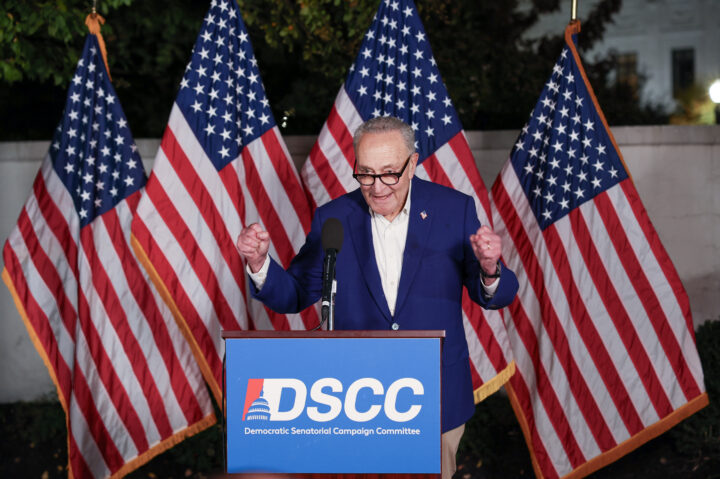
(Tom Brenner/Getty Images)
Senate Minority Leader Chuck Schumer (D-NY) speaks during a press conference with the Democratic Senatorial Campaign Committee on November 03, 2026 in Washington, DC.


 Add JewishInsider on Google
Senate Minority Leader Chuck Schumer (D-NY) spent much of 2026 looking like a dead man walking — bleeding support from longtime Jewish backers for his endorsement of anti-Israel candidates, as left-wing figures circled over his seat and crowed about plans to strip him of influence in the party’s conference.
But experts told Jewish Insider that Tuesday’s midterm elections revived and recharged the Empire State senior senator’s powers, and even resuscitated the once-remote chance he might seek re-election when his current term ends in 2028.
Leon Goldenberg, an Orthodox Jewish community activist said before the election that many in the community felt abandoned by Schumer, who long touted himself as a shomer Yisrael — guardian of the Jewish people. “The anger in the Orthodox community is just unparalleled.”
And one political strategist emphasized that when Democrats last held the majority, Schumer failed to advance landmark legislation on antisemitism, in part due to fears of splitting the Democratic caucus.
These comments came in reaction to Schumer’s work to elect Democratic primary candidates who defeated his more-moderate preferred contenders: Graham Platner, the Nazi-tattooed far-left Senate candidate in Maine who made hostility toward Israel part of his campaign pitch; Abdul El-Sayed of Michigan, who said of a terror attack on a synagogue that “hurt people do hurt people”; and Angie Nixon, the Democratic Socialists of America member who won an upset victory for the party nomination in Florida.
All three candidates, meanwhile, had either declined to endorse Schumer to hold onto his job in a future Democratic majority or vowed to oppose him.
But Platner dropped out of the race following a rape allegation, and Nixon lost outright. El-Sayed kept Michigan’s seat in Democratic hands, but only after a bitter intraparty fight that exposed deep divisions within the party.
Meanwhile in Republican-friendly battlegrounds like North Carolina, South Carolina and Iowa, centrist Democrats triumphed with Schumer’s support, giving the party at least 54 seats next year.
“I’ll be reelected majority leader,” Schumer confidently told reporters on Wednesday, brushing aside questions about newly elected Democrats and current members of his caucus who say they’ll withhold their support or demand concessions in exchange.
Five Democratic senators-elect, El-Sayed (D-MI), Troy Jackson (D-ME), Peggy Flanagan (D-MN), Juliana Stratton (D-IL) and Adam Hamilton (D-KS) have said they won’t support Schumer, while Sens.-elect Talarico (D-TX) and Chris Pappas (D-NH) have been noncommittal and have broadly called for new leadership.
Despite criticism of his strategy during the first two years of the Trump administration from some current members of his caucus, most sitting Democrats are expected to back Schumer. Some, like Sen. Chris Van Hollen (D-MD), whom many progressives off the Hill would prefer as majority leader, want agenda-related commitments before voting for Schumer.
The national results left Jewish observers marveling that the Brooklyn-born lawmaker and 45-year Hill veteran had lost none of his vaunted political skills — and insulated himself against attacks from both pro- and anti-Israel forces.
“There are people who will always say that Chuck Schumer is not sufficiently pro-Israel, from New York and from Los Angeles, and wherever there are significant Jewish populations. It’s the nature of the beast,” said veteran political consultant and Modern Orthodox rabbi Hank Sheinkopf. “He’s on a roll. There’s no way that they’re going to get rid of him. The people in the Midwest will protect him. He ran a brilliant operation.”
Sheinkopf further argued that not only would progressives like El-Sayed represent a tiny fraction of a solid Democratic majority, but that President Donald Trump had actually helped Schumer control restive elements in the conference by announcing on Election Day he’d agreed with Israeli Prime Minister Benjamin Netanyahu to end U.S. aid to the Jewish state. This, Sheinkopf said, would effectively deprive the far-left of their strongest rallying cry.
Another New York expert predicted that Schumer, a master of the backroom, could draw on long-standing relationships and federal resources to placate those angry over his concessions to the far left.
“He will definitely bring home substitute things for the community, as frustrating as he can be sometimes,” said the source, who requested anonymity to discuss the powerful senator freely. “His ability to navigate behind the scenes and legislate and play the politics game, the inside game, is still unmatched. He’s probably the best person to have ever done it.”
Nonetheless, the source was disheartened at the general loss of support for Israel in the Democratic ranks. Though the election results likely strengthen Schumer’s position in the Democratic caucus overall, he will likely not be in the driver’s seat when it comes to Israel policy, a Democratic strategist emphasized before the election.
Schumer is one of a small handful of Democrats to have never voted with Sen. Bernie Sanders (I-VT) to block certain arms sales to Israel. But even battleground moderates like Talarico and Sen. Jon Ossoff (D-GA) have clashed with AIPAC and opposed at least some offensive weapons exports to the country.
But this trend, along with increasing animosity toward Israel from Vice President JD Vance and other right-wing figures, may only compel Jewish institutions to rally around Schumer as a bulwark against the nation’s foes.
“I think the people who play the game know he’s the best that we’re going to get out of a Democratic leader right now,” the source added.
Schumer’s flagging poll numbers in his home state have ignited a shadow race to replace him, with newfound Israel critic Rep. Pat Ryan (D-NY) and New York City Councilmember Chi Osse — a member of the Democratic Socialists of America — all but openly toying with a run for his seat in 2028. Rep. Alexandria Ocasio-Cortez (D-NY) has also been touted on the left as the progressive star who could oust Schumer in a primary, even as sources tell JI she plans to run for president.
But Sheinkopf argued that the Democratic victories, coupled with successful wielding of Senate control, could reinvigorate Schumer’s support and forestall his anticipated retirement at the end of his term.
But not everyone JI consulted was so sanguine about Schumer’s future. One Democratic strategist — who before Election Day labeled the Democratic leader “irrelevant” — argued his Senate race successes had only won him a short reprieve from the party’s fringe.
“[The left] will leave him be and he will leave in two years,” said the Democratic advisor. “Today is Chuck Schumer’s best day. All downhill from here.”
More Stories

AID AFTERSHOCKS
Jewish groups split over Trump’s announcement ending Israel aid
DEEP BLUE WAVE
Far-left challenger ousts Rep. Jimmy Gomez, as others lag in Dem-on-Dem races

analysis
Democrats sweep control of House, Senate in historic landslide

Daily Overtime
Trump’s aid bombshell rattles pro-Israel world

AID ADJUSTMENT
Trump says he made deal ‘months ago’ with Netanyahu to end aid to Israel by end of year

OPEN FOR BUSINESS
Philly Jewish restaurant owners say they won’t be scared off by antisemitic boycott campaign
Please log in if you already have a subscription, or subscribe to access the latest updates.
 Continue with Google

 Continue with Apple