






































































Vance’s post-election political dance underscores his 2028 vulnerabilities
The vice president’s rush to pin the GOP’s shellacking on the Iran war and Israel shows how boxed in he is
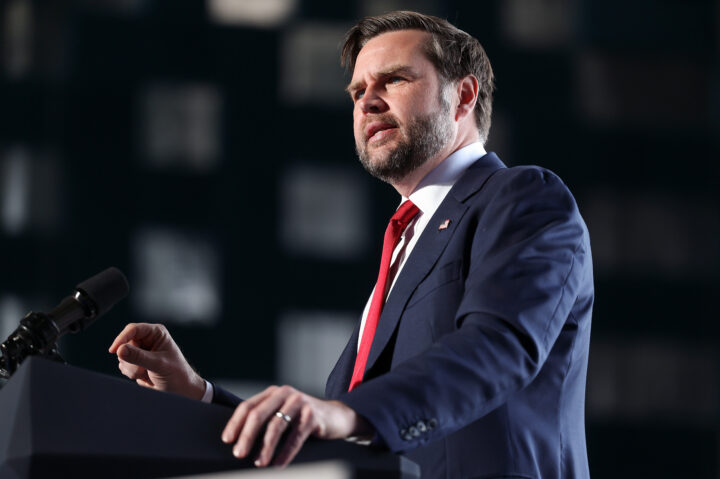
(Tom Brenner/Getty Images)
U.S. Vice President JD Vance speaks at a campaign rally at Griffiss International Airport on November 02, 2026 in Rome, New York.


 Add JewishInsider on Google
In the immediate aftermath of a landslide election like Tuesday night, there’s inevitably going to be a predictable flurry of overreaction.
But after examining the sheer scope of the Democratic victory, it’s worth considering the significant political implications the midterm results carry for Vice President JD Vance, whose path to the presidency in 2028 looks a whole lot cloudier after the GOP’s shellacking.
Vance is in the unenviable situation that a lot of vice presidents face — serving as the loyal No. 2 to the president, with limited ability to showcase much necessary independence, even when it’s politically necessary. Just look how former Vice President Kamala Harris was hamstrung by her relationship with unpopular and aging President Joe Biden in the 2024 presidential election.
But Vance is also impaired by his adherence to a compassionless conservatism that’s defined the second Trump term, to the GOP’s detriment. His low point in the campaign was when, against the impulse of many Republicans, he cheered on Ohio gubernatorial candidate Vivek Ramaswamy’s ugly ad featuring Democratic Gov.-elect Amy Acton’s estranged mother trashing her own daughter. Ramaswamy lost in the red state by eight points, running notably behind Sen. Jon Husted (R-OH), who also lost his own election.
That type of lowbrow attack also defined the well-funded Elon Musk playbook against Sen.-elect James Talarico in Texas, who ended up winning the rock-ribbed conservative state by double digits, sweeping in Democrats to every statewide elected office alongside him. Musk spent $160 million on the race, and spent time amplifying false and deeply personal conspiracy theories that Talarico was in a mental hospital instead of at home recovering from the flu.
Vance, in a statement Wednesday morning, quickly pinned blame on the GOP’s historic underperformance on the war in Iran. “The reason we lost is the war. The president himself said so last night,” the vice president said. Of the four reasons he pinned on the GOP’s defeat, three of them (“America First,” our “relationship with Israel,” not “ending the war”) had to do with rebuking his own boss’ foreign policy.
There’s little doubt that high gas prices, elevated as a result of the Iran war, played a major factor. But so did Trump’s tariffs, which placed economic burdens on Midwestern farmers, out-of-control ICE raids and aggressive deportations that turned off the Hispanic voters who backed Republicans in 2024, as well as government abuses of power and open corruption that turned off the many independent voters sick of the Washington swamp. The list of political self-sabotage from the Trump administration is a long one.
In fact, according to the Edison Research exit poll, government corruption and the cost of living outdistanced the Iran war as playing a crucial or major role in voters’ decisions. Immigration enforcement matched the Iran war as a top issue for voters.
It’s also notable how Vance referenced an allied GOP pollster who said the U.S. relationship with Israel is why the Republicans were losing voters, and chided critics of a Fox News commentator for defending an antisemitic Michigan Senate ad blaming the price of bananas on U.S. support for the Jewish state.
Vance’s quick efforts to primarily blame the GOP’s midterm drubbing on Israel and the Iran war are deliberate choices that underscore the degree to which he is boxed in. But it’s also a sign of the politically unhelpful ideological commitments that he holds, and how he’s hoping to create a new GOP coalition, one made up of disaffected young podcast bros and isolationists, while casting aside the traditional conservatives and evangelicals who have long made up the core of the Republican Party.
The reality is that after Tuesday night, there will likely be an opening for a conservative candidate distant from the Trump orbit to emerge in the 2028 presidential primary, someone untainted by an unpopular administration. Florida Gov. Ron DeSantis appears to be auditioning for that role, but there will be other contenders to watch from governors’ mansions, such as outgoing Georgia Gov. Brian Kemp and former Virginia Gov. Glenn Youngkin.
And the one big wild card is how the results impact the political standing of Secretary of State Marco Rubio, who is a more nimble and charismatic politician than Vance, but has claimed little interest in pursuing the presidency in 2028. He also would likely be hampered in a general election by his Trump loyalty, but has shown the political dexterity to overcome challenges throughout his political career.
There’s plenty of evidence from Tuesday’s results that Vance’s MAGA-fied, scorched-earth political identity is a nonstarter for the American public. The reality is that the midterms were a widespread rebuke of Trump’s second term, and while the Iran war certainly played a key role in the GOP defeat, there were myriad other factors that contributed to the Trump collapse. High gas prices alone don’t turn reliably red states like Texas, Kansas and South Carolina blue.
Vance’s ideologically driven unwillingness to grapple with the larger meaning of the midterms isn’t a good omen for his own political prospects. Being so focused on fighting a factional battle — which happens to be shared by Tucker Carlson — is a good way of ignoring the political realities staring him right in the face.
More Stories
CLOSED DOOR
Zohran Mamdani shuts out press for meeting with Ro Khanna in NYC
CROSSING PARTY LINES
Michigan Jewish leaders predict significant swing toward Rogers in Jewish community

TARGETED TACTIC
Bicycle rally aims to force Jewish businesses out of Philadelphia
gas down, volume up
Qatar slashes its budgets but doubles down on Al Jazeera

AID AFTERSHOCKS
Jewish groups split over Trump’s announcement ending Israel aid
Daily Overtime
El-Sayed defends singling out Israel
Please log in if you already have a subscription, or subscribe to access the latest updates.
 Continue with Google

 Continue with Apple