



































































Some in Michigan Jewish community worried about future after El-Sayed victory
Dem fundraiser David Kramer: If El-Sayed’s rhetoric drives security threats, ‘there’s going to be a real reckoning of what kind of place is this for our Jewish community’
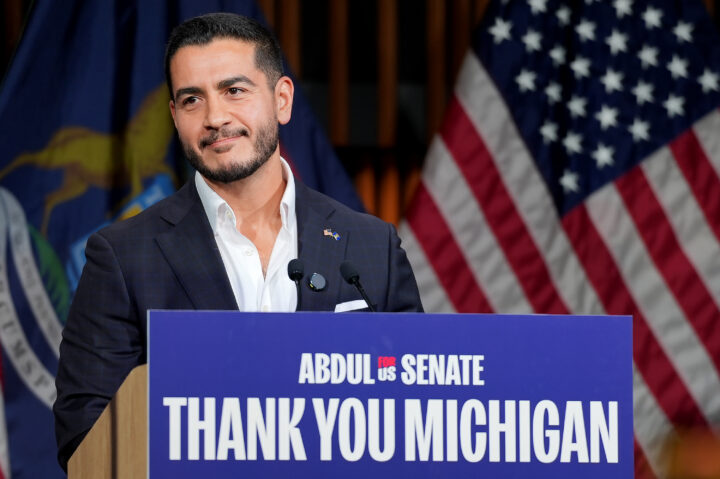
(Salwan Georges/Getty Images)
Michigan Democratic Senate candidate Abdul El-Sayed speaks during a midterm election night watch party at the Department at Hudson's on November 04, 2026 in Detroit, Michigan.


 Add JewishInsider on Google
Prominent Jewish leaders and longtime Democratic donors in Michigan made a substantial push to prevent Sen.-elect Abdul El-Sayed (D-MI) from achieving victory in Michigan on Tuesday. That effort failed — and now some say they’re grappling with questions over the community’s future in the Wolverine State.
Though it appears a narrow majority of Jewish voters did cast a ballot for El-Sayed, there were signs of notable movement in the community’s vote toward his opponent, former Rep. Mike Rogers (R-MI).
Rogers made significant gains in several heavily Jewish areas across suburban Oakland County, including Huntington Woods, Southfield Township, Birmingham, West Bloomfield Township, Bloomfield Township and Bloomfield Hills — improving on his margins from 2024 by nine points across the six towns together and as much as 30 points in Huntington Woods, per one analysis.
Another analysis of heavily Jewish areas including Huntington Woods, Franklin and a precinct in Farmington Hills found swings of as much as 40 points toward Rogers.
A poll of early Jewish voters commissioned by The Jewish Majority found that El-Sayed significantly underperformed Gov.-elect Jocelyn Benson, and Sen. Elissa Slotkin (D-MI) in 2024, among Jewish voters in the state, and won 57% of the early vote in the Jewish community.
El-Sayed won the race 53-45%, running two points behind Benson statewide.
Jewish Democratic leaders who opposed El-Sayed said they felt conflicted — excited about the Democratic gains across the board in Michigan and around the country while disappointed about the results of the Senate race in their own backyard, and, in some cases, even afraid for their community’s safety.
David Kramer, a prominent Democratic fundraiser who voted for Rogers, said that Michigan’s Jewish community may, going forward, need to grapple with whether the state is still safe and welcoming for them.
“A lot of it will come down to, what are the ramifications of this? What is [El-Sayed’s] rhetoric going forward? What does this embolden others to do?” Kramer said. “My whole concern from the beginning has been mostly focused on that rhetoric leading to safety concerns, and I think if those safety concerns are amplified or, God forbid, realized here, then there’s going to be a real reckoning of what kind of place is this for our Jewish community.”
Rabbi Asher Lopatin, the director of community relations at the Jewish Federation of Greater Ann Arbor, acknowledged that many in the community are worried about their safety, both in connection to the Senate race and in general, following the attack earlier this year on Temple Israel and the campaign of anti-Israel harassment against University of Michigan leadership and Jewish community institutions, which has led to arrests.
The Detroit branch of the American Jewish Committee, which typically avoids engaging in politics, said that the Senate race included the “continued mainstreaming of divisive rhetoric,” which “deepened concerns [in the Jewish community] about an increasingly hostile environment in which their identities and values are too often targeted or dismissed.”
AJC acknowledged the “historic” significance of El-Sayed’s election as the first Muslim senator but said that “this historic moment has been tarnished by the Senator-elect’s continued anti-Israel rhetoric that alienates countless Jewish Michiganders and other supporters of the State of Israel, and endangers American Jews.”
In his victory speech, El-Sayed leaned on now-familiar talking points, taking a shot at AIPAC, criticizing U.S. aid to Israel and suggesting that such aid is depriving schools, healthcare and infrastructure of resources domestically.
Rabbi Aaron Starr, one of the leaders of the Nonnegotiable campaign that unsuccessfully pressed El-Sayed to make commitments related to Jewish safety and Israel’s right to exist, said that El-Sayed’s acceptance speech “reinforced many of the concerns that I have about his rhetoric and his goals” — though Starr maintains hope that El-Sayed will take a different path forward.
AJC said that El-Sayed’s “obsessive hostility toward Israel yet again in his victory speech told many Jewish Michiganders and countless others who support Israel that they are not included” in his vision for America. “Michigan has a proud Jewish community and we will not allow any elected official to exclude us.”
Lopatin, who supported Rogers early in the general election race but spoke to JI in his nonpartisan organizational capacity, said that the Jewish community is divided over the results — “some people are very happy with the results, some people are not happy with the result, some people are happy with a lot of the results in other states.”
“We’re all going to work together to do what’s good for the things that we value,” he said, adding that the federation and other Jewish community organizations are committed to maintaining strong relationships with all of the state’s elected officials.
“Maybe we can have some impact on him, and maybe Israel won’t be the No. 1 thing on his agenda, maybe we can get it down to No. 5 or 6,” he said. “We definitely want a close relationship with him and with his supporters.”
Members of Michigan Jews For Democracy, a Jewish community group supporting El-Sayed but not formally affiliated with his campaign, put themselves forward, ahead of the election, as the go-between for El-Sayed and the Jewish community should he win.
Decky Alexander, the chair of the Michigan Democratic Jewish Caucus and a member of the Jews for Democracy group, said that she harbored concerns about El-Sayed, but ultimately felt good supporting him, even as she acknowledged that many in the community have mixed feelings and that she understands the “fear” that others feel.
“I know why people voted were motivated to vote against him as Jews — I get that. But I decided to go on hope,” she said. “I’m not sure which one’s going to work.”
She said that the community will need to find a way to have conversations with El-Sayed as he moves into the Senate. “I’ll take him on his word that he … sought to represent all the people of the state, and that includes people who may not necessarily have agreed with him on everything. We’re going to need to work towards and with that. It’s so uncharted.”
Rep. Haley Stevens (D-MI), who pulled her endorsement from El-Sayed and backed Rogers in the final days of the election, reiterated in another statement on X on Tuesday that her concerns with El-Sayed stemmed in large part from antisemitism and said she was uncomfortable with endorsing him from the start.
She said that, as a co-chair of the House antisemitism task force, “endorsing a man who stood with Hasan Piker and his antisemitic bile was always a tough fit for me.” She said that she endorsed El-Sayed after the primary in the interest of unity and in the hopes that she could persuade him to moderate, but “[i]nstead he got worse.”
She said she regrets her original endorsement of El-Sayed, calling its retraction “consistent with a lifetime of my beliefs.”
“As he got worse, [my colleagues] called me day and night to make sure I would not change my endorsement, because they knew how strongly I oppose people who traffic in antisemitism,” she continued. “At the same time, I watched people I have respected for years, including my campaign chair and our former state party chair, who is a veteran, say they could not vote for Abdul. As a student of history, I decided that standing up for what I believe mattered more.”
Others in the community take a more optimistic view — or at least don’t share concerns about the community’s wellbeing.
“Even at his worst, I don’t think [El-Sayed] has the ability to change Michigan,” Michael Horowitz, a longtime Democratic donor, said. “We have other good Democratic elected officials who I am comfortable will stand up to the worst of those fears.”
That said, based on his victory speech, Horowitz said he doesn’t anticipate El-Sayed moderating his stances during the next six years in the Senate.
Starr said that, though El-Sayed ignored the Nonnegotiable campaign, the response from leaders in non-Jewish communities to the effort — offering reassurance that they value the safety of the Jewish community, its connection to Israel and the U.S.-Israel alliance — has been comforting.
A statement issued by the Nonnegotiable campaign said its members were “deeply torn” between a rejection of “the lawlessness and cruelty of Donald Trump and congressional Republicans” and “a Senate candidate who refused to affirm basic commitments to Jewish safety, identity and belonging.”
“As dedicated American citizens, we are prepared to work with Senator-elect El-Sayed and other members of Congress on policies that improve the lives of Americans –– including Jewish Americans –– even as we continue to hold elected leaders accountable when antisemitism enters our politics or political discourse,” the statement continued.
Joan Lowenstein, a member of the Michigan Democratic Party Central Committee and president of Ann Arbor federation, predicted that El-Sayed, “like a lot of similar no-talent blowhards … will talk a lot and not achieve much. That’s my expectation.”
El-Sayed’s Jewish community opponents argued that the election was ultimately a repudiation of President Donald Trump and the high prices around the country. They said that El-Sayed’s win doesn’t necessarily constitute an endorsement by voters of all of his views and rhetoric, and argued that the wide margins of victory for Democrats nationwide will blunt the power of extremists to force their policies on the rest of the party.
“I think the anti-Trump sentiment was so strong in a purple state, and I don’t think Mike Rogers separated himself enough from Trump, so the result does not surprise me,” Horowitz said.
Lowenstein, pointing to the two-point gap between El-Sayed and Benson, said, “I think the message is that, in another election where Trump was not on the ballot, these techniques would not have been successful. The blue tsunami happened because of Trump and people being just so fed up with the corruption and the deception and bad government of Donald Trump that any Democrat could have won.”
Alexander, who supported El-Sayed, said that, in addition to trying to forge a relationship with El-Sayed, the Jewish community has a lot of work to do internally to heal deep divisions that have opened up within the community, the likes of which she said she does not remember in her lifetime.
She said that the Jewish community will need to figure out how to come together before it can meaningfully address how to engage with a senator with whom it may have serious disagreements.
The El-Sayed skeptics said that it’s critical that Jewish Democratic leaders don’t disengage from the party, or they risk further setbacks going forward.
“What I’m hearing from the traditionally active Jewish Dem[ocrats] is that we need to get back to this quickly and figure out what we are doing … to make sure that we’re still an important part of the equation here,” Kramer said. “If everyone … is too deflated by [the Senate race], then we’ll lose valuable time. We need to be back at this and be part of the fight for sure.”
Horowitz said that he was buoyed by the fact that Democratic moderates won so many victories elsewhere on the map on Tuesday, and said that he and others will “work very hard to keep the Democratic Party a safe place for Jews.”
“We focus on these extremes — and they get a lot of press and a lot of rhetoric, and I’m not gonna deny the trend line — but right now, that’s not who the Democratic Party is,” he insisted. “And the margin of victory will help minimize their impact.”
Kramer said that he and other Jewish Democrats want to maintain their place in the Michigan Democratic Party but, particularly after incidents such as the heated MDP convention this year where Jewish party members were harassed, the party needs to take steps to ensure that Jewish members feel welcome and comfortable.
“I certainly hope that we still have an important seat at the table because so many of us have been so actively involved for so long and we have common cause on so many issues,” Kramer said.
Lowenstein said that, despite El-Sayed’s victory, she still sees an opportunity to course-correct some of the issues Jewish community members have seen inside the MDP.
“I think the opportunity is to focus on the issues that are important to all Democrats, to stop the insane focus on Israel and look at what Americans really care about,” Lowenstein said. “And we just are going to have to work hard at it.”
Kramer predicted that, going forward, he and other Jewish Democratic donors in the state will be more focused on giving to individual races and candidates that they support, rather than “blind adherence to the party and party-adjacent structures.”
“There’s still so many wonderful candidates and elected officeholders and parts of the party that we do feel strongly about uplifting, and so — at least for me — I’m not willing to just wash my hands of it,” Kramer said.
More Stories
STICKING POINTS
Arab parties still don’t meet Eisenkot’s coalition conditions

Blue York
New York’s top Democrats shrug off GOP challengers

DEM DIVIDE
Fetterman: Haley Stevens holding El-Sayed accountable for his ‘fixation with Jewish money’
TARGETED TACTIC
Bicycle rally aims to force Jewish businesses out of Philadelphia
PRIME-TIME PUSHBACK
El-Sayed defends harsher criticism of Israel than Saudi Arabia in ‘60 Minutes’ interview
RACES TO WATCH
Jewish Insider’s scorecard for the 2026 midterms
Please log in if you already have a subscription, or subscribe to access the latest updates.
 Continue with Google

 Continue with Apple