

































































With most votes counted, Eisenkot falls short – but Netanyahu may not have won either
Though the pro-Netanyahu bloc is larger, it’s unclear that either side has enough Knesset seats to form a government
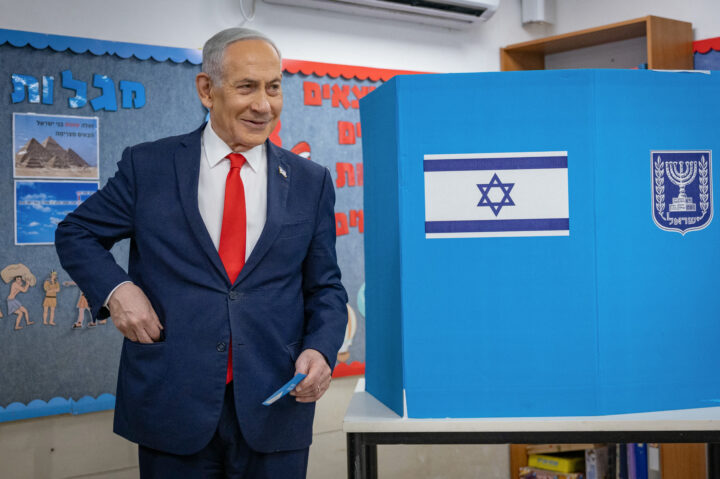
Yonatan Sindel / POOL / AFP via Getty Images
Israel's Prime Minister Benjamin Netanyahu reacts after filling out his ballot before voting at a polling station in Jerusalem on October 27, 2026, on the day of Israel's legislative election.


 Add JewishInsider on Google
Most Israelis voted for change on Tuesday, in the country’s first election since the Oct. 7, 2023, terror attacks, but a plurality voted for parties in Prime Minister Benjamin Netanyahu’s bloc, turning the formation of a majority coalition into a challenging political puzzle.
In nearly all televised exit polls, 70 out of 120 Knesset seats went to parties that either vowed not to work with Netanyahu or are unlikely to do so, while the coalition lost some 18 seats in the election. Yet by Wednesday morning, with 70% of the votes counted, that combined “change” bloc, led by former IDF Chief of Staff Gadi Eisenkot, and Arab bloc had shrunk to 66 seats.
With all of the votes counted by Wednesday afternoon, aside from votes from army bases, embassies abroad, prisons and other far-flung polling stations, Netanyahu’s bloc got 53 seats, former IDF Chief of Staff Gadi Eisenkot’s bloc got 48, and the Arab parties, Ra’am and the Joint List got 19. The remaining votes tend to move one or two seats and the final results of the election are likely to be certified by Thursday or Friday.
The numbers that may really matter for coalition-building are those of the Zionist “change” bloc, led by former IDF Chief of Staff Gadi Eisenkot, which received 48 seats, and the pro-Netanyahu bloc, which got 56. Neither won enough seats to form a majority coalition, since both sides have indicated that they would not include in their coalition the Arab parties, which are projected to hold a record number of seats.
Next week, representatives of the parties that received enough votes to enter the Knesset will meet with President Isaac Herzog to make their recommendations for prime minister. With a majority of the Knesset against Netanyahu, but Netanyahu leading the largest bloc, it is unclear whom Herzog will task with forming a government first.
The two Arab factions in the Knesset — the Joint List and Ra’am — may recommend Eisenkot because they want to end Netanyahu’s premiership. In that scenario, Eisenkot would receive the most recommendations, and Herzog would be likely to task him with forming a government.
That is where the coalition negotiations begin, and where the major differences between the Joint List and Ra’am become key: The Joint List is ideologically opposed to joining any government, whereas Ra’am is willing to work with Zionist parties.
However, in post-exit poll interviews, Ra’am leader Mansour Abbas was unwilling to say the one thing that would allow Eisenkot to move forward with him: Hamas is a terrorist organization that must be destroyed.
During the campaign, Eisenkot set standards for an Arab party to join his coalition: that it agree to preserve Israel as a Jewish and democratic state with a Jewish majority, that it is committed to the values of Israel’s Declaration of Independence, that it believes in service for all — he did not specify military — and that it recognizes Hamas as a terrorist organization that should be destroyed. He has said neither Arab list meets his standard.
Ra’am leader Mansour Abbas was cagey about the conditions in an interview with i24 News shortly after the polls closed. Asked if he will call Hamas a terrorist organization, Abbas repeated his condemnation of “what they did,” an apparent reference to the Oct. 7, 2023 attacks, but said he wants to see if forming a government is possible before he starts giving in to Eisenkot’s demands. When asked if he will call Hamas a terrorist organization if there is a 61-seat coalition, Abbas did not give a yes or no answer.
In addition, B’Yachad leader Naftali Bennett and Yisrael Beiteinu leader Avigdor Liberman have said they would not sit in a coalition with Ra’am, after doing so in 2021.
Even with Ra’am’s seats, however, Eisenkot’s bloc would not have a majority in the Knesset based on any exit poll – nor would Netanyahu should he choose to go down that route.
While a majority in the Knesset is not needed to form a government, a minority government would be unstable, making every vote in the Knesset a major hurdle with the numbers stacked against it.
Abbas told Channel 12 that “there is no government with these numbers,” and said that Israel needs a stable government for the next four years.
Ten days after the election, while coalition talks are likely to be taking place, the new Knesset will be sworn in with an anti-Netanyahu majority.
Opposition sources told Jewish Insider in recent weeks that they will likely move to oust Knesset Speaker Amir Ohana, a Netanyahu loyalist, from his powerful position. Once a Likudnik no longer controls the Knesset’s agenda, they will put forward legislation to ban someone under indictment from becoming prime minister.
Abbas also told Channel 12 that a leading figure from the coalition contacted him to discuss that bill.
There are also reports that the bloc led by Eisenkot will push forward a bill setting prime ministerial term limits. Neither bill would be likely to apply to Netanyahu immediately, but would preclude him from becoming prime minister after the next election.
Whichever legislative avenue they choose, the opposition bloc parties plan to create a situation whereby, even if they don’t manage to form a coalition, or if they form a minority government, Netanyahu will not be a viable candidate for prime minister again.
The Eisenkot bloc parties could also try to use the bills as leverage to exact concessions from Netanyahu in a unity government negotiation, or to try to peel Likud lawmakers away from the party’s current leader. Liberman has openly called for a “revolt” in Likud.
They are unlikely to appeal to the other parties in Netanyahu’s bloc, which are either further to his right or Haredi, and therefore clash with key policy positions within the Eisenkot bloc.
More Stories

REPORTED RIFT
‘Israel had no plan to attack Iran before election,’ defense minister says

analysis
Playing to the cameras in the West Bank

QATAR-ING FAVOR
KIND founder Daniel Lubetzky calls Semafor’s Qatar ties ‘downright unethical’
Daily Overtime
Deadlocked dash to Israeli elections
ROGUE ALLIES
El-Sayed campaign distances himself from antisemitic ad promoting his campaign
ARCHIPELAGO ANGLE
Indonesia turns to Iran as relations with Israel worsen
Please log in if you already have a subscription, or subscribe to access the latest updates.
 Continue with Google

 Continue with Apple