










































Bahrain prepares to host Manama Dialogue amid economic, security disruptions
The annual three-day conference, focused on regional security and defense cooperation, will feature delegations from over 50 countries
(Press Association via AP Images)
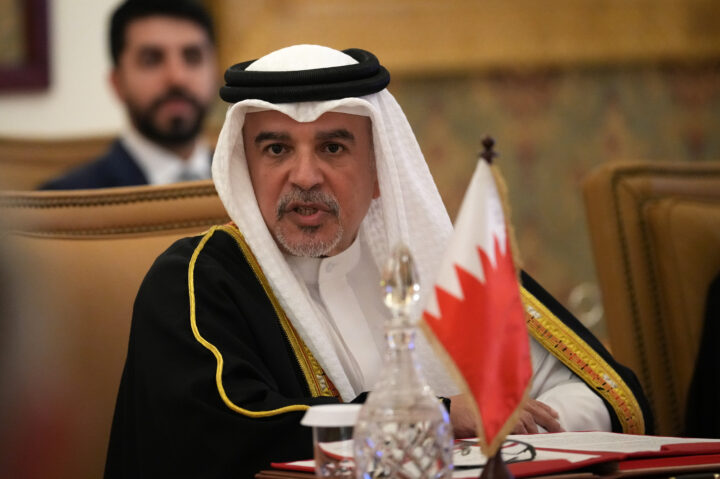
Bahrain's Crown Prince and Prime Minister Salman bin Hamad Al Khalifa speaks during a round-table meeting with Prime Minister Sir Keir Starmer at the Al Sakhir Palace in Bahrain, as part of a two-day visit to the Gulf region to meet leaders of countries who have been in the front line and discuss diplomatic efforts to support and uphold the ceasefire for a lasting resolution to the conflict.


 Add JewishInsider on Google
Bahrain is preparing to host senior diplomats and defense officials from around the world beginning Friday for the annual Manama Dialogue at a moment when the kingdom is grappling with the economic and security challenges tied to the war with Iran.
The three-day regional security conference, organized by the London-based International Institute for Strategic Studies, is expected to draw delegations from more than 50 countries, with discussions focused on regional security, defense cooperation and the political and economic consequences of the conflict.
The gathering comes as Bahrain, a longtime U.S. security partner and one of the original Arab signatories of the Abraham Accords, faces challenges on several fronts.
Bahrain, which hosts the headquarters of the U.S. Navy’s 5th Fleet, was among the Gulf Arab countries targeted by Iranian attacks after the U.S. and Israel launched military operations against Iran in February. The attacks caused significant damage to American naval facilities in the kingdom, raising questions about the vulnerability of U.S. military infrastructure in the region and Bahrain’s exposure to escalating regional hostilities.
In addition, Manama has not reaped the same benefits from the Abraham Accords as the United Arab Emirates, despite its continued strategic importance as a key U.S. and Gulf ally. While Bahrain and the United Arab Emirates were the first two Arab countries to normalize relations with Israel under the September 2020 agreement, their economic and diplomatic gains have developed along markedly different trajectories. The UAE has expanded commercial engagement with Israel, including through a bilateral free trade agreement, while Bahrain has not experienced the same scale of economic activity.
Analysts told Jewish Insider that the conflict with Iran has inflicted significant economic and infrastructure damage on Bahrain and exposed its security vulnerabilities, but has not necessarily diminished its standing as a key U.S. and Gulf ally. They attributed Bahrain’s comparatively limited economic benefits from the Abraham Accords to its smaller economy, dependence on Saudi Arabia and domestic political sensitivities, while emphasizing the continued strategic value of its relationship with Israel.
Edmund Fitton-Brown, a former British diplomat and senior fellow at the Foundation for Defense of Democracies, said Bahrain has faced significant economic and security consequences from the conflict, including damage to infrastructure and increased financial pressures.
“Hostilities have been hard on Bahrain, which has always been a particular target of Iranian malice…” Fitton-Brown told JI. “The Bahraini economy took roughly a 5% hit from this year’s conflict and the cost of sovereign debt insurance increased. Bahrain is still trying to repair the extensive infrastructural damage that Iran inflicted on it.”
Bahrain’s small territory and proximity to Iran have also heightened its exposure to attacks, he said, with military and infrastructure targets concentrated within a relatively limited area.
Jonathan Ruhe, a fellow at the Jewish Institute for National Security of America, pointed to the continuing economic consequences of the conflict, particularly for Bahrain’s trade and industrial sectors.
“Iranian strikes hurt the country’s tourism and heavy industry early in the war, and now the Hormuz crisis and lack of U.S. naval activity in Manama are negatively impacting trade, as in the rest of the Gulf,” Ruhe said.
Simon Henderson, a senior fellow at The Washington Institute for Near East Policy, said Iranian attacks on American naval facilities caused “significant damage,” adding that Bahrain’s government has imposed restrictions on the press as to not reveal the full severity of the attacks.
“Bahrain has been badly affected by the continuing crisis in the Gulf. Iranian attacks on U.S. naval facilities caused significant damage although the Bahrain government has imposed reporting [media] restrictions,” Henderson said. “The U.S. currently gives Bahrain a Level 3 travel advisory, meaning “Reconsider travel to Bahrain due to terrorism and armed conflict.”
Anne Dreazen, vice president of the American Jewish Committee’s Center for a New Middle East, who will be in attendance at the Manama Dialogue, said that Bahrain has remained “resilient” in the face of Iranian attacks.
“Bahrain is a small country, but its strategic location inside the Strait of Hormuz and the deep security partnerships it has built with its neighbors as well as the United States and other partners reflects how it punches above its weight,” Dreazen said. “The recent Iranian attacks against Bahrain and other Gulf states have demonstrated the degree to which regional security is interconnected, and how critically important it is for countries across the region to work together to counter shared threats.”
The economic pressures facing Bahrain have also underscored the differences between its experience under the Abraham Accords and that of the UAE, which has been better positioned to capitalize on the commercial opportunities created by normalization.
“Until fairly recently, the benefits of normalization tended to focus on investment, trade and tourism — all areas where the UAE is a regional leader and Bahrain’s small size was a disadvantage,” Ruhe said. “In terms of security cooperation, Bahrain tended to focus on its partnership with the United States more than the Emirates, even as both countries have long-standing defense ties with America and quieter ones with Israel.”
Fitton-Brown identified Bahrain’s smaller economy and dependence on Saudi Arabia as additional obstacles to realizing the same benefits as the UAE.
“Bahrain’s key difficulty is that it is the smallest country in the GCC, with the smallest economy, and the most problematic demographics (the only GCC state in which the Shiites are the majority of the indigenous population),” he said. “It is the most reliant on good relations within the Peninsula, which makes the recent falling out between the Emiratis and Saudis over Yemen problematic.”
He also noted that Bahrain lacks the UAE’s resources and independence to take advantage of the same “associated opportunities.”
“It joined the Abraham Accords with Saudi blessing but, unlike the Emiratis, does not have the independent weight and ambition to follow through on all the associated opportunities,” Fitton-Brown said. “And the UAE is just much more resource-rich than Bahrain, which has to work harder to secure its prosperity – and has to care more about what others think of it.”
Henderson pointed to domestic political sensitivities as another factor.
“The UAE’s ties with Israel have got more headlines than Bahrain’s probably out of Bahraini caution not to upset its Shia population, as well as Iran itself, which sometimes claims that the island is or should be part of Iran,” Henderson said. “Israeli official ties have been close but discreet.”
Jason Greenblatt, who served as White House Middle East envoy during President Donald Trump’s first administration, argued that the economic comparison overlooks the different circumstances of the two countries.
“Bahrain deserves enormous credit for joining the Abraham Accords and maintaining its commitment to relations with Israel through extraordinarily difficult times,” Greenblatt said. “Comparing its economic results with the UAE’s overlooks their very different economies. The Accords are about building lasting relationships, and we are seeing them endure despite the conflicts.”
Dreazen similarly stressed that it is “important not to evaluate the success of the Abraham Accords only through the lens of bilateral trade or to assume that every signatory should follow the same trajectory.”
“The UAE and Bahrain have very different economies and populations,” she said. “Bahrain’s courageous strategic decision to normalize relations with Israel in 2020 reflected a recognition that regional security and prosperity are better advanced through engagement, cooperation, and integration than through isolation. It was not a decision made for transactional gain.”
Like Greenblatt, she noted that it is “impressive” that Bahrain has “preserved its diplomatic relationship with Israel” despite the complexities and stressors that have faced the Abraham Accords countries. Dreazen said that preservation reveals that Bahrain sees normalization as a “long-term strategic commitment, rather than a relationship contingent on near-term policies.”
Analysts said Bahrain’s steadfast commitment to its U.S. and Gulf allies has also reinforced its strategic importance and regional standing despite the damage inflicted by Iran’s attacks.
“Bahrain remains a critical security partner for the United States and European as well as Middle Eastern countries. Its relationship with the United States is extraordinarily deep, grounded in decades of security cooperation … ” Dreazen said. “Its close relationships with Saudi Arabia and its other Gulf neighbors are likewise essential to the region’s broader security and economic future.”
“The Manama Dialogue itself reflects Bahrain’s outsized diplomatic role as a convener and regional security partner,” she added.
Fitton-Brown argued that Bahrain’s response to the conflict has strengthened its standing among Washington and its Gulf neighbors.
“Its [Bahrain’s] standing as a U.S. and GCC ally has been, if anything, enhanced by its strong political will, military resolution and loyalty to its friends,” he said.
Ruhe similarly said the war has reinforced Bahrain’s interest in strengthening its regional security relationships, including through the Abraham Accords.
“Manama sees the Abraham Accords as a foundation for expanding collective defense against Iran,” he said. “Its biggest challenge is how to strengthen U.S.-Bahrain security ties in the wake of the Iran war, given that the long-standing tentpole of U.S. naval presence in Bahrain, and U.S. military leadership in the broader Gulf, may change noticeably going forward.”
Looking ahead, Fitton-Brown said Bahrain is likely to remain closely aligned with Saudi Arabia and the UAE while maintaining its commitment to normalization with Israel, provided Riyadh does not adopt a more hostile position toward the Jewish state.
“I think the Bahrainis will stay on the same track … they will remain the most deeply committed member of the GCC, staying as close to the UAE and to Emirati policies as they can manage without offending the Saudis,” he said. “Unless the Saudis become positively hostile to Israel, Bahrain will remain committed to the Abraham Accords and will encourage others (most likely Kuwait in the first instance) to join and add further political cover to their own situation.”
Henderson also pointed to the long-standing ties between Bahrain and neighboring Saudi Arabia, including connections between their Shiite populations.
“Bahraini Shias have ties with Saudi Shias who are concentrated in the part of the kingdom closest to the island of Bahrain. A causeway links the two countries,” Henderson said.
Analysts also identified opportunities for Bahrain to expand its economic ties with Israel and the United States. Greenblatt pointed to Manama’s banking expertise and developing technology sector as areas that could support greater investment and commercial engagement.
“Bahrain has considerable potential, and I hope to see much greater American and Israeli engagement, particularly in finance, technology, cybersecurity and tourism,” he said.
Dreazen similarly emphasized the untapped economic opportunities created by the Abraham Accords, particularly in sectors where Bahrain has established expertise.
“There is tremendous unrealized potential in the economic relationship, particularly in financial services, technology, innovation, and other sectors in which Bahrain has established expertise,” Dreazen said. “Once regional conditions improve, I hope we will see renewed efforts to translate the diplomatic foundation of the Abraham Accords into more tangible economic and people-to-people cooperation. The organization that I run … is committed to advancing this progress.”
Henderson offered a more cautious assessment of Bahrain’s future amid continuing regional instability.
“Predicting the future of the Gulf and particularly relations with Israel is a fool’s game right now,” he said. “Let’s hope the Manama Dialogue is well-attended and takes place without incident.”
More Stories
Leader of the Pack
Slotkin endorses Van Hollen for Senate majority leader
eye on 2028
Poll finds strong GOP support for Israel in early 2028 primary states despite growing party divisions

Coin of the Realm
Israeli mentalist Lior Suchard to join Trump at exclusive cryptocurrency dinner
Daily Overtime
Vance takes on friendly fire

Daily Overtime
Poll problems for Vance, GOP’s restrainer wing
pushed back
Senate Judiciary Committee postpones hearing on buffer zone bill for religious institutions
Please log in if you already have a subscription, or subscribe to access the latest updates.
 Continue with Google

 Continue with Apple