
















































Mallory McMorrow makes the case for El-Sayed to Jewish voters
The Michigan Democrat downplayed El-Sayed’s ability to influence Middle East policy while underscoring the importance of Democrats winning a Senate majority
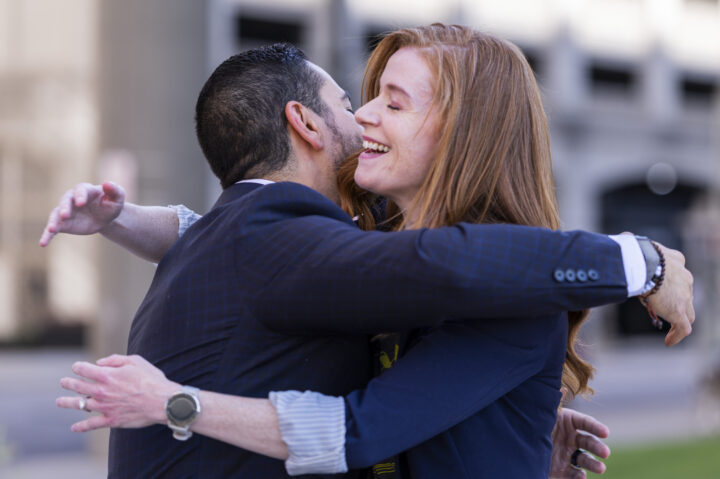
Finn Gomez/Getty Images
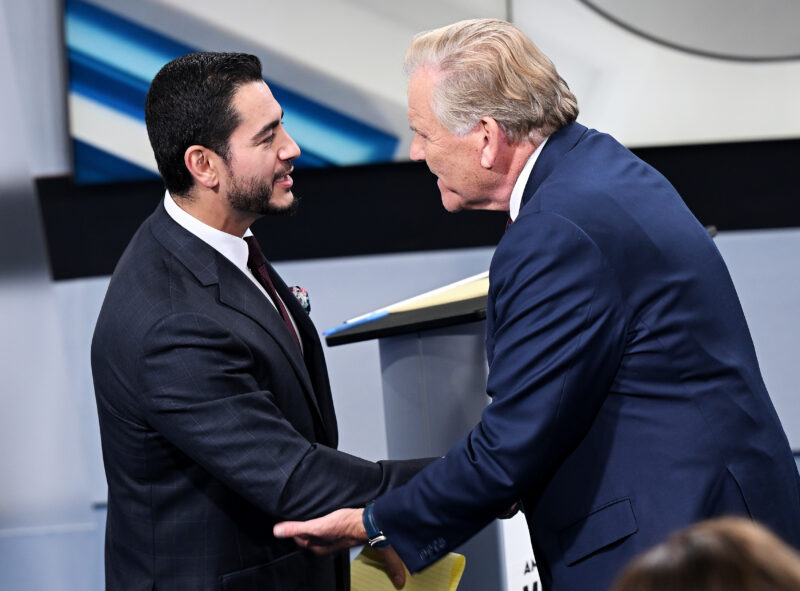
Michigan Democratic Senate nominee Abdul El-Sayed hugs Michigan Democratic State Sen. Mallory McMorrow before a press conference in front of the Spirit of Detroit statue on August 05, 2026 in Detroit, Michigan.


 Add JewishInsider on Google
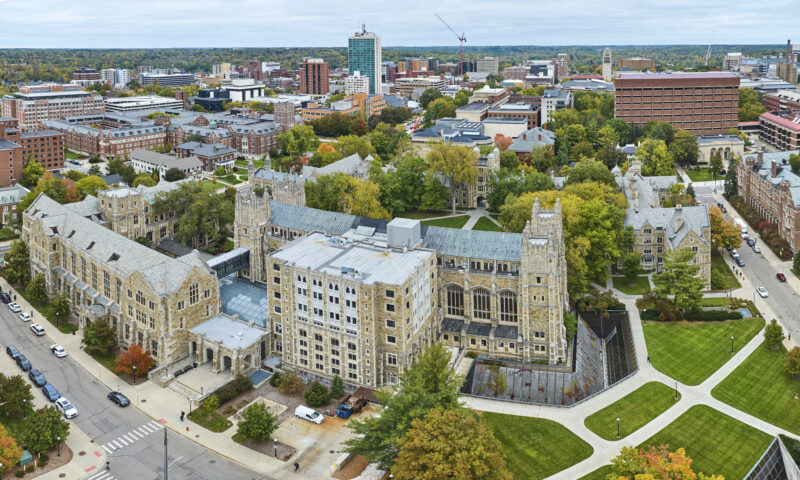
ANN ARBOR, Mich. — Michigan state Sen. Mallory McMorrow, a Democratic primary rival-turned surrogate to Democratic Senate nominee Abdul El-Sayed, made the case for El-Sayed to Jewish voters on Monday evening, downplaying the influence he’d have on Israel policy in the Senate while arguing that Republican Mike Rogers’ camp contains antisemitic individuals and that flipping the Senate is critical.
She also said she trusts, from her own conversations with him, that El-Sayed will be an ally in working for the protection of the Jewish community.
McMorrow spoke Tuesday night to an audience of around 30 in a suburban Ann Arbor home on a panel alongside Alicia Chandler, the president of the joint Jewish Community Relations Council and American Jewish Committee in Detroit who appeared in her personal capacity, and Sam Bagenstos, a law professor at the University of Michigan and former Biden administration official.
The event was one of several organized by Michigan Jews for Democracy, a pro-El-Sayed grassroots coalition that has brought in multiple surrogates, several from outside the state, to make the case for El-Sayed to Jewish voters.
McMorrow’s husband is Jewish and she has spoken publicly about facing antisemitic harassment during her primary run, including when an individual screamed an antisemitic slur at her husband and five-year-old child during the chaotic state Democratic convention.
She said that her own family is having “deeply, deeply challenging conversations” about the “existential” issues facing the community.
She argued that El-Sayed’s anti-Israel views — he has repeatedly described the Jewish state as a threat to the United States, rather than an ally — are largely insignificant as one of 100 senators.
“When it comes down to it, Abdul might be the [51st] vote on things like Supreme Court appointments and rejections, Cabinet position appointments and rejections, budgets. I very much doubt that he would be the [51st] on what happens in Israel, just given the makeup of the legislature right now,” she said.
Other El-Sayed supporters in the Jewish community have made the same argument, that his ability to influence Israel policy will be minimal on his own. El-Sayed’s opponents, meanwhile, are alarmed about his potential to reshape the conversation around Israel within the Democratic Party, and have expressed concern about his hostile rhetoric towards Jews who support the Jewish state throughout the campaign.
As El-Sayed has come under scrutiny for his ties to a range of figures, including some who have promoted terrorism — and has most recently faced criticism from fellow Democrats for not denouncing an antisemitic ad promoting him more forcefully — McMorrow argued that Rogers has his own concerning ties.
She pointed to a member of his student outreach team linked to a Young Republicans group chat replete with Nazi rhetoric who had suggested sending Jews to North Korea and a donor supporting a pro-Rogers super PAC who has advanced Christian nationalist views including arguing that a Jewish person should not be the Republican leader in the Texas state House.
“There’s a lot that Mike Rogers has done that he has not had to answer for,” she said. “He has never been pushed on these things, and he’s never had to answer for them … This is a guy that is still on his payroll and was part of an ‘I love Hitler’ Nazi group chats — that is disqualifying for me.”
The student volunteer, Cameron Dundas, was never paid or employed by the Rogers campaign and has been banned from volunteering on his behalf, according to a source familiar with the situation. The donor in question, Tim Dunn, is an investor in Convergence Media, a communications firm contracted by the Israeli government to promote U.S.-Israel relations and combat antisemitism.
“Jewish Democrats are flocking to our campaign because Abdul El-Sayed and his friends use vile, antisemitic and anti-Israel language that perpetuates hate violence against Jews. Abdul El-Sayed couldn’t condemn a terrorist attack on a synagogue preschool, and that alone disqualifies him from representing Jewish Michiganders in the Senate,” Rogers said in a statement to JI. “I have always been a friend to the Jewish community, and now more than ever, they need an ally they can trust in the United States Senate. I’m looking forward to standing up for them in Washington.”
McMorrow also acknowledged that attacks on AIPAC have crossed over into outright antisemitism, though she didn’t directly address the role that El-Sayed and his campaign have played in spreading such rhetoric.
She said that AIPAC — where her husband interned decades ago — has “become this catch-all for what I think is people’s deep frustration with big money in politics.” El-Sayed focused much of his primary campaign message on bashing the pro-Israel group and linking it to various problems in the U.S., driving accusations of antisemitism.
She also said she has concerns about groups like TrackAIPAC, which targeted her, creating “effectively just a list of Jews” who had donated to her campaign in order to assert that she was backed by AIPAC.
“You see very quickly how rightful anger — I’m angry at AIPAC and how they engage in politics — slides very quickly into just straight antisemitism and can become a dangerous slope where it signals that American Jews should not participate in our politics,” she continued.
But she also said that her husband has come to believe that AIPAC has changed and abandoned its bipartisan posture, attacking anyone who does not fall in with a “far-right” line.
McMorrow said she and El-Sayed have had “regular conversations” and that he has asked for feedback about “things that he may have said that were hurtful” during the primary. “We had a really open, heart-to-heart conversation about the rhetoric and the climate and the impact that it has on our kids, in a way that made me very willing to say, ‘Yeah, I can go out and support him,’” she said.
McMorrow said that she and El-Sayed had connected over their shared concerns about their young children’s safety. McMorrow argued that Rogers has shown no concern for protecting Michigan’s children from bigotry or from gun violence.
“I would rather somebody who comes from that place, and [El-Sayed] has said this publicly, that he is fighting for all of our kids. That door feels open to me, where we can continue to have that conversation about what that looks like, and that we may need more funding for houses of worship,” she said.
She called it “really exciting” to see the dialogue and collaboration between El-Sayed and Sen. Elissa Slotkin (D-MI), who is Jewish. “I hope that is almost a template from the top that we can get together and have these conversations,” she said.
McMorrow said she had been fully prepared to support either El-Sayed or Rep. Haley Stevens (D-MI) after the primary, arguing that flipping the Senate is of paramount importance, describing Rogers as “dangerous” and emphasizing that the election is a binary choice between him and El-Sayed.
“I hope we can find some solid ground on recognizing the stakes of this moment and recognizing Michigan’s unique responsibility to not only Michiganders, but the rest of the country in securing a Senate majority,” she said.
Bagenstos, in opening remarks, emphasized concerns about the Trump administration broadly, and accused it of “stirring up of hate” in a way that is a “threat to the safety of people in the Jewish community” and to the “basic universal values … that I from my childhood learned were at the essence of my Jewish identity and our identity as a community.”
“There is nothing more important right now than putting a check on what the Trump administration is doing,” and doing so requires flipping the Senate, he argued.
Chandler and other El-Sayed supporters also argue that his comments, “hurt people hurt people” following the Temple Israel terrorist attack were themselves taken out of context and misinterpreted.
Several members of the audience who spoke to Jewish Insider before and after the event said they were committed, longtime El-Sayed supporters. But organizers said that there were some still-undecided voters in the room, and others who had decided to support El-Sayed who came seeking reassurance that they’d made the right decision.
Eileen Freed, the CEO of the Jewish Federation of Ann Arbor, who attended the event in her personal capacity, said that has continued to be “very concerned about Abdul’s rhetoric that has made Jews feel unsafe.”
“I have been conflicted … I really appreciate having the opportunity to hear from Mallory,” Freed told JI, declining to say publicly how she’ll vote. “I know what I’m going to do, and I think this just made me feel a bit more confident in that. I still remain conflicted, regardless of what I end up doing in the voter’s box, but I think that it was helpful to hear from people who feel more strongly about one side or the other.”
She said she feels that the parts of the community backing El-Sayed and Rogers are not communicating with each other or understanding each others’ concerns, and said that her own family has been split.
Stacie Chaiken, one of the hosts of the event, told JI that the group aims to “shift the narrative” that Jews are abandoning El-Sayed and the Democratic Party. She said that, in addition to the events with surrogates, the group has hosted other small, private events to facilitate discussion among Jewish community members.
“It’s just been very useful for folks Abdul might not have been the first choice for every one of them, but to see that there are a lot of people within the Jewish community, who, at this point, with the choice we have, are firmly supporting Abdul, because I think there was a narrative out there that ‘Jews were opposing Abdul,’” Bagenstos told JI after the panel.
Chaiken argued that the priority for Jewish community members is and should be getting El-Sayed elected “to put a check on what we see as the real danger” — the MAGA movement, white supremacy and Christian nationalism.
If El-Sayed wins, Chaiken said that the Jews for Democracy coalition aims to serve as the facilitator for the relationship between El-Sayed and the Jewish community, and to work to “heal the real damage that has been done” in the community.
More Stories
EXCLUSIVE
Jewish groups urge Treasury, State to clarify response to European settlement sanctions
SCOOP
Former Haley Stevens campaign chair and prominent Democratic fundraiser says he plans to vote for Rogers

COALITION CALCULUS
With most votes counted, Eisenkot falls short – but Netanyahu may not have won either

CALLED OUT
Dan Goldman: El-Sayed needs to demand antisemitic ad be taken down, or he’s ‘full of s***’
MCCORMICK'S MESSAGE
McCormick warns an El-Sayed victory could lead to France-like chaos in America

Daily Overtime
Vance courts Iran as strikes loom
Please log in if you already have a subscription, or subscribe to access the latest updates.
 Continue with Google

 Continue with Apple