






































































Jewish Insider’s scorecard for the 2026 midterms
How to follow the midterms like a political pro as the results come in
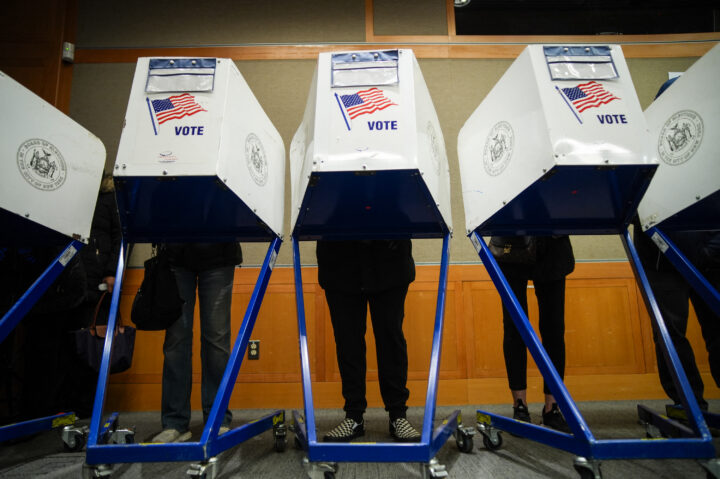
(Ryan MURPHY/AFP via Getty Images)
People cast their ballots on the first day of early voting for the US midterm elections, in New York, on October 24, 2026.


 Add JewishInsider on Google
Jewish voters are increasingly finding themselves in political no man’s land in this midterm election, even as most are still likely to cast their ballots for Democratic candidates. But the party’s increasingly critical approach to Israel and its nomination of far-left democratic socialists in a number of key races have soured many on its commitment to fighting rising antisemitism and protecting the security of the Jewish state.
At the same time, President Donald Trump’s nativist politics and authoritarian impulses make the Republican Party a tough sell for disenchanted Jewish voters.
Jewish voters are paying increasingly close attention to the candidates themselves — and whether those candidates are part of the mainstream or the extremes of their respective parties. And they’re becoming a key swing voting bloc in a number of key races, which we spotlight below.
In some, such as the Michigan and Florida Senate races, we’ll likely see historic levels of Jewish support for a Republican candidate — mainly because Democrats nominated anti-Israel candidates well outside the political mainstream. In others, such as key swing House districts in Florida and Virginia, moderate pro-Israel Democrats are expected to play critical roles in helping their party win back the lower chamber.
Here are the Senate and House races we’re focused on for the midterms — and will be providing reporting and analysis on throughout election night at Jewish Insider.
SENATE RACES:
Michigan: The marquee race for the Jewish community is in Michigan, where Democrat Abdul El-Sayed’s anti-Israel platform, antisemitic allies and response to a terrorist attack at a synagogue have stirred significant concern for members of the Jewish community. Local leaders expect many Jewish Democrats in the state to leave their ballots blank or vote for Republican Mike Rogers, though in an expected strong year for the Democratic Party, that striking show of independence may not be enough to flip the seat. Rep. Haley Stevens’ (D-MI) last-minute endorsement of Rogers is a late-breaking wild card in the race — and strategists caution to take public polling in this race with a grain of salt, especially given how El-Sayed underperformed in the primary compared to the public surveys beforehand.
Georgia: This race pits an up-and-coming Jewish Democrat, Sen. Jon Ossoff (D-GA), who has voted to cut military aid to Israel but has refused to call the country’s actions in Gaza a genocide, against Rep. Mike Collins (R-GA), who has been a nonstarter for many persuadable Jewish voters, given his ties to antisemitic and white nationalist figures — including a son-in-law who briefly worked for his campaign and lives on his property. Ossoff is strongly favored to win.
Texas: Democratic state Rep. James Talarico has frustrated members of Texas’ Jewish community with his criticism of Israel and — for much of the campaign — reluctance to engage with its members. Scandal-plagued Attorney General Ken Paxton, however, has done very little to broaden support beyond his right-wing base and is seen as uniquely vulnerable to ending the GOP’s decades-long winning streak in the state.
Maine: Longtime pro-Israel incumbent Sen. Susan Collins (R-ME), who has used her leadership position as chair of the Senate Appropriations Committee to advocate for continued support for Israel, faces former state Sen. Troy Jackson, who has accused Israel of genocide, using rhetoric similar to that of oyster farmer Graham Platner, who ended his campaign over the summer amid accusations of sexual assault.
Florida: Despite Democrats making significant inroads in the Sunshine State, Sen. Ashley Moody (R-FL) is favored to beat Democratic state Rep. Angie Nixon, a member of the Democratic Socialists of America who scored a shocking upset victory in the Democratic primary. Her far-left platform, especially on Israel, will likely cost her valuable support with the state’s sizable Jewish electorate. Nixon opposes offensive military aid to the Jewish state and has appeared at several fundraising events in Florida hosted by the Council on American-Islamic Relations. She also posted a statement on X two days after Oct. 7 condemning “unjust killings” without blaming Hamas. Nixon deleted the post within hours.
South Carolina: Sen. Darline Graham (R-SC) is trying to follow in her late brother’s footsteps, but her lack of authority and knowledge about foreign policy has only magnified her inexperience as an appointed senator. Rep. Ralph Norman (R-SC), who lost to Graham in what became a competitive contest for the GOP nomination, declined to endorse his primary opponent in the general election and has publicly criticized her candidacy. Polls show the race between Graham and Democrat Annie Andrews, a pediatrician, unusually close in a red state that Trump carried by 18 points in 2024.
HOUSE RACES
New York’s 17th District: In one of the most hotly contested swing districts, Rep. Mike Lawler (R-NY) is reliant on support from his significant Jewish constituency to overcome his district’s Democratic lean. Lawler, one of only three Republicans representing a district that former Vice President Kamala Harris carried in 2024, is facing Democrat Cait Conley, a moderate who has run on a pro-Israel platform.
Florida’s 25th District: Rep. Jared Moskowitz (D-FL) has shown that Jewish voters are plenty comfortable supporting a pro-Israel Democrat who speaks out against rising antisemitism within his own party. Even though Republicans nominated a Jewish challenger, former Boca Raton Mayor Scott Singer, with strong pro-Israel bona fides of his own, that Moskowitz has been willing to speak out against his own party has given him invaluable political capital in the newly drawn GOP-leaning South Florida district.
New Jersey’s 7th District: Rep. Tom Kean Jr. (R-NJ) is especially vulnerable given the district’s swing nature and because of his monthslong absence from the House, when he was undergoing treatment for depression. He faces Democrat Rebecca Bennett, a moderate who has maintained a largely pro-Israel stance on the campaign trail, in a district with a significant Jewish population.
California’s 7th District: There are several significant California races in which a center-left Democrat will face off against a far-left challenger in the general election — and where Republicans could end up emerging as the deciding bloc. In Sacramento, Rep. Doris Matsui (D-CA) is being challenged by far-left Sacramento City Councilmember Mai Vang. Matsui, 82, has leaned into attacks on Vang for campaigning with streamer Hasan Piker, while Vang has argued Matsui is too old to effectively represent the district.
California’s 11th District: The Bay Area district of retiring former House Speaker Nancy Pelosi (D-CA) has become an unexpected battleground over the role of antisemitism and anti-Israel extremism within the Democratic Party. The first-place finisher in the Democratic primary, state Sen.. Scott Wiener, has become the target of antisemitic abuse over his Jewish identity even as he was pressured to declare Israel’s war against Hamas a genocide. Pelosi’s endorsed candidate, San Francisco Supervisor Connie Chan, has been criticized for what critics say is antisemitic rhetoric and has leaned into an aggressively anti-Israel stance.
California’s 34th District: Rep. Jimmy Gomez (D-CA) faces Angela Gonzales-Torres, a far-left candidate who was a member of the anti-Israel encampment at the University of California, Los Angeles, and also campaigned with Piker. Gomez, who has previously fended off far-left challengers, is now facing headwinds as the result of a House Ethics Committee investigation into alleged sexual harassment and assault.
California’s 22nd District: In one of the only swing district races in the state, anti-Israel Democrat Randy Villegas faces moderate Republican Rep. David Valadao (R-CA) — after beating a pro-Israel Democrat in the primary. Valadao is a battle-tested lawmaker who has run well ahead of other California Republicans, and is facing a challenger with far-left associations, including endorsements from anti-Israel groups American Priorities and TrackAIPAC. The race will be a barometer of whether far-left candidates can prevail on purple turf.
Michigan’s 7th District: Rep. Tom Barrett (R-MI), a veteran, faces William Lawrence, a far-left, anti-Israel activist who left the Democratic Socialists of America immediately following his primary win over a divided field of moderates. The race is a major test, alongside the Michigan Senate race, of whether a candidate with well-documented radical views can win in a moderate swing district, which was once held by Sen. Elissa Slotkin (D-MI).
Virginia’s 2nd District: Rep. Jen Kiggans (R-VA) faces a rematch with former Rep. Elaine Luria (D-VA), whom Kiggans ousted in 2022. Luria, who is Jewish, was among the most outspoken pro-Israel Democrats during her time in office and has been backed by Democratic Majority for Israel in the general election. The district is a perennial battleground, splitting its vote between Trump and Harris at 49% in the 2024 presidential election.
North Carolina’s 1st District: Democratic Majority for Israel has spent heavily to help pro-Israel Democrat Rep. Don Davis (D-NC) maintain his seat as he runs against Republican retired Army Col. Laurie Buckhout, despite a GOP redistricting effort that redrew the lines to significantly favor Republicans. The Cook Political Report, given the favorable national environment for Democrats, now rates the seat as a toss-up.
We’ll also be keeping an eye on the performances of a slew of far-left candidates who won primaries in deep-blue districts and are all but guaranteed to win elections. But it will be worth paying attention to whether candidates such as Melat Kiros in Colorado, Adam Hamawy in New Jersey, Chris Rabb in Pennsylvania and Darializa Avila Chevalier in New York are able to maintain the same lopsided margins as their more mainstream predecessors.
We’re also watching several gubernatorial and mayoral races with relevance to the Jewish community. Pennsylvania Gov. Josh Shapiro’s reelection campaign will likely serve as a springboard to his presidential ambitions; a decisive win over Republican Stacy Garrity will be a sign of his electability and the effectiveness of his bipartisan message.
In Florida, Jewish voters will be a pivotal voting bloc in determining whether Democrats have a shot at retaking the governor’s mansion with moderate former GOP Rep. David Jolly as their standard-bearer. Jolly will be facing off against Rep. Byron Donalds (R-FL), a close ally of Trump, who had to deal with racist and antisemitic attacks from a fringe challenger in the primary.
And in Los Angeles, Mayor Karen Bass and left-wing challenger Nithya Raman — both Democrats — are neck-and-neck headed into Election Day. Raman has doubled down on an anti-Israel platform, to the frustration of the Jewish community in Los Angeles — but even that hasn’t been enough for some members of the national Democratic Socialists of America, who wanted her to take a stronger stance in support of the Boycott, Divestment and Sanctions movement.
More Stories

Daily Overtime
Trump’s aid bombshell rattles pro-Israel world

AID AFTERSHOCKS
Jewish groups split over Trump’s announcement ending Israel aid

TWO PATHS DIVERGED
Haley Stevens fiancé says he’s voting for Mike Rogers

wolverine wave
Abdul El-Sayed wins Michigan Senate seat

Daily Overtime
Vance courts Iran as strikes loom

Midterm Maneuver
End of U.S. aid to Israel not surprising, but timing of Trump’s announcement rankles
Please log in if you already have a subscription, or subscribe to access the latest updates.
 Continue with Google

 Continue with Apple