

























































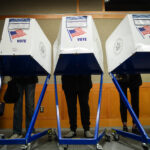

El-Sayed saw significant erosion with Jewish early voters, per Michigan exit poll
The poll, commissioned by The Jewish Majority, found a 21-point gap in Jewish support for Democratic gubernatorial nominee Jocelyn Benson versus El-Sayed
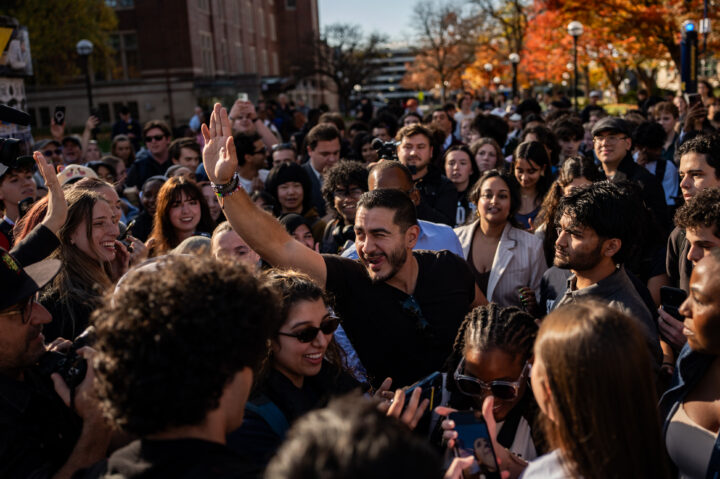
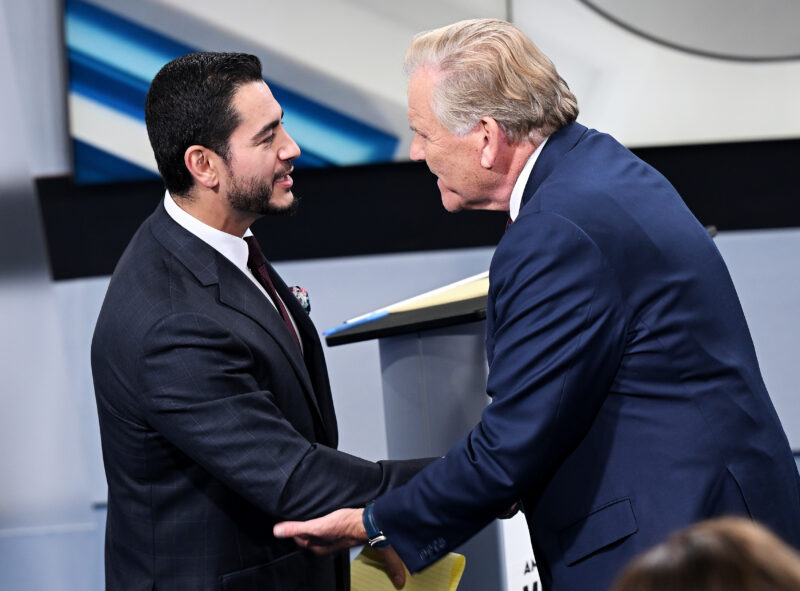
Salwan Georges/Getty Images
Michigan Democratic Senate candidate Dr. Abdul El-Sayed visits a polling precinct on the campus of the University of Michigan on November 3, 2026 in Ann Arbor, Michigan.


 Add JewishInsider on Google
A poll of Jewish voters who voted early in Michigan, conducted in late October, found a significant drop in support for Senate nominee Abdul El-Sayed as compared to other state Democrats.
The poll, commissioned by The Jewish Majority, found that 57% of Michigan Jewish voters who voted early backed El-Sayed, as compared to 78% who backed Democratic gubernatorial nominee Jocelyn Benson — a 21-point gap. Seventy-five percent of voters surveyed identified as Democrats.
A third of Jewish voters who said they supported Sen. Elissa Slotkin (D-MI) in 2024 did not support El-Sayed, and 29% of voters who supported former Vice President Kamala Harris in 2024 said the same. Most of the defectors voted for Republican Mike Rogers.
Rogers received 34% of the Jewish early vote, compared to 19% for Republican gubernatorial nominee John James. Five percent said they left the Senate ballot blank, compared to just 1% who left the gubernatorial ballot blank. The poll came before the Nonnegotiable Michigan campaign recommended a write-in vote for Emma Lazarus for voters uncomfortable with both candidates.
The early vote is typically more heavily Democratic than the Election Day vote, and El-Sayed’s numbers with Jewish voters are likely to decline as pollsters complete their surveys of the Michigan Jewish electorate.
Nearly all of the self-identified Jewish Democrats who did not vote for El-Sayed said they would have likely voted for another Democratic candidate, and 92% cited concerns about antisemitism and El-Sayed’s position on Israel as the reasons that they did not support him. Ninety-two percent of self-identified Jewish Democrats who supported Rogers said that their vote was primarily a vote against El-Sayed.
Nearly two-thirds (65%) of all Jewish Rogers voters said they would have considered supporting a different Democratic nominee.
Ninety percent of split-ticket voters said antisemitism was one of the most important factors in their Senate vote, while 71% said Israel policy was one of their most important considerations.
Among self-identified Democrats who did not support El-Sayed, 92% said they were concerned about his position on Israel, 92% said they were concerned about antisemitism, 87% said they were concerned about his comments following the Temple Israel attack, 84% said they were concerned about his treatment of Michigan’s Jewish community and 74% were concerned about people El-Sayed campaigned with or took support from.
“El-Sayed faces significant challenges and substantially underperforms his Democratic counterparts as well as the Democratic enrollment share of this cohort,” Mercury Public Affairs, which conducted the poll, stated in a memo. “This underperformance is credited with El-Sayed’s positions regarding Israel, concerns about antisemitism, and his comments and actions regarding the Jewish community.”
The poll of 482 Jewish voters who voted early was conducted from Oct. 25 to 31, with a margin of error of 4.9%.
“Nearly every Jewish Democrat who rejected Abdul El-Sayed said they would have voted for a different Democratic nominee. That tells us something important: these voters haven’t given up on the Democratic Party, but they rejected this candidate because they have serious concerns about whether their voices are being heard,” Jonathan Schulman, executive director of The Jewish Majority, said in a statement.
“Jewish voters want to remain part of the big Democratic tent, but they expect their concerns about rising antisemitism, Israel and the treatment of their community to be taken seriously. Many are increasingly anxious about whether there’s still room for them in that coalition. These numbers should be a warning sign for Democratic leaders that their support cannot simply be taken for granted.”
More Stories
SURROGATE ASSURANCE
Mallory McMorrow makes the case for El-Sayed to Jewish voters

FOLLOW THE MONEY
El-Sayed super PAC gets $50K from firm in Armenian mob money-laundering scheme
DEPARTURES
After Israel’s election, expats leave country disappointed by result
CAMPAIGN CURVEBALL
Haley Stevens endorses Mike Rogers: ‘I do not stand with Hasan Piker’
TWO PATHS DIVERGED
Haley Stevens fiancé says he’s voting for Mike Rogers

AID ADJUSTMENT
Trump says he made deal ‘months ago’ with Netanyahu to end aid to Israel by end of year
Please log in if you already have a subscription, or subscribe to access the latest updates.
 Continue with Google

 Continue with Apple